




Abstract
The present study aimed to identify overall stress and salient stressors experienced by adolescents from different education tracks and self-perceived ethnic backgrounds. A total of 1489 adolescents (M = 13.40 years; SD = 0.89 years) from nine Dutch secondary schools participated. Self-reported stressors were measured with the adapted version of the Adolescent Stress Questionnaire – Short. After controlling for age, gender, country of birth, and school classes, results showed that overall stress did not differ for educational track nor for ethnic background subgroups. Adolescents in academic education reported more stress from school-related stressors than adolescents attending vocational education. Adolescents with a mixed ethnic background (i.e., Dutch and another ethnicity) reported more stress regarding school-related stressors than adolescents with a Dutch ethnic background. These differences between adolescents of different educational tracks and ethnic backgrounds have implications for intervention programs targeting specific stressors.
Keywords
Introduction
Adolescence is a period of psychological, emotional, and social changes (Blakemore et al., 2010). As these changes occur, new and salient stressors (i.e., commonly occurring; Núñez-Regueiro & Núñez-Regueiro, 2021) arise, such as conflicts with parents or school pressure, and thereby the number of stressors adolescents may experience increases (Seiffge-Krenke, 2000). A systematic review and content analysis including 18 studies and 1568 adolescents across six nations (Núñez-Regueiro & Núñez-Regueiro, 2021) found that negative stressors most salient to adolescents include their own or other’s welfare (e.g., health issues of themselves or someone close and parental conflicts), interpersonal relationships (e.g., family, friendship, and romantic issues, teased by peers, and problems with teachers), and school and future oriented stressors (e.g., future uncertainty and school pressure). Another salient stressor is social media (Keles et al., 2020; Weinstein & Selman, 2016). If stressors are experienced for a prolonged period of time or in a cumulative manner, stress can become chronic. Chronic stress can threaten adolescents’ well-being (Zimmer-Gembeck & Skinner, 2008) and might, for example, lead to internalizing problems (Compas et al., 2012; Kim et al., 2003) or burnout complaints (Gerber et al., 2015).
Mental health problems mostly manifest during adolescence or young adulthood (Kelly et al., 2007). In order to avoid mental health problems, symptoms should be recognised and treated early (Jorm et al., 1997). From this perspective, we aimed to increase knowledge about experienced overall stress level and individual salient stressors in a large and diverse population of adolescents by targeting schools with different educational tracks and including adolescents from different ethnic backgrounds. To date, studies typically examine either the overall stress level, or different salient stressors. In the current study, we examined the overall stress level as well as salient stressors. No study, to date, examined potential differences in overall stress levels between adolescents from different educational tracks. When it comes to salient school and social stressors, very little research has been conducted to investigate these stressors across ethnic backgrounds. More knowledge about experienced overall stress and salient stressors across these inter-individual groupings is therefore warranted and can guide targeted interventions for adolescents with overall high stress levels and can highlight important stressors to focus on in such interventions.
Overall Stress Level
Several studies have reported inter-individual differences in overall stress level. For example, reported stress levels increase with age during adolescence (e.g., Byrne et al., 2007; Kleinjan et al., 2020). In addition, research consistently shows that girls report higher levels of stress than boys (e.g., Byrne et al., 2007; De Vriendt et al., 2012; Kleinjan et al., 2020). Whereas age and gender differences in stress have been extensively researched, less is known about whether – and to what extent – inter-individual differences in stress levels exist when considering adolescents from other inter-individual groupings, such as educational track and ethnic background. Knowledge about these inter-individual groupings can guide targeted interventions towards certain subgroups. The environmental model (Mcnamara, 2000) describes how stress can be experienced due to a challenging environment, for example a demanding educational track (Suldo et al., 2009). Indeed, adolescents following higher educational tracks experience more pressure at school (Stevens et al., 2017). However, they also experience higher levels of well-being and fewer problems (e.g., psychosomatic complaints, problems with peers, and behavior problems; Stevens et al., 2017). In the current study, we aimed to examine whether adolescents with different educational tracks differ in their experienced overall stress levels.
Since the second world war, three distinct immigrant groups arrived in the Netherlands: immigrants from former colonies, people who were recruited for unskilled jobs, and political refugees and asylum seekers (Zorlu & Hartog, 2001). First, de-colonisation of Indonesia and Surinam led to large immigration flows between 1949 and 1980 (Zorlu & Hartog, 2001). Another postcolonial immigration flow was in the late 1980s by residents of the Antilles (Sharpe, 2005; van Meeteren et al., 2013). Second, around the 1960s, the demand for workers for unskilled jobs increased, which attracted workers from Mediterranean countries like Italy, Spain, Portugal, Turkey, Morocco, and Greece (Zorlu & Hartog, 2001). These workers’ intention was to stay in the Netherlands temporarily, but many have stayed indefinitely (Zorlu & Hartog, 2001). Third, during the second half of the 1980s many political refugees and asylum seekers immigrated from various countries, such as Turkey, Iraq, and Sri Lanka (Zorlu & Hartog, 2001). The Dutch government aims to integrate immigrants into Dutch society as well as to preserve their cultural identity, for example by giving Dutch language lessons, but also multicultural courses (Vedder & Virta, 2005). Nowadays, in the Netherlands, 12% of the population has a migration background, meaning that at least one of their parents was born in another country, with most people coming from Turkey, Morocco, and Surinam (Central Bureau of Statistics, 2023). Due to the diverse composition of the population in the Netherlands and different groups, there is reason to investigate differences in stress across these groups.
Country of birth does not cover all dimensions of ethnicity, such as the country of origin or self-perceived ethnic background (Stronks et al., 2009). Self-perceived ethnic background, which represents the feeling of belonging to a specific ethnic group due to similarities in customs, history, and/or religion (Burchard et al., 2003), may differ from a person’s country of birth (Stronks et al., 2009). Coming in contact with another culture might lead to a change in experienced self-perceived ethnic background (Stronks et al., 2009). Based on the acculturation theory, which reflects the preservation of one’s heritage culture and adaptation to the host society, the process of integration into another culture is thought to be accompanied by acculturative stress (Sam & Berry, 2006). Acculturative stress refers to psychological adjustments when integrating into another culture, which can be manifested in anxiety and depression (Hameed et al., 2018). A Dutch study including 6718 participants between 11 and 16 years and with 22% of participants having a migration background found that acculturative stress can also be experienced by adolescents who did not undergo the migration process themselves but who experience it through their parents (Stevens et al., 2017). The differences in values, norms, and habits between the culture of the country of origin and the culture of the country they live in can be large, which can potentially lead to more conflicts at home, prejudices, and discrimination (Stevens et al., 2017). Hence, bridging two cultures (i.e., mixed ethnicity) might result in higher experienced stress levels than separation (i.e., non-Dutch) or assimilation (i.e., Dutch) with the dominant culture.
Moreover, some adolescents experience a conflict in deciding with which ethnicity they feel most connected. This is found to be associated with emotional distress and psychopathological symptoms (Rahim et al., 2021). In contrast, a meta-analysis by Nguyen and Benet-Martinez (2013), including 83 studies with many different ethnicities found that a mixed ethnicity was positively related to psychological and sociocultural-related adjustment rather than a single ethnicity. Another study examined the general stress levels of 705 adolescents across various ethnic backgrounds (i.e., Dutch, non-Dutch, and mixed) and asked them to fill out a self-report questionnaire (Vollebergh & Huiberts, 1997). The authors did not find differences in the overall stress levels between the ethnic background groups.
As contradictory findings were reported in the literature, no firm conclusions can be drawn regarding stress levels across ethnic background groups. Given these discrepancies, in the current study we aimed to comprehensively examine how much stress adolescents experience based upon their self-perceived ethnic background. Therefore, we divided adolescents into three ethnic background groups: (a) Dutch, (b) mixed (e.g., Moroccan-Dutch, Turkish-Dutch), and (c) non-Dutch (e.g., Moroccan, Moroccan-Turkish).
Experienced Salient Stressors
Several studies have reported inter-individual differences for salient stressors. For example, reported stress levels regarding home life, school performance, financial pressure, and future uncertainty increase during adolescence (Byrne et al., 2007). In addition, research consistently shows that girls report higher levels of stress than boys about home life, school performance, peer pressure, future uncertainty, and school/leisure conflict (Byrne et al., 2007; De Vriendt et al., 2012). Available research has shown that salient stressors experienced by adolescents differ according to educational track. In the Dutch secondary education system, adolescents are streamed after primary school, on average at 12 years of age, into separate tracks: practical education, pre-vocational education, senior general education, and pre-university education (Driessen & van Langen, 2013). Both practical and pre-vocational education lasts for four years (Maslowski & van der Werf, 2017). While practical education prepares adolescents for direct entry to the labor market (Maslowski & van der Werf, 2017), pre-vocational education gives access to senior vocational education (Jeliazkova & Westerheijden, 2004). Senior general education lasts five years, which gives access to higher professional education and pre-university education lasts six years and gives access to a university education (Driessen & van Langen, 2013; Jeliazkova & Westerheijden, 2004). Stevens et al. (2017) found that adolescents who follow academic education (i.e., senior general/preuniversity education) experienced more pressure to succeed in school than adolescents attending prevocational education. Another Dutch study with over 8000 adolescents between 11 and 16 years found that the higher the educational track, the more adolescents experienced stress from school or an accumulation of stressors (e.g., school, homework, social media, work, and sports; Kleinjan et al., 2020). A study performed in the United States with 319 participants found that adolescents in an International Baccalaureate Diploma Program (IB), which is comparable to preuniversity education (Wilkinson & Hayden, 2010), rated academic matters as a main stressor, whereas adolescents in general education reported higher levels of stress associated with a variety of stressors (e.g., family, peers, and academic struggles; Suldo et al., 2009). Thus, existing research in the Netherlands and the United States indicates that adolescents who follow academic educational tracks (i.e., senior general and preuniversity education adolescents, and IB students) experience more school pressure and stress from an accumulation of stressors, whereas adolescents who follow vocational educational tracks (i.e., prevocational and general education adolescents) experience a variety of stressors. However, previous literature examined only a couple of stressors within one study. Asking adolescents about a large variety of stressor domains - including social media, future uncertainty, and health - might help to understand which stressors are experienced by adolescents in certain educational tracks. With regard to ethnic background, very little research has been conducted to investigate salient school and social stressors across ethnic backgrounds.
When studying potential differences in stress levels for educational track and ethnic background subgroups, it might be crucial to account for the relation between these two groupings. In the Netherlands, ethnic minorities are often underrepresented in the academic schooling tracks, while they are overrepresented in the vocational schooling tracks (Central Bureau of Statistics, 2020). This pattern is also found in other countries across Western Europe (Heath et al., 2008). Hence, it is important to investigate whether the specific relationship between educational track and stress level is influenced by ethnic background, and vice versa. It is important to note that adolescents from minority groupings in the Netherlands are often under-recommended to higher educational tracks (Weiner, 2016), and are therefore more disadvantaged when entering the labour market (Crul, 2018). Moreover, a study found that applicants with a Dutch surname were invited almost twice as often for an interview than those with a Moroccan name (Andriessen et al., 2015).
The Present Study
In sum, there are significant gaps in the literature in terms of knowledge regarding I) overall stress level in adolescents from different educational tracks and ethnic background, and II) experienced salient stressors in adolescents from these different subgroups. Hence, the current study aims to fill this gap by investigating overall stress levels and salient stressors faced by young adolescents following different educational tracks and from various ethnic backgrounds. To this end, we recruited a large sample of Dutch adolescents from different educational tracks and ethnic backgrounds, and collected self-report data about a wide range of salient stressors. This study is the first to investigate overall stress and stress levels for 11 different salient stressors with the adapted version of the Adolescent Stress Questionnaire – Short in a diverse sample of young adolescents. Greater understanding of which stressors are most common during early adolescence could contribute to the development of targeted interventions aimed toward specific salient stressors and specific adolescent subgroups.
Three research questions were formulated: (a) what kind of stressors do adolescents generally experience and to what extent?, (b) are there differences in the extent of overall stress between adolescents of different educational tracks and ethnic backgrounds?, and (c) are there differences in salient stressors between adolescents of different educational tracks and ethnic backgrounds? We expected that (a) adolescents report the highest levels of stress regarding their own or other’s welfare, interpersonal relationships, and school or future oriented stressors (Núñez-Regueiro & Núñez-Regueiro, 2021). Due to limited information about adolescents’ overall stress from different educational tracks, no hypothesis was formulated for the second research question. Moreover, we expected that (c) based on the environmental model (Mcnamara, 2000), adolescents from an academic track experience more school related stressors than adolescents following a vocational track. As contradictory findings were reported in the literature regarding ethnic background, no additional hypotheses were formulated for the second and third research questions. Studies have shown that older adolescents and girls report higher levels of stress than younger adolescents and boys (Byrne et al., 2007; De Vriendt et al., 2012; Kleinjan et al., 2020) and the migration process is thought to be accompanied by acculturative stress (Hameed et al., 2018). Moreover, stress levels may differ between school classes (Torsheim & Wold, 2001). Therefore, we controlled for age, gender, country of birth, and school classes in all analyses.
Methods
Participants
In total 1489 predominantly young adolescents participated in the study, with an age range between 11 and 16 years (M = 13.40 years; SD = 0.89 years; 49% male). More specifically, 2% of the sample was 11 years old, 36% was 12 years old, 38% was 13 years old, 20% was 14 years old, 4% was 15 years old, and 1% was 16 years old. The participants were in the first (n = 859; 58%), second (n = 413; 28%), or third year (n = 217; 15%) of nine secondary schools (equivalent to USA 7th, 8th, and 9th grade) located in one of the four largest cities of the Netherlands. The schools offered education at six tracks (practical education, prevocational education, prevocational/senior general education, senior general education, senior general/preuniversity education, and preuniversity education). As the groups of practical education and prevocational/senior general education were too small, we merged the groups with the prevocational education group (hereafter referred to as vocational education). Further, adolescents who followed senior general secondary education and preuniversity education were grouped together, as most of these adolescents follow classes from a combination of both educational tracks (hereafter referred to as academic education).
We targeted schools with the explicit purpose of obtaining a diverse sample in terms of educational track and ethnic background. We approached approximately twenty schools to participate in the study via a national network of different schools. After the school leaders gave permission for their school’s participation, they were asked which of the early year groups wanted to participate. From the participating schools, every class within the year group participated in the study. Parents and adolescents were approached via letters and information folders. A total of 2880 adolescents and their parents were approached to participate, of whom 1643 adolescents and parents agreed to participate. Parental and adolescent informed consent was required before an adolescent was allowed to participate in the study. The distribution of the participating adolescents across school year and educational track is comparable to the distribution of adolescents who did not participate in the study.
In total 154 participants did not fill out the questionnaire because they were not in class at the moment of data collection. Eleven of the remaining 1489 participants (0.7%) did not complete the adapted ASQ-S. Nine of these adolescents did also not report their ethnic background and two did also not report their gender and date of birth. Additionally, 23 participants did not report their ethnic background and 19 participants did not report their date of birth. Participants with missing data were included for analyses whenever the variables used for analyses were not missing. The design of this study has been approved by the university’s Psychology ethical committee (CEP18-0911/336).
Procedure
The questionnaires were filled out on a computer using Qualtrics in the classrooms with two researchers present. The participants were given 45 minutes to complete the questionnaire during class. The participants were all working at their own desk and, hence, sufficient privacy was guaranteed. The data collected were part of a larger project, including a pre-test and post-test measurement. In the current study, only the pre-test measurement was used for analyses. In the larger project, data on knowledge about stress and intrapersonal variables, such as test anxiety and social phobia were collected (Vogelaar et al., 2023a, 2023b).
Materials
Self-perceived Ethnic Background
Self-perceived ethnic background refers to the feeling of belonging to a specific ethnic group due to similarities in customs, history, and/or religion (Burchard et al., 2003). In the present study, self-perceived ethnic background was operationalized by asking participants “with which cultural background do you feel most connected?“. Adolescents were given the answer options: Dutch, Turkish/Dutch, Antillean/Dutch, Moroccan/Dutch, or Surinam/Dutch. If not applicable, adolescents were provided with an open field to write down their own ethnic background. To address the main research questions, three groups were created: (a) Dutch, (b) non-Dutch (e.g., Moroccan, Moroccan-Turkish), and (c) mixed (e.g., Moroccan-Dutch, Turkish-Dutch).
Stressors
The Dutch version of the ASQ-S (Anniko et al., 2018) was used to measure experienced stressors and overall stress levels in the lives of adolescents. The ASQ-S contains 27 items, divided across nine different subscales. The subscales are home life (e.g., arguments at home), school performance (e.g., having to study things you do not understand), school attendance (e.g., going to school), romantic relationships (e.g., making the relationship with your boy/girlfriend work), peer pressure (e.g., peers hassling you about the way you look), teacher interaction (e.g., not being listened to by teachers), future uncertainty (e.g., concerns about your future), school/leisure conflict (e.g., having too much homework), and financial pressure (e.g., not enough money to buy the things you need). The ASQ-S is a reliable tool and is measurement invariant across gender, educational track, and ethnic background groups (Anniko et al., 2018; McKay et al., 2019; Vogelaar et al., 2023). Moreover, the ASQ-S has one second-order factor that underlies the nine subscales (Vogelaar et al., 2023). The subscale scores are derived by computing the mean score for the corresponding items of each scale. The total stress score is derived by computing the mean score for the 27 items. For each item, participants were asked ‘How stressful do you find’ (e.g., ‘Concerns about your future’) during the past month. As health (Kleinjan et al., 2020; Núñez-Regueiro & Núñez-Regueiro, 2021; Pedersen & Revenson, 2005) and social media stressors (Keles et al., 2020; Weinstein & Selman, 2016) have shown to be relevant stressors for adolescents, two additional stressor subscales were developed: (a) two questions about health (i.e., ‘Your health’ and ‘Health of a family member’); and (b) two questions about social media (i.e., ‘WhatsApp’, ‘Other social media’). Cronbach’s alphas of the stressor subscales ranged from .65 to .85, while the Spearman-Brown coefficients of the stressors ranged from .57 to .85. Those results indicated an acceptable internal reliability (Taber, 2018; van Griethuijsen et al., 2015). All questions had a 5-point Likert scale, ranging from not very stressful to very stressful (1–5); the answer options ‘do not apply’ or ‘is irrelevant to me’ are coded as 1, consistent with Anniko and colleagues (2018). Cronbach’s alpha across all 27 items was .92.
Data Analyses
The analyses were performed in IBM SPSS statistics 26. First, bivariate Pearson’s correlations between the subscales were examined to indicate whether the additional stressors correlated with the subscales of the original ASQ-S. To answer research question I, the descriptive statistics of each stressor subscale were computed for the full sample and for educational track and ethnic background groups separately. We identified the rank-ordering of the stressors to be able to indicate the most and least experienced stressors by adolescents by investigating which stressors differed significantly with 95% confidence intervals. This rank-ordering was conducted for the total sample and for the educational track and ethnic background groups. Research question II was tested with a one-way analysis of covariance (ANCOVA) with the total stressor score as dependent variable, and educational track and ethnic background as independent fixed effects. Both interaction and main effects of educational track and ethnic background for overall stress levels were examined. Research question III was tested with a Multivariate Analysis of Covariance (MANCOVA) with educational track and ethnic background as fixed effects and the eleven stressors as dependent variables. Main and interaction effects of educational track (categorical) and ethnic background (categorical) by stressor were examined. Academic education and Dutch ethnic background were added as reference categories in the analyses.The Bonferroni-Holm correction (Holm, 1979) was used to interpret the results of the MANCOVA. Age (continuous), gender, country of birth, and school classes were included as covariates in analyses. Small effect sizes were considered η2 = 0.01, medium effect sizes η2 = 0.06, and large effect sizes η2= 0.14.
Results
Preliminary Analyses
Distribution of adolescents by educational track and self-perceived ethnic background.
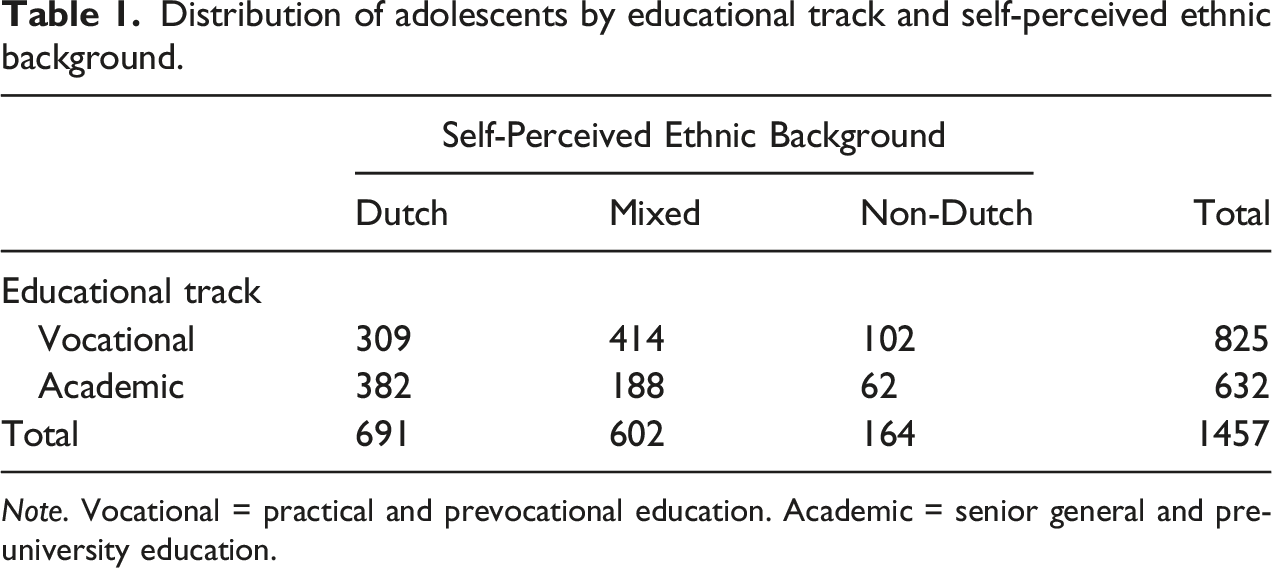
Note. Vocational = practical and prevocational education. Academic = senior general and preuniversity education.
Pearson correlations between the stressor subscales are displayed in Table B in the appendix. All subscales correlated significantly, ranging from .20 to .65. All correlation coefficients were small to medium-sized. This indicates that there is no multicollinearity present.
Rank-Ordering of the Stressors
Means (95% CI and standard deviations), main univariate F values for educational track and self-perceived ethnic background (controlled for age, gender, country of birth and school classes).
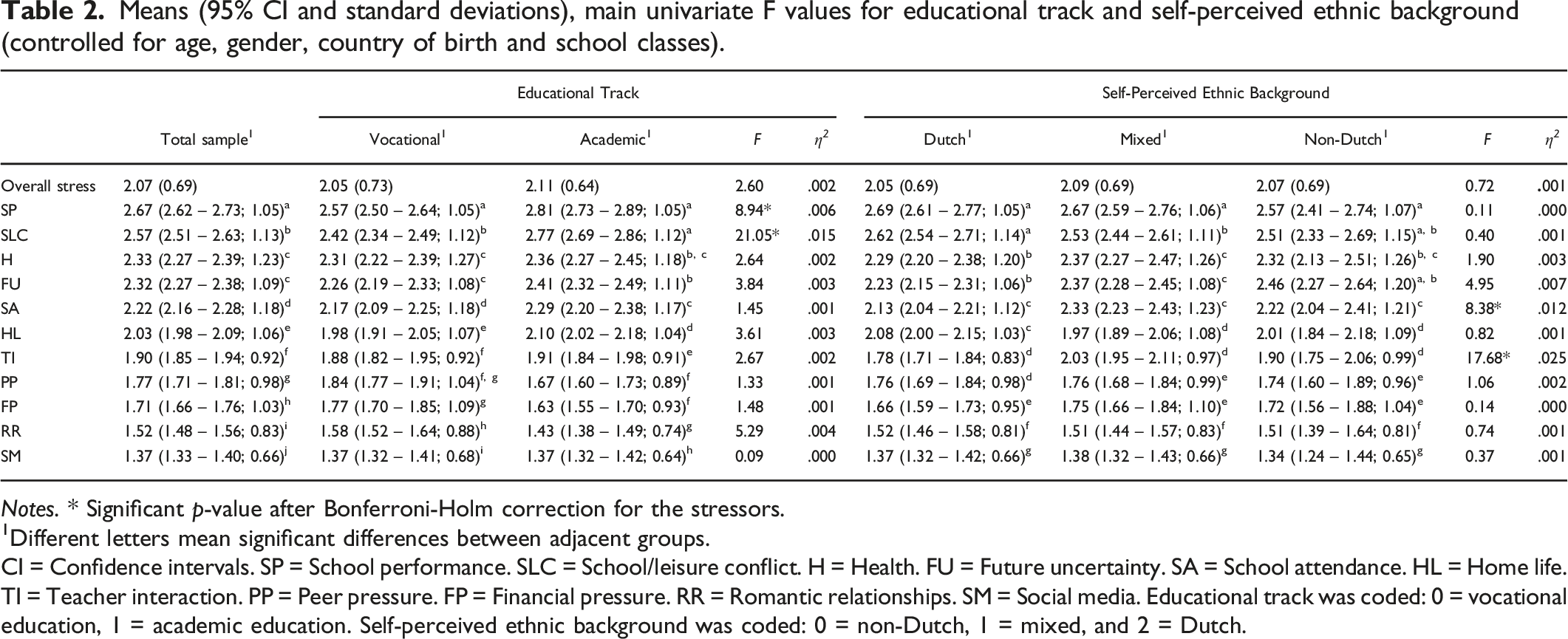
Notes. * Significant p-value after Bonferroni-Holm correction for the stressors.
1Different letters mean significant differences between adjacent groups.
CI = Confidence intervals. SP = School performance. SLC = School/leisure conflict. H = Health. FU = Future uncertainty. SA = School attendance. HL = Home life. TI = Teacher interaction. PP = Peer pressure. FP = Financial pressure. RR = Romantic relationships. SM = Social media. Educational track was coded: 0 = vocational education, 1 = academic education. Self-perceived ethnic background was coded: 0 = non-Dutch, 1 = mixed, and 2 = Dutch.
Educational Track
Participants who followed vocational education and academic education showed the same overall rank-ordering of stressors, except for the stressors’ health and future uncertainty for participants who follow academic education (i.e., the stressors health and future uncertainty interchanged their adjacent positions). The mean stress levels of health and future uncertainty did not differ significantly from each other.
Self-Perceived Ethnic Background
The participants with a Dutch, mixed, and non-Dutch background showed the same overall rank-ordering of stressors, with one exception for participants with a non-Dutch background (i.e., the stressors health and future uncertainty interchanged their adjacent positions) and one exception for participants with a mixed ethnicity (i.e., the stressors teacher interaction and home life interchanged their adjacent positions). However, the mean stress levels did not significantly differ from each other for health and future uncertainty and for teacher interaction and home life within ethnic background groups.
Overall Stress Levels by Educational Track and Ethnic Background
The one-way ANCOVA showed that the overall stress levels were not significantly different for educational tracks, nor the ethnic background groups. Further, the results showed a non-significant interaction effect (F (2, 1430) = 0.07, p = .94, η 2 = .000) between educational tracks and ethnic background for overall stress level, indicating that educational track and ethnic background exert independent effects on overall stress level. The covariate gender was statistically significant (F (1, 1430) = 18.73, p < .001, η 2 = .013), indicating a small effect. The results demonstrated that girls reported more stress than boys. The covariates age, country of birth and school class were not statistically significant, indicating that no differences in overall stress was found between age, country of birth, and classes.
Stressor Experience by Educational Track And Ethnic Background
The MANCOVA violated the assumption of no multivariate outliers. Therefore, 33 outliers were removed from further analyses. Furthermore, the assumption of normality and homogeneity of covariance were also violated. Therefore, the Pillai’s Trace test was used (Olson, 1974). In addition, Levene’s Test revealed significant differences in the error variances across groups, which indicates that homogeneity of variance between groups was violated. However, Bray and Maxwell (1985) found that a MANCOVA is robust when this assumption is violated if a large sample is used.
A statistically significant multivariate main effect of educational track (V = 0.03, F (11, 1387) = 4.37, p < .001, η 2 = .033) and ethnic background (V = 0.07, F (22, 2776) = 4.45, p < .001, η 2 = .034) was found, both considered a small to medium effect. This indicates that the individual stressors were experienced to different degrees by adolescents in different educational tracks and ethnic backgrounds. The multivariate interaction effect between educational tracks and ethnic background was non-significant, indicating that educational track and ethnic background have independent effects on individual stressors. The covariates age (V = 0.06, F (11, 1387) = 7.89, p < .001, η 2 = .059), gender (V = 0.09, F (11, 1387) = 12.78, p < .001, η 2 = .092), and country of birth (V = 0.03, F (11, 1387) = 4.12, p < .001, η 2 = .032) were statistically significant. This shows that across the stressors, girls reported more stress than boys and stress levels increased with age. Moreover, across the stressors, adolescents who were born in the Netherlands reported higher stress levels than adolescents who were not born in the Netherlands. The covariate class was not statistically significant, indicating that no differences in stressors were found between classes.
The results per stressor showed significant inter-individual differences between educational tracks for two stressors: school performance (F (1, 1397) = 8.94, p = .003, η 2 = .006) and school/leisure conflict (F (1, 1397) = 21.05, p < .001, η 2 = .015). The participants who follow academic education reported higher stress levels about school performance and school/leisure conflict than participants following vocational education. Regarding ethnic background, the results per stressor showed significant group inter-individual differences for two stressors: school attendance (F (2, 1397) = 8.38, p < .001, η 2 = .012) and teacher interaction (F (2, 1397) = 17.68, p < .001, η 2 = .025). Participants with a mixed ethnic background participants reported higher stress levels about school attendance and teacher interaction than participants with a Dutch ethnic background.
Discussion
The aim of this study was to fill several gaps in our knowledge of overall stress and stress experienced from different salient stressors in early adolescents. We investigated this in a large sample of young adolescents with a total of 85 ethnic backgrounds and from different educational tracks. Overall, adolescents reported relatively high stress from school performance, school/leisure conflict, health, and future uncertainty compared to the other stressors, while reporting relatively low stress from social media, romantic relationships, financial pressure, and peer pressure. Our results also showed that the overall stress levels did not differ for either educational track subgroups, nor for ethnic background subgroups. Nevertheless, we did find inter-individual differences for individual salient stressors. Adolescents following academic education reported higher stress levels about school performance and school/leisure conflict than adolescents in vocational education. Moreover, adolescents with a mixed ethnic background reported higher stress levels about school attendance and teacher interaction than adolescents with a Dutch ethnic background. Educational track and ethnic background exerted independent effects on salient stressors.
Relatively high stress about school, health, and future uncertainty was also reported by Núñez-Regueiro and Núñez-Regueiro (2021). Our findings and those of Núñez-Regueiro and Núñez-Regueiro (2021) suggest that school, health, and future uncertainty-related stressors are a non-negligible source of adolescent stress. Regarding health, it is important to note that the data collection was completed prior to the worldwide COVID-19 pandemic, indicating that adolescents felt stressed about health before the pandemic. Kleinjan et al. (2020) explained that having a good health protects against, among other things, school pressure and emotional problems. Therefore, adolescent health concerns should be taken into account in school-based stress management campaigns.
In line with an earlier study, social media was rated as least stressful (Kleinjan et al., 2020). Nevertheless, a systematic review by Keles et al. (2020) found that social media use was related to psychological distress in adolescents between 13 and 18 years. Our finding might be explained because adolescents mostly see the positive aspects of social media (e.g., it is a way to stay connected to others and to exchange important information; Siddiqui & Singh, 2016). The other stressors perceived as least stressful by adolescents were romantic relationships, financial pressure, and peer pressure, which is in line with the findings of De Vriendt et al. (2012). As the participants in our study and in the study of De Vriendt et al. (2012) were young adolescents, they might experience less stress from romantic relationships and financial pressure. In addition, the rank-ordering of the stressors was remarkably similar across educational track and ethnic background subgroups, indicating the potential for universal school-based interventions for a diverse group of adolescents in terms of educational track and ethnic background.
No differences in overall stress levels were found for educational track and for ethnic identity subgroups. Vollebergh and Huiberts (1997) found the same outcome for overall stress levels across ethnic identity groups. By contrast, the meta-analysis of Nguyen and Benet-Martinez (2013) found that mixed ethnicity was an advantage in terms of adjustment compared to a single ethnicity. Yet, adjustment does not necessarily mean that an individual experiences less stress. Stress can also be experienced as functional instead of only negative (Dhabhar, 2009). For example, the experienced academic stressors can also be beneficial for academic achievement, because it makes adolescents more alert and motivated (Kumari & Gartia, 2012). However, experiencing chronic stress should be prevented. Moreover, based on the acculturation theory, we would have expected a higher stress level for adolescents who perceived themselves as mixed or non-Dutch. Possibly, we did not find differences as the adapted ASQ-S did not include questions regarding acculturation stressors. The current study is the first to report overall stress levels for educational track groups. In contrast to the findings for overall mean stress levels, we did find inter-individual differences for individual salient stressors. Academic educational track was associated with higher stress levels about school performance and school/leisure conflict. This is in line with the environmental model (Mcnamara, 2000), which describes that more stress can be experienced due to more demanding educational tracks (Suldo et al., 2009). Mixed ethnic background adolescents reported higher stress levels about school-related stressors than adolescents who perceive themselves as Dutch. Although we observed that more mixed and non-Dutch background participants followed vocational education and more Dutch background participants followed academic education, these inter-individual groupings exerted their own, independent, effect on stress levels. This pattern of results indicates that the specific relationship between educational track and individual stressors is likely not an artefact of ethnic background, nor vice versa.
In line with our findings, an association between educational track and stress about school performance was also reported by Stevens et al. (2017). In addition, we observed an effect of the academic educational track for school/leisure conflict. This finding might be explained because adolescents who follow academic educational tracks reported higher levels of stress about an accumulation of stressors (e.g., school, social media, sports; Kleinjan et al., 2020). Experiencing all these different types of stressors might eventually lead to heightened stress levels due to experiencing a lack of leisure time. We did not replicate the observation by Suldo et al. (2009) that adolescents who follow practical education experience higher levels of interpersonal stressors than adolescents who follow academic education. However, it should be noted that Suldo et al. (2009) compared IB adolescents to general education adolescents. Even though IB is comparable to academic education, IB adolescents have to participate in extracurricular activities and communities, as a requirement to continue with the IB Program. In the Netherlands, adolescents who follow academic education do not have to meet similar prerequisites. For this reason, it could be that IB adolescents mostly focus on academic stressors and experience fewer interpersonal stressors than adolescents who follow academic education.
Mixed adolescents reported higher stress levels about school attendance and teacher interaction than Dutch adolescents. This finding could be explained by acculturation theory. Carter (2005) explains that the need to fit in could provide additional school stress for adolescents who are trying to belong to their ethnic group, while also adapting to the culture of their school. For adolescents with a mixed ethnic background, the conflicting expectations from their home and school might lead to heightened stress levels about teacher interaction and school attendance. Another explanation for the findings related to stress involving teacher interactions could be the experienced discrimination from teachers. Weiner (2016) found while examining classroom practices in the Netherlands that minority students were more often disproportionately disciplined and silenced compared to the majority students.
Limitations and Future Research
This study has some limitations. First, our results are based on self-report data. A multi-informant (e.g., parents, teachers, and adolescents) and multimethod approach (e.g., physiological indicators of stress and semi-structured interviews) would have added to the methodological rigor. Future research should aim to use multiple informants and methods. Second, the questionnaire was completed in a (computer) classroom. Adolescents might be prone to give more socially desirable answers in this context. Nevertheless, adolescents were working at their own desk and sufficient privacy was guaranteed. Moreover, as we aimed to examine differences in experienced stress based on ethnic background, this study does not allow for conclusions on differences between non-Dutch groups. A future study should recruit specifically large groups of certain minority groups to make sure that conclusions can be drawn for different non-Dutch groups. Furthermore, we did not collect contextual variables (e.g., potential conflicting expectations from home and school, experienced discrimination) from our sample. Future research should add more contextual variables to better understand why adolescents with a mixed ethnic background experience more stress from teacher interactions than other groupings in order to guide targeted interventions. Lastly, the items about social media were quite general and could have been interpreted differently by the adolescents. These items should therefore be formulated more specifically, for example about receiving mean messages or feeling smothered by the amount of contact (Weinstein & Selman, 2016). Stress about discrimination (e.g., Szalacha et al., 2003; Viruell-Fuentes, 2007), immigrant status (Gonzales et al., 2013), and acculturation (Sam & Berry, 2006) were not included in the study, even though these stressors could be highly salient for adolescents with a non-Dutch or mixed background. Future research should incorporate these kinds of stressors.
Implications
The current study indicates that academic, health, and future uncertainty stressors stand out from the adapted ASQ-S stressors as the most stressful for young adolescents. This finding is found in general and across all educational tracks and ethnic backgrounds. It is therefore very important that school communities are aware of this outcome and that they are involved in reducing these stress levels in adolescents that need help coping with their stressors. One way to reduce stress levels is by incorporating school-based stress management programs in the curriculum. By doing this, adolescents develop strategies to prevent and decrease stress levels (van Loon et al., 2020). Moreover, stress management programs can strengthen adolescents’ resilience and help them to cope with stressful situations (Kleinjan et al., 2020). Another way is to change the school environment for adolescents (e.g., spreading exams over the year or reducing the amount of homework). Further, it is important for teachers and parents to be aware of the signs of heightened stress levels and to help accordingly, especially because adolescents are often not aware of how to recognize stress. Incorporating a universal psychoeducation course about stress might help adolescents to become more aware of how to recognize stress in their bodies.
Moreover, based on the results, we know that adolescents with a mixed ethnic background experience more stress about interactions with the teacher and school attendance than Dutch adolescents. It is important that teachers are trained to be culture responsive during their teacher education to ensure a better interaction with adolescents from different cultures in the classroom (Theeuwes et al., 2019; Thijs et al., 2012), especially in schools with adolescents from different backgrounds.
In conclusion, young adolescents from different educational tracks and ethnic backgrounds showed similar stress profiles, with academic, health, and future uncertainty stressors as the most pressing source of stress. Adolescents in academic education reported higher stress levels about school related stressors than adolescents attending vocational education. Adolescents with a mixed ethnic background reported higher stress levels regarding school related stressors than adolescents with a Dutch ethnic background. School-based stress management programs should take the observed differences in salient stressors into account.
Supplemental Material
Supplemental Material - Self-Reported Stressors in Early Adolescence: The Role of Educational Track and Ethnic Background
Supplemental Material for Self-Reported Stressors in Early Adolescence: The Role of Educational Track and Ethnic Background by Simone Vogelaar, Anne C. Miers, Nadira Saab, Amanda W. G. van Loon, Hanneke E. Creemers, Jessica J. Asscher, and P. Michiel Westenberg in The Journal of Early Adolescence
Footnotes
Declaration of Conflicting Interests
The author(s) declared no potential conflicts of interest with respect to the research, authorship, and/or publication of this article.
Funding
The author(s) disclosed receipt of the following financial support for the research, authorship, and/or publication of this article: Nederlandse Organisatie voor Wetenschappelijk Onderzoek; 400.17.601.

Supplemental Material
Supplemental material for this article is available online.
Author Biographies
References
Supplementary Material
Please find the following supplemental material available below.
For Open Access articles published under a Creative Commons License, all supplemental material carries the same license as the article it is associated with.
For non-Open Access articles published, all supplemental material carries a non-exclusive license, and permission requests for re-use of supplemental material or any part of supplemental material shall be sent directly to the copyright owner as specified in the copyright notice associated with the article.
