




Abstract
Although adolescence is characterized by increasing individuation, parental support represents an important resource especially in early adolescence. This multi-informant study examined the role of parental self-efficacy in providing emotional and instrumental support when early adolescents partially learned from home during the COVID-19 pandemic. Based on a resources model of coping, we examined effects of parental self-efficacy on early adolescents' reports of self-regulated learning (SRL), learning self-efficacy, and positive emotions, mediated via early adolescents’ problem-focused and emotion-focused coping. Assumptions were tested among 263 Austrian parent-child dyads. While the mediation assumption was rejected, we identified positive associations between emotional support and SRL, and between problem-focused coping and SRL, learning self-efficacy, and positive emotions. Instrumental support negatively related to SRL, suggesting benefits of emotional over instrumental support.
Introduction
The COVID-19 pandemic and its associated constraints have had a significant impact on psychological well-being across societies worldwide. A particularly vulnerable group are young people who are in a particularly decisive stage of their lives with regard to their personal and educational development (Fegert et al., 2020). While long-term consequences of the pandemic in terms of adolescents’ mental health and future prospects are not yet foreseeable (Orben et al., 2020; Wade et al., 2020), studies indicate that coping with pandemic-related challenges, and learning under COVID-19 conditions has varied among youth (e.g., Salmela-Aro et al., 2021). To explain these interindividual differences, previous research has primarily examined adolescents’ individual characteristics, including indicators of their socioeconomic resources, and characteristics of the distance learning setting (e.g., Engel de Abreu et al., 2021; Holzer, Korlat et al., 2021; Pelikan et al., 2021). However, as schools closed, and learning shifted from the classroom to the home, parents' influence on adolescents' well-being and learning has increasingly gained relevance (Bormann et al., 2021; Knopik et al., 2021; Tang et al., 2021). This is especially true for early adolescents, in whose lives parents play an even greater role compared to later stages of adolescence (De Goede et al., 2009; Rubin et al., 2008).
In view of the pandemic, caregivers were required to offer their children both emotional and academic support in coping with the novel situation. However, the role of parental support for adolescent well-being, and, particularly, learning in times of COVID-19 has been investigated less extensively. The present study focuses on parental self-efficacy with respect to the provision of emotional and instrumental (i.e., academic) support. Parent-child dyads are examined to explore how parental self-efficacy regarding these two aspects of parental support relate to early adolescents’ self-regulated learning (SRL), learning self-efficacy, and positive emotions, directly as well as indirectly via early adolescents’ coping styles.
Parental Self-Efficacy
Self-efficacy refers to an individual’s beliefs to exercise control over challenging demands, reflecting confidence in their own abilities. The level of self-efficacy informs how a person is most likely to behave, i.e., whether they tackle a task or not, how much effort they put into it, and how long they persevere when facing obstacles and negative experiences (Bandura, 1997). Self-efficacy is commonly understood as domain-specific, that is, beliefs vary depending on the domain of functioning (Anderman & Gray, 2015). Accordingly, parental self-efficacy is defined as parents’ belief in their ability to influence the child and their environment to foster development and success (Ardelt & Eccles, 2001). In general, parents with strong self-referent estimations of parental competence also engage in positive parenting behaviors (Coleman & Karraker, 2000). Numerous empirical studies have accounted for the decisive role of parental self-efficacy for child functioning and adjustment (for a review, see Jones & Prinz, 2005). In this context, the term parental self-efficacy functions as an umbrella term that may encompass various aspects of parental role- and task-fulfillment, differing from study to study (for an overview, see Wittkowski et al., 2017). Moreover, parental self-efficacy may refer to the more generalized domain of parenting, or specialized tasks within this domain. The present study adopts the latter, focusing on parental self-efficacy regarding the provision of parental support.
Parental Support
At different stages of child development, different aspects of parenting are particularly relevant (e.g., Glatz & Buchanan, 2015). In adolescence, youths’ individuation, and high levels of conflict with parents as adolescents negotiate their autonomy are particularly salient (De Goede et al., 2009; Havighurst, 1976). Overall, however, the parent-youth relationship remains a relevant resource for psychological well-being throughout adolescence (Armsden & Greenberg, 1987; Hair et al., 2008; Rothrauff et al., 2009; Steinberg, 2001), with particular relevance in early adolescence (De Goede et al., 2009; Rubin et al., 2008). Besides parenting practices such as awareness, monitoring, strictness, and family routines, the parent-youth relationship is strongly shaped by parental support (Hair et al., 2008). Parental support is conceptualized as a multifaceted care resource that may include emotional (e.g., showing empathy), instrumental (e.g., offering help), informative (e.g., provision of helpful information) and appraisal support (e.g., providing feedback) (Kerres Malecki & Kilpatrick Demary, 2002; Pierce et al., 1996; Tian et al., 2018). As for educational and career-related parental support, literature mostly distinguishes between task-related instrumental and individual-related emotional support. Given the present study’s focus on the pandemic-induced learning situation, we will focus on these two aspects of parental support in the following.
Whereas emotional support is theorized to promote adolescents’ emotional well-being and coping with stressful events, instrumental support is theorized to directly facilitate youth’s academic outcomes (Li et al., 2020; Turner et al., 2003). However, empirical studies show beneficial effects of various aspects of parental support for adolescent well-being (for a review, see Gariépy et al., 2016). For example, in a Chinese sample, both emotional and instrumental support were found to be associated with lower levels of depressiveness and more positive self-perceptions (Wang et al., 2019). In a longitudinal study among Canadian adolescents, parents’ emotional support was found to reinforce self-esteem over time, while adolescents’ psychological distress decreased with parental emotional support (Boudreault-Bouchard et al., 2013). An older study with a sample of late adolescents found that those who received high parental support were better psychologically adjusted and less distressed than those with low parental support. Moreover, parental support was associated with adolescents’ psychological adjustment both directly and indirectly via adolescents’ approach coping strategies. This study did, however, not elaborate on the distinct type of parental support (Holahan et al., 1995). In addition to outcomes associated with adolescent well-being and coping, empirical research further accounts for the relevance of parental support for academic outcomes. For example, academic support in terms of parents’ involvement in their children’s education has been shown to positively relate to learning motivation and adaptive behavioral patterns such as school engagement, internalization of education values, perceived competence, perceived control, and self-regulation (Gonzalez-DeHass et al., 2005; Wentzel et al., 2016), as well as academic success in terms of school grades and educational attainment (Benner et al., 2016). In line with these findings, a meta-analysis based on 31 studies with a total sample size of 133,577 students found a moderately strong relation (r = .25) between parental support and their children’s academic achievement (Fan & Chen, 2001). In addition, there is some evidence that parental support affects academic outcomes differently depending on the type of support provided. This research suggests that parents’ emotional support benefits academic outcomes in terms of school grades and school belonging (Li et al., 2020; Watson et al., 2016). For instrumental support, however, these relations are less clearly evidenced. For example, in Li et al.'s (2020) study investigating a sample of undergraduate college students in the United States, parents’ emotional support positively predicted students' grade point average, whereas instrumental support negatively predicted students' grade point average.
Overall, literature on the role of parental support for emotional, and particularly academic outcomes, lacks differentiation with respect to the type of support provided. This may confound the specific effects of the type of parental support on adolescents’ personal and educational development (Diemer, 2007) and represents a gap in academic literature. Furthermore, except for the study by Benner et al. (2016), the above mentioned empirical studies refer to adolescents’ reports of parental support (i.e., the extent they felt supported by their parents). Studies on parental self-efficacy with respect to the provision of support, however, let alone different dimensions of support are scarce. Thus, given the important role of both parental self-efficacy and parental support, there is significant relevance in examining the role of parental self-efficacy regarding the provision of various aspects of support in adolescents’ learning and well-being in closer detail.
Parental Self-Efficacy and Parental Support in Times of COVID-19
As schools switched to distance learning and extra-familial peer-contacts were severely limited, youth were deprived of important resources for their personal development (Orben et al., 2020). Consistent with previous evidence on high secondary costs of school closures (Berkman, 2008; Rashid et al., 2015), studies conducted in the era of COVID-19 point to a substantial risk to adolescent well-being and positive development. Among these are a higher risk of anxiety and depression (Duan et al., 2020; Xie et al., 2020) and a lack of resources and services typically provided by schools (Silverman et al., 2020). Drawing on research prior to the pandemic that has identified parental support as one of the most significant protective factors for adolescent resilience during challenging times (e.g., Dimitry, 2012; McMahon et al., 2020), scholars have emphasized the significance of parents as important resource in times of COVID-19 both with respect to adolescent learning and well-being (Bormann et al., 2021; Knopik et al., 2021). However, empirical studies on the role of parental self-efficacy and parental support in times of COVID-19 are scarce. Moreover, to the best of our knowledge, there is no research that has dealt with parental self-efficacy regarding the provision of parental support. As for parental self-efficacy in general, in a study from Italy, parents’ belief to be able to manage daily parental demands during quarantine mediated associations of their psychological distress and regulatory emotional self-efficacy with their children’s emotional regulation (Morelli et al., 2020). As for the role of parental support in times of COVID-19, in a diary study with US-American adolescents, parents’ social support (i.e., adolescents spending pleasant time with and feeling supported by their parents) was associated with increases in adolescents’ same- and next-day positive affect and decreases in same-day negative affect (Wang et al., 2021). In another survey with students from China, adolescents who reported discussing the pandemic with their parents reported higher levels of current life satisfaction and had a lower risk of meeting the threshold of depressive, anxiety, and stress symptoms (Tang et al., 2021). Also, a study from Israel (Shoshani & Kor, 2021) revealed associations of perceived social support by peers and family with the well-being of adolescents. However, the items measuring social support in this study did not distinguish between whether support was provided by parents or peers. Moreover, the available studies on parental support and adolescent well-being in times of COVID-19 do not clearly distinguish between different types of support provided.
Similarly, there is only little research on the role of parental support for adolescents’ learning in times of COVID-19. And, to the best of our knowledge, there is no research one the role of parental self-efficacy for adolescents’ learning in times of COVID-19. In a Dutch study, which was conducted when school alternated between online and face-to-face teaching, the relation between perceived parental support and academic motivation differed for online and face-to-face teaching days. Adolescents with lower parental support reported lower academic motivation on online school days compared to face-to-face teaching days. In contrast, among adolescents with higher levels of parental support, the difference in academic motivation between online and face-to-face school days was less pronounced, suggesting a buffering effect of parental support (Klootwijk et al., 2021). Relatedly, a study with an Austrian sample found perceived supportive and understanding parental behavior at home to be positively associated with mastering self-regulated distance learning (i.e., structure their learning and mastering tasks; Berger et al., 2021). Self-regulated learning (SRL), which refers to setting goals and planning one’s learning process, represents a particularly relevant skill to manage the less clearly structured learning situation in times of COVID-19 and to maintain intrinsic learning motivation (Holzer, Lüftenegger et al., 2021; Huber et al., 2020). The influence of parental support on SRL, as identified by Berger et al. (2021), is grounded in theoretical assumptions, according to which children gain control of their thoughts and actions by learning from parents as role models for self-regulation (Schunk & Zimmerman, 1997). This implies that especially parents’ instrumental support in terms of assistance with schoolwork could contribute to the promotion of adolescents’ SRL.
The Role of Coping Styles in Times of COVID-19
Many studies on adolescents' well-being and learning in times of COVID-19 repeatedly mention adolescents’ coping with the pandemic (e.g., Berger et al., 2021; Holzer, Korlat et al., 2021; Salmela-Aro et al., 2021). In doing so, most of them refer to getting along with the situation in more general terms. However, what specific coping strategies young people have applied and how this has affected their emotions and behavior is less studied. According to the definition provided by Lazarus and Folkman (1984), coping refers to individuals’ response to stress and is divided into two basic coping styles: (1) active coping or problem-focused strategies (i.e., problem solving, positive self-instructions), and (2) avoidance coping or emotion-focused strategies (i.e., minimizing worries, distraction). Whereas problem-focused coping is generally considered beneficial for mental health, emotion-focused coping is considered maladaptive as it has been associated with psychological risk such as anxiety and depression (Folkman & Moskowitz, 2000; Seiffge-Krenke & Klessinger, 2000). Empirical findings, however, suggest that these associations should be considered in a more differentiated way. Accordingly, a meta-analysis of 40 studies found problem-focused coping strategies to be associated with less externalizing problems and healthy social and behavioral functioning among adolescents in response to controllable stressors. Regarding uncontrollable stressors, however, adolescents who used problem-focused coping strategies were more likely to exhibit behavioral problems. Active, problem-focused coping should therefore not be encouraged without consideration of stressor controllability (Clarke, 2006). In line with this, studies with African American and Latinx youth dealing with uncontrollable violent events identified positive effects on mental health for emotion-focused avoidant coping styles (i.e., seeking distraction), proposing that particular avoidance strategies might sometimes be adaptive (Brady et al., 2008; Gaylord-Harden et al., 2008).
In the context of the COVID-19 pandemic, adolescents have been confronted with both uncontrollable, as well as controllable elements. While the severity of infection rates, the occurrence of variants and similar events have been beyond adolescents’ control, young people could still actively shape their daily lives within the so-called new normal. This especially applies to the learning context, since the distance education setting has allowed students to approach learning in a highly individualized manner and thus harbors great opportunities for learners to practice, test, and expand their knowledge at their own pace (see for example Holzer, Korlat et al., 2021; Paechter & Maier, 2010). In this regard, it can be assumed that problem-focused coping styles might have been beneficial in response to the learning situation, while emotion-focused coping may have been adaptive in dealing with the uncontrollability of the more general circumstances and to maintain psychological well-being in the sense of positive emotions.
The Present Study
Given the risks posed by the COVID-19 pandemic on adolescent learning and well-being, and the particular relevance of the parent-youth relationship especially in early adolescence (De Goede et al., 2009; Rubin et al., 2008), this study aims to explore the role of two potential protective factors in more detail: parental self-efficacy with respect to the provision of parental support (i.e., emotional and instrumental support) and early adolescents’ coping strategies (i.e., problem-focused and emotion-focused strategies). Grounded in theory and empirical evidence that has accounted for relations of parents’ emotional support with adolescents’ emotional well-being and coping with stressful events, and parents’ instrumental support to facilitate youth’s academic outcomes including their self-regulated learning (Li et al., 2020; Schunk & Zimmerman, 1997; Turner et al., 2003), the study examines associations with indicators of adolescents’ feeling and functioning well, as they were particularly relevant during the COVID-19 pandemic and the (partially) learning from home (e.g., Holzer, Lüftenegger et al., 2021; Pelikan et al., 2021): adolescents’ capacity to self-regulate their learning (i.e., SRL), their perceived learning success (i.e., learning self-efficacy) and experienced positive emotions. The investigation draws on a resources model of coping (see Holahan et al., 1995; Lazarus & Folkman, 1984). Resources models of coping examine how personal and social resources relate to better functioning under high stressors by fostering adaptive coping efforts, proposing that coping mediates associations between psychosocial resources and functioning well (Holahan et al., 2007). Accordingly, we presume that parental self-efficacy with respect to the provision of parental support directly relates to positive behavioral and emotional outcomes, as well as indirectly, through adaptive coping. In this respect, both problem-focused and emotion-focused coping strategies are included in the model to examine how they are associated with early adolescents’ learning behavior (i.e., SRL), perceived learning success (i.e., learning self-efficacy) and positive emotions.
To investigate these relations, we draw on data from parent-child dyads. This allows for insights into interpersonal dynamics pertaining to adolescents’ coping, feeling and functioning well, as each informant provides unique information about their individual perception of their own functioning (e.g., Renk, 2005).
Hypotheses
As a general model (see Figure 1), we assume effects of parental self-efficacy with respect to the provision of emotional and instrumental support on early adolescents’ SRL, learning self-efficacy, and positive emotions, mediated via problem-focused and emotion-focused coping. Overview of the assumed relations (direct and indirect effects) in this study.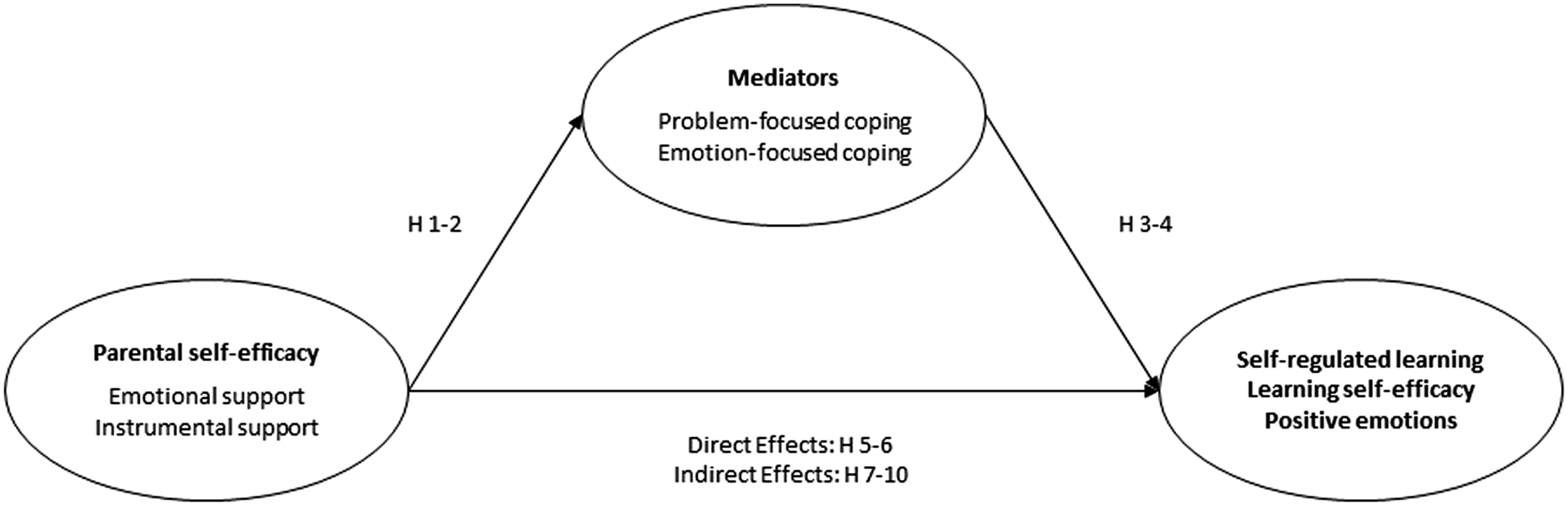
We accordingly test effects of parental self-efficacy with respect to the provision of emotional and instrumental support on early adolescents’ problem-focused and emotion-focused coping (hypotheses 1a-b and 2a-b), effects of early adolescents’ problem-focused and emotion-focused coping on SRL, learning self-efficacy, and positive emotions (hypotheses sets 3a-c and 4a-c), direct effects of parental self-efficacy with respect to the provision of emotional and instrumental support on early adolescents’ SRL, learning self-efficacy, and positive emotions (hypotheses sets 5a-c and 6a-c), and indirect effects of parental self-efficacy with respect to the provision of emotional and instrumental support on early adolescents’ SRL, learning self-efficacy, and positive emotions, mediated via problem-focused and emotion-focused coping (hypotheses sets 7a-c – 10a-c).
In line with previous studies that indicate associations of adolescents’ age with some of the investigated constructs (e.g., positive emotions, see Holzer, Lüftenegger et al., 2021; Ronen et al., 2016; e.g., SRL, see Effeney et al., 2013), we treated their age as control variable in our model.
Method
Sample, Procedure, and Context of Data Collection
Data for this study was obtained in the course of a larger research project investigating learning in times of COVID-19 in Austria (see Schober et al., 2020 for a full project description and access to full project-related data and codebooks). The present study relies on data collected at the project’s fifth measurement point between April 6, 2021 and May 25, 2021. From the full sample of 1421 secondary school students, this study draws on data from early adolescents (aged 10-14) of whom a parent (i.e., legal guardian) had also participated in the study. Accordingly, this study is based on a sample of N = 263 early adolescents (45.0% males, 52.3% females, 0.0% diverse, 2.7% did not indicate their gender; Mage = 12.39, SDage = 1.30, age range 10–14) and N = 263 parents (14.6% males, 85.1% females, 0.0% diverse, 0.4% did not indicate their gender; Mage = 46.13, SDage = 6.93, age range 32–79).
Data were collected with online questionnaires. To recruit participants, we cooperated with the Education Directorate for the City of Vienna, Austria. The Education Directorate established contact with secondary schools that were likely to be interested in participating in the project. School principals from 12 schools were then contacted by the project team and informed about the objectives and procedure. This included information about the research questions, the process of data collection, and the prospect of receiving an individual report for each school on their results in terms of descriptive statistics at the school level. Of the 12 schools that were invited, 9 declared their participation. The schools then received brochures to inform the students’ parents (i.e., legal guardians) about the study and to obtain their consent for their children to participate in the research. This information was translated into the students’ most common everyday languages to reach as many families as possible. Those who agreed to participate were provided with a weblink to the questionnaires for parents and students which was distributed by the schools. In the online form, participants were asked to create an individual study code along a specific pattern so that parent and student data could be matched. Participation in the study was completely voluntary. Only individuals who gave active consent took part. Additionally, parents’ consent was obtained for early adolescents’ participation in the study as well as data usage. Out of a total of about 6000 students in the 9 schools, we obtained data from 1421 students, corresponding to a response rate of 23.7%. Moreover, we collected data from 506 parents, corresponding to a response rate of 8.4%, respectively 35.6% in relation to the student sample. However, it is of note that the present study does not draw on the projects’ full sample, but on the data obtained from early adolescents and their parents, as stated above.
All procedures performed were in accordance with the 1964 Helsinki declaration and its later amendments as well as Austrian federal law and ethical guidelines regarding the conduct of scientific studies in schools. Moreover, the study was approved by the responsible local school boards as well as Ethics Committee of the University of Vienna.
Throughout the entire period of data collection, social distancing measures (e.g., wearing face masks, keeping minimum 1.5 m distance) were strongly recommended (Federal Ministry of Health, 2021). Moreover, the country was in a partial lockdown. Exit restrictions were in effect at night and secondary schools held classes in shifts. Accordingly, students physically attended school 2–3 days a week and, for the remaining days, were provided with assignments to complete independently at home. At school, students were tested for coronavirus at regular intervals and had to wear masks in the classroom.
Measures
Due to the novelty of the situation, for some constructs, there were no available previously published measurement instruments suitable for the context of data collection. We therefore adapted existing scales or developed new items based on qualitative data from previous measurement points to address the current circumstances. To ensure content validity of the measures, we revised the items based on expert judgments from members of our research group. In a next step, the questionnaire was piloted with cognitive interview testing. To ensure the construct validity of the finally implemented measures, we conducted confirmatory factor analyses (CFAs) and analyzed composite reliabilities (CR; Raykov, 2009). According to common cutoff criteria for reliability, CR scores above 0.60, 0.70, 0.80, and 0.90 were deemed marginal, acceptable, good, and excellent (Hair et al., 2008). All measures used a 5-point response format (1 = completely true; 5 = not true at all). Analyses were conducted with recoded items so that higher values reflected higher agreement with the statements.
Parents’ Questionnaire
Parental self-efficacy regarding emotional and instrumental support were measured using each three items that were newly developed. Based on the concepts of task-related instrumental and individual-related emotional support (Li et al., 2020; Turner et al., 2003), and tasks and challenges as typically reported by parents during the COVID-19 pandemic (e.g., Porsch & Porsch, 2020), we formulated a set of three items for each scale. All items were introduced with the phrase "Despite the current difficult situation due to the pandemic" and used a 5-point response format (1 = completely true; 5 = not true at all) corresponding to the other measures of our questionnaire. The items were reviewed by experts from our research group and slightly adjusted. In a last step, we piloted the items among a small group of parents by means of cognitive interview testing. CRs of the finally implemented scales were 0.64 for emotional support (e.g., “Despite the current difficult situation due to the pandemic, I manage to comfort my child when he or she has fears.”), and 0.68 for instrumental (i.e., academic) support (e.g., “Despite the current difficult situation due to the pandemic, I am able to assist my child with schoolwork if he or she needs it.”).
Early Adolescents’ Questionnaire
Early adolescents’ problem-focused and emotion-focused coping were assessed using each four items from the German Coping Questionnaire for children and adolescents (SVF-KJ; Hampel et al., 2002). The scales’ CR were .83 for problem-focused coping (e.g., “Currently, if something is causing me pressure at school, I try to figure out what the problem is”), and 0.71 for emotion-focused coping (e.g., “Currently, if something is causing me pressure at school, I tell myself it’s not that bad”).
Early adolescents’ self-regulated-learning was measured with five items adapted from the short version of the Learning Strategies of University Students questionnaire (LIST-K; Klingsieck, 2018, e.g., “In the current home-learning situation, I plan my course of action”) and three newly developed items (e.g., “In the current home-learning situation, I schedule fixed study sessions for each day”). The scale’s CR was 0.76.
Early adolescents’ learning self-efficacy was measured with three items developed based on Jerusalem and Satow (1999) and Kunter et al. (2002) (e.g., “At the moment, if I try hard, I can also solve the difficult tasks at school”). The scale’s CR was 0.81.
Early adolescents’ positive emotions were measured with three items from the Scale of Positive and Negative Experience (SPANE; Diener et al., 2010), measuring positive affect (“I feel good”, “I feel happy”, and “I am content”; CR = 0.92).
Data Analyses
Data were analyzed using MPlus version 8.4 (Muthén & Muthén, 2017). In addition to analyzing reliabilities of the scales by calculating composite reliabilities (Raykov, 2009), we conducted single-order CFAs for parental self-efficacy, early adolescents’ coping and the outcome variables (early adolescents’ SRL, learning self-efficacy, and positive emotions). Robust maximum likelihood estimation (MLR) was applied. Goodness-of-fit was evaluated using χ2 test of model fit, CFI, RMSEA, and SRMR. We considered CFI >0.95 and 0.90, RMSEA and SRMR <0.06 and 0.08 as cutoff scores accounting for excellent, respectively adequate model fit (Hu & Bentler, 1999).
For the main analyses, we conducted statistical mediation analysis. The conceptual diagram of the assumed relations is depicted in Figure 1. Statistical significance of the direct and indirect effects was tested using bias-corrected bootstrapping confidence intervals based on 10,000 bootstrap draws at the 0.05 p-level. When interpreting the results, apart from relying on statistical significance, we additionally focused on the effect sizes of the regression parameters. In doing so, we followed Cohen (1988), according to whom standardized values varying around 0.10, 0.30, and 0.50 reflect small, moderate, and large effects. The proportion of missing values ranged from 0.0% to 6.6% on the item level. To deal with the missing values, the full information maximum likelihood approach (FIML) implemented in MPlus was employed.
Results
Preliminary Analyses
Bivariate Latent Correlations, Descriptive Statistics and Composite Reliabilities.
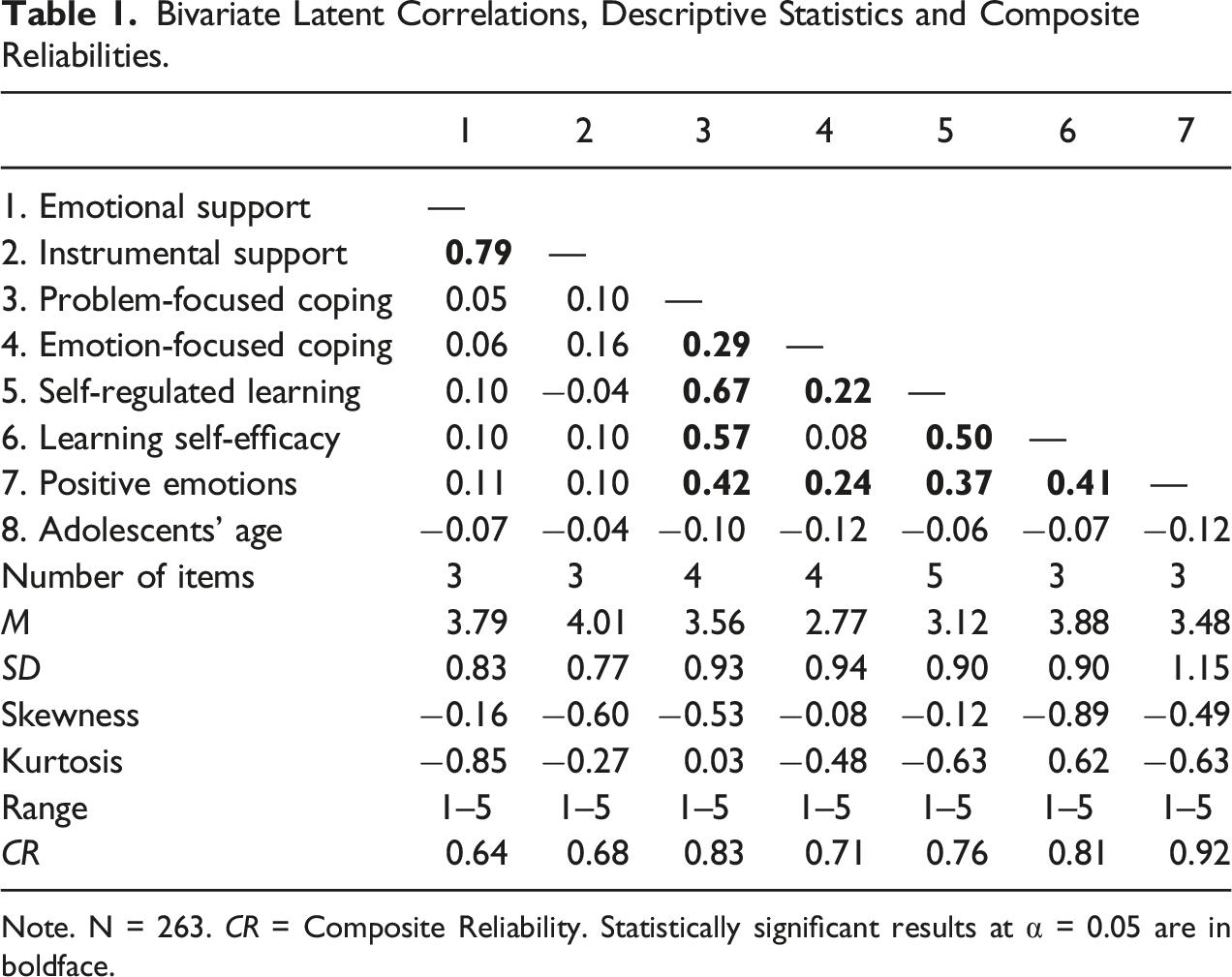
Note. N = 263. CR = Composite Reliability. Statistically significant results at α = 0.05 are in boldface.
Mediation Analysis
Results of Mediation Analysis.
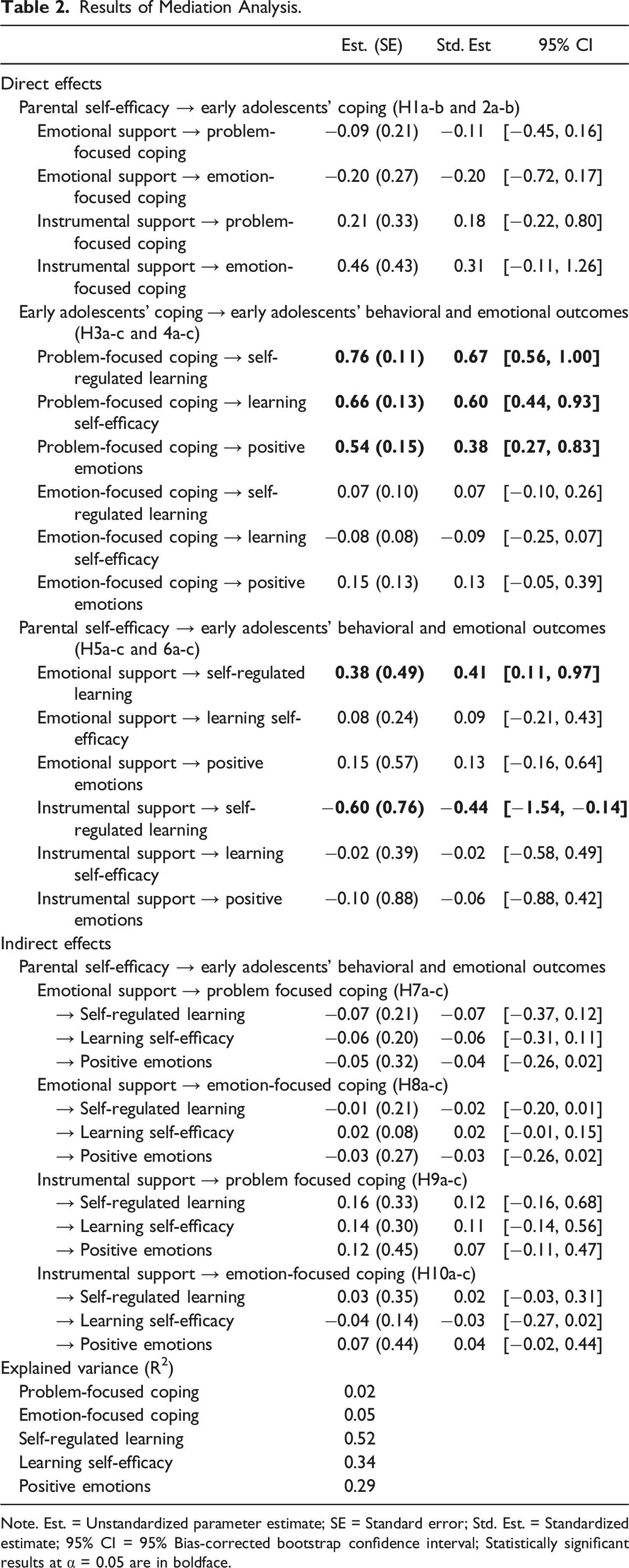
Note. Est. = Unstandardized parameter estimate; SE = Standard error; Std. Est. = Standardized estimate; 95% CI = 95% Bias-corrected bootstrap confidence interval; Statistically significant results at α = 0.05 are in boldface.
Direct Effects
Contrary to hypotheses sets 1 and 2, no effects of parental self-efficacy with respect to the provision of emotional and instrumental support on early adolescents’ problem-focused or emotion-focused coping strategies were detected. In line with hypotheses set 3, early adolescents’ problem-focused coping positively related to SRL (b* = 0.67) and learning self-efficacy (b* = 0.60) with each large effect sizes, and with positive emotions with a moderate effect size (b* = 0.38). Early adolescents’ emotion-focused coping was not statistically significantly related to SRL, learning self-efficacy, or positive emotions, thus rejecting hypotheses set 4. In line with Hypothesis 5a, parental self-efficacy with respect to the provision of emotional support positively related to early adolescents’ SRL with a large effect (b* = 0.41). There were, however, no significant associations with their learning self-efficacy, or positive emotions, thus rejecting Hypotheses 5b and 5c. As for parental self-efficacy with respect to the provision of instrumental support, contrary to our assumption, not a positive, but a large negative effect on early adolescents’ SRL (b* = −0.44), and no associations with learning self-efficacy or positive emotions, were identified, thus rejecting hypotheses set 6.
Indirect Effects
Contrary to hypotheses sets 7–10, no significant indirect effects of parental self-efficacy with respect to the provision of emotional and instrumental support on early adolescents’ SRL, learning self-efficacy, or positive emotions, mediated via problem-focused and emotion-focused coping were identified.
Discussion
Drawing on data from parent-child dyads, this study examined the role of parental self-efficacy in providing emotional and instrumental support when early adolescents partially learned from home during the COVID-19 pandemic. Based on a resources model of coping (see Holahan et al., 1995; Lazarus & Folkman, 1984), we examined effects of parental self-efficacy on early adolescents' reports of SRL, learning self-efficacy, and positive emotions. In doing so, we examined how early adolescents’ emotion-focused and problem-focused coping strategies were related to their SRL, learning self-efficacy, and positive emotions and could thus be considered adaptive in relation to the COVID-19 pandemic.
Contrary to our assumptions, no effects of parental self-efficacy regarding the provision of parental support on early adolescents’ coping were identified, thus rejecting the mediation assumption. Similarly, there were no direct associations between parental support and learning self-efficacy or positive emotions. However, as for SRL, an interesting pattern emerged. In line with our hypothesis, parental self-efficacy with respect to the provision of emotional support positively related to SRL with a large effect. As for parental self-efficacy with respect to the provision of instrumental support, however, not a positive, but a large negative association with early adolescents’ SRL emerged. Accordingly, early adolescents whose parents reported to be efficient in emotional support (e.g., comforting), more actively engaged in strategies to plan, monitor, and regulate their learning, while early adolescents whose parents reported to be efficient in providing instrumental support (i.e., active support in school matters), were less engaged in self-regulated learning. The association between parents’ emotional support and SRL is clearly in line with theoretical assumptions that environments in which adolescents experience authoritative parenting and education (e.g., warmth and responsiveness) are likely to have a positive influence on the development of self-regulation (Perry et al., 2018). It is moreover in line with empirical results, according to which emotional but not instrumental support is beneficial for academic functioning and related outcomes (Li et al., 2020). However, theory also suggests that children and adolescents gain control of their thoughts and actions by learning from parents as role models for self-regulation (Schunk & Zimmerman, 1997). This implies that parents’ instrumental support might foster the development of SRL. However, our results show that early adolescents whose parents report being able to provide a high level of instrumental support are less likely to practice SRL. One possible explanation for this could be that early adolescents who receive much instrumental support no longer need to regulate their learning themselves, because someone else has taken over this task. On the other hand, it is important to note that the present study is a cross-sectional study with data collected at one point and therefore neither chronological, nor causal directions can be tested. In this respect, the negative association could also be interpreted in such a way that those who had greater difficulties in practicing SRL were more strongly instrumentally supported by their parents as they felt it was necessary. According to theory (Schunk & Zimmerman, 1997), adolescents might as well benefit at a later stage and subsequently develop SRL competences because their parents had served as role models. However, to achieve this effect, theory as well as empirical evidence suggests that simply relieving adolescents of school-related tasks is not efficient to promote SRL. That is, to accomplish the development of SRL, emphasis must be placed on meta-cognition and self-efficacy to equip students with the self-regulatory capabilities that enable them to educate themselves (Bandura, 1997; Clark, 2012). Accordingly, it is significant to support young people in such a way that they remain involved in the learning process, to talk about learning, practice higher-order thinking, and engage students in meaningful work with formative feedback (Perry, 2013).
As for the effects of emotion-focused and problem-focused coping strategies in our model, in line with the hypotheses and previous findings, we identified associations between early adolescents’ problem-focused coping strategies and beneficial behavioral and emotional outcomes. Specifically, we identified large associations of problem-focused coping with SRL and learning self-efficacy, and a moderate positive association with positive emotions. Thus, early adolescents in our sample who engaged in active, problem-focused approaches to deal with pandemic-related challenges also reported more actively drawing on strategies to plan, monitor, and regulate their learning, reported higher self-efficacy in relation to learning, and were more likely to indicate that they generally felt emotionally well. This is consistent with theoretical assumptions that emphasize the advantages of problem-focused over emotion-focused coping (Folkman & Moskowitz, 2000; Seiffge-Krenke & Klessinger, 2000). Contrary to these theoretical assumptions, however, no negative effects of emotion-focused coping could be detected. This is in turn consistent with empirical findings that emotion-focused coping in face of uncontrollable stressors does not necessarily negatively impact adolescent well-being and functioning (Brady et al., 2008; Gaylord-Harden et al., 2008). Accordingly, COVID-19 has confronted adolescents with both controllable (i.e., individualized learning opportunities) and uncontrollable stressors (i.e., increases in infection rates, emergence of variants). Whereas, the present study clearly replicates positive effects of problem-focused coping in relation to controllable stressors (see for example Clarke, 2006), it also shows that emotion-focused coping in light of both controllable as well as uncontrollable stressors can neither be clearly considered adaptive nor maladaptive.
Thus, although not all hypotheses of our study were confirmed, our model accounted for 52% of the explained variance for SRL, 34% explained variance for learning self-efficacy, and 29% explained variance for positive emotions. This clearly speaks in favor of the relevance of parental self-efficacy regarding the provision of parental support, and early adolescents’ coping strategies for behavioral and emotional outcomes when early adolescents partially learned from home during the COVID-19 pandemic. Finally, considering the rejection of the mediation assumption (i.e., the circumstance that parental support was not related to early adolescents’ coping in the present study), we would like to point out the particularity of the present research in terms of the underlying data. Unlike previous studies that have identified effects of parental support on adolescents’ coping (e.g., Holahan et al., 1995), the present study drew on data from parent-child dyads. Accordingly, we used parents' reports of their self-efficacy regarding the provision of parental support as a predictor, whereas other investigations used adolescents’ own perceptions of parental support as a predictor of coping. Clearly, parental self-efficacy only provides information about how parents perceive their abilities, which does not necessarily match children’s perceptions. Thus, adolescents' perceptions of feeling supported may be more relevant to their coping behavior than parents' self-efficacy in this regard. Therefore, the present study might have benefited from incorporating this potential intermediate step in the mechanism as a mediator in the relation between parental self-efficacy and early adolescents’ coping. The relevance of including both parents' and children’s reports of parental or child behavior to improve the understanding of family environmental influences has been underpinned by several studies that have identified respective informant discrepancies (Niermann et al., 2022; Taber, 2010).
Limitations and Future Directions
Despite the notable strengths of the present study, such as the examination of matched data containing information derived individually from parents and early adolescents, some limitations must be acknowledged. First, the analyses are based on cross-sectional data. Therefore, conclusions on causal effects cannot be drawn. Second, this study relies on a self-selected sample. Because participation in the study required a certain level of (digital) literacy, as well as the ability to read for meaning, it must be assumed that particularly disadvantaged populations were less represented within the sample. Additionally, we suspect that parents who responded to our study were primarily those who were more involved and engaged in their children’s school-related activities than others. This is also reflected in the relatively high mean values in parental self-efficacy regarding emotional and instrumental support. Therefore, this study’s results should particularly not be generalized to groups of adolescents whose parents are disengaged from school activities. This also applies to middle or late adolescents older than 14 years who were not included in the sample. Moreover, this study had a focus on early adolescents’ learning situation. We thus followed the established practice in research on educational and career-related parental support to focus on task-related instrumental and individual-related emotional support (Li et al., 2020; Turner et al., 2003). It is of note that other types of parental support (i.e., informative and appraisal support), which could have contributed to an even more complete picture, were not included in the study. Finally, this study assumed an optimistic scenario, namely that early adolescents were generally supported by their parents during learning under COVID-19 conditions, or that parents at least have tried to do so. However, it must not be ignored that in times of COVID-19, many families experienced increased conflict and stress at home (e.g., Gadermann et al., 2021). Thus, research must not neglect the other side of the coin (i.e., the influence of negative experiences in the family context on emotional and behavioral outcomes).
Conclusion
The COVID-19 pandemic has substantially challenged adolescent positive functioning and well-being. At a time when young people have had to spend a considerable amount of time at home, and when the home has also become the place of learning, we examined effects of parental self-efficacy with respect to the provision of emotional and instrumental support on early adolescents' reports of SRL, learning self-efficacy, and positive emotions, mediated via early adolescents’ problem-focused and emotion-focused coping. While the mediation assumption was rejected, we identified positive associations between parental self-efficacy regarding emotional support and SRL, between problem-focused coping and SRL, learning self-efficacy, and positive emotions. An interesting finding that prompts further research is the identified large negative association between parents’ self-efficacy regarding instrumental support and early adolescents’ SRL. In this regard, it seems particularly interesting to investigate whether this effect is permanently negative, or whether parents also act as role models for SRL to a certain extent so that a later benefit can be expected.
Although not all hypotheses were confirmed, the high proportions of explained variance speak in favor of the relevance of parental self-efficacy regarding the provision of parental support and early adolescents’ coping strategies for behavioral and emotional outcomes in times of COVID-19. In confirming the benefits of problem-focused over emotion-focused coping, and by pointing to advantages of parents’ beliefs in their abilities to provide emotional over instrumental support, the present study importantly contributes to the identification and differentiation of protective factors for youth resilience in times of crisis.
Footnotes
Declaration of Conflicting Interests
The author(s) declared no potential conflicts of interest with respect to the research, authorship, and/or publication of this article.
Funding
The author(s) disclosed receipt of the following financial support for the research, authorship, and/or publication of this article: This study has been funded by the Vienna Science and Technology Fund (WWTF) [10.47379/EICOV20025].
