




Abstract
This study investigated whether support from teachers could serve as a protective factor and reduce disproportionality in problematic behavior. Data from the CILS4EU project on 14-year-old European students were used (N = 18,308). Students reported on their social background (parental resources, migrant background and adverse family risks), experiences of teacher support (academic and social) and problematic behavior (getting angry, acting impulsively and skipping classes). Multilevel regression analyses showed that students’ disadvantageous social background was associated with more problematic behavior. Teacher support had a beneficial effect: academic support from teachers was associated with less problematic behavior for almost all students, while social support reduced problematic behavior among students with low educated parents. Enhancing academic and social support from teachers could thus help reduce educational inequalities by protecting vulnerable students against negative behavioral outcomes.
Introduction
Students’ behavior and attitudes towards education are shaped by various aspects of the social context in which they grow up (Bronfenbrenner, 1979). Some aspects of students’ social background may put them at risk of poor outcomes: numerous studies have shown that students from poor and minority families or students who experience specific adversities as parental divorce report misbehaving in school more often, more often skip classes and are more likely to drop-out (e.g. Geven, 2019; Kaiser et al., 2019). These problems are relevant not only because they disrupt learning in school, but also because they can translate into long-term disadvantages such as low educational attainment or poorer health and well-being in adulthood compared to students from advantaged social backgrounds (Cavanagh & Fomby, 2019; Colder & Stice, 1998; Kaiser et al., 2019). In this way, problematic behavior among at-risk youth is a key-factor in (educational) inequalities. It is therefore essential to identify protective factors that can prevent problematic behavior among disadvantaged students and in this way foster equality of opportunity.
Support from teachers is often seen as a factor that may protect disadvantaged students against problematic behavior and poor educational outcomes (Atlay et al., 2019; Berkowitz et al., 2017; L. Ryan et al., 2019). Aside from the family, schools are the central place for children and adolescents’ learning and positive development (Sabol & Pianta, 2012). Virtually all children and adolescents spend a large share of their time in school with their teachers. Teachers can build positive relations with at-risk children and encourage positive behavior, reducing the impact of background disadvantage (Fredrick et al., 2017; Măirean & Diaconu-Gherasim, 2020; Roorda et al., 2017; L. Ryan et al., 2019). Given this potentially powerful impact, the current study investigates to what extent teacher support can contribute to educational equality by reducing disproportionality in problematic behavior at school among students from disadvantaged social backgrounds.
Teacher Support and Problematic Behavior
Some student behaviors can compromise their learning and educational progress (Cavanagh & Fomby, 2019; Colder & Stice, 1998; Kaiser et al., 2019). With regard to these behaviors, a distinction can be made between behaviors that disrupt teaching in class, and behaviors that are disruptive to students learning because they reduce students’ educational engagement and time spend on learning, such as skipping classes (Gottfried, 2014; Liu et al., 2021). Self-determination theory provides a theoretical basis for understanding such behaviors as well as the potential protective role of teacher support (R. M. Ryan & Deci, 2000). This theory argues that all students need a sense of competency, relatedness and autonomy in order to become either intrinsically motivated to learn, or internalize the values of education (a form of extrinsic motivation based on self-regulation instead of control) (R. M. Ryan & Deci, 2000; Van Petegem et al., 2015; Wang et al., 2020). These needs can be fulfilled by positive experiences and interactions in social environments, for instance with family and teachers. When students’ needs for competency, relatedness and autonomy are not met, however, students can reject school values and respond with ‘reactance’ (R. M. Ryan & Deci, 2000; Van Petegem et al., 2015). Instead of developing an intrinsic motivation or internalized regulation to learn, they may disrupt teaching and learning in class or they may skip classes. Although we cannot measure competency, relatedness and autonomy directly in the current study, previous research has shown the relevance of these concepts for understanding the benefits of teacher support (Roorda et al., 2017; Van Petegem et al., 2015; Wang et al., 2020).
Teachers can prevent and reduce problematic behavior among students via a teaching style that supports feelings of competency, relatedness and autonomy (Roorda et al., 2017; R. M. Ryan & Deci, 2000; Sabol & Pianta, 2012). Both academic and social support from teachers can contribute to this. Academic support means that students feel encouraged by their teachers and that teachers ensure learning activities match students’ ability by providing them with the appropriate information, guidance or help they need to learn (Atlay et al., 2019; Song et al., 2015). This form of teacher support promotes students’ sense of competency and autonomy, which improves students’ behavior in class by increasing their intrinsic motivation or internalized regulation to learn (Atlay et al., 2019; R. M. Ryan & Deci, 2000; Song et al., 2015; Wang et al., 2020).
Teachers who provide social support to students show that they care for students’ emotional-needs and well-being, which mainly contributes to students’ sense of relatedness at school (Hallinan, 2008). When students lack a sense of relatedness to their teachers (e.g., when they perceive their teachers as cold), students are less likely to develop positive motivations to learn (R. M. Ryan & Deci, 2000). The older students become, the more important social relationships at school gain importance relative to their family. Especially among adolescents, social relationships with teachers may therefore be an important source of relatedness, reducing problematic behavior (L. Ryan et al., 2019). Moreover, social support from teachers may consist of advice or practical help when students experience personal problems at school, home or elsewhere. This can also prevent negative behavioral responses to such problems (Roorda et al., 2017; Song et al., 2015).
Disproportionality in Problematic Behavior
Teacher support can thus promote positive behavior in school and may therefore be a relevant factor for improving the educational experiences of disadvantaged students. In this study, we focus on five factors in students’ social background that can place students at risk of problematic behavior: low parental education and parental unemployment (parental resources), migrant background, and household composition and parental rejection (adverse family risks). Previous research provides theoretical insights in why these students may report higher rates of problematic behavior. Lower educated parents tend to have less knowledge about the educational system and have less cultural resources to support their children’s learning and education (Kaiser et al., 2019; Lareau, 2011). Students with lower educated parents therefore often develop a lower sense of relatedness and competency at school, which can lead to problematic behavior (Epstein, 2010; Zhang et al., 2021). Financial strain due to unemployment can also lower parental involvement in children’s education, and can cause stress among children which puts them at risk of problematic behavior (Conger et al., 2010; Kaiser et al., 2019; Schenck-Fontaine & Panico, 2019). Similarly, families with a migrant background can experience a greater cultural distance between themselves and the school context, which can lower parental involvement and reduce students’ sense of relatedness at school (Mazzoni et al., 2020; Nakhaie, 2021). Growing up in a non-standard household and experiencing rejection is also associated with more stress among students, which can negatively impact their behavioral adjustment in school (Bussemakers et al., 2022; Cavanagh & Fomby, 2019). Moreover, these factors are also associated with less parental guidance and involvement, either because single-parents have less time and energy to spend on their children’s education (Cavanagh & Fomby, 2019; McLanahan et al., 2013) or because the parent-child relationship is strained as is the case with parental rejection (Veenstra et al., 2006). In sum, social inequalities can lead to differences in parental support and experienced stress between students from advantaged and disadvantaged backgrounds (Epstein, 2010; Hasselhorn et al., 2015), resulting in disproportionally larger risks of problematic behavior among students from disadvantaged backgrounds.
The Current Study: Teacher Support as a Protective Factor
To investigate whether teacher support can mitigate disproportionality in problematic behavior by students’ social background, we compare the impact of teacher support between students from disadvantaged and advantaged backgrounds and see how this affects disproportionality in problematic behavior. Our first hypothesis is that (1a) academic support and (1b) social support from teachers is associated with less problematic behavior among students from advantaged as well as disadvantaged backgrounds. Such a negative effect would be highly relevant for disadvantaged students, since they tend to report more problematic behavior at school.
Our second hypothesis is that the beneficial impact of (2a) academic support and (2b) social support from teachers is higher for students from disadvantaged backgrounds. Variation in students’ home environment may lead to different needs for support elsewhere. A higher level of problematic behavior among disadvantaged students may signal that these students have unfulfilled needs for competency, autonomy and relatedness, for instance because parents have less resources, knowledge or time and energy to support their children herein (Conger et al., 2010; Lareau, 2011). Support from teachers may fill this gap (R. M. Ryan & Deci, 2000), resulting in a possible larger impact of teacher support on problematic behavior for disadvantaged students. This, in turn, would reduce differences in problematic behavior due to students’ social background among students who experience more teacher support (Berkowitz et al., 2017; L. Ryan et al., 2019; Sabol & Pianta, 2012).
Although it is likely that teacher support can reduce disproportionality in problematic behavior, research on this topic is rather limited (L. Ryan et al., 2019; Wang et al., 2020). Our study advances on earlier studies in two main ways. Our first advancement lies in studying young adolescents. Studies on the protective role of teacher support often focuses on young children before or during elementary school, while adolescents have received less attention (Sabol & Pianta, 2012). This is surprising, given that many adolescents from disadvantageous backgrounds display behavioral problems (Gutman et al., 2019). In that light, it seems relevant to study protective factors for older students. Teacher support could potentially fulfill this role as almost all young adolescents spend a large share of their time in school and social relationships at school become more important as students get older (L. Ryan et al., 2019).
Our second advancement is that we broaden the scope of disadvantaged students who may benefit from teacher support. Earlier research on the influence of teacher support for equality in education was mostly oriented at American students with a low socioeconomic status (Berkowitz et al., 2017). We studied whether the possible protective role of teacher support also applies in other contexts and for other groups. We used data from the Children of Immigrants Longitudinal Study (CILS4EU), which were collected among schools in four European countries. Within these countries, we studied disproportionality in problematic behavior in relation to five indicators of a disadvantageous family background: low parental education, parental unemployment, migrant background, household composition and parental rejection. These disadvantages often overlap, for instance because migrant and single-parent families also often have less financial and cultural resources (Van De Werfhorst & Van Tubergen, 2007). By studying them jointly, we could disentangle these background-influences and study for which groups of students teacher support appears to be most relevant. Our focus is thus mainly on teacher support as a protective factor across these four countries. Of course, there may also be differences between countries in the relative impact of teacher support for different student groups, but that is outside the scope of the current study. We come back on this in the discussion.
Methods
Data and Sample
We used data from the CILS4EU project, which aimed to study the integration of adolescents with a migrant background in England, Germany, the Netherlands and Sweden (Kalter et al., 2016). The structure of this project as well as the nature of the survey questions that were used make these data highly suitable for our research. The study was conducted in schools; all schools in the four countries were eligible for inclusion. However, the aim was to sample relatively more schools with a high share of migrant students to ensure enough students with a migrant background would be included. To achieve this, schools were divided in five strata according to the relative share of students with a migrant background. More schools were included from strata with higher shares of migrant students than from the other strata. Within strata, schools were sampled at random with a sampling probability relative to their size. Within the selected schools, two classes were selected at random to be included in the study, and the students in these classes filled out the survey in class. The student survey included questions on their personal development, family life and social relationships including whether they experienced support from teachers. Additionally, their parents were invited to fill out a survey at home. CILS4EU is a longitudinal project, but because later waves did not include questions on all factors under study, we only used data from wave 1.
Measures
Problematic Behavior
As indicated in the introduction, we included three dependent variables as measures of problematic behavior: getting angry, acting impulsively and skipping classes. We use measures of anger and impulsivity as proxies for disruptive behavior, because we could not measure disruptive behavior directly. Anger was measured as the extent to which students indicated the statement “I get angry easily” applied to them (answers on a four-point scale ranging from never to often), while answers for the statement “I act without thinking” were used to measure impulsivity. For skipping classes, students were asked to indicate how often they skipped classes, with response categories ranging from every day to never. Because this variable was highly skewed (most students indicated they skipped lessons never or less than once a month), we created a dichotomous variable indicating whether students skipped lessons at least once a month.
Risk Factors in Students’ Social Background
We included two measures of parental resources, which were provided by parents in an additional parent survey. The first was parental unemployment, indicating a lack of financial resources. We created a dichotomous measure indicating that both parents were unemployed (or one parent for students from single-parent households), students of whom one or both parents were employed form the reference group. The second indicator was parents’ level of education, indicating cultural resources available in the household. The survey distinguished between four levels of education, which were maintained as a categorical variable in the analysis: no school leaving certificate, below upper secondary education, upper secondary education and tertiary education (reference group). 1 For students whose parents did not provide this information, we used students’ answers to the question on their parents’ education and employment. 2
Regarding migrant background, students were asked to indicate in which country they were born and where their parents were born. We created a dichotomous variable indicating that students or (one of their) parents were born abroad, native students form the reference category.
As adverse family risks, we include household composition and parental rejection. For household composition, students were asked whether they lived with both biological parents in one home. We differentiated between students who lived with both of their biological parents (reference category), students who lived with one of their biological parents and students who did not live with either of their biological parents. Parental rejection was measured with three questions that are highly similar to the EMBU-scale on parenting practices (Arrindell et al., 1983). Students were asked to indicate to what extent they agreed with the statements: parents often tell me to be quiet, parents are strict even over small things and parents often criticize me (5-point scale ranging from totally disagree to totally agree). The items form one scale with α = .72. We calculated students’ scores on parental rejection by taking the average score on the items for students who answered at least two questions. These scores were then standardized.
Teacher Support
Two forms of teacher support were measured, namely academic and social support. Academic support was measured with two statements: ‘I get the help I need from the teachers at school’ and ‘My teachers encourage me at school.’ Although these statements are quite broad and may also refer to non-academic help and encouragement from teachers, they were included in a subset of questions about working hard for school and parents’ interests in students’ grades. It can therefore be assumed that students’ answers related to the academic support they perceived from their teachers. Students were asked to indicate to what extent they agree with these statements (5-point scale ranging from totally disagree to totally agree). The items formed one scale with α = .76. We therefore calculated the average of students’ two answers and reversed and standardized these scores, so higher scores means that students experienced more academic support from their teachers. If students only answered one question, the score on that question was used (also reversed and standardized).
Social support was measured with a question in which students were asked to indicate who they would go to if they had a worry or concern. They could tick all options that applied, including for instance their father and mother, friends and teachers. We created a dichotomous variable, indicating whether students chose the option teacher (1 = yes). Going to teachers with worries or concerns shows that students feel their teacher understand the issues they struggle with and can provide emotional and/or practical help, which aligns with the social support that students may receive from their teachers (Song et al., 2015).
Analytical Strategy
To study whether teacher support reduced disproportionality in problematic behavior, we employed descriptive and regression analyses. We performed all analyses separately for the three dependent variables. Students with missing values on the dependent variables were removed from the analyses, students with missing values on the independent variables were included in separate missing categories (for continuous variables in combination with the average scores on these variables) to ensure their information could still be used to estimate the effects of the other variables. 3 This led to an analytical sample of 18,308 students (EN: 4,194, GE: 4,951, NL: 4,328, SW: 4835).
OLS regression analyses were employed for all three outcomes. Skipping classes was a dichotomous variable, which can be modelled using either logistic regression analyses or linear probability models (in other words: OLS regression with a dichotomous outcome variable). The latter was appropriate for our analyses because most independent variables were categorical and because we were interested in moderation-effects, which can be estimated better in linear models (Mood, 2010; von Hippel, 2017). Moreover, the probability and log odds were almost linearly related over the probability range of skipping classes (von Hippel, 2017). We estimated these models using robust standard errors.
To account for the nested nature of the data, we used hierarchical models in all analyses. Appendix A provides the intraclass correlations (ICCs) of the dependent variables. It shows that ICCs are generally highest at the class- and school-level, so we nested students in classes and schools by including random intercepts at these levels in our models. There was less variation at the country- and school-level. To capture variation due to differences in educational systems and other relevant factors at these levels, we included fixed effects of country and school type in our models. 4 At the individual level, the regression models also controlled for gender and year of birth.
We conducted regression analyses in three steps. First, we estimated the impact of social background on problematic behavior, to investigate the extent of disproportionality herein. Because we add all background factors to this model, the reference group consisted of students without any of the disadvantaged measured (students with university-educated, employed parents, without a migrant background and an average or lower score on the parental rejection variable). We therefore call this reference group ‘advantaged’. Second, we added teacher support to the models, to investigate whether disproportionality in problematic behavior was due to differential access to teacher support. Third, we included the interaction terms between social background and teacher support, to investigate differences in the impact of teacher support according to social background. This was done separately for academic and social support. Results are presented in figures showing the effects of teacher support and the adjusted mean levels of problematic behavior for the groups under study, based on the regression estimates (with 95% confidence intervals). These figures thus illustrate variation in the impact of teacher support and how it affects disproportionality in problematic behavior. The general regression equation can be found in Appendix B, while regression estimates can be found in Appendix C.
Results
Descriptive Analyses
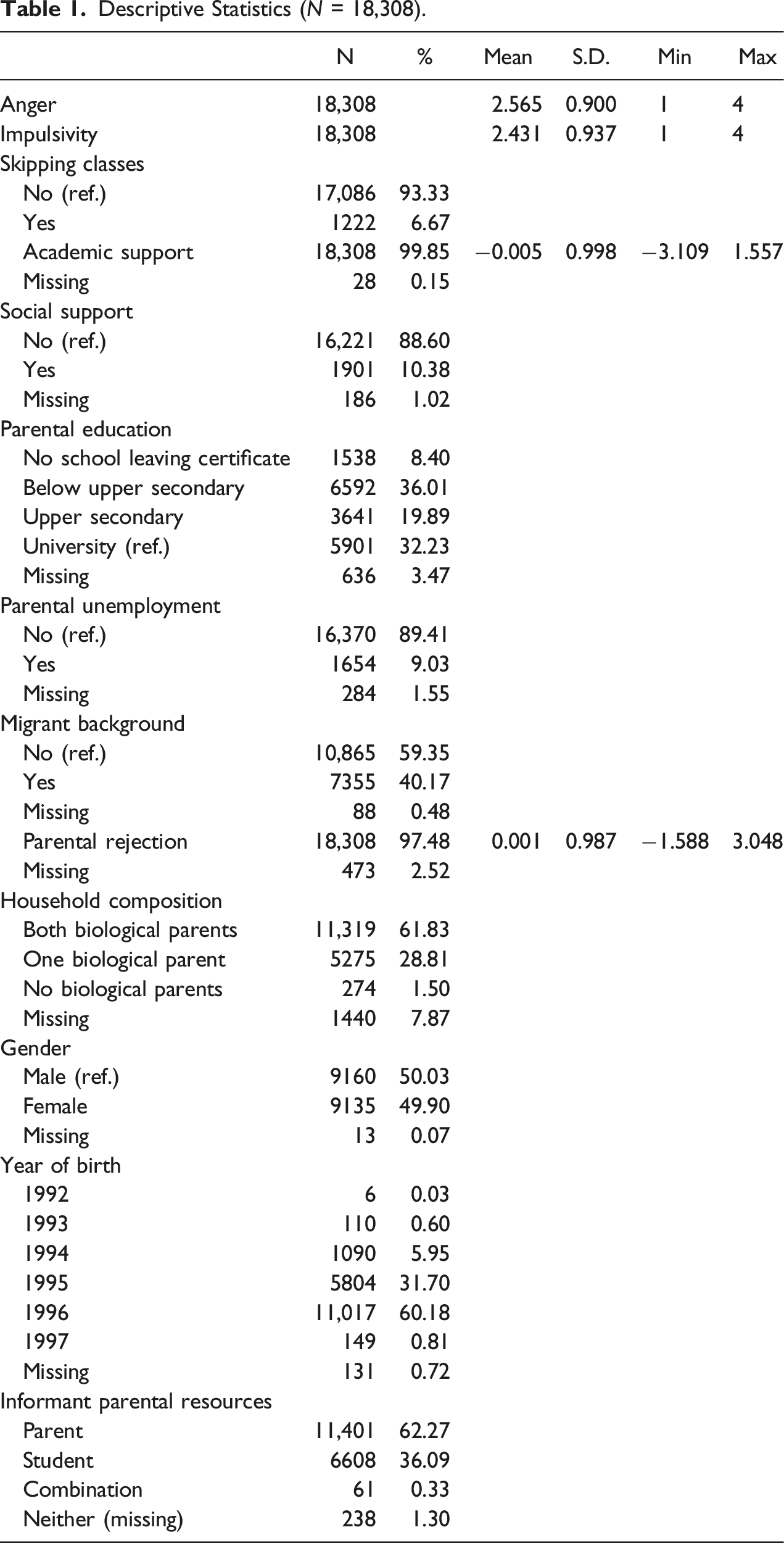
Descriptive Statistics (N = 18,308).
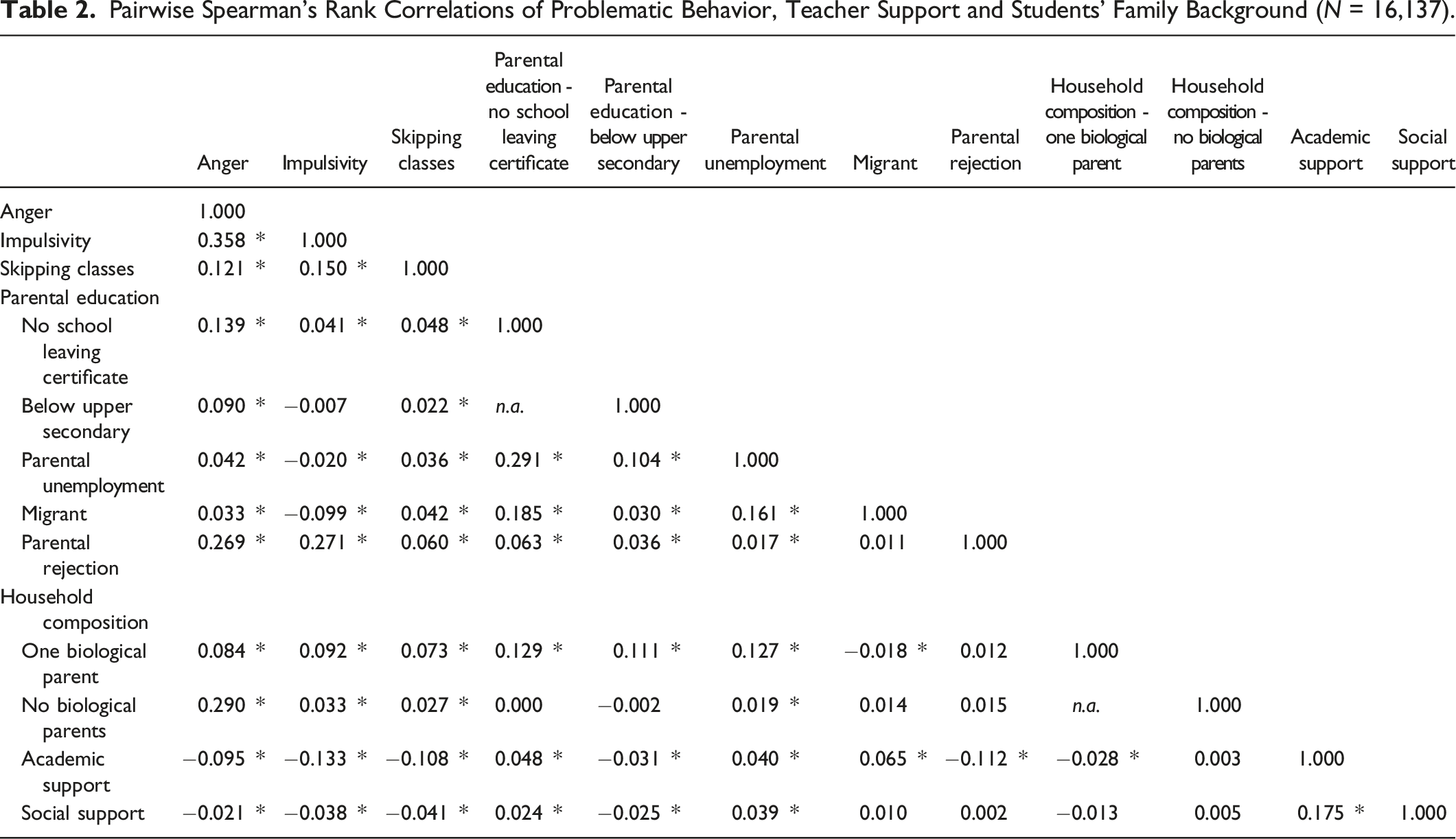
Pairwise Spearman’s Rank Correlations of Problematic Behavior, Teacher Support and Students' Family Background (N = 16,137).
Multivariate Analyses: Disproportionality in Problematic Behavior
Figure 1 presents adjusted mean levels of problematic behavior for students from disadvantaged and advantaged backgrounds, based on the regression models with the main effects of social background factors. The total effects indicate that students from advantaged backgrounds tended to have relatively low levels of problematic behavior. Students who lived with one or none of their biological parents and students who experienced rejection scored higher on all forms of problematic behavior than advantaged students. Note that the confidence intervals of the estimates of skipping classes for students who did not live with their biological parents and students who experience parental rejection overlapped at their extremes with the prediction for advantaged students, but that the effects of these experiences were statistically significant (bno biological parents = 0.04/p = 0.048 and bparental rejection = 0.02/p < .001) (see Goldstein & Healy, 1995). For the other groups, the pattern depended on the type of problematic behavior. Students whose parents were low educated scored significantly higher on anger (bno school leaving certificate = 0.15/p < .001 and bbelow upper secondary education = 0.09/p < .001), but not on impulsivity and skipping classes. Conversely, students with a migrant background more often skipped classes than advantaged students (b = 0.01/p = .036) but did not report more anger and reported less impulsivity (b = −0.18/p < .001). Finally, students of unemployed parents did not report any form of problematic behavior more often than advantaged students and reported lower levels of impulsivity (b = −0.08/p = .001) as well.
6
Adjusted Mean Levels of Problem Behavior by Student Background.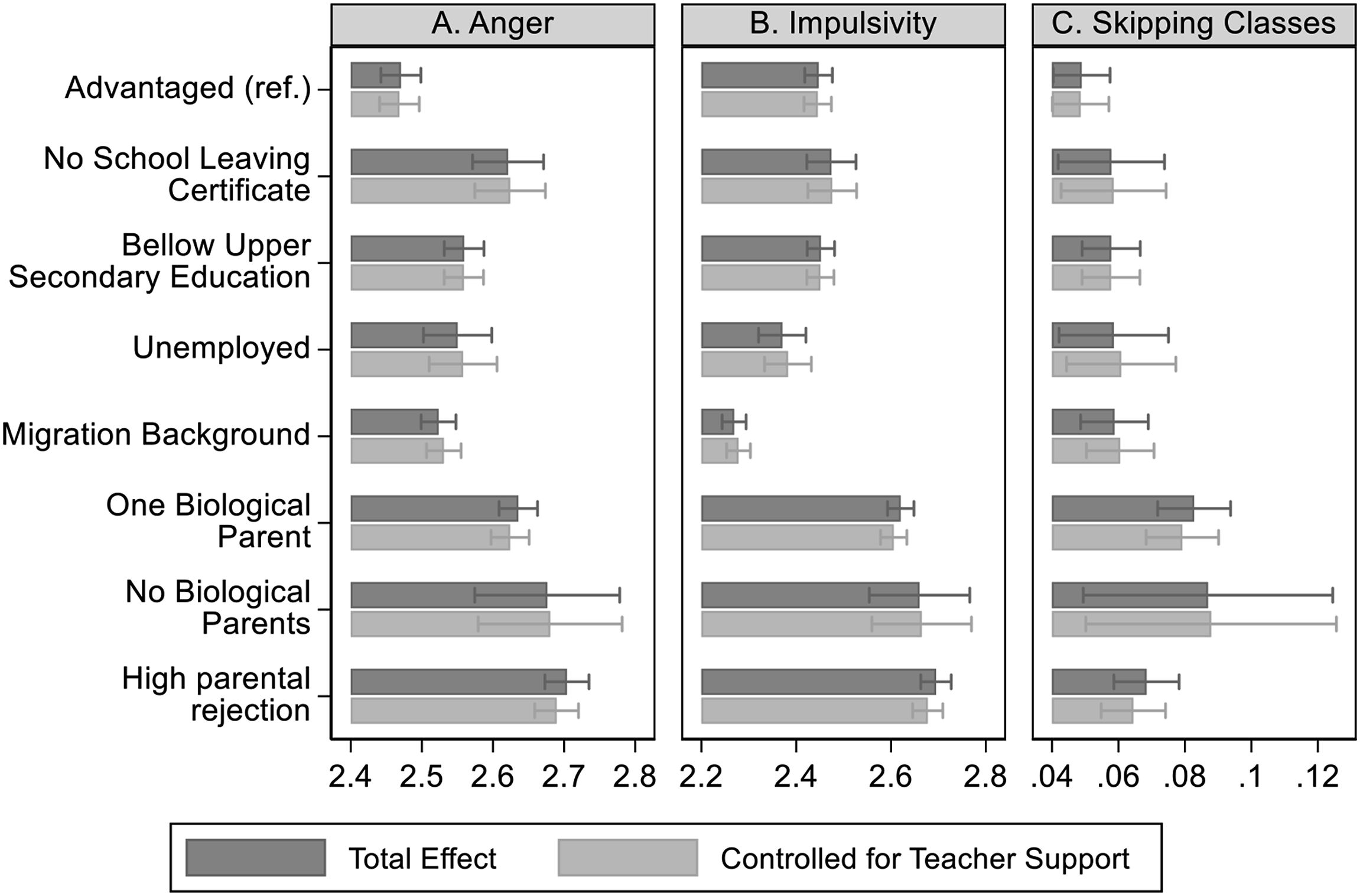
These differences remained when teacher support was added to the models, as shown by the means that controlled for teacher support in Figure 1. Only for adverse family risks (living with one biological parent and parental rejection), the difference with advantaged students became somewhat smaller, but remained substantial and statistically significant. This indicates that higher levels of problematic behavior among disadvantaged students could not be attributed to different levels of experienced teacher support between students from disadvantaged and advantaged backgrounds. In the next section, we discuss whether this also means that teacher support functioned as a protective factor.
Multivariate Analyses: Academic Support and Disproportionality in Problematic Behavior
Figure 2 presents the estimated effects of academic support from teachers for students from disadvantaged and advantaged backgrounds, while Figure 3 shows how this relates to disproportionality in problematic behavior by displaying the adjusted mean levels of problematic behavior of students with low (−1 SD) and high (+1 SD) levels of academic support by student background. Both are based on the third set of regression models which included the interaction effects between teacher academic support and each of the background factors. Figure 2 shows that that academic support was clearly associated with lower levels of all three forms of problematic behavior for students from advantaged backgrounds as well as students from most disadvantaged groups. Only for students who did not live with either of their biological parents, we found no significant relationship between academic support from teachers and any form of problematic behavior. Estimated Effects of Teacher Academic Support by Student Background. Adjusted Mean Levels of Problem Behavior by Student Background with Low and High Levels of Teacher Academic Support.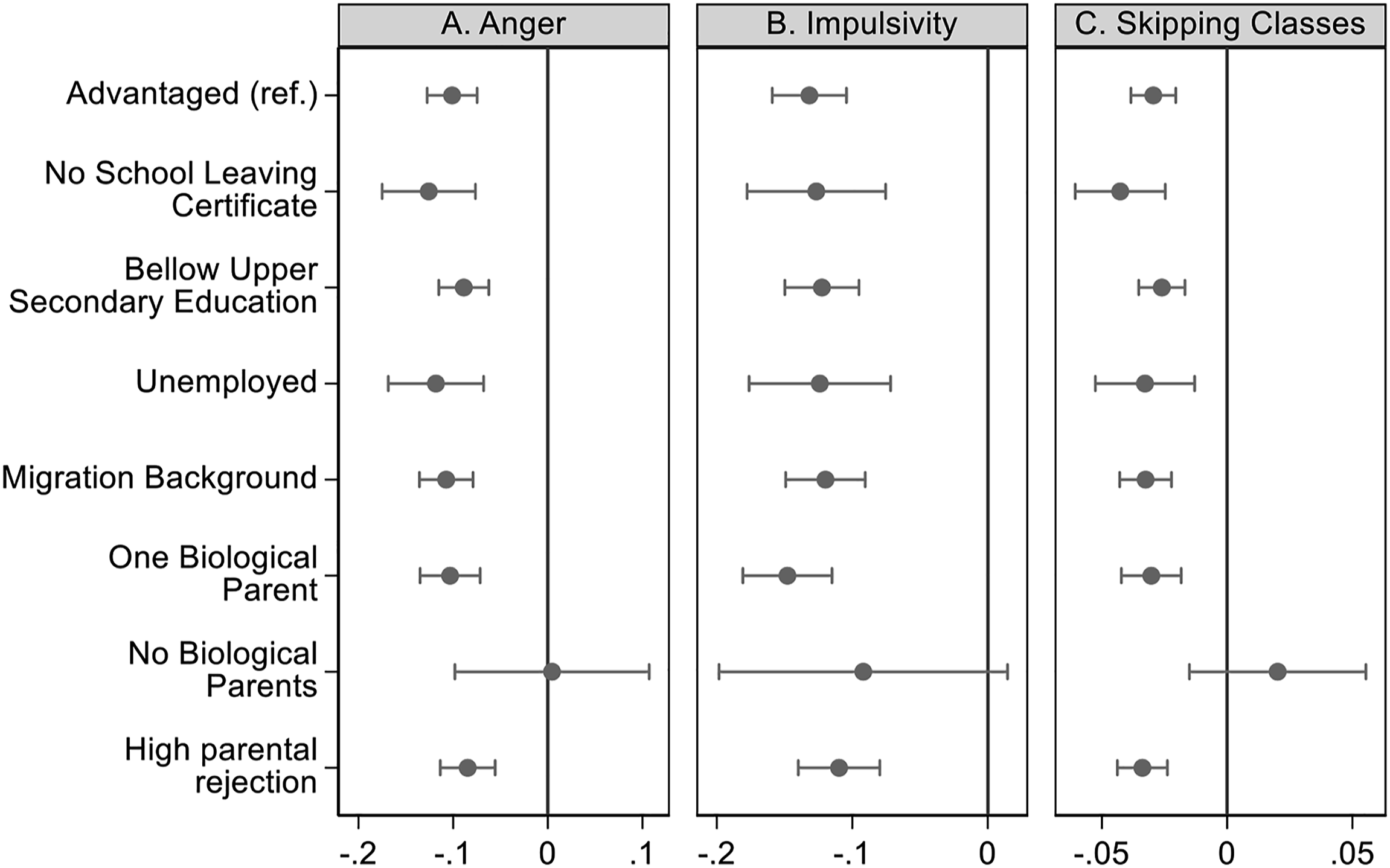
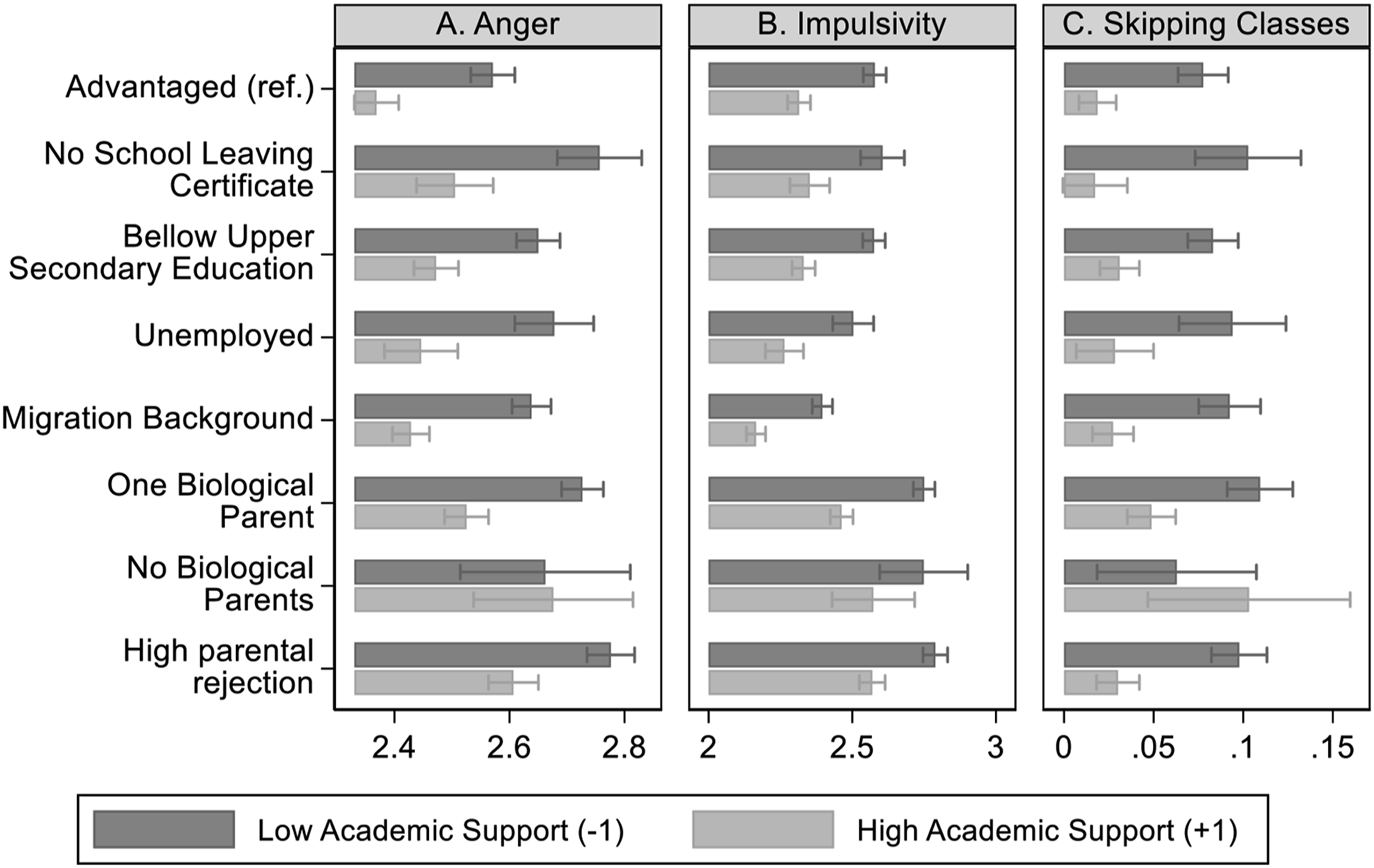
We found little evidence that the benefits of academic support from teachers were larger for students from disadvantaged backgrounds. We only found a significant negative interaction between parental rejection and academic support for skipping classes (b = −0.004/p = .033), meaning that the association of academic support and this outcome was somewhat stronger for students who experienced rejection. However, because this difference is small, it was not associated with a smaller difference in skipping classes between students who experienced rejection and advantaged students, as shown in Figure 3.
Moreover, some groups seemed to benefit less from teacher support for reducing problematic behavior. As said, we found no association between academic support from teachers and problematic behavior among students who did not live with either of their biological parents. Figure 3 shows that this translated into much larger differences in anger and skipping classes between students from advantaged backgrounds and students who live with neither of their biological parents when students experienced more academic support. We also found positive interactions between parental rejection and academic support for anger (b = 0.02/p = .005) and impulsivity (b = 0.02/p < .001), indicating smaller associations between academic support and these outcomes among students who experienced rejection. Figure 3 shows that this translated into larger differences in anger and impulsivity between students who experience rejection and advantaged students when students experienced more academic support.
Multivariate Analyses: Social Support and Disproportionality in Problematic Behavior
Figure 4 presents the estimated effect of social support from teachers according to student background, and Figure 5 displays the adjusted mean levels of problematic behavior of students with and without social support from teachers. These figures are based on models that included the interaction effects of teacher social support and student background factors. Figure 4 shows that social support from teachers was not associated with lower levels of problematic behavior for most groups. Students from advantaged backgrounds did not benefit from social support from their teachers for any form of problematic behavior under study. This also holds for most students from disadvantaged backgrounds, except for students with low educated parents. Estimated Effects of Teacher Social Support by Student Background. Adjusted Mean Levels of Problem Behavior by Student Background with Low and High Levels of Teacher Social Support.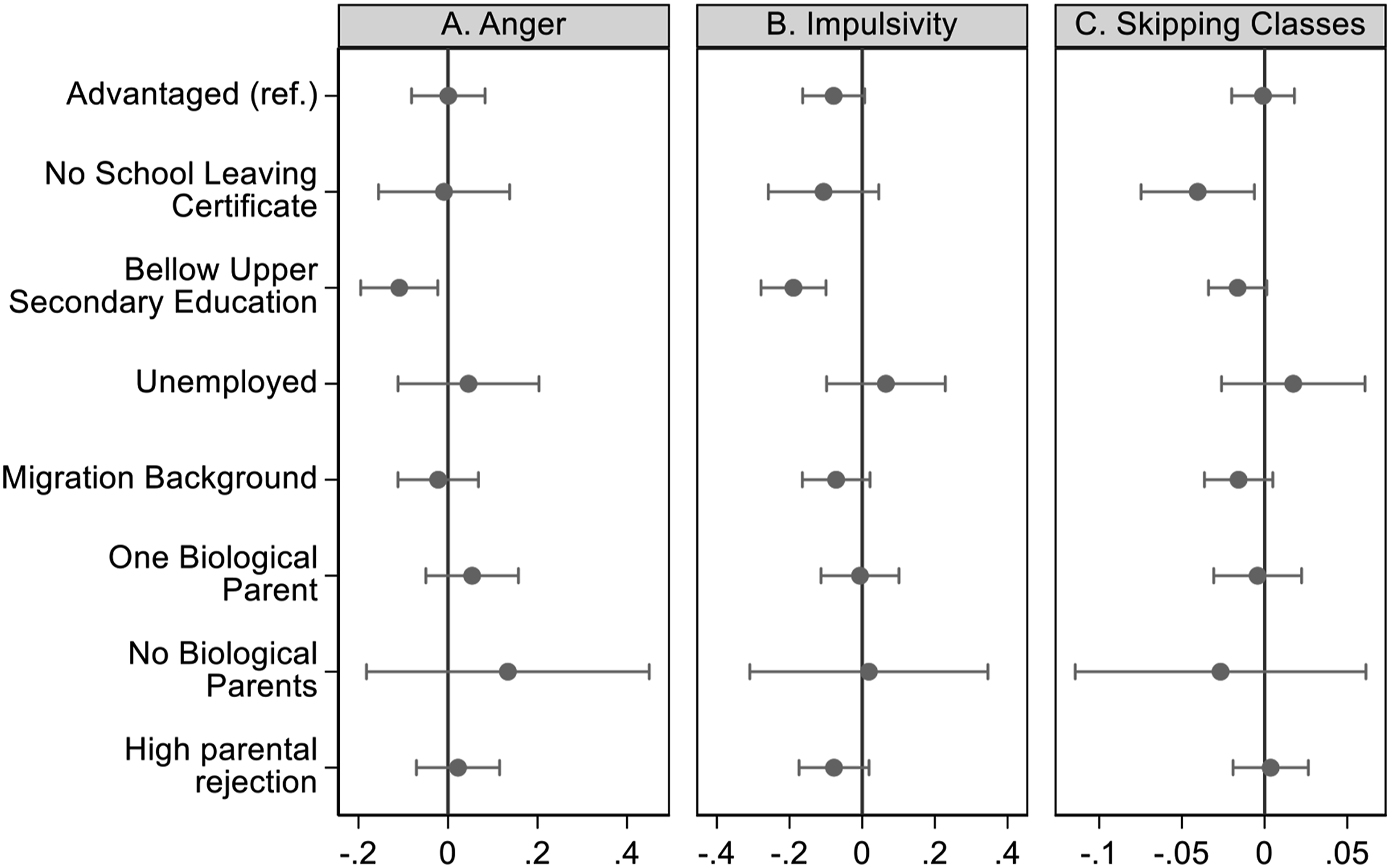
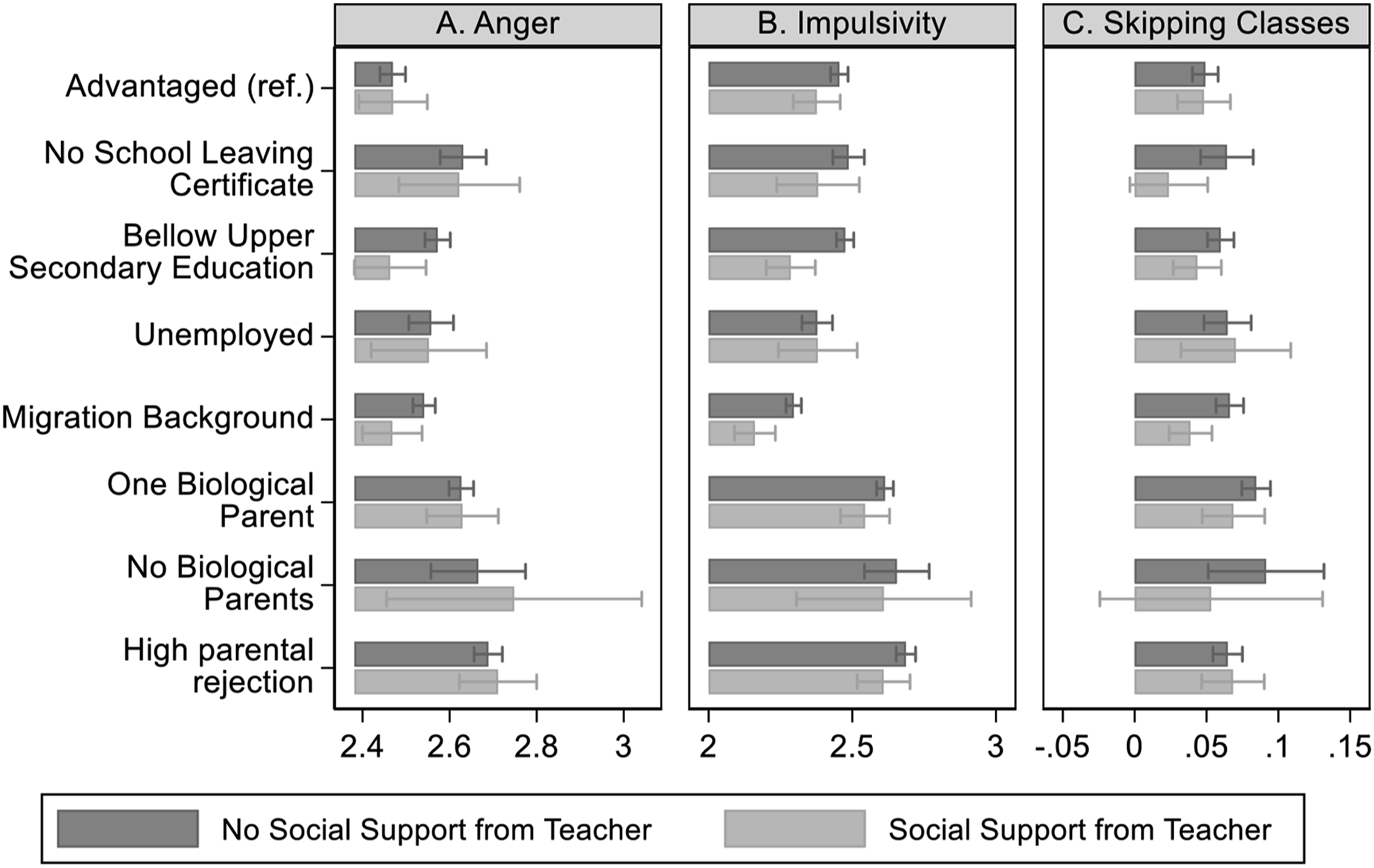
Students whose parents had below upper secondary education reported lower levels of anger if they experienced social support from their teachers (interaction effect: b = −0.11/p = .030) and impulsivity (interaction effect: b = −0.11/p = .035). Figure 5 shows that this translated into smaller differences in anger: these students reported higher levels of anger than advantaged students without social support from teachers, while the difference was reversed, smaller and not statistically significant for students who experienced social support. No difference in disproportionality was found for impulsivity because even without social support from teachers, students whose parents had below upper secondary education did not report higher levels of impulsivity than students from advantaged backgrounds.
The same applies to the relationship between social support and skipping classes for students whose parents had the lowest level of education. We found a negative, significant association between social support and skipping classes for these students (interaction effect: b = −0.04/p = .021). However, Figure 5 shows that these students were not more likely to skip classes than advantaged students, regardless of whether they experienced social support from their teachers. Therefore, this beneficial role of social support did not translate into smaller differences in problematic behavior between students with the lowest and highest educated parents.
Discussion
Problematic behavior in adolescence may translate into long-term disadvantages such as school drop-out, lower socioeconomic attainment and poorer health and well-being in adulthood (Cavanagh & Fomby, 2019; Kaiser et al., 2019). Risk-factors in students family environment, such as a lack of parental resources or adverse family risks, are associated with such behaviors (Geven, 2019; Kaiser et al., 2019). In this study, we investigated whether support from teachers can function as a protective factor against disproportionality of problematic behavior among students from disadvantaged backgrounds. In line with earlier studies, our analyses showed that students from disadvantaged social backgrounds reported more problematic behavior than students from advantaged backgrounds, underscoring the impact of background disadvantage and the relevance of studying protective factors (Berkowitz et al., 2017; Epstein, 2010).
The Protective Role of Teacher Support
We studied the protective role of two forms of support from teachers, namely academic and social support. In line with hypothesis 1a, our results showed that academic support was associated with less problematic behavior among almost all groups of young adolescent students, both from disadvantaged and advantaged backgrounds. This finding is consistent with self-determination theory that postulates that teachers may help fulfil students’ needs for competency, autonomy and relatedness (Roorda et al., 2017; R. M. Ryan & Deci, 2000; Sabol & Pianta, 2012). Because we found highly similar associations for advantaged students and most students from disadvantaged backgrounds, our results did not support the idea that academic support from teachers would reduce absolute differences in problematic behavior (hypothesis 2a). However, academic support can still play an important role as a protective factor to improve educational opportunities for disadvantaged students. High levels of problematic behavior in school, such as chronic absenteeism, have a much larger impact on negative student outcomes than lower levels of such behaviors (Gottfried, 2014). Because disadvantaged students tend to report more problematic behavior than students from advantaged backgrounds, teacher support may help bring these behaviors to such a decreased level that it is less harmful for students’ educational careers. Thus, even though the associations found in this study did not differ in absolute terms, the benefit of academic support may be relatively more impactful for disadvantaged students. Future research could investigate whether such a threshold hypothesis can be confirmed.
Students who did not live with either of their biological parents form an important exception to this, as we did not find a negative association between academic support and any of the forms of problematic behavior under study for this group. As a result, differences between these students and students from advantaged backgrounds were larger when students experienced more support. Previous research has shown that these students sometimes perceive the support they receive from their teachers as not sensitive to their specific needs (e.g., feeling pitied rather than supported) (Moyer & Goldberg, 2020), which may explain our findings. However, it should also be noted that we cannot be fully certain about this finding, since our sample only included a relatively small number of students who did not live with either of their biological parents in one household.
Contrary to hypothesis 1b and 2b, social support from teachers was not associated with less problematic behavior among almost all groups. Only for students with lower educated parents, social support from teachers was found to be associated with less anger, which translated into smaller differences in anger between this group and advantaged students. We postulate that for these students, social support from teachers may fill a need for support that is insufficiently met at home. Previous research has shown that low educated parents tend be less familiar with the norms of education, resulting in a larger cultural difference between the home and school environment which can make children feel less comfortable at school (Epstein, 2010; Kaiser et al., 2019; Lareau, 2011). In such circumstances, social support from teachers may be crucial to foster a sense of relatedness and to reduce and prevent problematic behavior among these groups (R. M. Ryan & Deci, 2000). On the other hand, the fact that social support was not associated with less problematic behavior in most other instances could signal that social support from teachers alone has limited impact in narrowing the possible gap between students’ home and school environment. Strengthening broader school and family partnerships, for instance via increasing parental involvement in school and helping parents in establishing supportive environments at home might be needed to improve the school experiences of disadvantaged students (Epstein, 2010).
Limitations and Directions for Future Research
This study employed large-scale data to explore to what extent support from teachers could protect against disproportionality in problematic behavior between students from advantaged and disadvantaged backgrounds. This comparative focus on inequality, however, also has some limitations. First, we could only measure to what extent students felt supported by their teachers, but not their need for support. We therefore could not distinguish between students who did not experience support because it was not sufficiently available, and students who did not experience support from their teachers because they did not have a need for this form of support. Moreover, students’ evaluations of support may be affected by their social background (e.g., adverse experiences), even if actual support provided by teachers is the same. We found that students’ with adverse family risks such as parental rejection reported less support from teachers, which is in line with previous research indicating negative experienced at home can harm students’ trust and relationships with adults at school (Sabol & Pianta, 2012). In this light, it is also relevant that we focused on risk factors in students’ family environment such as not living with both biological parents, which may not be equally impactful for all students. Differential susceptibility theory suggests that some people are less strongly influenced by both positive and negative environmental factors than others (Ellis et al., 2020). In our study, we did not measure the extent to which students would be susceptible to at-risk factors in their social background as well as social support from their teachers. Future studies could use more detailed individual-level information and/or qualitative methods to study which forms of social support fit best with the personal experiences and needs of (disadvantaged) young adolescents. Such studies could also focus on other aspects of students’ social background, such as racial or geographical inequalities.
Second, we employed cross-sectional data, which means we could not fully account for the bi-directional relationship between problematic behavior and support. This relationship is a complex one. As argued in our study, teacher support may prevent problematic behavior. However, the reverse is also possible: students with more behavioral problems may experience less support from their teachers, for instance because teachers may punish them for this behavior (Finning et al., 2020). Alternatively, teachers may increase support when they see students have behavioral difficulties or skip classes. Future research could employ a developmental perspective to investigate whether increases in teacher support can reduce problematic behavior at school and disproportionality herein. Such studies could also benefit from more elaborate measures of problematic behavior. Although we investigated three forms of problematic behavior, each was only measured by a single, self-reported question. Using multiple questions and/or multiple informants could increase the reliability of the measure and therefore give a better understanding of disproportionality in problematic behavior and how this can be mitigated.
Third, our study focused on experienced teacher support. We did not have information on how teachers shaped academic and social support and whether this aligns with students’ needs for competency, autonomy and relatedness as outlined in self-determination theory. Moreover, we could not investigate other factors in students’ schools that may serve as protective factors, such as school counselling or improving parental involvement in school. Future research may investigate the possible protective role of specific methods and policies that aim to enhance the supportive climate in a school.
We used data from four European countries to investigate the protective role of teacher support outside the U.S. Our models highlight the general importance of academic support from teachers, by accounting for possible differences between countries via country-level fixed effects. However, because our sample only encompassed four countries, we could not investigate differences between countries. Previous research has shown that differences between educational systems, such as the age at which students are selected into different educational tracks or the level of standardization, can affect inequalities between student groups (Van de Werfhorst & Mijs, 2010). 7 Future research could use large-scale, comparative data on more countries to study how such institutional factors affect the protective role of teacher support for different student groups.
Implications
Our study showed that both disadvantaged and more advantaged students reported less problematic behavior when they experienced more academic support from their teachers. Given that disadvantaged students have a higher risk of problematic behavior, academic support can fulfil a particularly important role in preventing adverse outcomes for these students. Furthermore, social support was associated with less problematic behavior among students with low educated parents, which translated into smaller absolute differences in anger between them and students from advantaged backgrounds. These benefits of teacher support underscore the importance providing teacher support to all students. In our data, less than 20% of students went to a teacher when they had a problem or concern, with little difference between disadvantaged and advantaged students. Increased social support from teachers may help reach students who need additional support to prevent problematic behavior in this group.
Regarding academic support, our bivariate analyses showed that students with adverse family risks (parental rejection and household composition) and students whose parents obtained the second lowest level of education experienced less academic support from their teachers than students from advantaged backgrounds. We speculate that the reason for this lower level of experienced support may be that teachers are less aware of students’ adverse family risks or relatively low parental education than other disadvantages, meaning that they are less likely to identify and address their needs for support. Alternatively, the negative experiences at home may reduce students trust in adults and impact their relationships with teachers (Sabol & Pianta, 2012). In either case, increasing support for these students could be an effective way to reduce problematic behavior among this group. This may be done in two ways. First, it may be relevant to increase levels of academic support as a preventive measure for all students, to also reach students with an ‘invisible’ disadvantage. Second, there is the possibility to increase awareness of parental rejection and other forms of disadvantage that may not be immediately visible to teachers. When teachers are more aware of these problems and the specific needs of these students, they may be able to provide suitable support for students with these experiences or help these students (and their families) by referring them to specialized care.
Finally, teachers are not solely responsible for supporting disadvantaged youth. Disproportionality in problematic behavior results from larger societal inequalities which translate into differences in resources and support available to children and adolescents at home. Teachers are often seen actors who might reduce the impact of such inequalities for students’ development (Atlay et al., 2019; Berkowitz et al., 2017; L. Ryan et al., 2019), due to the central place school has in students’ life (Sabol & Pianta, 2012). In this light, schools could implement programs that help teachers and other actors in schools to enhance their relationship with students and support their needs for competency, relatedness and autonomy (see for example Cheon et al., 2020). Moreover, strengthening interconnections between school, families and their broader social environment could be effective in reducing educational inequalities (Epstein, 2010).
Footnotes
Declaration of Conflicting Interests
The author(s) declared no potential conflicts of interest with respect to the research, authorship, and/or publication of this article.
Funding
The author(s) disclosed receipt of the following financial support for the research, authorship, and/or publication of this article: This work was supported by a Research Grant from the Netherlands Organization of Scientific Research (NWO) [grant number 406.17.504].

Notes
Appendix
Intra class correlation (ICC) of Students' Problematic Behavior.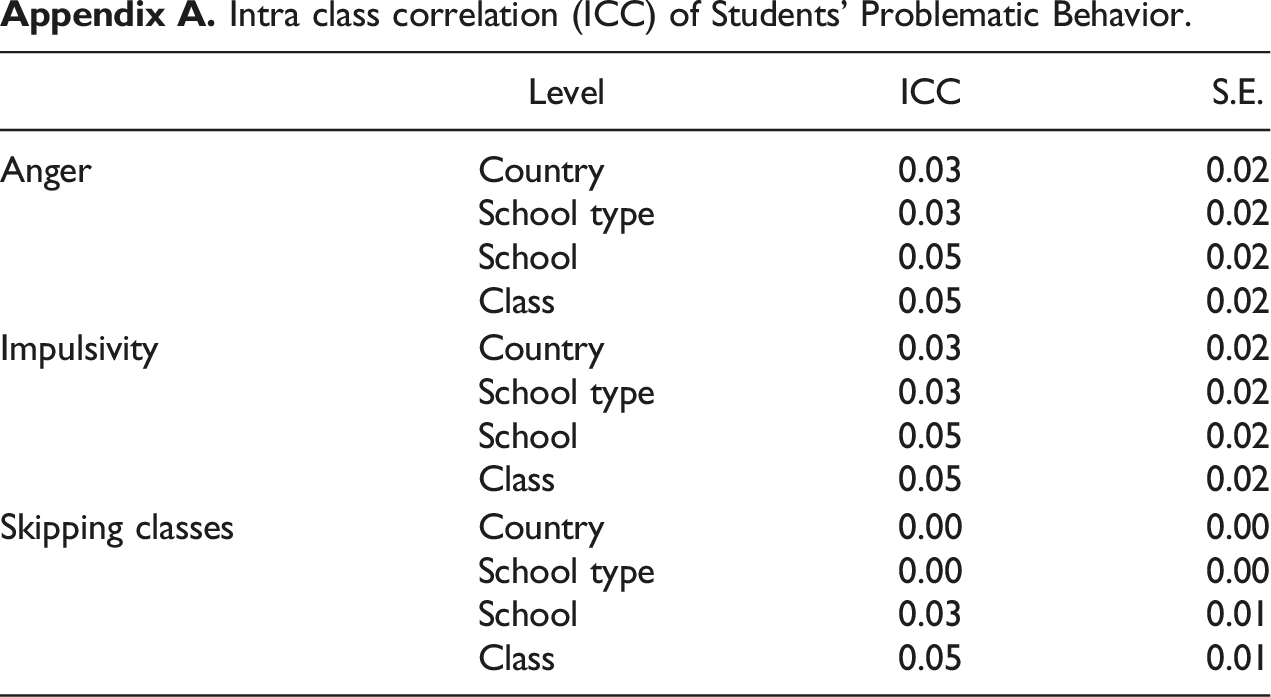
Level
ICC
S.E.
Anger
Country
0.03
0.02
School type
0.03
0.02
School
0.05
0.02
Class
0.05
0.02
Impulsivity
Country
0.03
0.02
School type
0.03
0.02
School
0.05
0.02
Class
0.05
0.02
Skipping classes
Country
0.00
0.00
School type
0.00
0.00
School
0.03
0.01
Class
0.05
0.01
Regression Equation
Level 1 (student):
Level 2 (class):
Level 3 (school):
Full Equation:
Dependent variables (Y): • Anger • Impulsivity • Skipping classes
Independent variables (X): • Parental education (5 categories with University as reference category) • Parental unemployment (3 categories with Employed as reference category) • Migration background (3 categories with No migration background as reference category) • Rejection (continuous variable) • Rejection missing (2 categories with No as reference category) • Household composition (4 categories with Both biological parents as reference category) • Academic support (continuous variable) • Academic support missing (3 categories with No as reference category) • Social support (3 categories with No as reference category) • Interaction variables (product scores) of academic support and: o Parental education (5 categories with University as reference category) o Parental unemployment (3 categories with Employed as reference category) o Migration background (3 categories with No migration background as reference category) o Rejection (continuous variable) o Household composition (4 categories with Both biological parents as reference category) • Interaction variables (product scores) of social support and: o Parental education (5 categories with University as reference category) o Parental unemployment (3 categories with Employed as reference category) o Migration background (3 categories with No migration background as reference category) o Rejection (continuous variable) o Household composition (4 categories with Both biological parents as reference category) • Sex (3 categories with Male as reference category) • Year of birth (7 categories with 1996 as reference category) • Informant parental resources (4 categories with Parent as reference category) • School-type (17 categories with the largest type in each country as reference category) • Country (4 categories with England as reference category)
Appendix C1
Multilevel OLS Regression of Anger on Student Background and Teacher Support (N = 18,308). All models control for country, school-type, gender, year of birth, informant of parental resources, and missing values on the variables of interest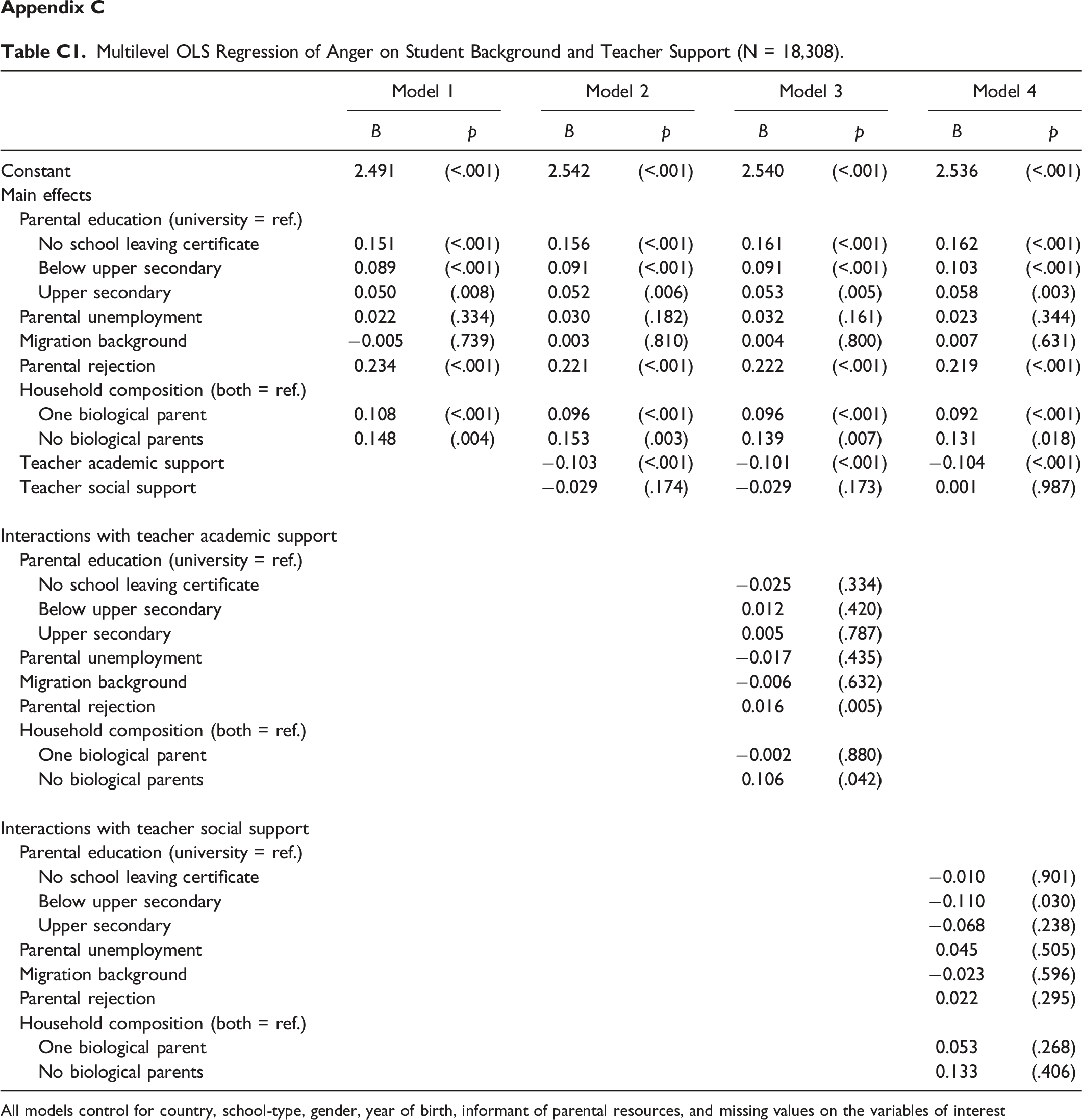
Model 1
Model 2
Model 3
Model 4
B
p
B
p
B
p
B
p
Constant
2.491
(<.001)
2.542
(<.001)
2.540
(<.001)
2.536
(<.001)
Main effects
Parental education (university = ref.)
No school leaving certificate
0.151
(<.001)
0.156
(<.001)
0.161
(<.001)
0.162
(<.001)
Below upper secondary
0.089
(<.001)
0.091
(<.001)
0.091
(<.001)
0.103
(<.001)
Upper secondary
0.050
(.008)
0.052
(.006)
0.053
(.005)
0.058
(.003)
Parental unemployment
0.022
(.334)
0.030
(.182)
0.032
(.161)
0.023
(.344)
Migration background
−0.005
(.739)
0.003
(.810)
0.004
(.800)
0.007
(.631)
Parental rejection
0.234
(<.001)
0.221
(<.001)
0.222
(<.001)
0.219
(<.001)
Household composition (both = ref.)
One biological parent
0.108
(<.001)
0.096
(<.001)
0.096
(<.001)
0.092
(<.001)
No biological parents
0.148
(.004)
0.153
(.003)
0.139
(.007)
0.131
(.018)
Teacher academic support
−0.103
(<.001)
−0.101
(<.001)
−0.104
(<.001)
Teacher social support
−0.029
(.174)
−0.029
(.173)
0.001
(.987)
Interactions with teacher academic support
Parental education (university = ref.)
No school leaving certificate
−0.025
(.334)
Below upper secondary
0.012
(.420)
Upper secondary
0.005
(.787)
Parental unemployment
−0.017
(.435)
Migration background
−0.006
(.632)
Parental rejection
0.016
(.005)
Household composition (both = ref.)
One biological parent
−0.002
(.880)
No biological parents
0.106
(.042)
Interactions with teacher social support
Parental education (university = ref.)
No school leaving certificate
−0.010
(.901)
Below upper secondary
−0.110
(.030)
Upper secondary
−0.068
(.238)
Parental unemployment
0.045
(.505)
Migration background
−0.023
(.596)
Parental rejection
0.022
(.295)
Household composition (both = ref.)
One biological parent
0.053
(.268)
No biological parents
0.133
(.406)
Appendix C2.
Multilevel OLS Regression of Impulsivity on Student Background and Teacher Support (N = 18,308) All models control for country, school-type, gender, year of birth, informant of parental resources, and missing values on the variables of interest.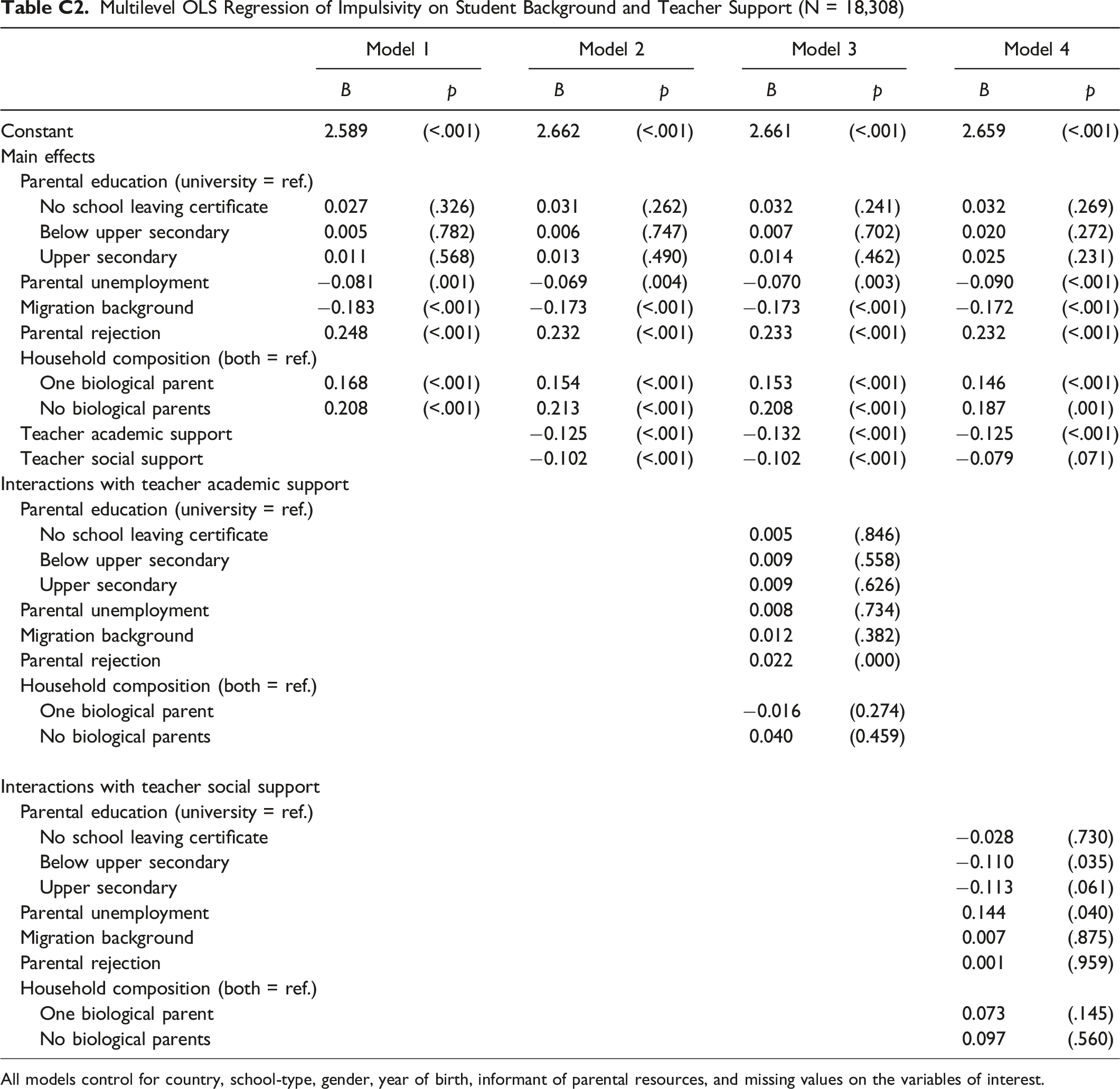
Model 1
Model 2
Model 3
Model 4
B
p
B
p
B
p
B
p
Constant
2.589
(<.001)
2.662
(<.001)
2.661
(<.001)
2.659
(<.001)
Main effects
Parental education (university = ref.)
No school leaving certificate
0.027
(.326)
0.031
(.262)
0.032
(.241)
0.032
(.269)
Below upper secondary
0.005
(.782)
0.006
(.747)
0.007
(.702)
0.020
(.272)
Upper secondary
0.011
(.568)
0.013
(.490)
0.014
(.462)
0.025
(.231)
Parental unemployment
−0.081
(.001)
−0.069
(.004)
−0.070
(.003)
−0.090
(<.001)
Migration background
−0.183
(<.001)
−0.173
(<.001)
−0.173
(<.001)
−0.172
(<.001)
Parental rejection
0.248
(<.001)
0.232
(<.001)
0.233
(<.001)
0.232
(<.001)
Household composition (both = ref.)
One biological parent
0.168
(<.001)
0.154
(<.001)
0.153
(<.001)
0.146
(<.001)
No biological parents
0.208
(<.001)
0.213
(<.001)
0.208
(<.001)
0.187
(.001)
Teacher academic support
−0.125
(<.001)
−0.132
(<.001)
−0.125
(<.001)
Teacher social support
−0.102
(<.001)
−0.102
(<.001)
−0.079
(.071)
Interactions with teacher academic support
Parental education (university = ref.)
No school leaving certificate
0.005
(.846)
Below upper secondary
0.009
(.558)
Upper secondary
0.009
(.626)
Parental unemployment
0.008
(.734)
Migration background
0.012
(.382)
Parental rejection
0.022
(.000)
Household composition (both = ref.)
One biological parent
−0.016
(0.274)
No biological parents
0.040
(0.459)
Interactions with teacher social support
Parental education (university = ref.)
No school leaving certificate
−0.028
(.730)
Below upper secondary
−0.110
(.035)
Upper secondary
−0.113
(.061)
Parental unemployment
0.144
(.040)
Migration background
0.007
(.875)
Parental rejection
0.001
(.959)
Household composition (both = ref.)
One biological parent
0.073
(.145)
No biological parents
0.097
(.560)
Appendix C3
Multilevel OLS Regression of Skipping Classes on Student Background and Teacher Support, with Robust Standard Errors (N = 18,308) All models control for country, school-type, gender, year of birth, informant of parental resources, and missing values on the variables of interest.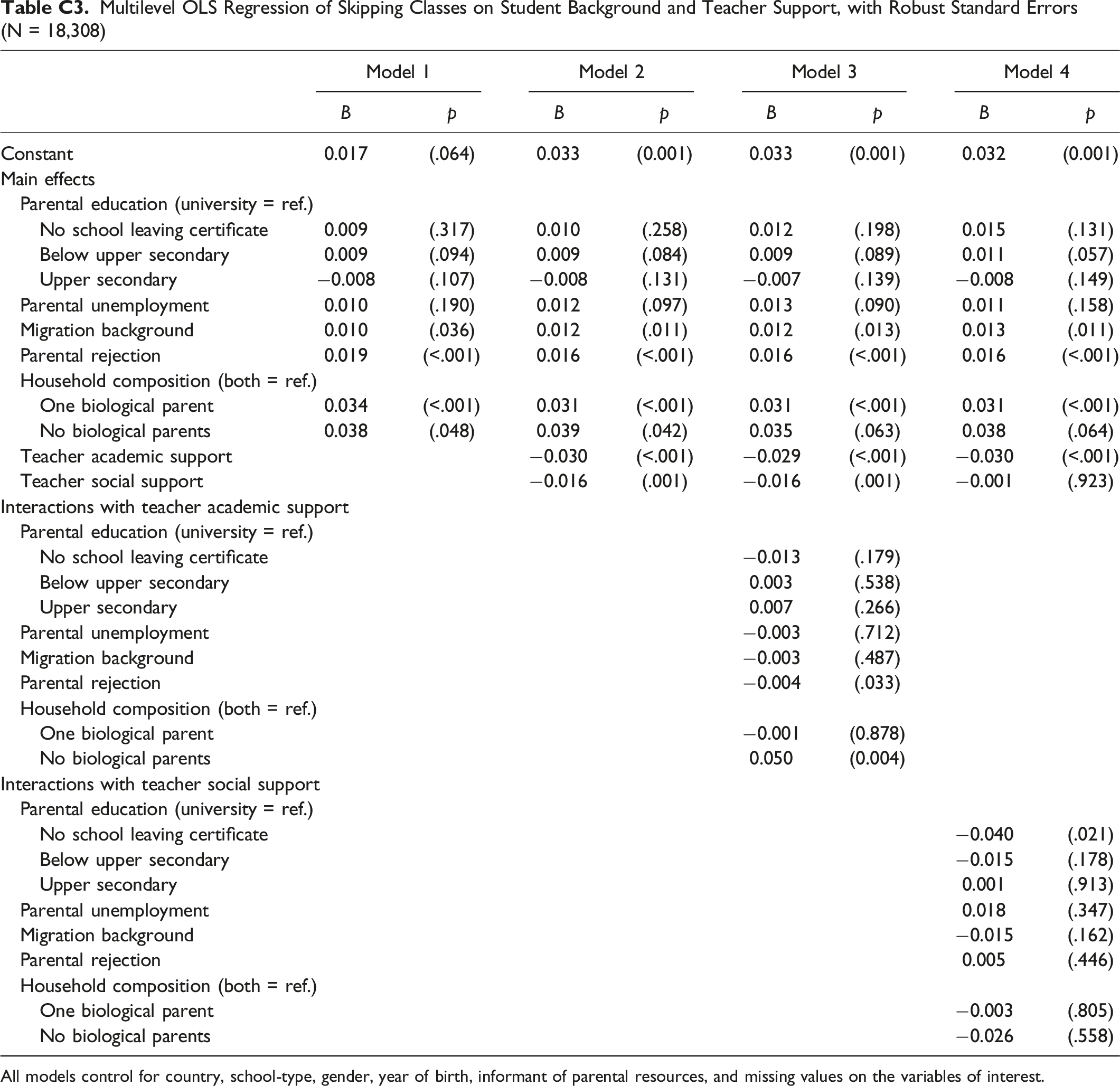
Model 1
Model 2
Model 3
Model 4
B
p
B
p
B
p
B
p
Constant
0.017
(.064)
0.033
(0.001)
0.033
(0.001)
0.032
(0.001)
Main effects
Parental education (university = ref.)
No school leaving certificate
0.009
(.317)
0.010
(.258)
0.012
(.198)
0.015
(.131)
Below upper secondary
0.009
(.094)
0.009
(.084)
0.009
(.089)
0.011
(.057)
Upper secondary
−0.008
(.107)
−0.008
(.131)
−0.007
(.139)
−0.008
(.149)
Parental unemployment
0.010
(.190)
0.012
(.097)
0.013
(.090)
0.011
(.158)
Migration background
0.010
(.036)
0.012
(.011)
0.012
(.013)
0.013
(.011)
Parental rejection
0.019
(<.001)
0.016
(<.001)
0.016
(<.001)
0.016
(<.001)
Household composition (both = ref.)
One biological parent
0.034
(<.001)
0.031
(<.001)
0.031
(<.001)
0.031
(<.001)
No biological parents
0.038
(.048)
0.039
(.042)
0.035
(.063)
0.038
(.064)
Teacher academic support
−0.030
(<.001)
−0.029
(<.001)
−0.030
(<.001)
Teacher social support
−0.016
(.001)
−0.016
(.001)
−0.001
(.923)
Interactions with teacher academic support
Parental education (university = ref.)
No school leaving certificate
−0.013
(.179)
Below upper secondary
0.003
(.538)
Upper secondary
0.007
(.266)
Parental unemployment
−0.003
(.712)
Migration background
−0.003
(.487)
Parental rejection
−0.004
(.033)
Household composition (both = ref.)
One biological parent
−0.001
(0.878)
No biological parents
0.050
(0.004)
Interactions with teacher social support
Parental education (university = ref.)
No school leaving certificate
−0.040
(.021)
Below upper secondary
−0.015
(.178)
Upper secondary
0.001
(.913)
Parental unemployment
0.018
(.347)
Migration background
−0.015
(.162)
Parental rejection
0.005
(.446)
Household composition (both = ref.)
One biological parent
−0.003
(.805)
No biological parents
−0.026
(.558)
Appendix D
Descriptive Statistics per Country (N = 18,308)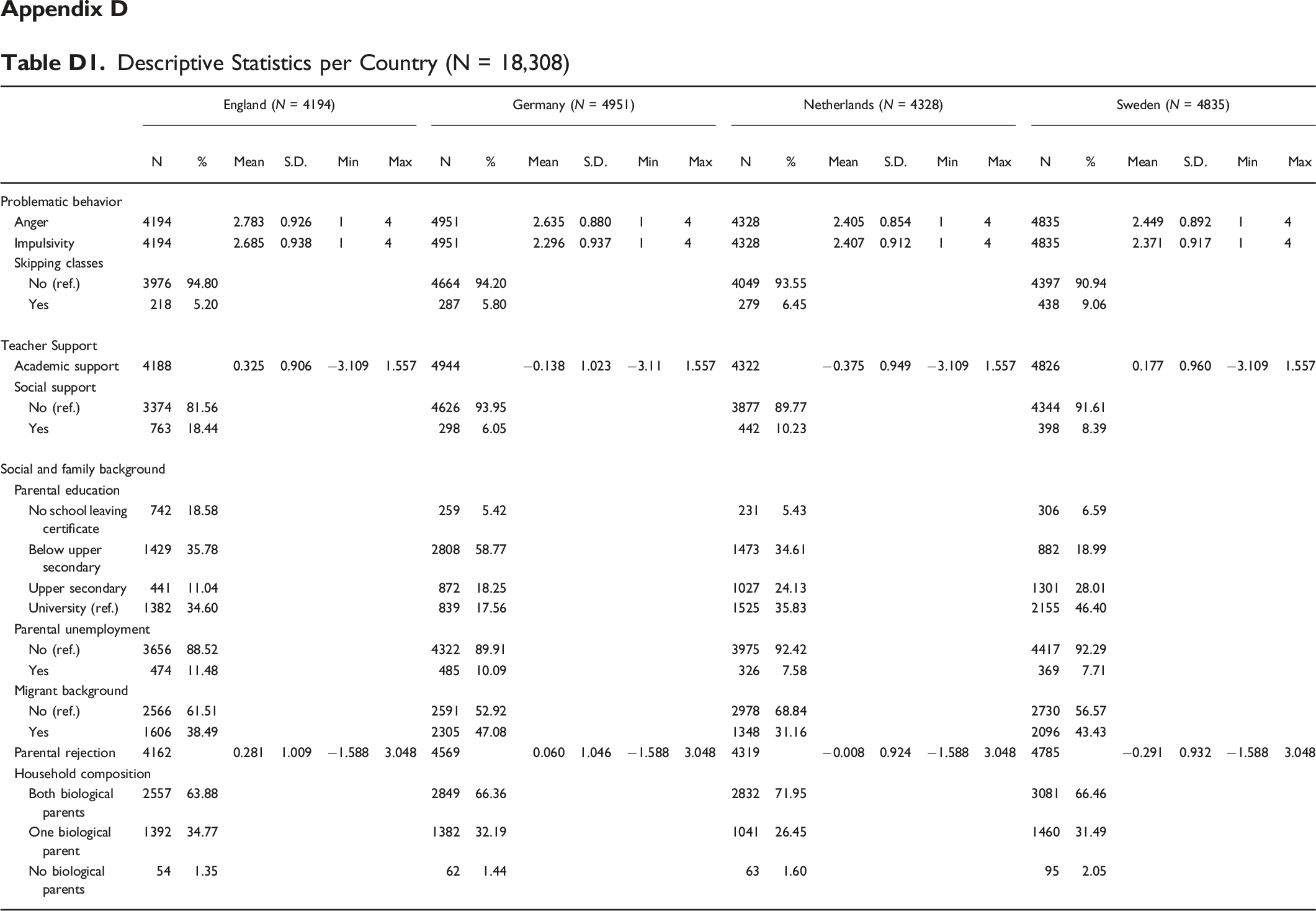
England (N = 4194)
Germany (N = 4951)
Netherlands (N = 4328)
Sweden (N = 4835)
N
%
Mean
S.D.
Min
Max
N
%
Mean
S.D.
Min
Max
N
%
Mean
S.D.
Min
Max
N
%
Mean
S.D.
Min
Max
Problematic behavior
Anger
4194
2.783
0.926
1
4
4951
2.635
0.880
1
4
4328
2.405
0.854
1
4
4835
2.449
0.892
1
4
Impulsivity
4194
2.685
0.938
1
4
4951
2.296
0.937
1
4
4328
2.407
0.912
1
4
4835
2.371
0.917
1
4
Skipping classes
No (ref.)
3976
94.80
4664
94.20
4049
93.55
4397
90.94
Yes
218
5.20
287
5.80
279
6.45
438
9.06
Teacher Support
Academic support
4188
0.325
0.906
−3.109
1.557
4944
−0.138
1.023
−3.11
1.557
4322
−0.375
0.949
−3.109
1.557
4826
0.177
0.960
−3.109
1.557
Social support
No (ref.)
3374
81.56
4626
93.95
3877
89.77
4344
91.61
Yes
763
18.44
298
6.05
442
10.23
398
8.39
Social and family background
Parental education
No school leaving certificate
742
18.58
259
5.42
231
5.43
306
6.59
Below upper secondary
1429
35.78
2808
58.77
1473
34.61
882
18.99
Upper secondary
441
11.04
872
18.25
1027
24.13
1301
28.01
University (ref.)
1382
34.60
839
17.56
1525
35.83
2155
46.40
Parental unemployment
No (ref.)
3656
88.52
4322
89.91
3975
92.42
4417
92.29
Yes
474
11.48
485
10.09
326
7.58
369
7.71
Migrant background
No (ref.)
2566
61.51
2591
52.92
2978
68.84
2730
56.57
Yes
1606
38.49
2305
47.08
1348
31.16
2096
43.43
Parental rejection
4162
0.281
1.009
−1.588
3.048
4569
0.060
1.046
−1.588
3.048
4319
−0.008
0.924
−1.588
3.048
4785
−0.291
0.932
−1.588
3.048
Household composition
Both biological parents
2557
63.88
2849
66.36
2832
71.95
3081
66.46
One biological parent
1392
34.77
1382
32.19
1041
26.45
1460
31.49
No biological parents
54
1.35
62
1.44
63
1.60
95
2.05