




Abstract
This study examined pathways from prosocial behaviour in the beginning of the school year to emotional health and academic achievement in the end of the year, taking into account the mediating role of peer acceptance. Participants were 734 grade 4 to 7 students in public elementary schools (51% female) in Western Canada. As expected, pathway analyses taking into account the clustered structure of the data indicated that self-reported prosocial behaviour in the beginning of the school year was significantly related higher levels of self-reported optimism, lower levels of depressive symptoms, and better grades in the end of the year; the association was mediated by peer-reported peer acceptance in the classroom. Findings support the role of peer acceptance as an underlying mechanism involved in the association between prosocial behaviour and positive developmental health outcomes in early adolescence. Findings are also practically relevant as they inform school-based social-emotional competence promotion through interventions.
Keywords
Prosocial behaviour is a key resource in development that contributes to positive youth development and thriving in life. More than two decades of research have shown that prosocial behaviour is associated with social, emotional, and psychological benefits in childhood and adolescence, including high quality relationships with peers and adults (Longobardi et al., 2021; Ma et al., 2020; Padilla-Walker & Carlo, 2015; Padilla-Walker et al., 2015; Wentzel, 2016), positive mental health (Layous et al., 2012; Paviglianiti & Irwin, 2017), and academic success (Caprara et al., 2000; Caprara et al., 2014; Jones et al., 2015; Longobardi et al., 2021; Malecki & Elliot, 2002). Prosocial behaviour entails voluntary acts that benefit others (Eisenberg et al., 2006), such as cooperating, kindness and sharing. Motivation for prosocial behaviour differs and can include concern for others, anticipation of approval or reward, a sense of justice, a desire to act in accordance with norms, or to fulfill a duty (Eisenberg et al., 2015).
The benefits of prosocial behaviour have been emphasized; however, less is known about specific pathways through which prosocial behaviour shapes developmental outcomes, such as improved social relationships resulting from prosocial behaviour in interaction with others. Peer relationships in particular need to be examined when connecting prosocial behaviour to developmental outcomes in early adolescence since it is a time when young people increasingly rely on their peers for social experiences and connectedness (Brown & Braun, 2013; Lam et al., 2014). To date, a majority of research examining prosocial behaviour in relation to developmental outcomes has been conducted with younger children and with older adolescents, and relatively few studies have focused on early adolescence in particular. Understanding the association between prosocial behaviour and developmental outcomes in the school context is critical in early adolescence because it can inform school-based interventions to enhance social-emotional health and academic success as young people are transitioning from childhood to adolescence (Silke et al., 2018). In fact, early adolescence has been described as a window of opportunity for fostering social-emotional skills and positive behaviours that support trajectories of thriving in adolescence (Phelps et al., 2009; Yeager, 2017).
The present study was informed by a positive youth development (PYD) framework which assumes that all children have the potential to thrive and that there are internal and external mechanisms and processes (i.e., personal and ecological assets) that can be enhanced to contribute to young people’s wellbeing (Theokas et al., 2016). In PYD, prosocial behaviour can be understood as a personal asset as it contributes to thriving and involves positive social values (e.g., caring, social responsibility) and social-emotional competence in youth (Lerner et al., 2009; Scales, Benson, Roehlkepartain, Sesma Jr, & van Dulmen, 2006). Positive relationships with peers can be understood as an ecological asset in PYD because the peer group is a key developmental context where early adolescents can experience social support, connectedness and belonging and these are important contributors to thriving (Thomson et al., 2018). PYD postulates that thriving is a developmental outcome that results from beneficial bidirectional relationships between individuals and their context and that can be actively supported in early adolescents (e.g., through school-based interventions), by cultivating personal and ecological assets (Taylor et al., 2017; Theokas et al., 2016).
The goal of this study was to examine the association between early adolescents’ prosocial behaviour in the beginning of school year and academic achievement and emotional health in the end of the school year, taking into account an indirect pathway through peer acceptance reported by peers in the middle of the school year (see Figure 1). This study contributes to existing research on prosocial behaviours in various ways. First, there is limited research on prosocial behaviours in relation to early adolescent outcomes taking into account multiple domains, namely social (i.e., peer acceptance), emotional (i.e., depressive symptoms, optimism), and academic (end-of-year grades) development. Second, even though prosocial behaviour has been associated with positive peer relationships in past research (Ma et al., 2020; Portt et al., 2020) and positive peer relationships have been consistently related to emotional health (Aldridge & McChesney, 2018; Oberle, 2018) and academic achievement (Wentzel, 2017), there is a shortage of research linking these domains of development and examining peer acceptance in the classroom as a potential mediator between prosocial behaviour and developmental outcomes. An exception is a study with elementary school children in China that found that peer relationships mediated the association between prosocial behaviour and academic success (Guo et al., 2018); however, the study did not examine emotional health and we are not aware of similar research conducted with early adolescents in Western countries. Third, this study addresses limitations that arise from common method variance (e.g., shared variance in self-report measures) by using a multiple measures approach. Specifically, early adolescents’ self-reports of prosocial behaviour goals at the beginning of the school year were connected to peer-reports of peer acceptance in the middle of the school year and to self-reported emotional health and teacher-reported academic grades (i.e., English Literacy, Mathematics) in the end of the school year. Analytical model with direct and indirect pathways from prosocial behaviour to emotional and academic adjustment in school.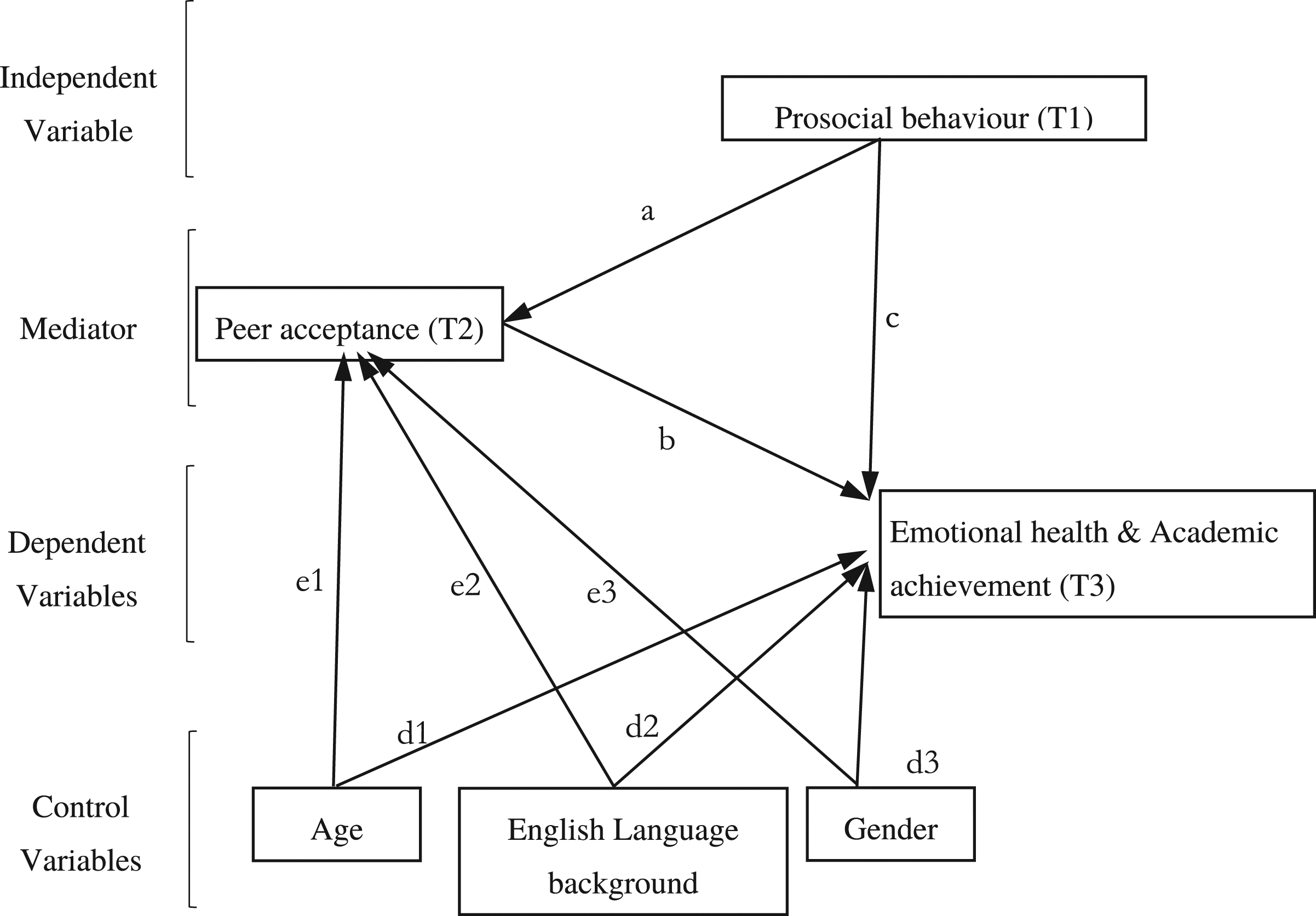
Based on previous research (Caprara et al., 2014; Caprara et al., 2015; Jones et al., 2015; Layous et al., 2012; Paviglianiti & Irwin, 2017), we hypothesized that prosocial behaviour in the beginning of the school year would be related to higher levels of optimism, lower levels of depressive symptoms, and better academic achievement in the end of the school year. Based on emerging evidence (Guo et al., 2018), we further hypothesized that peer acceptance would significantly mediate the link between prosocial behaviour and positive academic outcomes. Due to the lack of previous research, examining peer acceptance as a mediator between prosocial behaviour and emotional health was an exploratory research question in this study.
Method
Sample
Participants were 734 students in public elementary schools (K-7) in 4th to 7th grade (51% female). Students were from 38 classrooms located in 18 schools in a large, urban, public school district in Southwestern Canada. The median family income in neighbourhoods in which schools were located ranged from CA$ 62,976 to CA$ 135,424 (M = CA$ 87,235, SD = CA$ 17,560) (Statistics, 2018). A total of 26 students were in 4th grade, 137 students were in 5th grade, 239 students were in 6th grade, and 332 students were in 7th grade. Students’ ages ranged from 7.92 to 13.28 (M = 11.59, SD = 0.90). 73.3% reported English as a first language learned at home. Other first languages reported by more than five percent of students were Cantonese (12.9%), Mandarin (12.9%) and Filipino (7.8%).
A total of 576 students (78%) participated in the study at all three time points and therefore had linkable data that were included in analyses of emotional health. The main reasons for attrition were absence on a day of data collection and students having moved to another school.
Procedure
Student self-report data were collected in October/November 2018 (Time 1), January/February 2019 (Time 2), and April/May 2019 (Time 3). End-of-year academic achievement data were obtained from school records in June 2019. Ethics approval for this research was obtained from the (Institution BLINDED) and from the participating school district. To recruit students for participation, all school administrators in the participating district were invited to extend an invitation to classroom teachers in their schools who taught grades 4 to 7. Teachers who responded and indicated interest in participating in the study were provided with further information, and we held an information session about the study for them and their students in the classroom. Once teachers supported the research in their classroom, we distributed consent forms among students to obtain active parent consent for students’ participation. On the day of data collection, students provided assent for participation. Seventy-eight percent of the students who were invited to participate received consent and gave assent. The survey was paper-based and administered by a team of university researchers during a 1-hour classroom visit at each time point; all items were read out loud to adjust for differences in reading ability. At any time during implementation, students could ask the researchers questions if they didn’t understand survey items. Each participating classroom received a monetary gift as a sign of appreciation for the students’ participation.
Measures
Demographic Background
Students completed a brief demographic section, indicating their birth date, gender (female = 286, male = 284), and first language learned at home (English first language = 414, First language other than English = 162). A variable for age was computed based on birthdate (M = 11.59, SD = 0.90).
Prosocial Behaviour
The 6-item prosocial behaviour goals subscale of the Social Goals Questionnaire (Wentzel, 1993) was used to assess early adolescents’ goals to demonstrate prosocial behaviour in social interactions. Sample items: “How often do you try to: …help other kids when they have a problem; …help your classmates learn new things; …cheer someone up when something has gone wrong?”. Response options ranged from 1 (Never) to 5 (Always). Prosocial behaviour scores ranged from 1 to 5 (M = 3.61 SD = .70). Internal consistency was good for this scale (Cronbach’s
Peer Acceptance
Following established procedures to assess peer acceptance in the classroom (Layous et al., 2012; Oberle et al., 2010; Parkhurst & Asher, 1992), students were provided with a roster of their classmates and asked to circle the names of students (fellow participants) who they “would like to be in activities [i.e., spend time] with”. Students were instructed that they could circle as many or few names as they liked. The percentage of nominations each student received was computed by dividing the number of nominations received by the total number of participating students in the classroom (i.e., possible nominations). Peer acceptance scores thus represent aggregated perceptions of all classmates, standardized according to classroom size.
Emotional Health
Optimism was measured with a 9-item subscale of the Resiliency Inventory (Noam & Goldstein, 1998). Sample items: “I think that I am a lucky one”; “I start most days thinking I will have bad day” (reverse coded). Internal consistency was acceptable for this scale (Cronbach’s
Academic Achievement
End-of-school year grades in the subject domains English literacy and Math were used as indicators for academic achievement. Grades were retrieved from academic records that schools had submitted to the school district. Grade categories and respective interpretation provided by the school district were A (excellent or outstanding performance; 86–100%), B (very good performance; 73–85%), C+ (good performance; 67–72%), C (satisfactory performance; 60–66%), C– (minimally acceptable performance; 50–59%), and F (Failed or failing; 0–49%). Performances are evaluated in relation to expected learning outcomes for the course, subject, and grade. For further analyses, letter grades ranging from A to F were recoded into numeric achievement indicators ranging from 6 (A) to 1 (F); higher numbers indicate higher achievement. Mean achievement for math was 3.93 (SD = 1.18) which is considered “good”; mean achievement for English literacy was 3.39 (SD = 1.16) which is beween “satisfactory” to “good”.
Statistical Analyses
Data were analysed in Mplus 8 (Muthén & Muthén, 2017). First, data missingness was examined in the analytic sample. For self-report variables, missingness ranged from 0.2% to 0.7%. Regarding academic achievement, for 15% of the children, there was no linkable math grade and for 7% of children, there was no linkable English literacy grade available through school records. Full Information Maximum Likelihood (FIMIL) was used to handle missing values (Muthén & Muthén, 2017).
Means, Standard Deviations, and Correlations With Confidence Intervals.
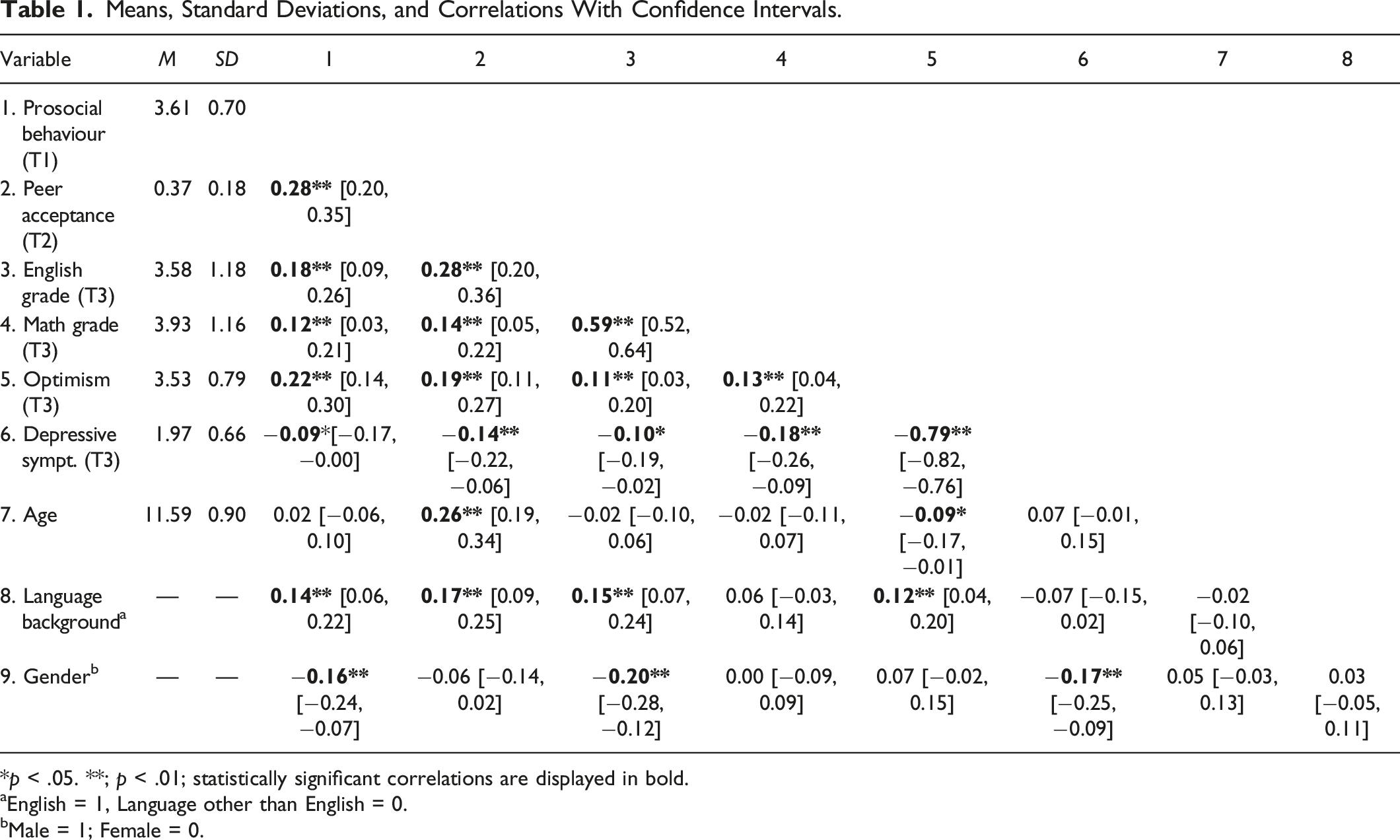
*p < .05. **; p < .01; statistically significant correlations are displayed in bold.
aEnglish = 1, Language other than English = 0.
bMale = 1; Female = 0.
Results
Means, standard deviations, and intercorrelations of all measures are reported in Table 1. Prosocial behaviour was significantly related to higher levels of peer acceptance, more optimism, higher Math and English grades, and lower levels of depressive symptoms. Peer acceptance was significantly related to higher levels of optimism, higher Math and English grades, and lower levels of depressive symptoms. Being male was significantly related to lower prosocial behaviour scores, lower English grade, and lower levels of depressive symptoms. Having learned English as a first language was related to higher prosocial behaviour scores, higher levels of peer acceptance, more optimism, and higher English grade.
Pathways from Prosocial Behaviour to Emotional Health
Direct and indirect Pathways From Prosocial Behaviour to Emotional Health and Academics.
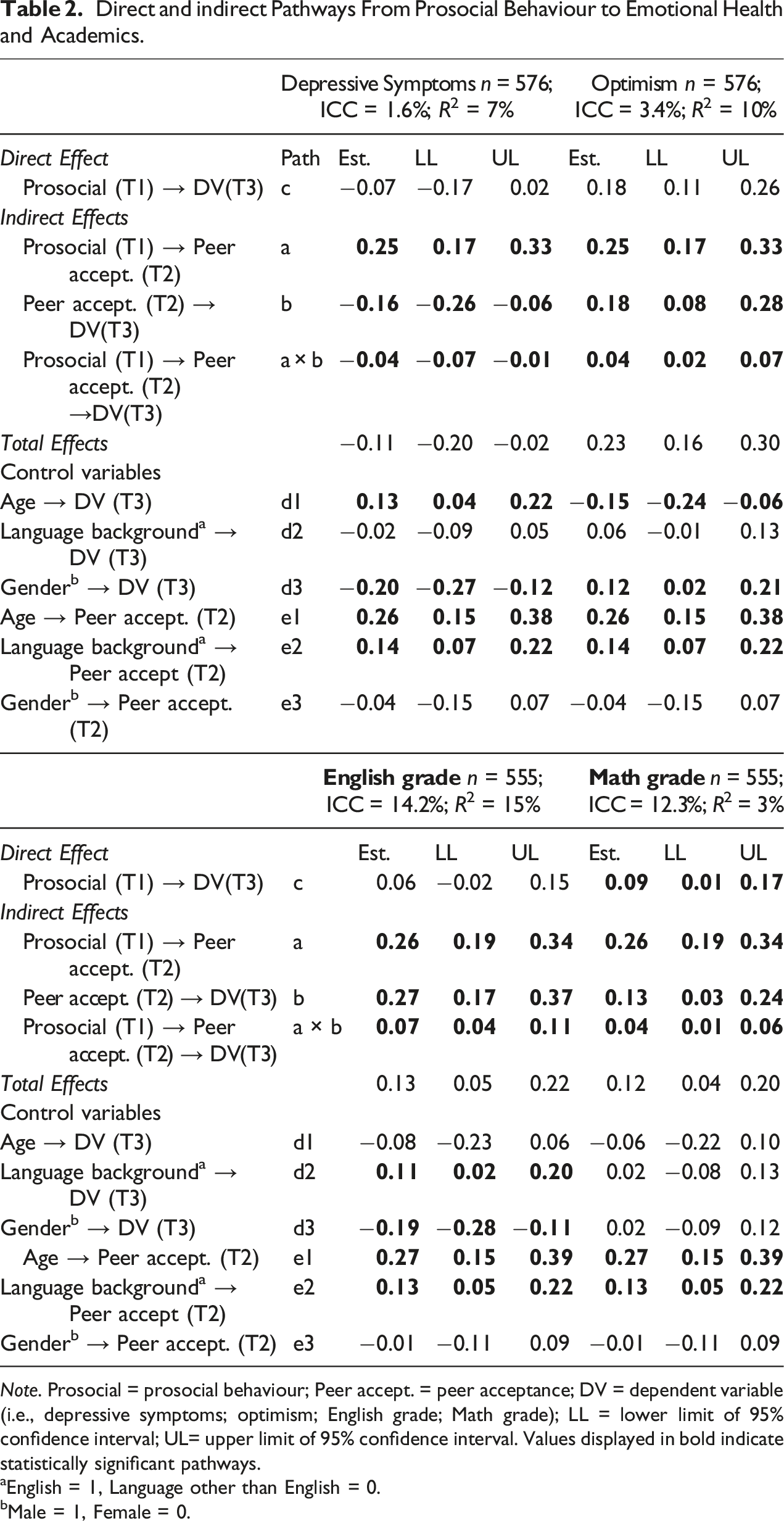
Note. Prosocial = prosocial behaviour; Peer accept. = peer acceptance; DV = dependent variable (i.e., depressive symptoms; optimism; English grade; Math grade); LL = lower limit of 95% confidence interval; UL= upper limit of 95% confidence interval. Values displayed in bold indicate statistically significant pathways.
aEnglish = 1, Language other than English = 0.
bMale = 1, Female = 0.
When examining optimism as an emotional health indicator, the direct pathway from prosocial behaviour to optimism was positive and significant (est. = 0.18, 95% CI [0.11, 0.26]). In addition, similar to the finding for depressive symptoms, there was a significant indirect pathway through peer acceptance. Specifically, prosocial behaviour at T1 was significantly and positively related to peer acceptance at T2 (est. = 0.25, 95% CI [0.17, 0.33]); peer acceptance at T2 was significantly and positively related to optimism at T3 (est. = 0.18, 95% CI [0.08, 0.28]). Peer acceptance partially mediated the relationship between prosocial behaviour and optimism (est. = 0.04, 95% CI [0.02, 0.07]). Regarding control variables (see Table 2), being female was related to lower levels of optimism; speaking English as a first language was related to higher levels of peer acceptance; age was related to higher levels of peer acceptance and to lower levels of optimism. The path model explained 10% of variance in optimism.
Pathways from Prosocial Behaviour to Academic Achievement
There was no direct effect of prosocial behaviour on English grade (est. = 0.06, 95% CI [−0.02, 0.15]) but there was a significant indirect effect through peer acceptance (est. = 0.07, 95% CI [0.04, 0.11]). Similar to the finding for emotional health, the path from prosocial behaviour at T1 to peer acceptance at T2 was significant and positive (est. = 0.26, 95% CI [0.19, 0.34]) and the path from peer acceptance at T2 to end-of-year English grade was significant and positive (est. = 0.26, 95% CI [0.17, 0.37]). Regarding control variables, speaking English as a first language and being female were both related to having received a better end-of-year English grade. The path model explained 15% of variance in English grades.
The pattern of findings for predicting end-of-year Math grades were similar. The direct path from prosocial behaviour to Math grade was significant (est. = 0.09, 95% CI [0.01, 0.17]) and the effect was furthermore partially mediated by peer acceptance (est. = 0.04, 95% CI [0.01, 0.06]). The path from prosocial behaviour at T1 to peer acceptance at T2 was significant and positive (est. = 0.26, 95% CI [0.19, 0.34]) and the path from peer acceptance at T2 to end-of-year Math grade was significant and positive (est. = 0.13, 95% CI [0.03, 0.24]). Regarding controls, neither speaking English as a first language nor gender were significantly related to Math grade. The path model explained 3% of variance in Math grades.
Discussion
The present study was guided by a PYD framework and examined pathways from prosocial behaviour to emotional health and academic achievement in early adolescents over the course of one school year, taking into account the mediating role of peer acceptance. Consistent with previous research (Caprara et al., 2014, 2015; Jones et al., 2015; Layous et al., 2012; Paviglianiti & Irwin, 2017) and consistent with theory on PYD (Lerner et al., 2009), we found that early adolescents with higher levels of prosocial behaviour in the beginning of the school year also had higher levels of optimism, lower levels of depressive symptoms, and better academic achievement in the end of the school year. Furthermore, we found that the association between prosocial behaviour and positive outcomes was mediated by peer acceptance in the classroom in the middle of the school year.
Identifying peer acceptance as a mediator between prosocial behaviour and academic achievement contributes to research on early adolescent positive youth development and is in alignment with a previous study. Specifically, our findings are aligned with findings from a large-scale study conducted with early adolescents in China (Guo et al., 2018) and extend the evidence to the North American context. Further, while previous research had solely focused on early adolescent academic outcomes (Guo et al., 2018), we found a similar pattern when predicting emotional health outcomes, with peer acceptance in the middle of the school year significantly mediating the association between prosocial behaviour reported in the beginning of the year and optimism and depressive symptoms in the end of the school year. This finding is important because it confirms the important role of peer acceptance in whole-child development including both academic and emotional health domains in development (Lewallen, Hunt, Potts-Datema, Zaza, & Giles, 2015). The pathways found in this study support theoretical perspectives arguing that display of prosocial behaviour is key for the formation of positive relationships with peers (Wentzel, 2014) and that acceptance by peers is a key asset that promotes emotional health and resilience in early adolescence (Jose et al., 2012). They furthermore underscore the importance of prosocial behaviour and peer acceptance as personal and ecological assets that contribute to early adolescents’ thriving in school (Theokas et al., 2016).
From a practical perspective, our findings support the importance of social and emotional leaning (SEL) in schools to teach students core social and emotional competencies (including prosocial behaviours) to foster emotional health and academic achievement (Brackett et al., 2012; Caprara et al., 2000; Domitrovich et al., 2017). In fact, previous SEL program evaluation research has consistently shown that enhancing social and emotional competencies through intervention leads to better academic achievement and higher levels of wellbeing (Brackett et al., 2012; Corcoran et al., 2018; Durlak et al., 2011). A meta-analysis of the long-term effects of SEL interventions on youth development (i.e., 6 months to 18 years post-intervention) furthermore suggests that the benefits of SEL for thriving are long lasting and highlight the role of school-based SEL to support PYD (Taylor et al., 2017). Consistent with our findings, scholars have theorized that enhanced social and emotional skills improve students’ social relationships with peers and adults in school; this in turn supports students’ positive adjustment and a sense of belonging at school, helps them feel safe in the classroom, and enhances their success in social learning contexts (e.g., group projects) (Corcoran et al., 2018). Our findings can directly inform the development of SEL strategies and interventions by identifying prosocial behaviour as a key social-emotional competency that can be cultivated and enhanced through school-based interventions, such as programs involving acts-of-kindness and supporting empathy and perspective taking (Layous et al., 2012; Schonert-Reichl et al., 2012). This also corroborates findings from research on school kindness that identified different types of prosocial behaviours as specific examples of enacting kindness (Binfet & Passmore, 2019), and findings from research that situated prosocial behaviours on a developmental pathway toward social-emotional outcomes including fostering kindness (Malti & Dys, 2018).
While the findings in this study were statistically significant for all four outcomes of interest (i.e., optimism, depressive symptoms, English language grade, Math grade), there were notable differences in the strengths of the effects. Specifically, pathways explained 14% of variability in English scores and 3% of variability in Math scores. This presents a notable difference that is consistent with previous research connecting social and emotional competencies to academic outcomes. For instance, findings from a longitudinal examination of the association between social-emotional competence and academic achievement in early adolescence (Oberle et al., 2014) students’ self-reported social-emotional competence was significantly related to English reading comprehension on a standardized test whereas the relationship with math achievement was not statistically significant. Similarly, in an examination of the relation between upper-elementary students’ self-reported social skills and academic achievement (i.e., reading, math, and language), the authors only found a significant and positive correlation with language achievement (Malecki & Elliot, 2002). Finally, recent research conducted in Indonesia (Wirajaya et al., 2019) found a significant correlation between secondary students’ social-emotional competence and their English academic achievement; the amount of variability in English academic performance accounted by students’ social-emotional competence was 12.6%, which is comparable to the current study. Math achievement was not measured in this study. Scholars have argued that there is a natural affinity between English Language Arts teaching in school and social and emotional learning (e.g., empathizing with a character in a story, taking the perspective of someone else when composing a text), which may also explain the strong connection between prosocial behaviour and English language grade in the present study (Storey, 2019).
Further, the pathways explained 10% of variability in optimism scores and 7% of variability in depressive symptoms scores, suggesting a slightly stronger relationship between prosocial behaviour, peer acceptance and positive emotional wellbeing compared to emotional illbeing. Stronger relations between prosocial behaviour and positive outcomes have been found elsewhere in the research. For example, a recent study found adolescent youth’s prosocial behaviour to be positively associated with their life satisfaction 2 years later, but no significant relations to anxiety and depression (Son & Padilla-Walker, 2019). One explanation for a stronger connection between prosocial behaviour and optimism is that both variables measure positive indicators in youth development and therefore more closely aligned.
Secondary findings in this study were that identifying as a girl was significantly related to lower levels of wellbeing and higher English grades, and that having a native language background other than English was significantly related to lower levels of peer acceptance. In fact, previous research has found generally lower levels of emotional and mental wellbeing in early adolescent girls than compared to boys (e.g., Campbell et al., 2021) with a particular difference in the level of internalizing problems (e.g., depressive symptoms) (Rosenfield et al., 2005). Furthermore, a large number of studies found that girls on average score higher than boys on academic assessments in reading, language arts, and writing (see Petersen, 2018, for a review). Explanations include that language arts related subjects tend to incorporate social and emotional skills (e.g., understanding and taking the perspective of a fictional character) and early adolescent girls tend to score higher on measures of social-emotional competence than boys (West et al., 2018). Furthermore, higher levels of self-discipline in girls has been identified as a key factor that may explain differences in academic outcomes in general between boys and girls (Duckworth & Seligman, 2006) as well as part of the differences in wellbeing. Self-discipline is a facet of conscientiousness and extreme conscientiousness has also been associated with detriments to well-being (Carter et al., 2015). The finding of lower levels of peer acceptance among students whose home language was other than English corroborates previous research that found English-speaking elementary school students garnered higher levels of acceptance among peers compared to those who spoke English as a second language students (Lee et al., 2021). This pattern of preference for same-language peers has been found at all ages, but in adolescence it becomes especially salient to friendship choices (Laursen, 2017) which is also evident in our findings. Further research with a focus population subgroups needs to be conducted to examine nuances in the pathways from prosocial behaviour to emotional wellbeing and academic achievement.
Taken together, identifying pathways from prosocial behaviour to positive youth development outcomes through peer acceptance advances research on pathways of positive youth development and is of practical relevance as it can be built on to inform the development of school-based positive youth development programs.
Limitations and Future Directions
The current study design is longitudinal over a short time period (one school year) and it is correlational of nature. Causality cannot be implied in the present study. Future research needs to examine the mediating role of peer acceptance in the relation between prosocial behaviour and positive youth development outcomes over a longer time period. Further, schools and classrooms self-selected their participation in the study and they were not randomly selected. Hence, the number of children at the different grade levels who participated was not equal (i.e., grade 4 children were underrepresented and grade 7 children were overrepresented in the sample) and they do not form a representative sample. However, it should be noted that student demographics (home languages spoken by students, ages at each grade level, gender) were comparable to those typically found in the larger urban area in which the study was conducted. Future research needs to examine whether the findings are stable in specific sub-groups of the population (e.g., older adolescents, students who are special learners). Future research also needs to examine whether the pattern of findings in this study differs for subgroups of early adolescents with different motivations driving their prosocial behaviour (e.g., true concern for others vs. anticipation of reward and approval). Additionally, end-of-year academic achievement was measured through the grades students received by their classroom teacher and not through a standardized assessment. While standardized assessments are believed to be a more objective form of academic (Greene et al., 2004; O’Connor, 2007), several studies have supported end-of-year grades as a valid measure (Elias & Haynes, 2008; Juvonen et al., 2011). We believe grades assigned by teachers are appropriate to use in this study since no standardized achievement data were available. Finally, the mediating link between prosocial behaviour and positive youth development outcomes needs to be tested in experimental studies, examining whether a manipulation of prosocial behaviour through SEL intervention leads to more acceptance in the peer group which in turn then leads to changes in early adolescent outcomes.
Conclusion
Prosocial behaviour is an important social and emotional skill that contributes to positive child and youth development. In this study, higher levels of prosocial behaviour in the beginning of the school year were related to higher levels of optimism, lower levels of depressive symptoms, and better academic achievement in the end of the school year. The association between prosocial behaviour and better emotional and academic outcomes could be partially explained by peer acceptance in the classroom in the middle of the school year. This suggests that prosocial behaviour in the classroom is a key contributor to acceptance by school peers which in turn supports higher levels of wellbeing and better grades in school. This research emphasizes the importance of SEL programs and strategies to support PYD and thriving in the school context.
Footnotes
Declaration of Conflicting Interests
The author(s) declared no potential conflicts of interest with respect to the research, authorship, and/or publication of this article.
Funding
The author(s) disclosed receipt of the following financial support for the research, authorship, and/or publication of this article: This work was supported by the Spencer Foundation (201800009).
