




Abstract
This study aimed to examine the evolution of test anxiety during the transition to secondary school, a challenging period that includes a set of contextual factors that could potentially increase students’ test anxiety. In addition, to further understand the contribution of different individual factors that might increase the susceptibility to test anxiety during this transition, the study examined the role of motivation, achievement, internalizing behaviors and gender in the development of test anxiety. A total of 478 French-speaking students (231 boys, 247 girls) were followed during their transition to secondary school. Latent growth analysis revealed an overall stable trajectory of test anxiety during the transition to secondary school. However, internalizing behaviors and gender moderated the trajectory over time. Additionally, high initial levels of internalizing behaviors, as well as lower grades in mathematics, were associated with initial levels of test anxiety, as measured at the end of elementary school.
Introduction
The transition from elementary to secondary school is known to be challenging for all students, regardless of their gender or socioeconomic status (Couture, 2019; Wigfield et al., 2006). This transition coincides with important developmental changes and increased stress levels (Lupien et al., 2001). In addition, this school transition represents a period during which students must adjust to important changes in the school structure, teachers’ expectations, and social relationships (Eccles et Roeser, 2003; Midgley et al., 2002; Whitley et al., 2007). For example, the school structure with one teacher per group of students is replaced by a structure with different teachers for each class, larger groups and potentially a less personalized approach (Duchesne et al., 2012). According to students, compared to elementary school teachers, secondary school teachers are more distant and generally more controlling with their students, providing fewer opportunities for them to make choices on their own (Wigfield et al., 1998). Consequently, the transition to secondary school is usually associated with decreases in achievement and motivational indicators, such as expectations of success, task values, and academic self-concept (Bouffard et al., 2001; Evans et al., 2018).
The primary-secondary school transition could also be a turning point in the development of test anxiety, a specific type of anxiety that stems from evaluative situations that are perceived as ego-threatening (Khalaila, 2015; Putwain, 2008; Putwain & Symes; 2012; Zeidner & Matthews, 2011; Zeidner & Schleyer, 1998). Test anxiety is generally conceptualised as a situation-specific trait (Putwain et al., 2021) especially prompted by competitive and performance-oriented contexts (Mueller & Dweck, 1998; Stan & Oprea, 2015). In other words, susceptible individuals placed in evaluative situations are likely to experience test anxiety, characterized by extensive worry, intrusive thoughts, and physiological arousal (Spielberger et al., 1976; Spielberger & Vagg, 1995). Past research showed that as many as 40% of students experience test anxiety at a moderate level, while more than 10% of elementary and secondary school students report high levels of test anxiety (Chapell et al., 2005; Herzer et al., 2015; Plante, 2019; Putwain et al., 2021; von der Embse et al., 2018). Test anxiety is, among other things, associated with various negative consequences such as lower cognitive performance, higher task disengagement, absenteeism (Burcaş & Creţu, 2020; von der Embse et al., 2018; Zeidner & Matthews, 2011), increased levels of negative self-perceptions (Herzer et al., 2015), slower academic progress (Cizek & Burg, 2006; von der Embse & Hasson, 2012), and greater probability of school dropout (Brière et al., 2017; Khalaila, 2015).
Test anxiety can occur during regular classroom assessment, but is amplified by the importance placed on evaluations (Putwain & von der Embse, 2021). In fact, test anxiety was found to be more prevalent in high-stakes testing situations (Segool et al., 2013). Such high-stakes evaluations are generally used in many countries. For example, in the United States, elementary and secondary school students are evaluated every year using standardized tests. In Canada, elementary school students are subject to high-stakes evaluations only twice, namely at the end of grade 4 and grade 6 and exclusively for mathematics and language arts. In secondary school, although standardized tests are not used every year, high-stakes assessments are more frequent and important, as they are used to qualify students for subsequent educational pathways and ultimately to obtain a secondary school diploma. Furthermore, secondary school evaluative practices are typically more oriented towards peer comparisons than elementary school ones (Chouinard et al., 2005).
Such observations suggest that the beginning of secondary school could exacerbate test anxiety, a possibility that the current study intends to empirically examine. To do so, the study was designed to take advantage of the contextual factors inherently involved in the transition to secondary school and simultaneously to examine individual-level predictors of text anxiety. In an extensive meta-analysis, von der Embse et al. (2018) showed that a variety of individual factors, studied independently mainly among adult samples, were related to test anxiety. These individual variables included motivational factors (e.g., self-concept), psychological factors (e.g., personality traits) and achievement-related factors (e.g., GPA scores). Based on these results, there are reasons to believe that some specific individual factors might be particularly involved in the intra-individual variations of test anxiety during the transition to secondary school. In order to ease the transition for students, examining a combination of individual factors that might increase students’ susceptibility to test anxiety seems essential to provide a more comprehensive understanding of its development.
Individual Predictors of Test Anxiety
In the current study, several individual factors were selected as predictors because they are expected to be especially relevant to understand test anxiety in the school context, and more specifically during the transition to secondary school. In particular, our study combined gender with other individual factors related to motivational beliefs (achievement motivation, i.e., expectations of success, task values and academic self-concept), school performance (initial achievement), and psychological vulnerabilities (internalizing behaviors).
Achievement Motivation
The concept of achievement motivation is often studied using expectancy-value theory (Barron & Hulleman, 2015; Eccles & Wigfield, 2002; Gaspard et al., 2018; Plante et al., 2013; Schunk et al., 2014). This social-cognitive theory postulates that motivation depends on two main indicators, namely students’ expectations of success and the value attributed to a task. The first refers to students’ self-perceptions about their ability to succeed; the latter includes students’ perceptions of the importance and utility of a learning task, as well as their interest for the task or domain (Eccles & Wigfield, 2002; Gaspard et al., 2018).
From a theoretical perspective, expectations of success should lead students to remain engaged in the task, even in stressful or competitive situations, therefore decreasing their test anxiety. Indeed, the few available studies on expectations of success and test anxiety show that students with low expectations of success report higher levels of test anxiety (Wigfield & Eccles, 1989; Zeidner & Matthews, 2011). The effect of high task values on test anxiety is less clear. On the one hand, it would be reasonable to expect that task values, known to promote positive behaviors and attitudes in school (Plante et al., 2013), would also be linked to lower levels of test anxiety. On the other hand, experimental studies have found that placing a high value on a task might paradoxically produce decrements in cognitive performance, a phenomenon known as “choking under pressure” (Beilock & Carr, 2001; Yu, 2015). In a similar way, it is therefore possible that high task value will increase students’ test anxiety.
Another widely used achievement motivation indicator is academic self-concept. Contrary to students’ expectations of success that are domain-specific, academic self-concept relates to students’ perceptions of their abilities in school across domains (Jonkman et al., 2012). Various studies have shown that academic self-concept is negatively associated with students’ test anxiety, perhaps in part because both factors stem from social comparison (Wigfield et al., 1998; Zeidner & Matthews, 2011). In fact, studies usually show that when students perform poorly in school, especially if they perform below the class average, they report lower academic self-concept and higher levels of test anxiety (Zeidner & Schleyer, 1998). Conversely, students who feel more competent than their peers show higher levels of academic self-concept and tend to be less anxious about evaluations (Zeidner & Matthews, 2011). On the whole, these results suggest that students’ motivational beliefs, as measured with expectancy-value indicators or academic self-concept, are likely to decrease their vulnerability to test anxiety during the primary-secondary school transition, as reflected by lower initial levels of test anxiety as well as less increase in test anxiety during the transition.
Initial Achievement
Students’ prior achievement in school is also likely to shape their level of test anxiety during the transition to secondary school. Most studies conducted in school settings have conceptualized test anxiety as a negative predictor of future performance or achievement (see Zeidner & Matthews, 2011 for an extensive review). From a theoretical perspective, it is also expected that previous achievement will predict future test anxiety. For instance, one could argue that students with high levels of test anxiety will become lower achievers, which, in turn, might increase their future levels of test anxiety. One of the only studies aimed at examining this latter hypothesis was conducted among undergraduate students and showed that, as predicted, low achievers experienced more test anxiety compared to high achievers (Khalid & Hasan, 2009). Hence, this finding raises the possibility that low achievement at the end of elementary school could predict greater test anxiety at the same timepoint, as well as an increase in test anxiety during the transition to secondary school.
Internalizing Behaviors
Another important potential predictor of students’ test anxiety is their levels of internalizing behaviors, which include different types and intensity of anxiety and depressive manifestations (Duchesne et al., 2012; Smith Carter et al., 2006). Contrary to test anxiety which comprises a state component triggered by evaluative situations, internalizing behaviors represent a more stable and general tendency to manifest worries and intrusive thoughts in everyday life (Segool et al., 2013; Zeidner & Matthews, 2011). Individuals with internalizing behaviors experience not only anxiety manifestations but also other types of symptoms unrelated to anxiety such as depressive thoughts and social withdrawal (Smith Carter et al., 2006). Therefore, students with a higher susceptibility to experience worries in general (i.e., those with higher internalizing behaviors) are likely to feel more threatened by evaluative situations, as captured by test anxiety.
During the transition to secondary school especially, students who experience internalizing behaviors are particularly vulnerable as they experience more stress or anxiety-related problems than other students (Lohaus et al., 2004; McLaughlin & Hatzenbuehler, 2009). Consequently, in our study, it is expected that students with high levels of internalizing behaviors might not only be more susceptible to experiencing high levels of test anxiety at the end of elementary school, but also to experiencing a more pronounced increase of test anxiety across the transition to secondary school.
Gender and School Domain Differences
Students’ gender is another important individual factor that might predict test anxiety during the transition to secondary school. In fact, test anxiety was found to be twice as prevalent among girls as boys in elementary and secondary school (Cassady & Johnson, 2002; Talbot, 2016; von der Embse et al., 2018; Wigfield, et al., 2015). Such findings are consistent with the fact that girls put more academic pressure on themselves (Duchesne & Larose, 2018), which has been associated with fear of evaluation (Ang & Huan, 2006). Based on these results, it is expected that female students will show higher levels of test anxiety throughout the transition to secondary school. Gender might also predict different trajectories of test anxiety during the transition from elementary to secondary school. Previous work on the topic found that girls are more likely to experience negative emotions such as guilt and shame when they do not meet the expectations of significant others such as teachers (Else-Quest et al., 2012). In addition, among students who are most susceptible to the high expectations of secondary school, girls, but not boys, report greater levels of anxiety during early adolescence (Duchesne & Ratelle, 2016). Coupled with the fact that secondary school is more performance-oriented than elementary school and that girls are more worried about school adjustment at the beginning of secondary school (Duchesne et al., 2012), it is likely that girls will show greater increases in test anxiety once they arrive at secondary school. In other words, girls’ vulnerability to test anxiety may not only translate into higher mean levels of test anxiety but also into steeper increases in test anxiety.
Test anxiety has been found to be particularly prevalent in mathematics compared to language arts (Cassady & Johnson, 2002). Indeed, mathematics are often perceived as being particularly socially valuable (Plante et al., 2013), which might contribute to explain the greater prevalence of test anxiety in this domain. Although test anxiety has mainly been studied in relation to mathematics variables (e.g., Frenzel et al., 2007; Hembree, 1990; Ho et al., 2000) a few studies included indicators in more than one domain. Results of these studies showed that test anxiety was more strongly related to mathematics than language arts variables (Goetz et al., 2010; Fréchette-Simard et al. submitted for publication). Therefore, it seems important to adopt a domain-specific approach when studying the predictors of test anxiety.
In sum, extant literature suggests that school transition is a critical period during which students are at risk of experiencing emotional and school adjustment difficulties. The contextual challenges that stem from this transition might also increase students’ susceptibility to experience test anxiety, a hypothesis that needs to be further examined. Moreover, individual differences in students’ characteristics might predict the vulnerability to experience test anxiety prior to the transition, as well as during the first year of secondary school.
The Present Study
The goal of this study was to evaluate the evolution of students’ test anxiety during the transition from elementary to secondary school, a challenging period that could potentially increase test anxiety. Contrary to most studies on the topic, the present study used a longitudinal design that allowed us to follow students during their transition to secondary school. Another innovative aspect of the study is that it aimed to evaluate the simultaneous contribution of different individual factors expected to prompt test anxiety specifically during this critical transition. In particular, we hypothesized that achievement motivation (expectancy-value variables and academic self-concept), initial achievement, internalizing behaviors and gender would predict the initial level and slope of test anxiety during the transition to secondary school. We also expected that girls would be more susceptible than boys to experiencing test anxiety during this transition. Finally, the study examined whether motivational and achievement variables in the two principal school domains, namely mathematics and language arts, each predict test anxiety. In doing so, the study enabled us to better capture the domain-specificity of the results.
Method
Participants
Data were drawn from a large-scale study designed to examine multiple hypotheses regarding motivation, engagement and learning goals among students facing the transition between elementary and secondary school. The study comprised a sample of 478 French-speaking students (231 boys, 247 girls, Mean age time 1= 12.15 SD = 0.43) from 28 public elementary schools and 11 private or public secondary schools serving students of various socioeconomic backgrounds. Schools were located in two different rural and suburban areas in the Montreal region (Quebec, Canada), with a proportion ranging from 14.2% to 16.6% of families with a low socioeconomic status (SES). The ethnic heritage of both communities from which our sample was drawn was predominantly white Caucasian with smaller proportions from Asian (0.5%–0.6%), Black (0.8%–1.5%), Latino-American (0.5%–1.4%), and other (0.5%–0.8%) backgrounds. In order to limit non-response bias, great care was taken to increase participation in the study. Therefore, in collaboration with teachers, who were responsible for gathering all parents’ consent forms, a classroom budget of $5 per student was provided at each timepoint. This measure led to a 95% participation rate.
Procedure
Students were surveyed at three different timepoints: the end of elementary school (T1; i.e., 6th grade), the beginning of the 1st year of secondary school (T2; i.e., 7th grade) and the end of the first year of secondary school (T3). They were asked to fill out a questionnaire to document their test anxiety, internalizing behaviors, and achievement motivation. Despite that all measures were collected at all three timepoints, all predictors were taken from the T1 questionnaire in order to ensure temporal precedence. Because the study included relatively young participants, all questions were read aloud to students in their classroom while they completed the questionnaire. Additionally, research assistants answered students’ questions about the wording of any item. At the end of the study, the participating schools provided us a copy of students’ report cards as a measure of achievement.
Measures
Students filled out the Test Anxiety Inventory-5 items short version (Taylor & Deane, 2002), the internalizing behavior scale of the Social Skills Rating System (Gresham & Elliott, 2008) and the expectancy-value scales of Eccles and Wigfield (1995). For all measures, mean scores were calculated.
Test Anxiety
Students’ test anxiety was measured using a five-item short version of the Test Anxiety Inventory (TAI-5; Taylor & Deane, 2002). Validation of the TAI-5 has shown similar results to those obtained from the full version of the TAI (Spielberger et al., 1980). The measure includes the items: “When I do a major exam, I feel very panicked.”, “During exams, I feel very tense”, “I wish exams didn’t bother me so much”, “I feel counterproductive when I am studying for an important exam” and “During exams, I get so nervous that I forget what I know”. For each item, students indicated their degree of agreement using a four-point Likert scale ranging from “1 = Almost never”, to “4 = Almost always”. The internal consistency score of the TAI-5 reported by Taylor and Deane (2002) is considered high (α = .87), whereas the one calculated for the present study was good (αT1 = .77, αT2 = .77 and αT3 = .77).
Internalizing Behaviors
To document students’ internalizing behaviors, the study used a French version of a scale initially developed and validated by Gresham and Elliott (2008). More specifically, this nine-item scale assesses various manifestations of anxiety and depression, thus providing an overall portrait of student’s internalizing behaviors, and includes items such as “I feel sad”, “I am afraid of many things”, “I don’t think anyone cares about me”, “I don’t sleep well at night” and “I am nervous around my classmates”. For each item, participants were asked to indicate their degree of agreement, using a 7-point Likert scale ranging from “1 = Strongly disagree” to “7 = Strongly agree”. The internal consistency of the scale is considered good for both the initial version (α = .83; Gresham et al., 2011) and for the translated version used in the present study (α = .84).
Gender
Students reported their gender (male or female) in the questionnaire.
Initial Achievement
Student’s achievement at the end of elementary school (6th grade) was obtained from their official report cards. Scores, reported in percentages, were obtained for both language arts and mathematics.
Expectancy-Value Variables
For both mathematics and language arts, two scales were used to measure participants’ expectancies of success and task value, respectively. These scales, elaborated by Eccles and Wigfield (1995) and validated among French-speaking Canadian students by Plante et al. (2013), show good internal consistency (language arts: αexpectations = .81, αvalue = .75; mathematics: αexpectations = .88, αvalue = .72); Plante et al. (2013). The internal consistency scores calculated for the current study also showed high reliability: language arts: αexpectations = .95; αvalue = .87; mathematics: αexpectations = .97; αvalue = .83. The measure of expectations of success scale includes five items for language arts and five items for mathematics. For each item, students answered using a seven-point Likert scale. For example, for the question “How do you think you will perform this year in mathematics?“, students answered on a seven-point scale ranging from “1 = very bad” to “7 = very good”. The scale evaluating the value comprises seven items for language arts and seven for mathematics. For example, students reported their answer to the question “How much do you like to do mathematics?” using a seven-point scale ranging from “1 = not very much” to “7 = very much”.
Academic Self-Concept
The measure of academic self-concept was a French version of a three-item scale initially developed by Marsh et al. (2008) and comprised items such as “I am good at most school subjects”. For each item of the scale, participants indicated their degree of agreement on a four-point Likert scale, ranging from “1 = strongly disagree” to “4 = totally agree”. Internal consistency of the original scale is good (α = .78), as well as the French version used in the current study (α = .86).
Statistical Analysis
To address the research objectives, we first examined descriptive statistics for all studied variables to ensure that all assumptions were met, such as normality and linearity (Kline, 2005). Then, in order to examine the potential relationship between the selected characteristics and students’ test anxiety during the transition to secondary school, latent growth analyses were performed because they are specifically adapted to capture the trajectory of change of a dependent variable over time (Geiser, 2013; Hancock & Lawrence, 2006). Unlike traditional methodological approaches for longitudinal data (e.g. ANOVA, ANCOVA, MANOVA), the latent growth model allows us to test for individual differences in the trajectories of a continuous variable, such as test anxiety, and its potential predictors (Byrnes, 2012; Wickrama et al., 2016; Geiser, 2013). We first tested an initial model without predictors, in order to examine whether test anxiety changes over time during the transition from elementary to secondary school. Then, to identify the potential characteristics that could moderate the initial levels or the slope of test anxiety during the transition to secondary school, we tested a latent growth model with the selected predictors regressed on the intercept (T1) and the slope of test anxiety during the transition. To control for the nested nature of students within classrooms, we used the option Type = COMPLEX in Mplus 8 (Muthén & Muthén, 1998–2017). Classroom was used as the grouping variable since each school in Canada has its own program offerings, creating groups of different strengths and little difference between the schools themselves. The tested models used maximum likelihood estimation with standard errors.
As recommended by Hoyle (1995) and Hu and Bentler (1999), several fit indexes were examined to better assess the fit of our models, including chi-square (χ2), the Comparative Fit Index (CFI; Bentler, 1990), The Tucker Lewis index (TLI; Kline, 2005) and the Root Mean Square Error of Approximation (RMSEA; Steiger, 1990). The chi-square is a test of the level of discrepancy between the fitted covariance, as specified in the hypothesized model, and the sample covariance. A finding of non-significance corresponds to an adequate model. For the CFI, values above .90 indicate good model fit (Bentler, 1990; Bollen, 1990; Kline, 2005). A TLI of .95 indicates the model of interest improves the fit by 95% relative to the null model (Kline, 2005). RMSEA values below .05 indicate an excellent model fit, whereas values of .05–.08 reveal a good fit (Browne & Cudeck, 1992).
Missing Data
The proportion of missing data for each of the variables used in the study ranged from 0% (gender at T1) to 21.2% (test anxiety at T3). In order to verify whether the pattern of missing values was completely at random (MCAR), we first performed a Little’s test (1988) on the only variable that was measured at all three timepoints, namely test anxiety. The p value was statistically nonsignificant, χ2 (7) = 14.027, p = .051, indicating that there were no systematic patterns of missing data. In a second step, we performed a Little’s test including all the study variables at all timepoints, which was statistically significant, χ2 (65) = 111.596, p < .001. These results suggest that the missing data was not MCAR. That being said, there are reasons to believe that the missing data was mostly missing at random (MAR; Baraldi & Enders, 2010). First, this missing data was restricted to eight of the 11 variables, six of which were missing for only one participant (0.2% of the sample) who did not answer the questionnaire at T1. For the two other variables, namely initial achievement in mathematics and in language arts at T1, the missing data represent a small proportion of the sample (respectively 2.3% and 2.1%). Most importantly, the missingness was not related to the nature of the variable itself since all students who agreed to take part in the project filled out a questionnaire and allowed the school to provide their grades in mathematics and in language arts at T1. In other words, missing data for these variables stems instead from administrative unavailability. The missing values were handled with full information maximum likelihood (FIML), which is considered superior to other traditional procedures since it produces unbiased estimates in the presence of missing data, both under MCAR and MAR (Baraldi & Enders, 2010; Enders & Bandalos, 2001).
Results
Does test anxiety increase during the transition from elementary to secondary school and do individual factors predict students’ test anxiety? Before addressing these questions, we first report descriptive statistics for the variables included in the study. In a second section, we present the results of latent growth analyses.
Descriptive Statistics and Preliminary Analyses
Descriptive Statistics.
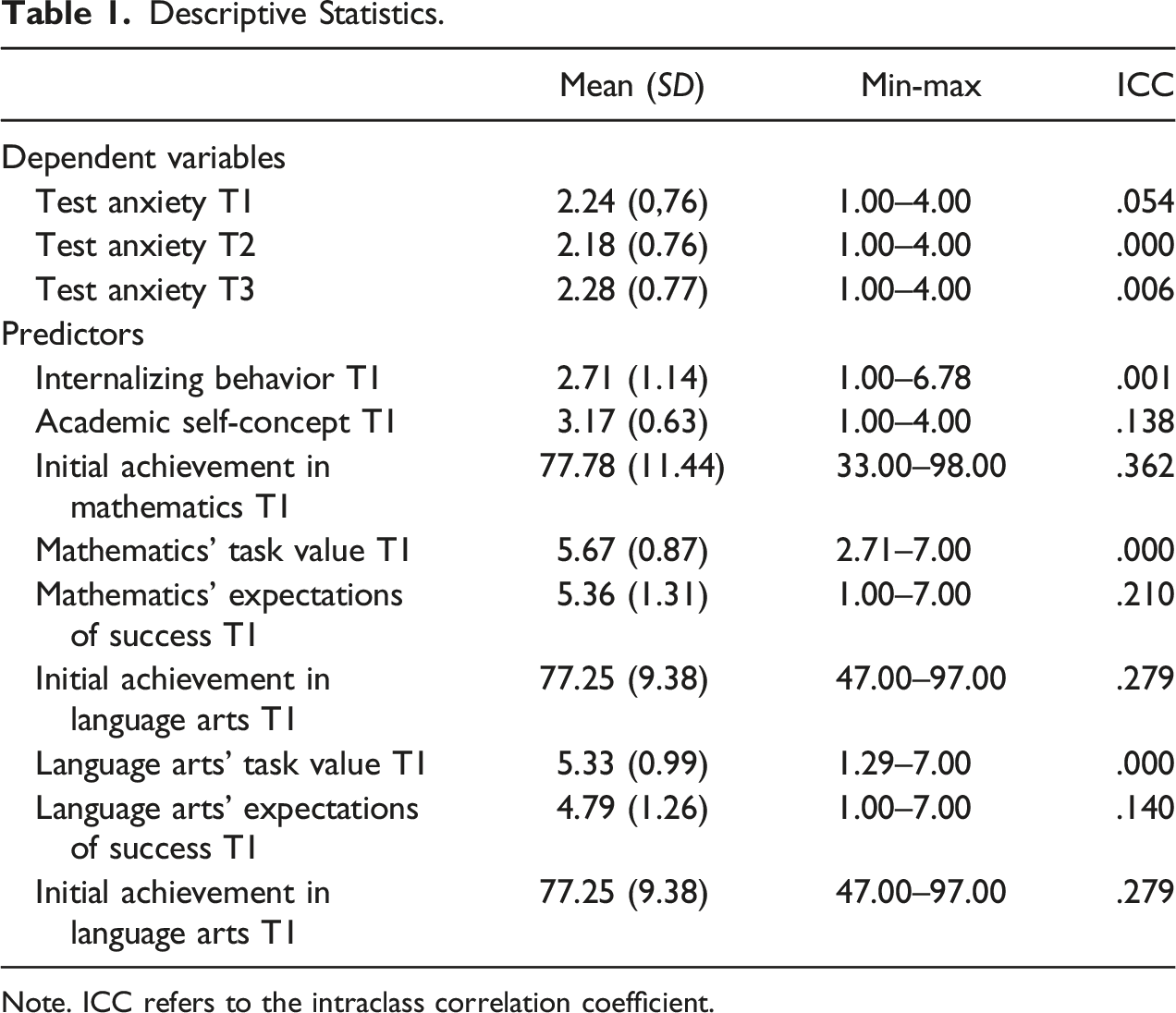
Note. ICC refers to the intraclass correlation coefficient.
Pearson’s Correlations.
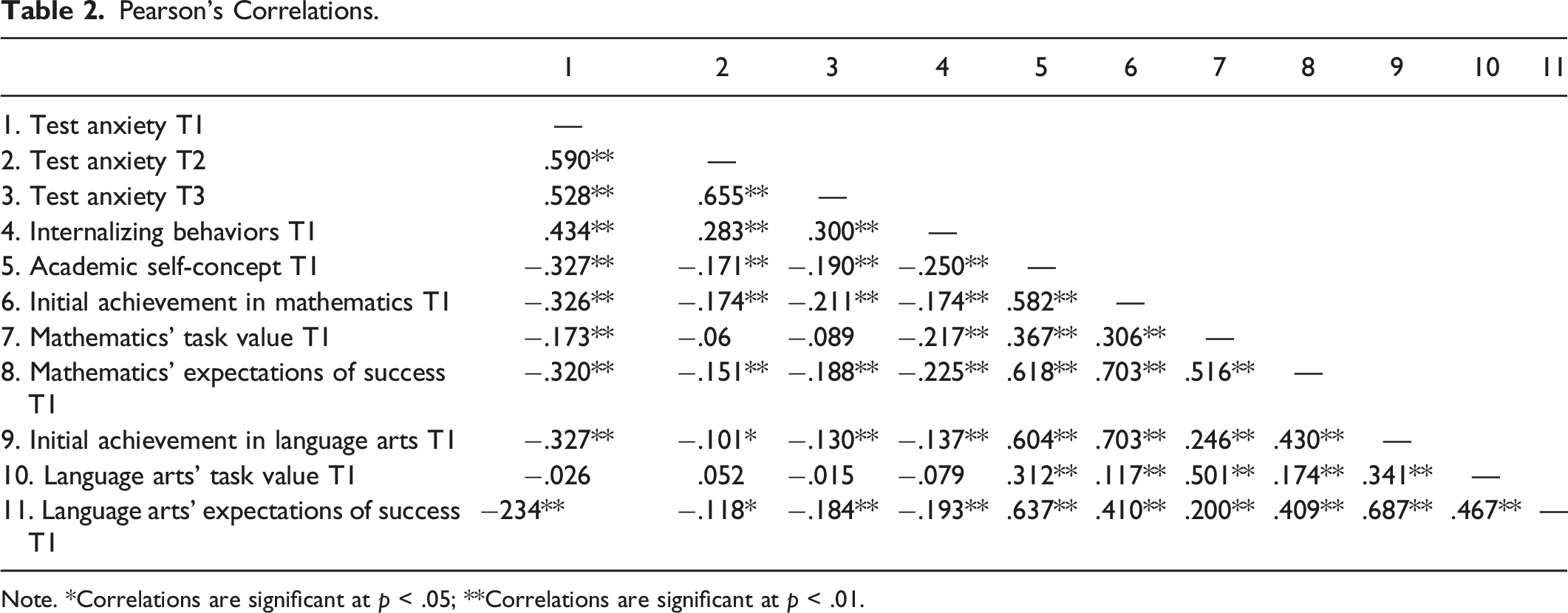
Note. *Correlations are significant at p < .05; **Correlations are significant at p < .01.
Results of Latent Growth Analyses
Initial Latent Growth Model
Longitudinal measurement invariance of test anxiety was tested using a mean and variance adjusted weighted least squares (WLSMV) estimator in MPlus. Results showed strict invariance, supporting the use of latent growth modeling. The initial latent growth model was tested to identify trajectories for test anxiety during the transition from elementary to secondary school. The tested model included two latent factors, one representing the intercept, i.e. the mean initial level, and the other representing the slope, i.e. the average rate of change over time (Wickrama et al., 2016). As expected, results showed a good fit between the data and the hypothesized model, according to the cutoff values proposed by Hu and Bentler (1999): χ2 (3) = 359.405, p < .001; RMSEA = .090, CFI = .989, TLI = .966. Results showed a significant intercept (coefficient = 2.202, p < .001), meaning that at the end of elementary school, students experience text anxiety to some extent. However, the slope was found to be non-significant (coefficient = .030 p = .157), suggesting that test anxiety did not vary over time for the whole sample.
Latent Growth Model with T1 Predictors
Parameter Estimates for Final Latent Growth Model.
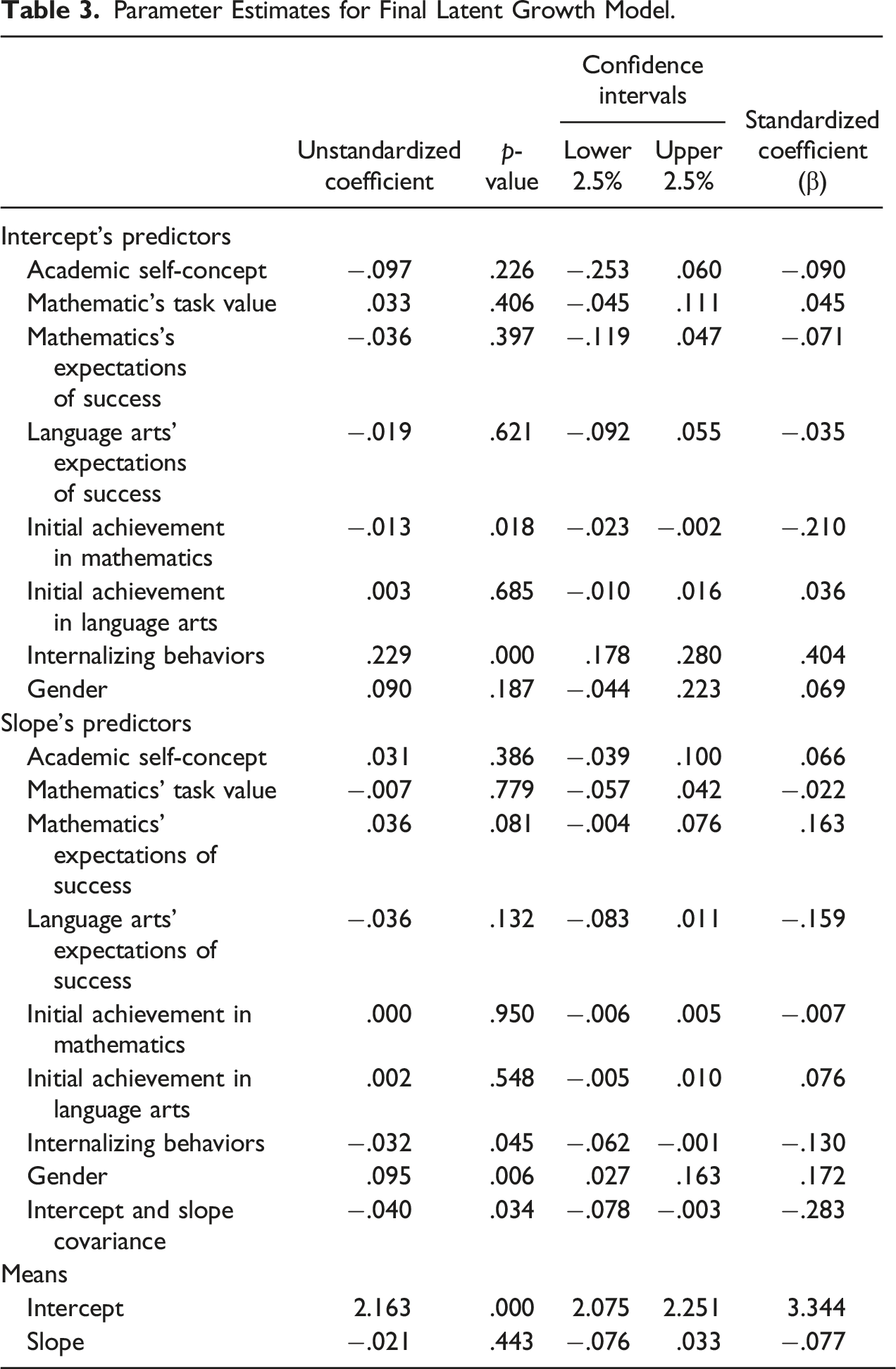
Results showed that internalizing behaviors, and initial mathematics performance are significant predictors of test anxiety’s intercept. These results mean that students with higher levels of internalizing behaviors have higher levels of test anxiety at the end of elementary school. In addition, students who achieve better grades in mathematics show lower levels of test anxiety at the end of elementary school. Contrary to what was expected, motivational variables, as well as initial achievement in language arts and gender did not predict the initial level of test anxiety.
Results also revealed that internalizing behaviors and gender significantly predicted test anxiety’s slope. First, we illustrated the relationship between internalizing behaviors and the slope of test anxiety in Figure 1 by categorizing the results into three levels of internalizing behaviors. This categorization was determined by adding and subtracting one standard deviation (1.14) to the mean of the variable (2.71). Therefore, “medium levels” corresponds to a mean of 2.71, whereas low levels and high levels correspond respectively to a mean of 1.57 and 3.85. The results showed that, only for participants with low levels of internalizing behaviors, the slope of test anxiety was significant and positive (coefficient = .064, p < .05) (see Figure 1). However, for students with medium and high levels of internalizing behaviors, test anxiety remained stable over time (coefficient = −.008, p = .760). Internalizing behaviors as a predictor of test Anxiety’s Slope.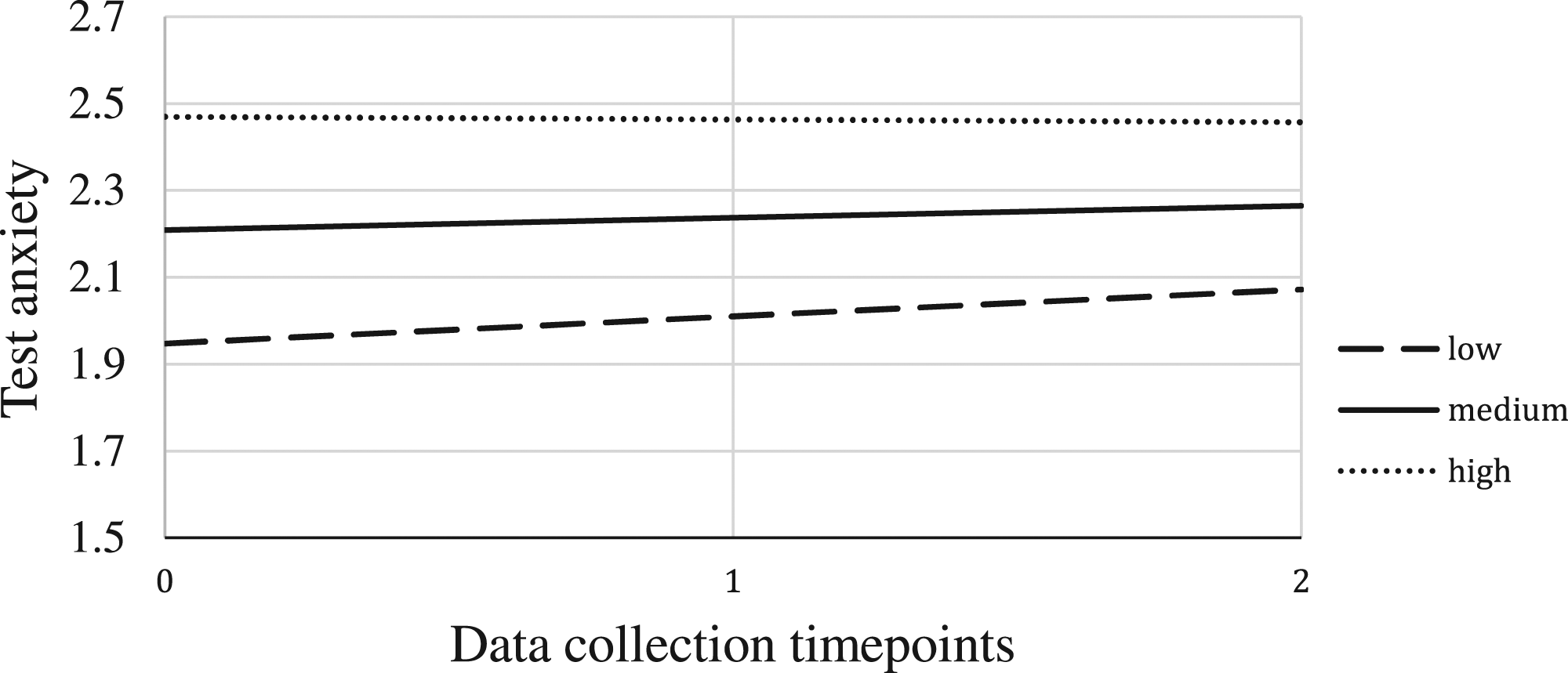
For gender, further analyses were performed to better interpret the direction and strength of the slope for each gender. Results showed that when all other variables are centered at the grand mean, test anxiety increases over time for girls (coefficient = .074, p < .005), but not for boys (coefficient = −.021, p = .443). These results are presented in Figure 2. Motivational variables, as well as initial achievement in both mathematics and language arts, did not predict any change in the slope of test anxiety. Gender as a predictor of test Anxiety’s Slope.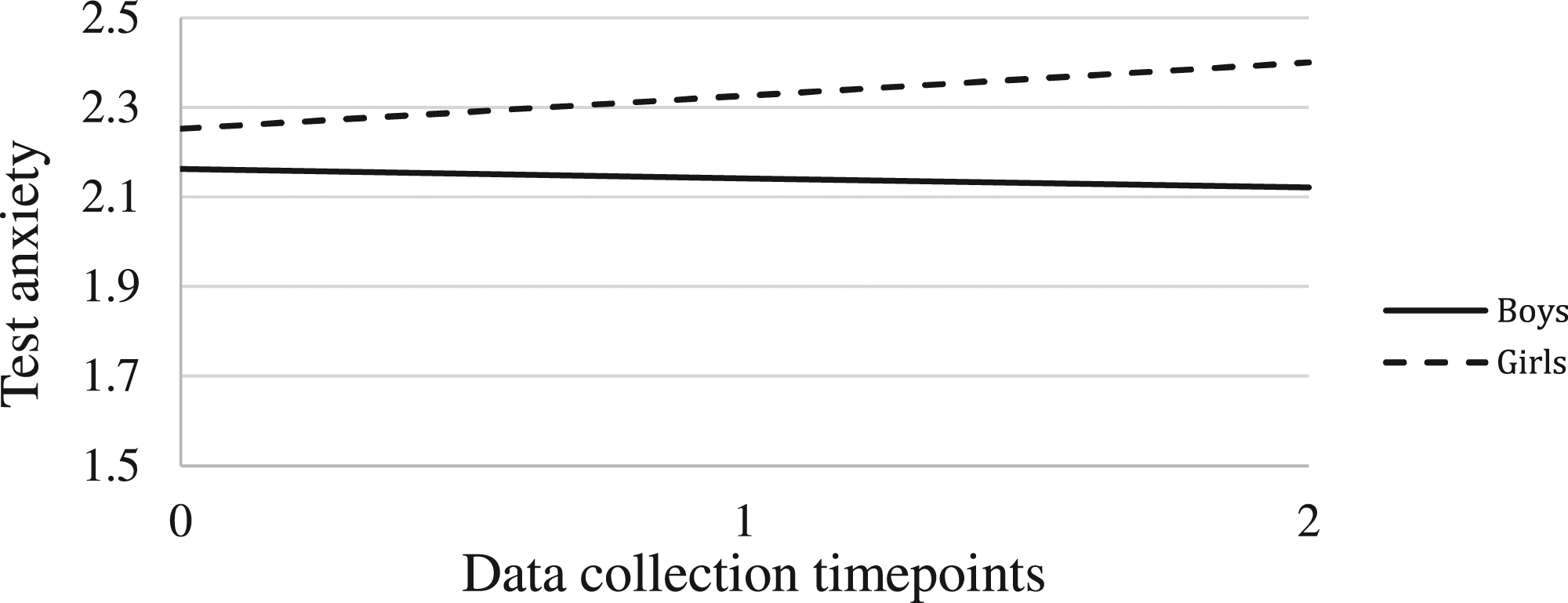
Discussion
The present study extends prior investigations by examining the trajectory of students’ test anxiety during the transition to secondary school, a critical period comprising many contextual factors likely to elicit test anxiety. Moreover, this study provides a more complete picture by suggesting that test anxiety could vary not only according to the transition, but also as the result of individual factors. Contrary to most studies on the topic that used correlations between measures collected at a single timepoint, the current study relied on a longitudinal design, which allowed us to capture temporal changes and intraindividual differences in test anxiety. Doing so enabled us not only to validate some hypotheses but also to uncover unexpected findings. For instance, we observed that test anxiety remained stable between the end of elementary school and the end of the first year of secondary school. However, among the studied individual factors, internalizing behaviors and gender were found to modify the amount and direction of change in students’ test anxiety. By establishing a relationship between individual factors and the evolution of test anxiety during the challenging transition to secondary school, such findings increase our understanding of the potential risk factors for the development of test anxiety during this transition.
Trajectory of Test Anxiety during the Transition to Secondary School
Overall, descriptive statistics showed that students, on average, experienced moderate levels of test anxiety. One original, yet unexpected finding was that overall, test anxiety did not significantly change between the end of elementary school and the end of the 1st year of secondary school. The stability of the results raises the possibility that test anxiety might be more stable than expected. In fact, despite that actual conceptualisation of test anxiety define this construct as a situational trait (Putwain et al., 2021), our results could rather mean that the susceptibility to experience test anxiety might reflect an individual stable characteristic. However, it is also possible that the measure of test anxiety used in the current study captured the more stable trait-like dimension of test anxiety. Additional measures timed to correspond with tests and exams could help to better capture the situational variability in test anxiety. Such measures would enable us to determine whether situations involving individual tests and exams in secondary school create a stronger state of test anxiety than those in elementary school. Nonetheless, the stability of the results remains surprising given that it was expected that the transition to secondary school would involve an increase in evaluative pressure likely to enhance test anxiety. This assumption may have been flawed since elementary school in the province of Quebec ends with a national high-stakes assessment. Therefore, it is possible that mean levels of test anxiety were already elevated prior to the transition to secondary school. Thus, future studies should investigate the evolution of test anxiety throughout elementary and secondary school to examine whether some periods are associated with an increased risk to develop test anxiety.
Individual Predictors of the Change in Test Anxiety
Despite its overall stability, some individual factors were found to moderate the strength and direction of changes in test anxiety. Even though students with higher levels of internalizing behaviors showed the highest levels of test anxiety throughout the study, it was only students with lower levels of internalizing behaviors who experienced an increase in test anxiety over time. However, it should be noted that their mean levels of test anxiety remained relatively low, even following this increase (i.e., around the midpoint of the scale). This finding brings empirical support for both the situational and the stable components of test anxiety (Putwain et al., 2021). Specifically, it seems that students with higher levels of internalizing behaviors (i.e., who manifest a stable susceptibility to test anxiety), because they experience more anxiety in general, may have developed more efficient coping strategies to reduce the influence of situational factors on their levels of test anxiety. In contrast, students with lower levels of internalizing behaviors, possibly because they developed fewer coping strategies to deal with the concerns and worries, could be more susceptible to situational factors such as changes in evaluative practices occurring during the transition to secondary school. This interpretation is consistent with recent findings showing that students develop reactions to stressful life events, such as school transitions, according to their ability to cope with challenging situations (Olivier et al., 2022). Therefore, one valuable avenue for future research would be to examine the role of coping strategies in the management of test anxiety, since students with higher and lower levels of internalizing behaviors could benefit from such interventions.
Second, the trajectory of students’ text anxiety differed by gender. In particular, girls experienced increasing test anxiety over time while boys’ test anxiety remained stable over time. Therefore, even though both genders are faced with great challenges during the transition to secondary school (Couture, 2019) the fact that only girls experienced increases of test anxiety during the transition could suggest that they may have a greater vulnerability to these challenges. These findings also concur with prior work suggesting that girls may be more preoccupied with the transition to secondary school (Duchesne et al., 2012). In addition, since girls are more likely to experience negative emotions (Else-Quest et al., 2012) and report higher academic self-pressure (Duchesne & Larose, 2018), they could be more susceptible to high expectations and demands inherent to secondary school. In turn, this could lead them not only to develop higher levels of anxiety in general (Duchesne & Ratelle, 2016), but also of test anxiety. Based on these results, special attention should be given to female students as they transition to secondary school, in order to help them manage their test anxiety.
Individual Predictors of Initial Levels of Test Anxiety
The current study also enabled us to examine whether initial levels of test anxiety, measured at the end of elementary school, varied according to individual variables. Replicating prior work showing that internalizing behaviors and test anxiety are correlated constructs (von der Embse et al., 2018), our results showed that higher levels of internalizing behaviors were associated with higher initial levels of test anxiety at the end of elementary school. Even though this result can seem obvious, internalizing behaviors, especially the anxiety component, and test anxiety were found, by previous research, to be two distinct constructs (Putwain et al., 2021). However, given that both constructs lead to an overall tendency to experience worries and intrusive thoughts (Zeidner & Matthews, 2011), it was expected that internalizing behaviors would predict test anxiety. Indeed, these schemas might lead them to apprehend the negative consequences of challenging situations, which could explain why students with high levels of internalizing behaviors are more susceptible to fear evaluations and experience high test anxiety. On the whole, these findings highlight the vulnerability of students high in internalizing behavior during the transition to secondary school and suggest that they might benefit from additional support during this transition to prevent and manage test anxiety.
Furthermore, lower initial achievement in mathematics were associated with higher initial levels of test anxiety. Interestingly, these findings were not observed in the domain of language arts. The fact that only initial achievement in mathematics predicted initial levels of test anxiety is consistent with prior work underlining the specificity of mathematics as a context that increases the susceptibility to anxiety (Carey et al., 2016; Ma, 1999). This apparent domain specificity might be due to the importance attributed to the study of mathematics in society, compared to other domains such as language arts, as shown through popular press articles (e.g., Cohen, 2016; Jones, 2013). Additionally, the mechanism underlying mathematics learning could potentially contribute to its unique relation with test anxiety. Specifically, mathematics requires a great use of working memory (Korhonen et al., 2018), a type of memory that is particularly affected by anxiety and directly involved in performance decrements related to choking under pressure (Ng & Lee, 2015). Despite the role of grades in mathematics in predicting initial levels of test anxiety, it is important to bear in mind that neither students’ mathematics initial achievement nor their language arts initial achievement predicted the trajectory of their test anxiety across the transition to secondary school. Overall, these results underscore that the inclusion of variables related to both mathematics and language arts was particularly helpful to provide a more accurate portrait of test anxiety, and to reveal that its role appears to be more pronounced in mathematics. Furthermore, this domain specificity may also be useful to guide interventions to prevent test anxiety in school.
Contribution of Motivational Variables in Test Anxiety
Unexpectedly, although the models in which each predictor was entered separately showed that all motivational variables were significantly related to test anxiety, the final model suggested otherwise. Specifically, when all variables were combined as predictors in the model, motivational indicators predicted neither the initial level of test anxiety nor its trajectory across the transition to secondary school. These results suggest that motivational variables assessed in this study (academic self-concept, expectations of success and task value) had a relatively limited contribution to students’ test anxiety, especially compared to other determinants such as internalizing behaviors, prior grades in mathematics and gender. One potential explanation for these surprising results is that motivational variables share a great proportion of variance with other predictors that were included in the study. For instance, achievement is known to be strongly related to academic motivation (i.e., academic self-concept, expectations of success and task value; Marsh et al., 2007; Steinmayr & Spinath, 2009). Therefore, the relationship between mathematics performance and test anxiety might, to some extent, also capture the role of students’ motivation in this domain to predict test anxiety. In a similar fashion, it is also possible that less motivated students, who are more likely to experience test anxiety (Wigfield & Eccles, 1989; Zeidner & Matthews, 2011), also have higher levels of internalizing behaviors. Another potential explanation relates to the fact that test anxiety was measured as a global construct whereas motivational variables were domain-specific. Indeed, it is possible that motivational variables could predict test anxiety specifically in each domain but that the global measure did not capture this relationship. Future studies including global and domain-specific measures of test anxiety would be useful to examine this possibility. Taken together, these explanations could help understanding why, once the variance related to internalizing behaviors was accounted for, motivation no longer contributed significantly to predict either the initial level or the trajectory of test anxiety.
Limitations, Implications, and Future Directions
Despite its strengths, the current study has a few limitations that should be addressed in future research. First, even with the longitudinal design of the study, it relied on a correlational approach, which makes it impossible to draw causal conclusions about the relations among the variables. Nonetheless, the current study was able to capture the changes in test anxiety during the transition from elementary to secondary school and to identify some individual predictors linked either to the initial level or trajectory of test anxiety. A second limitation concerns the measure of test anxiety. In fact, despite its good psychometric properties, this measure does not distinguish between different manifestations of test anxiety (e.g., cognitive, behavioral, physiological) nor between school domains, which might have provided a more nuanced portrait of test anxiety during the transition to secondary school. In addition, given that the study was conducted predominantly in small cities and rural areas where school competition may be less intense, it is possible that students showed relatively low levels of test anxiety. However, there is no clear reason to hypothesize that the relation between the predictors and test anxiety would be different in these contexts. That being said, future research should be conducted in varied types of school markets to better understand the generalizability of these findings. Another limitation is that minimal demographic information about the sample was collected. In particular, the study did not include data for the ethnic nor socioeconomic composition of the sample, therefore providing limited information about the generalisability of the results to students with different socioeconomic and ethnic backgrounds.
The present findings have important implications for theory, future research on the topic, and for potential interventions to reduce test anxiety in elementary and secondary school. An important contribution of the current study is that it underlined the overall stability of test anxiety across the transition to secondary school. These results lend empirical support to the theoretical conception of test anxiety as a construct including both a state and a trait component (Putwain et al., 2021; Zeidner & Matthews, 2011). Therefore, future research on the topic could use methods that disentangle between-person and within-person variation in test anxiety over time in order to simultaneously examine the potential state and trait facets of test anxiety. From a practical perspective, our findings call for multiple types of interventions, especially ones that target students who are more susceptible to test anxiety, such as girls, students who have lower grades in mathematics and those with higher levels of internalizing behaviors. However, because our study showed that, overall, the transition to secondary school was not a determinant timepoint for the evolution of test anxiety, implementing interventions to help students manage test anxiety prior to the secondary school transition might be a valuable avenue.
Conclusion
This study empirically examined students’ test anxiety through the transition to secondary school as well as potential predictors of their test anxiety. Findings of this investigation provided important theoretical and practical contributions to the field. Overall, the longitudinal design of the study revealed that test anxiety increased over time only for girls and for students with low levels of internalizing behaviors. In addition, we identified certain groups of students who are apparently more susceptible to test anxiety at the end elementary school, such as girls, students with high levels of internalizing behaviors and low achievers in mathematics. Based on these results, interventions targeting these at-risk students would be worthwhile. On the whole, our findings help elucidate the development and susceptibility to test anxiety, which is a step towards optimizing students’ potential, a central educational goal.
Supplemental Material
Supplemental Material - A Latent Growth Analysis of Individual Factors Predicting Test Anxiety During the Transition From Elementary to Secondary School
Supplemental Material for A Latent Growth Analysis of Individual Factors Predicting Test Anxiety During the Transition From Elementary to Secondary School by Catherine Fréchette-Simard, Isabelle Plante, Stéphane Duchesne, and Kathryn E. Chaffee in The Journal of Early Adolescence
Footnotes
Declaration of Conflicting Interests
The author(s) declared no potential conflicts of interest with respect to the research, authorship, and/or publication of this article.
Funding
The author(s) disclosed receipt of the following financial support for the research, authorship, and/or publication of this article: This work was supported by Fonds de Recherche du Québec-Société et Culture.

Supplemental Material
Supplemental material for this article is available online.
Author Biographies
References
Supplementary Material
Please find the following supplemental material available below.
For Open Access articles published under a Creative Commons License, all supplemental material carries the same license as the article it is associated with.
For non-Open Access articles published, all supplemental material carries a non-exclusive license, and permission requests for re-use of supplemental material or any part of supplemental material shall be sent directly to the copyright owner as specified in the copyright notice associated with the article.
