




Abstract
We used latent growth curve analysis to extend research on associations between early puberty and adverse peer relations by examining the role of pubertal timing in the developmental trajectories of peer victimization and offending from early- to mid-adolescence. We made use of three-wave longitudinal data collected annually from a cohort of Swedish adolescents (N = 1,515, 51% girls,
Puberty marks the start of adolescence. The well-established developmental readiness hypothesis (Mendle & Ferrero, 2012; Skoog & Stattin, 2014) posits that adolescents who experience the pubertal changes at relatively early ages, before most of their same-sex, same-age peers, have not had enough time to develop important emotional, cognitive, and behavioral skills and are not psychosocially mature enough to cope with their advanced sexual maturity and others’ reactions to their mature appearance. According to the hypothesis, this asynchrony is stressful and increases the risk for negative psychosocial outcomes. In line with this prediction, a large body of empirical research has established that experiencing the changes of puberty before most same-age and same-sex peers (i.e., early pubertal timing) is a risk factor in early- and mid-adolescent psychosocial development (Hamlat, Snyder, Young, & Hankin, 2019; Ullsperger & Nikolas, 2017). One central developmental domain in which early maturing adolescents appear to struggle more than others is peer relationships (Mendle, Harden, Brooks-Gunn, & Graber, 2012; Pomerantz, Parent, Forehand, Breslend, & Winer, 2017).
The importance of peer relations increases markedly in early adolescence (Bornstein, Jager, & Steinberg, 2013). Adolescents are greatly concerned about their role in peer groups and of how peers treat them (Somerville, 2013). Interestingly, early adolescence is also the period when adverse peer relations and different forms of aggression against members of the peer group peak (Noret, Hunter, & Rasmussen, 2018). It has been shown that the effects of adverse peer relations on psychosocial development in adolescence (e.g., mental health) may last well into adulthood (Brendgen, Poulin, & Denault, 2019). In addition to these group mean-level changes, adolescents follow different peer victimization and offending trajectories over the course of adolescence (Haltigan & Vaillancourt, 2014; Sumter, Baumgartner, Valkenburg, & Peter, 2012). This supports the idea that there could be meaningful predictors that explain the variance.
Adolescents’ pubertal timing has been found to have implications for at least two aspects of adverse peer relations during early- and mid-adolescence. First, early pubertal timing has been linked to being victimized by peers (e.g., Haltigan & Vaillancourt, 2018; Schreck, Burek, Stewart, & Miller, 2007). We define peer victimization as peer-to-peer interaction that involves being the target of a broad range of negative peer behaviors, including personal and sexual harassment, peer rejection, and physical aggression. The nature of the victimization ranges from being targeted for negative rumors (Reynolds & Juvonen, 2011) and being actively excluded from the peer group (Carter, Halawah, & Trinh, 2018) to experiencing physical violence (Haynie & Piquero, 2006) and sexual harassment (Skoog & Özdemir, 2016a, 2016b); In fact, peer victimization has been identified as an underlying mechanism in the well-established association between early pubertal timing and depressive symptoms among adolescent girls (Compian, Gowen, & Hayward, 2009; Nadeem & Graham, 2005; Skoog, Özdemir, & Stattin, 2016). Second, a smaller body of literature has linked early pubertal timing to adolescents’ involvement in own peer offending. Parallel to our definition of peer victimization, we define peer offending as peer-to-peer interaction that involves subjecting peers to a broad range of negative behaviors, including personal and sexual harassment, peer rejection, and physical aggression. Specifically, early maturing adolescents have been found to more often sexually harass (McMaster, Connolly, Pepler, & Craig, 2002), physically offend (Mrug et al., 2014), and bully (Jormanainen, Fröjd, Marttunen, & Kaltiala-Heino, 2014; Su et al., 2018) their peers.
There are several possible reasons why early pubertal timing puts adolescents at an increased risk for peer victimization and offending. Because of the emergence of secondary sexual characteristics (e.g., breasts and facial hair) and the growth spurt associated with puberty, early maturing adolescents look sexually mature at a time when their same-age peers do not. The change in appearance makes early maturers stand out in the peer group by looking older than they are. Simply standing out in the same-age peer group (by looking more sexually mature) increases the risk of peer victimization (Skoog & Özdemir, 2016a, 2016b; Troop-Gordon, 2017). In addition, early maturers are granted more autonomy by parents and are less supervised by them compared with what is the case for their later maturing peers (Mendle & Ferrero, 2012). Consequently, early maturers affiliate more in unsupervised settings with deviant peers than later maturing adolescents (Negriff, Ji, & Trickett, 2011; Stattin, Kerr, & Skoog, 2011). This increases the risk among early maturers for peer victimization and offending as adverse peer interactions often occur in unsupervised settings in which there are deviant peers engaging in this type of behavior (Hong & Espelage, 2012; Jennings, Piquero, & Reingle, 2012). Moreover, due to their tendencies for norm-breaking behavior (Ullsperger & Nikolas, 2017; for example, disturbing behavior in class), early maturers might come across as more annoying and, as a result, are victimized by peers, as suggested by Schreck and colleagues (2007). In fact, early maturing adolescents have been shown to have worse social skills than other adolescents (Carter et al., 2018). To the extent that early maturers are victimized, they have been assumed to retaliate (Jormanainen et al., 2014; Kaltiala-Heino et al., 2003). The latter proposition is in line with the well-established developmental link between victimization and offending, known as “the victim–offender overlap” (Jennings et al., 2012; Schreck et al., 2007). Against this background, the focus of this study is how the associations between pubertal timing on the one hand, and peer victimization and offending on the other hand, develop over the course of early- to mid-adolescence.
Two main hypotheses have been used to predict the role of pubertal timing in the developmental trajectories of adverse peer relations throughout adolescence. According to the attenuation hypothesis (Senia, Donnellan, & Neppl, 2018), early maturing adolescents have a higher starting point in early adolescence with respect to adverse peer relations compared with later maturing peers. The effects of pubertal timing disappear over the course of adolescence when later maturing individuals catch up in terms of appearance and behavior. In contrast, the selective persistence hypothesis (Senia et al., 2018) posits that early puberty continues to affect psychosocial development because it continues to increase the risk for “snares”, events that increase the risk for unsuccessful development across transitions.
To date, it is unknown which of the hypotheses makes the most valid prediction as the literature comprises just over a handful of longitudinal studies that have examined associations between pubertal timing and aspects of peer victimization or offending (Carter et al., 2018; Haltigan & Vaillancourt, 2018; Haynie & Piquero, 2006; Jormanainen et al., 2014; Mendle et al., 2012; Mrug et al., 2014; Reynolds & Juvonen, 2011). Three of the longitudinal studies focused exclusively on either girls (Mrug et al., 2014; Reynolds & Juvonen, 2011) or on boys (Mendle et al., 2012). The general finding in these studies is that early puberty is linked to more adverse peer relations, but there are some inconsistencies. For instance, Carter et al. (2018) found that early puberty was linked to initial levels (Grade 4) and the development of peer victimization to Grade 6 among girls but not boys. In the well-designed six-wave study by Haltigan and Vaillancourt (2018), the incidence of being victimized by a peer rose among less mature boys between Grades 5 and 6, 7 and 8, and 9 and 10, compared with other boys. For girls, the incidence of being victimized rose among early maturers between Grades 5 and 6, and 9 and 10, and rose among later maturers between Grades 8 and 9. These findings do not support one of the hypotheses over the other. They do, however, indicate that the associations between pubertal timing and peer victimization and offending could differ according to gender.
Moreover, most published longitudinal research (four out of seven studies) concerns peer victimization only (Carter et al., 2018; Haltigan & Vaillancourt, 2018; Haynie & Piquero, 2006; Reynolds & Juvonen, 2011). One study examined aspects of peer offending (i.e., aggression toward peers), but only among girls (Mrug et al., 2014). In that study, and in support of the attenuation hypothesis (Senia et al., 2018), a positive association was found between pubertal timing and physical aggression toward peers that diminished over time from 11 to 16 years of age. No links to relational and nonphysical aggression (e.g., giving mean looks) were found. Mendle et al. (2012) used one overall measure of negative peer relations that included aspects of both peer victimization and offending, but only among boys. In support of the selective persistence hypothesis (Senia et al., 2018), they found that, unlike their peers, early maturers experienced increased levels of negative peer relations from 9 to 13 years of age. However, when peer victimization and peer offending are not treated as separate constructs, we do not know whether any effects of pubertal timing are linked to either one or both of the constructs. Nevertheless, it is pivotal to include both of them in research, given their intertwined relation. Also, these findings highlight the fact that gender may be an important link in the associations as the study on girls (Mrug et al., 2014) can be taken as support of the attenuation hypothesis and the study on boys (Mendle et al., 2012) can be taken to support the selective persistence hypothesis. The study by Jormanainen et al. (2014) is the only longitudinal study that examined peer victimization and peer offending (i.e., bullying) as separate outcomes among both adolescent girls and boys. In that study, adolescents were followed from 15 to 17 years of age. In support of the attenuation hypothesis (Senia et al., 2018), they found that all links between early pubertal timing and peer victimization and offending had disappeared by age 17 years. This was true for both girls and boys. Thus, this finding might be taken to indicate that the role of pubertal timing in peer victimization and peer offending changes over the course of adolescence, but we still do not know how. In sum, previous research is limited and conflicted in showing support for either the attenuation or the selective persistence hypothesis. The role played by gender in the links is unclear.
Purpose of the Present Study
Despite the knowledge gained in past research, our literature review reveals that the nature of the association between pubertal timing and the development of peer victimization and offending is yet to be fully understood. A clearer understanding of the role of pubertal timing in the developmental trajectories of peer victimization and offending would advance the field theoretically and contribute toward interventions aimed at preventing adverse peer relations in adolescence. The present study was designed to fill the reported gap of knowledge in the literature and to test the predictions made by the attenuation and the selective persistence hypotheses (Senia et al., 2018). The main aim was to examine associations between pubertal timing and the initial levels and changes in peer victimization and offending across the transition from early- to mid-adolescence. As puberty is a process of sexual differentiation and gender dimorphism, its meaning for psychosocial development might differ between girls and boys (Marceau, Ram, Houts, Grimm, & Susman, 2011). Thus, we tested whether the effect of pubertal timing on the trajectories of peer victimization and offending was moderated by adolescent gender. We asked two research questions, as follows:
In line with theoretical notions (i.e., the developmental readiness hypothesis, Mendle & Ferrero, 2012; Skoog & Stattin, 2014) and prior empirical studies (e.g., Haltigan & Vaillancourt, 2018; Schreck et al., 2007), we expected early pubertal timing to be related to higher levels of peer victimization and offending. Given the shortage of prior work in the field on developmental processes and conflicting hypotheses (the attenuation and the selective persistence hypotheses, Senia et al., 2018), the analyses of the role of pubertal timing in the developmental trajectories of peer victimization and offending, as well as the moderating role of adolescent gender, were explorative.
We made use of three-wave longitudinal data from a cohort of Swedish adolescents and latent variable growth curve modeling (LGM) to examine the research questions. LGM is particularly suitable for studying developmental processes using longitudinal data (Duncan & Duncan, 2009). Three waves of measurement are sufficient to examine linear developmental processes. Moreover, we controlled statistically for the effects of socioeconomic status (SES), immigration status, and age at the first measurement wave in the analyses. We included these as control variables as they are linked to both pubertal development and peer victimization and offending (Biro et al., 2010; Sun, Mensah, Azzopardi, Patton, & Wake, 2017; Wang, Leary, Taylor, & Derosier, 2016) in an attempt to avoid identifying spurious correlations.
Method
Participants
Three waves of data from the Longitudinal Research on Development in Adolescence (Kapetanovic et al., 2020) were used to test our hypotheses. LoRDIA studies transitions in adolescence by collecting information about adolescents’ health, school functioning, relations to family, teachers, and peers, as well as the development of risk behaviors such as substance use and delinquency. The program is designed to follow adolescents in four medium-sized municipalities in southern Sweden from 12/13 to 18 years of age. The data collection started in 2013 with students in the sixth and seventh grade. Out of 2,108 adolescents invited in the first wave, 318 opted out, which resulted in 1,790 adolescents constituting the total sample of the study at Wave 1. Out of the total sample at Wave 1, 275 adolescents were absent from school on the days of the data collection, which resulted in an analytical sample of 1,515 adolescents.
The sample for this study is based on three waves of self-reported data, with 1,515 adolescents (50.6% girls), beginning in sixth grade (n = 781) and seventh grade (n = 734), respectively. The mean ages were as follows: T1:
Measures
Peer victimization
Nine items assessed what it was like to be a victim of offending (Trifan & Stattin, 2015) by asking the participants whether they had been subjected to sexual, verbal, physical harassment, or exclusion by their peers at school, or on the way to or from school, in the past semester, with questions such as “Has anyone fondled or touched your body in a sexual way that you didn’t like?” and “Have you been beaten, kicked, or assaulted in a nasty way by anyone at school or on the way to or from school?” The items were rated 1 (no, never), 2 (yes, a few times), and 3 (yes, many times), with the following internal consistencies: T1: α = .76, T2: α = .75, and T3: α = .75.
Peer offending
This measure was assessed by five items (Alsaker & Brunner, 1999), asking whether the adolescents had exposed their peers to sexual, verbal, or physical harassment at school, or on the way to or from school, in the past semester, with questions such as “Have you said nasty things, mocked or teased anyone in an unpleasant way at school?” and “Have you beaten, kicked, or assaulted anyone in an unpleasant way at school or on the way to or from school?” The items were rated 1 (no, never), 2 (yes, a few times), and 3 (yes, many times), with the following internal consistencies: T1: α = .71, T2: α = .60, and T3: α = .65.
Pubertal timing
The measures of pubertal timing in both girls and boys concerned aspects of central puberty, or gonadarche (Shirtcliff, Dahl, & Pollak, 2009), taking place in mid- to late puberty (Dorn & Biro, 2011; Lee & Kerrigan, 2004). To assess girls’ pubertal timing, we used age of menarche, by asking “How old were you when you had your first period?” Their response was categorized as follows: Early pubertal timing (before 12 years of age), On time (between 12 and 13 years of age), and Late pubertal timing (after 13 years of age). To assess boys’ pubertal timing, we asked a question about two aspects of mid-pubertal events: “How old were you when you had your first spermarche or when your voice deepened?” The boys’ responses were categorized as follows: Early pubertal timing (before 12 years of age), On time (between 12 and 13 years of age), and Late pubertal timing (after 13 years of age).
Background variables
The Questionnaire items assessed about adolescent age, subjective SES and immigration status at T1. The age of the adolescents in the sample ranged from 11 to 14 years and were entered as 0 = younger adolescents (11 and 12 years of age) and 1 = older adolescents (13 and 14 years of age). Adolescent subjective SES (Quon & McGrath, 2014) was calculated by averaging two items: “Do you perceive having less, as much, or more money than your classmates?” and “Does your family have less, as much, or more money than other families in your neighborhood?” with inter-item correlation (r = .42). Using a median split, the measure was dichotomized and entered as 0 = low SES and 1 = high SES. Immigration status was determined by asking the adolescents whether they studied Swedish as a second language in school and entered as 0 = Swedish background and 1 = non-Swedish background.
Procedure
LoRDIA received ethical approval from the regional research review board in Gothenburg, Sweden, before each data collection wave. In 2013, contact was established with all primary schools and parents of the students in the participating municipalities. Students, teachers, and parents were informed about the study, its confidentiality, and the voluntary basis of participation. Parents and students had the opportunity to decline consent for students’ participation. The data were collected by adolescents responding to paper and pen questionnaires in their classrooms. The questionnaires were collected by the research team.
Missing Data Analysis and Attrition
Before proceeding with the analyses, we tested whether the missing data were missing at random. Missing data analysis showed that Little’s missing completely at random (MCAR) was significant, however, the normed chi-square (χ2/df) was moderate (241.839/63 = 3.85), implying a moderate violation of the MCAR assumption. Although the violation of MCAR may increase the standard errors of estimates, it does not seriously distort parameter estimates or introduce bias (Collins, Schafer, & Kam, 2001; Dong & Peng, 2013). Further attrition analyses showed that 67% of the analytical sample at Wave 1 (N = 1,515) continued to provide data at T3. The attrited adolescents were more likely to be boys (
Data Analysis
Latent growth curve (LGC) analysis was used to assess the changes in adolescent peer victimization and offending over the course of early- to mid-adolescence. Using the framework of structural equation modeling (SEM), LGC employs changes on three-wave panel data by demonstrating an individual’s score on the outcome variable (i.e., the intercept) as well as the individual’s rate of change over time (i.e., the slope; Byrne, 2010; Duncan & Duncan, 2009). Notably, this type of modeling comprises intra- (i.e., within-person) change and inter-individual (i.e., between-person) differences with respect to the outcome variables (Byrne, 2010). In addition, time-invariant covariates can be included in the LGC to estimate the effect of the covariates on the developmental trajectories.
To address the hypotheses in this study, in the first step, we estimated a dual-domain unconditional (without covariates) LGC model to determine the developmental trajectories of peer victimization and offending (see Figure 1 for a conceptual model). In the unconditional LGC model, a significant variance in the intercept would reveal significant individual differences in victimization and offending at baseline. In addition, a significant variance in the slope would reveal significant individual differences in the change of victimization and offending over time. The path loadings from the latent intercept to each of the outcome measures were fixed at 1. The fixed loadings from the latent slope factor to each of the three outcome measures were 0, 2, and 3, reflecting the time interval measured by year. In the next step, a conditional dual-domain growth model was used to evaluate the effect of pubertal timing, controlling for adolescent age, SES, and immigration status, as time-invariant covariates, on the latent intercept and slope of peer victimization and offending. A significant path coefficient from the covariate to the latent intercept would indicate that the covariate was associated with the initial level of the individual’s victimization or offending. In addition, a significant path coefficient from the covariate to the latent slope would indicate that the covariate was associated with the progression of the individual’s victimization or offending over time.
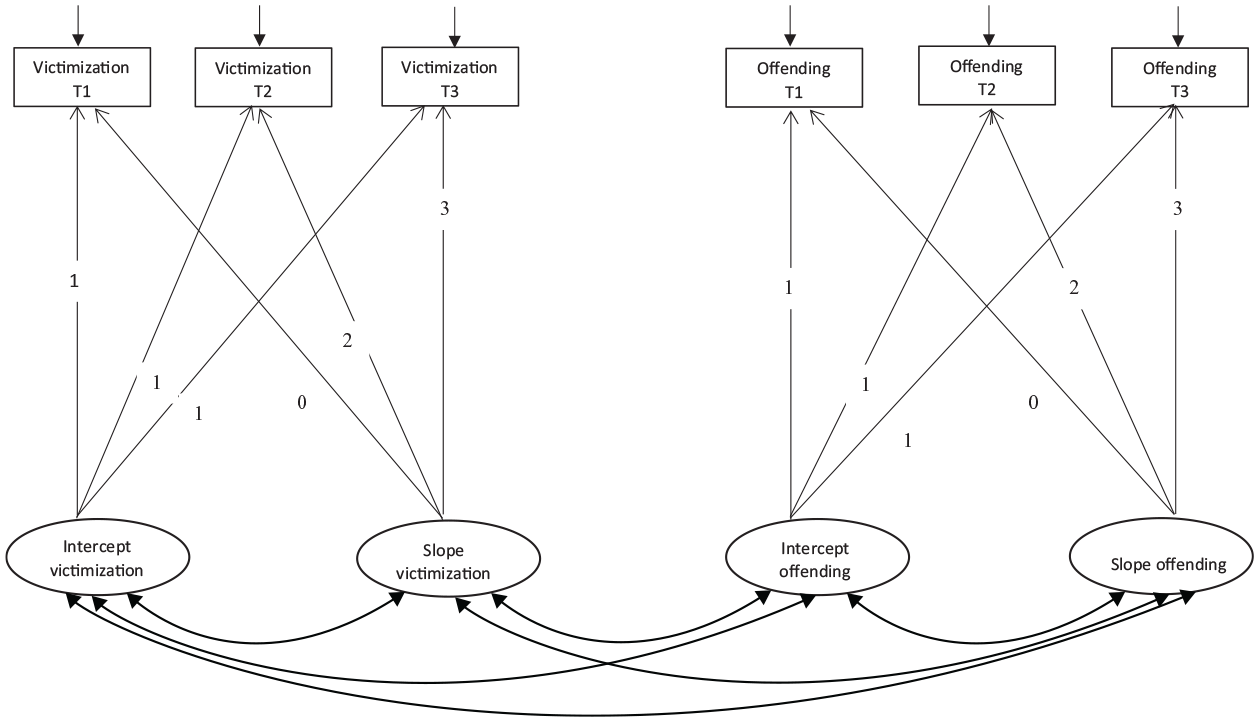
Conceptual dual-domain unconditional LGC model with peer victimization and offending.
Finally, the unconditional and conditional models were further investigated with a focus on adolescent gender. First, multigroup analyses were performed to test the moderating effect of gender on growth parameters in peer victimization and offending in the unconditional model. Thereafter, we conducted multigroup comparisons in the conditional model to test the moderating effect of gender on the effect of pubertal timing, with time-invariant covariates, on the latent intercept and slope of peer victimization and offending. The initial model, where the parameters were freely varying, was compared with the constrained model, where effects were set equivalent across gender, using a χ2 difference test. A significantly better fit of the unconstrained model (indicated by significant Δχ2 statistics) would indicate moderation. We ran all models in AMOS 23. Goodness of fit was based on recommended fit index cutoff values that indicated excellent model fit, chi-square (χ2 > .05), Tucker–Lewis index (TLI >.95), comparative fit indices (CFIs >.90), and root mean square error of approximation (RMSEA <.08), Hair, Black, Babin, & Anderson, 2010.
Results
Preliminary Analyses
Table 1 shows Pearson’s bivariate correlations between adolescent gender, pubertal timing, age, SES, and immigration status at T1, and peer victimization and offending at all three time points. Pubertal timing was negatively associated with T1 and T2 victimization and offending. The earlier the adolescents experienced puberty, the higher the levels of peer victimization and offending they reported at T1 and T2. These bivariate correlations were not found at T3. Age was positively associated with T1 victimization and negatively associated with T3 victimization and offending. Adolescent gender was negatively associated with T1, T2, and T3 victimization, and negatively associated with T1, T2, and T3 offending. SES was negatively associated with T1, T2, and T3 victimization, and T1 and T2 offending and immigration status was positively associated with T2 and T3 offending.
Pearson Correlation Coefficients Between Adolescent Gender, Pubertal Timing, Age, Subjective Socioeconomic Status, and Immigration Status at T1 and Peer Victimization and Offending at T1, T2, and T3.
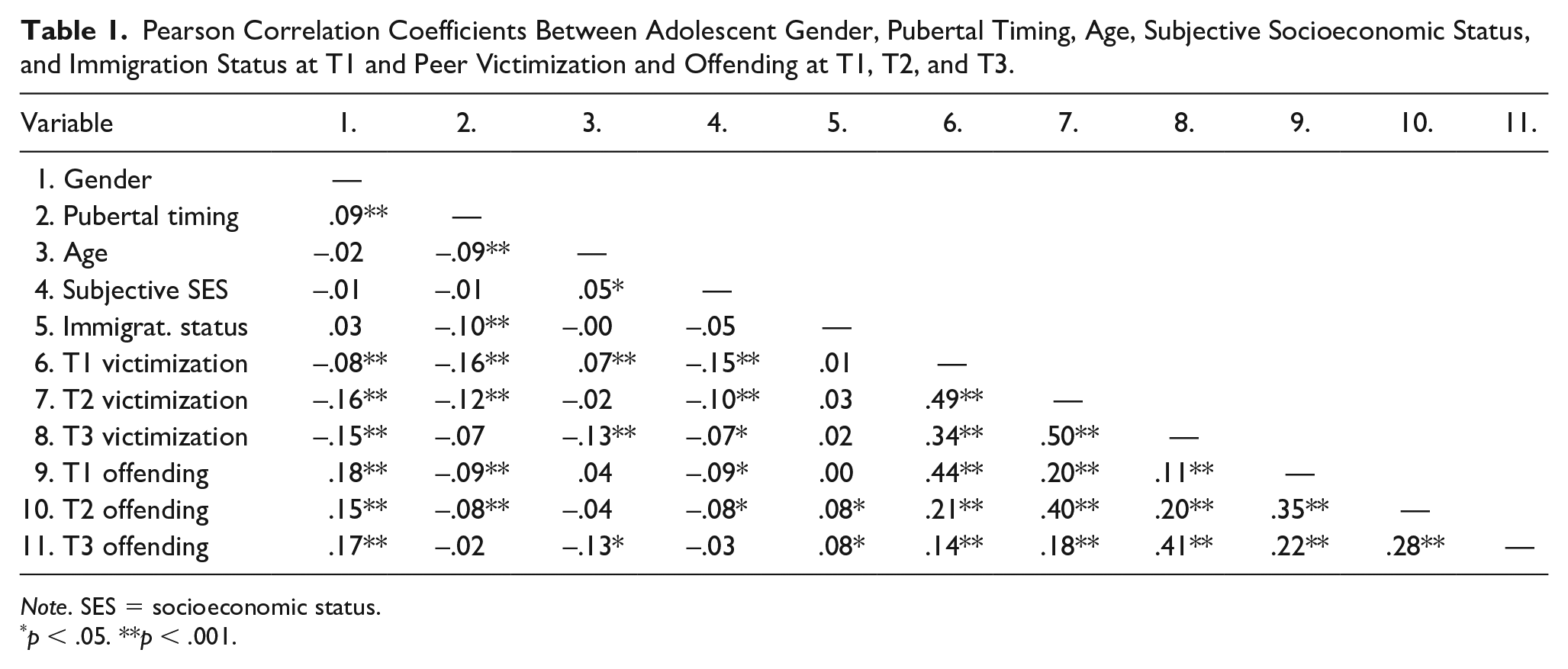
Note. SES = socioeconomic status.
p < .05. **p < .001.
Moreover, as shown in Table 2, the mean level of peer victimization and offending decreased throughout early- and mid-adolescence. Independent sample t tests showed that, over time, girls exhibited significantly higher levels of peer victimization than boys, whereas boys exhibited significantly higher levels of peer offending than girls.
Means and Standard Deviations of Peer Offending and Victimization.
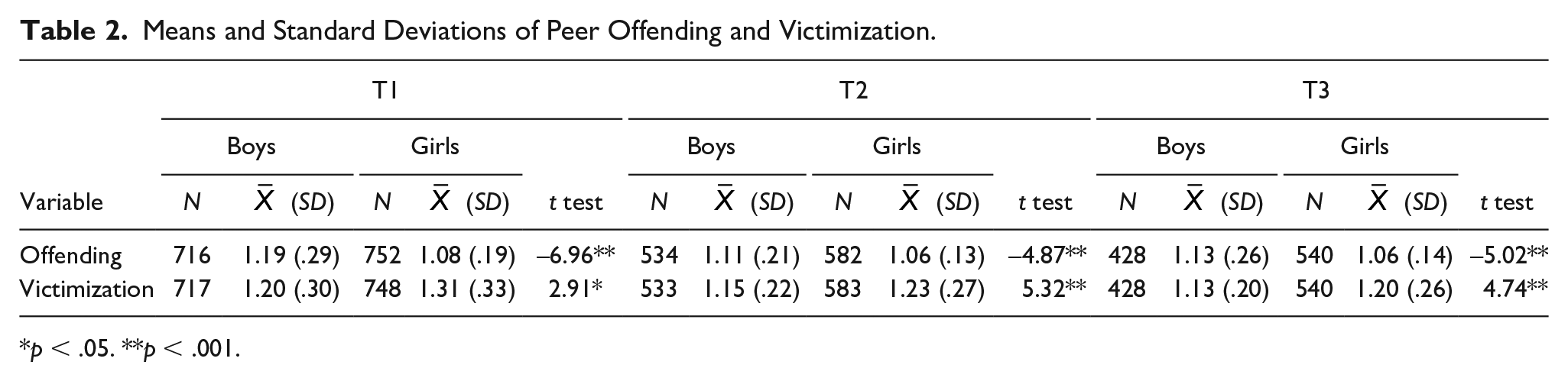
p < .05. **p < .001.
Trajectories of Peer Victimization and Offending among Adolescents
The overall fit indices for the model were acceptable, χ2(4) = 9.793, p = .044; TLI = .992; CFI = .998; and RMSEA = .031. The intercepts for victimization (i = 1.284, SE = .008, p
Moreover, the intercept and the slope of victimization (r = –.719, SE = .002, p
The conditional model, in which not only pubertal timing, but also age, SES, and immigration status were entered as covariates, provided good model fit, χ2(15) = 62.788, p
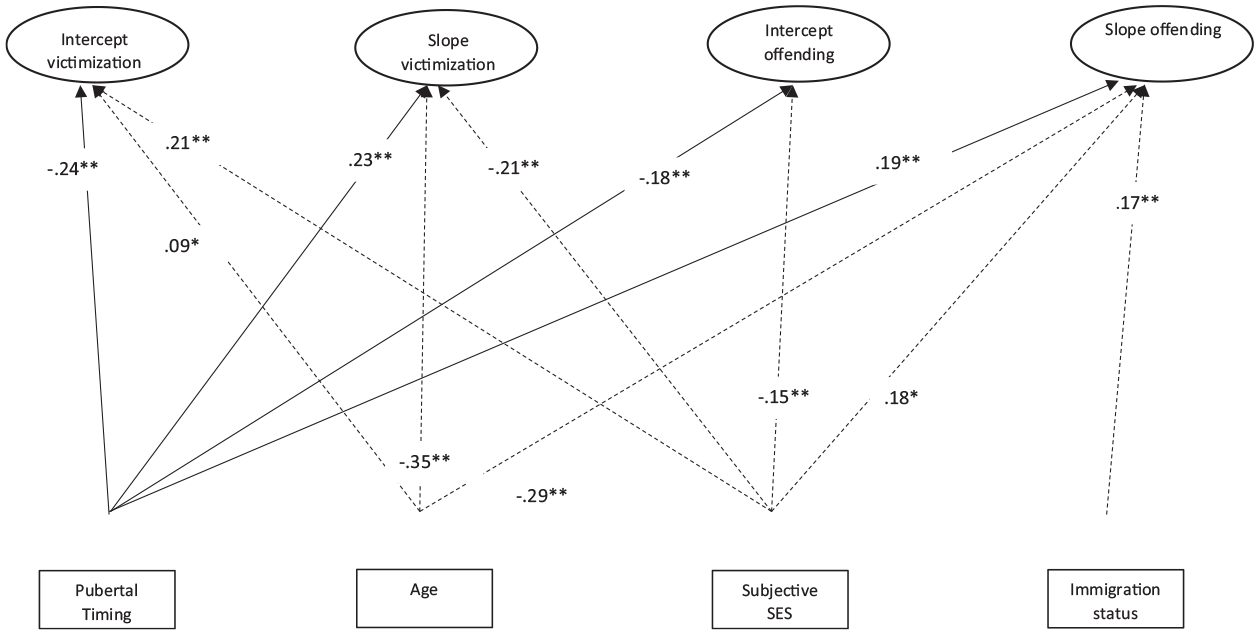
The effect of pubertal timing (straight lines) on growth parameters of peer victimization and offending, controlling for age, subjective SES, and immigration status (dashed lines).
Moderation by Adolescent Gender
Finally, we tested whether the LGC models differed between girls and boys. First, we tested whether the growth variances in peer victimization and offending in the unconditional model differed between adolescent boys and girls. Sequential multigroup analyses showed that the intercept for peer victimization, Δχ2(1) = 10.961, p
Next, we tested whether the effect of pubertal timing on growth parameters of peer victimization and offending, while controlling for time-invariant covariates, was moderated by gender. The multigroup analysis showed that adolescent pubertal timing, Δχ2(1) = 4.856, p = .002, had a stronger effect on the intercept of boys’ offending (β = –.172, SE = .018, p
Discussion
The ability to form and maintain positive social relationships is central to healthy adolescent development. Adverse peer relations, on the other hand, is a serious threat to adolescent psychosocial development (Bornstein et al., 2013; Brendgen et al., 2019). Early pubertal timing is a risk factor for many negative psychosocial outcomes in adolescence (Hamlat et al., 2019; Ullsperger & Nikolas, 2017), including, but not limited to, troubled peer relations (Mendle et al., 2012; Pomerantz et al., 2017). In this study, we used LGC analysis to extend previous research on associations between early pubertal timing and adverse peer relations in adolescence (e.g., Carter et al., 2018; Haltigan & Vaillancourt, 2018; Jormanainen et al., 2014; Su et al., 2018) by examining the role of pubertal timing in the developmental trajectories of peer victimization and offending from early- to mid-adolescence, and the role played by gender in these links.
The Development of Peer Victimization and Offending and Their Association
First, we examined the development of peer victimization and offending during the transition from early- to mid-adolescence. At the group level, we found negative developmental trends for both peer victimization and offending. As early adolescents grew older and entered mid-adolescence, they were less victimized by their peers and they themselves offended their peers less. This finding corroborates previous research (Noret et al., 2018) and might reflect the continuous development of social skills (Eisenberg, Fabes, & Spinrad, 2006) and the increase in empathy from early- to mid-adolescence (Allemand, Steiger, & Fend, 2014). At the same time, it is important to note that the analyses revealed significant variability not only in the initial levels but also in the individual developmental trajectories of peer victimization and offending. Thus, there was some instability found in the trajectories. Such a heterogenic developmental pattern is a typical finding in the literature on peer victimization and offending (Haltigan & Vaillancourt, 2014; Sumter et al., 2012). Furthermore, we explored the role played by gender in the initial levels and development of peer victimization and offending. Boys reported higher initial levels of peer offending than girls. This gender difference is well-established in the literature (Tsitsika et al., 2014). However, we also found that boys’ level of peer offending decreased more over time compared with girls. This developmental pattern is less researched. It could be that this gender difference reflects the general tendency for boys to attain psychosocial maturity at a later stage than girls (Lim, Han, Uhlhaas, & Kaiser, 2015). Finally, in line with previous research (Barker et al., 2008), we found that the initial levels and developmental trajectories of peer victimization and offending were related. The identification of a positive association between the offending and victimization trajectories can be linked to the concept of bully-victims (Espelage & Holt, 2007; Veenstra et al., 2005). The bullying literature has identified a distinct group of adolescents who both bully and are bullied by their peers. This group of adolescents is a well-known high-risk group in terms of negative functioning and adjustment in the range of developmental domains including school (Veenstra et al., 2005). It has also been argued that this group might be exposed to higher levels of adversities within and outside of the family compared with other adolescents (Espelage & Holt, 2007), which might drive and explain the link between bullying and victimization over time. The positive association between the offending and victimization trajectories demonstrates the intertwined association between peer victimization and offending, and highlights the importance of considering both sides of the negative-peer-relation coin in developmental studies. The individual differences in the initial levels and development of peer victimization and offending suggest that there could meaningful predictors that explain the variance.
The Role of Pubertal Timing in the Development of Peer Victimization and Offending
We continued the analyses by exploring the role of pubertal timing in these developmental trends. In the analyses, we controlled for the effects of SES, immigration status, and age due to their links to both the peer measures and pubertal development (Sun et al., 2017). To our knowledge, this is the first study to simultaneously explore the role of pubertal timing in developmental trajectories of peer victimization and offending among both girls and boys during the transition from early- to mid-adolescence. In line with our expectation and prior studies (Carter et al., 2018; Haltigan & Vaillancourt, 2018; Haynie & Piquero, 2006; Jormanainen et al., 2014; Mrug et al., 2014; Su et al., 2018), findings revealed that early pubertal timing predicted higher levels of peer victimization and offending at baseline. Thus, early maturers were more victimized than their peers in early adolescence. At the same time, they engaged in offending more than their peers. These findings are in line with the developmental readiness hypothesis (Mendle & Ferrero, 2012; Skoog & Stattin, 2014) and add to the body of knowledge suggesting that early puberty is a risk factor in adolescent psychosocial development (Hamlat et al., 2019; Ullsperger & Nikolas, 2017).
Previous research is limited and conflicted in showing support for either the attenuation or the selective persistence hypothesis as the best explanation of the role of pubertal timing in adverse peer relations during adolescence. In this study, we found support for the predictions made by the attenuation hypothesis (Senia et al., 2018) as pubertal timing predicted the slopes of both peer victimization and offending negatively. Early pubertal timing predicted a stronger decline in peer victimization and offending among adolescents over time. In this perspective, the relatively negative effect of pubertal timing for adolescents’ development attenuated over the transition from early- to mid-adolescence. In fact, the correlations between pubertal timing and peer victimization and offending at T3 (
There could be several reasons why the effect of pubertal timing disappear over time. Among other things, it could be that, as adolescents get older, sooner or later they all reach the final stages of puberty and achieve full sexual maturity. Consequently, early maturers do no longer stand out in this respect, and are no longer treated differently or behave differently, in the peer group. In addition, the difference in being granted autonomy by parents and being less supervised by them as a result of how mature adolescents look (Mendle & Ferrero, 2012) has likely disappeared at older stages of adolescence and the tendency for early maturers to have more deviant peer networks than later maturers, which exists in early adolescence, is no longer present (Lynne, Graber, Nichols, Brooks-Gunn, & Botvin, 2007). These changes could mean that the exposure to non-supervised and deviant contexts—a known risk factor for peer victimization and offending (Hong & Espelage, 2012; Jennings et al., 2012)—become more similar as late maturers catch up to their early maturing peers’ sexual maturity stance.
The current finding concerning peer victimization contradicts earlier research, which identified effects of early pubertal timing on the increase in adverse peer relations, including peer victimization (Carter et al., 2018; Haltigan & Vaillancourt, 2018; Mendle et al., 2012). At the same time, the current finding regarding peer offending corroborates another previous study, which found that the effect of early pubertal timing on aggressive behavior toward others weakened from 11 to 16 years of age (Mrug et al., 2014). It also supports the findings by Jormanainen et al. (2014), which suggested that the effects of pubertal timing disappear over time. There are some key methodological differences between our study and previous longitudinal studies that could help explain the seemingly somewhat inconsistent findings that should be noted. Our measure tapped into broader, general aspects of peer victimization and offending compared with some past research, which has used specific measures of bullying (Jormanainen et al., 2014) or aggression (Mrug et al., 2014). Compared with most previous longitudinal studies in the field, which tracked development from late childhood to early adolescence (Carter et al., 2018; Mendle et al., 2012), our sample was followed from early- to mid-adolescence. Finally, whereas we studied girls and boys both together and separately, some others studied only one gender (Mendle et al., 2012; Mrug et al., 2014; Reynolds & Juvonen, 2011). The heterogeneity of the studied populations and measures in the field is a general threat to drawing firm conclusions.
Furthermore, the current findings are in line with those from developmentally sensitive research in other domains (e.g., psychological distress and substance use), which have shown that the effects of pubertal timing attenuate and disappear over time (Berenbaum, Beltz, & Corley, 2015; Senia et al., 2018). For instance, in the case of substance use, it has been found that early maturers start out on higher levels compared with peers in early adolescence, but that other adolescents have a steeper adolescent growth of substance use thereafter (Cance, Ennett, Morgan-Lopez, Foshee, & Talley, 2013). Thus, the current findings add to the general literature of the meaning of pubertal timing in adolescent psychosocial development (Hamlat et al., 2019; Ullsperger & Nikolas, 2017). There is ample support for the notion that early puberty is a risk factor in early adolescent psychosocial development. But, for some, thus far unknown reasons, early maturers seem to manage to avoid long-lasting adverse peer relations. It appears that at the time when early maturers differ the most from their peers in pubertal status, they suffer the most from adverse peer relations. In sum, we found that the effect of pubertal timing on the development of peer victimization and offending weakened over the transition from early- to mid-adolescence.
The Moderating Role Played by Gender
Adolescent gender moderated some of the findings in this study. Most importantly, the effects of pubertal timing on the initial levels of peer offending differed between girls and boys. Pubertal timing had a stronger effect on boys’ offending than girls’. This gender difference is in line with another Nordic study (Jormanainen et al., 2014) that found that pubertal timing was related to involvement in bullying at age 15 years among boys but not among girls. There could be several reasons for the gender difference. Some have suggested that there are different processes underlying the associations between pubertal timing and behavioral outcomes among girls and boys (Marceau et al., 2011). The processes could in part be hormonal and be related to the relative difference in the rise of the sex hormones that drives pubertal maturation. An alternative explanation for the gender differences is that we and the others (e.g., Jormanainen et al., 2014) used different measures of pubertal development among girls and boys. It is important to note that no other effects of pubertal timing were moderated by gender. This suggests that the effects of pubertal timing are mainly universal. This conclusion is supported by recent meta-analyses (including age ranges from 9 to 48 years) that found that gender does not moderate the effect of pubertal timing on emotional and behavior problems (Dimler & Natsuaki, 2015; Ullsperger & Nikolas, 2017).
A final finding to note, which is in line with previous research (Bräuner et al., 2020), is that early pubertal timing was linked to immigration status. The reason for the identified association is unknown, but it is assumed to operate through the endocrinological contexts and processes (Bräuner et al., 2020).
Limitations and Strengths
The study has limitations that need to be considered when interpreting the findings. Despite the longitudinal design, we cannot determine the causal relations between pubertal timing and adolescents’ involvement in peer victimization and peer offending. It is unlikely that peer victimization and offending affect adolescents’ pubertal maturation, but there could be third variables that drive the associations. We controlled for the effects of SES, age, and immigration status in the statistical analyses, but we did not control for other factors that are related to both pubertal timing and the quality of peer relations. Two potential third variables to consider in the association between pubertal timing and the quality of peer relations in future research are adolescent delinquency and parent–adolescent relationships (Troop-Gordon, 2017). Another limitation is that all data were self-reported by the participating adolescents. As such, there is a risk of shared-method variance, which could produce biased estimates. It should be noted that conclusion validity is not considered to be seriously jeopardized by this limitation (Malhotra, Kim, & Patil, 2006). On a related note, it is possible that different measures of pubertal maturation correlate somewhat differently with psychosocial development (Beltz, Corley, Bricker, Wadsworth, & Berenbaum, 2014; Dorn & Biro, 2011). In this study, we used different measures of puberty for girls and boys. This is, in a way, necessary as central pubertal changes differ between girls and boys. However, it is possible that the different findings for girls and boys concerning the role of pubertal timing in the initial levels of peer offending can be explained by the use of different measures of puberty. Moreover, the fact that puberty occurs earlier among girls than boys, on average, might also have affected the findings.
The study’s strengths include a large sample, the use of longitudinal data and LGC analysis to document prospectively the role of pubertal timing in the stability and change in peer victimization and offending, and that important potential confounders—SES, immigration status, and age—were controlled for in the analyses.
Implications for Future Research
Future research is needed to confirm the current findings and to address the limitations of this study. Specifically, future studies are needed to explore the role of pubertal timing for the development of specific forms of peer victimization and offending (e.g., sexual harassment) and to understand the role of context (e.g., family and school context) in the associations. Given that the effect of pubertal timing was present already in early adolescence, we encourage studies that start monitoring girls and boys as early as from late childhood to be able to detect any effects at earlier ages. We also encourage the use of more measurement occasions to be able to detect nonlinear developmental patterns. Finally, group processes are a central part of peer victimization and offending in childhood and adolescence (Salmivalli, 2010). Including information on who the victims of early maturers are, and who it is that they are offended by—that is, who victimizes whom—will be fruitful for the designing of intervention. Therefore, we encourage researchers to study pubertal timing among girls and boys in relation to reciprocal peer victimization processes, for instance, using a social network approach (Veenstra, Dijkstra, Steglich, & Van Zalk, 2013).
It is important to bear in mind that although the effects of pubertal timing on conflicted peer relations disappeared across adolescence, it could be that the peer victimization and offending experienced by early maturers in early adolescence hamper the course of development in other domains. This idea of a spillover effect is in line with the growing literature on developmental cascades (Almy & Cicchetti, 2018). Thus, the current findings should not be taken as reason to not intervene against negative peer relations among early maturers in early adolescence. Rather, professionals and policy makers need to be aware of the social risks associated with early puberty among both girls and boys and future research is needed to understand whether the negative peer experiences in early adolescence among early maturers translates into problematic outcomes in other domains, for instance, self-esteem or delinquency (Gattario, Lindwall, & Frisén, 2020; Wong & Schonlau, 2013).
Conclusion
The quality of adolescent peer relations plays a salient role in psychosocial development all the way from the early stages of adolescence (Bornstein et al., 2013) to adulthood (Brendgen et al., 2019). Past research has demonstrated that early pubertal timing puts adolescents at an increased risk of being victimized by their peers and for offending peers themselves (e.g., Carter et al., 2018; Haltigan & Vaillancourt, 2018; Jormanainen et al., 2014; Su et al., 2018). However, it has not been known how pubertal timing relates to the stability and change of peer offending in particular over the first half of adolescence. By capturing the role of pubertal timing in developmental changes not only in peer offending, but also peer victimization, among boys and girls in the transition from early- to mid-adolescence, this study makes a significant contribution to the developmental literature. By using individually focused, trajectory-based analyses, the findings suggest that the negative impact of early pubertal timing on peer victimization and offending occurs in the early phases of adolescence, supporting the attenuation hypothesis (Senia et al., 2018). Gender did not moderate this main finding, suggesting that the effects of pubertal timing on peer victimization and offending are invariant across genders. By mid-adolescence, pubertal timing no longer predicted peer victimization or peer offending.
Footnotes
Author’s Note
These findings were presented as a paper presentation at the 17th EARA (European Association for Research on Adolescence) conference, Porto, Portugal.
Declaration of Conflicting Interests
The author(s) declared no potential conflicts of interest with respect to the research, authorship, and/or publication of this article.
Funding
The author(s) disclosed receipt of the following financial support for the research, authorship, and/or publication of this article: Data collection was sponsored by a combined grant (No. 259–2012-25) from four Swedish research foundations: Swedish Research Council (VR); Swedish Research Council for Health, Working Life, and Welfare (FORTE); Sweden’s Innovation Agency (VINNOVA); and The Swedish Research Council Formas.
