




Abstract
Curricular tracking is common in many countries, yet this school practice might have unintended consequences for students’ attitudes toward school. We examined the changes in adolescents’ school belonging among sixth graders placed in honors versus regular math, with academic identity as a mediator in this relation. Early adolescents (N = 322; 72% White; 164 girls) in the southeastern United States completed measures of school belonging and academic identity at the beginning and end of their sixth-grade year. With parent education, prior math achievement, and prior school belonging controlled, honors math placement predicted increases in school belonging from the beginning to the end of students’ sixth-grade year, and this association was positively mediated by academic identity. Results of this study are important for further understanding the influences of tracking on students’ motivational beliefs.
Curricular tracking, the separation of students into separate classes by ability, is a common educational practice in the United States (Oakes, 2005; Tyson, 2013). Although widespread use of tracking in the United States decreased during the 1990s because of concerns about educational inequities, its use increased substantially during the first decade of this century (Loveless, 2013). For many U.S. students, the first experience with tracking occurs in middle school math (Berwick, 2019; Stiff et al., 2011). Although these practices may benefit youth in high tracks, placement in a lower track often puts youth on a downward achievement trajectory that is resistant to change (Burris, Heubert, & Levin, 2006). Researchers studying these effects have identified both systemic (e.g., resource allocation) and psychosocial (e.g., self-concept) mechanisms that lead to these increasing divergences between students placed on upper and lower tracks (e.g., Carbonaro & Gamoran, 2002; Chmielewski, Dumont, & Trautwein, 2013). In this paper, we examine school belonging and academic identity as mechanisms that might contribute to these processes.
Students’ sense of school belonging (i.e., the degree to which they feel accepted, respected, and supported by others at school) is important for their academic motivation (Davis, 2012; Faircloth, 2009; Korpershoek, Canrinus, Fokkens-Bruinsma, & de Boer, 2020). Because teachers and students view honors placement as a valued social position that is an indicator of the student’s ability (Boaler, 2013; Legette, 2018; Tyson, 2011), placement in an honors versus nonhonors track might shape students’ perceptions of their place or fit within the school context (Legette, 2020). We hypothesized that track placement in sixth-grade math would be related to changes in students’ school belonging, and that this relation would be mediated by academic identity, the extent to which school and academic success are important components of the student’s sense of self (L. M. Anderman, 2003). In the current study, we tested these hypotheses using a U.S. sample of sixth graders who were placed in honors or nonhonors math for their first year of middle school.
Social Identities, Track Placement, and School Belonging
As recognized in social identity theory, people define themselves and others based on social group membership (Tajfel, 1974). Individuals tend to assume that in-group members share similar characteristics, norms, and/or values that distinguish them from out-group members (Bruneau, Szekeres, Kteily, Tropp, & Kende, 2020; Tajfel, 1978). These mechanisms operate for social groups that are nonarbitrary, constant, and highly salient such as race and gender, and also operate when groups are arbitrary and of shorter duration (Brewer, 1979). Because curricular tracking separates students into social groups based on academic ability, students and teachers are likely to perceive that students within the same track have similar academic abilities and behaviors, with greater differences across than within tracks (Oakes, 2005; Van Houtte, Demanet, & Stevens, 2013).
Tracking is particularly likely to influence students’ identification with different social groups within the school setting at the middle school transition because of normative aspects of identity development during early adolescence, increased public attention to academic achievement in middle school, and greater availability of extracurricular activities that heighten awareness of differences in students’ interests and skills (Brady, 2004; England & Petro, 1998). For example, individual differences in academic achievement become more salient in middle school through practices such as public records of honor rolls, awarding of prizes according to academic standing, and increased emphasis on performance rather than mastery learning goals (E. M. Anderman & Midgley, 1997; Eccles et al., 1993). Greater availability of extracurricular activities in middle school leads some youth to identify with the arts and others to views themselves as athletes (Brady, 2004). These changes in school context that occur for most youth in early adolescence are likely to make curricular track assignment salient to youth as a source of information about their “place” at school, leading to differences in academic identity and school belonging.
Although in general in-group members are viewed more positively than members of out-groups, high status groups are favorably perceived by both in- and out-group members when the status is viewed as important (Bettencourt, Charlton, Dorr, & Hume, 2001). Indeed, qualitative research indicates that students in both honors and nonhonors tracks perceive that honors courses are for the “smart,” “gifted,” and/or “bright” students (Tyson, 2011), and standard or lower track courses are for “dumb” and “bad” students (Legette, 2018). Thus, the visibility and valuing of performance in middle school, combined with status accorded to honors placement, are likely to have consequences for the extent to which students view academic success as an important component of their sense of self (i.e., academic identity), and their perceptions of their “fit” to the school setting (Bruneau et al., 2020; Legette, 2018).
One mechanism through which tracking is likely to influence students’ academic identity and school belonging is social interaction with others, particularly with teachers and peers (Allen, Kern, Vella-Brodrick, Hattie, & Waters, 2018; Gillen-O’Neel, & Fuligni, 2013). Teachers’ different perceptions of students’ academic abilities in standard as compared with advanced or honors classes might shape the support they provide students (Kelly & Carbonaro, 2012; Oakes, 2005) as well as students’ reflected appraisals (i.e., students’ understanding of teachers’ perceptions of them; Legette & Kurtz-Costes, 2020). In a national sample of approximately 14,000 teachers, teachers expected 90% of students in advanced classes to attend college, but held the same expectation for only 40% of students in standard classes (Kelly & Carbonaro, 2012). Even after accounting for students’ classroom engagement, standardized test scores, and grades, teacher expectations were greater for students in advanced than in standard classes (Kelly & Carbonaro, 2012). Because teachers’ academic expectations of students are related to the social and academic support they provide to students, students in standard classes might feel less respect, inclusion, and appreciation than students in honors classes, thereby influencing their school belonging (Allen et al., 2018).
Peer relationships are also important in influencing students’ school belonging (Allen et al., 2018; Faircloth & Hamm, 2005), and during adolescence, peers become increasingly important in shaping youth’s behaviors and social adjustment (Masten, Juvonen, & Spatzier, 2009; Rubin, Bukowski, Parker, & Bowker, 2008). Consistent with tenets of social identity theory that perceptions of self and others are shaped by group membership, theories on adolescent friendship suggest that adolescents modify their behaviors to resemble those of their friends (Geven, Weesie, & van Tubergen, 2013; Gremmen, Dijkstra, Steglich, & Veenstra, 2017). Therefore, students placed in honors courses might be more inclined than students in standard courses to view themselves as capable and to emulate academically motivated peers who have a strong sense of school belonging and a stronger academic identity. A large-scale U.S. national sample of adolescents demonstrated that students were more likely to report friendships with peers in their same academic track than with peers of similar academic ability who were in other tracks (Barber & Wasson, 2015). Moreover, students in advanced courses had friendship networks whose members reported greater school belonging and higher academic achievement than students in the standard courses.
Students’ sense of school belonging is based on their perceptions of the degree to which they are accepted, appreciated, and supported by teachers and peers (Baumeister & Leary, 1995; Faircloth, 2009). Given the performance focus of middle school, status difference between curricular tracks, and differences in teachers’ expectations, we hypothesized that students in honors math classes would report increases in school belonging across the sixth-grade year compared with students in standard math classes. Although prior research has illustrated track differences in teachers’ behaviors and expectations and has documented that students themselves link personal identity attributes (in particular, intelligence or school success) to track placement, prior studies have not examined curricular tracking as a predictor of students’ school belonging. An additional contribution of the current study was the examination of academic identity as a mediator in the relation between track placement and school belonging.
Curricular Track Placement and Academic Identity
Whereas school belonging refers to students’ sense of acceptance and fit within the school context (Faircloth & Hamm, 2005), academic identification is the extent to which schooling and academic success form the basis of one’s self-perception (Crocker & Major, 1989; Erikson, 1959). Academic identification stems from the domain identification framework rooted in the symbolic interaction perspective (James, 1997; Mead, 1934; Osborne & Jones, 2011) that posits that one’s sense of self is created and maintained through interaction with others and how one perceives she/he is viewed by others (Mead, 1934). Individuals who identify with a domain are more likely to view that domain as central to their global self-esteem and self-concept, thereby affecting identity development (Crocker & Major, 1989; Erikson, 1959). Whereas academic self-concept is defined as students’ perceptions of their academic abilities, academic identity reflects how strongly students view academic success as central to how they define themselves. For example, a high achiever might view academic success as an important aspect of his or her personal identity (i.e., have a strong academic identity), and yet recognize that she/he shows lower achievement in math than in foreign languages (i.e., academic self-concept).
Identity development is interwoven during early adolescence with other developmental processes that eventually lead to substantial differences in achievement trajectories (Roeser & Lau, 2002). Because the purpose of attending school is to learn, the strong associations made by teachers and students regarding track placement and ability have the potential to shape how students perceive their academic identity. Grouping students by their perceived ability to learn (i.e., curricular tracking) implies that ability or intelligence is an entity that is fixed in quantity, is not particularly malleable, and that it differs across tracks (Kinlaw & Kurtz-Costes, 2003; Muller & Dweck, 1998). Therefore, students who are assigned to advanced math are more likely than those in standard to view themselves as talented in math, and to view schooling and academic success as an important part of their identity. Indeed, a qualitative study with socioeconomically diverse Black seventh graders suggested that track placement is related to academic identity (Legette, 2018). Students in honors math stated that their track placement was an admired position in school allotted to students who were smart, who cared about school, and who were motivated to excel. Students in nonhonors math sections described frustration with teachers’ focus on discipline strategies and perceptions that teachers did not value their abilities. Students’ accounts were consistent with the idea that students in honors classes have stronger academic identity than students in nonhonors math classes.
A unique contribution of this study is the test of academic identity as a mediator of the relation between track placement and students’ school belonging. We suggest that a strong academic identity is likely to promote school belonging because of the salience of and value attributed to academic excellence at school. In contrast, students’ school belonging does not necessarily lead to a strong academic identity. For example, a high school student who is average academically might have a weak academic identity yet have a high degree of school belonging if she is a successful athlete. In summary, we posit that placement in an honors math track is likely to lead to a stronger academic identity, which, in turn, will promote school belonging in early adolescents.
Current Study
Most studies examining the effects of tracking on students’ motivational beliefs have focused primarily on academic self-concept (Chmielewski et al., 2013; Vogl & Preckel, 2014). We extend this literature by examining students’ math track placement as predicting changes in students’ school belonging over the sixth-grade year. The negative connotations associated with standard courses along with the value placed on advanced courses likely shape students’ perceptions of their “place” at school, thereby influencing their school belonging (Faircloth, 2009). We also examined students’ academic identity as a mediator in the relation between track placement and changes in school belonging. This question is important for both educational theory and practice to better understand the effects of tracking and also to know whether interventions targeting academic identity are likely to promote school belonging of students in standard tracks. Thus, we tested two hypotheses: (a) With prior achievement controlled, students in honors math classes would report increases in school belonging across the sixth-grade year, and (b) with prior achievement controlled, academic identity would mediate the relation between track placement and changes in school belonging.
Method
Participants
Participants for this longitudinal study were recruited from a school district in the southeastern United States. The sample (N = 322; 158 boys, 164 girls) was 72% White, 9% Black, 9% Latino, 8% Asian, and 2% Other, and ranged in age from 11 to 13 years. At the time of data collection (2016-2017), the school district was composed of 72.8% White, 11.9% Asian, 9.7% Black, and 6.4% Latino students, with a median household income of US$51,960, and 8.6% of the population below the federal poverty level. Sixth-grade participants were recruited from the four middle schools in the district. Most students were from a middle-class background, with 70% of parents holding a bachelor’s degree or higher. Approximately 49% of sixth-grade students in the school district returned their consent forms.
The school district employs a two-tiered tracking system for math, labeled compacted math (honors) and math. Each math class had 27 to 33 students. Of study participants, 129 were in compact math classes (55 boys, 74 girls), and 193 were in regular math (93 boys, 100 girls). Each school had two or three sixth-grade math teachers, each of whom taught compacted math (henceforth called “honors math”), math or both.
Measures
School tracking position
Students indicated if they were in honors math. Responses were coded as 0 (no) and 1 (yes).
School belonging
Students reported their school belonging perceptions on five items (e.g., I feel close to my teachers; Students here like me the way I am) that were adapted from existing scales (E. M. Anderman, 2002; Goodenow & Grady, 1993). Students rated agreement on a 4-point Likert-type scale (1 = strongly disagree and 4 = strongly agree), and item scores were averaged to create a composite score (α = .83 and .85 at Times 1 and 2, respectively).
Academic identity
The identification with academics scale (Osborne, 1997) assessed the extent to which a student’s self-esteem is connected with and dependent upon academic outcomes (e.g., “No test will ever change my opinion of how smart I am,” “I am often relieved if I just pass a course”). Thirteen items were rated on a 7-point scale ranging from “Strongly disagree” to “Strongly agree.” Item scores were averaged to create a composite score reflecting academic identity (α = .75 and .76 at Times 1 and 2, respectively).
Math grades
At Time 1, students reported the math grades they received on their fifth-grade report card. To capture the various grades students received, we used a 7-point scale (7 = mostly As; 6 = Both As and Bs; 5 = As, Bs, and Cs; 4 = More Bs and Cs than As; 3 = More Cs than Bs; 2 = Mostly Cs and Ds, and 1 = mostly Ds and Fs).
Demographic variables
Adolescents reported their gender (boy = 0; girl = 1), age, race or ethnicity (White, Black, Latino, Asian, American Indian and Other), and mothers’ and fathers’ education level (1 = less than high school; 7 = graduate degree). Responses to reports of parents’ education were averaged across the two parents.
Procedure
All procedures were approved by the [blinded] Institutional Review Board and are consistent with the ethical standards of the American Psychological Association. In the first weeks of the school year, parental consent packets were distributed to sixth-grade students through their homeroom teachers and through an online parent database. Packets included information about the study, the parent consent form, and child assent form. A total of 330 parents consented for their children to participate in the study. Eight students were later excluded because they selected the same response option for each question (n = 3), they were cognitively challenged and required assistance to complete the survey (n = 3), or they did not complete the survey (n = 2).
Students completed Qualtrics surveys in September and May of the sixth-grade year. On average, students completed surveys 3 to 5 weeks after the beginning of the year (September), and during the last month of the school year (May). Survey administration took approximately 30 to 45 minutes. All participating students went to a quiet location at the school (e.g., library, auditorium) and used laptops to take the survey. The principal investigator and three to five undergraduate students working on the project were present during survey administration to answer students’ questions. Students provided written assent prior to beginning the survey and were given a pizza party for participating.
Data Analysis
Twenty students were absent during data collection at Time 2 and therefore had missing data for all Time 2 measures. There were no significant differences on Time 1 study variables between students missing at Time 2 and the 302 students who completed both waves. Missing data for the 20 students were addressed with multiple imputation techniques utilizing STATA. Imputed values were obtained by drawing 20 multiple independent samples from the modeled distributions of corresponding variables given all other auxiliary variables to replace the missing data and form multiple complete data sets (Van, Buuren, & Groothuis-Oudshoorn, 2011).
We used multiple linear regression models to estimate the associations among track placement, academic identity, and changes in students’ school belonging. In addition, we conducted nonparametric bootstrapping analyses (Preacher & Hayes, 2004; Preacher, Rucker, & Hayes, 2007) to test the meditational model of academic identity as a mediator of the relation between curricular placement and school belonging, using change in Academic Identity (i.e., Time 2 Academic Identity minus Time 1 Academic Identity) as the mediating variable. In these analyses, mediation is significant if the 95% bias corrected and accelerated confidence intervals for the indirect effect do not include zero (Preacher & Hayes, 2004; Preacher et al., 2007). Given relations between students’ achievement and their gender, race, and parent education (McLoyd et al., 2009), these variables were controlled in the models along with adolescents’ baseline school belonging and school id. All continuous variables were grand mean centered.
Results
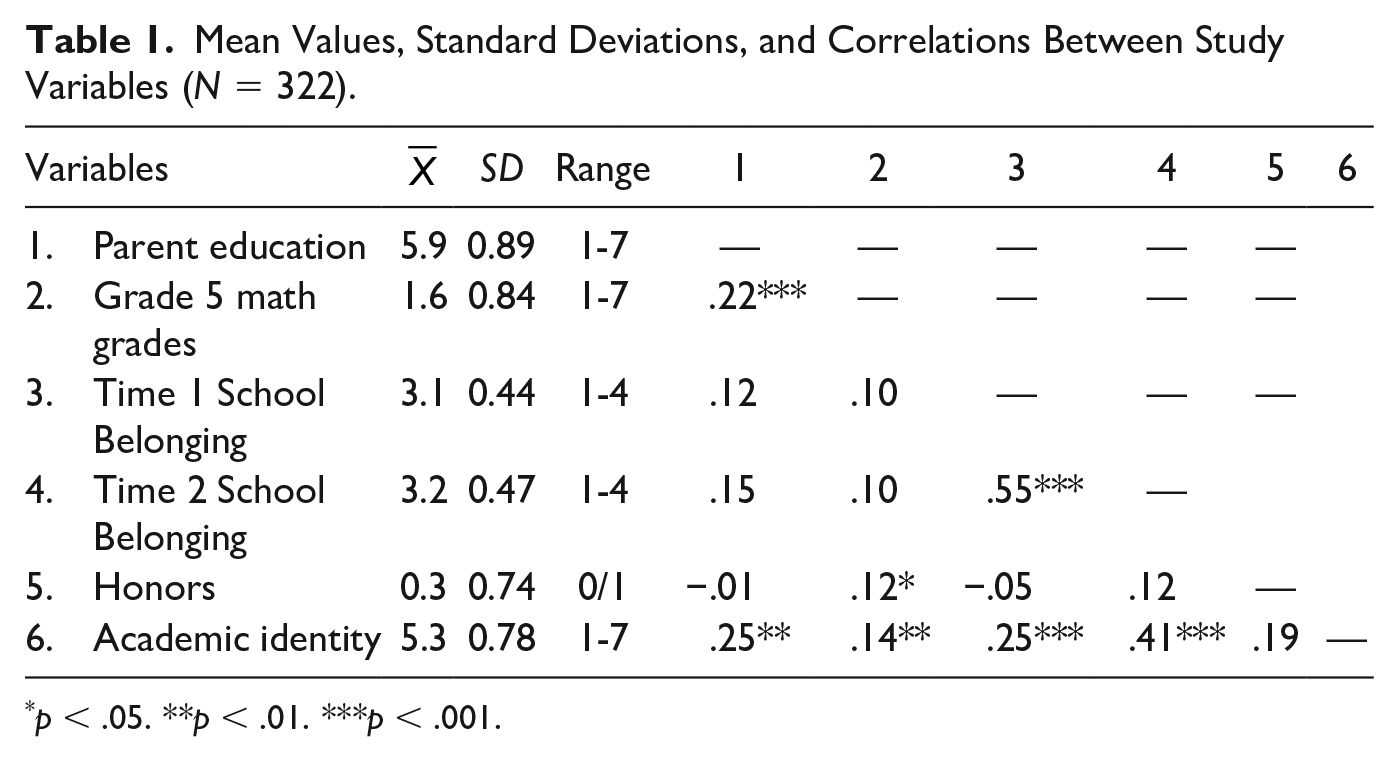
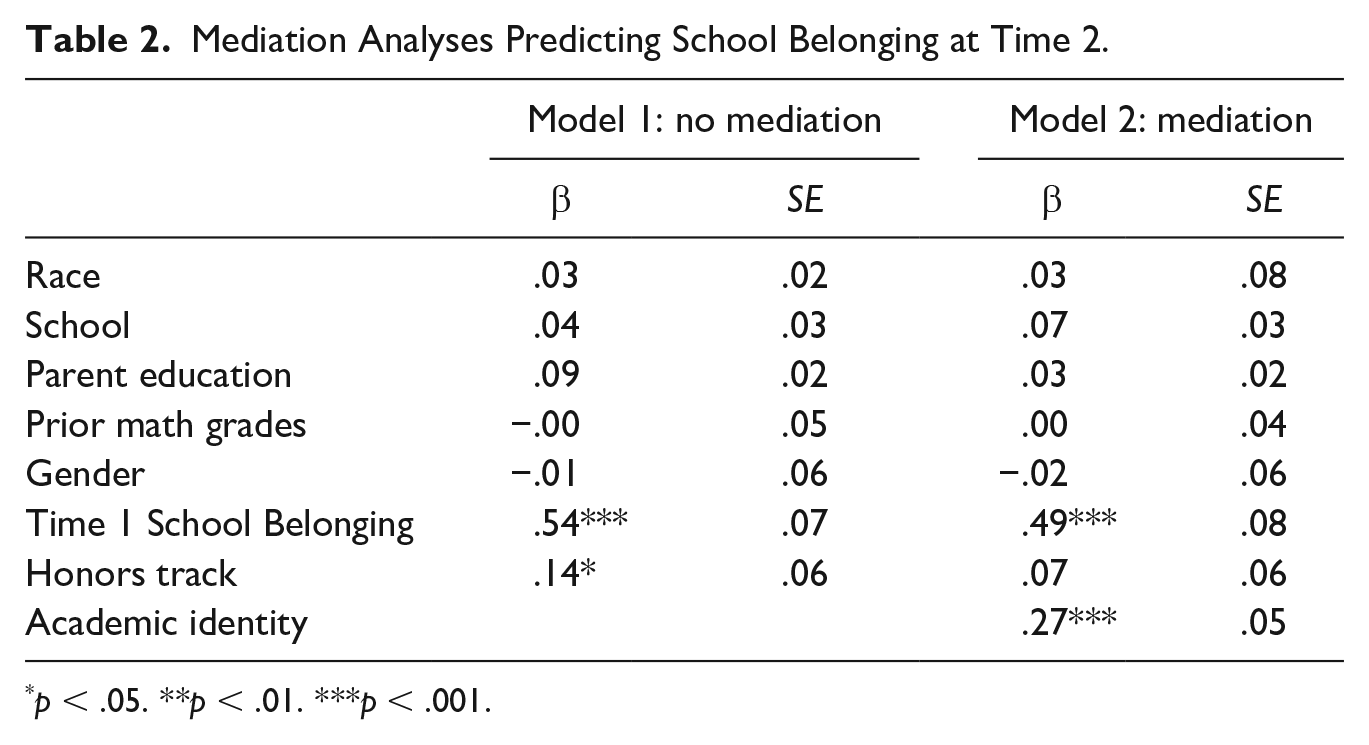
Table 1 illustrates mean values, standard deviations, and correlations between all pairs of study variables. School belonging at Time 2 was regressed on demographics, control variables, and track placement. These results appear in Table 2. As the first step, the demographic and control variables were entered in the model along with math track placement. These variables together accounted for 29% of the variance, R2 = .29, F(6, 183) = 10.68, p < .001. With Time 1 School Belonging controlled, students’ track placement positively predicted school belonging at Time 2 (β = .14, p = .04). Students in honors placement reported higher school belonging than students in standard classes. Next, we tested the full model, adding the Academic Identity change score (see Table 2 and Figure 1). The full model accounted for additional variance R2 = .41, F(7, 142) = 10.75, p < .001. Track placement was no longer significant (β = .07, p = .26), but with Time 1 School Belonging controlled, change in Academic Identity from Time 1 to Time 2 significantly predicted Time 2 School Belonging (β = .27, p < .001).
Mean Values, Standard Deviations, and Correlations Between Study Variables (N = 322).
p < .05. **p < .01. ***p < .001.
Mediation Analyses Predicting School Belonging at Time 2.
p < .05. **p < .01. ***p < .001.
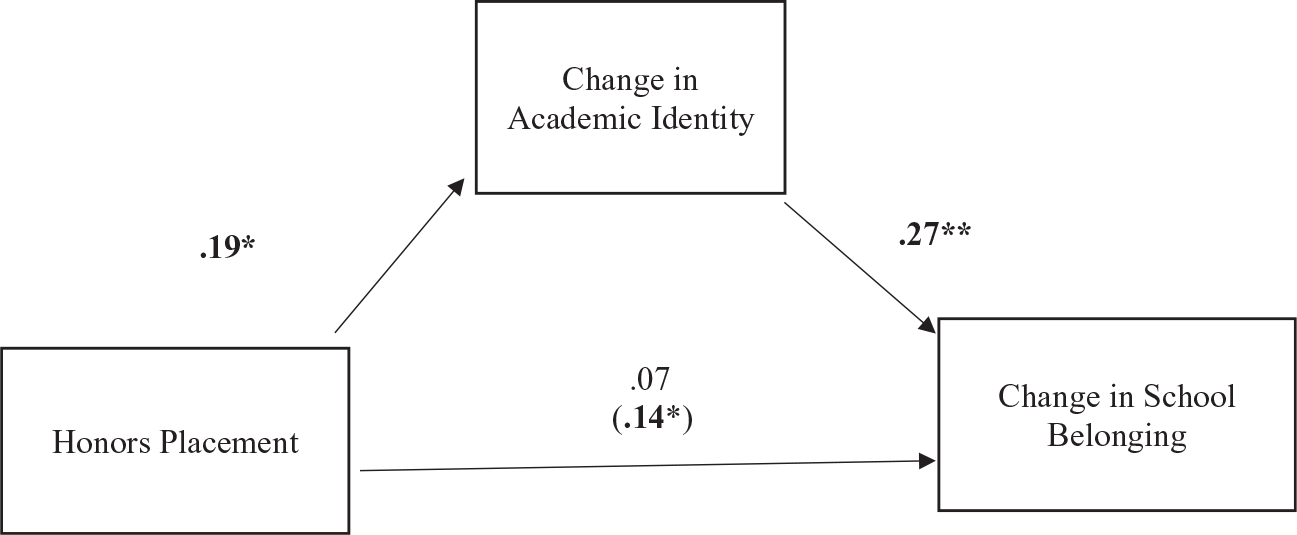
Standardized regression coefficients for the relationship between honors placement and school belonging as mediated by academic identity.
Mediation analyses based on 3,000 bootstrapped samples using bias-corrected and accelerated 95% confidence intervals (Preacher & Hayes, 2004) showed that change in academic identity had a nonsignificant total effect on school belonging (TE = .01, SE = .02, p = .45), a nonsignificant direct effect (DE = .03, SE = .02, p = .16), and a significant indirect effect (IE = .01, SE = .01, LL = .01, UL = .02) controlling for student background and Time 1 school belonging (see Table 2). Thus, our findings indicate that math placement shapes students’ academic identity, which in turns affects their school belonging perceptions.
Discussion
Many studies have examined how curricular tracking shapes students’ academic self-concept. Tracking is likely to have implications for other motivational beliefs as well (Legette & Kurtz-Costes, 2020). This study increases our understanding of the impact of tracking in early adolescence by examining the relation between Grade 6 math track placement and changes in students’ school belonging, which is correlated with students’ school attendance, academic motivation, educational aspirations, and achievement (Allen et al., 2018; Sánchez, Colón, & Esparza, 2005). Results of this study showed that the widely used practice of tracking in middle school math was related to changes in students’ school belonging. These changes occurred across the sixth grade, students’ first year in middle school, when youth are exploring who they are and how they “fit” within their new school context. In the current study, changes in school belonging linked to math track placement were mediated by students’ academic identity. Below we discuss implications of our results for better-understanding group processes that shape the development of adolescents’ academic motivation. We then provide suggestions for policy and practice before summarizing the limitations of the study and suggestions for future research.
Curricular Tracking, Academic Identity, and School Belonging
In the current study, we focused on changes in students’ reports of school belonging linked to students’ math track placement, finding that in contrast to students in regular math, students who were placed in an honors math course showed increases in school belonging across the sixth-grade year. We chose school belonging as a motivational belief because it is related to several academic outcomes such as achievement, classroom engagement, and academic efficacy (Allen et al., 2018; Gillen et al., 2013). For instance, in a sample of adolescent youth, a stronger sense of school belonging was associated with students’ intrinsic value and utility value of school each year over a period of 4 years (Gillen-O’Neel & Fuligni, 2013). Thus, students who experience increased school belonging because of placement in an honors math class at the beginning of middle school might be placed on a trajectory that leads to increased valuing of school across the high school years.
In the current study, the increases in school belonging associated with placement in honors math were mediated by students’ academic identity: Honors math placement was associated with increases in academic identity, which, in turn, predicted increases in school belonging. As described by Thoman et al. (2019), social influences often play a heavy role in the shaping of youth’s interests and goals, with significant consequences for their academic motivation. Results of the current study suggest that math track placement led to changes in students’ perceptions of their “fit” within the school context, and that these changes in school belonging were mediated by the degree to which they viewed academic success as an important aspect of their personal identities. We surmise that these processes occurred in part because of students’ ascribed “meaning” to track assignment, and in part to the social consequences of track placement.
With regard to the meaning ascribed to track placement, both teachers and students make assumptions about youth based on their curricular track placement (Legette, 2018; Rubie-Davies, 2007). Namely, students in both honors and standard classes believe that students in honors classes have better academic abilities and behaviors than students in standard classes (Legette, 2018; Tyson, 2011). As a result, students’ curricular track placement might lead to group differences in several motivational beliefs, including students’ perceptions of their ability, the extent to which academic success is an important part of their identity, and their valuing of school. For students who like math and perceive themselves as talented in math during elementary school, yet who are assigned to nonhonors math in middle school, track assignment might lead to negative change in motivational beliefs, with declines in valuing of and perceptions of competence in math. In contrast, students who are placed in honors classes are likely to view themselves as talented in math and increasingly value academic success as part of their personal identity, leading to a stronger connection and sense of belonging within the school context than that experienced by students in nonhonors classes. It is important to note that prior math ability was controlled in our analyses. Therefore, it is likely that students’ math placement and not group differences in math ability led to differences in academic identity and school belonging.
Our results might also have resulted from the social consequences of track placement if interactions with teachers and peers differed across the two tracks. Teachers hold more positive perceptions and higher academic expectations of students in advanced classes than in standard classes (Oakes, 2005), which in turn are associated with differences in teaching practices (Rubie-Davies, 2007). Teachers who hold high expectations for their classrooms provide students with more positive feedback, orient children to the lesson more, ask more open-ended questions, and manage students’ behavior more positively than teachers who hold low expectations for their classrooms (Rubie-Davies, 2007). Future research could substantiate that these track differences in teachers’ behaviors lead to differences across time in the academic achievement and goals of early adolescents.
Research suggests that students in standard classes are aware that teachers demonstrate more positive interactions with students in advanced classes (Gilbert & Yerrick, 2001). Thus, behaviors of peers might also differ across honors and advanced classes, with students in honors classes more likely to encourage a strong academic identity and sense of school belonging than peers in regular math classes (Nelson & DeBacker, 2008). We surmise that track placement influences early adolescents’ school belonging through both impacts on students’ motivational beliefs associated with their beliefs about the significance of track placement as well as through track differences in teachers’ and peers’ behaviors. Future research could address ways that these mechanisms act in tandem as well as addressing, as discussed below, changes in educational policy and practice that might alter those processes.
Recommendations for Policy and Practice
Our findings suggest that math track placement in middle school is related to changes in students’ schooling belonging, acting through their academic identity. Other research has shown that teachers hold lower academic expectations of students in standard classes than of students in honors classes, creating differences in student–teacher interactions and classroom instruction (Ansalone & Biafora, 2004; Kelly & Carbonaro, 2012). Increasing teachers’ awareness of the importance of expectations and fostering their high academic expectations of all students is likely to enhance student outcomes. For instance, in an intervention designed to foster teachers’ behavior consistent with high expectations, students in experimental classrooms showed greater math achievement than students in control classrooms (Rubie-Davies, Peterson, Sibley, & Rosenthal, 2015). Across the school year, test scores of students with teachers in the experimental group typically increased 41 points, compared with 32-point gains among students in control classrooms.
As Boaler (2013) has argued, because students’ achievement evaluations (e.g., test scores, grades) are used to stratify students into their curricular track placement, the competence connotations associated with track placement are likely to lead students to perceive that ability is fixed and drives academic success. Thus, another way for teachers to strengthen students’ academic identity is to have conversations with students about the malleability of ability. Several intervention studies indicate that teaching students growth mind-set messages predicts changes in achievement and academic motivation (Blackwell, Trzesniewski, & Dweck, 2007; Good, Aronson, & Inzlicht, 2003). For example, an intervention study with middle school students demonstrated that learning about the flexibility of the brain and ways to increase intelligence had a positive impact on students’ classroom motivation and achievement (Blackwell et al., 2007).
Finally, we suggest that systemic changes to the structure of curricular tracking should be implemented. Due to the sequencing of math courses in many school districts, students’ math course placement in Grade 6 determines their math course selection in high school (Kelly & Price, 2011). For example, Burris and Welner (2005) illustrated that students’ 10th-grade math enrollment differed by their curricular placement in middle school. Students tracked in advanced middle school courses were enrolled in trigonometry and advanced algebra in Grade 10, but students who had been tracked in standard math classes were enrolled in first-year algebra. Similarly, in our middle school sample, students in advanced math were learning content required for sixth grade but also math content taught in seventh grade. However, students in standard classes were only learning math content required for sixth-grade making it difficult, if not impossible, for students in standard classes to transition to advanced courses. As such, curricular tracking places students on a developmental trajectory that will lead to cumulative differences between high- and low tracks as they proceed through middle school and high school. One way to reduce the negative impact of lower track placement on students’ motivational beliefs would be to alter curricula so that students have greater flexibility in diverging from a “set track” after sixth-grade track assignment.
Study Limitations and Suggestions for Future Research
A limitation of this study is that a relatively small number of classrooms were studied, and the data did not include information at the classroom level. Although there is evidence that teacher effectiveness differs across honors and nonhonors classes, chance variation due to one or two teachers in participating schools could have influenced results. Thus, it is conceivable that characteristics of individual teachers may have led to differences between honors and standard tracks, and that results were due to these teacher effects rather than track assignment. Future research examining group processes associated with ability tracking should include a classroom level variable and include a sufficient number of classrooms to test within-track differences.
A second, related limitation is that we did not assess teacher or peer behaviors that might have led to group differences. Although prior research suggests that teachers’ instructional practices, student behaviors such as effort, and student–teacher relationships differ by track placement, we did not measure those constructs. Future research might target examination of teaching practices as well as other factors that lead to track differences in students’ school belonging.
Third, students reported their school belonging at only two time points. Thus, a limitation of the study is uncertainty regarding whether track differences in students’ academic identity and school belonging extended beyond sixth grade. However, because it is difficult for students in standard math tracks to move to higher tracks (Kelly & Price, 2011; Oakes, 2005), students’ repeated exposure to curricular differences might have a cumulative effect leading to greater differences linked to tracks by the end of high school. Additional longitudinal research is needed to examine these processes over time.
A fourth limitation of the study is the small sample size of Black and Latinx students, precluding the examination of ethnic/race differences. Persistent race achievement gaps in the United States and differing perspectives on the causes of those gaps might lead to qualitatively different influences of tracking on academic motivation and identity across racial groups (Bañales et al., 2019). Black students, Latinx students, and students of low socioeconomic status (SES) are consistently overrepresented in lower academic tracks, even with similar achievement levels as their White and upper-SES counterparts (Nicholson-Crotty, Grissom, Nicholson-Crotty, & Redding, 2016). Given the results of this study, another important avenue for future research is to explore whether tracking perpetuates race and social class inequities in educational outcomes via students’ academic identities and school belonging.
Conclusion
To our knowledge, this longitudinal study is the first to examine the relations among academic track placement and changes in students’ academic identity and school belonging. The results, demonstrating that students’ academic identity mediated the relation between track placement and changes in school belonging across the sixth-grade year, indicate that ability grouping has significant consequences for students’ motivational beliefs. Given the importance of math achievement for students’ eventual educational attainment, it is our hope that researchers and educators examine more comprehensively the implications of tracking for students’ success and identify ways to maximize that success.
Footnotes
Acknowledgements
We express our gratitude to the young adolescents who participated in this research as well as to the schools where students completed surveys.
Declaration of Conflicting Interests
The author(s) declared no potential conflicts of interest with respect to the research, authorship, and/or publication of this article.
Funding
The author(s) disclosed receipt of the following financial support for the research, authorship, and/or publication of this article: This work was supported in part by a postdoctoral fellowship provided by the National Institute of Child Health and Human Development (T32-HD07376) through the Center for Developmental Science, University of North Carolina at Chapel Hill and by a small grant from Duke University.
