




Abstract
The aim of the present study was (a) to investigate the effect of perceived parents’ disapproval of peer relations and perceived parental monitoring on youth’s engagement in organized sports activities, (b) to examine whether youth’s engagement in delinquent behaviors mediates the link between parents’ behaviors and youth’s participation in and dropout from organized sports, and (c) to test whether the mediation process is moderated by youth’s immigrant background. Data were collected from immigrant and Swedish adolescents (N = 687) in seventh grade over two consecutive years. Our main findings revealed that youth who disclose their whereabouts to parents and whose parents practice control are less likely to engage in delinquent behaviors, and, in turn, more likely to engage in organized sports. The findings were similar with respect to sports dropout. Most importantly, these results hold for both immigrant and Swedish youth.
A large number of school-aged children in Europe (Garrido, Olmos, García-Arjona, & Pardo, 2012; Lämmle, Worth, & Bös, 2012) and the Nordic countries (Nielsen, Hermansen, Bugge, Dencker, & Andersen, 2013; Özdemir & Stattin, 2012) spend a substantial portion of their time on leisure activities, especially organized leisure activities. Organized activities are characterized as structured activities that occur on a regular basis under adult supervision and with an emphasis on skill building. Various labels have been used to describe the content of organized activities, depending on where the activities are organized (e.g., school based or community based), when the activities are organized (e.g., after school, out of school, during summer, and extracurricular), and what the activities include (e.g., sports, music, and arts; Mahoney, Larson, & Eccles, 2005; Persson, Kerr, & Stattin, 2007). The specific focus of the present study is on organized sports activities.
Participation in organized sports activities has been shown to improve the adjustment of adolescents across several domains. Despite some contradictory findings (Fredricks & Eccles, 2005; Wagnsson, Augustsson, & Patriksson, 2013), it has been demonstrated that sports engagement is linked to better psychological (Mahoney & Vest, 2012; Zullig & White, 2011), behavioral (Mahoney & Stattin, 2000), and academic (Darling, Caldwell, & Smith, 2005) adjustment among adolescents across a range of cross-sectional and longitudinal studies. For example, it has been shown that youth who are involved in organized sports report lower depressive symptoms, higher self-esteem and self-confidence (Fredricks & Eccles, 2006; Özdemir & Stattin, 2012), fewer antisocial behaviors (Mahoney & Vest, 2012), and better academic adjustment (Darling et al., 2005; Mahoney & Cairns, 1997). Together, the findings suggest that adolescents benefit from participating in organized sports activities in many different ways.
Despite the positive link between participation in organized sports activities and the adjustment of adolescents, the current literature shows that there is an inequality in participation; that is, immigrant youth are less likely to participate in organized sports than their native peers (Garrido et al., 2012; Nielsen et al., 2013; Özdemir & Stattin, 2012). However, the current literature offers little understanding of this inequality. A majority of the studies have focused on sociodemographic factors, such as immigrant generation status (Garrido et al., 2012; Peguero, 2011; Springer et al., 2010), or the combination of socioeconomic status and immigrant-generation status (Camacho & Fuligni, 2015; Hallmann & Breuer, 2014; Lämmle et al., 2012). Nevertheless, the findings are inconsistent. Adolescents’ sociodemographic characteristics are not always linked to participation in organized activities (Camacho & Fuligni, 2015). To better identify the factors linked to participation in organized sports activities, in the current study, we focused on the role of family context. Specifically, we examined whether youth’s perceptions of parenting behaviors (i.e., parental monitoring and disapproval of peers) explained participation in, and dropout from, organized sports activities, and investigated potential explanations for any links found. We focused in particular on adolescents’ involvement in delinquent behaviors as a mediating mechanism. In addition, due to the inequality in participation rates between native and immigrant youth, we also examined whether the role of parenting behaviors and the mediating role of delinquency differed according to native or immigrant status.
Parenting Behaviors and Youth Participation in Organized Activities
Parents’ behaviors on a daily basis may play a critical role in facilitating youth’s participation in organized activities. For example, the context-choice model postulates that how parents treat their children in the home setting may influence youth’s engagement in structured and adult-supervised activities (Kerr, Stattin, Biesecker, Ferrer, & Wreder, 2003). Specifically, when youth are exposed to excessive control at home, the exposure makes them feel unvalued and disrespected, and leads them to avoid other adult-led situations, including organized activity settings. In line with this, Persson and colleagues (2007) showed that, when youth perceived their parents as controlling, and felt unvalued and disrespected in the family setting, they were less likely to become involved in structured activities. In addition, they were more likely to switch from structured to unstructured activities, such as just hanging out on the streets. Similarly, Caldwell and Smith (2006) showed that adolescents who were overly controlled by their parents were less likely to participate in organized sports and spend more time in public places, and were more likely to engage in antisocial behaviors. By contrast, when youth perceived that they had warm and responsive parents, they were more involved in school or community-based extracurricular activities (Fletcher & Shaw, 2000). In sum, these studies highlight parents’ intrusive controlling behaviors as an obstacle to youth’s participation in extracurricular activities. Following this line of research, we focused on two distinct parenting strategies that were used by parents to oversee youth’s day-to-day activities and whereabouts: parents’ disapproval of peer relations and parental monitoring behaviors.
Some parents may be motivated to manage the peer relationships of their children by using strategies such as prohibiting their children from engaging with certain peers (Mounts, 2001, 2002) or disapproving of any such engagement (Tilton-Weaver, Burk, Kerr, & Stattin, 2013; Tilton-Weaver & Galambos, 2003). Parents’ disapproval of peers might be motivated by their genuine concerns over the potential negative influences of deviant peers on their children (Tilton-Weaver & Galambos, 2003). Nevertheless, youth conceptualize friendship and peer relations as within their personal jurisdiction (Smetana, 1988; Smetana & Asquith, 1994), and may, therefore, perceive parents’ attempts to exert control in this domain as intrusive, and react rebelliously. Supporting this line of reasoning, previous studies have shown that when parents communicate disapproval of their peer relationships, youth are more likely to affiliate with deviant peers (Mounts, 2001, 2002; Tilton-Weaver et al., 2013) or increase contact with them (Keijsers et al., 2012). Based on these findings and arguments from the context-choice model (Kerr et al., 2003), we argue that parents’ disapproval of peer relations may encourage youth to seek environments where there is no adult figure or structure (e.g., by simply hanging out with peers). Consequently, these young people may tend to avoid structured activities, including organized sports.
Parents may also use monitoring behaviors to oversee their children’s behaviors, whereabouts, and day-to-day activities in nonintrusive ways. Monitoring was for a long time defined in terms of parents’ tracking and surveillance of their youth’s behaviors (Dishion & McMahon, 1998). Stattin and Kerr (2000), however, challenged the traditional definition of monitoring by arguing and demonstrating that the measures commonly used in the literature have instead involved assessments of parents’ knowledge of their youth’s whereabouts and activities. Indeed, Stattin and Kerr (2000) redefined monitoring, and suggested that parents can acquire knowledge about their children’s activities and behaviors through (a) child disclosure (i.e., children spontaneously sharing information with their parents), (b) parental solicitation (i.e., parents asking for information from their children and their friends), and (c) parental control (i.e., imposing rules and restrictions). Although parental solicitation and control represent parents’ active efforts to obtain information about their children’s whereabouts, child disclosure is driven by youth’s own initiatives. Parents can facilitate children’s voluntary and spontaneous disclosure of their day-to-day activities and behaviors by offering an open and warm family environment (Criss et al., 2015; Kapetanovic, Skoog, Bohlin, & Gerdner, 2018; Stattin & Kerr, 2000). Relatedly, child disclosure was identified as the most important source of parents’ overall knowledge of their youth’s day-to-day activities and behaviors, followed by parental control and parental solicitation (Kerr & Stattin, 2000; Stattin & Kerr, 2000).
Studies of the different aspects of parental monitoring have provided evidence suggesting that both children’s disclosure of their whereabouts and parental control are related to positive behavioral outcomes. Specifically, several studies have reported that the more youth disclose information to their parents, the less likely they are to engage in delinquent behaviors and consume alcohol (Kapetanovic, Bohlin, Skoog, & Gerdner, 2017; Kapetanovic et al., 2018; Kerr, Stattin, & Burk, 2010; Stattin & Kerr, 2000), and to engage with peers who are delinquent and also consume alcohol (Darling & Tilton-Weaver, 2018). In addition, youth who are willing to share information about their behaviors and activities to their parents spend less time beyond adult supervision (Laird, Marrero, & Sentse, 2010). Similarly, both cross-sectional (Stattin & Kerr, 2000) and longitudinal (Kakihara, Tilton-Weaver, Kerr, & Stattin, 2010; Kapetanovic et al., 2017, 2018) studies have demonstrated that children and youth whose parents use controlling strategies (e.g., requiring youth to explain what they did and with whom, to get permission before going out) are less likely to engage in delinquent behaviors, and with deviant peers (Kerr & Stattin, 2000). However, it is important to emphasize that these findings are specific to parents’ control for the purpose of setting rules to oversee their child’s behaviors and activities. This type of control is different from overcontrolling behaviors that may limit youth’s autonomy.
As for parents’ active search for information by posing questions to their offspring (e.g., parental solicitation), the literature presents mixed findings. For example, one group of studies has shown a positive association between parental solicitation and youth’s delinquent behavior (Cristini, Scacchi, Perkins, Bless, & Vieno, 2015; Kerr et al., 2010; Stattin & Kerr, 2000); that is, the more parents ask about their children’s whereabouts and behaviors, the more youth engage in delinquent activities. By contrast, another group of studies has shown that parents’ solicitation behaviors are associated, both cross-sectionally (Criss et al., 2015) and longitudinally (Hamza & Willoughby, 2011; Laird et al., 2010), with fewer adjustment problems among adolescents. For example, parents’ solicitation has been linked to lower antisocial behavior and substance use (Criss et al., 2015; Laird et al., 2010), fewer depressive symptoms (Hamza & Willoughby, 2011), and less time spent beyond adult supervision (Laird et al., 2010).
Following these findings, we argue that parents’ monitoring behaviors may protect youth from engagement in risky behaviors, and, in turn, create opportunities for them to spend time in adult-led activities, such as organized sports. Supporting our argument to some extent, Huebner and Mancini (2003) showed that youth are more inclined to engage in activities that are somewhat structured and adult-led, such as church or other religious activities, and also volunteering, when their parents use monitoring behaviors. Likewise, Caldwell and Smith (2006) showed that parental knowledge is positively associated with youth’s participation in organized sports, and negatively with antisocial behaviors. However, these studies (Caldwell & Smith, 2006; Huebner & Mancini, 2003) did not specify how the parents obtained knowledge of their youth’s day-to-day activities and behaviors. Specifically, it was not possible to determine whether these parents’ knowledge of youth’s behaviors was obtained through youth’s disclosure of information, parental control, or parental solicitation. Relatedly, we have a limited understanding of which aspect(s) of parental monitoring contribute to youth’s participation in organized sports. To address these limitations, in the present study by using two waves of longitudinal data, we specifically investigated whether there are unique effects of youth’s disclosure of information, perceived parental control, and perceived parental solicitation on youth’s engagement in organized sports activities.
Youth Delinquency and Participation in Organized Sports
Most studies of the link between delinquency and participation in organized activities have followed the premises of social control theories, which posit that involvement in settings with clear rules and adult guidance hinder the development of antisocial behaviors (Osgood, Wilson, O’malley, Bachman, & Johnston, 1996). These studies have conceptualized youth’s delinquent involvement as an outcome rather than an antecedent of sports involvement. Consistently, despite some mixed findings (Fredricks & Eccles, 2005; Spruit, Van Vugt, van der Put, van der Stouwe, & Stams, 2016), youth who were involved in organized sports activities have been found to report lower antisocial (Mahoney & Stattin, 2000), delinquent (Gardner, Roth, & Brooks-Gunn, 2009), and externalizing behaviors (Fredricks & Eccles, 2006, 2010) than their nonparticipating counterparts. On the other hand, the other line of thinking—that youth with delinquent tendencies chose not to take part in, or dropout from, organized sports—has received little attention. It has been argued that youth may choose the contexts for their activities on the basis of their basic temperamental characteristics or of emotions related to their adult-controlled settings (Stattin & Kerr, 2009). Youth who display oppositional predispositions would actively seek settings free from adult-endorsed rules and restrictions. In an early exploration of this idea, it was reported that 60% of boys who displayed delinquent (i.e., nonconforming, rule violating, and lack of responsibility) tendencies at the beginning of a summer youth sports program dropped out of the program prematurely, whereas only 30% of those who were rated as low on delinquent tendencies dropped out (Yiannakis, 1976). It is likely that adolescents who have difficulties in conforming and following rules tend to choose unsupervised activity settings. Stoolmiller (1994) reported consistently that increases in antisocial predisposition (a combination of aggressive, antisocial, and delinquent behaviors) from Grades 4 to 8 were highly correlated with increases in wandering (unstructured, unsupervised time) during the same period. Extending previous research, we expected that youth who are engaged in delinquent behaviors would be less likely to engage in organized sports activities where there is structure and adult leadership. In a similar vein, we expected that delinquent activities would be linked to dropping out from sports among the youth who were already involved in organized sports activities.
The Mediating Role of Youth Delinquency in the Link Between Parenting Behaviors and Participation in and Dropout From Organized Sports
The processes that explain why parents’ behaviors on a daily basis (particularly parental disapproval of peer relations and parental monitoring) play a role in youth’s participation in organized activities are not well understood. We propose that one of the pathways may be through youth’s (dis)engagement in risky or problem behaviors. As described earlier, the ways in which parents oversee their children’s day-to-day activities have implications for youth’s engagement in problem behaviors. Specifically, parental disapproval of peer relations (overseeing intrusively) puts youth at risk of hanging out with deviant peers and engagement in problem behaviors (Mounts, 2001, 2002; Tilton-Weaver et al., 2013), whereas parental monitoring (overseeing in a nonintrusive way) protects youth from involvement in risky behaviors, including delinquent behaviors (Kapetanovic et al., 2017; Kapetanovic et al., 2018; Kerr et al., 2010). In addition, it has been shown that youth with problem behaviors are less likely to participate and remain in organized activities (e.g., Yiannakis, 1976). Altogether, in the context of this study, we argue that, by protecting their children from delinquent behaviors, parents may increase the opportunities for their children to participate in prosocial activities such as organized sports. By contrast, parents who adopt intrusive parenting behaviors (e.g., parental disapproval of peer relations) may drive their children to engage in delinquent behaviors; and, in turn, their children may avoid structured and adult-led settings (e.g., organized sports).
The Role of Immigrant Status
The literature consistently shows that there are mean-level differences in parenting behaviors between immigrant and native parents. For example, studies conducted in Europe, such as in Belgium (Güngör, 2008), the Netherlands (Wissink, Dekovic, & Meijer, 2006), and the Nordic countries, including Norway and Sweden (Virta, Sam, & Westin, 2004), have shown that immigrant parents tend to use control as a parenting strategy more often than native-born parents. These controlling behaviors often become intrusive and interfere with children’s peer relationships. For example, several studies have shown that Latino parents are more likely to prefer their children to be friends with members of their own group, and, thus, grant less autonomy to youth in their peer relationships (Mounts & Kim, 2007; Updegraff, McHale, Whiteman, Thayer, & Crouter, 2006). It is argued that the use of overcontrolling behaviors among immigrant parents may be related to a motivation on their part to preserve their heritage (Halgunseth, Ispa, & Rudy, 2006; Segal, 1991). Specifically, it has been argued that immigrant parents often have a fear of losing their cultural values. These feelings lead them to apply intrusive controlling strategies (Este & Tachble, 2009), including disapproval of their children’s peer relations, in order to ensure that their children maintain the values of their heritage culture.
Immigrant parents, on the other hand, may tend to have less knowledge of their children’s whereabouts, probably due to low levels of youth disclosure and parental solicitation. Cristini and colleagues (2015) demonstrated that immigrant parents have less knowledge of their adolescents’ behaviors and activities outside the home than native parents, and adolescents with immigrant parents are less likely to disclose information to their parents than their native counterparts. Consistently, parents of an ethnic-minority or immigrant background use less parental solicitation (Fernandez, Loukas, & Pasch, 2018) to oversee their children’s whereabouts. Taken together, there are some mean-level differences between immigrant and native parents in terms of parenting behaviors. However, these differences in parenting behaviors may not necessarily lead to differential adjustment outcomes among immigrant youth (Özdemir & Bayram Özdemir, 2020).
The no-group differences hypothesis (Rowe, Vazsonyi, & Flannery, 1994) suggests that mean-level differences on specific factors should not be interpreted as entailing different developmental processes across groups. Supporting this argument, Fernandez and colleagues (2018) showed that despite mean-level differences on youth disclosure and parental solicitation, their associations with youth’s depressive symptoms were equal across non-Hispanic White and Hispanic youth. Similar findings have been observed by Delforterie and colleagues (2016). In line with these arguments and empirical findings, we expected to find differences in youth’s perception of parental disapproval of peers, child disclosure, parental solicitation, and parental control. On the other hand, in line with the no-group differences hypothesis, we expected that the association between parents’ parenting behaviors and youth’s participation in organized sports, and the process underlying this association, would be similar across both immigrant and native youth.
The Current Study
Sweden is one of the most sporting nations in the European Union (Eurobarometer, 2018), and the rate of participation in the activities of sports clubs is high among young people (van Bottenburg, Rijnen, & van Sterkenburg, 2005). This bright picture may be related to national public-health policies highlighting the importance of organized sports activities (Swedish Sports Confederation, 2019) and the government’s systematic support for these activities (Bergsgard & Norberg, 2010). In addition, we should note that organized sports activities are by far the most popular extracurricular activities among youth in Sweden. Specifically, data in national reports (Statistics Sweden, 2017-2018) reveal that both native Swedish (63%) and immigrant (43%) youth (12-18 years old) engage in organized sports activities more than non–sports-related organized activities (Swedish = 19%, immigrant = 14%). Given the emphasis on participation in organized sports activities in the Swedish cultural context, we aimed in the current study to examine whether and how parenting behaviors contribute to youth’s engagement in organized sports activities among Swedish and immigrant youth.
Our first aim was to investigate whether there is an association over time between youth’s perception of parents’ parenting behaviors (i.e., disapproval of peer relations, parental control, parental solicitation, and youth disclosure) and youth’s participation in and dropout from organized sports. Our second aim was to examine the mediating role of youth’s engagement in delinquent behaviors in the association between youth’s perception of parents’ behaviors and youth’s involvement in organized sports and dropout over time. Our third and final aim was to test the moderating effect of immigrant background. Specifically, we examined whether the mediating role of youth’s engagement in delinquent activities on the association between parenting behaviors and youth’s participation and dropout from organized sports is moderated by youth’s immigrant background, by fitting moderated mediation models. Understanding such an association may have particular importance for practitioners and scholars interested in immigrant youth’s participation in organized activities and their adjustment into Swedish society. To test our research questions, we adopted a longitudinal approach, with two waves of assessment at a 1-year interval.
Method
Participants
The data were drawn from the Seven School Study—a longitudinal study of youth’s experiences inside and outside school, and of their relationships with parents, peers, and teachers—conducted by Håkan Stattin and Margaret Kerr. Data were collected from seven public upper secondary schools in a medium-sized city in central Sweden. Despite some minor differences, compulsory education has four stages for most public-sector schooling institutions in Sweden: preschool, low or primary (Grades 1-3), middle or lower secondary (Grades 4-6), and high or upper secondary (Grades 7-9). Students start upper secondary school at age 13 and continue until age 15. There is no school transition from seventh to ninth grades. The schools for the current project were selected from different neighborhoods to match the sociodemographic characteristics of the city. The target sample consisted of 1,654 students (seventh to ninth grades), and 88% of the target sample (N = 1,455) were present during the first data collection. Of this target group, only the students who were in Grade 7 or 8 in the first year of data collection were available for the second data collection (N = 1,002). Of the eligible group, 687 (47.5% girls, Mage = 13.91 years and SDage = 0.74) comprised the analytic sample for the study. Most of the participating youth were from intact families (63.6%), and had employed parents (78% for mothers and 87% for fathers), and 71% perceived their financial situation to be equally as good as or better than that of other families in their neighborhood. Overall, 32% (n = 219) of the youth or their parents were born outside a Nordic country (Denmark, Finland, or Norway), and 68% (n = 468) were born into Swedish families. Over 60% of the immigrant youth had been living in Sweden for five or more years. The immigrants came from different countries, representing regions in the Middle East (e.g., Egypt, Iran, Iraq, Israel, Lebanon, Syria, and Turkey), Africa (e.g., Eritrea, Gambia, Somalia, and Tunisia), Asia (e.g., India, Malaysia, Thailand, and Vietnam), south and central America (e.g., Colombia, El Salvador, and Uruguay), Europe (e.g., Greece, Poland, and Spain), Russia, and former Yugoslavia (e.g., Bosnia, Kosovo, and Serbia). Most of the youth spoke Swedish at home with their family, whereas 28% spoke their native language at home.
Attrition and Missing Data Analysis
Of the analytic sample (N = 687), 7% of the youth did not participate in the study at Time 2 (T2), whereas the rest participated at both Time 1 (T1) and T2. We performed a logistic regression analysis to examine whether the study variables were systematically related to longitudinal attrition in the data. The results showed that none of the study variables significantly predicted attrition. In addition to longitudinal attrition, less than 5% of the participants had missing information on specific items. Comparison of the youth with and without missing values on the other study variables did not reveal any significant differences. Thus, the missing values were estimated using the expectation-maximization (EM) algorithm (Enders, 2010).
Procedure
Parents received an information letter by regular post with a description of the project, and were asked to return a postcard in a prepaid envelope if they chose to refuse the participation of their offspring in the study. Youth provided assent to participate in the study before the data collection started. This followed a thorough description of the project, a statement about the voluntary nature of participation and confidentiality of information, and an assurance that participants could quit the study whenever they wanted. Data collection from the youth took place during two regular class hours (approximately 90 minutes), and was administered by trained research assistants. Students with language difficulties (less than 5%) received help from research assistants who were able to read out the questions in the students’ first languages. The study was approved by a regional Ethics Review Board.
Measures
Organized sports participation
Participation in organized sports activities was assessed using two items. Initially, youth were asked “Are you involved in some club or organization or the like where there is an adult leader whom you meet one or several times a week at a specific time?” The response items were no = 0 and yes = 1. Subsequently, youth were asked, “If you are involved in a club or organization, what kind of organization is it and how often do you meet?” Response items included sports or athletic association, theater or art association, outdoor activities association (e.g., nature club, or similar), religious association (e.g., church or Free Church), political association, music association, hobby association, and boy or girl scouts. Based on the information from the second question, we selected youth who were engaged in an organized sports or athletic association in the presence of an adult leader and who met on one or more occasions. Overall, 61% of the youth were involved in an organized sports activity (38.3% involved only in sports and 22.7% involved in at least one other activity in addition to sports), 10% were involved in some nonsporting activity, and 29% were not involved in any type of activity at T1. In the present study, we focused on youth who were involved in sports or athletic associations. Those who participated in organized sports were coded as 1 (n = 419), the others as 0 (n = 268).
Sports dropout
Like other scholars who have studied dropout (Calvo, Cervelló, Jiménez, Iglesias, & Murcia, 2010; Persson et al., 2007), we used the same items to measure participation in organized sports activities at T1 and T2. Then, we identified the youth who were involved in sports activities during T1 but were no longer involved during T2 as dropouts. The youth who continued in organized sports activities were coded 0 (n = 337), and those who were involved in sports activities at T1 but were no longer involved at T2 were coded 1 (n = 82).
Disapproval of peer relations
A revised version of the Parent’s Peer Management Scale was used to measure youth’s perception of parental disapproval of peer relations (Tilton-Weaver & Galambos, 2003; Tilton-Weaver et al., 2013). The scale consists of four items (e.g., “Your parents have talked to you about who they think you should keep as friends,” “Your parents have told you that they don’t like some of your friends”). The adolescents were asked to respond to each item on a 4-point scale ranging from 1 (don’t agree at all) to 4 (agree completely). All four items were averaged so that higher values reflected greater parental disapproval of peer relations. Past research has provided evidence of the predictive and construct validity of this scale by reporting significant positive associations between parent’s disapproval of peer relationships and parent’s concerns about friends (e.g., Tilton-Weaver & Galambos, 2003). This scale has also shown acceptable inter-item reliability across multiple studies (e.g., Tilton-Weaver et al., 2013; Tilton-Weaver & Galambos, 2003). Inter-item reliability was .81 in the present study.
Perceived parental monitoring
Drawing on Stattin and Kerr’s (2000) reinterpretation of monitoring, we conceptualized parent’s monitoring as having three aspects: youth’s disclosure to parents, perceived parental solicitation, and perceived parental control. Adolescent disclosure was measured using five items (Stattin & Kerr, 2000). Example items included, “Do you talk at home about how you are doing in different subjects in school?” answered on a 5-point scale ranging from 1 (talk about almost everything) to 5 (keep almost everything to myself), “Do you keep much of what you do in your free time secret from your parents?” answered on a 5-point scale ranging from 1 (a lot) to 5 (nothing at all), and “If you are out at night, when you get home, do you say what you have done that evening?” answered on a 5-point scale ranging from 1 (very often) to 5 (almost never). The responses were reversed so that higher values reflected more adolescent disclosure. Cronbach’s alpha for this scale was .72. A revised version of the Parents’ Solicitation Behaviors Scale (Stattin & Kerr, 2000) was used to measure youth’s perception of parental solicitation. The scale consisted of six items, and example items included, “How often do your parents ask you about where you have been after school and what you have done?” answered on a 5-point scale ranging from 1 (very often) to 5 (almost never), “Do your parents usually talk with your friends if they come to your home (e.g., ask what they do or what they think and feel about different things)?” answered on a 5-point scale ranging from 1 (almost always) to 5 (almost never), and “During the past month, how often have your parents started a conversation with you about your free time?” answered on a 5-point scale ranging from 1 (several times this week) to 5 (not this month). The responses were reversed so that higher values reflected more perceived parental solicitation. Cronbach’s alpha for this scale was .80. Youth’s perception of parental control was measured using five items (Stattin & Kerr, 2000). Example items included, “If you have been out very late one night, do your parents demand that you explain what you did and whom you were with?” “Do you need to ask your parents before you can decide with your friends what you are going to do on a
Youth delinquency
The adolescents were asked to respond to a delinquency inventory (Magnusson, Dunér, & Zetterblom, 1975), which has been documented to have high validity when comparing self-reports with official data (Stattin, Kerr, & Bergman, 2010). In the present study, we used 18 items from this inventory. The questions included a wide range of delinquent activities whose frequencies were rated on a 5-point scale ranging from 1 (no, it has not happened) to 5 (more than 10 times). Example items included, “Have you taken things from a store, stand, or shop without paying during the last year?” “Have you stolen something from someone’s pocket or bag during the last year?” and “Have you, purposely, destroyed or participated in destroying objects such as windows, street lights, phone booths, benches, gardens, etc. during the last year” This scale has also shown high internal consistency, reliability, and predictive and construct validity across multiple studies (e.g., Stattin et al., 2010; Stattin & Kerr, 2000). Inter-item reliability was .93 in the present study.
Immigrant status
Immigrant status was defined on the basis of parents’ places of birth. If both parents were born outside any Nordic country, the adolescents were regarded as immigrant. Others were considered Swedish. A small group of young people (2.9%) who had only one parent born outside Sweden were not included in the analysis. Native Swedish youth were coded 0, and immigrant youth 1.
Demographic characteristics
The young people reported on their gender and age, and on parental employment (i.e., does your mother/father have a job?). We also assessed the perceived family economy with a single item: “Do you have more or less money in your family than other families in your area?” The participants responded on a 5-point scale (1 = we have a lot less money than other families, 3 = we have as much money as other families, 5 = we have a lot more money than other families).
Data Analysis
We inspected the bivariate associations to examine whether parenting behaviors, youth delinquency, and sports participation were associated with each other in the expected directions. We estimated odds ratios (ORs) and 95th percentile confidence intervals (CIs) to quantify the differences between immigrant and Swedish youth, and boys and girls, on sports-participation and dropout rates. To address the first research question, we used logistic regression, and regressed youth’s participation and dropout from organized sports activities on youth’s perception of parents’ behaviors. Then, we fitted a mediation model to test our second research question. Parenting behaviors served as the predictors, with youth delinquency as the mediator, and youth’s participation and dropout from sports activities as outcome variables. Measures of parenting behaviors and delinquency were obtained at the first data collection, and participation in sports was assessed a year later. We fitted separate models for the two outcome variables: youth’s participation in organized sports assessed a year later and dropout from sports activities. We fitted a full mediation model first, and evaluated the model fit and model modification indices. After revising the model, we tested for model improvement using a chi-square difference test (Kline, 2015). To test our third and final research question, we fitted moderated mediation models (Hayes, 2018) to examine whether immigrant background moderates the mediation effect. Because the outcome variable was dichotomous, and the delinquency measure was nonnormal, we employed the weighted least squares mean and variance adjusted (WLSMV) estimator, which uses a diagonal weight matrix with standard errors, and mean- and variance-adjusted chi-square test statistics (Muthen & Muthen, 1998-2010). We evaluated the model fit using model chi-square, the comparative fit index (CFI > 0.95), the root mean square error of approximation (RMSEA < 0.06), and the standardized root mean square residual (SRMR < 0.08; Hu & Bentler, 1999). In all models, we included age, gender, perceived socioeconomic status (SES), maternal and paternal employment as covariates by regressing the mediator and outcome on these variables. We used MPlus 8.1 (Muthen & Muthen, 1998-2017) to fit the mediation and moderated mediation models in a structural equation framework (Stride, Gardner, Catley, & Thomas, 2015). All other analyses were performed in SPSS version 25 (IBM Corp., 2017).
Results
Descriptive Statistics and Preliminary Analyses
Means, standard deviations, and correlations among the study variables are presented in Table 1. All the study variables were associated with each other in the expected directions. Specifically, perceived parental disapproval of peer relations was negatively associated with participation in organized sports, whereas perceived parental monitoring (adolescent disclosure, parental solicitation, and parental control) was positively related to participation in organized sports. We also found that youth disclosure and parental control were negatively associated with dropping out from organized sports activities, whereas the associations of perceived parental disapproval of peer relations and parental control with dropping out from organized sports were not statistically significant. As we expected, engagement in delinquent behaviors was negatively associated with participation in organized sports, and positively associated with dropping out from organized sports (see Table 1).
Bivariate Correlations Among the Study Variables, Means, Standard Deviations, Minimum and Maximum Values.
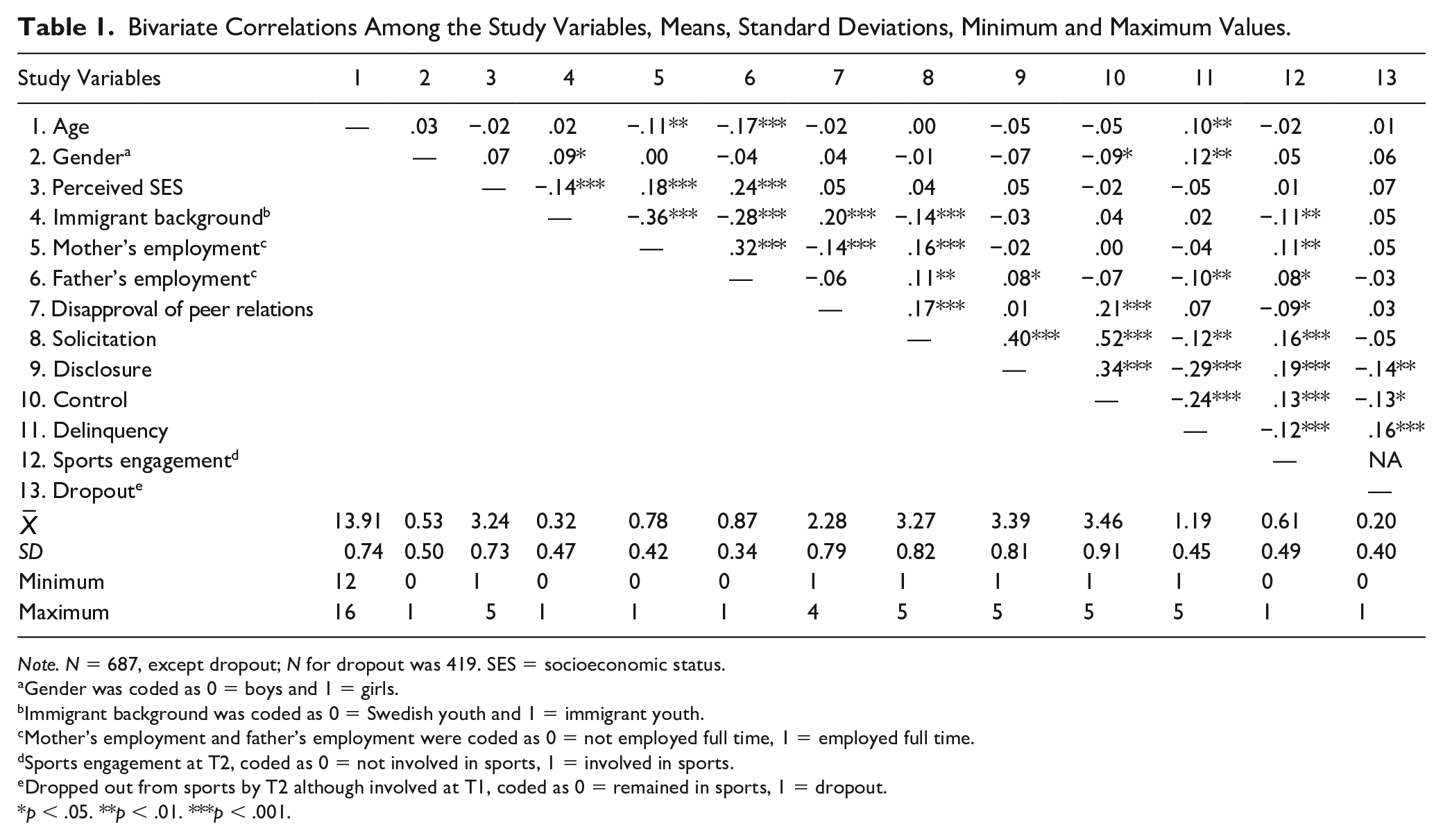
Note. N = 687, except dropout; N for dropout was 419. SES = socioeconomic status.
Gender was coded as 0 = boys and 1 = girls.
Immigrant background was coded as 0 = Swedish youth and 1 = immigrant youth.
Mother’s employment and father’s employment were coded as 0 = not employed full time, 1 = employed full time.
Sports engagement at T2, coded as 0 = not involved in sports, 1 = involved in sports.
Dropped out from sports by T2 although involved at T1, coded as 0 = remained in sports, 1 = dropout.
p < .05. **p < .01. ***p < .001.
We also examined whether immigrant and Swedish youth differed from each other on the study variables. The findings revealed several differences. First, immigrant youth reported that their parents engaged in higher levels of disapproval of peer relations (
Regarding participating in and dropping out from organized sports, we also observed differences between immigrant and Swedish youth. Specifically, our findings showed that 61% (n = 419) of the youth at T1 participated in organized sports activities. Immigrant youth (52.5%) were less likely to participate in organized sports activities than Swedish youth (72.6%) at T1, χ2(1) = 9.71, p = .002. At T2, again, 52% of immigrant youth participated in organized sports, whereas the rate for Swedish youth was 72.4%, χ2(1) = 8.70, p = .003. ORs indicated that Swedish youth were, at T1, 1.68 times (95% CI = [1.21, 2.32]), and, at T2, 1.63 times (95% CI = [1.18, 2.26]) more likely to participate in organized sports activities than their immigrant peers. These findings were especially salient when we compared immigrant and Swedish youth taking gender into account. Specifically, we found that Swedish girls at T1 were 2.26 times (95% CI = [1.38, 3.71]), and, at T2, 2.95 times (95% CI = [1.79, 4.87]) more likely to participate in organized sports activities than immigrant girls, χ2(1) = 10.73, p < .001 and χ2(1) = 18.59, p < .001, respectively. There were no differences between Swedish and immigrant male adolescents in sports participation at T1, χ2(1) = 1.93, p = .164, and, at T2, χ2(1) = 0.06, p = .800.
Participation in sports was fairly stable over time. Overall, 77% of the youth maintained their participation status by being either engaged or unengaged at both data collection points. In the overall sample, the youth who participated in sports at T1 were 9.83 times (95% CI = [6.88, 14.05]) more likely to remain in organized sports than dropping out at T2. Immigrant youth were slightly more likely to drop out from sports than Swedish youth, OR = 1.29, 95% CI = [0.77, 2.19], but this difference was not statistically significant, χ2(1) = 0.93, p = .335.
Do Parenting Behaviors Predict Participation in and Dropout From Organized Sports?
To answer our first research question (i.e., is there an association between youth’s perception of parental disapproval of peer relations and parental monitoring and youth’s participation in and dropout from organized sports?), we fitted two logistic regression models (see Table 2). At the first step, we entered immigrant background (and T1 sports participation for the longitudinal analysis of sports participation) into the model; at the second step, we entered the demographic characteristics (i.e., age, gender, perceived SES, full-time employment of mother and father); and, at the third step, we entered the parenting variables (i.e., parents’ disapproval of peer relations, parental solicitation, youth disclosure, and parental control).
Logistic Regression Results Predicting Sports Participation Over Time and Dropout From Sporting Activities.
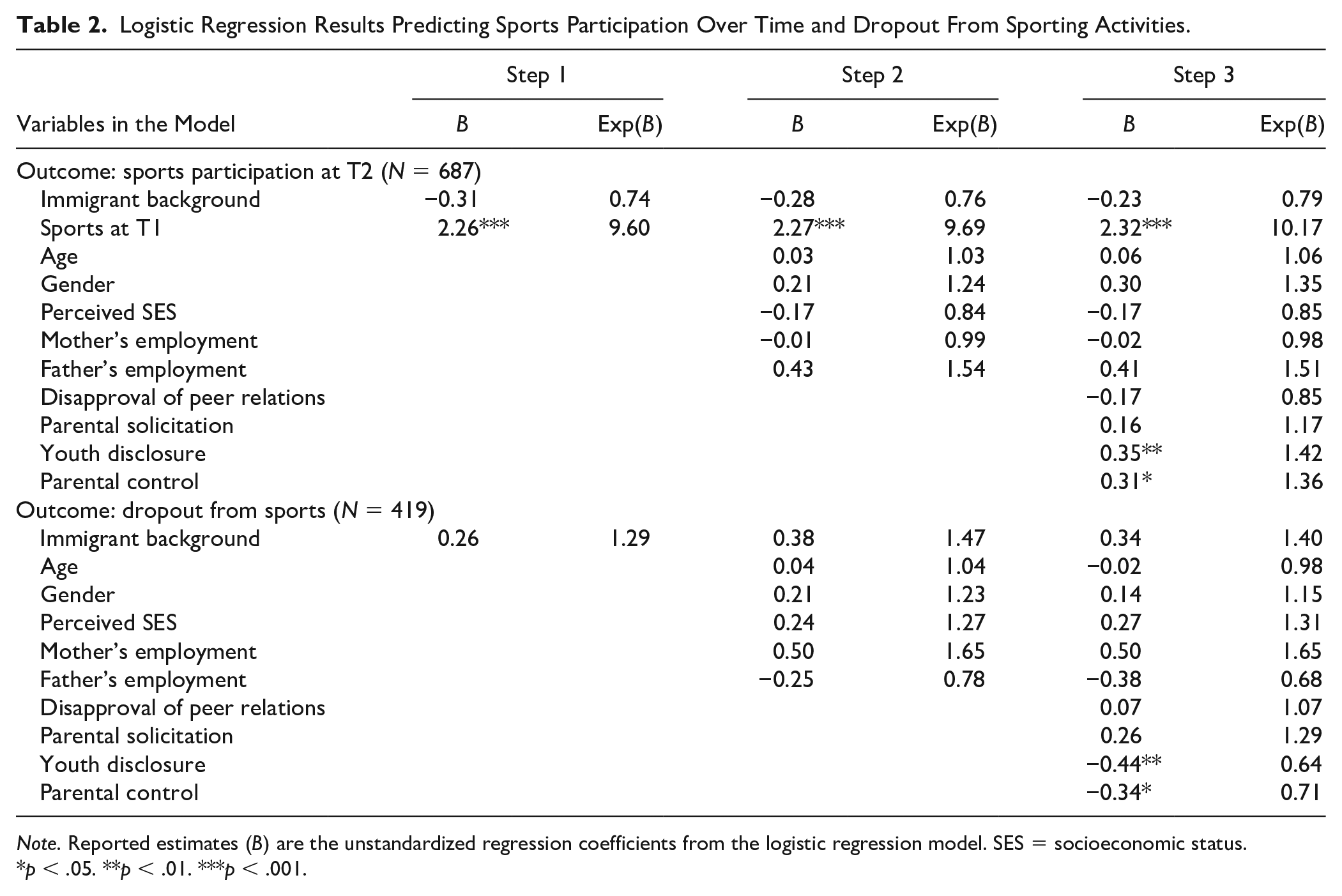
Note. Reported estimates (B) are the unstandardized regression coefficients from the logistic regression model. SES = socioeconomic status.
p < .05. **p < .01. ***p < .001.
The results indicated that youth who participated in sports at T1 were more likely than others to engage in sports activities at T2. Neither immigrant background nor demographic features of the youth predicted changes in participation in organized sports. However, both youth disclosure to parents and perceived parental control positively predicted participation in organized sports longitudinally. Specifically, youth who disclosed their whereabouts to their parents and who perceived their parents as using control were more likely to participate in organized sports activities, even after controlling for their participation in the previous year.
The models estimating youth’s dropout from organized sports activities considered only the youth who participated in an organized sports activity at T1 (n = 419). The results indicated that neither immigrant background nor demographic features predicted dropout from organized sports. On the other hand, the same monitoring indicators predicted dropout from sports activities. Specifically, youth who disclosed to their parents and whose parents controlled their day-to-day activities were significantly less likely to drop out from sports activities.
The Mediating Role of Youth Delinquency
In order to address our second research question (i.e., does youth’s engagement in delinquent behaviors mediate the link between youth’s perception of parents’ behaviors and youth’s participation in and dropout from organized sports?), we fitted two mediation models. We did not include parents’ disapproval of peer relations and parental solicitation as predictors in these models because neither of these two parental behaviors independently predicted youth’s sports participation and dropout. In all models, we included age, gender, immigrant background, perceived SES, and parents’ employment as covariates by regressing the mediator and outcome onto these variables. The full mediation model for longitudinal changes in sports participation had poor fit, χ2(3) = 12.69, p = .005, CFI = 0.95, RMSEA = 0.07, SRMR = 0.12, but modification indices suggested adding a direct path from youth disclosure to sports participation. Adding this path to the model significantly improved model fit, Δχ2(1) = 6.45, p = .011. The modified model had good fit, χ2(2) = 6.58, p = .037, CFI = 0.98, RMSEA = 0.06, and SRMR = 0.06. The results indicated that both youth disclosure (ß = −.22, p < .001) and parental control (ß = −.17, p < .001) negatively predicted delinquency. In addition, delinquent behaviors negatively predicted youth’s participation in sports (ß = −.11, p = .006). Testing of indirect effects revealed that the youth who disclosed their whereabouts to parents were less likely to engage in delinquent behaviors (ß = −.22, p < .001), and, in turn, were more likely to participate in organized sports activities over time, ßindirect = .03, z = 2.25, p = .024, 95% CI = [0.01, 0.07]. Similarly, youth whose parents used control strategies were less likely to engage in delinquent behaviors (ß = −.17, p = .006), and, consequently, were more likely to participate in sports activities in clubs or associations, ßindirect = .02, z = 2.28, p = .022, 95% CI = [0.01, 0.05]. Finally, youth disclosure had a significant direct effect on sports participation (ß = .13, p = .009), suggesting that delinquent behaviors partially mediated the association between youth disclosure and sports participation over time (see Figure 1).
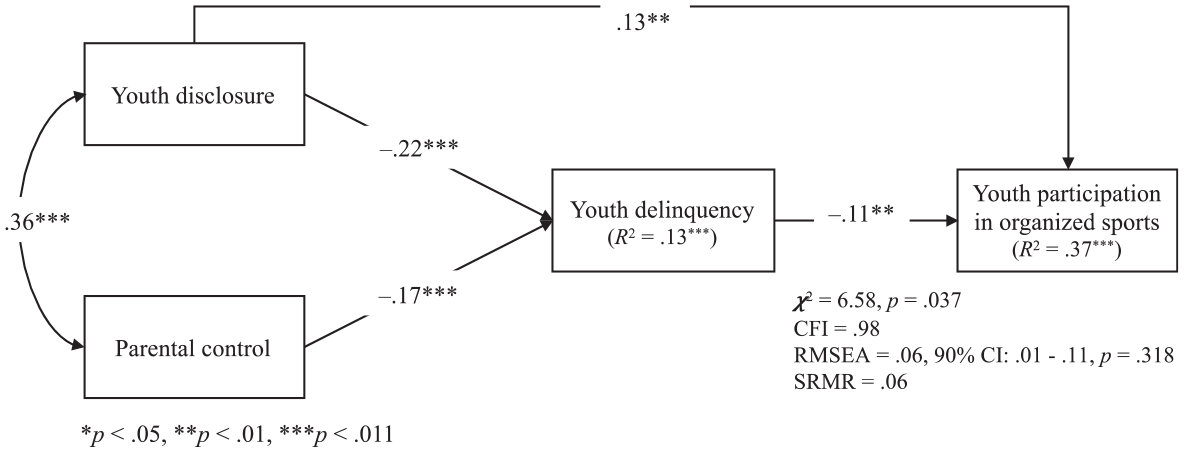
Mediating role of youth delinquency in the association between youth disclosure, parental control, and youth’s participation in organized sports activities.
The model for dropout from sports showed acceptable model fit statistics, CFI = 0.98, RMSEA = 0.08, and SRMR = 0.02, although the chi-square statistic was significant, χ2(2) = 9.09, p = .011. Both youth disclosure to parents (ß = −.17, p < .001) and parental control (ß = −.16, p = .002) negatively and significantly predicted youth delinquent behaviors. In addition, delinquent behaviors positively predicted dropout from sports activities (ß = .23, p < .001). The test for an indirect effect showed that the youth who disclosed their whereabouts to parents were less likely to engage in delinquent behaviors, and, in turn, were less likely to drop out from organized sports activities, ßindirect = −.04, z = −3.21, p < .001, 95% CI = [−0.08, −0.02]. Similarly, the youth whose parents controlled their whereabouts were less likely to engage in delinquent behaviors, and, in turn, were less likely to drop out from organized sports activities, ßindirect = −.04, z = −2.07, p = .039, 95% CI = [−0.08, −0.01] (see Figure 2).
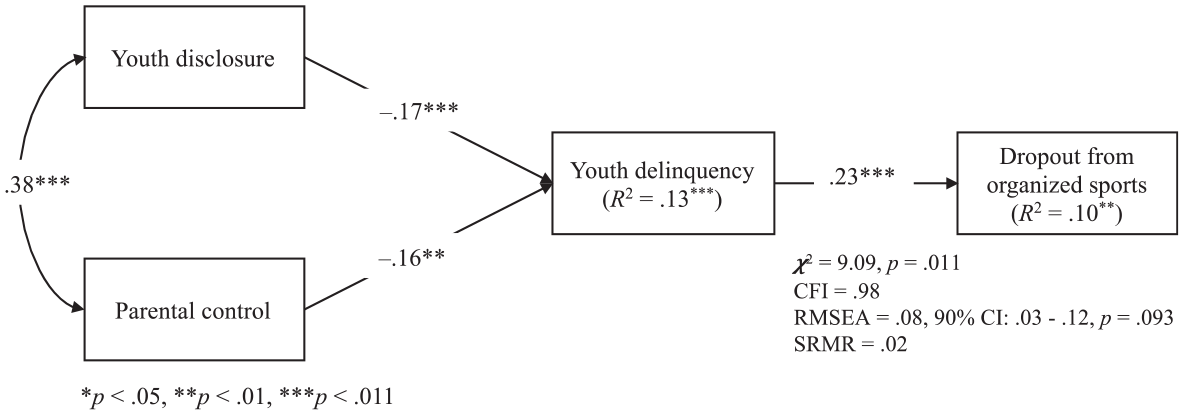
Mediating role of youth delinquency on the association between youth disclosure, parental control, and youth’s dropout from organized sports activities.
Moderating Role of Immigrant Background
To address our third and final research question (i.e., whether the mediating role of youth’s engagement in delinquent activities on the association between parenting behaviors and youth’s participation and dropout from organized sports is moderated by youth’s immigrant background?), we fitted a series of moderated mediation models. In the proposed mediation model, immigrant background could moderate three specific effects: (a) the effects of youth disclosure and parental control on sports participation or dropout, (b) the effects of youth disclosure and parental control on youth delinquency, and (c) the effects of youth delinquency on sports participation or dropout. The first effect concerns moderation of the direct effect of the predictor on the outcome, whereas the latter two concern moderation of the mediation process. Overall, immigrant background did not moderate the effects of youth disclosure and parental control on sports participation, dropout, and delinquency. There was also no significant interaction between immigrant background and youth delinquency in predicting sports participation and dropout. The p values of the test statistics for the interaction terms across all the models ranged between p = .102 and p = .843. In sum, the proposed mediation process, where youth disclosure and parental control predict organized sports participation and dropout through youth’s involvement in delinquent behaviors, was equally plausible for both immigrant and Swedish youth, suggesting robustness of the mediation effects.
Bidirectional Association Between Youth Delinquency and Participation in Organized Sports
In the current study, we used delinquency as a predictor of changes in sports participation. However, several studies have conceptualized delinquency as an adjustment outcome related to engagement in sports/extracurricular activities (Gardner et al., 2009; Matjasko, Holland, Holt, Espelage, & Koenig, 2019; Rutten et al., 2007). Thus, we fitted a cross-lagged model to examine how delinquency and sports participation were related to each other over time. The results showed that youth delinquency at T1 significantly predicted lower participation in organized sports activities at T2, β = −.32, p < .001, 95% CI = [−0.50, −0.14]. On the other hand, sports participation at T1 did not significantly predict changes in delinquency over time, β = .00, p = .957, 95% CI = [−0.13, 0.13]. In sum, the current findings suggest that engagement in delinquent behaviors predicts sports participation over time.
Discussion
The purpose of the present study was to investigate whether and how perceived parenting behaviors contribute to engagement in organized sports activities among Swedish and immigrant youth. Specifically, we examined whether youth’s perception of parental disapproval of peer relations and perceived parental monitoring (i.e., adolescent disclosure, parental control, and parental solicitation) were associated with youth’s involvement in and dropout from organized sports over time. We also investigated the possible underlying mechanism (i.e., youth’s engagement in delinquent behaviors) and conditions (i.e., youth’s immigrant status) in any such association. Our main findings are that youth’s disclosure and their perception of parental control indirectly predict youth’s participation and dropout through youth’s engagement in delinquent behaviors among both Swedish and immigrant youth. The study findings are discussed in greater detail below, along with implications for future research.
Parenting Behaviors and Youth’s Involvement in and Dropout From Organized Sports
In line with the literature (Caldwell & Smith, 2006; Huebner & Mancini, 2003), our main findings are that parents’ monitoring behaviors predict youth’s engagement in and dropout from organized sports activities. More specifically, our findings suggest that youth’s disclosure of information and perceived parental control, but not parental solicitation, are linked to youth’s sports participation and dropout. These findings extend previous research (Caldwell & Smith, 2006; Huebner & Mancini, 2003) and add to the literature by demonstrating that not all aspects of parental monitoring behaviors are linked to youth’s prosocial behaviors. The current findings raise questions regarding the role of parental solicitation, but do not necessarily entail that parental solicitation per se is ineffective. How parents solicit information may play a role in the potential outcomes of parents’ active search for information. For example, some parents may be intrusive when they solicit information, whereas others may seek information through a warm and caring conversation. Future studies may elucidate the role of solicitation by examining the different ways that parents seek information from their children.
Why Do Parenting Behaviors Predict Youth’s Involvement in and Dropout From Organized Sports?
The current study yielded partial support to our expectations regarding the mediation process that may explain the link between parents’ behaviors and youth engagement in organized sports activities and dropout from them. Contrary to our expectations, neither youth’s perception of parents’ disapproval of peer relations nor parental solicitation predicted youth engagement in and dropout from organized sports activities, after accounting for youth disclosure and parental control. Thus, we did not include these two parenting behaviors in the testing of our mediation models. On the other hand, in line with our reasoning, child disclosure and perceived parental control were found to be negatively linked to youth’s delinquent behaviors, which, in turn, predicted youth’s concurrent and prospective participation in organized sports activities. Prior studies have shown that open (e.g., warm and mutually responsive; Criss et al., 2015; Kapetanovic et al., 2018) and close (e.g., secure, safe, friendly) parent-child relationships increase adolescents’ disclosure of information (e.g., Criss et al., 2015; Kapetanovic et al., 2018; Stattin & Kerr, 2000). By contrast, poor parent-child relationships (e.g., quarreling and fighting between parents and child) are linked to a decrease in adolescents’ information sharing (Kapetanovic et al., 2017; Kerr & Stattin, 2000). Hence, positive and warm parent-child relationships are important prerequisites for youth’s disclosure of information. Such parent-child relationships may increase the amount of time parents spend with their children, and also foster quality communication where youth might disclose information about their needs and well-being to their parents. Supporting these arguments, Fernandez and colleagues (2018) showed that the more youth disclosed information to their parents, the less depressive symptoms they reported, and, in turn, the fewer conduct problems, concurrently and prospectively, they displayed. The less youth engage in problematic behaviors, the more they may engage in activities in prosocial settings such as organized sports activities. In a similar way, through increased awareness, parents can respond to their youth’s needs and prevent their children from engaging in risky and norm-breaking behaviors, and also have opportunities to guide them in pursuing their interests. In sum, by creating warm and open relationships where youth feel comfortable in disclosing information, parents may have the opportunity to guide their children toward safe and secure environments where there is structure and adult supervision (such as organized sports places).
Parents may monitor their children’s day-to-day activities and behaviors by setting up and communicating clear rules. By setting rules and imposing restrictions, parents can oversee their children’s leisure time outside school and home (Stattin & Kerr, 2000). Consequently, youth may have fewer opportunities to spend time in unknown settings. In addition, parents who set rules for their youth may be more inclined to permit or guide their children to engage in organized sports activities because such activities are structured and adult led. This would allow parents to gain insights into their children’s whereabouts and behaviors. In line with this reasoning, our findings show that parental control is negatively linked to youth’s engagement in delinquent activities, which in turn predicts their involvement in organized sports activities. A similar pattern was observed for sports dropout, because youth who were subject to parents’ rules and restrictions were found to be less likely to engage in delinquent behaviors and less likely to drop out from sports activities.
In sum, our findings extend previous research (Caldwell & Smith, 2006; Huebner & Mancini, 2003) on the link between parents’ monitoring behaviors and youth’s participation in adult-led and prosocial activities, such as organized sports. More specifically, the findings contribute to the literature by offering a potential explanation for how parents’ monitoring behaviors, specifically youth’s disclosure of information and perceived parental control, are associated with youth’s involvement in organized sports activities. In addition, our findings suggest that parents’ monitoring behaviors may not only protect their youth from engaging in delinquent activities but also promote their children’s participation in organized sports activities, which are linked to positive youth adjustment (Farb & Matjasko, 2012).
Moderating Effect of Immigrant Background
In line with previous findings, we found differences between immigrant and native youth’s perception of their parents’ behaviors (Güngör, 2008; Virta et al., 2004; Wissink et al., 2006). In addition, again in line with the literature (Özdemir & Stattin, 2012; Singh et al., 2008), we observed that immigrant youth, especially immigrant girls, were less likely to participate in organized sports activities than their native peers. Nevertheless, as highlighted by Rowe and colleagues (1994), differences across ethnic groups do not necessarily indicate distinct developmental experiences and processes. Supporting this line of reasoning, our findings show that youth’s disclosure of their activities and parents’ rule setting have similar implications for both immigrant and Swedish youth. Specifically, these two aspects of parental monitoring predict participation in sports activities and dropout via lower engagement in delinquent behaviors. This finding is in accordance with the theoretical arguments and empirical evidence that highlight the importance of open and warm communication between parents and children (Criss et al., 2015; Kapetanovic et al., 2018; Wissink et al., 2006), and also of the role played by parents’ rule-setting behaviors and guidance (Kerr & Stattin, 2000; Stattin & Kerr, 2000).
Taken together, one of the main contributions of the present study is that it shows that youth’s immigrant background does not moderate the associations between parents’ behaviors and youth participation in and dropout from sports activities. Specifically, our findings suggest that explanations for the behavioral and developmental outcomes of youth are provided not by ethnic or cultural origin, but by the developmental context and day-to-day experiences (Rowe et al., 1994; Özdemir & Bayram Özdemir, 2020). Young people, regardless of their ethnic and cultural origin, may benefit from living in a family environment where they feel comfortable in openly disclosing information to their parents about their activities outside their home, and have rules that regulate their behaviors without their parents being overly restrictive and intrusive. Growing up in such family environments may both reduce youth’s likelihood of engagement in problematic behaviors, and, in turn, increase their chances of engaging and remaining in structured, adult-led prosocial activities, such as organized sports.
Differences Between Immigrant and Swedish Youth in Participation in Organized Sports
Although not part of the main aim of the present study, it has some interesting descriptive results about immigrant youth’s participation in organized sport. Consistent with previous research (Özdemir & Stattin, 2012; Singh et al., 2008), we found that immigrant youth, specifically immigrant girls, are less likely to participate in organized sports activities than their Swedish peers. However, the results suggest that the differences are mainly between immigrant girls and their Swedish female counterparts. These findings may be related to immigrant parents’ gender-specific attitudes and gendered socialization behaviors. Prior studies have suggested that parents of immigrant background may have more conservative attitudes, and, in general, impose greater demands on, and, in particular, grant less autonomy to their daughters than their sons (Domènech Rodriguez, Donovick, & Crowley, 2009; Le Espiritu, 2001; Qin-Hilliard, 2003). For example, findings from qualitative reports have shown that immigrant parents grant girls less freedom than boys with respect to dating, interacting with peers, and engagement in outdoor activities (Qin-Hilliard, 2003; Raffaelli & Ontai, 2004). Taken together, immigrant parents’ gendered socialization beliefs and behaviors may contribute to immigrant girls’ low sports participation rates. Future research should pay attention to the role of potential gender-socialization behaviors among immigrant families in order to broaden the understanding of immigrant girls’ low rate of participation in organized sports.
Limitations and Strengths
A first limitation of the current study lies in our definition of organized sports participation. We defined organized sports as “adult-led activities with set practice schedules.” In Sweden, the most common organized sports activity for youth is football. However, young people do take part in other types of sports in considerable numbers. The current study is unable to establish whether parents’ role in youth’s sports engagement varies across different types of sports. Thus, the implications of our findings may not apply to all types of sports. Future studies may address this limitation by focusing on a single or just a few sports. Second, youth who do not get involved in sports may take part in other types of organized activities. In fact, 10% of the youth in the current sample took part in a nonsporting organized activity. The current study is unable to provide an explanation for the links between parenting behaviors and participation in nonsporting organized activities. Larger data sets may allow more detailed examination of the predictors of involvement in different types of activities, and may help establish whether specific subgroups (e.g., boys vs. girls or immigrant vs. native youth) have preferences for particular types of organized activities and sports. A third limitation of the study is that our measure of sports participation is unable to quantify the frequency or intensity of sports participation. For example, there may be differences across sports teams or groups of sporting activists in how many times they meet and for how long they run practice sessions. Intense practice sessions may become a demotivating factor for some youth, who, in turn, may become more likely to drop out. Nevertheless, the current data do not allow us to test whether there is a link between intensity of participation and dropout. Fourth, and finally, in the current study, we used two waves of data with a 1-year interval between assessments. Most adolescents start participating in an organized sports activity in middle- to late childhood. Future studies that assess youth before they start participating in organized activities and follow them over longer periods are needed to develop a comprehensive understanding of the predictors of participation and dropout.
Despite these limitations, the present study has some strengths. To our knowledge, no previous study has investigated the role played by parents’ monitoring in immigrant youth’s delinquent behavior and participation in and dropout from organized sports. Previous research has mainly focused on demographic factors as potential explanations for immigrant youth’s low participation rates in organized sports activities, and the findings have been mixed (Camacho & Fuligni, 2015; Garrido et al., 2012; Peguero, 2011). Concentrating on the role of demographic factors, however, may provide only very limited insight into how immigrant youth’s participation can be improved. The current study, however, highlights the potential role of malleable parenting practices in promoting youth’s engagement in organized sports activities.
Conclusion
In line with previous studies (Cristini et al., 2015; Delforterie et al., 2016), our findings show that parents’ monitoring—specifically, child disclosure and perceived parental control—are associated with lower adjustment problems among immigrant and native youth. Our findings add to the literature by demonstrating that parents’ monitoring behaviors also have important implications for youth’s positive adjustment. More specifically, adolescents whose parents monitor their whereabouts are less likely to engage in delinquent behaviors, and, in turn, are more likely to be involved in structured and adult-led settings, such as organized sports. In addition, these youth are less likely to quit organized sport. Hence, these findings extend previous research (Caldwell & Smith, 2006; Huebner & Mancini, 2003) by demonstrating which aspects of parental monitoring are linked to youth’s participation in organized sports activities and why. Last but not least, the most important contribution of the present study is that the positive role of youth disclosure and perceived parental control, and also the underlying mechanisms that explain why parental monitoring is linked to higher sports participation and lower dropout, are similar across immigrant and Swedish youth. Hence, our findings suggest that the socialization context of youth rather than their ethnic background is what matters in this context. In sum, regardless of youth’s ethnic and cultural background, efforts to develop strategies to increase youth’s engagement and persistence in relation to organized sports activities should aim to promote open communication between youth and parents so as to further youth disclosure and encourage parents to set rules without being intrusive and overcontrolling.
Footnotes
Acknowledgements
The authors thank Professors Håkan Stattin and Margaret Kerr for granting permission to use the data that were collected as part of the Seven Schools Study, a longitudinal study conducted at Örebro, Sweden, and funded by Swedish Research Council for Health, Working Life and Welfare (FORTE).
Declaration of Conflicting Interests
The author(s) declared no potential conflicts of interest with respect to the research, authorship, and/or publication of this article.
Funding
The author(s) disclosed receipt of the following financial support for the research, authorship, and/or publication of this article: This study was made possible by funding from the Swedish Research Council for Health, Working Life and Welfare (FORTE, dnr: 2013-1536) awarded to the second author, Metin Özdemir.
