




Abstract
This longitudinal study covering two educational transitions examined 1,821 Finnish students’ participation in and identification with school and their associations with students’ academic achievement and truancy. The students were surveyed (a) at the end of primary school, (b) at the beginning of lower secondary school, (c) at the end of lower secondary school, and (d) in the first year of upper secondary education. In alignment with the participation-identification model, higher levels of participation in school activities at the end of primary school predicted higher levels of identification (i.e., feelings of belonging and valuing school) at the end of lower secondary school. This association was mediated by academic achievement. High levels of both participation and identification at the end of lower secondary school predicted lower levels of truancy in upper secondary education. The study indicates that promoting students’ participation and identification during comprehensive school prevents student disengagement from upper secondary education.
Keywords
Truancy is a persistent and significant educational problem (Henry, 2007; Maynard, Salas-Wright, Vaughn, & Peters, 2012; Vaughn, Maynard, Salas-Wright, Perron, & Abdon, 2013) and a significant indicator of school disengagement. School principals across Organisation for Economic Co-Operation and Development (OECD) countries have cited truancy as one of the main issues hindering students’ learning, along with staff’s resistance to change (OECD, 2018). Truancy rates appear to have remained constant in the United States, with 11.55% of students on average reporting one or more instances of skipping school during the past 30 days between 2002 and 2014 (Maynard et al., 2017; for similar results, see Henry, 2007; Vaughn et al., 2013). Truancy is associated with many negative school and postschool outcomes, including poor academic performance, unemployment, low levels of education, substance abuse, low levels of school engagement, and school dropout (Darmody, Smyth, & McCoy, 2008; Maynard et al., 2012; Maynard et al., 2017; Vaughn et al., 2013). Particularly, chronic skippers are at an elevated risk of antisocial behavior, such as marijuana use, theft, drug sales, and fighting (Maynard et al., 2012).
Student engagement (i.e., participation and identification) with school has recently been conceptualized as not merely the absence of disengagement, such as truancy, but a conceptually different construct (e.g., Fredricks, Parr, Amemiya, Wang, & Brauer, 2019; Wang & Degol, 2014). As such, engagement and disengagement are related but distinct constructs that may be associated with different antecedents and learning outcomes. Therefore, promoting students’ participation and identification is seen as a means to increase school attendance (Klem & Connell, 2004), address truancy from school (Virtanen, Lerkkanen, Poikkeus, Kuorelahti, 2014), and reduce school dropout rates (Archambault, Janosz, Fallu, & Pagani, 2009).
The present study draws primarily from the seldom-tested model of student engagement, the participation-identification model (Finn, 1989; Finn & Zimmer, 2012), which views participation in school activities and identification with school as a developmental process, resulting in either school completion or dropout. Using a Finnish longitudinal data set that covers four time points between ages 12 and 17 years, the study aims to add to the lack of longitudinal studies using more than two time points (Wang & Fredricks, 2014), including not only the transition from primary to lower secondary school but also the transition from lower secondary to upper secondary education. This is critically important because disengagement, such as school absenteeism, typically increases by age (Gubbels, van der Put, & Assink, 2019) and discontinuity in the educational contexts (Sameroff, Peck, & Eccles, 2004) may disrupt the relationships between participation and identification and cause problems for many students (see Eccles & Roeser, 2011). For example, a student’s teachers and partly peers change at the same time with physical and mental changes in early adolescents’ development. By covering these important school transitions, this study is able to inspect whether identification and participation have lasting effects after these transitions. Moreover, using four time points enables the examination of whether Grade 7 academic achievement is a mechanism (process) that underlies the relationship between participation and identification during compulsory education. We complement the prior literature by examining how school participation and identification during compulsory basic education (termed “comprehensive school” in Finland) predict truancy in postcompulsory education. We first explore how participation and identification—a hybrid of a sense of school belonging and valuing education—predict each other from primary to lower secondary school. Second, the study examines whether students’ academic achievement mediates these influences, and third, how participation and identification predict postcompulsory upper secondary education truancy, defined as intentional, unexcused absences from school (Gentle-Genitty et al., 2015). Knowing that truancy is related to multiple adverse school and postschool outcomes (Darmody et al., 2008; Maynard et al., 2012; Maynard et al., 2017; Vaughn et al., 2013), the results of the current study are needed to inform educators and other school personnel how to tackle an internationally acknowledged educational problem school truancy (OECD, 2018).
Participation-Identification Model
Finn’s (1989; Finn & Zimmer, 2012) participation-identification model was developed to understand why students drop out of school. The model distinguishes between external behavioral component (i.e., participation) and an internal psychological component (i.e., identification). The participation component refers to visible indicators of a student’s engagement with school. It is characterized by participation in school-based academic and nonacademic activities. Students high in participation are attentive during class and behave appropriately (Wang & Eccles, 2012). Identification, in turn, captures a student’s emotional connection and attachment with school-related people and the student’s interests and values (see Fredricks, Blumenfeld, & Paris, 2004). Therefore, students high in identification feel a sense of belonging to school, perceive themselves as accepted and supported, value school, and consider education beneficial and important (Finn, 1989; Finn & Zimmer, 2012; Voelkl, 1997; Wang & Holcombe, 2010).
The participation-identification model suggests that participation in school activities and identification with school mutually shape each other over time. The starting point is a student’s early participation in school-related activities, which through improved academic outcomes strengthens his or her identification to the institution, exemplified by a sense of belonging and valuing school-related outcomes, which again promotes participation (Finn, 1989; Finn & Zimmer, 2012). The model is in line with self-determination theory, which suggests school context that fulfills students’ psychological needs of competence, relatedness, and autonomy, leads to a higher level of student engagement and academic performance (Ryan & Deci, 2000). However, participation-identification model emphasizes the importance of learning and high academic achievement as an outcome of participation because in the model, academic achievement is assumed to explain the relationship between participation and identification. It has been further suggested (Finn, 1989; Marsh, 1987) that poor school performance impairs students’ academic self-concept and leads students to turn against the context they hold accountable for this loss. Such a negative developmental cycle may lead a student to eventually drop out from school because it results in nonparticipation in classes, poor school performance, and, therefore, nonidentification. From concepts of self-determination theory, such developmentally inappropriate instruction fails to fulfill a student’s basic psychological needs of relatedness, competence, and autonomy (Ryan & Deci, 2000, 2017). In the long run, nonidentification increases nonparticipation in a cyclical manner (Finn, 1989).
Associations Between Participation in and Identification With School and Educational Outcomes
Prior empirical research on participation and identification has been conducted under the broad meta-construct of student engagement, which includes affective, cognitive, and behavioral dimensions (Fredricks et al., 2004). However, research on the interplay between the affective and cognitive dimensions (which form the dimension of identification) and the behavioral dimension (participation) is largely lacking (Wang & Degol, 2014). In alignment with the participation-identification model, some researchers have suggested that behavioral engagement is the key component among the dimensions of student engagement (Hospel, Galand, & Janosz, 2016; Skinner, 2016). There is evidence that behavioral engagement directly predicts students’ educational outcomes (see Finn & Zimmer, 2012). For example, Stefansson, Gestsdottir, Geldhof, Skulason, and Lerner (2016) found that the specific behavioral engagement factor (e.g., participating in classroom discussions, coming to class prepared, completing homework) predicted Icelandic national examination (INE) scores from Grade 9 to Grade 10 over and above the effects of the global school engagement factor. In the same vein, Archambault, Janosz, Fallu, and Pagani (2009) showed that while a global engagement (i.e., affective, behavioral, and cognitive dimensions of engagement combined into one global engagement construct) reliably predicted lower secondary school students’ dropout of high school, participation (i.e., school attendance and behaving appropriately) also uniquely predicted the likelihood of dropping out. The authors speculated that it is plausible that students’ school-related affects and cognitions (identification) influence their probability to drop out indirectly through changes in their school participation (see Wang & Degol, 2014).
Li and Lerner (2013) assessed how students’ school-related affects, behaviors, and cognitions relate to each other over time. They found support for both affects preceding behaviors and behaviors preceding affects hypotheses. While participation in classroom discussions, preparation, not skipping classes, and finishing homework on time in Grades 9 and 10 were predictive of a sense of belonging and affects toward school in the following academic years, a sense of belonging and affects toward school in Grade 9 merely predicted Grade 10 behaviors.
In general, motivational literature indicates that connections to others and valuing school-related outcomes should precede participation (e.g., Connell & Wellborn, 1991; Skinner, Furrer, Marchand, & Kindermann, 2008). Positive affects and cognitions incentivize students to participate at school; thus, a student’s behavior reflects his or her affective and cognitive involvement (Archambault, Janosz, Morizot, & Pagani, 2009). Hence, the expected causal loop can be assumed to run from affects to behaviors (see Wang & Degol, 2014), thereby promoting a student’s skills, abilities, and personal adjustment (Connell & Wellborn, 1991). Self-determination theory (Ryan & Deci, 2000, 2017) suggests that the basic psychological needs of relatedness, competence, and autonomy are essential to all socialization (i.e., internalizing regulations and values). In the school setting, adolescents who have strong relationships with others are willing to internalize the values that school promotes. Internalizing the school’s values and goals, in turn, leads adolescents to behave accordingly and view school as relevant and beneficial for their future (Ryan & Deci, 2009). Seen from this perspective, being connected to others and feeling a sense of belonging provide a student with ties to the school (Mahatmya, Lohman, Matjasko, & Farb, 2012), thus contributing to educational persistence, such as completing school.
Engels et al.’s (2016) cross-lagged model showed that among secondary school students (Grades 7–11), a component of school belonging, namely the teacher-student relationships, predicted student participation (i.e., paying attention in class, working, and trying hard on schoolwork); students with positive teacher-student relationships tried harder and payed more attention than students with negative teacher-student relationships over time (for a review, see Quin, 2017). The reverse association was not found as participation in school did not predict teacher-student relationships or peer support. Regarding academic achievement, some evidence has shown that to perform well academically, students do not necessarily have to enjoy or feel accepted at school or even have an interest in school (Wang & Peck, 2013). The influences of identification with school may operate through changes in participation in school, so their influences on academic outcomes seem to be indirect rather than direct (Archambault, Janosz, Fallu, & Pagani, 2009; Connell & Wellborn, 1991; Finn & Zimmer, 2012; Voelkl, 2012; Wang & Peck, 2013).
In line with the participation-identification model, the current study views two processes critical in addressing truancy from school. First, active participation in school-based activities is crucial in that it results in long-term academic success and develops students’ identification with school (i.e., experiences of being clearly part of the school environment and valuing success in school-relevant goals). Identification, in turn, is important because it feeds back to participation. Adolescents who feel supported, valued, and cared for and who have internalized school-related regulations and values are likely to be self-determined and, thus, participate in classes and school in general.
Associations Between Participation at and Identification With School, and Truancy From School
Although empirical evidence connecting student engagement and truancy is scarce (Teuscher & Makarova, 2018), existing evidence has shown that, in general, the levels of students’ participation at and identification with school are of the utmost importance for their behavioral and psychological outcomes, including school dropout, delinquency, substance use, mental health, educational aspirations, academic achievement, and college enrollment rates (e.g., Li & Lerner, 2011; Wang & Fredricks, 2014; Wang & Peck, 2013). Cross-sectional studies have indicated a negative correlation between the effort students exert in doing their schoolwork, paying attention in class, and preparing for classes and school truancy (Virtanen et al., 2014). Teuscher and Makarova (2018) showed that after controlling for students’ sex, age, grades, relationships with peers, relationships with teachers, and family’s migration and socioeconomic background, the negative correlation between students’ combined behavioral, cognitive, and affective engagement and truancy was moderate to large (Cohen, 1988). Vaughn et al. (2013) showed that in comparison with nontruant youths, students with truant behavior reported attending fewer school activities, had lower levels of liking school, and found schoolwork less meaningful, interesting, and important. Finally, Maynard et al. (2017) found that perceived importance and interest in learning and school activities were lower for truant youth than for those who did not skip school.
Transition From Primary to Secondary Education in the Finnish School System
Transitioning to secondary school is a source of discontinuity (Sameroff et al., 2004) in a student’s school career. As such, the transition can disrupt a student’s functioning at school in terms of decreased school engagement and motivation (Eccles et al., 1993; Otis, Grouzet, & Pelletier, 2005). In Finland, an administratively unified basic education (Grades 1–9) eases the transition from primary school (ages 7–12 years) to lower secondary school (ages 13–15 years), in which the National Core Curriculum for basic education (Finnish National Agency for Education, 2014) is followed. However, the physical environment often changes in secondary school; it is a larger unit than primary school, and it is located in a neighborhood far from the student’s home. In addition, students have more autonomy, but it is also assumed that they will take more responsibility for their studies. They choose new academic subjects and are exposed to multiple teachers. In lower secondary school, students are taught by various subject teachers rather than by one class teacher, as is the case in primary school. Furthermore, unlike primary school, where a single teacher monitors each student’s learning and development, a homeroom teacher assumes this role in lower secondary school. A homeroom teacher is one of the students’ subject teachers who is not in daily contact with his or her students. A student’s peer group composition is also likely to change, which may lead to decreased well-being if a student’s overall perception of peer support decreases (Virtanen, Vasalampi, Torppa, Nurmi, 2019).
Following lower secondary school, most students transition to noncompulsory upper secondary education. In 2016, among the students who completed comprehensive school, 95.2% continued on to further studies in upper secondary education in either the academic (52.7%) or the vocational (42.5%) track (Official Statistics of Finland, 2017). Generally, the academic track prepares students for tertiary education studies, while the vocational track develops students’ vocational competencies. Students can also attend both vocational and academic secondary schools simultaneously. In academic year 2016-2017, approximately 0.5% of students left school without completing the entire comprehensive school syllabus during their compulsory education (Official Statistics of Finland, 2018b). In the upper secondary vocational track in 2015-2016, 7.3% of students discontinued their education, while in the academic track, the corresponding figure was 3.0% (Official Statistics of Finland, 2018a).
The Aims of the Present Study
Using a unique longitudinal data set that includes students followed from age 12 to 17 years and includes two main school transitions in the Finnish educational system, the present study complements the scarce literature by examining the extent to which participation in school activities and identification with school are related to each other directly or indirectly via students’ academic achievement from primary to lower secondary school. Furthermore, it examines the extent to which participation in and identification with primary and lower secondary school predict truancy in upper secondary education.
Figure 1 depicts the hypothesized associations between the key study variables. The bold arrows show the tested associations with the numbers referring to the corresponding research question.
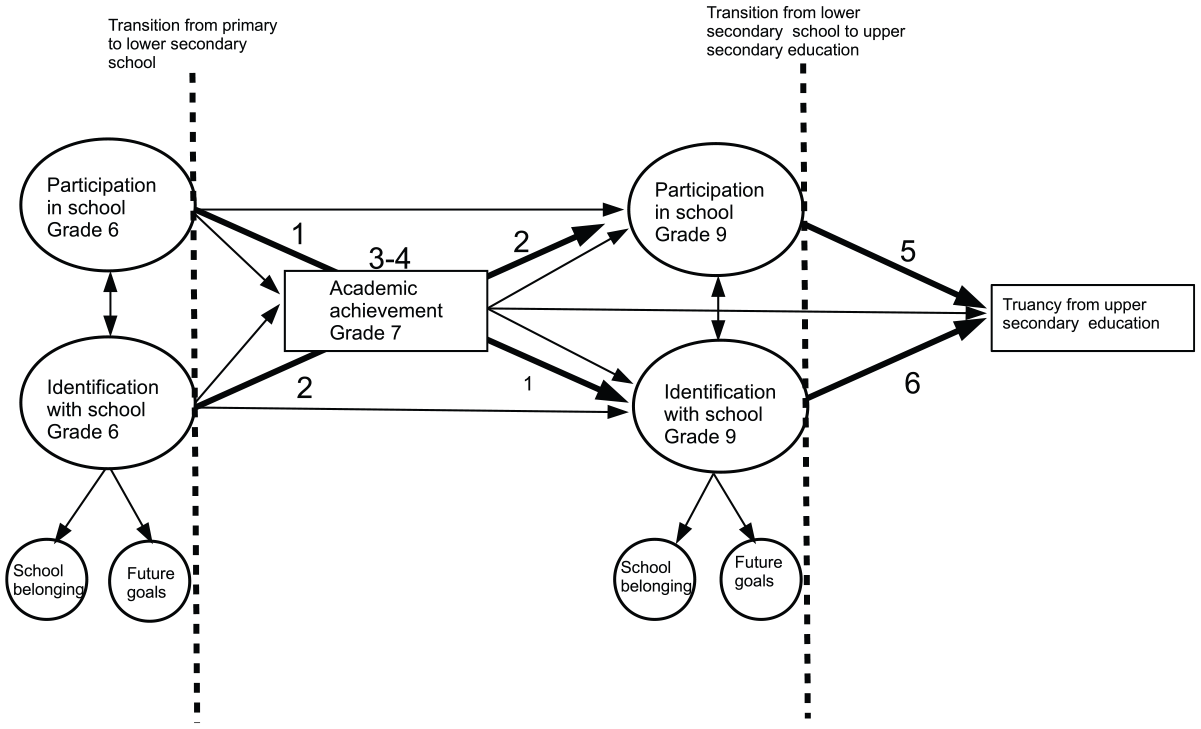
Conceptual model depicting the associations between the study variables.
The following research questions and hypotheses were set (see Figure 1):
To what extent does Grade 6 participation predict identification in Grade 9 after controlling for identification in Grade 6? Based on the participation-identification model (Finn, 1989; Finn & Zimmer, 2012) and empirical evidence (Li & Lerner, 2013), we hypothesized that Grade 6 participation predicts identification in Grade 9: the higher the level of Grade 6 participation, the higher the identification in Grade 9 (Hypothesis 1).
To what extent does Grade 6 identification predict participation in Grade 9 after controlling for participation in Grade 6? Based on self-determination theory (Ryan & Deci, 2000, 2017) and previous literature (Connell & Wellborn, 1991; Engels et al., 2016), we hypothesized that Grade 6 identification predicts participation in Grade 9: the higher the level of Grade 6 identification, the higher the participation in Grade 9 (Hypothesis 2).
Is the association between Grade 6 participation and Grade 9 identification fully mediated by academic achievement in Grade 7? Based on the participation-identification model (Finn, 1989; Finn & Zimmer, 2012), we hypothesized that the association between Grade 6 participation and Grade 9 identification is fully mediated by academic achievement in Grade 7 (Hypothesis 3).
Is the association between Grade 6 identification and Grade 9 participation fully mediated by academic achievement in Grade 7? As suggested by the participation-identification model (Finn, 1989; Finn & Zimmer, 2012) and prior empirical evidence (Archambault, Janosz, Fallu, & Pagani, 2009; Connell & Wellborn, 1991; Finn & Zimmer, 2012; Voelkl, 2012), a causal loop is assumed to run from school-related affects to participation in school rather than to academic outcomes. We, therefore, hypothesized that academic achievement does not mediate the path from Grade 6 identification to Grade 9 participation (Hypothesis 4).
Does Grade 9 participation predict truancy in upper secondary education? We hypothesized that Grade 9 participation (Virtanen et al., 2014; Vaughn et al., 2013) predict upper secondary education truancy: the higher the level of Grade 9 participation, the lower the students play truant from upper secondary education (Hypothesis 5).
Does Grade 9 identification predict truancy in upper secondary education? We hypothesized that Grade 9 identification (Maynard et al., 2017; Vaughn et al., 2013) predicts upper secondary education truancy: the higher the level of Grade 9 identification, the lower the students play truant from upper secondary education (Hypothesis 6).
Method
Participants and Procedure
The participants were from a two-phase longitudinal age-cohort study. In the First Steps study Phase 1 (Lerkkanen, Niemi, Poikkeus, Poskiparta, Siekkinen, & Nurmi, 2006–2016), approximately 2,000 children were followed 10 times from kindergarten to the end of lower secondary school (Grade 9). In the School Path: from First Steps to Secondary and Higher Education study Phase 2 (Vasalampi & Aunola, 2016–), the same students were followed twice after the transition to upper secondary education. The students were from four Finnish municipalities (i.e., one rural area, two medium-sized towns, and one large city) in different parts of Finland. In each of the four municipalities, all Finnish-speaking schools were invited to join this study. In the large city, Swedish-speaking schools were excluded. Both phases of the study were approved by the Ethical Committee of the University of Jyväskylä in 2006 and 2018.
The questionnaire data used in the present study were collected at four time points: time 1 in April 2013 (last year in primary school, Grade 6), time 2 in April 2014 (first year in lower secondary school, Grade 7), time 3 from February to April 2016 (last year in lower secondary school, Grade 9), and time 4 from January to March 2017 (first year in upper secondary education; that is, in upper secondary academic track and vocational schools). In Grade 6, 1,821 students ( = 12.76 years, SD = 0.34, 47.6% girls) from 77 primary schools participated in the study. In Grade 7, the number of students was 1,789 ( = 13.75 years, SD = 0.33, 47.2% girls), and in Grade 9, the number was 1,725 ( = 15.73 years, SD = 0.33, 47.5% girls) from 34 lower secondary schools. Postcompulsory education data consisted of 1,652 students ( = 16.68 years, SD = 0.37, 51.5% girls) from 61 schools, with 62.4% of the students attending the upper secondary academic track and 29.3% attending vocational school. In addition, 5% of the students combined upper secondary studies from both tracks, and 2.8% studied in alternative vocational schooling systems. Eight students dropped out from education. The response rates at Grade 7, 9, and upper secondary education were 94.0%, 91.4%, and 75.7%, of the Grade 6 sample who initially participated in the study, respectively.
The students who had complete data sets across the four time points (54.2%) differed from those students who had at least one missing observation in any of the time points (45.8%) for most of the indicators included in the present analyses. Students with complete data sets showed more participation and self-reported peer support, and higher future educational goals in Grade 6 than students with incomplete data sets. The same pattern of differences was observed for the variables in Grades 7 and 9. Compared with students with incomplete data sets, students with complete data sets had higher academic achievement and academic ability, reported more participation, higher future educational goals, and stronger teacher-student relationships and peer support. They also came from families with higher educational backgrounds, which was more common among girls than boys. However, Cohen’s d effect sizes were, with two exceptions, small (d < 0.50), ranging from 0.11 (“School is important for achieving my future goals”) to 0.28 (“I often come to class unprepared”) for Grade 6 variables, from 0.14 (gender) to 0.52 (grade point average [GPA]) for Grade 7 variables, and from 0.12 (teacher-student relationships) to 0.26 (“I often come to class unprepared”) for Grade 9 variables. For upper secondary education truancy, the difference between students with complete and incomplete data sets was large, d = 1.21, indicating more truancy for students with incomplete data sets.
Measures
Participation in school activities (Grades 6 and 9)
This describes students’ level of behavioral commitment to schoolwork. The four indicators of participation were drawn from the self-report measure, Rochester Assessment Package for Schools (RAPS-SM; Wellborn & Connell, 1987). Two positively worded items (e.g., “I work very hard on my schoolwork”) and two negatively worded items (e.g., “I often come to class unprepared”) were rated on a four-point scale (1 = strongly agree; 4 = strongly disagree). The negatively worded items were reverse-coded so that higher scores indicated higher participation. The alphas (αs) for the Grade 6 and 9 scales were .67 and .74, respectively.
Identification with school (Grades 6 and 9)
In line with the participation-identification model (see Figure 1), identification with school was specified as a second-order factor consisting of two first-order factors, Sense of Belonging at School and Future Educational Goals, measuring the value component of identification. Identification describes the extent to which students experience a sense of school belonging, have educational goals, and consider school important for their future aspirations. The items were taken from an extensively validated self-report measure, the Student Engagement Instrument (SEI; Appleton, Christenson, Kim, & Reschly, 2006; for adjustment in the Finnish school context, see Virtanen, Kiuru, Lerkkanen, Poikkeus, & Kuorelahti, 2016). Sense of Belonging was measured with three indicators: teacher-student relationships (mean of three items, for example, “My teachers are there for me when I need them”), family support for learning (mean of three items, for example, “My family/guardian(s) want me to keep trying when things are tough at school”), and peer support at school (mean of three items, for example, “Other students here like me the way I am”). The Cronbach’s αs for Grade 6 teacher-student relationships, family support for learning, and peer support at school were .87, .79, and .83, respectively. For Grade 9, the αs were .88, .83, and .86, respectively. Future educational goals were measured with three items (e.g., “Going to school after comprehensive school is important”). The αs were .83 in Grade 6 and .82 in Grade 9. The items measuring Sense of Belonging at School and Future Educational Goals were rated on a four-point scale (1 = strongly disagree; 4 = strongly agree).
Students’ academic achievement
The GPAs of all subjects in Grade 7 were collected from school registers. The Finnish grade scale ranges from 4 = fail to 10 = excellent.
Truancy
Truancy measured intentional, unexcused absences in the first year of upper secondary education with an ordinal variable: “How many days have you been absent from school because of truancy?” The time period for absence was the ongoing academic year, and the response options were the following: not at all, 1 to 2 days, 3 to 5 days, and more than 5 days. Of the students, 76.6% reported nontruancy, 15.7% truanting 1 to 2 days, 3.8% 3 to 5 days, and 4.0% more than 5 days.
Control variables
Guided by the participation-identification model (Finn, 1989; Finn & Zimmer, 2012), the following two variables were controlled for in the analyses. Students’ academic ability in Grade 7 was measured with the mean value formed from reading, spelling, and math tests. A nationally standardized reading and spelling test, Reading test for lower secondary school (YKÄ; Lerkkanen, Eklund, Löytynoja, Aro, & Poikkeus, 2018), developed for lower secondary grade levels was used. It included four group-administered reading tests and one spelling test: the sum of correct responses on reading comprehension, word reading fluency, sentence reading fluency, a word-chain task (number of correct dividing lines to differentiate words), and the sum of correctly spelled pseudo words. Moreover, basic arithmetic fluency was tested using a 3-min time limit test (Aunola & Räsänen, 2007). Cronbach’s α of the academic ability measure was .76. Unobserved school characteristics were accounted for by 32 (k − 1) school dummy variables. Moreover, student’s gender and parents’ level of education were introduced in the model as control variables. Gender was a dummy variable (1 = boy). Parents’ educational level was measured as the parent-reported highest basic education completed (1 = less than 9 years of basic education, 2 = completion of 9 years of basic education, 3 = completion of 12 years of upper secondary education). The control variables were of no primary interest in the study; therefore, they are not discussed in the “Discussion” section.
Analysis Strategy
Statistical analyses were conducted in the following steps. First, measurement models were estimated separately for Grade 6 and Grade 9. Both models included correlating factors of Participation and the second-order factor Identification. The fit of the estimated models was assessed with the following indices: chi-square (χ2) test, root mean square error of approximation (RMSEA) with 90% confidence interval (CI), comparative fit index (CFI), Tucker-Lewis index (TLI), and the standardized root mean squared residual (SRMR). The cutoff values for relatively well-fitting models were as follows: χ2 = ns (p > .05), RMSEA close to .06, CFI and TLI close to .95, and SRMR value close to .08 (Hu & Bentler, 1999).
Second, longitudinal factorial invariance of the Grade 6 and Grade 9 measurement models was evaluated (Van de Schoot, Lugtig, & Hox, 2012). The Grade 6 Participation and Identification factor means were fixed to zero, while they were estimated freely in Grade 9, except for the model with equal factor loadings across time, which was estimated with factor means fixed to zero in both time points. Because χ2 tests may be overly sensitive to large sample sizes (present Ns = 1,652–1,821) and normality assumption violations (Bollen, 1989), the Satorra-Bentler χ2 difference test was not employed in the invariance analyses. Instead, Chen’s (2007) recommendation was applied; thus when comparing the nested invariance model, factorial invariance should be rejected when ΔCFI ≥ −0.010 is supplemented by ΔRMSEA ≥ 0.015. Third, after evaluating the longitudinal factorial invariance, the measurement models were combined into one model in which concurrent year factors were allowed to correlate with each other. Factor indicator autocorrelations were freely estimated for the same item pairs from Grades 6 and 9 to account for item-specific shared variances.
To examine how Grade 6 participation directly predicts Grade 9 identification (Research Question 1, Figure 1), and how Grade 6 identification predicts Grade 9 participation (Research Question 2), a structural equation model (SEM) with control variables was specified. In this model, cross-lagged associations between participation and identification in Grades 6 and 9 were estimated along with the stabilities of both constructs from Grade 6 to Grade 9. At this stage, the mediator, academic achievement in Grade 7, was excluded from the model.
Mediating effect of academic achievement in Grade 7 in the association between participation in Grade 6 and identification in Grade 9 (Research Question 3) and the association between identification in Grade 6 and participation in Grade 9 (Research Question 4) was examined next. For this purpose, academic achievement was added to the SEM (Figure 1). As recommended (e.g., Shrout & Bolger, 2002), mediation effects were examined via the bootstrapping method. The bootstrapping method estimates the sample distribution of the mediation effect by repeatedly drawing random samples with replacements from the original sample. This allows for generating bootstrapped CIs to test the significance of the mediation path. A path was statistically significant (i.e., academic achievement served as a mediator) if the 95% bootstrapped CI did not include zero.
Finally, whether Grade 9 participation and identification predicted students’ truancy in upper secondary education (Research Questions 5 and 6) were examined with the SEM depicted in Figure 1.
All analyses were conducted with Mplus software version 8.3 (L. K. Muthén & Muthén, 1998-2017). This study’s data were hierarchical in nature (i.e., students nested within classrooms, which were nested within schools). However, because intraclass correlations (ICCs; B. O. Muthén, 1991) for the observed variables used in the measurement models were low (≤.03), single-level models were estimated using maximum likelihood estimation (L. K. Muthén & Muthén, 1998-2017). Students’ Grade 7 academic achievement was, however, clustered at the school level to some extent (ICC = .11). Therefore, differences between the schools were controlled for by entering k − 1 dummy variables in the final SEM. Little’s missing completely at random (MCAR) test showed that missingness was not completely random, χ2(6115) = 7,525.29, p < .001. The plausibility of the missing at random assumption (MAR; i.e., unobserved values were missing at random) was, however, supported by the multivariable model estimated in the current study. A large number of variables increase the probability that missing data are directly related to variables (such as students’ GPAs) in the analytical model. It corrects possible biases in parameter estimates (Widaman, 2006). To handle the missing data and to account for the skewness of the observed variables, the full information maximum likelihood (FIML) method was applied. The parameter estimates are presented as standardized.
Results
Preliminary Results: Descriptive Statistics and Measurement Models
Means and standard deviations of the observed variables and the correlations between them are presented in Table 1.
Correlations, Means, and Standard Deviations for the Key Observed Variables.
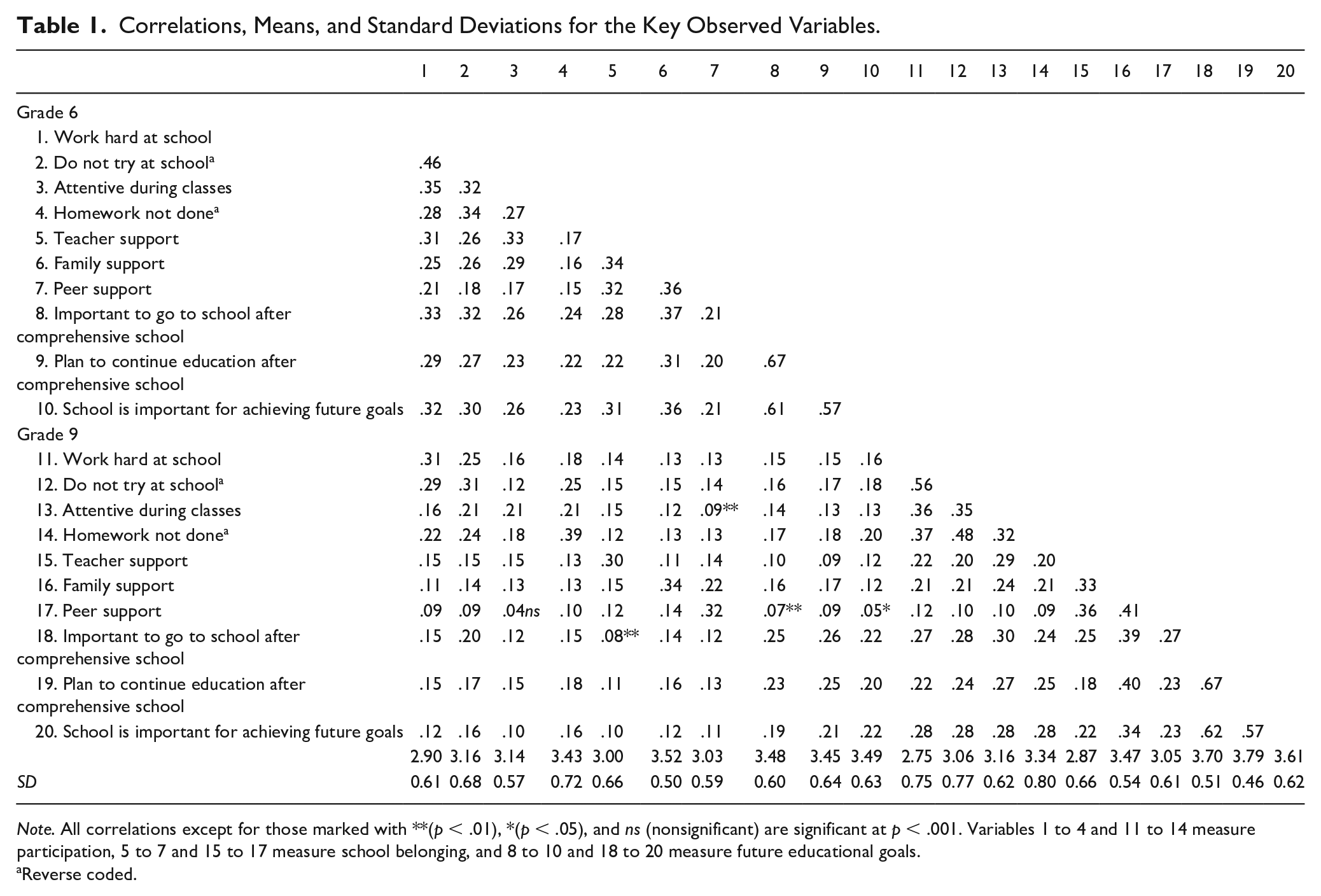
Note. All correlations except for those marked with **(p < .01), *(p < .05), and ns (nonsignificant) are significant at p < .001. Variables 1 to 4 and 11 to 14 measure participation, 5 to 7 and 15 to 17 measure school belonging, and 8 to 10 and 18 to 20 measure future educational goals.
Reverse coded.
Table 2 reports the fit indices of the measurement models separately for Grade 6 (Model 1) and Grade 9 (Model 2), and the two time points combined in the same model (Model 3). All the models showed relatively good fit to the data. A comparison of Models 3 and 4 showed that factor loadings could be set equal across Grades 6 and 9, according to Chen (2007) criteria. However, a comparison of Models 4 and 5 showed a substantial decrease in the model fit, indicating that intercept invariance could not be established. Therefore, based on theoretical and empirical justifications, we estimated a model with partially invariant intercepts (Model 6). In this model, factor loadings were constrained to be equal, but the intercepts of three items from the Future Educational Goals scale, the teacher-student relationships item intercept, and the intercept of one item (“I pay attention in class”) from the Participation in School Activities scale were estimated as noninvariant across time. The comparison of Model 6 and Model 4 (factor loadings equal) showed that the worsening of the Model 6 fit was within the Chen (2007) criteria (ΔCFI = −0.003, ΔRMSEA = 0.000). We concluded that partial intercept invariance across Grades 6 and 9 measurement points was achieved. As a result, the SEMs for answering the research questions were estimated with equal loadings and partially equal intercepts across Grades 6 and 9.
Longitudinal Factorial Invariance of the Grade 6 and Grade 9 Measurement Models.
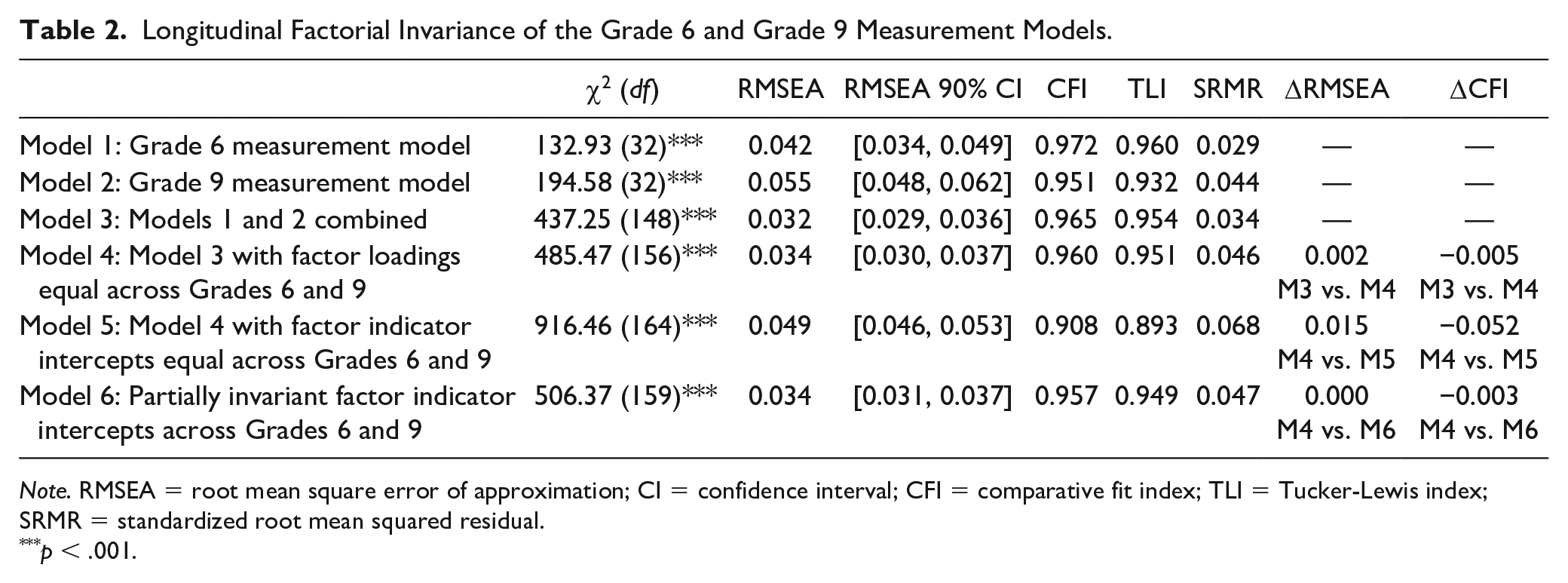
Note. RMSEA = root mean square error of approximation; CI = confidence interval; CFI = comparative fit index; TLI = Tucker-Lewis index; SRMR = standardized root mean squared residual.
p < .001.
Associations Between Participation and Identification Grade 6 to Grade 9
Research Questions 1 and 2 concerned the extent to which participation in Grade 6 predicted identification in Grade 9 and vice versa. The model showed relatively good fit to the data: χ2(229) = 774.92 (p < .001), RMSEA = 0.035 (90% CI = [0.033, 0.038]), CFI = 0.940, TLI = 0.928, and SRMR = 0.049. The results showed that after controlling for stabilities of participation (β = .60, p < .001) and identification from Grade 6 to Grade 9 (β = .21, p = .052), participation in Grade 6 predicted identification in Grade 9 (β = .22, p = .032), but identification in Grade 6 did not predict participation in Grade 9 (β = −.11, p = .186).
Academic Achievement as the Mediator Between Participation and Identification
Research Questions 3 and 4 asked whether academic achievement in Grade 7 mediated the association between Grade 6 participation and Grade 9 identification, and Grade 6 identification and Grade 9 participation. The SEM with academic achievement as the mediator showed relatively good fit to the data: χ2 (1013) = 2181.03 (p < .001), RMSEA = 0.025 (90% CI = [0.024, 0.027]), CFI = 0.905, TLI = 0.906, and SRMR = 0.042. The results (see Figure 2) indicated that Grade 6 participation predicted Grade 7 academic achievement (β = .36, p < .001). Academic achievement, in turn, predicted Grade 9 identification (β = .34, p < .001). This standardized indirect effect was statistically significant: β = .12 (90% CI = [.07, .17]). This equals a completely standardized mediation effect size (MacKinnon, 2008). It indicates that Grade 9 identification is expected to increase by 0.12 standard deviations indirectly through Grade 7 academic achievement per a standard deviation change in Grade 6 participation.
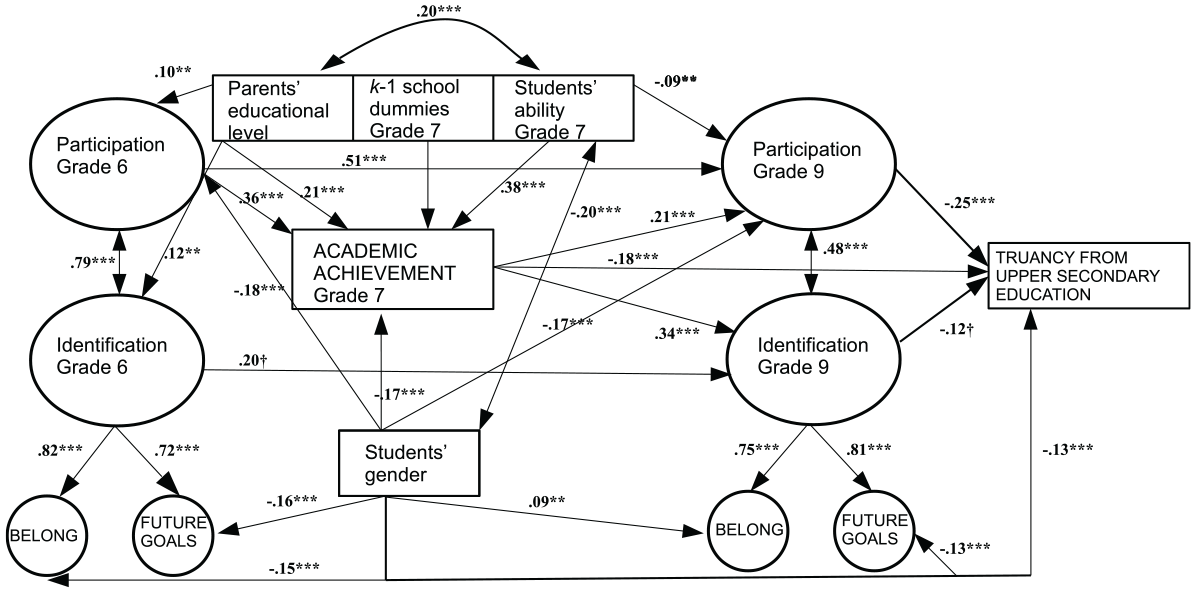
Standardized parameter estimates of the SEM model with academic achievement as the mediator.
Grade 6 identification did not predict Grade 7 academic achievement (β = .02, p = .774). Academic achievement, instead, predicted Grade 9 participation (β = .21, p < .001).
Participation and Identification Predicting Truancy From Upper Secondary Education
Research Questions 5 and 6 asked whether Grade 9 participation and identification predicted student truanting from upper secondary education. As seen in Figure 2, Grade 9 participation (β = −.25, p < .001) predicted statistically significantly negatively and identification marginally significantly negatively (β = −.12, p = .081) truancy in upper secondary education: students with higher participation in school activities and identification with school in Grade 9 played truant from upper secondary education less than students with lower Grade 9 participation and identification.
Discussion
The present longitudinal study addressed the scarcity of empirical studies examining the development of participation in school activities and identification with school from primary school (Grade 6) to the end of lower secondary school (Grade 9) and the extent to which they predict truancy from upper secondary education. Moreover, we examined whether students’ academic achievement in Grade 7 mediated the associations between participation and identification. This study is among the first student engagement studies to cover two educational transitions (from primary to lower secondary school and from lower secondary to upper secondary education). It showed that particularly students’ long-term participation in school activities is of pivotal importance in preventing truancy from upper secondary education. More specifically, the results first showed a cross-lagged effect from Grade 6 participation to Grade 9 identification (but not vice versa). Second, Grade 7 academic achievement mediated this association. Third, higher participation and identification in Grade 9 predicted lower levels of truancy in upper secondary education.
The results aligned with Hypothesis 1 in that Grade 6 participation positively predicted Grade 9 identification. As suggested by the participation-identification model (Finn, 1989; Finn & Zimmer, 2012), participation in school-related activities is a critically important process and a predictor of high academic outcomes and identification with school. Identification with school in terms of a sense of belonging and valuing school-related outcomes is built on continued participation, which, in turn, is promoted through instruction that manages to take into account a student’s basic psychological needs of relatedness, competence, and autonomy (Ryan & Deci, 2000, 2017). It is noteworthy that primary school participation in school activities predicted identification at the end of lower secondary, even though the school environment changed from primary to lower secondary school. Although the effect size of the association was not very high (β = .22), the result is considerable because students’ previous levels of identification along with their academic abilities and gender were controlled for in the analysis. The result indicates that the favorable impact of participatory behavior on identification is not context dependent but rather stable, even though an increased number of mediating processes potentially intervenes in the association between primary school participation and post-transition identification with school.
Unlike expected (Hypothesis 2), Grade 6 identification did not predict Grade 9 participation. The results further indicated that identification from primary school to lower secondary school is unstable, implying that to a large extent, it is a context-dependent construct. Consequently, in order for the positive effects of identification and participation to be manifested in the new school environment, students may need to renegotiate their relationships with teachers and peers (indicators of school belonging) and to see education as beneficial (indicator of future educational goals; see Sameroff et al., 2004). Therefore, students need to reidentify and reconnect with varying contexts because participation in school is a consequence of successful reidentification rather than preidentification. This was supported in a study by Virtanen et al. (2019), which showed that the transition to lower secondary school for a group of psychologically ill-being and low-functioning primary school students was a successful start in terms of improved well-being and school functioning, including their future educational goals. It appears that the transition from primary to lower secondary school operates differently for different students, and for some students, it can also be a fresh start in their schooling careers if they are able to feel relatedness and a sense of belonging in their new school environment.
Congruent to Hypothesis 3, the results showed that academic achievement mediated the association between primary school participation and identification at the end of lower secondary school: the more students participated in school activities in Grade 6, the better were their grades in Grade 7, which, in turn, explained students’ levels of identification with the school institution in Grade 9. Given that this study covered the time span of the school transition to lower secondary school and, thus, potentially contained multiple intervening mediation processes, the magnitude of the effect (β = .12) can be deemed considerable. The finding is, first, in line with prior literature showing the relationship between students’ participation in school and their academic achievement (Finn & Zimmer, 2012; Fredricks et al., 2004; Stefansson et al., 2016; Wang & Holcombe, 2010). Second, it provides support for the participation-identification model (Finn, 1989; Finn & Zimmer, 2012), which emphasizes that a consistent pattern of participation in school activities is a prerequisite for students to perform academically well. In order to learn, students must participate in the work of learning, which involves paying attention, concentrating, exerting effort, reflecting, and persevering with academic tasks (Skinner, 2016). Briefly, participation is essential for positive academic and nonacademic outcomes to be realized (Finn, 1989); no matter how much students identify with school, if they do not behaviorally participate in school activities, they will not learn optimally. By Grade 6 (i.e., end of primary school), most students have likely internalized externally regulated activities, such as school assignments, as valuable and important, and they have integrated them into their sense. This is manifested by participation in classroom activities, which contributes to students’ academic achievement and, eventually, strengthens their sense of belonging and future educational goals (Deci & Ryan, 2000; Ryan & Deci, 2009). This positive cycle is further assumed to contribute to subsequent participation (Finn, 1989; Finn & Zimmer, 2012).
Congruent with Hypothesis 4, Grade 7 academic achievement did not mediate the path from Grade 6 identification to Grade 9 participation because Grade 6 identification did not predict academic achievement 1 year later. Thus, identifying with school as a social context and valuing education do not guarantee academic success. Rather, it is likely that school-related emotions and thoughts are ingredients to maintain students’ involvement and persistence in class and school activities and to overcome challenges at school (Archambault, Janosz, Fallu, & Pagani, 2009; Finn, 1989; Finn & Zimmer, 2012; Voelkl, 2012).
The results of the present study indicated that participation in Grade 9 predicted lower rates of truancy during the first year of upper secondary education (Hypothesis 5). This result is in line with prior cross-sectional empirical evidence conducted among young adolescents (Virtanen et al., 2014; Vaughn et al., 2013), which show that participation is a factor that buffers students against truanting from school. However, the present longitudinal study expands previous studies by revealing that participation in Grade 9 predicted lower levels of truancy across a major school transition from compulsory lower secondary school education to voluntary upper secondary education. This transition puts demands on students because they need to be more capable of autonomous behavior compared with compulsory education. The findings of the study suggest that if active participation in school-related activities is internalized by the end of compulsory education, it is likely to persist across changing school contexts. If participation is supported by identification with school, as shown by positive concurrent correlations in the present study (see Figure 2), increased autonomy and freedom in school-related decisions do not result in the misuse of autonomy in terms of school truancy. Rather, a student is self-determined in that he or she controls his or her studying (Deci & Ryan, 2000; Ryan & Deci, 2009). Knowing that students’ belonging and participation in school wanes (Wang & Eccles, 2012) and disengagement increases with age (e.g., Marks, 2000), effectively promoting students’ active participation in school-related activities prior to transitioning to the next level of education is a way to tackle student disengagement from further education (Finn, 1989; Finn & Zimmer, 2012).
In alignment with our expectations (Hypothesis 6), Grade 9 identification also negatively predicted upper secondary education truancy; the higher the students’ perceptions of identification with school were at the end of lower secondary school, the less they were truant in upper secondary education. According to self-determination theory (Ryan & Deci, 2009), a type of affective connection with school, namely the extent to which adolescents perceive themselves related with others, affects how they internalize school-promoted values. If students are attached to norm-relevant significant others, such as teachers and parents, they do not want to disappoint them. Rather, they conform to their expectations and view school as beneficial for their future (Ryan & Deci, 2009), and therefore, they are not truant from school (Veenstra, Lindenberg, Tinga, & Ormel, 2010). Further, in line with self-determination theory (Ryan & Deci, 2000, 2017), it is possible that truant adolescents do not experience support for their autonomy, competence, and relatedness at school, and therefore, they seek that support outside school (Vallerand, Fortier, & Guay, 1997). This result complements prior empirical evidence (e.g., Maynard et al., 2017; Vaughn et al., 2013), showing that students’ inner school-related affective and cognitive experiences are negatively related to school truancy. It is interesting that whereas the predictive association between identification and participation appears to be interrupted in the primary to lower secondary school transition, the transition to upper secondary education did not eliminate the negative association between identification and truancy. This implies that truancy is not merely a lack of participation but conceptually different from it (e.g., Fredricks et al., 2019; Wang & Degol, 2014). It also highlights the important role of identification at the end of lower secondary school in preventing adverse schooling outcomes after the transition to upper secondary education.
Limitations
While adding to the current research on student participation and identification with school, our study has some limitations that future studies should address. First, the students with complete data sets across the four time points showed higher levels of overall adjustment to school than students with missing data. This may limit the generalizability of our results, as students with low levels of participation and identification were underrepresented in the sample. However, the differences between the students with and without complete data sets were generally small in magnitude. Second, our measure of truancy was based on students’ self-reports. Students may have found it difficult to report the correct frequency of their truancies retrospectively. Also, some may have not reported their truancy levels honestly. However, students’ responses on truancy were recorded in upper secondary education where it can be assumed that they can assess the frequency of their absence from school and whether each absence was excused or unexcused. Third, we could not establish intercept invariance of the measurement models across Grades 6 and 9. This is an interesting finding as such because it implies that the nature of the construct changes from Grade 6 to Grade 9 (Buss & Royce, 1975). However, partial longitudinal intercept invariance was shown, indicating that the entire construct did not change but rather the means of some of the items (particularly those indicating students’ future educational goals). Finally, our conceptualization included a two-dimensional construct consisting of participation and identification. This conceptualization did not allow for a separate examination of students’ school-related cognitions (see Fredricks et al., 2004). The division between the dimensions was, however, made based on the influential participation-identification model (Finn, 1989; Finn & Zimmer, 2012). Thus, the focus was on the developmental dynamics between students’ internal (a hybrid of affects and cognitions) and external (behavioral) experiences with their schoolwork.
Practical Implications
The present study showed that student participation in school-based activities and identification with school in terms of school belonging and valuing school are of pivotal importance in predicting lower levels of post-transition truancy from upper secondary education. More specifically, participation and identification have “carryover” effects, which help students to avoid truancy after the transition to the new school context. Participation was shown to operate through increased academic achievement. Because promoting students’ participation is within the teachers’ purview (Jackson, 2016), it provides a practical means through which students’ improved academic achievement, increased levels of participation and identification, and lower levels of truancy may become accessible. Instruction that focuses on fulfilling students’ basic psychological needs of relatedness, competence, and autonomy (Ryan & Deci, 2000, 2017) is likely to promote participation in school-based activities.
Identification with school appears less stable than participation in the transition to lower secondary school. For some students, the transition to lower secondary school can imply a new start, while for others, discontinuity causes problems in the new school environment and peer group. Consequently, educators could focus on supporting students with reidentifying and reconnecting after the transition to lower secondary school. School counselors could organize systematic student engagement data collection in order to monitor students over time, identify struggling students (Appleton, 2012), and help them by evidence-based interventions (Christenson, Stout, & Pohl, 2012).
Conclusion
Knowing that adolescence is the time period when students have to face challenges concerning school transitions (Eccles et al., 1993), waning school belonging and participation (e.g., Wang & Eccles, 2012), and increasing school disengagement (Mahatmya et al., 2012), this study informs school practitioners on how participation and identification shape each other and how this process predicts post-transition truancy from school. The study particularly indicates that while both processes are important, promoting students’ participation can have long-lasting positive effects on their later school careers. Promoting students’ participation in school activities during primary school improves their academic achievement and identification in lower secondary school and prevents their disengagement, such as truancy from upper secondary education.
Footnotes
Declaration of Conflicting Interests
The author(s) declared no potential conflicts of interest with respect to the research, authorship, and/or publication of this article.
Funding
The author(s) disclosed receipt of the following financial support for the research, authorship, and/or publication of this article: The study has been supported by grants from the Academy of Finland (No. 299 506, 323773)
