




Abstract
We examined Israeli parents’ perceptions and attitudes toward inclusive preschool education for children with and without intellectual and developmental disabilities. Using qualitative focus groups and questionnaires, researchers interviewed 23 Jewish parents (16 with typically developing children, seven with children with disabilities) at Shalva’s inclusive preschool program. Four themes emerged: positive parental feelings toward inclusion, viewing inclusion as “real world” preparation, high developmental expectations, and identification of success facilitators including dedicated staff and individualized approaches. Both parent groups demonstrated favorable attitudes—parents of typically developing children were motivated by social justice values, while parents of children with disabilities sought developmental opportunities and community integration. Findings emphasize the role of parental support, professional staff training, and tailored programming in implementing effective inclusive education that benefits all participating children and families.
Keywords
Inclusive education aims to provide children with disability-related needs integrated schooling within the least restrictive environment. This approach involves educating children with and without disabilities together and thereby fostering their collective development and socialization (Ahmetoğlu, 2015; Covo, 2024). Inclusion may be implemented full time, part time, or in the form of inverse integration. The latter occurs when the parents of children without disabilities voluntarily register them as students for classes at special education schools (Ahmetoğlu, 2015). Although the global inclusive education movement has gained increasing momentum over the last decades (De Bruin, 2019; Hehir et al., 2016), universal access to inclusive programs remains far from a reality for children with disabilities, and especially those under 5 years of age (Odom et al., 2011). The present investigation focuses on the perceptions and attitudes of parents of children with and without intellectual and developmental disabilities (IDD) toward inclusive preschool education in Israel.
The Benefits and Rights of Inclusive Preschool Education
Inclusive preschool education is associated with positive outcomes for children with disabilities, across a range of disabilities, as well as for non-disabled children enrolled in these settings (Ahmetoğlu, 2015; Hehir et al., 2016; Odom, 2000; Odom et al., 2004, 2011). Inclusive education can provide numerous academic and social benefits for students with disabilities, such as higher achievement in language and mathematics, improved rates of high school graduation, increased self-esteem, and more positive relationships with non-disabled students (Hehir et al., 2016). For many children with disabilities in inclusive settings, engagement, social acceptance, and friendships are realistic and meaningful outcomes (Odom et al., 2011). As reported by parents of children without disabilities (Sharma & Salend, 2016), positive outcomes arise for students without disabilities from gaining a greater understanding of disability, increasing their sensitivity to differences among people (Ahmetoğlu, 2015; Odom, 2000; Odom et al., 2004), and gaining social development benefits. Non-disabled students can benefit academically from inclusion as well; inclusion is generally associated with either positive or neutral effects on academic outcomes (Hehir et al., 2016).
Beyond the instrumental goal of positive educational and social outcomes, inclusive education is a human right that was recognized for the first time in international human rights law by The United Nations Convention on the Rights of Persons with Disabilities (CRPD) (The United Nations, 2006). CRPD Article 24 prohibits discrimination against children with disabilities and also affirmatively requires that they should be able to participate in their nations’ general education systems (CRPD, art. 24). The CRPD emphasizes a holistic and integrated approach to public education systems, requiring access by students with disabilities to schools and the promotion of their learning and well-being within mainstream classrooms, regardless of disability (Harpur & Stein, 2019; Paseka & Schwab, 2020). Article 24 closely follows the social model of disability by aiming to remove barriers to equal participation in society so that children with disabilities can access education (De Beco, 2014).
Israel ratified the CRPD in 2012, committing to uphold Article 24, which mandates inclusive education. Amendment 7 of Israel’s Special Education Law underscores the significance of integrating students with disabilities into general education settings and solidifying their legal rights and the services they are entitled to receive. Additionally, Amendment 11 of that law highlights the importance of parental choice in determining their child’s educational placement and promotes a holistic approach that considers the needs of both students and their families as central to the educational process (Bar & Kanj-Sirhan, 2019).
Parental Attitudes and Concerns Regarding Inclusive Education for Children with Disabilities
Studies point to parents expressing overall favorable attitudes toward the inclusion of their children with disabilities in inclusive programs, and these positive attitudes tend to increase over time (Odom, 2000; Tryfon et al., 2021). Parents of children without disabilities generally support inclusion (Sharma & Salend, 2016; Sira et al., 2018), but their attitudes are more positive for students with physical disabilities or learning difficulties compared to those with behavioral or cognitive disabilities (Paseka & Schwab, 2020).
Despite their overall favorable attitudes, parents of both children with and without disabilities nevertheless voice several concerns regarding inclusion. These concerns include the ability of educators to provide sufficient attention to their respective children, the number of staff available to meet children’s needs, and the lack of training for mainstream teachers (Jigyel et al., 2020; Seery et al., 2000; Sharma & Salend, 2016). Parents of children with disabilities can hold ambivalent attitudes, acknowledging both potential benefits and risks for their children (Paseka & Schwab, 2020) and trepidation that their children may not experience social acceptance or be included by children without disabilities or their parents (McKinlay et al., 2022). Parents of children without disabilities express concerns about possibly challenging behavior exhibited by students with disabilities and potential delays in their children’s academic progress (Jigyel et al., 2020; Sharma & Salend, 2016). Furthermore, they report difficulty explaining disability to their children (Sira et al., 2018).
Research from around the world emphasizes the importance of meaningful parent involvement as a crucial ingredient for successful inclusive practice (Afolabi et al., 2013). Starting a dialogue with parents of children without disabilities can help change their attitudes toward inclusion, make them aware of the opportunities it presents for all children, and establish them as strong partners in joint efforts to improve the conditions for the successful implementation of inclusion (Paseka & Schwab, 2020).
Moreover, studies highlight the significance of the cultural and social background of the community and family in relation to the ability to implement and sustain inclusive educational practices (Frankel et al., 2010; Odom et al., 2004). Cultural and social background shapes the form that inclusion takes in the classroom as well as the access that families may have to inclusive programs. Understanding and appreciating the diverse sociocultural perspectives of parents and participants is important.
Finally, research indicates that the attitudes of parents of children without disabilities toward children with disabilities can influence their own children’s attitudes. When these parents have positive attitudes towards inclusion, their children are more likely to be socially accepting of students with disabilities. Conversely, negative parental attitudes can contribute to negative attitudes in their children toward inclusion (Santilli et al., 2022).
Parents of children with disabilities often endorse the concept of inclusion in mainstream education (Bopota et al., 2020; Stevens & Wurf, 2020), but they may also express concerns and encounter significant challenges. Some parents believe that special education systems may offer greater benefits for their children with disabilities (Rudrabhatla et al., 2024). Although these parents generally have positive attitudes toward inclusive education, they also often worry that teachers are not sufficiently trained to address their children’s unique needs and that school systems lack adequate support for effectively integrating their children into mainstream classrooms (Bhopti et al., 2020; Stevens & Wurf, 2020).
The Israeli Education System and Special Education Structure
To understand the context in which Israeli parents make decisions about inclusive education, it is important to examine the structure of Israel’s education system and how special education services are organized and funded. Israel’s education system operates through a centralized structure where the Ministry of Education is responsible for education at all levels in state and state religious schools, while local authorities play supporting roles in educational provision. The special education system functions through three different organizational frameworks: special education schools, separate special education classes in regular schools, and mainstreaming of students with special needs in regular classes, each with distinct budgeting methods. This framework applies to children with special needs from ages 3 to 21, including preschool-age children who are the focus of this study. A key mechanism for special education service delivery involves Local Support and Resource Centers (LSRCs), called “MATIA,” which operate in nearly every community to provide educational services to learners with special needs in regular classrooms by bringing services into classrooms rather than removing children from class. These centers provide assessment, support, interventions and treatments by special education teachers, occupational therapists, physical therapists, communication clinicians, and other specialists, allocating resources according to specific local needs. This decentralized approach, where regional support centers are responsible for provision of special education resources in their areas with governmental distribution determined by the number of students served and their assessed needs, provides important context for understanding the current study’s recommendations for establishing educational inclusion coordinators for local authorities and implementing targeted financing systems for inclusive education frameworks (Blass, 2022; UNESCO, 2021).
Study’s Aim and Rationale
Research in the United States and parts of Europe and Africa highlights the role of parental attitudes in implementing inclusive preschool education (Afolabi et al., 2013; Paseka & Schwab, 2020). While substantial research has focused on teachers’ and students’ attitudes toward inclusion (Dias & Cadime, 2016; Štemberger & Kiswarday, 2018), parental attitudes remain underexplored (Paseka & Schwab, 2020). Understanding parental perspectives across age groups is essential (Paseka & Schwab, 2020; Seery et al., 2000). Some studies have examined attitudes among parents of children with autism (Su et al., 2020) and other disabilities (Sari & Saleh, 2020), but a significant knowledge gap exists regarding parents of children with IDD. Research on parental perspectives regarding inclusive education, especially at the preschool level, is limited (Sharma et al., 2022). Despite the importance of parental involvement in educational decision-making, studies on parental attitudes toward inclusive practices for young children are scarce (Rudrabhatla et al., 2024). This gap limits our understanding of how to support successful inclusive education implementation, as parental voice plays an important role in determining the quality of inclusive education (Sharma et al., 2022). Understanding parental attitudes is crucial for effective implementation, as attitudes and perceptions toward inclusive education are essential for the successful implementation of inclusion practices (Dias & Cadime, 2016).
The sociocultural background of the community and family plays a role in shaping the implementation of inclusive education and the accessibility of programs. Given that the current study was conducted at Shalva, which serves a diverse population including many religious families, it is important to note this cultural context. Research on religious attitudes toward disability inclusion in Israel shows generally positive findings, with studies indicating that both religious and secular populations can hold favorable attitudes toward inclusion, though with some variation in approach (Karni-Vizer, 2022; Lifshitz & Glaubman, 2002; Weisel & Zaidman, 2003).
We aimed to enhance understanding of the viewpoints of parents of children with IDD regarding inclusive preschools. We examined the perceptions and attitudes of parents of children with and without IDD toward inclusive preschool education in Israel, particularly those who have chosen inclusive settings for their children. We had three main aims: (1) To describe the motives and expectations of parents of children with and without disabilities regarding inclusive preschool education in Israel; (2) To identify facilitators of successful inclusive preschool education from the perspectives of these Israeli parents; and (3) To identify factors contributing to successful inclusive preschool education from the perspectives of Israeli parents of children with and without disabilities.
Methods
Design
We employed a qualitative descriptive design to explore parents’ experiences, motives, and expectations regarding inclusive preschool education. Qualitative approaches aim to understand phenomena from the perspective of those experiencing them (Vaismoradi et al., 2013) and are often used for studying complex social and public policy issues (Ritchie & Spencer, 2002). They also effectively identify underlying attitudes and perceptions among participants and their cultures (Ulin et al., 2004).
We used thematic analysis (Braun & Clarke, 2006) to identify patterns of meaning across the data. This approach allowed for a rich, detailed description of participants’ perspectives while remaining close to their words and minimizing interpretive abstraction.
Setting
We conducted this study at Shalva’s inclusive preschool education program. Shalva, the Israel Association for the Care and Inclusion of Persons with Disabilities, offers a comprehensive range of services for individuals with disabilities and their families, regardless of age, race, gender, or religion.
Shalva operates as a Jerusalem-based organization with national recognition, serving families from across Israel as the country’s largest center for inclusion and disability care. The organization functions as a complementary service provider to Israel’s formal education system, with its inclusive preschools preparing children ages 4 to 6 for integration into mainstream education by first grade. Shalva represents one specialized provider within Israel’s broader network of disability services, working in partnership with government ministries and other educational institutions (Shalva, 2025).
Shalva operates various preschool education types, including special education for children with IDD, communication education for children with autism, and municipal education for children without disabilities. Attendance at Shalva’s inclusive preschool program is funded by the Israeli government rather than through private tuition. These settings foster a dynamic environment of shared learning and development. Integration processes are central to the preschool agenda, led by an integration manager and a team of specially trained counselors and assistants. The approach is tailored to each child’s individual characteristics, considering the scope and type of integration that best suits them.
Ongoing assessments are conducted for each child to examine progress and determine if adjustments to the integration approach are needed. Shalva’s preschool employs 18 different integration styles, ranging from partial to full inclusion in various activities. For example, a child might participate in some group activities with peers without disabilities while receiving specialized instruction in other areas. The integration team selects the most suitable approaches based on each child’s specific needs and potential contributions to the group. This flexible, individualized approach allows for seamless integration, maximizing development opportunities while fostering an inclusive environment for all children in the program.
Sample
The inclusion criteria for participating in the study was that interviewees should be parents of preschool children with or without disabilities, whose children participate in inclusive preschool education at Shalva. A second criteria for participation in the study was these parents’ willingness to participate in the study and their availability.
The convenience sample included 16 Jewish parents of children without disabilities and seven Jewish parents of children with disabilities. All parents were employed. Detailed participant characteristics are presented in Table 1.
Demographic Characteristics of Study Participants.
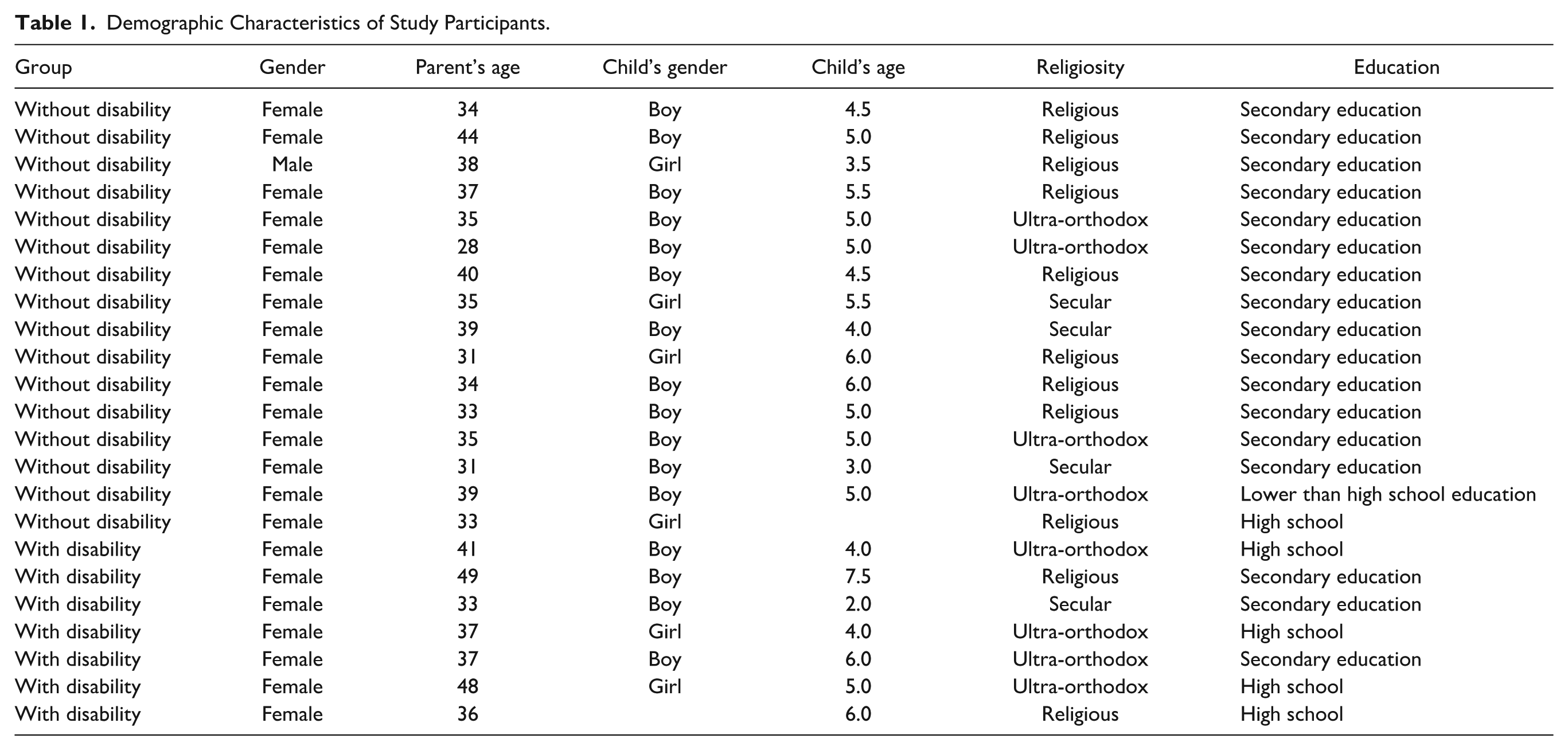
Parents of children without disabilities included 15 mothers and one father, with a mean age of 35.38 years (SD = 3.99, range 28–44 years old). Their children were 12 boys and four girls. Children’s ages ranged from 3 to 6, with a mean age of 4.83 (SD = 0.84).
Among parents of children with disabilities, all parents were mothers, with a mean age of 40.14 years (SD = 6.18, range 33–49 years old). Their children were four boys and two girls. Children’s ages ranged from 2 to 6.5, with a mean age of 4.92 (SD = 1.79).
The second author continued to reach out to parents until they felt that the data was sufficiently extensive and deep. Hence, the ultimate number of participants was the by-product of convenience sampling and saturation.
Instrumentation
A qualitative instrument was developed based on extensive review of the current literature. A preliminary list of key issues to be explored was developed through consultation with three experts in the disability education field, resulting in focus group protocols and open-ended questionnaires. The qualitative instrument included the following seven questions:
What motives led you to choose an inclusive preschool education for your children?
Describe your previous experiences in inclusive education settings (if any).
Describe your thoughts and feelings towards the school year (concerns, worries, dilemmas, etc.).
How do you expect that being in an inclusive preschool education setting will affect your child?
How do you expect that having your child in an inclusive preschool education setting will affect you (the parents)?
In your opinion, what are the facilitators for successful inclusive preschool education?
In your opinion, what are the barriers to successful inclusive preschool education?
The following personal characteristics of the participants were also collected: gender, age, religiosity, level of education, employment status, marital status, and number of children. Children’s characteristics were also collected regarding child’s age and gender. For the sample of parents of children with disabilities, information on disability severity and the extent of challenging behavior was also assessed.
Procedure
The study was approved by the institutional review board of the School of Social Work at Bar Ilan University. Parents were invited through Shalva’s preschool parent mailing list. The research team prepared the invitation text, which was distributed by the preschool administration to all families enrolled in the inclusive program. Participation was voluntary, and interested parents contacted the researchers directly. To avoid any perceived influence due to the authors’ connection with Shalva, the invitation emphasized that participation or non-participation would not affect families’ relationship with the organization. All sessions were conducted independently by the research team.
The first and second authors presented the participants with the research aim of exploring motives and expectations from inclusive preschool education and describing facilitators of successful inclusive preschool education from the perspective of parents of children with and without disabilities. Participants were given vital information on the course of the study. It was emphasized that participation was voluntary and that participants had the right to withdraw from the study without penalty at any stage. Participants were assured that all measures would be taken to protect their anonymity and confidentiality. All the participants signed informed consent forms. No compensation was given to the interviewees for participation in the study.
Data were collected through two focus groups and individual questionnaires. Both focus groups included parents of children with disabilities and parents of children without disabilities in integrated sessions to facilitate dialogue and mutual understanding between parent groups. All 23 participants attended the focus groups and also completed individual questionnaires, allowing for both group discussion and private reflection on their experiences with inclusive preschool education. The 23 participants were divided into two integrated focus groups of approximately equal size, each group including a mix of parents of children with and without disabilities. Participants completed the individual questionnaires prior to the focus group sessions to ensure their individual perspectives were captured before group discussion potentially influenced their responses.
Data collection was conducted 3 months after the beginning of the academic year, allowing all participating parents to reflect on their actual experiences with the inclusive preschool program rather than solely on their initial expectations or concerns.
The first author moderated both focus groups following established focus group research protocols, including use of a structured discussion guide and maintaining balanced participation. The focus groups were recorded and transcribed. Each focus group session lasted approximately 60 to 90 min. Data analysis involved four authors. The first and second authors each separately translated the Hebrew quotes into English and ultimately decided on the final translation through discussion.
Data Coding and Analysis
A thematic analysis was used to identify major themes that arose in response to open-ended questions. Data analysis was conducted by the second and third authors, researchers in the disability field who are experienced with qualitative data analysis. Data from focus groups and questionnaires were combined and analyzed together as a single dataset, with all responses coded without distinction by source.
Thematic analysis was chosen because of its flexibility; it is not bounded by a specific theoretical framework and thereby provides rich, detailed, and complex data. Data analysis began with transcribing the verbal data, a standard part of data familiarizing processes. Then, the data was transferred to the qualitative analysis software Maxqda. The software assisted in organizing and analyzing the data and involved all researchers in the analytical process. The data was coded using the software into meaning units and then grouped into significant themes and sub-themes. The authors identified all quotes that were related to a major theme, cut them out, and sorted them into subthemes.
Both overarching themes and subthemes were then reviewed to understand how they fit together, and what comprehensive story appeared throughout the data (Braun & Clarke, 2006; Denzin & Lincoln, 2011). Appropriate quotes were incorporated into the result section to highlight the themes under discussion.
Ensuring Credibility and Trustworthiness
To enhance the credibility and trustworthiness of this qualitative study, several strategies were employed following current methodological recommendations (Hermann et al., 2024). Inter-rater reliability was established through independent coding of all transcripts by the second and third authors, with disagreements resolved through systematic discussion until consensus was reached. The coding process followed established procedures for focus group analysis, including systematic application of codes to meaning units and integration of group interaction dynamics into the thematic analysis process (Hermann et al., 2024). Methodological triangulation was achieved by employing both focus groups and open-ended questionnaires, allowing for cross-validation of findings across different data collection methods and strengthening confidence in the identified themes. Data saturation was determined by the second author through ongoing analysis during data collection. After conducting both focus groups and reviewing all questionnaire data from the 23 participants, no new themes emerged from participant responses, indicating that sufficient depth and breadth of data had been achieved. Additionally, the involvement of four authors with varying expertise provided diverse analytical perspectives and enhanced interpretive rigor throughout the coding and interpretation process.
Researcher Reflexivity
As researchers with extensive backgrounds in disability studies and social inclusion, we acknowledge that our professional orientations and personal values regarding inclusion shaped our approach to this study. The research team brought diverse perspectives: expertise in psychosocial aspects of disability and Israeli disability policy, professional and personal connections to inclusive educational settings, qualitative health research experience, and international disability rights advocacy including participation in drafting the UN Convention on the Rights of Persons with Disabilities. While we employed multiple analytical perspectives to enhance rigor, we recognized that our collective commitment to inclusion principles could influence data interpretation, particularly given the second author’s professional involvement with an organization implementing innovative inclusion models. To address this positionality, we maintained ongoing reflexive discussions throughout the research process and employed methodological triangulation, ensuring that our interpretations remained grounded in participant voices rather than solely reflecting our theoretical predispositions toward inclusive practices.
Results
Four rich themes emerged from the data. In each theme, we specify the views of parents of children with and without disabilities. The first theme focused on the parents’ feelings toward the inclusive educational process. The second theme was that motives for inclusion were associated with preparing children for engaging with the “real world.” The third theme regarded parental expectations about the inclusion process for themselves and for their children. The fourth theme summarized facilitators for successful inclusive education. The four themes are described below in detail.
Theme 1: Parents’ Feelings Toward the Inclusive Educational Process
Parents of Children Without Disabilities
The parents of children without disabilities expressed a range of emotions towards inclusive education. Most expressed excitement and happiness and felt it was not only their children’s experience but theirs as well. As Ruth, a non-religious 35 years old mother of a daughter without disability, said: “we are all excited and anticipating this school year. We are looking forward to the opportunity to meet and begin the educational inclusion process with children who are different from us.” Rachel, a religious 28 years old mother of a son without disability added that she was “happy for the children, they will be together in the same special and magical preschool education.”
Along with the happiness and excitement came some concerns from these parents. Deborah, a religious 37 years old mother of a son without disability said: “I am afraid our child will not like and won’t connect to the idea of educational inclusion. I fear he will shy away from children who look different.”
Parents of Children with Disabilities
Parents of children with disabilities also expressed positive feelings toward inclusive education, though their emotions were often intertwined with practical considerations and careful assessment of their children’s readiness. One parent expressed her fundamental conviction about inclusion: “I truly believe there’s nothing healthier for them than being part of regular society.” Another parent shared her hopes while carefully assessing the process: “I want to see how she integrates throughout most of the day, so I can determine if she’s ready for full inclusion.”
When asked about concerns regarding other parents’ reactions, one participant expressed confidence in the Shalva setting: “Not at all. Actually, I think the environment here is very inclusive—the teachers are supportive, and the parents are accepting. It’s much more welcoming here than anywhere else.”
Theme 2: Motives for Inclusion: Preparing for the “Real World”
Parents of Children Without Disabilities
Parents of children without disabilities had a variety of reasons for choosing inclusive education for their children. Some mentioned past experiences that influenced their decision. Some mentioned previous negative experiences of seeing people with disabilities from a distance and feeling fearful of them, and expressed that they wanted to set a more positive example for their children.
Some parents mentioned positive experiences they had interacting with people with disabilities and wanted their children to have similarly positive experiences with children with disabilities. Other parents were personally exposed to special education, for example, having a relative with disability, and felt that inclusive education provided a unique introduction to the “real world” as was said by Avi, a religious 38 year old father of a son without disability: “Once our children learn to accept different people, the expectation is for them to show tolerance, sensitivity and to apply this to the real world, outside of the preschool education and incorporate this throughout their lives.”
Parents of Children with Disabilities
The parents’ main motivation for choosing inclusive education was their wish to challenge their children and promote their personal growth, as Sarah an ultra-Orthodox 41 year old mother of a child with Down syndrome stated, “a successful educational inclusion that will help him (her child) progress emotionally, functionally and cognitively.”
Parents of children with disabilities also viewed inclusive education as an opportunity to experience inclusion and to utilize this experience to make future decisions about their own child’s education. They mentioned seeing inclusive education as preparation for the next steps in the real world. As Dina, a non-religious 33 year old mother said, “We do not know which educational setting will suit him (her child with developmental delay) next year, and the inclusive education at Shalva will help us to integrate him into a regular educational setting in the future.” These parents were highly motivated and dedicated to the inclusion process with the awareness that its success relies on the commitment of the entire family.
Theme 3: Parental Expectations from the Inclusion Process for Themselves and Their Children
Parents of Children Without Disabilities
Parents of children without disabilities felt that Shalva’s inclusive education is not a typical educational venue, and described it as a “magical and unique educational setting.” Parents also recognized the rare potential of the change that educational integration can bring about in their child’s relationship with a person with a disability. For example, Mira, an ultra-Orthodox 35 year old mother of a child without disability said, “through my children’s education, they can become better people, more inclusive and more accepting of people with disabilities.” These parents discussed the moral expectations that they had from the inclusive education process. The parents spoke about changes they expected from their children’s behavior, as Sharon, a non-religious 31 year old mother of a child without disability said, “I hope that the educational inclusion process will help our child become a more compassionate person who respects every human being even if he or she is different. My expectation for him with his experience with inclusion is to play with and love every child with disabilities and accept him (the child with disabilities) as he is equal and will not shy away or pity him.”
Rafael’s parents (religious) said, “We expect that the inclusion process will transform our child (without disability) into a more socially conscious person who will respect everybody, no matter who, even if he is different, he will learn to help those in need and play with and love every child, even if he has a disability, he will accept them as equals and not shy away or pity them.”
Parents had expectations for themselves in the inclusive educational process. Their expectancies were mostly to remove the stigma they had towards people with disabilities. For example, one mother said that her goal was “to remove stigmas and difficulties in dealing with exposure to children with disabilities.”
Another notable expectation mentioned by these parents of children without disabilities was their desire to become better acquainted with the parents of children with disabilities, to understand their lives and what they went through on a daily basis. As Mira said, “I want to improve my understanding of what parents of children with special needs go through.” Osnat, a non-religious 39 year old mother of a child without disability added to that concern and emphasized understanding the needs of parents of children with disabilities, “To better understand the needs of parents with children with disabilities, I would also like a group for parents of children in the inclusion process.” Gila, an ultra-Orthodox 39 year old mother of a child without a disability felt that knowing parents of children with disabilities gave her a better outlook on her life and appreciate what she has: “To be at Shalva and to see different people, even for us parents, helps us gain a perspective on life and helps us behave better” towards people with disabilities.
The parents of children without disabilities observed changes in their children’s behavior, which also had the potential to change their own attitudes toward people with disabilities. As Michal, a religious 35 year old mother said, “Because we come from places where there are not so many families with children with disabilities, we, like our children, will learn how to accept everyone and how to better communicate with people with disabilities. We will know how to convey to our children the feeling that we, like them, are learning to become more inclusive and accepting of people in society who are not deemed ‘normal’.” These parents were aware of the stigma attached to disability and wished for a different experience for their children. As Rachel said, “To remove stigmas and difficulties in dealing with exposure to children with disabilities.” Shlomit, an ultra-Orthodox 35 year old mother added her expectation “that, I too, as a parent, will not be deterred or fear children with special needs.” Dana, a secular 33 year old mother said, “As a mother, I expect that I will also not be afraid of children with disabilities.” Several parents also said that the inclusion process will help them become people accepting of others as equals without pitying them for their challenges.
Together with the expectations and commitment to the process, the parents emphasized the importance for their children to enjoy the process. Shira, a religious 38 year old mother said, “It is important that the child enjoys the inclusion process,” and Rachel added, “The child should also enjoy the inclusion process and have a positive experience so that he will not feel threatened or deterred.”
Parents of Children with Disabilities
Parents of children with disabilities expected that their children would be able to advance and develop. As Dina said, “I expect him to interact with ordinary children. To communicate with integrating children, to be exposed to them will improve his communication skills and allow for meaningful play and reciprocal communication.”
Some parents also expected better behavior due to the communication and play with children without disabilities, as Sarah said: “The expectation that the integration will influence normative behavior and integration options in the community in the future. We have high expectations for a successful combination that will help him move forward functionally, cognitively and emotionally.” Dina concluded with the expectation that this process will bring “hope for a successful future for our child.”
Parents of children with disabilities relied on a variety of expectations for their children’s developmental progress. Therefore, their personal expectations for the integration focused on relief in the field of developmental care for the child. As said by Rivka, a religious 32 year old mother of a child with Down syndrome, “Educational integration will reduce the burden of community care outside the educational setting.”
Theme 4: Facilitators for Successful Inclusive Education Process
Parental Attitudes and Preparedness
Parents mentioned the initial attitudes towards inclusion as an important facilitator to the success of inclusive education. From their contributions to the focus group, it could be understood that parents must believe in the idea of inclusive education and choose it for ideological reasons for it to succeed. As mentioned by Avi, a religious 38 year old father of a boy without disability, “Parental disagreement with the course of educational integration can sabotage the process.” Mina, a religious 32 years old mother of a child with Down syndrome also clarified this facilitator for success and said, “the inclusive education depends on parents who chose another educational setting for their children for different reasons and not because of the uniqueness of the inclusive Preschool Education.”
The need for preparedness in dealing with difficulties throughout the process was also expressed. Parents mentioned that the process might not work well unless their fellow parents were ready to engage with the challenges that come with inclusion, for example, if they came with concerns that their children might learn behaviors that are not acceptable in mainsteam society. Parents with children without disabilities said that it would be beneficial to provide themselves and other parents in the future with information about the children’s disabilities and the general inclusion process to encourage a more successful outcome. As Shira said, “It is also worthwhile for me to give the parents a brief introduction on the inclusion process, how to deal with children’s questions and what we can do to help with the process.”
The Educational Staff: Attitudes and Qualifications
A frequently mentioned point was the importance of a professional and caring educational staff dedicated to inclusive education. Both groups of parents unanimously cited the importance of staff as a key to educational integration success. Dina a non-religious 33 year old mother also mentioned the following elements: “Good and professional staff, a personalized approach to caregiving, paramedical staff and (work) small groups.” Parents noted the sincere desire required by the team for successful integration and recommended the need for staff training to help them become better equipped with facilitating the process. Finally, both parent groups pointed out the need for ongoing contact with the staff throughout the week to receive updates in order to be involved in the process in the best way possible.
Proper Mediation to the Children
Both parents of children with and without disabilities emphasized the importance of providing the children with adequate preparation for the process and warned that without it, the inclusive education process could fail, Brachi, an ultra-Orthodox 28 years old mother of a child with Down syndrome said: “Our child does not speak and if there is a mediator who can explain certain movements/behaviors to him, it can help him.” Sarah, an ultra-Orthodox 41 years old mother of a child with Down syndrome likewise described the need for adapting the inclusive educational process to each child’s abilities and challenges as a “specifically tailored inclusion plan.”
Ariela, a religious 43 years old mother of a child without disability, shared an episode that expressed the importance of mediation for the children participating in the inclusion process: “Explanatory sessions (for the children) to explain the limitations of children with special needs. Today, for example, my son encountered some children with special needs in the elevator. They wanted to touch him and his belongings, it was difficult for him and he did not know how to easily handle the situation.” Dana, another mother of a child without disability mentioned the importance of conveying the needs of the children with disabilities to the children without disabilities. She added that it would help get a better understanding and with that, less frustration, “A need for mediation to address the difficulties and frustrations that would arise between both groups of children.”
Further, on the issue of mediation, the parents mentioned the sensitivity necessary to know if their child, whether with or without disabilities, is ready for the educational inclusion process and how much mediation is required. Mika, a religious mother of a child without disability, said “Don’t try to force a child into an integrated classroom if he or she is not ready. It is important to identify reluctance with the child in the initial stages and try to understand/explain the causes.” Ron, a father of a child with Down syndrome, recounted that they joined the inclusive education process but quit in the middle because they felt their child was not ready: “Don’t force things on the child that are not suitable to him. As mentioned earlier, our child had a tough time with some of the children and, after consulting with the preschool education teacher, we took him out of the program to improve his educational experience. Based on his progress, we may consider bringing him back into the program later, but only if he wants to.”
Facilities and Equipment
The inclusive educational process took place at Shalva where the preschool children, both with and without disabilities, had access to the organization’s specialized facilities. This was one of the reasons why some parents chose to include their children in the integrated program. They wanted their children to enjoy a variety of activities and facilities in the preschool education (Snoezelen, gym, shows, and events, etc.) that are designed for children with special needs. For example, Ariela a mother of a child without disability said, “I would like my child to enjoy the facilities intended for the children in the special education Preschool Education, including the Snoezelen, pool and more.”
Discussion
The current study examines the perceptions and attitudes of parents toward inclusive education in early childhood in Israel. The participants included parents of children with IDD and parents of children without disabilities. Research on inclusion in preschool education remains limited (Sherfinski et al., 2015), particularly regarding parental perspectives (Paseka & Schwab, 2020). This study addresses this knowledge gap.
The sample consisted of 16 parents of children without disabilities (15 mothers, one father) and seven mothers of children with IDD. The predominance of mothers in our sample reflects patterns observed in disability research (Columna et al., 2020).
The scant literature on parental attitudes towards educational integration examines this mainly from the perspective of parents of children with disabilities, under the assumption that it is they who benefit greatly from the process and are thus likely to choose it. In keeping with this, the present study investigated the attitudes and perceptions of parents regarding the educational inclusion of their child with a disability in Shalva’s inclusive preschools. The parents explicitly expressed their desire for inclusion. Furthermore, consistent with findings in the literature, they also recognized their significant role in the implementation of educational inclusion (Sherfinski et al., 2015).
In the present study, parents also recognized the advantages of educational inclusion for their children. Many of them viewed inclusion as an integral part of the educational process in which they believed and had specifically chosen, particularly within the Shalva organization, where they had received services over the years (some had participated in Shalva’s programs since the birth of their child with a disability). Parents of children with disabilities perceived the process of educational integration in preschool education as a necessary and preparatory step towards integration in integrated schools after preschool education age.
A novel finding in the current study is the expressed desire of parents of children with disabilities to engage more with parents of children without disabilities. This desire can be seen as a strategic approach to bridging concerns and even creating a parallel community to the preschool education—a community of inclusive and included parents. This finding aligns with the currently accepted perspective that views educational inclusion in schools as a process which fosters a sense of “belonging,” that is, one that views inclusion as a platform for creating deep and meaningful partnerships (Kovač & Vaala, 2021). The present study highlights the inclusion process as fostering a sense of belonging among parents of preschool education-aged children, thereby extending the age range that benefits from and supports inclusion.
Another aspect relating to the sense of belonging and the desire for connection emerged from parents of children with disabilities regarding the key to successful inclusion. Parents identified the preschool education staff as a critical factor in the success of their children’s educational inclusion process and emphasized the importance of their relationship with the inclusive preschool staff. This finding, which also appeared in a study by Mantilla et al. (2024), is particularly intriguing. In the current study, it is attributed to the parents’ desire for connection and a sense of community and “belonging.” Parenting a child with a disability is often accompanied by stress and loneliness, and this finding is highlighted in the current study in light of the need for parents of children with disabilities to feel a sense of belonging throughout the inclusive education process (Kovač & Vaala, 2021).
While the above findings illuminate the perspectives of parents of children with disabilities, this study also examined parents of children without disabilities—a group that remains understudied despite their crucial role in successful inclusion. Understanding how these parents perceive inclusive settings, what benefits or concerns they identify, and what influences their educational placement decisions enhances our understanding of parental attitudes toward inclusion and can inform more effective implementation practices.
Motivating factors for preschool education inclusion among parents of children without disabilities include the desire to provide their child with the unique experience of encountering human diversity at a young age while fostering a sense of respect for every individual. These parents perceive educational inclusion as integral to their broader worldview concerning social justice (Rudrabhatla et al., 2024). In this study, some parents even described the opportunity for their child to learn in an inclusive preschool as “giving a gift.”
Additionally, it is noteworthy that parents expressed a desire to better understand the field of disability and to connect with the parents of children with disabilities, indicating a wish to engage in the social process accompanying inclusive education. In this manner, they chose to give the “gift” of inclusion not only to their children but also to themselves. This finding highlights the extensive and far-reaching social impacts of educational inclusion. It also appeared among parents of children with disabilities, reinforcing the theoretical foundation that views educational inclusion as a process fostering a sense of “belonging,” thereby giving it a broader and deeper meaning (Kovač & Vaala, 2021).
Parents of children without disabilities reported a significant positive impact of educational inclusion on their children, which further motivated them to continue with the inclusive educational process. One notable positive impact was the increased patience and willingness to accept others, which, according to the parents, became more pronounced among children participating in inclusive education.
Parents attributed the success of educational inclusion to a committed and dedicated staff. This finding aligns with the attitudes of parents in the study by Mantilla et al. (2024). However, the current study further reveals that parents emphasized the necessity of tailoring individual inclusion plans for each child according to their unique abilities and challenges. They stressed that the role of the educational staff involves adapting the scope and content of inclusion to meet the specific needs of each child, rather than applying a generalized program for all preschool education children.
Parents of children without disabilities emphasized the necessity for resources and an adequate physical environment to support and enhance the process of educational inclusion. This finding aligns with previous studies, such as those by Paseka and Schwab (2020), which underscore the importance of resources for teacher training in implementing inclusive education. Both parent groups identified the importance of having trained and dedicated staff, with parents stressing that successful inclusion requires individualized approaches tailored to each child’s unique abilities and challenges rather than generalized programs. These findings highlight the practical elements that parents view as essential for effective inclusive education implementation.
Study Limitations
This study focused on examining parental attitudes and perceptions towards educational inclusion, without considering the views of the educational staff. While participants represented diverse religious backgrounds (secular, religious, and ultra-Orthodox), this study did not specifically examine how religiosity influenced attitudes toward inclusion.
An additional limitation concerns potential response bias, as the study was conducted within the Shalva setting where participating parents receive services. Despite assurances of confidentiality, parents may have provided socially desirable responses favoring the program, which could have contributed to the predominantly positive attitudes expressed toward inclusive education. Furthermore, all study participants had actively chosen to enroll their child in the Shalva inclusive preschool, making them more likely to hold positive attitudes toward inclusion compared to the general parent population.
Given the exploratory nature of this research in preschool educational inclusion, future studies should also investigate the perceptions and attitudes of preschool education staff towards the inclusion process. Additionally, based on previous literature, future research should explore attitudes and perceptions regarding educational inclusion in relation to disability category.
Practical Implications
While this exploratory study has limitations, mapping the data reveals that parents of children with and without disabilities possess profound and significant insights into educational inclusion. These insights can inform the adaptation of precise practices for implementing inclusion effectively. Parents’ understanding of the importance of having trained and dedicated staff to lead the effort in educational inclusion highlights the need for training educational teams for optimal implementation of inclusive education.
These preliminary insights point toward a national action plan that could be essential to promote comprehensive initiatives that support the advancement of inclusive education in schools, tailored to the specific contexts of each local authority. Each local authority should be guided by an educational inclusion coordinator who is updated with local data and can adjust the implementation plan accordingly.
Furthermore, the study’s findings emphasize the necessity of preparing and adapting the inclusive education system to better integrate children with disabilities. This preparation involves developing Universal Design for Learning principles that create accessible learning materials and teaching methods suitable for all children, as well as creating physical and human environments that support the principles of inclusion.
Policy Implications
Although this study examined a specific setting and should be interpreted cautiously, the current study underscores the importance of public participation processes that base responses on accurate information received from parents within the community. Future research should examine these recommendations more broadly, but initial findings indicate local policymakers and program administrators could consider implementing a targeted financing system for educational frameworks that advance effective inclusive education practices in early childhood.
This policy approach, rather than a mandatory requirement or simple remuneration system, is justified by our findings which indicate that financial incentives tied to program-level performance criteria may motivate educational settings to invest in proper training, resources, and structural adaptations needed for successful inclusion. Moreover, investing in early childhood inclusion yields substantial long-term economic benefits, as research consistently demonstrates that early intervention significantly reduces later costs associated with special education, healthcare, and social services while increasing future productivity and social participation (Heckman & Karapakula, 2019). The financing would be contingent upon meeting defined principles and evidence-based program inclusion criteria, thereby strategically promoting inclusive education as the foundation for an inclusive society while allowing for context-sensitive implementation and maximizing the return on public investment.
While acknowledging the exploratory nature of this research, we assert that a policy fostering inclusive education from an early age, here preschool, carries a significant social message: it is possible to develop and internalize concepts related to self-other relationships and values of justice, equality, and fairness from an early stage of child development. Promoting inclusive education at this foundational level can have a profound and lasting impact on our moral, creative, and personal development as human beings.
Conclusion
This study addresses the significant lacuna in knowledge regarding parents’ attitudes towards inclusive education in preschool education settings. The uniqueness of this research lies in its dual focus on understanding these attitudes and perceptions from both parents of children with disabilities and parents of children without disabilities.
The findings reveal that both groups of parents generally hold positive views towards inclusive education, expressing optimism about its secondary social benefits. Key benefits highlighted include fostering a sense of respect and inclusion among children and promoting social change through increased interaction and understanding among parents.
Parents emphasized the crucial role of dedicated and well-trained staff in the success of inclusive education. They also noted the importance of explaining the concept of inclusion to children and developing individualized plans to effectively implement inclusive practices. These insights contribute to a deeper understanding of the practical and social implications of inclusive education in early childhood, guiding future efforts to enhance and expand inclusive educational practices.
Footnotes
Declaration of Conflicting Interests
The authors declared the following potential conflicts of interest with respect to the research, authorship, and/or publication of this article: The first and last authors declare that they have no competing interests. The remaining authors, Liron Benisti (Director of Research and Development), Dr. Adi Finkelstein, and Dr. Ariel Tenenbaum, MD, are members of the scientific committee at the Research and Development department in Shalva.
Funding
The authors received no financial support for the research, authorship, and/or publication of this article.
