




Abstract
Infant/toddler biological siblings of autistic children are at a higher likelihood for language delays and/or autism than siblings of typically developing children. There is strong face validity for preemptive interventions, those delivered before a delay is identified, yet previous research has indicated that these approaches may not be effective for all, and there are known difficulties with recruitment in this population. Frequent developmental monitoring may be one reasonable alternative to potentially burdensome preemptive interventions. This U.S. survey study aimed to understand parents’ perspectives on the needs, preferences, and factors associated with different options for supporting younger siblings before a diagnosis can be made. One hundred forty-three survey responses indicated that parents are willing to participate in virtual preemptive interventions or developmental monitoring protocols. Concern for their child’s development was related to parenting self-efficacy such that greater parenting self-efficacy predicted those who had concern for their child’s development and those willing to participate in intervention. Parents highlighted challenges with current systems for developmental monitoring, lack of support during a stressful time, and a need for more information regarding their child’s development. There is a need for a more tailored early support strategy for addressing the high likelihood for language disorders in this population that incorporates parent characteristics and preferences for participation.
Biological younger siblings of autistic children (sibs-aut) are at a higher likelihood than same-age peers for language and communication disorders, including developmental delays, autism, or communication disorders (Brian et al., 2008; Messinger et al., 2013; Miller et al., 2015; Toth et al., 2007). Yet, delays may not become apparent during the first few years of life (Shephard et al., 2017; Szatmari et al., 2016). This leaves parents of sibs-aut waiting to learn if or what support their child may need. Preemptive interventions, or interventions delivered before the need for intervention is established, are one proposed solution during this waiting period. Yet, parent-mediated interventions (PMIs) designed to prevent potential communication disorders have not established effects on child outcomes (Hampton & Rodriguez, 2022), and the burden of carrying out a potentially unnecessary intervention could outweigh the benefits (Shalev et al., 2020).
Multiple protocols for supporting families during a watchful waiting period for sibs-aut have been recently proposed (Dawson et al., 2023; Green, 2019; Green et al., 2022; Kasari, 2019; Talbott & Miller, 2020). These protocols have shared features: optimizing and systematizing screening tools and protocols to identify autism earlier, supporting parents during periods of watching and waiting, and understanding who might best benefit from preemptive interventions. Taken together, there are two promising approaches to supporting parents of sibs-auts during the watchful-waiting period: developmental monitoring or preemptive intervention.
Developmental Monitoring
Developmental monitoring has advantages over single-point screening tools (Szatmari et al., 2016). While there are strong recommendations for frequent ongoing and long-term developmental monitoring for sibs-aut (Charman et al., 2017; McDonald et al., 2020), parent concerns may not predict ultimate diagnostic outcomes for sibs-aut when screened earlier rather than later (Becerra-Culqui et al., 2018; Ozonoff et al., 2009). This may be because sibs-aut can develop pragmatic language delays, attention deficit disorders, and others that are not readily detectable until after 36 months of age (Miller et al., 2015, 2019). However, parents of sibs-aut often report early concerns for their infant/toddler’s development (Herlihy et al., 2015), which may increase worry, concern, and stress (Voliovitch et al., 2021). Previous developmental monitoring studies for sibs-aut have identified a few potential negative effects of frequent monitoring, including the burden of frequent or lengthy surveys, boredom, distress from the child, and researchers identifying concerns when there are few or no effective preemptive interventions (Achermann et al., 2020). Thus, the need for and benefit of developmental monitoring protocols is unclear, and there is a need to incorporate parent preferences into developmental monitoring protocols to ensure feasibility.
Preemptive Intervention
As an alternative approach to developmental monitoring, emerging evidence indicates that intervening earlier in toddlerhood results in greater developmental outcomes (Guthrie, 2015; Hampton & Rodriguez, 2022). There is strong face validity to including parents as partners in early intervention (Kaiser et al., 2016), and PMIs can be particularly effective for populations at risk for language delays (Roberts et al., 2019). Yet, recent research has identified that the impact of preemptive interventions on social communication outcomes for sibs-aut may be mediated by the parents’ ability to implement core strategies (Yoder et al., 2021b), and different child characteristics may increase a child’s response to these strategies (Yoder et al., 2021a). Despite the promise of preemptive interventions, recruitment of parents into sibling-focused intervention research studies has been notoriously difficult (Bradshaw et al., 2020). To create an effective and more tailored preemptive strategy for supporting parents, it is first important to understand their different needs, preferences for intervention, and barriers to participation.
Parenting Self-Efficacy
The variable outcomes in preemptive interventions and challenges in developmental monitoring have led researchers to call for more nuanced protocols that consider parent and child characteristics in these practices (Kasari, 2019). Parenting self-efficacy may play a particularly important role in a parent’s initial concern for a younger sibling’s development (Karp et al., 2017; Teti & Gelfand, 1991) and, in turn, influence participation in intervention. Researchers have identified an interaction between parenting self-efficacy and knowledge of child development; parents with lower self-efficacy and low knowledge about their child’s development also demonstrate lower sensitivity to their infant/toddler’s cues (Hess et al., 2004). Parenting self-efficacy is also directly linked to advocacy for parents of autistic children, indicating that those with greater self-efficacy may be more likely to seek early evaluations (Boshoff et al., 2016).
Parenting self-efficacy is directly linked to developmental monitoring and intervention effectiveness. For example, limited or poor-quality developmental monitoring protocols are related to lower parenting self-efficacy (Murphy & Harrison, 2022). Developmental monitoring protocols may benefit from step-wise monitoring or pre-diagnosis care that considers parent needs and preferences (Green et al., 2022). Furthermore, parenting self-efficacy is closely related to therapeutic self-efficacy for caregivers participating in PMIs (Russell & Ingersoll, 2021). This indicates that parenting self-efficacy may be key in determining the best candidates for preemptive interventions. Alternatively, some parents experience improved self-efficacy following PMIs (Aldred et al., 2004; Ingersoll et al., 2016). Parenting self-efficacy may be an important candidate for optimizing developmental monitoring or PMIs. The potential influence of parenting self-efficacy on different preemptive protocols requires further investigation to identify a more integrated and family-centered protocol for monitoring and intervention.
Study Purpose
We sought to understand parent perspectives on developmental monitoring, preemptive interventions, and the relationship between parent beliefs and parenting self-efficacy in parents of sibs-aut. We addressed this by answering the following research questions: (1) Are parents of sibs-aut concerned about their sibs-aut ability to reach developmental milestones? (2) What format and type of support might be helpful for parents of sibs-auts? (a) virtual developmental monitoring, or (b) a virtually delivered preemptive intervention specifically designed for the sibs-aut? (3) Does parenting self-efficacy predict who will likely participate in each of these supports? (4) What recommendations do parents of sibs-aut have for (a) professionals and (b) other parents during infancy and toddlerhood while watching and waiting for possible diagnoses?
Method
Inclusion Criteria
Participants were included if they indicated that they lived in the United States, had a child with an autism diagnosis, and had a younger, undiagnosed sibling under the age of 60 months. We chose to exclude those with a confirmed diagnosis because we were interested in hearing the perspectives of parents who were unclear about their child’s development and need for support.
Distribution
In January 2021, we distributed the survey through email and social media specifically to autism-focused parent groups, through autism organizations focused on engaging parents, and through community listservs that included autism intervention providers and parents. We re-posted and re-sent emails 2 weeks following the initial recruitment push. We chose this purposeful sampling method to reach caregivers in the community who might not typically participate in research studies while limiting potential robot activity. Social media distributions were limited to private parent groups and organizations requiring administrator approval to join. We also chose this method, rather than broad social media advertising, to reduce robot activity. We closed the survey in March 2021. Forty participants were randomly selected using a random number generator to receive a $20 gift card, as described below.
Participants
A total of 230 responses were recorded. We excluded participants who answered fewer than 25% of the survey questions, those who submitted surveys that were suspicious of robot activity, and those who did not respond to questions about the older child’s diagnosis. We screened responses for possible robot activity, including (a) resubmissions from the same IP address, (b) submissions from outside the United States, or (c) duplicate responses. The only submissions suspicious for robot activity based on these criteria were previously excluded due to <25% completion. A total of 143 responses remained in the final analysis, with most participants reporting siblings 36 months of age or younger (80%; Table 1).
Survey Respondent Demographics.
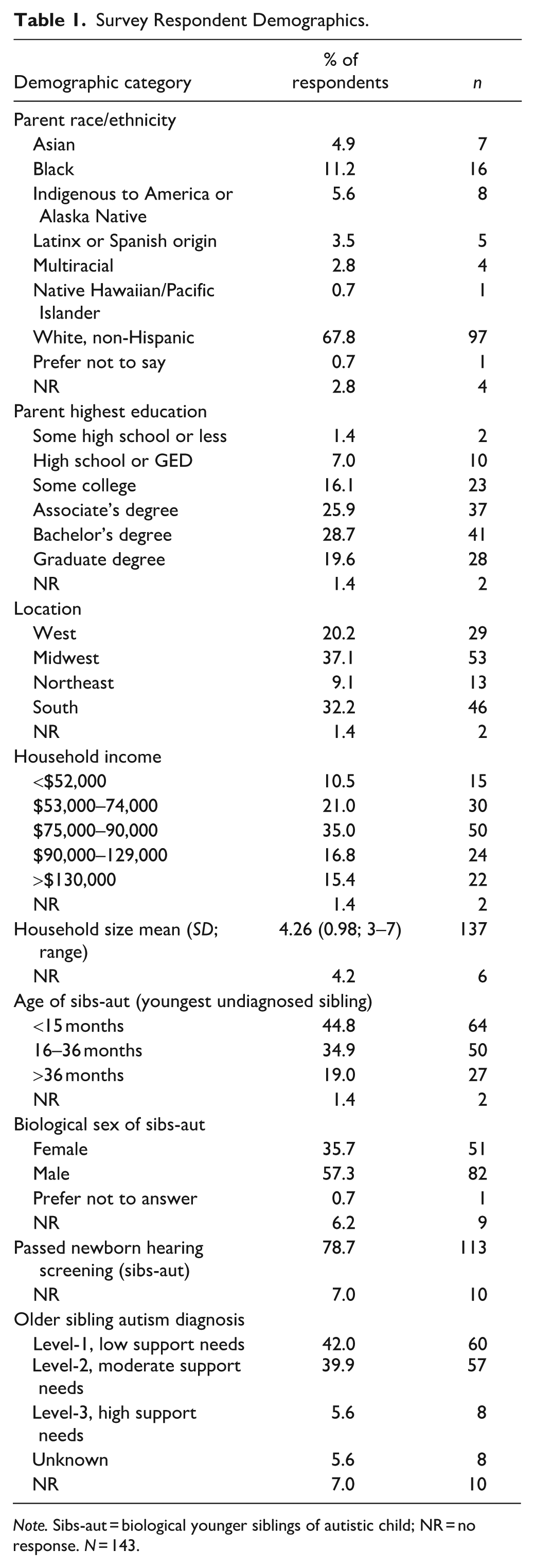
Note. Sibs-aut = biological younger siblings of autistic child; NR = no response. N = 143.
Survey Design
The authors developed the survey in REDCap, a survey distribution tool designed for secure electronic data capture (Harris et al., 2009). The survey was reviewed by three graduate students and two faculty members from different disciplines and perspectives, including audiology, special education, behavior analysis, and parents of autistic children. Reviewers provided written feedback, such as edits for clarity, terminology, and item choices. All suggestions were incorporated into the final draft and re-reviewed by the research team. The survey design was overseen by a board of invested community members, including three autistic adults and three parents of autistic children. The community members recommended using the term “increased likelihood for autism” throughout the survey rather than high-risk, which had been used in the field previously. The full survey is available as a Supplemental Material.
The survey included an initial page with an IRB-approved consent that indicated that participants could provide an email address to be selected, at random, to receive one of 40 available $20 gift cards. The 20-min survey included six sections with 95 items total: (1) short-answer demographic information, (2) multiple-choice questions about their sibs-aut’s hearing screenings, (3) Likert scale questions about their concerns for the sibs-aut’s development, (4) Likert scale questions about likelihood to participate in developmental monitoring or preemptive interventions, (5) the Early Intervention Parenting Self-Efficacy Scale (EIPSES; Guimond et al., 2008), and (6) open-ended notes boxes to share recommendations for practitioners and other parents.
The EIPSES is a 20-item self-report measure with high internal consistency
The open-ended note-box questions included two specific questions: (a) what they wish early intervention providers knew about having an infant/toddler with an increased likelihood for autism, and (b) what they wish their pediatrician knew about having an infant/toddler with an increased likelihood for autism. Responses to recommendation questions were optional.
Analysis
We used quantitative approaches, supplemented by qualitative approaches, to support our interpretation of these results and to understand parents’ beliefs, concerns, and recommendations about preemptive interventions (Tashakkori, 2010). Quantitative summary analyses included using descriptive statistics and excluding item-level missingness. We report means and standard deviations for continuous variables and percentages for all categorical variables based on the observed distributions. No data points were removed or recalculated based on normal distributions. The relationship between parenting self-efficacy scores and beliefs was analyzed in a logistic regression context using R-studio running R 4.2.1 (R Core Team, 2014). We used odds ratios to compare the parent concern to a subgroup of the older sibling diagnostic category.
An inductive summary approach was used to summarize the observed free-response data for generalized findings (Hyde, 2000). This method was selected because it allows researchers to summarize findings using a broad qualitative lens when a full qualitative thematic analysis is not appropriate due to brief answers and small datasets (Braun, 2016). While a thematic analysis is driven by the goal of understanding underlying themes or patterns in the data, an inductive summary approach summarizes the qualitative data without imposing any preconceived categories or theories. This approach results in categories of responses rather than inferring deeper meaning through theme identification. When using an inductive summary process, a higher frequency of quotes in a category does not indicate that these categories are more valuable. While this inductive summary process is not appropriate for presenting statistical results, it can add to the overall importance of the study's quantitative findings (Braun, 2016).
The data included all responses to open-ended survey questions (n = 88, 60% of the completed surveys provided open-ended responses). Free-response answers were reviewed independently and summarized by two coders trained in inductive summary approach data analysis. Once the coders had reviewed, summarized, and categorized the dataset, they met to resolve any discrepancies with a third, trained coder. Quotes that did not answer the question asked were not included due to the lack of related content (n = 5).
Positionality
Our research team (all study authors and coders) includes clinician-researchers who represent diverse perspectives regarding preemptive intervention, including an Audiologist, Special Educators, Early Interventionists, and Behavior Analysts. Our research team is also comprised of parents of young neurotypical children, a parent of a young autistic child with an undiagnosed sibling, and interventionists with experience working with sibs-aut. Further, we included a six-member review board representing invested community members, including autistic adults and parents of autistic children.
Results
Quantitative Results
Parents primarily identified as White (68%, n = 97), and mostly reported living in the Midwest (37%, n = 53) or the South (32%, n = 46), with a wide range of income and education levels (see Table 1). Household sizes ranged from three to seven family members. The older, diagnosed sibling was most frequently reported to have a Level 1 autism diagnosis (low support needs; 42%, n = 60), with few (13%, n = 18) parents reporting they did not know or did not want to answer this question. Sibs-auts were mostly 3 years old or younger (80%, n = 114), and mostly male (57%, n = 82).
Parent Concerns
Overall, parents were concerned for their sibs-aut’s development (78%, n = 112), with most parents also reporting concerns for their infant/toddler receiving an autism diagnosis (77%, n = 110) or other delays not explained by autism (75%; n = 107; Table 2). Further, many parents reported concerns for their infant/toddler’s hearing (57%; n = 81). Some parents reported that their developmental concerns were observed by a doctor or professional (43%, n = 62), and many parents reported that their child was not meeting developmental milestones (43%, n = 61). Parent concern about infant/toddler development was more likely reported if the older sibling was diagnosed Level 2/3 autism (moderate to high support needs) than those diagnosed with Level 1 autism (low support needs; OR = 1.74, SE = 0.39).
Parent Perspectives.
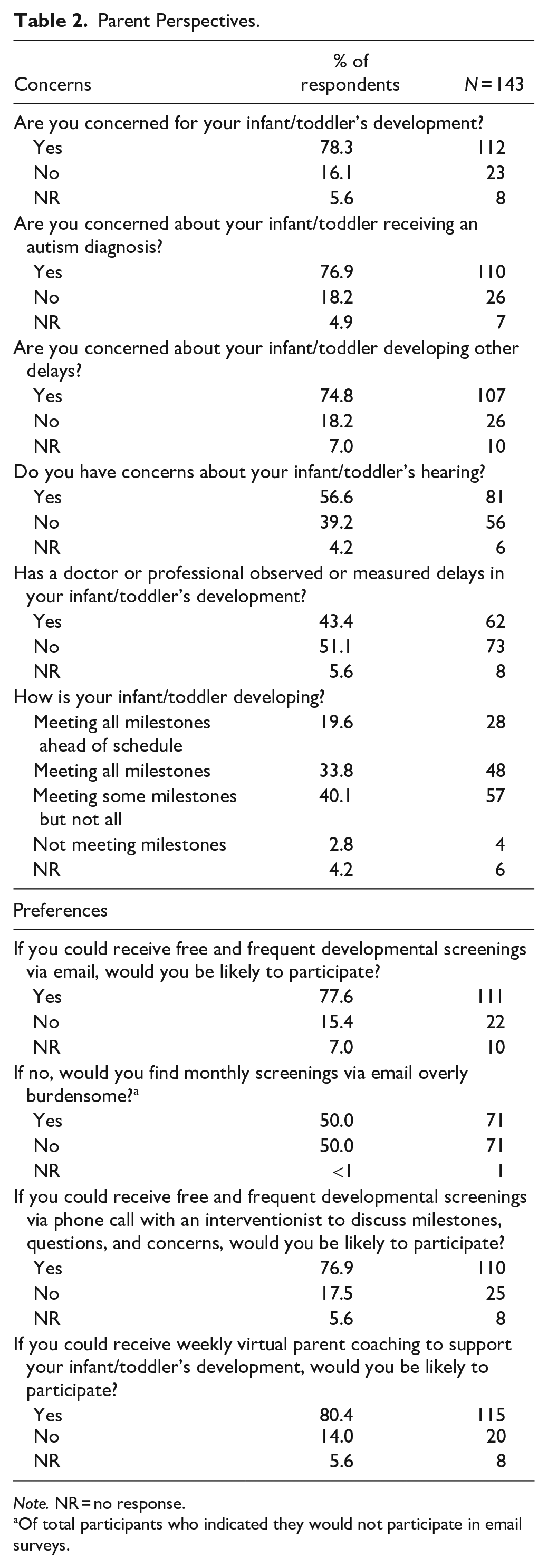
Note. NR = no response.
Of total participants who indicated they would not participate in email surveys.
Parent Preferences
Overall, parents were equally likely to report a willingness to participate in free ongoing email (78%, n = 111) or phone call (77%, n = 110) surveys for developmental monitoring (Table 2). Further, most parents were willing to participate in free virtual parent coaching to support their infant/toddler’s development (80%, n = 115). Fewer than 7% (n = 10) of parents did not respond to questions about parent preference.
The Role of Parenting Self-Efficacy
Parents reported a wide range of parenting self-efficacy (M = 99.93, SD = 13.47, range = 21–131, n = 133). Higher parenting self-efficacy scores significantly predicted parents’ concern for their child’s development
Qualitative Results: Inductive Summary Approach
In summarizing the responses to the first open-ended question, “What do you wish early interventionists knew about having a child with a high likelihood of autism?” multiple ideas were identified. These included (Table 3): more understanding of parent and family stress/difficulties, having practitioners share data with the family, increased parent education, more awareness of autism symptomology, treatments, resources for families, advice for families, understanding that autism is not a tragedy but a difference in thinking, parental affection and love for their child when making choices in the best interest of the child, listening to the parents’ voice and concerns, and an increase in communication between families and practitioners.
Parent Free-Response Answers.
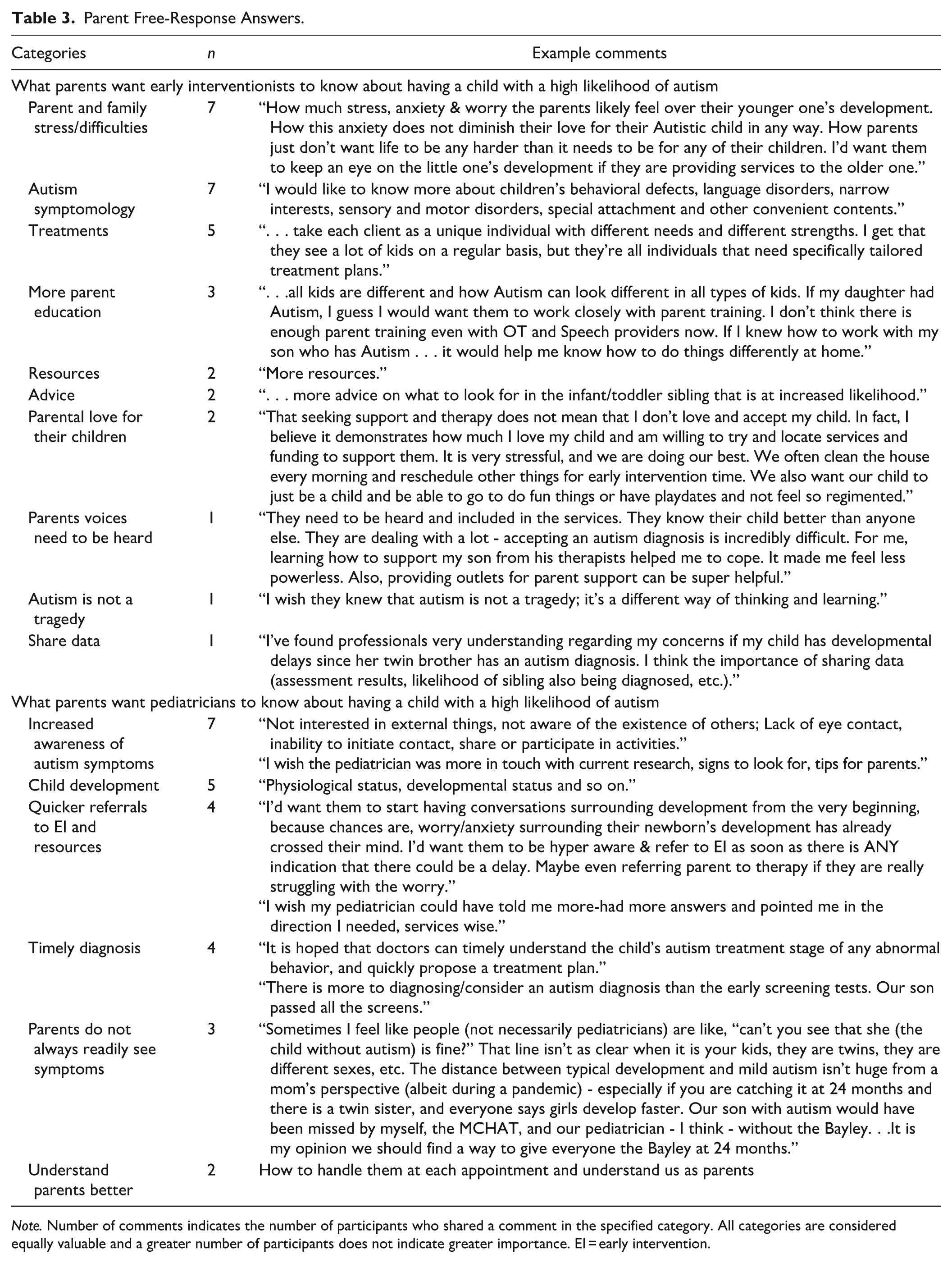
Note. Number of comments indicates the number of participants who shared a comment in the specified category. All categories are considered equally valuable and a greater number of participants does not indicate greater importance. EI = early intervention.
When parents were asked, “What do you wish pediatricians knew about having a child with a high likelihood of autism?” they mentioned a quicker referral to early intervention and resources and an increased understanding of their role in developmental monitoring and awareness of autism symptomology (see Table 3). Similarly, parents called for a better understanding of the child’s developmental status from the pediatrician during well-child visits. Lastly, parents called for a timelier diagnosis, for pediatricians to be aware of current research and share that information with the families they are seeing, and to consider more frequent developmental screenings. Caregivers and parents want both pediatricians and practitioners to understand their perspective. Caregivers called for more sharing of knowledge, data, and an update of current and best practices.
Discussion
The purpose of this study was to understand parents’ perspectives about how to best support sibs-aut during the watchful waiting period of early development and to understand the extent to which parenting self-efficacy may explain different needs during this time. Overall, parents of sibs-aut in this study reported great concern for their child’s development during the watchful waiting period, with many reporting concerns for their child’s overall development and hearing, replicating prior findings about parent concern for sibs-aut development (Herlihy et al., 2015). Parents were more likely to report concerns about their child’s development if their older child had more reported support needs, which is consistent with patterns observed previously (Talbott et al., 2015). Differences in concern for sibs-aut development may be due, in part, to differences in reported parenting self-efficacy. This may be a bidirectional finding. For parents who are noticing developmental delays, these delays may be related to the parent’s perceived self-efficacy (Fang et al., 2021), and alternatively, it may be that parents who already are experiencing low self-efficacy may have less confidence to detect developmental delays in their child (Boshoff et al., 2016).
Despite prior research and meta-analyses indicating mixed effects from preemptive interventions and developmental monitoring protocols (Achermann et al., 2020; Hampton & Rodriguez, 2022), parents of sibs-aut in the current study reported a desire to participate in virtual developmental monitoring and preemptive interventions. However, parents with lower parenting self-efficacy may be less likely to participate. There has been a recent call for research focused on developing and evaluating more nuanced preemptive interventions (Grzadzinski et al., 2021). This is echoed in the parents’ statements in this study and a previous study of parent preferences during a preemptive intervention (Freuler et al., 2014). Our results indicate that while preemptive intervention and developmental monitoring protocols may be well-received and useful for supporting parents of sibs-aut, there is a great need for the individualization of approaches for families and the training of professionals to support individual needs.
Preemptive Interventions
While previous studies including sibs-aut have primarily provided in-vivo interventions (Hampton & Rodriguez, 2022), these studies have widely struggled to meet benchmarks for recruitment (Bradshaw et al., 2020). Parents in the current study, indicated that virtual participation options might be preferred, and this approach may help address the greatest barriers to delivering preemptive interventions: parent time and resources (Bradshaw et al., 2020). Video feedback methods are an effective tool for supporting skill development in parents of autistic children, and these may also provide cost-effective (Segal et al., 2023) and acceptable options for families (Cleary et al., 2022). Preemptive interventions incorporating shared decision-making may be one feasible option to improve participation, given that shared decision-making in early intervention has a strong relationship with parenting self-efficacy (Popp & You, 2016), and interventions that promote parent involvement have demonstrated improvement in parenting self-efficacy (Kurzrok et al., 2021). Greater individualization is needed, and parenting self-efficacy may be important in engaging parents in preemptive interventions. This was echoed in the willingness of parents to participate in preemptive interventions and calls for parent education, individualized treatments, and inclusion of parent preferences.
Developmental Concern and Monitoring
Parents of sibs-aut have stated concern for their child’s development and that their children are not meeting milestones. This relationship is related to the amount of support that their older child needs, indicating that some families might be less likely to recognize developmental delays if their older child has lower support needs. Further, parents reported that concerns about or observed developmental delays are frequently dismissed or unnoticed by physicians. This finding replicates previous findings, indicating that dismissed parent concerns may be a persistent problem in early childhood (Locke et al., 2020). Many parents specifically reported concerns for their sibs-aut hearing, indicating a need for additional sibs-aut hearing screening procedures. Autistic children present with a higher incidence rate of hearing loss than typically developing peers (Do et al., 2017), and it is unclear if or how this likelihood impacts siblings. Given these associations, sibs-aut may benefit from frequent developmental monitoring with additional hearing screenings.
Parenting self-efficacy may play an important role in parents’ ability to detect concerns for their child’s development or to recognize the need for a preemptive intervention (Karp et al., 2017; Teti & Gelfand, 1991). Parents reported that their pediatrician had dismissed concerns about their infant/toddler’s development during well-checks, which may impact parenting self-efficacy and confidence over time. Low-effort developmental monitoring (i.e., email surveys) may be a feasible and acceptable solution to addressing parent’s concerns more frequently. There have been calls for close developmental monitoring in sibs-aut (Hess & Landa, 2012), yet there isn’t strong evidence to suggest that frequent screening translates into meaningful long-term outcomes (Szatmari et al., 2016). A large-scale study is needed to understand for whom, and under what conditions, developmental monitoring can be effective and optimized by parent preference.
The inductive summary analysis illustrates the challenges parents face in monitoring developmental milestones in young children. Parents noted the need for pediatricians or other professionals to provide more frequent and detailed monitoring. This need may be particularly important for Black or Hispanic parents who often experience long delays between noticing concerns for their child’s development and receiving a diagnosis (Fisher et al., 2023; Sansosti et al., 2012). Pediatricians receive little training in developmental milestones and often rely on checklists that may not pick up on the specific worries and concerns of parents of sibs-aut (Carbone, 2013). Therefore, a program that includes more frequent, yet low-effort developmental monitoring may be specifically beneficial to parents of sibs-aut during this time of uncertainty. Sharing this burden across professionals with an integrated monitoring system may reduce the burden on pediatricians who often see children infrequently during development.
Parent Recommendations and Concerns
Parents reported a need for additional support to monitor their child’s development, including more information and support from pediatricians and other community providers. This highlights the need to improve pediatrician screening practices (Murray & Barton, 2021) and parent psychoeducation (Brukilacchio, 2022). Early childhood professionals, child-find programs, early intervention, and school systems also participate in screening and monitoring. This interdisciplinary team provides benefits from multiple experts watching development and supporting families; however, the shared responsibility requires communication, collaboration, and care coordination. A more coordinated and integrated early care system is necessary (Green et al., 2022), and capitalizing on technology may be a promising solution (Lipkin et al., 2020).
Many parents shared a reflection of acceptance of their child’s disability and reported that their child’s disability does not define them as a person. This neurodiversity affirming notion creates implications for the way the provider and parents interact (Vanaken, 2023). Providers can be supportive by following the parents’ lead, considering a viewpoint of acceptance, and working with families to assist the child in being as independent as possible in the years to come.
Limitations
The findings of this study must be considered in light of a few important limitations. First, our sampling method did not provide us with the data necessary to calculate a response rate. The results should be interpreted considering the potential for response bias. Further, the purposeful sampling method limited the distribution and may limit the generalizability of our findings. While this study summarizes parent perspectives around preemptive intervention and developmental monitoring, more research is needed to understand how parents may or may not act on these stated beliefs. Additionally, the survey was distributed during the COVID-19 pandemic, and the results should be interpreted considering these potential implications.
The results should be interpreted considering some limits in our data collection procedures. We took steps to reduce activity from robots and bad actors, but it is possible that some submissions may not be genuine. We asked parents to report specific details of their older child’s diagnosis, but we could not verify participant diagnostic status or hearing status, and our questions relied on free-response answers for parents to report any false positives. While no parents indicated false-positive results, failed newborn screenings may be an over-representation of true hearing loss in this sample. The survey was also designed to ask about parent gender and age, but an error prevented most from viewing this field. Thus, we were unable to characterize parents by age and gender.
While the findings in this study provide meaningful insights about supporting sibs-aut and their parents, there is a need to replicate these findings with a larger sample. The results of this study could have a meaningful impact on service delivery, monitoring practices, and practitioner training. We chose not to provide a post hoc power analysis, as this can bias the interpretation of the results (Christogiannis et al., 2022). While the significant findings in this study (like any single study) may represent a false positive, replication of these findings is key to strengthening recommendations for future practice.
Future Research
Early intervention providers could greatly benefit from additional research in understanding the needs, preferences, and expectations of parents with sibs-aut in early development through more in-depth qualitative analyses. There is a need to understand the relationship between parent concern and the older child’s support needs and how to support parents further as concern increases or decreases over time. Researchers may further explore parent recommendations, concerns, and needs using focus groups or interviews to understand the nuance and specificity of the themes and ideas exposed in this study. There is a similar need to further understand pediatricians’ perspectives about developmental monitoring and how the responsibility of developmental monitoring could be shared. Taken together, this survey study provides a foundation for future quantitative and qualitative studies to further understand the existing supports and need for additional supports for parents of sibs-aut and the providers who support them.
Recommendations for Practice
There is a great need for an adaptive preemptive intervention for infant/toddler siblings of autistic children that integrates developmental monitoring and parent preference for participation (Kasari, 2019). Further, it may be important to consider autism-specific parent-support interventions such as mindfulness (Curl & Hampton, 2023), acceptance and commitment therapy (Gould et al., 2018), or motivational interviewing (Rogers et al., 2019) that may support parenting self-efficacy or buy-in specifically for parents with lower self-efficacy (Hohlfeld et al., 2018). Parents with lower parenting self-efficacy reported they were less likely to enroll in a preemptive intervention and may be less likely to be concerned for their child’s development. These parents, in particular, may benefit from additional support toward understanding their child’s likelihood for developmental delays, milestone development, and the potential benefits of a preemptive intervention (Graybill et al., 2016). Alternatively, parents may be more responsive to ongoing developmental monitoring until a clear need for intervention is established.
Conclusion
Parents of sibs-aut have concerns about their child’s development and are interested in participating in virtual developmental monitoring or intervention programs. Preemptive interventions may be improved with virtual delivery, developmental milestone instruction, or shared decision-making. Further, parents of sibs-aut want other families to know that they are not alone, that autism can take many forms, and sometimes other parents are the best resource. As the field seeks to understand how to optimize effective preemptive interventions and developmental monitoring, parents are waiting for more information, transparency, and community support.
Supplemental Material
sj-pdf-1-tec-10.1177_02711214251333414 – Supplemental material for Understanding Parent Perspectives of Preemptive Intervention for Toddler Siblings of Autistic Children
Supplemental material, sj-pdf-1-tec-10.1177_02711214251333414 for Understanding Parent Perspectives of Preemptive Intervention for Toddler Siblings of Autistic Children by Lauren H. Hampton, Elizabeth M. Rodriguez, Annabel Garza and Sheri E. Potter in Topics in Early Childhood Special Education
Footnotes
Acknowledgements
We would like to express our sincere gratitude to the family members who provided their rich perspectives, and to the community board members who collaborated with us on developing this measure. This work is richer because of each of these individuals.
Declaration of Conflicting Interests
The author(s) declared no potential conflicts of interest with respect to the research, authorship, and/or publication of this article.
Funding
This research in this article was supported by the National Institute on Deafness and other Communication Disorders (NIDCD R21DC018908) and Health Resources and Services Association (HRSA) Leadership Educaiton in Neurodevelopmental and other related Disabilities (LEND; T73MC42029).

References
Supplementary Material
Please find the following supplemental material available below.
For Open Access articles published under a Creative Commons License, all supplemental material carries the same license as the article it is associated with.
For non-Open Access articles published, all supplemental material carries a non-exclusive license, and permission requests for re-use of supplemental material or any part of supplemental material shall be sent directly to the copyright owner as specified in the copyright notice associated with the article.
