




Abstract
We investigated the linguistic abilities and emerging literacy skills of children with Autism Spectrum Disorders (ASD) compared to children with Typical Development (TD), along with exploring the relationship between these domains. Forty children (20-ASD, 20-TD) participated in the study. Statistical analyses revealed significant differences between ASD and TD groups in syntax and semantics, TD children demonstrated higher proficiency despite being younger. No significant-differences were found in phonological production abilities. Regarding emerging literacy skills, children with ASD exhibited higher proficiency in letter identification compared to typically developing children, while no significant differences were observed in phonological awareness and print-awareness. Distinct patterns of relationships emerged between language abilities and emerging literacy skills in ASD and TD groups. Limitations include small sample size and task sensitivity issues, suggesting avenues for future research to provide a more nuanced understanding of linguistic-abilities and literacy connections in children with ASD.
Introduction
Emerging literacy skills are the foundational abilities that children develop in early childhood, such as print awareness, phonological awareness, and letter knowledge, which prepare them for formal reading and writing (Lonigan, 2015; Lonigan et al., 2000). Understanding these skills helps educators and researchers improve early literacy strategies (Vesay & Gischlar, 2013). While many studies have evaluated the emergent literacy skills of typically developing children, there’s a gap in understanding the factors affecting emerging literacy skills of diverse or developmentally challenged groups, especially those with autism spectrum disorder (ASD) (Fleury & Lease, 2018). Language development encompasses how we communicate with others through spoken, written, or signed forms of expression. It involves semantics, phonology, syntax, and pragmatics, all of which are pivotal for emerging literacy skills. However, children with ASD often face challenges in this area (Schaeffer et al., 2023). The objective of the current study is to examine various language abilities and their connection to the quality and quantity of emerging literacy skills in these children. This study aims to contribute to future intervention and assessment strategies, fostering evidence-based practices for optimal literacy outcomes in children with ASD.
Language Abilities of Children with ASD
Diagnosis of ASD relies on specific behavioral criteria, including social skill difficulties, restricted behaviors, early onset, and the impact of these behaviors on various domains of functioning (The Diagnostic and Statistical Manual of Mental Disorders, Fifth Edition—DSM-5; American Psychiatric Association, 2013). Language delays are a common early indicator for parents seeking a diagnosis for their child (Tager-Flusberg, 2018). While some individuals with ASD develop language abilities similar to typically developing peers, others face significant delays (Schaeffer et al., 2023). Even though 75% to 90% of individuals with ASD eventually achieve verbal language, their language use often remains impaired (Rogers et al., 2006).
Past studies found that linguistic difficulties in children with ASD span across multiple domains, including syntax (sentence structure), semantics (meaning of words and sentences), phonology (sound systems), and pragmatics (social language use) (Schaeffer et al., 2023). Variability in these linguistic components is substantial among children with ASD, with some subgroups showing more pronounced challenges. In the domain of semantics, research findings are mixed. Some studies suggest that children with ASD have reduced understanding of word relationships and face difficulties integrating new lexical-semantic information while others found children with ASD to show age matched vocabulary production and comprehension (Henderson et al., 2014; Sukenik & Tuller, 2023). Regarding syntax (the rules governing sentence structure) this domain presents specific challenges for children with ASD, such as difficulties with pronouns, relative clauses, and complex sentence structures (Schaeffer & Siekman, 2016; Sukenik & Friedmann, 2018). Phonological awareness (PA), which involves the ability to recognize and manipulate sounds in spoken language, shows diverse outcomes in ASD. Some studies report PA skills as a relative strength in children with ASD (Fleury & Lease, 2018). In contrast, phonological production skills, such as the accurate articulation of phonemes, often show deficits, including atypical speech patterns and pronunciation difficulties (Sheinkopf et al., 2000). Finally, pragmatic language challenges are prominent, particularly in areas like discourse skills, appropriate topic selection, and the ability to maintain conversations (Kissine, 2012).
As a whole, the research base highlights that linguistic challenges in children with ASD significantly influence their literacy development. These challenges span various domains, including syntax, semantics, and phonology, which are critical for language acquisition and literacy outcomes. Given that linguistic abilities in typically developing children are strong predictors of later literacy skills, this study aimed to explore differences in the linguistic abilities of children with ASD and their typically developing peers, as well as the connections between these abilities and emerging literacy skills.
Emerging Literacy Skills
Literacy encompasses more than just the mechanical skills of reading and writing; it involves the capacity to effectively communicate and comprehend messages (Joaquin, 2009; Kaniel, 2006). Past research suggests that the development of reading skills begins much earlier than the first grade (Westwood, 2001). These early experiences, known as “emergent literacy skills,” involve behaviors and attitudes formed during early childhood that lay the foundation for reading and writing abilities (Johnston et al., 2008). According to Lonigan (2004), emerging literacy skills encompass various cognitive abilities, with three primary areas consistently emerging as predictors of reading skills in children with typical development: phonological awareness, print awareness, and linguistic abilities.
Phonological awareness is the ability to recognize and manipulate sounds in spoken language. It develops gradually, starting with distinguishing words and syllables, then sounds and rhymes, and finally individual phonemes which are the smallest units of sound that distinguish meaning in a language (Runge & Watkins, 2006; Whitehurst & Lonigan, 2001; Yopp & Yopp, 2009). This skill enables children to blend syllables, produce rhymes, segment syllables, and identify similar and different sounds (Skibbe et al., 2004). Children with better phonological awareness tend to learn to read faster (Hume et al., 2018).
Print awareness is the understanding of the forms and conventions of written text. It includes letter recognition, letter-sound correspondence, and literacy conventions like reading direction, book handling, distinguishing text from pictures, and understanding terms like “letters,” “words,” and “title” (Justice & Ezell, 2000; Piasta et al., 2012). Studies show print awareness is crucial for early literacy development (Dynia et al., 2014). Additionally, letter knowledge was found to be a strong predictor of reading success (Browder et al., 2006; Whitehurst & Lonigan, 2001).
Emerging literacy abilities are often predicted by language abilities. The National Early Literacy Panel (NELP, 2008) reviewed 300 studies and found that language abilities are a key predictor of future literacy skills. Language abilities identified as tied to reading proficiency include vocabulary, syntactic knowledge, semantic knowledge, and conceptual understanding, all closely tied to reading proficiency (Cain, 2007; Duursma et al., 2007).
The emergence of literacy in TD children is shaped by a range of factors, including physical, cognitive, and social development, as well as their ability to comprehend context (Skibbe et al., 2008). Emergent literacy skills develop through children’s interactions with literacy materials and by observing adults around them. The concept of emergent literacy, introduced by Whitehurst and Lonigan (1998), includes a range of skills such as language proficiency, narrative abilities, symbol and letter recognition, grapheme-phoneme correspondence, pattern recognition, imaginative play, and phonological awareness. Studies have shown that these skills, when developed during preschool, are strong predictors of future literacy behaviors, including decoding, reading fluency, comprehension, writing, and spelling (Furnes & Samuelsson, 2009; Lonigan et al., 2000; Westerveld et al., 2017).
Emerging Literacy Skills of Children with ASD
Despite the likelihood of delayed language development in the ASD population and the established connection between early linguistic abilities and later reading proficiency, limited research has explored the emerging literacy abilities of children with ASD. Some studies have examined the letter recognition abilities of children with ASD compared to TD children, with varying results. Lanter et al. (2012) and Westerveld et al. (2017) found strengths in letter recognition among children with ASD. Similarly, Dynia et al. (2014) examined literacy-related skills, including letter recognition, print-concept knowledge, vocabulary, and phonological awareness, in children aged 3–6 years with ASD compared to typically developing children. The study found that children with ASD exhibited significantly stronger alphabet knowledge compared to their TD peers. However, they demonstrated lower levels of print-concept knowledge and print interest, highlighting a unique profile of literacy-related strengths and challenges within this population. However, contrasting results have also been reported. Davidson and Ellis Weismer (2014) found lower letter recognition abilities in children with ASD when compared to typically developing children of the same age.
Limited research on phonological awareness in preschoolers with ASD shows varying findings. Alnemr (2022), Dynia et al. (2014), and Smith Gabig (2010) reported deficiencies in some children with ASD. Conversely, Fleury and Lease (2018) and Westerveld et al. (2017) observed age-matched skills in others. Recently, Westerveld et al. (2020) compared 4-year-olds with ASD to their typically developing peers, matched by age, gender, socioeconomic status, language, and cognition, finding no significant differences in phonological awareness.
Print awareness, the third important emerging literacy skill, is often acquired through social interactions centered on shared book reading. These interactions involve behaviors such as persistence, book-related facial expressions, eye contact, managing distractions, verbal communication, and responding to adult support. A study conducted by Bean et al. (2020) investigated the book reading orientation of preschool children with ASD, developmental language disorder (DLD), and typical development. The findings revealed that children with ASD exhibited lower levels of book reading orientation compared to their peers with DLD and typical development.
A study by Davidson and Ellis Weismer (2014) examined 101 children with ASD aged 2.5 to 5.5 compared to typically developing peers on how their language abilities relate to emerging literacy skills, offering insights into their reading proficiency by investigating language skills like phonological awareness, vocabulary production, and comprehension, alongside print awareness and phonological awareness skills. Results showed ASD children struggled with print awareness, for example, reading left to right and identifying author/book title. Four profiles emerged among ASD children: (1) typical readers, (2) poor readers, (3) good letter recognizers with limited understanding, and (4) proficient letter recognizers with impaired word/symbol knowledge (Davidson & Ellis Weismer, 2014). As with previous studies testing language abilities that found inconsistent results regarding children with ASD, regarding emerging literacy skills the results also seem to be inconsistent. The question remains to what extent and in what way the language difficulties may influence the development of emerging literacy skills of children with ASD.
Emerging Literacy Skills in Hebrew
Hebrew, a Semitic language written from right to left, is distinguished by several unique orthographic features, meaning the conventions and rules of how written symbols represent spoken language. As a consonantal writing system, where only consonants are typically represented in writing and vowels are often omitted in everyday text, Hebrew requires readers to rely heavily on context and their understanding of morphological structures—patterns of word formation and inflection that reflect relationships between words—to accurately interpret words (Ravid, 2005). This non-linear orthography is built around consonantal roots, with meanings derived from specific patterns of vowels and affixes. The language’s rich morphological structure, characterized by frequent inflections and derivations, adds complexity to decoding and word recognition (Ravid & Schiff, 2006). These features necessitate that Hebrew-speaking children develop strong phonological awareness, a deep understanding of morphology, and the ability to infer meaning from context to become proficient readers (Schiff & Ravid, 2012).
The development of emergent literacy skills in Hebrew-speaking children parallels to that of English-speaking children, particularly in the acquisition of phonological awareness, letter knowledge, and early writing skills (Shany et al., 2010; Wasserstein & Lipka, 2019). However, the unique morphological structure of Hebrew plays a significant role in literacy development, with children required to demonstrate sensitivity to morphological cues from an early age (Levin et al., 1999; Levin & Korat, 1993). While these developmental patterns are consistent across different populations, including immigrant children, socio-cultural factors can influence the proficiency of these emergent literacy skills (Shany et al., 2010).
The Current Study
We structured the current study around three distinct research questions. First, we aimed to investigate the language differences between Hebrew-speaking preschoolers with ASD and their TD peers. We hypothesized that children with ASD would exhibit lower linguistic abilities, particularly in syntax, compared to TD children (Schaeffer & Siekman, 2016; Sukenik & Friedmann, 2018). Second, we explored the differences in emerging literacy skills between children with ASD and TD children. We hypothesized that children with ASD would score lower in emerging literacy skills, especially in print awareness (Davidson & Ellis Weismer, 2014; Dynia et al., 2014; Lanter et al., 2012). Finally, we examined the potential associations between language abilities and emerging literacy skills. Specifically, we aimed to test whether there is a relationship between linguistic components (syntax, semantics, and phonology) and emerging literacy skills in Hebrew speaking children with ASD. While previous studies have shown such associations in TD children (Frith & Snowling, 1983; Lonigan et al., 2009), we aimed to determine whether these relationships differ in children with ASD.
Method
Participants
The current study involved 40 Hebrew speaking children, comprising 20 children diagnosed with ASD and 20 children with typical development (TD), ranging from preschool to first grade. The children with ASD were between 4 and 7 years old (mean age = 5.4 years; SD = 0.97), with 75% boys and 25% girls, reflecting the typical gender ratio in ASD diagnoses. All children with ASD attended special education preschools specifically designed for children with ASD; none were integrated into regular preschools. Sixteen of these children completed the study assessments during their morning preschool sessions, while four were assessed at home after school. No significant differences were found in the test scores based on the setting, so these children were considered as a single group. All participants with ASD had undergone a comprehensive DSM-IV-based diagnosis before the current study. The typically developing children, between 4 and 6 years old (mean age = 4 years and 9 months; SD = 0.53), included 45% boys and 55% girls. Seventeen of these children participated in the study during their morning preschool sessions, and three were tested at home. All attended mainstream preschools.
We used four descriptive measures to describe the participants (task descriptions can be found in the next section): (1) the Social Communication Questionnaire (SCQ); (2) the Vineland-II Adaptive Behavior Scales; (3) Raven’s Colored Progressive Matrices; and (4) the Peabody Picture Vocabulary Test, 5th edition (PPVT). These standardized and validated assessments were all used in their Hebrew versions and were chosen to provide a comprehensive characterization of the ASD group, ensuring that our conclusions would be accurate and reliable. Based on the descriptive measures (see Supplemental Appendix 2), effect size analysis showed that the ASD group was slightly older than the TD group (moderate difference), but no significant differences were found in non-verbal IQ, suggesting the cognitive abilities of the children in both groups were similar. The TD group outperformed the ASD group on receptive vocabulary (PPVT) (moderate difference), though the wide standard deviations suggest significant variability among participants. The mean score on this task was relatively high for the ASD group (m = 92.5, SD = 10.85; score range 78–113), indicating that despite the group difference, most children with ASD had age-appropriate scores on this task. SCQ results indicated severe social communication difficulties in the ASD group (substantial difference), while Vineland-II scores showed significantly lower adaptive behavior in the ASD group (large difference), as expected due to their ASD diagnosis.
Measures—Descriptive Measures
Social Communications Questioner—SCQ—(Rutter et al., 2003; Translated to Hebrew by Pinchover & Shulman, 2018)—The SCQ is a standardized tool used to assess communication skills and social functioning in children aged 4 and above, designed to evaluate ASD characteristics. It consists of 40 items scored as 0 (no) or 1 (yes), with total scores ranging from 0 to 40. A score above 11 suggests the presence of an autism spectrum disorder (ASD). The SCQ has been validated against the Autism Diagnostic Interview-Revised (ADI-R), a tool that is considered the gold-standard in assessment, that is effective in distinguishing individuals with ASD from those without ASD (Mulligan et al., 2009). Higher scores on the SCQ indicate the presence of more behaviors associated with ASD, such as difficulties in social communication and repetitive or restricted behaviors. Typically, individuals with ASD tend to score higher on the SCQ because the tool is designed to capture the key traits and characteristics of the disorder (Rutter et al., 2003). The SCQ’s scoring system helps to screen for ASD by identifying the frequency and severity of behaviors that are central to the diagnosis. The SCQ has high internal consistency, with Cronbach’s alpha ranging from .85 to .93 (Chandler et al., 2007).
Raven’s Coloured Matrices—RCM—(Raven et al., 1998)—The Raven’s CPM is a standardized test designed to measure non-verbal cognitive abilities in children aged 4.5 to 11.5 years. It consists of 36 geometric questions divided into three sets (A, AB, and B), increasing in difficulty. Participants identify the missing piece in a pattern from six options. Scores range from 0 to 36, with a score below the 70th percentile indicating poor performance. This test is widely recognized for its reliability and validity in assessing cognitive abilities. The RCM has high internal consistency, with Cronbach’s alpha ranging from .80 to .90.
Vineland-II Adaptive Behavior Scales—(Sparrow et al., 2005)—The Vineland-II is a semi-structured questionnaire administered to parents or caregivers to assess a child’s personal and social functioning in communication, daily functioning, motor skills, and social interaction. Behaviors are scored based on frequency (0 = no, never; 1 = sometimes or partially; 2 = usually) and converted into standard scores, providing domain-specific and overall adaptive behavior scores ranging from 40 to 140. Higher scores indicate better adaptive functioning, while lower scores suggest challenges in these areas. By focusing on real-world, everyday behaviors, the Vineland-II provides a comprehensive view of how individuals function in their environment, capturing strengths and weaknesses in adaptive skills (McDonald et al., 2015). The tool has high internal consistency (0.90–0.80) and validity (>0.90) (Sparrow et al., 2005).
Peabody Picture Vocabulary test 5th edition—PPVT—(Dunn, 2019; Hebrew version by Isman et al., 2020): The PPVT-5 assesses receptive vocabulary using image recognition and pointing. The test includes 240 items of increasing difficulty. Each item features four drawings, and the participant must point to the picture that corresponds to a word read aloud by the examiner. One point is awarded for each correct response. The test ends after six out of eight consecutive incorrect responses (Isman et al., 2020). The PPVT-5 provides a measure of vocabulary comprehension, with higher scores indicating stronger receptive vocabulary skills (Gathercole et al., 2008). It is used frequently in research and clinical settings for identifying deficits in receptive vocabulary in children with developmental disorders, including ASD, as well as for comparing vocabulary levels to age-appropriate norms (Sukenik & Tuller, 2023). The PPVT has high internal consistency, with Cronbach’s alpha ranging from .96 to .99 (Isman et al., 2020).
Language and Emerging Literacy Assessments
Katzenberger language assessment test (Katzenberger & Meilijson, 2014)—The Katzenberger is a language assessment test for Hebrew speaking preschool-aged children (4–6 years old) which encompasses 26 sub parts distributed across 7 different areas: word recognition, auditory processing, vocabulary, grammar, phonological production, semantic categories, and storytelling based on picture series. The test underwent standardization through a study involving 454 children with typical language development as well as children with language impairments (Katzenberger & Meilijson, 2014). Specific subtests of the Katzenberger Language Assessment were chosen to align with the research questions by targeting key areas of language development critical for literacy. These subtests assessed various aspects: vocabulary (identifying the days of the week; internal consistency of Cronbach’s alpha = .66), syntactic processing and working memory (sentence repetition; internal consistency of Cronbach’s alpha = .63), basic vocabulary and object recognition (naming body parts; internal consistency of Cronbach’s alpha = .67), verb usage and grammar (using specific verbs; internal consistency of Cronbach’s alpha = .63), grammatical knowledge and morphological awareness (recognizing plural nouns; internal consistency of Cronbach’s alpha = .63), phonological production skills (producing single-word responses related to phonological awareness; internal consistency of Cronbach’s alpha = .81), semantic organization and retrieval (retrieving items from specific categories; internal consistency of Cronbach’s alpha = .67), and narrative skills (constructing sequential stories using pictures; internal consistency of Cronbach’s alpha = .62) (Katzenberger & Meilijson, 2014).
The Eight tasks test—(Mast et al., 2015)—initially designed for Hebrew-speaking first graders to assess reading and writing abilities, was partially utilized in this study to focus on younger participants. Three subtests—letter identification, letter-sound correspondence, and phonological awareness—were selected as they focus on foundational early literacy skills that align with the study’s research objectives and are appropriate for the developmental stage of the participants. The remaining tasks, such as word recognition, sentence reading, text reading, spelling, and listening comprehension, were not included, as they assess more advanced literacy skills that were not suitable for the age and literacy level of the participants. The thresholds for difficulty in the subtests were determined based on the original scoring guidelines of the Eight Tasks Test, developed for Hebrew-speaking first graders. A score below 24 in letter identification and below 23 in letter-sound correspondence reflects significant difficulty with these foundational skills, aligning with the expectations for emergent literacy development at this age. These thresholds serve as indicators of proficiency levels and were deemed appropriate for identifying areas of challenge among younger participants without requiring further adaptation of the test structure.
Awareness to print task (built for the current study)—A print awareness task was developed for this study, validated through a pilot study with 10 typically developing children aged 4 to 5. Initially, it had 10 items scored 0 or 1, resulting in a 0 to 10 score range. After the pilot, four items were adjusted to a 0 to 2 scoring range, expanding the total score range to 0 to 14. The task asked participants to “read” a book, observing their approach, such as how they opened the book, turned pages, and referred to the title.
Procedure—The research protocol was approved by the Bar-Ilan University’s Ethics Committee and the Ministry of Education’s Office of the Chief Scientist (approval number 11382). After gaining approval, five preschool teachers were contacted via email with study details. Ultimately, one regular education preschool and three special education preschools agreed to participate. Data collection, originally scheduled for January 2020, was delayed until the summer due to Coronavirus Disease restrictions, significantly impacting participant recruitment and resulting in an unintentional age gap between groups. Despite these challenges, additional efforts were made, including the individual recruitment of three children with typical development and four children with ASD outside the preschool setting in summer 2021. In September 2021, two additional special education preschools joined the study to help mitigate the impact of earlier disruptions.
In the next phase, letters explaining the study and consent forms were sent to parents through the preschools. The response rate was low, with 2 to 4 children (out of 9) participating from each special education preschool and 17 children (out of 35) from the regular education preschool. All participating children were verbally capable according to their teachers. After obtaining parental consent, individual assessments were scheduled in quiet rooms at the preschools. Initial assessments included Raven’s Colored Progressive Matrices (CPM) and the Peabody Picture Vocabulary Test, Fifth Edition (PPVT-5), followed by the Katzenberger test, the eight-task test, and the print awareness task. Parents also completed the Social Communication Questionnaire (SCQ) and the Vineland Adaptive Behavior Scales, Second Edition (Vineland-II). Sessions of half and hour, averaging two to three per child, were adjusted based on each child’s abilities and were recorded and transcribed.
To ensure reliability in data collection and analysis, 30% of the assessments and transcripts were independently coded by a second language expert. Measures included transcription accuracy and scoring consistency for the PPVT-5, Katzenberger task, Eight-task test, and print awareness task. Discrepancies were resolved through discussion until consensus was reached. A percent agreement of 95% was achieved, reflecting high interrater reliability. This process was conducted systematically throughout data collection to minimize bias and enhance the internal validity of the study.
Data analysis—Quantitative analysis included counting correct answers, and calculating group averages and standard deviations. Independent samples T-tests analyzed descriptive measure variables (age, SCQ, Raven, Vineland), and a chi-square test examined gender differences. Due to significant age differences among participants, all further analyses controlled for age. As the other descriptive measures were used to characterize the ASD group (RCM, SCQ, Vineland, and PPVT) they were not controlled for during statistical analysis. MANCOVA and ANCOVA were used to examine language ability variables with chronological age as a covariate. An ANCOVA analysis was used to examine emerging literacy skills, also controlling for age. Multiple linear regression, using stepwise selection, was used to determine the impact of language components on emerging literacy skills in both the ASD and TD groups.
To construct individual profiles, the scores of participants in the ASD group were compared to the control group average using a T-test for individual scores. This comparison utilized the Singlims program developed by Crawford and Garthwaite (2002) and updated in 2012. Each test had a designated threshold to distinguish between typical and impaired performance. Thresholds were established based on this analysis and followed recommended guidelines when there were insufficient items or nonexistent standard deviations in the control group. A poor threshold was defined as performance two standard deviations below the control group mean (Willmes, 1990).
Results
All statistical analyses were conducted to examine the differences between children with ASD and typically developing children across various measures. In each analysis, the dependent variables (DVs) were the specific measures of linguistic abilities and emerging literacy skills, and the independent variables (IVs) were the diagnostic groups (ASD, TD). Age was controlled for in all analyses unless otherwise specified.
Language Abilities of Children with ASD Compared to Typically Developing Children
Though measurable differences in language abilities (syntax—sentence structure, semantics—sentence and word meaning, phonology—the sound system of a language and its rules) existed between children with ASD and typically developing children, these differences were not statistically significant. A one-way MANCOVA and ANCOVA analysis of variance were employed for this investigation.
The MANCOVA analysis yielded a borderline significance difference between the research groups (F(5,33) = 2.34, p = .064,
ANCOVA Values Comparing Linguistic Abilities.
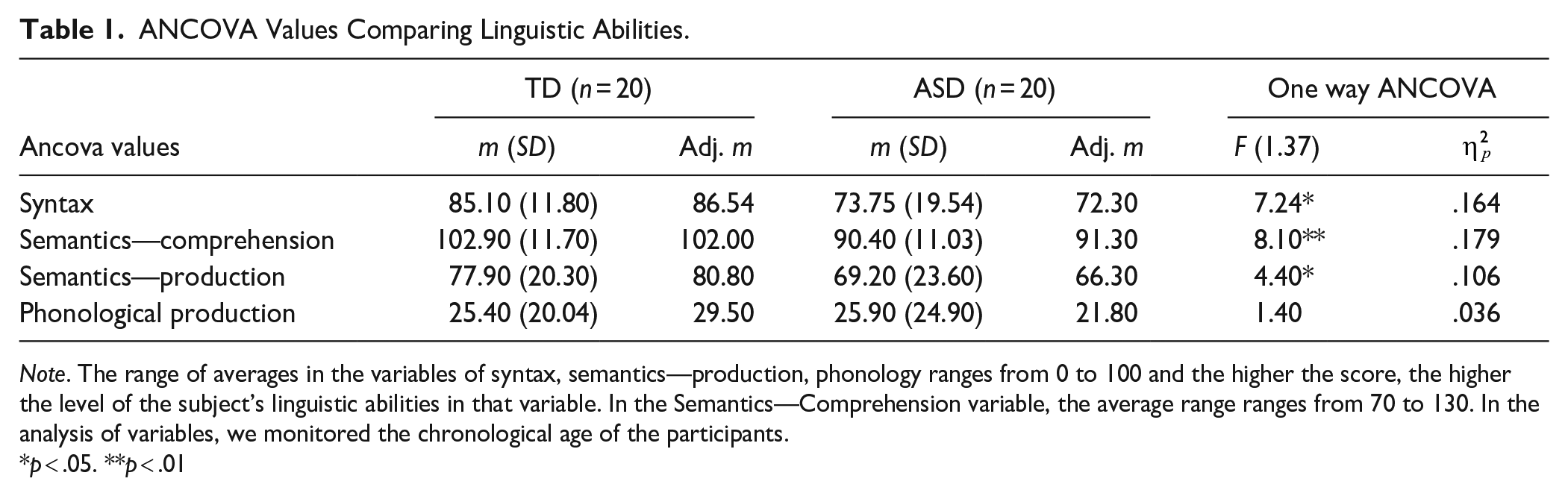
Note. The range of averages in the variables of syntax, semantics—production, phonology ranges from 0 to 100 and the higher the score, the higher the level of the subject’s linguistic abilities in that variable. In the Semantics—Comprehension variable, the average range ranges from 70 to 130. In the analysis of variables, we monitored the chronological age of the participants.
p < .05. **p < .01
Emerging Literacy Skills of Children with ASD Compared to Typically Developing Children
Our second research question aimed to explore differences in emerging literacy skills between children with ASD and typically developing children. A one-way analysis of covariance (ANCOVA) was employed for this investigation. Given the low and negative correlations among some emerging literacy measures, a multivariate analysis of covariance (MANCOVA) was deemed unsuitable, as outlined in Table 2. Notably, in the eight-task test, specifically task 2 (phonological awareness), 22 participants did not receive a score due to their failure to meet the required level established in task 1 (recognition and placement of letters).
ANCOVA Values Comparing Emerging Literacy Skills.
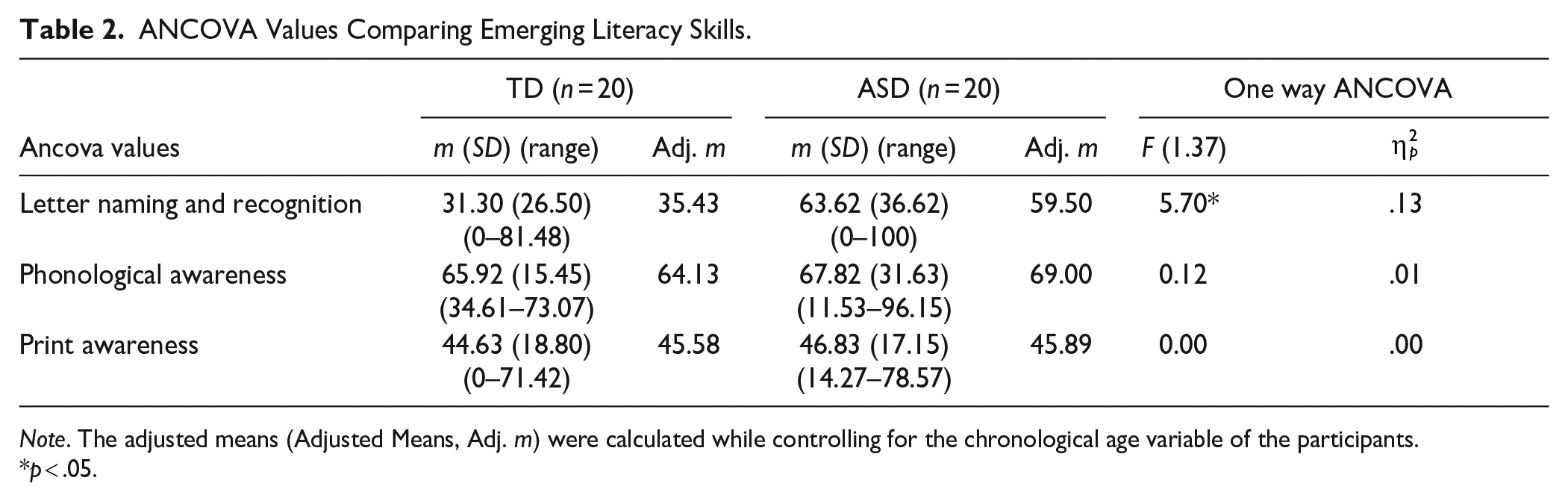
Note. The adjusted means (Adjusted Means, Adj. m) were calculated while controlling for the chronological age variable of the participants.
p < .05.
Upon examination of the one-way ANCOVA supervised analysis of variance results, as detailed in Table 2, a significant difference emerged between the study groups in one of the three emerging literacy variables, the “Letter naming and recognition” variable. The standardized means indicated that children with ASD exhibited significantly higher levels in letter naming and recognition skills compared to typically developing children. However, no significant differences were observed between the groups in the remaining variables. The effect size analysis, as determined by one-way ANCOVA, reveals notable differences between typically developing children and children with ASD. For letter naming and recognition, the ASD group demonstrated significantly higher scores, with a moderate effect size (
Individual Profiles
To address the significant variability observed in the language abilities and emerging literacy skills within the ASD group, we conducted a comprehensive analysis of individual profiles. Each research variable was compared with the TD group, establishing a performance threshold for impaired/typical performance as described in the methodology section. Based on this threshold, each participant’s performance was categorized as either equal to or impaired compared to the TD group. Given that most children in the ASD group scored low on the non-verbal IQ task (NVIQ) (n = 18), the profiles focus solely on language abilities and emerging literacy skills, excluding descriptive measure variables (see Supplemental Material).
Three primary profiles emerged: children who had TD equivalent scores in both linguistic abilities and emerging literacy skills, children with a mix of high and low scores across language and literacy measures, and children whose performance was generally on par with TD children except for a single impaired score. Many children in the second profile obtained low scores in the semantics-production variable (assessed using the Katzenberger test), suggesting difficulties in this specific area. Additionally, seven children in the second profile did not complete the phonological awareness task, indicating potential challenges or avoidance in this area. Although not statistically significant, it seemed that older children tended to have fewer low scores in language and emerging literacy skills, suggesting that as children with ASD grow older, their abilities in these areas may improve or stabilize. Notably, no child exhibited low scores across all variables, highlighting that every child had at least some areas of strength. These profiles highlight the heterogeneity within the ASD group, revealing different patterns of language abilities and emerging literacy skills.
Associations Between Language Variables and Emerging Literacy Measures
The third research question sought to explore the potential association between specific language variables (syntax, semantics, and phonological production) and the performance of children with ASD and typically developing children on emerging literacy measures. Table 3 presents a matrix of inter-correlations between these variables for the TD group. As expected, numerous correlations were observed between all language variables, indicating strong connections among them. This suggests that children with typical development display a balanced profile of language abilities across all variables. In terms of emerging literacy skills, a significant correlation was found between letter naming and many language variables. The phonological production task was highly correlated with the letter naming task, while the print awareness task did not show a significant correlation with phonological production.
Correlations of Linguistic Versus Emerging Literacy Skills Variables for Children With TD.
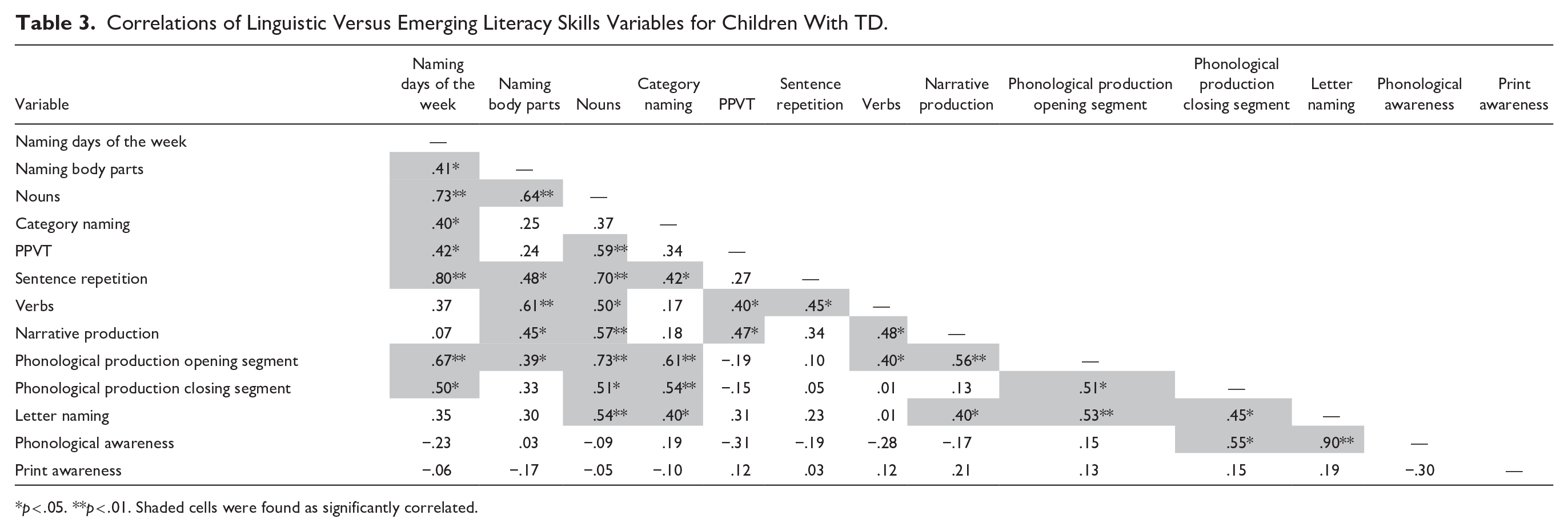
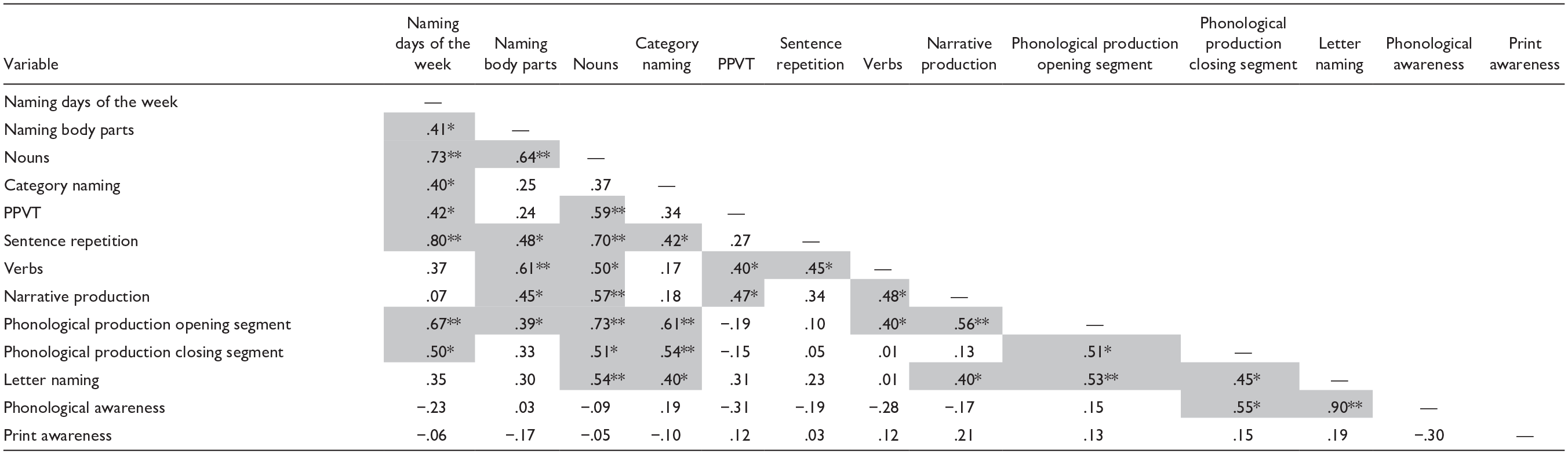
p < .05. **p < .01. Shaded cells were found as significantly correlated.
Table 4 presents the correlations for the ASD group. In this group, fewer correlations were observed between the language variables, indicating a less uniform performance across language abilities. For children with ASD, letter naming was found to be correlated with semantic variables (naming of weekdays and category naming), as well as with narrative production abilities and phonological production (opening segments). The phonological awareness from the eight task test was correlated only with the phonological production task of closing segments. Additionally, the print awareness task was correlated with narrative production abilities and noun naming abilities.
Correlations of Linguistic Versus Emerging Literacy Skills Variables for Children With ASD.
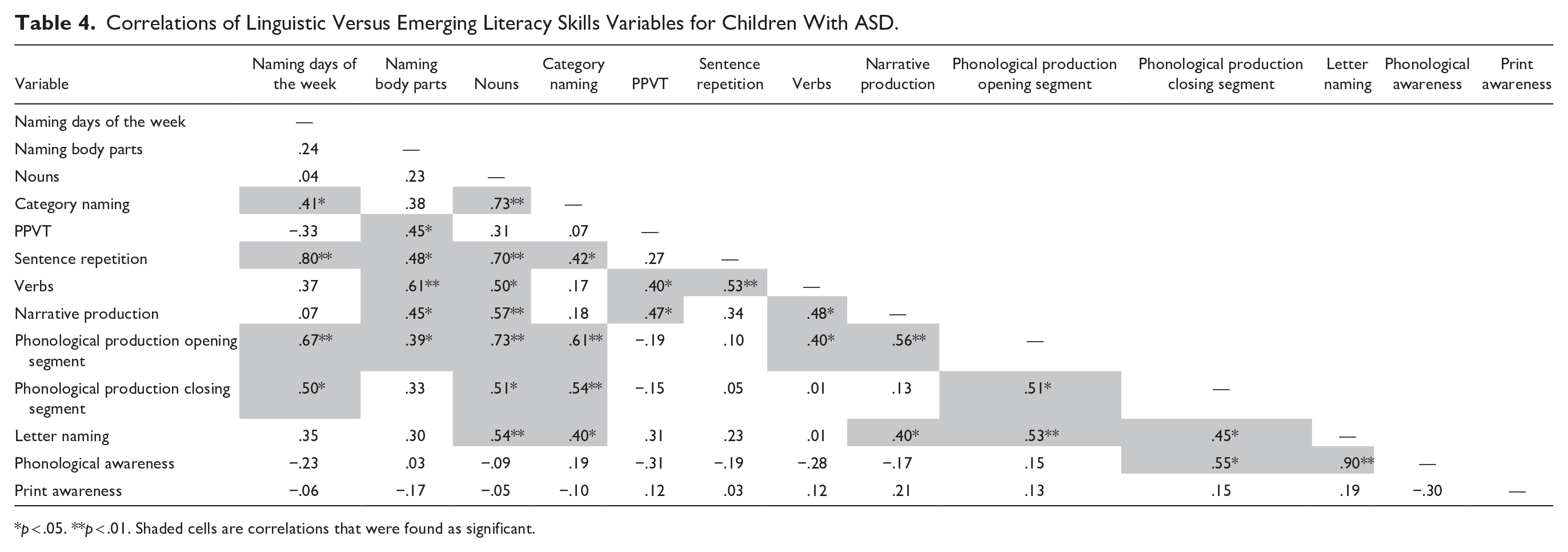
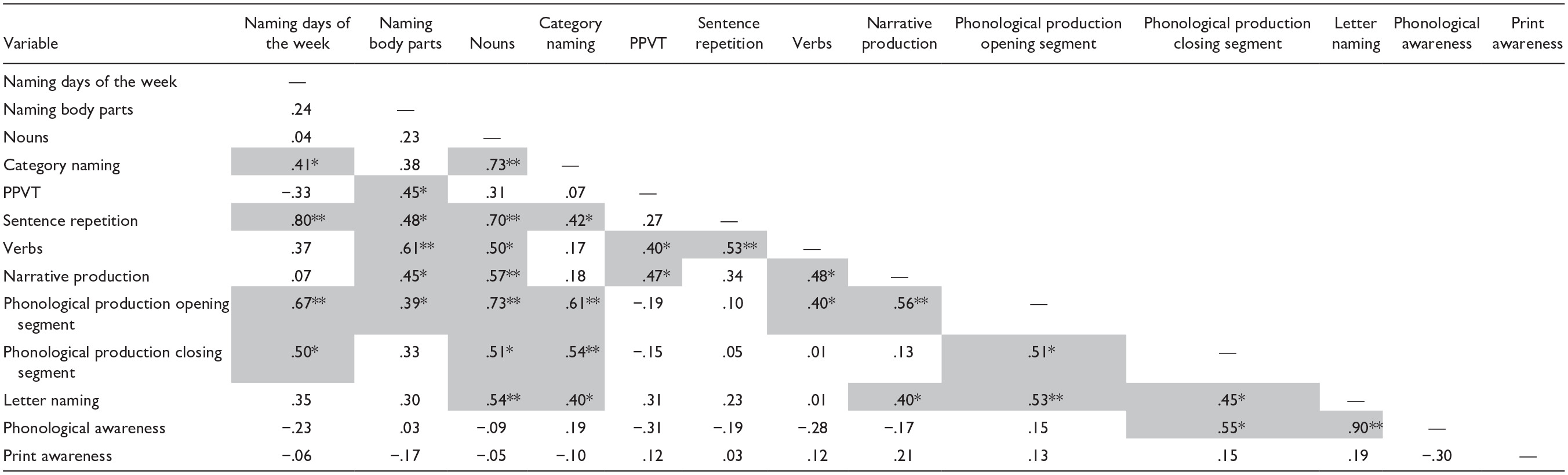
p < .05. **p < .01. Shaded cells are correlations that were found as significant.
Investigating the Role of Language Components in Explaining Variations in Emerging Literacy Skills
To test our third research hypothesis, we conducted multiple linear regression analyses on the scores of both the ASD and TD groups. The aim was to investigate the role of language components (syntax, semantics, and phonological production (opening segments and closing segments) in explaining variations in emerging literacy skills. Three models were used: Model A assessed recognizing and naming letters, Model B examined phonological awareness, and Model C focused on print awareness. We employed the Stepwise method, which includes only variables that significantly contribute to explaining the differences in emerging literacy skills. The variables were entered into the model in a specific order based on their distinct contributions at each step.
Results for the TD Group
Next, we present the results of the multiple linear regression analyses for the TD group, focusing on how language components predict variations in emerging literacy skills. Model A: This model tested if semantics, syntax, or phonological production (opening segments and closing segments) predicted recognizing and naming letters. The analysis found that phonological production (opening segments and closing segments) significantly predicted letter naming (β = .72, p < .05). The positive β-coefficient indicates that higher scores in phonological production (opening segments and closing segments) correspond to higher performance in letter naming. Semantics and syntax did not make significant unique contributions. Model B: This model examined phonological awareness as assessed by the eight task test. None of the language components significantly predicted phonological awareness. Model C: This model tested if semantics, syntax, or phonological production (opening segments and closing segments) predicted print awareness. None of the language components significantly predicted print awareness.
Results for the ASD Group
A similar analysis was conducted for the ASD group. Model A: This model tested if semantics, syntax, or phonological production (opening segments and closing segments) predicted recognizing and naming letters. The analysis showed that semantics significantly predicted letter naming (β = .77, p < .001). The positive β-coefficient indicates that higher scores in semantics correspond to higher performance in letter naming. Syntax and phonological production (opening segments and closing segments) did not make significant unique contributions. Model B: This model examined phonological awareness as assessed by the eight task test. None of the three language components (syntax, semantics, and phonological production (opening segments and closing segments) significantly predicted phonological awareness). Model C: This model tested if semantics, syntax, or phonology as assessed by the eight task test predicted print awareness. Syntax significantly predicted print awareness (β = .48, p < .05), accounting for 30% of the variance. The positive β-coefficient indicates that higher syntax scores correspond to better print awareness. Semantics and phonological production (opening segments and closing segments) did not significantly contribute to this outcome.
In summary, the third research question aimed to examine the extent to which language components (syntax, semantics, and phonological production, including opening and closing segments) account for the performance of children with ASD and TD in measures of emerging literacy skills. The findings revealed distinct patterns in how language components influence emerging literacy skills across the two groups.
Among children with ASD, semantics showed a significant positive association with letter naming, while syntax had a significant positive relationship with print awareness. However, phonological awareness was not explained by any of the language measures in this group. This suggests that children with ASD may rely more on semantics and syntax for certain literacy skills, while phonological productions play a less central role.
In contrast, among typically developing children, phonological production significantly predicted letter naming, indicating a stronger reliance on phonological processes for this skill. However, none of the language measures, including phonological production, significantly explained print awareness or phonological awareness in this group. This difference suggests that children with typical development and children with ASD rely on different language components to support their emerging literacy skills. Children with ASD appear to show a more variable or mixed reliance on language components, while typically developing children exhibit a pattern more strongly influenced by phonology for specific skills such as letter naming.
Discussion
The present study offers insights into the language abilities and emerging literacy skills of children with ASD, focusing on comparing language abilities, exploring emerging literacy skills, and examining the relationship between these skills in ASD and TD groups. Previous research has shown that children with ASD often have uneven language profiles, with specific strengths and weaknesses across different linguistic components (Schaeffer & Siekman, 2016; Sukenik & Friedmann, 2018). Our findings extend previous research by identifying specific associations between linguistic components and emerging literacy skills in children with ASD. Consistent with Davidson and Ellis Weismer (2014) and Dynia et al. (2014), semantics and syntax significantly influenced letter naming and print awareness in children with ASD, suggesting that targeted support in these areas could be beneficial. However, phonological production did not significantly relate to any language components in the ASD group, aligning with Lanter et al. (2012), suggesting that phonological awareness skills may develop differently or require different approaches in children with ASD. For typically developing children, our study confirms the strong link between phonological skills and letter naming, consistent with Frith and Snowling (1983) and Lonigan et al. (2009). The lack of significant correlations between other language measures and emerging literacy skills in the TD group suggests that phonological awareness skills are particularly crucial during early literacy development.
In terms of comparing language abilities between groups, significant disparities emerged between typically developing children and those with ASD, particularly in syntax and semantics. Despite being younger, TD children exhibited markedly higher proficiency levels compared to their ASD counterparts. This finding aligns with prior research highlighting challenges in specific linguistic areas for children with ASD, such as understanding and expressing personal pronouns and sentences with relative clauses (Novogrodsky, 2013; Perovic et al., 2013; Schaeffer & Siekman, 2016; Sukenik & Friedmann, 2018).
Interestingly, no significant difference was observed between the study groups in terms of phonological awareness. From our results it seems that phonological awareness was no more likely to be delayed or disordered in children with ASD than in their typically developing peers. This result corresponds with previous research suggesting phonological awareness may not present notable challenges for children with ASD (Jones & Schwartz, 2009). An alternative explanation for this finding could be attributed to task comprehension difficulties. The phonological production assessment involved the Katzenberger task, where participants identified and produced the initial and final sounds of presented pictures. Initially challenging for both groups, children gradually improved after a few examples. Additionally, task comprehension appeared to be related with participants’ age, with 5-year-olds demonstrating better understanding of task demands compared to 4-year-olds. Despite being older, children with ASD performed similarly to the TD group on the phonological production tasks, although substantial variability made definitive conclusions challenging. It should be noted that both groups achieved low scores in the phonological production assessments with very high SD’s.
Regarding differences in emerging literacy skills, a significant difference was found in letter identification and naming, with children with ASD showing higher proficiency in this area. This aligns with previous research consistently identifying letter recognition as a strength for children with ASD (Lanter et al., 2012; Westerveld et al., 2017). However, no significant differences were observed in phonological awareness as assessed by the eight task test and print awareness between the two groups, potentially due to task sensitivity issues or similar exposure to reading interventions.
The current study examined the relationship between language abilities and emerging literacy skills, revealing different pathways for children with ASD and typically developing children. In children with ASD, semantics was found to significantly influence letter naming, whereas TD children demonstrated a strong association between phonological production and letter naming, with no significant link to semantics. These findings underscore the unique nature of emerging literacy development in children with ASD, suggesting that their literacy acquisition relies on specific linguistic skills that differ from those utilized by TD children. Consistent with prior research, our findings affirm the strong connection between phonological abilities and letter naming in TD children (McLachlan & Arrow, 2014; Suortti & Lipponen, 2016; Yampratoom et al., 2017), supporting the effectiveness of phonetic learning approaches for literacy development in this group (Ehri et al., 2001; Gray et al., 2014). However, for children with ASD, these results indicate that the common phonetic approach may be less effective, as their literacy acquisition appears to rely more on letter naming skills, that is, naming letters similar to naming objects. This could contribute to the high rates of reading difficulties observed in children with ASD (Whalon, 2018; Wei et al., 2015). Future research is needed to further elucidate these processes and to develop tailored approaches to literacy instruction for children with ASD.
Another notable difference between the groups emerged in the print awareness variable. In the TD group, none of the tested linguistic variables (semantics, syntax, or phonological production) were found to be related to print awareness. However, in the ASD group, a significant positive association was identified between syntax and print awareness. This finding aligns with prior research, which has consistently identified syntax as a challenging area for children with ASD, often tied to difficulties in social comprehension abilities (Lind & Bowler, 2009; Milligan et al., 2007). A possible explanation is that children with lower social comprehension abilities may gravitate toward books with simpler text, limiting their exposure to complex syntactic structures and thereby reinforcing syntactic deficits. Furthermore, book exposure for children with ASD is often mediated by the quality and frequency of social interactions during shared reading (Boyle et al., 2019; D’Agostino et al., 2020; Fleury & Ford, 2021). For instance, children who experience interactive discussions, social imitation, and reciprocal exchanges about the content of a book may have more opportunities to internalize syntactic structures, enriching their linguistic repertoire and enhancing their print awareness skills. The social context of literacy acquisition is particularly critical for children with ASD, who may benefit less from passive exposure to books and more from explicit, socially engaging experiences (Fleury et al., 2021; Tipton et al., 2017). Shared reading activities that involve guided conversations, joint attention, and scaffolded discussions not only support language acquisition but also foster broader cognitive and social skills (Sénéchal & Young, 2008). For example, parents or educators who actively model syntactic structures and encourage children to ask questions or make comments during reading can create an environment that simultaneously promotes social communication and literacy development. These findings suggest that literacy development in children with ASD is shaped by the interplay between linguistic and social factors. Increasing the frequency and quality of socially mediated reading experiences could improve not only syntactic abilities but also print awareness and other foundational literacy skills. This aligns with the NELP’s (2008) research, which highlights the multifaceted relationship between language abilities and literacy, emphasizing the importance of vocabulary, syntactic knowledge, and interactive learning environments (Boudreau & Hedberg, 1999; Dickinson, 2001; Whitehurst & Lonigan, 1998).
Individual profile analysis revealed three distinct profiles, emphasizing the limitations of group results in capturing language abilities in children with ASD. Notably, younger children tended to exhibit mixed profiles, indicating potential improvement with age. These three profiles align with the findings of Davidson and Ellis Weismer (2014), who identified four profiles characterizing the relationship between language skills (semantics and phonological awareness) and emerging literacy skills (print awareness) in kindergarten-aged children with ASD. The fact that no child was found to exhibit low scores on all areas tested suggests that at least in this specific group of children, they all had the ability to acquire language and emerging literacy skills.
Study Limitations and Future Directions
COVID-19 restrictions impacted participant recruitment, resulting in a smaller, less diverse sample size, an age gap between groups, and logistical challenges in data collection. Additional preschools were recruited, and individual recruitment efforts were intensified, but the findings remain preliminary. Future research needs larger, more balanced samples to confirm these results. Participants came from both regular and special education schools, potentially affecting generalizability. The small sample size (20 with ASD, 20 TD) limits the robustness of the findings. Future studies should control for educational settings and use larger samples to test the influence of different settings. SCQ and Vineland scores were not controlled in this study, as they reflect the core deficits inherent to autism and were used to describe the participants. Controlling for these variables would diminish their diagnostic relevance, and the differences observed are consistent with the typical deficits seen in ASD. In this study, we included the PPVT as a descriptive measure; however, future research should also control for expressive language abilities, as these factors may serve as indicators of overall language competence, potentially influencing the development of other cognitive skills, such as emerging literacy. Furthermore, significant variation among participants with ASD was noted, likely due to the absence of a language threshold for participation. Another limitation pertains to the print awareness task developed specifically for this study. The task aimed to assess various components (ten in total) of pre-reading skills, with participants asked to “read” a book of their choice to the researcher. While the coding of data was conducted objectively, the task included a relatively small number of items, limiting its overall impact. Additionally, some children with ASD found the requirement to “read” the book challenging, as they did not fully grasp the concept of reading. It is worth noting that this particular aspect has received limited research attention thus far. Future research could focus on several key areas to build on and address these challenges. One direction for future research could involve developing and validating a more comprehensive and robust assessment tool for print awareness that includes a larger number of items and a broader range of pre-reading skills. This would provide a more detailed and accurate measure of print awareness in children with ASD. Additionally, future research could explore alternative methods of assessing print awareness that are more accessible and understandable for children with ASD. For example, using interactive or digital storybooks might help children engage more naturally with the task and better demonstrate their pre-reading skills. Further studies could also investigate the specific challenges children with ASD face in understanding the concept of reading and how these challenges affect their performance on print awareness assessments. This could involve qualitative research, such as interviews or observational studies, to gain deeper insights into their experiences and difficulties.
Although our study focused on Hebrew-speaking children with and without ASD, we did not include an in-depth morphological task that could have captured differences arising from Hebrew’s unique root-based morphology. Despite this limitation, our findings align with previous studies in other languages, suggesting broadly consistent patterns in the relationship between language components and emerging literacy skills. Future research should explore Hebrew’s unique properties, such as its rich morphology, to better understand their role in language and literacy development in children with ASD and typically developing peers.
Future research should implement rigorous sampling strategies, recruit larger and more diverse samples, refine assessment strategies, and incorporate comprehensive language assessments to better understand the connections between language abilities and emerging literacy skills.
In conclusion, this study provides insights into the language abilities and emerging literacy skills of Hebrew-speaking preschoolers with ASD. The main findings indicate significant differences between children with ASD and their typically developing peers, particularly in areas such as syntax, semantics, phonological abilities, and print awareness. Despite the challenges posed by the COVID-19 pandemic, including recruitment difficulties and logistical constraints, the research highlights the importance of early identification and targeted interventions to support literacy development in children with ASD. Although the results are preliminary, they lay a foundation for future research with larger, more diverse samples to validate these findings and explore the impact of different language abilities on literacy outcomes.
Supplemental Material
sj-docx-1-tec-10.1177_02711214251319734 – Supplemental material for Exploring Language Abilities and Emerging Literacy in Hebrew-Speaking Preschoolers with ASD: A Pilot Study
Supplemental material, sj-docx-1-tec-10.1177_02711214251319734 for Exploring Language Abilities and Emerging Literacy in Hebrew-Speaking Preschoolers with ASD: A Pilot Study by Shira Oren and Nufar Sukenik in Topics in Early Childhood Special Education
Footnotes
Declaration of Conflicting Interests
The author(s) declared no potential conflicts of interest with respect to the research, authorship, and/or publication of this article.
Funding
The author(s) received no financial support for the research, authorship, and/or publication of this article.

References
Supplementary Material
Please find the following supplemental material available below.
For Open Access articles published under a Creative Commons License, all supplemental material carries the same license as the article it is associated with.
For non-Open Access articles published, all supplemental material carries a non-exclusive license, and permission requests for re-use of supplemental material or any part of supplemental material shall be sent directly to the copyright owner as specified in the copyright notice associated with the article.
