




Abstract
Interventions to support autistic children are often described as developmental, behavioral, or naturalistic developmental behavioral interventions; however, developmental approaches have not been well defined as a class of therapeutic intervention. We present the position of an interdisciplinary group of researchers and clinicians regarding the common features of developmental interventions. The term Developmental Relationship-Based Interventions (DRBI) is proposed as a useful way to represent this classification of interventions. The defining features of DRBI are: (a) a developmental framework based on a child’s innate motivation for social engagement and learning, and (b) a primary focus on supporting parent-child and other social interactions and relationships. Four strategies consistently used in DRBI are: Social Play, Sensitive Responding, Following the Child’s Lead, and Presenting Challenges. We also describe the features that differentiate DRBI from Naturalistic Developmental Behavioral Interventions (NDBI). The proposed description of DRBI may aid clinical decision-making, policy formation and research design.
Keywords
Introduction
Historically, interventions to support autistic children were often classified as either developmental or behavioral. However, in 2015, the term Naturalistic Developmental Behavioral Interventions (NDBI) was introduced as a further classification for interventions based on behavioral principles that also incorporate developmental concepts (Schreibman et al., 2015). Since the introduction of NDBI, the term has been widely adopted and has been used to classify intervention approaches within reviews (Binns & Oram Cardy, 2019; Trembath et al., 2023) and a meta-analysis (Sandbank et al., 2020). In contrast, developmental interventions are identified less consistently. For example, developmental approaches have been included in categories of Naturalistic Interventions (Hume et al., 2021), Developmental Social Pragmatic approaches (Binns & Oram Cardy, 2019), Parent Implemented Interventions (Cheng et al., 2023; Deb et al., 2020; Hume et al., 2021), and Play-based Interventions (Dijkstra-de Neijs et al., 2023; Francis et al., 2022).
As developmental interventions accrue evidence of effectiveness (Binns & Oram Cardy, 2019; Deb et al., 2020; Dijkstra-de Neijs et al., 2023; Francis et al., 2022; Hume et al., 2021; Sandbank et al., 2020; Trembath et al., 2023), clarification of their defining characteristics is needed. We propose the term Developmental Relationship-Based Interventions (DRBI) to best represent this class of interventions. The consistent application of the term DRBI would clarify distinctions for research, policy making, and clinical decisions. In the following sections we will explore the defining characteristics of DRBI and the factors that distinguish them from NDBI.
Methodology
Recognizing a need for a common understanding of the term developmental intervention, a diverse group of researchers and clinicians was recruited from across four countries from the disciplines of pediatrics, psychiatry, psychology, marriage and family therapy, speech and language pathology, and special education to develop a position paper regarding the defining characteristics of developmental intervention and the features that distinguish developmental intervention from NDBI. The group evolved organically to include those with interest, experience and expertise in DRBI. Because of distant locations and time zones, the group collaborated primarily through electronic mail. These exchanges explored the history of developmental theory and the evolution of developmental approaches for autistic children, to identify their priorities, philosophies, methodologies, and goals. The group considered similarities and differences between developmental, behavioral and NDBI approaches. After multiple interchanges, the group generated this position paper regarding the defining and distinguishing features of DRBI. Further analysis of the developmental intervention literature resulted in the identification of four common strategic elements. Five intervention approaches for young children, each with a research base, were chosen to illustrate the core features of DRBI.
Defining Features of Developmental Relationship-Based Interventions
Two defining features of DRBI were identified. The first is the use of a developmental framework that promotes the child’s internal motivation for social engagement and learning (in contrast to operant learning theory). The second is a focus on relationships by empowering parents to understand their child’s individual differences and to create mutually enjoyable interactions that support the child’s initiative, creativity, and learning. (Please note that we use the term parents to refer to the child’s primary caregivers; however, the strategies of DRBI are also applied to broader relationships, such as other family members, peers, teachers, care providers, therapists, etc.).
A Developmental Framework
The word develop is derived from a 17th century French word that means unfolding. From a developmental perspective, the process of growth is seen as a largely spontaneous process of unfolding, revealing increasingly advanced developmental phases of an individual with an intrinsic incentive to connect with others, explore, communicate, and learn. The developmental approach is influenced by the work of Piaget, who viewed the child as an active learner with an innate drive to explore, experiment and acquire new information (Piaget & Inhelder, 2008). DRBI also draw from infant studies, particularly attachment theory, which holds the view that children have an innate drive to form emotional bonds with caregivers (Bretherton, 1992). Vygotsky is also a contributing influence, including his recognition of the importance of play (Vygotsky, 1976) and the concept that child development advances through psychological stages as a consequence of both a child’s actively selecting what is of interest to them and their social interactions (Chaiklin, 2003).
Innate motivation has been defined as “the inherent tendency to seek out novelty and challenges, to extend and exercise one’s capacities, to explore, and to learn” (Ryan & Deci 2000, p. 70). Deci and Ryan (2000) describe intrinsic motivation as sustained and enhanced by innate psychological needs for competence, autonomy (volition), and relatedness. The concept of inherent motivation aligns with the neurobiological concept that the infant generates an instinctual urge to actively engage with the world in affective ways (Shultz et al., 2018; Trevarthen & Delafield-Butt, 2013; Wright & Panksepp, 2012).
The developmental premise is that autistic children have an inherent desire to engage socially, although the expression of that desire may be influenced by neurologic individual differences. Evidence is accumulating regarding the breadth of social motivation present in autistic individuals, including the need and interest in trusting relationships, social connection, and acceptance (Botha et al., 2022; Jaswal & Akhtar, 2019; Livingston et al., 2019; Mazurek, 2014; Milton, 2014; Murray et al., 2023). The developmental approach considers how neurologic differences, present from infancy in autistic children, may impact developmental trajectories with cascading effects on social interactions and learning (Constantino, 2019; Estes et al., 2015; Green, 2022; Greenspan, 2001; Klin et al., 2020; Proff et al., 2022; Robertson & Baron-Cohen, 2017; Shultz et al., 2018; Trevarthen & Delafield-Butt, 2013). Greenspan (1992) and Greenspan and Wieder (2006) pioneered an appreciation of individual differences in sensory-motor and sensory-affective processing and their effects on development. Sensory and motor differences are pervasive in autistic children and are associated with core features of autism (Ausderau et al., 2014; Daniel et al., 2022; Ketcheson et al., 2021; Schaaf, Mailloux, et al., 2022; Zampella et al., 2021). Within DRBI, parents are supported to understand a child’s unique individual differences and encouraged to appreciate the child’s efforts to engage in exploration, connection, and creativity (Greenspan & Wieder, 2006; Schertz, Lester, et al., 2020; Schertz, Odom, et al., 2018; Solomon et al., 2014).
In summary, the developmental framework envisions child development as a process of iterative transformations, emanating from the child’s inherent impetus to explore, experiment and engage in increasingly complex social interactions. DRBI seek to optimize outcomes for autistic children through the support of interactions that recognize a child’s innate motivations as well as their constitutional differences.
A Focus on Relationships
DRBI are designed to build on parents’ insight and knowledge of their child, bolster their confidence, and facilitate the achievement of increasingly complex and rich interactions (Alquraini et al., 2018; Green et al., 2010; Schertz, Odom, et al., 2018; Solomon et al., 2014; Whitehouse et al., 2021). The developmental premise is that by supporting interactions and relationships between parent and child, the child’s inherent capacities for engagement and interaction can flourish, leading to broad developmental advances (Greenspan, 1992). Responsive Teaching (RT), for example, is based on a theoretical model described by G. Mahoney et al. (2007) which holds that as parents learn to interact more responsively, they encourage their child’s use of pivotal behaviors including attention, persistence, interest, cooperation, initiation, joint attention, and affect, and in turn, these support developmental learning. Karaaslan and Mahoney (2015) state: RT . . . encourages parents to use RI [responsive interaction] strategies to promote dimensions of engagement related to children’s cognitive (i.e., social play, initiation, exploration, practice, problem solving), communication (i.e., joint activity, joint attention, intentionality, vocalization, conversation), and social emotional functioning (i.e., trust, empathy, cooperation, self-regulation, feeling of competence). (p. 287)
DRBI recognize and encourage the parent-child dyad’s individual styles of interaction (Green et al., 2010, 2017) and support parents’ confidence and creativity (Leadbitter et al., 2020; Liao et al., 2014; Schertz, Liu, et al., 2022). As described by Green et al. (2010), “The intervention proceeds on a partnership basis, building on the parents’ skills and promoting parents’ individual resourcefulness. Parental independence, decision making, and self-belief is emphasised throughout the programme.” (p. 3 in Appendix).
Theoretical Distinctions Between DRBI and NDBI
While NDBI and DRBI share some features, fundamental distinctions exist in their theoretical frameworks and the resulting implementation strategies. NDBI are based on behavioral principles while incorporating selected developmental concepts (Bruinsma & Gengoux, 2020; Frost, Ingersoll, et al., 2020; Gengoux et al., 2020; Schreibman et al., 2015; Schreibman, Jobin, et al., 2020). The behavioral framework is based on the premise that behaviors are controlled by environmental events, that is, antecedents and consequences, and through manipulation of these factors, behaviors can be changed (Schreibman, Jobin, et al., 2020). NDBI use the antecedent-behavior/response-consequence sequence (ABC) to teach targeted behaviors (Frost, Ingersoll, et al., 2020), that may include explicit teaching of social initiation, imitation and symbolic play (Bruinsma & Gengoux, 2020). As described by Schreibman, Dawson, et al. (2015) “All NDBIs require the systematic use of adult prompts to promote new skills and systematic delivery of contingent reinforcers” (p. 2419). In NDBI, learning opportunities or teaching episodes are embedded in play interactions and daily routines (Frost, Ingersoll, et al., 2020) and use natural contingent reinforcement or reward for desired behaviors, such as offering a tangible item related to the child’s interest and/or giving social praise (Jobin & Schreibman, 2020; Kasari et al., 2021; Minjarez & Bruinsma, 2020).
The developmental framework recognizes the impact of environmental events, but views behavior as largely determined by internal psychological forces such as an inherent motivation to explore and learn and the human desire to form social connections (Greenspan, 1975, 1979, 1992). DRBI specifically discourage the use of directive teaching strategies (Green et al., 2010; Schertz, Call-Cummings et al., 2018; Wolfberg & Woods, 2023), and instead prioritize pleasureable interactions, spontaneous exploration, and acceptance and expansion of the child’s ideas (Alquraini et al., 2018; Binns & Oram Cardy, 2019; Greenspan & Wieder, 2006; G. Mahoney & Solomon, 2016; Rahman et al., 2016; Schertz, Call-Cummings, et al., 2018; Schertz, Liu, et al., 2022; Whitehouse et al., 2021; Wolfberg & Woods, 2023). Schertz, Odom, et al. (2013, 2018) describe how Joint Attention Mediated Learning (JAML) discourages instrumental communication, which includes directive requests, commands, or instructions, and encourages social engagement that is socially motivated and has a playful nondirective quality. Karaaslan and Mahoney (2015) state, “Behavioral teaching strategies are inconsistent with the interactive qualities promoted by RI [Responsive Interaction] strategies.”
Examples of Developmental Intervention
Five examples of DRBI are provided in Table 1 and additional information about them is available in the Supplemental Materials. These examples represent a range of interventions, ages, length of intervention, etc. and do not represent an exhaustive list of all DRBI. The five DRBI models have been included in recent reviews (Binns & Oram Cardy, 2019; Steinbrenner et al., 2020; Trembath et al., 2023) and meta-analyses (Cheng et al., 2023; Sandbank et al., 2020). All have either self-identified as developmental or have prioritized social communication and interaction between the caregiver and child. Importantly, none describe behavioral learning theory as a contributing philosophy or directly use operant conditioning strategies.
Examples of DRBI for Autistic Children.
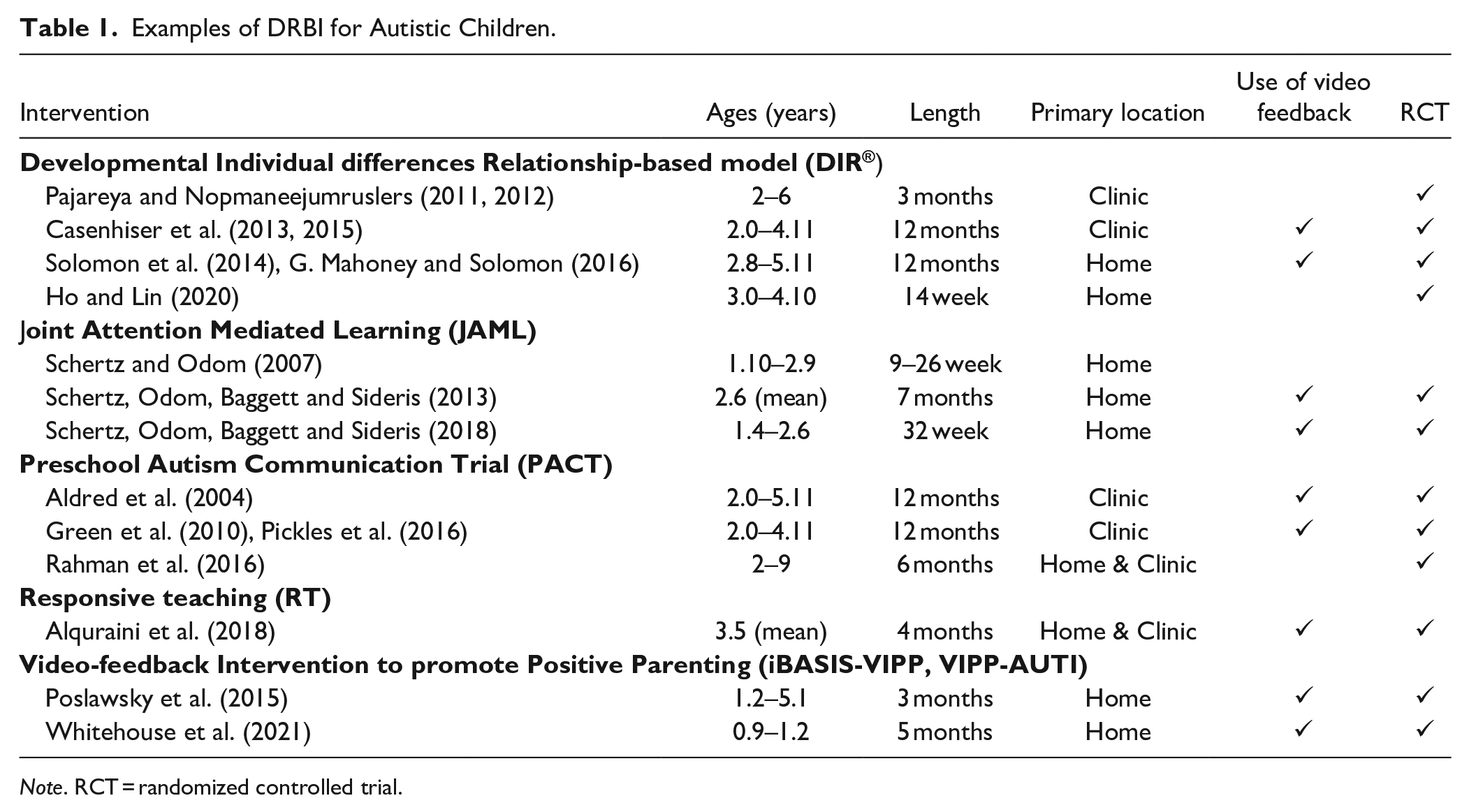
Note. RCT = randomized controlled trial.
DRBI Strategies
A review of the developmental intervention literature reveals the common use of core strategies that can be grouped into four categories: (a) Social play; (b) Sensitive responding, (c) Following the child’s lead, and (d) Presenting challenges.
Social Play
DRBI primarily take place in play interactions between the child and parent/s. The benefits of play have been widely studied and described (Colliver et al., 2022; Eberle, 2014; Wieder, 2017; Zosh et al., 2018). Play occurs along a spectrum of free play to adult-guided play (Wolfberg & Woods, 2023; Zosh et al., 2018). In guided play, an adult may arrange the play context while allowing the child to direct the play. For example, in JAML, interactions may begin with face-to-face back-and-forth games that encourage shared attention or reciprocal exchange such as play with bubbles or water play. Games, such as “Ready, set, go!” and Hide-and-seek create opportunities for the child to initiate and extend exciting reciprocal interactions. The variety of play is unlimited as parents apply their own creativity in following their child’s cues and interests (Schertz, Liu, et al., 2022). Social play also occurs at higher levels of representational and symbolic play. As the adult and child co-create playful interactions, discover each other’s unique ways of interacting, and form expectant patterns of shared enjoyment and engagement, developmental progress occurs in social, language, and cognitive domains (Alquraini et al., 2018; Green et al., 2010; Greenspan & Wieder, 2006; Schertz, Liu, et al., 2022).
Sensitive Responding
DRBI support parents to use sensitive responding to achieve engagement and reciprocity. DRBI guide parents to carefully observe and interpret their child’s subtle cues, attribute interest and intention to their child’s focus of attention and respond in a manner that expresses acceptance and understanding or creates shared meaning. These parental capacities have been defined, operationalized and measured in various studies (Green et al., 2010; G. Mahoney & Perales, n.d; Schertz, Odom, et al., 2018; Solomon et al., 2014; Whitehouse et al., 2021).
Some DRBI (e.g., Developmental Individual differences Relationship-based approach, also known as Floortime [DIR], Responsive Teaching [RT], iBASIS-Video Interaction to promote Positive Parenting [iBASIS-VIPP]) emphasize affective attunement in which parents are encouraged to assume the perspective of the child by using their own feelings and intuition to empathize with the child’s emotions (Greenspan & Wieder, 2006; G. Mahoney & Perales, n.d.; Poslawsky et al., 2015; Whitehouse et al., 2021; Wieder & Greenspan, 2003). As described for iBASIS-VIPP: The observations . . . are discussed in depth with a focus on the attribution of intentionality to the infant. The purpose is to reinforce parental empathy with the infant’s affect state as this forms the basis of a sensitive contingent response. (Whitehouse et al., 2021, Supplement 2, eMethods 1)
Reciprocity in two-way communication is promoted as caregivers respond to the child’s subtle cues and intent (Green et al., 2010; G. Mahoney & Nam, 2011; G. Mahoney & Solomon, 2016; Schertz, Odom, et al., 2018; Solomon et al., 2014; Whitehouse et al., 2021).
Following the Child’s Lead
In DRBI, following the child’s lead means joining the child’s current interest or intent (Dunst et al., 2012; Greenspan & Wieder, 1999; G. Mahoney et al., 2006; Whitehouse et al., 2021). The adult helps the child to do what they want to do and supports their intent. Following the child’s lead reflects the adult’s respect and acceptance of the child’s ideas including the full range of positive and negative feelings (Gerber, 2017; Gernsbacher, 2006; G. Mahoney & Perales, n.d.; Poslawsky et al., 2015; Schertz, Lester, et al., 2020). DRBI emphasize the individualized nature of the child’s preferences, special interests, and talents (Binns & Oram Cardy, 2019; Casenhiser et al., 2013; Greenspan & Wieder, 2006; Wieder, 2017; Wolfberg & Woods, 2023). Underlying individual sensory-motor and affective influences are continuously appreciated and addressed to support development (Greenspan & Wieder, 2006; Schaaf, Benevides, et al., 2014; Schaaf, Mailloux, et al., 2022).
Presenting Challenges
In DRBI the adult presents challenges to expand the scope of play and interactions (Green et al., 2010, 2017; Karaaslan & Mahoney, 2015; Schertz, Odom, et al., 2018; Solomon et al., 2014). Building on the child’s lead, the parent encourages the child to delve deeper into their idea or intent. By playfully introducing surprises, problems to solve, questions, or other actions, the child is presented with opportunities to extend their play idea and thus build their cognitive, sensori-motor, communicative, and affective competencies in a fun interaction.
A challenge might be to heighten affect, such as when the play or interaction involves surprising and exciting events like knocking down a tower of blocks: the adult may increase the drama by helping to make a higher tower, thereby increasing anticipation and suspense and encouraging a mutually enjoyable sustained interaction through higher levels of excitement. Or, if a child is lining up cars, the adult might offer more cars or help to arrange them as the child wishes (in reciprocal give-and-take), and then, playfully insert a non-matching vehicle or add a ramp or tunnel. The adult might then join in the child’s efforts to solve the problem, trying different solutions. The goal is to sustain a shared problem-solving interaction, with a rich array of co-regulation and communication, building from the child’s intent. The adult might challenge the child to move into symbolic thinking by animating a car to zoom away, or say, “I want to be first!” or by asking a question, “Where are we going?” If the child expresses fear toward a pretend animal (or storm, or other idea), the adult might gradually (and playfully) make the animal more threatening, intensifying their idea, and then perhaps join the child in hiding. By accepting, encouraging and joining with the child’s ideas, the interaction continues fluidly and spontaneously.
DRBI emphasize warm engagement and playfulness even as challenges are introduced. The developmental priority is to honor the child’s response, especially as children grapple with strong emotions and attempt to discover their own solutions (Wieder, 2017). The adult may modulate the intensity of the play or interaction to allow the child time to regulate and formulate their response, providing support as needed so that the child does not become overwhelmed (G. Mahoney & Perales, n.d.). DRBI aim to promote secure attachment by providing a safe base during times and of stress (Salman, 2016) since secure attachment relationships encourage exploration and more advanced play and thinking (Naber et al., 2008).
Similarities and Differences Between DRBI and NDBI
NDBI integrate developmental concepts resulting in areas of similarity between NDBI and DRBI. For example, NDBI, like DRBI, focus on developmentally sequential goals and prerequisites for later development such as joint attention and early communication (Gengoux et al., 2020; Kasari et al., 2021; Schreibman, Jobin et al., 2020). Similar strategies include sensory social and object play routines, imitating the child, consistent responses to the child’s cues, pauses and waiting, and shared turn taking (Bruinsma & Gengoux, 2020; Minjarez & Bruinsma, 2020). The principal distinction is that NDBI use behavioral strategies such as modeling, prompting and praise to elicit and reinforce desired behaviors (Bruinsma & Gengoux, 2020; Frost, Ingersoll, et al., 2020) and embed adult-directed teaching episodes into interactions (Jobin & Schreibman, 2020), whereas progress in DRBI is derived from building on the child’s intent, to form increasingly complex social interactions without reliance on prompting or reinforcement of specific behaviors.
Both NDBI and DRBI use a strategy of following the child’s lead. In both, this strategy supports initiative, motivation, and elaboration of the child’s play ideas. In DRBI, following the child’s lead means to interpret the child’s interest and intent and then join this interest, encouraging them to pursue and expand their ideas in sustained reciprocal interactions (Greenspan & Wieder, 2006; G. Mahoney & Perales, n.d., Wolfberg & Woods, 2023). In NDBI, following the child’s lead may be used to reward a preferred behavior or as an opportunity to embed a teaching episode within the context of the child’s interest (Kasari et al., 2021; Minjarez & Bruinsma, 2020; Schreibman, Jobin, et al., 2020).
Challenging the child to expand and extend their ideas is a key feature of DRBI. NDBI also address expanding play, but there are meaningful differences. In DRBI, the adult seeks to amplify the child’s intent and thus encourage the child’s creativity and problem solving. NDBI expands play by modeling appropriate behaviors or target skills (Jobin & Schreibman, 2020) or by introducing novel actions to sustain motivation or increase initiations (Bruinsma & Gengoux, 2020).
Although there are similarities between NDBI and DRBI regarding the role of parents, there are also distinguishing elements. In both, parents magnify the intensity of intervention as strategies are implemented during personal interactions, play and daily activities (Kasari et al., 2021; Minjarez, Karp, et al., 2020; Schreibman, Jobin, et al., 2020). NDBI promotes the use positive affect and animation adjusted to the child’s level of arousal to enhance social engagement (Frost, Brian, et al., 2020; Minjarez & Bruinsma, 2020; Schreibman, Jobin, et al., 2020). DRBI also endorse parents’ expressions of enjoyment, surprise and enthusiasm (Casenhiser et al., 2013; Greenspan & Wieder, 2006; G. Mahoney & Perales, n.d.; Schertz, Call-Cummings, et al., 2018). Unique to NDBI, using strategies to establish relationships and improve engagement is considered an antecedent to teaching episodes and to increase the effectiveness of social consequences (Minjarez & Bruinsma, 2020; Symon et al., 2020).
The critical differences between the perspectives of NDBI and DRBI affect priorities of intervention: for example, in NDBI there is a priority on teaching imitation (Bruinsma & Gengoux, 2020), compliance (instructional cues that evoke correct responses) (Frost, Ingersoll et al., 2020), strengthening desired behaviors (Bruinsma & Gengoux, 2020; Jobin & Schreibman, 2020) and skill building (Bruinsma & Gengoux, 2020; Gengoux et al., 2020), while DRBI instead emphasize mutual enjoyment and fostering sustained and creative playful interactions (Alquraini et al., 2018; Green et al., 2010; Greenspan & Wieder, 2006; G. Mahoney & Perales, n.d.). Through these DRBI interactions, in which the relationship itself provides validation and encouragement for initiative, exploration and problem-solving, children acquire and generalize concepts and competencies that are taught in a more structured way in NDBI (Casenhiser et al., 2015; Green et al., 2010, 2017; Whitehouse et al., 2021).
DRBI Outcomes
A complete analysis of the goals and outcomes of DRBI is beyond the scope of this paper; however, a body of research using valid and reliable outcome measures demonstrates the effectiveness of various DRBI to address the core features of autism. Aims of DRBI are variously framed as social development (Alquraini et al., 2018), social communication (Green et al., 2010; Schertz, Odom, et al., 2018), and/or parent-child interaction (Solomon et al., 2014; Whitehouse et al., 2021). Standardized instruments include measures of autism symptoms, social interaction and social-emotional reciprocity (Green et al., 2010; Solomon et al., 2014; Whitehouse et al., 2021). Other empirical findings include observational measures of shared attention and child initiation (Green et al., 2010; Karaaslan et al., 2013; Schertz, Odom, et al., 2018; Solomon et al., 2014).
Some DRBI studies evaluate functional outcomes across developmental domains, including language, adaptive skills, and early learning (Alquraini et al., 2018; Casenhiser et al., 2015; Green et al., 2010, 2017; Whitehouse et al., 2021). Studies of the DIR model often use a measure of functional emotional development (Greenspan et al., 2001) that rates the developmental capacities for engagement, reciprocal interactions, co-regulated interactions, and symbolic thinking (Pajareya & Nopmaneejumruslers, 2011, 2012; Solomon et al., 2014).
Since DRBI are enacted through and with parents, various instruments are used to measure parental experience, including parental sensitivity and responsiveness (Green et al., 2010; Karaaslan & Mahoney, 2015; Schertz, Liu, et al., 2022; Solomon et al., 2014; Whitehouse et al., 2021), parental experiences of stress and depression (G. J. Mahoney & Solomon, 2020), and self-reports of competence, confidence, and self-efficacy (Liao et al., 2014; Poslawsky et al., 2015; Schertz, Lester, et al., 2020).
Importantly, mediation analyses report the relationship between the degree to which parents modify their interactions in a manner consistent with the intervention model and improvements in children’s autism symptoms (G. Mahoney & Solomon, 2016) as well as their communication and social functioning levels (Aldred et al., 2012; Carruthers et al., 2024; Karaaslan & Mahoney, 2015; Schertz, Liu et al., 2022). Two studies report long-term outcomes after short term intervention (Pickles et al., 2016; Whitehouse et al., 2021), and one study describes examples of long-term outcomes after extensive DRBI in childhood (Greenspan & Wieder, 2005).
Conclusion
This paper addresses a current gap in the literature regarding the meaning of developmental intervention. Through a collaborative process a group of experienced researchers and clinicians have described the defining features of developmental interventions and propose the term DRBI to represent this class of interventions. DRBI is based on the concept that development emanates from a child’s internal motivation to explore, discover and connect with others, and that developmental transformations evolve spontaneously during sensitively attuned, pleasurable and responsive interactions with trusted caregivers. DRBI aim to magnify the developmental process common to all children and help the autistic child overcome the neurologic differences that may impede their inherent drive for learning and connection. In DRBI, parents engage in playful interactions, following the child’s intent and then challenging the child to extend their ideas and abilities. Developmental progress has been documented in DRBI using objective empirical measures, especially in social development and social communication, key areas of concern for autistic children.
In addition, we describe the factors that distinguish DRBI from NDBI. While NDBI incorporate some developmental concepts, there are important differences in both theory and practice. The primary distinction is that NDBI are based on operant behavioral theory and use instruction and behavioral strategies such as prompts and praise to elicit and reinforce desired behaviors. This orientation results in significant differences in both implementation strategies and priorities of intervention.
The field is encouraged to recognize the unique features of DRBI and adopt the three classifications of DRBI, NDBI, and Behavioral Interventions when presenting and reviewing studies. The consistent use of the category of DRBI will facilitate identification of interventions with these defining characteristics and promote research to further evaluate their effectiveness. In addition, identification of an intervention as DRBI will encourage dialogue regarding the similarities and differences among different DRBI approaches and support continuous advancement of these methodologies. The classification of DRBI can also assist in the formulation of policies regarding funding and access to services. Importantly, clarity regarding the defining features of DRBI will support informed clinical decision-making for families and professionals.
Supplemental Material
sj-docx-1-tec-10.1177_02711214241303695 – Supplemental material for Developmental Relationship-Based Interventions for Autistic Children
Supplemental material, sj-docx-1-tec-10.1177_02711214241303695 for Developmental Relationship-Based Interventions for Autistic Children by Diane A. Cullinane, Amanda V. Binns, Joshua D. Feder, Tessa Graham, Gerald J. Mahoney, Fabiënne B. A. Naber, Ricki G. Robinson, Hannah H. Schertz, Richard M. Solomon, Andrew J. O. Whitehouse and Serena Wieder in Topics in Early Childhood Special Education
Footnotes
Acknowledgements
We would like to acknowledge Jonathan Green for his review and support of this paper.
Declaration of Conflicting Interests
The author(s) declared the following potential conflicts of interest with respect to the research, authorship, and/or publication of this article: DC is co-founder and executive director emerita of Professional Child Development Associates, a non-profit agency that provides Developmental Individual-differences Relationship-based intervention (DIR®). She receives no funding for services, training or research.
AB is an Assistant Professor at University of Toronto and Adjunct Professor at University of Western Ontario. She has previously received fees for consulting with community clinics on intervention practices for autistic children and teaches courses on topics including Developmental Relationship-Based Interventions (DRBI). She has also received research funding to explore the impact of interventions used in community practice that are classified as DRBI.
JF is an Adjunct Professor at Fielding Graduate University and Clinical Associate Professor at UCSD, with research related to DRBI and on Project IMPACT for Toddlers, an NDBI. JF is Executive Medical Director at Positive Development which provides DRBI services. Dr Feder receives minimal finding, less than $1000 per year, for research related to DRBI and NDBI.
TG is CEO of Child Development Institute, a non-profit organization that provides training and services using DRBI. She is an Adjunct Professor at California State University, Northridge where she provides training in DRBI, Applied Behavioral Analysis, and other intervention models.
GM is Professor Emeritus from Case Western Reserve University and Director of Responsive Teaching International. He receives no financial support for research related to the DRBI, and only minimal royalties of less than $3,000 per year for training and publications related to DRBI.
FN participates in research and training at the University Medical Center Utrecht regarding a DRBI. Dr. Naber does not receive funding for these activities.
RR is Clinical Professor of Pediatrics at Keck School of Medicine at the University of Southern California where she provides training in DRBI; she is Medical Director of Profectum Foundation which provides training about DIR®, and she is Co-Director of Descanso Medical Center for Development and Learning, which provides services using DIR®. Dr. Robinson does not receive funding for research or products related to DRBI.
HS, Indiana University Professor of Special Education, has received funding from the U.S. Department of Education’s Institute for Education Sciences to study Joint Attention Mediated Learning (JAML) and for the Building Interactive Social Communication (BISC) framework to support community-based practitioners in implementing parent-mediated intervention for toddlers with autism.
RS is the founder of The PLAY Project™. He has received funding for research on The PLAY Project and receives funding for training and products related to The PLAY Project.
AW has previously received funding to conduct research related to iBASIS-VIPP and is a Director of CliniKids, a clinic that provides PACT and iBASIS-VIPP. He contributed to the development of iBASIS-VIPP and is employed by an organization that holds a joint copyright for iBASIS-VIPP (The Kids Research Institute Australia).
SW is Clinical Director of the Profectum Foundation which provides training in Developmental Individual differences Relationship-based approach (DIR®). She does not receive funding from the Profectum Foundation but does receive funding for other training about DIR®.
Funding
The author(s) received no financial support for the research, authorship, and/or publication of this article.

References
Supplementary Material
Please find the following supplemental material available below.
For Open Access articles published under a Creative Commons License, all supplemental material carries the same license as the article it is associated with.
For non-Open Access articles published, all supplemental material carries a non-exclusive license, and permission requests for re-use of supplemental material or any part of supplemental material shall be sent directly to the copyright owner as specified in the copyright notice associated with the article.
