



Abstract
Animal models are important in preclinical psychopharmacology to study mechanisms and potential treatments for psychiatric disorders. A working group of 14 volunteers, comprising an international team of researchers from academia and industry, convened in 2021 to discuss how to improve the translational relevance and interpretation of findings from animal models that are used in preclinical psychopharmacology. The following paper distils the outcomes of the working group’s discussions into 10 key considerations for the planning and reporting of behavioural studies in animal models relevant to psychiatric disorders. These form the iTRIPP guidelines (Improving Translational Relevance In Preclinical Psychopharmacology). These guidelines reflect the key considerations that the group thinks will likely have substantial impact in terms of improving the translational relevance of behavioural studies in animal models that are used to study psychiatric disorders and their treatment. They are relevant to the research community when drafting and reviewing manuscripts, presentations and grant applications. The iTRIPP guidelines are intended to complement general recommendations for planning and reporting animal studies that have been published elsewhere, by enabling researchers to fully consider the most appropriate animal model for the research purpose and to interpret their findings appropriately. This in turn will increase the clinical benefit of such research and is therefore important not only for the scientific community but also for patients and the lay public.
Introduction
A working group of 14 volunteers, comprising an international team of researchers from academia and industry, with expertise in behavioural studies of animal models, convened in 2021 to discuss the translational relevance and interpretation of findings from animal models that are used in preclinical psychopharmacology. The translational approach of moving from laboratory studies in animal models into the clinic, and back again, is used by researchers to investigate the causes of psychiatric illness and to develop new treatments. Selecting the most appropriate animal model for the purpose, based on an understanding of the benefits and limitations of different models, will help increase the clinical benefit of such research. How such studies are interpreted and reported, taking into consideration both their strengths and weaknesses, is important not only for the scientific community but also for patients and the lay public.
A key challenge arising from the discussion was the need for guidance and practical advice on the use of behavioural models. Such guidance is the focus of this article (see iTRIPP, Table 1), which highlights some key considerations that the working group agreed were likely to have substantial impact in terms of improving the translational relevance of behavioural studies in animal models that are used in the research of psychiatric disorders and their treatment. Our aim is to offer recommendations regarding the use of animal behavioural models in preclinical psychopharmacology; in particular, recommendations that will complement existing, more general, guidelines for the planning, conduct and reporting of animal studies (Vollert et al., 2020) such as the PREPARE (Smith et al., 2018) and ARRIVE 2.0 (du Sert et al., 2020) guidelines. These guidelines do not address the translational validity of the experimental procedures, which is the focus of this article.
Guidelines for Improving Translational Relevance In Preclinical Psychopharmacology (iTRIPP) These guidance points are intended for consideration only after it has been confirmed that the use of animals in the experiment is essential (i.e., there are no viable non-animal alternatives). The ‘3Rs’ principles must be adhered to and a harm-benefit analyses conducted to ensure regulatory and welfare implications have been taken into account before starting the experiments. General recommendations should be followed in respect of the design and reporting of animal experiments, as specified in, for instance, the PREPARE guidelines, the Experimental Design Assistant and the ARRIVE 2.0 guidelines.
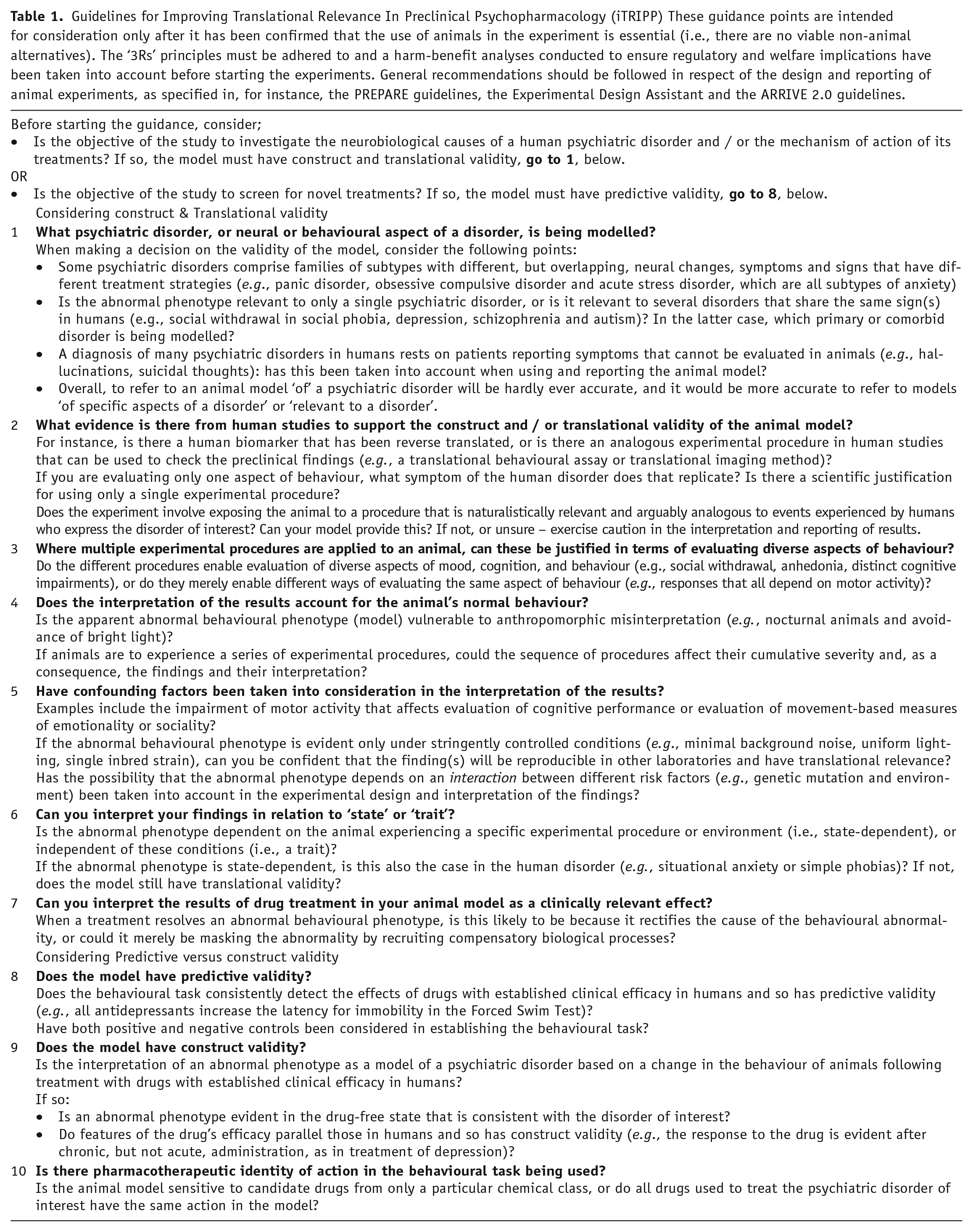
It is important to point out that our intention is not to be prescriptive: that is, we do not intend to provide a list of ‘requirements’. Instead, we have aimed to provide a tool for researchers to help address key questions in their presentations, publications and grant applications and to promote the development of a consensus on the use and interpretation of animal models in psychopharmacology research. The points in the guidance fall into two broad categories: those that are important for the overall study conception (i.e. before the start of the study) (Part 1); and those that are important for the interpretation and reporting of the study outcomes (Part 2).
Part 1: Study design
Translational validity: Are the study findings likely to translate to humans, especially relevant patient groups?
Translational validity brings together the concepts of ‘face validity’ (i.e. the objective similarity between the animal model and the analogous manifestations in humans) and ‘construct validity’ (i.e. the extent to which animal models share the aetiology, neurobiological and/or psychological mechanisms with the disorder of interest) (Willner, 1986). Consideration of the translational validity of a study (i.e. its relevance to humans, especially specific patient groups) is an essential part of the study design and includes the choice of behavioural assays and other outcome measures.
When appraising the translational validity of an animal model it is important to recognise that many psychiatric disorders are diagnosed on the basis of (subjective) symptoms that cannot be evaluated in animals, such as hallucinations or suicidal ideation. In addition, psychiatric illnesses are diverse conditions with heterogeneous signs and symptoms, which might be impossible to recapitulate in animals. Nevertheless, there are some behavioural assays that are suitable for use in both animal and human studies and so have unequivocal translational relevance. This makes it possible to collect similar behavioural measures across species providing a ‘translational bridge’ from behavioural studies in animal models to humans. By way of examples, memory, sustained attention, cognitive flexibility, cognitive affective bias and place learning can all be evaluated in both humans and non-human animals and are impaired in several psychiatric illnesses, such as schizophrenia and ADHD; they also seem to depend on similar neurobiological mechanisms (Barnett et al., 2010; Bauer et al., 2021; Brown and Tait, 2014; Buckley and Bast, 2018; Fajnerová et al., 2014; Hales et al., 2014; Robbins, 2002; Young et al., 2009). Other examples include locomotor activity and prepulse inhibition of the acoustic startle response, which can be similarly measured in animals and humans and are disrupted in several disorders, including schizophrenia, and so can be useful to investigate brain mechanisms that might contribute to the disorders (Perry et al., 2009; Swerdlow et al., 2008). Overall, the use of cross-species behavioural assays can help with the extrapolation of findings from animal studies to humans, including relevant patient groups.
However, a critical issue with animal models in psychiatry research is how well behavioural phenotypes in animal models reflect complex psychiatric disorders and the subjective experience associated with these disorders. A case in point is the elevated plus maze (EPM), which assesses innate approach – avoidance behaviour in rodents (Wall and Messier, 2001). Avoidance is an essential survival mechanism and reflects the fear that drives cautious behaviour. The EPM is often referred to as an ‘animal model of anxiety’. However, innate anxiety/fear, as measured on the EPM, is not the same as pathological anxiety. Moreover, ‘anxiety’ is a catch-all term for a family of heterogeneous psychiatric conditions that share some features, such as excessive and non-specific worry coupled with motor tension and hypervigilance (American Psychiatric Association, 2013). These symptoms cannot be assessed in the EPM. It has been suggested that the risk assessment activity in the EPM, as a novel environment, may reflect phobic tendencies, but that cannot be certain (Ennaceur and Chazot, 2016). We also do not know whether, in a given experiment, increased exploration of the open arms arises from reduced fear (avoidance) or enhanced motivation to explore (approach) or even impulsive behaviour (Bespalov and Steckler, 2021). In short, the EPM may indicate whether innate avoidance/risk assessment behaviours are altered, but it cannot be inferred that a rodent model has ‘an anxiety phenotype’ nor what type of human anxiety the rodent may be experiencing. An ongoing challenge in preclinical psychiatry research is that the most commonly used models, such as the EPM, were developed as in vivo screens for compounds but have subsequently been used to infer changes in human disease states, without any compelling justification for that interpretation (also see section Construct versus predictive validity).
Nonetheless, one advantage of tasks like the EPM is that approach–avoidance behaviour is seen across different species. Using a mixed virtual reality and real-world setting, open arm avoidance as a component of anxiety has been validated in healthy human participants (Biedermann et al., 2017). Moreover, as when using the EPM to test the effects of anxiolytic and anxiogenic drugs in rodents, lorazepam (an anxiolytic in humans) increases time spent on open arms compared to placebo whereas yohimbine (which can cause anxiety in humans) reduced time spent in the open arms. ‘Low anxiety’ participants identified via self-rating scales had a shorter latency to enter, made more open arm entries and spent more time in the open arms than ‘high anxiety’ participants. Furthermore, using additional self-rating scales, open arm avoidance was suggested to be related to acrophobic fear (fear of heights) whereas the open arm approach was related to sensation-seeking and not related to a general tendency for anxious temperament (trait anxiety). These findings confirm that the EPM is not evaluating a clinically relevant state of anxiety. Nevertheless, it does have predictive validity for screening anxiolytic drugs of certain chemical classes (the sedative-hypnotic anxiolytics) across different species. Such experiments illustrate the value of studying behaviours in healthy humans that complement and inform the development of better animal models (Bach, 2022; Grillon et al., 2019).
Finally, a ‘reverse translation’ approach has been suggested in the context of addiction research to improve the translation of animal research into better treatments (Venniro et al., 2020). This approach focuses on the reverse translation of successful human treatments (e.g. opioid agonist maintenance, contingency management and the community-reinforcement approach to treat addiction) into new animal models that mimic these successful treatment approaches. These models can then help clarify the mechanisms underlying the successful treatments and, thereby, help identify new treatments.
Research Domain Criteria (RDoC) Framework: Modelling selected neural and behavioural aspects of psychiatric disorders
Animal models relevant to psychiatric disorders are still constrained by our poor understanding of the underlying neurobiological causes of human psychiatric conditions. In part, animal models fall short of representing a psychiatric illness because they generally lack the ‘ontogeny’ or developmental aspects that contribute to the human condition. In particular, psychiatric conditions are highly heterogeneous, with a likely complex interplay amongst genetic vulnerabilities, interoceptive cues and environmental factors, with few if any diagnostic tests or biomarkers.
One approach to dealing with these challenges is to interpret animal models as expressing particular aspects of the human condition, rather than the full-blown disorder, as recommended by the RDoC framework. This proposes the investigation of psychiatric disorders by focusing on functional domains that span traditional diagnostic categories (Insel et al., 2010). These include aspects of human psychological functioning that encompass emotion, cognition, motivation and social behaviour. Because mental health conditions are multifaceted, the use of a single experimental model to recapitulate or assess a broad spectrum of behaviours is unlikely to be successful.
A benefit of the RDoC approach is the use of multiple behavioural tasks or models that provide complementary data that can help increase confidence in experimental outcomes and inferences. It should be acknowledged that here is a concern, from a 3Rs perspective, about increasing the number of animal tests, which can increase cumulative severity. However, where tests engage different aspects of brain function, such a complementary approach helps increase confidence in the findings and conclusions regarding the overall behavioural phenotype.
The wisdom of the RDoC approach has been questioned on the basis that it ‘conflates variation along axes of normal function, with quantitative measurements of disease phenotypes and with the occurrence of diseases in overlapping clusters or spectra’ (Ross and Margolis, 2019). The criticism that the RDoC framework treats disease as extremes of normal human behaviour, rather than distinct pathological states, is most pertinent in respect of neurological illnesses where abnormal pathological processes are clearly involved. In such cases, a bottom-up approach, advocated by Ross and Margolis (Ross and Margolis, 2019) (genes, pathogenic pathways, cell and animal disease models), may be preferable.
However, psychiatric conditions are harder to diagnose and categorise, especially as the underlying pathology is so poorly understood. Also, there is evidence that some neuropsychiatric disorders, such as schizophrenia, reflect the extreme expression of personality traits (so-called schizotypal personality traits), that exist as a continuum within the general population (Nelson et al., 2013). Ross and Margolis concede that RDoC conceptualisation may have merit for some conditions, but not others (Ross and Margolis, 2019).
Despite the limitations of RDoC, as it is currently structured, there are advantages from the perspective of animal models. The RDoC approach offers a way to sidestep the debate of whether or not an animal model recapitulates the full-blown human disease by focusing on domains of brain function that are common to both rodents and humans. RDoC removes the need to try to model human disease in a rodent. Furthermore, this focus on symptoms and symptom domains helps to avoid the use of language that does not respect the sensibilities of people living with psychiatric conditions, which they may not wish to have labelled as a ‘disease’ or ‘illness’.
Construct versus predictive validity
Animal models relevant to psychiatric disorders can have two aims: (1) to explain neurobiological or pathological mechanisms that underlie the psychiatric condition of interest; and (2) to assess the likely efficacy of novel therapeutic treatments. These two aims are distinct, but are often confused (Pratt et al., 2022; Stanford, 2017, 2020). Importantly, there are several animal behavioural models that are suitable to address aim 2 (by screening for potential treatments) and have predictive validity, but are of limited use to address aim 1, that is, they have limited, if any, construct validity.
One such example is the active avoidance test. The majority of antipsychotic agents are high affinity antagonists of dopamine D2 receptors (DRD2). Dopaminergic transmission in the brain contributes to the behavioural response to aversive stimuli (avoidance learning) (Antunes et al., 2020; Dombrowski et al., 2013; Ilango et al., 2012). In the active avoidance procedure, animals learn to escape from an environment, which they have learned to associate with an aversive stimulus (active avoidance) (Ögren and Archer, 1994). DRD2 receptor antagonists blunt this avoidance response (Ögren and Archer, 1994). On that basis, the active avoidance assay is widely used to screen new candidate antipsychotic drugs. However, the effects of test drugs on active avoidance neither confirm nor refute any putative role for DRD2 receptors in the cause(s) of psychosis and so, in terms of being analogous to human psychopathology, active avoidance tests lack translational relevance and are unlikely to make any substantial contribution to our mechanistic understanding of human psychosis. They are useful as preliminary (predictive) drug screens, nonetheless.
Similarly, it is not certain that open arm avoidance in the EPM is any indication of an anxious state that is related to human anxiety disorders (see discussion above), so this behaviour has limited construct validity with respect to these disorders. However, open arm avoidance is strongly modified by allosteric modulators of the GABAA receptor. These range from the sedative-hypnotic anxiolytics (e.g. benzodiazepines), which increase activity on the open arms, to pro-anxiogenic (e.g. picrotoxin) drugs, which reduce it (Rodgers and Dalvi, 1997). On this basis, the EPM is regarded as having ‘predictive validity’. As a predictive screen, the model does not require the behavioural measures to be relevant to the human disorder, or for either the temporal or dose profile of the compounds to emulate their effects in humans. By contrast, if it is to be asserted that these treatments are actually ameliorating or reducing anxiety, then at the very least, the effects of these drugs should occur at doses that correspond to the effective dose range in humans and at doses that do not disrupt normal behaviour or physiology (e.g. locomotor, cardiac and respiratory activity).
Appropriate experimental design
Once the most appropriate animal models have been chosen, depending on the aims of the study – be that understanding neurobiological mechanisms underlying the disorder or assessing drug efficacy – several factors must be considered during experimental study design. Biological factors (such as age, sex, strain, species) and operational factors (maze design, lighting, husbandry, handling, time of day, automated or manual scoring) vary widely across laboratories and contribute to significant variability of the response reported in the literature (Hogg, 1996; Violle et al., 2009). However, the validity of behavioural tests rests on them producing consistent patterns of behaviour, notwithstanding any influence of these baseline experimental variables.
There are well-established resources for designing and reporting in vivo experiments. These include the Planning Research and Experimental Procedures on Animals: Recommendations for Excellence (PREPARE) (Smith et al., 2018), followed by the Experimental Design Assistant (EDA) (du Sert et al., 2017), and the Animal Research: Reporting of In Vivo Experiments (ARRIVE 2.0) guide (du Sert et al., 2020), which are all freely available as online resources. A thorough description of experimental procedures should include all pertinent methodological details, including species, strain, sex and source of animals, sample size justification, exclusion criteria and a statistical analysis plan and a full description of reagents including their source. More recently, it has been highlighted that the default for animal studies should be the balanced inclusion of both sexes (to facilitate translation of findings to the whole population), and that using only one sex (typically, the male sex, as has traditionally been the case in preclinical animal studies) requires robust justification (Karp and Reavey, 2019; National Institutes of Health, 2015; UKRI, 2022). Alongside this, the study design should also include negative and positive controls that will enable drug treatment responses to be carefully interpreted and to reduce the risk of ‘false positives’ or ‘false negatives’.
The PREPARE guidelines, developed by Norway’s National Consensus Platform for the advancement of the 3 Rs (NORECOPA), in collaboration with the Royal Society for the Prevention of Cruelty to Animals (Smith et al., 2018), align well with the implementation of the 3Rs. In formulating animal studies, consideration must be given to ethical issues, harm–benefit assessment and humane endpoints. Working in conjunction with the animal facility, important issues around animal housing and husbandry can be identified that might affect the quality of the study. Collectively the PREPARE guidelines are designed to enhance animal welfare, in both academic and industry research settings (described in Tannenbaum and Bennett, 2015), whilst increasing the reproducibility of research and reducing unnecessary repetition of experiments. Another tool to improve the implementation of the 3Rs in animal research is the Experimental Design Assistant (EDA) developed by the National Centre for the Replacement, Refinement and Reduction of Animals in Research (NC3Rs) (du Sert et al., 2017). The EDA is a web-based tool that takes a stepwise approach to the design and planned analysis of animal studies. It contains a wealth of valuable resources including advice on conducting a power calculation to determine sample size, randomisation of studies, factorial designs and choice of analysis method. The ARRIVE guidelines, also developed by the NC3Rs, are mainly aimed at improving transparency and, thereby, reproducibility of animal research studies (du Sert et al., 2020). Together, these resources offer complementary guidelines to implement the principles of the 3Rs and increase transparency in animal research methods.
Part 2: Interpreting experimental results
Existing guidelines, such as PREPARE (Smith et al., 2018) or ARRIVE 2.0 (du Sert et al., 2020), offer valuable overviews and delineate standards for carrying out and reporting animal research. However, these guidelines do not diminish the difficulty of human interpretation or oversight of complex animal behaviours: that is, how should results from preclinical models be interpreted and applied to clinical features? There are two main issues regarding the interpretation of behavioural changes in animal models relevant to psychiatric disorders.
First, no matter how well designed, a scientific study may suffer from inappropriate, or frankly erroneous, assessment and interpretation of complex behaviours exhibited by rodents. It is likely that features that are common or most problematic in clinical populations may not be readily displayed or recognised in rodent models. This can lead to misinterpretation of a phenotype. There is a particular risk that any putative clinical relevance is based on over-interpretation based on anthropomorphism, simply to claim some clinical relevance for the study. For example, despite the supposed agreement that the forced swim test is not a model of depression (Reardon, 2019), rather a predictive screen for detecting antidepressant candidates (Reardon, 2019), many researchers still refer to it as such. This is explained by the original description of the immobility as a ‘state of despair resembling depression’ for example (Porsolt et al., 1978), an inference based on anthropomorphic assumptions, but lacking any supporting evidence.
Second, it is important to explore changes in all aspects of animals’ behaviour: what an animal is and what it is not doing. This is because changes in a behaviour of interest that are induced by an experimental challenge may reflect other behavioural changes, which are mutually exclusive. For example, animals may show changes in grooming, cognitive task performance, immobility in the forced swim test or open arm avoidance on the EPM because of changes in motor behaviour. To be aware of such confounds, it is important to assess the behavioural (ethological) profile of the animals more broadly, coupled with statistical exploration of covariates, and not simply to measure a single aspect of behaviour that is of greatest interest.
Conclusions
This article highlights some key considerations for the design and reporting of animal model studies in psychopharmacology. These have been assembled in the iTRIPP guidance outlined in Table 1. Foremost amongst these is the question of whether or not an animal model faithfully recapitulates a psychiatric disorder or only certain behavioural symptoms of the disorder. That point is not only key to the scope of the validity of the model, but also to building bridges that facilitate forward and reverse translation. Finally, comprehensive reporting and reduced over-interpretation are essential. In this respect, there is an important role for authors, reviewers, editors, journals and funders to reduce hyperbole and ensure that results are interpreted with caution and reported accurately. Whilst demonstrating the clinical relevance of the study is important, researchers should be realistic about its potential for translation to the human clinic. These points have been incorporated into the iTRIPP guidance and are recommended for consideration when drafting manuscripts, grant applications and presentations, in which animal models are used to study psychiatric disorders and preclinical psychopharmacology.
Footnotes
Acknowledgements
The authors were convened as part of research community engagement activity conducted by the Psychiatry Consortium, which is led and managed by Medicines Discovery Catapult, a UK-based not-for-profit entity.
Author’s note
Lauren Chaby is also affiliated to ALZpath, Carlsbad, CA, USA.
Laura A Ajram is also affiliated to British Neuroscience Association, Bristol, UK.
Declaration of conflicting interests
The author(s) declared no potential conflicts of interest with respect to the research, authorship, and/or publication of this article.
Funding
The author(s) received no financial support for the research, authorship, and/or publication of this article.
