



Abstract
Background:
Research on psilocybin has become increasingly popular during the current psychedelic renaissance, which began in the early 1990s. Psilocybin’s effects on mental health are promising and there are ongoing efforts to investigate its clinical implementation and its effects on cognition.
Aims:
The purpose of this study is to report trends in publications, methods, and findings from research examining the effects of psilocybin on cognition and creativity in adults.
Methods:
We conducted an Open Science Framework preregistered scoping review, guided by the JBI Manual for Evidence Synthesis, on literature pertaining to psilocybin’s effects on cognition and creativity.
Results/outcomes:
In the 42 included studies, psilocybin was primarily administered orally (83%) in a bodyweight-adjusted manner (74%) to healthy participants (90%). Of the few studies that explicitly reported safety outcomes (26%), only one reported serious adverse reactions. During the acute phase post-intake (i.e., minutes to hours), macrodoses tended to impair cognitive performance and creativity, whereas microdoses tended toward creative enhancement. The few macrodosing studies that included post-acute measures (i.e., 1–85 days) reported primarily null but some positive effects.
Conclusions/interpretation:
This scoping review identified a time-based variation of psilocybin macrodosing effects on cognition and creativity, in which impairment may be observed early post-intake but withdraw over time, and some positive effects may emerge afterward. These findings are limited by methodological concerns and inadequate assessment of long-term effects. We therefore recommend that future psilocybin research be conducted according to existing guidelines and include well-validated measures of cognition and creativity at multiple timepoints.
Introduction
Overview
Psychedelics elicit unique states of consciousness characterized by altered sensation, perception, cognition, and sense of self (Johnson et al., 2019; Nichols, 2016). There are two main groups of psychedelics: classic psychedelics which are serotonin 2A receptor (5-HT2AR) agonists and non-classic psychedelics which have other varied mechanisms of action (Carhart-Harris et al., 2014; Mendes et al., 2022). Classic psychedelics include lysergic acid diethylamide (LSD), N,N-dimethyltryptamine (DMT), 5-Methoxy-N,N-dimethyltryptamine (5-MeO-DMT), mescaline, and psilocybin, which is the focus of this scoping review (Johnson et al., 2019; Lowe et al., 2021).
Psilocybin occurs naturally in over 200 species of fungi primarily of the genus Psilocybe (Nichols, 2020; Van Court et al., 2022). Psilocybe mushrooms, commonly referred to as “magic mushrooms,” have been used by cultures around the world for thousands of years (Lowe et al., 2021; Nichols, 2020; Van Court et al., 2022). For example, Aztecs used them in healing rituals and religious ceremonies and ancient Hindu texts suggest their use in the ritualistic sacrament “soma” (Carod-Artal, 2015; Johnson et al., 2019; Nichols, 2020). Psilocybin is therefore considered an entheogen due to its use in mystical and religious contexts (Carod-Artal, 2015). While it is clear that psilocybin use spans millennia, its prevalence prior to the 20th century remains unknown (Johnson et al., 2019).
Scientific research into psychedelics began in the late 19th century and accelerated following Swiss chemist Albert Hofmann’s discovery of LSD’s psychedelic properties in 1943 (Hofmann, 2013; Johnson et al., 2019). It then expanded to include psilocybin after American amateur mycologist Gordon Wasson’s experiences with psilocybin mushrooms in the Sierra Mazateca of Mexico were published in 1957, sparking widespread public interest (Johnson et al., 2019). This research flourished until 1970 when psychedelics became regulated under the most restrictive schedule (schedule 1) of the United States Controlled Substances Act and, subsequently, under similar schedules worldwide (Belouin and Henningfield, 2018). These stringent regulations prompted an approximately 25-year period of limited advancement in psychedelic research (Belouin and Henningfield, 2018; Johnson et al., 2018).
Renaissance
After decades of considerable limitation, researchers once again obtained approval to administer psychedelics to humans in 1990 (Strassman, 1991, 1995), a year which also marks the beginning of a distinct increase in psychedelic publications more broadly (Solmi et al., 2022). Despite this, the first publication for a psychedelic trial in humans during this period did not appear until 1994 (Hadar et al., 2023; Strassman and Qualls, 1994), thus marking the beginning of the current “psychedelic renaissance” for the purposes of this review. Although the first human trial specifically involving psilocybin during this period was not published until 1996 (Spitzer et al., 1996), we chose 1994 as a start date to facilitate comparison with other psychedelic reviews (Bălăeţ, 2022; Sayalı and Barrett, 2023).
At the forefront of this renaissance is psilocybin (Lowe et al., 2021). While similar to other psychedelics in its psychological effects, its half-life of roughly 163 minutes upon oral ingestion is uniquely convenient (Passie et al., 2002; Swanson, 2018). In contrast, other psychedelics like LSD (roughly 306-minute half-life) and 5-MeO-DMT (roughly 16-minute half-life) produce experiences that are either too long-lasting or too brief for many clinical and research contexts (Barsuglia et al., 2018; Dolder et al., 2017). Furthermore, psilocybin has a relatively favorable safety profile (Hendricks et al., 2015; Lowe et al., 2021) and often carries less stigma than other psychedelics such as LSD (Belouin and Henningfield, 2018; Fuentes et al., 2020). Recent findings have demonstrated psilocybin’s promise for treating depression and anxiety in patients with life-threatening cancer (Griffiths et al., 2016), treatment-resistant major depressive disorder (Davis et al., 2021; Goodwin et al., 2023), and substance addiction (Bogenschutz et al., 2015, 2022; Johnson et al., 2017), even though these findings have been criticized due to small sample sizes and a paucity of long-term outcome measures.
Mechanisms of action
Serotonin (5-HT) is an important neurotransmitter that binds to cell membrane receptors to produce wide-ranging effects throughout the central nervous system (López-Giménez and González-Maeso, 2018). Upon ingestion, psilocybin is dephosphorylated into the psychoactive metabolite psilocin which is structurally similar to serotonin (see Figure 1; Nichols, 2020). It is this structural similarity that allows psilocin, like other classic psychedelics, to bind serotonin receptors and subsequently alter consciousness (Dinis-Oliveira, 2017). The prefrontal cortex, a brain region implicated in higher-order cognition including executive functions like planning, inhibiting, and problem-solving (Garcia-Barrera, 2019), has especially high concentrations of both 5-HT1A receptors, generally considered inhibitory, and 5-HT2A receptors, generally considered excitatory (Puig and Gulledge, 2011). Psilocin’s psychedelic effects are primarily a result of it binding to the 5-HT2A receptor on neurons, thereby triggering increases in brain activity (Vollenweider and Kometer, 2010; Vollenweider et al., 1998) and network connectivity (Daws et al., 2022; Doss et al., 2021). However, recent work has emphasized the importance of non-neuronal brain cells, primarily microglia, in psilocin’s cellular mechanism of action (Tay et al., 2017; VanderZwaag et al., 2023).
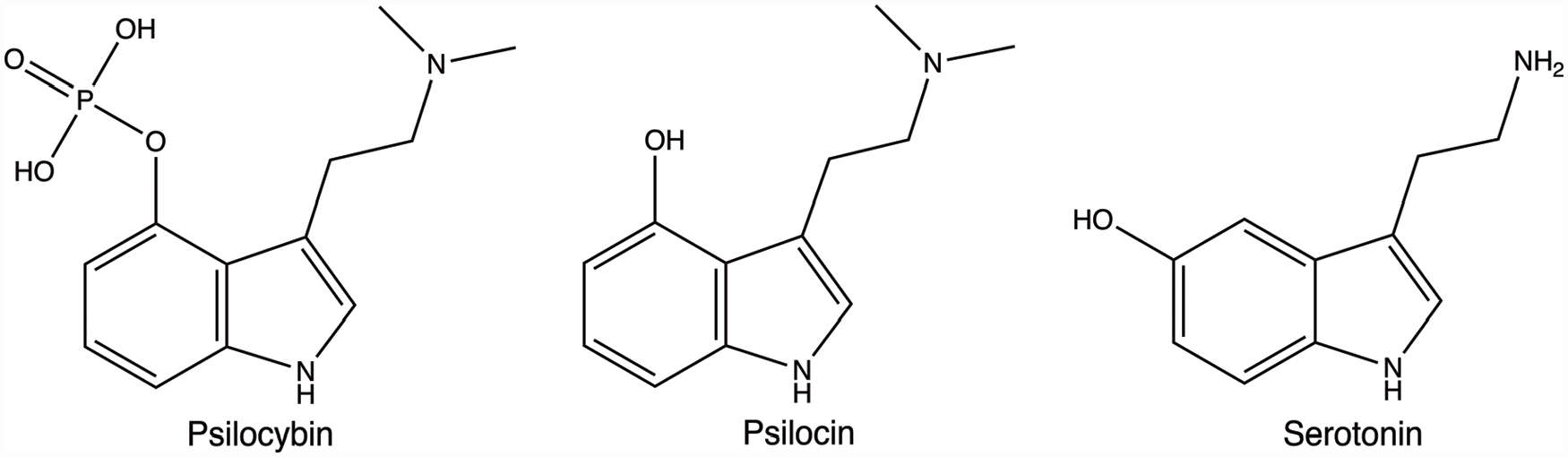
Chemical structures of psilocybin, psilocin, and serotonin. This figure was created using ChemDraw Prime software
Psilocin has no direct effect on dopaminergic systems and therefore lacks the reinforcement mechanisms necessary for dependence to occur (Bienemann et al., 2020; Dinis-Oliveira, 2017; Nichols, 2016). Furthermore, psilocin is physiologically safe given its low toxicity and low risk of overdose—a lethal dose is estimated to be 1000 times greater than an effective dose (Gable, 2004). Despite this, “bad trips” (i.e., episodes characterized by intense negative emotions) remain a concern and can lead to dangerous behaviors. However, these types of experiences are most likely to occur when individuals are either not mentally prepared or are in a poorly controlled environment (Johnson et al., 2008; Pilecki et al., 2021) and can be managed by following safety guidelines for clinical research involving hallucinogens (Johnson et al., 2008).
Cognition and creativity
Cognition is acutely altered by hallucinogenic “macrodoses” of psilocybin, typically ranging from ~130 µg/kg (“low-dose”) to ~370 µg/kg (“high-dose”) when taken orally (Barrett et al., 2018; Vollenweider et al., 2007), even though recent research suggests that adjusting doses by bodyweight is unnecessary (Garcia-Romeu et al., 2021). While Doss et al.’s (2021) open-label study in patients with major depressive disorder found improvements in cognitive flexibility 4 weeks post-psilocybin therapy, a recent double-blind, randomized, placebo-controlled study in healthy participants found no changes in cognition at 8, 29, or 85 days post-psilocybin therapy (Rucker et al., 2022). Contradictory findings such as these contribute to ongoing controversy regarding the long-term effects of psilocybin on cognition.
Psilocybin can also be taken in very low, sub-hallucinogenic “microdoses,” typically ranging from ~100 mg to ~500 mg of dried mushrooms (of variable potency) taken orally, or about one-tenth to one-twentieth of a macrodose (Anderson et al., 2019; Kuypers et al., 2019; Polito and Stevenson, 2019). Anecdotal reports claim that microdosing psilocybin has many benefits including enhanced cognition and creativity (Lea et al., 2020), even though findings from research on this topic are mixed (Cavanna et al., 2022; Marschall et al., 2022; Rootman et al., 2021; Szigeti et al., 2021).
Although current psychiatric drugs often alleviate symptoms such as depression and anxiety, they seldom improve and sometimes impair cognition, as observed with selective serotonin re-uptake inhibitors in patients with depression (Millan, 2006; Millan et al., 2012). Psilocybin studies showing improvements in psychiatric symptoms largely fail to consider its effects on cognition, even when assessing its use in populations with known cognitive impairments (Bogenschutz et al., 2015; Davis et al., 2021; Griffiths et al., 2016; Johnson et al., 2017). It is therefore unclear whether improved symptoms coincide with cognitive enhancement, impairment, or null cognitive effects. Measuring cognitive performance in clinical studies will not only improve our understanding of how psilocybin affects disease processes, but it will also guide us toward identifying new target populations. Furthermore, for clinicians who intend to engage in psychedelic-assisted therapy, knowledge of acute versus long-term cognitive outcomes will be important in guiding treatment decisions.
While researchers are increasingly incorporating measures of cognitive performance and creativity in psilocybin studies, we are unaware of any publications that synthesize these findings. Therefore, this scoping review presents trends in publications, methods, and findings from records published since 1994 (i.e., the beginning of the current psychedelic renaissance) that measure cognitive performance and/or creativity after psilocybin administration in adults.
Methods
Protocol and registration
This scoping review was conducted according to the JBI Manual for Evidence Synthesis: Scoping Review chapter (Peters et al., 2020) and is reported in accordance with the Preferred Reporting Items for Systematic Reviews and Meta-Analyses (PRISMA) guidelines (Page et al., 2021; Tricco et al., 2018). The review protocol was registered (Bonnieux et al., 2021) with Open Science Framework prior to its execution, which proceeded as planned except for adjustments to eligibility criteria.
Eligibility criteria
Inclusion criteria were studies published in English, French, or Spanish (i.e., languages known by the authors); studies published since 1994 (i.e., the beginning of the current psychedelic renaissance); empirical studies; studies limited to adult human participants; studies in which participants ingest psilocybin; studies in which one or more measure(s) of participants’ cognitive performance/creativity is/are reported, and/or participants’ subjective perceptions of their cognitive performance/creativity are reported, and/or participants’ brain activity in response to cognitive performance/creativity task(s) is reported. Exclusion criteria were non-empirical studies (e.g., reviews, meta-analyses); animal studies; studies in which measure(s) of participants’ cognition is/are not related to cognitive performance (e.g., changes in mood); studies in which participants’ subjective perceptions of cognition are not related to cognitive performance (e.g., experiences of ego dissolution); studies in which participants’ brain activity is not in response to a cognitive performance/creativity task (e.g., resting-state functional connectivity).
Search strategy
The following electronic databases were systematically searched on February 21, 2023 for records published since January 1, 1994: APA PsycINFO (EBSCOhost), MEDLINE (Ovid), Cochrane Central Register of Controlled Trials (Ovid), and Web of Science Core Collection (Clarivate). We developed a 2-concept comprehensive search in APA PsycINFO based on an analysis of a known set of articles on the topic. The two main concepts searched were psilocybin (intervention) and cognition/creativity (outcomes). The comprehensive search incorporated subject headings and keywords in addition to available database operators and Boolean operators to enhance sensitivity. The APA PsycINFO search was first tested against a known set of studies before being translated to the other databases. The searches were developed by one author (JNB) and peer reviewed by another author (ZP), a librarian with expertise in evidence synthesis methods. See Supplemental Materials for the list of database segments queried in the Web of Science Core Collection and the search strategies as executed in each of the above databases.
Supplementary searches last performed on March 3, 2023 involved reviewing included studies’ cited references and citing references using Google Scholar; searching for gray literature such as conference proceedings, dissertations, and theses; searching selected organizations’ websites; and doing an incognito Google search. See Supplemental Materials for a comprehensive list of the resources consulted in the supplementary searches.
Article selection process
Electronic database search results were imported into Covidence systematic review management software (Covidence Systematic Review Software, 2021). In Covidence, duplicates were removed automatically. Titles and abstracts of the remaining records were screened for their relevance (see eligibility criteria above) by two authors (JNB and BV) independently. A third author (MGB) was then consulted to resolve disagreements. The full texts of the remaining records were reviewed for inclusion by the same two authors independently. The same third author was again consulted to resolve disagreements. Finally, supplementary searches were performed by a single author (either JNB or BV) to identify additional records for inclusion.
Data extraction
A data extraction form was developed to extract the following information from each included report: study name, year of publication, publication type, journal of publication, authors, author affiliations, study design, sample size (placebo and psilocybin conditions only), participant characteristics, dosage and intake protocols, pre-intake protocols, acute phase protocols, post-acute phase protocols, study environment, intake to assessment intervals, assessment tools, neuroimaging methods, adverse effects reported, outcome directions, effect sizes, and funding sources and disclosures. Two authors (JNB and BV) used this form to complete the data extraction independently. Three authors (JNB, BV, and MGB) joined a working session to resolve inconsistencies between the two sets of extracted data.
Critical appraisal
Given that research examining the effects of psilocybin on cognitive performance and creativity has both mixed findings and mixed methodologies, our research team deemed it appropriate to critically appraise each of the 42 included reports using the 2018 version of the Mixed Methods Appraisal Tool (MMAT; Hong et al., 2018). First, two authors (JNB and BV) independently classified each report into one of the following five study design categories: qualitative research, randomized controlled trials (RCTs), non-randomized studies, quantitative descriptive studies, and mixed methods studies. Then, the same two authors met with a third (MGB) to resolve classification disagreements. Next, the same two authors independently rated each report on five quality criteria which varied depending on the report’s study design classification. Responses for each criterion are either “yes” meets criterion, “no” does not meet criterion, or “can’t tell” because appropriate information is missing. Lastly, the same three authors met to resolve disagreements in quality criteria ratings. Consistent with the MMAT authors’ recommendation, no overall MMAT scores were calculated (Hong et al., 2018). Instead, a synthesis of the methodological concerns identified by the critical appraisal is presented in the Results section of this paper.
Data synthesis
Research into the effects of psilocybin on cognitive performance and creativity was characterized using the following data synthesis methods. First, we presented the timeline of publications using a cumulative frequency distribution. Second, we showed the institutions involved in research on this topic, the extent of their contributions, and the inter-institutional connections using a network analysis. Third, we presented the methodological characteristics of each report including psilocybin dosage and intake protocols. Finally, we synthesized findings from behavioral and subjective measures and extracted general themes from neuroimaging findings.
Statistically significant differences between psilocybin and baseline/placebo conditions were classified as either positive or negative findings depending on whether they reflected cognitive/creative enhancement or impairment. Nonsignificant differences between conditions were classified as neutral findings. Each finding was grouped into one of six categories based on the construct being measured. For instance, attention and vigilance were classified as foundational cognitive processes (e.g., Psychomotor Vigilance and Attentional Blink Tasks), inhibition and working memory as lower order cognitive processes (e.g., Digit Symbol Substitution and Trail Making Tests), planning and fluid intelligence as higher-order cognitive processes (e.g., Tower Test and Raven’s Progressive Matrices), empathy and reactions to affective stimuli as social cognitive processes (e.g., Multifaceted Empathy Test and Ultimatum Game), convergent and divergent thinking as creative processes (e.g., Picture Concept and Alternate Uses Tasks), and self-reported changes in cognition as subjective findings (e.g., Visual Analog Scale [Concentration and Creative subscales], and the Five Dimensional Altered States of Consciousness Scale [Impaired Control and Cognition subscale]). Guided by categorizations of both cognitive (Nigg, 2017) and creative (Kuypers et al., 2016) processes in the literature, all classifications were discussed until consensus was reached among three authors (JNB, BV, and MGB). Moreover, findings were characterized as having been measured during acute drug effects or after acute effects had subsided (post-acute).
Results
Included articles
1253 results were identified by the electronic database searches and 516 were removed as duplicates by Covidence (Covidence Systematic Review Software, 2021). The remaining 737 records were screened with an inter-rater agreement of 85% and Cohen’s kappa of 0.56. Of the 129 records considered to be relevant, three (Ort et al., 2018; Paulus and Vollenweider, 2006; Vollenweider et al., 2006) could not be retrieved despite attempts to contact the authors via email. The remaining 126 full-text articles were reviewed for inclusion and interrater agreement was 78% with a Cohen’s kappa of 0.52. Supplementary searches identified an additional 25 records of interest. After screening, seven of these were considered relevant and were sought for retrieval. Three of these had already been identified in the main database searches, leaving four to be added to the final list of included studies. A total of 42 reports were included in the review. The PRISMA flow diagram shown in Figure 2 summarizes each step of the search process. See Supplemental Materials for the full list of included reports.
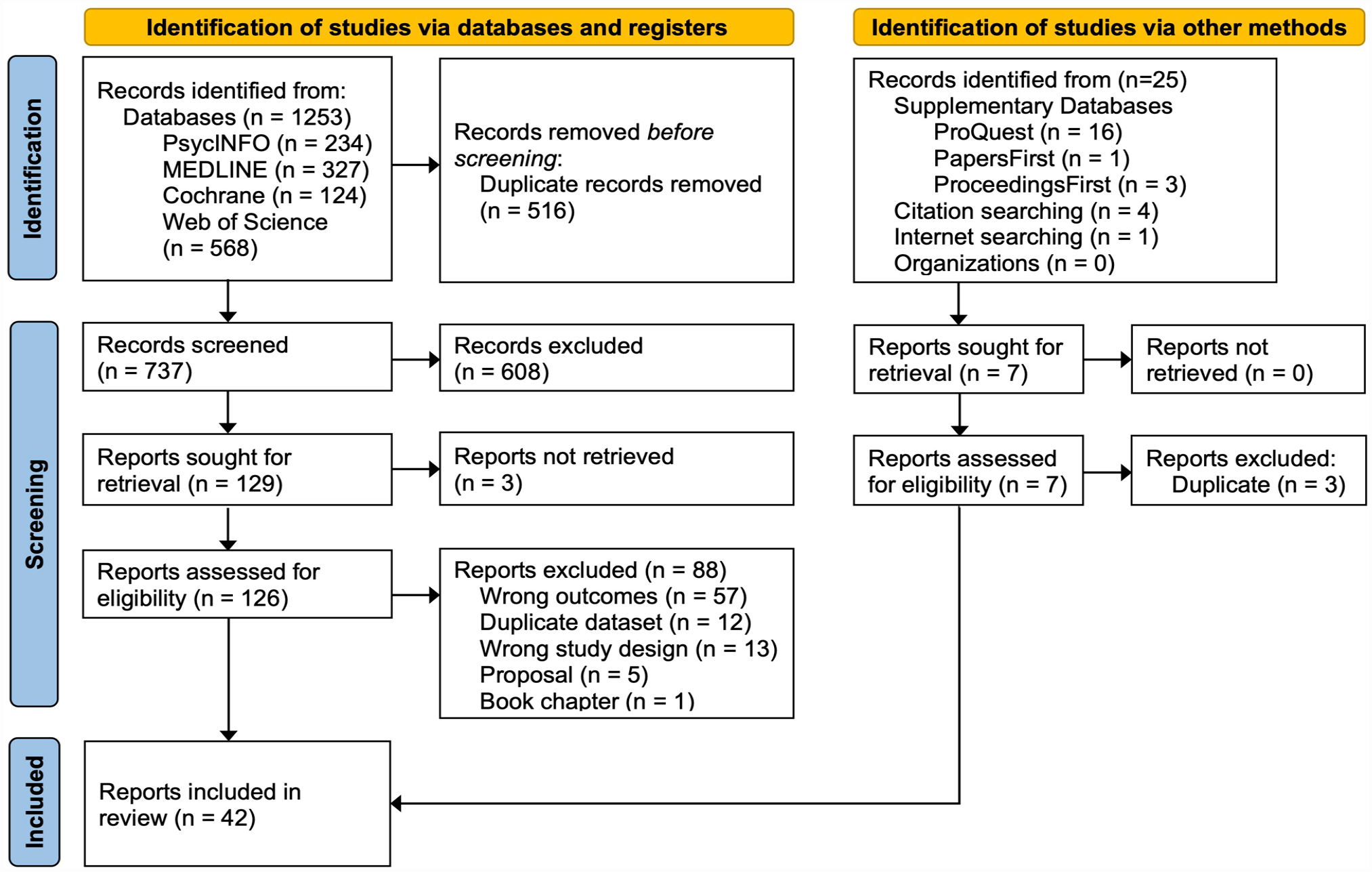
Preferred Reporting Items for Systematic reviews and Meta-Analyses (PRISMA) flow diagram.
Publication timeline
Figure 3 shows the progression of publications from the first report meeting our eligibility requirements in 1996 to the 42nd in 2023. Major milestones in the broader psychedelic renaissance were added to provide additional context.
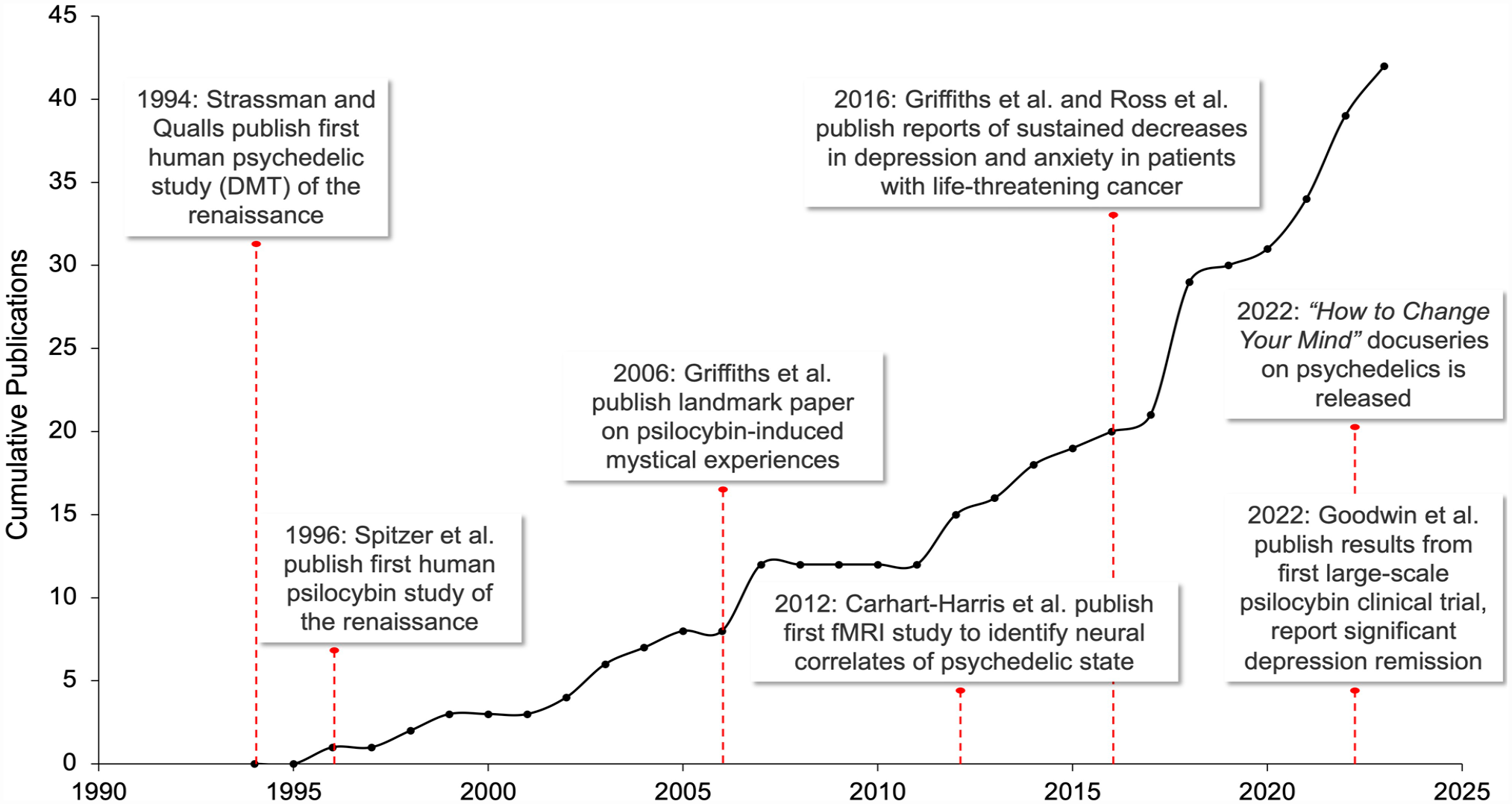
Publication timeline of included reports. Major milestones in the broader psychedelic renaissance were added to the figure using the following citations: Strassman and Qualls (1994), Spitzer et al. (1996), Griffiths et al. (2006), Carhart-Harris et al. (2012a), Griffiths et al. (2016), Goodwin et al. (2022), and Michael Pollan on the Psychedelic Renaissance and Netflix’s New ‘How to Change Your Mind’ Documentary (Law, 2022).
Research institutions
The authors of the included reports were affiliated with a total of 87 institutions, as shown in Figure 4. Of these, Psychiatric University Hospital, Zürich, contributing to 31% of the included reports, and Heffter Research Center, Zürich, contributing to 19%, are the most prolific and their collaboration on 17% of the reports also makes them the most interconnected. These two institutions were especially productive in the beginning of the renaissance, with publications spanning from 1998 to 2022. Other institutions with notable involvement include Johns Hopkins University School of Medicine and University of California San Diego, each contributing to 10% of the included reports. Geographically, institutions from the European Union are the most highly represented (n = 77) followed by the United Kingdom (n = 31), North America (n = 26), South America (n = 4), and Australia (n = 4).
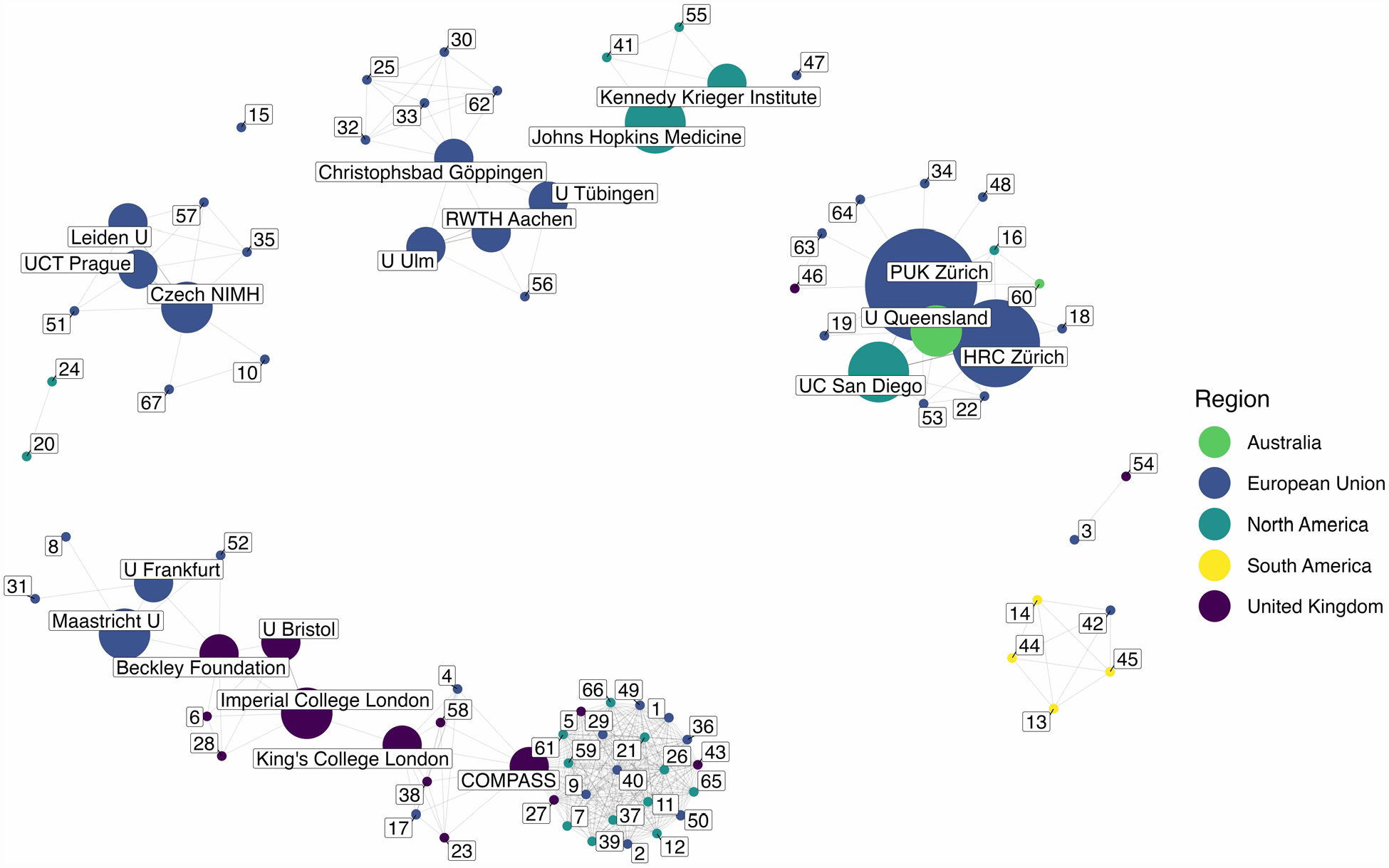
Network representing institutional affiliations (nodes) of included reports and their inter-connections (edges). Network was created in RStudio version 2021.09.0 using the Kamada-Kawai algorithm and the following R packages: psych (William Revelle), tidygraph (Thomas Lin Pedersen), tidyverse (Hadley Wickham), ggraph (Thomas Lin Pedersen), igraph (Gabor Csardi & Tamas Nepusz). See Supplemental Materials for the full institution names corresponding to the labels in the figure.
Study characteristics
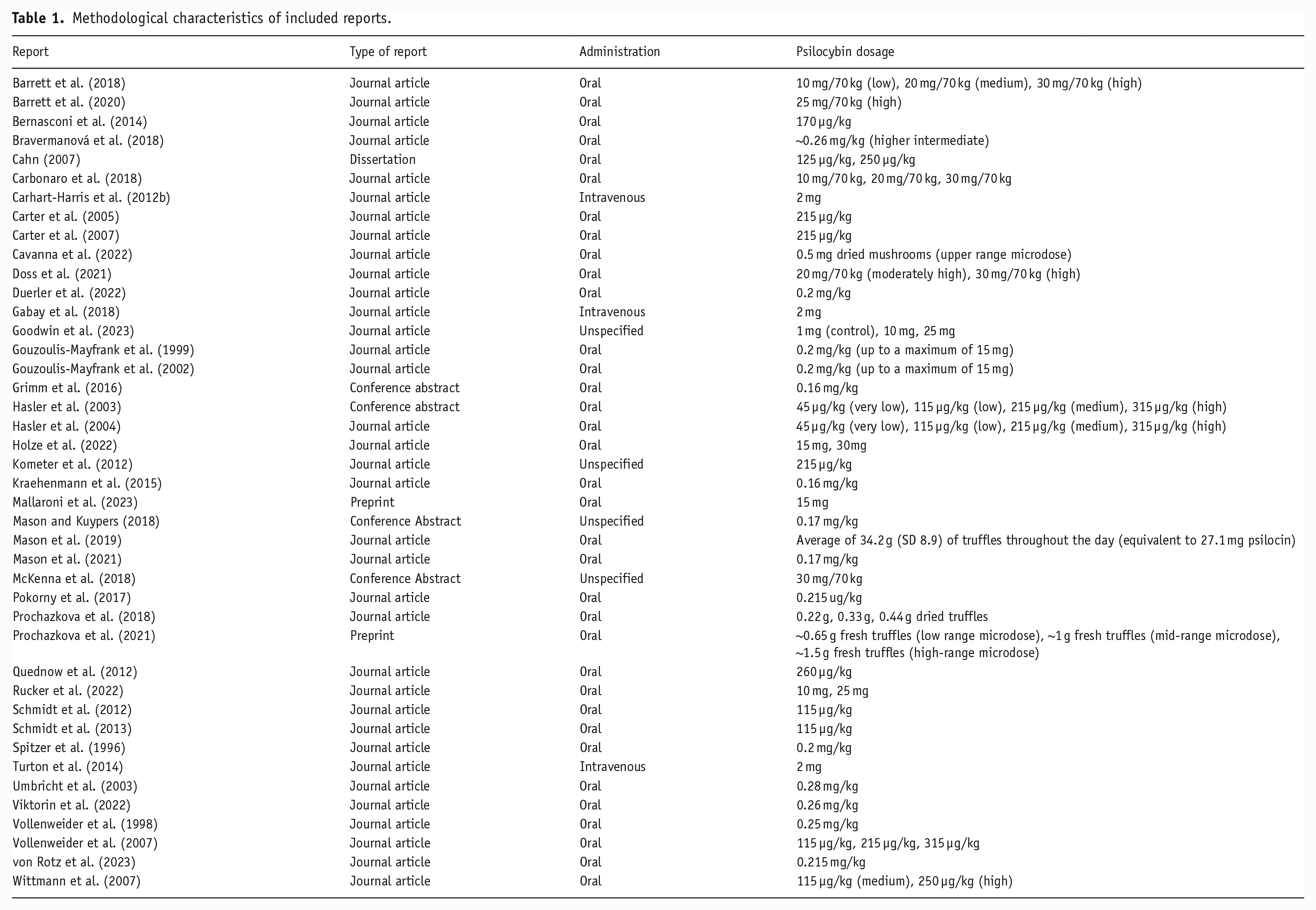
90% of the reports included only healthy participants (three of which included only physicians and/or psychologists; Gouzoulis-Mayfrank et al., 1999, 2002; Spitzer et al., 1996), 7% included participants with major depressive disorder (Doss et al., 2021; Goodwin et al., 2023; von Rotz et al., 2023), and 2% included treatment-seeking smokers (McKenna et al., 2018). Sample sizes ranged from 8 to 233 participants (median = 20). 79% used a within-participant design, 10% used a between-participant design, and 12% used a mixed design. 83% included a placebo condition while 17% did not. 83% included at least one objective measure of cognitive performance and/or creativity while 17% included only subjective measures. 81% included only acute measures, 12% included only post-acute measures (ranging 1–85 days post-psilocybin administration), and 7% included both. Psilocybin administration protocols and dosages are presented in Table 1.
Methodological characteristics of included reports.
Eighty-three percent of the reports indicated that participants were blinded to condition. Of these, only four (12%) assessed blinding integrity (i.e., whether participants were able to guess which condition they had been assigned to) and, of these four reports, only one indicated that blinding was successful. Four additional reports (12%) commented on the importance of examining blinding integrity but did not assess it, noting this as a limitation.
Seventy-four percent of the reports made no mention of adverse outcomes, 12% reported no adverse outcomes, and 14% reported some adverse outcomes. Of the six studies (14%) that reported adverse outcomes, only one classified any as serious (Goodwin et al., 2023). These serious adverse outcomes occurred in 5% of participants with treatment-resistant depression and included suicidal ideation and intentional self-injury. Commonly reported non-serious adverse outcomes included headache, insomnia, and anxiety.
Critical appraisal
The full critical appraisal using the MMAT is presented in Supplemental Materials. Of the 42 included reports, 23 presented quantitative non-randomized studies, 18 were quantitative RCTs, and 1 was a qualitative study (Turton et al., 2014). There were several methodological concerns raised during the appraisal. Of the 23 quantitative non-randomized studies, just over half (n = 12) clearly demonstrated that participants were representative of the target population. Moreover, many (n = 9) failed to clearly demonstrate that they adequately accounted for confounds in their design and analysis. Of the 18 quantitative RCTs, 1 study did not perform appropriate randomization to groups and a majority (n = 10) failed to provide adequate information to determine if this was the case. Furthermore, two did not clearly demonstrate that outcome assessors were blind to the intervention provided. Lastly, a majority (n = 10) failed to provide adequate information to determine if groups were comparable in outcome measures at baseline.
Synthesis of results
A total of 254 findings (208 acute and 46 post-acute) from behavioral and subjective measures of cognitive performance and creativity were extracted from the 42 included reports. Acute effects on cognition and creativity were primarily negative (49%) and neutral (46%) as opposed to positive (5%). However, the 18 acute findings that assessed creativity following microdoses were exclusively neutral (67%) or positive (33%). Similarly, post-acute effects on cognition and creativity were most often neutral (72%) or positive (22%) and seldom negative (6%).
Figure 5 visualizes the dose–response relationship of the 200 behavioral findings (154 acute and 46 post-acute) that were compatible with this analysis: 2 positive, 4 neutral, and 22 negative acute findings were excluded because they were from subjective measures; 1 negative acute finding was excluded because it followed intravenous psilocybin administration thereby making dosage comparison with oral administration meaningless; and 18 neutral and 7 negative acute findings were excluded because they lacked adequate dosage information. Overall, the excluded acute findings were primarily negative (56%) and neutral (41%) as opposed to positive (4%), thus demonstrating a pattern of outcomes that is consistent with those included in the figure.
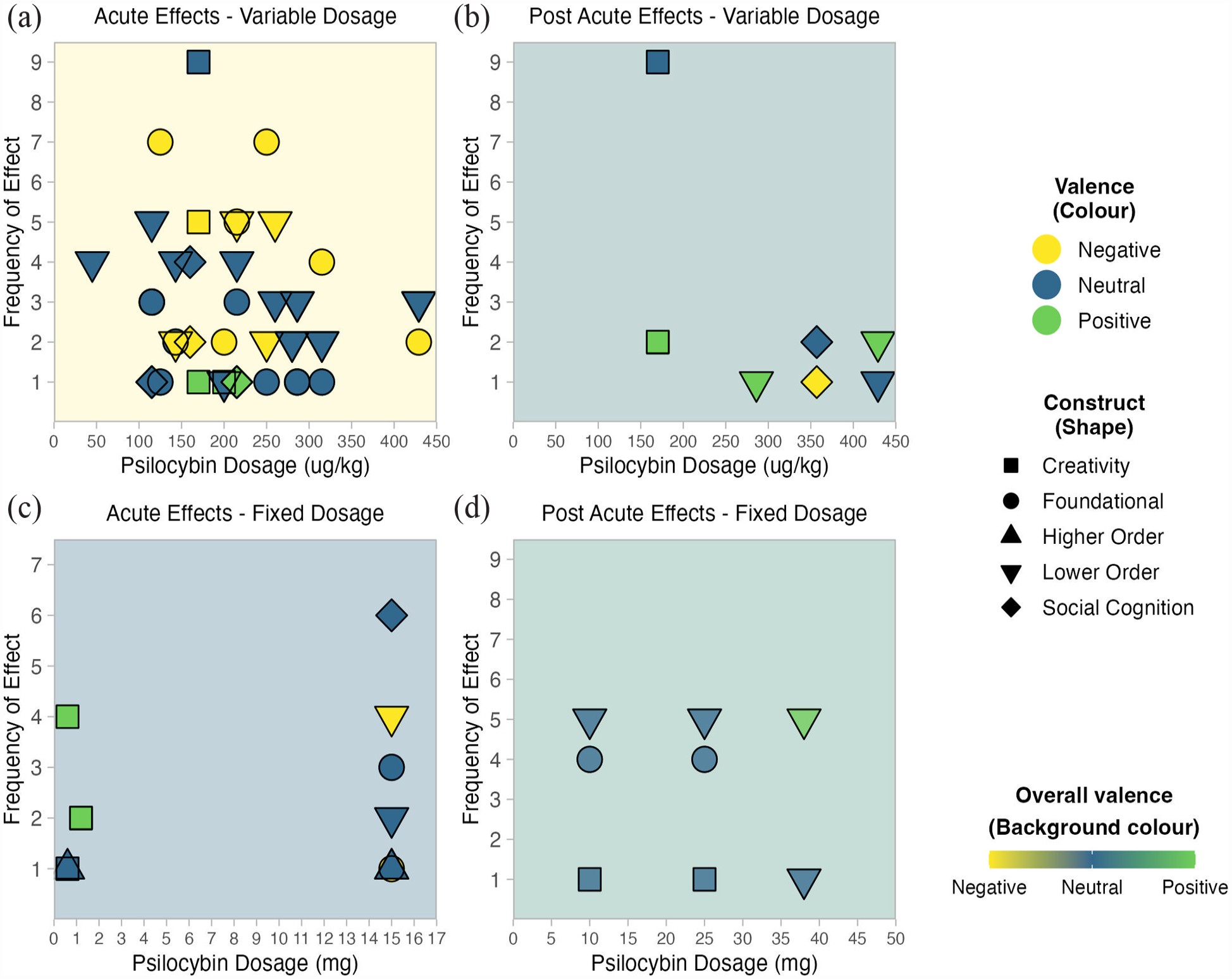
Cognitive performance and creativity outcomes according to psilocybin dosage. This figure contains four scatter plots showing cognitive performance and creativity outcomes measured during acute drug intoxication (plots a and c) or during post-acute phases (plots b and d). The horizontal X-axis shows psilocybin dosage administered in either a bodyweight-adjusted manner represented in µg/kg (plots a and b) or a fixed manner represented in mg (plots c and d). The vertical Y-axis shows the frequency of the reported outcome. The valence of each finding (negative, neutral, or positive) is indicated by the shape’s color, and its corresponding construct (foundational, lower order, higher-order, social cognitive, or creative processes) is indicated by the type of shape. The overall valence of each plot was determined by subtracting negative from positive findings and dividing this by the total number of findings; the result of this equation was used to create a background color. The plot was created in RStudio version 2021.09.0 using the following R packages: tidyverse, xlsx, psych, ggrepel, viridis, ggpubr, cowplot, and grDevices.
Effect sizes were reported in four (10%) of the included publications (Mallaroni et al., 2023; Mason et al., 2021; Prochazkova et al., 2018; Vollenweider et al., 2007). Mallaroni et al. (2023) reported the following significant negative outcomes with large effect sizes during the acute phase following a 15-mg psilocybin macrodose: increased reaction time on the Tower of London Test (a measure of higher-order executive function; d = 1.8), decreased correct (d = 1.45) and total (d = 1.5) responses on the Digit Symbol Substitution Test (a measure of lower order executive function), decreased correct responses on the Spatial Memory Test (a measure of lower order executive function) both immediately (d = 1.34) and 30 minutes (d = 1.43) following administration, increased reaction time on the Psychomotor Vigilance Task (a measure of foundational cognitive function; d = 0.81), and increased ratings of “impaired control and cognition” (a subjective measure of cognitive function; d = 1.93) on the Five Dimensional Altered States of Consciousness (5D-ASC) scale. Mason et al. (2021) reported significant impairments with large effect sizes during the acute phase following a 0.17 mg/kg psilocybin macrodose for the fluency measure (d = 0.80) on the Alternate Uses Task, and the fluency (d = 0.84) and convergent (d = 0.85) measures on the Picture Concept Task, and significant impairment with a medium effect size for the originality measure (d = 0.65) on the Picture Concept Task (all measures of creativity). The same study found that at 7-day follow-up, psilocybin resulted in significant impairment with a medium effect size for the convergent measure on the Picture Concept Task (d = 0.60) and significant enhancement with a medium effect size for the novel measure on the Alternate Uses Task (d = 0.52). Prochazkova et al. (2018) reported that approximately 90 minutes after taking a microdose of psilocybin, the number of correct responses on the Picture Concept Task was significantly improved with a medium effect size (d = 0.49). Finally, Vollenweider et al. (2007) reported a dose-dependent pattern of significant negative acute effects of psilocybin macrodoses on Frankfurt Attention Inventory (FAIR; a measure of foundational cognitive processes) performance. This included large negative effects on performance capacity (FAIR P) scores after low (d = 1.03), medium (d = 1.27), and high (d = 1.17) doses, large negative effects on continuity of performance (FAIR C) scores after low (d = 0.86), medium (d = 1.13), and high (d = 1.13) doses, and large negative effects on performance quality (FAIR Q) scores after high doses of psilocybin (d = 0.95).
Eleven studies (26%) reported neuroimaging findings related to cognitive performance and creativity tasks. Five of these studies used electroencephalography (EEG) including examination of event-related potentials (ERPs), five used functional magnetic resonance imaging (fMRI), and one used positron emission tomography (PET). One common neuroimaging finding was that psilocybin decreased amygdala activation in response to emotional stimuli, as reported in three separate fMRI studies (Barrett et al., 2020; Grimm et al., 2016; Kraehenmann et al., 2015). Another common finding was that psilocybin acutely decreased task-induced P300 ERP amplitude (Bravermanová et al., 2018; Cahn, 2007; Kometer et al., 2012), with one study demonstrating that lower amplitudes were correlated with higher serum psilocin levels (Bravermanová et al., 2018). Psilocybin was also found to acutely decrease the following ERP amplitudes: N170 (Cahn, 2007; Schmidt et al., 2013), N100 (Cahn, 2007), and N200 (Kometer et al., 2012).
Discussion
Given that the current psychedelic renaissance has emerged from a period of stringent regulations, it is unsurprising that publications were scarce at first (Pilecki et al., 2021). Despite this, research into the effects of psilocybin on cognition and creativity is on the rise, with half of the reports in this review being published since 2018. Compared to other topics like mental health, cognition remains understudied in the field of psychedelics; therefore, the relatively small number of studies included in this review represents a niche and novel sub-field within psychedelic research which offers important insight into psilocybin’s clinical utility.
While regulatory bodies in the United States and Europe began approving psychedelic research in the early 1990s, European institutions like Psychiatric University Hospital Zürich and Heffter Research Center Zürich were unique in their inclusion of cognitive outcome measures during this period (Strassman, 1995). Over time, the list of contributing institutions has greatly expanded with notable involvement from Johns Hopkins University School of Medicine and University of California San Diego. As interest in this research grows and barriers to its conduct are removed, new opportunities for collaboration are bound to arise.
Unlike prior epochs which relied heavily on anecdotal evidence, the current psychedelic renaissance is characterized by more rigorous and reliable research methods (Sessa, 2012). This is reflected in our critical appraisal which identified nearly all of the included reports as quantitative, including 15 double-blind, randomized, placebo-controlled trials. Despite this, maintaining blinding with respect to drug condition represents an ongoing challenge for research with psychedelics due to their pronounced psychoactive effects (Muthukumaraswamy et al., 2021; Schenberg, 2021). While the majority (83%) of included reports had participants blinded to condition, only a small minority (12%) assessed blinding integrity (i.e., whether participants were able to guess which condition they had been assigned to), making it impossible to rule out placebo effects in most cases. Moreover, most studies were conducted with small samples consisting entirely of healthy participants (90%), thereby limiting the conclusions that can be drawn as well as their generalizability to clinical populations.
Inconsistent psilocybin dosage and intake protocols represented an additional challenge for comparison across studies. Psilocybin was most often administered orally (83%), and dosages were typically body weight-adjusted (74%) despite recent research suggesting this to be unnecessary (Garcia-Romeu et al., 2021). Furthermore, dosages and their classifications (e.g., “high” or “low”) varied substantially, indicating a lack of consensus regarding optimal dosing for different applications. “Set and setting,” that is, how participants and their environment were prepared for the psilocybin experience (Gukasyan and Nayak, 2021), was also highly variable, with some studies failing to report on it altogether. To address these inconsistencies, we encourage researchers to adopt a fixed dosing regimen, as observed in recent publications (Goodwin et al., 2023; Rucker et al., 2022), and to consult existing guidelines for conducting psychedelic research (Johnson et al., 2008). Furthermore, authors should publish comprehensive procedures to facilitate replicability and comparison across studies.
Psilocybin’s safety is an important consideration in both clinical and recreational settings. It is therefore noteworthy that the majority (74%) of included reports made no mention of adverse outcomes. Despite most reported adverse outcomes being categorized as non-serious (e.g., headache, nausea, anxiety, and increased blood pressure) and only one study reporting serious adverse outcomes (e.g., suicidal ideation and intentional self-injury) in a small minority (5%) of participants with treatment-resistant depression (Goodwin et al., 2023), the overall paucity of safety reporting makes firm conclusions from these data inappropriate. We therefore strongly advise researchers to explicitly state the observed safety and tolerability of psilocybin in future reports.
It is crucial that researchers and clinicians who intend to incorporate psilocybin in their work have a comprehensive understanding of the drug’s effects on cognition. This is especially true when working with psychiatric populations who often present with cognitive impairments such as deficits in memory, attention, processing speed, and executive functions (DeBattista, 2005; Millan et al., 2012; Warren et al., 2021). Psilocybin’s effects on creativity should also be considered, given anecdotal evidence of their occurrence (Lea et al., 2020) and associations between cognitive processes and creativity (Benedek et al., 2014; Wang, 2009). While it is important to consider these effects during acute drug intoxication, we argue that an understanding of long-term effects is paramount. Our synthesis discovered myriad acute but limited post-acute findings, thus identifying this as a significant gap in the literature.
Given psilocybin’s hallucinogenic nature, it is unsurprising that macrodoses produced primarily negative acute effects on cognitive performance and creativity, as indicated by both objective and subjective measures. Despite this, microdoses tended toward acute creative enhancement, providing early support to anecdotal claims (Lea et al., 2020). Post-acute findings pertaining to macrodoses were mostly neutral and were more often positive than negative, suggesting that initial cognitive deficits are followed by a return to baseline and possibly even enhancement in some areas, although the limited number of post-acute findings and the heterogeneity of assessments limits the conclusions that can be drawn from these data. Moreover, it is important to consider that cognitive enhancement may occur as an indirect consequence of psilocybin’s well-documented benefits for mood regulation (Heuschkel and Kuypers, 2020; Johnson and Griffiths, 2017).
It is germane to compare and contrast these findings with those that have been published in relation to other classic psychedelics. Two recent reviews (Bălăeţ, 2022; Sayalı and Barrett, 2023) reported that higher doses of classic psychedelics caused acute cognitive impairment. Both reviews also reported that creative enhancement was observed but that these findings were limited to studies involving psilocybin, LSD, and ayahuasca. It is worth noting that psilocybin is the most researched classic psychedelic with respect to cognition and creativity, with few studies to date examining how these constructs are affected by other classic psychedelics including LSD, ayahuasca, DMT, and mescaline. As psychedelic research progresses, it will be imperative that future reviews synthesize findings pertaining to the effects of these substances on cognition and creativity to inform researchers and clinicians of advancements in our understanding.
Evidently, there is a strong need for further exploration of cognitive and creative outcomes following psilocybin administration. It is our recommendation that researchers employ well-validated measures of the cognitive and creative processes most affected in the populations they are examining. Moreover, we advise researchers to include these assessments both acutely and at multiple post-acute timepoints, as observed in several recent studies (Barrett et al., 2020; Goodwin et al., 2023; Mason et al., 2021). Doing so will help elucidate the time-course of psilocybin’s effects, thereby enabling clinicians to better prepare patients for changes in mental functioning that may occur after ingestion. Moreover, these data will help researchers identify populations that are more likely to experience favorable risk to benefit ratios from psilocybin and should thus be considered for future clinical studies.
Our findings support the notion that psilocybin is well tolerated and does not induce persistent deficits in cognition or creativity. This compendium is the most thorough to date and may be used to provide evidence to government and funding agencies for those considering the use of psilocybin in clinical populations in research or therapeutic settings, with a particular emphasis on countries where this research is greatly impeded such as Canada.
Limitations
One limitation of this scoping review is the moderate inter-rater reliability (McHugh, 2012) achieved by the two reviewers while selecting studies for inclusion at both the initial screening and full-text review stages. Despite this, having a third reviewer resolve any disagreements provided a robust mechanism to ensure that edge cases were given adequate attention and important inclusions were not missed.
Despite a recent surge in publications, research on this topic remains limited and the findings should therefore be considered preliminary. The possibility that discouraging findings, particularly those related to microdoses, remain unreported due to publication bias should be noted. More research is needed on long-term outcomes of psilocybin on cognition and creativity in addition to more detailed, objective cognitive assessments. In general, there was a lack of systematic reporting of the outcome measures such that means, standard deviations, and effect sizes were seldom provided, thereby making it difficult to compare raw scores across individuals, groups, and studies. These scores are commonly provided in cognitive research and can be useful to those with a broad understanding of the assessments. It is also noteworthy that few neuroimaging studies were included because many of those that were screened only collected resting-state rather than task-based data. Concerns have been raised regarding the use of resting-state, or task-free data, particularly under the influence of psychedelics (Doss et al., 2022). Given these criticisms, we recommend that researchers collect task-based neuroimaging data which can provide important insights into psilocybin’s effects on specific mental processes, thereby improving our understanding of its potential clinical applications. Another limitation is the small number of institutions conducting this research. While it is unsurprising that few facilities are currently able to produce empirical research with psilocybin given worldwide regulatory challenges, the field would benefit from a diversity of contributing institutions. Currently, the field’s reliance on a core group of institutions to produce empirical research is stunting its growth; for psychedelic research to advance, greater collaboration between institutions is advised.
Conclusion
Research examining the effects of psilocybin on cognition and creativity has been expanding since the current psychedelic renaissance began in the early 1990s. As expected, findings from this research demonstrate that psilocybin macrodoses impair cognitive performance during acute intoxication. Interestingly, findings from microdosing studies suggest acute creative enhancement. Moreover, macrodosing studies that included long-term follow-ups found neutral and even positive effects on both cognitive performance and creativity. However, the limited number of long-term findings and the heterogeneity of assessments limit the conclusions that can be drawn from these data. We therefore recommend future research to include well-validated measures of cognitive performance and creativity both acutely and at multiple post-acute timepoints in well-controlled experiments guided by existing resources for conducting psychedelic research (Johnson et al., 2008). With thorough reporting of methodology and findings, including means, standard deviations, and effect sizes, future research can elucidate psilocybin’s effects on mental processes of profound importance to both clinical and nonclinical populations.
Supplemental Material
sj-docx-1-jop-10.1177_02698811231179801 – Supplemental material for Psilocybin’s effects on cognition and creativity: A scoping review
Supplemental material, sj-docx-1-jop-10.1177_02698811231179801 for Psilocybin’s effects on cognition and creativity: A scoping review by Justin N Bonnieux, Baeleigh VanderZwaag, Zahra Premji, Albert Garcia-Romeu and Mauricio A Garcia-Barrera in Journal of Psychopharmacology
Footnotes
Acknowledgements
We are immensely grateful for both Ryan Wong and Juan Pablo Escudero’s expert consultation which helped us produce the data visualizations in this article. We would also like to thank the members of the CORTEX lab at the University of Victoria for providing a constant source of inspiration and support, without which this research would not have been possible.
Author contributions
JNB led this research from initial conception to final execution. BV made substantial contributions from the execution of the systematic literature search onward. ZP provided expert consultation pertaining to methodology. AGR provided expert consultation pertaining to psychedelic research. MGB supervised this research and made substantial contributions throughout. The writing of this article was led by JNB with substantial contributions from BV and MGB. All authors reviewed and approved the final article for submission.
Declaration of conflicting interests
The author(s) declared the following potential conflicts of interest with respect to the research, authorship, and/or publication of this article: AGR is a paid scientific advisor to NeonMind Biosciences, InnerWell, and ETHA Natural Botanicals. AGR has received research funding from MicroDoz Therapy Inc., Mydecine Innovations Group Inc., Unlimited Sciences, the Council on Spiritual Practices, the Heffter Research Institute, and National Institutes of Health. Effort from AGR on this work was supported through the Johns Hopkins Center for Psychedelic and Consciousness Research with funding provided by Tim Ferriss, Matt Mullenweg, Blake Mycoskie, Craig Nerenberg, and the Steven and Alexandra Cohen Foundation.
Funding
The author(s) received no financial support for the research, authorship, and/or publication of this article.
ORCID iDs

Supplemental material
Supplemental material for this article is available online.
References
Supplementary Material
Please find the following supplemental material available below.
For Open Access articles published under a Creative Commons License, all supplemental material carries the same license as the article it is associated with.
For non-Open Access articles published, all supplemental material carries a non-exclusive license, and permission requests for re-use of supplemental material or any part of supplemental material shall be sent directly to the copyright owner as specified in the copyright notice associated with the article.
