



Abstract
Due to the consequences of child abuse, it is important that authorities act on suspicions of abuse to stop it and offer support and interventions. After the Child Forensic Interview (ACFI, in Swedish Efter barnförhöret) is a model that aims to offer information and support to parents and children, and to motivate parents to accept interventions, which are mostly voluntary and typically require parental consent, to end the abuse. Based on interviews with 20 family social workers who use ACFI, this study uses content analysis to address the following research question: How do family social workers make use of ACFI to motivate parents to consent to interventions following child welfare investigations? Based on family social workers’ experiences, ACFI may function as a motivator. They describe how the timing during crisis, the chance to build trust during ongoing investigations, and the focus on how children are affected by problems such as suspected abuse all support motivational work. These mechanisms shape how ACFI is used to encourage parents to consent to interventions based on identified needs. The findings also suggest that offering support during ongoing investigations may help ensure children receive needed help and further motivate parents to consent to interventions.
Keywords
Introduction
In Sweden, most of the support provided by the child welfare services (CWS) to children and parents is based on the principle of voluntariness. Internationally, child welfare systems are often described as oriented either toward child protection or family service (Gilbert, 1997; Gilbert et al., 2011). Child protection–oriented systems, common in Anglo-Saxon countries, prioritize safeguarding children from harm through mandatory interventions and legal authority. Family service–oriented systems, found in Sweden and other Nordic and continental European countries, emphasize voluntary cooperation and therapeutic support for the family as a unit. While many countries now combine elements of both, these structural differences shape how issues of consent and access to services arise. In family service–oriented systems, such as Sweden, it means that the authorities first propose voluntary measures (Leviner, 2014; O’Mahony et al., 2020), and then—if necessary—apply coercive measures. This way of working is based on the Social Services Act (2025:400), which emphasizes the right to self-determination and voluntary participation. However, it is usually the parents who decide to what extent, if at all, they and their children will participate in voluntary measures. Recent research shows that in about half of the cases in Sweden where voluntary interventions are offered, the parents refuse, thus blocking their children’s access to support (Heimer and Pettersson, 2023). This raises concerns about whether the children’s right to support and interventions is realized when parents do not consent (cf. Christiansen and Hollekim, 2018). This problem is further emphasized by Kemp et al. (2009), who state that “those families most in need of services are also least likely to engage in them” (p. 103).
About one billion children aged 2–17 worldwide are exposed to child abuse (World Health Organization, 2020), which can have wide-ranging impacts on their physical, emotional, and psychological well-being (Gilbert et al., 2009; Jernbro, 2015; Lippard and Nemeroff, 2020; Nemeroff, 2016). The effects are particularly severe when the child is exposed to repeated or multiple forms of victimization (Cater et al., 2014; Radford et al., 2013). Many parents restrict their children’s access to support, significantly increasing the risk of harm to these children. In light of this research, we can state that there is a need to increase parents’ motivation to let their children participate in child welfare measures, such as support in cases of child abuse.
In 2015, the United Nations Committee on the Rights of the Child criticized Sweden for the difficulties children who have experienced abuse and neglect face in accessing rehabilitation services and mental health care. In response to this, the child welfare professionals Hans Elfström and Gerd Olofsson developed the model After the Child Forensic Interview (ACFI) to provide support to children and their families immediately after the child forensic interview (Elfström et al., 2017). Today, the Children’s Welfare Foundation (Stiftelsen Allmänna Barnhuset) trains professionals in the model and disseminates it. Among other things, ACFI strives to inform parents about, and motivate them to accept, interventions from the CWS for themselves and their children. To our knowledge, it is the only model of its kind and has spread to about 190 of Sweden’s 290 municipalities. Despite the rapidly growing popularity of the model, there is a lack of research on it. To date, only two studies have explored the use of the model by professionals (see Petersén et al., 2025; Thulin et al., 2024). The results show that professionals said the model could serve as a “window of opportunity”; a brief period of time when parents were motivated to accept support from CWS.
The present study
In this study, we will continue the exploration of ACFI and its usefulness as a way to motivate parents to accept interventions. Analyzing the experiences of family social workers, the study addresses the following research question: How do family social workers make use of ACFI to motivate parents to consent to interventions following child welfare investigations?
ACFI
The ACFI model is used in cases where children are brought in for forensic interviews because there is suspicion that they have been subjected to child abuse by one or both parents. The model does not apply to cases of non-familial or random victimization. Importantly, ACFI is intended for use only in cases where child protection authorities have already conducted an initial assessment and decided that immediate protective measures, such as taking the child into care, are not necessary. The decision to use ACFI is at the discretion of each child welfare officer or family social worker, and it is not automatically applied in every eligible case. In practice, resource constraints and workload considerations often mean that ACFI is only used in a subset of cases (Petersén et al., 2025). The model is based on the idea that this situation causes a crisis within the family, and therefore, they need information and support. The model consists of three parts: (1) an information meeting with the parents, the investigating child welfare officer, and the family social worker immediately after the forensic interview, (2) a home visit by two family social workers that same afternoon or early evening, and (3) follow-up meetings where the child and the parents can talk more about their feelings, what constitutes violence, and their home situation. The overall focus of all three parts of the model is the child’s experience of the forensic interview and the child’s needs. The short-term goal of the model is to calm down upset and confused children and parents by offering them information and support. The long-term goals are to educate children and parents about what actions are defined as violence and how to deal with situations that increase the risk of violence, and to inform children of where to turn if they are exposed to violence (Elfström et al., 2017). ACFI is conducted by family social workers. These social workers usually work with interventions that are offered to families after the completion of a child welfare investigation, meaning that the use of ACFI rearranges the regular sequence of events. The child welfare officer conducts the child welfare investigation at the same time as ACFI is being used, and the family social worker communicates with the child welfare officer if he or she receives information that needs to be passed on. In this study, the term “support” is used in relation to ACFI and the service offered during the child welfare investigation, while the term “intervention” is used in relation to the service decided upon as a result of the investigation. This means that the child receives “support” immediately during the ongoing investigation through ACFI, while any formal “interventions” are decided by the child welfare officer after the investigation is completed. The decision on which interventions to apply, and when, rests with the child welfare authority, and ACFI serves to facilitate communication, provide information, and motivate parents to consent to these subsequent interventions.
Analytical framework
This study uses three concepts to analyze and understand the family social workers’ experiences of trying to motivate parents to consent to interventions for themselves and/or their children within the context of the ACFI model. The concepts are motivation, relationship, and timing. Motivation was chosen in relation to the earlier research noted above, while relationship and timing are two concepts that we were able to discern during the content analysis of the empirical material. These three concepts together help us to understand the context in which the work with ACFI takes place, with most of the work being done in a short period of time immediately following a child forensic interview that has taken place without the parents’ knowledge. We argue that this is a unique situation, from a motivational perspective, that might not happen in other CWS cases.
Motivation, according to the APA Dictionary of Psychology (American Psychological Association, n.d.), is defined as “the impetus that gives purpose or direction to behavior and operates in humans at a conscious or unconscious level.” The focus here is on motivation related to personal and social motives, such as affiliation, competition, or interest. Motivation can be further divided into extrinsic and intrinsic motivation. Extrinsic motivation refers to external motivation, that is, behaviors done not for reasons related to internal satisfaction, but rather for the sake of financial gain, approval, or praise (Ryan and Deci, 2020). It can be related to externally imposed rewards or punishments, or internal rewards of self-esteem about success and avoidance of feelings of shame or guilt. Intrinsic motivation, on the other hand, applies to activities done because of an inner willingness, without external influence. Such motivation is a result of inherent interest and enjoyment. It can also refer to a genuine wish to engage in or master a specific task or skill. Finally, Ryan and Deci (2020) write about another type of behavior called amotivation. This refers to a lack of intentionality, and results from a lack of perceived competence to perform, or a lack of interest or sense of value. It has a negative impact on engagement, among other things. Different types of motivation can co-exist; a person can have a mixture of extrinsic and intrinsic motivations. However, there is research suggesting that extrinsic motivation may reduce the likelihood of goal achievement over time (Duan et al., 2020).
A related concept to motivation is the client–professional relationship, which is central to human service organizations (HSO) such as CWS (Hasenfeld, 2010a), because a good relationship can enhance motivation. A client–professional relationship constitutes the driving force through which the clients’ needs are assessed and matched with appropriate support services, is a component of the intervention offered, and is a tool for client compliance and monitoring (Hasenfeld, 2010b). This is an institutional form of relationship that can differ depending on the type of institution the client is in contact with, and for what reason. In many cases, such as child abuse, the contact with the HSO is involuntary because the client has nowhere else to turn (Lipsky, 2010). Involuntary contact with an HSO is not the best basis for a relationship, and for the relationship to be effective, the preferred basis for the client–professional relationship is instead a collaboration built on trust (Hasenfeld, 2010a). To develop trust in this context, two issues must be addressed: discretion and power. The professional’s discretion means that the client is dependent on the professional’s good will, which makes the client vulnerable. This leads to the next issue, power. A power imbalance is always present in the client–professional relationship in HSO, because the professional has authority over decisions that affect the client’s life in various ways.
Moving on to timing, this concept is used to understand the unique situation in which ACFI is used. Related to both motivation and relationship, timing adds a dimension to the understanding of when it is useful to motivate people to change. We understand timing using the sociology of time, which describes how time involves multiple dimensions such as duration, passing, and change, as well as being a quantitative measure (Gurvitch, 1990; Šubrt, 2021). The social meaning of time goes beyond time as a measurement; instead, it understands time in terms of social processes related to social events (Sorokin and Merton, 1990). In other words, the meaning of time changes depending on the social processes taking place at a given time. Building on this, Lewis and Weigart (1990) discuss social time, arguing that the presence of time is not enough to ensure certain outcomes in social life; instead, timing is of importance. This means that in order for a positive outcome to occur, something needs to happen at a particular time that involves certain specific factors. For this reason, timing needs to be understood as social time in relation to social events and processes, not as a quantitative measure. This does not mean that time as a quantitative measure is disregarded, but that the concept goes further and suggests that it needs to be understood in relation to what is happening at a specific time.
In this study, motivation, relationship, and timing are used in combination to understand how family social workers use ACFI to motivate parents to consent to support. To begin with timing, ACFI has a unique feature in that it is used at a specific time in relation to ongoing police and child welfare investigations. This means that timing could be an important component for understanding the outcomes of the model. However, timing alone cannot explain the outcomes, which is why we also use the concepts of motivation and relationship. Some sort of motivation is needed to consent to support, while a good client–professional relationship built on trust might increase motivation.
Method
Procedure and participants
This study is a part of a larger research project Efter Barnförhöret – Evaluation of an early intervention from the social services in cases of child abuse, which aims to evaluate ACFI. The larger project consists of four sub-studies, where one of them focuses on the experiences of family social workers who use the model. The other sub-studies consist of data from child welfare investigations, and a survey and interviews with child welfare officers and police employees, with each data set looking into different aspects of the use of ACFI. This specific paper is part of the first sub-study consisting of 20 interviews with family social workers, where the quotes from the participants were chosen specifically for this paper. The participants were recruited with the help of the Children’s Welfare Foundation Sweden (Stiftelsen Allmänna barnhuset), which provided a list of municipalities with personnel trained in ACFI. The municipalities were contacted with information about the study and how to contact the researchers if they wanted to participate. The potential participants would then voluntarily reach out to the researchers. The participants come from 11 municipalities, with a maximum of 3 participants per municipality.
The participants’ experience of working with ACFI ranged from a few months to 5 years. Most were qualified social workers, but some were, for example, social pedagogues or family therapists. The interviews were conducted by all authors, with 14 interviews being conducted digitally, 5 in person, and 1 by telephone (due to technical difficulties). Nineteen of the participants were female, and one was male. The semi-structured interviews took place between May and December 2022, and lasted between 40 and 70 minutes each. An interview guide was used that included background questions (e.g. work title, education, and how long they had used ACFI), questions about the three parts of ACFI (e.g. Can you describe how you conduct the first/second/third part of ACFI? Are there any specific strategies or activities conducted during the first meeting with the parents?), and questions about the strengths and weaknesses of the model (e.g. What is your experience of ACFI as a whole? In your experience, does the ACFI result in any changes within the families? What are the strengths and weaknesses with the model?). The semi-structured format allowed both the interviewer and the family social workers some flexibility to probe for details or discuss the use of ACFI in a wider perspective.
Analysis
The interviews were audio-recorded and transcribed verbatim by the authors. The data were then analyzed using content analysis (Graneheim and Lundman, 2004; Hsieh and Shannon, 2005). The process began with all the authors reading the transcripts multiple times to identify meaning units (see Hsieh and Shannon, 2005). These were then condensed in two steps: first, to condense each meaning unit into a shorter text while staying close to the original text, and second, to add an interpretation to the meaning unit. These interpretations were categorized into themes (see Table 1 for examples of the analysis process). After this categorization of the themes, the theoretical concepts that make the analytical framework were chosen. They were chosen as the empirical material indicated the importance of motivation, relationship, and timing.
Examples of the content analysis.
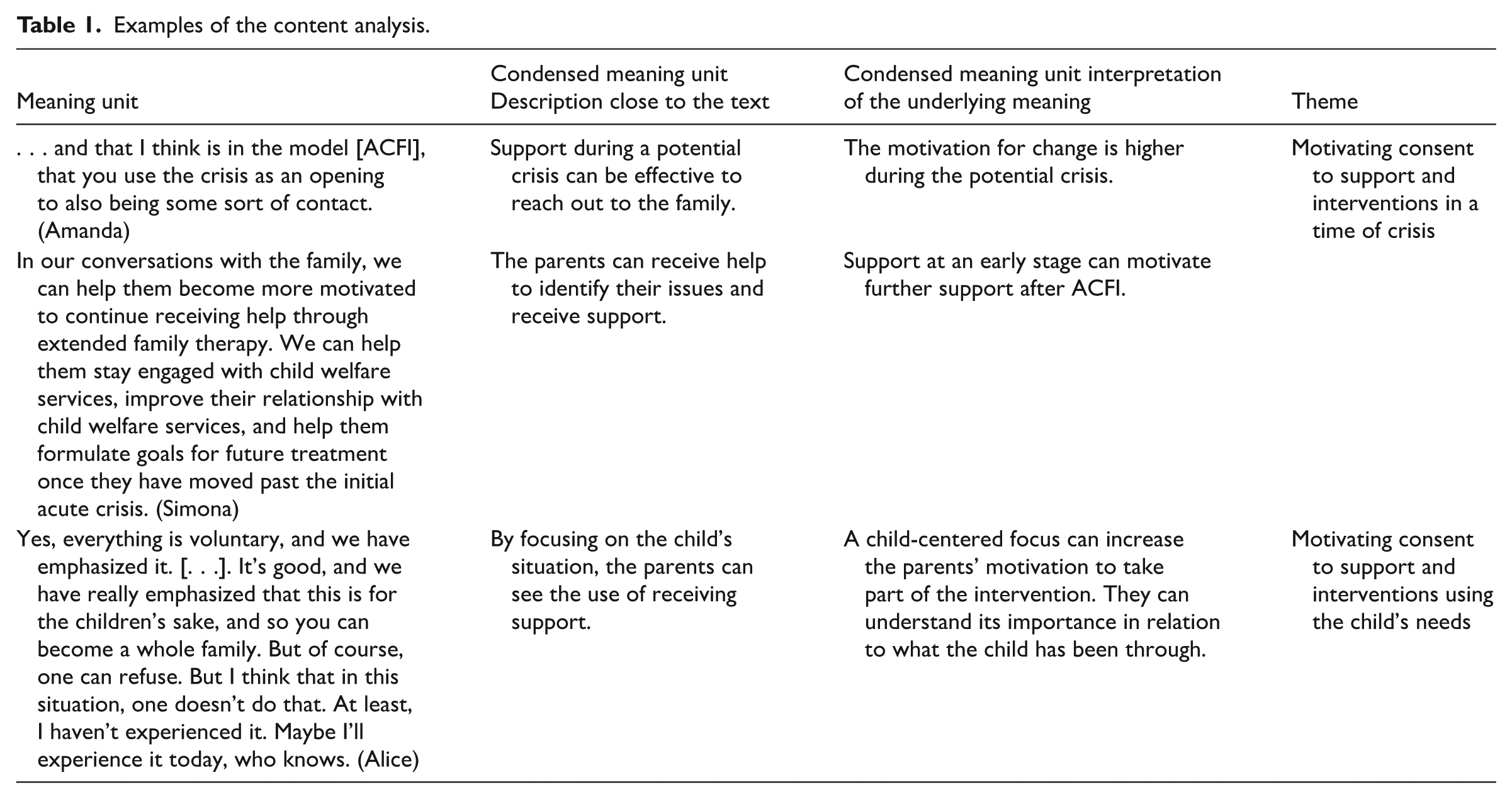
The entire analysis process, and especially the categorization of meaning units into themes, was a dynamic process in which the authors first did the coding and condensing of meaning units separately and then discussed possible themes based on the interpretation. Overall, the authors agreed with each other, but some meaning units that were moved around between the themes, and the names of the themes were revised several times to accurately describe the content. The analysis resulted in two themes related to how to motivate parents to consent to support and interventions for themselves and their children: Motivating consent to support and interventions in a time of crisis and Motivating consent to support and interventions using the child’s needs. These themes were analyzed using a combination of the concepts of motivation, relationship, and timing.
Ethical considerations
The project has received ethical approval from the Swedish Ethical Review Authority (dnr. 2022-00486-01; 2023-00723-02; 2024-03321-02). The participants received both oral and written information about the project, what their participation might entail, and their rights in relation to their participation before giving their consent to participate. The names of the participants and locations have been pseudonymized.
Findings
This section presents the empirical findings in two sub-sections: Motivating consent to support and interventions in a time of crisis and Motivating consent to support and interventions using the child’s needs.
Motivating consent to support and interventions in a time of crisis
According to family social workers, ACFI provides an avenue for early engagement with families during ongoing investigations by facilitating the initial stages of relationship building. Family social workers describe the potential crisis that may arise in connection with the child forensic interview as an opportunity to engage with families and provide support, initially through ACFI and subsequently through other forms of intervention, as illustrated in the following quotes: It’s that we think we’ve got the family on the hook a bit, so later, when support is offered, the job’s already half done. (Filippa) And that I think is in the model [ACFI], that you use the crisis as an opening to also being some sort of contact. (Amanda)
The family social workers often experienced a lengthy wait for the child welfare investigation to be completed, which can lead to a loss of motivation, especially for the parents and possibly the children, increasing the risk of their refusing to consent to interventions and a possible continuation of the abuse. For this reason, as Filippa describes, ACFI can make it easier to get families to consent to interventions later, as they are already “on the hook” or as Amanda describes that the crisis in itself can help in establishing “some sort of contact.”
Reaching out to the families to offer them support already during the child welfare investigation could also help motivate them to consent to interventions after ACFI and the completion of the child welfare investigation. All of the interviewed family social workers perceive the use of ACFI as helping them motivate the parents and pinpointing the kinds of issues they see in the families and to talk about how these issues can be resolved through the support and interventions they can provide, as the following quotes illustrate: But it is a voluntary service, so it’s not something we can coerce to either. But you always try to motivate, but then it can be that [the parents] are separated and one parent needs support but not the other. Or they live together and then it can also be that one feels that he/she needs support, but not the other. Then the other one is not so involved. So, it is a bit different also, well how it looks. But of course, it is always good to motivate when you see that, that it’s needed. (Milla) There are parents [about which] the child welfare officer says “I don’t think he would have come [to the CWS] if you hadn’t talked to him.” Precisely because we have this, we come from a different direction. That they dare to listen to us even if they’ve had bad experiences of child welfare officers or the child welfare services before. (Siri) What we notice is that when we make the home visits, people often tell us, “well it has been hard with [name of the child] and this event and this event happened,” that they describe that there kind of is some truth in what it is about. And then parents are really motivated to work with this problem. And there we have sort of done that it develops towards more and more that we talk to the social worker at CWS and tell them that [the family] wants to come, that they want to come now and talk about this, not just talk about the crisis, the crisis intervention after the child forensic interview, but that they want to work with the problems, that they don’t know what to do when they get really angry. (Hedda). Yes, most of them proceed with continued support [. . . ]. [I]f there has been a forensic interview, then we, that I can say that almost everyone agrees to have Safer Children [an intervention]. I also think that they feel that it’s good to receive continued support and that it becomes a less dangerous way of saying that we understand that it can be really hard, we know that being a parent is the world’s most difficult job. (Hanna)
Based on the quotes, it seems that using ACFI to provide support during the child welfare investigation contributes to the family social workers’ efforts to motivate parents to consent to interventions afterward, as does the building of a trusting relationship, regarding which the timing of when ACFI is offered seems to be a factor. It seems that ACFI is offered at a time when the motivation for support is high as most, according to the quotes, seem to both accept ACFI and continue with other interventions as well.
There are also circumstances in which families are already receiving interventions from the CWS, meaning that no new interventions are being offered. In these cases, as Simona describes below, the task becomes one of motivating the families to continue with the interventions they already have.
In our conversations with the family, we can help them become more motivated to continue receiving help through extended family therapy. We can help them stay engaged with child welfare services, improve their relationship with child welfare services, and help them formulate goals for future treatment once they have moved past the initial acute crisis. (Simona)
In cases when it is uncertain whether additional interventions will be offered, the family social workers using ACFI can help with other aspects, mainly keeping the families motivated and engaged during the child welfare investigation. Like Simona, Alice describes the importance of the relationships that the family social workers build with the families. Alice also describes how the model has helped the families and professionals to talk more openly about violence: We’ve also received a lot of people through open intake, and they’re also more open to talking about violence, and we can have three conversations about violence. So, it’s my impression that we’ve become more open about . . . I may be imagining it, but I think I see in others that they’re talking, that they can talk more openly about violence. (Alice)
Alice also talks about additional outcomes of using ACFI in the form of the families seeming to find it easier to talk to family social workers than to the child welfare officer who is investigating them. This could suggest that the different roles of the family social workers and the child welfare officers affect the kind of relationship they can build with the families, with the family social workers perhaps being able to build a closer relationship because they are not the ones investigating the families. For this reason, the family social workers might be able to act as a bridge between the families and the child welfare officers.
Motivating consent to support and interventions using the child’s needs
The interviewed family social workers describe how they can use aspects of the child’s situation, such as the consequences of abuse for children and their need for support, to help the parents understand the seriousness of the situation, to motivate them to accept support through ACFI, and to consent to CWS interventions after the child welfare investigation is completed. They explicitly focus on the child’s needs and describe the information meeting (part one of the model) as an opportunity for the parents to unload their emotions onto them as professionals rather than onto the children. The parents also receive instructions on how to behave toward their child afterward. The following quotes illustrate how the child’s situation is emphasized in relation to the parents: Yes, everything is voluntary, and we have emphasized it. . . . It’s good, and we have really emphasized that this is for the children’s sake, and so you can become a whole family. But of course, one can refuse. But I think that in this situation, one doesn’t do that. At least, I haven’t experienced it. Maybe I’ll experience it today, who knows. (Alice) The child often have a bit easier to talk about their experiences by themselves and if you do it together with the child ‘how should we talk about this with mummy and daddy’ and then you do it a bit based on the child’s needs for the most part and do they want to meet together with their mum and dad, and then you perhaps meet together a couple of times, and then it is good to meet separate again. (Hedda) Yes, we tell the parents quite a lot to be quiet. That their role is to listen and that we talk about this they for the [child]. [The child] is the one telling with the help and support of the child family social worker. (Ellen)
The family social workers in the quotes are clear that ACFI is voluntary, as well as most other support services from CWS, but with the help of the ACFI model, the children’s needs and experiences are kept in focus to the point that the family social workers tell the parents to be quiet and listen to what the children are telling them.
At the same time, parents are in constant fear of what might happen next in the process. Filippa and Anja, for example, express it as follows: But it’s also when one has felt . . . a case where we sensed that the parents were terrified of the CWS, and then we felt we’re not going to be like that, force ourselves on them, because they were like “yes you can come, you can come and look around, I have to get back to work but you can come afterwards” and so we tried again to explain that the purpose is not control, instead we want to help you. (Filippa) It feels like families are kind of grateful over receiving this help and sort this out and it becomes much calmer because it becomes an incredible crisis for the adults in the family when something like this happens, so it feels like they, we can make a difference and come in and kind of calm down and explain and so. Kind of also that you don’t have to be afraid of the child welfare services, instead that you can receive help. (Anja)
Emphasizing how the children are affected could help motivate the parents to agree to participate in ACFI and interventions after the child welfare investigation. Still, as both Alice and Filippa illustrate, parents in this situation are unlikely to refuse what is offered, which raises the question of whether their motivation is genuine; even if they are not actually forced to participate, they may feel that way and consent because they are suspected of child abuse and are afraid of where the child welfare investigation might lead. This is confirmed to some extent by the quote from Filippa.
Two other family social workers, Bella and Cecilia, describe the importance of keeping the child’s situation in focus, though by building a relationship with the parents: No. One should also mention that it has a lot to do with the preparatory work we do in the information meeting, the safety they feel and the trust they feel, well . . . no, even in the most difficult cases . . . as a family social worker an incredible amount of work goes into alliance building. Alliance, alliance, alliance, alliance, so I put 200 percent effort into it, just so we can keep our focus on the child’s perspective at 200 percent, and so we need to have the parents with us in a good way. (Bella) They try sometimes, but they can’t do that because then we focus back on the child because it is there we are working. It is really the child in focus. So no, [the parents] understand that there is no point. (Cecilia)
If the parents are not on board, there is a risk that the children will not receive the support they need. Building a trusting relationship takes time, and ACFI can help by laying a foundation, especially when all three parts of the model are used. It is clear from the interviews that time is a component of building a relationship, but it is also a limited resource. This is illustrated by the family social workers’ responses that that not all municipalities use the third part of ACFI as intended in the manual (see Elfström et al., 2017). The third part of the model is meant to last a bit longer than the first two parts, for instance, a couple of meetings over a few weeks. Not using the third part limits the time available to build a good relationship. Numerous municipalities replace the intended series of meetings with a single meeting or a follow-up telephone conversation with parents. Amanda and Emilia identify this as a deficiency in how the model is used: About that, I think . . . if there’s something we’re missing, I think it’s that specific part of the model we have, because the child welfare officer is the one who mainly talks with the child. (Amanda) There will still be the adult version in step three—or whatever you should call it—of how the night went. But we’ve actually taken it kind of easy with that after the information meeting and the home visit. So, most of the time we’ve thought it’s probably as the parents say, otherwise we’ve signaled to the child welfare officer if there’s concern that there’s more to it. But you probably can’t rule out that it has become difficult anyhow. (Emilia)
Not using the third part of the model as intended in the manual can be seen as a deficiency in relation to keeping the child’s situation in focus and building a relationship that can keep up the parents’ motivation. If too much attention is given to the parents’ stories, this can indirectly become a confirmation of the parents’ view of the situation, rather than the child’s view. This, in turn, could result in ACFI not having the intended motivational effect, if it means that parents do not recognize their own problems, and how they affect their children. This could also raise the question of how genuine the parents’ motivation is, and whether they are pretending to be motivated to keep CWS from interfering in their lives.
Discussion
This study aimed to address the research question: How do family social workers make use of ACFI to motivate parents to consent to interventions following child welfare investigations? Based on the experiences of family social workers working with ACFI, the model appears to function as a motivator. The family social workers describe factors of the model that they perceive as contributing to the motivational work. These factors are related to the crisis the families may be in and the fact that ACFI is used at that particular time, the opportunity to begin to build a trusting client–professional relationship during ongoing investigations, and the emphasis given to how the children are affected by problems, such as suspected abuse, within the family. These factors will now be analyzed and discussed using the analytical framework.
This study confirms previous research (Dale, 2004; Gladstone et al., 2012; Takaoka et al., 2016) regarding the importance of trusting client–professional relationships in social service interventions. At the same time, it extends existing knowledge by illustrating how ACFI can actively facilitate such relationship building. ACFI operates in a particularly complex context, providing support and motivational work during a period of crisis and concurrent investigations by both the CWS and the police. This means that there are a lot of professionals, with different roles, working with and within the families simultaneously. ACFI offers a clear work division between the CWS workers and the family social workers, where the CWS workers can focus specifically on their investigation and leave all aspects of support to the family during the investigation to the family social workers. This means that the family social workers can start building the trusting relationship needed with the family, bridging the CWS investigation and interventions the investigation results in. This is unique for ACFI, that the family social workers potentially can follow each family throughout the whole social services system, which hypothetically could reduce drop-out thanks to the time spent on building the relationship (Anderson et al., 2019; Heino et al., 2025; Sharf et al., 2010). Based on the family social workers’ descriptions, timing is essential in these types of cases. Timing is understood in terms of aiming to perform an action at a specific time that is favorable for achieving a positive outcome (Lewis and Weigart, 1990; Sorokin and Merton, 1990). Based on this, the family crisis following the child forensic interview can be interpreted as a social event, and the police and child welfare investigations are both processes related to this event. The use of ACFI during this period serves as a window of opportunity when the parents might be receptive and motivated to support and interventions, for example, due to realizing the need for help resolving the issues within the family, but also out of fear of what might happen if they do not cooperate.
As the quotes in the previous section illustrate, ACFI is a voluntary support service, but using the crisis can raise questions about how voluntary the clients’ actions are and concerns about the genuineness of their motivation. The findings therefore highlight a hybrid form of intervention situated between voluntariness and involuntariness—ACFI might be voluntary, but what might happen if the parents say no? For this reason, ACFI may elicit amotivation or extrinsic motivation (cf. Ryan and Deci, 2020). If that is the case, then parents’ motivation to accept support from the CWS may come from something else than a genuine wish for change, such as fear of punishment or an attempt to avoid negative emotions such as shame or guilt. Being driven by amotivation or extrinsic motivation entails a high risk of failure in the long run (cf. Duan et al., 2020). In this case, failure could take the form of withdrawing from the treatment. Therefore, it is important to balance the timing of ACFI with the window of opportunity that might accompany it, but at the same time consider whether the parents’ consent to participate in ACFI is genuine. This study on how family social workers make use of ACFI shows that motivation in CWS cases occurs where the boundaries between voluntary and involuntary interventions are vague, which is an area that is empirically understudied so far in research.
The timing of the use of ACFI also raises ethical concerns. The use of the crisis can be seen as a morally vague timing, where the power imbalance is very apparent and the families are in a vulnerable situation. At the same time, refraining from acting on the information provided by the child is morally problematic. Professionals are obliged to respond to disclosures of violence against children and to ensure that the child receives help and support. This window of opportunity where the motivation from the parents to consent to support might be at its highest, at the same time serves as an ethical paradox where the motivation is crisis-driven.
The last factor raised by the family social workers concerns the role of the children from a motivational perspective. According to the manual, ACFI is intended to be a child-centered model, emphasizing the child’s own narrative of the day of the forensic interview (see Elfström et al., 2017). However, based on the interviews, a somewhat different story could be identified, in which the children’s needs for support and interventions, as well as the overall impact that the suspected abuse might have on them, are discussed to motivate the parents to accept participation in ACFI and consent to interventions after the child welfare investigation. This type of motivation is likely also extrinsic, based on external factors such as fear that the children will be removed from the family if the parents do not cooperate, rather than intrinsic, based on a genuine desire for change (Ryan and Deci, 2020). Still, the family social workers using ACFI perceive that focusing on the child’s experiences—though not necessarily on the child’s own narrative—during the day of the forensic interview, can motivate the parents to consent to interventions for their children and themselves. For this reason, the real motivator might not be the model itself, but rather the relationship that the parents have with their children, and that may help parents recognize their need for external support from CWS to resolve their problems. However, the structure of ACFI might help the parents understand how their behavior can affect the child negatively. Such reasons for accepting support seem to be more in line with what research refers to as intrinsic motivation (see Ryan and Deci, 2020), and may therefore be more likely to lead to a positive outcome. The timing then helps to express the seriousness of the situation, with both police and CWS involvement, and can serve as a turning point for the families, and something which the family social workers can continue to build.
This study also shows that ACFI is rarely used as intended, with the third part of the model being changed or not used at all (see also Thulin et al., 2024). This implementation deficiency changes the logic of the model, where the continued meetings are not used as intended, for example, the ACFI’s role as, for example, a motivator for further interventions from CWS. The third part of the model can contribute with a deepened relationship and understanding for the children’s experiences. This deficiency risks that the motivation stays extrinsic due to lack of time building a trusting relationship, and the missed timing opportunity for the model. This study therefore contributes with knowledge about the risks that might follow if a model is adapted without taking the risks into account, and in the case of ACFI, it can be in the form of less power as a motivator.
To summarize, motivating parents to consent to interventions based on the needs identified in the child welfare investigation is one of the aims of ACFI, according to the manual (Elfström et al., 2017). Based on the findings, it is clear that ACFI is used in a complex context built on the combination of timing, crisis, ongoing investigations, and a simultaneous role division. These mechanisms contribute to building trusting relationships during ongoing investigations and how ACFI can be used as a motivator for continued interventions from CWS. From a victimological standpoint, it is important to reach these families, both the suspected perpetrators and the potential victims, in order to stop the abuse and ensure that those in need receive help and support. Previous research has shown that approximately half of parents refuse support for themselves or their children, thus blocking the child’s right to support (Heimer and Pettersson, 2023). This is an important issue due to the potential consequences of child abuse, and it highlights the need to take all possible measures to ensure that children receive the support and interventions to which they are entitled as victims of crime (Chapter 5 § 11 Social Services Act, 2001:453; European Parliament and Council, 2012; Thunberg, 2020). ACFI could play an important role in increasing the number of parents who consent to support for their children and themselves, but more studies are needed to confirm this.
Limitations and suggestions for future research
A limitation of this study is the small sample and that the interviews come from only 11 municipalities, although ACFI is used in many more. This affects the possibility of drawing conclusions beyond the empirical material, as Swedish municipalities differ in the way they organize and structure their operations, although there are many similarities as well. However, the descriptions show similarities, suggesting that the experiences of the family social workers may not be so different throughout Sweden. Still, the results should therefore be interpreted with caution. This study suggests that ACFI provides an opportunity to support families at an early stage, while the child welfare investigation is still ongoing, which may motivate the parents to consent to further treatment. This study, however, only includes professionals’ perspectives on the use of ACFI and their overall positive experiences. Future research needs to include the parents’ and children’s perspectives and investigate whether they perceive that participating in ACFI has motivated them to consent to additional support in relation to the suspected child abuse. This is important, as research right now is one-sided, where professionals have interpretive authority. Comparative studies are also needed to examine differences between cases in which ACFI was and was not used during the child welfare investigation to determine the motivational effects of ACFI.
Practical implications
The results, building on the family social workers’ perceptions, indicate that support through ACFI during an ongoing child welfare investigation may be beneficial from a motivational standpoint. However, because it is the parents or legal guardians who must agree to participate in support services and interventions, there is still a risk that children will go without adequate support if the parents have little motivation to consent. For this reason, there is a need for more support services during ongoing investigations to keep parents’ motivation high to ensure that children’s support needs are met. Legislative measures might also be needed to make sure that there are more support options for children in situations where their parents do not consent, but CWS determines that there is a need for interventions and coercive actions are applicable. This is especially the case because victimization can have serious consequences, which can be even more severe if repeated (Annerbäck et al., 2012; Cater et al., 2016; Thunberg and Källström, 2018). In a broader context, this study shows that it is possible, and perhaps even beneficial, to begin with support during ongoing investigations to make sure children receive the support they need regardless of reason for the investigations and to further motivate parents to consent to interventions.
Footnotes

Ethical approval
The project has received ethical approval from the Swedish Ethical Review Authority (dnr. 2022-00486-01; 2023-00723-02; 2024-03321-02).
Consent to participate
The participants received information about the aim of the project, what their participation might entail, how their information will be used, including that it will be used for publications, and how they can withdraw their consent, before giving their written consent.
Author contributions
Sara Thunberg planned the study, formulated the aim, and played a major part in the data collection and analysis. She wrote most of the method, findings, and discussion sections.
Lisa Sandelin wrote parts of the theory section, took part in the data collection and analysis, and reformulated and added text to all sections.
Anna Charlotta Petersén wrote the introduction and parts of the theory and discussion sections, and took part in the data collection and analysis. She reformulated and added text to all sections.
Funding
The authors disclosed receipt of the following financial support for the research, authorship, and/or publication of this article: The present study was funded by the Swedish Research Council for Health, Working Life and Welfare (grant number: 2021-02061).
Declaration of conflicting interests
The authors declared no potential conflicts of interest with respect to the research, authorship, and/or publication of this article.
Data availability statement
The data is not openly available due to the sensitivity of the project.