




Abstract
While previous studies have focused on bystander intervention, current understanding specifically in the area of bystander intervention to hate crime is limited. This study seeks to focus on bystander intervention to hate crime in the United Kingdom. This study utilised 10 semi-structure interviews with participants who had personally witnessed a hate crime incident, exploring reasons for intervention, or lack thereof. Results revealed that for some who intervened, the decision to do so often stemmed from an instinctive, impulsive place, whereas for others it was a calculative decision-making process. The findings also reveal that there are various factors which influence participants in deciding whether to intervene. Critically, while all factors were described as pivotal to influencing participants in choosing whether to intervene or remain bystanders, there was no hierarchy of factors which can be generalised. The study concludes that the decision to intervene is a complex multi-faceted process and promotes awareness-raising about the various options available when witnessing a hate crime.
Introduction
A bystander is someone who witnesses a crime unfold but chooses not to intervene and support the victim (Communities Inc Organisation, 2018). Current research shows that many people avoid giving assistance when witnessing crimes, particularly in public settings when other bystanders are present (Darley and Latané, 1968). Exploring bystander responses to hate crime is important not just with the aim of attempting to tackle social injustices but also because the reaction of bystanders is significant in determining a victim’s psychological response to the crime (Rayburn et al., 2003). Research shows that the psychological and emotional impacts of hate crime victims are greater than non-hate crime offences (Iganski and Lagou, 2015). Being a victim of hate crime can have long-lasting effects and can erode quality of life. This hurt is somewhat alleviated when victims feel supported through bystander intervention, with research showing that intervention has a positive impact on the victims, whereas non-intervention heightens the ‘sense of humiliation and isolation’ (Chakraborti et al., 2014: 82).
Bystanders
Despite Bentham (1789) being overly supportive of implementing a general duty to rescue, there is no legal duty to intervene nor help another citizen in need within the United Kingdom. Bad Samaritan Statutes are not in existence in the United Kingdom, and there is no legal expectation to help another citizen in peril. This system is contrary to other countries such as Italy, France, and Germany, who have established a legal duty to rescue another citizen. As Cicero (44 BC) wrote over 2000 years ago: One who does not defend against or prevent the occurrence of harm – if it is within his power to do so – is in the wrong just as if he had deserted his parents, friends or country. (I.23)
Bystanders have a broad range of actions available to them, from reporting the incident, to expressing disapproval, to removing the victim from the vicinity, to directly confronting the perpetrator and increasing the potential for personal risk. For example, research on sexual harassment has shown that those witnessing may intervene in varied ways, such as reporting cases of witnessed harassment, stopping an unfolding event, or providing negative feedback to harassers regarding their behaviour (Bowes-Sperry and Powell, 1996, 1999). Bystanders often have the power to stop the situation from escalating (Clarkson, 1996), but frequently fail to execute intervention. In most instances, bystanders are the large majority, whereas rescuers are the exception.
One of the most widely cited frameworks of bystander intervention is known as the ‘Bystander Effect’ proposed by Darley and Latané (1968). The central tenet of this model is that there is a ‘reduction in helping behaviour’ when a bystander is in the presence of other people (Latané and Darley, 1968, 1970). This principle, known as diffusion of responsibility, (that the more people there are in the vicinity the longer it would take for subjects to help) is widely recognised and accepted throughout the literature on bystanders (Darley and Latané, 1968). Latané and Darley (1970) outline two other psychological factors that are thought to facilitate bystander non-intervention. These factors are the fear of unfavourable public judgement; and the belief that if no one else is helping, then the situation must not be as serious as it may seem. When other witnesses are present, the responsibility to intervene is thus ‘shared’ among all the bystanders. Subsequently, the pressure to intervene is no longer placed on one individual, and often results in non-intervention by all (Darley and Latané, 1968).
Latané and Darley (1970) also developed a process model of giving help, which consists of five-stage cognitive steps that a person proceeds through when deciding whether or not to intervene in a situation where someone may be in need of help. First, the bystander must become aware that the situation occurring requires intervention. Second, the bystander must then interpret the situation as one that requires immediate action. Third, the bystander must then take responsibility for the situation and feel a sense of obligation to intervene. Fourth, the bystander must then decide on a course of action to take, such as seeking help or intervening directly. Fifth, the bystander must then take the chosen course of action, whether it be seeking or intervening directly. At the end of each of these steps, the observer may decide not to intervene.
Importantly, Darley and Latané (1968) have claimed that the non-intervention should not be confused with ‘bystander apathy’. Specifically, they report that bystanders do feel genuine concern for the victim and that the bystanders who choose not to intervene have showed more emotion than the subjects who did respond. Many of the non-intervening subjects showed ‘physical signs of nervousness’ such as ‘trembling hands and sweaty palms’ (Darley and Latané, 1968: 382). The inference was then made that non-intervening subjects did not actively choose not to respond, but instead were in a state of ‘indecision and conflict’ which subsequently led to feelings of guilt and shame regarding their non-responsivity. Darley and Latané (1968) concluded that ‘apathy’ is an inaccurate word to describe non-intervening bystanders, as rather than having lack of empathy for the victim, the non-intervention is based on lack of clarity as to how to approach the situation.
Some research shows that in emergency situations (and despite a high number of people present) bystanders are likely to intervene and the ‘bystander effect’ is reduced (Fischer et al., 2006). This is because in dangerous situations, bystanders recognise the urgency to intervene and understand that the costs for not helping the victim increase when there is genuine danger present (Fischer et al., 2006). This is supported by Bennett et al. (2014: 478) who claim that the context of the situation (namely assessing danger levels) has an ‘important influence’ on bystander intervention or non-intervention and must be considered when evaluating bystander behaviour.
While the model developed by Darley and Latané presents some limitations, in that it assumes a linear and orderly process of decision-making (Gaertner and Dovidio, 1986) and does not account for the role of emotions in the decision-making process, which can be a determinant factor in whether or not a person decides to intervene (Fischer et al., 2006), this model is widely accepted as an explanation for bystander behaviour.
What is a hate crime?
Hate crime is defined as ‘a crime which is perceived by the victim, or any other person as being motivated by hostility or prejudice’ based on someone’s race, religious, sexual orientation, disability or transgender identity’ (College of Policing, 2014: 3), an offence which invites similar intervention by bystanders.
The impact of hate crime on victims and communities is well researched (Iganski and Lagou, 2014). Hate crimes inflict greater harm and are more psychologically damaging than crimes that are not motivated by hate (Iganski and Lagou, 2014). Unlike ordinary crimes which do not contain a hateful element, victims of hate crime are attacked because of an immutable characteristic, be it colour, religion, sexual orientation, or another protected characteristic. That characteristic is unchangeable and therefore they are potentially prone to subsequent attacks. This hatred stems from the dislike of ‘difference’ (Perry, 2001: 46). Walters (2011) claims that people who are deemed to be different are feared within society. This is because their presence causes some individuals to feel threatened by those who are ‘different’ as they will intrude on their ‘identity and cultural norms’ (Walters, 2011: 318). Other members of their community are also equally likely to be victimised, hence the term ‘message crime’ (Levin and McDevitt, 1993); these crimes send a message to the community that they could be next. Hate crimes are aimed in sending a message of hate to whole communities, and consequentially cause people of the same identity to feel ‘personally vulnerable’ (Paterson et al., 2019: 995).
Bystander intervention for hate crimes
Some of the more large-scale but rare examples of hate crime intervention specifically are the ‘Rwanda’s Righteous’ who risked their lives in 1994 to save Tutsi Rwandans from the Hutu majority. Another infamous example of intervention of hate crime were the ‘Righteous Among the Nations’: non-Jews who risked their and their respective families’ lives during Nazi Germany in order to save Jews from being exterminated. These people, contrary to the broader population, demonstrated courage, and resourcefulness.
There are some recent smaller scale examples of bystanders’ intervention. For example, in November 2019, a man targeted Jewish children wearing the kippah on a London Underground train (Kottasová, 2019). The other passengers tried to intervene, but the man threatened them. However, a woman wearing a hijab, confronted him in a firm and persistent way, as one of the passengers reported. Some cases of intervention have resulted in serious risk of harm to those who stepped in. For example, during the London Bridge attack in 2019, a man targeted several people with a knife. A bystander stepped in to intervene and used a fire extinguisher to subdue the attacker until the police arrived (Dearden, 2019). Another example of intervention took place in Ireland in 2021, a black man was insulted, threatened, and hit with a hurling stick by two individuals. He managed to escape, when a passer-by intervened (Michael et al., 2022).
Research on bystanders to hate crime is limited. Some research which has focused on identity sharing with the victims shows that those who can identify with the victim of the hate crime, such as being part of the same racial/ethnic minority group, feel more empathy for the victim (Rayburn et al., 2003). This can be due to a ‘shared history of prejudice victimisation’, which means the bystander can relate to the victim and understand the victimisation on a personal level (Rayburn et al., 2003: 1059). Other studies have found contrasting results. Perry and Levin (2009: 176) discovered that students who shared the same characteristics as the hate crime victim (such as being gay, Black, or Muslim), were less likely to intervene. This is because they are aware that they could potentially be the ‘next target’ and wished not to redirect the hate crime onto themselves (Perry and Levin, 2009).
Minimal research about bystanders to hate crime is known from larger studies on Islamophobia, anti-Semitism, and homophobic hate crime. Research conducted on Islamophobic hate crime is mindful of the non-intervention of bystanders. Zempi and Chakraborti (2014) interviewed victims of Islamophobic hate crimes and found that bystanders to Islamophobic incidents by-and-large do not intervene when witnessing a hate crime take place. One respondent stated, ‘there are witnesses all over the place, people are looking but nobody does anything’ (Zempi and Chakraborti, 2014: 67). Another Muslim participant stated, ‘I feel humiliated, and I feel totally alone’, ‘nobody has ever come to my defence’ (Zempi and Chakraborti, 2014: 67). One Muslim female participant described an incident where her hijab was pulled off by a child, and a teacher who had witnessed this incident unfold chose to remain silent (Awan and Zempi, 2020). Another participant suggested that physical action from bystanders is not always needed; even just ‘a phone call to assist the police’ in responding to the hate crime would be valuable and appreciated by victims (Awan and Zempi, 2020: 4). Awan and Zempi (2015) discovered that many victims of Islamophobia were aware of the sheer number of inactive bystanders during their public victimisation, which left them with feelings of helplessness and deterred them from reporting future incidents.
Research conducted on victims of antisemitism (Flax, 2018) revealed the lack of support sensed by members of the public who had witnessed antisemitic abuse (Flax, 2018). By way of example, a Rabbi who was travelling on a full train from Newcastle to London had food and cans being thrown at him by a group of ‘big thug looking guys’ who were singing anti-Jewish songs. He describes the incident: I have never been so scared in my entire life. I had a Berlin 1938 type of feeling. I didn’t know what to do, I didn’t know what was going to happen to me. I was all by myself. The other people on the train pretended to pay no attention whatsoever and did absolutely nothing about it. I was sitting opposite other minorities, and no one stood up, no one said anything about it. (Flax, 2018)
In the research of Flax (2018), there was only one antisemitic incident which was distinct as intervention took place. A couple in their early 20s entered a pharmacy with their dog, in a predominantly Jewish neighbourhood and when the Black female pharmacist stated that no dogs were permitted in the pharmacy, the woman responded: ‘why can’t I bring animals in here, there are Jews allowed in here!’ The pharmacist subsequently chased them out of the pharmacy yelling at them that they are never welcome back (Flax, 2018).
A similar pattern of non-intervention by bystanders to homophobic hate crime was researched by Dunn (2010). In situations where the hate crime consisted of verbal abuse, one homosexual victim reported that ‘I don’t remember hearing anyone say stop it, you’ve gone too far’ (Dunn, 2010: 95). Another participant claimed that ‘there were witnesses, but nobody intervened – perhaps they thought what was happening was relatively harmless or they may not even have noticed it’ (Dunn, 2010: 100). A lack of intervention or support from bystanders is also noted to have deterred some victims from pursuing any help following their victimisation nor from reporting their hate crime experiences (Dunn, 2010).
The impact of intervention/non-intervention
It is widely supported that bystander intervention for any crime has a positive impact on the situation and the people involved (Das, 2016), and this is no more so the case than for hate crimes. Indeed, the impact of the hate crime upon the victim is exacerbated when there are witnesses present who choose not to help (Chakraborti et al., 2014). Specifically, when bystanders choose not to offer any assistance to the victim and ‘turn a blind eye’, a ‘heightened sense of humiliation and isolation’ results for the victim (Chakraborti et al., 2014: 82). Lack of support from society creates increased negative feelings for hate crime victims, such as ‘anger, depression, and helplessness’ (Rayburn et al., 2003: 1057).
Knowing that other people are witnessing the victimisation and not intervening questions our morality as society. An inquiry into everyday experiences of victims of hate crime led by Morrow (2016) highlighted the importance of citizenship and the importance of bystanders intervening. Morrow stated: ‘we can make a change in society by refusing to be a bystander, showing responsible leadership by example and speaking up and being an active citizen’ (Brooks, 2016: 1). According to Morrow (2016), this lack of intervention by the public serves to condone hate crime. It normalises the hate, instead of counteracting this in order to create a more tolerant and less hateful society. Conversely, bystander intervention sends a powerful message that hate crime will not be tolerated. It can also serve to de-escalate, with research showing that if a bystander intervenes within 10 seconds, 50% of the time the incident stops or de-escalates (Craig and Pepler, 1997).
The present study
While there is extant literature regarding bystander behaviour in general, research regarding bystanders of hate crimes specifically, and their reasons for intervening, is scarce. This research will thus consider factors which feature in the decision-making processes for intervention in the context of hate crime cases, and to illuminate considerations which factor in as to whether to intervene or not. This article will aim to broaden knowledge about bystanders’ behaviour in general but more specifically, in the context of hate crime.
Method
This study adopted an interpretative qualitative methodology. In this perspective, data were approached by adopting a constructivist, inductive lens where the researcher aims to understand the subjective meaning that individuals attach to their experiences and how they construct their reality through their interpretation of events (Creswell, 2012). Morrow (Brooks, 2016: 1) notes that qualitative techniques are the ‘most useful approach to understanding the meanings people make of their experiences’ and ‘delve into complex processes and illustrate the multifaceted nature of human phenomena’. A qualitative approach was thus adopted in order to gain a deeper understanding of the reasons behind intervening or non-intervening.
Participants
Ten participants were recruited by posting an invitation through organisations such as Stop Hate UK, West London Equality Centre, Communities Inc and Crime Stoppers. Participants were also recruited by posting an advertisement on the University of West London’s website which resulted in students and members of staff responding to this advertisement. The advertisement specified that participants are required to live in the United Kingdom and to have witnessed a hate crime incident. Of the 10 participants, 7 participants were female and 3 were males. Their ages ranged from 21 to 60. They varied in ethnic, religious, economic, and educational backgrounds. All participants witnessed one hate crime incident, but two had witnessed two hate crime incidents. Therefore, a total of 12 hate crime incidents were analysed in this article. Of the 12 incidents, there were 8 incidents in which the bystander did intervene, and 4 incidents where the bystander did not intervene.
Materials and procedure
Semi-structured face-to-face or videoconferencing interviews were conducted with participants who have personally witnessed a hate crime incident in the United Kingdom. Interviewees were reminded of their right to withdraw at any time and that confidentiality and anonymity will be adhered to. Two principal areas were covered in the interviews. First, respondents were asked to recount the hate crime incident. Second, respondents were asked questions about whether they did or did not intervene in the hate crime incident they witnessed and finally, respondents were provided with the opportunity to explain in detail the factors that pivoted in them responding the way that they had done. Open-ended questions were asked to explore factors which may have influenced their decision as a bystander. Interviews lasted between 30 and 60 minutes. Following the interviews, all participants were given a verbal and written debrief. The research received ethical clearance from the School of Human and Social Sciences Ethics Panel of the University of West London. Participants are referred to as Respondent 1 [R1], Respondent 2 [R2], and so on.
Analytic plan
All interviews were transcribed verbatim. Reflexive thematic analysis by Braun and Clarke (2019) was used to analyse the data. Reflexive thematic analysis reports the ‘experiences, meanings and realities’ of the participants (Braun and Clarke, 2006: 81). The data analysis was conducted with the aim of uncovering the underlying patterns and themes that emerge from the data. Thematic analysis is a method used to identify, analyse, and report patterns/themes, within a data set (Braun and Clarke, 2006). Therefore, the researchers positioned themselves to be open to discovering new insights and perspectives that were not initially anticipated. Identifying common themes across the interviews offers insight of this phenomenon. This approach contributed to a deeper understanding of the psychological and social factors that influenced individuals’ decisions of whether to intervene or not.
The first and second authors independently coded interview transcripts by hand, void of any software, followed by various discussions about the developing themes and agreed quotes. All transcripts, notes and themes adduced from the analysis were collated throughout the research in order to ensure reliability and so to provide an audit trail (Shaw, 2010).
Results
The findings of this study have been grouped into two main sections. The first is the process prior to the point of intervention, whereas the second section focuses on the pivotal factors which influenced the decision to intervene or otherwise. The first section of pre-intervention considers the way participants approached their decision-making. The main themes which dominated at the point of intervention, were the Internal assessment process and The instinctive personality. This section will highlight that for most participants, the decision-making process was absent, and intervening was very instinctive, whereas for a couple of other participants, an internal assessment process was taking place before intervening.
The second section uncovers the pivotal factors which influenced the decision to intervene or otherwise. Intervention and non-intervention were the overarching themes. There were several factors raised by those who had intervened, forming the subthemes. The two main subthemes which were apparent were the need to Seeking justice and Having a shared identity with the victim. The main three subthemes for non-intervention were Being of young age and lacking confidence, Gauging their response depending on the emotional expressions of the victim and Fear of placing themselves at risk. Figure 1 presents the final thematic map, depicting the themes and connections discussed in this section.
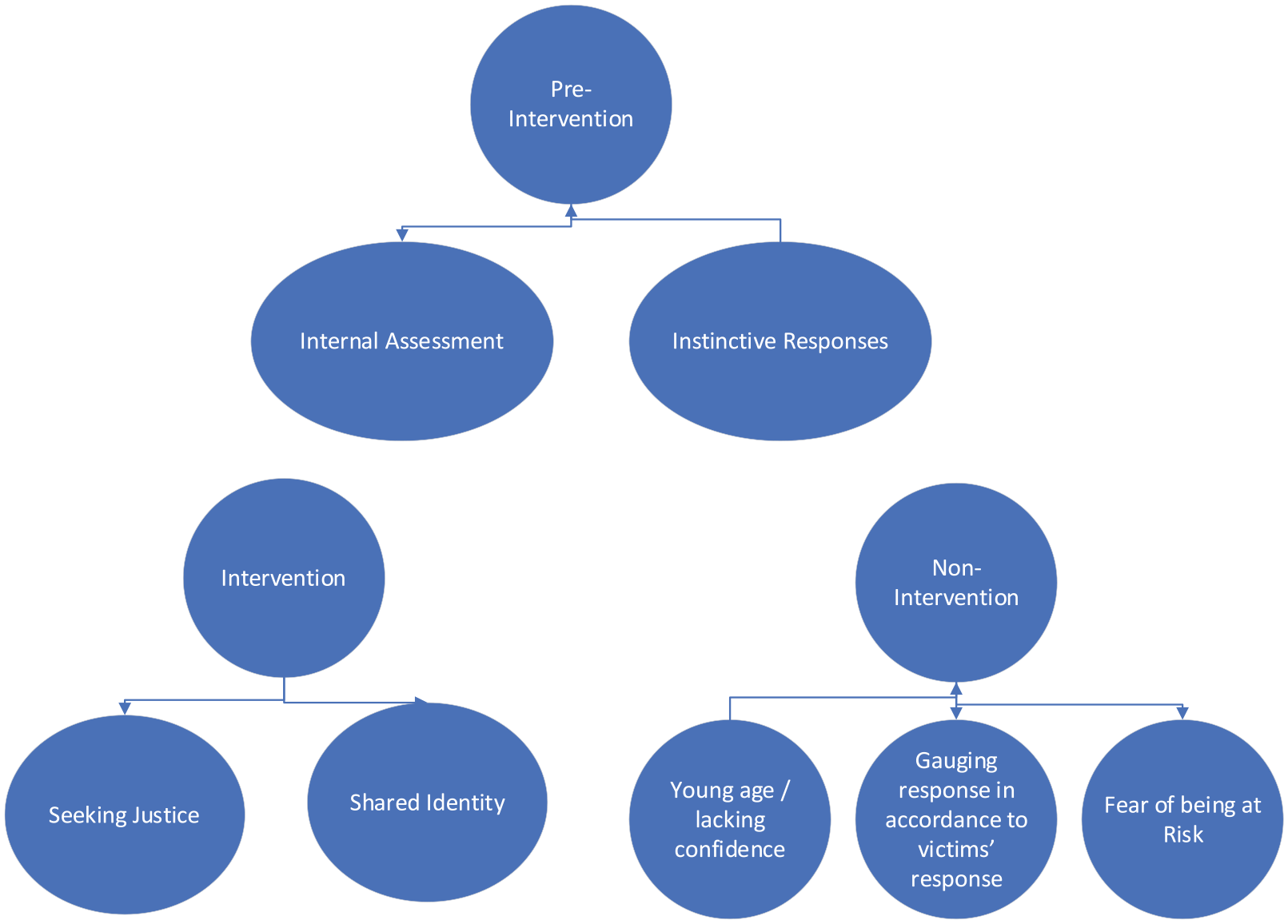
Study’s Thematic Map.
Pre-intervention
Internal assessment
Of the 12 incidents of hate crime which were described, two participants undertook an internal assessment process in deciding whether to intervene or not. These two participants were more measured in their approach and calculated various variables in deciding whether to intervene.
For example, R5 (Muslim Male) was a teacher in a school for violent offenders. R5 overheard the victim, a Muslim teenage girl, being racially and sexually verbally abused by two Black young men in their early twenties. The young men made sexually inappropriate comments to the girl, relating to her wearing a hijab. R5 describes spending a few moments considering the potential risks and repercussions of choosing to intervene.
The girl was shouting back and seemed more than capable to look after herself. She was giving it back to them good and proper. I wasn’t sure that she actually needed me . . . . I had to weigh that up against my own levels of responsibility as a teacher and that I can’t just overlook it. I am responsible for my students and did not want to see her being harmed.
The multiple factors which he considered were first the fact that the victim seemed to be able to stand up for herself and thus was not in urgent need for assistance. Another contributory factor was fear of repercussions from authority, as this incident took place on the grounds of the school that he taught at and finally he considered the effect the intervention could have on his relationship with the victim, as he was her teacher. These multiple factors played in his mind, revealing that an extensive internal assessment was taking place in reaching a decision. R5 concluded that he should get involved and decided to diffuse the situation by intervening verbally. Moreover, working at a school for violent offenders would have a major impact on decision-making to intervene, as this is part of the teachers’ brief at this kind of institution.
R1 (Black Female) also describes an internal assessment process taking place in deciding whether to intervene. R1 witnessed a colleague mocking another colleague’s oriental accent over and over. Despite R1 feeling great discomfort and knowing that it was wrong, she describes the need to carry out ‘an environmental risk assessment’. She describes weighing up: ‘Where was I, who was I, when. What was my place in that situation, what the possible repercussions were, what would be the outcome for the person, all kind of risk assessments’. She continues to describe the factors which she weighted up: If I did intervene there would have been lots of paperwork, writing up a statement . . . the negative and detrimental impact on my friendship with the perpetrator . . . There would have been the outcome, working in an enclosed space . . . it has an impact on the rest of the dynamic . . . and I had to weigh it up against the impact of not intervening.
R1, after weighing up the above factors, chose not to intervene. Therefore, in certain instances, the participants undergo a comprehensive thought process, weighing up various factors, before deciding whether to intervene or otherwise.
Instinctive responses
This theme related to those who did not carry out an internal assessment but who acted from a place of instinctiveness and impulsiveness. By way of example, R2 witnessed a Black male security guard being racially verbally abused and spat at outside McDonalds in Manchester City Centre late on a Saturday night by a white couple. R2 described the incident outside: ‘A security guard from McDonalds was shouting at this couple asking them to get away. They were spitting at him and calling him things like you black ****** fuck off’. R2 shouted at them to stop. This resulted in him being punched in the head by the male perpetrator. He describes: ‘The next thing I know . . . there’s loads of people around me, people, strangers padding my head, blood everywhere, I didn’t know where. . . ’. There were many bystanders but R2 was the only one who intervened. In explaining his actions R2 describes: ‘It’s not something I think about, it just comes naturally, it’s just in my personality . . . it just comes naturally, spurts out of my mouth and there you go’. As a result of this intervention, R2 was treated in hospital for sustaining a head injury and required stitches, reflecting on the very real risk of harm that can emanate from intervening. Despite the physical injuries endured, when reflecting on the incident, R2 stated that he would act in the same way if faced with a similar scenario in the future. This evidences that being at risk of physical harm to oneself would not deter this participant from intervening.
In another incident, R3 (European Female) described an incident where she witnessed two white police officers using unreasonable force and acting aggressively towards a group of Black young teens. The Black boys were riding their bikes down the dark street ‘minding their own business nor causing any disturbance’. She describes that the ‘white police officer told the young boys to get off their bikes immediately and the officer pulled and twisted the wrist of one of the boys’. R3 describes feeling very upset with the abuse of power by the police officer and states: I felt so protective. I felt that I just had to do it. There are some situations in life, that no guns or armour would have stopped me from doing it (intervening) . . . I would be happy to interfere over and over . . . It doesn’t matter who they are’.
This section has highlighted that for some participants there is a measuring up process in deciding whether to intervene, with a myriad of factors that are considered by them at this point. For other participants, it is an instantaneous and impulsive act, with very little thought process.
Choosing intervention or non-intervention
This theme depicts the choice that the bystanders made. The majority of participants in this research chose to intervene. Of the 12 hate crime incidents, there was intervention in eight of these. This section will consider the factors which were pivotal in intervening, followed by factors which were raised as explanations for non-intervention.
Those who did intervene
The overarching theme of intervention is supported by two subthemes. The two main factors which were raised by those who had intervened were the need to pursue justice and having a shared identity with the victim.
Upon reflecting on his childhood, R2 had presented behaviour of a protective and instinctive nature throughout his life. He recalled an incident in his childhood whereby he hit another child with a spanner at just five years old, to protect his cousin who was being bullied. He recounts that he has consistently been someone who is unafraid to intervene and acts in accordance with what he believes to be just.
Similar perceptions were described by R5, who intervened in an incident which took place on the school grounds for convicted violent adolescent offenders. In this incident, the participant was aware that getting involved could subject him to backlash from the victim who has a background of violent behaviour, but chose to intervene. Both of these participants, one acting impulsively and the other being more measured, resolved on the importance of pursuing justice. R5 describes: I have a thing about justice and being just. If I see someone being unjust, I really dislike it. To anyone, to animals, to children, to anyone of any race or sexuality. (R5, Muslim Male)
In another incident, R4 (White Female), sat in a coffee shop with her Korean female friend during the beginning of the COVID-19 pandemic. A white man in his 60’s slammed his coffee cup onto the table shouting: ‘It’s all because of you, go back to your own country’ referring to the COVID-19 outbreak. After a short exchange of words, in an attempt to diffuse the situation, R4 suggested to her friend that they should leave the coffee shop. The perpetrator continued to follow them and R4 turned to him in anger and said: ‘If you don’t stop following us, I will throw this boiling coffee on your face’. R4 felt very protective and sensed an heightened sense of injustice. R4 explained that she was raised with an acute awareness of the need to support others. She describes: My father always taught me that if you see something wrong going on and you don’t do anything about it, then you are as guilty as the person doing it . . . . It has been rooted in my brain since I was quite young so for me, it’s just something normal and natural.
Research on intervention highlights that individuals who have been modelled interventions, are more likely to respond quickly and face fewer hurdles in determining whether to intervene (Bandura, 1986). This is due to them having been taught how to respond and when to take action, and because their inhibitions to intervene have been lowered. R4 is a prime example of someone who has been taught behavioural patterns which she is comfortable in remodelling.
In a further incident R8 (White Female) was working in a retail shop, serving a customer at the till. The customer, a middle-aged white man said to R8: ‘By the way, that girl over there, she stinks and people like her shouldn’t be working in place like this’. The customer was referring to the participant’s Somalian colleague, who was wearing a hijab. Despite the victim not being within earshot to the abusive comments, R8 intervened by telling the customer that his comments were not welcome and that he should leave the store immediately.
I was not just going to stand there and listen to his discriminatory remarks. I had to step in and support my colleague in some way. I would have been very upset with myself if I did not ask him to leave the store. I would have OK’d that kind of behaviour.
R8 often stands up and defends minorities who do not have the power to defend themselves but recognises that it is part of her privilege of being a white person. She explains that she tries her best to educate family members on topics such as Black Lives Matter, the refugee crisis etc.
It can be drawn out from this subtheme that some participants have an innate attribute which triggers in them the need to intervene when they witness injustice or inequality. Their perceptions on morality stem from their natural character traits as well as the way they have been raised. For some, this pursuit of justice and correcting the wrong which has been done is paramount.
I was the only Muslim who could have related, so I felt I had to intervene . . . I just related to this personally . . . You are feeling the same anger they are feeling and so it is natural for you to act or intervene . . . He is making remarks about me sort of . . . Even though he is not saying it to my face, he is saying it about me or about my family or my religion. (R6, Muslim Female)
This quote supports existing literature on hate crimes being ‘message crimes’ (Levin and McDevitt, 1993), affecting all members of the victims’ community. Even though the victimisation was not targeted at the bystander directly, it was received very personally by others from the same community
Religious and ethnic groups share common experiences of prejudice and discrimination, which can create alliances between them when witnessing a member of their group be subjected to hate crime victimisation. R6 frequently used the word ‘we’ when discussing other Muslims, emphasising the cohesion and solidarity between members of the Muslim community. Although she did not personally know the victim prior to this incident, she had an immediate affiliation to her because of their religion. This connection between people with a shared minority status is well documented in research on hate crime (Paterson et al., 2018). Craig (1999) also found that people who can identify with the victim, due to sharing a minority status, are likely to have a more emotional response to hate crimes, due to a ‘shared history of prejudice victimization’ (Rayburn et al., 2003: 1059).
R5 provided further evidence for this. When witnessing one of his students being verbally abused, R5 hesitated to step in when the abuse was directed towards the victim’s identity as a woman, but as soon as the verbal abuse became relevant to their shared religion, namely being Muslim, he stepped in. This highlights that it was the shared identity with the victim which increased bystander intervention.
It’s a human nature thing. I think if you have an affinity towards something specifically, it’s more likely to play in your mind when you hear those kinds of things . . . For me, I am always a Muslim, and I always know Muslims and I always have that affinity towards them . . . When I hear something about my religion it plays more in my mind kind of thing. So that was the thing I stepped in for. (R5, Muslim Male)
These assertions are in line with Social Identity Theory which maintains that individuals are more likely to provide support to those in their in-group, compared to those in their out-group (Tajfel and Turner, 1979). This is supported by the study of Ghumman et al. (2016) who stated that observers are most likely to intervene when sharing the same religion as the victim.
This subtheme highlights that support by bystanders is more likely to result if an identity is shared as notions of solidarity may outweigh any apprehension of intervention.
Those who did not intervene
Of the 12 incidents of hate crime described, there was non-intervention in four out of the 12 incidents. Of interest, none of the three factors described by Latané and Darley (1970) which facilitated bystander non-intervention (diffusion of responsibility; fear of unfavourable public judgement; and the belief that if no one else is helping, then the situation must not be as serious as it may seem) were raised by any of the participants. Three subthemes were evident from the narratives of the participants as factors for non-intervention: being of young age and lacking confidence, gauging their response depending on the emotional expressions of the victim and fear of placing themselves at risk.
The attack was so nasty. I knew I had to do something, but I did not have the courage to step in. I was young and immature. I was timid and froze. I did not have age, life experience and maturity in my favour.
R10 described similar feelings, referencing that she was very young at the time of the incident and did not have the confidence to intervene. Both these participants explained that since those incidents, they have matured in confidence and feel that they would act differently and intervene in any future hate incident they may witness.
For me it’s all just about confidence, I think I feel strong enough now in myself, because I was quite vulnerable at the time. (R9, Asian Female) At the time I knew it was wrong, of course I knew it was wrong, but I was young then and I didn’t have the confidence to challenge someone (R10, White Female).
These statements reveal that the participants were fully aware that intervening was the right thing to do but were held back by their lack of confidence and their young age.
If the victim themselves are not taking it seriously then that just makes you think okay, they are not caring about it . . . You can tell when someone needs help, either with their facial expressions or their body language or whether they actually say something. (R6, Muslim Female)
Similarly, R1 also referred to the victim’s response in deciding whether to intervene. R1 made an assumption that the victim was accustomed to this type of treatment to justify her non-intervention. She described: I had to weigh up between what was going to happen to me and what was going to happen to the victim, and it was pretty much, well I’m sure she has heard something like this before, so I figured that she would be OK. (R1, Black Female)
She conceived that as this incident did not seem to have a serious impact on the victim, it was deemed not to be necessary to intervene.
The extent of impact on the victim as a decision-making factor is versed in current literature. Ghumman et al. (2016: 279) state that observers show higher levels of intervention when ‘emotional reactions are high’. In addition, Greitemeyer and Mügge (2013) found that when a bystander perceives their contribution to be unnecessary, they do not intervene. The response of the victim and its respective expressions of severity allows participants to gauge whether the incident is serious and warrants intervention.
I only see things in high risk and unknown risk now unfortunately. I weigh everything up in terms of risk. (R1, Black Female)
Other participants also raised fear to themselves as a factor. R9 describes: ‘in the back of my mind, there is always that fear, because you know knife crime is at an all-time high and things like that, if you intervene what would happen’. R10 (White Female) recounts an event whereby she was in an underpass and a white girl and Black boy were holding hands. A group of four skinheads started beating up the Black boy quite violently. She describes being weary of the level of risk she would have placed herself had she intervened: I was afraid of course . . . you are not challenging one person, you are challenging four people, and they all happen to be male . . . you’re putting yourself in a very difficult position . . . you have to be careful because you don’t know what you are stepping into’.
Therefore, weighing up the risk to oneself is a factor which cannot be overlooked in assessing whether to intervene or not. This is in line with existing literature which has acknowledged the significance of fear on bystander intervention levels, with Zhong (2010) revealing that a bystander’s fear of crime can discourage their intervention.
Discussion
The aim of this study was to provide more insight on bystander intervention specifically in response to hate crime incidents. Uniquely, it is the first study to explore the views of witnesses to hate crime incidents, thus providing novel insight in this area of research. The study has highlighted various factors which are pivotal to intervening, extending the scope beyond the work of Latané and Darley (1970). Bearing in mind the greater psychological distress illuminated by victims of hate crime, which is exaggerated when bystanders choose not to intervene, awareness raising is crucial in empowering bystanders.
This article is an important step in starting to understand the responses of bystanders to hate crime. This article acknowledges that some participants act from an instinctive impulsive place, whereas others apply a far more calculated decision-making process before deciding to intervene. This research has highlighted those instinctive personalities are more likely to intervene. This is in line with wider research on sexual harassment which shows that individuals who have strong emotional reactions to incidents are more likely to take immediate intervention action (Bowes-Sperry, O’Leary-Kelly, 2005). Individuals who have intense negative emotions will be more predisposed to act out, as this will help them manage their strong emotions (Weiss and Cropanzano, 1996). The participants who adopted a more instinctive response, opted to take action, such as challenging the perpetrator or taking an active and pertinent role in the hate crime incident. In those incidents, it was apparent that the participants wanted to see an end to the victimisation and felt that being party to the incident was important.
Analysis revealed several factors which influence witnesses’ perceptions regarding intervention or non-intervention. Justice seeking and correcting a wrong which has been done emerged as a dominant catalyst for intervention. This is in line with previous research exploring the attributes that distinguish active bystanders. For example, for children and youth bystanders of episodes of bullying, a sense of social justice appears to be a strong motivator to intervene in support of the victims (Cappadocia et al., 2012). When active bystander children and youth were asked what motivated them in standing out for others, ‘most reported that they intervened because no one deserves to be bullied and/or bullying is not fair’ (Cappadocia et al., 2012: 209–210). Similarly, in studies conducted to investigate bystander intervention against homophobic behaviour, the findings indicate that hight moral and justice sensitivity and empathy are associated with engaging in defending the victims (Carlo, 2006; Forsberg et al., 2014; Poteat and Vecho, 2016). Bystanders are also more likely to intervene if they have a shared identity with the victim. This is supported by other research on intervention in cases of sexual harassment. Bowes-Sperry and O’Leary-Kelly (2005) and Darley and Latané (1968) show that friendships and feelings of similarity with the victim of harassment will influence intervention. In accordance with Social Identity Theory, findings from this study also showed the individuals are more likely to provide support to those in their in-group, compared to those in their out-group.
Factors which were raised in support of non-intervention were being of young age and having low levels of confidence. With gained life experience and a growing maturity, these participants believe they would respond differently if they were confronted with the same incident. Gauging their reactions based on the victims’ emotional response was another contributory factor, with a more emotional victim triggering a heightened reaction by the bystander and vice versa. This research is in line with the studies on religious harassment studies which show that higher levels of interventions are more likely when the victim seems distressed (Ghumman et al., 2016). Another factor which was pivotal to not intervening was the fear of placing oneself at risk, this acting as a deterrent to intervention. This was in line with the research of Zhong (2010) which revealed that a bystander’s fear of crime can discourage their intervention.
Thus, the key contribution which this study makes is that there are various factors which influence the witnesses’ perceptions regarding intervention or non-intervention, recognising that bystander intervention in hate crime incidents is a multifaceted complex phenomenon which cannot be compartmentalised. While there are various factors which are pivotal in influencing participants in choosing whether to intervene or remain bystanders, there is no hierarchy of factors which can be generalised. Various considerations are given dissimilar weight by different participants and a hierarchy of factors cannot be generalised.
This research was an exploratory piece of research, ensuring that participants will not have a prescriptive list of factors which may have swayed them in favour or against intervening. In allowing participants to allude to the factors which were pivotal to them, no mention was made of the original framework laid out by Latané and Darley (1970). The three factors which facilitated bystander non-intervention (diffusion of responsibility, fear of unfavourable public judgement, and the belief that the situation must not be as serious as it may seem) were not alluded to by any of the participants. It is of interest to note that this research did not replicate the classical framework developed by Latané and Darley. It is feasible that the framework suggested by Darley and Latané (1968) was not replicated because of the nature of the conduct of hate crime. Hate crime is very targeted and filled with embedded prejudices, and it may be that different theoretical explanations are needed here.
The findings from this study have important implications for those working within the sector. The findings speak towards a wider need around awareness-raising of the positive effects which intervention has on victims of hate crime. There is a need to educate the public regarding the possible options available when witnessing a hate crime. The public should be made aware of the various options available other than putting oneself at risk when intervening. Raising public awareness around the negative impact which rests with victims of hate crime and on the other side, the positive feelings which ensue when there is intervention, would act as a catalyst for intervention.
A further implication which falls within the awareness raising process is that the public should be educated about the various forms which hate crimes can take. There is significant ambiguity around people’s understandings and definitions of hate crime. Hate crime incidents are clearly prevalent in modern society, and yet seem invisible to some; resulting in bystanders not recalling them or deeming them important enough to step in. Therefore, for a bystander to recognise their role as a bystander, they must first be able to fully identify the incident as a hate crime incident.
It is important to note some limitations to this research, with one limitation being that the response rate in this research of participants is more likely to stem from those who did intervene in the incident they had witnessed. This is because bystanders who chose to intervene are more likely to be able to recollect the events and are more likely to have the desire to speak out about the incident due to feelings of pride in their intervention. An inactive bystander who is disappointed with themselves for not intervening, may not be interested in recalling those events. Future research, to provide further support for these findings on a wider scale, is needed.
This study provides a crucial first step in understanding bystander intervention in situations involving hate crime. It demonstrates that previous theories explaining bystander intervention may not be applicable to these very specific and unique incidents. Moreover, findings have revealed myriad factors weighed by bystanders when deciding whether to intervene, and they highlight the importance of spreading awareness regarding the significance of intervening. Lack of intervention sends a message to victims that hate crime incidents are condoned and may even create an environment which is encouraging to hate crime. It questions our morality as a society, whereas intervention promotes the notion of social community and enhances cultural sensitivity among society. It is therefore crucial that we continue to further understand the mechanics of intervention in these circumstances and empower bystanders to do so.