




Abstract
Previous research has established correlations between anti-LGBTQ hate crime, fear of crime, perceived victimization risk, and the concealment of sexual orientation. Aside from correlations, the relationships between these variables remain poorly understood. Therefore, the aim of the present study is to explore the relationships between anti-LGBTQ hate crime, perceived risk, and the concealment of sexual orientation in relation to fear of crime. Based on previous research and theory, the authors hypothesize (1) that experiences of hate crime victimization increase fear of crime, perceived victimization risk, and the concealment of sexual orientation; (2) that high levels of perceived risk result in high fear of crime and a more prevalent concealment of orientation; and (3) that the concealment of sexual orientation results in lower fear of crime. The sample consists of LGBTQ students enrolled at a Swedish university. The study uses a mixed method approach, combining survey data (N = 353) and interview data (N = 10). The data are assessed using path analysis and thematic analysis. The path analysis supported the authors’ hypothesis regarding experiences of anti-LGBT hate crime, perceived risk, and fear of crime. The qualitative analysis showed that victims of hate crimes had a reduced ability to process negative emotions because they experienced other traumatic life events parallel to the victimization. Similarly, feelings of being reduced to a negative stereotype resulted in higher levels of both fear of crime and perceived risk. Finally, the path analysis rejected the hypothesis that the concealment of sexual orientation results in lower fear of crime. Rather than being an agency-driven and functional fear response, the interview data showed that while these practices reduced victimization risk, they negatively impacted the overall health of the participants through feelings of lack of authenticity and self-censorship.
Introduction
Fear of crime is at the forefront of victimological research but remains understudied in relation to hate crime against LGBTQ people. Fear of crime has wide-ranging consequences, including damage to psychological well-being on an individual level and reduction in collective trust and cohesion. Those are in turn linked to populist politics and harsh policies (Skogan, 1986; Stafford et al., 2007). Previous research has established correlations between anti-LGBTQ hate crime, fear of crime, and perceived victimization risk (Doude and Cook, 2023; Herek et al., 1999; Meyer and Grollman, 2014; Otis, 2007; Tiby, 1999). However, aside from correlations, the relationships between these variables remain poorly understood. Qualitative interview studies with LGBTQ people have repeatedly shown that perceptions of victimization risk are often intimately linked to visibility and practices of identity concealment (Meyer, 2010; Perry and Dyck, 2014; Tiby, 1999). Perceived risk of victimization among LGBTQ people and its links to practices of identity concealment has not been explored in quantitative research.
The overall aim of the present study is thus to explore the relationships between anti-LGBTQ hate crime, perceived risk, and the concealment of sexual orientation in relation to fear of crime. We will utilize a combination of quantitative and qualitative analysis (Hall and Howard, 2008) using a sample of Swedish LGBTQ students. The study thereby makes an important contribution to the field by developing and assessing measures that more adequately correspond to how fear of crime is lived and experienced by LGTBQ people.
Literature review
Key concepts in fear of crime
Individual fear of crime is broadly defined as the frequency and intensity at which the individual worries about falling victim to a crime (Newburn, 2017). This worry can be specific to crime types (e.g. burglary) or crime in general, although the measures of intensity are considered less accurate for research purposes (ibid.).
Recent studies differentiate between the concepts ‘perceived risk of victimization’ and ‘fear of future victimization’. Perceived risk is predictive of fear of future victimization and generally moderates the relationship between established predictor variables and fear of crime (Collins, 2016; Otis, 2007). For example, Otis (2007) found that predictors of fear of crime lost their significant effect in regression models when perceived risk was included but were significantly correlated with perceived risk itself, suggesting that the effects of the predictors are of an indirect nature.
A useful tool for understanding these dynamics in a more detailed manner is Warr’s model of ‘sensitivity to risk’ (Warr, 1984, 1987). Sensitivity to risk describes the amount of perceived risk necessary to produce fear across different groups (Warr, 1984) and crime types (Warr, 1987). For example, since the outcomes of being the victim of rape and being the victim of a bike theft differ greatly in perceived severity, a person might still have a greater fear of rape despite knowing that the probability of bike theft is greater than that of rape. While the results of these investigations were not generalizable across different groups (e.g. genders and age groups; differences were observed but not in a way that clearly supported any theoretical hypotheses (Warr, 1984)) the differences across crimes (mainly murder, burglary, theft, and rape) were well distinguishable, corresponding to the perceived severity of the crime (Warr, 1987).
These findings were reproduced more recently by Jackson (2011) and Chadee et al. (2007). Chadee et al. (2007) utilized a FearAllCrimeIndex to compare risk sensitivity among men and women and across age groups, finding no significant differences. Beyond the reproduction of results, Jackson (2011) found significant differences in risk sensitivity across different types of crimes and, furthermore, included the concept of perceived control over the risk of victimization. He found that perceived control mediates the relationship between perceived risk and fear. The variables form an intertwined relationship in which the level of control perceived by an individual impacts the relationship between the risk they perceive and the fear they experience (Jackson, 2011). Other research observed the same effect, where perceiving higher risk can lead individuals to adopt risk-mitigating behaviors which decreases their fear (Doude and Cook, 2023).
In a recent meta-analysis, Collins (2016) reviewed 114 studies and found that the most stable and strongest predictors for heightened fear of crime were being female, having previous experience of victimization, and living in a neighborhood with high crime rates or physical incivilities. The strongest predictors for a lower fear of crime were being white, living in a neighborhood with high social efficacy, and satisfaction with the police (ibid.).
While the negative effects of fear of crime on life quality, individual freedom, and psychological well-being are well-established, it is worthwhile making a distinction between functional and dysfunctional fear (Jackson and Gray, 2010). The operationalization of these concepts involves examining how much the respondent’s quality of life is affected by fear (ibid.). In contrast to dysfunctional fear, which restricts the individual, functional fear can be a motivator for problem-solving and adaptive behavior that in turn reduces dysfunctional fear. Similar findings have been replicated among sexual minorities, for whom previous victimization led individuals to adopt protective behaviors that reduced their fear of crime (Doude and Cook, 2023). Jackson and Gray (2010) found that previous victimization was a predictor of dysfunctional fear.
Anti-LGBTQ hate crime and fear of crime
To the authors’ knowledge, the concepts of sensitivity to risk (Jackson, 2011; Warr, 1987), functional fear, and dysfunctional fear have not been examined empirically in relation to anti-LGBTQ hate crime (Jackson and Gray, 2010). However, there is available research that looks more broadly at the relationship between anti-LGBTQ hate crime and fear of crime.
In their pioneering studies about homophobic hate crime, Herek et al. (1999) showed that homosexual men and women with experiences of homophobic hate crime reported elevated levels of fear of crime, depression, traumatic stress, anger, and perceived vulnerability when compared to victims of nonbias crime. While there is some variation in the self-reported prevalence of hate crime victimization among sexual minorities, most quantitative studies point to a lifetime prevalence of approximately 30% (Burks et al., 2018; Cramer et al., 2018; Herek, 2009; Tiby, 1999). Research points to within-group variation, with homosexual people at higher risk of victimization than bisexuals, and men at higher risk for victimization than women (Burks et al., 2018; Cramer et al., 2018; Herek, 2009; Tiby, 1999). Additional research also highlights intersectional aspects, for example, overlaps between non-normative gender expression and additional risk for those who belong to racial minorities (Cramer et al., 2018; Flores et al., 2022; Meyer, 2008, 2010; Paterson et al., 2019).
Furthermore, sexual minorities rate their victimization risk as higher due to their minority membership. As an example, results from the British Crime Survey show that 46% of lesbian, gay, and bisexual participants believed they were at greater risk of being subjected to physical violence than heterosexual people, and 72% of lesbians believed they were at greater risk of being harassed or insulted due to their orientation (Dick, 2009). However, perceived risk has not been assessed in relation to fear or other detrimental outcomes of victimization.
In line with the early research, recent studies describe the negative impact of anti-LGBTQ hate crimes (Flores et al., 2022; Herek et al., 1999; Mellgren et al., 2021; Paterson et al., 2019). Interview studies have outlined the emotional and behavioral impacts that follow in the wake of hate crimes among LGBTQ persons. Victims describe becoming both physically and mentally hypersensitive to reminders of their victimization, sometimes in the form of physical reminders of injuries and in other instances by being mentally vigilant (Meyer, 2010; Perry and Dyck, 2014; Tiby, 1999; Willis, 2008). Vigilance is described as a constant scanning of the surroundings to identify potential threats. A qualitative study with homosexual men further showed that hate crime had a profound effect on their ability to form intimate relationships, with the author stating that ‘at the time of the study, none of the participants had been able to form intimate relationships since the time of their hate crimes’ (Willis, 2008: 579). Similarly, the trans women in Perry and Dyck’s (2014) study described how they isolated themselves as a strategy to avoid victimization. While these questions remain unexplored, empirical results pointing to more detrimental outcomes for victims of anti-LGBTQ hate crime suggest that the presence of a hate motive might work as an LGBTQ minority-specific measure of perceived severity, as initially developed by Warr (1987).
Moreover, quantitative studies show that LBGTQ people are more likely to alter their behavior post hate crime victimization when compared to religious and racial minorities (Dick, 2009; Mellgren et al., 2021), and participants in interview studies have described the restrictions on their freedom experienced post hate crime as one of the worst impacts (Willis, 2008). In addition, results from the British Crime Survey showed that 32% of the homosexual and bisexual groups reported that they try to conceal their orientation to be safer (Dick, 2009).
While these negative impacts are well researched and rehearsed, and there is ample evidence showing that anti-LGBTQ hate crime has an impact on fear of crime, perceived victimization risk, and identity concealment (Doude and Cook, 2023; Herek et al., 1999; Meyer and Grollman, 2014; Otis, 2007; Tiby, 1999), no study has to date systematically assessed these different concepts in relation to one another. The recent literature further stresses the lack of empirical data on LGBT people’s fear of crime (Doude and Cook, 2023). The present study aims to remedy these shortcomings.
Anti-LGBTQ hate crime and LGBTQ health in the Swedish context
In the Swedish context, Tiby (1999) was the first to study homo- and transphobic hate crime. Her results showed that experiences of homo- and transphobic hate crime had a lasting impact on the victims in the form of heightened fear of crime and general vigilance. Tiby’s (1999) study had a significant impact on Swedish hate crime legislation, which at the time only provided protection for crimes based on race, skin color, national or ethnic origin, and religion (Proposition, 1993/94:101: 6). Her results led to a legislative change in 2002, which included sexual orientation (Proposition, 2001/02:59). However, almost two decades passed between the publication of her study and the inclusion of transgender identity or expression as a basis for hate crime in 2018 (Proposition, 2017/18:59).
Since the completion of Tiby’s (1999) research on hate crime toward LGBTQ people, the link between anti-LGBTQ hate crime and broader ill-health and fear of crime among Swedish LGBTQ people has remained unstudied. Research and governmental reports have focused on health and living conditions among Swedish LGBTQ people (Björkenstam et al., 2016; Clark et al., 2021; Donahue et al., 2017; Folkhälsomyndigheten, 2020; Forte, 2018; MUCF, 2022; NCK, 2017).
Broadly speaking, the LGBTQ movement in Sweden has gained ground in improving civil rights for LGBTQ people, especially since the 2000s. Since 2005, same-sex couples have been allowed to make use of insemination procedures, and since the implementation of a gender-neutral marriage and partnership law in 2009 (Regeringskansliet, 2023), they have enjoyed the same marriage and partnership rights as heterosexual couples. In addition, protection against discrimination due to sexual orientation was included in the Swedish constitution in 2011. Civil rights for transgender people, however, have usually taken longer to implement and been met with stronger opposition. An illustrative example is the way sexual orientation was included in the hate crime legislation in 2002 (Proposition, 2001/02:59), whereas transgender identity or expression was only included in 2018 (Proposition, 2017/18:59). Similarly, the forced sterilization laws practiced as part of a eugenic ideology were abolished for all groups except transgender people in 1976. The practice continued until 2013 and was only abolished after a group of trans activists sued the state of Swedish for being in violation of the European Convention of Human Rights (Proposition, 2012/13:107; Stiernstedt, 2013).
Over time, LGBTQ populations in Sweden have consistently reported poor health levels compared to other populations (Folkhälsomyndigheten, 2020; Forte, 2018; NCK, 2017). For example, studies and governmental reports alike show that Swedish LGBTQ people are more likely to suffer from depression, self-harm, eating disorders, suicidal ideation, and suicide attempts (Björkenstam et al., 2016; Clark et al., 2021; Donahue et al., 2017; Folkhälsomyndigheten, 2020; Forte, 2018; MUCF, 2022; NCK, 2017). In addition, a recent survey found that 18% of Swedish LGBTQ youth stated that they had been subjected to some form of conversion attempt (MUCF, 2022). Five percent had been subjected to severe forms of conversion attempts, such as conversion ‘therapy’, threats to be taken abroad against their will if they did not change, or forced heterosexual marriage (MUCF, 2022). Similarly, a recent quantitative study on health among trans people in Sweden found that 36% of the respondents reported serious suicidal ideation during the past 12 months. The rate among trans youth aged 15–19 years was even higher (57%) and can be compared to the population average in the same age group, which is 7% (Folkhälsomyndigheten, 2020).
Summing up the literature review, there is ample evidence that sexual minorities experience higher levels of victimization frequency and fear of crime, and suffer more consequences of victimization than the heterosexual population (Doude and Cook, 2023; Katz-Wise and Hyde, 2012; Whitton et al., 2016). However, the literature illustrates a lack of empirical data on fear of crime among LGBT people (Doude and Cook, 2023). The literature also fails to systematically address the LGBTQ context, and on a broader level, the hate-crime context regarding the concepts of perceived risk (Collins, 2016; Otis, 2007), sensitivity to risk (Chadee et al., 2007; Jackson, 2011; Warr, 1984, 1987), and risk control (Doude and Cook, 2023; Jackson, 2011; Jackson and Gray, 2010).
The review shows that we currently have good insight into the broader ill-health and living conditions of LGBTQ people in the Swedish context. However, no studies have been conducted on how experiences of homo-, bi-, and transphobic hate crimes are related to fear of crime since Tiby’s thesis (Tiby, 1999). Furthermore, Tiby’s (1999) thesis contains mainly descriptive statistics without significance tests. This means that we cannot rule out the possibility of some observed differences between victims of hate crimes and nonvictims to be random.
The aim of the present study is to explore the less well-understood relationships between anti-LGBTQ hate crime, perceived risk, and the concealment of sexual orientation in relation to fear of crime, using a mixed-methods approach (Hall and Howard, 2008) that combines survey and interview data.
Method
Data collection
The present study uses data collected during 2013 and 2014 as part of a larger project on hate crime victimization among Swedish students, ‘Experienced and Exposure to Hate Crime’ (described in greater detail in Andersson, 2018). Described briefly, the project consisted of a combined survey and interview study conducted at Malmö University. Questionnaires were distributed in class to students taking courses of 15 credits or more, and the research team managed to survey a total of 164 of the 177 student groups that met the 15-credit criterion. Of the 4,649 students, 2,853 whom we met when distributing the questionnaire answered, giving a response rate of 61%. Interview participants were recruited via the survey study, in which victims of hate crime were encouraged to provide contact information if they wanted to participate in an interview about their experiences.
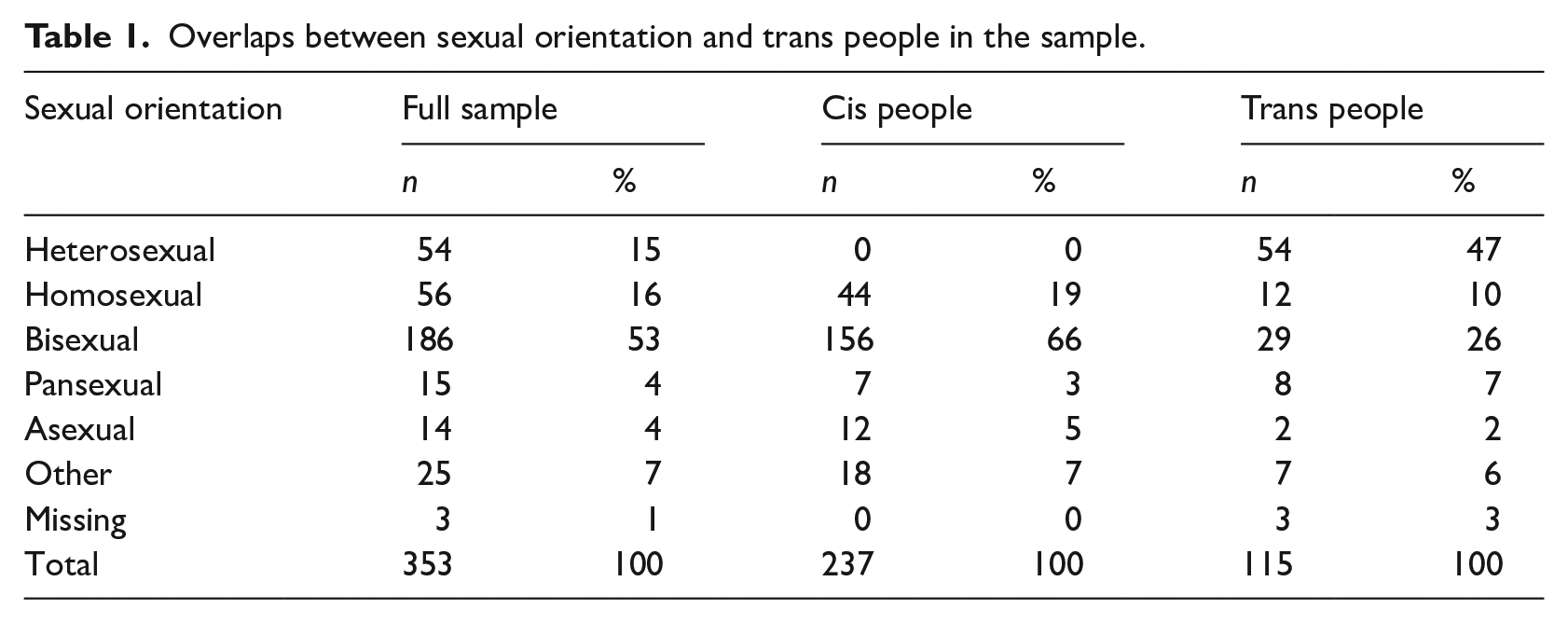
For the present study, we selected LGBTQ participants from the survey and interviews. The definition of being LGBTQ in the survey and interview study was guided by RFSL, a Swedish NGO that has worked for LGBTQ rights since the 1950s (RFSL, 2019). Using their terminology, ‘trans people’ refers to individuals who self-reported nontraditional gender identities and/or expressions, and ‘sexual minority’ refers to individuals who self-reported being homosexual, bisexual, pansexual, asexual, or other (ibid.). While there is a large overlap between people who are homo-, bi-, pan-, or asexual and people who are trans people, 54 of the trans people in the sample identify as heterosexual. In the interview, we asked about lifetime experiences of hate crime, not limited to a specific time span.
Ethical considerations
Since the study contains sensitive personal data, it was examined and approved by the Regional Ethical Review Board in Lund, as set forth by the Helsinki declaration (DNR 2013/221). The students were given both written and oral information that described (1) the aims of the study, (2) that all participation was voluntary, (3) that all results would be anonymized in publications, and (4) that consent could be withdrawn at any time. Furthermore, those who participated in the subsequent interviews were also asked whether they felt comfortable about being recorded and quoted in forthcoming publications. All participants consented. All participants in both the survey study and the interviews received a folder containing contact information for student health services and victim support groups. We offered all interview participants the opportunity to have their interviews at Malmö University but also explicitly stated that we could meet at another location if this would make them feel more comfortable.
Sample
The quantitative sample consists of a total of 353 students. The distribution of sexual orientation and gender identity can be seen in Table 1. Because the sample was taken from a student population, the mean age is 25 years and the median age is 23 years. None of the respondents were younger than 18 years, and 9 individuals were aged over 40 years. No one was above the age of 48 years.
Overlaps between sexual orientation and trans people in the sample.
A total of 28 students participated in the interviews, 10 of whom identified as LGBTQ. Four of those identified as bisexual women, two as lesbian women, one as a trans woman, one as nonbinary, one as a homosexual man, and one participant presented himself as a man who preferred not to define his sexual orientation. The interviewees excluded from the present study were sexual majority members with experiences of racial and/or antireligious hate crime.
Measures
Hate crime victimization is a variable that ranges from 0 to 2, where 0 = no previous victimization, 1 = previous victimization without a hate motive, and 2 = previous victimization with an anti-LGBTQ hate motive. The variable was constructed using the victimization questions in the survey, which included experiences of verbal, phone, or online threats or harassment; being followed or chased; having one’s hair pulled or being pushed; being hit with an open hand, kicked or punched; being attacked with a weapon; and being exposed to unwanted physical contact of a sexual nature and/or rape. The survey screened for lifetime prevalence of victimization. Sexual minority participants who reported that they had been targeted by the offender due to prejudice and/or hostility toward their sexual orientation were categorized as having experiences of hate crime, as were trans persons who reported that they had been targeted due to prejudice and/or hostility toward their gender identity or gender expression. In the quantitative analysis, this measure will be deployed as an ordinal variable. We base this approach on previous research which indicates that previous experiences of crime in general have a positive effect on fear of crime (Collins, 2016; Otis, 2007), while experiences of hate crime victimization impact fear of crime to an even larger extent (Herek et al., 1999; McDevitt et al., 2001; Pezzella and Fetzer, 2017; Warr, 1987).
It is important to note that while the measure accurately operationalizes an individual’s previous experiences and whether they have been subject to crime, hate crime or no crime, it does not account for individuals who have been both the subjects of nonhate crime and hate crime. As this study does not aim to analyze the properties of ‘amounts of victimization’, the measure remains appropriate and accurate.
Perceived risk ranges from 0 to 2, where 0 = believing that sexual minorities have no elevated risk of being subjected to threats or violence, 1 = believing that the risk is a little higher, and 2 = believing that the risk is significantly higher.
Concealment of sexual orientation ranges from 0 to 3, where 0 = I never conceal my orientation due to fear of threats or violence, 1 = I sometimes conceal my orientation due to fear of threats or violence, 2 = I often or frequently conceal my orientation due to fear of threats or violence, and 3 = I always conceal my orientation due to fear of threats or violence.
Fear of crime is a scale ranging from 0 to 27, with high values corresponding to a high level of fear (α = 0.864). The scale is based on 9 questions on fear of crime that correspond to how frequently the participants worried about being subjected to the victimization items described above, that is, (1) verbal threats or harassment, (2) online threats or harassment, (3) phone threats or harassment, (4) being followed or chased, (5) having one’s hair pulled or being pushed, (6) being hit with an open hand, kicked or punched, (7) being attacked with a weapon, (8) being exposed to unwanted physical contact of a sexual nature, and (9) rape. Answers for each question measure the frequency of worry during the past 12 months, in line with Newburn (2017), where 0 = never, 1 = once or twice, 2 = occasionally, and 3 = regularly.
Analysis
Initial analysis
In the results, we start by presenting descriptive statistics on victimization in the full sample and for subgroups based on sexual orientation and gender identity.
We then present 3 one-way ANOVA tests where we initially assess the relationships between the independent variables Hate crime victimization, Perceived risk, and Concealment of sexual orientation, and the dependent variable Fear of crime. The analyses are conducted to assess if there is a linear relationship between the independent variables and the dependent variables. The latter is particularly important for the independent variables Hate crime victimization and Concealment of sexual orientation, which have not been used in previous studies.
Path analysis
Path analysis is used to decompose the relationships between variables into their constituent parts and to find indirect effects (Randolph and Myers, 2013). An indirect effect is one where a variable influences another variable, which in turn influences a third. The authors opted for a path analysis over structural equation modeling because the variables captured in the survey that are of relevance to this study are not latent in character. This means they are not comprised of different underlying variables, which is the primary reason for conducting structural equation modeling (Bentler and Yuan, 1999). Nonetheless, the analysis includes error terms, which represent latent variables that may influence the model, nonlinearity, unpredictable effects, and measurement errors. P values are used to designate significance throughout. In this study, we complemented the path analysis with a Sobel test to calculate the significance of the proposed mediations.
In the present study, AMOS was used to assess the effect of the measures Hate crime victimization, Perceived risk, and Concealment of sexual orientation on Fear of crime.
All independent variables in this analysis are ordinal, which has some implications for interpretation. Most importantly, an ordinal variable does not provide equal intervals, since an ordinal variable might have more of a ‘zig-zag’ relationship with the dependent variable with the differences between some values playing a larger role than others (Boyle, 1970). The initial one-way ANOVA tests presented in the results, and especially the post hoc tests, provide further insight into the relationships between the different values of the ordinal variables and the dependent variable.
It should be noted that path analysis, while establishing existing relationships, does not present causal mechanisms. For most of the variables, however, the direction of the relationship—and probable causality—are theoretically very clear. For example, worrying about victimization will not cause a person to become the victim of a hate crime.
Thematic analysis
For the present study, we used Nvivo when analyzing the interview data. The thematic analysis follows the analytical process developed by Braun and Clarke (2022). Within this approach, themes are defined as clusters of codes united by a central organizing concept. Because the goal of the qualitative analysis was to further explore the concepts of hate crime victimization, perceived risk, and the concealment of sexual orientation in relation to LGBTQ hate crime, the 10 interviews were initially read and screened in their entirety for relevant content based on the concepts of hate crime victimization, perceived risk and concealment. To examine hate crime victimization, we selected the material in which the respondents described what distinguished their experiences of hate crime. Most of this material comes from the interview question ‘What would you say sets hate crime victimization apart from other experiences of victimization?’. Perceived risk was examined using material in which the respondents described the links between their experiences of hate crime and their everyday risk management. Interview questions that resulted in material of high relevance were ‘How do you feel when revisiting places where you’ve been victimized?’ and ‘Would you say that you’ve changed your behavior or made other changes to avoid hate crime victimization?’. Finally, concealment of sexual orientation was examined using material in which the participants described the links between visibility and victimization. Much of the relevant material came from follow-up questions to descriptions of the participants’ victimization experiences, which were ‘Why do you think the offender thought you were gay/lesbian/bisexual/trans?’ and ‘Do you have friends who have also been subjected to hate crime?’. The selected materials were analyzed inductively, and the leading principles for the thematization were scientific and conceptual relevance, distinctness, and richness (Braun and Clarke, 2022).
Results
Quantitative analysis
Initial analyses
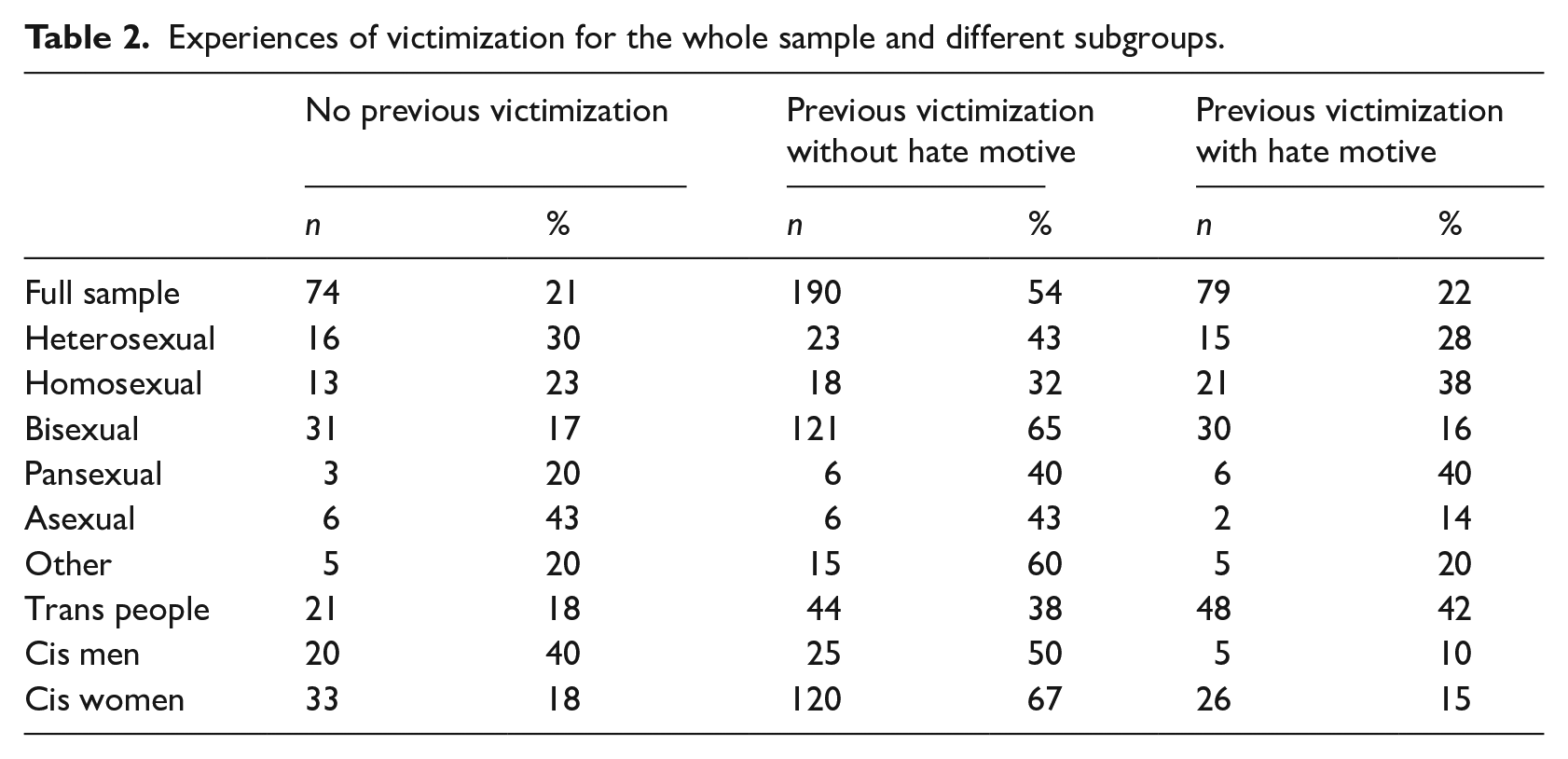
Descriptive analyses showed that approximately 80% of the sample had experiences of some form of victimization (see Table 2). As for self-reported experiences of hate crime victimization, the trans people and the homosexual subgroups reported the highest prevalences, at 43% and 37%, respectively.
Experiences of victimization for the whole sample and different subgroups.
The first ANOVA test supported that the measure of hate crime victimization had a significant (p = 0.001) relationship to fear of crime, as the mean value of fear of crime gradually increased between nonvictims (mean = 2.61), nonbias victims (mean = 5.81) and anti-LGBTQ hate crime victims (mean = 7.79). Post hoc t-tests further showed that these differences were significant between all three groups. Nonvictims were significantly less fearful when compared to nonbias victims and hate crime victims alike: both relationships had a p-value of <0.001. In addition, hate crime victims were significantly more fearful than nonbias victims with a p-value of 0.003. The second ANOVA test supported that the measure of perceived risk for sexual minorities was also significant (p = 0.001) and linearly related to fear of crime, with a gradual increase between those who believed the risk was not elevated for sexual minorities (mean = 2.69), those who believed the risk was a little higher (mean = 4.28), and those who believed the risk was significantly higher (6.80). However, post hoc t-tests showed that the difference between those who did not believe in an elevated risk for sexual minorities and those who believed the risk to be a little higher was not significant with a p-value of 0.214. Meanwhile, those who rated the risk as markedly higher were significantly more fearful when compared to those who believed that the risk was not elevated (p = 0.001) and those who rated the risk as a little higher (p ⩽ 0.001).
Finally, although the ANOVA for concealment of sexual orientation also pointed to a linear relationship with a gradual increase in fear of crime between those who never conceal their orientation (5.14), those who rarely conceal their orientation (6.33), and those who sometimes or always conceal their orientation (8.32), the significance level was somewhat weaker (p = 0.011). The post hoc t-tests offered some insight as to why this was the case: the only significant between-group difference was between those who never concealed their identity and those who sometimes or always concealed their identity (p = 0.005). On the other hand, those who rarely concealed their identity were not significantly more fearful compared to those who never concealed their identity (p = 0.107) or those who sometimes or always concealed their identity (p = 0.109).
Hate crime victimization, Perceived risk, and Concealment of sexual orientation
Based on previous research and theory, the authors hypothesize that (1) experiences of hate crime victimization increase fear of crime, perceived victimization risk and the concealment of sexual orientation; (2) high levels of perceived risk result in high fear of crime and a more prevalent concealment of orientation; (3) the concealment of sexual orientation results in lower fear of crime. Moreover, we propose that (4) perceived risk and concealment of identity has a mediating effect of hate crime victimization on fear of crime, and (5) that concealment of identity has a mediating effect of perceived risk on fear of crime.
The quantitative analysis supported several of our hypotheses (see Figure 1). Hate crime victimization significantly predicted perceived risk (0.23, p ⩽ 0.001), concealment of sexual orientation (0.19, p = 0.002), and fear of crime (0.28, p ⩽ 0.001). Perceived risk also positively predicted fear of crime (0.19, p ⩽ 0.001) and concealment of sexual orientation (0.17, p = 0.005). However, our hypotheses regarding concealment of sexual orientation were not supported. Contrary to our predictions, concealment of sexual orientation positively predicted fear of crime (0.12, p = 0.037) although at a lower significance level.
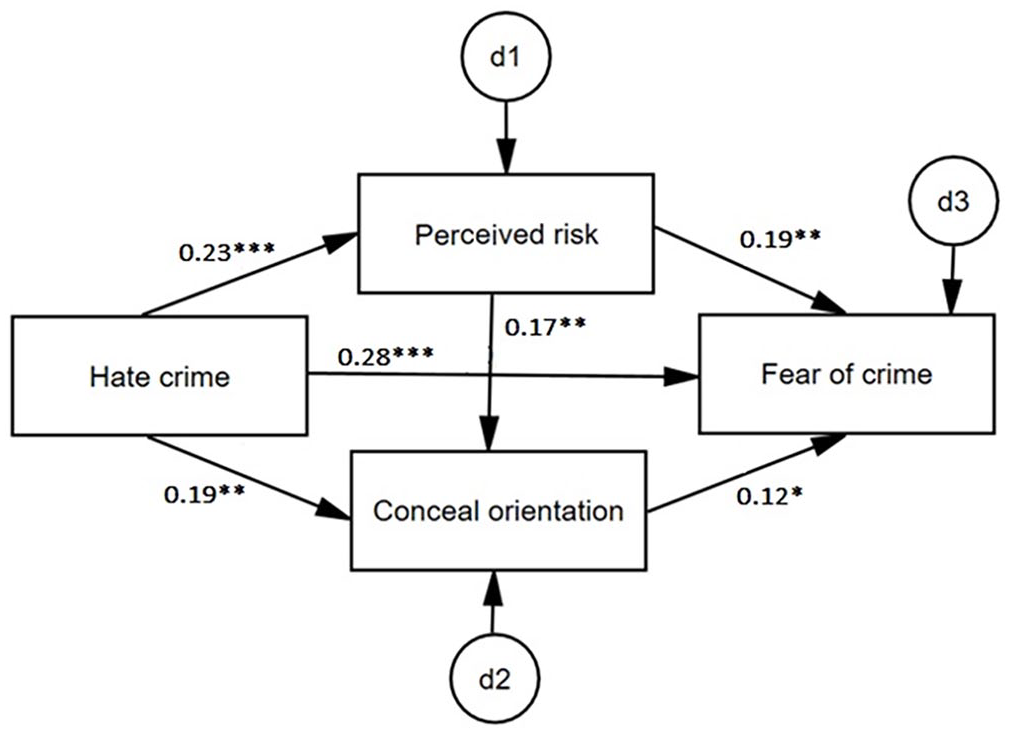
Path analysis, standardized model.
With regards to the mediation effects, the Sobel test showed that hate crime victimization exerted a positive indirect effect on fear of crime through perceived risk (3.21, p ⩽ 0.001), which aligned with our expectations. The Sobel test also showed that hate crime victimization exhibited a positive indirect effect through concealment of sexual orientation (2.31, p = 0.021) and that perceived risk showed an indirect positive effect on fear of crime through concealment of sexual orientation (4.42, p = 0.016), albeit at a weaker significance level.
The established predictor variables for fear of crime, as identified in previous literature, also apply within the context of our study. However, the concept of functional fear and control over risk, as proposed by Jackson and Gray (2010), did not bear scrutiny within the LGBTQ context. Controlling perceived risk through concealment of sexual orientation did not negatively predict fear of crime. These findings suggest that within our study, controlling perceived risk of victimization because of belonging to a sexual minority does not mitigate fear of crime. Further elaboration on the relevance of these results will be provided in the discussion section.
Qualitative analysis
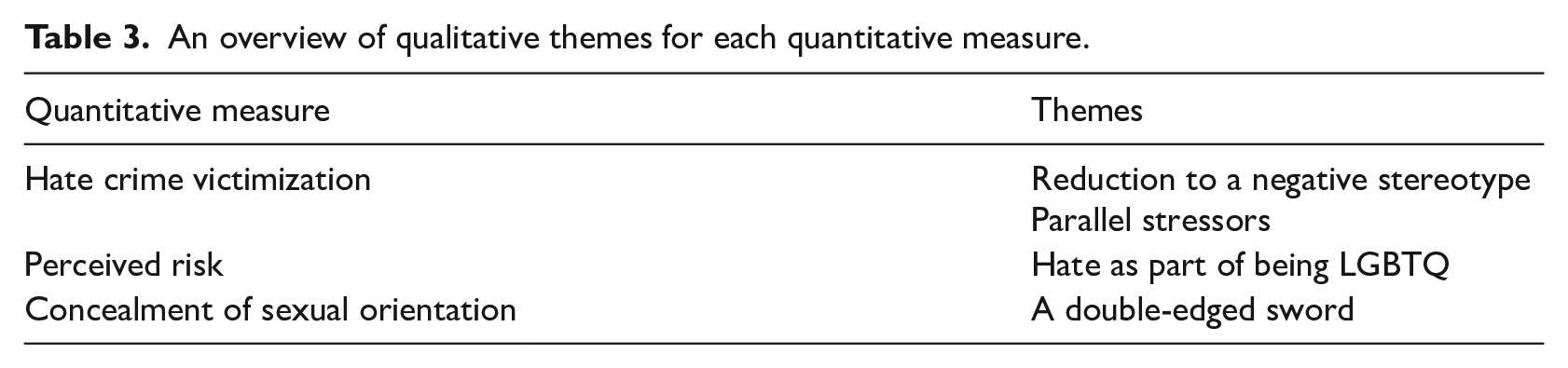
The qualitative analysis presented below adds further nuance to the reasons why hate crimes are perceived as more severe in comparison to nonbias crimes via the themes Reduction to a negative stereotype and Parallel stressors.
The theme Hate as part of being LGBTQ illustrates how previous experiences of hate crime can influence the perceived victimization risk by bleeding into both the present and expectations about the future. Finally, the theme A double-edged sword sheds some light on why concealing one’s sexual orientation does not necessarily result in lower fear of crime. A presentation of the themes and the respective link for each quantitative measure is presented in Table 3.
An overview of qualitative themes for each quantitative measure.
Reduction to a negative stereotype
The violations described in the interviews were based on negative stereotypes that did not correspond to the victims’ own perception of their sexual orientation, gender identity, or gender expression. Robin, a nonbinary participant, expressed themselves in the following way when talking about the offender’s perception of them and their partner: ‘She had no idea who I was; it was because of my choice to be with my partner who wasn’t of the opposite sex or whatever . . . it was so difficult to deal with’. The quote captures the disbelief Robin experienced when fully realizing that being in a same-sex relationship was the cause for their victimization.
Linda, a transgender woman, described the powerlessness and lack of control she felt after hate crime victimization like this: If I were to sum up the problem, I’d say it’s the powerlessness. It’s that you can’t protect yourself against it. It doesn’t matter if you’re competent, knowledgeable, or ambitious. It doesn’t matter what you do, and that’s where the powerlessness lies.
These interview participants thus experienced hate crimes more severely when compared to nonbias crime because they were reduced to a negative stereotype, which had a negative impact on the victim’s ability to form a positive personal experience of what it is like to belong to a sexual minority. Instead, the minority membership as such becomes a risk. Alva, a bisexual woman, said that ‘What I find difficult is not that I feel sad about it (her experience of being harassed outside of an LBGT club); it’s more like I feel sad that it (homophobia) exists . . . that those kinds of thoughts exist’. Hate crime had an impact on how participants perceived their own risk of being subjected to crime and, consequently, their fear of crime.
Parallel stressors
An additional factor that influences the impact of hate crimes involves the experiences of homo- and/or transphobic bullying and abuse by family and/or close friends that sometimes occur when an LGBTQ person decides to disclose their orientation and/or identity. Although the bullying and abuse in these relationships might not have met the legal criteria for hate crime, it placed the victims in a position where they had to deal with parallel stressors on top of experiences of hate crime. For example, Jan, a homosexual man, described how his brother would tease and bully him after he disclosed that he was homosexual.
He does things to mess with me, he doesn’t want to drink from the same glass and stuff like that . . . I get really annoyed. Because he has preconceived ideas about me, how uh, that as soon as you are with a guy you get diseases.
Teasing and bullying was not uncommon in families and at school. In addition to the example above, Jan also said that his mother would call him sissy and faggot regularly. Erick, a bisexual man, described how he was teased and bullied in school for body language that his peers interpreted as feminine. When Sanna came out as bisexual, her best friend broke off all contact with her because he was part of a conservative Christian environment. As an added stressor to the loss of an important friendship, Sanna was bullied in school after disclosing her orientation. The bullying gradually escalated from verbal slurs in school to anonymous SMS messages saying that she was disgusting and should commit suicide. Eventually, the anonymous texts began to contain explicit death threats. Within a short space of time after disclosing her orientation, Sanna thus had to deal with three parallel stressors: bullying in school, harassment and death threats over the phone, and the loss of a previous social support network. Though the online harassment that included death threats might be the ‘only’ incidents that reach the legal criteria for a criminal offense in the Swedish penal code, the impact of those threats was compounded by the bullying and loss of important relationships.
Hate as part of being LGBTQ
The participants developed expectations based on a notion of what it meant to be part of a queer collective. These expectations were formed both by their own and others’ experiences of hate-based violations. For example, Robin described how they witnessed a friend being beaten by a homophobic perpetrator; while two of their friends were nearly hit by a driver who drove his car up the sidewalk at high speed, targeting a group of LGBTQ people during a Pride event. Robin also had several personal experiences of hate crime, especially in the form of threats and harassment—primarily for having same-sex relationships. Robin described one incident that was a wakeup call: I remember that I just fell apart afterwards. After we had been interviewed [by the police] and left a report, we sat on the train, and yeah, I . . . was going to work later in the evening, and I had to call my boss and I just like, ‘I can’t come in’. And I just fell apart, completely. And the . . . (longer pause). It was then I realized how naive I still was.
The continuation of one’s own and friends’ experiences of hate crime led the participants to regard these as an integral part of what it means to belong to a queer collective. Liv, a lesbian woman, shared the following experience in her interview: When another girl also came out about having a girlfriend, they (friends in her class) came up to her and said: ‘You’re so disgusting! How can you do this? You’re so fucking gross’. I remember being so scared, like thinking, ‘I’m never going to come out’.
This risk awareness permeated participants’ encounters with heteronormative people and institutions. Elin, a bisexual woman, expressed this as follows: I will always have to deal with it. All my life, I will continue to come across idiots who will not be able to . . . not accept who I am, who will be calling me names. Co-workers and so on, children’s parents—it will be everywhere, and I know that now. At the same time, I will handle it in a better way than I did before. Today, a larger part of me knows that it is they who are at fault and not me. And that part of me is growing all the time.
A double-edged sword
The qualitative data show that for sexual minorities, visibility primarily consists of two components: nonconservative gender expressions and showing love or affection for a same-sex partner. Tindra, a bisexual woman, described the following incident at the end of the interview when I asked if there was something more she wanted to talk about before we would round off:
A male friend of mine in (city) was assaulted a month and a half ago—completely beaten up—he’s so . . .. um, stereotypical, looks a way that a lot of people would classify as gay, he dresses quite feminine and stuff. And I think that if I would have been butch I’d be more exposed because people would notice that I am different—that I like women—and maybe I would be involved in more stuff, like, because people seem to be very intolerant sometimes.
Do you think that is why don’t get targeted in the same way, because they don’t see it?
Yes, I think so, but not only in hate crime contexts, I’m assumed to be a straight woman even though I’m really not . . . it’s mostly about prejudices, just like people wouldn’t see me as having a disability, like, even though I do.
In a similar example, Erik described how his body language was interpreted as feminine from childhood into adulthood. His body language often led others to assume that he was homosexual even though Erik himself preferred not to define his orientation. Jan, on the other hand, described that he passed as a heterosexual man, and attributed this to having a conservatively masculine gender expression and body language.
Some participants described that they could shift in and out of visibly belonging to a sexual minority by means of superficial changes to their appearance, but this was not always the case. Linda, for example, described that she passed as a cis woman at the time of the interview, but she attributed this to being years into gender-affirming treatment. She described that her exposure to transphobia in general was much greater during the period before she started hormone therapy.
Passing as a heterosexual cis person thus provided many benefits, but it remained a double-edged sword. For many, heteronormativity is staged rather than a representation of their authentic selves. Ulrika, a lesbian woman, spoke about her staging of heteronormativity in the following way: It [staging heteronormativity] is connected to when it [a homophobic incident] has happened, and why it has happened. Like, it happened like that, and I looked like this, and when doesn’t it happen? . . . I think that I might be exposed because of my gender, my appearance, and my sexuality, and if I can then reduce some of these, and remove them, it will go away.
Similarly, Elin described how staging heteronormativity was connected to feelings of social insecurity in the following interview excerpt:
You talked about being careful, about not bringing it (your sexual orientation) up.
Mmm.
Can you describe that a bit more?
I don’t know, well, it’s just that you . . . if you’re in a context where you don’t feel fully aware of what people think, you might not . . . want to include certain . . . certain things . . . it [your sexual orientation] might not be the first thing you bring up when you meet someone . . . . some things are kind of personal and so on, and you don’t want to risk someone attacking you for it.
In addition, fitting into a conservative gender role might pose a problem, as it can lead to family and friends not believing the individual when they come out. Liv described how her mother did not believe that she was a lesbian, because she had always been feminine. At the time of the interview, Liv described that her mother still believed she was heterosexual, despite the fact that Liv came out as a lesbian a decade earlier and had a steady same-sex relationship.
Discussion
Hate crime victimization, reduction to a negative stereotype, and parallel stressors
In line with the proposed hypotheses, the quantitative results showed that hate crime victims reported significantly higher levels of fear of crime and perceived victimization risk for sexual minorities, and were more likely to conceal their sexual orientation compared to nonvictims and nonbias victims.
The nexus between hate crime victimization and fear has been illuminated via the themes of reduction to a negative stereotype and parallel stressors. The inability to control how LGBTQ people are perceived, as expressed in the theme reduction to a negative stereotype, appeared to influence both perceived risk and fear of crime in the interview data. For those who had gone through parallel stressors connected to their status as LGBTQ persons during or in close proximity to their experiences of anti-LBGTQ hate crime, this had an overall negative impact on their ability to handle stress, including fear of crime. The qualitative analysis sheds light on themes that could be used and assessed in forthcoming quantitative research. Based on the results, it is feasible that feelings of being reduced to a negative stereotype mediate both perceived risk and fear of crime among sexual minority victims of hate crime. In line with previous research and theory (Chakraborti and Garland, 2015; Tiby, 1999), the results also suggest that the presence of parallel stressors may act as a confounder that increases victimization risk due to the accompanying interpersonal vulnerability and that enhances fear of crime via a lowered tolerance for stress.
From a policy perspective, the results show that to minimize the risk of continued victimization, victim support needs to be holistic in its approach and target both psychological crisis reactions, such as internalized minority stigma and social aspects of the victim’s everyday life.
Perceived risk and hate as part of being LGBTQ
The results supported the hypotheses that perceived risk predicts fear, and that hate crime victimization has an indirect effect on fear of crime, moderated by perceived risk. The results are thus in line with Otis’s (2007) study on perceived risk and fear of crime among homosexual men and women. The hypothesis that high levels of perceived risk result in more prevalent identity concealment was also supported. While it has been shown that perceived victimization risk may lead to adaptations in the form of risk avoidance, for example, by altering activity patterns or means of transport (Jackson, 2011; Skogan, 1986; Warr, 1987), the results of the present study point to the way that adaptations used by LGBTQ minorities, such as identity concealment, may be overlooked in studies that use more generic measures.
The qualitative theme hate as part of being LGBTQ further illustrates how hate crime, along with various forms of anti-LGBTQ hatred, was perceived as a normal part of belonging to a sexual minority. This theme exemplifies how perceptions of risk for sexual minorities as a group also converge into anticipation and expectation of future individual victimization. However, while the interview participants sometimes described that they could manipulate their dress and appearance to pass as straight cis people, the interview data did not provide any conclusive information about the link between the perceived victimization risk for LGBTQ people and identity concealment. This is thus an important area for future studies.
Concealment of sexual orientation as a double-edged sword
In contrast to the proposed hypothesis, concealment of sexual orientation was associated with higher levels of fear of crime, rather than lower levels of fear of crime. The qualitative theme a double-edged sword provides some insight into why concealing one’s orientation does not decrease fear of crime. While the interview participants acknowledged that visibility and/or disclosure of LGBTQ status may increase their victimization risk, concealment was accompanied by psychological costs. The costs primarily revolved around feelings of self-censorship, a lack of authenticity, and conditional approval of the participants’ personhood. The lived experience of concealing one’s orientation was something quite different from the agency-driven functional fear described by Jackson (2011), which is in line with previous qualitative research on victim impact (Meyer, 2010; Perry and Dyck, 2014; Tiby, 1999).
Practices of concealment of sexual orientation in the interview data also appeared to be fear driven, rather than fear regulating. Considering previous theory (Jackson, 2011), the authors therefore argue that concealing one’s orientation cannot be regarded as part of a functional fear response for LGBTQ people but rather as a dysfunctional fear response.
Strengths and weaknesses
The quantitative analysis combined with the themes from the qualitative analysis make an important contribution. In line with Hall and Howard’s (2008) work, the combination of methods yielded synergistic effects, resulting in a more comprehensive assessment of fear of crime among LGBTQ students. For example, the internal validity of the quantitative analysis is elevated by the inclusion of qualitative data. The interview participants were drawn from the same sample as the quantitative analysis, making the two approaches coherent. While the 10 interview participants do not entirely represent the quantitative sample, they provide an insight into the nexuses found among the variables. For example, in the case of the double-edged sword, the qualitative data shine a much-needed light on the understanding of the variable concealment of sexual orientation.
On its own, qualitative research has the advantage of high internal validity and enhances our understanding of the mental processes that lead to measured variables. Quantitative analysis, on the other hand, assists in uncovering correlations that suggest relationships between variables and their effect sizes on a population level. In our case, the path analysis identified indirect effects and predictive power, which suggests that the theoretical directions of the relationships are accurate.
In the instance of the concealment of sexual orientation variable, one weakness is apparent. The survey question used to specify this variable specifically asked whether the participants concealed their sexual orientation. Part of the sample consists of trans people who self-identify as heterosexual (n = 54). Previous research has shown that transphobic gender expressions that do not align with conservative notions of a person’s biological sex are often interpreted as homosexuality and not transgender identity (Paterson et al., 2019; Perry and Dyck, 2014; Tiby, 1999), but there are also trans people whose gender expression aligns with their biological sex. The survey question thus does not technically apply well to this latter group, which means that the relevance of concealing one’s orientation for the subgroup of heterosexual trans people is questionable. We recommend that future studies include specific items measuring concealment of transgender identity to remedy this gap.
Finally, we cannot rule out that changes in societal attitudes since the data collection might have had an impact on the emotional and psychological responses of hate crime victims. Given the fluidity of attitudes toward the LGBT community, especially in the context of increasing visibility and advocacy, the fear experienced by victims could manifest differently now compared to a decade ago. Moreover, data from the Swedish National Crime Survey show that the number of hate crimes targeting sexual minorities has increased over the past 10 years (Hagerlid and Granström, 2023). This increase necessitates further research of the underlying drivers, contextual shifts, and systemic responses that may have escalated hate crime incidents against sexual minorities, as well as further research about the individual and community impact among sexual minorities in Sweden.
Most of the hate crime victims also had experiences of nonbias crime and repeat victimization. This has important theoretical implications. First, it indicates that many victims of anti-LGBTQ hate crime are vulnerable to victimization in a broader sense. We therefore maintain that it is highly important to examine why some sexual minority members are repeatedly victimized, while others are not. Second, it also means that the higher levels of fear of crime might be the result of cumulative victimization experiences in this vulnerable group, and not the hate crime victimization alone.
Conclusions
Previous research points to elevated levels of fear of crime and psychological ill-health among LGBTQ populations in Sweden and internationally. Based on the results from the present study that further assesses the relationships between victimization, hate crime, perceived risk, concealment of sexual orientation, and fear of crime, the authors want to stress the importance of developing policies and preventive measures to reduce victimization for LGBTQ persons. At the same time, it is important to acknowledge that there are at risk-groups within sexual minorities, and that the risk of victimization is not equally distributed among LGBTQ people. It is therefore important to identify vulnerable LGBTQ persons at high risk for victimization and develop preventive strategies geared toward the specific risks of this group.
Importantly, the results show that practices of self-censorship or concealment of LGBTQ-status are driven by fear and performed at great personal cost for LGBTQ people. Because of this, social policy should also aim more broadly for acceptance and inclusion of LGBTQ people within several sectors, such as work life and educational systems, with the aim to reduce self-censorship among LGBTQ people.
Anti-LGBTQ hate crime appears to be only one of a number of factors that contribute to the marginalization and self-censorship of sexual minorities. Measures to promote equality for LGBTQ people need to address a broader range of hate and marginalization practices.
