




Abstract
Sex trafficking narratives tend to follow the same storyline: a young, female victim is lured into sexual slavery by a foreign offender, and in the end, she is rescued by a Western hero. This article examines the sex trafficking narrative, and its accompanying characters in popular media, with a specific focus on the victim. It combines sex trafficking research with theories about folk tales and concepts of purity and the sacred. Empirically, the article explores the narratives of sex trafficking in six internationally influential films and books. The analysis creates an understanding of why one particular victim, and one metanarrative of sex trafficking, continue to dominate contemporary popular media. It traces the moralistic narrative continuities of sex trafficking, and creates an understanding of why we keep repeating this particular narrative, and why we seem to need it.
Introducing the story of sex trafficking
Horror stories of abused and traumatized girls chained to brothel beds have dominated the representations of sex trafficking during the last decades. Sex trafficking is described as one of the most serious and growing crime problems in the world, and has gained a prominent position not only in media, but also in politics, and research (Doezema, 2010; Erez et al., 2004; Goodey, 2003; O’Brien, 2018; Soderlund, 2011). The sex trafficking narrative typically revolves around a young, female victim who is lured by a foreign man, and later rescued by a White hero. This storyline, with its recurring characters, is effective in raising awareness, protection, and restoration for victims (O’Brien, 2018; Villacampa and Torres, 2019). However, an increasing number of academics have challenged the dominant descriptions of sex trafficking. These researchers argue that the victim descriptions are problematic, and both the magnitude and severity of the problem are hugely exaggerated (e.g. Doezema, 2000, 2010; Goodey, 2008; O’Brien et al., 2013; Segrave et al., 2009; Vijeyarasa, 2015; Weitzer, 2007, 2011, 2014; Zhang, 2009). Rather than describing a well-substantiated problem, the dominant sexual slavery narrative can be viewed as a moral tale, which channels people’s concern regarding migration and women’s independence (Andrijasevic and Mai, 2016; Doezema, 2010; Pickering and Ham, 2014; Segrave et al., 2009). The narratives amplify gendered and racialized notions of sex trafficking victims, and tend to confound fiction with reality, and victims with sex workers and migrants (Doezema, 2010; Heber, 2020; Skilbrei, 2003; Small, 2012; Weitzer, 2018).
This article will focus on analysing and deconstructing the popular media narrative of sex trafficking, with an emphasis on the victim. It will critically examine why sex trafficking experiences are depicted so strikingly alike in books and film. Sex trafficking stories influence how the problem of sex trafficking is framed, and what causes of, and solutions to, the problem are promoted (Broad and Gadd, 2023; O’Brien, 2018; Vance, 2012). Hence, it is crucial to study sex trafficking narratives since they impact public mentalities and attitudes, as well as criminal justice responses, legislation, and social welfare agencies’ work (O’Brien, 2018; O’Brien et al., 2013; Segrave et al., 2009; Soderlund, 2011; Todres, 2015).
Doezema (2010: 108) argues that the simplified sex trafficking story is so powerful that its constant repetition turns the iconic myth into reality, with actual repercussions. Hence, sex trafficking tales have far-reaching practical, political, and economic consequences, not least for sex trafficking victims. The sex trafficking story shapes current laws and promotes repressive law-and-order solutions, which may not always benefit the victims (Benoit et al., 2019; Forringer-Beal, 2022; Vance, 2012).
In this article, I seek to create an understanding of why one particular metanarrative of sex trafficking seems to dominate contemporary, popular media directed towards a Western audience. While previous studies have described the sex trafficking tale, and its recurring characters, this study tries to venture further by also analysing why the dominant narrative is repeated, and what function it seems to fill in today’s society. It adds an important piece to the puzzle by innovatively interlacing sex trafficking research with two additional strains of theories and research: Durkheim’s notion of purity and ‘the sacred’, and research about folk tales. This is a novel research approach to sex trafficking, which may expand how we can understand the sex trafficking tale and its impact. The aim of the article is thus to contribute to three distinct research traditions about (1) sex trafficking narratives, and especially their victim representations; (2) Durkheimian analyses of ‘the sacred’; and (3) folk tales, and more specifically the tale about ‘the maiden’s tragedy’. In this article, I will argue that the metanarrative of sex trafficking is a moralistic and cautionary tale about the sacred maiden, which is a sexist story with colonial undertones, serving to uphold societal and victim hierarchies. So, let us begin with the story of sex trafficking.
Researching Natasha and other sex slaves
The metanarrative of sex trafficking generally centres around one central character: the sex slave, who is depicted as a victimized, sexually abused young woman, or ‘girl child’ (O’Brien, 2018: 59). The sex slave character is accompanied by a specific sequence of events that develop these narratives into more or less full stories. While the story centres on the stereotypical, female victim, excluding all male ones, the cast generally also includes a foreign villain and a Western rescuer (Balgamwalla, 2016; Dennis, 2008; Kinney, 2015; O’Brien, 2018; Small, 2012). The narrative comprises themes of innocence, sexual violence, and abduction or coercion (Kinney, 2015). Doezema (2000, 2010) argues that the political and media discourse on sex trafficking in the global North constitutes a modern revival of stories of the White slave trade that gave rise to panic in Europe and the United States at the beginning of the 20th century. The horror of sex trafficking is a tale modulated for a Western, middle-class audience, which is equally horrified by poverty, which is often described as the underlying cause of sex trafficking (Vance, 2012). Today’s sex trafficking narrative usually follows a specific outline, where a young girl from a poor country is lured into sex trafficking in the West. Zhang (2009: 181) describes this more in detail: A young woman, naïve and desperate to escape poverty or to help her families, answered an advertisement promising jobs in a foreign country – waitressing, modelling, or bartending [. . .] Either during the journey or after she arrived at the destination, she found herself held against her will, her travel documents taken and her movement restricted. She was sold to a brothel and told to sleep with as many men as possible to pay off her debt, which often multiplied for various reasons. Physical violence and gang rape were used to break her will.
This so called ‘Natasha story’ 1 centres on sex slaves with an Eastern European origin, and is told in media and politics all over Europe. The ending of this archetypical narrative differs somewhat; Natasha can either be rescued (Balgamwalla, 2016), she can actively seek help from authorities (Zhang, 2009), or escape her tormentors on her own (O’Brien, 2018).
Hoyle et al. (2011) reason that one could expect this tale to vary between countries, not least with regard to different countries’ varying historical roots in slave-ownership or trade. While sensibly argued, it seems like there are similar sex trafficking narratives in very diverse parts of the world. Andrijasevic and Mai (2016: 2) have pointed out that ‘The mythological function of the trafficking narrative and the victim figure are most visible in the fact that the trafficking plot never varies’. While the Natasha narrative dominates the European context, Mexico, Brazil, and its neighbouring countries have a parallel narrative in the ‘Maria story’ (Blanchette et al., 2013; Wetmore, 2003). The story tells of how the innocent, young, and beautiful Maria meets a man, who lures her to Europe or the United States under false pretentions. He then locks Maria into an apartment where she is beaten, raped, and forced into sex work. If Maria is ‘lucky’ she is rescued and deported home by the authorities; if she is unlucky, she dies alone, sometimes of HIV (Blanchette et al., 2013). The ‘Ghita story’ is yet another repetition of the Natasha story, but relates to Nepal-to-India sex trafficking. We recognize the tale; poor, beautiful Ghita is lured or abducted, locked in a brothel, raped, beaten, and forced into sex work (Frederick, 2012).
Critical researchers have highlighted how these simplified constructions of sex trafficking are based on problematic stereotypes of gender, sexuality, and ethnicity (Andrijasevic, 2010; Balgamwalla, 2016; O’Brien, 2018; Pickering and Ham, 2014). It ignores the sexual exploitation of boys and men as well as lesbian, gay, bisexual, transgender/transsexual, and queer or questioning (LGBTQ) + victims of sex trafficking (Boukli and Renz, 2019; Dennis, 2008; Forringer-Beal, 2022; Moynihan et al., 2018). The potent image of ‘the nice girl forced into sexual exploitation’ has been a successful symbol in raising public outrage and political support (McDonald, 2004: 143), and she is essential in anti-sex trafficking campaigns (Forringer-Beal, 2022; O’Brien, 2018; Vance, 2012). Such depictions of sex slaves have both dramatic as well as symbolic and moral functions, sorting women into traditional dichotomies of good/bad, innocent victim/guilty sex worker, or the Madonna/the whore (Doezema, 2000, 2010; Gadd and Broad, 2018; Heber, 2020). In this article, I will add to previous studies’ critical perspective on sex trafficking stories and ‘Natashas’, by specifically exploring the meaning of the sex slave, and developing a theoretical understanding of her moral function.
Enter the monster and the hero
An ideal victim like Natasha requires an ideal offender (cf. Christie, 1986), and in the sex trafficking narrative, it is the sex trafficker who is the main villain (Balgamwalla, 2016; O’Brien, 2018). The trafficker is consistently typecast as a criminal mastermind or even a mobster, with very few traits other than being male, foreign, dangerous, and evil; a pure monster, who violently forces the innocent victim into sex trafficking (Broad and Gadd, 2023; Heber, 2020; O’Brien, 2018). This ‘new folk devil’ stereotype appears repeatedly in popular culture, news media, government reports, and anti-trafficking campaigns, despite researchers having questioned the validity of this ideal sex trafficker (Broad and Gadd, 2023; Gadd and Broad, 2018; Raby and Chazal, 2022). Even if the sex trafficker plays an essential role in the narrative, as both driving the plot forward and as morally contrasting the victim, the villain remains rather anonymous. What is clear is that this monster is normally a man who personifies evil, and is everything that the victim is not when (female) virtue is contrasted to (male) evil (Doezema, 2010). Lee (2011) has employed Garland’s concept of the ‘criminology of the other’ to explain the demonization of sex traffickers. This is achieved by describing them as a form of distinct racial outsider, which leads to classic racial stereotyping and othering. Offenders need to be unlike ‘us’, and described as monsters, so that problems can be externalized, and so that society can fully blame these foreign offenders, claims Christie (1986). This may also explain why the sex buyers, or ‘johns’, are so invisible in the European and Anglo-Saxon tales of sex trafficking, despite many of them being White. When Western men occasionally appear as offenders in the narratives, their evil is explained as an individual failing. Some (White) sex buyers can even become heroes if they decide to rescue the victim (O’Brien, 2018; Vance, 2012).
In addition to the victim and the villain, the hero is the third, central character in the sex trafficking story (Balgamwalla, 2016; Kinney, 2015; O’Brien, 2018; Small, 2012). Since the sex trafficking narrative usually involves a ‘search and rescue’ of victims, the story needs a hero to liberate the victim (O’Connell Davidson, 2015). This hero is stereotypically a White man, but the role can also be played by (Western) governments, nongovernmental organizations (NGOs), activists, and ‘concerned citizens’ who become heroic rescuers (Agustin, 2005; Gadd and Broad, 2018; O’Brien, 2018; Segrave et al., 2009). This may reflect the fact that many real-life anti-sex trafficking activists are privileged, White, educated, middle-class individuals (Agustin, 2007; Cojocaru, 2015), and the metanarrative of sex trafficking is often directed towards them. The liberation of victims is the expected outcome in this narrative, and the main goal for many actual NGOs’ practices and government-run anti-sex trafficking operations. While being rescued can obviously have positive outcomes for the sex trafficking victim, it can also bring negative consequences such as repatriation to a ‘home’ country, or a pressure to testify against the sex trafficker (Agustin, 2005; Gadd and Broad, 2018; Heber, 2020; Segrave et al., 2009). Hence, the ‘search and rescue’ narrative is interlinked with repressive law and order responses, which do not always serve the best interest of sex trafficking victims (Benoit et al., 2019; O’Brien, 2018). Furthermore, there is a strong commitment towards the rescue of ‘good’, innocent and pure women/girls, while other more ‘undeserving’ victims are neglected (Cojocaru, 2015; Vance, 2012). Nevertheless, actual liberations of sex trafficking victims are rare in real-life sex trafficking, while fairy-tale endings are essential in the sex trafficking tale (O’Connell Davidson, 2015). In this article, I will continue to deepen the analysis of the victim, the villain, and the hero, and add a theoretical understanding of the rescue as a purifying ritual. To be able to do that, we need a deeper knowledge of the tales we tell.
The tales we tell
Stories are deeply embedded in human culture, and storytelling has been described as ‘a basic device for creating, providing and assigning meaning’ to people’s experiences (Sandberg and Ugelvik, 2016: 129). Researchers have become increasingly preoccupied with stories, especially crime stories, and criminology is described as having taken a narrative turn (Carrabine, 2008: 120). Sandberg (2016) highlights three types of narratives within criminology: life stories about a person’s lifespan, event stories that centre on specific episodes, and tropes. The latter, tropes, has numerous definitions but has been described as culturally agreed upon phrases, which go beyond their literal meaning. Tropes can, for example, represent themes or characters in a drama, and may thus be interpreted as narratives in themselves (Baldick, 2008; Sandberg, 2016). In the analysis, I will refer to tropes that represent characters, as ‘narrative characters’. As I will also show, the stories that I have analysed include all three types of narratives, and are told within the metanarrative of sex trafficking.
Metanarratives encompasses culturally agreed upon stories. They outline which stories can be communicated, thereby maintaining conformity in the cultural reproduction of a story (Stephens and McCallum, 1998: 3). Although stories change with their context, their core often remains intact (Zipes, 2012). Berger (1997) believes that fairy tales form the archetypical core of today’s stories. Even popular culture genres like detective stories are built on the classic narrathemes from fairy tales: a quest to rescue a kidnapped princess. Researchers have pointed out that this is certainly true for many sex trafficking stories (Kinney, 2015; O’Brien, 2018). In this article, I will highlight the similarities between some popularized sex trafficking narratives and how they seem to originate from classic folk tales.
Furthermore, stories can be transferred between different media, and thus construct intermedial metarepresentations (Hallet, 2014). This seems to be highly relevant for the sex trafficking tale, since parallel narratives are retold across various media. Stories are also transferred visually, and the visual aesthetics of crime can be especially important when studying depictions of victimization (Young, 1996). By considering the visual representations of crime, it is possible to understand how visual images can have ‘coercive and normalizing effects’ (Brown and Carrabine, 2017: 1). This study is informed by both the narrative turn in criminology, and the novel approach of visual criminology.
Stories can also be examined in relation to the sequence of the narrative. Such a sequential analysis shows that there are a limited number of fundamental, chronological patterns, which are repeated in folk tales (Propp, 1968). This means that certain narratives are anticipated not only because of their themes and characters, but due to their sequences, and these stories guide us in familiar directions (Presser and Sandberg, 2015). Stories can tell us about normative behaviour, social relations, and sexual roles (Zipes, 2006). Lieberman (1972: 384) argues that narratives function as a ‘gentle but forcible’ socialization, especially for women. Many fairy tales, for example, Little Red Riding Hood, told all over the Western World, has been interpreted as a cautionary tale about rape and violation (Zipes, 1993). Thus, folk tales have been understood as an oral tradition of talking about crime, horrors, and evil; communicating moral warnings of being too naïve, young, or beautiful (Gavin, 2012).
‘The maiden’s tragedy’ is a classic folk tale with a narrative structure that reappears in more than thousand variations in many well-known tales. It forms the basis in Greek mythology and reappears today in many Disney movies (Burkert, 1996; Zipes, 2012). Burkert (1979, 1996) outlines this tale and points to five chronological patterns: (1) a young girl has to leave her home and family, (2) she is secluded, (3) a catastrophe befalls her, usually by the introduction of a male who violates her, (4) a period of suffering/wandering/imprisonment in which she agonizes, and (5) she is rescued, or accomplishes a set of tasks, and the story finishes with a happy ending. The story of the maiden is a common narrative circling around the character of the ‘damsel in distress’, which reappears in numerous films and books. The ‘damsel’ shares the characteristics of the ideal victim, as she is weak, overpowered by a strange man, and in need of rescue (Fredriksson, 2021). As Sparks (1992: 145) has pointed out; the damsel is always the likeliest victim in popular culture.
Sacred (im)purity
In this article, I argue that the sex trafficking narrative’s ‘damsel in distress’, that is, the sex slave, can be interpreted in Durkheimian terms, as a representation of ‘the sacred’. For Durkheim (1995 [1912]), the sacred represents an ancient religious symbol of respect, desire, and worship ‘around which gravitates a set of beliefs and rites’ (p. 38). The idea about the sacred, originally developed as an analysis of primitive religions (Durkheim, 1995 [1912]: 21), was later reconsidered by Durkheim as highly relevant also in modern societies (Jacobsson, 2006), believing it to be a core feature of the moral order (Garland, 1990: 55). While ‘the sacred’ embodies the pure and elevated, it is also antagonistically defined in relation to the profane, which is the mundane, everyday representation (Durkheim, 1995 [1912]; Karsenti, 2012). We, the profane, share collective, ambivalent feelings towards the sacred as we are drawn to the desired yet forbidden sacred. Hence, the sacred can inspire both love and fear, and also oscillates between being considered pure and impure. The pure and impure are both part of the sacred, just like good and evil are part of the profane world (Caillois, 2001 [1959]: 34). The ambiguity towards the sacred can be clarified through different rites, where suffering may purify the impure (Durkheim, 1995 [1912]: 413–417).
Russell (2018) argues that trafficked women can be seen as symbols of the sacred, which people are both attracted to and disgusted by. The sex trafficking victim’s transgressed, polluted morality and body make her a perfect representation of the impure sacred. In our ambiguity, we want to both save and abject the sex trafficking victim. Boundary pollution is especially relevant when it comes to women’s sexuality, according to Douglas (1966). Female sexuality is frequently viewed as morally wrong, impure, and threatening. Thus, the female body must be disciplined and purified through rituals like confessing and sacrificing, which can reverse the pollution and purify morals (Douglas, 1966). Here, Douglas is following Durkheim’s (1995 [1912]) argument on purifying rituals.
Drawing on interviews with women who self-identified as victims of sex trafficking, Russell (2018) shows how these women had started embodying feelings of disgust, pollution and stigma. They longed for normality, re-establishing normative gender identities (to be a wife and mother), and controlling their bodily boundaries. Recovery and (re)integration for sexually exploited women are challenging in numerous ways (Meshkovska et al., 2021). Similarly, sex workers describe fears of lasting stigmas, and talk about their difficulties negotiating their conflicting identities as a sex worker, mother, wife, and immigrant (Andrijasevic, 2010; Jacobsen and Skilbrei, 2010). Mass media representations of both sex work and sex trafficking focus on victimization, exploitation, and stigmas (Weitzer, 2018). Fohring (2018) emphasizes the importance of researching victims’ stigma, identity and hierarchy, and challenging stereotypical depictions. Social performances of identities are enacted within moral dramas, where emotions are central (Giesen, 2006: 360). Let us now look more closely at one particular emotional drama, which centres on the sex trafficking victim.
Analysing sex trafficking films and books
This study analyses the moral drama of sex trafficking in six internationally influential films and books. The films are Lilya 4-ever, Taken, and The Price of Sex, while the books are Trafficked, SOLD, and God in a Brothel.
My interest in the sex trafficking narrative started with the film Lilya 4-ever, which is loosely based on a true story. This highly influential Swedish crime drama premiered in 2002, and presents a classic Natasha story. The story follows 16-year-old Lilya, who is living in poverty in Estonia, and is lured to Sweden by her boyfriend under the pretence that she will get a job. On arrival, she is handed over to a pimp, locked up, raped, beaten, and forced into prostitution, before she commits suicide. The film was selected for analysis because of the massive attention it received, both in the Nordic countries and elsewhere. It is still referred to today in Nordic crime policy debates (cf. Heber, 2020), and it has been described by scholars as ‘one of the most prominent anti-trafficking feature films’ (Sharapov and Mendel, 2018: 545).
The US film Taken has had a similar influence to Lilya 4-ever. Even though Taken is an entirely fictional film, it affected many North Americans’ perceptions of actual sex trafficking, and has been called ‘the first “blockbuster” movie on human trafficking’ (Todres, 2015: 8). Taken was a huge success, generating 145 million dollars domestically in the United States, and it was sold to 61 countries. The film has had two sequels and was followed by a television series (IMDb Pro, 2020). This US action thriller premiered in 2008, and outlines a classic rescue narrative, mainly told from the hero’s perspective. The film centres on the reluctant hero, (played by Hollywood star Liam Neeson), who needs to save his teenage daughter from sex traffickers before her virginity is sold and she is forever lost into sex trafficking.
Because I had chosen a crime drama based on a true story (Lilya 4-ever), and a fictional thriller (Taken), I wanted to see how sex trafficking had been depicted in a documentary since it may provide valuable insights into the sex trafficking narrative. One documentary that Plambech (2016: 183) argues has shaped ‘the image of sex work, human trafficking and sex work migration’ is The Price of Sex (2011). This critically acclaimed, award-winning documentary seems to showcase a rather different narrative, being described as ‘a story told by survivors’ (IMDb, 2020b). This investigative film is made by the American-Bulgarian photojournalist Mimi Chakarova, who documents sex trafficking in several countries. The film is based on interviews with survivors, police officers, prosecutors, and traffickers.
When I had selected which films to analyse, I wanted to see how sex trafficking was depicted in other types of popular media. Here, I turned my attention to books. I searched Amazon for sex trafficking books, and chose three among those that turned up in my search for ‘sex trafficking’. The first one is a survivor narrative; Trafficked: My Story of Surviving, Escaping, and Transcending Abduction into Prostitution. This ’Sunday Times bestseller’ is written by British national Sophie Hayes (2013). She was lured, beaten, and threatened into street prostitution by her boyfriend while on holiday abroad, but her parents helped her to escape. The second book is also a so-called ‘true story’, written by undercover criminal investigator and New Zealander Daniel Walker (2011): God in a Brothel: An Undercover Journey into Sex Trafficking and Rescue. Walker’s book is a rescue narrative, focusing on the many undercover rescue missions conducted by the author during 4 years in more than a dozen countries, mainly in Southeast Asia. The author often turns to his (Christian) God for help and guidance, as he cannot possibly save everyone he wants to save. Each chapter in the book is followed by a fact page on sex trafficking.
The third book that I chose was the fictional book SOLD (2008), written by the US author and investigative reporter Patricia McCormick. SOLD is endorsed by Amnesty International, and this award-winning book has been turned into a film. It is a classic ‘Ghita-story’ about 13-year-old Lakshmi, an extremely poor Nepalese girl who is sold into sexual slavery by her stepfather. She gets locked up in a Calcutta brothel where she is drugged, raped, and forced into prostitution with numerous men. In the end, she is rescued from her hell by an American man. The author bases her story on interviews she has done in Nepal and India, and with rescued girls in the Calcutta red-light district (McCormick’s webpage, 2019). Because I looked for books on the British and American Amazon webpage, my search ended up with books marketed mainly towards a Western audience. This may have implications for my analysis because these stories can be seen as narratives produced by, and for, the global North.
When I analysed the narratives, I started by reviewing the characters that make up these stories. Previous literature highlights the victim, the villain and the hero (e.g. O’Brien, 2018), but I also wanted to see if other parts of the cast may be important and how, for example, the sex buyers. When I did the character analysis, which is presented in the first part of the result section, I was especially interested in how the main characters were introduced, and what meanings they were ascribed in the narrative. I paid particular attention to the victim, and I wove in Durkheim-based theories to outline an argument about how and why this character could be interpreted as ‘the sacred’. In the next part of the analysis, I proceed with a sequential analysis studying the outline of the narrative. Here, I mainly utilize theories about folk tales and storytelling, and in the results section, I outline how the sex trafficking metanarrative can be viewed as a replica of the traditional folk tale ‘the maiden’s tragedy’. In the third and final part of the analysis, I focused on sexual slavery, which is the core of the story. Here, I utilized Durkheim’s and Douglas’ work about purity and purification rituals to understand the meaning of sexual slavery. I also paid attention to the ending of the narrative, and its variations. I analysed this with the help of both previous empirical sex trafficking research and Durkheimian theories. In my conclusion, I draw together my arguments about why this particular metanarrative is repeated, and what function it fills.
Results and analysis
Introducing the central characters
Let us start with the girl. It is around her that the whole trafficking narrative revolves. Before we even open the book or start watching the film, the victim is introduced through the cover or poster. The cover girl is, unsurprisingly, young and beautiful, signalling innocence and purity. Often, she stares courageously into our eyes (see Figure 1), daring us to hear her story, and sometimes the girl is half-hidden, perhaps broken, as her face is partially covered or cropped (see Figure 2). Victims who are depicted alone evoke the viewers’ empathy and outrage more effectively than victims in a group (Lenette and Miskovic, 2018), and one can easily see how these dark dramas need a heroine that the audience can sympathize with. When the story starts, the girl is presented to us in various ways, but her traits of beauty, naivety, and childishness are highlighted. The girl is skipping happily into the room on her birthday (the film Taken), or is described as living a content but poor life in her village (the book SOLD), or dreaming naïvely of a better life (the film Lilya 4-ever).

Film poster Lilya 4-ever. Copyright Memfis Film Rights AB.
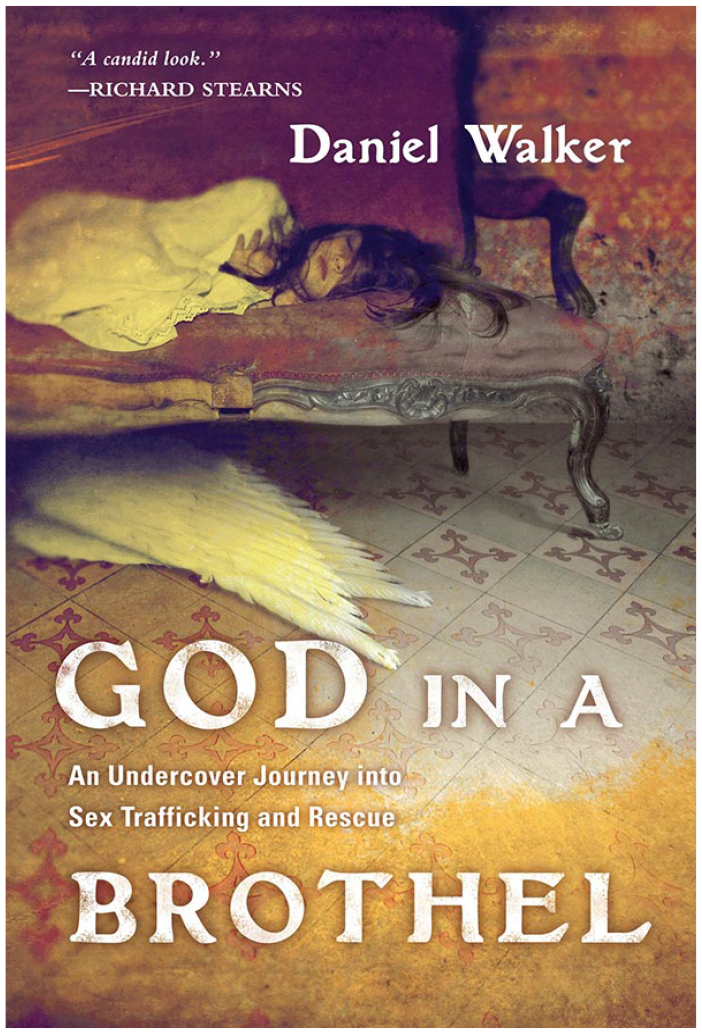
Book cover God in a Brothel. Copyright InterVarsity Press.
These stereotypical descriptions of the sex trafficked girl have been pointed out in previous research (e.g. Balgamwalla, 2016; Doezema, 2010; O’Brien, 2018). Here, I want to emphasize how difficult it seems to be to tell a sex trafficking story without giving the girl these characteristics. The pictured sex trafficking victim is clearly attributed all the characteristics of an ideal victim (Christie, 1986). Moreover, I want to make a stronger point about how these traits of youth, beauty and innocence can be seen as signifiers of the girl’s sacredness. The sacred girl is pure, and elevated; society idolizes her, yet desires her (Durkheim, 1995 [1912]). Furthermore, she is described as ready for a life change, freedom, or (sexual) adventure. However, she must be pure to survive that journey. This is particularly clear in the fictional film Taken, where the main girl of the tale is a virgin, while her friend is not. The virgin is rescued, and even though her virginity was sold on the sex trafficking market, she is saved ‘intact’. Her older and sexually experienced friend is instead found chained to a dirty brothel bed, sexually abused and dead. The friend’s polluted, half-naked body is spent, non-recoverable, in this scene where sexuality and dirt are closely intertwined. To argue in line with Russell (2018), it is the representation of the female body that we can locate the impure sacred, as her body and morality have been polluted.
The girls in the films and books are at risk of pollution once they transgress from girlhood into womanhood. When the girl Lakshmi in the fictional book SOLD starts to menstruate at the age of thirteen, she gets advice from her mother: Now, she says, you must carry yourself with modesty, bow your head in the presence of men, and cover yourself with your shawl. Never look a man in the eye. Never allow yourself to be alone with a man who is not family. And never look at growing pumpkins or cucumbers when you are bleeding. Otherwise they will rot. Once you are married, she says, you must eat your meal only after your husband has had his fill. Then you may have what remains. If he burps at the end of the meal, it is a sign that you have pleased him. If he turns to you in the night, you must give yourself to him, in the hopes that you will bear him a son. (SOLD by McCormick, 2008: 21)
By transforming into a woman, Lakshmi is viewed by her traditional society as polluted while bleeding (cucumbers can rot), but she may also be desired by men. Similar to Durkheim’s (1995 [1912]) religious symbol ‘the sacred’, the girl can inspire both love and fear, but I would rather label it as desire and repulsion. Since men now want Lakshmi, they can also abuse her if she is not modest enough. Just like Gavin (2012) has pointed out, girls’ beauty, or I would say sexuality, can put them in danger if they are not careful. But beauty and sexuality can also lead down the more conventional road of marriage. This narrative can therefore ‘help’ girls to beware of dangers, and guide them towards the traditional path in life. The sex slave trope in films and books can thus be seen as a classic cautionary tale in a new format, socializing women to follow society’s conventions (cf. Zipes, 1993; 2012).
The protector of the sacred sex trafficking victim’s sexuality is the hero of the tale. Previous research points out that this hero is generally a White man from the global North (O’Brien, 2018). It holds true for my analysed books and films too. This underlines the stereotype of how ‘white men are saving brown women from brown men’ (Spivak, 1993: 93). This narrative upholds heteronormative and colonial hierarchies (Forringer-Beal, 2022; Vance, 2012), and it reflects many Western countries’ colonial legacies (Broad and Gadd, 2023; Doezema, 2010). The global North’s colonializing heritage apparently precludes other nuances in the sex trafficking narrative. Hence, the hero is modulated for the Western man, who never has to identify with a foreign, evil offender, nor a sex buyer, since he is always cast in the role of the superhero, elevated and superior with unimaginable powers. Daniel Walker, the author of the autobiography God in a brothel, refers to superheroes when he recounts his journey of how and why he became an undercover police officer working against sex trafficking: I always wanted to be a superhero. Not with tights and a cape but with the kind of hero every boy aspires to be. Growing up, I worshiped Zorro, the Lone Ranger and the Bionic Man. I read every Commando comic, watched every war movie and closely followed the adventures of every modern-day savior, be they Luke Skywalker or James Bond. I would regularly lose myself for hours playing war games with friends, imagining my heroic part in all the great battles of history. As I grew older I began to look forward to fulfilling my own destiny in some modern-day struggle of good versus evil. The only two vocational options attractive to me were those of a soldier or a police officer. I determined to give my heart and soul to one or the other. (God in a brothel by Walker, 2011: 18)
This superhero character is modelled after previous archetypal heroes, and is an equivalent to the knight in shining armour out to rescue the princess. Walker portrays himself as a rescuer, ‘the good guy’ in a war against evil. Despite being on the ‘good side’, the hero in the sex trafficking narrative also brings a lot of vengeance. Let us consider the fictional film Taken’s tagline, a film mainly told from the hero’s perspective: ‘They have taken his daughter. He will hunt them. He will find them. He will kill them’ (IMDb, 2020a). From the tagline, we can tell that there are severe consequences for those who cross paths with the hero on his journey to liberate the sacred sex trafficking victim. Thus, if someone is evil and threatens to defile the sacred, this sacrilege may be followed by the wrath of God, administrated by the hero. Subsequently, drawing on Durkheim, the hero represents the good and battles evil, sometimes by being evil, while the sacred sex trafficking victim’s battle stands between purity and impurity.
The third character in the sex trafficking narrative is the villain (see also Balgamwalla, 2016; Kinney, 2015; O’Brien, 2018). I have already introduced the princess and the knight, so here comes the dragon. And like any monster, we can tell by his appearance how evil he is. In the fictional film Taken, the hero is warned by a police chief of the criminals: ‘They are Albanians, they are dangerous’, and they certainly do look dangerous. When our hero enters the lair of the dragon, he is met by swarthy, beefy, aggressive men, and subsequently ends up fighting them. Many of the villains in the analysed books and films are Eastern Europeans or Arabs. The ‘evil Arab’ caricature is a well-known trope, embodying the global North’s suspicions and concerns (Shammas, 2018), and he fits perfectly into the sex trafficking tale. By continuously describing offenders as foreigners and monsters (cf. Christie, 1986), we can fully blame ‘the others’ for the sex trafficking problem.
Nevertheless, the height of the damsel’s distress is when she is forced to sell sex to numerous, unknown men. Perhaps surprisingly, sex buyers merely have supporting roles in the analysed narratives, while sex traffickers are described as the true monsters. The ‘johns’ are simply depicted as fleeting ghosts, despite being the ones inflicting such pain on the sex trafficked girl. These anonymous, male shadows’ only characteristic is their frequency. In the fictional film Lilya 4-ever, the viewers see and feel Lilya’s pain as the camera films all her ‘johns’ from Lilya’s viewpoint. Here, we are no longer observers looking at Lilya, we become Lilya as our emotions intertwine with hers. The men are old, young, ugly, good-looking, and so many, as they enjoy their own pleasure and Lilya’s pain; they are truly haunting and punishing her. Even though many of them are White men, this is not stressed in any of the films or books since the global North’s audiences are supposed to identify with the hero, not with the ‘johns’. The sex buyers are mere extras in this story of suffering and redemption. These ghosts’ purpose is to inflict pain on the damsel, and turn her into a victim. I would argue that the sex buyers are not true characters of this story, rather they are functions that drive the story forward. They are the pain.
The plot thickens
In the studied films and books, there are numerous reruns of the Natasha/Maria/Ghita-stories. The fictional film Lilya 4-ever is entirely built around this sequential narrative, and this is repeated in the other films and books. In this part of the analysis, I will explore the sequence of the stories and their outlines. Furthermore, I will look more closely at the tale’s moral warnings and towards whom they are directed. In the autobiographic book God in a Brothel, the author narrates the classic Natasha story: Sixteen-year-old Emily then told me her story. She had recently travelled to the United States from Puerto Rico with her mother. However, not long after her arrival, her mother died, and Emily was left alone and very vulnerable. Into this void stepped a man named Steve. Steve was a pimp and had little difficulty in providing all of the reassurances and affection Emily needed. Once he had sufficiently ensnared her in his web of deceit and manipulation, Steve put her to work in the strip clubs, truck stops and cheap hotels on the outskirts of Atlanta. She explained how she was forced to work every day, either prostituting herself to truck drivers and hotel patrons or having sex in the back rooms of a nearby strip club. She could not hide her tears as she lamented her plight and the very different dreams her mother had held for her future once they had arrived in the United States. (God in a Brothel by Walker, 2011: 108–109)
Burkert (1996) would point out that a sequential analysis of Emily’s narrative (à la Propp, 1968) is a replica of the classic ‘maiden’s tragedy’, with all the required ingredients: leaving home; seclusion; tragedy; violation; and suffering, but this particular sex trafficking story lacks a happy ending. Furthermore, Burkert (1996) understands the maiden’s tale as a culturally accepted way to describe girls’ transition into womanhood. That interpretation is relevant for many of the life stories (cf. Sandberg, 2016) told by or about the ‘Natashas’, just like Emily’s story.
Let us look at a sex trafficking narrative that has the potential to be different from the maiden’s tragedy. The documentary film The Price of Sex is marketed as a survivor story, and one of the main characters, obviously upset, tells her tale of how she was ensnared into sex trafficking: Do you want to work as a waitress? she asked. I do. Where? Dubai. I’ll go. $500 a month. Wow! Of course, I wanted to go. OK! she said. Tomorrow we’ll leave for the capital. Someone will arrange your documents and passport. Looking back, I think, my God! How could I have been so stupid? How could I have believed such a thing? I was so naïve. I was 19 years old and fell for the money. And it only hit me when I got to Dubai. We were met by this . . . Hassan . . . We went to an apartment. He told me to give him a blowjob, and exactly how to do it. I said: why is this necessary? Don’t you know why you are here? I’m here to be a waitress, I said. That’s when he told me, you’ll be serving, alright, but not as a waitress, as a prostitute. (The Price of Sex, 2011)
This is a familiar sex trafficking narrative, which is told both as a life-story and as an event story (cf. Sandberg, 2016). Moreover, this survivor story also bears great similarities to the Natasha story: a young, naïve woman is lured under false pretences and trafficked into a life of sexual slavery. Here, we can observe the unfolding of ‘the maiden’s tragedy’ and its storyline as described by Burkert (1979, 1996). Thus, the sex trafficking narratives do not seem to diverge from each other, whether they are told as classic victim stories, survivor stories or hero stories, nor if they are fictional or ‘authentic’, nor between the selected books or films. It is evident how difficult it is to tell a story of sex trafficking, or making it reverberate, without adhering to the traditional metanarrative of the maiden’s tragedy.
Now, I would like to plunge deeper into the start of these stories, to better understand their intentions. When it comes to non-Western sex trafficked girls (‘brown girls’ and ‘Natashas’ from the former Soviet bloc), their destinies are sealed by their poverty, just like Emily in God in a Brothel (Walker, 2011). Poverty drives them, or their parents, to seek a better future. In the fictional film Lilya 4-ever, Lilya’s mother abandons Lilya, and leaves with a new boyfriend to find a better life in America. In a very emotional scene, Lilya, in her nightgown, runs after her mother into the street. Lilya screams, cries, and begs her mother: ‘Don’t leave me! I can’t do it!’ She hugs her mum and tries to stop her from getting into the leaving car. When her mother still leaves, Lilya falls to the ground on her knees, crying in total despair.
While these narratives make us understand the desperation arising from poverty, they simultaneously blame and shame the parents, and especially the mothers. How can a good mother abandon, sell, or risk the life of her own daughter? The ‘bad mother’ is a deeply embedded trope in Western culture, which can include almost all women, not only actual mothers, who can be labelled as bad mothers when they inflict harm instead of care (Jewkes, 2011).
Furthermore, Suchland (2013) has interpreted Lilya 4-ever as a Western, voyeuristic tale of post-socialist failure. Indeed, a sense of Western superiority is transparent in several of the analysed films and books. Zipes (2006) argues that many of the fairy tales people tell, are moral tales, serving the interests of powerful groups. This is especially obvious in the cautionary tales about sex trafficked ‘brown girls’ and Natashas; the stories warn off attempts to break free from poverty. Narratives of sex trafficking have been interpreted, among several things, as a racialized fear of migration, and a fear of the loss of control over borders (Agustin, 2005; Berman, 2003; Jahnsen and Skilbrei, 2018; Kinney, 2015). It can be viewed as an expression of colonial and ethnocentric values about migrants, the poor, and ethnic minorities (Cojocaru, 2015). My argument is in line with previous researchers, as I consider the constant repetition of these cautionary tales of sex trafficking being warnings to poor, non-Whites to not breach the borders of the West. These narratives show how transgression of borders in the global North may be retaliated with sexual slavery. However, I will also add to previous research by showing that the tale is also directed towards young, White women in the global North.
When it comes to girls that are White and Anglo-Saxon, their stories do not begin with poverty. Instead, these girls want to travel and see the world, and they long for freedom, agency, and self-emancipation. The girls are sometimes explicitly warned against this. The daughter in the fictional film Taken is cautioned before her travels abroad by her father, the former CIA-agent. In a conversation, the daughter, Kim, says: ‘Mom said your job made you paranoid’, and the father replies: ‘My job made me aware’. The father knows the dangers of the world, and the daughter will deeply regret that she did not listen to him. Baker (2014) has interpreted Taken as sending a message to women that they need male protectors, and that they should listen to their parents and stay home. Similarly, the analysed autobiography Trafficked is also a cautionary tale, where the British girl Sophie too should have stayed home. Instead, she travels out of the country with her Albanian boyfriend, and is forced into prostitution by him. ‘I thought I could manage it on my own’, Sophie says to a British police officer who later helps her (Hayes, 2013: 230). It is clear from these narratives that the girls cannot, and should not, try to manage on their own. They need masculine help, protection, and guidance from a White hero.
The sex trafficking narratives may thus be interpreted as a quelling of young women’s sexual liberation. Kim, the girl in the fictional film Taken, sets out on an adventure to Paris, the capital of romance, with her sexually more experienced friend. The first thing that happens to them upon arrival is an encounter with a young man, whom the friend flirts with. The young man turns out to be a spotter for an Albanian sex trafficking ring. Here, female sexuality is considered to be not only morally wrong, but also dangerous (Douglas, 1966). Therefore, the overall message of the sex trafficking tale directed towards White women is: do not strive for self-emancipation and freedom, or explore your sexuality, that could be risky! As Caillois (2001 [1959]: 96), following Durkheim, has put it: ‘virtue consists in remaining in the order, keeping in one’s own place, not leaving one’s station, keeping to what is permitted, and not approaching what is forbidden. Having done this, one also keeps the universe ordered’. Similar to the fairy tale Little Red Riding Hood, girls should not diverge from the traditional path, or the evil wolf will hunt them (Gavin, 2012; Zipes, 1993).
Emotional sufferings as we near the end
Let us now explore the core of the tale: the sexual slavery. There would not be a narrative of sex trafficking without the sexual degradation of the girl, which I interpret as the girl’s punishment. The sex trafficked girl receives a severe penalty for not following conventions and warnings, and for not staying at home, and/or in poverty, and guarding her chastity. According to O’Connell Davidson (2010: 256), the sex slave is ‘represented as the ultimate, suffering premodern Other against which civility can be measured’. This is certainly true for the sex trafficking narratives of global South women such as Natasha, Maria, and Ghita who seek a better life in the West and are punished for crossing that border. However, as I have shown, White girls from the global North such as Sophie, Emily and Kim are also punished in the sex trafficking narrative for not complying with society’s moral rules when they seek adventure in Europe or the United States. To further understand the metanarrative of sex trafficking, I would like to deepen the argument of how the sex trafficking victim can be seen as a modern representation of ‘the sacred’. In the narrative, we are witnessing the sex slave’s suffering when her body is polluted over and over. This gruesome penalty is, for example, described in the fictional book SOLD: In between, men come. They crush my bones with their weight. They split me open. Then they disappear. I cannot tell which of the things they do to me are real, and which are nightmares. I decide to think that it is all a nightmare. Because if what I happening is real, it is unbearable. (SOLD by McCormick, 2006: 129–130)
It is emotionally challenging to read about, and look at, the sufferings of sex trafficking victims, but horror and emotional turmoil are natural responses to stories about sexual slavery (Gadd and Broad, 2018). Still, there seems to be a craving for ‘the powerlessness, the shocking details, the humiliation, the horror and the sexual domination’ (Cojocaru, 2015). These emotions of distress and disgust are at the core of the sex trafficking tale, and this is what makes the tale so powerful. If we interpret the sex trafficking victim as a representation of the sacred, like Russell (2018), this narrative describes how the sacred’s body is transgressed and polluted by the sexual violations. After these defilements, the female body can be purified to regain holiness, through rites that may involve suffering (Douglas, 1966; Durkheim, 1912 [1995]). Drawing on Durkheim and Douglas, I consider the sexual slavery in the narratives as representing a ritual that both punishes the sacred, and has the possibility to purify her: to forgive the sacred for her moral wrongs and re-establish the hierarchical, societal order. Hence, the sex trafficking tale symbolizes a restoration of the moral order, which is a core function of punishment, according to Durkheim (1961 [1925]). The punishment of the sex trafficked girl is a moral education and a cautionary tale directed specifically towards women; warning them of seeking freedom, (sexual) liberty, or a life beyond poverty.
Sex trafficking narratives usually end with the sex slave’s rescue (O’Brien, 2018; Todres, 2015). Liberation from sex trafficking ‘is the optimistic and emotionally satisfying ending that provides readers with closure’, writes O’Connell Davidson (2015: 206). This is certainly true for the fictional accounts that are included in this study: the film Taken and the book SOLD. Both narratives have happy endings, entailing a heroic liberation of the girl by a White man, and a restoration of order. However, not all fictional narratives end happily. In the film Lilya 4-ever, which is based on a true story, there is no knight in shining armour who can rescue Lilya, so our heroine commits suicide. Furthermore, there are only unhappy endings in the documentary The Price of Sex, as the descriptions of women who have made it out on their own or through NGOs are deeply unsettling. One of the survivors tells us, through her tears: ‘I’d be better off dead than living like this’. Even though she has been freed from sex trafficking, the portrayal of her is of someone profoundly broken and barely able to live. Hence, the analysed sex trafficking narratives that are closer to reality do not end with heroic rescue operations. Instead, when the story is closer to reality the former sex slaves have severe difficulties leaving their experiences behind them, as they are trapped in the identity and stigma of the sex trafficked victim (Russell, 2018). If the sex slave is not rescued by a hero, her punishment continues. It looks like only the hero can end the sacred’s suffering, which is more plausible in fiction than reality. The purpose of the hero in the sex trafficking narrative is to conclude the ritual, and complete the purification of the victim. Thus, when the hero salvages the sacred this ends her punishment, she is forgiven for her moral offences, and is purified, elevated, and reinstated. The masculine hero is our saviour and our priest.
Conclusions: moralistic narrative continuities
In this article, I have shown how the metanarrative of sex trafficking includes three narrative characters that can be recognized from traditional folk tales: a damsel in distress, a monster, and a superhero. Furthermore, the outline of the sex trafficking story follows the classic folk tale of ‘the maiden’s tragedy’; a moralistic and cautionary life story of girls turning into women. The sex trafficking narrative comes with colonializing undertones, which pinpoint foreigners as evil, and warn poor women from trying to seek a better life by crossing borders in the global North. However, it is a sexist warning aimed at White women too, who should not deviate from gender norms, or society’s moral order. The tale reminds women that they are dependent on (White) masculine help and protection. Thus, this popular media story, is continually retold to maintain traditional power relations; the global North’s domination over the global South, men over women, adult over youth. The metanarrative of sex trafficking can thus be interpreted as a moral warning of breaking traditional hierarchies. The story of sex trafficking disciplines us and outlines societies’ accepted moral standards of purity and impurity.
Furthermore, I have argued that the sex slave victim can be understood as a modern-day symbol of ‘the sacred’, embodying both purity and impurity. Traditionally, she originates from myths, fairy tales, and religious beliefs; while today she is (re)presented in popular media. The sacred is glorified, and we empathize with her when she suffers. I have theorized that the metanarrative of sex trafficking starts with the sacred’s moral transgression when she seeks freedom/adventure, or liberation from poverty. Her sexual slavery can thus be understood as a correction, a punishment, as well as a purification ritual if it is completed by a male rescuer. However, I have also shown that the fairy-tale ending is mainly reserved for fictionalized stories of sex trafficking, while stories closer to real-life events rarely end happily. Following Durkheim further, we can see how the condemnation of the sacred and her punishment strengthens society’s hierarchically gendered and colonial order, and binds us together in a moral cohesion. By being saved, the sex slave is forgiven for not following conventions, and society’s moral order is restored. When the sex trafficking story is told and retold, its morality is imprinted on its audience and we are warned against diverging from our outlined path in the world.
This article has pointed out the moralistic, narrative continuities between influential, popular media depictions of sex trafficking and classic folk tales. The core of the narrative has remained the same, as the story has been adapted between different popular media. The continuous repetition of the sex trafficking narrative makes the tale, and especially its moral connotations, a vital part of many cultural scripts. Stories like these are powerful, metaphorical communications of values, normative behaviours, and sexual roles (Zipes, 2006), as they are repeated in popular media. This is certainly true for the sex trafficking narrative.
While the influential metanarrative of sex trafficking may highlight some victims’ experiences, and raise awareness and support in the fight against sexual slavery, it is also deeply problematic. The ‘poster girl’ of sex trafficking captivates and excites the audience, encourages a reproduction of the perfect victim archetype, and promotes rescue and salvation (Agustin, 2005, 2007; Cojocaru, 2015; Doezema, 2010). However, as this article has shown, the simplified sex trafficking narrative nourishes a hierarchy of victimhood where only ‘ideal’ victims are endorsed, sex traffickers are stereotyped, sex buyers are invisible, and non-ideal victims tend to be ignored or even blamed and shamed.
Critical victimologists call for alternative ways to tell more complex stories about sex trafficking and its survivors (see, for example, Doezema, 2010; Forringer-Beal, 2022; O’Brien, 2018), since such representations may nuance and destigmatize victims’ lived experiences (Weitzer, 2018) We can access alternative narratives through interviews, biographies, and auto-biographies, as well as in research (Cojocaru, 2015; McGarry, 2017; van Dijk, 2009; Walklate, 2018). Those narratives include more complex or unusual characters such as sex trafficked boys/men/LGBTQ + victims (Boukli and Renz, 2019; Dennis, 2008; Forringer-Beal, 2022; Moynihan et al., 2018), non-ideal offenders who do not fit the stereotype of evil, organized sex traffickers (Broad and Gadd, 2023; Raby and Chazal, 2022), as well as empowered survivor tales of agency and resilience, as well as sex workers’ and sexually experienced victims’ stories (e.g. Dennis, 2008; Vance, 2012).
Consequently, the established metanarrative of sex trafficking can be challenged through counter narratives, a variety of stories, and complex tales. The story’s set characters should be diversified by acknowledging and encompassing a wider variety of victims in both popular media and research, including the non-ideal ones, and a variation of representations that go beyond the iconic tale of damsels, monsters, and superheroes.
Footnotes
Acknowledgements
The author thanks Tea Fredriksson, Tove Pettersson, Victor Lund Shammas, and Anders Stenström for many useful comments, support, and helpful suggestions. A huge thanks to Tea Fredriksson for proofreading the article. This work was supported by the Department of Criminology, Stockholm University.
