



Abstract
From previous research it is well known that victimization can have various short- and long-term consequences resulting in a need for support to cope with the victimization. Research also shows, however, that not all victims of crime seek or receive support. One cause of this might be the conditions and constraints that affect professionals’ matching of support services with individual victims’ needs. The purpose of the present conceptual paper is to discuss how professionals can co-produce support services with the individual victim and if needed engage suitable external organizations for the purpose of adapting support services to the individual victim’s needs, while also considering the complex field of constraints that professionals need to navigate during this process. The paper makes two main contributions. First, it conceptualizes the complex field of constraints as consisting of five sets of conditions (mandatory, local, professional, support-user, and inter-organizational conditions), which professionals must navigate during the co-production of victim support services. Second, the paper suggests a seven-step process of how professionals can navigate this complex field during co-production of victim support services’ activities with the individual victim, and potentially those of external organizations as well.
Introduction: the intersection of individual needs and professionals’ complex field of constraints
Victims of crime may have practical, emotional and/or informational support needs related to coping with their experiences, however, few victims seek formal support, and even fewer receive it (e.g. Bryce et al., 2016; Guterman et al., 2002; McCart et al., 2010; Sabina et al., 2014; ten Boom and Kuijpers, 2012; Thunberg and Källström, 2018). Adding to this, not all victims of crime who do receive formal support perceive it as helpful (Thunberg, 2020), or experience that their needs are met by the support to which they are legally entitled (Holmberg et al., 2020). Such experiences might be caused by, for example (1) victim-blaming attitudes or ideas among support providers (e.g. police officers) about who is most ‘worthy’ (e.g. Banwell-Moore, 2023; Bryce et al., 2016; Pemberton et al., 2019); (2) an organization’s lack of resources to accommodate support needs (e.g. Lorenz et al., 2019); (3) victims feeling unable to tell their story and exercise their agency (i.e. to feel less assertive, respected, or in control of the situation) (e.g. Banwell-Moore, 2023; Shapland, 2018; Thunberg, 2022); or (4) different expectations about how a case should be handled (Shapland, 1986). Taken together, previous research suggests that the matching of individual needs with the formal support that is offered is not functioning as expected. This calls for more theoretical research to further our understanding of how to improve the accuracy of post-victimization support so that it better accommodates the support needs of the individual crime victim.
This paper combines victimological and organizational perspectives in a discussion of the potential (and challenges) of using co-production and inter-organizational relations to meet victims’ support needs. Co-production concerns the potential relationship between professionals and support users, where the professionals are involved as ‘regular producers’ and the users are involved through voluntary efforts to enhance the quality and/or quantity of the support services they receive (Bracci et al., 2016; Mortensen, 2020; Pestoff and Brandsen, 2010; Voorberg et al., 2015). Here, the term ‘professionals’ refers to government employees (e.g. police officers or social workers) or trained volunteers (e.g. victim supporters) in direct contact with support users as a part of the support provision (McMullin, 2022), while the term ‘support users’ refers to those victims who receive and consume public support services (Mortensen et al., 2021). Co-production builds on the premise of empowerment and direct user participation in public service delivery, and thus, the approach aligns with victimological research stating that encouraging active and thoughtful involvement from victims in the construction of their own support increases the accuracy of support (cf. McCold and Wachtel, 2003; Shapland, 2018). The concept of inter-organizational relations refers to the patterns of relationships between and among organizations (or their representatives) that are pursuing a mutual interest and solving shared problems while remaining autonomous (Cropper et al., 2008; Mandell et al., 2017). Crime victims often have multiple and changing support needs, and no single organization can or should be expected to meet all these needs, whether owing to a lack of resources, skills, or knowledge (Thunberg, 2020). Hence, based on this premise, in order to create seamless services from the victim’s point of view, professionals need to co-produce support services not only with crime victims, but also together with professionals from other organizations (Brix et al., 2021; Shapland, 2018). A key assumption in this regard is that professionals must be able to distinguish between different forms of inter-organizational relationships and adequately match the potential and requirements of a given form with the support needs of the victim in question to achieve seamless service delivery in instances where in-house solutions are not enough (Keast et al., 2007).
Introducing the concepts of co-production and inter-organizational relations into the context of victim support holds a lot of potential. Nevertheless, research offers limited perspectives on how professionals can co-produce support services specifically with crime victims while potentially engaging suitable external organization(s) in the support delivery process. Such a process presumably entails that professionals must navigate various conditions, among other things legislation, in-house and external resources, discourses, and the victims’ motivation to seek and receive support (Bryce et al., 2016; Jägervi, 2014; Leukfeldt et al., 2020; Ljungwald and Svensson, 2007; McAlinden, 2014; Thunberg, 2020; Thunberg and Andersson Bruck, 2020). In addition, engaging external organizations in the support provision can involve several risks if the proper precautions are not considered (e.g. formalities and trust between the organizations) (Keast et al., 2007; Mandell et al., 2017). Together, various conditions contribute to a complex field of constraints, which the professionals must navigate while providing formal support together with the support user and potentially other organizations as well (Mortensen et al., 2021). Nevertheless, research does not comprehensively identify these various conditions in the context of victim support, which together compose constraints for engaging in co-production with both support users and external organizations. The argument of this paper is that understanding the process of co-producing post-victimization support delivery, as well as the conditions that professionals must navigate during such a process, might be a step toward gaining a better understanding of how support services can better be matched with individuals’ needs.
Based on previous research and theoretical discussions, the aim of the present paper is to discuss how professionals can co-produce support services with the individual victim and, if needed, engage suitable external organizations for the purpose of adapting support services to the individual victim’s needs, while also considering the complex field of constraints that professionals need to navigate during this process. In the pursuit of this aim, the article needs to uncover the conditions that make up the complex field of constraints. For this purpose, we draw on the theoretical concepts of victimization, victim and victimhood, co-production, and inter-organizational relations. We then bring the concepts together to discuss and problematize the potential process of co-producing formal support with crime victims and, if needed, involving external organizations to match the victims’ support needs, and how the professionals should navigate the complex field of conditions along the way. Thus, the paper intends to build on current knowledge through a theoretical discussion regarding the victimological and organizational theories and their potential to improve the matching process between victims’ needs and the availability of support.
Theoretical concepts
In this section, we introduce the concepts of (1) victimization, victim, and victimhood, (2) co-production, and (3) inter-organizational relations. This is done to identify the relevant conditions that make up the complex field of constraints as well as the potential process through which co-production of support services could occur.
Victimization, victim, and victimhood
Because the support user plays an active role in co-producing activities, it is essential to uncover the relevant conditions involved in engaging this specific user group in the provision of support (Lipsky, 2010), or more specifically, the conditions connected with having experienced a crime and being a victim who needs and seeks support. When conceptualizing the concept of ‘victim’, two other sub-concepts emerge as well: victimization and victimhood (Thunberg, 2020). In short, if a victimizing event (i.e. a crime) happens to an individual or collective, then this event leads to a victimization. The term ‘victimization’ is related to the legal definition of what constitutes a crime in national law; hence, victimization may be understood differently in different countries and cultures (Thunberg, 2020). The act of victimization then causes the individual or collective to become a victim; however, the term ‘victim’ is based on two understandings: (1) a structural understanding of how a victim is perceived in a social setting according to social norms and values in that setting, and (2) an individual understanding, where each victim constructs his or her own victimhood (also called victim positioning) (Thunberg, 2020; Thunberg and Andersson Bruck, 2020).
In the Western world, a victim is often structurally understood in accordance with Christie’s (1986: 18) conception of the ‘ideal victim’, which is defined as ‘a person or a category of individuals who—when hit by crime—most readily are given the complete and legitimate status of being a victim’. Christie (1986) ascribes five attributes to the ideal victim: (1) the victim is weak (e.g. sick), (2) the victim was carrying out a respectable activity, (3) the victim is beyond reproach, (4) the offender was dominant in relation to the victim and can be described in negative terms, and (5) the offender was unknown and had no relationship to the victim. Christie’s theory has, however, been strongly criticized for being stereotypical and making victims appear weaker than the offender, a description with which some crime victims cannot identify (e.g. Fohring, 2018; Holmberg et al., 2020; Jägervi, 2014). For this reason, other terms such as ‘person exposed to crime’, ‘injured party’, or ‘survivor’ have emerged in the literature and in practice to avoid the sometimes negative connotations associated with the word ‘victim’ (Dunn, 2005; Holmberg et al., 2020; Lorenz et al., 2019). Some researchers have criticized the conception of the ideal victim for not representing the ‘real world’, as the world is not as black and white as the concept makes it out to be (e.g. Fohring, 2018; Holmberg et al., 2020; Jägervi, 2014; Lerner, 1980). Similarly, several researchers have problematized the fact that victim discourses, such as the assumption of an ideal victim, deny victims a voice in their cases, as they treat victims as passive and do not take their resilience into account (Green et al., 2021; McAlinden, 2014; Walklate, 2011).
In response to the critique of these negative victim discourses, other researchers argue that people construct their own ways of being victims (Burcar, 2005; Thunberg and Andersson Bruck, 2020), which is also how the concept is used in this paper. Because people construct their own ways of being victims, the concept of ‘victim’ needs to be understood in relation to how the individual who has experienced the victimization defines it. A pertinent condition for meeting the victim’s individual support needs thus seems to be to encourage active participation by the victim and to listen to the victim’s own perception of what happened (cf. Green et al., 2021; Shapland, 2018). In doing so, professionals must go beyond the prevailing victim discourse in the co-production of support with victims, and instead listen to the victims’ experiences and expressions of what they need to process these experiences. In the present study, ‘victim’ is used as a subjective concept to indicate that an individual has experienced a victimization, which is in line with both the United Nations (1985) Declaration of Basic Principles for Justice for Victims of Crime and Abuse of Power and EU Directive 2012/29/EU concerning the minimum standards for crime victims’ rights, support, and protection (see European Parliament and Council, 2012). These documents illustrate the importance of looking beyond victim status in a discursive and legislative meaning and instead seeing individuals and their needs of support, which calls for a subjective understanding. A closely related concept is victimhood, which refers to how individuals construct their own ways of being a victim. A person may renounce their victim status because they cannot identify with the discursive understanding of the concept, for example, due to the connotations that accompany the idea of the ideal victim (Åkerström et al., 2011; Burcar and Åkerström, 2009; Jägervi, 2014). Similarly, others may question a person’s victimhood if that person does not act as expected of a victim (Van Dijk, 2009). However, several studies have problematized this, arguing that questioning victims’ ways of constructing their victimhood may deprive them of agency (McAlinden, 2014; Pemberton et al., 2019; Thunberg, 2022). Victimhood is a process whereby individuals assess their victimization and their understanding of the victim concept in relation to their established identity, and thus construct their own ways of being victims. In this regard, victimhood is a doing, while a victim is a being. Therefore, an essential condition for professionals is presumably to preserve or reestablish the victim’s agency in the provision of support by focusing on victims as active stakeholders in their own support provision.
The perception of support
The Victims’ Rights Movement gained momentum worldwide during the 1970s and generated an increasing number of rights related to support which professionals need to consider and navigate in their support provision (Holmberg et al., 2020). In Sweden and Denmark, for example, victimization does not need to be defined as a crime in accordance with the national penal code in order for the victim to receive support; that is, the victim does not need to wait for the police to determine if a crime has taken place before getting access to support. Nevertheless, victims’ needs are not always accommodated by these formal legal rights, as they leave limited room for respecting differences in how victims construct their victimhood. How individuals construct their victimhood and view themselves as victims might affect their need for support, whether they seek and receive it, and whether they perceive the support they are offered as supportive. In this paper, support is defined as the help and interventions needed to process the psychological, financial, physical, practical, and social effects of victimizations and includes, for example, emotional support, practical help, and information (e.g. Shapland, 1986; ten Boom and Kuijpers, 2012; Thunberg, 2022). In research on young crime victims, it seems that those who identify as victims and receive acceptance from other people for this positioning more often seek and receive support than those who do not receive acceptance (Thunberg, 2020; Thunberg and Andersson Bruck, 2020). Such research findings underline the interpersonal aspect of accommodating individual support needs of crime victims (Pemberton et al., 2019). This further suggests that how people identify themselves has implications for what kind of support they perceive as available to them and as supportive. This could be connected to the concepts of agency and communion, which stress the importance of individuals feeling, for example, in control of their life and being able to act, while also feeling included in their social context (Abele and Wojciszke, 2014; Thunberg, 2022). Pemberton et al. (2017) argue that victimization can negatively affect the individual’s feeling of agency and communion, while Thunberg (2020) further builds on that argument, stressing that post-victimization support needs to focus on strengthening the individual’s feeling of agency and communion. Through Green et al.’s (2021) arguments, which focus on victims’ narratives, individuals’ resilience and strength are both added to the understanding of victimhood, which also puts more focus on victim agency. Listening to individuals’ narratives of victimizing events and how they have affected them can be a starting point for the co-production of support services that are adapted to individuals’ needs and contexts.
From the standpoint of support providers, research shows that the way individuals are viewed as victims affects how the support providers act (Burcar and Åkerström, 2009; Holmberg et al., 2020; Tennent, 2019a, 2019b). For example, Burcar and Åkerström (2009) illustrate this in a Swedish context by quoting a respondent who states that the information about support to victims did not seem to include him; it seemed to focus on female victims of rape (for similar results from Denmark, see Holmberg et al., 2020). This would suggest that a certain image of the victim is conveyed by support providers, making others feel excluded. The image that is projected is that the victim needs to be someone who has suffered and needs to talk about what happened in order to process the victimization (i.e. to align with the perception of the ideal victim), but this is not something that all victims identify with (Burcar, 2005; Burcar and Åkerström, 2009; Jägervi, 2014). Instead, they might view themselves as both strong people and as victims. Similarly, a study from New Zealand finds that support providers define whether the victim’s need for support is related to criminal victimization or something else to determine whether they should receive victim support (Tennent, 2019a, 2019b). The assessment is based on the support providers’ organizational requirement to determine which victims of crime are entitled to support in accordance with the organization’s definition of who is a victim. This is done regardless of whether the individuals themselves identify as victims, and it illustrates the boundaries set by local conditions in an organization where a professional wants to help victims of crime, but at the same time the victims need to fit into a ‘victim category’. In such cases, the professionals should ideally look for external organizations that might be able to help the victim instead. Hence, it is not simply a question of resources, or of what ways people identify themselves as victims, but rather it is a combination of a victimological and an organizational perspective, where the victims can retain ownership of their victim narratives while the professionals also consider the resources needed to be able to help (see Pemberton et al., 2019).
Based on the above, we can infer that the professionals need to take various legal considerations into account (e.g. in terms of what legally constitutes victimization, victims’ right to support, etc.), along with how victims create their victimhood and perceive their need for support. In addition, it seems pertinent that the professionals should be attentive to rebuilding the victim’s agency and sense of communion during the provision of support. The section also illustrates how professionals might be restricted by internal definitions of a victim, and in response, they need to look for external organizations that are better equipped to help the victim in question.
Co-production
In this section, we introduce the concept of co-production and discuss the potential constraints such an approach places on professionals providing support to crime victims. Co-production was first introduced in the 1970s, but it was not until the 2010s that it emerged as an organizational recipe for service production (Mortensen, 2020; Mortensen et al., 2021). It is often considered an umbrella concept, as it captures a mixture of activities, including several dimensions of interaction (e.g. dialog, practical matters) that occur in any phase of the public service cycle, and in which actors from the public (e.g. police officers) and third sector (e.g. non-profit organizations, support users) work together to increase the efficiency of public services (Brandsen and Honingh, 2016; Ewert and Evers, 2014; Sicilia et al., 2019).
However, co-production is not just a question of whether there is interaction between professionals and support users, but also of whether the support users’ contributions are induced by the behavior of the professionals (Brandsen, 2020; Ewert and Evers, 2014). It is essential that experiences and outcomes are negotiated between support users and professionals, and that professionals avoid dominating the situation (Källström and Thunberg, 2019; Osborne and Strokosch, 2013). Professionals must be able to listen to the support users, give weight to how they perceive their support needs, and take their overall life situation into consideration. The aim of this is to empower the support users and make them feel in control of their experience of public services and able to contribute to their own desired outcomes (Brandsen, 2020; Osborne and Strokosch, 2013). In this regard, the underlying assumptions of co-production seem to align with the victimological assumptions about how to provide support that accommodates crime victims’ individual needs.
Co-production arguably demands certain capabilities of the professionals, as they need to use their knowledge, skills, and discretion to design and implement co-production activities (Sicilia et al., 2019). Tuurnas (2021) points out that professionals must be skilled in (1) identifying the citizens or user groups who have the right kind of situational knowledge for realizing co-production; (2) communicating, so that encounters with the support users are empathetic and empowering; and (3) enabling facilitation and coordination. Moreover, for co-production to be successful, the professionals need to be motivated to engage in it (Tuurnas, 2021). Motivation to co-produce can be created, for example, by having a clear and well-articulated vision of the method, adequate resources (e.g. skills and funding), and managerial endorsement (Mortensen, 2020). In addition, it is essential that the professionals are trained in how to co-produce in accordance with the national and international legislations, which they need to comply with. Hence, to achieve the desired outcomes, the professionals need to balance their own abilities and motivations with local and mandatory conditions for co-producing a support service (Mortensen et al., 2021). Having the right skills and motivation is not only an issue for the professionals; co-production also requires a lot from the support users, for instance, motivation and ability. For example, it can presumably be challenging for some crime victims to take part in co-production, as they may be unable to articulate their needs due to the initial shock of the experience or a specific vulnerability. In this paper, we define vulnerability as a lack of: ‘access to resources and opportunities (for instance, access to institutions or democratic participation) that people are normally expected to possess’ (Brandsen, 2020: 529). Vulnerability in this sense might, for example, be caused by age, disability, gender, or ethnicity. Taken together, the observations in this section indicate that the professionals must navigate the constraints set by (1) their personal discretion, experience, and motivation; (2) the fixed boundaries set by legislation, economic considerations, and political priorities; (3) the setting of their workplace; and (4) the support users’ motivation, and potential vulnerabilities.
Often, however, professionals need not only to co-produce services with the support users, but also to link their expertise with external actors with a direct stake in the service in question (Brandsen and Pestoff, 2006; Brix et al., 2021; Noordegraaf, 2015). Therefore, an essential aspect of co-production during the provision of victim support is to know how and when to ‘mix and match’ different inter-organizational relationships to fit the varying and changing needs of crime victims (Brix et al., 2021; Keast et al., 2007; Thunberg, 2020). On this basis, it seems relevant to shed some light on the conditions that such inter-organizational efforts impose on the work of professionals during support provision. This is done in the following section.
Inter-organizational relations
The co-production literature distinguishes between two modes of inter-organizational relationships between the government and non-profit organizations (NPOs): co-governance and co-management (Brandsen and Honingh, 2016; Brandsen and Pestoff, 2006; Strokosch and Osborne, 2017). The former refers to instances where NPOs have a direct role in policy formation and community governance (Brandsen and Pestoff, 2006; Strokosch and Osborne, 2017). This gives NPOs an opportunity to bring their interests and agendas into the planning and governance of public services. The latter describes arrangements where NPOs contribute to public service delivery (Brandsen and Pestoff, 2006; Strokosch and Osborne, 2017). These arrangements are often formalized by contracts that provide a clear division of labor, where NPOs are responsible for service delivery, and the government controls the funding (Strokosch and Osborne, 2017). In this way, the governmental employees’ day-to-day interaction with support users is reduced by placing NPOs between them. Hence, the use of inter-organizational relations in support delivery is reduced to the level of co-management, in line with the focus of this paper. In this regard, the co-production literature views inter-organizational relations in service delivery from a rather broad perspective by not differentiating between different forms with differing requirements and possibilities.
We will argue, however, that co-management does not adequately describe the arrangements found in the context of victim support nor what is required from a normative standpoint. Instead, we build on research arguing that inter-organizational relations during support delivery can manifest differently depending on the purpose of involving external organizations and the intended outcome of doing so (Keast et al., 2007; Mandell et al., 2017; Mandell and Keast, 2008). We argue that a failure to understand the attributes of the various forms of relationships and to adequately match their potential with support users’ needs undermines the conditions set for the professionals during support provision (Keast et al., 2007; Mandell et al., 2017). For example, some crime victims’ support needs might be accommodated by exchanging information with another organization, while those of others might require a more complex coordination of services across organizational boundaries. For that purpose, we agree with inter-organizational relations research that argues in favor of clearly distinguishing between the different forms of relationships between organizations, in our endeavor to conceptualize the complex field of constraints imposed on professionals (e.g. Keast et al., 2007; Mandell et al., 2017; Sandfort and Milward, 2008). It is argued that the relationship forms should be isolated and contrasted in terms of their specific characteristics, unique potentials, and what they require of the professionals (Keast et al., 2007; Mandell et al., 2017). The 3C’s network typology (Cooperation, Coordination, and Collaboration) is used below to further isolate and contrast the specific characteristics of different inter-organizational relations in service provision (Keast et al., 2007; Mandell et al., 2017).
Cooperation is rather informal, with its limited focus on sharing information and/or expertise, and it involves relatively few, if any, risks (Keast et al., 2007; Mandell et al., 2017). Each organization remains independent, interacting only when necessary to harmonize efforts. For example, cooperation occurs when police officers share information with volunteers about how they handle certain cases. Coordination refers to integrating services more closely to increase efficiency yet allowing them to remain independent, and it involves a higher degree of risks and trust because of the closer interactions when working together (Keast et al., 2007; Mandell et al., 2017). The organizations do not only share information, but also ‘interact and plan with each other about the ways to better align what they are already doing’ (Mandell et al., 2017: 329). This form of relationship occurs, for example, when organizations providing support refer victims to one another. Finally, collaboration refers to a relationship where some kind of innovation is needed in the delivery system due to the complexity of the social problem (Keast et al., 2007). Hence, the social problem can presumably not be ‘solved’ solely through the usual operations of any of the participants, or even by coordinating their existing modes of operation (Mandell et al., 2017). The collaborators recognize that they are interdependent and need mutual commitment; that is, for the actions of one organization to be effective, they must rely on the actions of their collaborators (Mandell et al., 2017). This form of relationship relies on deep trust and involves high risks, and it is often formalized by contractual agreements.
What is essential is that these three forms of relationships come with different inter-organizational conditions (e.g. degree of trust, formalization, and structure) that set boundaries for the work of professionals, as will be discussed in the following section.
The complex field of constraints
As shown above, several conditions can set boundaries for professional co-producers providing support to crime victims. Inspired by Mortensen et al. (2021) and their concept of opportunity space, we have attempted to conceptualize the different sets of conditions that seem to define the complex field of constraints (also referred to as constraints) for co-production of support for crime victims that is relevant and matches their needs. These researchers defined professionals’ opportunity space for co-production in terms of mandatory conditions (e.g. legislation, the national economy, and political priorities) and local conditions (e.g. strategic, tactical, and operational priorities of resource allocation, decision mandates, the culture of the workplace) (Mortensen et al., 2021). However, we argue that the constraints for co-producing victim support are a bit more elaborate than is suggested by these scholars. On that basis, we suggest adding three further sets of conditions to their original work to provide a comprehensive understanding of the contextual phenomenon consisting of support user, professional, and inter-organizational conditions (see Table 1) (Brix et al., 2021; Lipsky, 2010; Mandell et al., 2017; Mortensen et al., 2021; Noordegraaf, 2015; Sandfort and Milward, 2008). These additional three sets of conditions are selected based on the theoretical perspectives presented above. The resulting five sets of conditions coexist, but one set might be more influential than another in a given situation. For example, if a crime victim can get his or her needs fulfilled by the in-house solutions of one organization, then inter-organizational conditions are not relevant. The conditions will presumably also influence one another, and changes in one set of conditions (e.g. mandatory conditions) are likely to cause changes in another set (e.g. local conditions) as well. It is important to emphasize that we do not perceive these five sets of conditions as an exhaustive list, and we encourage further research on this matter.
The five sets of conditions making up professionals’ complex field of constraints.
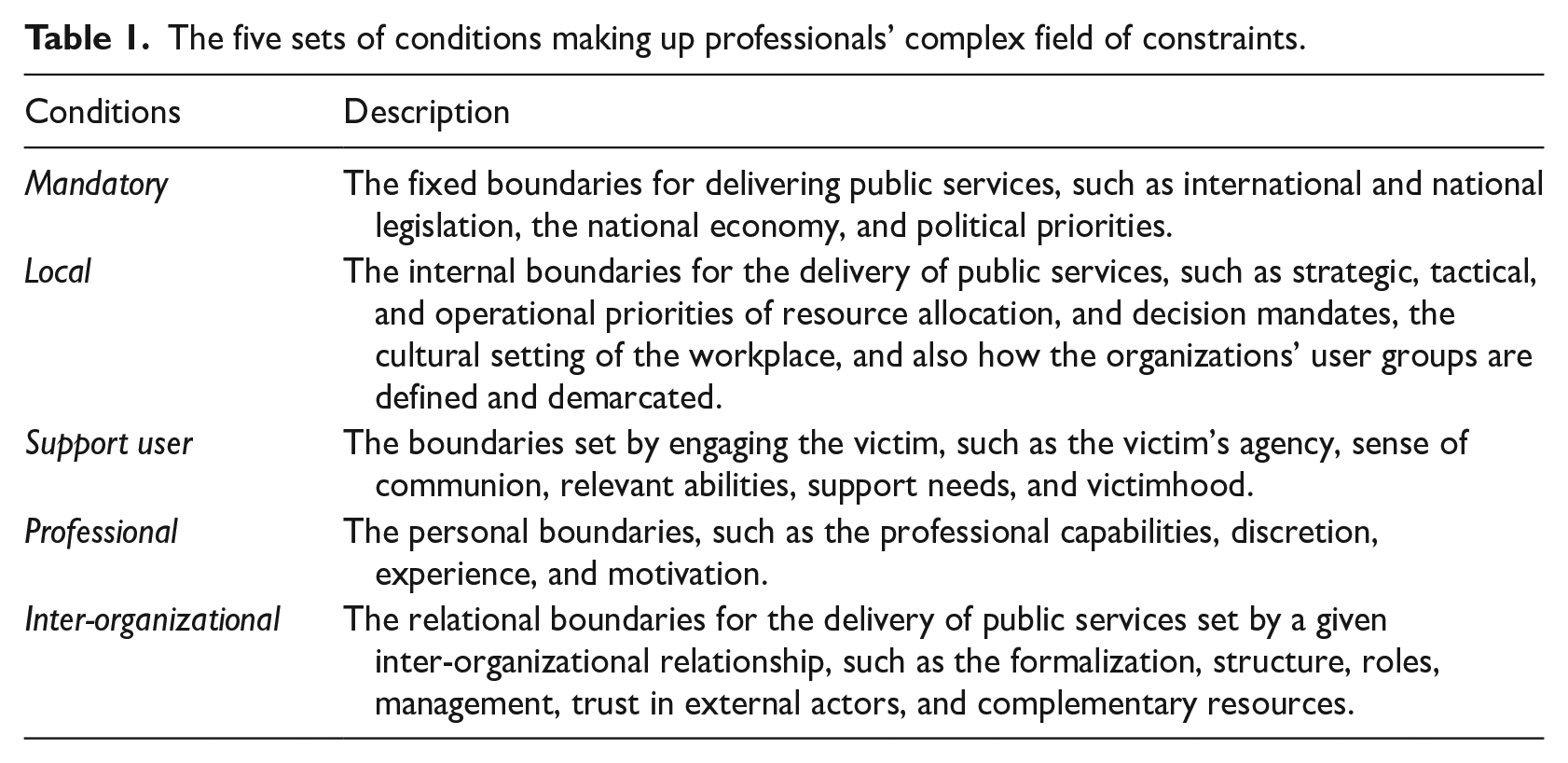
It is assumed that the opportunities for co-producing victim support together with the victim (and involving external organizations if needed) depend on how the five sets of conditions manifest themselves in a given situation. The professionals need to assess whether co-production is a viable option based on such conditions. Our argument for adding the support user conditions is based on our theoretical findings suggesting, among other things, that listening to the victim’s story and the victim’s agency and ability are enabling factors for the victim’s participation in the support delivery (Thunberg, 2022; Tuurnas, 2021). Presumably, if the victim, for example, has a limited ability to identify support needs and engage in decision making regarding his or her support (e.g. due to age or disability), then this will decrease the possibility of co-production (Brandsen, 2020). We have added professionals’ conditions based on the literature emphasizing the importance of professionals’ discretion, motivation, and skills (e.g. communication and coordination skills) when it comes to segmenting support users and involving them in co-production with the aim of providing the right support to them (Brix et al., 2021; Noordegraaf, 2015; Tuurnas, 2021). For example, if the professional employs an empathetic communication strategy by acknowledging the experiences of the victim, then the victim is more likely to engage with the support provision, and thus the possibility for co-production will presumably increase (Bryce et al., 2016; Tuurnas, 2021). Finally, inter-organizational conditions are added to our framework based on the assumption that the three forms of relationships come with different requirements and possibilities, and professionals need to activate the most suitable form of relationship based on the problem they are facing (e.g. lack of appropriate support interventions) and navigate its conditions (e.g. high trust in external organization) (Brix et al., 2021; Mandell et al., 2017; Sandfort and Milward, 2008). For example, if organizations have an overview of what resources are needed, from which organizations, and ‘how’ these resources complement each other to create a ‘complete service’ (Brix et al., 2021), then this will increase the possibility for coordination with one or more external organizations.
Combining victimological and organizational perspectives on post-victimization support
In this section, we discuss and problematize how professionals can co-produce support services with the individual victim and, if needed, engage suitable external organizations for the purpose of adapting support services to the individual victim’s needs, while also considering the complex field of constraints that professionals need to navigate during this process (cf. the purpose of the paper). In Figure 1, we have summarized our view of this process using solid arrows, while the stippled arrows illustrate potential deviations from this process. In the figure, the victim column illustrates the actions taken by the victim, while the victim/professionals column illustrates the actions taken by both the victim and the professional(s). The emphasis of this section is on describing the process illustrated by the solid arrows using local examples from Sweden and Denmark. It must be emphasized that the support process illustrated in the figure illustrates an ideal process, meaning it might be challenging to implement it in complete accordance with the description below. The support process is often more complex and less linear than illustrated here. This normative stand must not, however, be mistaken for a standardized solution to the support provision, as a standardized solution would not be ideal for handling a ‘wicked problem’, such as the one in question (Keast et al., 2007). Instead, it is intended to illustrate some guiding principles for the support process from a theoretical perspective.
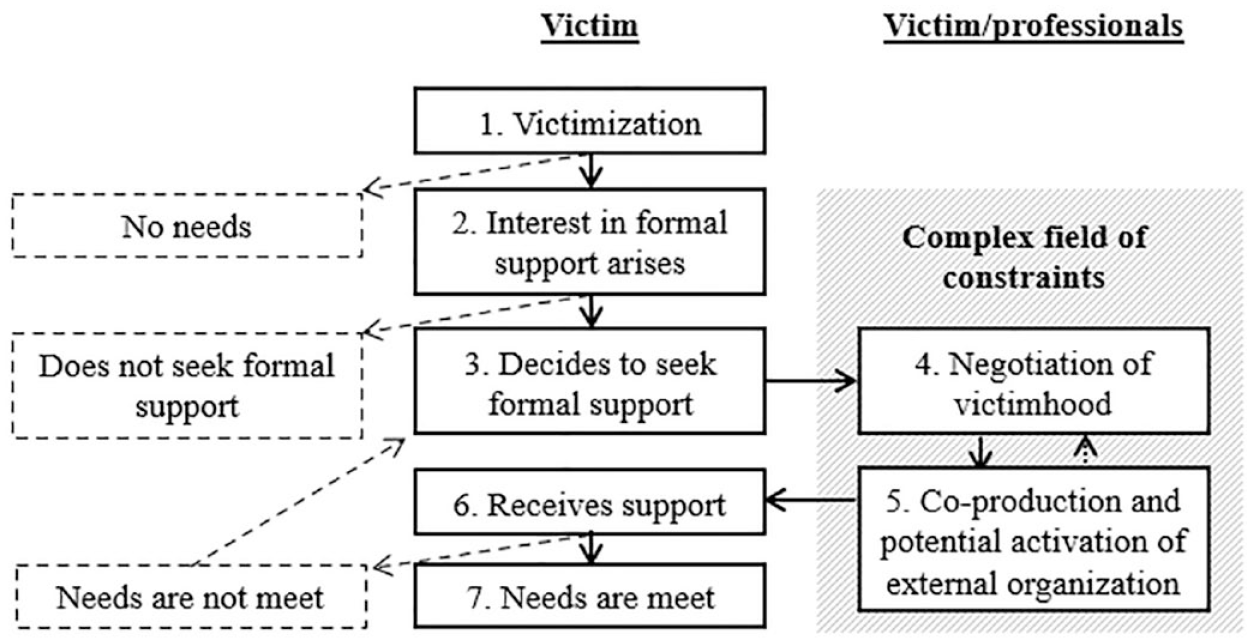
The figure illustrate how co-production can occur in relation to victim support.
As can be seen, the process starts in the victim column with a person experiencing victimization and becoming a victim (step 1). In this step, individuals begin to form their own victim narratives and to construct their victimhood, meaning they take ownership of their narrative (Pemberton et al., 2019). In step 2, the victims need to experience that they need support to cope with their victimization. As argued, the need for support depends on factors such as previous experiences of crimes and the type of crime, because such factors can build resilience regarding victimization (Thunberg, 2022). This step can contain a high degree of agency for the victims, as they begin to define their own needs. We will return to the matter of agency later in the process. Once a victim has identified a need for support, he or she can decide to seek formal support (e.g. in relation to police reporting, or emotional support) from trained professionals, or informal support from their personal network, depending on the nature of the support needs (step 3) (McCart et al., 2010). If the victim seeks formal support, this becomes the first meeting with the support providing organization, and he or she becomes a support user.
In the first meeting between the victim and the professional(s) (i.e. the victim/professional column), negotiation of the victimhood takes place (step 4). As illustrated, this is also the first step in the process where the professionals’ constraints have an impact. The person’s victimhood might be assessed based on the victim’s narration of the victimization (i.e. the support user conditions), the internal definition of what victims the organization is able to help (i.e. local conditions), and applicable legislation (i.e. mandatory conditions) (e.g. Thunberg, 2020; Thunberg and Andersson Bruck, 2020; Burcar, 2005; Van Dijk, 2009). In accordance with the above, the impact of the structural understanding should preferably be minimized in this step. Instead, the victim’s agency and empowerment as a support user become important aspects for the professional to keep in mind, in order not to just make decisions and assessments that do not align with how the victims perceive themselves (Banwell-Moore, 2023; Green et al., 2021; Thunberg, 2020). The victim’s first contact with the support system plays a crucial role in the subsequent process. Notably, the first organization can act as a gatekeeper to the formal support system, in case the initially contacted organization cannot accommodate all the victim’s self-defined support needs. As argued by Thunberg (2020), it is important to make sure, as much as possible, that victims have one way into the overall support system, and that the coordinating function of the first-contacted organization then provides them with support from other organizations if necessary. We will return to this matter in the description of the fifth step. Defining or negotiating victimhood is a sociocultural process that occurs on both conscious and subconscious levels in a social context together with other people. The negotiation becomes a way of reaching a mutual understanding, in this case of a person’s victimhood and the professionals’ possibility to accommodate this victimhood. Although it is a joint negotiation, it is important that the victims do not lose their ownership of their narrative, as that can be experienced as secondary victimization (Pemberton et al., 2019). It is also important to bear in mind that not all victims may be equally assertive when it comes to expressing their needs in relation to the victimization. For this reason, professionals need to be aware of specific vulnerabilities such as age, gender, ethnicity, and disability, all of which may require that adaptations be made to enable the co-production of support services. This can be important as early as in step 2, to encourage them to seek support to begin with.
Once a mutual understanding of the victimhood is reached, the professional assesses whether co-production of the support services is possible (Tuurnas, 2021), and if it is, co-production of the support services begins (step 5). Here, the professional must listen and give weight to the support user’s perceptions and expectations about the outcome of the support, and these should be central in the joint discussion of which organizational resources are needed to accommodate the user’s support needs and constructed victimhood (Källström and Thunberg, 2019; Osborne and Strokosch, 2013). Hence, it is important to place the support user’s narrative of what happened at center stage to empower him or her (see Green et al., 2021). This emphasizes the strength of the support user and how the victimization can be an opportunity for growth, instead of just looking at the event as something harmful that support services are meant to fix. It is also essential that the professionals do not make any assumptions based on physical appearance. A Danish study found that some police officers deliberately refrain from informing victims about Victim Support Denmark (Offerrådgivningen) if they do not believe its services would be useful (e.g. based on the gender and age of the victim) (Banwell-Moore, 2023; Holmberg et al., 2020). Although this is possible, both due to the flexible nature of the guidelines for informing crime victims about the victim counseling service (i.e. mandatory conditions) (Holmberg et al., 2020) and because some victims might not want to engage in co-production activities (i.e. service user conditions), it is essential to leave the decision up to the victims themselves (Thunberg, 2022). In this regard, the different conditions can act at cross-purposes during the co-production of support, which would seem to hinder the potential of this approach.
An important aspect of co-production can be to involve external organizations in cases where the desired outcome of the support cannot be achieved using in-house solutions at the first-contacted organization (e.g. due to local conditions). Here, the professionals need to rely on their expertise and link it with other professional co-producers in external organizations to create a seamless experience from the victim’s point of view (Brix et al., 2021; Shapland, 2018). When external organizations are needed, the professional needs to consider what form of relationship is needed to achieve the outcome (Keast et al., 2007). If information sharing is all that is required, then cooperative efforts are sufficient, and the professional will only need to handle a minimum of inter-organizational conditions (Keast et al., 2007). Likewise, if activities across organizations need to be aligned in order to continue operating as they currently do but in a more systematic fashion, then coordination will be the appropriate intervention (Keast et al., 2007). This mode of relationship, however, also imposes more constraints on professionals (e.g. a higher degree of trust and formalization), which is essential to keep in mind. For the professionals to assess which form of relationship is needed, they need knowledge of the abilities, resources, and capacities of external organizations (i.e. inter-organizational conditions) (Brix et al., 2021). A Danish study found that in those police districts with limited resources (i.e. challenging local conditions) to create awareness about the work of Offerrådgivningen, police officers were less likely to think of this option during their service delivery even though referral to Offerrådgivningen is mandatory (Krogstrup et al., 2021). In this regard, the possibility of co-production of victim support decreases when awareness of the work of external organizations is lacking. Apart from that, the professionals must have the skills and motivation to involve the victims in co-production (i.e. professional conditions), and also need to have the proper resources and an articulated vision for engaging in co-producing activities (i.e. local conditions) while also considering the mandatory conditions (Tuurnas, 2021). Mandatory conditions in cases of inter-organizational relationships can include, for example, handling personal information in compliance with the General Data Protection Regulation (GDPR). This kind of information cannot, in most cases, be shared between organizations without the individual’s consent, which can make inter-organizational relationships difficult to realize (Krogstrup et al., 2021).
The support provision process might involve back and forth communication between multiple stakeholders (e.g. the police, the criminal justice system, victim support services, insurance companies, etc.) and might continue long after a potential conviction. Every time the victim encounters a new organization, he or she needs to negotiate their victimhood again (hence the stippled line between the fourth and fifth steps). Through co-production activities, victims receive support (step 6), which ideally enables them to live with the potentially harmful consequences of their victimization, so that it does not affect their everyday life. However, this is only the case if the victim’s needs were met by the support provided (step 7). They might be able to recover by reconstructing their view of themselves, as well as how they view the victimization.
Conclusion
Based on the discussion in this paper, we argue that both organizational and victimological perspectives are needed to understand and address the constraints surrounding potential co-production of victim support. No organization has all the necessary resources, but they do all have constraints, which professionals need to navigate during the adaptation of support services to the individual victim’s needs through co-production. This co-production of support might not be done solely based on internal resources; instead, the professionals might need to mix and match one or more of the three forms of inter-organizational relationships to access external resources in accordance with the stated support needs. Listening to victims’ narratives of their support needs should be a central part of post-victimization support, as it cannot simply be standardized and simplified. Based on the conceptual framework, we argue that stronger communication is needed between individual victims of crime and organizations providing support. Such improved communication could enable support organizations to co-produce the support with victims based on the needs of the individual and what the organization can offer, either through their own organization, or through cooperation, coordination, and/or collaboration with other organizations. We understand that this is not an easy process, but we do hope that our theoretical reasoning can help lead to improvements of the matching process between individual needs and organizational constraints.
