




Abstract
In the United States, there are high levels of father absence, female-headed single-parent households, and intimate partner violence (IPV) in the African American community. While the relationship between single motherhood and father absence is yet to be showcased in studies of IPV against African American women, its relevance has been evident in the public sphere through the Maury Show (hereon Maury), a US daytime television talk show on paternity disputes. The paper draws on a sample of episodes of Maury and uses content analysis to showcase paternity disputes as a salient context within which African American single mothers can experience nonphysical IPV (i.e. psychological/emotional and economic). In the paternity disputes shown on Maury, patriarchal ideologies and stereotypes of African American women are reproduced to subject African American single mothers to psychological/emotional and economic abuse. Based on the findings, the paper is a call on stakeholders in IPV to prioritize the education of women, particularly single mothers, on the various sites (private and public), contexts and dynamics of nonphysical IPV.
Keywords
Although the problem of intimate partner violence (IPV) against African American 1 women has produced a significant amount of research and literature, little attention has been given to the relationship between single motherhood and IPV among African American women. This paper begins to fill this gap through its exploration of nonphysical IPV (specifically psychological/emotional and economic) against African American single mothers during public controversies over paternity viewed on the US daytime television show Maury. 2
The Maury show focuses on issues pertaining to familial relationships. Produced by NBCUniversal and hosted by Maury Povich, the show is in the public domain and has been running since 1998. 3 Potential guests choose to apply to appear on the show and only a sample of the applicants are selected following an interview with the show’s producers. Of relevance to this paper is the show’s segment on child paternity controversies that result from (1) the denial of paternity by a current or past intimate partner and (2) the mother’s effort to prove that the current or past intimate partner is the biological father of her child. Typically, the mother first presents her case as to why she believes the intimate partner is the biological father of her child. Subsequently, the intimate partner explains why he believes he is not the biological father of the child in question. Both the mother and the alleged biological father bring in their respective witnesses to support their side of the story.
These contexts set the stage for verbal disputes among the intimate partners and witnesses, during which the mother is often verbally abused and degraded by the alleged biological father and his witnesses. Maury Povich’s reading of the paternity test result resolves the paternity question with the phrase ‘you are the father’ or ‘you are not the father’. 4 Either way, the show offers counseling opportunities in cases where the mother or the alleged biological father was distressed due to the disputes or the result of the paternity test.
The paper draws on content analysis of 31 episodes of paternity disputes on Maury to depict the public humiliation of African American single mothers by their intimate partners in forms that would be defined as psychological 5 or emotional abuse—exemplified in verbal insults, and nonverbal behaviors, such as ridiculing laughter and withholding of affection or care (see O’Leary and Maiuro, 2001; World Health Organization, 2012). Stark’s (2007) concept of coercive control introduces a new model for understanding the power of nonphysical IPV in the domination of abused women by their abusers. The use of degrading, humiliating, and shaming language is one of many gendered tactics that abusers employ to subjugate the abused female to the male abuser’s domination and authority (Stark, 2007).
In the narratives of paternity disputes on Maury, the male intimate partners tapped into patriarchal ideologies that endorse and reinforce pejorative stereotypes of African American women to subject the single mothers to psychological abuse. For example, the male intimate partners seemed to subscribe to stereotypical notions of African American women’s sexuality, symbolized in the historical image of the oversexed and seductive jezebel (see Collins, 2000; Gillum, 2002). One can thus assume that subscription to the jezebel stereotype can create a paternity dispute, and invariably IPV, particularly in loose intimate partner relationships—a type that is commonly found among African American single mothers. Research has shown that African American men view sexual promiscuity as justification for the perpetration of physical violence against African American women (see Gillum, 2002). On a nonphysical and public level, hip-hop music (see Oliver, 2006) is demonstrative of the stereotypical objectification and degradation of African American women by African American men in the public sphere.
Thus, the public display of gendered nonphysical abuse of African American women by African American men is not unique to Maury. The Maury show simply provides a visual public platform for the display of such imagery in real acts of victimization of African American single mothers. Ultimately, the message in the intersections of paternity disputes, single motherhood, race/ethnicity, and nonphysical IPV in a public arena is not to be taken for granted. Interestingly, the women on The View
6
recognized the significance of the issues addressed on Maury when Sunny Hostin made this statement in a question she posed to Maury Povich:
Your show really pushed the envelope and while always entertaining you highlighted real issues from teen pregnancy to infidelity . . . and abusive relationships as well. How do you think you help normalize conversations on some of these topics in mainstream media?
In response, Maury Povich states,
Well, you ask a good question because you know over the years . . . anytime you go to the edge of something, all of a sudden critics . . . don’t want you. I say to them all the time, look, I am trying to get fathers into the lives of these kids. Everybody knows that a child has a better chance with two parents in their life instead of one, and if I can get this guy involved in the lives of these kids then he has a better chance, and since I have been on all these years, we bring these people back 15 years later, 20 years later to find out did they get involved, and many, many times, I am not saying majority, but a significant percentage of these fathers got involved.
True to the reality of the show, 7 the interactions were a depiction of nonphysical IPV against African American single mothers by their male intimate partners who reproduced stereotypical representations of African American women in child paternity disputes. The paternity disputes also reveal the economic abuse of the single mothers when the biological fathers of their children are not only absent, but also fail to provide child support, thus putting economic strain on the single mothers (see, for example, Postmus et al., 2016 for a discussion of economic abuse).
Why is single motherhood important in the study of African American women’s experiences of IPV?
African American women have the highest national percentage of ‘never married’ single mothers in the United States. Considering the long-standing concerns over the intersections of single motherhood, father absence, and social problems in the African American community, it is surprising to this author that African American family structure has not been salient in studies of IPV against African American women. This is despite evidence that single mothers, in general, encounter the greatest risk of IPV when compared to married women with offspring and single women with no offspring (see Child and Family Research Partnership, 2014).
Although single motherhood is the second most common family structure in the United States, having witnessed an upward trend since 1968 (Hemez and Washington, 2021), it appears to be the most common family structure in Black households. Over the years, the rate of married-parent Black households has declined while the rate of single-mother Black households has increased. For example, in 1960, 67% of Black children lived in two-parent families. By 1991, this figure had dropped to 36% (see U.S. Department of Commerce, 1993). In 2017, single-mother households made up 43% of Black or African American households (U.S. Bureau of Labor Statistics (BLS), 2018). A recent publication by the US Bureau of Census (see Hemez and Washington, 2021) reveals that in 2020 almost half of Black children under the age of 18 lived with their mother only. The percentage of mother-only Black households stood at 46.3 in 2020 compared to 13.4% White, 7.8% Asian, and 24% Hispanic households, respectively. In sum, as Livingston (2018) observes, single parents ‘are more likely to be female and black’.
Furthermore, single mothers experience a high level of poverty relative to married or cohabiting parents, with Black single mothers being more likely than their White counterparts to experience impoverishment (see Livingston, 2018; U.S. Department of Agriculture, 2020; U.S. Department of Commerce, 1993). The social and economic strain of poverty on African American households, particularly on children, is well acknowledged (see Bowman et al., 2018; Thomas and Fry, 2020). Also, the general intersection of race, class, and gender is recognized in IPV literature vis-à-vis the African American community. Since single motherhood is a fundamental part of the race-class-gender relationship, one could argue that this relationship suggests that African American single mothers may be disproportionately vulnerable to IPV. According to Kennedy et al. (2012),
Low parental income and educational attainment, as well as race (i.e., being African American), are associated with greater likelihood of living in a single-parent household; poor single mothers of color typically face multiple chronic stressors—including heightened risk of IPV. (p. 1331)
While single motherhood has been insignificant in discourses of IPV against African American women, it has remained an integral part of concerns over the issue of father absence in African American households. A Black father is more likely than a White or Hispanic father to have a child out of wedlock and to live apart from his child (see Livingston and Parker, 2011). Some consider father absence to be a major contributor to the disproportionate rate of single motherhood and related social problems in African American households (see Morehouse Research Institute and Institute for American Values; Massey et al., 2007; Morehouse Research Institute and Institute for American Values (MRI/IAV), 1999; Wilson, 2012). For example, as the sole bearer of economic, parenting, and childcare responsibilities, the single mother and her children are likely to experience poverty and other forms of socioeconomic deprivation. Illustrated in this scenario is not only economic abuse of African American single mothers, but also their experiences of emotional strain, due to father absence (see Harris, 2002).
Despite the use of intersectionality as a conceptual tool in the study of IPV in the African American community by African American scholars (see, for example, Bent-Goodley, 2013; Crenshaw, 1989, 1994; Gillum, 2009; Nash, 2005) nowhere has father absence, considering its negative impact on African American single mothers, been studied within the context of IPV. Nowhere has paternity dispute, considering its probable relationship to father absence in female-headed households, been examined within the context of IPV. While single motherhood provides a special context for exploring expressions of IPV, its connection to African American women’s exposure to IPV is yet to be examined.
Below, this paper first situates intersectionality as its conceptual framework and simultaneously provides a literature review of how this concept examines IPV vis-à-vis African American women. This is followed by a presentation of the research method and the research findings, respectively. The paper concludes with a discussion of the findings.
Intersectionality in African American women’s experiences of IPV
For the most part, Black 8 women are at a higher risk of IPV, including intimate partner homicide, than their counterparts from other racial groups (see Petrosky et al., 2017). For example, in 1994, 20.3 per 1,000 Black females aged 12 or above experienced IPV relative to White females (15.6 per 1,000), Hispanic females (18.8 per 1,000), and other racial groups (6.3 per 1,000; see Catalano, 2012). Relatively, recent studies paint a similar picture. Data from the National Intimate Partner and Sexual Violence Survey (NISVS) for the years 2010–2012 estimate that, except for American Indian/Alaska Native women, Black women are more likely than other racial/ethnic groups—White, Asian/Pacific Islander, and Hispanic—to experience IPV in their lifetime (see Smith et al., 2017). The NISVS measured physical violence, stalking, and contact sexual violence by an intimate partner.
These official data are not disaggregated into ethnic subtypes of Black women, which means that the statistical composition of African American victims of IPV is not delineated in IPV data. However, African Americans outnumber the combined totals of other Black ethnic groups, which suggests that African American women comprise most victims in the IPV data.
Some studies, primarily by African American scholars, have specifically examined African American women’s encounters with IPV. These have ranged from studies of the experiences and effects of IPV among African American women to their help-seeking behaviors (see Bent-Goodley, 2013; Gillum, 2009; Hampton and Gullotta, 2006; Leone, 2011; Nash, 2005; Taft et al., 2009; Waller et al., 2022; West, 2004). These studies and others have drawn on the concept of intersectionality (see Crenshaw, 1989, 1994) to unveil the specificity of African American women’s experiences of IPV beyond the unidimensional gender-focus of mainstream feminism. Crenshaw’s emphasis on the notion of intersectionality, beginning in the 1980s, gave significance to how women’s victimization experiences were shaped by a variety of interlocking factors. Her work stands out in Black feminist activism, as she campaigned through her writings to position Black women at the center of feminist discourses of women’s victimization. Crenshaw (1994) asserts that Black women’s lived experiences of victimization have multiple dimensions, notably race and gender. These intersected identities render Black women uniquely vulnerable to violent victimization.
By underscoring diversity and variations in women’s experiences of victimization, the concept of intersectionality has laid the groundwork for unearthing a variety of interlocking factors in women’s victimization experiences. Studies of IPV against African American women have typically intersected race, gender, and class in the women’s victimization experiences. Herein, unlike White women, African American women experience racism, and relative to White women, they are more likely to be impoverished. Both factors interlock with their gender to increase their vulnerability to IPV and their barriers to help-seeking (see Leone, 2011; Potter, 2006, 2007; Rennison and Planty, 2003; Richie, 2012; Waller et al., 2022). As studies have shown, low-income African American women experience IPV at a disproportionate rate (see Hampton et al., 1998; Leone, 2011; Rennison and Planty, 2003; Sokoloff and Dupont, 2005), especially indigent African American women who depend on welfare benefits, including food stamps (see Honeycutt et al., 2001).
But among Black women, African American single mothers are hardest hit by socioeconomic disadvantage and poverty (see Livingston, 2018). These scenarios suggest that indigent or low-income African American single mothers are more likely to be victims of IPV than other women from other family structures, such as married or cohabiting. Drawing on the concept of intersectionality, this paper interlocks single motherhood, race/ethnicity (i.e. African American), and gender in the study of nonphysical IPV in paternity disputes. Here, African American single mothers experience psychological and economic victimization by past or current intimate partners who deny paternity of the women’s children.
Method and analysis
Source and type of data
The Maury show has an official YouTube channel that hosts past videos of topics covered in the show. From mid July 2021 until early August 2021, the author conducted an initial review of the videos. By the start of the review, the channel had recorded 3,849 aired videos that dated back to January 2012 air date. Because the videos covered a variety of topics that had no relevance to paternity, it was unfeasible to sieve through all 3,849 videos to locate ones that were relevant to the study. A viable option for the author was to use the playlists on the channel to systematically search and select the relevant videos, in that the playlists were categorized into 24 different titles. One category was inaccessible, leaving the author with 23 accessible categories.
The author screened each category in search of videos that had complete narratives 9 of paternity disputes. Out of the 23 categories, four showed episodes of paternity disputes in all or some of the videos in the categories. The four categories were as follows:
DNA Drama. This category had 16 videos of 16 different episodes.
4 Minutes of Maury. This category had 51 videos. One video was not accessible. Each of the remaining 50 videos had two episodes, respectively.
New This Week. This category had seven videos of seven different episodes.
Out of Control Teens. This category had 40 videos of 40 different episodes.
Sample selection, data collection and analysis
Data collection, including sample selection, took place in October 2021. Having decided to draw the study sample from the four categories mentioned earlier, the author reviewed all the videos in the categories. There were episodes that did not bear relevance to the issue of paternity. Likewise, there were paternity-related episodes that did not apply to African American intimate partners. In the category ‘4 Minutes of Maury’, 58 of the episodes were related to child paternity while 42 were not. Thirteen of the episodes in ‘DNA Drama’ were relevant to paternity while three were not. Out of the 40 episodes in ‘Out of Control Teens’, only 10 were relevant to paternity. All seven episodes in ‘New This Week’ bore relevance to paternity.
Considering the interest of the study on African Americans, the paternity-related episodes were reviewed for the racial/ethnic composition of the Maury guests, using visual categorization of guests as African American or non-African American (see Table 1 below). African American couples had a higher representation 10 of guests than same race/ethnic couples from other racial/ethnic groups, notably Whites. Also, African American guests had the highest number of males in interracial intimate partner cases of paternity controversies, with White females comprising most of their intimate partners. However, to stay in compliance with the purpose of this study, the paper focuses on episodes that involved intra-racial African American intimate partners. There were demographic factors that were not revealed, or only partially revealed, during the show. In only six of the 42 episodes involving African American couples was the age of the woman made known. In terms of marital status, only one African American woman was married; others were single. Employment status of the women was not revealed in any episodes.
Number of child paternity episodes by category of title and race/ethnicity.
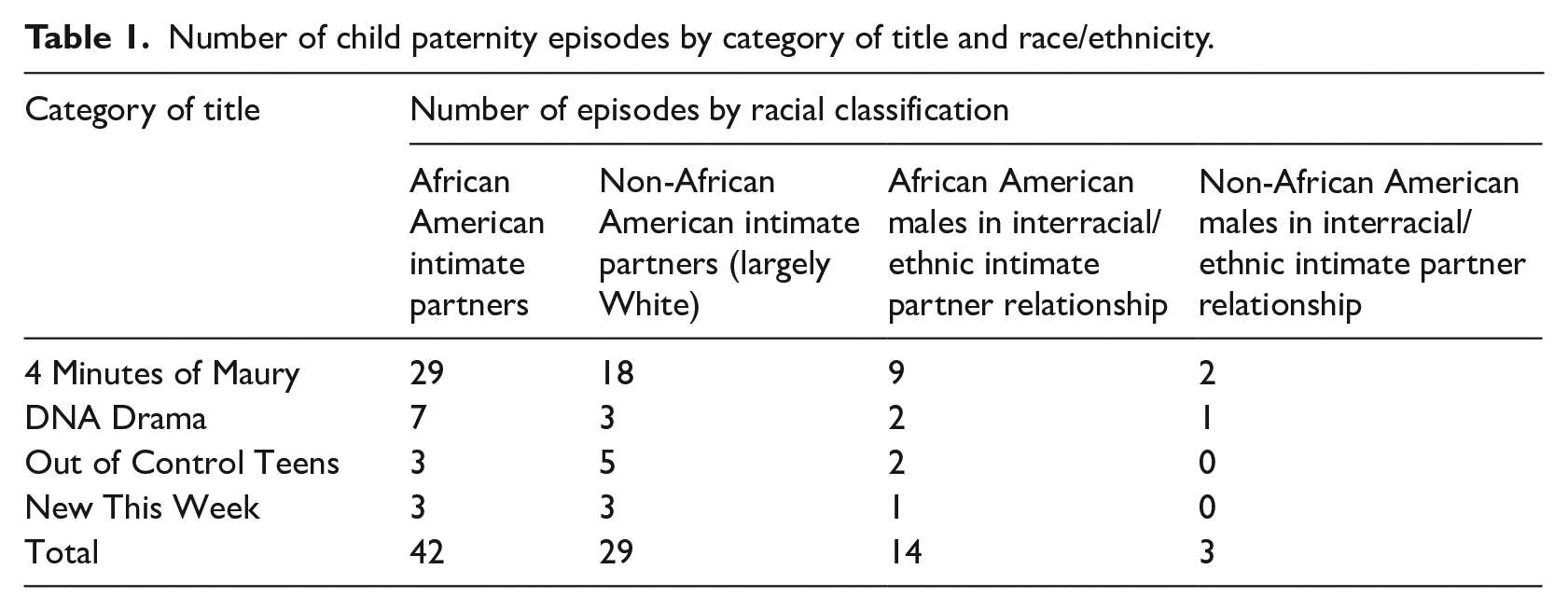
A further review of the 42 episodes showed that paternity was not denied in a significant number of cases (n = 11). In most of these cases, the guests wanted to confirm paternity. In one episode, there was no paternity test conducted. The author removed the 11 episodes from the sample. After weeding out episodes that were unspecific to child paternity denials, the author revisited the 31 remaining episodes for data analysis.
Data analysis started in late October 2021. The episodes were already transcribed, and the transcriptions were reviewed for errors and omissions. Videos of episodes were watched and rewatched to check for consistency with the transcribed textual information. 11 Having identified the textual data as the unit of analysis, the data were subsequently analyzed using content analysis (see Schreier, 2012; Weber, 1990), with the aid of MAXQDA, a qualitative data analysis software.
To code, the texts were read and reread to abstract from the data meaningful messages of patriarchal ideologies and practices, sexual degradation, and economic abuse. Demeaning nonverbal gestures were also extracted. In so doing, the texts were split into parts that were assigned codes to reflect the various contexts and expressions of psychological and economic IPV against African American single mothers. Subsequently, similar coded meanings were condensed into categories from which themes were generated to show relationships in patterns of these forms of abuse toward African American single mothers. As the study findings will show, the themes embody various forms through which single motherhood, gender, race/ethnicity, and nonphysical IPV intersect in child paternity denials.
At this point, it is worth acknowledging that studies of this kind have limitations, despite the research, policy, and practice benefits of their findings. Like the limitations found in various sources of research data, such as self-report surveys, interviews, and statistical data, talk shows have received their share of criticisms, ranging from their subject matter coverage and impact on viewers to claims of guest manipulation for ratings. However, such criticisms do not void the reality of the structural problems, or the seriousness of the social issues being conveyed in the storytelling, by the storytellers in a public forum (see Greenberg and Smith, 2000; Tolson, 2008). Thus, there is reality in the paternity disputes, the associated DNA tests, and their outcomes. This reality matters. There is reality in the narratives of how current or past intimate partners of African American single mothers, most of whom were absent and uninvolved, denied the paternity of the women’s children. This reality matters.
Nevertheless, caution must be exercised in generalizing the findings to other African American single mothers and absent fathers in the United States. This paper does not claim that the Maury paternity episodes studied represent all accounts of the incidents. As this author has noted elsewhere, this sort of limitation is also found in other secondary data sources, such as newspapers and court transcripts, where ‘information available to the public may not reflect its full . . . content’ (Kalunta-Crumpton, 2013: 217).
Findings
Not all the paternity DNA test results in the 31 12 episodes proved positive. Most (25) were positive while eight were negative, thus exonerating eight men from allegations of biological paternity. The paternity disputes, regardless of test outcome, revealed verbal interactions among the guests that mirrored stereotypical ideologies of African American women in intimate partner relations. This was particularly shown in how the alleged biological fathers (hereon, ABFs/ABF 13 ) and their witnesses drew upon negative representations of African American women to justify paternity denials. Through their use of derogatory language and nonverbal gestures, the men characterized the single mothers (hereon, SMs/SM 14 ) in stereotypical images of race, gender, and sexuality. In this process, they also subscribed to patriarchal ideologies of how gender relations are negotiated in the African American community. Herein, father absenteeism and the abandonment of ‘father’ responsibilities seemed normal to the ABFs, despite the economic and psychological burden of these situations on the single mothers.
Below, the SMs’ experiences of nonphysical IPV are described in the following three key themes that emerged from the study: sexual degradation, patriarchal masculinity, and ‘baby’ father 15 absence. These respective themes were evident in more than half of the cases. In 19 (i.e. 61%) of the 31 cases, the SMs were sexually degraded. Patriarchal masculinity was demonstrated in 17 (i.e. 55%) cases. The most prevalent of the themes, ‘baby’ father absence, is only applicable to the 25 cases where the paternity tests were positive. In these cases, 20 (i.e. 80%) of the ABFs were absent. The themes complement each other in the perpetration of nonphysical IPV through child paternity disputes.
Sexual degradation
A common response from the ABFs to paternity allegations made by the SMs was to defile the sexual behavior of the SMs. The women’s sexual conduct was defined and represented in racialized images of African American women and promiscuity. Name-calling is an instance of derogatory language used by the ABFs (and their witnesses) to characterize the SMs as sexually immoral, even in cases where SMs claimed to be in a stable intimate partner relationship with the ABFs. In denying paternity, the ABFs invoked familiar depictions of race, gender, and the jezebel stereotype.
Sexual promiscuity: you’re a hoe 16
In the ABFs’ denial of child paternity, their representation of the SMs in the image of a prostitute is what differentiates their portrayal of promiscuity from sexual infidelity, symbolized as having an affair. Ranging from the label of a ‘one night stand’ to a ‘hoe’, the SMs, so described, were objectified, and hypersexualized in line with popular notions of African American women and sexuality (see Rosenthal and Lobel, 2016). According to the SMs in these cases, they had believed that they had, or were on the way to having, a stable and meaningful intimate partner relationship with the ABFs. Instead, the ABFs portrayed them as mere sexual objects. In one case (case 1), the SM was only 16 years when she met the ABF whom she claimed knew she was young:
[ABF] is a big liar; he knew from day one that I was young.
Yeah, he knew, he knew. Did he care, no, he didn’t care.
I lied to him, but I told him I was 17, I was 16. But do you think he asked again, he didn’t care, he didn’t care really.
In response, the ABF, who had five children from another relationship, verbally demeaned her:
I want everyone watching to know that SM was the biggest mistake that I ever made. She lied about her age to get me in bed. Now she’s lying to me about this baby. I will never ever mess with someone young and dumb like her. People around our town know [SM] as nasty [SM]; that’s because she gets around. I’ve seen over a thousand mail contacts in her phone and I bet you she has slept with every last one of them. I’m here to put my name in to prove to [SM] that I’m not her baby father and once I do, nasty [SM] can get back to her nasty ways. That’s one of them white man baby . . . with blue eyes . . . that’s nasty [SM], man, everybody know her.
By associating the SM with ‘white man baby’, the ABF seemingly invoked the race, gender, and hypersexuality stereotype that was used to justify the sexual abuse of African American women during slavery (see Anderson et al., 2018). Even when the paternity test proved positive, the ABF still claimed ‘ain’t my baby’, ‘the result is wrong’.
Despite what the SM in one case (case 2) thought was a stable intimate partner relationship between her and the ABF, which included planning the baby together, the ABF’s depiction of her in a sexually derogatory language stated otherwise:
He say we was going be forever, we was going be a family, he told me so many things . . . I felt as though he meant it.
[SM] is always freakin on every single guy, now she’s going say it my baby, no way.
In our neighborhood [SM] gets more drive-through business than Wendy’s.
I’m sick of the lies and the rumors. When the DNA tests come back that I’m not the father, [SM] will finally baseball for the woman she really is.
All I hear is rumors about this that and that she’s sleeping with everybody she know.
The characterization of the SMs as sexually promiscuous was not perpetrated by the ABFs alone. Female relatives of the ABFs played an influential role in the sexual demonization of the SMs. In case 2 (above), the SM blamed the ABF’s sister for spreading rumors about her, thereby causing a rift between her and the ABF. In her response, the ABF’s sister portrayed the SM as promiscuous:
I was friends with [SM] until I found out she was a trifle, in fact introducing her to my brother was the biggest mistake of my life. One of my friends told me he has sex with [SM] and then he passed her around to all his friends, that is not my brother’s baby. My friend sent a screenshot of a text message that [SM] wrote that said ‘I want to (BLEEP) your face’. That is not the type of woman that I want for my brother. They sent crazy text messages talk about what she want to do to them. What’s going around me and what they say about his baby mother . . . I’m gonna let my brother know, why wouldn’t I.
This representation did not apply to the ABF whom the paternity test proved to be the biological father of the SM’s 2-year-old child. There were instances where the mothers of the ABFs were at the forefront of the sexual demonization process. For example, in one case (case 3), the SM claimed she had sexual intercourse
17
with two brothers at a party organized by their single mother. The SM was convinced that one of the brothers was the father of her 16-month-old child. The ABFs’ mother, along with her sons, believed otherwise, and she displayed her disbelief in a verbal assault on the SM’s sexual behavior while ignoring the ABFs’ sexual (mis)conduct:
There is absolutely no way that my son [ABF1] or [ABF2] is the father of [SM’s] baby. On . . . I threw a legendary party. The only mess that I thought I’d be cleaning up cups and bottles but it turned [SM] was the biggest mess there, she slept with both of my sons on the same night, oh wait, she also slept with three other men too. The doctors also said she was pregnant a whole month before my party,
18
should I keep going? I am pissed that my sons would stoop to that level, they may have acted like irresponsible idiots but as a woman [SM] need to have more self-respect. If I know one thing for certain is this, . . . is not my grandchild. Let me tell you not only does she sleep with my two sons, she slept with like five different other guys in this same night . . . the same night . . . five different other guys.
Seemingly proud that she organized a party attended by over 200 people, the ABFs’ mother continued to abuse the SM:
Yes, it’s probably two hundred or more, so many people to be at the party, if they could have picked just one, it was enough women there or girl there that they did not have to sleep with the same one, that’s how much of a party, they could not have slept with the same one. They did not have to do that . . . they did not have to do that.
The SM denied sleeping with ‘five other guys’. When the paternity test proved that one of the brothers was the biological father, their mother intensified her use of abusive sexually derogatory language, while the SM was standing in a corner of the backstage crying:
You still a hoe . . . you still a hoe . . . he’ll take care of his child. (to her son) You gonna man up and take care of the baby, you, you gonna man up and take care of that baby and apologize to the hoe.
This instance and others represent a double standard in an African American woman’s depiction of race, gender, and sexuality, where African American men do not have to account for their sexual conduct. Not only does the intra racial–gender victimization of the SM by fellow African American women reinforce the pejorative sexual stereotypes of African American women, but it also alludes to the internalization of such stereotypes by African American women themselves.
Patriarchal masculinity: the double standard of sexual conduct
The case studies discussed in the preceding section also point to the role of patriarchy in how intimate partner relations are interpreted among African Americans. Sexual infidelity or promiscuity constitutes an act that the ABFs engaged in, but for which they did not have to deny or explain to the SMs. These sexual practices fit into the traditional masculine ideals, which seem to explain why the SMs condoned such behavior among the ABFs. As exemplified in case 3 above, male sexual promiscuity was expected and acceptable. In sharp contrast to the condemnatory humiliation of the SMs accused of sexual promiscuity, the ABFs who were involved in the same sexual behavior were not abused by their SM partners.
In cases where the ABFs accused the SMs of sexual infidelity to justify paternity denial, both the ABFs and the SMs agreed that they had a long-term relationship, either in the past or in the present. Yet, claims of infidelity against the SM were normally based on the ABF’s own perception of, or hearsay about, a sexual relationship between the SM and another man. In contrast, the ABFs’ engagements in infidelity were undeniable. In one case (case 4), the ABF had two women alleging paternity. The ABF agreed that he had been with the two women but denied paternity of their children. One of the SMs claimed, ‘We was together three and a half years’. However, the ABF denied paternity of her 8-month-old baby, claiming that a friend told him that the SM was seeing another man. Hence, the biological father must be someone else:
Yeah her exes, 19 her exes, you know and even it even came to be a deacon or a preacher of the church.
What exes, what exes? Let me know so that I can find my baby daddy. What church do I go to? What pastor? My pastor old.
I don’t know, I don’t know, that’s what going around town.
Although the paternity result was positive in this case and negative in the case of the other SM, the preceding interaction did not question the morality of the ABF’s sexual conduct in relation to the women. The onus was placed on the SM to defend herself against the negative portrayal of her as sexually irresponsible.
There were cases where the ABFs denied fathering all the children born during their relationship with the SMs. For example, in one case (case 5), the SM had three kids with the ABF, and both were together for 6 years before splitting up. But the SM’s sexual behavior was questioned because, according to the ABF, ‘my family members already told me rumors’ about the SM’s (alleged) infidelity, and as such ‘I’m not gone take care of some kid that’s not mine’. Like other vilified SMs, the SM in this case positioned her defense around herself and her own sexual behavior:
Family members told you . . . was they there when we had sex? Do they know how we conceived? I was with him since I was 19 years old, that’s six years um, now that we are not together his family, the new girl that he with are talking about they’re not his kids. They’re in his ear like these are not his kids.
The DNA tests proved that the ABF was the father of the SM’s three children aged 4, 3, and 10 months, respectively—an outcome which caused the SM to leap for, and dance with, joy.
Unlike the SMs whose sexual reputations were discredited by the ABFs, the role of the latter’s sexual behaviors in (allegedly) making the baby or babies under controversy were hardly raised by the SMs or the ABFs and their witnesses. At the least, the ABFs could have been held accountable for not wearing a condom to protect against an unwanted pregnancy. Except for two ABFs 20 who stated that they wore a condom and therefore could not possibly be the alleged biological fathers, the burden of sexual responsibility was not placed on the ABFs. It was as if the ABFs did not have to justify their sexual behavior to the SMs.
Case 6 illustrates this point further. In this case, two SMs 21 were involved, for both of whom the ABF denied paternity of their children. A third woman, the ABF’s girlfriend, was pregnant with his child and sitting in the audience. The women knew about each other and seemed unperturbed by the ABF’s promiscuity and lack of respect for them. The ABF was said to have seven children:
Is it true that you went back and forth between [SM1] and [SM2]?
Yeb, they knew.
(to ABF’s girlfriend in the audience) Do you know her? (Referring to SM1)
Yes, I do.
And do you think he’s the father of that child?
no, I do not.
SM2 responded to the ABF’s girlfriend:
Girl, you don’t know nothing, you know after we met, he was barely the father of your child.
[ABF] plays all these women, right, the same way, right?
He plays them all, he plays them all.
He’s playing you two.
The SMs’ uncritical attitude toward the ABFs’ promiscuity normalized this sexual behavior among African American men. The verbal altercation between SM2 and the ABF’s girlfriend further highlights the pervasiveness of African American women’s tolerance and reinforcement of the patriarchal double standard toward sexuality in the African American community.
‘Baby’ father absence 22
The study findings reveal that father absence can have negative implications for the psychological and economic well-being of African American single mothers. For some of the SMs in this study, the presence of the ABFs was not only expected after childbirth, but it was also expected during pregnancy. The SMs narrated the various ways in which they were victimized by the ABFs through their absence. The ABFs’ denial of paternity coupled with their absence, and (alleged) abandonment of the SMs and childcare responsibilities caused the SMs emotional and/or economic strain.
Psychological/emotional IPV
The heading titled Sexual Degradation (above) captures examples of verbal insults and humiliation that the SMs received in their quest to determine paternity of their children. As illustrated in the following statement by an SM (Case 7), there is psychological strain involved in the process of searching and establishing paternity:
My journey on this show has not been easy. I’ve had so many ups and downs. I was so thankful when I was able to prove who the father was of my daughter X and my son Y but there has been a huge void in my heart because after testing six men, I still don’t know who the father of my son Z is. I was humiliated, I was destroyed, I was ashamed.
In addition, the SMs expressed ways in which they were emotionally burdened by father absence. Some SMs claimed that they were abandoned by their ABFs during their pregnancy and/or after childbirth, and they felt alone. This is instanced in the case (case 8) of an 18-year-old SM whose high school education was interrupted when she got pregnant at the age of 16, while the ABF (estranged and aged 19) had moved on with his life and into college. Although the paternity test proved negative for the ABF in this case, the SM expressed feelings of abandonment. Such feelings were common among SMs who received positive paternity results. The 18-year-old SM claimed it was hard returning to high school, that the ABF was not in the child’s life and that her mother took the place of the ABF:
I can’t even finish my high school career because you left me with a child.
He met X once and X was nine months old when he saw him for the first time. She does everything, anything that I can’t do my mother will do.
It was typical of ABFs to show anger when a contested paternity is resolved through a positive paternity test result. From walking off the stage in anger to violently pushing a chair, the ABFs made their lack of concern for the SMs and their children apparent. In one case (case 9), the SM had mentioned to the ABF that she wanted to give up her baby for adoption, but when she changed her mind, the ABF was allegedly upset:
When I told him I was gonna keep the baby, he was mad, he sent me like five paragraphs you need to get a job you need to do this you need to do that, my daughter good, I don’t need to do anything for my daughter, I don’t need him do nothing for her, I was so hurt when he said that.
The SM indicated that she simply wanted the ABF to be there for the child but instead, she claimed, ‘he don try to build no connection with my daughter’. The desire for father presence and involvement was expressed by other SMs, as illustrated in the following statements:
They’re not gonna have a father if you keep denying them like that, I didn’t even have a daddy, I didn’t have a daddy. (Case 5) Yeah, that’s all I want, that’s all I want you to be there for your daughter. (Case 2) My baby birthday in like three weeks. My baby graduated, he wasn’t there for that. When my baby first used the pot he wasn’t there for that. I don’t care about money and none of that cuz I take care of mine, the struggle real, I struggle do what I gotta do. I just want him to be a part of my son’s life. (Case 7)
Economic IPV
In addition to being perturbed by the absence of a father in their children’s lives, some SMs were overtly upset that the ABFs were not contributing to the upkeep of their children. The SMs were the sole bearers of the economic burden of raising a child. For example, in case 1 (above), the SM, who claimed to have been raising her 2-year-old son by herself, shared an invoice of her expenses for her 2-year-old son to the tune of US$17,000:
By the way you’re raising this child by yourself, and you have a list of expenses, right?
Yes, Maury.
What’s the expenses?
(stood up to show an invoice of expenses on the screen) These are everything I had to buy diapers, milk, shoes, outfit.
and he owes you ten thousand dollars for emotional distress.
Yes because I have been through a lot, yes, I have been through a lot.
Whether the SMs who received a positive paternity result pursued child support is beyond the scope of this paper. However, in (case 6) above, SM2 alluded to child support in her response to the observation that the ABF was ‘playing’ two or more women at the same time:
No, he ain’t played me, he about to get played with child support. (To the ABF’s girlfriend in the audience) marry him, baby, marry him, I need my child support money, marry him.
The ABFs were aware of the connection between paternity and economic responsibility, in that their denial of paternity justified their decision not to take care of a child they claimed was not theirs. As one ABF (case 10) stated, women tend to pin a child on a man for money:
They are money-hungry for real, I’m be honest with you, they find out you’ve got something going for you.
But contrary to the ‘money-hungry’ observation, the SMs in the paternity-positive cases claimed that the ABFs in those cases had made little or no economic contribution to the upkeep of their children.
Discussion and conclusion
The findings of this study beg the question of whether the SMs were aware that they were victims of emotional and economic IPV. Because until recently with discussions of coercive control, discourses of IPV are yet to prioritize nonphysical IPV, including its contexts and dynamics, many women may not associate acts, such as verbal insults, degradation, ridicule, male promiscuity, ‘baby’ father absenteeism, and nonpayment of child support, with IPV. Yet, nonphysical abuse is no less damaging than physical IPV (see Kalunta-Crumpton, 2021). The paternity disputes between the African American men and women in the sample illustrate this point. The disputes echoed familiar stereotypical representations of African American family structure, single motherhood, father absence, and sexuality. Those stereotypes were utilized to victimize African American single mothers.
Through accusations of promiscuity against the SMs, the ABFs and their female relatives objectified the women. The imagery that the allegations conjured resonated with racialized stereotypes of African American women and sexuality that date back to history. As Rosenthal and Lobel (2016) summarize,
More specifically related to sexuality, Black American women continue to be stereotyped as promiscuous, hypersexual, sexually available, and as having ‘animalistic’ sexuality, all of which have a long history connected to the sexualized exploitation of Black women during slavery and are consistent with the jezebel archetype. (p. 417)
Typically, the jezebel archetype intersects with another pejorative image of African American women—the welfare mother or queen, which is a depiction of ‘an uneducated, poor, single Black woman who does not want to work but has many children in order to take advantage of public assistance’ (Rosenthal and Lobel, 2016: 417). Although there were SMs who had several children, and from different fathers, it is unknown to this author if they were receiving public assistance at the time.
African American men and women are cognizant of pejorative stereotypes about African American women and sexuality. Indeed, African American men utilize those stereotypes to control, dominate, and abuse the women in intimate partner relationships (see Gillum, 2002). In the paternity disputes, humiliating statements such as ‘you sleep around’, and she was ‘just a hit and quit’ were common in the ABFs’ language. This form of sexual degradation of women is not untypical in the African American community. Oliver (2006: 929) identifies, ‘sexual objectification and exploitation of Black women’ as ‘a major theme in contemporary hip hop’. Laughing mockingly and blowing a raspberry were instances of nonverbal gestures used by the ABFs to ridicule the SMs. Accordingly, Karakut and Silver (2013: 804) have identified ‘verbal assault’ and ‘ridicule’ as forms of abuse that ‘targets the emotional and psychological well-being of the victim’.
Most of the ABFs in the study had other children out of wedlock. For example, one ABF had 10 children with other women. Nonetheless, their sexual conduct was not under scrutiny. In fact, some ABFs appeared to celebrate their promiscuity, in that they boldly confirmed that they had several children with other women or were in a relationship with two or more women simultaneously. Some have argued that promiscuity is one of the ways African American men enact their own masculinity, considering their inability to compete against the conventional indicators of masculinity and masculine roles—wealth/provider and power/protector (see Eyre et al., 1998; Oliver, 2006). Thus, African American males are socialized to embrace negative gendered representations of African American women, so that while their peers herald their promiscuity and exploitation of women, their female counterparts are labeled ‘hos’ (see Anderson, 1999; Eyre et al., 1998).
It was characteristic of the SMs to respond to the sexual degradation on the defensive, which suggested their familiarity with, and tolerance for, the degradation. Although the ABFs were not in any sexually moral position to defile the SMs, the latter did not question the former’s sexual (mis)conduct. In so doing, they affirmed the patriarchal authority of the African American male in gendering sexuality. The apparent acceptance of subjugation exhibited by the SMs alluded to an internalization of their own subordination in intimate partner relationships. Rather than view these forms of victimization as IPV, with African American men as perpetrators, African American women, who may not fully understand what constitutes IPV, often blame themselves for their own victimization (see Brice-Baker, 1994; Watson et al., 2012). Watson et al. (2012) have identified victim self-blame to be a consequence of sexual objectification due to ‘the internalization of stereotypes regarding African American women’s sexuality, particularly the Jezebel stereotype’ (p. 471). In view of the self-blame or abuse tolerance response that underlines this form of internalized gendered oppression, African American women perpetuate these malign stereotypical ideologies. The SMs in the study were abuse tolerant.
In its direct form, the internalization of gendered stereotypes, abuse, and oppression is shown in the overt sexual degradation of the SMs by the female relatives of the ABFs. In some cases, the verbal assault by the ABFs’ female relatives seemed more sexually degrading than the verbal assault by the ABFs. Recall case 3 (above) where the African American mother repeatedly referred to the SM in the case as a ‘hoe’ while exonerating her two sons, both of whom had sexual intercourse with the SM. It was the SM who ‘as a woman’ needed to ‘have more self-respect’ even though her sons ‘may have acted as irresponsible idiots’. This double standard in the application of sexual degradation by an African American woman against another African American woman speaks to the damaging role some African American women play in the perpetuation of stereotypical images of them as hypersexual, sexually immoral, and promiscuous (Anderson et al., 2018; Rosenthal and Lobel, 2016). Simultaneously, it accords African American men the patriarchal privilege to define, dominate, and control their female counterparts and their sexuality.
The findings of this study show other ways, besides sexual objectification, that African American women are forced into tolerating abuse and subjugation by African American men. One, the ABFs who tested positive for paternity were absent in their children’s lives. And two, the SMs in the paternity-positive cases seemed be the sole providers for their children. At a minimum, these interrelated situations constitute economic abuse, considering that the paternity-positive ABFs abandoned their child maintenance responsibilities to the SMs. ‘Baby’ father absence has left many African American single mothers unemployed, impoverished (Wilson, 2012), and vulnerable to a vicious cycle of nonphysical IPV. However, this is a situation that seems to be in tandem with the socioeconomic status of the absent fathers who, studies have shown, are more likely to be socioeconomically disadvantaged, with limited education and financial means (see Harris’ (2002) review of research on African American father absence).
While the socioeconomic status of the ABFs in this study is unknown to this author, it was obvious that economic responsibility was not a crucial part of the ABFs’ perception of parental responsibility. Accordingly, the SMs appeared to have resigned themselves to this reality of paternal apathy to child support. Hence, for the SMs, being ‘a part of’ their children’s lives or being ‘there for’ them were adequate attributes of fatherliness. Studies have shown that even among African American absent fathers, this style of parenting is considered more significant than economic support. Harris’ (2002: 119) statement, in reference to findings from Harner’s (1997) study of absent African American fathers, attests to this:
The results showed that the roles and functions of these men varied from those of the European ideal of fatherhood. African American men emphasized caregiver (i.e. spending time, emotional support) and disciplinarian roles (i.e. teaching right from wrong) above those of economic provider . . . Unlike the role of protector that is ranked highly as a European American fatherhood ideal, protection was not an ideal of fatherhood offered by African American men.
Attitudes to father involvement among the ABFs and SMs seem to confirm this observation. Furthermore, since absent African American fathers tend to be socioeconomically marginalized, it is also likely that they would uphold the noneconomic perspective of fatherhood. But this form of fatherhood, which may be intermittent and unenduring, does not attend to the many ills of impoverishment faced by African American single mothers and their children. Because single motherhood among African Americans normally starts at a young age (Martin et al., 2020), they are likely to have limited education (no more than high school), limited work experience and, therefore, limited human capital for employment. By tolerating the noneconomic contribution of absent fathers, these women shortchange themselves and, simultaneously, contribute to the institutionalization of this arrangement in the African American community. Recall case 9 (above) where the ABF’s reaction to the SM’s decision to keep her baby was to ask her to get a job, thereby making the upkeep of the baby, plus the associated socioeconomic strain, the sole responsibility of the mother. It was an expectation that seemed normal when one also considers stereotypes of African American women as independent and strong (Bell and Mattis, 2000; Rosenthal and Lobel, 2016).
While such stereotypes tend to cloud the vulnerability of African American women to economic IPV, the situation is exacerbated by the reproduction of the stereotypes by African American women themselves. Statements, such as ‘I don’t care about money and none of that cuz I take care of mine’ (case 7) and ‘I don’t need him do nothing for her’ (case 9), indicate that these women have internalized a feeling of independence, which includes nonexpectation of economic contribution from the AFBs. Ironically, this sense of independence is a constraint for many African American single mothers, considering their ongoing encounter with a multitude of barriers to socioeconomic advantage. Even single mothers who want economic input from absent fathers may be handicapped by the economic disability of those fathers and other related challenges, such as the trouble of officially filing for child support, and the legal implications of nonpayment for the absent father.
Safeguarding their male counterparts against victimization by criminal justice agencies is a known reason why African American women, often of low income, do not report their experiences of IPV to official agencies. In Nash’s (2005) account of IPV tolerance among African American women, she referred to the expectation of African American women by the African American community to be protectors of African American men because of the belief that the latter experience disproportionate levels of racism. Having internalized this expectation, African American women sacrifice their own well-being for the sake of African American men who perpetrate IPV against them. These women are trapped in a culture of loyalty to their community and their race, which requires them to protect the already stereotyped African American males from further disrepute (also see Lichtenstein and Johnson, 2009; Richie, 2012), while peripheralizing their own experiences of disparaging stereotypes.
From the sexual degradation of the SMs to the economic burden that father absenteeism and noninvolvement placed on them, the findings of this study pave the way for research into IPV and African American single motherhood, considering that single motherhood is the major family structure in the African American community. Furthermore, there is need to prioritize research into the often-marginalized nonphysical IPV, including the various ways in which this form of IPV is illustrated in practice. There are women who associate IPV with its physical exhibition only, such as slapping and punching, with little or no knowledge that the nonphysical types, such as those illustrated in this study, constitute IPV (Kalunta-Crumpton, 2016, 2021). While the study findings show how the SMs were psychologically and economically abused by the ABFs, it is unknown if the SMs viewed their experiences as IPV.
However, it was clear that the SMs had internalized the stereotypical ideologies that underscored their experiences of sexual degradation, patriarchal subjugation, father absenteeism, and the ABFs’ apathy toward them and their children. And so did the female relatives of the ABFs, who also perpetuated the gendered and racialized stereotypes of African American women. It was apparent that the SMs and the ABFs’ female relatives condoned nonphysical IPV and the subordinate position that came with it. Perhaps, the SMs were aware that they were being economically and psychologically abused but chose to endure their experiences in the interest of protective loyalty to the ABFs. Perhaps, father absence is so deeply entrenched and normalized in African American culture that single mothers view father involvement, especially financial involvement, as a privilege rather than a right. Tolerating nonphysical IPV is one of the sacrifices of that ‘privilege’.
There are at least three major conclusions that can be drawn from this study. One, there is need for significant research into nonphysical IPV and the differing contexts through which it can be expressed. Two, IPV can be perpetrated from a variety of sites beyond the private space. Three, single motherhood is a salient intersecting factor in discussions of race/ethnicity, gender, and IPV. Based on findings from this study, it appears that to prevent IPV against African American single mothers, and women in general, there is the need to educate them on the various contexts, sites, and dynamics of IPV, particularly the nonphysical type. This may help liberate women from internalized victimization and oppression by their male counterparts.