




Abstract
As graphic video evidence becomes a standard element in the investigation and prosecution of violent crime, criminal justice organizations must consider and address exposure to and impact of this potentially traumatizing workplace material for criminal justice professionals. Using a discovery-oriented qualitative design and a long-interview method of data collection, this study explores organizational responses to the exposure of criminal justice professionals to a growing volume of video evidence of violent crime. Repeated exposure to high-quality video evidence has the effect of placing criminal justice professionals in the midst of traumatic events, resulting in responses that are akin to trauma contagion. However, organizational awareness and the acceptance of trauma and support systems have not kept pace with the exponential rise in exposure, often being deployed when the person is no longer able to continue in their role. As a result, affected individuals may over-rely on equally affected colleagues for support, intensifying the cycle of trauma contagion. Organizational responses to reduce trauma contagion and the psychological burden on professionals working with video evidence of violent crime should occur at three levels: prevention through moderating exposure; preparation through creating a culture of awareness and acceptance; and intervention through systematic and formal supports.
Keywords
As surveillance, security, webcam, personal, and eyewitness cell phone cameras play an ever expanding role in our digitally mediated lives, these devices often serve as a valuable source of video evidence in the investigation and prosecution of violent crimes (Brayne et al., 2018; Dodge, 2018; Dodge et al., 2019; Henry and Powell, 2016, 2018; Henry et al., 2018; Kimpel, 2021; Powell and Henry, 2018, 2019; Powell et al., 2015; Sandberg and Ugelvik, 2017; Spencer et al.,2018, 2019). Indeed, according to Biber (2017: 21), the public and the criminal justice system have ‘assimilated visual knowledge to the extent that we now demand it wherever probative work needs to be done. Claims without images seem more difficult to substantiate’. Consequently, those working throughout the criminal justice system are increasingly required to intimately engage with this potentially traumatic content by way of locating, analysing, documenting, interpreting, disclosing, and deliberating upon video recordings of violent crime. Of course, the potential trauma for those dealing with the footage is not comparable to the victim/survivors depicted within it (Regehr et al., 2021b). However, as viewers now have access to visual and audio information not previously perceptible, this form of evidence is potentially a site of trauma, amplifying its impact, causing injury far beyond the original act, and as such, requiring its own policy and safety protocols for all involved (Birze et al., 2022b; Regehr et al., 2021b).
Research on occupationally derived stress and trauma among police officers and other justice system actors has traditionally focussed on direct traumatic exposure to physical events (Lee et al., 2020; Regehr et al., 2021a; Skogstad et al., 2013; Wagner et al., 2020). Effects of such exposure in police officers and other public safety personnel, for instance, include avoidance of situations that may result in further risk of psychological or physical harm, depersonalization, emotion dysregulation, and hostile, defensive, and enforcement-based approaches to the public (Hofer et al., 2021; Park et al., 2021). In addition, following the example of research on workplace empathy-based stress responses – such as secondary traumatic stress or vicarious traumatization – that arise from indirect exposure to others’ traumatic experiences among the helping and other professions (Brady, 2017; Branson, 2019; Molnar et al., 2020; Pirelli et al., 2020; Slack, 2020), a limited but growing body of research is examining indirect secondary traumatic stressors and their effects in professions or roles within the justice system, such as police officers (Brady, 2017), lawyers (Leclerc et al., 2020; Seamone, 2013; Zwisohn et al., 2018), judges (Edwards and Miller, 2019; Polak et al., 2019), and jurors (Haragi et al., 2020; Lonergan et al., 2016; McQuiston et al., 2019). To this end, the DSM-5 now includes in its criteria for posttraumatic stress disorder (PTSD), indirect exposure to aversive details of the trauma in the course of occupational duties, with specific mention of first responders (American Psychiatric Association, 2013). As such, some scholars have begun to examine the traumatic impact of digital evidence more broadly, sometimes briefly discussing the particularly traumatic potential of video (e.g. online child sexual abuse material including still images and text; (Bourke and Craun, 2014; Burruss et al., 2018; Denk-Florea et al., 2020; Powell et al., 2015; Seigfried-Spellar, 2018). Importantly, almost no research has specifically addressed what might now be considered an overwhelming barrage of potentially traumatic, obscene, and gruesome video evidence of violent crimes for many criminal justice actors (Kimpel, 2021).
While therapeutic interventions for direct traumatic exposures in the workplace have demonstrated effectiveness at reducing symptoms of posttraumatic stress (Alden et al., 2021), research on the effectiveness of interventions for indirect exposures and secondary traumatic stress are scarce (Bercier and Maynard, 2015), and tend to focus on self-care, health promotion, and wellness practices (Bober and Regehr, 2006; Kim et al., 2021; Molnar et al., 2017; Sprang et al., 2019). Moreover, in contexts with high exposure to others’ traumatic experiences, supportive colleagues within a team environment are often regarded as a key aspect of supporting workers (Anderson et al., 2020; Ashley-Binge and Cousins, 2020; Cohen and Collens, 2013), thus promoting, encouraging and facilitating reliance upon colleagues for informal support. In light of the fact that most organizational interventions are self-care based and do not address the specific conditions and effects of secondary exposures to traumatic content (Kim et al., 2021), it is important to note that workplace traumatic experiences may be exacerbated through lack of appropriate organizational supports (Birze et al., 2022a; Ham et al., 2021). This paper presents the results of a qualitative study, which sought to explore organizational responses to the impact of growing workplace exposure to video evidence of violent crime on Canadian criminal justice professionals including police, lawyers, judges, psychiatrists, law clerks, and court reporters.
Methods
This project adopted a discovery-oriented qualitative design, utilizing a constructivist grounded theory (CGT) method. Originally developed by Glaser and Strauss (1967), grounded theory ‘takes a systemic, inductive, comparative and interactive approach to inquiry’ and developing theory in understudied areas (Charmaz, 2008: 166). Building on earlier work, Charmaz (2000, 2014) proposed an adaptation to grounded theory, CGT, which underpins the grounded theory approach with a constructivist paradigm. CGT asserts that data and meaning are co-constructed through the relationship between the researchers and the participants (Birks and Mills, 2015; Charmaz, 2017; Chun Tie et al., 2019). To this end, the researchers in the present study engaged in dialogues with professionals working in the criminal justice system using the long-interview method of data collection (McCracken, 1988). In a process that was approved by the Human Subjects Research Ethics Board of the University of Toronto, participants were asked to recount the nature of cases encountered that involved video evidence, types and sources of the video evidence encountered, the use of the video evidence in the administration of justice and its impact, and their thoughts on the response and supports provided by their organizations.
Sixteen Canadian criminal justice professionals who had experience working with violent video evidence were recruited through the varied professional networks of the researchers, as well as subsequent snowball sampling, as such some, but not all participants were known to one another. Years of practice of participants were broadly distributed, ranging from 4.5 years to over 50 years. Interviews with 11 women and 5 men ranged from 45 to 120 minutes in length. Inclusion criteria were employment in the criminal justice system and extensive experience engaging with video evidence of violent crimes. There were no exclusion criteria, given the current ubiquity of video evidence in the criminal justice workplace. Thus, while invited participants were understood to support information-rich sampling, another aspect of a CGT approach (Cho and Lee, 2014), we did not encounter any individuals who declined to participate for lack of experience with video evidence.
Seven participants were members of large and small, urban or national policing organizations, six of whom were detectives, supervising, or senior officers with investigative experience and one of whom was a civilian analyst (coded IDP). While policing-associated participants largely drew on their experiences working within specialized units (e.g. sexual assaults, child exploitation, homicide, organized crime, major crimes, hate crimes, cybercrimes, forensic video analysis, digital device forensics, national security, intelligence, and traffic services), much of the video evidence they discussed would first have been obtained and viewed by those working in frontline policing, suggesting widespread organizational exposure given recent socio-technological trends (Stratton et al., 2017).
Eight participants were diverse members of the legal profession in an urban centre in Ontario including prosecuting attorneys, defence counsel, a law clerk, a court reporter and a judge (coded IDLP). One individual was a forensic mental health professional (coded IDFMHP). While legal professionals also largely drew on their experiences working within specialized teams or areas (e.g. sexual violence and assaults, homicides, child abuse, domestic violence, and aggravated assaults), many of the videos they discussed were representative of the general trend towards the use of visual evidence in criminal justice proceedings overall (Brayne et al., 2018).
Data analysis
The interviews were professionally transcribed verbatim for line-by-line micro-analysis, allowing us to interact with the data and examine emerging themes that best explain observed phenomena. Open, axial, and selective coding as typically used in grounded theory was employed to further determine germane categories (Strauss and Corbin, 1998). Once interviewing and transcribing had begun, the constant comparison method, originally developed to analyse data derived from a grounded theory approach, was used throughout coding (Strauss and Corbin, 1998). This method of analysis allows for not only comparison of data between interviews of each participant but also comparison of themes and categories within interviews. All authoring researchers were involved in the data analysis, each individually coding a portion of the interviews to establish preliminary analytic focusses and categories such as the ubiquity, sources, and importance of video evidence, how it is managed throughout the criminal justice system, the nature and context of viewing, and organizational awareness of and response to the growing volume of this material. In this way, emerging themes and patterns were identified and categorized, followed by determining inter-relationships between categories. Finally, concepts were discussed, revised, clarified, and integrated to refine the emerging theory.
Forms of trustworthiness include prolonged engagement, triangulation, peer validation, and member checking (Lietz and Zayas, 2010; Loh, 2013). In this study, this included: the researchers’ prior experience in conducting research on the impact of workplace trauma exposure; engagement with the participants through the interview process; triangulation of data from various interviews with different professionals and the relevant literature; discussions of emerging findings with other experts in the field; and checking emerging hypotheses from earlier interviews in subsequent ones.
Results
In keeping with the original aims of this study and the nature of questions posed in long interviews, the results are presented in four broad categories concerning the contemporary nature of video evidence in the criminal justice context as well as organizational awareness and supports for workers who regularly engaged with potentially traumatic video evidence of violent crimes. They are as follows: the volume and nature of video evidence; variable organizational trauma awareness; variable application of organizational supports such as mandatory psychological evaluations and benefits packages; and a pronounced emphasis on the importance of support among colleagues, with potentially concerning implications. The first category provides important contextualization of the contemporary workplace by briefly discussing the growth of technology, and innumerable sources of violent video evidence and how they have increased the amount of potentially traumatic content in the criminal justice system, thereby stressing the salience of the remaining themes and the timeliness of our findings.
The volume and nature of video evidence
Ubiquity of video evidence
Overall, participants felt that in recent years they had come to recognize a marked increase in the amount of video evidence of violent crimes with which they must engage on a regular basis. A supervising officer and past investigator in sex crimes, child exploitation, cybercrimes, and computer forensics stated that in current-day major investigations,
we seem to get a lot more of sources of video than we’ve ever had before . . . just regular people out there are recording more video than we’ve ever had . . . with people having captured the event from multiple different angles. (IDP104)
A senior supervising officer and past sexual assault and child exploitation investigator suggests that ‘because of technology, there’s more out there. There’s more being created. There’s more abuse going on’ (IDP106). Another senior officer noted ‘we’re finding [that] a lot of sexual assault suspects film everything. And it’s everywhere . . . These images are everywhere’ (IDP101). Now responsible for the supervision of analysts and investigators of various violent crimes, the officer we first heard from then goes on to explain the workload effects and the prolonged engagement involved with analysing such volumes of evidence:
[W]e can have investigators sitting in a room alone viewing that material for eight hours straight. There just doesn’t seem to be a really good way of parsing through thousands of hours of video into something that’s digestible. So, you’re really exposing somebody to massive amounts of video to watch. (IDP104)
For example, an investigator describing a sexual violence case reported ‘hours and hours upon hours of watching several different camera views and different camera angles’ (IDP102) of an assault as it was occurring. In a different investigative field, an analyst working in national security reports that a lot of people ‘watch beheading videos. It’s something we encounter very, very frequently’ and goes on to describe the explosion of video evidence in national security investigations by comparing what it was like before the most recent technological advances in video creation versus the current-day realities of conducting this type of work.
Before you would get a USB on a file [e.g. subject or event of interest] and you would be like, it has eight videos, back in 2012. Now it’s like . . . I watched eight videos in the last 10 minutes. It’s growing exponentially. (IDP105)
Not only was the exponential growth of violent video evident to those in policing, but it was to all other participants with various roles throughout the criminal justice system. A law clerk suggests ‘people just reach for the video on their phone. And capture it, and then post it for everyone to see, regardless of what the content is. And that’s the mentality that’s been created’ (IDLP204). A prosecuting attorney who primarily works on homicide cases suggests ‘it is so common that people now expect it like – Where’s the surveillance video? Why don’t you have surveillance video? Why didn’t someone capture that on a camera?’ (IDLP203). Another adds that they no longer need to rely on other traditional forms of evidence as video’s ability to fully relay what transpired has set new precedents; ‘video evidence is integral to the justice system at this point in time . . . We don’t need to rely on written notes and statements to be able to know what someone had done or what transpired’ (IDLP206). But rather, ‘we rely on [video] for that purpose, to sort of put you in the shoes of the participants as it were’ (IDLP206).
A prosecuting attorney who works primarily on violent sexual and aggravated assault cases reports that ‘in today’s world, 95% of the cases involve some form of video evidence. I think it is a rarity now to have a case that doesn’t’ and recounts working on ‘hundreds and hundreds of cases’ (IDLP206) that included video evidence of violent crimes. A judge also recalls ‘There are cameras everywhere . . . they pick up all sorts of things that weren’t anticipated . . . but they also sometimes pick up events that no one appreciated was going on’ and continues to forecast this evidentiary trend by saying ‘I think you’re going to see more and more and more of this’ (IDLP208).
Real-ness of video evidence
As participants discussed the exponential growth of video evidence of violent crimes, they also ascribed a particular quality to video evidence as being ‘more real’ compared with other forms of evidence, perhaps suggesting a greater potential for traumatic impact. A senior supervisor with investigative expertise in sex crimes and child exploitation indicated:
[C]ertainly the videos made it even more real of them being real children or real victims because they were live. Not that the images didn’t, but the videos just had far more physical and mental impact on me, for sure. (IDP106)
A court reporter similarly describes watching video evidence of violent crimes as an experience akin to witnessing the original event by saying that ‘it’s happening to a real person, in real time’ (IDLP207), as does a prosecuting attorney: ‘You’re seeing the actions of people . . . You’re seeing the reactions of people and you’re having your own reaction . . . there’s a drastic difference. You actually see a live sort of person reacting to things’ (IDLP203).
Recordings, relative to other forms of evidence, allow after-the-fact and unlimited access to actual events as they occurred. A senior officer explains the qualitative difference from other forms of evidence as:
It’s different, I think, for people to see a picture of something that happened . . . But when you actually show the video, it seems to really have a pronounced effect on them because it’s literally the actual recreation of the event. And you can see more, the sound, the video, I think it affects somebody more in their minds. It’s real to them . . . It’s more real. (IDP104)
A judge similarly describes the ‘more real’ aspects of video, suggesting its superiority over even that of victim or witness testimony, while expanding on the added benefits of being able to manipulate the playback of video for prolonged and detailed engagement with the content:
[V]ideo evidence . . . is more real . . . than a witness recounting what happened, because if you’re the trier of fact, whether a juror or judge, you don’t have to sort of picture it in your mind as you’re listening to the witness describe it. You can actually see it with your own eyes . . . you can play it as often as you want . . . You can stop it, you can enlarge it . . . it is more real than other forms of evidence. (IDLP208)
A sex crimes investigator and senior officer suggests what the impact of this type of engagement with video might be:
You relive the trauma . . . that would be my experience, that the video stayed with me as opposed to the images, or even the victim statements . . . And for me to see the video of that interview was one thing, but for me to see the video or the evidence of her being abused . . . is far more impactful . . . because of course it’s the emotion, it’s the words that are used, it’s the state of the victim or the child. (IDP106)
An experienced defence attorney well versed in homicide trials remarks that videos have particularly profound impacts on viewers when they have captured individuals who are then deceased at the time of viewing, with haunting regularity:
I think video has a different impact, because video is almost always, I would say, 99.9% of the time, is taken by people when they’re alive. In other words, home videos or CCTV cameras or whatever, it captures events as they actually happened . . . When we see people on video who are not alive anymore, I think it does have a different impact on people. (IDLP201)
As a result, images become imbedded in the minds of professionals who view the videos, replaying in their minds, and emerging in their dreams. As one senior officer reported, ‘I can still see the images and hear them. I don’t think that it will ever go if it hasn’t by now . . . I think those kind of scars will probably always be there . . . you relive it’. (IDP106). An attorney, after viewing and replaying for the family, a video of the victim’s homicide scene, recounts of her very first homicide case that ‘I still to this day wake up at 3:30 in the morning, that was when the very first homicide I did . . . She was killed at 3:30 a.m. and until this very day I wake up at 3:30 every night’ (IDLP203).
While participants consistently described the exponential growth and cumulative traumatic impact of repeatedly viewing video evidence of violent crimes (see also Birze et al., 2022b), they also discussed their engagement with such evidence – as a function of its inevitability – as unguarded and of a perfunctory nature. An attorney notes ‘I don’t really take any sort of different precautions based on what’s in the video. I just sort of watch it just like you would Netflix basically’ (IDLP206). A court reporter suggests however, that cases involving video evidence of violent crimes necessitate advanced preparation considering their potentially traumatic effects for viewers throughout the criminal justice process.
[W]hat about for the people who are actually involved, whether it’s the Crowns, or the judge, or everybody really who touches it . . . I think when you have a case like that, they do have to vet it somehow. Otherwise, we’re almost making more victims. (IDLP207)
Variable organizational awareness and acceptance
Organizational awareness and support for potentially traumatic video content varied across organizations, investigative and legal teams. Participant perspectives appeared to reflect organization- and unit-specific levels of awareness and best practice strategies or policies. Often, those with comparative experiences across different policing units or legal teams discussed heightened trauma awareness in some units or teams, relative to others. Participants consistently suggested their organizations had better awareness of the potentially traumatic impact of the video content with which child exploitation professionals must engage, while simultaneously acknowledging that other areas were lacking awareness or comprehensive approaches to supporting workers. One supervising officer with experience in a number of investigative units says:
I think the Service . . . know[s] the psychological effects of viewing child pornography on the investigator. That’s been documented. They’re well aware of that over the last couple years. So, they’ve put a lot of emphasis on ensuring that those investigators are looked after. (IDP104)
Another senior officer echoes this recent awareness across organizations by saying ‘We’ve had suicides before in other agencies for somebody who was trying to get out from an office where they were met with lots of images and they couldn’t handle it anymore’ so as a result ‘if somebody in child exploitation says, I don’t think I can do this anymore, we shut them off . . . Because the minute you put your hand up to say, I’ve had enough, you’ve had enough, you have to leave’ (IDP101). The same officer we first heard from in this section then compares the organizational awareness and support in other units by saying:
I think I felt more supported in Child Exploitation versus anywhere else. We didn’t get the same sense of support from when I worked in Homicide, or when I worked at Intel[ligence] . . . I think that there was more recognition that the child pornography videos had a greater risk to our mental health versus anything else. So, I don’t think there is a recognition that viewing regular violent videos would have any effect. (IDP104)
This same officer also suggests additional omissions in the supports for similarly exposed officers:
[I]n the greater sense, everywhere, the divisions, the specialty units . . . they’re viewing video on a day-to-day basis, and I know there’s nothing in place for those officers. Short of the standard, hey, if you’re not feeling well, there’s EFAP [employee and family assistance program] to speak to. (IDP104)
Importantly, this officer then finally adds ‘I think I’ve seen other violent video that’s been as horrific or even more horrific than child pornography investigations, for sure’ (IDP104).
Another senior officer with extensive experience in child exploitation, speaking specifically about child exploitation units suggests:
Because of the highlights on wellness, we are doing better . . . We talk about it constantly in our force. When it comes to violent video, there are rules . . . And we talk more about PTSD and we talk about vicarious trauma, and we talk about video. (IDP106)
This same officer then later speaks more generally about organizational awareness around the ubiquity of violent video across the organization and believes:
… recognizing that this is in almost every file. We don’t talk about it at all, so I think that’s something as well. We could specifically speak about that piece . . . We talk about child sexual abuse images. But we rarely talk about the violent videos. We know it’s there . . . But certainly, from a management or a leadership perspective, it needs to be on our radar, for sure. (IDP106)
Also speaking of another organization more generally, a senior officer believes there has been ‘zero’ organizational response in terms of workplace safety to the growth and inevitability of violent video evidence:
I think we talk about seeing the actual event . . . I don’t think we even turn our minds for a second to, okay, that’s your 10th video or your 100th video or your 1,000th video . . . I don’t think there’s anything institutional . . . . certainly not that we’ve turned our mind to having discussions with people about safeguarding themselves, I think because it’s necessary. You have to watch it. You can’t tap out. (IDP101)
This same senior officer suggests protocols around the handling of video are centred on the integrity of the chain of evidence and admissibility of the video in court. ‘The expectations are more driven by what they’re required to do for court, documenting them, going through the [forensic video analysis unit], make sure that they lock it down so that it can’t be tampered with’ (IDP101).
Alternatively, a senior officer working in national security suggests:
There’s a huge, huge awareness and many, many, many discussions about the types of videos that we expose our people to, and then the side effects of that. Certainly, any personal repercussions for them, and their ability to deal with it and process it, and the constant engagement by management, but also supervisors and all the way down. (IDP103)
This officer then suggests, however, that this degree of organizational awareness and responsibility depends on those who are in leadership roles, alluding to the precarity of support as a systemic response.
I think in some cases . . . it comes down to the right people in leadership roles in some of those units . . . But it’s not formalised . . . It’s like, hey, let’s turn our minds to that. Because we’ve been through it . . . through the trenches. (IDP103)
Again, through a supervising officer, we see that being a supportive leader is often seen as providing a way out. ‘I’ve sat down with members and said, I think maybe your time here is coming to an end and it would be good for you to move on to something else. I think it’s getting to you’ (IDP107).
Paradoxically then, seeking help through in-house resources and protections may also come at a cost:
There’s the whole thought that, if I do that [seek supports], then I’m somehow going to compromise my role. So, all of a sudden, I’m going to be looked at by my manager saying, oh, he doesn’t have the stuff to do the work, so we’ve got to get him out, and move him out of his unit. Or he’s not going to get promoted because he doesn’t have the fortitude or the strength to get through it . . . So, it takes a lot for an officer to get to the point where he’s actually going to seek some type of help. (IDP104)
A similar hesitancy over seeking supports for exposure to video evidence of violent crimes was relayed by legal professionals. As one attorney describes,
I think that there is a cultural problem that associates the ability to withstand violent video material with your strength and your position as a Crown . . . Frequently it’s just left to people to determine their own tolerance level and then potentially go past that and realize they’ve gone past that and deal with the fallout afterwards. (IDLP206)
Others also felt the expectation to singularly withstand the content of videos if they wished to continue working or perhaps not compromise their status or position. ‘[U]nless you speak up and say, look, I need a break because this is what I’ve been dealing with, you’re on your own’ (IDLP203). Another attorney suggests that this fallout from withstanding exposure to violent video evidence for too long may manifest in various ways, however, internalizing the cultural problem as a personal failure:
Some people can stay around too long and then it becomes apparent in the drop in the quality of their work or just a change in their personality . . . it was me that was apprehensive about leaving just because of my own personal feelings about failure and not staying around or sticking out things long enough. But at the end of the day, just didn’t think I could. (IDLP205)
In discussing the varied levels of awareness and support for the potentially traumatic impact of violent videos of all kinds, participants at times appeared to conflate support and safeguarding against traumatic effects with no longer viewing videos and leaving potentially traumatic roles. In questioning the potential for trauma from viewing videos, at times the only option for supporting an individual was understood as transferring them away from the work, perhaps because they had already passed some critical point.
Variable application of organizational supports
Mandatory evaluations
Across policing organizations, some specialized units required annual psychological assessments or debriefings, but decisions about which units were subject to mandatory assessments appeared highly variable both within and between organizations. One senior officer with experience across organizations states ‘in certain units, they have both psychologists and psychiatrists . . . they would certainly go for, I’ll say, an annual assessment. So, they’re compelled to . . . in homicide . . . sexual assault squad . . . child pornography . . . undercover operators’ (IDP103). Whereas another officer with experience in the same organization states ‘they call them periodic evaluations. So, in some units you have to go once a year. Homicide is not one of those units’. (IDP107). A senior officer in another organization suggests that the annual assessments are an opportunity for employees to learn how to manage viewing video evidence of violent crimes.
Homicide and Sex Crimes and FIS [forensic identification services] see the psychologist that’s in-house once a year. So, there’s an avenue there for them to gain skills that will assist them in watching it, because it is sort of part of the work. (IDP101)
An officer who had attended sessions in the past states ‘It was mandatory, I think, and it kind of made it easy to have a conversation with somebody . . . I don’t know, it felt like it made it a safe way to have a conversation with somebody’ (IDP107).
Those working in areas or roles that were not compelled to attend annual assessments wondered whether that was something that might be beneficial given their exposure to extreme videos. For example, an analyst in national security wondered:
the same way that people that work in child exploitation, how they have mandatory meetings with counsellors, mandated through the organisation . . . I think it’s once a year or so, they have to have a psychological assessment or something like that. My boss has debated if the national security analysts need the same . . . so maybe something like that would be an okay thing, just to have that third party check in that’s not your boss and not your co-workers. (IDP105)
Heightened trauma awareness and further procedures for monitoring the well-being of employees were evident in some child exploitation units. As one senior officer relays,
we embedded mandatory psychological debriefings for our members on entry. So, you actually had to have a briefing or an assessment before even coming into ICE [internet child exploitation], and then you had a debriefing when you left ICE, but then also mandatory monthly debriefings and group debriefing. Those pieces have been a bit of a reaction from the force in regards to the sensitivities of that crime type. (IDP106)
Although mandatory psychological assessments or evaluations were largely absent within the legal professions, there were participants who felt the need for additional supports including both one-off and systematic and mandatory sessions. In a similar finding to policing, irregular recognition and supports for different roles within the criminal justice system were evident. After a particularly gruesome and graphic trial containing video evidence, a law clerk describes:
But no one came to me and offered me any therapy. It was offered to the jury. It was offered to the judge. It was offered to the Crown. It was offered to the witnesses. It was offered to all of the police officers. Nobody gave a damn about us. (IDLP204)
While legal professionals suggested they had experienced an increase in ‘email blasts’ (IDLP206) for organization-wide mental health resources, they also noted that generalized approaches comprising awareness raising were insufficient for dealing with the content they were regularly exposed to.
[G]enerally speaking, there’s a lot more talk about mental health and resources . . . But by and large, they seem to me and the ones that I have tried to access, they all seem to be inter-ministerial kind of classes or awareness sessions. (IDLP206)
Another attorney suggests more individualized approaches are necessary for specialized teams (e.g. child/adult sexual abuse material, homicide) at greater risk of exposure to varied graphic and obscene video evidence:
We all deal with very different cases and everybody has their own personal reaction to it. A large-scale response to it with awareness and talking about coping mechanisms really isn’t helpful at all. I think especially where somebody is on a specialized team like I was, it should be mandatory and it should be one-on-one. (IDLP205)
In the absence of mandatory psychological services, participants also spoke of the benefits available through their workplace insurance coverage.
Health benefits programmes
Although some in supervisory or managerial roles suggested excellent access to mental health resources, and others suggested increases in organizational awareness, the extent to which these services were effective and covered by benefit plans were often points of concern for professionals. For example, an attorney acknowledges the recent increases in mental health awareness but questions concrete supports through the workplace. ‘[P]eople are saying, okay, we need to start at least trying to offer something’ and then suggests ‘we have good access to counselling it’s just not covered in any great financial way . . . It’s not like we get counselling covered in its whole extent or anything like that, we get like $30.00 a session’ (IDLP203). Another attorney feels unsupported in the current context when saying ‘My benefits give me $30.00 off of psychotherapy. Nothing is mandatory and it’s not funded. No, I don’t think there are any supports at all’ (IDLP205). This same attorney then suggests a perceptible ‘disconnect’ between the way supports are discussed in the workplace and the actual concrete benefits they have access to:
I don’t have a lot of faith on the management side of it. There’s a tendency for the employer to talk a big game about being there for his employees, and that’s just not felt from the day-to-day management . . . There’s definitely a disconnect. When you talk to your boss one-on-one, they’re supportive and nice and great and understanding. But then when you talk from a policy perspective, they haven’t changed anything about our benefits and they continue to do large-scale web seminars that really aren’t any impact or change. (IDLP205)
Others felt fortunate for what little coverage they were able to access but acknowledged that supports were insufficient in their own and other contexts:
I think that we do not have great benefits with respect to psychiatrics and psychological care. So, I think that that needs to be addressed kind of from our union side about increasing those benefits. Because I was seeing a therapist a year or two ago now, and our benefits barely covered the fees. I feel fortunate because I was able to and have some coverage, but it’s pretty minimal what we get. I think it’s like $50.00 or something. And I think additional supports could be put in place. (IDLP206)
A senior legal manager suggests, however, that to support the use of mental health resources, employees need to be made aware of the benefits to which they have access. ‘The fact of the matter is the government has excellent employee assistance programs, but nobody . . . people have to be made aware that that included mental health counselling’ (IDLP202). This same individual then recalls of one specific tribunal,
there were all sorts of supports that are available to anybody really, but they were told it was explicitly available to them, given the kind of work that they did. They often supported each other; they were like a team. (IDLP202)
As the previous quote suggests and the following section highlights, support from coworkers was often an important aspect of mental health supports in the workplace but seemed at times to be compensatory, when official supports were inadequate, causing additional distress for some.
Reliance upon collegial support
Reliance upon colleagues for assistance and support with difficult case content was apparent across criminal justice professions in this study. Given this collegiality, both variations in trauma awareness and workplace culture, at times appeared to lead to unnecessary sharing of potentially traumatic videos. An analyst in national security describes a lack of preparedness for what they might uncover and then reveals that this situation might lead to relying upon colleagues:
Any time you open up a phone, you’re not able to necessarily . . . You prepare yourself for the worst, that’s the best thing, or you make jokes about it, you try to laugh, or you rely on your teammates, but the risk is just that it’s so unpredictable. You don’t know what you’re going to encounter, so you can’t prepare yourself. (IDP105)
A senior officer describes ‘you’re surrounded by people who will make sure that you’re okay. If any of my [investigators get a particularly traumatic case], instantly they’ll get emails from people, like, are you alright? We check on each other constantly’ (IDP101). A sexual assault investigator also believes their first priority is taking care of each other. ‘It’s priority one to make sure that everybody’s okay, and that everybody is able to balance the stresses of work. Because we all know how, especially in our office, how difficult it can be sometimes’ (IDP102). When asked whether they had experienced any kind of institutional or organizational support after viewing particularly difficult video evidence, a prosecuting attorney says ‘no’ and then further describes that ‘People will check in to see if you’re doing okay. If somebody hears that you’ve got a rough case, they’ll ask you are you doing okay usually’ (IDLP205). Another attorney feels ‘I have to say I feel incredibly supported by my colleagues on a personal level’ (IDLP206) and reports that ‘the team that I’m on, we have a constant WhatsApp group going, where we’re always just checking in with each other’ (IDLP206).
This same attorney then continues to explain that this collegial support can sometimes lead to workplace sharing of traumatic videos:
[Y]ou’re in a . . . pod, where I have a dozen or so team members who are all around me and we don’t have closed offices . . . so you can just kind of come in and walk in . . . and sometimes that’s I think a benefit because you have colleagues there to assist you when you’re looking at something that might be disturbing. (IDLP206)
A senior officer also describes ‘There are times when it’s shared. You will see a group of 15 people sitting around a desk watching it’ (IDP101). As an example of this type of occurrence, a supervising officer recounts:
[T]there was this kid, a teenager, that was . . . attacked brutally here in the city. And it was being investigated by the [investigative unit] that worked right next to us. And so, we saw the videos . . . it might just be whoever happens to be in the office, who hears it playing. It’s like, oh, I heard you’ve got a video, let me see if I can recognise anybody. (IDP107)
While instances of sharing were often in the spirit of assisting coworkers, additional sharing appeared to arise as a matter of unconsidered practice as well as a lack of additional opportunities for formal supports. An attorney describes:
[A]t work, we kind of all really discuss our cases and we rely on each other for colleagues’ opinions . . . I frequently am having people view exactly what I’m viewing to try and assist me in assessing a case or assessing a particular issue. And also, there are just times where we see things that are just pretty shocking, I guess, and generally speaking, when you see something, you usually call over a colleague where it’s really something that you haven’t seen before . . . . (IDLP206)
At times, in both policing and legal professions, variations in unit or team culture appeared to shape the extent to which videos were shared. For example, an officer suggests:
[In child exploitation] there’s more respect I think for that type of evidence, in the sense of when you find something that’s really horrific, it’s not something that you share, or you call your buddy over to view. But when you’re looking at other units, sometimes there’s a thought that you want to show people that video. I know that I’ve had the experience where people say, hey, come over, you’ve got to see this, it’s really bad . . . And it may be that the person calls you over to view it because they’re so taken aback by it that they maybe just want to see somebody else’s reaction to it. (IDP104)
Whereas an attorney suggests:
[T]his is more to do with the child pornography element . . . There was talk within our team, watch it with someone else if you can . . . It was pretty much, look at it as little as possible, watching it with someone else can make it easier. (IDLP205)
Furthermore, workload distribution of potentially traumatic cases was sometimes seen as a way of ensuring workers had someone to speak with when the content was understood to be particularly traumatic:
I have a child torture case that I am doing with another colleague . . . [and it] is a good example of one where there are certain cases that are serious enough and that are traumatic enough that they shouldn’t be the burden of one person and to have someone to talk about it with. (IDLP205)
Perhaps not surprisingly, with the rise of work from home policies and growth of violent video content that must be managed on a regular basis, some participants felt as though the customary support received from colleagues was insufficient for their needs for various reasons; warning signs of unwellness among colleagues would become easier to miss, co-worker support was no longer a viable resource given general fatigue from traumatic content, and concerns around confidentiality and objective perspectives. An analyst in national security describes the recent coronavirus disease-19-related changes in working contexts:
[B]efore COVID it would have been completely sitting in the office together. But now it’s something we can do remotely . . . we haven’t had somebody that has had an issue arise from it, but it is something, we are very lucky because the analyst’s shop is very close. We talk regularly, we have team calls and stuff like that, but you do think you might not see some of the concerns if you’re not sitting there. (IDP105)
Often encouraged to seek support among colleagues, some participants felt it was their only option while also recognizing that sharing may not be ideal. A supervising officer with experience in sexual assaults and child exploitation states:
[Y]ou are going to learn really quickly that no one wants to hear about what you’re working on. But everybody who’s working in here, on what they’re working on, needs to talk about it. Because you can’t talk about it when you go home, you can’t talk about it to your friends, and you can’t . . . Nobody wants to hear what you’re working on, and nobody wants to hear about it . . . so everybody that works in this unit should be talking to somebody. (IDP107)
The potential consequences of the tendency to rely on colleagues for support and repeated or unconsidered sharing of videos of violent crime, however, become visible in participant accounts of the eventuality of these strong peer support networks:
When somebody tells you about a case, you visualize it or you watch the video, so you take it on . . . It’s definitely vicarious from talking to your colleagues . . . now a fatigue has set in where I’ve become very apprehensive about viewing anything unnecessarily . . . for the most part, I won’t look at their videos, just because I have no interest and I just don’t want to be exposed to it anymore. (IDLP205)
Understandably, another attorney raises the concern that ‘Everybody’s resources are tapped, so there’s no ability to check in right now’ (IDLP203). Another attorney suggests that they need other supportive perspectives and resources given the content and current climate:
I think after viewing material, you should also have somebody that you can talk to who’s not part of the job . . . I think some people may want to say some stuff about what they viewed and they don’t want to say it to a colleague. They want it to be protected and privileged. (IDLP205)
Discussion
As technology has advanced and become an integral aspect of everyday life, the nature of evidence in the investigation and prosecution of violent crime has similarly evolved. Within a relatively short period of time, video evidence of violent crime has become both a common and expected element of criminal justice and indeed a defining feature of violent crime (Sandberg and Ugelvik, 2017), exposing those who work in the criminal justice system to an unprecedented volume of material that captures untold human suffering and the violence imposed by individuals on others. We the authors acknowledge that the trauma for those dealing with the footage is not comparable to the victim/survivors depicted in such footage. We have focussed on victims’ rights within video evidence elsewhere (Regehr et al., 2021a). However, criminal justice professionals in this study overwhelmingly suggested that recent technological advances and the accompanying ubiquitous use of recording devices had radically altered the landscape of their criminal justice work with significant increases in exposure to potentially traumatic content. Following rapid changes in the technological landscape, organizations appeared to struggle with keeping pace with these developments and participants largely experienced variable organizational awareness and acceptance of these new exposure risks. Given the variable trauma awareness, formal supports were similarly irregular with inconsistent implementation both within and across organizations, professions, and specific roles. As a result, workers were either explicitly encouraged or, themselves, implicitly recognized that their most accessible option was to seek informal support among colleagues, which often included the sharing of potentially traumatic videos. The combined influence of these factors appeared to lead to heightened exposure to video evidence of violent crimes, and in turn, to an accumulation and compounding of the embodied experience of another’s trauma (see Figure 1 – the cycle of trauma contagion).
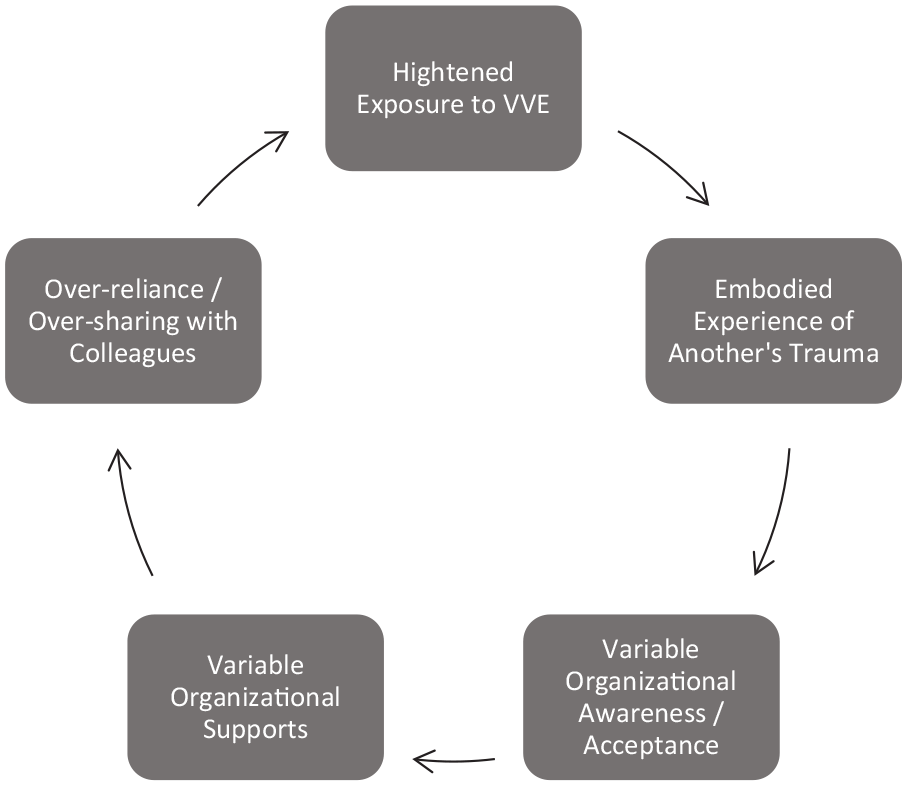
Trauma contagion through exposure to violent video evidence (VVE).
Recent efforts to reconceptualize trauma have brought to the fore the relational aspects of traumatization that enable its transmission or travel among and between individuals – a process akin to contagious spreading (Coddington, 2017; Coddington and Micieli-Voutsinas, 2017). That is, close engagement and ‘proximity to the traumatized person, leads the practitioner to engage with the same catastrophic happening [italics in original] that so disrupted the traumatized person’s life’ (Coddington, 2017: 68). While the experiences of the actual victim depicted in the images and that of the viewer are not directly comparable, in this study of criminal justice professionals who consistently and repeatedly view video evidence of violent crime, the first site of contagion is between the victim whose suffering is graphically depicted and the viewer. Rather than ‘imagining what it would be like to be in their shoes’ (Coddington, 2017: 68), however, video evidence of violent crime immortalizes actual events and amplifies aspects of trauma that might have otherwise been fleeting, imperceptible or unknowable to individuals other than the original victims and witnesses. In addition, what was once shared primarily through verbal description, text, or still images is now shared with new context and richness that carries a greater weight and potential for injury. In this respect, the distinction between indirect and direct traumatic exposures becomes blurred as the viewer experiences the sounds and sights at intimate range. As has been previously reported, the repeated viewing of video evidence of violent crimes can not only re-victimize the actual victim depicted in the images (Regehr et al., 2021b), but also result in profound traumatic responses as the experiences of others are embodied by the viewer (Birze et al., 2022b), thereby expanding ‘trauma’s mobility as it travels in and through bodies’ (Coddington and Micieli-Voutsinas, 2017: 52).
Trauma contagion through the viewing of video evidence of violent crime has profound implications for those who work in the criminal justice system and highlights the need for organizational approaches to address the impacts, given the consistent association between organizational supports and secondary trauma in workers (Alden et al., 2021; Brady, 2017). As Katherine Biber (2015) has described in her analysis of technological advances in visual evidence in the context of justice, ‘[t]his new visibility, the ability to see secrets, demands a sensitive response’ (p. 237). Findings from this qualitative exploration, however, suggest that the rapid pace of technological advance and exponential production and transmissibility of video has far outpaced organizational awareness, preparedness and response. While in some policing organizations those in certain units, such as the investigators of Internet child exploitation, have mandatory psychological evaluations, these are not available in all organizations or even in all units of the same organization. Employee assistance programmes are more universally available but are viewed as either too general in their orientation (such as general stress management) or inadequately supported (such as covering only a small portion of the cost). In addition, in both policing and legal professions there is a continuing sense that admitting to the need to use such services may result in negative outcomes, such as that the individual does not possess the strength of character to manage the job (Brady, 2017; Regehr and Bober, 2005). As a result, criminal justice professionals may only formally admit to being impacted by the exposure when they have reached a point that they need to quit or be reassigned.
Given this context, many professionals who are affected and perhaps suffering as a result of exposure to violent video evidence turn to colleagues for support. This may include describing the nature of the evidence or asking others to also view the video material. However, while the support of colleagues is indeed associated with reduced impact of traumatic workplace exposures (Anderson et al., 2020; Regehr et al., 2003; Shakespeare-Finch et al., 2015), these individuals are also faced with an overwhelming barrage of traumatic material in their own work. This then becomes a second site of potential contagion, intensifying the experiences of those already feeling the effects of additional traumatic exposure, thereby ‘compounding and binding together sometimes unrelated life traumas’ (Coddington, 2017: 66). This has implications for the individuals experiencing the trauma, perceptions of organizational support, the overall health and functioning of the organization, and ultimately the public that are served. Thus, enhanced supports at the organizational level are critical.
Based on the findings of this study, organizational responses to reduce trauma contagion and the psychological burden on professionals working with video evidence of violent crime in the justice system should occur at three levels: (1) prevention through moderating exposures; (2) preparation through creating a culture of awareness and acceptance; and (3) intervention through systematic and formal supports.
In terms of prevention, there have been growing efforts in other fields such as journalism and human rights advocacy to develop standards of viewing practice in an effort to mitigate traumatic impact (Dubberley et al., 2015; Rees, 2017), arising from awareness of the traumatic impact of viewing violent videos (Baker et al., 2020; Feinstein et al., 2014; Zeng, 2018). This has included strategies such as discussing and processing graphic materials with others who understand the work they do, limiting exposure to graphic material by setting limits on content or case caps through shared roles, taking breaks, reducing the length of viewing periods and avoiding such content in their personal lives through drawing physical and mental boundaries between work and home (Baker et al., 2020). In human rights video analysis, as is the case in some areas of policing (Sanchez et al., 2019), machine learning and computer vision have the potential to support efforts to reduce exposures when large volumes of open-source, dark web, and other video material must be catalogued and analysed (Aronson, 2018).
An organizational culture that includes awareness and acceptance of the potential traumatic effects of work can include preparedness training that incorporates trauma theory and research, normalizes reactions to traumatic content, explicitly labels graphic content, provides some advance description of the content, supports healthy work/life balance, and encourages appropriate boundaries and help-seeking (Baker et al., 2020; Hill et al., 2020). This can allow individuals to voice concerns before they are at a point where they can no longer tolerate the work and their expertise is lost. Finally, organizations have moved forward in providing assessment and debriefing services that participants in this study found useful. Given the exponential growth in the use of digital recording devices, normalizing the access and use of these support services and systematically and thoughtfully expanding to a broader range of workers can potentially have a significant effect on their well-being, their subsequent job performance and expertise, and the health of organizations more broadly.
