



Abstract
Claims of sexual assault are especially prone to scrutiny and (re)interpretation as something else. We investigated how people judged the veracity of sexual assault claims and how they subsequently framed their interpretations of these claims using ‘general knowledge’ in the form of sexual scripts, rape myths, and gender stereotypes. Participants (n = 161) read about a sexual assault allegation by a male or female claimant and were asked to describe in more detail what they thought had happened. Data were analyzed using a combination of quantitative and qualitative frame analysis. A key finding was that although participants mostly accepted the facts of the claim, this did not automatically imply they shared the claimant’s interpretation of the event as (serious) sexual assault. The analysis revealed that participants drew upon distinct frames to interpret the claim, including frames – such as regretted consensual sex and miscommunication – that exonerated the accused and emphasized claimant responsibility. Frames were differentially employed in response to male and female claims of sexual assault. We discuss how our research design and findings can contribute to an increased understanding of the underlying mechanisms of victim acknowledgment.
Introduction
Was it rape or was it a bad date? This question circulated in social media following online disclosure of women about their negative sexual experience during a date with a man. Where a woman might claim she felt violated as a consequence of the man’s actions, the man can maintain that he believed their sexual activity had been consensual. Sexual assault claims have frequently been severely scrutinized by third parties and subsumed under headings other than sexual assault (Serisier, 2019; Worthington, 2020).
Claims of sexual assault in particular are prone to scrutiny and (re)interpretations as something other (Jackson, 2018) so that a claimant can be far from certain of being granted the status of legitimate victim. This may in part follow from the idea that in the (frequent) absence of victim injury or witnesses, such claims boil down to a ‘he said, she said’ type of allegation (Gilmore, 2017). Related to this, rape myths such as the belief that alleged victims frequently lie about rape (Boux and Daum, 2015; Edwards et al., 2011; Rumney, 2006) can function to prompt skepticism about sexual assault claims from the outset. Finally, an intertwinement between discourses of normative (erotic, romantic, consensual) sex and of sexual violence may enable reinterpretation (Gavey, 2005). Specifically, an understanding of sexual assault as motivated by sex rather than (also) by power and domination may facilitate alternative narratives of miscommunication or regretted drunken sex (Lea, 2007).
Although the above describes several potential reasons why third parties may question sexual assault claims, only a few studies have expanded their focus to include the question how third parties employ ‘general knowledge’ in the shape of sexual scripts, rape myths, and gender stereotypes to assign credibility to the alleged victim’s statements, and construct ‘plausible’ versions of what happened (e.g. Alcoff, 2018; Anderson and Doherty, 2008; Ellison and Munro, 2009a). The current research seeks to further address this question by investigating how people judge the facticity of a sexual assault claim by a female or a male student, and what types of ‘general knowledge’ they subsequently resort to in order to make sense of an (ambiguous) allegation of sexual assault.
Scrutinizing and (re)interpreting claims of sexual assault
According to Anderson and Doherty (2008: 51), ‘from the moment that a rape survivor makes a public declaration that s/he was raped, the truth status of that claim is likely to be treated as provisional, as an “allegation” and will be scrutinised and debated’. Where a first step in the public response to claims of victimization is likely to involve this veracity judgment, even when observers factually accept claims, they may subsequently contest the alleged victim’s interpretation of the event (Gilmore, 2017; Serisier, 2019).
It is a well-established finding that alleged victims and their claims of sexual assault are frequently met with disbelief and other negative reactions (Campbell, 2008). As noted by Burt and Estep (1981: 15) nearly four decades ago: ‘the combination of sexual activity and coercion does not automatically qualify the coerced individual for the victim label’. In other words, the assignment of legitimate victimhood status does not solely depend on the presence of specific ‘facts’ of the event, but also on the observers’ willingness to interpret them in a certain way (Temkin and Krahé, 2008). Burt and Estep (1981) delineated several potential alternative interpretations that compete with the acknowledgment of sexual violence and legitimate victimhood. These included suggestions that the victim has fabricated a claim out of thin air, that the event entailed consensual sex, that coerced sex occurred but consequential damage was minimal, and that sexual assault occurred but that the victim was largely responsible. Such (re)interpretations typically amount to disbelieving or blaming the (alleged) victim, and to trivializing (the severity of) the transgression.
What facilitates competing interpretations of sexual assault and victim role claims? A growing body of research has highlighted the ways in which sexual violence can be justified, normalized, or obscured (e.g. Ehrlich, 2001; Lea, 2007; Lea and Auburn, 2001). For instance, authors point to the discursive overlap between normal sex and sexual assault, meaning that certain elements of sexual encounters – most notably a woman’s resistance and a man’s persistence – are interpretable through either frame of reference (Jeffrey and Barata, 2019; Philadelphoff-Puren, 2005; Ryan, 2011). This discursive overlap also creates the possibility to (re)interpret a claim of sexual assault as a type of event that was not mentioned in the work of Burt and Estep (1981): a misunderstanding. As Gilmore (2017: 11–12) aptly describes, ‘The narrative of sexual harassment as an artifact of love and longing gone wrong circulates the false notion that harassment arises from innocent, unknowing, and therefore nonresponsible stirrings, awkward, perhaps, but hardly actionable’. This interpretation – where any feelings of violation are perceived as non-intended and instead more likely to have resulted from miscommunication between equally agentic parties – has been found to be a popular explanation of negative sexual experiences and acquaintance rape (Crawford, 1995; Frith and Kitzinger, 1997; Hindes and Fileborn, 2019).
Sources of (re)interpretation
The fact that Burt and Estep (1981) did not discuss miscommunication as an alternative suggestion to sexual assault is not surprising. At the time of their publication, attention had only just started to shift from stranger to acquaintance rape (Gavey, 2005; Koss, 1988), and an escalated hookup was perhaps not yet a ‘logical’ explanation for rape claims. This only serves to illustrate that people select information from discourses that are available, relevant, and credible to them in order to make sense of an event. Thus, in their interpretation of claims of sexual assault and victimhood, third parties draw from prevalent cultural beliefs or ‘general knowledge’ on the subject matter (Burt and Estep, 1981). Part of the reason why we included male claimants in our study is precisely because fewer sources of ‘general knowledge’ seem available in trying to make sense of male claims of sexual victimization (Anderson, 1999; Cohen, 2014).
General knowledge includes cultural scripts that represent what ‘normal sex’ and sexual assault are (or ought to be) like. People employ sexual scripts to determine what can normatively be expected in a situation (Simon and Gagnon, 1986), but also to frame events as one thing or another (Edwards, 1994; Frith and Kitzinger, 2001). Sexual scripts portray sexual encounters as following a predictable sequence of actions, in which different roles are assigned to men and women (Frith, 2009). The traditional sexual script relies heavily on the stereotypical gender roles of a male initiative-taker and a female gatekeeper (Wiederman, 2005). The script most employed to portray sexual violence – the ‘real rape’ (or stranger rape) script – describes the stereotypical violent rape of a vulnerable woman by an aggressive male attacker unknown to her (Estrich, 1987; Ryan, 2011). Both sexual scripts and gender stereotypes allocate the passive (victim) role to women and the active or aggressive role to men. Male sexual victimization defies these scripts and stereotypes. Hence, these sources of ‘general knowledge’ serve us poorly in organizing and explaining stories in which men feature as victims of sexual violence.
Related to rape scripts are rape myths, which serve to dismiss anything that does not adhere to the prototypical stranger rape – including the rape of men – as not ‘real rape’. Rape myths are persistent stereotypical beliefs that justify and trivialize sexual violence, and assign responsibility for rape to the victim (Burt, 1980; Gerger et al., 2007). Rape myths tend to point toward many factors other than the perpetrator’s behavior as determinants of sexual assault, including alcohol consumption, appearance, and the promiscuity of the victim (Gravelin et al., 2019), and miscommunication between parties (Dardis et al., 2017).
Framing sexual assault
Sexual scripts, rape myths, and gender stereotypes are all integral to the framing of (claims of) sexual assault. They are the building blocks of what relevant frames depict as ‘general knowledge’ or ‘common sense’. Framing is ‘the process of culling a few elements of perceived reality and assembling a narrative that highlights the connections among them to promote a particular interpretation’ (Entman, 2007: 164; Goffman, 1974). In framing, actors and events are tactically placed in (causal) relations to each other, resulting in particular distributions of (moral) responsibility (Hertog and McLeod, 2001).
Previous research has illustrated the key role of language in the framing of (claims of) sexual assault (Ehrlich, 2001). Studies have for instance demonstrated that the use of active and passive verbs can serve to emphasize or obscure the agency and responsibility of the involved actors (e.g. Bohner, 2001; Ehrlich, 2001; Frazer and Miller, 2009; Niemi and Young, 2014). The placement of different elements as either actor or contextual factor in a frame similarly functions to construe (internal or external) causations of an event. The same elements, such as alcohol use, may thus be given the status of internal or external cause depending on ‘their discursive deployment in action sequences such as blaming or mitigating, excusing or accusing’ (Edwards and Potter, 1992: 99; see also Coates, 1997). Furthermore, the choice of (morally or emotionally charged) words may function to embed a particular experience within a framework of normative sex, or instead within a framework of (sexual) violence (e.g. Bavelas and Coates, 2001; Coates et al., 1994; Hindes and Fileborn, 2019; Lea, 2007; Lea and Auburn, 2001; Siefkes-Andrew and Alexopoulos, 2019).
The current study
Identification of victimization or sexual assault is an ‘interpretive process’ (Alcoff, 2014: 448). However, most (experimental) research on observer reactions to (claims of) sexual assault gives little insight into this interpretative process. Indeed, such research is generally marked by the manipulation of a limited number of concrete variables alongside closed-ended answer possibilities. Consequently, they provide us with little insight into how observers form judgments of sexual assault, that is, what pieces of information they focus on, and how they combine these elements to construct an account of what happened (Anderson and Doherty, 2008). While this insight is lacking in research on claims of female sexual victimization, it is virtually absent with regard to claims of male sexual victimization (Cohen, 2014; but see Anderson and Doherty, 2008; Doherty and Anderson, 2004). The current study hence employed a mixed-methods design to investigate how observers interpreted a claim of sexual assault by a male or female student. First, we examined participants’ veracity judgments of a sexual assault claim. Second, we explored through which framing strategies participants conveyed their portrayal of the event. Framing strategies that were investigated related to the selective repetition of the original vignette, the inclusion of and emphasis on specific acts, and the positioning of the actors (in relation to the acts). We hypothesized that participants draw upon different frames when making sense of a sexual assault claim by a female versus a male student. More specifically, we expected that interpretations of female claims of sexual assault lean more heavily on traditional scripts and stereotypes.
Method
Participants
Participants who were at least 18 years old and of British nationality were recruited via the online UK-based research platform Prolific Academic. The collected sample consisted of 162 participants, of whom one participant was excluded because of substantial missing data. For the remaining 161 participants (82 men, 78 women, and one person who identified as non-binary), ages ranged from 18 to 76 (M = 35.17, SD = 11.81). They were randomly allocated to the female (n = 81) or male (n = 80) claimant condition. Participants were awarded £0.90 for participation.
Procedure and materials
Participants read a vignette about either a male or a female student who had reported a sexual assault to the University Board. According to the claimant, the sexual assault had been committed by a fellow (male) student during an on-campus party. The vignette was purposefully designed to include limited and ambiguous information. For instance, the claimant stated that (s)he and the accused had been drinking, but the amount of alcohol was left unspecified. Furthermore, the claimant was said to resist verbally, but not physically, and the details of the sexual assault were left open. Participants were requested to write down in detail what they expected had happened between the claimant and the accused. 1 The complete vignette and instructions are in the Appendix.
Analysis
We used a mixed-methods frame analysis that combined qualitative analysis with frequency counts. Several authors have noted the value of frame analysis as a mixed-methods approach (e.g. Reese 2007; van Gorp, 2007), where a qualitative analysis serves to capture the subtleties inherent in sense-making (Anderson and Doherty, 2008), and frequency counts can be used as indications of, for instance, the emphasis placed on particular concepts within a frame (Hertog and McLeod, 2001). In this particular study, a mixed-methods approach allowed us both to qualitatively investigate the subtle ways in which respondents (re)construct claims of sexual assault, and to point toward potential differences in the type and frequency of frames employed in response to male and female claimants. Both authors individually coded the participants’ claim endorsements, actions, and actors that featured in the response, and any type of moral judgment expressed by the participants. Codes were discussed, compared, and where necessary adjusted in the course of frequent meetings.
We first determined to what extent participants endorsed the claimant’s story as (factually) veracious. Responses were categorized as accepting, questioning, or rejecting the claim, or refusing to evaluate it altogether (interrater agreement 95%). Subsequently, we coded all actions (e.g. drinking, saying no, forcing) mentioned by the respondent, as well as the agents connected to those actions (claimant (c), accused (a), both (b), or unspecified (u)) per respondent. This resulted in an action sequence. For example, the following response: ‘I feel that the event happened as Melanie said, they had been drinking and she had asked the male to stop several times but he didn’t. Then she felt too scared and not able to physically restrain him’ was coded as: (b) drink, (c) says no, (a) persists, (c) cannot resist. After a first round of coding, we discussed commonalities in the action sequences. We identified action sequences that were common in the responses. Each common pattern was labeled, so that we deducted frames that clearly depicted sexual assault, or in contrast depicted regretted consensual sex. The remaining responses were initially labeled as ‘gray areas’. In a second round of coding, we distinguished three common action sequences within these gray area responses either because they diminished the severity of the claim, emphasized the responsibility of the victim, or downplayed the intentionality and responsibility of the accused. After careful reexamination, these responses were coded as trivialization, victim focus, and miscommunication frames.
Results
The majority of participants initially accepted the claim as truthful (Table 1). The number of people initially accepting the claim was significantly higher than the number of people questioning or rejecting the claim or refusing to interpret taken together (χ2(1) = 8,503, p < 0.001). The pattern of responses did not differ depending on whether the claimant was male or female (χ2(3) = 2,493, p = 0.48). The most commonly provided reason for accepting the claim was that victims would not lie about such a serious allegation and/or had nothing to gain from it. Alternatively, participants expressed that one should start from a position of believing the claimant’s word. People who did not accept the claim declared it unreliable because of the claimant’s alcohol consumption and/or mentioned the need for more evidence (e.g. hearing witnesses, the other side of the story). People who refused to evaluate the claim stated they were not prepared to make assumptions.
Initial endorsements of claim.

Note. Percentages refer to proportion of claims within one row.
Table 2 displays five frames participants seemed to draw upon in their responses. The contents and implications of these frames are described in detail in the qualitative analysis in the following sections. Multiple frames could be offered in one response: a participant could for instance question the claim by entertaining the possibilities that the claim resulted from a real assault, from a mishap in communication, or from regretted sex. Hence, the frames correlated but did not completely overlap with participants’ initial endorsements of the claim. Most notably, accepting the facts of the claim did not automatically result in an interpretation of the situation as (serious) sexual assault. In other words, participants were still found to employ frames that constructed the event as not serious, exonerated the accused, and/or held the claimant (partly) responsible.
Application of frames in relation to initial endorsements of claim.
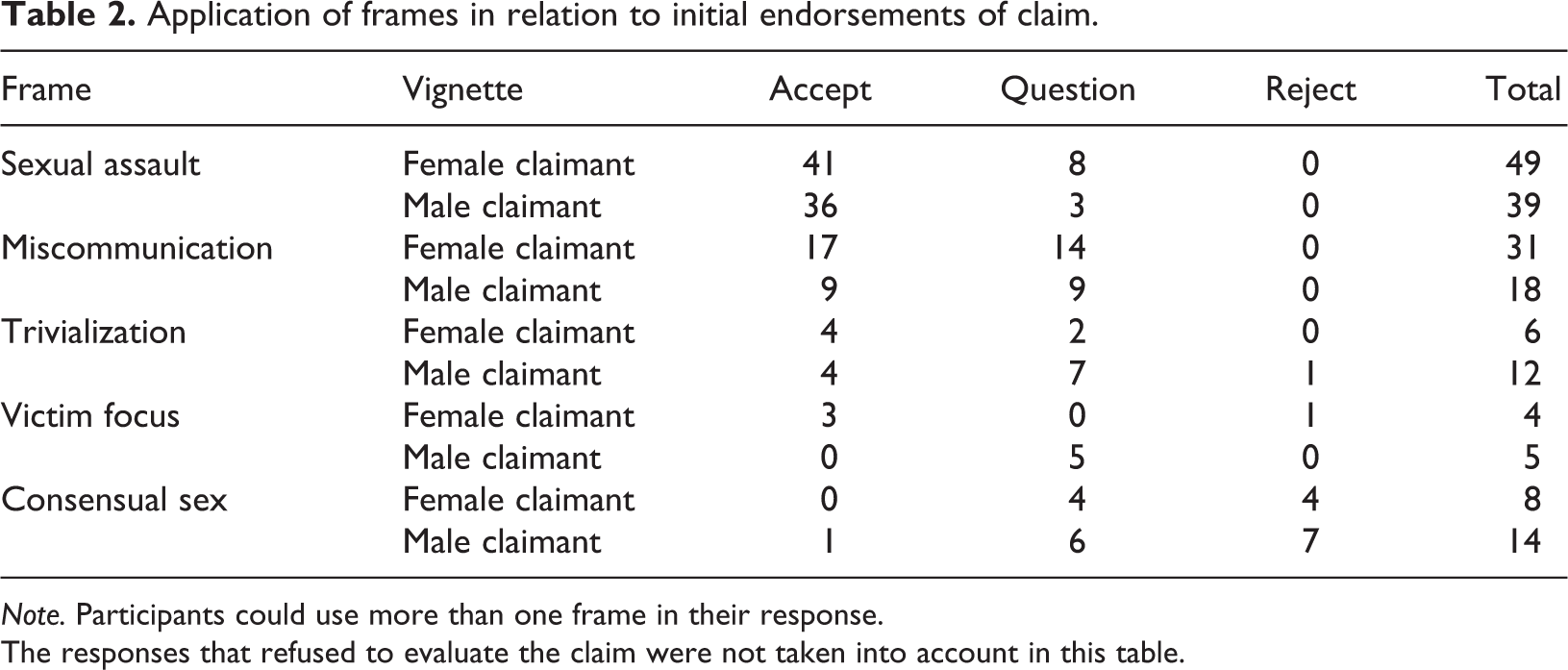
Note. Participants could use more than one frame in their response.
The responses that refused to evaluate the claim were not taken into account in this table.
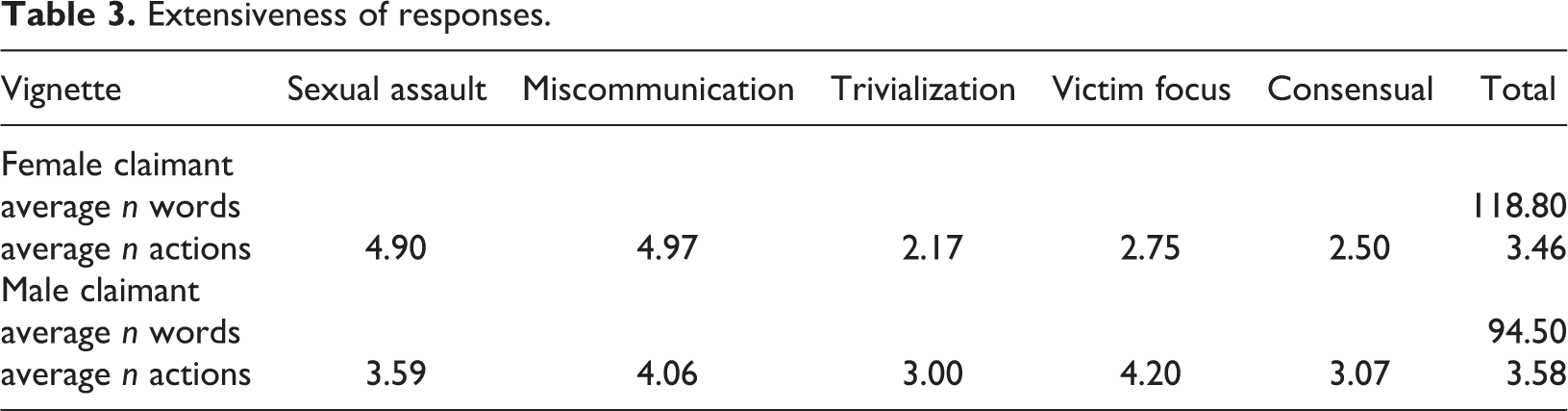
On average, participants used more words to describe the event leading up to the female claim compared with the male claim of sexual assault (Table 3). This could suggest that participants have an easier task describing and explaining female sexual assault claims, considering the cultural knowledge available to both endorse and refute such claims. Table 3 further shows that participants included more actions when they portrayed the event as sexual assault or miscommunication in response to the female claim. In contrast, they mentioned more actions when they portrayed the event as trivial, victim focused, or as consensual sex in response to the male claim. 2 These findings complement the differences in the conditions described in Table 2. The specific action sequences per frame are displayed in Table 4, and qualitatively analyzed below per frame. Each section starts with the most common action sequence in the frame.
Extensiveness of responses.
Action sequences within the various frames.
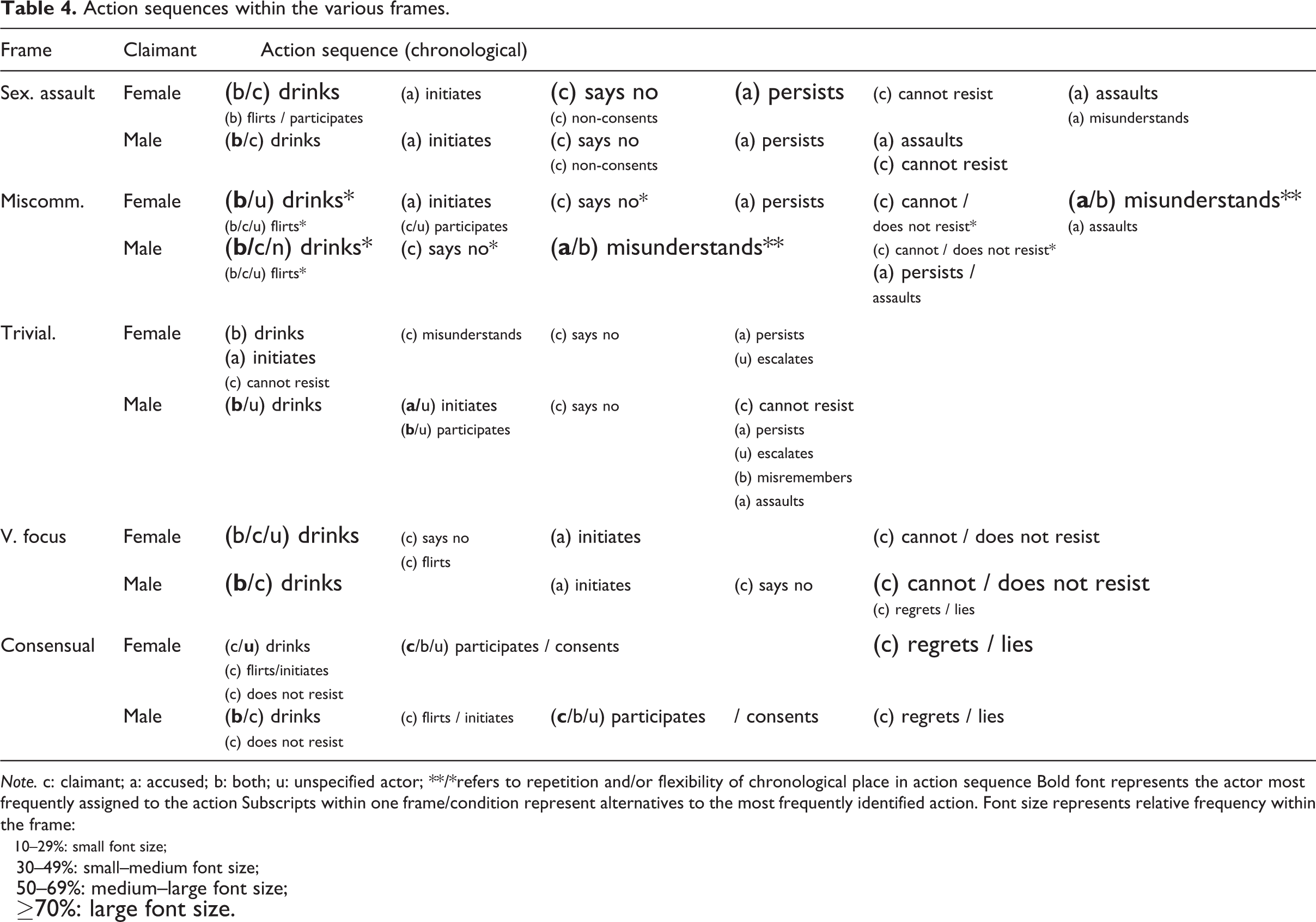
Note. c: claimant; a: accused; b: both; u: unspecified actor; **/*refers to repetition and/or flexibility of chronological place in action sequence Bold font represents the actor most frequently assigned to the action Subscripts within one frame/condition represent alternatives to the most frequently identified action. Font size represents relative frequency within the frame: 10–29%: small font size; 30–49%: small–medium font size; 50–69%: medium–large font size;
Sexual assault
Sexual assault was commonly portrayed using the following action sequence: the claimant and accused drink alcohol, the accused initiates sex, the claimant says no, the accused persists, the claimant cannot resist, and the accused assaults. Participants most frequently employed this frame in their responses, particularly when they accepted the veracity of the claim. This frame was the most elaborate (Table 3) and contained concrete actions of both the claimant and the accused (Table 4). In employing the sexual assault frame, participants gradually progressed from a discourse of romantic interaction to one of violence and control. The described actions shifted from accused to claimant and back, whereby the accused (intentionally) pushed for something that the claimant tried to resist. Oftentimes, this simple combination of actions was enough to justify the label of ‘assault’. The going back-and-forth between perspectives placed the actors progressively in opposition to each other. Although participants who employed the sexual assault frame shared the claimant’s interpretation of the event, and hence labeled the claimant as a legitimate victim, they did not always and explicitly hold the accused accountable.
Where participants described the accused’s advances in rather non-specific terms in the male claimant condition (‘the other male has made advances’), more explicit references to sex were found in the female claimant condition. Examples like ‘at some point he makes a move, kisses or touches her’ show that participants initially drew upon a discourse of normative sex. Participants then described the claimant’s attempts at resistance by (repeatedly) saying no. When the accused subsequently persists, the conflict was marked both in the content of the interpretation and in language use. Persistence meant that the accused ‘proceeded’ or ‘carried on’ his initial behavior, or that he ‘didn’t listen’ or ‘ignored’ the claimant’s resistance. In terms of language, the conflict was indicated by sharp contrasts: ‘
The claimant was portrayed as passive and weak, that is, as a stereotypically legitimate victim (Christie, 1986), through an inability to resist the persisting accused. Whereas resistance was in the first instance specified as saying no, after the accused’s persistence, participants described the claimant as lacking the required physical power to ‘fight him off’ or ‘physically restrain him’. In both conditions, this lack of power was mostly attributed to shock or fear, though it seemed fear was attributed more often to the female claimant (n = 14 vs. n = 6). This might relate to fear being considered a stereotypically feminine emotion (Hess et al., 2009).
The last identifiable action in the sexual assault frame was the assault itself, which was frequently described in terms that indicated severe violence, such as ‘sexual assault’ and ‘rape’. If the frame included assault as an action, it was often much shorter than the elaborate frame described above: in 18 cases, the frame consisted solely of the assaulting action, or assaulting and any one other action. The following examples were full-length responses of participants: ‘She was sexually assaulted without consent by the male student’, ‘He was raped. He did not consent so was raped’. The fact that short frames were more frequent in the male claimant condition (n = 13 vs. n = 5) could suggest that participants less easily constructed an elaborate narrative of male victimization (Table 3). Participants did not always employ assault as an action (i.e. as a verb), but at times concluded that a particular combination of actions – particularly saying no/non-consenting and persistence – should be defined as assault. Examples include, ‘However if she did say no and he did proceed
It was striking that the moral judgment of sexual assault did not necessarily entail an explicit condemnation of the accused. In fact, the agency of the accused was obscured in several ways. One way of doing so was by removing the actor from the sentence structure and nominalizing the assault, for example, ‘more serious sexual assault took place’. Moreover, the assault was often described in passive language – Michael/Melanie was assaulted (by the accused) – placing the accused in the periphery of the frame. In sum, the sexual assault frame often portrayed a legitimate victim and acknowledged the seriousness of the situation without clearly and predominantly attributing blame to the responsible agent.
Consensual sex
The action sequence of the consensual sex frame typically consisted of both parties’ participation in or consent to sex, followed by regrets and lies by the claimant. Employing the consensual sex frame positioned the claimant as an active agent in a discourse of sexual desire, meaning that (s)he could be held accountable for what happened. We found that participants used three discursive ‘tactics’ to suggest claimant responsibility: they focused on the acts of the claimant rather than the accused, they described these acts in an active way both semantically and grammatically, and they focused on reasons why a claimant would choose to lie.
As illustrated in Table 4, the actions of the claimant were leading in this frame, whereas hardly any actions were identified that were performed by the accused alone. As such, the claimant was portrayed as an active agent who deliberately engaged in a sexual encounter. This could start with active initiation: ‘Melanie gave the other student the come on to play with his feelings or to make the other student buy her drinks’, ‘I believe he might have given signals to show he was interested’. At a minimum, participants emphasized that the claimant did not resist the advances of the accused, thereby potentially ‘tacitly consenting’. Non-resistance was described as an active choice, rather than a matter of circumstances outside the control of the victim: ‘she decided to go with it’, ‘he didn’t stop the guy from physically advancing’. The possibility that the victim could not resist was not mentioned.
Similar to the phrasing of non-resistance, subsequent actions construed the claimant as an active agent. For instance, the claimant actively participated in the sexual encounter, often by giving active consent: ‘the female consented to the sexual activity’, ‘he agrees to a liaison’. Notably, the action ‘drinking’ was less prevalent than in other frames, which suggested that the consumption of alcohol was assigned a less influential role in the unfolding of events. By implication, the claimant’s responsibility was emphasized: the claimant cannot reduce their accountability on the basis of not thinking clearly. When participants did mention the influence of alcohol consumption on the claimant, alcohol was portrayed as the fuel to make active decisions, not as an impairment to doing so: ‘maybe she got too drunk and said yes’, ‘I think that Michael got drunk and had sex with the guy by giving consent’.
Finally, participants described that at a (much) later point in time – often the next day – the victim looks back, regrets the encounter, and lies about it, thereby changing the narrative from consensual sex to violent assault: ‘These two may have had
Grey areas
Whereas the frames described above generally followed clear action patterns, many responses were more complex and/or less clear-cut. These responses indicated that participants assumed some sort of (sexually) transgressive behavior had occurred, but they did not convincingly construct the event as sexual assault. We named these ‘grey area’ responses because they tended to remain ambiguous about the presence or absence of victim consent and perpetrator intent. Within these responses, we identified three separate frames: miscommunication, victim focus, and the trivialization frames.
Miscommunication
Participants who drew upon a miscommunication frame typically depicted the event using the following action sequence: the claimant and accused both drink, the claimant says no but then both parties consistently misunderstand each other’s intentions, which leads to an escalation of the situation. This frame was dynamic, but relatively clear-cut and frequently employed compared with the other grey area frames. The miscommunication frame often featured in the same response as the sexual assault frame (n = 21), especially in the female claimant condition (n = 15), meaning that miscommunication was regularly used as an alternative to or explanation for sexual assault. Indeed, the actions in the miscommunication frame resembled those of the sexual assault frame, but included repeated interjections of the action ‘misunderstanding’. Especially in responses coded as both sexual assault and miscommunication, participants at times explicitly argued that even though the event was rooted in a misunderstanding, there was no excuse (e.g. being drunk) for the accused’s behavior, and that he should have stopped when told to. Regardless, depicting the event as a misunderstanding tended to distribute responsibility more evenly among the involved parties, while simultaneously refraining from explicitly blaming either one. This balancing act was accomplished in a number of ways.
First, participants emphasized that the development of events required the involvement of two (i.e. both) parties: ‘As they had
Furthermore, the repetition with which misunderstandings occurred (see also Table 4) seemed to create a narrative where both actors experienced and reasoned from their own experiential worlds. Such an interpretation did not require the participant to dispute the ‘facts’ that had been reported by the claimant. Instead, the participants focused on how those (f)acts were experienced. For instance: ‘I suspect that the events Melanie relayed are correct but that each of them see the situation differently given that both were under the influence of alcohol’, ‘The other student may not have been aware that Michael was seriously refusing him, especially as Michael did not physically resist or attempt to shout and make a scene’. These interpretations suggested the possibility that actions perceived as transgressive by the alleged victim were not intended as such by the accused. Indeed, what stood out in the miscommunication frame was that participants attempted to imagine how the accused might have perceived the situation: ‘the male likely thought’, ‘the perpetrator probably didn’t know that Michael didn’t want to do it’. Additionally, the claimant’s non-resistance was framed almost as frequently in terms of did not resist as in terms of could not resist. In taking the accused’s perspective, participants did not (have to) elaborate on why the claimant did not – or may not have felt able to – resist: ‘When he went to undo her belt she did not resist or remonstrate so he continued’. As a result, non-resistance seemed to contribute to the claimant’s culpability.
Finally, although it was almost exclusively the accused who was said to misunderstand, participants frequently externalized the reasons for the accused’s misunderstanding. Specifically, and reiterating that a misunderstanding involves two parties, reasons were often found with the (ineffective) communicator – that is, the claimant – who sent signals or performed actions liable to, or directly causing, misunderstanding: ‘Melanie was being playful in the way she acted while saying to stop, which
The miscommunication frame featured both more frequently (Table 2) and more elaborately (Tables 3 and 4) in the female- compared with the male claimant condition. Indeed, participants often entertained the possibility that the female claimant’s actions were interpreted as ‘playful’, ‘sexual teasing’, or ‘shy’. These findings demonstrate how traditional gender roles and sexual scripts facilitate miscommunication as a ‘reasonable’ explanation for sexual assault (Frith and Kitzinger, 1997).
Victim focus
The victim focus frame refers to an action sequence in which the victim is the predominant performer of actions: mainly, the victim drinks, and the victim cannot or does not resist. Because responses solely reflected on the actions and experiences of the victim rather than incorporating actions by the accused such as ‘persist’ and ‘assault’, the event was presented as less serious, and the victim as at least in part responsible.
For instance, whenever a distinction between the claimant and accused was made, the claimant’s alcohol consumption was emphasized. Additionally, although several participants mentioned that the claimant said no or tried to say no, they emphasized that the claimant did not or could not resist. Reasons for non-resistance were located within the claimant, rather than in coercive circumstances. Participants mentioned the possibility that the claimant did not resist because the claimant was not actually opposed to the sexual interaction: ‘In this situation myself I feel I would have kicked off not froze when it got serious if I didn’t want it to happen’. Alternatively, they stated the victim could not resist because (s)he had drunk too much alcohol and (hence) felt out of control: ‘Michael could have asked the other person to stop but then been too drunk to actually act on it’. As such, the claimant was construed as someone who acted irresponsibly and did not exert serious effort to stop the accused.
Trivialization
The trivialization frame had the least structured action sequence of the frames we identified. Visual evidence for this can be found in Table 4, with many actions featuring relatively infrequently, and forming no clear chronological pattern. In 11 of the 18 frames, we coded no more than two actions in total. Relatedly, whereas in other frames participants frequently concluded with the action that reflected the name of the frame (e.g. misunderstand, regret/lie, and assault), there was no clear endpoint to this frame. As shown in Table 2, the trivialization frame emerged twice as often in response to male- compared with female claimants. Responses were labeled as trivializing because, even when participants accepted the claim, they described the event in ways that presented it as non-serious. They accomplished this in several ways.
First, the part of the original vignette that suggested a form of perceptible conflict disappeared in participants’ responses. Responses that included both resistance and persistence featured infrequently (n = 3) in this frame. Typically, the actions of one party were not followed by the actions of the other party at all: ‘A boy made sexual advances on Melanie throughout the night, before undoing her belt. Melanie was uncomfortable throughout the night, as a result of the boy’s behavior’. A key aspect of conflict also disappeared when it was not located in the dynamics between parties, but instead phrased as an agentless development in events, that is, an escalation, or ‘things [that] got out of hand’ and ‘drunken flirting [that] went too far’. Alcohol was discursively placed in direct connection with the alleged assault, to some extent exonerating the actor who drank the alcohol: ‘X was wrong to do this as no consent had been given for sexual activity,
A second notable aspect, illustrated in the first example above, was that victimization was phrased as an experience or a feeling. Such terminology suggested that the outcome of the evening was directly related to the claimant’s personal state of mind rather than a result of the accused’s actions per se. Thus, even though the actions of the accused ‘resulted’ in the claimant’s experience, they were assigned only limited significance. Participants’ framing of the event in terms of feelings individualized the experience, and hence allowed for the possibility that another person would experience the same event entirely differently. Such relativity seems to counter the position that the event consisted of something ‘objectively’ severe. Trivialization was further achieved by describing the subjective experience in terms of discomfort rather than, for instance, trauma or fear. For the uninformed reader or listener, this language likely obstructs accurate deduction of the type of accusation that was made.
Finally, what happened between the accused and claimant was generally described either in language fitting a discourse of normative sex, or in vague non-sexual terms. Examples included, ‘initiating sexual activity by beginning to undress Melanie despite her lack of consent’, ‘a drunken fumble’, ‘they did something sexual together’, ‘the behavior’, ‘improper conduct’. Responses that lacked any sexual connotations were particularly frequent in the male claimant condition.
General discussion
Disbelief and other negative observer reactions are a pressing social problem (Campbell, 2008). They may lead (alleged) victims to feel unheard, and may as such hinder their ability to cope with their experience and their ability to construct their own life stories (Pemberton et al., 2019). Previous research has indicated that these reactions are particularly likely in reaction to claims of sexual assault (Jackson, 2018; Temkin and Krahé, 2008). In this study, we hence investigated what types of ‘general knowledge’ participants employ when asked to make sense of an (ambiguous) allegation of sexual assault.
One of the most important findings of this study was the apparent difference between an acceptance of facts of the claim and an acknowledgment of ‘real’ sexual assault and legitimate victimhood. Most participants initially accepted the claim and very few participants explicitly accused the claimant of lying. However, even when accepting the facts of the claim, not all participants subsequently interpreted the situation as actual sexual assault, but employed frames that constructed the event as not serious, exonerated the accused, and/or held the claimant (partly) responsible. Hence, the identification of a legitimate victim depends not only on accepting the facts of the claim, but also on observers’ willingness to share the claimant’s interpretation of those facts (Temkin and Krahé, 2008).
Potentially, observer responses that counter the claimant’s interpretation of the events may amount to what Fricker (2007: 1) has termed testimonial injustice, which ‘occurs when prejudice causes a hearer to give a deflated level of credibility to a speaker’s word’. For instance, framing the event as a miscommunication implies that the claimant has misunderstood and therefore mislabeled the acts and (non-)intent of the accused. Framing the event as a miscommunication may function to diminish the accused’s accountability and simultaneously depict the actions of the claimant as contributing to – even causing – the misunderstanding, emphasizing the claimant’s own responsibility. Furthermore, in the trivialization frame, the problem is primarily located in the claimant’s ‘subjective interpretation of the encounter’ (Hindes and Fileborn, 2019: 647) rather than in the actions performed by the accused. As such, the claimant’s interpretation is reduced to a subjective experience of limited significance, thereby rejecting the claimant as a worthy source of knowledge.
Finally, by framing the event as consensual sex, rape myths are employed to deflate the speaker’s credibility, and accuse the claimant of intentionally providing an altered interpretation, that is, ‘crying rape’. These results clearly show the importance of investigating all responses to claims of sexual assault, including those that do not dispute the facts of the case, in order to better understand the underlying mechanisms of victim acknowledgment.
Responses to sexual assault claims by men versus women
Of particular interest was whether participants would (more easily) draw upon different types of scripts, myths, and stereotypes to explain female versus male claims of sexual assault. Our analysis revealed that participants were more likely to draw upon (more elaborate) frames of sexual assault and miscommunication in their response to female claimants, and to draw upon (more elaborate) frames of consensual sex and trivialization in their response to male claimants. This seems to support our expectation that participants had more ‘general knowledge’ available to explain a claim of female- compared with male sexual assault.
Female claims of sexual assault are potentially more likely to be accepted because they are familiar to third parties, that is, everyone is aware that women are the frequent and ‘normal’ targets of unwanted sexual advances and sexual violence (Cohen, 2014). However, accessible normative sexual scripts also provide material to reframe sexual violence against women as ‘just sex’ or ‘love gone wrong’ (Gavey, 2005; Gilmore, 2017). Particularly striking was the frequency, and hence presumed ease, with which participants used miscommunication as an (legitimate) explanation of what a woman reports as sexual assault. Reflecting previous research, these findings suggest that the severity and responsibility of sexual assault (claims) can be diminished and reapportioned by recourse to discourse of ‘normal’ (hetero)sexual interaction (Frith and Kitzinger, 1997; Hindes and Fileborn, 2019; Jeffrey and Barata, 2019). Our findings also suggest that people (falsely) presume that others, perhaps women in particular, are quick to report sexual assault when actually it was not quite as serious as that.
Participants seemed to have more difficulty to make sense of male claims of sexual assault. Even when participants acknowledged sexual assault, they frequently reiterated that ‘an assault’ had taken place without specifying what this entailed. Furthermore, participants were twice as likely to employ a trivializing frame in response to male compared with female claimants. This frame in particular could alternatively be considered the absence of a frame, and thus the absence of ‘clear-cut explanations’ for a claim of sexual assault. The lack of available knowledge about sexual violence against men may be related to the absence of discourse on ‘normal’ sexual relations between men. For instance, we found that participants made fewer references to sex in their description of what led up to Michael’s claim. As has been suggested by others, negative reactions or a lack of response to male sexual victimization may be related to the perception of male rape as ‘a homosexual issue’, and a continuing unease with homosexual relations (Javaid, 2017: 119; Sivakumaran, 2005). Supporting this suggestion further, participants were more likely to reframe claims of male students as consensual sex compared with those of female students, and ‘backed up’ those interpretations with suggestions that hint at (‘experimenting with’) homosexuality as something shameful.
The value of (qualitative) frame analysis
Whereas quantitative studies have (separately) identified a range of factors that influence observer reactions to (alleged) victims of sexual assault, the current study has given more insight into the interaction between such factors, and the meaning observers assign to them. We identified five different frames that each had their own recognizable structure in terms of how participants placed actors and actions in a chronological action sequence. We found that participants could assign very different meanings to these elements, presumably based on their motives and/or relevant knowledge. One clear example is the consumption of alcohol. Previous research has generally found that the victim’s intoxication may serve to increase responsibility attribution, whereas, somewhat ironically, a perpetrator’s intoxication may serve to diminish his perceived responsibility (Finch and Munro, 2007; Norris and Cubbins, 1992). Our results generally support these previous findings, but also illustrate that alcohol consumption attains a different meaning depending on the overall frame a participant drew from. Consumption of alcohol could be portrayed as a stupid decision of the victim, as a catalyst for overall confusion and misunderstanding between parties, or as an obstacle to the possibility of giving consent and thus lending credibility to a story of sexual assault.
Another example of context-dependent meaning was found in the element of non-resistance. Previous research has indicated that victims who do not resist are generally blamed more and perceived as less credible (Angelone et al., 2015; Davies et al., 2008). Our findings have shed more light on how respondents construe non-resistance. They may attribute a failure to resist to circumstantial factors that lead to shock and fear in the victim, which are presumably ‘good’ reasons for freezing or stopping to resist (after saying no multiple times). In this case, non-resistance taps into the passivity required of an ideal, and hence legitimate, victim (Christie, 1986). Participants may also attribute non-resistance to a victim’s own mindset or perceive it as a consequence of their own behavior. In this case, non-resistance becomes a factor that increases culpability.
Limitations and future research
Perhaps the most important limitation to note is that because responses were still clearly elicited in an (online) experimental setting, participants received little incentive for the quality or elaborateness of their responses. As a consequence, some of the frames we extracted from the data, that is, the trivialization and victim focus frames, may have been marked by brevity and vagueness (in part) due to reasons unrelated to participants’ perceptions of the claim. Although one may wonder whether trivialization and victim focus thus really amount to ‘frames’, they do resemble previously identified definitions as established by Burt and Estep (1981) that portray the victim as responsible, or the harm done as negligible.
Eliciting responses in an experimental context also meant that participants were likely to know the claim to be fictional. They could thus describe what happened in the abstract, rather than having to justify their version of events to others, such as the claimant. If they had to account to others (Dunn, 2008), we might expect different types of responses and framing strategies from observers (Anderson and Doherty, 2008; Mulder and Bosma, 2018). Future research may hence elicit more elaborate answers from participants, as well as vary the context in which such responses are elicited, for instance through interview methods or more naturalistic conversations between participants (e.g. Doherty and Anderson, 2004; Ellison and Munro, 2009b). Future research might also vary vignettes to include different (interplays between) elements in order to investigate (participants’ spontaneous reproduction of) more scripts and myths that ‘explain’ sexual violence claims. In this case, an experimental condition with a female accused might be added. Finally, to strengthen the potential of frame analysis to bridge the gap between qualitative and quantitative approaches (van Gorp, 2007), future research might benefit from the inclusion of additional quantitative measures (e.g. Rape Myth Acceptance scales; Bohner, 2001). This would, however, require larger samples. Our sample of 161 participants sufficed for the purpose of qualitative analysis, but limited the reliability of quantitative findings. Hence, differences in frequency counts in the current study have been interpreted with caution.
Conclusion
Our findings support Burt and Estep’s (1981) conclusion that there are many ways in which a claim of sexual assault can be interpreted as something else. We demonstrated that even when third parties accept the facts as recounted by an alleged victim, they may offer alternative interpretations that effectively nullify his or her claim to the status of legitimate or ‘ideal’ victim. These interpretations can depend on many different factors, which are informed by ever-changing cultural knowledge in the shape of prevalent sexual scripts, rape myths, and gender stereotypes. In frequently employed quantitative research designs, the assigned meanings and interplay between these factors remain largely obscured. In contrast, by using a mixed-methods frame analysis we believe we have contributed to a more encompassing approach to ‘the telling and hearing of narratives of sexual assault’ (Andersson et al., 2019: 1). In this case, our study has specifically shed more light on the gap between the telling and the hearing, or uptake, of such sexual assault narratives. An understanding, and potentially enhancement, of male and female victim acknowledgment is likely to require a continuing critical examination of this gap.
Footnotes
Appendix: Vignette and Instructions
Acknowledgements
This research was supported by the Nederlandse Organisatie voor Wetenschappelijk Onderzoek (grant number 406-15-157) and Fonds Slachtofferhulp (grant number 17.01.03).
Authors Note
Eva Mulder is now affiliated with Netherlands Institute for the Study of Crime and Law Enforcement (NSCR).