



Abstract
When one individual commits a transgression or aggressive act against another, third parties often have expectations about how the victim should respond, even when they do not have any personal involvement in the event. When their justice expectations are violated, such as when a victim forgives the offender for an act that third parties deem too heinous to forgive, third parties may react in a way that is critical of the victim. This research examines how third-party observers react when victims forgive seemingly ‘unforgivable’ offences. Study 1, a scenario-based experiment, showed that although third parties were not directly critical of a forgiving victim, they did not agree with the decision to forgive. Study 2 replicated these findings and explored in more depth third parties’ justice-related feelings about the transgression and the victim, using both quantitative and qualitative data. Results suggest that although third parties are reluctant to directly criticize ‘extreme’ forgivers, they are not supportive of their decision to forgive. This could have implications for victims, who may interpret this disagreement with their choice as a lack of support.
I walked over, shook his hand and introduced myself. I wanted to show him it had not affected my life and that I had understood and forgiven him. (Katja Rosenberg, on meeting the person who raped her (Lines, 2014)) I have no idea why people think this is something to be praised. The lady sounds like a very decent and compassionate person, but equally she sounds dippy and naïve. Rapists are scum and always will be scum. (Anonymous Internet commenter, on the Katja Rosenberg story (Anonymous, 2014))
This research sets out to explain why an individual who was not directly harmed by an offence would be unsupportive of a victim who chooses to forgive this kind of extreme offence. It seems especially counterintuitive for an uninvolved third party to criticize the victim’s forgiving response when the victim is making a seemingly positive gesture that could have positive personal benefits. Although there is a considerable amount of literature on third-party responses to offenders and punishment, there are gaps in our understanding of the emotional reactions of third parties to victims themselves (Gromet, 2012). This is also an important issue for victims, because there may be instances where victims may want to forgive the transgressor but are reluctant to do so publicly because they fear that they will be judged negatively. This may put victims in a situation where they must balance their own desires with the expectations of others. As one victim who forgave her new husband for kidnapping and assaulting two women said, ‘[It’s] hard to feel pressure to hate when it [isn’t] what [you] feel’ (Moroney, 2012: 304).
In this research we examine how and why third parties respond to victims who forgive serious offences. Using a combination of quantitative and qualitative methods, we aim to better understand the role that justice expectations play when individuals form judgments of these ‘extreme forgivers.’
Third-party judgments of offenders and crime
When one individual commits a transgression against another it violates social norms about how people should behave (Gromet et al., 2012; Vidmar, 2000). Relatively minor interpersonal transgressions, such as lying to a friend or betraying a trust, may be seen as breaking common codes of social conduct, because it is generally expected that individuals will be honest and trustworthy. More severe transgressions, such as those involving crime and interpersonal harm, violate more widely held societal rules, because it is expected that individuals will obey moral and legal codes.
In addition to the victims who experience the direct harms of these offences, third parties may also be negatively affected despite not having any personal involvement in the event. As ‘observers of injustice’ (Van Doorn and Brouwers, 2017: 68), third parties are witness to the violation of social and moral codes, and thus will have expectations about how the injustice should be rectified or resolved (Carlsmith and Darley, 2008; Gromet, 2012). Depending on the offence, this may include sanctions against the offender (e.g. punishment), and/or compensation to the victim (Van Doorn and Brouwers, 2017). When no such resolution is forthcoming, it violates the justice expectations of the third party, resulting in a perceived justice failure (Zhu et al., 2012). Because justice expectations are seen as a core set of moral expectations that help individuals make sense of the world, when a justice failure occurs it can cause distress (Zhu et al., 2012) and moral outrage (Darley and Pittman, 2003).
Research has shown that third-party observers who are not directly involved in a transgression can be negatively affected by witnessing or being made aware of interpersonal transgressions and injustice even when they are not the target (Eaton and Sanders, 2012; Skarlicki et al., 1998). They may also have strong opinions about the transgressor and the way the conflict is resolved. For example, research has shown that third parties are often more critical and less forgiving than victims are towards an offender (Cooney et al., 2011; Green et al., 2008). This ‘third-party forgiveness effect’ (Green et al., 2008) stems from differences in how victims and third parties evaluate the offence and the offender. For instance, Green et al. (2008) found that third parties were more likely than victims to assign blame and to see the offender as responsible for the offence. Cooney et al. (2011) found that, compared to victims, third parties were less likely to see the act of forgiveness as being beneficial for the victim, and instead focused on the importance of withholding forgiveness from the offender. Third parties also were less likely to try to take the perspective of the offender.
The fact that third parties tend to make hostile attributions about offenders and place a strong emphasis on reparation and restoring justice suggests that they do see transgressions in which they are not involved as justice violations and are motivated to seek out ways to reduce the uncertainty that accompanies these justice failures.
Third-party judgments of victims who forgive
In addition to judging the transgressor and the offence, third parties may also judge the victim and the way the victim responds to the transgression. One way that victims can respond is with forgiveness. Forgiveness has been shown to have mental and physical health benefits for the forgiver (Worthington, 2007). Even in cases where transgressions are severe (for example, in criminal cases), victims have reported benefits to forgiving the offender even if they have not received an apology (e.g. Jaeger, 1998; Knight and Burford, 2014). Although there are situations where forgiveness may not be good for victims (for example, if it leads to re-victimization; McNulty, 2011), there is evidence that victims can personally benefit if they forgive.
What do third parties make of victims who forgive? On the one hand, forgiveness is viewed by many as an admirable choice, and is often considered a character strength (Peterson and Seligman, 2004). Forgiveness may signal to third parties that the victim has recovered from the transgression and/or made peace with the offender (Gromet and Okimoto, 2014). On the other hand, if a victim forgives it may signal that they are not sufficiently upset about the transgression. The literature on victim blaming suggests that victims who are not sufficiently distressed, as evidenced by, for example, forgiving or not fighting back, may be viewed as being responsible for their victimization (De Judicibus and McCabe, 2001; Kay et al., 2005; Skarlicki et al., 2015). In this way, forgiveness can be seen as a sign of weakness.
This places victims in a potentially difficult position. If they do not forgive when third parties feel that they should, they may be subject to the ‘victim backlash effect’ (Gromet and Okimoto, 2014), whereby they will be judged harshly or seen as weak. If they do forgive when third parties feel that they should not, however, they will also be judged harshly and possibly even held accountable for the harm they experienced or be seen as condoning the behavior. This suggests that victim forgiveness must be seen as being appropriate for the situation in order to be considered admirable by third parties (Gromet and Okimoto, 2014). When a victim’s decision to offer or withhold forgiveness does not match the expectations of third parties, third parties might interpret it as a violation of shared values (Smith et al., 2014) and, hence, a justice failure (Zhu et al., 2012).
Evidence from research on romantic relationships suggests that third parties’ perceptions of victims are affected by whether the victim forgives or not, and that the severity of the event matters. Smith et al. (2014) found that third parties judged a victim as weaker and less competent if she forgave a romantic partner for committing a sexual infidelity than if she did not forgive him. Similarly, DiDonato and colleagues found that, although victims of more severe offences (i.e. infidelity) were rated by third parties as warmer than unforgiving victims, they were also rated as less competent (DiDonato et al., 2015). When the offence was minor (i.e. breaking a favorite mug), victims who did not forgive were judged as less warm.
Although the findings of these studies cannot necessarily be generalized to situations in which the parties are not in a romantic relationship, they do suggest that victims who forgive will not always be perceived as being virtuous and wise by third-party observers. Especially in situations where the severity of the offence is high, forgiveness by the victim may be seen as being too extreme for the situation. When victims do forgive, it may trigger a justice failure (Zhu et al., 2012) for third parties. Because they have no means to correct this justice failure directly, third parties may expect the victim to act as a proxy for their moral outrage. When the victim chooses to forgive rather than withhold forgiveness, third parties may direct their anger and uncertainty toward the victim instead. This anger may be based on differing ideas of what forgiveness means. While victims may forgive an offender while simultaneously wanting to see them brought to justice, third parties may view this forgiveness as a replacement for justice, and hence view it as a justice failure.
It is important to note that third parties would not be expected to direct the same amount of anger and hostility towards victims who forgive as they would toward the actual offender. Although victims’ extreme forgiveness would violate the justice norms of the third party, given that it is a response to an offence rather than the offence itself, the responses would be tempered. In addition, it would be expected that third parties would be reluctant to criticize a victim too harshly, as social norms dictate that we protect those who are weaker or disadvantaged. Thus, we would expect that negative judgments of victims who forgive would not be outwardly hostile; rather, we would expect that it would take the form of criticism of the decision to forgive rather than direct criticism of the victims themselves.
Overview of empirical work
We designed two studies to test whether participants (acting as third-party observers) would respond differently to victims who forgive an extreme transgression (i.e. the death of loved ones) compared to victims who do not forgive. Both studies included an experimental manipulation in which the victim either forgave or not. In addition, Study 1 assessed whether the findings are moderated by an apology from the offender. In both studies, participants were asked to rate their feelings about the offence, the victim, and forgiveness of the offence. Study 2 also included a qualitative component in which participants were asked to expand on their judgments of the victim and the victim’s response to the offender. We predicted that third-party observers would judge the offences as negative and not worthy of forgiveness (Studies 1 and 2); that an apology from the offender would temper their judgments (Study 1); and that they would be less positive toward victims who forgave and more likely to agree with the decisions of victims who chose not to forgive (Studies 1 and 2). We did not have specific predictions about participants’ written reasons for their judgments (Study 2), but we expected that themes of moral outrage, justice, and violation of shared values would be present, especially when victims forgave. Our samples consisted of undergraduate students, and we acknowledge the limitations of using this primarily young, educated population with regards to generalizability. We used these samples in part because we have found sufficient variability in attitudes toward forgiveness with this type of sample in our prior research (e.g. Eaton and Sanders, 2012) and in part because of the exploratory nature of this research.
Study 1
In Study 1 participants read a news story about a woman who forgives, does not forgive, or does not mention forgiveness after receiving a phone call from the person who purportedly abducted and murdered her child. Although the target in this scenario is not a direct victim in that the transgressor did not harm her directly, we wanted to create a realistic account of a seemingly ‘unforgivable’ transgression. Family members of murder victims are often referred to as secondary victims, and research suggests that they can experience severe trauma through their close association with a primary victim (Condry, 2010). Because apologies have been shown to soften reactions to transgressions (Darby and Schlenker, 1982; Eaton et al., 2006), we also manipulated apology, whereby the transgressor either apologized or not. We predicted that participants would be negatively affected by the event and would see it as being unforgivable. We also predicted that they would be critical of the victim and her decision to forgive, especially if the transgressor did not apologize.
Method
Participants
Participants were 146 university students enrolled in a first-year undergraduate psychology course who completed the study online for partial course credit. The sample consisted of 103 (70%) females and 43 (30%) males, with an average age of 18.76 years (standard deviation (SD) = 1.37). A total of 150 participants accessed the survey, but four were removed because they failed to complete a majority of the questionnaire.
Procedure
After providing informed consent, participants read a mock news story about a woman, Isobel Horton, who received a phone call from the person who purportedly abducted her 11-year-old daughter three months earlier. They were told that the purpose of the study was to assess how people read and interpret news stories, and that they should pay attention to the details of the story. Participants were randomly assigned to one of six experimental conditions (forgiveness: yes, no, unknown × apology: yes, no). Forgiveness was manipulated in the news story by a quote from Isobel Horton: she either stated that she had forgiven the offender, not forgiven the offender, or made no mention of forgiveness. Half of the participants read that the offender had apologized to Isobel Horton, and half read that he had not apologized. After reading the story they answered some questions about the details of the article and then completed questions to assess their feelings about the news story (mood and level of distress), about the victim (judgment of the victim’s character and sympathy toward the victim), and feelings about forgiveness (whether they would forgive the offender and whether they thought the victim should forgive the offender).
Measures
Mood
The Positive and Negative Affect Scale (PANAS; Watson et al., 1988) was used to measure mood. It consists of 20 items for which participants are asked to rate their agreement on a 7-point Likert scale as to the extent to which they currently felt that way. There are 10 items measuring positive affect (e.g. interested and excited) and 10 measuring negative affect (e.g. upset and distressed). Internal reliability (Cronbach’s alpha) was 0.82 for the positive items and 0.89 for the negative items.
Distress
Participants’ distress was measured with three items that assessed how upset, disturbed, and distressed they were by Isobel Horton’s situation, measured on a 7-point Likert scale where 1 = ‘not at all’ and 7 = ‘extremely’. Cronbach’s alpha for this scale was 0.89.
Judgment of victim’s character
Participants were asked to rate their opinion of the victim, Isobel Horton, on eight characteristics (e.g. dependable, trustworthy, and a good person), measured on 7-point Likert scales where 1 = ‘not at all’ and 7 = ‘extremely’. Cronbach’s alpha for this scale was 0.95.
Sympathy
Sympathy toward the victim was measured with a single-item measure (‘How sympathetic do you feel toward Isobel Horton?’), measured on a 7-point Likert scale where 1 = ‘not at all’ and 7 = ‘extremely’.
Forgiveness of offender
This was a single-item measure, in which participants were asked to rate to what extent they would forgive the offender, measured on a 7-point Likert scale where 1 = ‘not at all’ and 7 = ‘extremely’.
Agreement with forgiveness
This single-item measure assessed to what extent participants felt that Isobel should forgive the offender, rated on a 7-point Likert scale where 1 = ‘definitely not’ and 7 = ‘definitely’.
Results
Manipulation checks confirmed that the manipulations of offender apology and victim forgiveness were successful. Those in the apology group were significantly more likely to indicate that the offender had apologized (mean (M) = 6.03, SD = 1.40) than those in the no apology group (M = 1.35, SD = 1.14), t(143) = -22.10, p < 0.001. The mean forgiveness ratings of the three forgiveness groups (forgiveness, no forgiveness, and unknown) were also significantly different from each other, F(2, 143) = 93.87, p < 0.001, with those in the forgiveness group significantly more likely to indicate that the victim had forgiven the offender (M = 5.78, SD = 1.65) than those in the no forgiveness group (M = 1.30, SD = 1.02), and those in the unknown forgiveness group scoring in between (M = 3.00, SD = 1.97).
A series of 2 (apology) × 3 (forgiveness) analyses of variance (ANOVAs) were then conducted on the dependent variables. Correlations between the variables are presented in Table 1 and all group means are presented in Table 2.
Descriptive statistics and correlations for Study 1 variables.
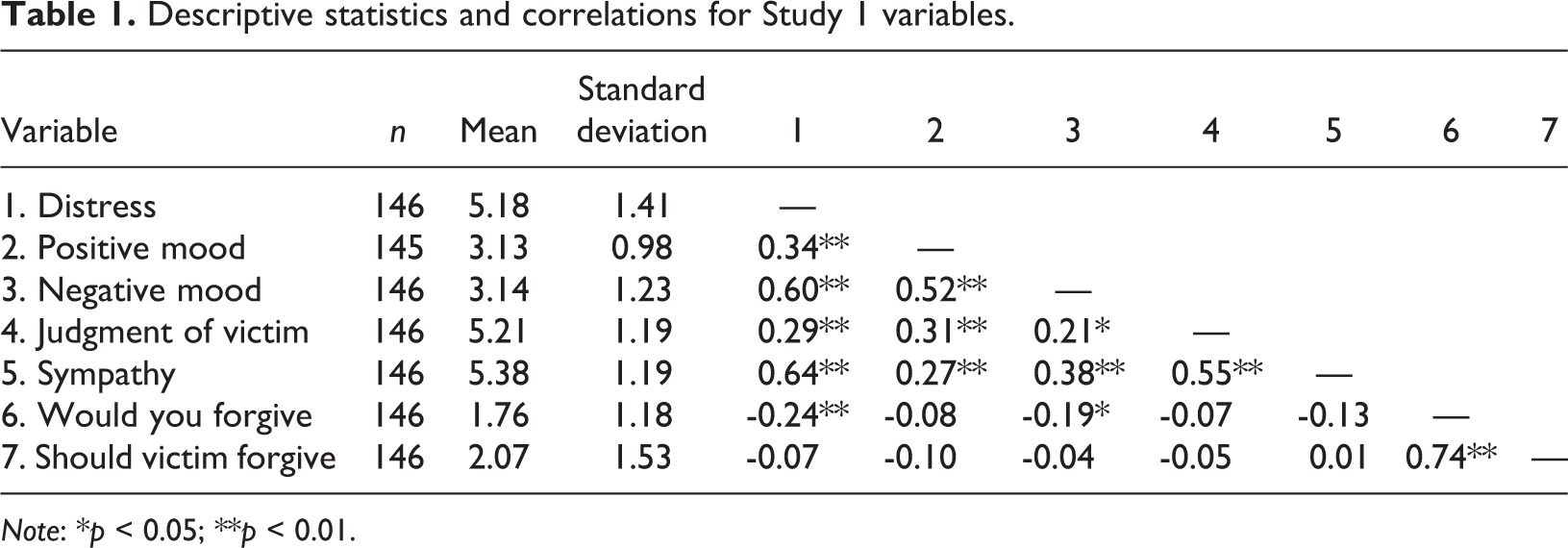
Note: *p < 0.05; **p < 0.01.
Group means (standard deviations) and ns for Study 1 variables.
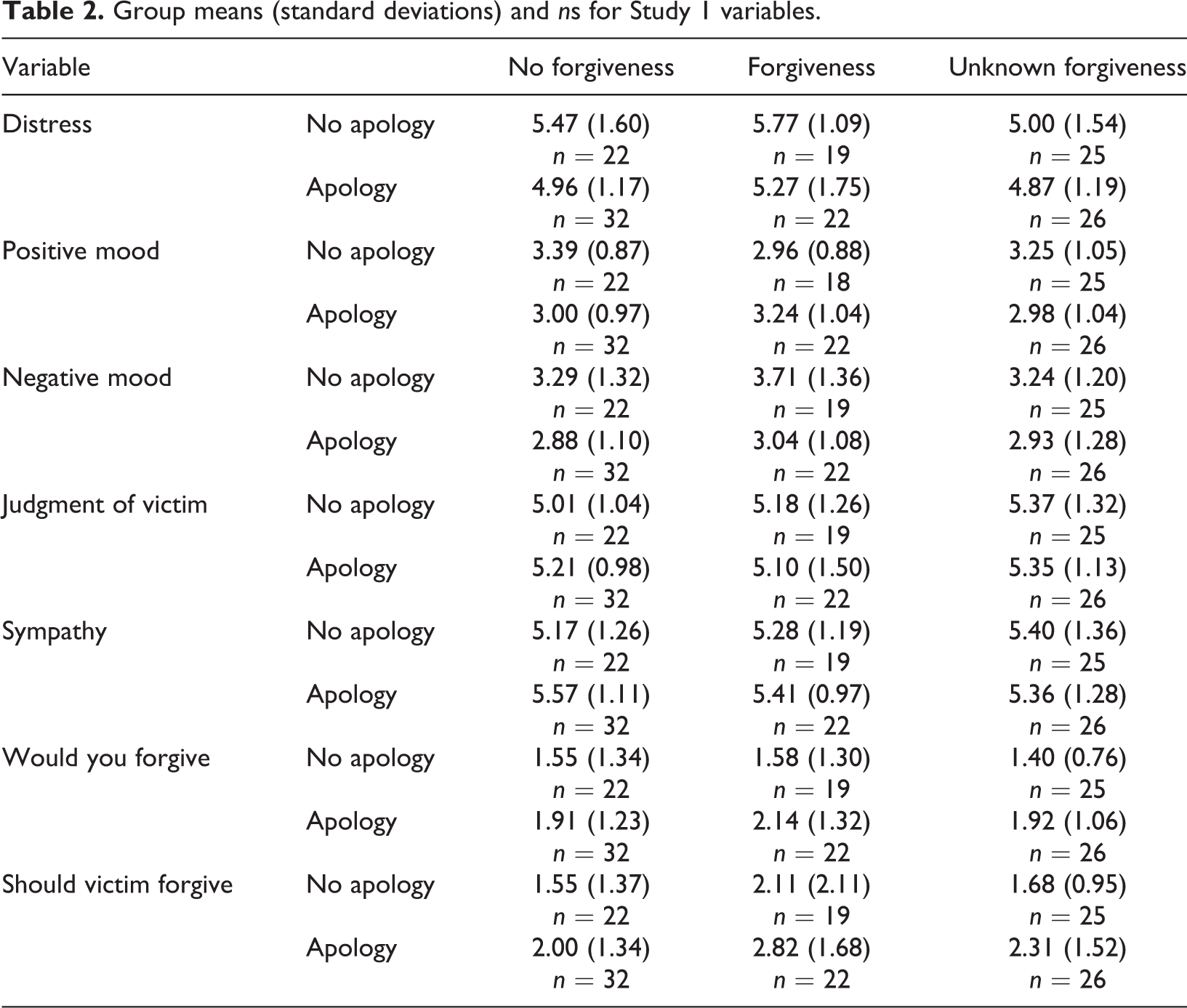
Judgment of the offence
In order to assess participants’ reactions to the event, we assessed their positive and negative mood and level of distress regarding the incident. Results showed that when the offender apologized to the victim, it did not increase participants’ positive feelings, but it did decrease their negative feelings. Whether the victim forgave or not had no effect on participants’ mood. Specifically, the analysis revealed no significant main effects on positive mood for either apology, F(1, 140) = 0.59, p > 0.05, or victim forgiveness, F(2, 140) = 0.13, p > 0.05, and no interaction effect, F(2, 140) = 1.41, p > 0.05. There was, however, a significant main effect of apology on negative mood, F(1, 140) = 5.23, p < 0.05, η2 = 0.04, whereby negative mood was lower in the apology group (M = 2.94, SD = 1.15) than in the no apology group (M = 3.39, SD = 1.28). There was no effect of victim forgiveness, F(2, 140) = 0.83, p > 0.05, and no interaction effect on negative mood, F(2, 140) = 0.25, p > 0.05.
Overall, participants reported a high degree of distress regarding the incident, with mean distress ratings (M = 5.18, SD = 1.41) significantly above the midpoint of the 7-point distress scale, t(146) = 5.18, p < 0.001. A two-way ANOVA revealed no significant main effect of either apology, F(1, 140) = 2.64, p > 0.05, or victim forgiveness, F(2, 140) = 2.00, p > 0.05, and no interaction effect, F(2, 140) = 0.31, p > 0.05.
Judgment of the victim
Judgment of the victim’s character was consistently positive, regardless of whether the victim forgave or not and whether the offender apologized. There were no main effects of either apology, F(1, 140) = 0.03, p > 0.05, or victim forgiveness, F(2, 140) = 0.64, p > 0.05, and no interaction effect, F(2, 140) = 0.19, p > 0.05, on participants’ judgment of the victim’s character. There were also no main effects of either apology, F(1, 140) = 0.64, p > 0.05, or victim forgiveness, F(2, 140) = 0.01, p > 0.05, and no interaction effects, F(2, 140) = 0.45, p > 0.05, on their level of sympathy toward the victim.
Overall judgment of the victim was positive, with mean ratings for judgment of her character (M = 5.21, SD = 1.19) and sympathy toward her (M = 6.07, SD = 1.21) significantly above the midpoint of the 7-point scale judgment, t(145) = 17.42, p < 0.001 and sympathy, t(145) = 19.08, p < 0.001 measures.
Forgiveness
Overall, participants did not support forgiving the offender, although this was tempered somewhat by whether the offender apologized or not. The extent to which they said they would forgive the offender (M = 1.76, SD = 1.18) was significantly below the midpoint of the 7-point scale, t(146) = -17.78, p < 0.001, as was the extent to which they felt the victim should forgive the offender (M = 2.07, SD = 1.53), t(145) = -11.34, p < 0.001.
In order to determine if the actions of the victim and the offender had an effect on their responses, we assessed the extent to which participants stated that they would forgive the offender and also the extent to which they thought that the victim should forgive the offender. There was a main effect of apology on whether participants would forgive the offender themselves, F(1, 140) = 5.94, p < 0.05, η = 0.04, whereby likelihood of forgiveness was higher if the offender apologized (M = 1.98, SD = 1.19) than if he did not apologize (M = 1.50, SD = 1.13). There was no main effect of victim forgiveness, F(2, 140) = 0.32, p > 0.05, and no interaction effect, F(2, 140) = 0.10, p > 0.05.
Similarly, there was a main effect of apology on whether participants thought that the victim should forgive the offender, F(1, 140) = 5.68, p < 0.05, η = 0.04, whereby belief that the victim should forgive was higher if the offender apologized (M = 2.33, SD = 1.52) than if he did not apologize (M = 1.76, SD = 1.49). There was no main effect of victim forgiveness, F(2, 140) = 2.47, p > 0.05, and no interaction effect, F(2, 140) = 0.09, p > 0.05.
Discussion
These findings lend support to the theory that extreme transgressions can lead to moral outrage, even for those not directly involved in the offence. Our participants expressed a high degree of distress about the incident and generally saw it as unforgivable. They were not more critical of a victim who forgave, at least in terms of being more willing to denigrate her character, but they did disagree with the decision to forgive, especially when the offender did not apologize. Although this is not a direct criticism of the victim, it could still be interpreted as a lack of support. Given the importance of social support and validation to victims (Cohen and Wills, 1985; Mueller et al., 2008), there could be negative consequences for victims when others disagree with their decision to forgive.
Study 2
Study 2 was designed to replicate the findings of Study 1 with a different sample and also extend them by examining in more detail whether there were personal characteristics on which third-party observers would judge a victim negatively if he/she forgave. In retrospect, it is unlikely that one would label a mother who has lost her child as not dependable, untrustworthy, and not a good person (items included in our measure in Study 1) simply because she forgave the offender. Judging her as less strong or less competent may be a more typical response to a violation of one’s justice worldview. We also wanted to assess whether there were traits for which extreme forgivers would be seen more positively than those who do not forgive, such as their level of maturity. We address these issues with items assessing the victim’s perceived strength, competence, and maturity.
In Study 2 we also altered the nature of the transgression, using a scenario in which the victim’s child and spouse are killed in a traffic accident caused by a drunk driver. In Study 1 the offender’s motives were unarguably intentional (i.e. abducting a child), but in Study 2 we aimed for more ambiguity with regards to intent. We were interested in whether judgments would be different if the motives of the offender were not as clear.
Also, because the findings with regards to apology in Study 1 clearly replicated prior research on the positive effects of apology on forgiveness (Darby and Schlenker, 1982; Eaton et al., 2006), in the interest of parsimony we did not include apology as an independent variable in Study 2. Instead, we introduced victim gender as an independent variable in Study 2. Although the literature is mixed on whether females and males differ in terms of their propensity to forgive (e.g. Fehr et al., 2010; Miller et al., 2008), lay observers often assume that females are more forgiving than males (Miller et al., 2008). Given that our study involves lay perceptions about victims, it is possible that third-party perceptions of victim forgiveness may be influenced by the gender of the victim. A female victim may be perceived as more empathic and perceptive to the social needs of others (Neff and Karney, 2005) and hence her forgiveness might seem less incongruous than forgiveness by a male victim. There is little research in this area, although in a recent study Yao and Chao (2019) found no difference in how male and female forgivers were perceived when their forgiveness was explicit (as compared to when it was implicit). Given the lack of clear evidence on gender differences in forgiveness, we made no specific predictions about third-party responses to male and female victims.
This study employed a 2 (victim forgiveness: yes, no) × 2 (victim gender: female, male) factorial design. In addition, in an attempt to better understand the judgments that third parties make about victims and offenders, we included a qualitative component to this study in which we asked the same participants to write about whether they felt the victim did the right thing, and why. By allowing our participants to explain the reasons for their judgments and examining to what extent themes of morality and justice were present in their explanations, we hoped to gain a more nuanced understanding of the role of these concepts in their decision-making process.
Method
Participants
Participants were 111 university students enrolled in a first-year undergraduate psychology course who completed the study online for partial course credit. There were 88 (70.3%) females and 23 (29.7%) males, with an average age of 19.17 years (SD = 1.39).
Procedure
The procedure was similar to that used in Study 1. Participants were randomly assigned to one of the four experimental conditions (2: forgiveness × 2: victim gender). They then read a news story made to look like a social media page, with a section for public comments underneath. The news story described a car accident involving a drunk driver, in which a parent and child are killed. The victim in this case was the surviving spouse/parent. Forgiveness was manipulated in the story with a quote from the victim stating that they either forgave or did not forgive the drunk driver. The gender of the victim was manipulated by referring to them as either the wife/mother or husband/father of the deceased. All participants then completed questions to assess their feelings about the news story (mood and level of distress), about the victim (judgment of specific aspects of the victim’s character and sympathy toward the victim), and about forgiveness (whether they would forgive the offender and whether they thought the victim made the right choice).
The measures for mood (Cronbach’s alpha = 0.83 for the positive items and 0.79 for the negative items), distress (Cronbach’s alpha = 0.91) and sympathy toward the victim were the same as in Study 1.
Judgment of the victim’s character
Three single-item measures were used to assess the extent to which participants felt that the victim was competent, mature, and strong, based on concepts measured by Smith et al. (2014). The questions were set up to look like comments on a link to the story in social media. Participants saw a picture of a car accident with the headline associated with their experimental condition: it mentioned that the surviving parent (either the mother or the father) either forgave or did not forgive the driver who caused the accident. Underneath the photograph and headline were five responses to the article; participants were asked to select the option they most agreed with. For example, for the ‘competent’ variable, the options ranged from ‘Wow, that [mom/dad] is totally incompetent for saying that. I wouldn’t have done that’ to ‘What the [mom/dad] says shows how totally competent [she/he] is!’ Responses were converted to 5-point Likert scales where 1 = ‘totally incompetent’ and 5 = ‘totally competent’. A similar format was used to assess how mature and how strong participants felt that the victim was.
Agreement with response
Participants were asked to rate the extent to which they agreed with the victim’s response to the transgressor and the extent to which they would respond in the same way, on 7-point Likert scales where 1 = ‘not at all’ and 7 = ‘a great extent’.
Results
So as not to reveal the true intent of the study, we did not directly ask participants if the surviving parent had forgiven the offender. Instead, we asked factual questions about the scenario in order to assess whether they had fully attended to the content. On a 7-point scale in which they were asked to specify the extent to which they agreed with the statements that the parent and children had died in the crash and that the driver was intoxicated while driving, participants had mean scores of 6.51 and 6.63, respectively.
In order to test our hypotheses, we conducted a series of two-way ANOVAs with victim gender and forgiveness as the independent variables. Correlations between the variables are presented in Table 3 and all group means are presented in Table 4.
Descriptive statistics and correlations for Study 2 variables.
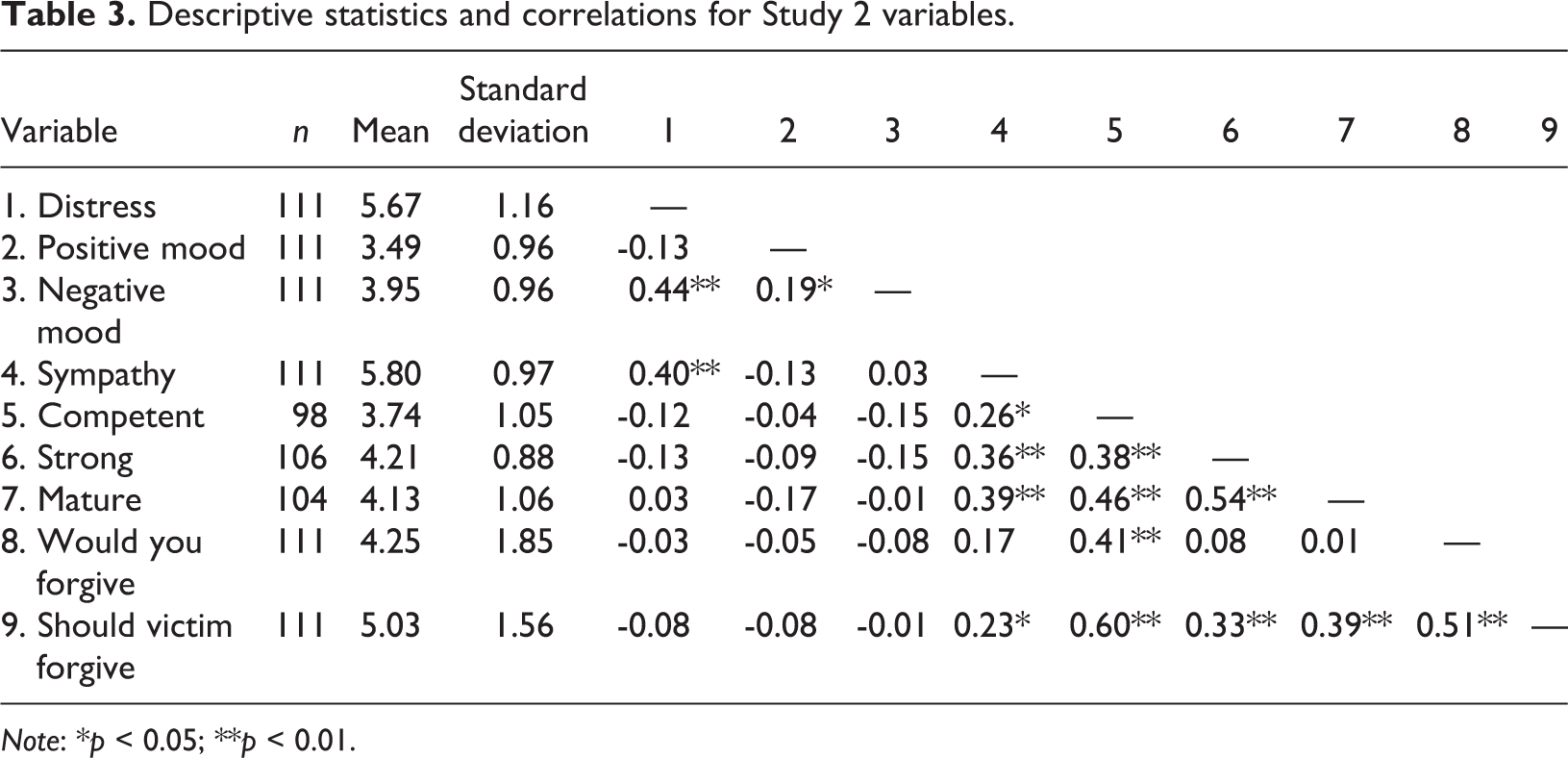
Note: *p < 0.05; **p < 0.01.
Group means (standard deviations) and ns for Study 2 variables.
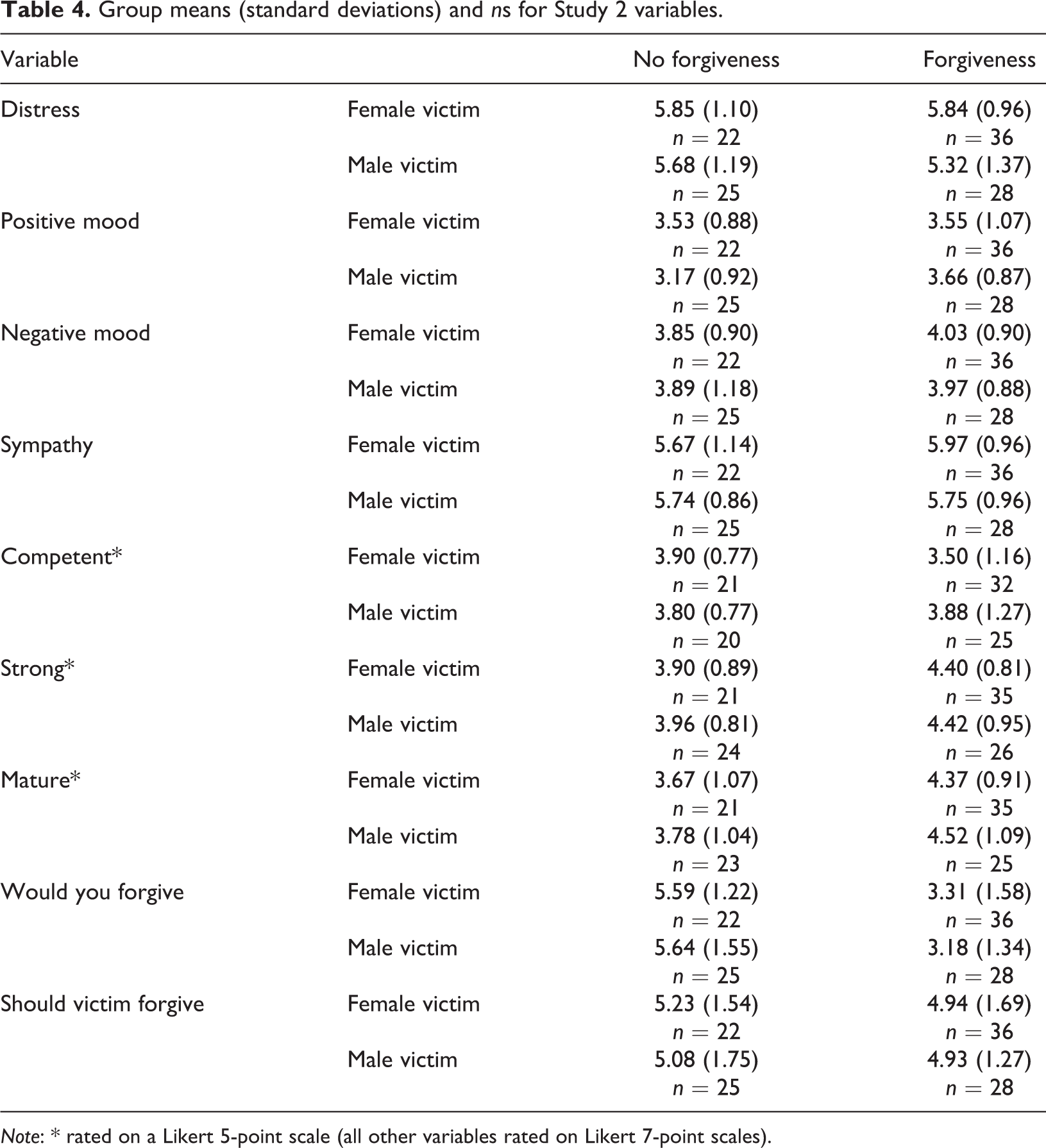
Note: * rated on a Likert 5-point scale (all other variables rated on Likert 7-point scales).
Judgments of the offence
As in Study 1, we assessed participants’ mood and level of distress after reading about the incident. Whether the victim was described as the mother or the father and whether they forgave had no effect on participants’ mood or level of distress. Specifically, the analysis revealed no significant main effects on positive mood for either victim forgiveness, F(1, 107) = 1.67, p > 0.05, or victim gender, F(1, 107) = 0.45, p > 0.05, and no interaction effect, F(1, 140) = 1.64, p > 0.05. There were also no significant main effects on negative mood for either victim forgiveness, F(1, 107) = 0.51, p > 0.05, or victim gender, F(1, 107) = 0.00, p > 0.05, and no interaction effect, F(1, 140) = 0.09, p > 0.05.
Overall, participants reported a high degree of distress regarding the incident, with mean distress ratings (M = 5.67, SD = 1.16) significantly above the midpoint of the 7-point distress scale, t(111) = 19.77, p < 0.001. A two-way ANOVA revealed no significant main effect of either victim forgiveness, F(1, 107) = 0.69, p > 0.05, or victim gender, F(1, 107) = 2.36, p > 0.05, and no interaction effect, F(1, 107) = 0.61, p > 0.05.
Judgments of the victim
In order to assess participants’ judgments of the victim, we assessed their level of sympathy toward them and also their ratings of how competent, strong, and mature the victim was. Results showed a high degree of sympathy regardless of the victim’s gender or whether they forgave, but victims who forgave (regardless of gender) were judged as being stronger and more mature, but not more competent, than those who did not. Specifically, the analysis revealed no significant main effects on sympathy for either victim forgiveness, F(1, 107) = 0.67, p > 0.05, or victim gender, F(1, 107) = 0.17, p > 0.05, and no interaction effect, F(1, 140) = 0.61, p > 0.05. Regardless of whether the victim was female or male and whether she/he forgave or not, sympathy was consistently high (M = 5.80, SD = 0.97), and was significantly above the midpoint of the 7-point scale, t(110) = 25.00, p < 0.001.
With regards to ratings of the victim’s competence, there were no significant main effects for either victim forgiveness, F(1, 94) = 0.57, p > 0.05, or victim gender, F(1, 94) = 0.41, p > 0.05, and no interaction effect, F(1, 94) = 1.26, p > 0.05. With regards to ratings of the victim’s strength, there was a main effect of victim forgiveness, F(1, 102) = 7.96, p < 0.01, η2 = 0.07, whereby victims who forgave were judged as being stronger (M = 4.41, SD = 0.86) than victims who did not forgive (M = 3.93, SD = 0.84). There was no main effect of victim gender, F(1, 102) = 0.05, p > 0.05 and no interaction, F(1, 102) = 0.01, p < 0.05. With regards to ratings of the victim’s maturity, there was a main effect of victim forgiveness, F(1, 100) = 12.65, p < 0.01, η2 = 0.11, whereby victims who forgave were judged as being more mature (M = 4.43, SD = 0.98) than victims who did not forgive (M = 3.73, SD = 1.04). There was no main effect of victim gender, F(1, 100) = 0.43, p > 0.05, and no interaction effect, F(1, 100) = 0.01, p > 0.05.
Forgiveness
We also assessed the extent to which participants would forgive the offender themselves and the extent to which they agreed with the victim’s decision to either forgive or not forgive. Generally, participants did not think that the offender should be forgiven, but they were less likely to explicitly say that they disagreed with the way the victim responded. Specifically, there was a main effect of forgiveness on the extent to which they would make the same decision as the victim, F(1, 107) = 72.00, p < 0.001, η = 0.40, whereby participants were significantly more likely to agree with the victim’s decision when the victim did not forgive (M = 5.62, SD = 1.39) than when they did forgive (M = 3.25, SD = 1.47). There was no main effect of victim gender, F(1, 107) = 0.02, p > 0.05, and no interaction effect, F(1, 107) = 0.10, p > 0.05.
The analysis revealed no significant main effects on whether participants felt that the victim did the right thing for either victim forgiveness, F(1, 107) = 0.51, p > 0.05, or victim gender, F(1, 107) = 0.07, p > 0.05, and no interaction effect, F(1, 140) = 0.05, p > 0.05. Regardless of whether the victim forgave or not, support for the victim’s decision was consistently strong across conditions (M = 5.03, SD = 1.56), and was significantly higher than the mid-point of the 7-point scale, t(110) = 10.29, p < 0.001.
Qualitative analysis
In order to better understand why participants agreed or disagreed with the victim’s response, we conducted a qualitative analysis on their written responses to the question, ‘Do you think the [victim] did the right thing? Why or why not?’ We were interested in the general themes of third parties’ judgments of victim responses. In addition, our factorial design, in which participants were randomly assigned to a condition in which the victim either forgave or did not forgive, allowed us to examine whether there might be differences between why third parties might agree with a victim who forgives and why they might disagree with a victim who does not forgive and, conversely, why they might agree with a victim who does not forgive or disagree with a victim who does forgive. Although we did not have specific predictions about differences between these groups, our review of the literature suggested that we would find themes of moral outrage, justice violations, and shared values.
General themes
From the language that they used, it was evident that participants found the situation distressing (‘a horrible tragedy’ [number 13] and ‘this awful situation’ [number 23]). They also expressed moral outrage (‘he took away three innocent lives because of his ruthless actions’ [number 21] and ‘she lost her family due to irresponsible and outright wrong activity’ [number 11]). It should be noted that this moral outrage was always directed at the offender; even when they disagreed with the victim’s decision, they did not criticize her/his character. Despite their anger at the situation, some also expressed compassion for the offender (‘all people make mistakes and screw up in life’ [number 8] and ‘[the offender] is likely already being hard on himself and he doesn’t need more people to criticize him’ [number 41]).
Justice also arose as a common theme. More specifically, there was evidence that participants saw the offence as a violation of norms (‘that is not acceptable’ [number 7] and ‘[the offender] needs to realize what he did was wrong’ [number 27]). Even if they agreed with the victim’s forgiveness, they often acknowledged that the crime was ‘a horrible tragedy’ [number 13] and ‘an extremely difficult situation’ [number 16].
After reviewing all of the comments as one group, we divided them into two categories (‘victim forgives offender’ and ‘victim does not forgive offender’) and then further divided these categories into whether the participant agreed with the victim’s decision. We were interested in all four categories, but the one most relevant to our hypothesis was the one in which the participant disagreed with the victim’s decision to forgive.
Victim forgives offender
When the victim forgave the offender, participants who agreed with this decision tended to comment on the victim rather than the offender. Common themes included praise for how strong, brave, or mature the victim was (‘I believe that it was an amazing thing to do though because it must have been tough and taken some time to really think about it’ [number 55]), statements about how forgiveness is beneficial for the victim (‘holding onto anger…would only cause more distress and anger’ [number 35]), and praise for the victim’s ability to move on (‘In forgiving the driver, the [victim] is giving both themself and the drunk driver an opportunity to move on from this tragedy’ [number 14]). Comments that mentioned the offender tended to minimize his responsibility or level of intent for the incident (‘everyone should be forgiven for their mistakes’ [number 43]).
When participants disagreed with the victim’s decision to forgive the offender, their comments were mostly focused on the offender and the justice violation he had committed. They did not directly criticize the victim. General themes were that forgiving the offender served to condone drinking and driving (‘I think that because [the victim] forgave him, he may act out again and think it’s okay to drink and drive. The [victim] is sending out the wrong message to the world’ [number 23]), that the offence is unforgivable (‘What the drunk driver did is unforgivable’ [number 24]), and that the driver was fully responsible for the accident (‘[the offender] needs to realize what he did was wrong’ [number 27]). Underlying many of the comments was the feeling that the crime was too severe to be forgiven (‘he killed her kids, so no’ [number 22]). A sense of moral outrage could be seen in such comments as, ‘I hate drunk drivers. They kill innocent kids that have not had a chance to grow’ [number 17].
Victim does not forgive offender
When the victim did not forgive the offender, participants who agreed with this decision focused their comments entirely on the offender and the justice violation he had committed. Similar themes emerged as for those who disagreed with the victim’s decision to forgive: that the offence is unforgivable (‘what [the offender] did is unforgivable’ [number 82]); and that the driver was fully responsible (‘He caused the accident. He caused the harm. There is no excuse…’ [number 74]). Many mentioned justice with regards to how he broke the law (‘Drinking and driving is illegal for a reason’ [number 96]) and should face repercussions (‘This should be an example for the public that something like this is completely unacceptable’ [number 80]). In addition, some commented on how this was not his first offence and thus should be punished more harshly (‘Personally I believe that somebody can be forgiven for a mistake; however, in this case since he had been caught drinking and driving several times, there is no reason to forgive him’ [number 75]).
When participants disagreed with the victim’s decision not to forgive the offender their comments focused on either minimizing the offender’s responsibility for the offence (‘people make mistakes’ [number 88]) or on how forgiveness could benefit the victim (‘forgiving him might be helpful for healing’ [number 103]). Very few participants mentioned justice directly and those who did said that it should be handled by the criminal justice system (‘[the victim] should have faith that the justice system and society at large has repercussions in place for [the offender’s] actions’ [number 94]). A few participants suggested that the victim may come to forgive in time (‘over time, I think [the victim] would eventually forgive the driver’ [number 111].
We were also interested in, when the participant felt that the victim should forgive, whether the nature of the participants’ comments was different depending on whether the victim forgave or not. In other words, did the themes differ in the group in which participants agreed with the victim’s forgiveness and the group in which they disagreed with victim’s lack of forgiveness? The themes that emerged from these two groups were similar, in that they both included the fact that forgiveness was beneficial to the victim, that the offender made a mistake and should be given a second chance, and that the criminal justice system was responsible for punishing the offender. Interestingly, even when participants disagreed with the victim’s response, they still tended to be sympathetic and kind in their comments. While participants were quick to praise victims for their forgiveness, they did not, as a rule, criticize them for their lack of forgiveness. For example, while participants tended to label victims who forgave as strong, brave, and mature, they did not label victims who did not forgive as weak, afraid, and immature. Their comments regarding victims who did not forgive tended to be encouraging, such as suggesting that they would feel better if they forgave or that in time they might come to forgive.
We conducted a similar comparison with the group in which the participants disagreed with the victim’s decision to forgive and the group in which the participants agreed with the victim’s decision not to forgive. The main themes were similar: the offence was unforgivable; the driver was fully responsible for his actions; and that justice was necessary. Participants tended not to praise or criticize the victim in these two categories. When the victim did not forgive, participants reinforced the culpability of the offender rather than make attributions about the victim’s character. When the victim forgave, although participants would criticize the decision to forgive, they did not denigrate the victim.
Discussion
The findings of Study 2 mirrored those of Study 1. Participants found the offence to be distressing and expressed sympathy for the victim. This compassion was unaffected by whether the victim forgave or not. Using more refined measures of judgment of the victim’s character, this study found that third parties rated victims who forgave as more strong and more mature than those who did not forgive. Their ratings of the victim’s competence were unaffected by the victim’s response. Thus, third parties are sympathetic toward victims who forgive and they express a certain degree of admiration for them. There was also some tension, however, in third parties’ responses as to whether they thought the victim should forgive. Although they were significantly more likely to say that they would make the same decision as a victim who did not forgive, they were less willing to criticize the victim’s decision directly, being just as likely to agree that a victim who forgave did the right thing as a victim who did not forgive.
The qualitative data supported these findings. Third parties expressed strong opinions on whether the offence was forgivable and the extent to which they felt the offender should be punished, but they did not directly criticize the victim or the victim’s decision to forgive or not. When they disagreed with the victim’s decision to forgive (the group most directly related to our hypotheses), they tended to comment on justice-related issues, such as the fact that forgiveness might be seen as condoning the crime rather than punishing it and that the offender was fully responsible for his actions, or on the fact that the act itself is unforgivable. This group was also the one in which moral outrage was expressed most often.
We found no effects of victim gender on any of the variables. This suggests that, at least for severe transgressions, it does not matter to third parties whether the victim is male or female.
General discussion
In two studies we found support for our hypothesis that third parties can be negatively affected by severe transgressions in which they are not involved, and that they hold strong opinions on whether forgiveness is warranted or not. Study 2 provided additional evidence that these strong feelings may stem from justice violations: they were more likely to express moral outrage and use justice-related arguments when they disagreed with a victim’s decision to forgive.
Third-party observers did not tend to judge the characters of extreme forgivers very harshly. Whether the victim forgave or not had no effect on their overall impression of the victim (Study 1) or on how competent they felt the victim was (Study 2). This is not because third parties do not care about victims; in both studies they expressed a high level of sympathy toward the victim. In addition, in their comments in the qualitative section of Study 2 participants were willing to praise the victim as brave and strong when they agreed with the victim’s decision to forgive. Interestingly, when they disagreed with the victim’s decision to forgive, rather than criticize the victim as cowardly or unwise, they tended to focus instead on the offender and the offence. Generally, our findings suggest that third parties are reluctant to directly criticize victims who forgive extreme transgressions.
This is not to suggest that third parties do not make judgments about victims who forgive. Judgments specifically related to the victim’s forgiveness came in the form of disagreement with her decision. In both studies participants expressed a low desire to forgive the offender themselves. Although this may, on the surface, appear to be a milder form of judgment, it is likely that it would not seem mild to victims. Regardless of how severe a transgression may be, victims often turn to others to make sense of the event and to receive assurance that they responded appropriately (Eaton and Sanders, 2012; Volkema et al., 1996). If victims do not feel that others support their decision to forgive (or to not forgive), they may feel invalidated and unsupported, arguably at a time when they are most in need of validation and support. This quote from Wilma Derksen, a mother who publicly forgave the person who murdered her daughter in Winnipeg, Canada in 1984, shows the harm that public judgment can cause: ‘At times it was incredibly tough. People said we couldn’t have loved Candace because we forgave [her murderer]’ (Derksen, 2019). These effects may be compounded when victims seek out support online. As suggested by the example we used at the beginning of this article, third parties may not communicate directly with victims, but they can still make their opinions known in online forums such as the comments sections of news articles. Especially when third parties post anonymously, their comments may be particularly impolite or mean-spirited (Barlett et al., 2018). If victims turn to social media for support, they may instead encounter critical and invalidating opinions. Thus, we suggest that a lack of agreement with the victim’s response is a relatively harsh judgment, and could have negative repercussions for the victim.
This research addresses some novel questions in the justice and forgiveness literatures, but questions remain unanswered. For example, our studies involved a justice failure in which a victim forgives a seemingly unforgivable offence (‘extreme forgiveness’). However, a justice failure should also occur when a victim refuses to forgive a minor transgression (‘extreme unforgiveness’). A more complete test of the justice failure argument should include both types of situation. Also, in our experiments, criminal sanctions against the offender were not made clear to the observers (in Study 1 because he had not been caught yet and in Study 2 because the offence had just happened) because we wanted to present a clear justice failure. A logical next step would be to determine if third-party observers respond in the same way if the offender has been punished.
Because of the exploratory nature of this research, both of our scenarios involved parents who had lost a child, and we deliberately presented the parents as ‘ideal victims’ (Christie, 1986) whose status as victims was unarguable. Although this simplified our study design and reduced the potential of confounds, we recognize that most crimes, and indeed, most transgressions, are not this clear-cut. Future research should examine third-party perceptions of victims who are less ‘ideal,’ for whom it might be more difficult to garner sympathy.
Another issue that should be addressed in future studies is how gender affects third-party judgments. Although we did study the potential effects of the gender of the victim, we did not explore whether there are gender differences in how third parties respond and whether third-party gender might interact with victim gender.
Finally, our participants were young adults attending university, so some caution should be taken in generalizing our findings of this young, educated sample to the general population. Although they are exposed to news and would be in a position to judge victims’ responses to crime, our sample does not represent all possible types of third-party observer. Especially given that sympathy toward victims can be dependent on factors such as perceived similarity to the victim and past experiences (Loewenstein and Small, 2007), our findings should be replicated with a more diverse sample.
Conclusion
This research adds to our understanding of third-parties’ emotional responses to victims. In one way our findings are encouraging, in that even though third parties may see victim forgiveness for extreme offences as a justice violation and not worthy of forgiveness, they tend not to be overly critical in their judgments of victims who forgive. However, the fact that third parties do not agree with the victim’s decision to forgive is concerning, and may be perceived as invalidating to victims. Better education on the personal benefits of forgiveness may help third parties reframe their views on extreme forgiveness so that it is not seen as a violation of their justice expectations but, rather, as a positive coping mechanism for victims.