




Abstract
Hate crimes carry many emotional and psychological detriments for those who are targeted because of who they are. The harms associated with hate are commonly theorized in the context of those directly targeted. Using a victimological lens, I consider how the harms of a mass anti-LGBT+ shooting in Orlando, Florida were carried across social media, indirectly victimizing LGBT+ people in the North East of England. This article examines seven distinct interviews conducted post-Orlando from a wider sample of 32. LGBT+ participants were victimized vicariously by receiving news of the Orlando shooting. They utilized social media to organize vigils, stand in solidarity with LGBT+ Floridians, and share in the emotional distress caused by the shooting. The findings contribute to our understandings of hate crime as a communicative tool, by examining the role of social media in carrying the emotional harms associated with hate. Through these in-depth narratives, this article encourages a conversation about how hate crimes, transmitted across social media, can victimize people who share the victimized identity with the direct victims.
Introduction
The use of social media as a communicative tool has been well researched. It is acknowledged (see Murthy, 2012) that social media platforms are used to find like-minded others and form communities. Conversely, they can also be used to communicate hatred towards marginalized groups and communities who are often subject to online abuse and harassment, usually in the form of hate speech (Awan, 2016). Online victimization is frequently considered a direct form of abuse within scholarly studies, whereby the perpetrator(s) use social media to directly target and harass the victim(s). Few studies have considered how the transmission of information through social media platforms, relating to hate victimization, indirectly victimizes those who share an identity with the victimized group. This article draws on seven distinct semi-structured interviews from a sample of 32 LGBT+ people in the North East of England.
From January–May 2016, 25 interviews were conducted. However, on 12 June 2016, Omar Mateen walked into Pulse, a queer nightclub in Orlando, Florida. Pulse was hosting a Latin night for Latinx, black, and queer people of color from the local area. Armed with a semi-automatic rifle, Omar entered Pulse and began shooting its inhabitants, killing 49 and injuring 58. This marked the deadliest incident of targeted violence towards LGBT+ people since the Holocaust and represents an extreme example of homophobic terrorism (Schweppe and Walters, 2016). I observed members of LGBT+ online social media groups – of which I was a member for recruitment purposes – disseminate news of this event across these platforms. Seven interviews were conducted, as part of the main project, post-Orlando. Questions about the Orlando shooting were then posed to participants as part of the regular interview schedule, to keep the project current and in line with participants’ daily realities. Ordinarily, a sample size of seven would be very small; however, given the unexpectedness of the Orlando shooting, it is not unreasonable to examine the perspectives of participants interviewed after such a landmark event of anti-LGBT+ violence. The immediacy of interviews conducted post-Orlando provided a unique opportunity to produce high-quality data, given the paucity of research into vicarious victimization across social media.
Utilizing Iganski’s (2001) model of hate crime, this article takes the form of a qualitative case study and examines how victimization was transmitted to participants in the North East of England. I argue that participants shared in and experienced this terrorist hate crime, indirectly, and vicariously, through their collective LGBT+ identity. Few studies capture the (indirect) victimization of individuals as it is unfolding and occurring. Indeed, Iganski (2001: 636) concludes that ‘little is known about the effects of hate crimes beyond the impact of the initial victim’. This article therefore provides a unique snapshot into the victimization process caused by information sharing. I argue that information transmission and communication of hate events across social media can indirectly victimize those who share the victimized identity of the direct hate victims.
Social media use and hate crime
In England and Wales, hate crime is defined as ‘any criminal offence which is perceived, by the victim or any other person, to be motivated by hostility or prejudice towards someone based on a personal characteristic’ (Crown Prosecution Service, 2016: 2). Police forces monitor five key strands of hate crime: race and ethnicity, sexual orientation, religious beliefs, disability, and transgender identity (College of Policing, 2014). Specifically, Section 146 of the Criminal Justice Act 2003 offers protections to LGBT+ people, which ‘empowers courts to impose enhanced sentences for offences involving hostility directed towards the victim’s sexual orientation, disability or transgender identity’ (Chakraborti and Garland, 2015: 10). However, hate crime offences are treated differently depending on the country where the crime was committed, due to differential legislative powers within respective jurisdictions.
Statistically, hate crime is of serious criminological concern. Between the years 2017 to 2018, 94,098 hate crime offences were reported to the police in England and Wales, with 1,605 of those offences (2%) taking place online. Hate crimes against sexual orientation represent 12% of the overall reported hate crimes (see Home Office, 2018). Whilst the latest Home Office (2019) report, at the time of writing, does not include official data for online crimes, 2018 to 2019 saw an increase in overall hate crimes by 10% (to 103,379) with hate crimes against sexual orientation and transgender identity increasing by 25% (to 14,491) and 37% (to 2,333), respectively.
Given that an individual’s identity is intimately connected towards perceptions of the ‘self’, Iganski (2001) reasons that hate victimization hurts more than non-hate crime. There is a wealth of evidence to suggest that people who experience hate crime demonstrate higher physical, emotional, and psychological distress than those who have experienced crimes not motivated by hate (Herek et al., 2003; 1999; Iganski and Lagou, 2015). Thus, the victimization experienced when hate is committed has both macro and communal implications, beyond the primary individual targeted. Iganski (2001) developed a ‘waves of harm’ framework, arguing that hate crimes are communicative crimes designed to send a terroristic message of hostility to all those who belong to the victim’s identity group. He maintains that the group to which the primary victim belongs experiences the harms associated with hate. These harms, as indicated by Figure 1, ripple from the direct victim to neighbouring communities and eventually to communities beyond the initial victims group, creating vicarious victims.
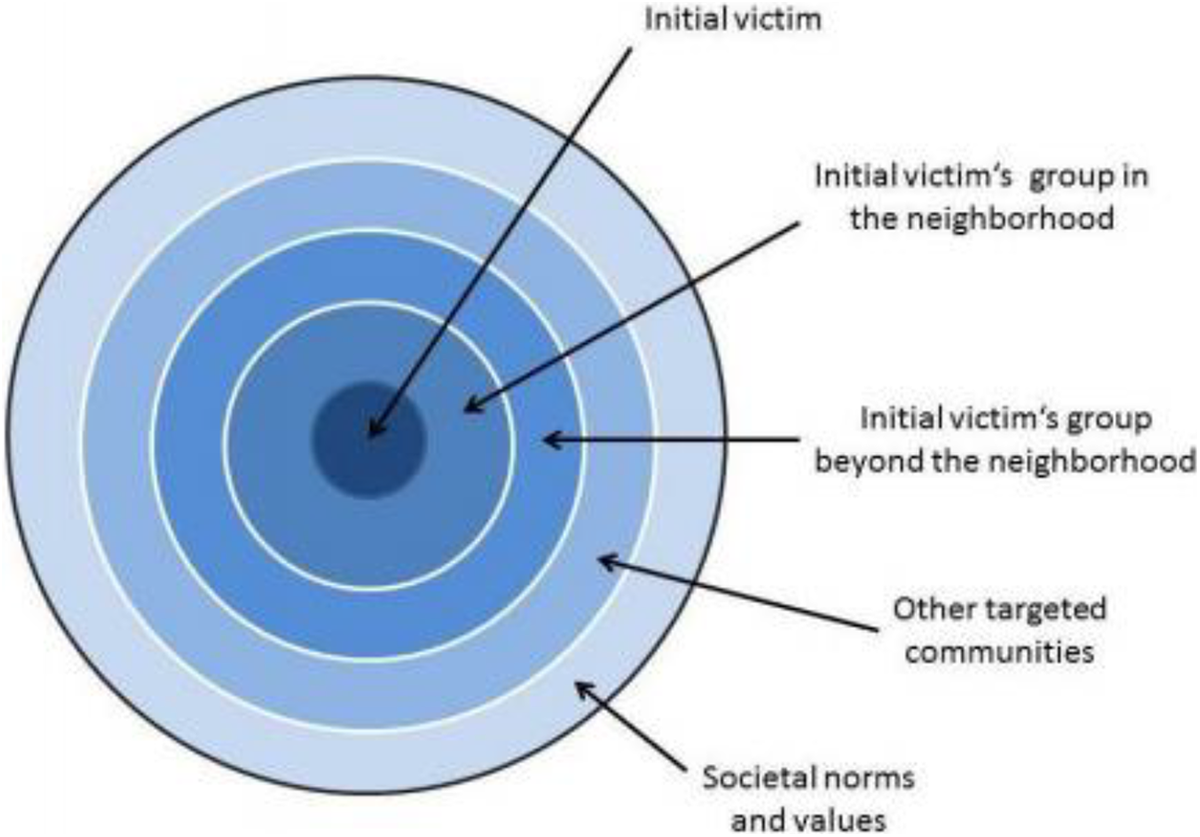
Waves of harm generated by hate crimes (adapt. from Iganski 2001: 629, by Fingerle and Bonnes, 2013.)
As summarized by Perry and Alvi (2011: 57): awareness of violence directed toward another within an identifiable target group yields strikingly similar patterns of emotional and behavioral responses among vicarious victims. They, too, note a complex syndrome of reactions, including shock, anger, fear/vulnerability, inferiority, and a sense of the normativity of violence. And, like the proximal victim, the distal victims often engage in subsequent behavioral shifts, such as changing patterns of social interaction.
Social media provide the ability to reach wide audiences under an anonymous guise, enabling individuals to bypass moderation, regulation, and editorial control (Awan, 2014, 2016). Whilst digital and social media use are of particular importance for all minority groups to form communities, they are a particular pull for LGBT+ people, who are able to meet like-minded others without being outed, due to the cloak of anonymity that cyberspaces allow (Hawkins and Watson, 2017). LGBT+ people often utilize cyberspaces to discover more about their sexuality; seek prospective sexual and/or romantic partners through location-based dating apps (Blackwell et al., 2015; Van De Wiele and Tong, 2014); establish friendships (Corriero and Tong, 2016); and partake in queer activism (Cooper and Dzara, 2010). Indeed, Boyd (2014) posits that individuals have agency to construct their identities online, in order to be more open about their sexuality than their offline circumstances may allow. Furthermore, online media are particularly beneficial for LGBT+ people who are able to access a greater diversity of representation of queerness that is lacking in offline media (e.g. see Duguay, 2016), which traditionally represent LGBT+ people in a stereotypical or limited way (Craig et al., 2015: 256). Thus, social media are entangled in the practice of everyday life, with tangible ‘real world’ impact (Albury et al. 2017).
There are both positives and negatives to social media usage however. The main concerns for LGBT+ people are levels of violence and sexual exploitation, misinformation around sexual health, and hook-up opportunities which promote risk taking behaviors such as chemsex 1 and barebacking 2 (Hawkins and Watson, 2017). Further, research has indicated that 56% of young people (sexuality unspecified) experienced technology-based interpersonal violence - defined as disparaging the reputation of the individual, threatening with physical violence, and unwanted sexual solicitations - within a two year period (Korchmaros et al., 2014). Thus, there are considerable victimological concerns over the use of social media and online technology.
Within the context of hate studies, social media are conceptualized as platforms used to commit and organize acts of hate (Perry and Olsson, 2009). In short, they are tools used to target both individuals and groups to send direct messages of hate. Online hate such as hate speech, bullying, harassment, stalking, and incitement to violence have therefore become a key issue for law enforcement and social media platforms. The focus of this study is set in England and Wales; however, the regular geographical boundaries of legal jurisdictions and social bonds are blurred, as social media allow people to communicate across these.
Fearn’s (2016) doctoral research found that cyberhate is a pervasive phenomenon, with 80% of participants experiencing direct cyberhate with an even higher percentage experiencing and witnessing indirect cyberhate. Her research also found that cyberhate carries similar negative psychological impacts as offline hate, both to direct and indirect victims. Both online and offline hate can cause the victims to experience anxiety, depression, and feelings of isolation. When hate speech is used to directly threaten and incite violence, these feelings are found to be particularly strong (Awan and Zempi, 2015). Further, offline real-world events such as terrorist shootings often trigger instances of cyberhate and organized cyber harassment (Burnap and Williams, 2016). Consequently, marginalized people and groups strategically alter their internet habits to either avoid or challenge the hate directed towards them (Fearn, 2016; Jane, 2017). Näsi and colleagues (2015) acknowledge that those exposed to hate material experience short-term emotional stressors such as anger, loneliness, and fear. They found that such exposure can decrease the trust one has in others and increase feelings of isolation.
This article considers that social media are vehicles for hate victimization based on the transmission of information about violent events. By outlining the emotional reactions of participants who are exposed to information relating to the Orlando shooting, I demonstrate that sharing news of key hate events across social media, communicates the hostilities and harms of hate, suggested by Iganski (2001), to those who share the identity of the primary victims involved in the initial hate event; indirectly and vicariously victimizing them.
Social media as transmitter of hate
By being used to form groups and communities, and find likeminded others, social media are fundamentally a method of connection and communication. A significant portion of communication manifests through news and information sharing. Kümpel et al. (2015: 2) define news sharing as ‘the practice of giving a defined set of people access to news content via social media platforms, as by posting or recommending it’; allowing individuals to participate in discussions, share stories, and form communities. Due to the increasing presence of news sharing across social media, news outlets have capitalized on this activity and use these platforms as a central means to distribute their content and stories (Kümpel et al., 2015). Purcell et al. (2010) found that a third of social media users contribute to the dissemination of news online by posting links to social networking sites, commenting on shared links, and discussing news on comment threads. Certainly, in comparison with other forms of online communication such as emailing, text messages, and discussion forums/message boards, social media are often the most widely used platform to share news stories (Purcell et al., 2010). This practice of sharing news across social media is often a regular part of people’s daily lives.
Communities are thus often formed around such news sharing behaviour, as individuals tend to share news stories with those who have a similar interest in the news topic (Becker and Copeland, 2016; Ma et al., 2014). Indeed, ‘users are more likely to seek information in a network in which the connections are similar in terms of demographics, attitudes, and informational interests. This is expected because people like to interact with those who are similar to themselves’ (Ma et al., 2014: 611). Homophilious networks such as LGBT+ communities are more likely to form strong-tie relationships, which in turn increases users’ intentions to share news within their respective network. Further, emotional ties are essential to the formation and maintenance of networked relationships, both online and offline. The impact of sharing news that is particularly sensitive to the online community can therefore be an emotionally distressing process. For example, Stieglitz and Dang-Xuan (2014) posit that emotional contagion - the process of one person’s emotions triggering similar or shared emotions in another individual and/or group – influences the information sharing and coordination within group-level communication. Given that crimes of hate are considered to be communicative in nature (Chakraborti and Garland, 2015), it is fair to posit that the sharing and viewing of news relating to hate events communicates the hostilities of victimization and the subsequent waves of harm described by Iganski (2001).
Victimologically, the concern here is to consider how the transmission of news about the victimization of specific groups, such as the Orlando shooting, can indirectly victimize those who belong to that group. Whilst her study was conducted prior to the mainstreaming of social media usage, Noelle’s (2002) small-scale research into the impact of the Matthew Shepard murder, a widely reported homophobic hate crime in 1998, found that LGB participants (nine in total) who learned of his murder were vicariously victimized by news of his murder facilitating a ripple effect. Using assumptive world theory, Noelle (2002: 29) argued that learning of such events disrupts previously held assumptions ‘of benevolence of the world, meaningfulness of the world, and self-worth’ causing victims to question their sense of justice, the ability to prevent their victimization, and their self-worth. Paterson et al. (2018, 2019) have examined the indirect victimization of LGBT+ people more comprehensively. They argue that those who hear about the direct victimization of someone, for an identity that they themselves share with the primary victim demonstrate comparable feelings of anxiety, vulnerability, and stress. Their findings indicate that both direct and indirect victims are more likely to experience vulnerability, shame, and anxiety. This would suggest that anti-LGBT+ hate events can increase, indirectly, the levels of distress of LGBT+ people who experience the waves of harm transmitted from the initial hate event (Ignaski, 2001).
Methods
The project explored anti-LGBT+ hate crime across three community strands – policing, education, and voluntary sector – in the North East of England. The project received ethical approval from the university ethics board in 2015 to carry out qualitative hate crime research across these strands. In total, 32 semi-structured interviews were conducted, with anonymity via pseudonyms being provided for all participants. Youth workers and charity executives responsible for voluntary sector LGBT+ youth groups were approached with information sheets (see Crow et al., 2006) detailing the nature of the project. University LGBT+ societies were also targeted, with information sheets being distributed across their social media pages (Facebook) with requests for recruitment.
All participants were recruited using time-space and snowball sampling methods (Muhib et al., 2001). Time-space sampling methods focus on the specific venues and times that the target demographic congregates, allowing for interviews to be conducted in the venues and spaces that are utilized by participants. Snowball methods allow initial participants to distribute information about the research to recruit future potential participants from their circle of acquaintances (Davies and Francis, 2018). Both time-space and snowball sampling allow researchers to explore the community networks of the groups being researched. For example, on one occasion a participant organized a Facebook chat group with themselves, potential participants they had identified, and me. This chat group enabled me to disseminate information about the project and answer any preliminary questions directly to future participants. I recruited three participants in this instance. As a member of these online groups - specifically University LGBT+ Facebook groups - for the purposes of recruitment, I observed that in the wake of Orlando, individuals shared news articles and YouTube clips of debates and news reporting across group news feeds. They also established vigils through Facebook events and indicated their attendance to vigils by ‘RSVP’ing’ online.
The Orlando shooting was an unexpected contemporaneous event that occurred when data collection was being conducted. As a project utilizing an inductive approach, the shooting presented an opportunity to explore its impact on participants. Thus, in order to explore the emotionality of the Orlando shooting, I included questions pertaining to this event as part of the main interview schedule. In-depth semi-structured interviews were conducted with seven participants following the shooting and lasted between 1–2 hours. Of the seven participants from whom this article is formed, three were students, two were criminal justice workers (CJW), and two were voluntary sector youth and community workers (YCW). Interviews were analyzed using a reflexive thematic analysis framework (Braun and Clarke, 2019), with thematic codes being applied to transcripts in order to organize into general patterns. Thematic patterns were constructed across the data from all 32-interviews; the seven interviews that concern this paper were then re-analyzed together for the purpose of examining the Orlando shooting. This article draws extensively and qualitatively on the author’s own personal observations and the thematic analysis of these empirical narratives (Harding, 2013).
Whilst generalizations cannot be made from these seven interviews, few studies capture the process of indirect victimization in its immediacy. This article is therefore novel in its contribution to both hate crime theory and communication studies and begins a victimological conversation over the impact of victimization on international communities. I employ the specific pronouns (he/she/they) used by participants at the time of study to refer to their individual narratives. This is particularly pertinent for transgender participants who identified as non-binary or gender fluid.
Findings and discussion
The analysis of empirical interviews produced four core themes relating to social media and vicarious victimization of LGBT+ people. Excerpts from interview data are used throughout to evidence the analysis presented. I begin by outlining how LGBT+ people utilize social media in relation to their LGBT+ identity and examine the role of social media in raising levels of fear and anxiety of participants.
Social media use and elevated anxiety
As supported by the literature, participants utilized social media to find other LGBT+ people and form friendships, connections, relationships, and peer networks (Murthy, 2012). Online spaces provided participants with the ability to form solidarities with peers across the world, outside of their local vicinity. Forming connections with other LGBT+ people was described as creating a family, with intimate connections being transmitted across social media. As outlined by Riley (genderfluid, bisexual, aged 14), who was interviewed pre-Orlando: you meet people on social media that you have never met in person and like I know LGBT people across the world that I never thought I would. I have never met them in person. So, it is like one massive family essentially, so I guess it makes you want to fight a lot more for it like I kind of want to take people in and fight for them. I think that it [hate crime] can appear more common because of social media. Young trans people are often very worried about being assaulted or even killed because whenever the murder of a trans person occurs in America, it is all over social media and it becomes very immediate because you know all the details about the person, and everybody is talking about it…because we have a lot of American news it feels like it is something that could happen to you. So, people can vicariously experience hate crime definitely…When all they have is social media it can be very scary.
Sue’s narrative infers that the globalized context of anti-LGBT+ hate can create a distorted image of the levels of victimization within Britain, indirectly victimizing people who read about and share news relating to hate crime. When analyzing the above narrative, it seems that LGBT+ people conflate global levels of violence towards LGBT+ people with local levels of violence, gaining a distorted picture of fear over anti-LGBT instances of violence. Psychological studies have shown that recency bias – where people ‘react more heavily to recent observations and experiences than they do older ones’ (Fudenberg and Levine, 2014: 10826) can shape the way people assess risk. For example, individuals may be more scared to fly if a plane has crashed recently. However, criminologically, it is incredibly difficult to measure the ‘fear of crime’, as fear occurs within different social contexts, including social relations, external forces, inner anxieties of the individual and their social location (Carrabine et al., 2014). Further, individuals tend to find imaginative ways to ignore or adapt to risky or precarious circumstances (Tuan, 1997).
It is well documented (see Hardy and Chakraborti, 2020; The Leicester Hate Crime Project, 2014) that victims of hate tend to normalize and minimize instances of direct hate in their daily lives. Although extreme forms of violence (e.g. murder) towards LGBT+ people are rare within the context of England, the amplified fear of anti-LGBT+ violence due to the sharing of news on social media, in Sue’s experience, appears to be a normal and regular fear. The emotionality of extreme indirect hate events, however, appears to move beyond this normalization process, as Sue outlines that in her experience, the young trans people she works with regularly negotiate a sense of worry over being killed or assaulted. The personalization of the direct victim – ‘it becomes very immediate because you know all the details about the person, and everybody is talking about it’ – appears to enhance the waves of harm that are transmitted to indirect victims, by making the victim more relatable. This point is pertinent to the Orlando attack, as news outlets reporting on the event frequently showcased the names, pictures, and personal details of the direct victims (e.g. Williams, 2016), with several including direct CCTV footage of the shooting and interviews with survivors (e.g. Webb and Dean, 2016). I now turn to investigate how news of the Orlando shooting impacted British participants.
Emotional response to Orlando
I probed participants following the Orlando attack to describe their feelings towards the event. The majority remarked, in line with Ruth’s (cis woman, lesbian, aged 44) statement – ‘just from a personal point of view I did not want to spend much time dwelling on Orlando because it upsets me too much’ – that they were still processing the event and still in shock. Few studies capture this process in its immediacy. This article therefore opens a conversation of how hate is experienced, vicariously, through international events that make mainstream news, and contributes to both hate crime theory and communication studies.
LGBT+ professionals who work specifically on hate crime in the criminal justice system reflected that Orlando impacted them on a personal level over a professional level. For example, one CJW (Maddy, cis woman, gay, aged 36) outlined: You know what, it did affect me but more personally than professionally. Just because you think wow that is close…I think it is because you can see yourself there and you can see yourself in those people. It is almost like one of your family. It was shocking. I didn’t realize that it had affected me personally until a few days after…I realized that it had affected me quite deeply in ways that you know I mean I go to work and talk about hate crime but if it is homophobic hate crime it is me…it was just at that meeting that I just thought that I am on the verge of getting emotional. Which is not a bad thing, but it is not what I am used to in my professional life. I think reflecting on it has sort of strengthened my resolve in a lot of ways.’ I mean I was massively affected by it and I was really sad, and doing the vigil was incredibly important, but unfortunately for me it hasn’t really changed that much…like it is unbelievably horrific, but like more trans people have died from violence in the last year than the people who died in Orlando in that one specific place…I think that even though it has been such a horrific tragedy in reality homophobia hasn’t really changed in my head.
Like Noelle’s (2002) findings, the Orlando shooting served as a ‘wakeup call’ or a ‘reality check’. Ruth (YCW, cis woman, lesbian, aged 44), for example, lamented that despite gains in legislative equality for gay people, Orlando reminded her that there is still a risk of the community being targeted: I think that Orlando has been a wakeup call for lots of people. You know it’s like that thing where a lot of people think that we are equal but then all of a sudden there was a targeting on a nightclub because it was gay. Just anger like I just got really angry and the next day. Orlando was a shock. I think that some of it was nothing because there are so many shootings in America anyway. So, it was sort of numbing at first but then as I sort of realized that they shot them because of who I am it became harder. It was against me and people like me…So, I think it was just numbness followed by anger. I think that I just wrote it off as American to get over it. Like if it happened in the Western Europe or New Zealand or Canada, I would have had a much more emotional response because there is a lot less gun crime in these areas and they are very liberal areas anyway. Whereas in America gun crime that is as much as a problem…I guess that I just reassure myself that I am not there to cope with it.’
It is worth noting here that Stroebe et al. (2017) have found little evidence in the States to suggest that the Orlando shooting caused a major increase in threat perception, with their data highlighting little increase in gun purchases for the purpose of protection. Thus, the vicarious victimization outlined is distinct from fear amplification described earlier. Participants were not fearful that they would experience similar victimization; they were emotionally harmed by the shooting through their shared identity.
Resistance and remembrance
In the wake of Orlando, many LGBT+ people, including hate crime scholars in England (e.g. Schweppe and Walters, 2016) used their platforms to express their thoughts of remembrance and solidarity to LGBT+ Floridians. Information about the Orlando shooting shared through social media arguably had a global impact, as many were prompted to organize vigils worldwide (Taylor, 2016), including in the North East of England (for example, Hodgson, 2016). Vigils are a ritualistic way of standing in solidarity with those traumatized and victimized by acts of violence. They are an organized social event where individuals can express their sociality as a way of remembering those who have died. Speaking on Transgender Day of Remembrance – a day dedicated to remembering all trans people murdered – Lamble (2008: 25) states that ‘narratives as practices of remembrance have material effects on the social ordering of relations of power and the ways in which we come to know ourselves in relation to the dead.’ Thus, holding vigils for murdered queer people is a political tool to mobilize and stand in solidarity with those lost.
I observed news of this event being shared across social media groups to inform online LGBT+ communities; vigils were also organized and promoted within these spaces. Participants were emotionally affected by the initial instance of hate crime – becoming angry, anxious, distressed, and fearful. However, participants in this sample came together and mobilized in solidarity to remember the direct victims of Orlando and show resistance to anti-LGBT+ violence. People like Jamie (student, gender neutral, gay, aged 27), who was ‘president of an LGBT society, I am part of an online network of Northeast LGBT members. I helped organize the vigil for the Orlando shooting’, disseminated information about this event through his online Facebook networks. The vigils served the purpose of remembering the direct victims of Orlando. Ruth went on to describe the emotionality of the vigils but described how the vigils in turn prompted the direct victimization of those in attendance: You know a lot of people have been upset at vigils for it. We had one in Newcastle where over 200 people turned up and there was one at Sunderland where there was even more people. Somebody still felt at the point where someone was reading the names of the dead names out over a microphone, despite there being 200 people there, despite there being the police, and the security, someone felt that they could walk up and take the microphone and yell ‘come on stop talking about fucking puffs now’. On the other hand, there were a lot of people that went to Pride in spite of Orlando that have never been there before. A couple that I know…went to Pride because of Orlando to protest. You know people think that we are included in society now but there is still an issue with homophobia and transphobia and a lot of the funding has been cut to tackle it.
Police reassurance and social media
At the time of the Orlando shooting, according to two participants who were interviewed two months prior to Orlando, police forces in the North East of England were in their infancy of utilizing social media for promotion and community liaison. Gabby (CJW, cis woman, straight, aged 34), a civilian criminal justice professional, articulated ‘we have only just started using social media and there’s a lot more we can do. But this last 12 months have been absolutely fantastic, like to know that our LGBT support network has a Twitter account is amazing. We never had that before.’ Rhys, a CJW (cis man, gay, aged 22) reinforced that social media was key in bridging community barriers between LGBT+ people and the police, in order to help overcome their marginality: If you look at social media like Twitter some police forces have their LGBT organizations on there. There are various things on social media all the time like Facebook and Twitter promote pride events…I think social media has played a big part in that too because although Gay Police Association exists now and in the past has existed, people don’t know that because it wasn’t promoted so I think it has probably become more open because of social media. I went to Pride and noticed armed police outside. Normally armed police officers would send shiver down my spine, but I ended up thinking that it was probably a good thing that they were there. So, yes, I feel like there is a big need to reassure as much as we can but I’m not quite sure how we do that other than trying to see prosecutions through successfully and trying to get the press on board. It was good that the police were on high alert for Pride…instead of the usual six officers we get there were eighty…for the police it was an exercise in community reassurance but it was an acknowledgement that the community would be worried and that there might be a very real threat. That felt good too, it felt really good. I have heard a lot of people that were made really anxious about Orlando. ‘
Conclusions and implications
This work advances theories of victimization, marginality, and communication, providing an evidence base for the indirect victimization of oppressed groups. Participants shared in the emotionality incurred from the Orlando shooting by vicariously experiencing the harms associated with hate crime. Social media carried these waves of harm by news of the shooting being circulated across these. The events of Orlando reinforced participants’ experiences of anti-LGBT+ oppression, reminding them of their own personal risk of victimization and harm. This article is of original value in capturing the indirect victimization of individuals whilst it is unfolding and occurring. It contributes to theoretical criminological knowledge by acknowledging that social media can carry the harms of hate – outlined by Iganski (2001) – associated with key hate events to international community members. Emotionally, participants processed feelings of anger, distress, and upset in the aftermath of Orlando, confirming Iganski’s (2001) premise that hate crimes carry waves of harm to communities beyond the initial victims.
Several policy implications can be drawn from this paper. Firstly, police forces in the United Kingdom could develop national, operational support strategies and packages which can be delivered to local community members in the aftermath of international hate events. This study found that police stood with LGBT+ people in solidarity at remembrance vigils, acknowledging the indirect victimization of the local community. Further, news of the Orlando shooting had a tangible impact on the level of policing at local Pride events in the North East, with the local force increasing the numbers of police officers, in order to exercise community reassurance and reduce overall fears of victimization in the aftermath of Orlando. Criminal justice agencies usually respond to events of crime, victimization, and violence in their immediate local area. However, social media transgress geographical boundaries, carrying the waves of harm associated with targeted hate crime internationally. Developing a national policy that specifically outlines and directs police forces on how pastoral provisions can be delivered to local communities would streamline the support provided by police services. This article highlights that care for indirect victims should not be overlooked. A national police policy that recognizes how indirect victimization occurs through the transmission of information across social media can enable strategic support mechanisms to be put in place, building an international response required to address the challenges facing marginalized communities in society.