



Abstract
Background:
Seizures are an important palliative symptom, the management of which can be complicated by patients’ capacity to swallow oral medications. In this setting, and the wish to avoid intravenous access, subcutaneous infusions may be employed. Options for antiseizure medications that can be provided subcutaneously may be limited. Subcutaneous sodium valproate may be an additional management strategy.
Aim:
To evaluate the published experience of subcutaneous valproate use in palliative care, namely with respect to effectiveness and tolerability.
Design:
A systematic review was registered (PROSPERO CRD42023453427), conducted and reported according to PRISMA reporting guidelines.
Data sources:
The databases PubMed, EMBASE and Scopus were searched for publications until August 11, 2023.
Results:
The searches returned 429 results, of which six fulfilled inclusion criteria. Case series were the most common study design, and most studies included <10 individuals who received subcutaneous sodium valproate. There were three studies that presented results on the utility of subcutaneous sodium valproate for seizure control, which described it to be an effective strategy. One study also described it as an effective treatment for neuropathic pain. The doses were often based on presumed 1:1 oral to subcutaneous conversion ratios. Only one study described a local site adverse reaction, which resolved with a change of administration site.
Conclusions:
There are limited data on the use of subcutaneous sodium valproate in palliative care. However, palliative symptoms for which subcutaneous sodium valproate have been used successfully are seizures and neuropathic pain. The available data have described few adverse effects, supporting its use with an appropriate degree of caution.
- In palliative care patients for whom there is a need for non-oral antiseizure medications, and a preference to avoid intravenous access, options are primarily limited to benzodiazepines.
- In circumstances where the sedative effects of benzodiazepines are to be avoided, the use of subcutaneous levetiracetam have been reported.
- There are limited guidelines available regarding the possible use of subcutaneous sodium valproate.
- Several studies have described successful use of subcutaneous sodium valproate in palliative care to manage seizures.
- While limited, the available data described few adverse effects, aside from an isolated local reaction that is resolved with a change of site.
- Current routine medication resources may not reflect this potential use of sodium valproate, and palliative care has unique medication considerations that may not apply to medication administration in other settings.
- Although data are limited, existing studies present enough evidence to argue for the inclusion of subcutaneous valproate in the palliative care armamentarium for selected circumstances.
Introduction
Achieving adequate seizure control during palliative care is of vital importance. 1 Particularly in the setting of neurological disorders, patients may have a variable ability, or lack of ability, to swallow oral medications. In palliative care patients for whom there is a need for non-oral antiseizure medications, and a preference to avoid intravenous access, options may be limited outside of benzodiazepines. Given the sedative effects of benzodiazepines, the use of less sedating options like subcutaneous levetiracetam have been reported. 2 Similarly, subcutaneous sodium valproate may be another proposed option in circumstances where intravenous access and sedative effects are to be preferentially avoided.
Sodium valproate is a widely used antiseizure medication, often recommended as first-line therapy for generalised epilepsy. 3 Sodium valproate may also be used in some instances of severe neuropathic pain, 4 although evidence to support its use as a first-line agent is lacking. 5 It is commonly administered orally, 6 however, intravenous administration may also be used, such as during status epilepticus. 7 Other reported administration routes include rectal and subcutaneous.8,9 There are limited guidelines available regarding the possible use of subcutaneous sodium valproate.
This systematic review aimed to evaluate and summarise the available published experience regarding the use of subcutaneous valproate in a palliative care setting, namely with respect to effectiveness and tolerability.
Materials and methods
Study design, search strategy and selection criteria
Prior to being conducted, this systematic review was prospectively registered with the PROSPERO (CRD42023453427). This systematic review was conducted and reported in accordance with the Preferred Reporting Items for Systematic Reviews and Meta-Analyses (PRISMA) guidelines (see Supplemental Information 1 for PRISMA checklist). 10 The databases PubMed, EMBASE and Scopus were searched from inception to 11.08.2023. The search employed was based upon the following terms: (valpro* OR epilim OR dyzantil OR epival) AND (subcut* OR hypoderm*) AND (palliat* OR end-of-life OR hospice OR comfort OR terminal OR symptomatic OR supportive). Please see Supplemental Information 2 for additional details regarding inclusion criteria and data extraction.
Results
Search results and study characteristics
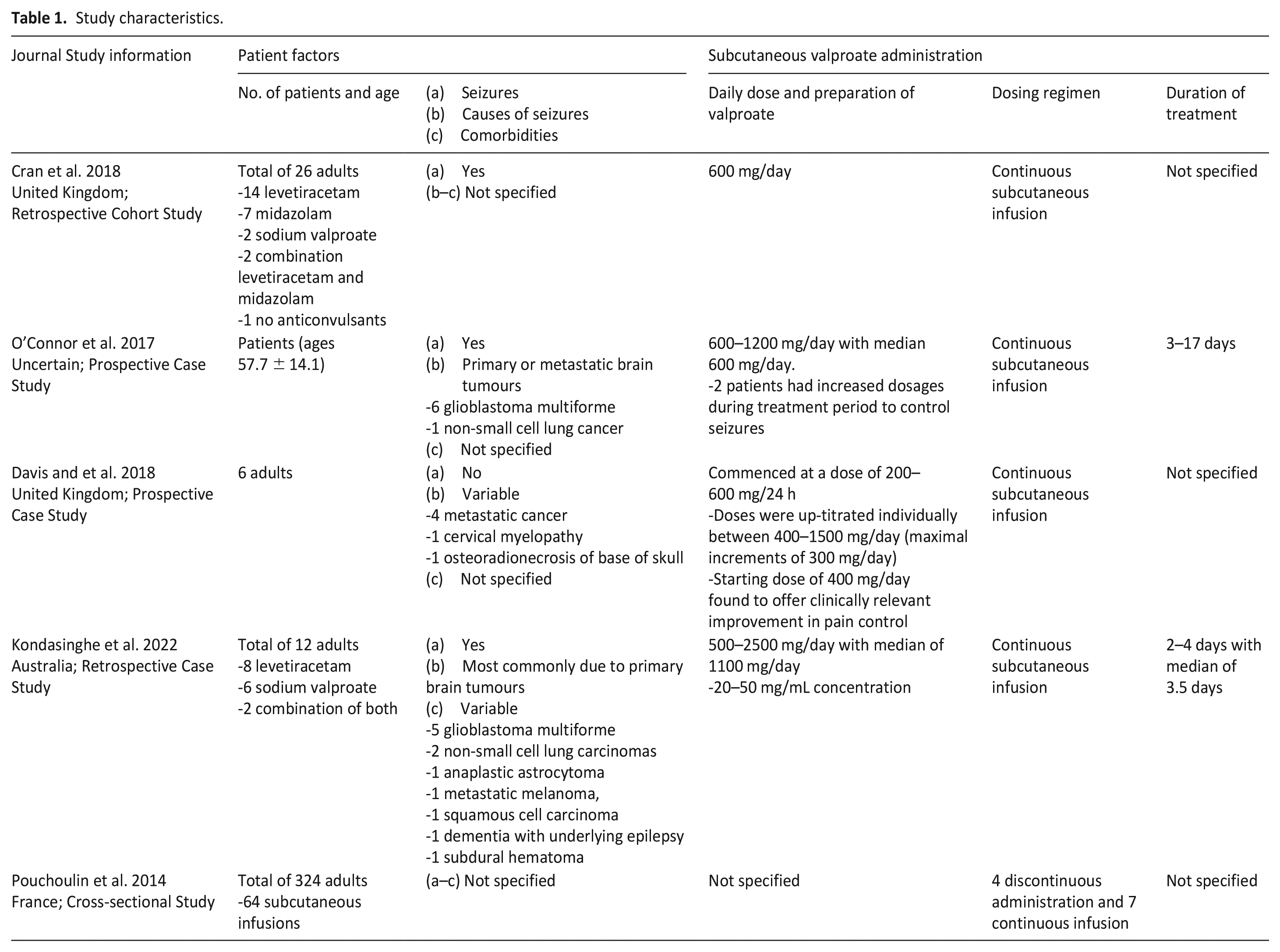
There were 429 articles identified. Subsequently, there were eight studies that underwent full-text review. There were six studies that were considered to fulfil inclusion criteria (see Supplemental Information 3). These studies included four case series and one cross-sectional study (see Table 1). One of the studies that fulfilled inclusion criteria, O’Connor et al., 11 presented a subset of the patients reported in another study, O’Connor et al., 12 and therefore will not be discussed separately. Risk of bias analysis of the included studies showed that they were often of at least moderate risk of bias (see Supplemental Information 4). However, this potential for bias must acknowledge the limitations of the publication types in which the cases were described, which was often a poster or abstract format. Study reporting was most often limited by lack of detail, particularly with respect to methodology description and the presentation of baseline patient characteristics.
Study characteristics.
Effectiveness
There were three studies that described the use of subcutaneous sodium valproate for seizure control. Kondasinghe et al. 9 describe the use of continuous subcutaneous infusions of sodium valproate in six patients (range 500 mg–2500 mg/24 h, median 1100 mg/24 h; see Table 2), in whom 5/6 (83%) had their seizures controlled. O’Connor et al. describe seven patients in whom sodium valproate was used by continuous subcutaneous infusion as doses varying from 600 mg/24 h to 1200 mg/24 h. In this study 7/7 (100%) of patients achieved seizure control following initial dose adjustments. 12 One study described the use of continuous subcutaneous infusions including sodium valproate (600 mg/24 h), but did not present results specifically with this medication. 13 However, in their group of 25 patients that received medications including sodium valproate, levetiracetam and midazolam, seizures were described to be controlled in 69% of cases following initial doses. In one study of patients with neuropathic pain, continuous subcutaneous infusion of sodium valproate (dose range from 400 mg/24 h to 1500 mg/24 h), 5/6 (83.3%) of patients had a clinically significant improvement in pain within 48 h. 14
Subcutaneous sodium valproate efficacy and tolerability.
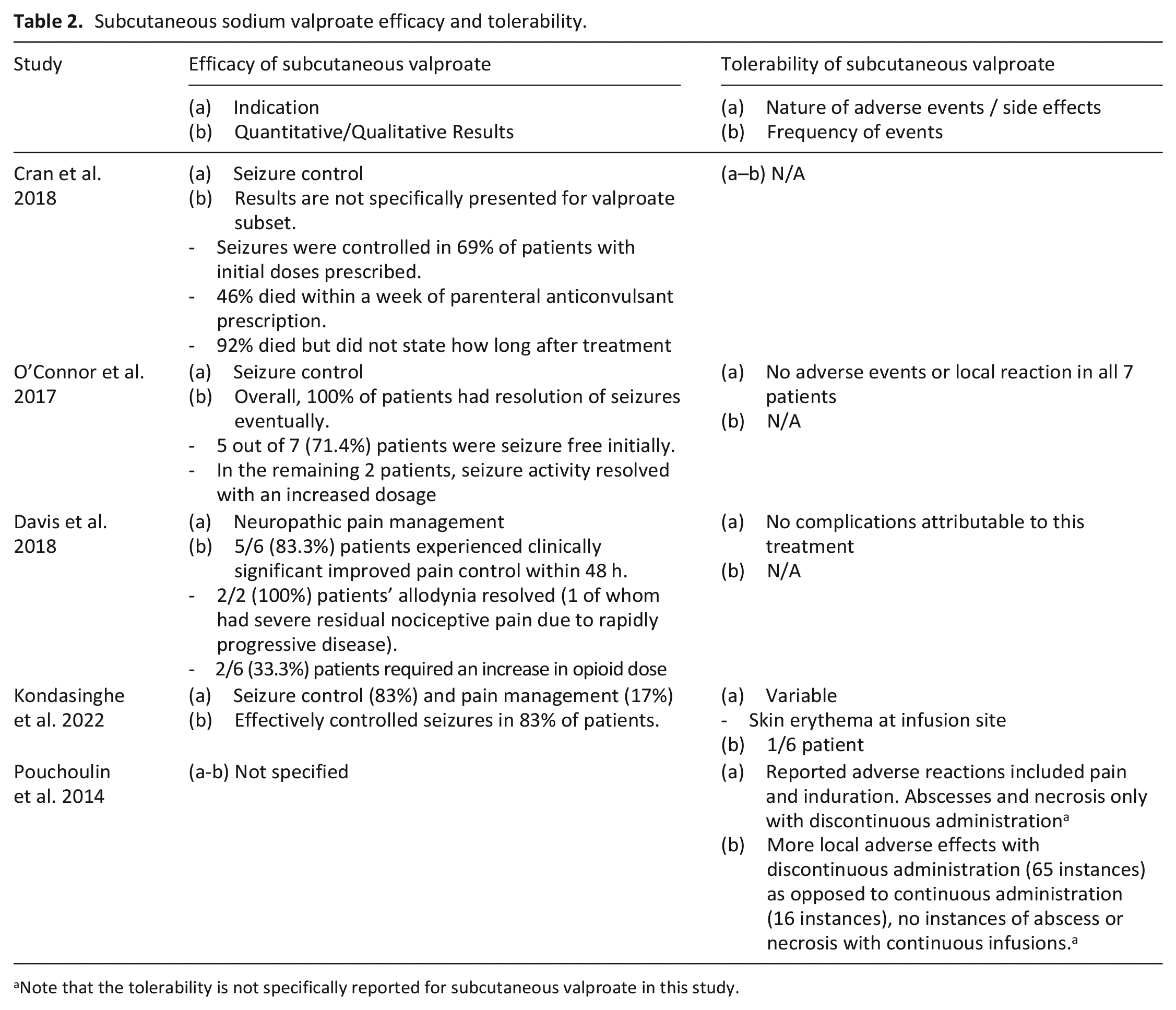
Note that the tolerability is not specifically reported for subcutaneous valproate in this study.
Tolerability
Four studies reported on the tolerability or adverse effects associated with subcutaneous sodium valproate.9,12,14,15 The three of these studies that presented results on valproate in isolation, comprising a total of 19 patients receiving subcutaneous sodium valproate, reported one adverse effect. Kondasinghe et al. 9 described one patient who experienced erythema at the subcutaneous line insertion site, which then resolved when a new subcutaneous access was obtained and the same concentration of sodium valproate provided subcutaneously at the second site. One study reported on adverse effects in a cohort of patients receiving a diverse range of subcutaneous medications, which included a subset who were receiving subcutaneous valproate. This group of patients had a number of local site reactions described; however, it was not possible to determine which reactions were associated with sodium valproate. In this study, it was described that local site reactions were less frequent with continuous infusions as opposed to discontinuous administration. 15
Discussion
Summary of main findings
The results of this review have demonstrated that there is relatively little evidence regarding the use subcutaneous sodium valproate; however, the evidence that is available suggests that subcutaneous sodium valproate may be a reasonable consideration for selected patients. Current routine medication resources may not reflect this potential use of sodium valproate. 16 In particular, palliative care has unique medication considerations that may not apply to medication administration in other settings. The majority of studies used subcutaneous sodium valproate for seizures in patients with difficulty tolerating oral medications. There were also reports of benefit derived for neuropathic pain with subcutaneous sodium valproate use. Studies that specifically reported on the tolerability of a subcutaneous sodium valproate group described very few adverse effects, aside from an isolated local reaction. One study described its dilutant, using 0.9% saline or water for injections. 12 Practical considerations regarding subcutaneous valproate administration are discussed further in Supplemental Information 5.
Strengths and limitations
All primary peer-reviewed articles with palliative care patients treated with subcutaneous valproate were included irrespective of language. The main limitation of the review is in the low level of evidence of the studies that were available for inclusion. The review process itself is limited by the potential for publication bias influencing the results of the review.
Implications for future research
In the first instance, further descriptive data would add value to the current literature regarding the use of subcutaneous sodium valproate. Future observational studies may provide useful information through the specific description of patient cohort characteristics, dose conversions, concentration and dilutants. Real-world data regarding its use would aid in estimating the frequency of adverse effects, such as local site reactions. If a situation arose in which a patient was receiving subcutaneous valproate and required a blood test for another indication, measure a sodium valproate level may also provide additional information.
Conclusion
There are several studies that have described the successful use of subcutaneous infusions of sodium valproate in the palliative care setting. Palliative symptoms for which the use of sodium valproate via this route have been described include the management of seizures and neuropathic pain. Ultimately, in view of the limited data at this stage, this route of administration of sodium valproate would at best be an adjunct to other strategies being used to manage palliative symptoms. However, should the situation arise in which it is necessary, there are limited data to support its use with an appropriate degree of caution. The existing studies present enough evidence to argue for the inclusion of subcutaneous valproate in the palliative care armamentarium for selected circumstances. Future research in this area would be aided in the first instance through the presentation of additional descriptive data.
Supplemental Material
sj-pdf-1-pmj-10.1177_02692163241234597 – Supplemental material for Subcutaneous sodium valproate in palliative care: A systematic review
Supplemental material, sj-pdf-1-pmj-10.1177_02692163241234597 for Subcutaneous sodium valproate in palliative care: A systematic review by Sheryn Tan, Jeng Swen Ng, Charis Tang, Brandon Stretton, Joshua Kovoor, Aashray Gupta, Thomson Delloso, Tony Zhang, Rudy Goh, Shaddy El-Masri, Michelle Kiley, Ian Maddocks, Adil Harroud, Sybil Stacpoole, Gregory Crawford and Stephen Bacchi in Palliative Medicine
Footnotes
Author contributions
S.T., J.N., C.T., B.S., J.K., A.G., T.D., T.Z., R.G., S.E., M.K., I.M., A.H., S.S. G.C. and S.B. made substantial contributions to the conception and design of the work, acquisition of data, analysis and interpretation of data, drafting the article, revising the article critically for important intellectual content, gave final approval for the version to be published and agreed to be accountable for all aspects of the work.
Declaration of conflicting interests
The author(s) declared no potential conflicts of interest with respect to the research, authorship, and/or publication of this article.
Funding
The author(s) received no financial support for the research, authorship, and/or publication of this article.

References
Supplementary Material
Please find the following supplemental material available below.
For Open Access articles published under a Creative Commons License, all supplemental material carries the same license as the article it is associated with.
For non-Open Access articles published, all supplemental material carries a non-exclusive license, and permission requests for re-use of supplemental material or any part of supplemental material shall be sent directly to the copyright owner as specified in the copyright notice associated with the article.
