



Abstract
Background:
Nursing homes are among the most common places of death in many countries.
Aim:
To determine the quality of dying and end-of-life care of nursing home residents in six European countries.
Design:
Epidemiological survey in a proportionally stratified random sample of nursing homes. We identified all deaths of residents of the preceding 3-month period. Main outcomes: quality of dying in the last week of life (measured using End-of-Life in Dementia Scales – Comfort Assessment while Dying (EOLD-CAD)); quality of end-of-life care in the last month of life (measured using Quality of Dying in Long-Term Care (QoD-LTC) scale). Higher scores indicate better quality.
Setting/participants:
Three hundred and twenty-two nursing homes in Belgium, Finland, Italy, the Netherlands, Poland and England. Participants were staff (nurses or care assistants) most involved in each resident’s care.
Results:
Staff returned questionnaires regarding 1384 (81.6%) of 1696 deceased residents. The End-of-Life in Dementia Scales – Comfort Assessment while Dying mean score (95% confidence interval) (theoretical 14–42) ranged from 29.9 (27.6; 32.2) in Italy to 33.9 (31.5; 36.3) in England. The Quality of Dying in Long-Term Care mean score (95% confidence interval) (theoretical 11–55) ranged from 35.0 (31.8; 38.3) in Italy to 44.1 (40.7; 47.4) in England. A higher End-of-Life in Dementia Scales – Comfort Assessment while Dying score was associated with country (p = 0.027), older age (p = 0.012), length of stay ⩾1 year (p = 0.034), higher functional status (p < 0.001). A higher Quality of Dying in Long-Term Care score was associated with country (p < 0.001), older age (p < 0.001), length of stay ⩾1 year (p < 0.001), higher functional status (p = 0.002), absence of dementia (p = 0.001), death in nursing home (p = 0.033).
Conclusion:
The quality of dying and quality of end-of-life care in nursing homes in the countries studied are not optimal. This includes countries with high levels of palliative care development in nursing homes such as Belgium, the Netherlands and England.
The number of deaths in nursing homes is growing in many countries worldwide.
Many nursing home residents are affected by multiple chronic progressive illnesses, including frailty and dementia, and thus have complex care needs and high levels of disability and dependence towards the end of life.
Although there are indications that nursing home residents are underserved by palliative care, the existing epidemiological data on quality of dying in this setting are vastly insufficient to assess needs and guide policy-making.
We conducted an epidemiological study of the quality of end-of-life care and quality of dying of nursing home residents as reported by nurses and care assistants in Belgium, Finland, Italy, the Netherlands, Poland and England.
Although countries differed significantly regarding quality of dying and quality of end-of-life care, all revealed room for improvement, particularly with regard to physical and emotional distress, advance care planning and helping residents achieve closure.
These findings also applied to countries with relatively high levels of palliative care development in nursing homes (i.e. England, Belgium, the Netherlands).
The quality of end-of-life care and quality of dying of nursing home residents in the six European countries studied can potentially be improved.
The findings suggest that a strong policy base may be an important but not sufficient precondition for high-quality end-of-life care and quality of dying in nursing homes.
Additional palliative care guidelines and practice tools may be needed.
Introduction
As the world’s population is ageing, a rapidly growing number of people will die in old age, affected by chronic progressive illnesses and with complex care needs.1,2 In many countries, a large number of older people are admitted to nursing homes or care homes as they near the end of life.3–5 In some countries, up to one-third of people in need of palliative care die in these settings, 6 and this figure is expected to rise. 7 This article uses the term ‘nursing home’ to refer to ’collective institutional settings where care, on-site provision of personal assistance in daily living, and on-site or off-site provision of nursing and medical care, is provided for older people who live there, 24 h a day, 7 days a week, for an undefined period of time.8,9
While previous research has studied aspects of end-of-life care in nursing home residents (e.g. hospital admissions, hospice use in the United States, resident level outcomes), it has important limitations. Studies included data from only one or two countries at a time and used different outcome measures which prevented comparisons between countries and hence points of reference to judge where improvement may be necessary.5,10 Other studies sampled prospectively which means they could not obtain population-based samples of deaths in nursing homes,11,12 and yet others reported process measures of care (e.g. hospice use, hospital admissions) but did not report resident level outcome measures.13,14 We can conclude that there is insufficient epidemiological data to evaluate the quality of dying and quality of end-of-life care in nursing homes and to guide policy-making and clinical practice. This is concerning given that research suggests that nursing home residents may be underserved by palliative care,3,15 although it is indicated given the life-limiting nature and complex symptoms of the chronic diseases, including dementia, which affect many residents. 16 Quality of end-of-life care reflects elements of the setting in which dying takes place whereas quality of dying refers to symptom burden and other resident outcomes that can be influenced by care and various resident-related factors.17,18 Methodological difficulties in obtaining population-based data on the end of life have hampered research on the end of life of nursing home residents. This includes difficulties in determining suitable population denominators, non-response due to poor functional or cognitive status, and ethical concerns about burdening people who are very ill. 19 Several authors have proposed retrospective studies of deaths as a valuable solution, in particular for large-scale epidemiological studies,12,19 and the number of such studies in palliative care research is growing.20–22
We report the main outcomes of the European PACE study in nursing homes in six European countries.16,23 The research questions were as follows:
What is the quality of dying and quality of end-of-life care of nursing home residents in six European countries according to staff members (nurses and care assistants) most involved in care, and are there differences between countries?
To what extent are country, resident or nursing home characteristics associated with quality of dying and quality of end-of-life care in nursing homes?
Methods
Study design
PACE (Palliative Care for Older People in Care and Nursing Homes in Europe) is an epidemiological survey study of deceased residents of nation-wide representative samples of nursing homes in Belgium (Flanders), Finland, Italy, the Netherlands, Poland and England. 23 We identified all deaths of residents that occurred over the period of 3 months prior to the distribution of questionnaires. The main outcome was quality of dying and quality of end-of-life care as reported by the staff member most involved in each deceased resident’s care. The study methods are described in detail elsewhere. 23
Setting
The data were collected in 2015. The selected countries represent various stages of palliative care development in nursing homes in terms of policies and activities regarding palliative care in this sector. Previous research has described higher levels of palliative care development in nursing homes in Belgium, the Netherlands and England compared to Finland, Italy and Poland. 24
Sampling
Based on an expected minimum of four deaths per nursing home over 3 months, we determined that we needed to sample 48 facilities per country to achieve a sufficiently large sample for this analysis. Details of the sample size calculation have been published with the study protocol. 23 We sampled nursing homes in each country through proportional stratified random sampling to obtain representative samples in terms of region within country, nursing home type and bed capacity. We sampled from national lists of nursing homes in all countries except Italy, where no national lists exist and a previously created cluster of nursing homes with interest in research participation was used. 25 The English team additionally recruited through ENRICH, a network of nursing homes with interest in research participation, to improve the participation rate.
Participants
Questionnaires concerning the deceased resident’s care were distributed to (1) the nurse most involved in the care of the deceased resident or a care assistant in case a nurse could not be identified (both henceforth termed ‘staff member’); (2) the nursing home administrator/manager/head nurse (henceforth termed ‘administrator’); (3) the resident’s treating physician (general practitioner (GP) or elderly care physician).
Procedure
Assisted by a researcher, the administrator identified all deaths, assigned anonymous codes to questionnaires and mailed the questionnaires and up to two reminders (ethics committees allowed one reminder in Poland and England). Respondents mailed the questionnaires directly to the research team.
Measurements
The main outcomes, quality of dying and quality of end-of-life care, were reported by the staff member most involved in care through two validated questionnaires: End-of-Life in Dementia Scales – Comfort Assessment while Dying (EOLD-CAD) 26 and Quality of Dying in Long-Term Care (QoD-LTC) 27 , respectively. The EOLD-CAD assesses quality of dying by measuring symptom burden in the last week of life on four subscales: physical distress, dying symptoms, emotional distress, well-being. The QoD-LTC assesses quality of end-of-life care in the last month of life on three subscales: personhood, closure, preparatory tasks. 17 Previous reviews have recommended these scales as the most appropriate instruments for measuring quality of dying in mixed nursing home populations (with various levels of cognitive and physical functioning).18,28 Functional status 1 month before death was also reported by the staff member and assessed using the Bedford Alzheimer Nursing Severity-Scale (BANS-S). 29 The underlying cause of death was based on the clinical judgement of the treating physician, or the staff member, if no information was available from the physician. Dementia was determined as present if either the treating physician or the staff member most involved in care indicated so. Dementia was determined as not present if both the treating physician and the staff member indicated that the resident did not have dementia. If neither respondent provided information, the response was recorded as missing. Nursing home administrators reported residents’ age, gender, length of stay in the nursing home and place of death, and the nursing home type and status (i.e. public, private non-profit, private for profit).
Analysis
The non-response analysis involved comparing administrator-reported sociodemographic characteristics, place of death and length of stay of residents for whom staff did and did not return questionnaires. Sample characteristics, quality of dying and quality of end-of-life care were reported per country. We reported frequencies for all items of the EOLD-CAD and QoD-LTC along with estimated marginal means for subscale scores and total scores. The scores were calculated using generalised linear mixed models with nursing home as random factor, and country and residents’ sociodemographic and clinical characteristics that differed significantly between countries as covariates.
To determine associations between quality of dying and quality of end-of-life care on one hand, and country, resident and nursing home characteristics on the other hand, we computed two generalised linear mixed models with the total scores of EOLD-CAD and QoD-LTC as dependent variables and nursing home as random factor. Covariates were country, resident characteristics (age, gender, cause of death, functional status, length of stay in the nursing home, place of death, presence of dementia) and nursing home characteristics (nursing home type, nursing home status). All generalised linear mixed models were calculated with random intercepts and without random slopes. We checked all multivariable models for collinearity using variance inflation factors. Hypothesis tests were two-sided. Statistical significance was set at α < 0.05. Analyses were conducted in IBM SPSS statistics version 24.
Ethics
The research teams in all participating countries obtained ethical approval from their respective ethics committees or waivers for the collection of data of deceased residents (Netherlands, Italy). All respondents participated on a voluntary basis and remained anonymous. The return of a questionnaire was taken as consent to participate.
Results
Sample and response rates
In 322 participating nursing homes in six countries, we identified 1707 deceased residents, 342 in Belgium, 283 in Finland, 229 in Italy, 329 in the Netherlands, 356 in Poland and 168 in England. A staff member most involved in the resident’s care was identified for 1696 residents, and they returned questionnaires for 1384 residents (response rate of 81.6% overall; 85.1% in Belgium; 95.1% in Finland; 91.7% in Italy; 67.5% in the Netherlands; 87.4% in Poland; 54.2% in England). The responding staff member was a nurse for 75% of residents. The non-response analysis did not reveal significant differences between residents for whom staff did or did not return questionnaires in terms of age, gender, place of death or length of stay in the nursing home (see Supplementary Table S1).
The median age at death was lowest in Poland (83 years) and highest in England (89 years) (p < 0.001; Table 1). Between 60% in England and 83% in Finland were judged as having had dementia (p < 0.001). The difference between countries in length of stay was significant (p < 0.001) with the longest lengths of stay in Netherlands (70% stayed 1 year or more) and particularly short stays in Poland (53% stayed for 6 months or less).
Characteristics of deceased nursing home residents in six European countries.
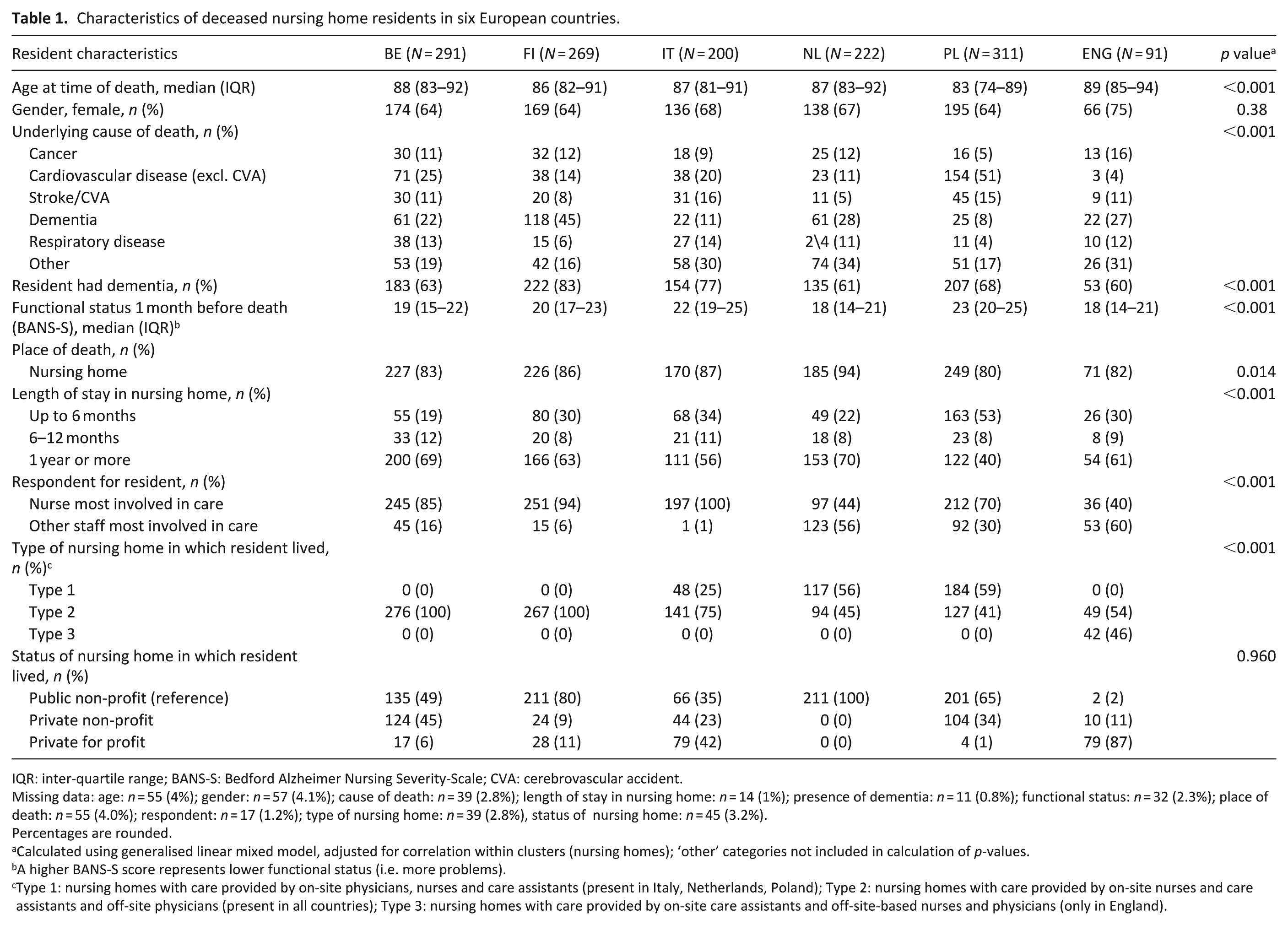
IQR: inter-quartile range; BANS-S: Bedford Alzheimer Nursing Severity-Scale; CVA: cerebrovascular accident.
Missing data: age: n = 55 (4%); gender: n = 57 (4.1%); cause of death: n = 39 (2.8%); length of stay in nursing home: n = 14 (1%); presence of dementia: n = 11 (0.8%); functional status: n = 32 (2.3%); place of death: n = 55 (4.0%); respondent: n = 17 (1.2%); type of nursing home: n = 39 (2.8%), status of nursing home: n = 45 (3.2%).
Percentages are rounded.
Calculated using generalised linear mixed model, adjusted for correlation within clusters (nursing homes); ‘other’ categories not included in calculation of p-values.
A higher BANS-S score represents lower functional status (i.e. more problems).
Type 1: nursing homes with care provided by on-site physicians, nurses and care assistants (present in Italy, Netherlands, Poland); Type 2: nursing homes with care provided by on-site nurses and care assistants and off-site physicians (present in all countries); Type 3: nursing homes with care provided by on-site care assistants and off-site-based nurses and physicians (only in England).
Quality of dying in nursing homes: symptoms in the last week of life (EOLD-CAD)
The estimated marginal means of the EOLD-CAD total score ranged from 29.9 in Italy to 33.9 in England, on a theoretical scale range of 14 through 42 (Table 2).
Quality of dying in the last week of life (EOLD-CAD items) as judged by nursing home nurses or care assistants in six countries.
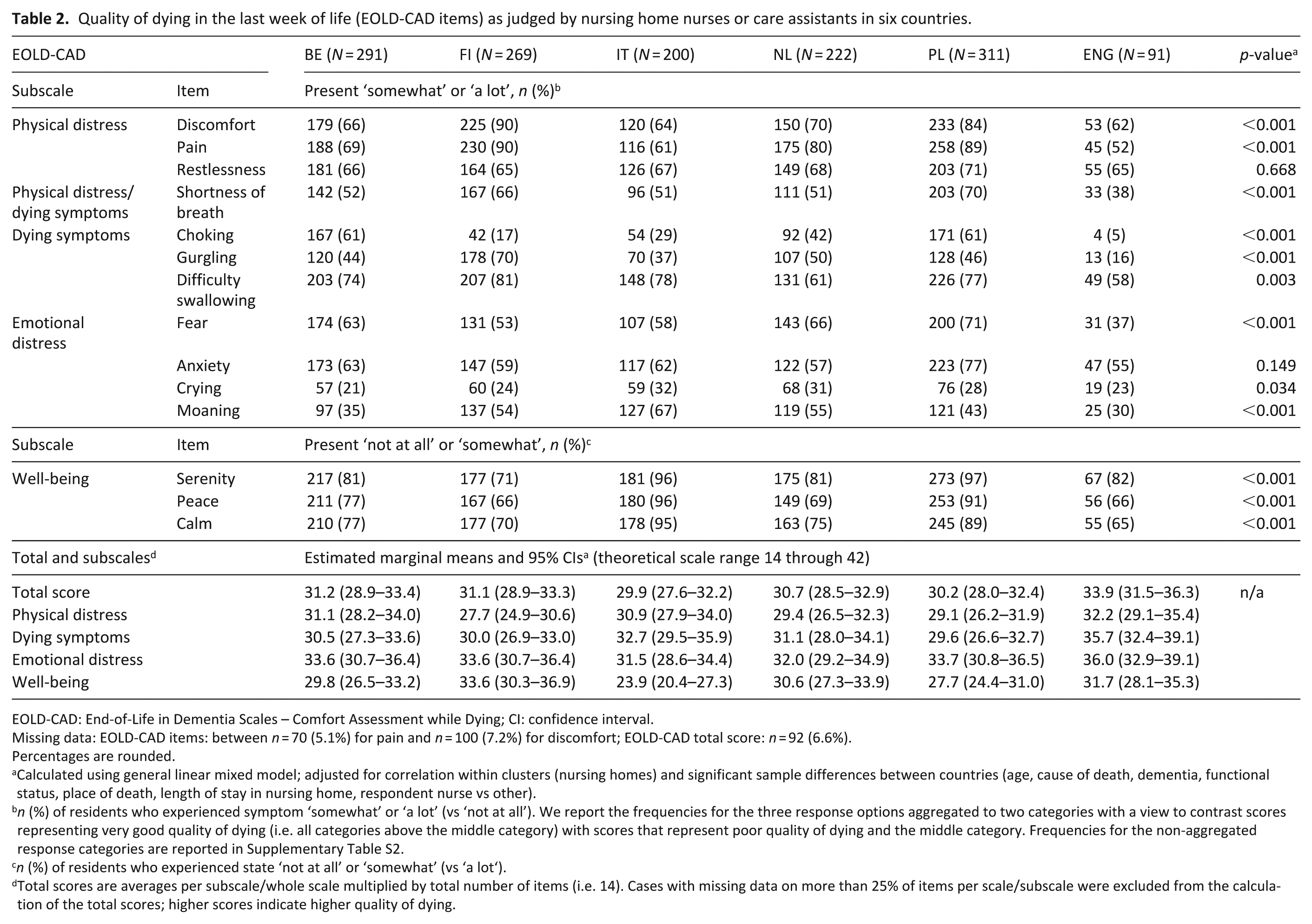
EOLD-CAD: End-of-Life in Dementia Scales – Comfort Assessment while Dying; CI: confidence interval.
Missing data: EOLD-CAD items: between n = 70 (5.1%) for pain and n = 100 (7.2%) for discomfort; EOLD-CAD total score: n = 92 (6.6%).
Percentages are rounded.
Calculated using general linear mixed model; adjusted for correlation within clusters (nursing homes) and significant sample differences between countries (age, cause of death, dementia, functional status, place of death, length of stay in nursing home, respondent nurse vs other).
n (%) of residents who experienced symptom ‘somewhat’ or ‘a lot’ (vs ‘not at all’). We report the frequencies for the three response options aggregated to two categories with a view to contrast scores representing very good quality of dying (i.e. all categories above the middle category) with scores that represent poor quality of dying and the middle category. Frequencies for the non-aggregated response categories are reported in Supplementary Table S2.
n (%) of residents who experienced state ‘not at all’ or ‘somewhat’ (vs ‘a lot‘).
Total scores are averages per subscale/whole scale multiplied by total number of items (i.e. 14). Cases with missing data on more than 25% of items per scale/subscale were excluded from the calculation of the total scores; higher scores indicate higher quality of dying.
Pain, discomfort, difficulty swallowing and lack of well-being were the most frequent symptoms within each of the countries studied (Table 2). Between 52% (England) and 90% (Finland) of residents experienced pain in the last week of life. Between 62% (England) and 90% (Finland) experienced discomfort, and between 58% (England) and 81% (Finland) were reported as having had difficulty swallowing. Items of the ‘well-being’ subscale (i.e. serenity, peace, calm) were reported as ‘not at all’ or ‘somewhat’ present in the last week of life in 65% (calm, England) to 97% (serenity, Poland) of residents.
Quality of end-of-life care in nursing homes: personhood, closure and preparatory tasks in the last month of life (QoD-LTC)
The estimated marginal means of the QoD-LTC total score ranged from 35.0 in Italy to 44.1 in England, on a theoretical scale range of 11 through 55 (Table 3). In each of the countries studied, staff reported significantly lower scores (as shown by non-overlapping confidence intervals (CIs)) on the ‘preparatory tasks’ subscale (estimated means 18.1 in Italy to 39.7 in England) than on the ‘personhood’ subscale (44.7 (Belgium) to 49.1 (England)). Furthermore, in Belgium, Italy, the Netherlands and England, staff rated ‘closure’ (33.5 (Italy) to 39.4 (England)) significantly worse than personhood.
Quality of end-of-life care in the last month of life (QoD-LTC items) as judged by nursing home nurses or care assistants in six countries.
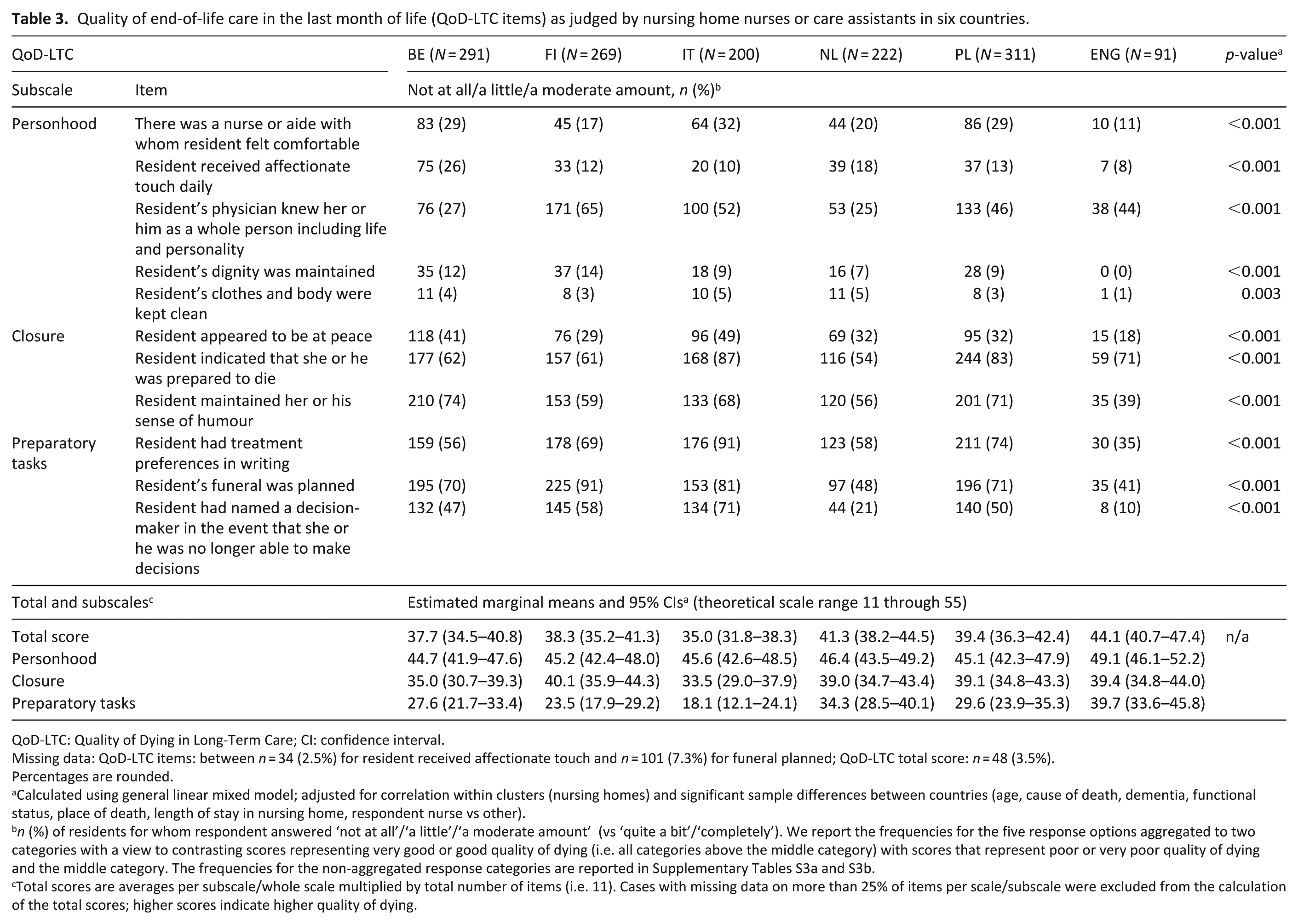
QoD-LTC: Quality of Dying in Long-Term Care; CI: confidence interval.
Missing data: QoD-LTC items: between n = 34 (2.5%) for resident received affectionate touch and n = 101 (7.3%) for funeral planned; QoD-LTC total score: n = 48 (3.5%).
Percentages are rounded.
Calculated using general linear mixed model; adjusted for correlation within clusters (nursing homes) and significant sample differences between countries (age, cause of death, dementia, functional status, place of death, length of stay in nursing home, respondent nurse vs other).
n (%) of residents for whom respondent answered ‘not at all’/‘a little’/‘a moderate amount’ (vs ‘quite a bit’/‘completely’). We report the frequencies for the five response options aggregated to two categories with a view to contrasting scores representing very good or good quality of dying (i.e. all categories above the middle category) with scores that represent poor or very poor quality of dying and the middle category. The frequencies for the non-aggregated response categories are reported in Supplementary Tables S3a and S3b.
Total scores are averages per subscale/whole scale multiplied by total number of items (i.e. 11). Cases with missing data on more than 25% of items per scale/subscale were excluded from the calculation of the total scores; higher scores indicate higher quality of dying.
Four aspects of quality of end-of-life care were consistently rated as poorest within each of the countries studied (according to aggregated percentages for ‘not at all/a little/a moderate amount’): the resident having treatment preferences in writing (35% (England) to 91% (Italy)) the resident’s funeral having been planned (41% (England) to 91% (Finland)) the resident indicating that they were prepared to die (54% (Netherlands) to 87% (Italy)), and the resident maintaining their sense of humour (39% (England) to 74% (Belgium)) (Table 3).
Factors associated with quality of dying and quality of end-of-life care in the nursing home
Country was significantly associated with both quality of dying (EOLD-CAD, p = 0.027) and quality of end-of-life care (QoD-LTC, p < 0.001; Table 4) in the multivariable models. Among resident characteristics, better quality of dying was associated with older age (p = 0.012), length of stay in the nursing home of 1 year or more compared with up to 6 months (p = 0.034) and better functional status 1 month before death (p < 0.001). Better quality of end-of-life care was associated with older age (p < 0.001), length of stay in the nursing home of 6 months or longer (compared with up to 6 months; 6–12 months: p = 0.048; 1 year or more: p < 0.001), better functional status 1 month before death (p = 0.002), absence of dementia (p = 0.001), and the resident having died in the nursing home compared with another location (p = 0.033).
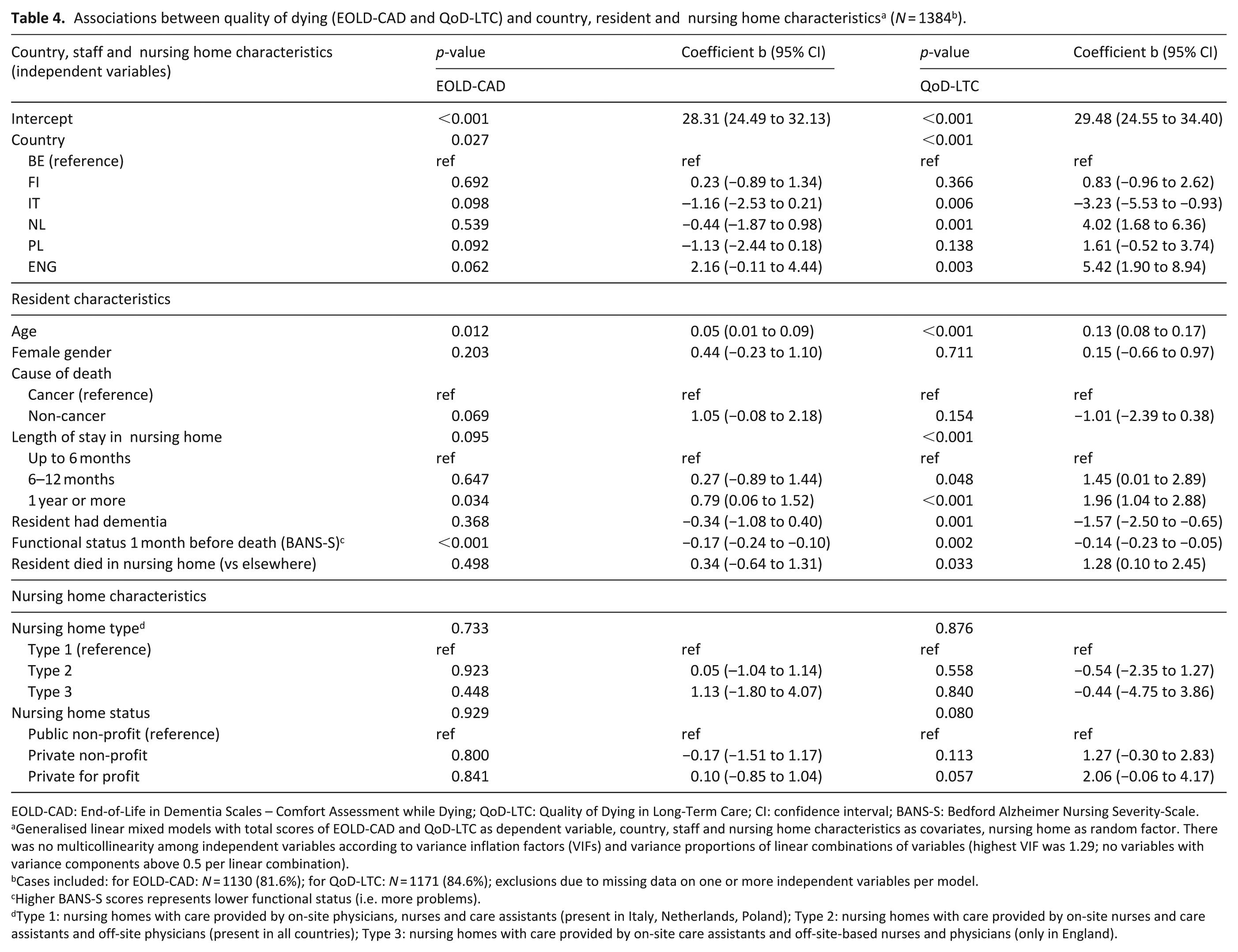
EOLD-CAD: End-of-Life in Dementia Scales – Comfort Assessment while Dying; QoD-LTC: Quality of Dying in Long-Term Care; CI: confidence interval; BANS-S: Bedford Alzheimer Nursing Severity-Scale.
Generalised linear mixed models with total scores of EOLD-CAD and QoD-LTC as dependent variable, country, staff and nursing home characteristics as covariates, nursing home as random factor. There was no multicollinearity among independent variables according to variance inflation factors (VIFs) and variance proportions of linear combinations of variables (highest VIF was 1.29; no variables with variance components above 0.5 per linear combination).
Cases included: for EOLD-CAD: N = 1130 (81.6%); for QoD-LTC: N = 1171 (84.6%); exclusions due to missing data on one or more independent variables per model.
Higher BANS-S scores represents lower functional status (i.e. more problems).
Type 1: nursing homes with care provided by on-site physicians, nurses and care assistants (present in Italy, Netherlands, Poland); Type 2: nursing homes with care provided by on-site nurses and care assistants and off-site physicians (present in all countries); Type 3: nursing homes with care provided by on-site care assistants and off-site-based nurses and physicians (only in England).
Discussion
Main findings of the study
The responses of nursing home staff on the EOLD-CAD indicate that quality of dying of nursing home residents in all countries studied may require improvement. For considerable proportions of residents, staff reported burden in several symptoms that indicate physical or emotional distress. Staff responses on the QoD-LTC showed that the quality of end-of-life care in the last month of life can also be improved in all countries, in particular with regard to achieving closure and completing preparatory tasks. Country was significantly associated with both the quality of dying and quality of end-of-life care. Staff reported better quality of dying and quality of end-of-life care for residents with a longer stay in the nursing home, residents with a higher functional status 1 month before death and older residents. In addition, staff reported better quality of end-of-life care for residents without dementia and residents who died in the nursing home as opposed to elsewhere.
Quality of dying: symptom burden in the last week of life
A first notable finding of this study is the similarity in the symptoms that staff in different countries reported for large proportions of residents in the last week of life. This concerns pain, discomfort, difficulty swallowing and lack of serenity, peace and calm. These symptoms have also been described in previous studies of the end of life of people with dementia,5,30 who make up a large proportion of nursing home residents (in our study between 60% and 83%). A considerable percentage of residents in all countries are thus perceived by staff as dying with physical and emotional distress. This finding points to an urgent need to determine whether improvements can be made in the systematic assessment, recognition and management of end-of-life symptoms in this population.
Quality of end-of-life care: personhood, closure and preparatory tasks in the last month of life
Across countries, staff consistently rated end-of-life care in terms of personhood (e.g. resident’s body and clothes were kept clean) relatively well. Poorer quality of end-of-life care was reported with regard to preparatory tasks (e.g. resident had treatment preferences in writing) and closure (e.g. resident indicated that she or he was prepared to die). This suggests that aspects of general good nursing home care (e.g. preserving dignity, hygiene) may be better established than care that is more closely linked to palliative care and the dying process, such as advance care planning. This in line with existing literature indicating a low prevalence of advance care plans for nursing home residents.31,32 These findings further highlight the need for the integration of a palliative care approach into regular nursing home care.
Factors associated with quality of dying and quality of end-of-life care
Country was significantly associated with both the quality of dying and quality of end-of-life care, independent of sociodemographic and clinical characteristics. Differences between countries may therefore be reflections of differences in the organisation of nursing home care, and particularly integration of palliative care in the nursing home sector. 16 Several resident characteristics were associated with better quality of dying and end-of-life care, for instance a longer stay in the nursing home. This is consistent with findings of previous research showing that residents with a longer stay were more likely to be prescribed drug treatment that can be classified as palliative 33 and less likely to experience undertreatment of non-pain symptoms. 34 Staff were also more likely to report poorer quality of end-of-life care in the last month of life (QoD-LTC) for residents with dementia than for residents without dementia, a difference not found on the EOLD-CAD (i.e. symptom burden in the last week of life). This association may reflect the particular challenges related to communication and care planning in dementia.
Implications for policy and practice
The findings of this study highlight the need to recognise ‘dying well in nursing homes’ as an issue of utmost importance for clinical practice and public health. Deaths in nursing homes will increase substantially over the coming years and decades, and nursing homes will be the most frequent place of death in England by 2040. 35 Our study showed that many nursing home residents were very old and affected by dementia or other diseases that considerably limit physical and cognitive functioning. Many experienced distressing symptoms at the end of life. Residents’ length of stay in the facilities is relatively short and will likely continue to decrease, considering that policy in many countries aims to keep older people at home until they reach very high levels of disability. 36 The fact that a shorter length of stay was associated with poorer quality of end-of-life care and quality of dying will further complicate the delivery of high-quality care in this population. Countries with a high level of palliative care development in nursing homes (i.e. Belgium, the Netherlands, England) did not perform better in terms of quality of dying and quality of end-of-life care than countries with lower levels of palliative care development (i.e. Poland, Italy, Finland). 24 This suggests that palliative care policies or practice frameworks for nursing homes may be an important but not sufficient precondition for high quality of end-of-life care. Next to a strong policy base, additional practice tools and guidelines for nursing homes may be needed.
Strengths and limitations of the study
We obtained nation-wide representative samples of nursing homes in six European countries and cross-nationally comparable data by employing standardised research methods. Retrospective data collection through proxy respondents is the most accurate and feasible method for large-scale population-based epidemiological studies on the end of life and for a uniform time frame (e.g. last month of life).12,19 It avoids potential bias inherent in prospective sampling that is caused by underrepresentation of people who live longer than the study follow-up period or who are affected by certain conditions whose terminal phase is often not recognised. 37 Our data collection resulted in high staff response rates in all countries except England, where it was satisfactory. As data were collected after death, some might have been difficult for staff to remember. Although we cannot exclude the possibility of recall bias, we did attempt to limit it by including deaths that occurred at most three months before data collection. Studying a 3-month period retrospectively is an established approach in end-of-life care research.5,38–40 Although our outcome measures are validated questionnaires, they have not been validated cross-nationally. Differences between countries in staff members’ reports of quality of dying and end-of-life care therefore need careful interpretation. Finally, averaging scores of quality of dying and quality of end-of-life care across facilities means that important differences in quality between facilities cannot be seen.
Conclusion
A considerable proportion of nursing home residents are perceived by staff as dying with physical and emotional distress. Staff rated aspects of general nursing home care at the end of life as being of high quality for the vast majority of residents. However, they rated the quality of end-of-life care as poorer in areas related to palliative care and dying. These problems were reported in all countries, including those with high levels of palliative care integration in nursing homes such as Belgium, the Netherlands or England. The study findings point to an urgent need to review whether improvements can be made in the systematic assessment, recognition and management of end-of-life symptoms and underline the importance of further integration of palliative care in nursing home care.
Supplemental Material
PACE_supplementary_PallMed – Supplemental material for Quality of dying and quality of end-of-life care of nursing home residents in six countries: An epidemiological study
Supplemental material, PACE_supplementary_PallMed for Quality of dying and quality of end-of-life care of nursing home residents in six countries: An epidemiological study by Lara Pivodic, Tinne Smets, Nele Van den Noortgate, Bregje D Onwuteaka-Philipsen, Yvonne Engels, Katarzyna Szczerbińska, Harriet Finne-Soveri, Katherine Froggatt, Giovanni Gambassi, Luc Deliens and Lieve Van den Block in Palliative Medicine
Footnotes
Acknowledgements
The authors thank all nursing homes and their staff for participating in this project and acknowledge the Ministry of Science and Higher Education of Poland (decision NR3202/7.PR/2014/2 dated 25 November 2014). The authors also thank the ENRICH network for their support in recruiting nursing homes in England. Finally, the authors thank Nanja van Dop for data collection in Belgium and for assistance in data cleaning; Roos Colman for assistance in statistical analysis and Jane Ruthven for language editing. All authors conceived and designed the study; T.S., L.V.d.B., B.D.O-P., K.S., H.F-S., K.F. and G.G. acquired data. L.P. analysed data; all authors revised the analysis and participated in the interpretation of data. L.P. drafted the manuscript; all authors revised it critically for important intellectual content. All authors have given final approval of the manuscript to be submitted for publication. All authors have participated sufficiently in the work to take public responsibility for appropriate portions of the content. L.D. and L.V.d.B contributed equally as last authors. PACE collaborators not in the author list: Federica, Mammarella, Martina Mercuri, Mariska Oosterveld-Vlug, Ilona Barańska, Paola Rossi, Eleanor Sowerby, Agata Stodolska, Hein van Hout, Anne Wichmann, Eddy Adang, Paula Andreasen, Danni Collingridge Moore, Agnieszka Pac, Sheila Payne, Violetta Kijowska, Maud ten Koppel, Jenny T. van der Steen, Myrra Vernooij-Dassen, and the European Association for Palliative Care Onlus, European Forum for Primary Care, Age Platform Europe and Alzheimer Europe.
Data management and sharing
Data can be obtained from the authors upon reasonable request.
Declaration of conflicting interests
The author(s) declared no potential conflicts of interest with respect to the research, authorship and/or publication of this article.
Ethical approval
The research teams in Belgium, Finland, Poland and England obtained ethical approval from their respective ethics committees: Ethics Committee of Brussels University Hospital (143201422845); Committee for Research Ethics of the Ministry for Health and Wellbeing (THL/116/6.02.01/2015); Ethics Committee of Jagiellonian University (122.6120.11.2015); NHS Health Research Authority (15/NW/0205). The research teams in the Netherlands (Medical Ethics Commission of VU University (2014.587) and Italy (Ethics Committee of Università Cattolica del Sacro Cuore; no identification number) obtained waivers for the collection of data of deceased residents.
Funding
The author(s) disclosed receipt of the following financial support for the research, authorship and/or publication of this article: The PACE project was funded by the European Union’s Seventh Framework Programme (FP7/2007e2013) under grant agreement 603111 (PACE project Palliative Care for Older People). This work was supported by an AXA Research Fund postdoctoral grant. L.P. is a Postdoctoral Fellow of the Research Foundation – Flanders. The funders had no role in study design, collection, management, analysis or interpretation of the data; preparation, review or approval of the manuscript; nor in the decision to submit the manuscript for publication.

References
Supplementary Material
Please find the following supplemental material available below.
For Open Access articles published under a Creative Commons License, all supplemental material carries the same license as the article it is associated with.
For non-Open Access articles published, all supplemental material carries a non-exclusive license, and permission requests for re-use of supplemental material or any part of supplemental material shall be sent directly to the copyright owner as specified in the copyright notice associated with the article.
