




Abstract
Objectives
To understand the nature and effectiveness of interventions aimed at improving informal stroke caregiver burden, stress, and strain.
Data sources
In line with Preferred Reporting Items for Systematic Reviews and Meta-Analyses guidelines, a systematic search of CENTRAL, CINAHL, MEDLINE, Embase, APA PsycInfo, and Web of Science was conducted in May 2022.
Review methods
Studies were eligible if they included an intervention designed for informal stroke caregivers, reported on caregiver burden, strain, or stress, were published in English, and used a randomized controlled trial design. An updated search was conducted in June 2024. The methodological quality of studies was appraised using the Cochrane risk-of-bias tool for randomized trials. The data were pooled, and a meta-analysis was completed for caregiver burden and strain outcomes.
Results
Nineteen studies met inclusion criteria and were meta-analyzed. Interventions ranged from 4 days to 12 months. Most studies incorporated educational and/or support components. Meta-analyses revealed nonsignificant effects on caregiver burden or strain. Significant between-group differences for caregiver strain and burden were, however, found in seven studies.
Conclusion
Limited studies, small sample sizes, and conflicting results made definitive conclusions on the most effective intervention characteristics for improving caregiver outcomes difficult. Of the 19 studies, seven found significant between-group differences for caregiver outcomes postintervention, and these tended to incorporate educational components and comprised between seven and nine sessions. Further high-quality research is required to identify optimal format, duration, and frequency for improving caregiver outcomes.
Globally, stroke remains the second leading cause of death, and third leading cause of death and disability combined.1,2 The majority of stroke survivors will live in the community following a stroke and often require ongoing assistance.3–5 Informal caregivers provide ongoing support to meet the needs of stroke survivors, especially with community participation, and overcoming activity restrictions.6,7 Providing ongoing care can result in caregiver burden, stress, and strain. 8
Previous systematic reviews have explored the effectiveness of interventions on the health, quality of life, and/or well-being outcomes of stroke caregivers.9–11 A review by Legg et al. 12 evaluated the effectiveness of interventions targeting informal stroke caregivers on outcomes such as caregiver stress and strain. This review included eight randomized controlled trials and found no significant result for stress or strain, with the exception of one study. 13 Another review by Rubbens et al. 14 investigated the effectiveness of interventions to reduce burden and strain in informal stroke caregivers. Findings demonstrated a dearth of evidence, and due to the variability of interventions, the optimal type and length of intervention to reduce caregiver burden and strain was unclear. The field of research has grown considerably since these reviews were published.
Therefore, the aim of this systematic review was to examine the nature and effectiveness of interventions designed to improve outcomes for informal caregivers of stroke survivors and answer the following research questions:
What are the characteristics of interventions designed for informal caregivers of stroke survivors? What approaches were used to inform intervention development? Are interventions aiming to improve caregiver burden, stress, or strain effective?
Methods
In line with Preferred Reporting Items for Systematic Reviews and Meta-Analyses (PRISMA) guidelines (Supplementary Appendix S1), 15 the systematic review protocol was prospectively registered on PROSPERO (ID: CRD42022315940). A systematic search of Cochrane Central Register of Controlled Trials (CENTRAL), CINAHL (EBSCO), MEDLINE (Ovid), Embase (Ovid), APA PsycInfo (EBSCO), and Web of Science was conducted in May 2022. A search strategy was developed based on terms related to population, study design, and outcomes, and date limiters were set for January 2010 through May 2022 to provide a summary of evidence based on recent published interventions in the field (Supplementary Appendix S2). No organizations, websites, or clinical registers were used to identify studies. The search strategy was reexecuted, covering the period from May 2022 to June 2024 to identify new studies.
Studies were eligible for inclusion in this review if they met the following criteria: (1) informal caregivers were aged 18 years and over, regardless of the length of the caregiving role; (2) inclusion of a nonpharmacological interventions designed for caregivers; (3) interventions were implemented in an acute, rehabilitation, or home setting; (4) caregiver burden, stress, or strain was included as an outcome; and (5) studies used a randomized controlled trial design. For the purpose of this review, informal caregivers were defined as individuals who provide unpaid care to someone who needs it within the context of an existing relationship (e.g., family member, neighbor, friend). 16 Studies that included paid carers were excluded. Studies were also excluded if stroke survivors resided in a residential care facility as evidence suggests the needs and challenges of these carers can differ substantially. 17
Following database searches, records were identified and imported into Covidence. 18 After removal of duplicates, two reviewers (MJ and ND) independently screened the title and abstract and full text of articles based on the selection criteria. This process was monitored by a third researcher (ESG) to resolve any conflicts. Reference lists of included studies were inspected for additional studies. The full screening process is described in Figure 1. When articles were selected, two reviewers independently extracted data from each study using a standard recording form. The following data were extracted from each study: (1) author and year of publication; (2) participant characteristics and country; (3) study design, intervention details (duration, frequency, delivery, type), comparison; (4) outcome measures; and (5) main caregiver outcomes (i.e., between-group difference). The primary outcome measures extracted from each study were any changes in caregiver burden, stress, or strain. If data were missing, the corresponding author of the study was contacted by email.
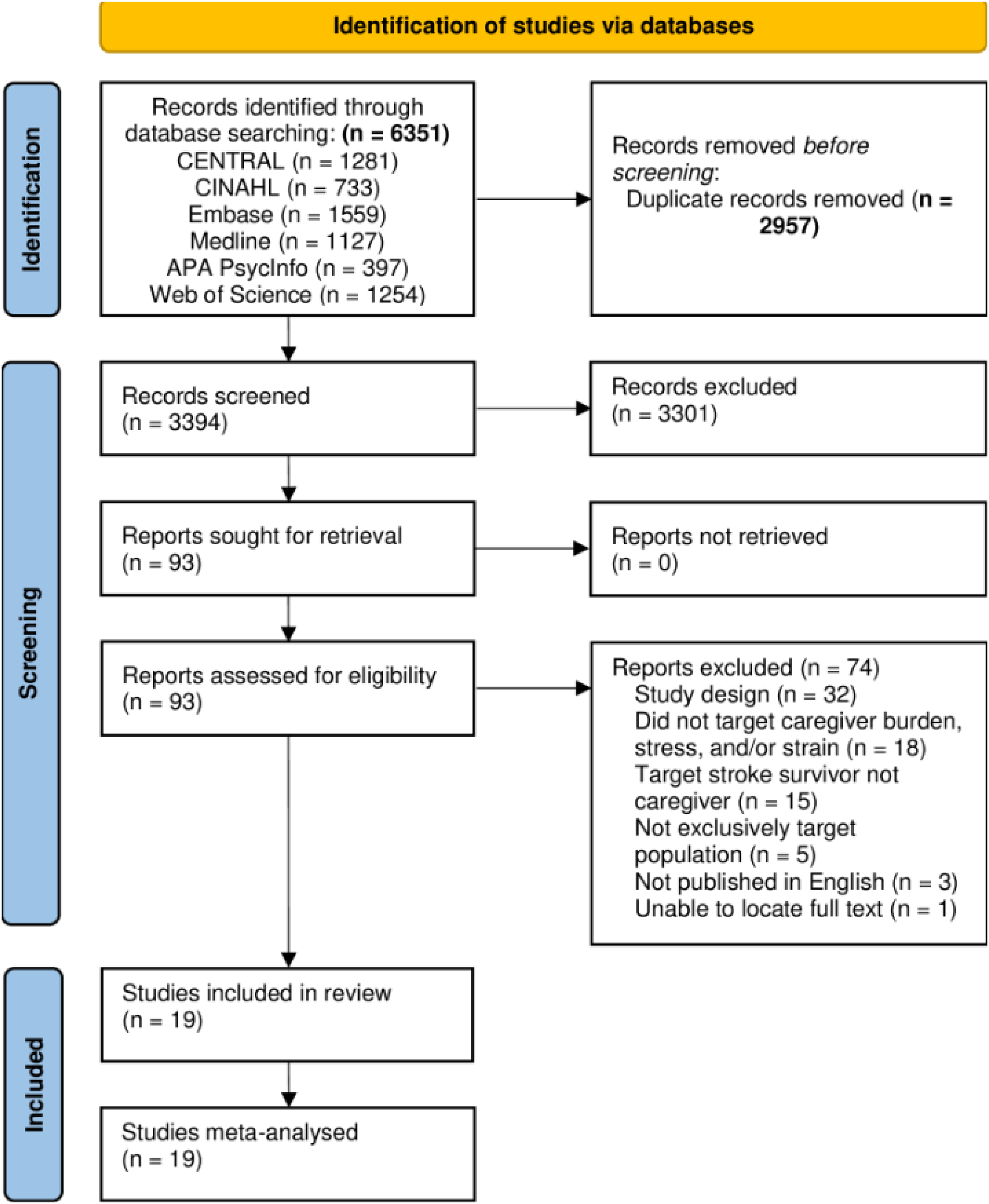
Preferred Reporting Items for Systematic Reviews and Meta-Analyses (PRISMA) flow diagram.
The risk of bias was assessed independently by two reviewers (MJ and ESG) using the Cochrane risk-of-bias tool for randomized trials (Supplementary Figure S1). 19 Using this tool, studies were evaluated across five domains for potential selection, performance, detection, attrition, and reporting bias. For each domain, reviewers used the tool's suggested algorithm to assign an overall rating of “low risk of bias”, “some concerns”, or “high risk of bias”, and then assigned an overall risk of bias to each study. An overall judgment of “low risk” was assigned when a study was assessed to be low risk of bias for all domains, whereas studies assigned “some concerns” for at least one domain were assigned an overall judgment of “some concerns.” A study was judged to be at “high risk of bias” where “some concerns” had been assigned for multiple domains or at least one domain was scored as “high risk.”
All studies were pooled for meta-analysis. The summary measure was the size of the intervention effect on caregiver burden and strain at intervention end. All outcomes for caregiver burden and strain were continuous and multiple measurement scales were used across the studies; thus, a standardized mean difference was used (i.e., Hedge's g).9,20 A random effects model was used in this study as the included studies were assumed to be varied yet similar intervention effects.9,20 The pooled effect was calculated for burden and strain between the intervention and control group from baseline to postintervention follow up. For each analysis, a forest plot showing the effect of the intervention on caregiver burden and strain was generated. For this study, a negative value of Hedges’ g indicates an effect favoring the intervention, while a positive value indicates the opposite. Values of Hedges’ g indicated effect sizes that were categorized as small (0.2), medium (0.5), or large (0.8 or greater). Heterogeneity across studies was assessed using the I2 statistic. In the event where heterogeneity was found (I2>50%), meta-regression was used to test the impact of potential effect modifiers (i.e., baseline caregiver age, baseline stroke survivor age, caregiver sex etc.). Stata version 17 (StataCorp LLC, College Station, TX, USA) was used to conduct the meta-analyses.
Publication bias was assessed using funnel plots (Supplementary Figure S5) and Egger's regression test.
Results
Following database searches, 6351 records were identified. After duplicates were removed, a total of 3394 records were screened for title and abstract. A total of 3301 articles were excluded after title and abstract screening, leaving 93 full-text articles to be screened for eligibility. Two additional studies21–23 were identified through an updated database search in June 2024. A total of 19 studies were deemed eligible and all qualified for meta-analysis.21–39
Characteristics of the included studies are listed in Table 1. Of the 19 randomized controlled trials, two were feasibility studies,30,36 and three were pilot trials21,32,33 which were not powered to detect a significant change in caregiver outcomes. Of these studies, eight involved the participation of informal caregivers and stroke survivors (dyad interventions)21–23,25,27,33,35,38 and 11 involved caregiver participation only.24,26,28–32,34,36,37,39 Included studies were conducted in nine countries, China (n = 5), Australia (n = 3), Türkiye (n = 3), Iran (n = 2), United States (n = 2), Brazil (n = 1), Egypt (n = 1), Thailand (n = 1), and United Kingdom (n = 1). All studies assessed intervention effects directly after the intervention, four studies assessed intervention effect at six months,29,31,35,37 and three studies completed a 12-month follow up assessment of intervention effect.26,35,37
Characteristics of included studies.
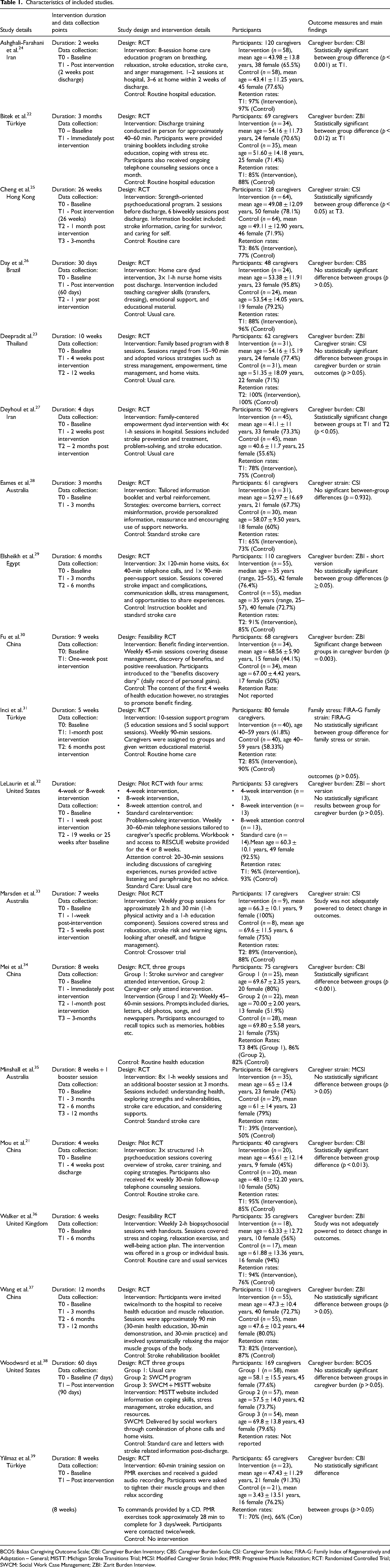
BCOS: Bakas Caregiving Outcome Scale; CBI: Caregiver Burden Inventory; CBS: Caregiver Burden Scale; CSI: Caregiver Strain Index; FIRA-G: Family Index of Regeneratively and Adaptation – General; MISTT: Michigan Stroke Transitions Trial; MCSI: Modified Caregiver Strain Index; PMR: Progressive Muscle Relaxation; RCT: Randomized Controlled Trial; SWCM: Social Work Case Management; ZBI: Zarit Burden Interview.
The total sample size recruited across all included studies was 1440 informal caregivers, and sample sizes ranged from 17 33 to 128 25 caregivers. The caregivers in most studies were predominately female (mean 72%). Of the studies that reported caregiver mean age this ranged from 41.1 27 to 70.0 34 years (median 53.7 years) for the intervention group and 40.6 to 69.8 years (median 53.9 years) for the control group. Among the studies that reported length of caregiving, this ranged from 14.5 days 27 to 10 years. 39 From the studies that reported caregiver relationship (n = 14),21,24–29,31–36,38 most of the caregivers recruited were a partner (46.2%) or a child (34.5%) of the stroke survivor. In addition, several studies (n = 9)21,22,24–26,28,29,31,38 reported living arrangements of caregivers, and within these studies 81.7% of caregivers lived with the stroke survivor.
End of intervention retention within included studies ranged from 39% 35 to 98% 34 (median 81.5) in the intervention groups, and from 50% 35 to 97% 24 (median 75) in the control group.
Interventions were conducted within acute or rehabilitation settings (n = 6),21,25,27,28,33,37 community (n = 2),29,36 caregivers’ home (n = 5),23,26,34,38,39 or across multiple settings (n = 6).22,24,30–32,35 Nine interventions were delivered face-to-face,24,26,27,30,31,33,34,36,37 seven through a combination of telephone and face-to-face sessions,21–23,25,28,29,39 and three interventions offered flexible modes such as a website, skype, telephone, or emails.32,35,38 Fourteen studies included interventions that were delivered on an individual basis,21,22,24–26,28,30,32,34,35,37–39 four delivered on a group basis,23,27,31,33 and two provided a choice between individual or group delivery.29,36 Interventions were delivered by nurses (n = 10),21–27,29,31,32 researchers (n = 3),36,37,39 psychologists (n = 2),34,35 occupational therapists (n = 1), 28 or multidisciplinary teams (n = 3).30,33,38
Majority of studies incorporated more than one component such as peer support, psychoeducation, and problem-solving.21,23–25,27–29,31,33,36–39 A total of nine studies incorporated an educational and/or support component focused on stroke risk factors, positioning and transfers, disease management, and stress management.22–24,26,28,30,31,33,38 One of these educational interventions also incorporated a physical activity component which comprised circuit training with strength training. 33 Four studies delivered psychoeducational programs which focused on skill building and providing stroke education in combination with psychotherapeutic strategies (i.e., counseling).21,25,29,35 Within other studies (n = 3) participants received education and training on how to complete relaxation exercises,36,37,39 and two interventions included problem-solving techniques such as providing caregivers with virtual problems to solve.27,32 The remaining intervention utilized reminiscence therapy to encourage participants to recall memories on various topics including childhood, dreams, and hobbies. 34
Interventions varied considerably in duration and total number of intervention sessions. Intervention duration ranged from 4 days 27 to 12 months 37 (median 56 days), and total number of intervention sessions offered ranged from 3 26 to 24 sessions37,39 (median eight sessions). Intervention sessions within the studies also varied in length. The majority of sessions (n = 14) ranged from 30 to ≤90 min,21–28,30–32,34,35,39 whereas three studies had sessions that were between 90 min to 2 h and 30 min.29,33,36 One intervention involved participants engaging in muscle relaxation for approximately 28 min three times per week. 39 Of the interventions that incorporated telephone contact, these sessions ranged from 30 to 60 min and telephone contact was made approximately three to six times throughout the intervention.25,28,29
Fourteen studies reported caregiver burden as an intervention outcome.21–24,26,27,29,30,32,34,36–39 Of these studies, eight22,23,29,30,32,36,37,39 used the Zarit Burden Interview 40 to measure burden, and four21,24,27,34 used the Caregiver Burden Inventory. 41 The remaining studies (n = 2)26,38 used the Caregiver Burden Scale (n = 1) 42 or Bakas Caregiving Outcomes Scale (n = 1). 43 Six studies reported on caregiver strain23,25,28,31,33,35 and utilized the Caregiver Strain Index 44 (n = 5)23,25,28,33,35 or Family Strain Index 45 (n = 1). 31 Two studies30,31 measured caregiver stress using the Adult Carer Quality of Life Questionnaire (n = 1) 46 or Family Stressors Index (n = 1). 45
Study quality
The methodological quality of studies is presented in Supplementary Figure S1. Eight studies were rated as “high risk”,22,27,31,33,35,37–39 six were rated as “some concerns”,21,23,24,29,30,34 and five were rated as “low risk” of bias overall.25,26,28,32,36 Two studies reported that participants were blinded to group allocation.30,31 Overall, 17 studies were not able to blind participants and researchers to intervention assignment due to the nature of the interventions. Concerns regarding performance bias were raised in two studies due to missing information and not using intention to treat analysis.31,35 In addition, some concerns were identified across eight studies due to outcome measurement which was mostly attributed to unblinded outcome assessors.27,29,31,33,35,37–39 Using Cohen's kappa, 47 the interrater reliability between two reviewers was 0.80, indicating a high level of agreement. A sensitivity analysis of studies by risk of bias for burden and strain outcomes generally revealed that studies with a higher risk of bias showed more favorable effects compared to studies with a lower risk of bias (Supplementary Figure S2 and S3).
Approaches used to inform intervention development
Thirteen studies utilized an approach such as a framework, model, or formative work to guide intervention components, identify session objectives, and for the development of strategies to achieve objectives.21,23,25–32,34–36 Twelve studies adopted a theoretical model or framework to guide their intervention approach.21,25,27–29,31,32,34,36 This included models such as the Health Belief Model, 28 Biopsychosocial model, 36 problem-solving and stress models (i.e., caregiving stress process model, problem-solving model),25,32 and family-centered models (i.e., Family-Centered Empowerment Model, the resiliency model of family stress).27,31 Theories and frameworks such as a dialogical and problematizing educational approach (n = 1), 26 stress coping theory (n = 2),30,32 and a collaborative therapy framework (n = 1) 35 were also used. Seven studies utilized formative work to guide intervention format, content, length, and delivery.21,28,32,34–36,38 Formative work comprised the use of qualitative methodology (n = 4) (i.e., questionnaires, focus groups, or interviews),23,28,36,38 the completion of systematic reviews (n = 2),21,35 and the use of an advisory panel and pilot study (n = 1). 32
Effectiveness of interventions
Fourteen studies evaluated the effects of a stroke caregiver intervention on caregiver burden.21–24,26,27,29,30,32,34,36–39 Findings from the meta-analysis (Supplementary Figure S4) revealed no overall significant difference in reduction in caregiver burden (Hedge's g = −0.40, 95% CI [−0.81 to 0.01], p = 0.05). Heterogeneity was high (T2 = 0.54, I2 = 89.2%) and no predictors explained this variation. A visual inspection of a funnel plot (Supplementary Figure S5) and Egger's regression test (p = 0.33) suggested no publication bias.
A small number of studies (n = 6) found statistically significant between-group differences for caregiver burden postintervention.21,22,24,27,30,34 Of these studies, five incorporated an intervention with an educational component21,22,24,27,30 and one used reminiscence therapy. 34 The majority (n = 4) of these interventions21,24,30,34 included between seven and nine sessions, and one study included four sessions. 27 These intervention sessions were delivered on a daily, 27 weekly,21,30,34 monthly, 22 or on a sporadic basis. 24 Of these studies that found statistically significant between-group difference, end of intervention retention ranged from 78% 27 to 97% 24 in the intervention groups, and from 75% 27 to 97% 24 in the control groups. From the studies that found mean difference between the intervention and control group, the majority (n = 4) were rated as “some concerns”,21,24,30,34 and two studies received an overall rating of “high risk”.22,27
Six studies reported on the effectiveness of a stroke caregiver intervention on reducing caregiver strain.23,25,28,31,33,35 Five studies had the necessary data to be included in the meta-analysis (Supplementary Figure S6).25,28,31,33,35 Findings from the meta-analysis showed no effect on reducing caregiver strain (Hedge's g = −0.14, 95% CI [−0.45 to 0.17], p = 0.38). Heterogeneity was low (T2 = 0.59, I2 = 48.7%). Egger's regression test (p = 0.40) and review of funnel plot (Supplementary Figure S7) resembled no significant asymmetry between studies and suggested no bias from smaller studies. Thus, no statistically significant evidence of publication bias was evident.
Two studies tested the effectiveness of interventions on reducing caregiver stress.30,31 One study utilized a benefit finding intervention and found a nonsignificant (p = 0.0549) between-group difference for caregiver stress postintervention. 30 The second study also found no statistically significant changes within the intervention or control group for family stressors (p = 0.512) or family distress (p = 0.924) outcomes. 31
Discussion
This review aimed to determine the nature and effectiveness of interventions designed to improve outcomes for informal stroke caregivers. Overall, meta-analyses revealed interventions were not effective in reducing burden or strain. In addition, we found no evidence that interventions were effective at reducing caregiver stress. A possible explanation for these findings could be the variation in the type of intervention, session frequency, and length of intervention. An alternative explanation could be the small sample size in pilot studies that were not powered to detect change.21,30,32,33,36 In addition, the majority of studies within this review did not use a codesign approach or complete formative work to inform intervention design and implementation. Evidence suggests, however, the use of a codesign approach is recommended to inform the development of relevant client-centered interventions and can lead to more effective interventions.48,49 Similarly, included studies were conducted across various settings, which made it challenging to draw meaningful comparisons of intervention effect.
A few studies within this review found significant between-group differences for caregiver burden and strain postintervention.21,22,24,25,27,30,34 The majority of these studies, however, were rated overall as “some concerns” for risk of bias, primarily due to inadequate or unclear concealment of allocation. Five of these studies, included between seven and nine intervention sessions with an educational component.21,24,25,27,30 Most interventions that incorporated an educational component, focused primarily on skills and training related to the stroke survivor. This is consistent with literature, which suggests within the first three months of the caregiving role, caregivers often report needing information and education on medication, treatment, and managing medical emergencies. 50 When caregivers at this stage are not provided with education and information, it can result in uncertainty and anxiety. Similarly, a review by Bakas et al. 11 found that interventions combining psychoeducation and skill building within five and nine sessions may improve caregiver outcomes.
In line with the findings of the current study, previous reviews found no statistically significant effects on caregiver outcomes.9,11 A meta-analysis by Cheng et al. 25 found a small but nonsignificant effect of psychoeducational interventions on reducing caregiver burden in family caregivers. Whereas a meta-analysis by Chin et al. 9 found a statistically significant reduction in depressive symptoms for technology-based interventions with an element of structured education. This review, however found no significant effects on other outcomes such as caregiver burden. Uniquely the current review reported on the use of approaches to inform intervention development, which may influence the effectiveness of interventions.
The majority of caregivers recruited within this review were a partner or child of the stroke survivor. This is reflective of statistics from countries within the Organisation for Economic Co-operation and Development. 51 Additionally, most studies within this review included predominantly female caregivers. This is reflective of global demographics which indicate that most caregivers (paid and unpaid), regardless of location and income level, are women. 52 The mean age of caregivers ranged from 40.6 to 70.0 years. This sample represents the average age of primary carers within countries such as Australia, 53 United States, 54 and United Kingdom. 55 There is a shift in global demographics with an increase in prevalence of young carers (2%–8%) between 2001 and 2011, 56 however, research indicates that young caregivers (aged ≤25 years) are often overlooked in research and policy.57,58 Based on limited evidence, young caregivers may experience unique challenges, including restricted peer networks, employment, and educational opportunities. 59
Studies within this review recruited caregivers at different time points in their caregiving role. As the caregiving trajectory can be nonlinear, the needs of stroke caregivers can change over time. Predictors such as time spent caregiving, lifestyle restrictions, and number of caregiving tasks are associated with burden at different time points.60,61 Therefore, it is important that where possible, interventions are designed to suit the specific needs of caregivers at different time points.
There are several strengths and limitations within this review. Through use of the PRISMA guidelines this review was conducted in a rigorous manner, reducing inherent bias and error. Moreover, the use of meta-analysis and the Cochrane Risk of Bias tool further strengthened this review. The findings of this review should be interpreted with consideration given potential limitations. First, although approximately 68% of included studies were conducted in non-English speaking countries, only articles published in English were included. Similarly, grey literature was not searched. This may introduce language bias and exclude alternative perspectives published in nonmainstream sources. Second, meta-analysis indicated high levels of heterogeneity for caregiver burden, and no predictors explained this variation. In addition, analyses were limited to postintervention results due to variation in intervention length and data collection points, so the long-term effect could not be established. Third, the majority of studies within this review scored an overall quality rating of “some concerns” or “high risk,” indicating a lower research quality, and highlighting a need for high-quality interventions in this population. Finally, in line with previous reviews, most of the included studies recruited predominantly female caregivers, so the impact of these interventions on male caregivers remains unclear.
This review demonstrates the importance of equipping caregivers with necessary skills and support, to reduce caregiver burden, stress, and strain. High-quality trials are needed to facilitate recommendations regarding the optimal intervention, type, frequency, and length of sessions. Similarly, future studies should consider a codesign approach and recruit diverse samples of caregivers including male carers and young carers who are underrepresented in research and policy.
Clinical messages
High-quality interventions that use a codesign approach to inform design and implementation are needed.
Future studies should consider recruiting diverse samples of caregivers including male and young carers.
Supplemental Material
sj-docx-1-cre-10.1177_02692155241271047 - Supplemental material for A systematic review and meta-analysis of randomized controlled trials to reduce burden, stress, and strain in informal stroke caregivers
Supplemental material, sj-docx-1-cre-10.1177_02692155241271047 for A systematic review and meta-analysis of randomized controlled trials to reduce burden, stress, and strain in informal stroke caregivers by Melissa Jammal, Gregory S Kolt, Karen P Y Liu, Justin M Guagliano, Nariman Dennaoui and Emma S George in Clinical Rehabilitation
Footnotes
Declaration of conflicting interests
The author(s) declared no potential conflicts of interest with respect to the research, authorship, and/or publication of this article.
Funding
The author(s) disclosed receipt of the following financial support for the research, authorship, and/or publication of this article: This work was supported by the Australian Government, (grant number Research Training Program Scholarship). Funding for author MJ was supported by the Research Training Program Scholarship.

Supplemental material
Supplemental material for this article is available online.
References
Supplementary Material
Please find the following supplemental material available below.
For Open Access articles published under a Creative Commons License, all supplemental material carries the same license as the article it is associated with.
For non-Open Access articles published, all supplemental material carries a non-exclusive license, and permission requests for re-use of supplemental material or any part of supplemental material shall be sent directly to the copyright owner as specified in the copyright notice associated with the article.
