



Abstract
Objective
To review methods for aquatic exercise monitoring using wearables.
Data sources
Database search of PubMed, IEEEXplore, Scopus and Web of Science based on keywords, considering articles from the year 2000. The last search was performed on 26 October 2022.
Review methods
Following the Preferred Reporting Items for Systematic Review and Meta-Analyses (PRISMA) protocol, eligible articles on water exercises were selected and summarized. Further screening process concentrated on studies exploiting wearable devices, organized according to demographics, purpose, protocols, outcomes and methods. A custom critical appraisal questionnaire was applied.
Results
Out of the 1062 articles identified, 572 were considered eligible and subjected to preliminary synthesis. The final review focused on 27 articles featuring wearable devices applied to aquatic exercises. Four studies were disregarded as they applied wearable devices to determine daily physical activity or for sleep monitoring after training. Summary tables of 23 studies exploiting wearable devices for underwater motion analysis are provided, specifying the investigated parameters, major outcomes and study quality. This review identified four research gaps: (a) the absence of clinical protocols for underwater motion studies, (b) a deficit of whole-body studies, (c) the lack of longitudinal studies monitored via wearable devices and (d) the reliance of underwater studies on measurement and assessment methods developed for land-based investigations.
Conclusions
This review emphasizes the need for both technological and methodological improvements for underwater motion analysis studies using wearables. We advocate for longitudinal clinical investigations with wearables to substantiate water exercise as an addition or replacement for land-based physical activity.
Introduction
Aquatic exercises and hydrotherapy are especially well suited where traditional land-based physical therapies are known to be potentially harmful, 1 due to the weight-reducing and stabilizing forces of buoyancy and drag that water provides. 2 Systematic reviews of aquatic motion analysis have focused on specific dysfunctions or conditions, such as neurological diseases,1,2 fibromyalgia, 3 asthma, 4 spinal cord injury,5,6 haemophilia 7 and stroke8–10. Additional reviews have also investigated the physiological effects of water, 11 evaluated the use of aquatic exercise for healthy subjects12,13 and for glycaemia 14 and studied the biophysical differences between aquatic and land-based treatments. 15 The presence of water generally constrains the application of classical investigative tools for motion analysis, including motion capture and electromyography.16,17 Currently, systematic investigations of underwater motion remain scarce: two reviews explored the literature on surface electromyography for exercises and gait in water, and for deep water running,18,19 while Heywood et al. 20 focused on spatiotemporal and kinematic parameters in water. Lastly, Marinho et al. 21 surveyed the use of wearable Inertial Measurement Units (IMUs) for underwater human monitoring for non-swimming activities.
The objective of this review is to identify major research gaps and determine potential improvements for future clinical studies by addressing two research questions. First, what are the most frequently applied methods for aquatic motion analysis over the past two decades? Second, what major gaps remain when considering the existing body of literature using IMU wearable devices for monitoring of underwater exercises, and what can be done to improve the understanding of aquatic motion analysis?
The current review provides a systematic assessment of the state of the art of aquatic exercises and hydrotherapy studies, following the Preferred Reporting Items for Systematic Review and Meta-Analyses 22 (PRISMA) method.
Methods
The review protocol was registered in the international database PROSPERO (CRD42022316782). The selected literature repositories were searched using specific keywords and considering only peer-reviewed articles published from 2000 onward. The final search was performed on 26 October 2022 by two independent reviewers.
The identification of candidate English-language literature was performed on PubMed, IEEE Xplore, Web of Science and Scopus databases. The complete list of keywords and filters applied is reported in Appendix (Table A1), as well as the number of articles selected per database. Due to the large number of potentially significant studies, the terms underwater, water and aquatic were used to refine the field of interest. The keyword combinations used for screening concerned general exercise terms including rehabilitation, training, hydrotherapy and kinematic. In addition, the exercise-specific keywords treadmill, gait and walk were included to improve the specificity of the filtering stage of the review. The keywords IMU, electromyography, motion capture, force plate and wearable devices were also included as they represent the most current aquatic exercise monitoring methods.
Potentially relevant articles and additional articles identified through citation searching were screened following PRISMA after removing duplicates (Figure 1). To reduce errors and avoid risk of bias, the identified articles were filtered, sorted, examined and evaluated by two independent authors. Based on the title and abstract, articles outside the scope of the research questions, review articles, publications featuring animals or robots, book chapters and theses, discussion articles and editorials unrelated to aquatic exercises were excluded. Subsequently, further works were omitted which were unrelated to active hydrotherapy including shower massages, spa therapies or passive water immersion, swimming, diving or other recreational water sports. In addition, articles developing mathematical models, works which provided guidelines for clinical study designs, physical activities surveys or publications testing novel waterproofing methodologies and tools were also excluded. A preliminary synthesis was conducted on the remaining eligible articles. The synthesis was used to define the state of the art, organize the studies by publication year, demographics, general characteristics and the methods used to investigate motion.
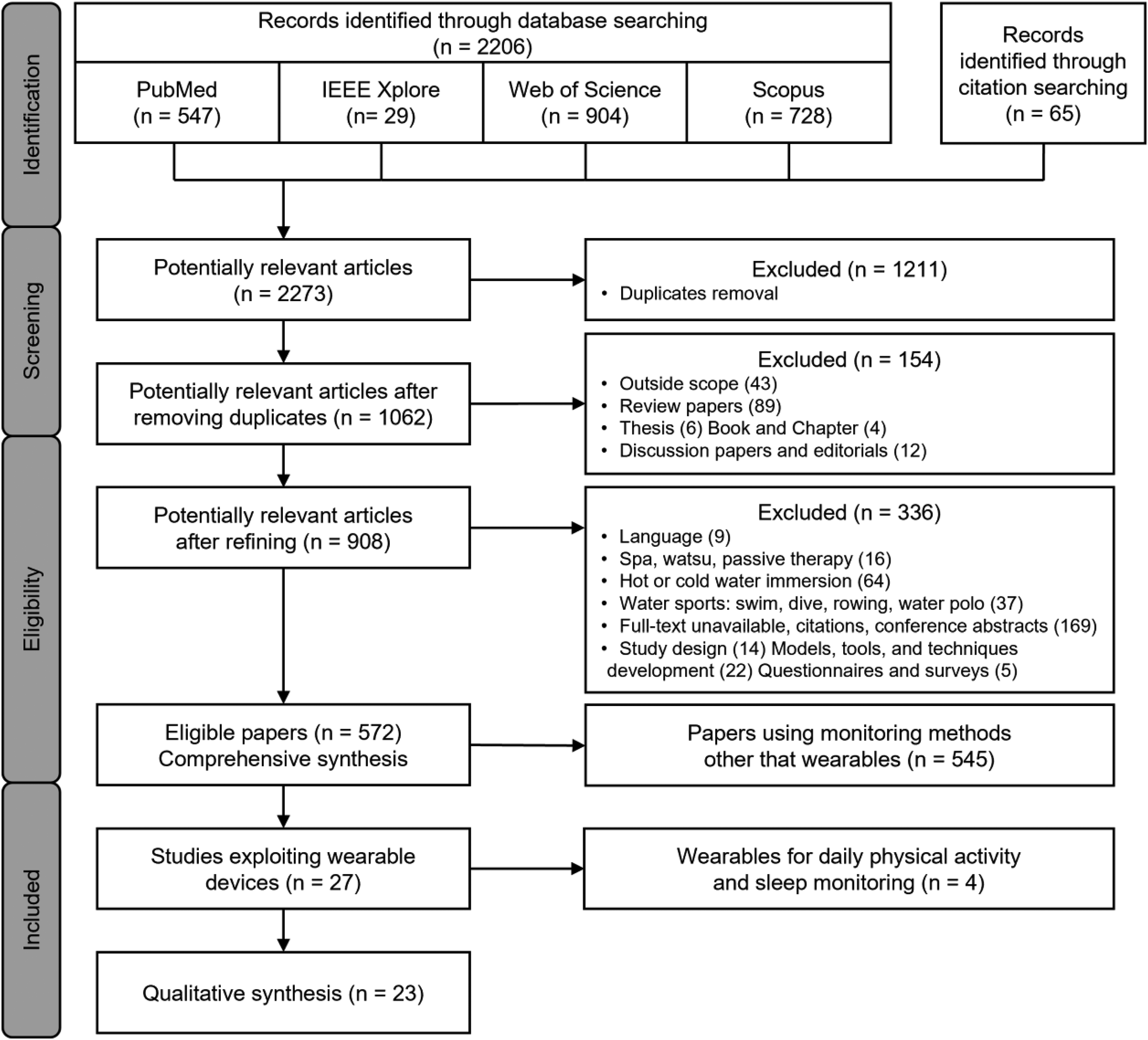
Flow diagram of the identification, screening, eligibility and inclusion steps of the Preferred Reporting Items for Systematic Review and Meta-Analyses (PRISMA) systematic literature review process.
Finally, PRISMA stage was considered solely the eligible articles exploiting wearable devices. A qualitative synthesis of works using wearable technologies for underwater motion analysis was conducted because a meta-analysis was considered inappropriate due to the substantial heterogeneity of the remaining studies. Articles using wearable devices to quantify daily physical activity or for sleep monitoring were disregarded from the qualitative synthesis.
An overview of the demographics and characteristics of the investigation, choice of protocol, evaluation method and estimated outcomes was generated. A custom critical appraisal questionnaire of the studies was created based on STROBE, 23 CASP 24 and McMaster 25 assessment tools. The custom questionnaire consists of nineteen questions and is provided in Table A2. Articles were evaluated according to positive, negative, partial answer or not applicability of the inquiry.
Results
Preliminary synthesis of the eligible articles
After removing duplicates, a total of 1062 potentially relevant articles were identified and filtered producing 572 eligible articles (Figure 1). In the period ranging from 2000 to 2010, 142 (25%) articles were published on water exercise and from the years 2011 to 2022, 430 (75%) articles were identified, indicating a growing interest of researchers and clinicians in aquatic activities.
Examining the structure of the eligible studies, 333 (58%) works analysed the whole rehabilitation cycle over multiple weeks to evaluate the effect of the long-term protocols through pre/post comparison. The remaining 239 (42%) studies investigated the subjects once, and generally presented results based on 5–10 repetitions of the investigated task to estimate the differences between water and land-based exercises.
Slightly more than half of the eligible articles (293, 51%) involved healthy subjects. The remaining 279 focused on patients with disorders and chronic conditions, 20 of which included a healthy control group. The most common conditions investigated were neurological impairments (100) including Parkinson's disease, stroke, multiple sclerosis, incomplete spinal cord injury and intellectual disabilities. The second most common conditions pain-related disorders including arthritis, osteoporosis, fibromyalgia and non-specific back pain (75). A total of 39 studies considered cardiovascular or respiratory diseases. Twenty articles involved children and 16 considered orthopaedic conditions. The remaining 29 works focused the investigation on various pathologies and conditions as diabetes, obesity and pregnancy.
The outcomes of water activities were monitored in 318 of the 572 eligible studies with quantitative methods. Among them, 88 works exploited two or more of these tools. The most common methodology exploited was the dynamometer (94), which was applied to estimate strength and muscular endurance. Force plates and pressure sensors were used in 88 studies to investigate the dynamic component of motion as ground reaction forces or to evaluate balance ability and proprioception. Kinematics were investigated with motion capture in 84 articles using optoelectronic 26 systems based on infrared cameras or video analysis using standard commercial cameras and smartphones. Electromyography was used in 81 articles to record the electric signals generated by muscle contraction via surface or intramuscular electrodes. A total of 34 studies exploited goniometers to measure joints’ range of motion, 27 articles used IMU devices to investigate motion using small, lightweight data loggers outfitted with a combination of triaxial accelerometer, gyroscope and magnetometer sensors. The remaining set of 13 studies made use of other highly customised technologies. The most common combinations of monitoring systems were motion capture and electromyography (17) or force plates (10) or both (6). Wearables were used in combination with motion capture, force plates and electromyography in 12 studies.
The other main category of techniques employed to monitor aquatic exercises are methods for metabolic assessments. The most common methods were heart rate and respiratory gas analysis. Semi-quantitative and qualitative methods for motion analysis included tests, scales and questionnaires, and were focused towards determining patient conditions, mobility and the overall effectiveness of water-based therapies. Furthermore, these methods can be categorized into seven distinct groups: (a) functional tests of motion-related, kinematic and muscular evaluations for gait specific tests, balance and postural control, exercise-specific parameters, mobility tests and muscular parameters; (b) metabolic tests based on cardiovascular, cardiorespiratory and/or ventilatory observations; (c) pain assessment; (d) rates of perceived exertion and fatigue; (e) condition-specific tests and questionnaires; (f) lifestyle and quality of life tests, mental health tests and / or physical activity level; (g) patient self-evaluation and other related tests. Of the 572 eligible articles, 447 (78%) utilized semi-quantitative and qualitative methods while 193 studies combined quantitative analysis with at least one of these 7 groups.
Qualitative summary on wearables for water motion analysis
Only 27 of 572 eligible articles exploited inertial-based wearable devices in studies on aquatic physical activity. The following tables synthesize 23 works in which inertial sensors assessed underwater motion, four remaining studies were excluded from the qualitative synthesis as they exploited accelerometers to evaluate the amount of daily physical activities27,28 and the quality of sleep29,30 of subjects undergoing hydrotherapy protocols (Figure 1).
Table 1 summarizes the characteristics and demographics of the included articles, showing that the majority of studies were published between 2017,31–38 201939–42 and 202043–46 and no articles were found before 2014. Most of the articles31–33,35–37,42,44–51 involved healthy adults or elderly subjects,41,43 while the remaining investigated anterior cruciate ligament injury,34,52 incomplete spinal cord injury39,40,53 and chronic anterior knee pain. 38 Three studies involved a healthy control group,34,38,39 and one 52 exploited previously published data of a healthy reference group. The sample size was typically 10 or more subjects, up to a maximum of 50, and 4 articles36,38,44,46 had a balanced gender distribution. One article included both the validation of the developed system as well as observational studies in the clinical field and in sport biomechanics. 34 All studies included observations of motion both on land and underwater, with the exception of 33,47,50,51 in which only underwater motion was investigated.
Review articles demographics. For each selected articles, the first author and publication year, participants investigated (Part), presence of control group (CG), sample size (Sample), gender distribution (M-F) and age are reported. The type of study and the environment investigated is listed in the final column (Measure).
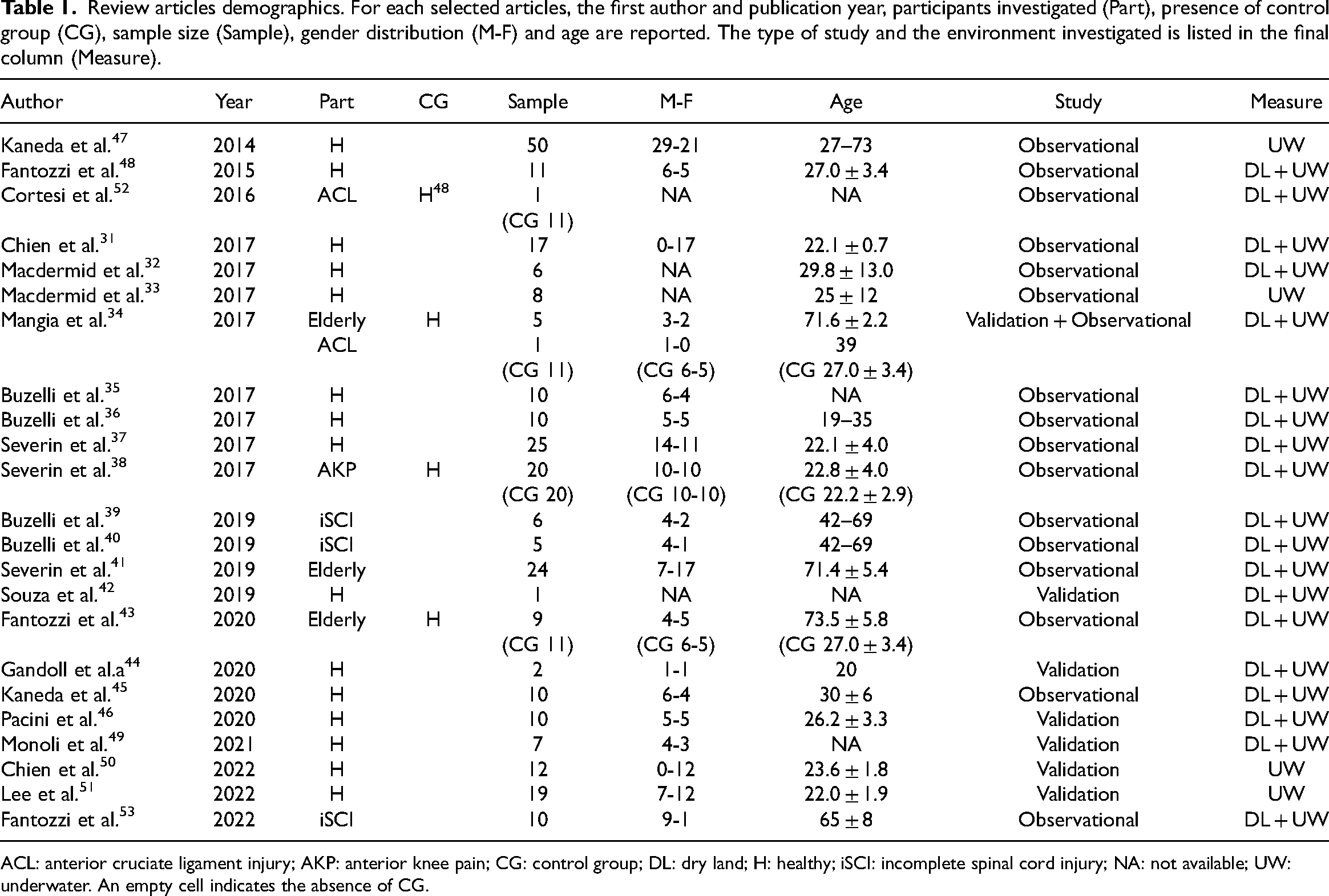
ACL: anterior cruciate ligament injury; AKP: anterior knee pain; CG: control group; DL: dry land; H: healthy; iSCI: incomplete spinal cord injury; NA: not available; UW: underwater. An empty cell indicates the absence of CG.
Table 2 outlines the study purpose, experimental protocols, measured outcomes, wearable technology, a description of additional methods and major study outcomes. The 23 analysed articles encompass a wide variety of study purposes concerning movement analysis, compare land and underwater motion or focus solely on methodological development and validation. This variety is also reflected in the adopted protocols, exercises and evaluation metrics. Gait analysis is performed on dry land and underwater in nine studies,34,42,43,45–49,51,52 following in four34,43,48,52 cases the Outwalk protocol. 54 In all of these works, as well as in studies evaluating running on a treadmill,32,33 the measured outcomes are focused on temporo-spatial parameters, joint kinematics and range of motion. In three studies37,38,41 squats, split squats and single limb squats have been performed to estimate joint kinematics, range of motion and asymmetries. In the remaining articles, gait initiation,36,40,53 balance during standing35,39 and countermovement jumps 50 were included to assess centre of pressure parameters and ground reaction forces. Exercise-specific parameters have been estimated when knee flexion-extension 31 and shoulder movements 44 were performed. Additionally, linear mixed models were developed43,48 to approximate the effects of water on the observed kinematic parameters. Ground reaction forces were quantified by accelerometer data in 50 and in two studies, quality and validation of algorithms were assessed.44,46
Summary of articles included in the review. Organized by publication year, investigation purpose, the exercise protocol followed, the main outcomes and the methods exploited for the analysis of motion. Considering wearable devices, the type of sensor, number and positioning are listed.
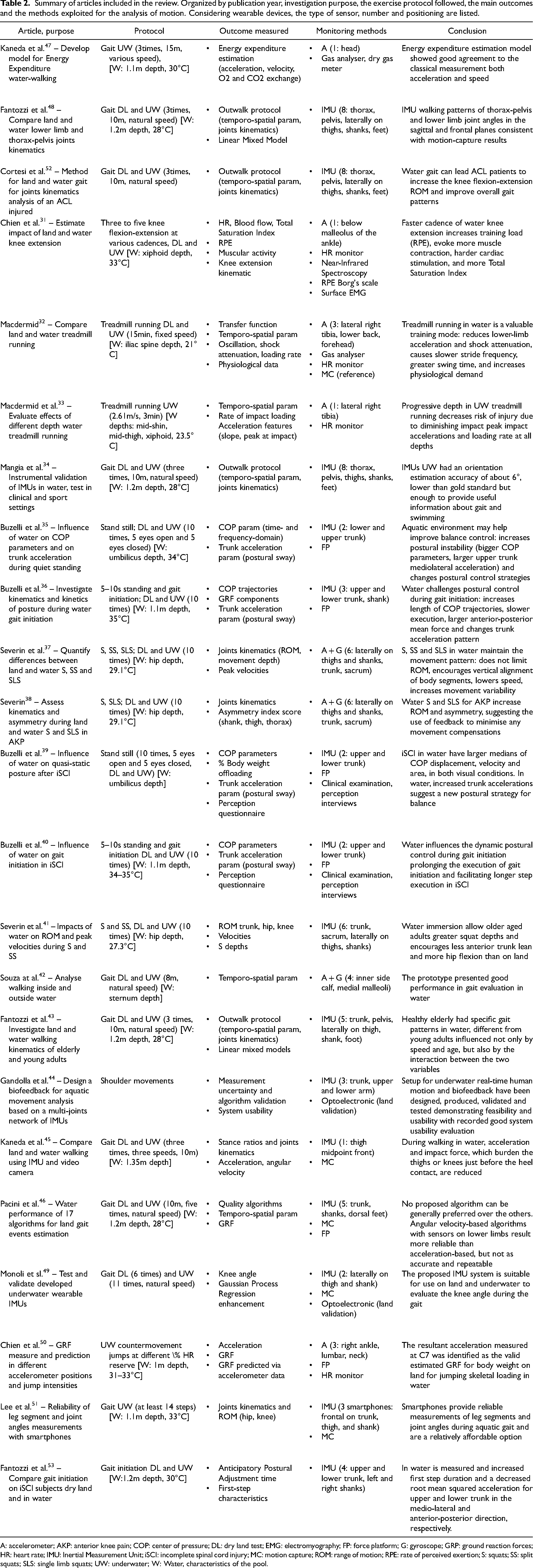
A: accelerometer; AKP: anterior knee pain; COP: center of pressure; DL: dry land test; EMG: electromyography; FP: force platform; G: gyroscope; GRP: ground reaction forces; HR: heart rate; IMU: Inertial Measurement Unit; iSCI: incomplete spinal cord injury; MC: motion capture; ROM: range of motion; RPE: rate of perceived exertion; S: squats; SS: split squats; SLS: single limb squats; UW: underwater; W: Water, characteristics of the pool.
Considering wearable methods, 13 studies made use of IMU sensors (gyroscope, magnetometer and accelerometer),34,35,36,39–41,43–46,48,49,52 3 used a sensor with accelerometer and gyroscope37,38,42 and 5 studies applied a stand-alone 3D accelerometer31–33,47,50; lastly, Lee and Han 51 explored the novel use of smartphones for underwater gait analysis. The number of devices and their positioning on the subject varied from one to eight, placed most commonly on the trunk and laterally on the lower limbs and in one case on the occipital region. 47 Notably, only one article investigated the upper limbs. 44 The sensor data sampling rates ranged from 50 Hz to 500 Hz and the waterproofing methods featured in the studies relied mostly on external casings and plastic bags.
Taking into account the use of additional quantitative investigation tools, eight studies exploited wearable devices only.34,37,38,41–43,48,52,53 Five articles included motion capture and optoelectronic system as support,45,46,51 reference 32 or as gold standard to validate the inertial sensors.44,49 Force plates were used by Marinho-Buzelli et al.35,36,39,40 to estimate the centre of pressure parameters and sway, and by Pacini Panebianco et al. 46 and Chien et al. 50 to determine ground reaction forces. Lastly, Chien et al., 31 accompanied the accelerometer data with electromyography for the investigation of muscular contraction and near-infrared spectroscopy to estimate the tissue saturation index.
Additional aquatic exercise monitoring methods included metabolic, cardiovascular and cardiorespiratory parameters were investigated using heart rate monitors31–33,50 and gas analysers.32,47 No studies were found to include functional or motion-related tests, pain assessment or lifestyle and quality of life questionnaires. However, the rate of perceived exertion was evaluated by Chien et al. 31 using Borg's scale and Marinho-Buzelli et al.39,40 performed a clinical examination on balance and perception via International Standards for Neurological Classification of Spinal Cord Injury, Berg's Balance Scale and Mini-BESTest and perception interviews.
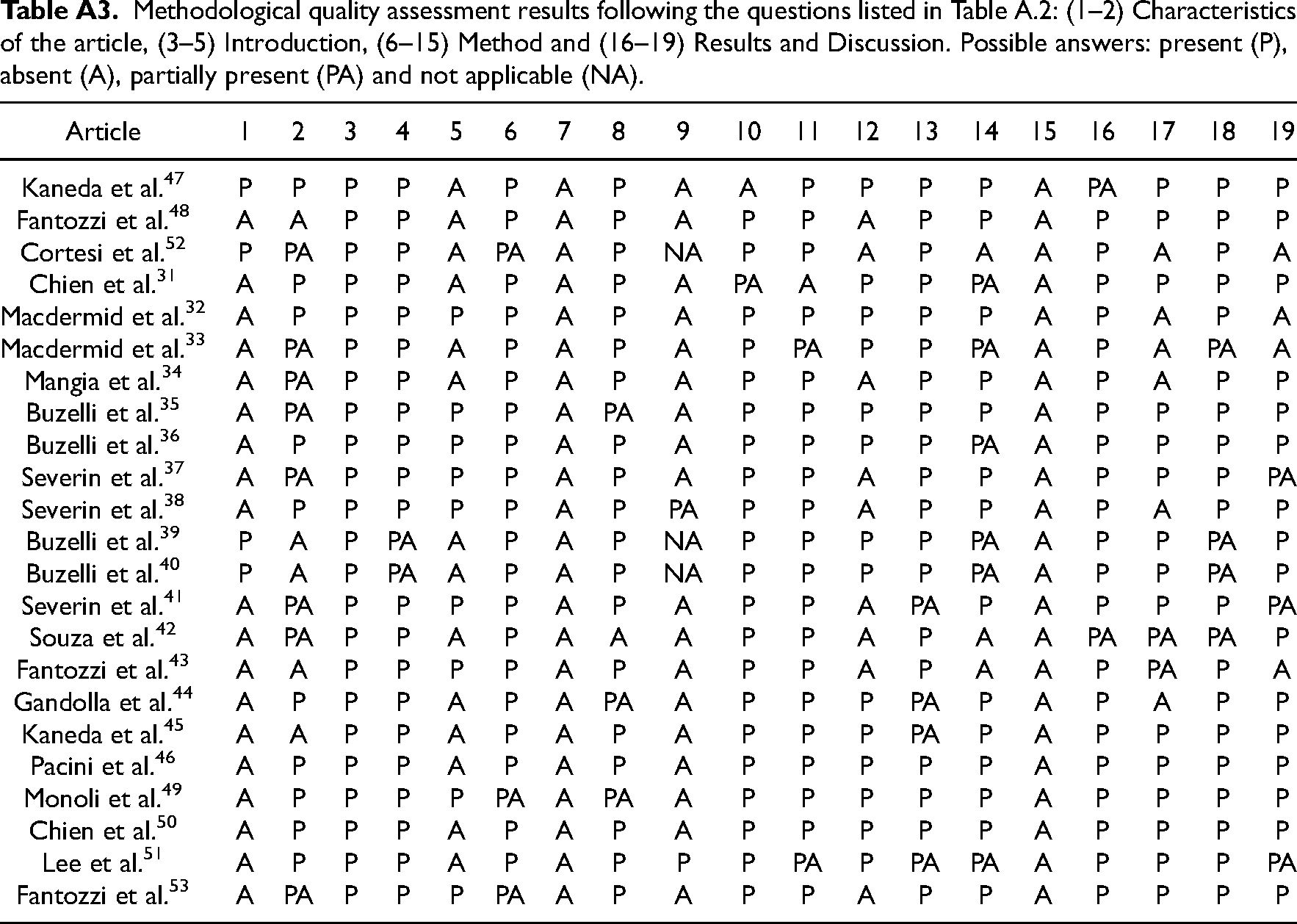
The critical assessment of the selected articles is provided in Table A3, and summarizes the answers to the custom questionnaire (Table A2). The analysed studies were generally found to be of satisfactory value, since most of the inquiries were marked as present or partially answered. Nonetheless, it is worth noting that four questions received mostly negative answers. The articles did not specify the study design (question 1), with the exception of two case series,39,40 a case study 52 and a cross-validation study. 47 Similarly, the study participants and inclusion/exclusion criteria were not clearly justified (question 9), apart from 38 which involved a gender-matched control group and 51 that conducted a power analysis to justify the number of subjects involved. Additionally, none of the studies included multiple measurements over a complete rehabilitation protocol (question 7), nor did any studies address the management of missing data (question 15).
Discussion
The synthesis of eligible articles addressed the first research question of this work, pointing out that the most frequent methods applied to perform aquatic motion analysis are dynamometers and force plates, followed by motion capture. Furthermore, it was possible to clearly differentiate between two major methodological categories: quantitative methods providing an objective evaluation of motion and qualitative or semi-quantitative methods to evaluate the quality of motion and the effects of water exercise across a scaled spectrum.
It is important to note that the current review did not distinguish between studies that evaluated motion underwater, on land or in both environments but considered all the methods exploited to assess motion in the context of aquatic exercise. The authors also wish to point out the limitations of this systematic review as the chosen keywords and inclusion criteria may have excluded some relevant studies. This review did not consider wearable sensors for swimming monitoring, choosing instead to focus on the investigation of water exercises. In contrast to Marinho et al. 21 which focused on defining the benefits of wearable technologies, this review identifies the research gaps and provides concrete suggestions to improve future aquatic exercise monitoring studies.
The second research question of this work focused on identifying major gaps in studies using wearable devices for monitoring of underwater exercises and making recommendations on how to improve aquatic motion analysis. Four major research gaps have been recognized. First, the absence of clinical protocols for underwater motion analysis studies. While the quality assessment indicates that the studies are of overall good quality, a lack of common methodologies renders the cross-comparison of study findings infeasible. Each article defined and used a distinctive protocol exploiting wearable devices, both in terms of number of sensors used and their placement on the body. Even when the task executed was similar, the study objectives, methods and outcomes varied greatly between studies. Future works may wish to define clear protocols for underwater wearables and allow for the quantitative comparison of water physical activities with increased confidence.
The second major research gap found is the substantial deficit of whole-body studies via wearable devices. This restriction is likely due to the technical difficulty of inertial sensor data analysis, especially in the water environment where standard methods do not exist. Focusing on a limited portion of the body, however, does not allow for the explicit consideration of the effects of drag and buoyancy as additional forces unique to the water environment.
The lack of longitudinal studies monitored via wearable devices was identified as the third main gap. All articles included in the qualitative synthesis had a maximum of 10 repetitions of the selected task, performed in one day and most of them included only healthy subjects. This may be due to the challenges associated with organizing repeated measures with wearable devices, resulting in limited insight into the influences of water on kinematic features as well as the effectiveness of long-term hydrotherapy.
The fourth gap identified a need for measurement and assessment methods specific to aquatic exercises, as studies remain heavily reliant on the use of land-based methods. When motion capture systems32,44,45,49 or other sensing modalities31,35,36,39,40,46,50 were used, they were nearly universally applied for cross-comparison or validation of a newly proposed method and data were infrequently related with wearable sensors data. Only a single study 46 combined multiple sensor data to improve motion assessment. Furthermore, only seven studies exploited additional methods for metabolism monitoring. A combined approach using multiple quantitative methods and the involvement of specific tests and questionnaires may improve the current interpretation of aquatic exercise and the effects of the water environment on kinematics.
The major finding of this review is that there is a substantial deficit of protocols and wearable monitoring methods for aquatic exercises. Specifically, we advocate for the establishment of common protocols for wearable sensor placement and whole-body monitoring during non-recreational aquatic exercise. Furthermore, we encourage longitudinal studies which include multiple sensing modalities to generate a more complete understanding of the effects of aquatic exercises on kinematic parameters.
Clinical messages
There is a lack of clear protocols for the use of wearable devices in underwater motion analysis, hindering the cross-comparison of studies.
Longitudinal studies monitored via wearable devices are necessary to estimate the effects of long-term aquatic exercises on kinematic parameters.
Incorporating wearable sensing technology into long-term hydrotherapy programmes may improve monitoring processes and the cross-comparison of study outcomes.
Footnotes
Author’s contribution
CM: Study design, data collection, analysis and interpretation and preparation of the manuscript.
JAT: Analysis and interpretation, preparation and revision of the manuscript.
LP: Study design and manuscript revision.
MG: Study design, interpretation of data and manuscript revision.
Declaration of conflicting interests
The authors declared no potential conflicts of interest with respect to the research, authorship, and/or publication of this article.
Funding
The authors disclosed receipt of the following financial support for the research, authorship, and/or publication of this article: This research was funded by the Estonian Centre of Excellence in IT (EXCITE) and European Regional Development Fund.

Appendix
Methodological quality assessment results following the questions listed in Table A.2: (1–2) Characteristics of the article, (3–5) Introduction, (6–15) Method and (16–19) Results and Discussion. Possible answers: present (P), absent (A), partially present (PA) and not applicable (NA).
| Article | 1 | 2 | 3 | 4 | 5 | 6 | 7 | 8 | 9 | 10 | 11 | 12 | 13 | 14 | 15 | 16 | 17 | 18 | 19 |
|---|---|---|---|---|---|---|---|---|---|---|---|---|---|---|---|---|---|---|---|
| Kaneda et al. 47 | P | P | P | P | A | P | A | P | A | A | P | P | P | P | A | PA | P | P | P |
| Fantozzi et al. 48 | A | A | P | P | A | P | A | P | A | P | P | A | P | P | A | P | P | P | P |
| Cortesi et al. 52 | P | PA | P | P | A | PA | A | P | NA | P | P | A | P | A | A | P | A | P | A |
| Chien et al. 31 | A | P | P | P | A | P | A | P | A | PA | A | P | P | PA | A | P | P | P | P |
| Macdermid et al. 32 | A | P | P | P | P | P | A | P | A | P | P | P | P | P | A | P | A | P | A |
| Macdermid et al. 33 | A | PA | P | P | A | P | A | P | A | P | PA | P | P | PA | A | P | A | PA | A |
| Mangia et al. 34 | A | PA | P | P | A | P | A | P | A | P | P | A | P | P | A | P | A | P | P |
| Buzelli et al. 35 | A | PA | P | P | P | P | A | PA | A | P | P | P | P | P | A | P | P | P | P |
| Buzelli et al. 36 | A | P | P | P | P | P | A | P | A | P | P | P | P | PA | A | P | P | P | P |
| Severin et al. 37 | A | PA | P | P | P | P | A | P | A | P | P | A | P | P | A | P | P | P | PA |
| Severin et al. 38 | A | P | P | P | P | P | A | P | PA | P | P | A | P | P | A | P | A | P | P |
| Buzelli et al. 39 | P | A | P | PA | A | P | A | P | NA | P | P | P | P | PA | A | P | P | PA | P |
| Buzelli et al. 40 | P | A | P | PA | A | P | A | P | NA | P | P | P | P | PA | A | P | P | PA | P |
| Severin et al. 41 | A | PA | P | P | P | P | A | P | A | P | P | A | PA | P | A | P | P | P | PA |
| Souza et al. 42 | A | PA | P | P | A | P | A | A | A | P | P | A | P | A | A | PA | PA | PA | P |
| Fantozzi et al. 43 | A | A | P | P | P | P | A | P | A | P | P | A | P | A | A | P | PA | P | A |
| Gandolla et al. 44 | A | P | P | P | A | P | A | PA | A | P | P | P | PA | P | A | P | A | P | P |
| Kaneda et al. 45 | A | A | P | P | A | P | A | P | A | P | P | P | PA | P | A | P | P | P | P |
| Pacini et al. 46 | A | P | P | P | A | P | A | P | A | P | P | P | P | P | A | P | P | P | P |
| Monoli et al. 49 | A | P | P | P | P | PA | A | PA | A | P | P | P | P | P | A | P | P | P | P |
| Chien et al. 50 | A | P | P | P | A | P | A | P | A | P | P | P | P | P | A | P | P | P | P |
| Lee et al. 51 | A | P | P | P | A | P | A | P | P | P | PA | P | PA | PA | A | P | P | P | PA |
| Fantozzi et al. 53 | A | PA | P | P | P | PA | A | P | A | P | P | A | P | P | A | P | P | P | P |