




Abstract
Objective:
To develop evidence-based recommendations for effective and safe diagnostic assessment and intervention strategies for the physiotherapy treatment of patients in intensive care units.
Methods:
We used the EBRO method, as recommended by the ‘Dutch Evidence Based Guideline Development Platform’ to develop an ‘evidence statement for physiotherapy in the intensive care unit’. This method consists of the identification of clinically relevant questions, followed by a systematic literature search, and summary of the evidence with final recommendations being moderated by feedback from experts.
Results:
Three relevant clinical domains were identified by experts: criteria to initiate treatment; measures to assess patients; evidence for effectiveness of treatments. In a systematic literature search, 129 relevant studies were identified and assessed for methodological quality and classified according to the level of evidence. The final evidence statement consisted of recommendations on eight absolute and four relative contra-indications to mobilization; a core set of nine specific instruments to assess impairments and activity restrictions; and six passive and four active effective interventions, with advice on (a) physiological measures to observe during treatment (with stopping criteria) and (b) what to record after the treatment.
Conclusions:
These recommendations form a protocol for treating people in an intensive care unit, based on best available evidence in mid-2014.
Introduction
More than 75000 patients with various life-threatening conditions are admitted to a Dutch intensive care unit each year. 1 Although the survival rate of these seriously ill patients has significantly increased through improvements in medical care, the number of patients with long-term impairments, regardless of the medical diagnosis of admission to the intensive care unit, has also increased. 2 Critical illness oftentimes associated with long-term bed rest and inactivity may lead to intensive care unit-acquired muscle weakness. 3
Intensive care unit-acquired muscle weakness is strongly associated with increased short- and long-term morbidity, physical impairments and mortality. 4 Intensive care unit-acquired muscle weakness is a frequently observed complication of critical illness, occurring in approximately 50% of intensive care patients.3,4 Growing evidence exists that early physiotherapy interventions (mobilization and stimulation of activities) in critically ill intensive care patients may influence or even prevent physical impairments.5–12 Within this literature, consensus about the use of physiotherapeutic measurement tools and strategies concerning the musculoskeletal and cardiopulmonary system are lacking. 11
Moreover, with the recognition of the importance of early mobilization of critically ill patients, a clear description of the physiotherapy clinical practice within the intensive care multidisciplinary team is warranted. Also guidelines or evidence statements regarding the safety and diagnostic process of physiotherapy interventions in intensive care patients, as well as the effectiveness of these interventions are needed.13,14
The effects of physiotherapeutic treatment strategies on different aspects of functioning and disabilities can be measured and classified according to the domains of the International Classification of Functioning, Disability and Health (ICF).15,16 The ICF has a logical coherent content, aids in determining classification and effective decision-making and is adopted in rehabilitation service. The purpose of this work was to formulate an evidence-based, expert driven, practical statement within the ICF domains, regarding diagnostics and effective and safe physiotherapy treatment strategies aiming at early mobilization and physical activity for patients in an intensive care unit.
Methods
For the development of an ‘evidence-based, expert driven, practical statement for physiotherapy in the intensive care unit’, we adhered to the recommendations of the ‘Dutch Evidence Based Guideline Development Platform’ (EBRO method).17,18 This method systematically follows several steps towards the development of an evidence-based guideline or statement.
First, analyse the problem to identify relevant ‘clinical key questions’; second, systematic search and appraise the literature systematically; and third write and discuss the draft guideline with feedback from experts and eventually establish the final recommendations. The final recommendations in this systematic process regarding diagnostics and treatment strategies of the musculoskeletal and cardiorespiratory system in intensive care patients were classified according to the ICF. 19
A project group was established with expertise from intensive care medicine, intensive care physiotherapy, guideline development and research to execute and monitor the process. The following steps of the method, according to the Dutch Evidence Based Guideline Development Platform, were undertaken.
Problem analysis to identify relevant ‘clinical key questions’
A postal survey among 70 Dutch hospital intensive care physiotherapists was held to search for the gaps in evidence-based clinical decision making with respect to intensive care physiotherapy. The domain of the respiratory system was not considered specifically, because of the current Dutch situation in which physiotherapist are primarily involved in the management of deconditioning.
With this, the following relevant clinical key questions were identified.
Which criteria are recommended in order to mobilize and activate patients in an intensive care unit safely?
Which clinimetrics and their psychometric properties are recommended to quantify physical functions and activities in intensive care patients according to the ICF classification?
Which physiotherapy interventions are effective to improve physical functions and activities in intensive care unit patients?
Systematic literature search
To answer the clinical key questions, we performed a systematic literature review with the following search terms: intensive care units, critical illness, acquired weakness, rehabilitation, physiotherapy, exercise therapy, functional training, activity of daily living, motor activity, early mobilization. Therefore we searched the electronic databases PubMed, Cochrane, Embase, PEDro and CINAHL from 1995 till September 2014.
We included studies with participants older than 18 years of age who were admitted to an intensive care unit. Articles regarding patients with neurological conditions that existed prior to intensive care unit admission, such as stroke and spinal cord lesions, were excluded.
Quality assessment of included articles
We assessed and classified the methodological quality of the retrieved studies into the level of evidence and grading of scientific conclusions according to the criteria of the Dutch quality institute for Health Care who are based on the Oxford Centre for Evidence-Based Medicine (OCEBM).18,20,21
Level A1: Systematic review.
Level A2: Double blinded randomized controlled trial of good quality and size.
Level B: Comparable research with not all characteristics of A2 (e.g. patient controlled and longitudinal cohort studies).
Level C: Non-comparable research.
Level D: Experts opinion.
Formulation of recommendations
To answer the three clinical key questions, we summarized the articles and formulated draft recommendations. In addition to the evidence-based conclusions from the literature, the project group added clinical relevant aspects, such as feasibility and costs, referred to as ‘other considerations’ to the initial recommendations.18,20 Each individual recommendation was based on the combination of the scientific level of evidence of the literature and the ‘clinical expertise.
Level 1: Recommendation based on evidence of research of level A1 or at least two independent studies from level A2.
Level 2: Recommendation based on one Level A2 study or at least two independent Level B studies.
Level 3: Recommendation based one study from Level B or C.
Level 4: Recommendation based on experts opinion.
Feedback from experts and formulation of final recommendations
Two different expert groups reviewed the draft recommendations in three different feedback rounds. One expert group consisted of two representative intensivists from the Dutch Society of Intensive Care (NVIC), employed at an academic and a general hospital. The other expert group consisted of 16 physiotherapists employed at academic and general hospitals with at least three years of experience within the treatment of intensive care unit patients.
In the first feedback round, experts provided their opinion with respect to the content, feasibility and implementation issues on a form composed for this purpose. The study group adjusted the recommendations according to the feedback, whereupon the final recommendations were presented again for approval to the expert groups. Finally, the agreed recommendations were integrated in a physiotherapy clinical reasoning workflow and submitted for final approval to the expert groups.
Results
Problem analysis to identify relevant ‘clinical key questions’
The survey revealed the need for recommendations in three areas:
to guide clinical practice with respect to safety criteria for early mobilization and activation;
for clinimetrics with good psychometric properties; and
for interventions (frequency, intensity, type and time: the FITT components) to improve the cardiorespiratory system and musculoskeletal system in intensive care unit patients. 22
The systematic literature search from 1995 till September 2014 yielded 129 studies. Two authors (JS and MvdS) assessed the studies for methodological quality. Subsequently, JS extracted the articles to answer the three clinical key questions and formulate draft recommendations.
Criteria for treatment and safety
In intensive care unit patients, early mobilization and activation is complicated because of the critical pulmonary and haemodynamic condition necessitating medication and invasive equipment. In addition, owing to critical illness, this medical situation can rapidly change. Therefore monitoring patients’ safety before and during mobilization and activation is of vital importance.
As part of the clinical reasoning process, every patient should be screened for the presence of red flags (contra-indications) and relative contra-indications to consider (potential) risks and benefits before and during every physiotherapy treatment session. These are shown in Figure 1. The strength of evidence of the recommendations for red flags is Level 1 and for ‘relative contra-indications’ Level 3 and 4 evidence.5,10,23–33
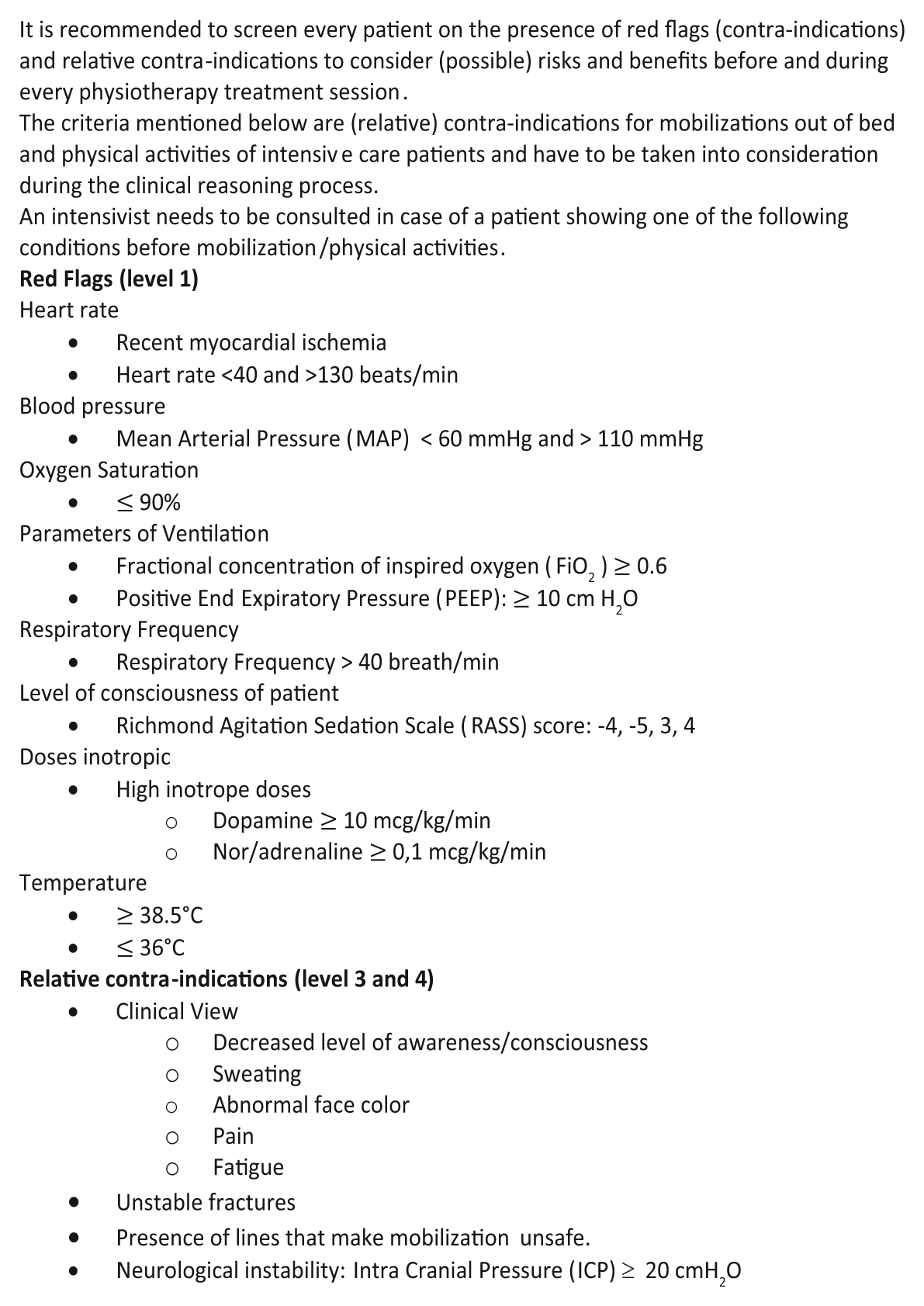
Criteria for safety of treatment.
Recommended assessments
The recommended assessment tools are (Figure 2):
Richmond Agitation Sedation Scale (RASS): Screening of global mental functions, i.e. patients responsiveness and consciousness (Level 1);
Standardized Five Questions (S5Q): Assessing patients’ ability to cooperate (Level 4);
Goniometry: Measuring range of joint motion (ROM) (Level 4);
Medical Research Council sum score (MRC): Measuring manually localized muscle strength as well as the summation of total muscle strength (Level 2);
Hand held dynamometry (HHD): Measuring localized muscle strength in muscles with MRC > 3 (Level 2);
Modified Ashworth Scale (MAS): Assessing muscle tone (Level 4);
Modified Nottingham Sensory Assessment (NSA): Evaluating sensory function (Level 4);
De Morton Mobility Index (DEMMI): Measuring functional ability (e.g. transfers in and out of the bed, standing balance and walking (Level 4);
The Borg Score: Monitoring exertion during exercise (in conscious patients) (Level 4).
These clinimetrics have moderate to good psychometric properties and can be used, when indicated, for diagnostics and tailor-made interventions at the bedside to evaluate impairments and activity restrictions within the ICF classification. The levels of recommendations are described in detail in Note 2 of the Appendix, available online.
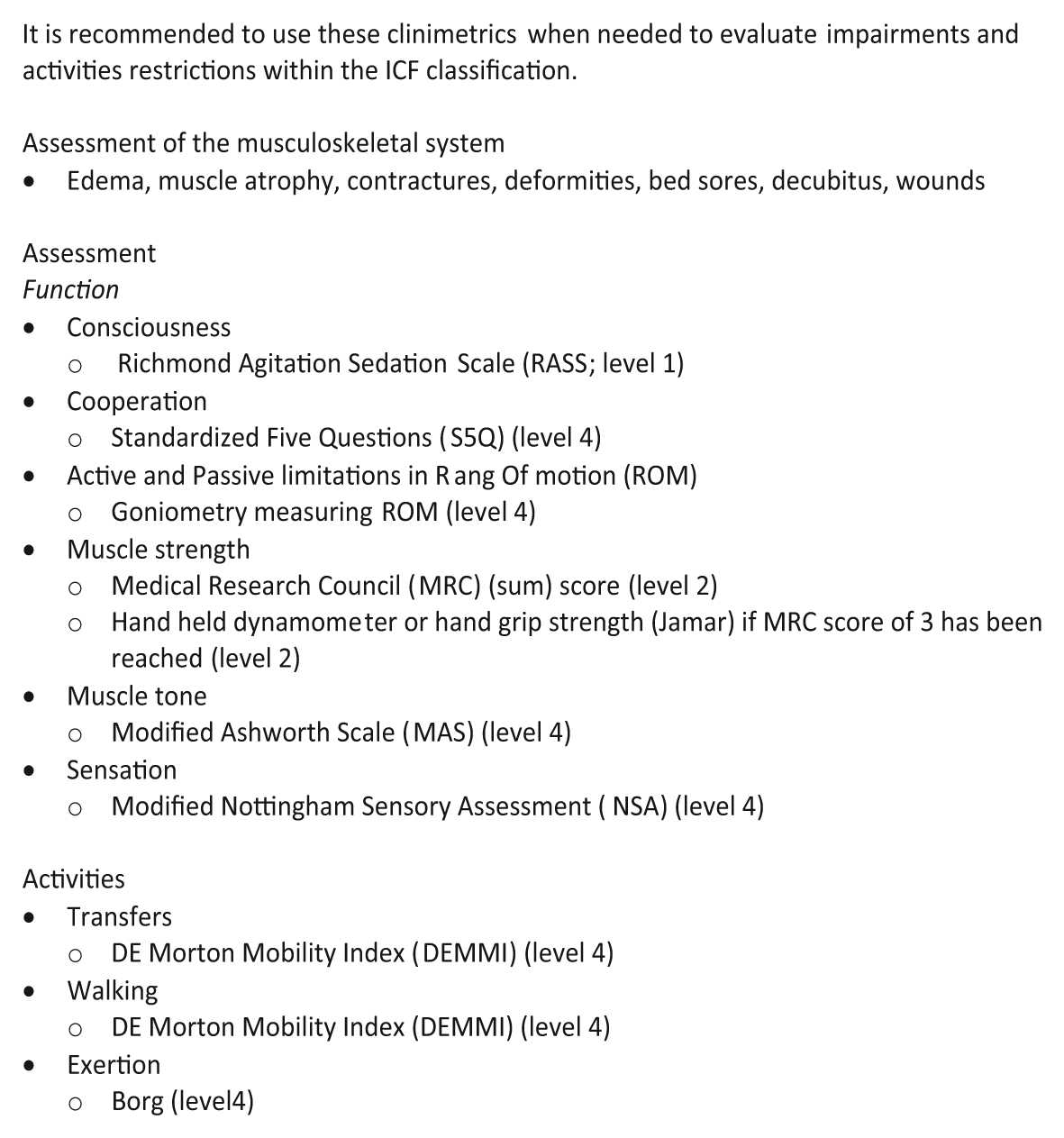
The recommended assessment tools.
Which physiotherapy interventions are effective?
The interventions that are recommended for intensive care patients, regardless of their medical diagnosis, are presented in the physiotherapy clinical reasoning regarding the therapeutic process and presented in Figure 3. The strength of the recommendations was between 1 and 4. In Note 3 of the Appendix (available online) a detailed description of the interventions as well as the level of evidence is provided. In Table 1, a summary of the different recommended interventions is presented.
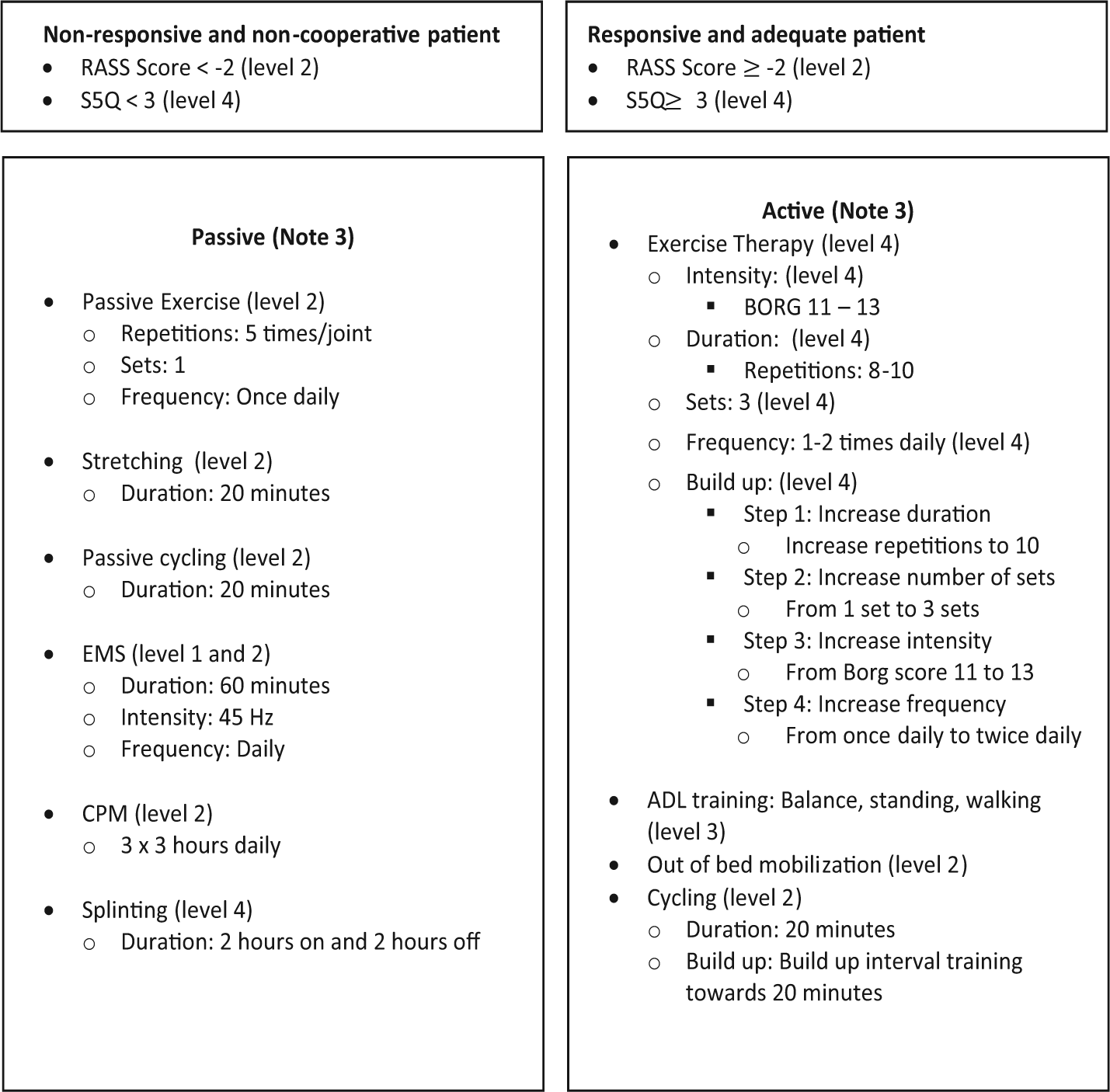
Physiotherapy intervention.
The effects of physiotherapeutic interventions on functional movement in intensive care patients according to the ICF classification.

6MWT: 6-minute walking test; ADL: activities of daily living; BI: Barthel Index; CIPNM: critical illness polyneuromyopathy; CPM: continuous passive motion; EMS: electro muscular stimulation; FIM: Functional Independence Measure; fr: respiratory rate; HHD: hand held dynamometer; ICU: intensive care unit; LOS: length of stay; MAP: mean arterial pressure; MEP: maximum expiratory pressure; MIP: maximum inspiratory pressure; MRC: Medical Research Council; NIRS: near infrared spectroscopy; ROM: range of motion; SF36: Short Form-36; Ve: minute ventilation; Vt: tidal volume; Vt/T1: flow rates; Katz-ADL: The Katz index of independence in Activities of Daily Living.
Scientific level of conclusion – Level 1: studies from A1 or minimal two A2 studies; Level 2: one A2 study or minimal two B studies; Level 3: one study from B or C; Level 4: opinion of expert.
For clinical practice, the recommended physiotherapy interventions are divided into interventions for patients who are able (active interventions) and who are not able to follow instructions (passive interventions), determined primarily by the level of consciousness. Changes in safety parameters should be monitored during each treatment session.
For unconscious patients the range of motion for joint contractures and muscle tone using passive joint movements should be monitored daily.25,30,34–36 In patients who are at risk for, or already have, joint contractures, stretching, splinting 37 or passive movements using continuous passive motion (CPM) should be applied for 20 minutes daily.36,38
In addition, passive cycling (20 minutes), CPM10,38,39 or electrical muscle stimulation (EMS) should be applied daily to stimulate muscle contractions.6,40–48
For patients who are conscious and able to follow instructions, active therapy modalities in a functional context are recommended. For the prevention of joint contractures and muscle tone a sequence of five active range of motion exercises are recommended daily.7,25,30,37 To prevent muscle atrophy and improve muscle strength, active exercises (building up training referring to FITT components: frequency, intensity, type and time, repetitions from eight till ten and sets from one till three,25,30,37,49,50 as well as 20 minutes of active cycling 10 are recommended.
To improve functional performance, mobilization in a functional context towards standing position and walking (from sitting on the edge of the bed towards sitting in the chair, and eventually walking, training of daily activities and active cycling (20 minutes per day)7,10,25,30,37,38,49,51–55 is recommended.
During the intervention the safety parameters, as well as the level of awareness/consciousness, should be monitored (Appendix, Note 5 and 7, available online). The intervention should be stopped according to the termination criteria (Appendix, Note 6, available online).
Discussion
We present the first evidence-based, expert driven and practical statement for the physiotherapy clinical reasoning process regarding motor functions and activities of intensive care patients. With that, this evidence statement provides evidence-based clinical recommendations regarding safety precautions, as well as the evaluation and treatment of musculoskeletal and cardiopulmonary functioning in intensive care, regardless of the medical diagnosis for which the patient was admitted to the intensive care unit. The levels of evidence are classified and provided.
This evidence statement follows the recommendations of the European Respiratory Society and European Society of Intensive Care Medicine Task Force on Physiotherapy for Critically Ill Patients. 37 In 2008, this task force identified targets for physiotherapy for intensive care patients and summarized the literature regarding the available effective physiotherapy interventions. With the discrepancies and lack of data on the efficacy of physiotherapy and of guidelines for physiotherapy assessments, there was a need to standardize pathways for clinical decision-making for physiotherapists.
Hanekom et al. 25 identified differences in clinical treatment strategies within and between countries.25,56,57 They developed a clinical management algorithm for early physical activity and mobilization of intensive care patients in order to decrease clinical variability and to improve patient safety. These studies established important clinical tools for the early mobilization and activation in intensive care patients.25,37 However, an evidence-based description of the clinical reasoning process and recommendations on the use of diagnostic tools and therapeutic interventions are still not available.
In addition to the available recommendations and algorithms, the present evidence statement provides explicit safety criteria for early mobilization, recommendations for the use of clinimetrics with psychometric properties and tailored interventions for relevant domains of functions and activities for intensive care patients based on the recent literature complemented with professional experience of intensive care physiotherapists and intensivists.
The strength of this evidence statement is that the recommendations are based on ‘strong’ (Level of 1 and 2) scientific evidence.7,10,49,58 However, when ‘clinical experience’ was integrated in the recommendations, the strength, for example the safety criteria, reduced to ‘moderate strong’.
One could criticise our limited search strategy that only included literature from 1995. However, we assume that we did not miss relevant literature since the first study on the effects of activity in critically ill patients was published in 1995 by Griffiths. 38 After this publication, a growing number of studies have been published on early mobilization and activation of intensive care patients, which were included in our search.
Our aim was to provide a core set of clinimetrics within the ICF levels function and activities based on a ‘strong’ level of scientific evidence. With respect to the assessment of functions, instruments to measure cooperation, range of motion and muscle strength have been described to be appropriate for the use in intensive care patients, but instruments measuring sensation and muscle tone have not been investigated in an intensive care population.34,35,37,59,60
Several measures of activities have been proposed for the use in intensive care patients. The Physical Function ICU Test (PFITT), Barthel Index (BI) and the Functional Independence Measure (FIM) have been proven to be valid and reliable, but several items are not applicable for the use in patients with low level physical function, resulting in floor effects and low responsiveness if used in intensive care patients.56,61–64 The Functional Status Score for the Intensive Care Unit (FSS-ICU) does contain relevant items for intensive care patients, such as bed mobility skills, but psychometric properties have not been established for an intensive care population.63,65 A disadvantage of the above-mentioned instruments (PFITT, BI, FIM, and FSS-ICU) is that these instruments measure at an ordinal scale, which limits the quantification of changes in physical function. 63
In the feedback rounds with the clinical experts, the DEMMI came forward to be used for measuring the ability to perform activities in intensive care patients. 66 The DEMMI measures mobility and its reliability, validity and absence of floor and ceiling effects have been shown in elderly hospitalized patients. 66 Although the psychometric properties of the DEMMI has not been established in intensive care patients, it was recommended because it is based on Rasch analysis, actually measuring real changes in functioning. 66 Moreover, validated translation versions of the DEMMI are available for different languages. 67 It is already part of standard physical therapy treatment in many hospitals in the Netherlands, which may facilitate the implementation for the use in intensive care patients.
In our opinion, the core set of instruments as proposed in this evidence statement is feasible and covers all relevant function and activity domains of critically ill patients.
In recent reviews and meta-analysis11,68,69 the clinical relevant effects of physiotherapy interventions in intensive care patients for improving physical functioning have been described. In healthy adults, the detailed information regarding the FITT components has been described and transferred into guidelines, whereas owing to the complexity and changes of the acute conditions in intensive care patients, this remains lacking in this population. 70
In the feedback rounds, physiotherapists and intensivists were asked to bring forward clinically relevant and feasible safety parameters to be used in the mobilization and activation of intensive care patients. These safety parameters might influence the training principles and involved FITT components. Safe and effective intensive care physiotherapy treatment strategies, including FITT components, should be developed in the future, as well as knowledge regarding the pathophysiological mechanisms and the influence of training.
The present evidence statement on physiotherapy at the intensive care is limited to recommendations with respect to the treatment of primarily the musculoskeletal system, because in the current Dutch situation physiotherapists are primarily involved in the management of deconditioning. However, we realize that the physiotherapy domain may also involve the respiratory condition of intensive care patients.37,71
Patient preferences should also be considered in the development of clinical guidelines. For this evidence statement, the survey to identify relevant issues for evidence-based practice was only directed towards intensive care physiotherapists. Although respondents were united with respect to three priority clinical key questions, it would have been interesting to investigate whether these are also reflecting preferences among intensive care survivors. 72
The strength of the recommendations within the evidence statement varies from moderate to strong. The methodological approach and the use of recent literature with a high level of evidence, supplemented with the feed-back from experienced physiotherapists and intensivists, ensures that the recommendations are evidence-based, as well as practical and feasible for the implementation in daily practice. Nevertheless, we believe that the evidence statement should be relevant for all intensive care patients.
Further research is recommended to determine the ideal dose and timing of exercise and the effect of exercise on specific conditions. Although the effectiveness of physiotherapy interventions is not for debate, the pathophysiological mechanisms of specific interventions and the dose – response relation in intensive care patients remains unknown.
Clinical messages
Evidence and expert knowledge on patients in an intensive care unit has lead to:
a set of criteria determining when it is safe to mobilize patients;
a set of clinical parameters and nine specific standard assessments for use in this setting;
recommendations on passive and active treatments to be used, and parameters to be monitored during treatment.
Footnotes
Acknowledgements
We acknowledge the physiotherapists and intensivists of the expert groups for their contributions in the three feedback rounds.
Conflict of interest
The authors declare that there is no conflict of interest.
Funding
This research received funding from Fonds NutsOhra (No. 1104-029).
References
Supplementary Material
Please find the following supplemental material available below.
For Open Access articles published under a Creative Commons License, all supplemental material carries the same license as the article it is associated with.
For non-Open Access articles published, all supplemental material carries a non-exclusive license, and permission requests for re-use of supplemental material or any part of supplemental material shall be sent directly to the copyright owner as specified in the copyright notice associated with the article.
