



Abstract
City centres and their retail spaces have faced major challenges in recent years, including the rise of e-commerce and out-of-town retail, the disruption caused by the COVID-19 pandemic, and the current cost-of-living crisis. These challenges, along with other changes to the retail sector, have led to high retail vacancy rates, reduced footfall, and a decline in department stores, particularly in UK city centres that have struggled in recent years to attract sufficient visitors to remain economically viable. Many cities in the UK have prepared strategic plans to respond to the recent challenges of retail spaces of city centres. This paper aims to explore how the UK Core Cities have dealt with these challenges at a strategic level. Through analysing their strategic plans, this paper investigates whether they have acknowledged the major challenges in the retail sector, whilst classifying the strategies that they have adopted to deal with these challenges. The results show that the studied cities have acknowledged the major changes to the retail sector and have adopted various strategies to address retail-related challenges. These strategies can be classified into three categories of temporary interventions, economic and financial interventions, and planning and design interventions. While there are considerable similarities among the adopted strategies, some cities have developed more comprehensive and innovative strategies, particularly in relation to planning and design interventions.
Introduction
City centres are currently experiencing unprecedented changes, evidenced through increasing retail vacancy rates, reductions in visitor numbers, changing shopping habits, and the growth in the number of out-of-centre outlets (Dolega and Lord, 2020; Hubbard, 2017; Lashgari and Shahab, 2022). The rise of online shopping, which accelerated during the COVID-19 pandemic, coupled with a cost-of-living crisis, has played a significant part in reshaping the role and function of city centres. This has amplified past concerns about whether traditional retail spaces in city centres may be becoming obsolete (Hughes and Jackson, 2015). The UK is among the countries with the highest share of retail e-commerce sales in the world. In 2019, e-commerce sales reached a share of 21.8% of all retail sales in the UK, jumped to 32.5% in 2020 as COVID-19 restrictions were implemented (Statista, 2021). While the increase in online shopping post-pandemic has not been as significant as previously anticipated (ONS, 2024), the current cost-of-living crisis yet revealed the vulnerability of retail-dominated city centres, further highlighting the need for city centres to shift away from a retail-dominated space (Whalley and Curwen, 2023).
This marks both a threat in terms of the potential resilience of city centres as retail hubs to major challenges (e.g. increase in online shopping, disruption caused by pandemics and reduced demand caused by high inflation rates and cost-of-living crises), and an opportunity for city centres to once again be reinvented for a new era. The loss of vitality in city centres has previously been associated with physical decay, crime, loss of land values, and negative stereotypes (Collis et al., 2010; Whysall, 2011), serving as warnings of the potential impacts of neglect of these spaces for the future. The role of city centres as places of monetary transactions and consumption has been challenged during recent years (Kickert and Talen, 2022). The revitalisation of city centres is important as they are not simply locations for shopping and service provision, but also form part of collective identities, and places of shared interaction and experiences (Sepe, 2013; Woolley et al., 1999). Some retail spaces of city centres have redefined their functions to address these challenges, for example, through increasing entertainment and leisure functions to increase the overall attractiveness of retail destinations (Coca-Stefaniak, 2013; Mumford et al., 2017; Teller et al., 2016). Following Sparks (2021), it is important to acknowledge that even amidst significant challenges and structural shifts within the retail sector, certain high streets and city centres continue to thrive. This resilience underscores the significance of factors extending beyond retail, specifically those pertaining to the overall vibrancy of a city or urban area.
Yet, the issue of redundant retail space has been a major concern for decision makers in the UK, particularly since the global economic crisis of 2008 (Hallsworth, 2010; Wrigley and Dolega, 2011). According to Dolega and Lord (2020), the 2008 economic crisis and the following austerity period have adversely affected city centres in the UK. For example, the average vacancy rate in the UK’s city centres doubled between 2008 and 2012 (Wrigley et al., 2015). Since then, some city centres have been able to reshape their structure to survive the crisis, while others have witnessed dramatic increases in vacant retail units due to reduced levels of economic viability for the retail sector (Dolega and Lord, 2020). The COVID-19 pandemic added additional pressures, with shopping centres, predominantly located in city centres, seeing a 5.2% rise in vacancies between 2019 and 2021 before declining 1.6% by 2023 as city centres began to slowly recover (Local Data Company, nd, Centre for Cities, 2022). Following the end of pandemic restrictions, the cost-of-living crisis in the UK has seen consumers rein in spending, resulting in increased pressure on retailers and a 56% increase in retail insolvencies between 2021/22 and 2022/23 (1942 in 2022/23 – up from 1243 in 2021/22) (RPC, 2023).
Policy makers at various government levels in the UK have responded to the challenges that city centres and their retail spaces face. In 2021 the UK Government published a policy paper entitled ‘Build Back Better High Streets’ which set out the government’s vision for the future of the high street. Previously, an independent review into UK high streets concluded that ‘high streets have reached a crisis point’ (Portas, 2011). At a local level, many cities in the UK have prepared post-pandemic recovery plans and/or revised their strategic plans to respond to the major changes caused by the pandemic while also increasingly turning their attention to the cost-of-living crisis. Despite academic research on the challenges that city centres face as a result of the triple shock of online shopping, the COVID-19 pandemic, and cost-of-living crisis little is known about how UK cities have responded to such challenges and what interventions they have designed and/or implemented at a strategic level to address the issues surrounding the changing role and function of city centres.
This paper aims to address this gap through answering the following questions: whether/how have the UK Core Cities (i.e. an alliance of 11 major cities in the UK) acknowledged the changes in retail sector in their strategic and/or recovery plans post-pandemic? What are the key retail-related challenges that have been acknowledged in the strategic/recovery plans of the UK Core Cities? What strategies have the UK Core Cities adopted to deal with retail-related challenges? And what are the similarities and differences between the adopted strategies between the UK Core Cities? To this end, the paper first provides a brief review of literature on the changing role of city centres and their retail spaces. Then, it presents the methodological steps that were undertaken in searching for relevant policy documents and their analysis. The paper goes on to analyse the strategies adopted by decision makers to deal with retail-related challenges in the UK Core Cities. Finally, the paper presents the conclusions of this research.
Changing role of city centres and their retail spaces
The UK’s retail landscape has undergone significant change since the mid-1990s when planning policy sought to prioritise retail development within town and district centres and away from out-of-town developments in reaction to declining high streets (Guy, 2002). This presumption in favour of town centres was operationalised through the sequential test that put the onus on retail developers to prove that there were no suitable and available alternatives within existing nearby town or district centres (Whysall, 2011). The policy focus on ensuring the ‘vitality’ and ‘viability’ of town centres was often praised locally as a key means of stopping the hollowing out of the high street but was also met with criticism for its inflexibility and lack of recognition of the changing behaviours of consumers and the broader retail market (Dolega and Lord, 2020). The restrictive nature of the policy also often limited the ability of town and district centres to deal with economic shocks and increased competition (Hallsworth and Coca-Stefaniak, 2018; Hughes and Jackson, 2015; Wrigley and Dolega, 2011).
The need to acknowledge the heterogeneity of town centres also extends to the existence of a hierarchy of retail centres depending on a range of contextual factors (Jones, 2021). This hierarchy has typically been explored through various indicators of town centre size and attractiveness that are used to identify the relative position of a centre in relation to others (Dolega et al., 2021). Smaller town centres tend to provide very local services and are comprised of constrained catchment areas while those at the other end of the hierarchy have regional catchments, provide multi-purpose shopping experiences, and draw on a large labour market area (Coca-Stefaniak et al., 2010; Dennis et al., 2002; Dolega et al., 2016; Guy, 1998). Beyond academic classifications, retail hierarchies have been used in the design and delivery of planning policy, most recently in England where the National Planning Policy Framework states that planning policies should ‘define a network and hierarchy of town centres and promote their long-term vitality and viability’ (DLUHC, 2023: p. 26). Here, ‘town centre’ is broadly defined to include ‘city centres, town centres, district centres and local centres’ (Ibid), acknowledging the existence of various types of retail centres yet at the same time generically designing and applying policy without differentiation across this hierarchy.
Yet city centres have traditionally formed a key policy focus of central government. Previous efforts have focused on the development of regeneration policies, design interventions, community initiatives, and innovative financial mechanisms targeted to city centres (Zheng et al., 2014). Driven by public-private partnerships, inner-city regeneration of former ‘left-behind’ post-industrial cities saw a focus on retail and residential development, resulting in the re-population of city centres and subsequent revitalisation of urban spaces for new mixed uses and commercial activity (Bailey, 1994; Emery, 2006). One of the aims of this ‘residentialisation’ of city centres was to generate local retail demand and increased social and economic activity both during the day and night to counter the out-of-town retail offering (Bromley et al., 2005). This re-population of city centres was coupled with a policy push to develop mixed-use regional centres that could attract a greater number of consumers through an expansion of retail catchments focused on large anchor stores, established luxury brands, expanded leisure offerings, and renewed public spaces maintained through private management to allow careful curation of the retail areas (Carmona, 2015; Guy, 2010; Helbrecht and Dirksmeier, 2012; Hubbard, 2017). These efforts were however criticised for the exclusionary nature of developments, socio-economic impacts on existing neighbourhoods, and deregulation of development controls (Ball and Maginn, 2005; Belotti and Arbaci, 2020; Erie et al., 2010).
The economic crisis of the late 2000s resulted in the bursting of the property bubble and subsequent decline in city centre regeneration activities (Jones and Evans, 2013). This period also coincided with the rise of e-commerce which saw large brands begin to re-purpose their retail offer to enable click-and-collect while established city centre retailers also faced increased competition from online retailers who benefited from not having to pay business rates (Grimsey, 2018; Wang and Goldfarb, 2017). As austerity continued, a shift towards more value driven consumers also changed retail habits resulting in an increase in online price comparison and more focus on lower cost retail offerings (Dolega and Lord, 2020; Reynolds et al., 2007; Rhodes, 2015). Yet despite these challenges, major city centres were not as badly impacted as secondary and tertiary centres that lacked regular weekday footfall due to the concentration of jobs, large and diverse range of retail sites, convenience stores, and leisure opportunities in close proximity to one another (Singleton et al., 2016; Swinney and Sivaev, 2013; Wrigley and Dolega, 2011). Wrigley et al. (2015) argue that this ‘convenience culture’ was a key driver of the retail success and resilience of large city centres during the austerity period.
The overarching premise of this retail model was tested as the COVID-19 pandemic resulted in first drastic reductions in city centre workers due to multiple lockdowns followed by social distancing restrictions and then a desire by employees for more permanent shifts to accommodate new work-from-home patterns (Deole et al., 2023; Magriço et al., 2023). Modelled analysis of the impact of the March 2020 lockdown restrictions in England on footfall demonstrated a 57–75% reduction followed by highly variable rates of recovery after the lifting of restrictions (Enoch et al., 2022). The same analysis showed that larger centres fared worse compared to smaller centres – likely due to the reduced number of commuters and decline in more discretionary journeys coupled with work-from-home polices that meant employees were more likely to shop near their residence compared to where they use to work (Enoch et al., 2022). Concerns about the impacts of work-from-home policies on the economy were amplified by government, with the then Cabinet Office Minister pushing for civil servants across England to return to their offices, noting ‘this will bring economic benefits for businesses across the country, with sandwich shops and the hospitality sector due to see a dramatic increase in footfall’ (Cabinet Office, 2022). The ‘convenience culture’ driven by employment-based footfall that served major city centres well during austerity became a concern during the COVID-19 pandemic and continues to provide challenges for the subsequent recovery and work-from-home policies being implemented within the UK.
Early attempts to support local businesses and draw consumers back to city centres following lockdown and the introduction of social distancing saw the implementation of temporary design interventions within the built environment focused on balancing health guidelines and consumer demand for more outdoor social spaces (Andres et al., 2021). This temporary urbanism approach typically involves ‘processes, practices and policies of and for spatial adaptability, which allow the activation of a space in perceived need of transformation, thus leading to paths of change through a trajectory of transformation’ (Andres and Kraftl, 2021). While originally stemming from more informal and spontaneous interventions and occupations on public space, temporary urbanism has increasingly been formalised and institutionalised as a deliberate urban regeneration strategy (Andres and Zhang, 2020). Here, the ‘power of temporary use’ (Oswalt et al., 2013) has been used to address issues of urban blight, vacancy, and decline (Colomb, 2012; Haydn and Temel, 2006; Martin et al., 2020). During COVID-19 a more hybrid approach that saw rapid state acquiescence to bottom-up requests for temporary use of spaces, such as expanded use of public space for restaurants and bars, was developed (Andres et al., 2021). Yet, as Martin et al. (2020) note, there is often a poor understanding of the roles played by the various stakeholders and users involved in the use of such temporary spaces, the types of spaces developed, and their spatial location within cities.
The ability of city centres to quickly implement such temporary measures along with responsive city centre management and governance approaches can be thought of in relation to a location’s adaptative resilience. City centre resilience is traditionally thought of in relation to its vitality and viability, with changes in land use and urban regeneration seen as key success outcomes of an urban centre’s adaptative cycle (Wrigley and Dolega, 2011). Powe (2020) argues that, as complex adaptive places, city centre success is reliant on high-level policies that support key visitor and community attractions, more targeted actions to encourage positive change, and a proactive and open approach that can take account of emergent activities and opportunities. Strategic factors influencing economic outcomes of city centre resilience are also seen to relate to a combination of regional characteristics and wider multi-level economic and consumer dynamics (Coca-Stefaniak, 2013; Singleton et al., 2016; Wrigley and Dolega, 2011). Yet studies of city and town centre resilience and adaptability have been criticised for failing to address the shorter-term recovery process following an economic shock and the ways that such centres go about developing new growth trajectories (Dolega and Celińska-Janowicz, 2015).
As part of the COVID-19 economic recovery process, the UK government developed the Build Back Better high streets strategy aimed at supporting the long-term recovery and transformation of high streets (DLUHC, 2021). The strategy sought to address building vacancies, provide business support, improve the public realm, improve safety and cleanliness, and improve civic pride. The approach did not focus solely on retail recovery, nor city centres specifically, but also included wider considerations around housing, green space and green infrastructure, and wider place-making and drew on a range of existing funds to support initiatives noted in the strategy. There was also a strong emphasis on partnership working between residents and businesses and a desire to tailor implementation to local contexts (Maliphant, 2021). Despite this, the strategy has been criticised for its ambiguity and lack of detail in relation to place-based issues (McCann et al., 2021) and indeed repeatedly refers to ‘high streets and town centres’, highlighting the lack of explicit policy attention to the unique challenges of city centres. This national policy void necessitates the need to better understand the local development of city centre recovery strategies, the key actors and stakeholders involved, the issues identified, and the interventions proposed to better understand the potential resilience and future growth trajectories of city centre retail, to which this paper now turns.
Methodology
This study uses a case study of UK Core Cities, an alliance of 11 major cities in the UK, to analyse the strategies adopted by decision makers to deal with retail-related challenges in city centres. These cities include Belfast, Birmingham, Bristol, Cardiff, Glasgow, Leeds, Liverpool, Manchester, Newcastle, Nottingham, and Sheffield. The UK Core Cities are representative of small to medium sized cities in the UK, but exclude the capital cities of London and Edinburgh. The Core Cities have different characteristics including operating within different legal systems and government structures, as they span four nations (i.e. England, Wales, Scotland and Northern Ireland). They also include different types of city governance and leadership (e.g. directly elected mayors that oversee multiple local authorities or conventional political councils) and have grappled to adjust to the decline of their former industrial economies (Champion and Townsend, 2011, 2013; Hincks et al., 2014). Their founding was predicated on the mutual development of their regional economies, lobbying of central government, counter-balancing the strength of the London economy, and promotion of investment in their cities as a means of benefiting their wider regions through a ‘trickle-down’ process (Townsend and Champion, 2020). The leaders of the member cities meet regularly to discuss areas of mutual interest and concern and regularly publish policy and research reports on a range of topics (Core Cities, nd). Their most recent (Core Cities UK, 2022) priorities include a specific reference to ‘tackling … Covid/city centre recovery’. The Core Cities were chosen due to this mutual priority of COVID city centre recovery within the context of a political body designed to encourage innovative policy exchange and development.
The description of the policy documents investigated in this study.
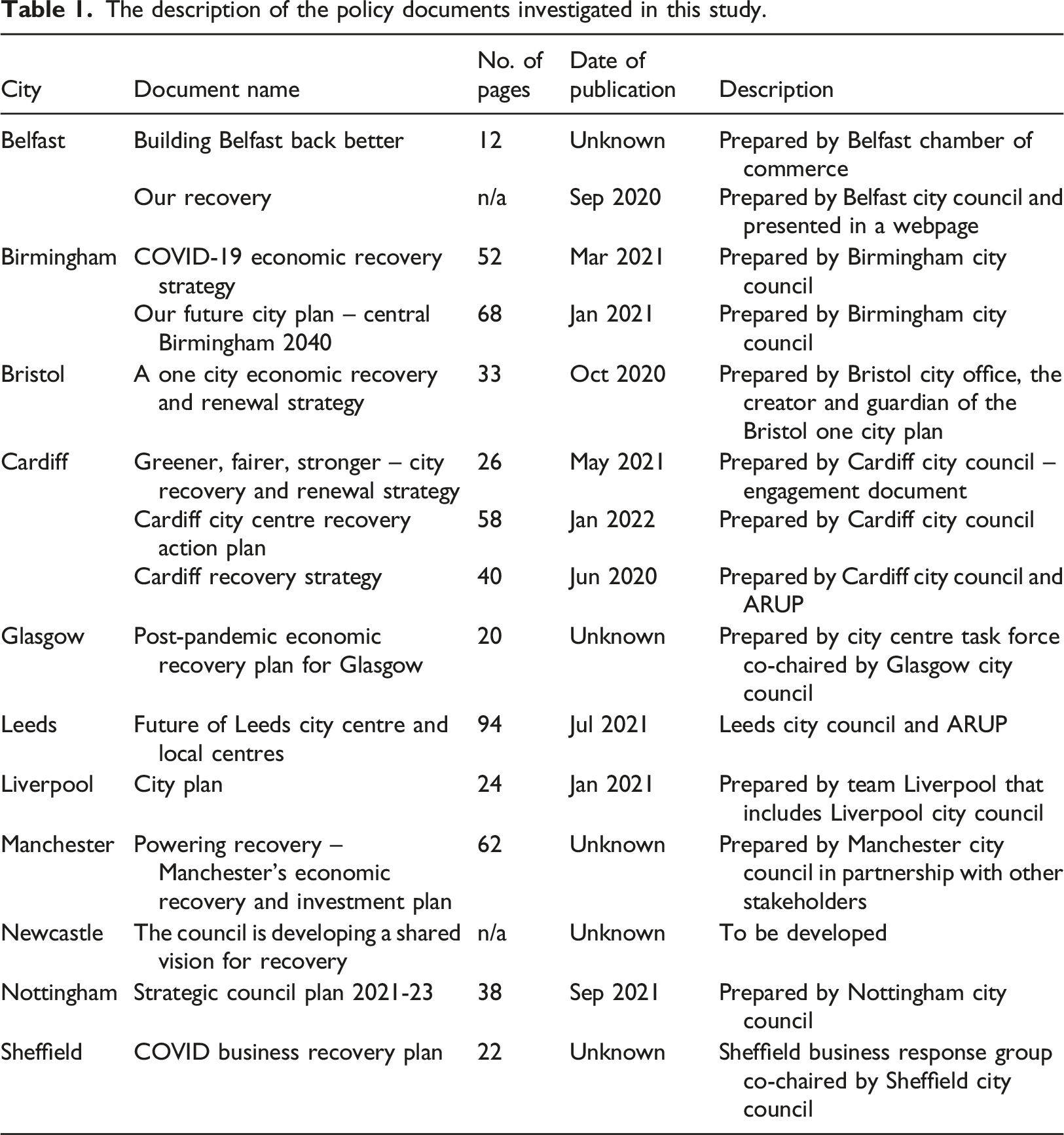
In the second stage, the researchers read the selected policy documents, including both skimming (i.e. superficial examination) and thorough examination (Bowen, 2009). In the third stage, the researchers conducted a thematic analysis, informed by the research questions. The thematic analysis undertaken in this study was in line with the Thematic Coding Approach suggested by Robson and McCartan (2016). To do so, the selected policy documents were coded (i.e. identified as representing something of potential interest regarding retailing in city centres). Codes of the same label were grouped together as a theme. The themes then served as the basis for further data analysis and interpretation, and for making comparisons between different aspects of the collected data. It is worth mentioning that this study was focused on written and official policy documents, and the unwritten plans and views of decision makers were not investigated.
Results and discussions
Acknowledgement of major changes in city centres and their retail spaces
All of the case-study cities acknowledged the major changes that city centres and their retail spaces have gone through in the last few years. The shock of the COVID-19 pandemic and the sharp rise in the popularity of online shopping have been the key drivers of these recent changes. All of the cities highlighted the significant impacts of the COVID-19 pandemic on city centres and their retail spaces. For example, Belfast’s recovery plan discussed that the footfall (i.e., the number of people entering an area in a given time) in Belfast city centre fell by more than 90%, with a reduction of 74% in retail and recreation activity, between early April and mid-May 2020, leading to the ‘desertification’ of the city centre (Frago, 2021). While some of these impacts have been short-term, it has been acknowledged that the pandemic has also had long-term impacts on city centres. For example, Cardiff’s City Centre Recovery Action Plan and Glasgow’s City Centre Recovery Plan noted that the pandemic has forced the local decision makers to reflect on longer term trends that were already occurring in retail activity. Others, such as Glasgow, acknowledged how underlying factors limited their recovery, such as a small residential city centre population, reliance on a regional workforce, and delayed return of university students to campus. In addition, many cities highlighted that the impacts of the COVID-19 pandemic have been uneven across various sectors, with city centre businesses ‘hit the hardest’. Bristol’s Economic Recovery and Renewal Strategy highlighted that ‘the impact of the crisis [i.e. the pandemic] has been uneven across sectors, with customer-facing businesses in retail, the visitor economy, culture and education experiencing the greatest shock’. Similarly, Birmingham’s COVID-19 Economic Recovery Strategy mentioned that ‘its [the city centre’s] businesses have been hit hardest by closures and loss of trade’.
The rise in the popularity of online shopping, which has been accelerated by the COVID-19 pandemic, has also been highlighted as a driver of change in city centres of the UK Core Cities. Leeds’s strategic plan acknowledged that ‘the shift from bricks and mortar retail to online retail is leading to some retail space and businesses becoming unviable’. Cardiff’s Recovery and Renewal Strategy mentioned that online shopping and e-commerce are set to be more permanent features of the post-pandemic economy and that ‘the shift from bricks to clicks is an existential threat to city centres’. Nottingham’s strategic plan acknowledged these major changes, whilst making reference to the collapse of INTU, a British real estate investment trust, and their proposals for the Broad Marsh Shopping Centre. A change in types of retail and their ownership patterns has also been noted. Cardiff City Centre Recovery Action Plan mentioned that some of the chain stores have left the city centre and independent businesses have taken their place. Birmingham’s Economic Recovery Strategy argued that increasing doubts about the future of city centre retail space can lead to a potential shift towards local high streets.
Strategies of dealing with the challenges of retail in the UK Core Cities
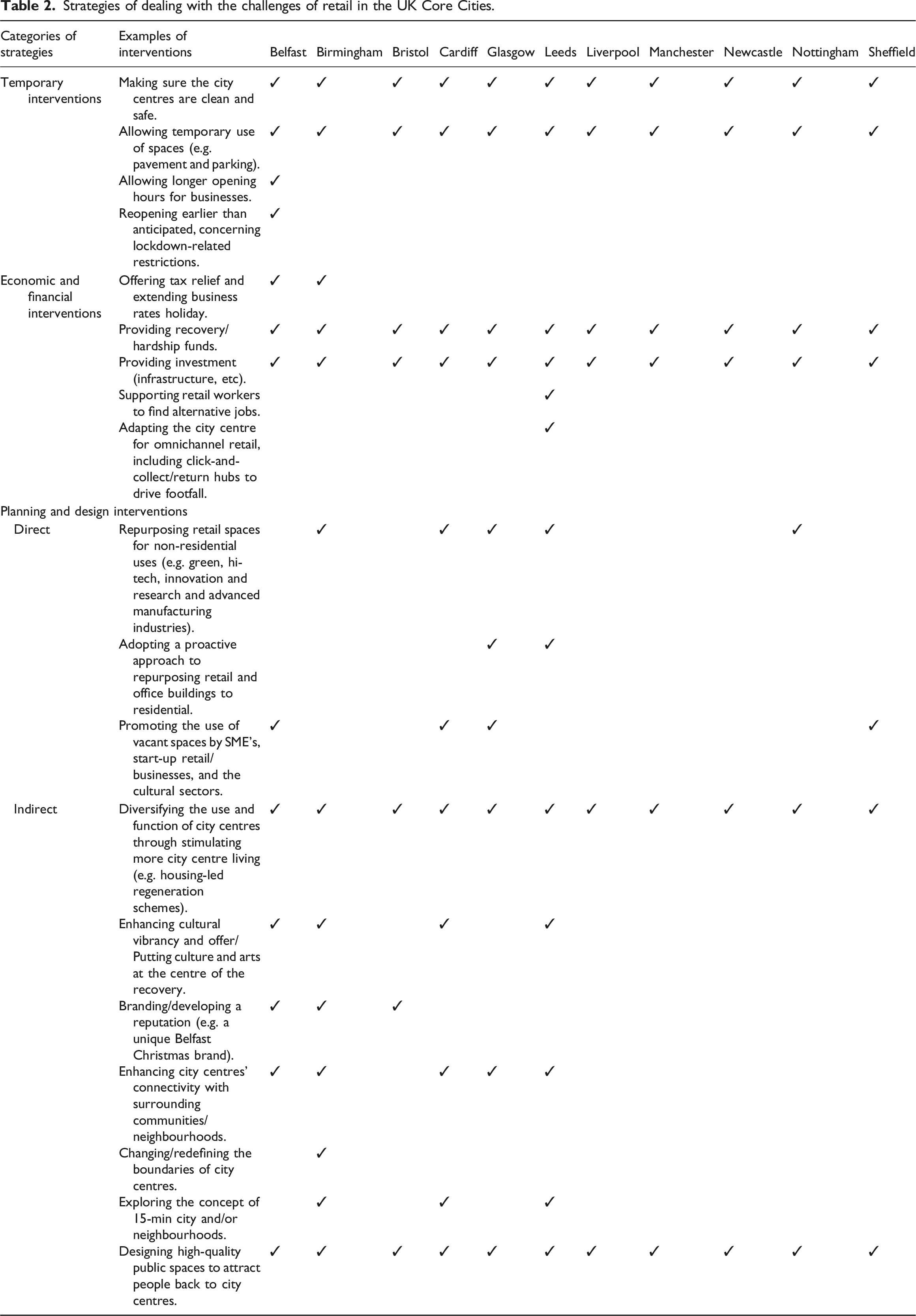
Strategies of dealing with the challenges of retail in the UK Core Cities.
Temporary interventions
As discussed previously, the retail sector was among the most affected sectors from the COVID-19 pandemic and subsequent public health response. The UK Core Cities adopted a wide range of short-term strategies and interventions to support retailing in city centres. All studied cities committed to ensuring their city centres are clean and safe for visitors. To do so, they implemented different measures to utilise pedestrian spaces and the movement of people, whilst providing sanitation services, such as hand sanitising stations. The focus was on temporary interventions in areas of highest footfall, for example, high streets. In addition, some cities extended the permitted opening hours of businesses in city centres; for example, Belfast City Council allowed businesses to maintain longer opening hours on Sundays in the city centre as a temporary measure to help retailers and hospitality businesses during the recovery period.
Allowing temporary use of spaces was also common among the UK Core Cities. The COVID-19 pandemic heightened interest in temporary use of space, a major urban trend that had started pre-pandemic, with increasing popularity among the public, policy makers, and academics (Bishop and Williams, 2012; Colomb, 2012; Madanipour, 2018). For example, Cardiff City Council made the open space within Cardiff Castle free to enter for visitors, creating a new green public square within the city centre – a temporary use which was subsequently made permanent. Also, Castle Street in Cardiff was temporary closed to car traffic, whilst turning it into an al fresco dining area to provide additional space for city centre food vendors. Belfast City Council put an emphasis on pavement café licensing and allowed businesses, particularly those in the hospitality sector, to use the pavement spaces around their shops more easily. Areas of open and public space were designated as ‘hospitality zones’ with cover and seating to create safe areas for people. Cafes, bars, and restaurants were allowed to temporarily use parking bays in front their establishments as seating and dining areas. Similarly, Sheffield City Council implemented the Temporary Coronavirus Pavement Café Scheme that aimed to allow any business with a straight-forward and free of charge application to put seating outside to comply with social distancing requirements as quickly as possible.
Economic and financial interventions
The UK Core Cities have offered a range of economic and financial supports to businesses that face the challenges of the double shock of online shopping and the COVID-19 pandemic. This was initially supported by over £22 billion in central government funding that was distributed by local authorities. The ability of local government to provide funding following the impacts of COVID-19, and longer period of central government-imposed austerity, means that the financial capabilities of local authorities in the UK was variable and dependent on existing financial reserves and financial management practices (Ahrens and Ferry, 2020). Following the end of the UK Government’s Coronavirus Job Retention Scheme (aka furlough scheme), the UK Core Cities provided struggling businesses with recovery/survival funds by drawing on other UK Government funds as well as internal funds. Birmingham City Council drew on central government COVID funding to provide £215 million of small business grants across retail, leisure, and hospitality sectors, along with discretionary grants to the value of £10.6 million, and utilised the central government Additional Revenue Grant scheme to support 11,800 businesses. Birmingham City Council also used the ‘Reopening High Streets Safely’ European Regional Development Fund to offer grant support to retail and hospitality businesses and public space improvements. Sheffield City Council distributed over £100 million in grant funding, whilst bidding for the UK Government’s Future High Streets Fund. Belfast City Council provided business rates 1 holiday for retail and hospitality businesses, whilst introducing programmes to assist businesses to, for example, improve productivity and enhance their e-commerce presence.
Among the UK Core Cities, Leeds has introduced a wider range of economic and financial supports. Leeds City Council has explored the idea of adapting the city centre for omnichannel retail, including click-and collect/return hubs, to drive footfall. The city has highlighted that there is a need for omnichannel retail, which integrates different retail channels (e.g. stores, online and mobile) into a single, seamless customer experience (Gao and Su, 2017; Von Briel, 2018). Acknowledging the need for longer term solutions for the changing nature of the retail sector, the local council offers support to retail workers to find alternative jobs and to develop their skills to access opportunities in other sectors.
Planning and design interventions
Planning and design interventions, which concern managing land uses and urban spaces in city centres, have been the main focus of most of the UK Core Cities’ strategic and recovery plans. There are a wide range of planning and design interventions that the UK Core Cities’ strategic and recovery plans have proposed. This study classifies these interventions into two categories of direct and indirect interventions. While the former refers to those interventions that directly target the retail sector and their spaces in city centres, the latter includes a broader range of interventions that address the changing roles and functions of city centres, including their retail spaces.
Direct interventions
Planning and design interventions that directly target retail spaces have mostly been focused on repurposing empty and redundant retail spaces for non-retail uses. This trend was already on the rise in some cities due to changes in planning regulations prior to COVID-19 (Clifford et al., 2019) but subsequently accelerated due to the rise in commercial/office vacancies. For example, Leeds seeks to identify redundant and less well-located retail and office spaces in the city centre and in local centres, aiming to convert them to residential units. Retail-to-dwelling conversions have been centrally promoted by the UK Government in order to deal with the ongoing housing crisis. These conversions, which are part of the broader agenda of deregulating the planning system in England, are justified by the fact that retail demand is declining, while housing demand remains high (Clifford and Madeddu, 2022). To facilitate such conversions, the UK Government has expanded the range of what is considered ‘permitted development’ to include conversion of shops to houses 2 . Expanding the scope of ‘permitted development’ has been subject of criticism from many planning scholars and activists (Clifford, 2021; Clifford et al., 2019; Ferm et al., 2020; Madeddu and Clifford, 2021; Marsh et al., 2020; Morris, 2021) due to the higher risk of producing sub-standard spaces and the lower scope for local authorities to control the quality of development produced. Acknowledging the risk of poor-quality conversions, Leeds aims to adopt a proactive approach to repurposing retail and office buildings to residential. As put forward in the ‘Future of Leeds City Centre and Local Centres’ plan, the aim is to strike “the right balance between protecting some retail frontages, while also being flexible in encouraging good quality conversions.”’ While Glasgow highlights the potential opportunities to convert city centre buildings in support of net-zero climate targets.
The ambition of converting retail spaces to non-retail uses is not merely limited to residential units but also includes non-residential uses. For example, Belfast proposes to ‘turn vacancies into valuable spaces’ through bringing forward the use of vacant space by small and medium-sized enterprises (SMEs), start-up businesses, and the cultural and third sectors. Acknowledging the prospect of reduced demand for retail spaces in the future, Leeds aims to repurpose surplus office or retail spaces to creative workspaces. The Leeds plan argues that there is evidence of unmet demand for such spaces in the city, for example, the need for a textiles and fashion incubator. Aiming to promote a range of locations to cluster green, hi-tech, innovation and research, and advanced manufacturing industries, Birmingham seeks to repurpose retail or other commercial spaces. Cardiff aims to ‘develop proposals for meanwhile uses and incubation spaces, providing a dynamic approach to ensuring that empty units, retail, and office spaces are used productively’.
Nottingham has a bold vision to rewild the city and ‘green up’ the historic city centre following the decision to demolish the Broadmarsh Centre, one of the largest shopping centres in the city, with plans to transform it into a ‘mini Central Park’. Located in the south of Nottingham city centre, the Broadmarsh Centre was opened in 1975 on land owned by Nottingham City Council, which was later leased to Intu Properties. In 2020, the 20-acre (8-ha) site was handed to the city council after Intu entered administration. The City Council’s efforts in obtaining funding to deliver the vision, however, have been unsuccessful, which has resulted in delays and uncertainties over the delivery of the project. Similarly, following the May 2021 closure of Cardiff’s Debenhams department store, the site’s owner, Landsec, submitted a planning application to Cardiff Council. This proposal outlines the demolition of the former retail space and its subsequent transformation into a public open-air square and urban park.
Indirect interventions
Planning and design interventions that indirectly target retail spaces take a wide range of forms and scales. Almost all the UK Core Cities highlighted the need for diversifying the use and function of city centres through stimulating more city centre living. Increasing the population of city centres can be considered as part of the current urban densification agenda in the UK (Bibby et al., 2020; Dembski et al., 2020), and what has been described as ‘reurbanisation’ (Rérat, 2012) through the ‘return to the city’ (Rae, 2013). Belfast aims to strategically use public sector land assets to increase city centre living via delivering housing-led regeneration schemes. City centre living has been promoted as ‘the most sustainable way to achieve the Belfast Agenda target of growing the city’s population by 66,000 by 2035 and provide a boost for our retail and hospitality sectors’. Related to the aim of increasing the population of the city centre, Belfast continues to grow the number of available student accommodation units to meet the current high demand and projected increase in student numbers. Compared to other UK university cities, the student accommodation market in Belfast has been relatively under-developed and has room to grow. This has meant Belfast is increasingly becoming an appealing market for property investors, which supports the council’s ambition to increase city centre living in order to enhance footfall. Cardiff, Birmingham, and Sheffield also highlighted the trend of increasing city centre living over the recent years, whilst proposing to further develop the city centre housing offer, including opportunities for both low density (family housing) and high-density residential developments, to increase the residential population of their city centres. Increasing the number of people living in city centres not only enhances their livelihood and appeal (Bromley et al., 2005; Tallon and Bromley, 2004), but also boosts retailing in city centres through increasing the number of potential customers and footfall.
Similarly, Manchester’s Economic Recovery and Investment Plan reported that more houses were built in the city centre, compared to the rest of the city in 2019/20. In this year, out of a total of 4161 new houses that were built in Manchester, 2869 (69%) houses were located in the city centre. This has been partially the result of establishing the Manchester Life Development Company (a partnership between Manchester City Council and Abu Dhabi United Group) that have delivered over 1000 new homes, which has consequently expanded the city centre residential offer into new neighbourhoods in Ancoats. Allen (2007) argues that Manchester city centre dwellers can be classified into three categories; ‘counter-culturalists’ that originate from within the new middle class and were the main group to first move back into the city centre, ‘city-centre tourists’ that originate from the service class and would like to experience living at the heart of things, and ‘successful agers’ who tend to be over the age of 50. While the increased city-centre living of diverse groups of people have augmented the livelihood and the cultural offer of the city centre, he argues that this increase is unlikely to have a regenerating impact on other areas of the city because the social, cultural, and economic interests of city-centre dwellers are located in the city centre (Allen, 2007).
The strategic and recovery plans of the UK Core Cities also highlighted the need to diversify the use and function of city centres through promoting arts and cultural activities and events. Cardiff, Sheffield, and Belfast propose to put culture and arts at the centre of their post-pandemic recovery through enhancing and diversifying city centres cultural vibrancy and offer. For example, Belfast aims at developing a reputation as a Christmas capital and making a unique Belfast Christmas brand. Manchester and Leeds highlight the role that cultural venues and activities can play in the future of city centres through bringing people back to city centres, boosting creativity and growth, and building social cohesion. Liverpool aims to prepare a new cultural strategy for the city to support the recovery, diversity, and ambition of arts and culture sector. The focus on arts and culture as future roles of city centres can be interpreted as an attempt to move away from retail-led regeneration projects and retail-dominated city centres, which have been prevalent in the last few decades (Instone and Roberts, 2006). This is evident in the ‘Future of Leeds City Centre and Local Centres’ plan, as it argues ‘the role of centres will need to be less about retail consumption, and more about production, innovation, social interaction, living, education, culture, and public services’.
Five of the studied UK Core Cities (i.e. Belfast, Birmingham, Cardiff, Glasgow and Leeds) put emphasis in their strategic plans on enhancing city centres’ connectivity with surrounding communities and neighbourhoods. For example, Leeds aims to connect neighbourhoods and local centres to the city centre through creating high-quality walking and cycling routes. Birmingham’s Our Future City Plan seeks to provide the most deprived communities in the city with better access to opportunities in the city centre through linking together the city centre and inner-city neighbourhoods. Birmingham is also seeking to expand the boundaries of its city centre that are historically defined by the Middle Ring Road. Birmingham’s COVID-19 Economic Recovery Strategy highlighted that defining the city centre by the ring road has resulted in physical and perceived barriers between the city centre and its surrounding areas. Through redefining the boundaries of city centre, the city aims to enhance the connectivity of the centre with its surrounding communities and neighbourhoods. Similarly, Cardiff seeks to integrate Cardiff Bay (located in the south of the city centre) and other key locations to the city centre. The city has been successful in securing a £50 million investment from the UK Government’s Levelling Up Fund, and match funding of a further £50m from the Welsh Government, for a new connection between Cardiff Central and Cardiff Bay. The funding will be used to create a regular tram service between Cardiff Central and a new platform at Cardiff Bay train station, whilst improving public spaces around the existing and new train platforms. Glasgow takes a wider metropolitan approach through the delivery of an integrated transport strategy, improved bus journey times to and within the city centre, and introduction of an integrated ticketing system.
Exploring the concept of 15-min city and/or neighbourhoods has been another indirect intervention with implications for city centres and their retail spaces. The 15-min city concept aims to create self-sufficient neighbourhoods with the essential functions of living, working, commerce, healthcare, education, and entertainment by decentralising urban functions and services (Bocca, 2021; Ferrer-Ortiz et al., 2022; Moreno et al., 2021). Cardiff’s City Centre Recovery Action Plan discussed that ‘the city centre should work in tandem with 15-min neighbourhoods, where people have easy and safe access to shops, schools, health care and green/blue spaces in the vicinity of their homes’. Similarly, Birmingham strives to identify a network of 15-min neighbourhood areas, with the aim of making local living easier through providing local amenities and services. While acknowledging the benefits of creating 15-min neighbourhood in reconnecting communities within local centres, Leeds’s strategy plan highlights that ‘the concept also has some limitations, as it is more relevant to local centres than city centres’. Given the concept of the 15-min city is still in its nascent stage and there are no real implemented cases, the implications of creating such cities or neighbourhoods for city centres and their retail spaces remain unclear.
Discussion and conclusion
The UK Core Cities are at a post-pandemic crossroad as they seek to develop strategies to ensure the vitality and viability of their urban retail centres. Our analysis of the strategic and/or recovery plans of the UK Core Cities revealed that, in line with national policies, local decision makers have adopted various strategies to address the challenges facing city centres and their retail spaces. We classified these strategies into three categories of temporary interventions, economic and financial interventions, and planning and design interventions. Temporary interventions concerned short-term strategies and interventions to support the retailing in city centres during the pandemic, for example, ensuring the city centres are clean and safe, and allowing longer opening hours and more flexible use of public spaces for businesses. Economic and financial interventions were mainly concerned with providing struggling businesses with tax relief and recovery/hardship funds. Being the main focus of the plans, planning and design interventions included a wide range of interventions, ranging from those directly targeting retail spaces to broad strategies for city centres and their retail spaces. While at times similar in approach the development of these strategies has not however been uniform. Some cities (e.g. Leeds) were more proactive about adapting to change than others, for example, through identifying and facilitating the repurposing of under-performing retail spaces for residential and non-residential uses. Also, the studied cities adopted specific strategies to address their unique city centre retail challenges. For example, Birmingham highlighted the ring road around its city centre as a physical and perceived barrier that needs to be addressed through redefining and expanding the boundaries of the centre.
While COVID-19 clearly acted as the impetus for the development of these recovery strategies it has also provided the opportunity to reflect on other changes and challenges in the retail landscape. Chief among them being the expansion of online shopping which threatens traditional physical retail models of consumption (Grimsey, 2018; Wang and Goldfarb, 2017). Here, all the strategic plans acknowledged the combination of a decline in footfall and convenience shopping stemming from the introduction of work-from-home policies and growth in online shopping. For some cities (e.g. Birmingham, Cardiff, Glasgow and Leeds), part of the solution to this meant an acceleration of residentialisation policies complemented by the re-purposing of existing buildings. This will have implications for the wider urban planning of these city centres given the difficulties in converting non-residential buildings to residential uses and the necessity of considering the needs of new residents and users for different amenities and services then previously provided (Clifford and Madeddu, 2022).
The complex governance structure of contemporary urban centres in the UK has seen different types of partnerships and leadership emerge. While all have involved local councils’ as major actors, some strategies have been produced in cooperation with Chambers of Commerce, business task forces, and consultancies, highlighting the complex governance structure of town centres and recognition of the need to involve key stakeholders at all stages of the policy-making process. The diverse array of strategies and interventions, however, typically neglected the role of the wider metropolitan region. This may be due to the fragmentation of local government in the wider city-region areas. It is a notable omission given the traditional importance of regional catchment areas for urban centres. Too narrow a strategic and investment focus on the city centre risks shrinking the potential catchment area and increase in potential policy conflict between large urban centres and secondary and tertiary centres which are also undergoing their own transformations and challenges. To facilitate partnership and collaborations between local authorities, combined authorities are introduced as a legal entity by the Local Democracy, Economic Development and Construction Act 2009, with Greater Manchester Combined Authority having been established in 2011 as the first combined authority outside Greater London. Our analysis of the case-study policy documents however did not show a considerable difference between the strategies of the cities located within an established combined authority with those without one.
Dolega and Celińska-Janowicz (2015) argued that existing explorations of adaptative resilience have failed to explore the role played by shorter-term recovery following an economic shock and how centres develop new growth trajectories. This research has contributed to this gap through an exploration of the post-COVID recovery plans of 11 ‘core cities’ in the UK. It has demonstrated how certain short-term policy responses became universally rolled out, either due to national funding requirements (such as hardship and infrastructure funding) or common understanding of an issue and the appropriate solution (the need to quickly accommodate the temporary use of space to ensure safety). These national policies and accepted policy responses constrained the adaptative ability of local government as it set and provided specific universal conditions and support as part of the recovery.
At the same time, it was clear that the economic shock of COVID-19 forced cities to confront longer term trends – the ‘drivers of change’ as Pendall et al. (2010) call them – that they had perhaps become complacent about given wider financial pressures and economic investment conditions, such as a decline in quality public spaces and stalling of wider urban regeneration schemes designed to diversify city centre functions. Linked to this, some strategies demonstrated a myopic view of the city centre that, while place based, failed to consider the linkages between proposed recovery policies and the wider city and, indeed, existing economic development strategies throughout the city-region.
The research has also shown how short-term recovery strategies risk being too reactive before trends and patterns are fully known. Many of the strategies assumed the continued rapid rise of online shopping and did not foresee the cost-of-living crisis stemming from high inflation and the impact of this on consumer consumption habits. The focus on adaptation of city centre buildings towards more cultural, green, or entrepreneurial start-ups and away from retail risks ‘locking in’ city centre development patterns before broader trends are known. Within adaptative resilience, lock-in is often conceptualised in terms of the ability of a place to manage to change and adjust from past behaviour but greater consideration needs to be given to how existing concepts of lock-in may ignore how initial reactions to a shock can also alter strategies and potentially lock-in poorly developed policy approaches. This research highlights the need for adaptive resilience to better understand the reactive ‘lock-in’ effects caused by short-term economic policy and the interaction between national policy universality, city-region co-dependency, and local differentiation as they develop ‘new growth trajectories’ (Dolega and Celińska-Janowicz, 2015). While this research examined the diversity of policies and strategies included in the UK Core Cities’ policy documents, more research is needed to establish whether and how these strategies and interventions are implemented on the ground, whilst analysing their effectiveness in achieving their goals.
Footnotes
Declaration of conflicting interests
The author(s) declared no potential conflicts of interest with respect to the research, authorship, and/or publication of this article.
Funding
The author(s) disclosed receipt of the following financial support for the research, authorship, and/or publication of this article: This study was supported by the Economic and Social Research Council (ESRC), UK Research and Innovation (UKRI), Grant No. ES/W010771/1.
