




Abstract
Tourism is used as a community development tool. It has been incorporated into national development plans. In South Africa, it is incorporated into local economic development (LED) plans. The LED strategy for the City of Mbombela Local Municipality includes the development of a tourism route in the former Umjindi Local Municipality. Through the application of the descriptive research design, we use the Likert scale to investigate perceptions of the community around the area where the tourism route is proposed. A sampling frame was developed by listing all the 224 households who live in the section of the road covered by the tourism route. From the 224 households in the sampling frame, a simple random sample of 89 households was drawn using the SPSS random number generator. A structured questionnaire was used to solicit the perceptions of respondents concerning the economic, socio-cultural, environmental and infrastructural attributes of the tourism route. Although they need to be interpreted directionally, most of the economic, socio-cultural and environmental attributes were significant. Of the infrastructure attributes electricity and water supply were significant. Generally, respondents had positive perceptions of the tourism route. Therefore, we strongly recommend the development of the tourism route with the caveat that sustainability issues need to be paid attention to.
Introduction
The former Umjindi Local Municipality in Mpumalanga Province of South Africa, which is now merged into the City of Mbombela Local Municipality, proposed the development of a tourism route as part of its Local Economic Development (LED) strategy. Figure 1 shows the proposed destinations for the tourism route. It starts from the R40 road gateway to the former Umjindi Local Municipality. It then stretches to Umjindi Township, to Barberton Town and ends at the second entrance to the former Umjindi Local Municipality. It turns into Shange road where the first stop is at the Roadway Café and Shisanyama fast food outlet at Ezanini in Kamhola Extension 2, the tourists then proceed to Rockafellaz Night Club, Bongani Bottle Store and Saphile Sive General Dealer to the G-Line Bar, where tourists can relax and have the kasi experience comprising shisanyama (locally made braai meat), pap (thick porridge mainly made from maize meal but can also be made from other grains like sorghum, pearl and finger millet) and refreshments. They also get to interact with the community and learn their way of life before proceeding to Lounge and Top-Notch African Food where tourists will get a taste of traditional foods and learn how the dishes are prepared. The route then proceeds to the tennis court where tourists can play tennis or watch soccer at Umjindi Stadium and even participate in some of the sporting activities at Umjindi Sport Outdoor. The route passes a clinic on the way to Ekujabuleni Skills Centre Art and Crafts in Spearville where tourists will get to see and buy arts and crafts artifacts. The route then proceeds to Barberton Golf Club which has an 18-hole par 70 course which lies on gently undulating terrain with spectacular views in all directions making it one of Edinburgh’s best golf courses (Barberton Golf Club, 2019). The route then joins Srown Street to Barberton Prison which existed from the early 1980s at the height of the apartheid era. Barberton Prison was the place to which the most dangerous and violent prisoners in South Africa were sent to serve their sentences. Even though the prisoners sent here were considered violent, it was considered ‘normal’ offenders, as opposed to the high-profile political offenders detained in prisons like the infamous Robben Island in the apartheid era (Pete, 2015). Tourists will learn about the history of the prison. Keller Park Tunnel is a Todd House that was built by the Todd family in 1887 and it is at present owned by the third generation of the family (Soudan, 2011). Then the route passes through the Phoenix Hotel which has been in existence since 1886 and was rebuilt in 1942. It’s known for its ambiance, hospitality, service and cuisine (Safarinow, 2019). Google Earth Map showing the location of the site along the proposed tourism route.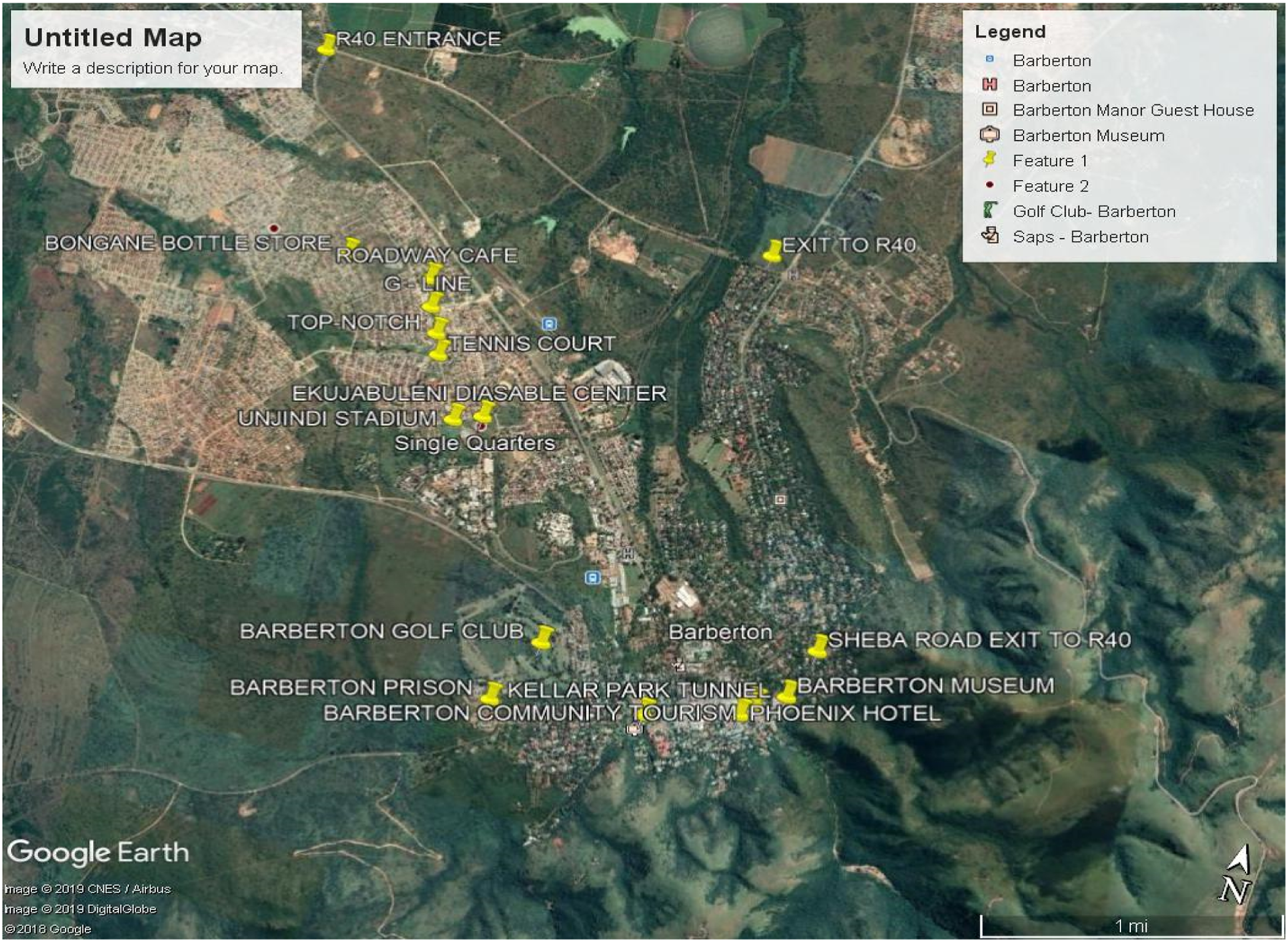
The route then proceeds to Barberton Community Tourism Centre which is a tourism information centre where you get information about places of interest, accommodations, restaurants around the area and activities to do, the route then proceed to Barberton Museum surcease the geology, archaeology, town and gold mining history and Swazi culture (Liebenberg, 2016). The route then proceeds to Crown Street to join Shaba Road and ends at the second entrance to the former Umjindi Local Municipality on R40. Figure 1 shows the location of sites on the proposed tourist route.
This route certainly sounds well thought out and exciting. However, it is important to note that Tshipala et al. (2014:41) observe that in developing tourism, it is important ‘…to understand the views of residents, business owners, tourists, and government employees on ….. tourism’. Based on observations by Tshipala et al. (2014) the success of tourism in the future depends on effective decision-making by all stakeholders involved in the tourism industry spanning from consumers to planners of tourist products. Tshipala et al. (2014) also point out that since it is communities that must live with the resultant outcome of tourism development, communities must be consulted and involved in the development of tourism products. They also point out that in some instances, it is possible and desirable to package the community as a part of the tourism product. This is the approach that should be taken by this proposed tourist route development in the former Umjindi Local Municipality.
Literature review
Tourism is one of the forces shaping the world economy (Binns and Nel, 2001). It is one of the critical sectors in South African economic development (Rogerson, 2013a). The strength of tourism is found in the fact that it links easily with other economic sectors. This makes tourism a good candidate for inclusion in local economic development (LED) plans. As Meyer and Meyer (2015: 200) put it, ‘The tourism sector has strong linkages with other economic sectors and these linkages need to be optimised for accelerated economic development. Linkages with sectors such as retail, agriculture, transport and construction will enhance the local multiplier effect and eventually create better economic growth and employment opportunities’. About tourism, RSA (2015: 3) writes, ‘This sector’s influence spans over a multitude of economic sectors and has a significant multiplier effect. The existing, numerous, tourism assets ……. should be optimally promoted and developed’. Estimates put the multiplier effect of tourism at about 1.6 (Meyer and Meyer, 2015). Because of these characteristics, tourism-led LED is being proposed in South Africa (Binns and Nel, 2001) and many believe that this approach can lead to robust LED (Rogerson, 2013a) because the capacity of tourism to contribute towards employment, income and general economic growth is evident (Martins et al., 2017; Meyer and Meyer 2015). Kgote and Kotze (2013:323) observe that ‘All over the world, tourism is recognised as an instrument or tool for stimulating economic growth by creating jobs for communities and bringing development to regions and countries, especially those blessed with an abundance of tourist resources’. South Africa is one of the countries with an abundance of tourist resources (Tshipala et al., 2014). Ezeuduji et al. (2017) point out that tourism can contribute to community development by: 1. Creating clear opportunities for employment locally. 2. Encouraging local actors, who comprise non-governmental organisations, the local population and the private and public sectors to collaborate. 3. Ensuring continued institutional capacity-building that supports the active participation of the local population. 4. Increasing the community’s access to infrastructure and services provided for tourists 5. Empowering the local population through participation. 6. The enhancement of the socio-cultural impacts of tourism.
However, Ezeuduji, et al. (2017) caution that sometimes tourism does not achieve the anticipated benefits.
Given the ease with which it links with other sectors through forward and backward linkages (Meyer and Meyer, 2015; Spencer and Zembani, 2011) tourism has been developing rapidly recently (Martins et al., 2017). Meyer and Meyer (2015) estimate that in South Africa tourism accounts for not less than 29 percent of the services sector export component. However, some challenges do exist. In a study of 218 countries covering the period 1995 to 2012, Martins et al. (2017) found that relative expenditures declined at a rate of about 2% per year while new arrivals grew at 1.2% per year. Besides the challenges presented by fluctuations in performance, the incorporation of tourism in development planning is sometimes hampered by the fact that it is hard to define tourism (Spencer and Zembani, 2011). There are different types of tourism, namely, ecotourism, nature-based tourism (Kgote and Kotze, 2013), adventure tourism (Tshipala et al., 2014) cultural tourism (Manavhela and Spencer, 2012) and agricultural tourism (Rogerson, 2013b), like the wineries in Western Cape. Tourism can be developed around arts, crafts, traditional performances and local cuisine and in so doing tourism can create business opportunities (Ezeuduji et al., 2017). For adventure tourism, South Africa offers horseback safaris, climbing, mountain biking, hiking, surfing, diving and river rafting. South Africa is a highly developed adventure tourism destination in Africa, which has a huge scope for further development (Tshipala et al., 2014). Although the categories of tourism are obviously not mutually exclusive, the list above shows the diversity of tourist products that can be developed by and within a region or country. Spencer and Zembani (2011: 202) argue that the development of tourism rests with the public sector. They write, ‘In South Africa, sport, recreation, and tourism are government-led, private sector driven and community-based…’ It is therefore important, when the opportunity exists, to include tourism development in LED plans. Spencer and Zembani (2011) further note that in order for tourism potential to be fully realised there is a need for public-private partnerships and that it is the role of government to create an environment where such partnerships can be brokered. They further note that even though there is great potential for tourism development in developing countries, like South Africa, in many developing countries tourism is still in its embryonic development stage, signaling the potential for growth.
Since, tourism can create income, taxes, hard currency and jobs, it is therefore ideal to include it in LED strategies. However, it can also create negative social impacts such as cultural erosion and or littering. Given the potential negative impacts, more sustainable tourism planning, management and development options need to be considered. Community-based tourism (CBT), which includes the cultural or traditional heritage and people from the community as part of the tourism product, is one of the planning options being considered (Manavhela and Spencer, 2012). CBT is an offshoot of community-based development. Community-based development is a development model originating from the 1970s which aimed to involve local communities in decision-making. CBT is currently growing in popularity (Giampiccoli, 2015). Giampiccoli et al. (2015) offer a more comprehensive list of what constitutes CBT which includes many activities like home-stays with families, guided tours by communities, craftsmen, performers, participation of community leaders, visits to local restaurants and visits to farmers. Tourists can stay with local families in a homestay, in a lodge, owned by a community or in a campsite organised by the community. The use of local transport should be encouraged when travelling during such a program. Giampiccoli et al. (2015: 1206) offer an indicative list of preconditions for the development of CBT, some of which include that, ‘…. CBT should be an endogenous effort but external facilitation is possible (and often needed); CBT should be based on local culture; CBT should be established, especially in its initial stages, as a complementary activity within the context of the diversification of livelihood strategies (but with the possibility to grow in relevance); CBT should enhance individual and community-wide well-being of direct and indirect beneficiaries….’. CBT is supported and encouraged by World Tourism Organisation and many other international organisations because it can conserve both cultural and natural resources and it can empower communities (Giampiccoli et al., 2015).
One of the striking observations about tourism is that sometimes there is poverty around tourism developments. Such is the case for Nandoni dam in Limpopo Province (Manavhela and Spencer, 2012). Despite this observation, tourism has been used as a development tool in both industrialising and industrialised countries. It has also been used in strategies to reduce poverty (Mtapuri and Giampiccoli, 2013; Rogerson, 2013b; Spencer and Zembani, 2011) and it has been used as such in countries like South Africa, Botswana and Mozambique (Giampiccoli et al., 2015). Tourism is used as a community development tool and it has been incorporated into national development plans for instance in South Africa where it is incorporated into LED plans.
It is not only in South Africa where government, specifically local government, is perceived as a driver of the development of local economies through tourism. Based on a case study in the Philippines, Milos and Bulilan (2021) state that ‘The role of the government is crucial in making tourism beneficial for local people.…local government units…perform both political and entrepreneurial functions in tourism development….. The …[case study]…demonstrates how the local government can integrate governance, coordination, and doing business through tourism’. Tourism can be used to develop local economies because of its nature of being a generator of spending and income and a user of local resources (Patton, 1985). This observation was made in reference to small urban areas of Reading and Reading SMSA in Pennsylvania (USA) which used local factory outlets as a facet of their tourism development strategy. When national government budgets become tight, rural areas tend to suffer by not getting enough development investment funds. In Turkey, Kocaman and Kocaman (2014) describe how a rural district, Zile District, used cultural and gastronomic tourism in their local economic development strategy and describe how the district can potentially enhance tourism in their district. These studies show how creatively tourism can be incorporated into local economic development both in rural and urban areas.
Theoretical framework: Local economic development (LED) theory and the South African context
This study is underpinned by the local economic development (LED) theory. LED has been applied in many parts of the world. For instance, Wong (2002) describes its application in England. LED was already being implemented in industrialised countries before becoming popular in developing countries around the 1990s (Patterson, 2008). Local economic development focuses on the development of localities. It is the planned and deliberate shift of resources from centralised institutions of the state to maximise on potentials of localities by building their competitiveness by taking advantage of the forces of globalisation (Rogerson and Rogerson, 2010). Wong identifies 11 determining factors for LED that need to be taken into account when designing LED interventions, namely, locational factors, physical factors, infrastructural factors, human resources, capital and finance, knowledge and technology, industrial structure, quality of life, business culture, institutional capacity and community identity and image (Wong, 2002).
In LED theory, internationally, economic growth is generally viewed as an immediate objective, while more specific impacts like improvement in the quality of life and poverty reduction are viewed as the overall goals. Given the history of South Africa, poverty reduction among the previously disadvantaged is a priority objective (Hindson and Vicente-Hindson, 2005). In South Africa, the adoption of LED as a development strategy for localities is set in sections 152 (c) and 153 (a) of the South African Constitution (RSA, 2014), and LED policy was first implemented through the Reconstruction and Development Program (RDP) ( Patterson, 2008). There are few countries, if any, where LED is articulated in the constitution. Indeed, Nel and Rogerson (2016:111) observe that ‘….South Africa is regarded as somewhat of the world leader in terms of the development of LED policy...’, however, on the ground, results have largely been, at best, lackluster (Meyer-Stamer, 2003; Nel and Rogerson, 2016).
In the South African LED planning guidelines, the four main spheres of LED are considered to be: Enterprise development, which comprises initiatives that strengthen the competitiveness of localities through improved access to market opportunities by local enterprises and enhanced local business efficiency; Locality development, which is the improvement in the economic, social and environmental conditions in which businesses function in the locality and comprises both intangible and tangible location factors; Community development, which constitutes the improvement in access to basic amenities for, housing, health, welfare and education and; Governance, which is how the local municipalities get involved as defined in the constitution of South Africa. The core concept used in the development of the LED guidelines is that of a ‘developmental’ state (Hindson and Vicente-Hindson, 2005) and implementation is through LED strategies which are usually a part of Integrated Development Plans (IDPs).
In the LED strategy for the City of Mbombela Local Municipality, RSA (2015: 5) writes, ‘To ensure optimal stimulation of economic development, job creation, poverty alleviation, SMME development, human resource development, etc. the following actions need to be taken: Utilise the tourism sector as an economic catalyst for stimulating development across all sectors of the local economy’ among the 12 actions to be taken. Under Regional Tourism Routes and Packages, Umjindi Local Municipality is listed. This is in direct recognition of the impact that tourism can have on the LED plans for a local municipality. It is in this spirit that Ehlanzeni District Municipality in Mpumalanga Province, where the City of Mbombela local municipality is located, is proposing the development of a new community-based tourism route in the former Umjindi Local Municipality as part of the LED strategy (RSA, 2015).
Objective
Given the observations by Tshipala et al. (2014), in this study, we offer an understanding of the views of residents regarding a proposed tourist route. The objective of the study was to determine the community’s perceived benefits of developing the tourist route in the former Umjindi Local Municipality, Mpumalanga Province. The perceptions are used to assess whether the community perceives the development of the tourist route as a viable option. Furthermore, Barnesis (2016) conducted a review of 45 perception studies published over 36 years. This study shows that most perception studies are done on tourists and few on communities but invariably for existing tourism instruments. Hardly are perception studies conducted on proposed tourism instruments. This study fills in this gap by studying the perceptions of communities about a proposed tourism route.
Study area
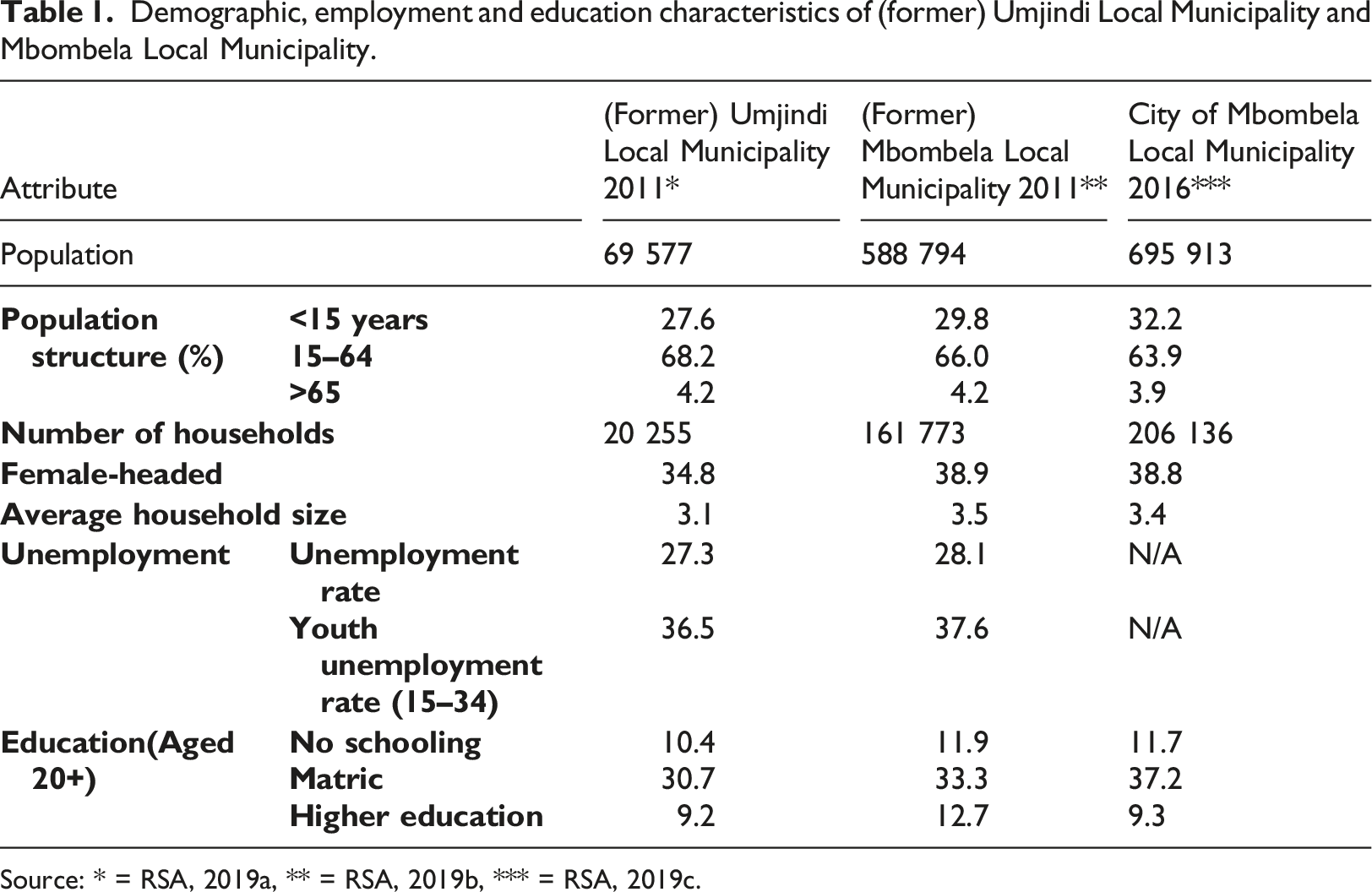
Demographic, employment and education characteristics of (former) Umjindi Local Municipality and Mbombela Local Municipality.
Source: * = RSA, 2019a, ** = RSA, 2019b, *** = RSA, 2019c.
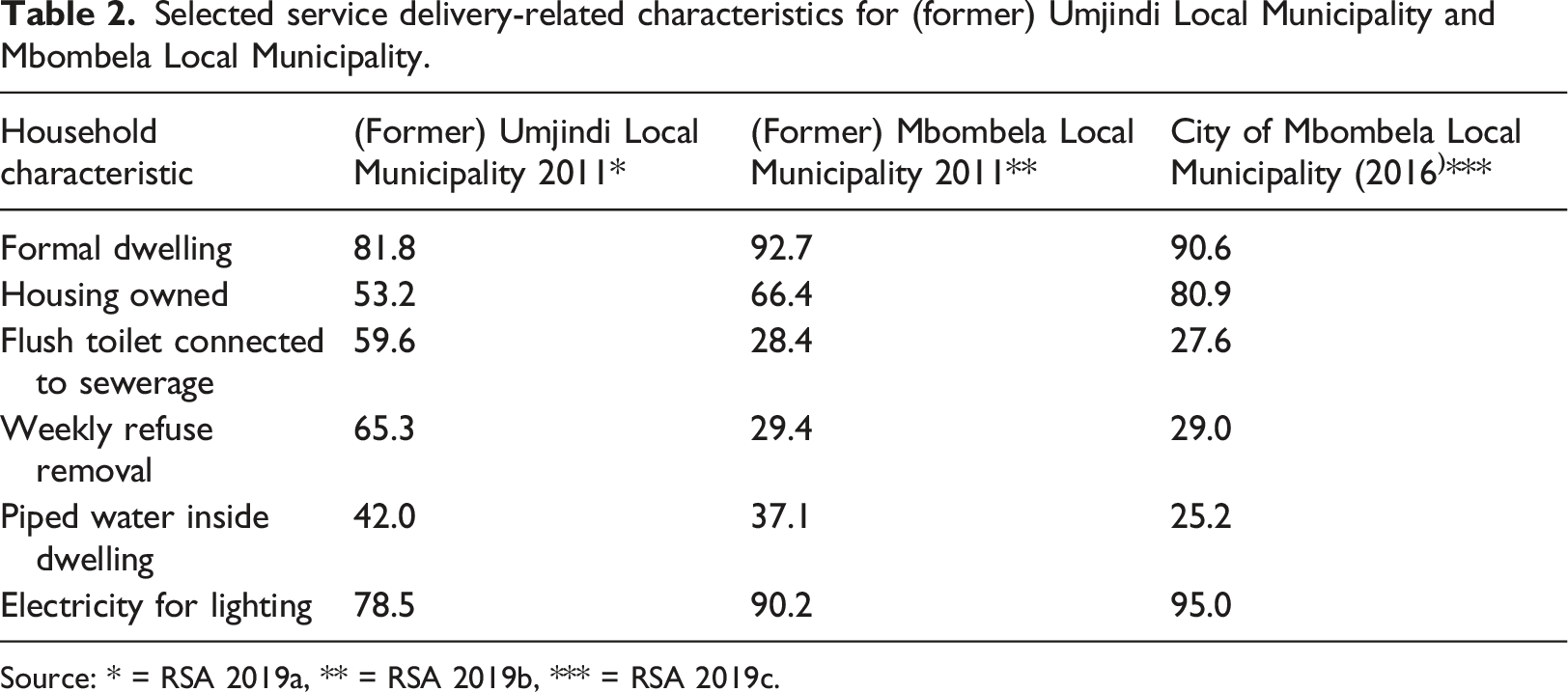
Selected service delivery-related characteristics for (former) Umjindi Local Municipality and Mbombela Local Municipality.
Unemployment for the former Umjindi Local Municipality and former Mbombela Local Municipality was over 27 percent for both with youth unemployment higher than 35 percent. Unemployment figures are not available for the City of Mbombela Local Municipality.
Table 2 shows selected service delivery-related characteristics for the former Umjindi Local Municipality, former Mbombela Local Municipality and the City of Mbombela Local Municipality. Table 2 shows that more than 80 percent of households live in formal dwellings as opposed to informal dwellings like shacks.
In the former Umjindi Local Municipality, about 60 percent of households had flushing toilets, whereas this was about 28 percent for both the former Mbombela Local Municipality and the City of Mbombela Local Municipality. 42 percent of households had piped water inside their dwelling in the former Umjindi Local Municipality; however, this was 37 percent and 25 percent for the former Mbombela Local Municipality and City of Mbombela Local Municipality, respectively.
These characteristics show that the newly established City of Mbombela Local Municipality needs programmes that can improve the socio-economic status of its residents. Satisfaction surveys can be good ways of identifying such programmes.
Methodology
This study uses perceptions to assess the feelings of the community in the former Umjindi Local Municipality that was situated in and around the area where the tourist route is proposed. There are many perception studies on consumers of tourism products (Ezeuduji et al., 2017; Kgote and Kotze, 2013; Tshipala et al., 2014). However, even though the involvement of communities in developing tourism products is advocated for (Ezeuduji et al., 2017; Tshipala et al., 2014), there are few perception studies of communities within which tourist products are developed to assess their perceptions of communities before the tourism products are developed; yet, this could assist the planning and development of tourism products. This paper sought to fill this gap.
The Likert scale, which is used in social science and educational research as a psychometric measure of human attitude (Joshi et al., 2015) was used in this study. In studying views on sustainable adventure tourism in South Africa Tshipala et al. (2014) used two Likert scales. One scale comprised five points from 1 = (strongly disagree) to 5 = (strongly agree) and the other with five points ranging from 1 = (not important at all) to 5 = (extremely important). Kgote and Kotze (2013) used a three-point Likert scale to study the attitudes and perceptions of visitors on tourist products offered at Pilanesberg National Park, South Africa. The Likert scale comprised the categories, ‘below expectation’, ‘matched expectation’ and ‘above expectations’. This shows that the Likert scale has variants. Joshi et al. (2015) mention that sometimes a seven-point Likert scale is used.
The way a Likert scale is used is that statements are constructed about an individual’s feelings about the concept under study. The individual is then asked to match their feelings against the Likert scale. The two Likert scales applied in this study were constructed as follows: 1 = Very good, 2 = Good, 3-Neutral, 4 = Poor, 5 = Very poor to assess perceptions about the tourism route, and 1 = Strongly agree, 2 = Agree, 3 = Neutral, 4 = Disagree and 5 = Strongly Disagree to assess willingness to pay for the development of the tourism route.
Sampling
The total number of households residing along the section of the Shongwe road where the tourist route is proposed is 224 (RSA, 2009). A sampling frame was developed by listing all the 224 households who live in this section of the road. Due to budget limitations, only 40 percent of the 224 households could be interviewed. A simple random sample of 89 households was drawn using the Statistical Package for the Social Sciences (SPSS) random number generator.
Data collection
First, the attributes of interest were classified into four categories, namely, economic, socio-cultural, environmental and infrastructure-related attributes, which were deemed as the factors that would be affected by the development of the tourism route. The constituents of each attribute are as follows: a. Economic attributes comprised: i.Respondents’ income; ii.Employment in the area; iii.Business opportunities within the area; and iv.Tourism contribution to government revenue; v.Tourism awareness. b. Socio-cultural attributes comprised: i.Cultural awareness; ii.Respect for culture; iii.Community involvement in tourism activities; iv.Preserving of heritage in the community; and v.Entertainment. c. Environmental attributes comprised: i.Maintenance of sensitive areas and habitat; ii.Conservation and protection physical environment; iii.Awareness on the conservation of the environment; iv.Traffic congestion; and v.Pollution; vi.Noise disturbance. d. Infrastructure attributes constituted: i.Roads; ii.Telecommunication; iii.Sewage; iv.Electricity; and v.Water supply.
A structured questionnaire was used to ask respondents about their perceptions of the attributes currently. They were then immediately asked what their perceptions would be if the tourism route was developed. These are, therefore, only perceptions because the tourism route is yet to be developed. Using the t-test, we tested whether the current perceptions of the attributes were different from the perceived perceptions after the (hypothetical) development of the tourist route.
The respondents were also presented with two statements as follows: 1. If the municipality is willing to pay for the development of a tourism route, I’m willing to accept the development of the tourist route. 2. If I have to pay for part of the development of the route, I’m willing to accept the development of the tourist route.
For each statement, respondents were asked to select their response from the Likert scale: 1 = Strongly agree, 2 = Agree, 3 = Neutral, 4 = Disagree and 5 = Strongly disagree
Similar hypothetical situations are used by economists when they estimate non-market values for ecosystem services for proposed environmental interventions by use of the contingent valuation method (Venkatachalam, 2004).
Analysis of results and discussion
Community perceptions on the development of a tourism route on Shongwe road
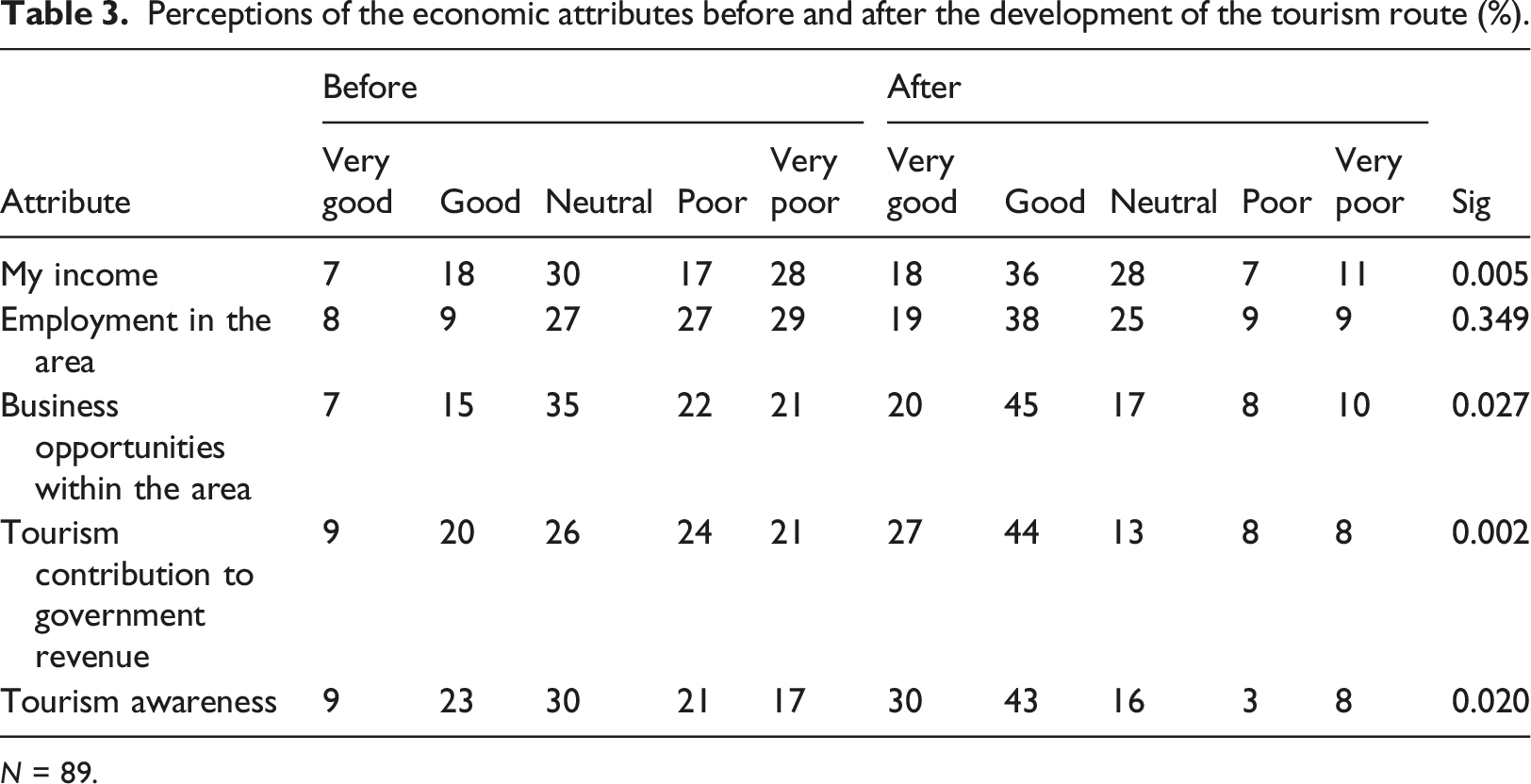
Perceptions of the economic attributes before and after the development of the tourism route (%).
N = 89.
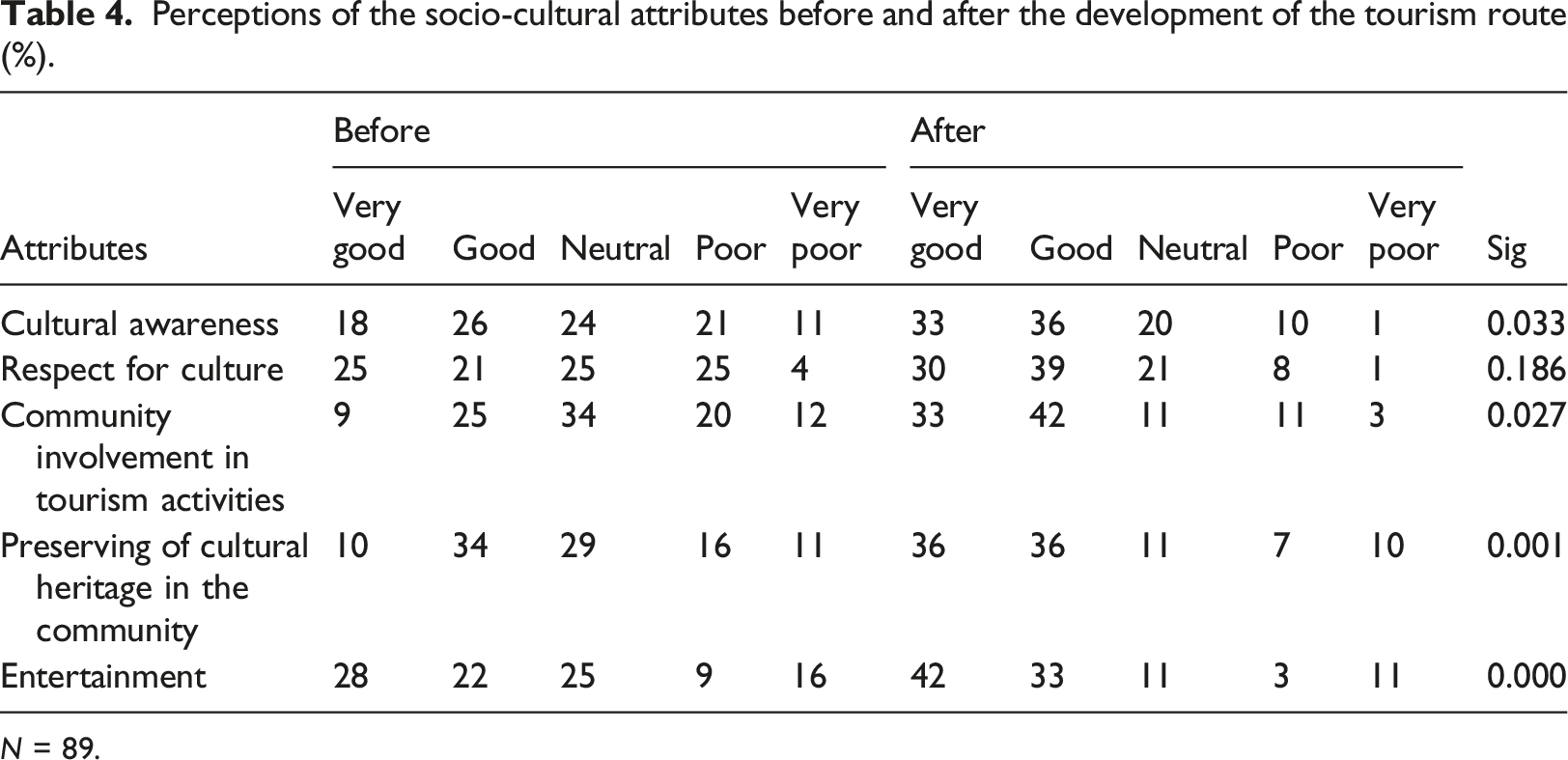
Perceptions of the socio-cultural attributes before and after the development of the tourism route (%).
N = 89.
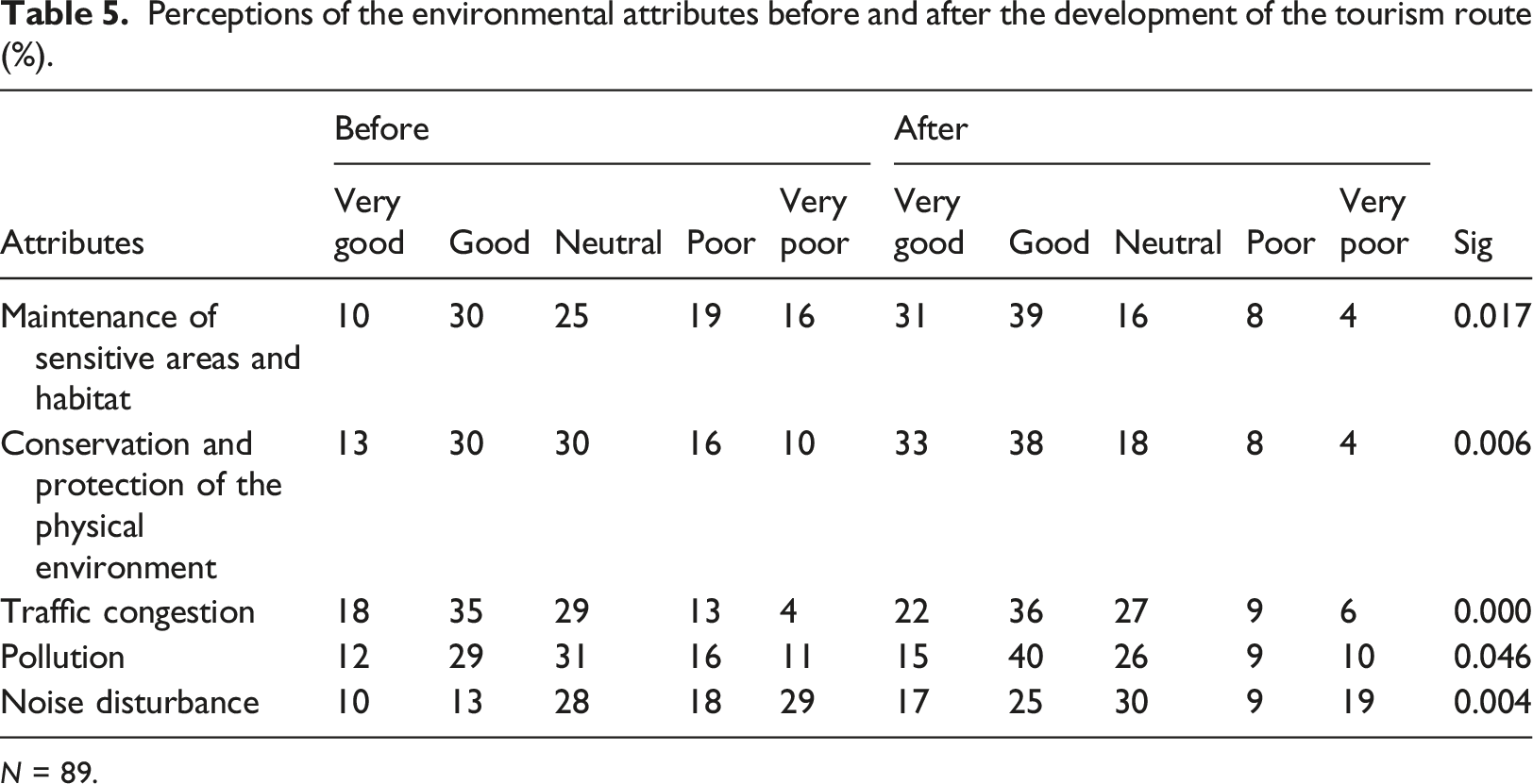
Perceptions of the environmental attributes before and after the development of the tourism route (%).
N = 89.
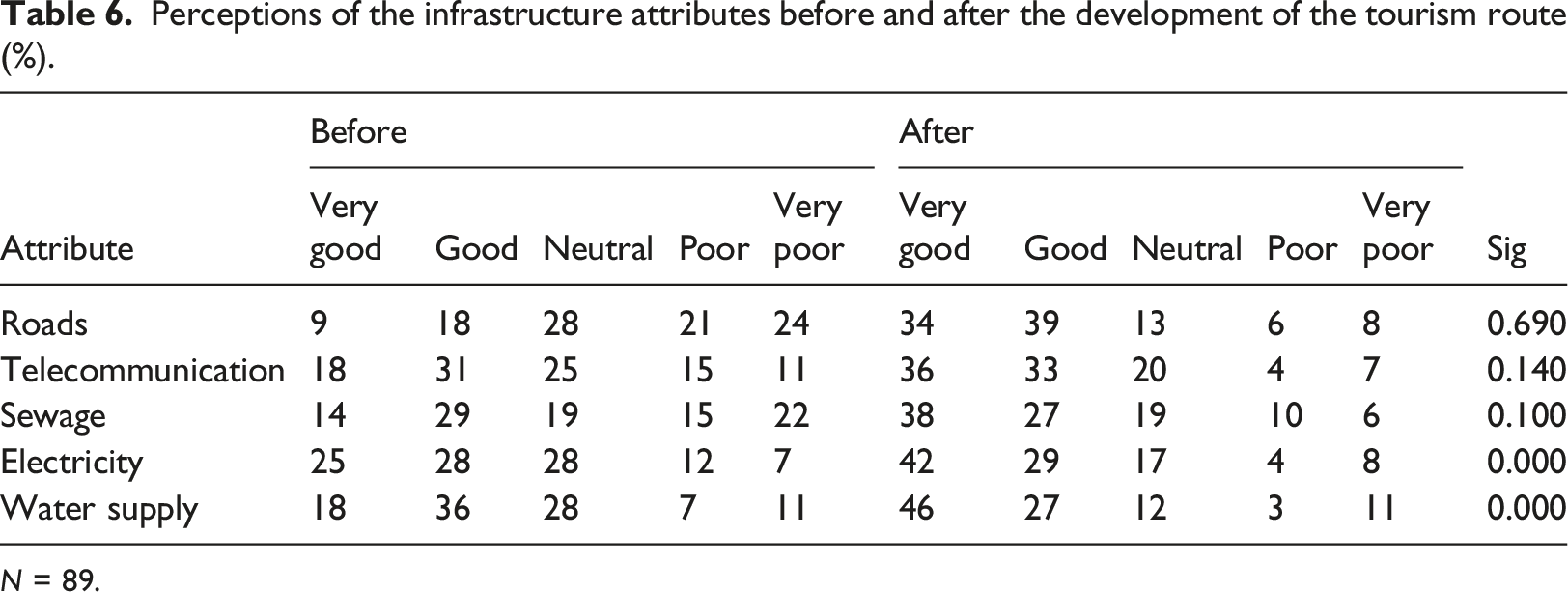
Perceptions of the infrastructure attributes before and after the development of the tourism route (%).
N = 89.
Community perceptions on economic attributes
Table 3 summarises the responses from the economic attributes. The significant attributes are income (p = 0.005), business opportunities within the area (p = 0.027), tourism contribution to government revenue (0.002) and tourism awareness (0.020). At p = 0.349 employment in the area is insignificant.
Table 3 shows that 25 percent of the respondents reported that they perceived their income to be good before the tourism route project development. 45 percent reported that they perceived their income as poor. 54 percent reported that the perceived income would be good after the project. Only 18 percent reported that the perceived income would be poor after the project. This shows that the perceived income impact of developing the tourism route is positive.
With reference to business opportunities within the area, 22 percent of the respondents reported that they perceived business opportunities within the area to be good before the tourism route development. 43 percent reported that they perceived business opportunities to be poor. However, 65 percent reported that the perceived business opportunities within the area would be good after the project. Only 18 percent reported that the perceived business opportunities within the area would be poor after the project. We conclude that the respondents expect business opportunities to increase as a result of the development of the tourism route.
Regarding tourism contribution to government revenue, 29 percent of the respondents reported that they perceived tourism contribution to government revenue to be good before the tourism route project. Forty-five percent reported that they perceived tourism contribution to government revenue to be poor. However, 71 percent reported that they perceived tourism contribution to government revenue to be good after the project. Only 16 percent reported that the perceived tourism contribution to government revenue would be poor after the project. This shows that the perceived tourism contribution to government revenue is positive.
With reference to tourism awareness, 32 percent of the respondents reported that they perceived their tourism awareness to be good before the tourism route project. 38 percent reported that they perceived that their tourism awareness is poor. However, 73 percent reported that the perceived tourism awareness would be good after the project. Only 11 percent reported that the perceived tourism awareness would be poor after the project. This shows that the perceived tourism awareness impact is positive.
It is worth commenting on the insignificant result regarding employment in the area. This attribute is insignificant despite the attribute like business opportunities that have a direct impact on employment and income which is partly a function of employment being significant and perceived to improve. The result seems counterintuitive but this may be a result of several aspects. First tourism’s rate of creation of employment may be perceived to be low; secondly, people may perceive that even if employment may improve, it may not be local people who benefit. Lastly, Table 1 shows high levels of unemployment in general and for the youths in particular. This may result in general pessimism regarding the perceived impacts of the tourism project on employment. It is clear that given the importance of creating jobs through development projects, this aspect requires further investigation.
Community perceptions on socio-cultural attributes
Table 4 summarises the responses for the socio-cultural attributes. The significant attributes are cultural awareness (p = 0.033), community involvement in tourism activities (p = 0.027), preserving of cultural heritage in the community (p = 0.001) and entertainment (0.000). Only respect for culture is not significant.
Table 4 shows that 44 percent of the respondents reported that cultural awareness was good before the tourism route project. Thirty-two percent reported that they perceived that cultural awareness is poor. However, 69 percent reported that the perceived cultural awareness would be good after the project. Only 11 percent reported that the perceived cultural awareness would be poor after the project. This shows that the perceived cultural awareness impact of the tourism project is positive.
In terms of community involvement in tourism activities, 34 percent of the respondents reported that they perceived community involvement to be good before the tourism route project. Thirty-two percent perceived community involvement to be poor before the tourism route project. Seventy-five percent reported that they perceived community involvement would be good after the tourism project and only 14 percent reported that they perceived community involvement would be poor after the tourism project. We conclude that the respondents perceive community involvement in tourism to increase as a result of the development of the tourism route development.
Regarding the preservation of heritage in the community, 44 percent of the respondents reported that they perceived preserving heritage in the community to be good before the tourism route project. Twenty-seven percent reported that they perceived the preservation of heritage in the community to be poor. However, 72 percent reported that they perceived preserving heritage in the community would be good after the project. Only 17 percent reported that they perceived preserving of heritage in the community would be poor after the project. This shows that the respondents perceived that preserving heritage in the community would improve as a result of the tourism route project development.
With reference to entertainment, 44 percent of the respondents reported that they perceived entertainment, to be good before the tourism route project. Thirty-two percent reported that they perceived that entertainment is poor. However, 69 percent reported that they perceived entertainment, would be good after the project. Only 11 percent reported that they perceived entertainment would be poor after the project. This shows that the respondents perceived that entertainment would be impacted positively by the development of the tourism route project.
The insignificant t-statistic for respect for culture shows that respondents do not expect respect for culture to be impacted as a result of the development of the tourism route. One would expect that respect for culture would be positively affected, especially among the young who would be exposed early to the culture. This is an area requiring further investigation as it might indicate the possible existence of some underlying aspects of culture that the community feels about the development of the tourism route.
Community perceptions on environmental attributes
Table 5 summarises the results for the environmental attributes. The significant attributes were maintenance of sensitive areas and habitat (p = 0.017), conservation and protection physical environment (p = 0.006), traffic congestion (p = 0.000), pollution (p-0.046) and noise disturbance (p = 0.004).
Table 5 shows that 40 percent of the respondents reported that they perceived the maintenance of sensitive areas and habitats to be good before the tourism route project development. Thirty-five percent perceived maintenance of sensitive areas and habitats to be poor before the tourism route project. 70 percent reported that the perceived maintenance of sensitive areas and habitat would be good after the project and 12 percent reported that the perceived maintenance of sensitive areas and habitat would be poor after the project. This shows that the impact on the perceived maintenance of sensitive areas and habitat after the development of the tourism route is perceived as positive.
Regarding the conservation and protection of the physical environment, 43 percent of the respondents reported that they perceived the conservation and protection of the physical environment to be good before the tourism route project. Twenty-six percent perceived conservation and protection of the physical environment to be poor before the tourism route project. Seventy-one percent reported that they perceive conservation and protection of the physical environment would be good after the project and 12 percent reported that the perceived conservation and protection of the physical environment would be poor after the project. This shows that the conservation and protection of the physical environment after developing the tourism route is perceived to be positively impacted by the development of the tourism route.
In terms of traffic congestion, 53 percent of the respondents reported that they perceived the traffic congestion to be good before the tourism route project. 17 percent perceived traffic congestion to be poor before the tourism route project. Fifty-five percent reported that the traffic congestion would be good after the project and 15 percent reported that the perceived traffic congestion would be poor after the project. This shows that the respondents perceived that the development of the route would impact traffic congestion positively, perhaps through the development of better road infrastructure and better traffic control.
In terms of pollution, 41 percent of the respondents reported that they perceived the pollution to be good before the tourism route project. Twenty-seven percent perceived pollution to be poor before the tourism route project. Fifty-five percent reported that the pollution would be good after the project and 19 percent reported that the perceived pollution would be poor after the project. This shows that the respondents perceived that the development of the route will have a positive impact on pollution. This result is counterintuitive. The development of the tourist route would be expected to increase traffic and therefore increase pollution. This aspect requires further study to check if the respondents understood the implications of the development of the tourism route on pollution.
With reference to noise disturbance, 23 percent of the respondents reported that they perceived noise disturbance, to be good before the tourism route project. Forty-seven percent reported that they perceived that noise disturbance is poor. However, 42 percent reported that the perceived noise disturbance would be good after the project. Only 28 percent reported that the noise disturbance would be poor after the project. It shows that the perceived impact of the development of the tourism route on noise disturbance is perceived to be positive. This is also a counterintuitive result. The development of the tourism route is expected to increase the sources of noise and therefore worsen the noise disturbance. However, it is possible that the development of the tourism route might result in better policing of noise disturbance and therefore improve it.
The two counterintuitive results are disturbing. They raise the question of whether the respondents completely understood the environmental implications of the development of the tourism route. During the design phase of the questionnaire, we had suspicions about the possibility that respondents may not completely understand the implications of the tourism route on the environmental aspect. We, therefore, included a check question whereby two similar aspects were included. These were conservation and protection of the physical environment and awareness of the conservation of the environment. We expected these to move in the same direction. However, the results were conservation and protection of the physical environment (p = 0.006) and awareness of the conservation of the environment (p = 0.139). That awareness of the conservation of the environment was insignificant while conservation and protection of the physical environment were insignificant raises questions about understanding this concept.
Community perceptions on infrastructure attributes
Table 6 summarises the results for the infrastructure attributes. The significant attributes are electricity and water supply both with p = 0.000.
In terms of electricity, 53 percent of the respondents reported that they perceived the electricity to be good before the tourism route project. 19 percent perceived electricity to be poor before the tourism route project. Seventy-one percent reported that the electricity would be good after the project and 12 percent reported that the electricity would be poor after the project. Thus the residents perceive that the tourism route would positively impact electricity. This result is surprising given that the descriptive analysis shows that electricity for lighting has great coverage. Perhaps the residents see improvements in electricity for other uses such as cooking.
In terms of water supply, 54 percent of the respondents reported that they perceived the water supply to be good before the tourism route project. 18 percent perceived the water supply to be poor before the tourism route project. Seventy-three percent reported that the water supply would be good after the project and 13 percent reported that the water supply would be poor after the project. This shows that the impact of the development of the project on the water supply is perceived to be positive. The descriptive analysis shows that the water supply, proxied by piped water inside the dwelling, is an area needing improvement. Perhaps increased activity due to the development of the tourist route can put pressure on the municipality to improve the water supply.
The comparisons of perceptions before and after the project for roads, telecommunication and swage were insignificant. In our explanation of the perception of the improvement of traffic congestion under environmental attributes, we offered better road infrastructure as a possible explanation. The result of the road infrastructure negates this and the explanation possibly lies in better traffic control say through better traffic lights and signs. Regarding telecommunication, it is possible that the tourist route development is at too small a scale to affect telecommunications. The descriptive analysis of the study area shows that sewage is an area needing improvement and it may be that the impact is not perceived for similar reasons to telecommunication.
Willingness to accept the development of a tourism route if the municipality will pay for the project
Respondents were asked to respond to the statement that they are willing to accept the tourism project if the municipality was paying for it. Figure 2 shows that 60 percent of the respondents strongly agree that they will accept the development of the tourism route provided the municipality will be paying for the development because they do not have enough capital to do the project themselves. Willingness to accept the tourism project.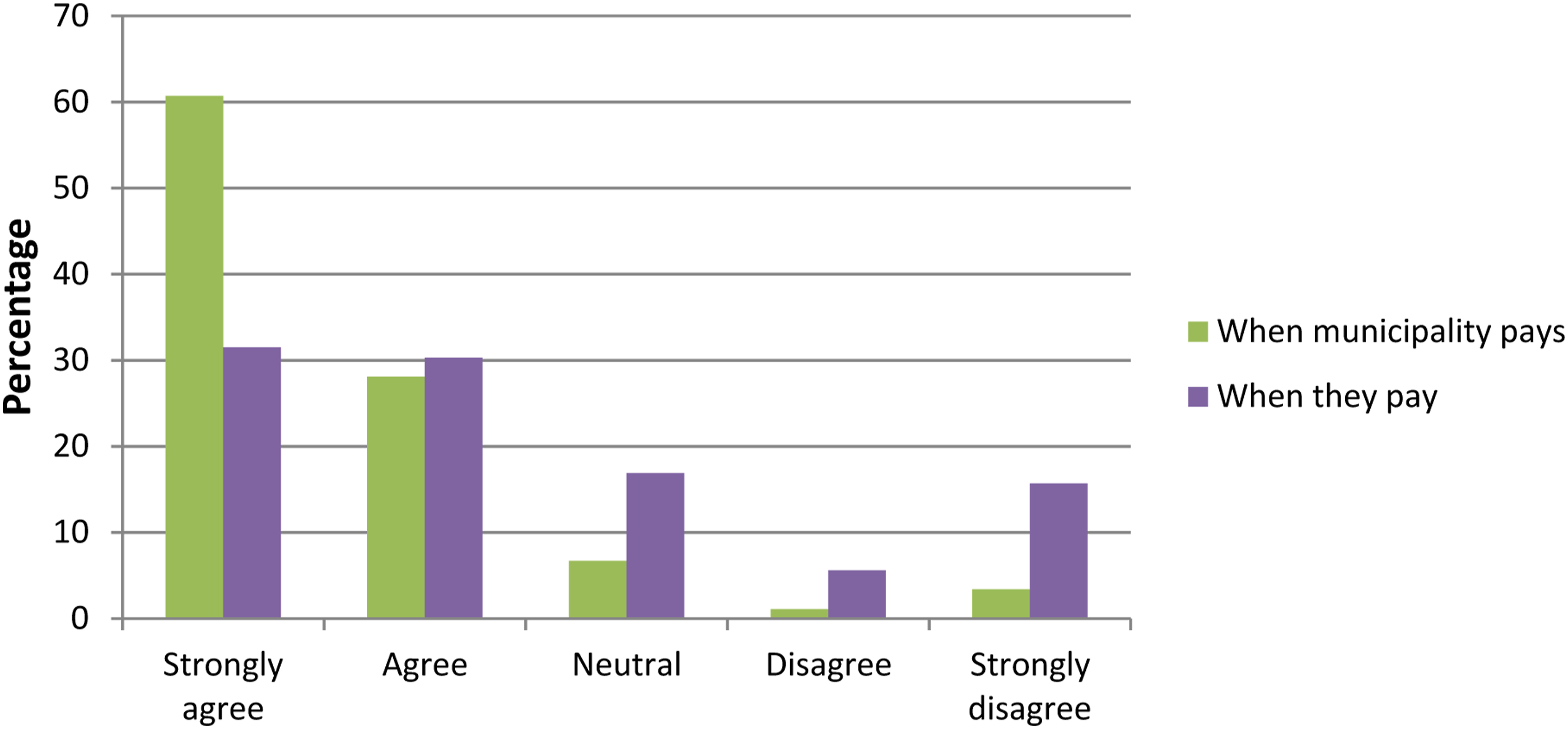
Twenty-eight percent of the respondents agree that they are willing to accept the development of the tourism route provided the municipality will be paying for it, seven percent of the respondents were neutral, one percent of the respondents disagree that they are willing to accept the project even if the municipality will be paying. Three percent of the respondents strongly disagree that they are willing to accept the development of the route if the municipality will be paying for the project.
Willingness to accept the development of a tourism route if they will pay for the project
Respondents were asked to respond to the statement that they are willing to accept the tourism project if they were to pay for the development of the tourism route. Figure 2 shows that 32 percent of the respondents strongly agree with the development of the tourism route even if they have to pay for the development. 30 percent of the respondents agree to accept the development of the tourism route and are willing to pay for it. 17 percent of respondents were neutral about whether they are willing to accept to the development of the tourism route if they will be paying for the project. Six percent of the respondents disagree to accept the development of the tourism route if they will have to pay for it and 16 percent of the respondents strongly disagree with the development of the tourism route if they will have to pay for it.
Conclusion and policy implications
The perceptions of the economic attributes comprised: respondents’ income, employment in the area, business opportunities within the area, tourism contribution to government revenue and tourism awareness. Except for employment in the area, respondents’ perceptions indicated that they expected positive impacts on the economic attributes. The insignificant result on employment in the area may indicate that the residents are wary that the project may impact employment. This result signals the planners to think about employment generation as they put together the components of the activities along the tourism route.
The socio-cultural attributes comprised cultural awareness, respect for culture, community involvement in tourism activities, preservation of heritage in the community and entertainment. The respondents perceived the tourism route to have positive impacts on all except for respect for culture. A better understanding of this result is needed. If the result means that the respondents thought that respect for culture would not be affected by the development of the tourism route, then there is no cause for concern. However, if it means that the respondents are not sure whether the impact of the tourism route on respect for culture would be positive or negative, then this is cause for concern. Sometimes tourism negatively affects local culture so the planners need to pay attention to this aspect starting by finding out what this insignificant result truly means.
The environmental attributes comprised maintenance of sensitive areas and habitats, conservation and protection physical environment, awareness of the conservation of the environment, traffic congestion, pollution and noise disturbance. The results show that respondents perceived that the tourism route would have a positive impact on all the environmental attributes. This result is somewhat disturbing because tourism in such circumstances is likely to increase traffic and make pollution worse. The result may be a reflection of how upbeat the respondents are about the prospect of the development of the tourism route. The planners need to be cautious about potential negative environmental aspects of the tourism route so as to make it sustainable.
The infrastructure attributes comprised roads, telecommunication, sewage, electricity and water supply. Roads, telecommunication and sewage were insignificant. Although there seems to be some disturbing contradiction with our explanations for the result on environmental attributes, we believe that this result is consistent with the fact that these attributes require broader, larger-scale development to be positively affected. So planners need to pay attention to these aspects.
Based on the willingness to accept analysis, 89 percent of the respondents will accept the project if the municipality pays for it, and 62 percent will accept the project if the community were to pay for it. The fact that more than 50 percent of the respondents are willing to accept the project even if the community pays for it, and only 22 percent of the respondents are not willing to accept the project if the community pays for it is strong evidence of the fact that the community perceives that the project will bring benefits to the community. The results of the willingness to pay analysis are consistent with the results from the Likert scale analysis.
In conclusion, we recommend that the City of Mbombela Local Municipality undertake this development as proposed in their LED strategy. The community perceptions are positive regarding the development of the tourism route except for the few areas of concern that have been highlighted. A final word of caution is that Binns and Nel (2001) observe that tourism development can sometimes lead to pollution, loss of identity and destruction of resources. Therefore, although the results of this study lead to recommend tourism-led LED, we note that its pursuit should be done in a sensitive manner which ensures the minimisation of negative impacts, thus ensuring sustainability.
Footnotes
Declaration of conflicting interests
The author(s) declared no potential conflicts of interest with respect to the research, authorship, and/or publication of this article.
Funding
The author(s) received no financial support for the research, authorship, and/or publication of this article.
