



Abstract
I examine the development and current situation of the woollen knitwear and woven fabric industry in the Scottish Borders. The paper opens with a brief theoretical exposition of the logic and dynamics of industrial clusters. An overview of the consolidation of the industry as a multifaceted spatial cluster or agglomeration in the 19th century is presented. I then describe changes in the locational structure and productive capacities of the industry over the last several decades. I provide a diagnosis of the industry’s decline in recent years together with an assessment of relevant stocks of region-based resources and capabilities. I argue that the Scottish Borders region lacks many of the pooled competitive advantages typically found in successful clusters but that carefully modulated policy could do much to improve local economic performance in the future. A number of specific policy guidelines focussed on inter-industrial relations, labour markets and institutional infrastructures are examined.
Keywords
Preamble
My objective in this paper is to offer an analysis of the historical development, organizational logic, spatial dynamics and competitive prospects of the woollen textile industry in the Scottish Borders region of southeast Scotland.
1
This is an industry that has developed over the last two centuries and more in a number of small towns and villages in the region (see Figure 1). It has inherited a long tradition of skilled craftsmanship and consistently high product quality and it is nowadays almost entirely specialized in high-priced, fashion-orientated knitwear and woven fabrics destined for national and international markets. Today, however, given the effects of global competition and relatively inelastic demand for woollen textile products, the industry has dwindled into a small residual cluster of firms, and its reserves of physical capital and its overall level of employment represent only a fraction of what they were in the more ebullient decades following the Second World War. Scottish Borders: Principal urban settlements. The Scottish Borders Council area is shaded.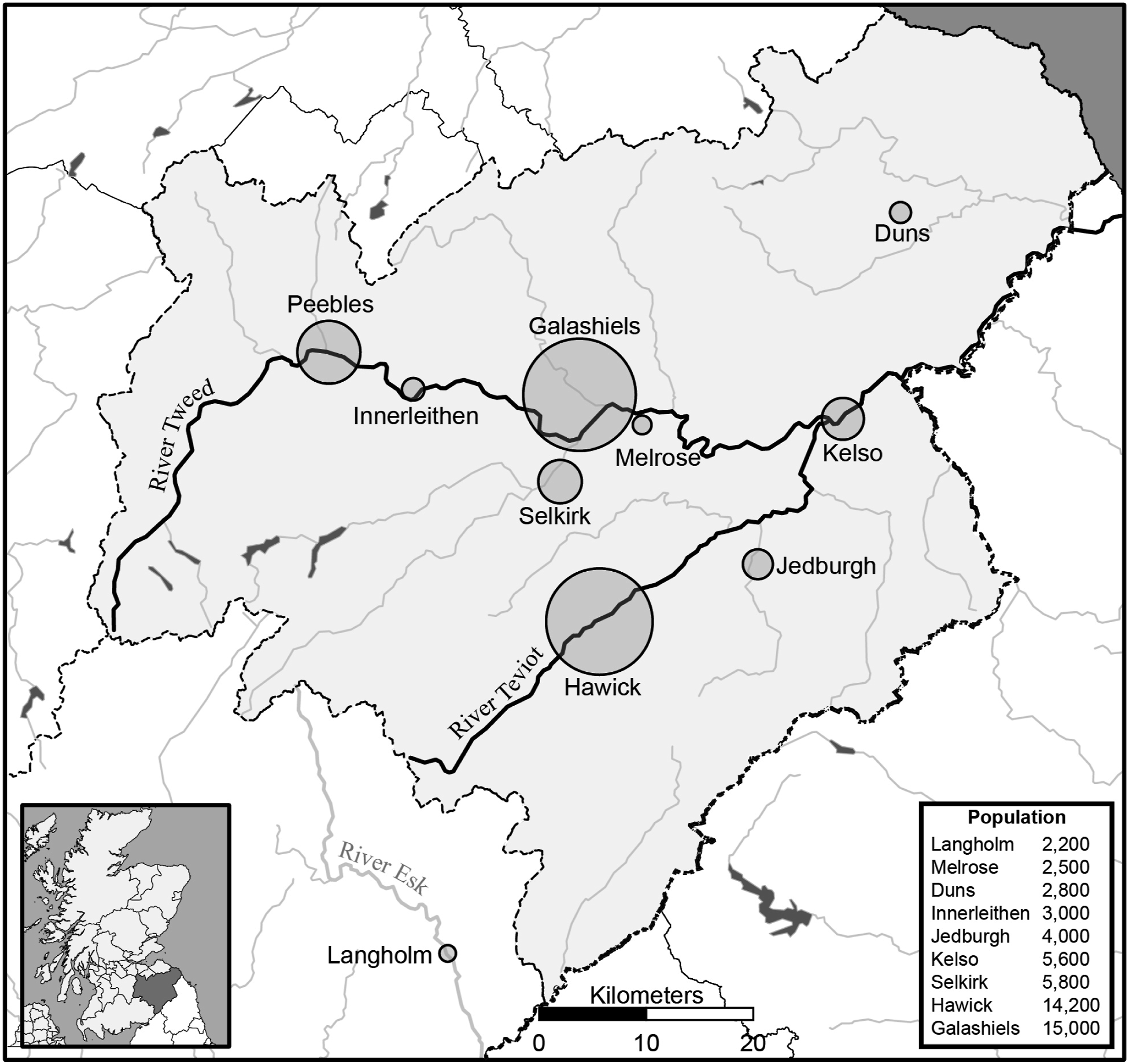
The industry is thus faced at the present time with an array of puzzling predicaments but also with many latent opportunities. On the one hand, very tangible weaknesses are identifiable in the joint regional assets and endowments available to the industry; on the other hand, most individual manufacturers in the region are capable of skilled, superior-quality production, and despite the headwinds that they face are still able to maintain a definite presence on some of the world’s most exacting markets. In consequence of these opposing tendencies, a number of important issues must be addressed in regard to the current state of the industry and its competitive advantages and hence its capacity to attain to its full potential. Competitive advantages, of course, are partly an expression of intra-firm activities and relationships and partly an outcome of socio-economic logics that are external to the firm but internal to the industry and the region. The present analysis is focussed principally though not exclusively on these external elements and on assessment of their potentially energizing role in the regional economy. These types of competitive advantages are collective in nature and are thus prospective objects of joint action and policy attention.
Accordingly, the argument that follows seeks to address three major questions: How and why did the woollen industry in the Scottish Borders develop historically over time? What are the current strengths and weaknesses of the industry as a regional system of production? And what role might public policy play in helping to chart new pathways to regional competitive advantage? In seeking answers to these questions, I draw broadly on the theory of industrial clusters and the theory of regional economic development more generally. The stakes are high, not only in terms of competitive advantage but also in terms of local employment, and not least, in terms of the industry’s embryonic claim to consideration within the policy push now being focussed on the emerging creative economy of Scotland (Scottish Government 2021).
Preliminary empirical and conceptual observations
Woollen textile clusters in global context
The formation of dense agglomerations or regional clusters of industries is a persistent feature of economic development processes This tendency to spatial aggregation is especially evident in the case of labour-intensive crafts producers in sectors like clothing, shoes, jewellery, furniture and the woollen textile industry, where interdependencies between individual firms are usually at a high level and where localized pools of common resources are typically widely available (De Propris and Lazzeretti 2007; Hall 1962; Ostrom 1990; Scott 2005)
Some of the most dramatic instances of the tendency to agglomeration in the woollen textile industry occurred at the height of the Industrial Revolution in Yorkshire in England (Gregory 1982) and the Roubaix-Tourcoing district in France (Daviet 1987), though these particular instances have long since faded into decayed remnants of what they once were. The most economically successful centres of the industry today are located far from the original heartlands of the Industrial Revolution, most notably in the so-called Third Italy, China and India. In Italy, producers are concentrated in relatively high-wage clusters in Carpi, Modena and Prato where some of the world’s most design-intensive woollen textiles are made (Bellandi and Santini 2018; Dei Ottati 2009; Lazerson 1995; Scott 1988). Even here, producers have been threatened by competition from cheaper producers, as have producers in other high-wage European centres such as Baden-Würrtemberg in Germany (Staber 2001) and Herning in Denmark (Holm-Jenson 2016). The main sources of this market contestation are the huge numbers of producers located in low-wage, low-cost agglomerations, and in particular, in the major manufacturing centres of Dongguan in China (Butollo 2015; Waldron et al. 2014) and Ludhiana in India (Tewari 1999). In view of this overall global configuration of high-wage high-fashion producers and low-wage low-price producers, the small cluster of woollen textile manufacturers in the Scottish Borders is manifestly caught in a vice that exerts relentless competitive pressures all across the market spectrum. We may ask, what factors generate the competitive advantages of dynamic clusters like those in Italy, China and India, and what, if anything, can producers and policy makers in the Scottish Borders learn from them? A brief scrutiny of these factors provides a critical point of departure that will help to clarify much of the later discussion on the history, current performance and prospective policy needs of the Scottish industry.
Theoretical preliminaries
A mountain of literature on the structure and functional logic of industrial clusters of all kinds has accumulated over the last few decades (see, e.g. the collections of essays edited by Barnes and Gertler 1999; Braunerhjelm and Feldman 2007; Karlsson 2010; Oqubay and Lin 2020; Pyke and Sengenberger 1992). Each individual cluster is, of course, constituted as a unique amalgam of social and economic phenomena (including production activities, local labour markets and various kinds of collective assets) but a reasonably coherent account of the generic elements that constitute their basic composition and functions can fairly readily be constructed.
Three general features play major roles in what we might refer to as the archetypical industrial district or cluster though in view of the copious literature on this subject I shall be brief in dealing with them. First, production systems in successful industrial clusters are invariably marked by high levels of specialization and complementarity, meaning that each individual firm is typically focussed on a limited range of products but is also dependent on other firms for critical material and service inputs. This dependency is expressed in networks of inter-firm procurements, subcontracting relations and business service activity, and networks of this type require more or less sustained levels of collaboration, cooperation and trust in order to function effectively. Second, producers in vibrant clusters virtually always depend on shared pools of labour possessing cluster-specific know-how and skills and steady local supplies of such labour are essential for effective industrial performance. Public or private provision of intra-cluster educational and training facilities often plays an important role in sustaining these supplies. Third, industrial clusters thrive on the active circulation of relevant practical knowledge, research findings and general business insights. These useful informational inputs are difficult to acquire in any systematic way by individual firms but are critical to managerial efficacy and the pursuit of innovation. Again, a communal culture that leans towards cooperation and sharing expedites this general process. At the same time, highly functional clusters are almost always endowed with institutional infrastructures that help to correct market failures by managing externalities (such as information on technological developments) in the interests of all and by supplying certain benefits (such as industry-relevant research or labour training services) that individual firms typically produce in socially suboptimal quantities (Arrow 1962). In these ways, leading industrial clusters affirm their competitive vitality as communities of firms, workers and ancillary functions by jointly generating economies of scale (size), scope (variety) and agglomeration (spatial proximity) that reduce costs, boost productivity and innovation, and shore up resistance to competitive threats from outside.
These preliminary remarks equip us with some basic conceptual tools for investigating the development and future prospects of the woollen textile industry in the Scottish Borders (see also Parker et al. 2021). As I shall argue, and notwithstanding the continuing viability of a small cadre of producers serving international markets, the cluster as a whole is lacking in many of the positive collective attributes described above. This condition is in no small degree due to a strong local tradition of individualism, self-reliance and inter-firm rivalry that works counter to the construction of a more socially embedded economic structure; but it is also strongly reinforced by the small size of the cluster. Thus, as we shall see later, whereas the region was once able to sustain many useful local resources and externalities, it is no longer able to do so on any significant scale as things now stand, and this state of affairs is quite certainly a shackle on the its future prospects.
Brief overview of a long tradition
The production of raw wool together with domestic spinning and weaving goes far back in time in the Scottish Borders Council area (a region comprising the old pre-1975 counties of Berwickshire, Peebleshire, Roxburghshire and Selkirkshire together with a small part of Midlothian). By the late 18th and early 19th centuries, rudimentary workshop- and factory-based production was beginning to congregate in many of the small towns and villages in the region, with Hawick in Roxburghshire and Galashiels in Selkirkshire firmly in the lead followed in a distant third place by Selkirk (Barty-King 2006; Bremner 1869; Hall 1898; Turner 1985a, 1985b; Wilson 1953).
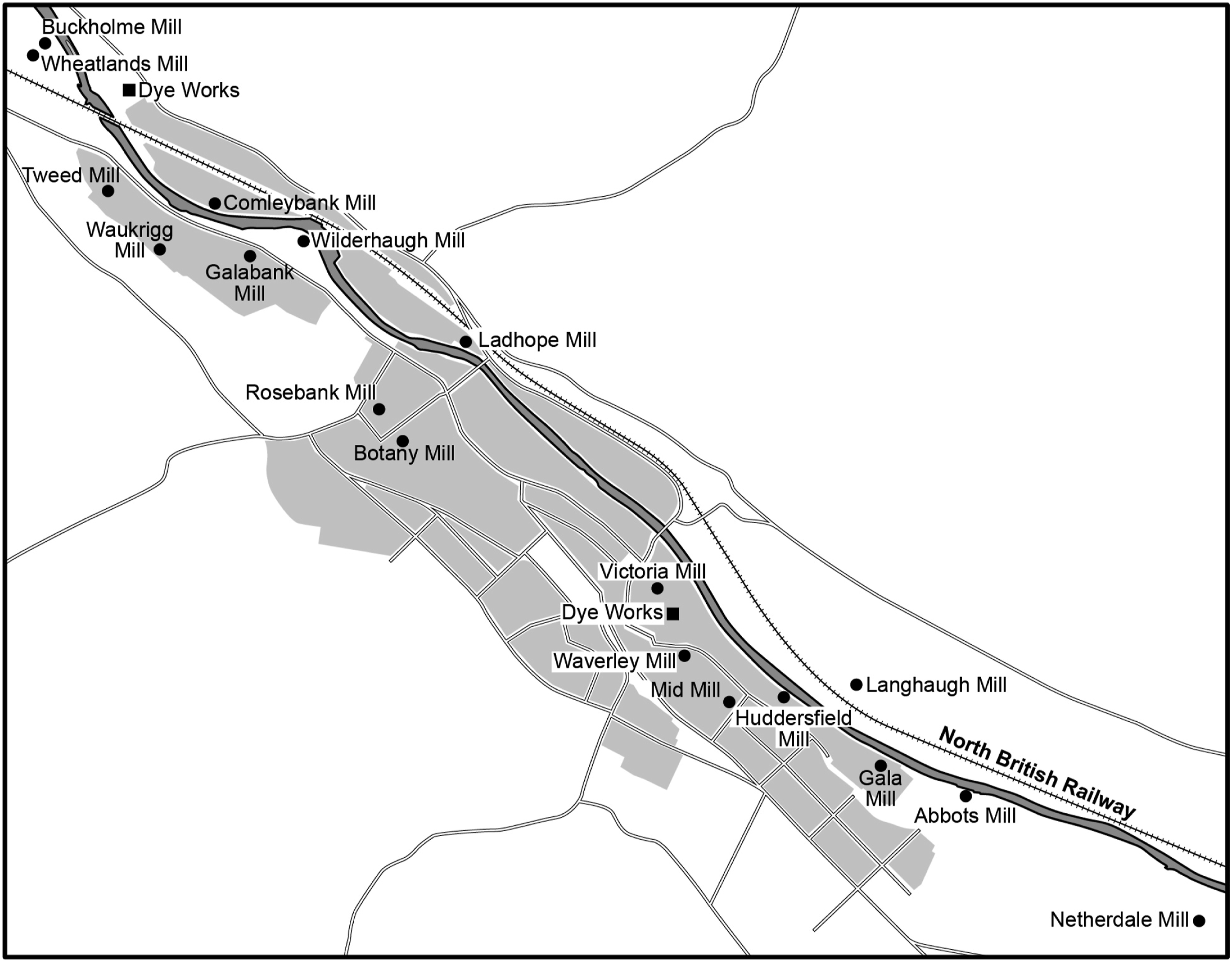
In the early days of the industry, final outputs consisted mostly of cheap hosiery and woven fabrics produced on stocking frames and hand looms using wool from Cheviot sheep reared in the local area (Wells 1972). Periodic fairs in Hawick, Kelso and St Boswells facilitated the flow of raw wool into the industry (Gulvin 1973). Outwork was common to begin with, but as mechanization set in, production was consolidated in purpose-built mills in local towns and villages. By the second half of the 19th century, a growing though never absolute geographical distinction was coming into being in the chief centres of production, with specialized hosiery production (now including knitted underwear) concentrated in Hawick, and woven fabrics in Galashiels (Bremner 1869; Hall 1898; Martindale 1972; Turner 1964; Wilson 1953). Figures 2 and 3 reveal the agglomerated locational pattern of the industry in the two centres at this time – a pattern that still, though in a much-attenuated form, has persisted into the 21st century. Here, the industry is aligned along lades or mill streams running through the valley bottoms of the fast-flowing rivers Teviot and Gala, respectively, (Pattison 1946). At this stage in the industry’s development, spinning was undertaken in close association with knitting and weaving, sometimes in vertically integrated units sometimes in independent ventures. Several small handloom weaving shops and hosiery frame shops were also in operation in Hawick and Galashiels (Rorke et al., 2011). Dyeing, too, was in some instances vertically integrated into the overall manufacturing process while a few independent dye works (typically incorporating washing and scouring functions) in Hawick, Galashiels and other smaller centres offered their services on a subcontract basis. Virtually all of the mills in the region in the 19th century were small in size, with an average of just 40 workers per mill (Parliamentary Papers 1850). In the early decades of the century the proportion of the factory workforce made up by women was low, but as the century progressed feminization became much more pronounced, rising to upwards of 60% in the 1890s. Locations of woollen mills and dye works in Hawick in the second half of the 19th century. The built-up area is shown as it was in 1897. Not all of the mills shown were operational at the same time. Sources: Ordnance Survey six-inch to the mile maps surveyed in 1858 and 1897 and the Canmore website at https://canmore.org.uk/. Locations of woollen mills and dye works in Galashiels in the second half of the 19th century. The built-up area is shown as it was in 1897. Not all of the mills shown were operational at the same time. Sources: Ordnance Survey six-inch to the mile maps surveyed in 1858 and 1897, the Canmore website at https://canmore.org.uk/, and Rorke et al. (2011).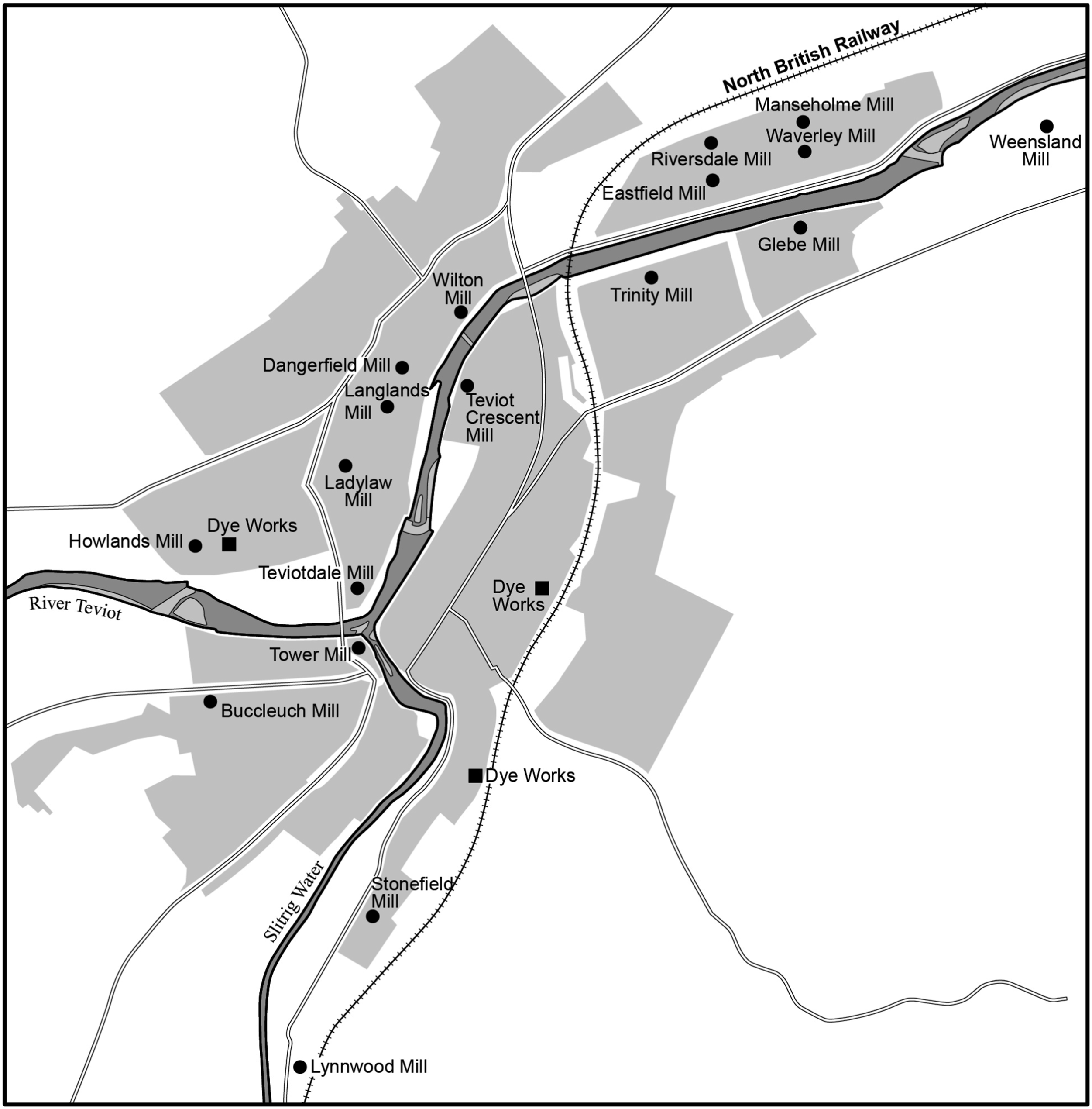
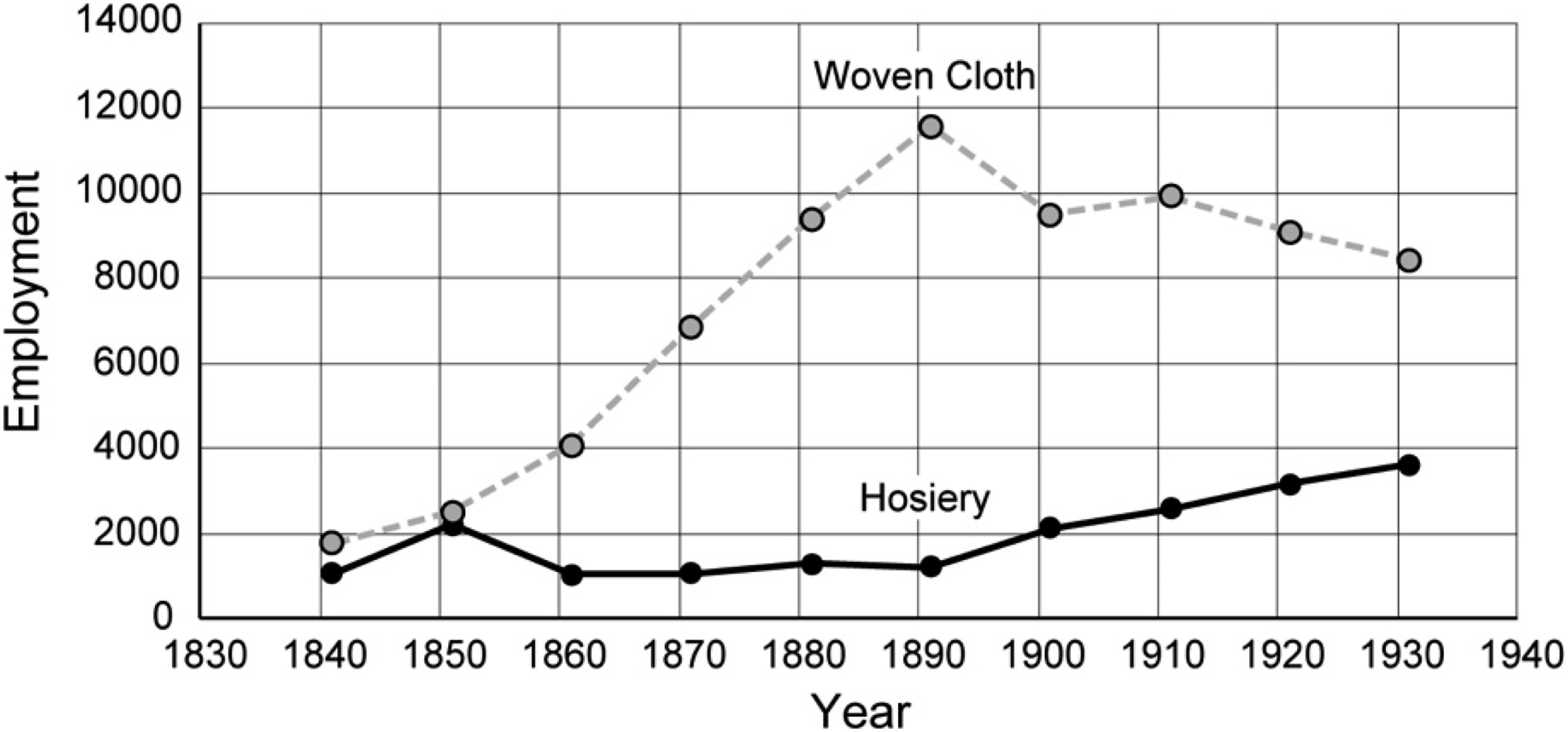
Employment as a whole grew fairly steadily over the 19th century (Figure 4) with the total number of workers reaching a peak in 1891 of 12,784, representing just over one-third of Scotland’s labour force in the woollen industry in that same year. This peak level of employment has never subsequently been surpassed. Most of the expansion that occurred in the second half of the 19th century was concentrated in the woven fabric side of the industry. The hosiery side remained stagnant over the same period, but began to grow again after the turn of the century (Figure 5). The woven fabrics subsector benefitted greatly from Victorian taste for tweeds and tartans and found ready markets in the affluent fashion centres of Edinburgh and London (NASWM 1956). By contrast, hosiery was primarily a standardized, low-fashion product caught up in relentless competition with large-scale producers in the East Midlands and elsewhere (Chapman 2002; Smith 1963). From the late 19th century onwards hosiery production steadily evolved into knitted outwear production, and by the 1940s, the transition to this more fashion-sensitive line of production was complete (Chapman 2002; Gulvin 1984). Woven fabrics remained a significant element of the region’s textile output, but knitwear now moved decisively ahead, led by the firm of Pringle whose employment had swollen to as many as 1100 workers by 1950 (Moffat 2014). By this time, as well, cashmere wool imported from China and Mongolia for both knitting and weaving was in significant degree replacing the merino wool from Australia and New Zealand that had hitherto served as the main source of yarn in the industry and since the Second World War, high-quality cashmere-based products have constituted the major proportion of the region’s total output. Employment in the woollen textile industry in the Scottish Borders, 1841–1931. Production in Berwickshire was negligible over this period and data for this county are hence omitted. Source of data: Census of Scotland. Employment in the hosiery and woven-fabric subsectors of the woollen textile industry in the Scottish Borders, 1841–1931. Source of data: Census of Scotland.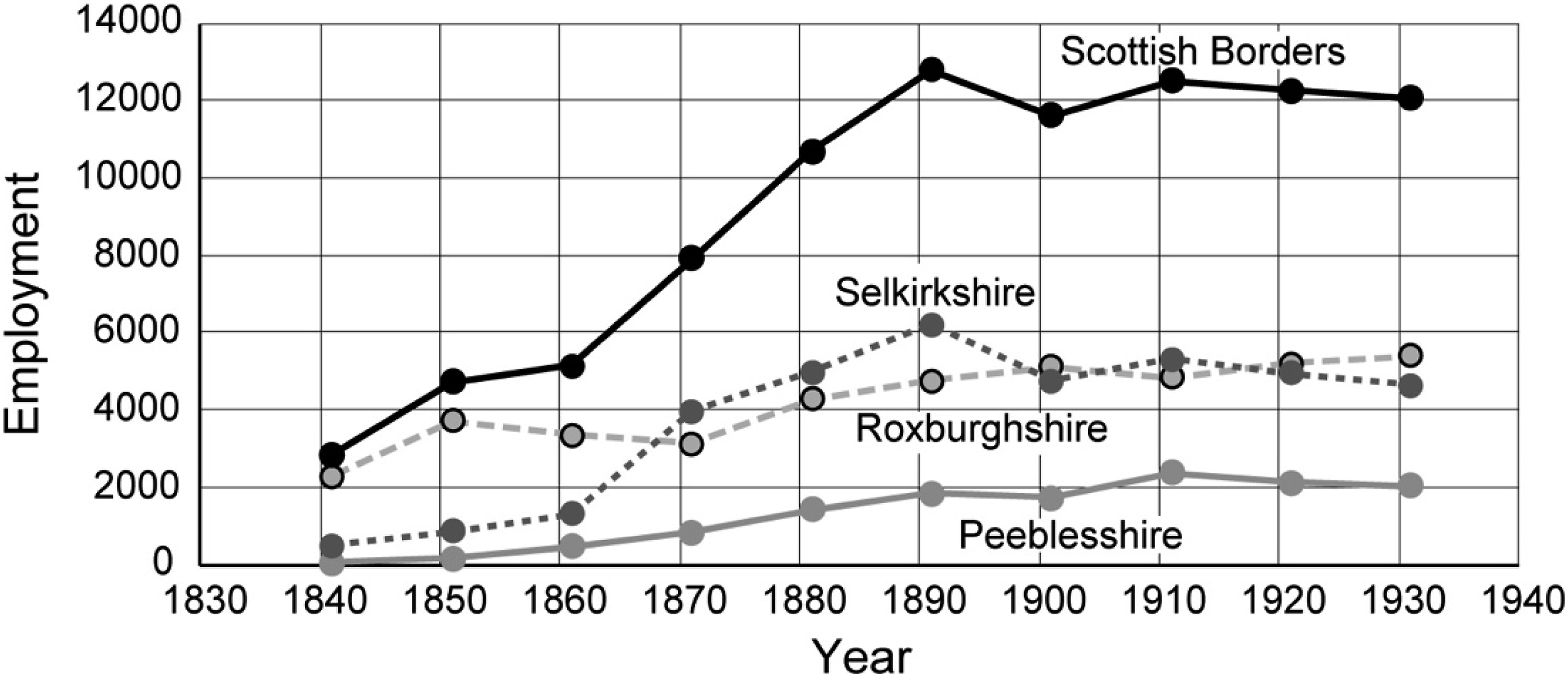
A regional industrial system: Current status and predicaments
Crisis and its aftermath
The post-War years represent a period of expansion in the Borders’ woollen industry as markets for fashioned textiles expanded in all of the world’s more highly developed economies. The auspicious prospects that opened up over these years were short-lived, however, for already by the 1960s, the first intimations of global competitive pressures and restructuring in the textile industry were beginning to make themselves felt. By the 1970s, the so-called new international division of labour identified by Fröbel et al. (1980) was coming into its own and countries in what was then identified as the world periphery were starting decisively to carve out niches for themselves on world markets, with ultimately devastating effects on industrial employment in high-wage countries, most especially in the textiles sector. Consistent time-series data on the woollen industry for the second half of the 20th century in the Scottish Borders are hard to come by, but it seems clear that at least by the 1970s, significant erosion of production and employment was beginning to occur. Moreover, the process of decline has continued more or less uninterruptedly down to the present day, and Brexit has recently added further to the industry’s difficulties in the matter of external trade.
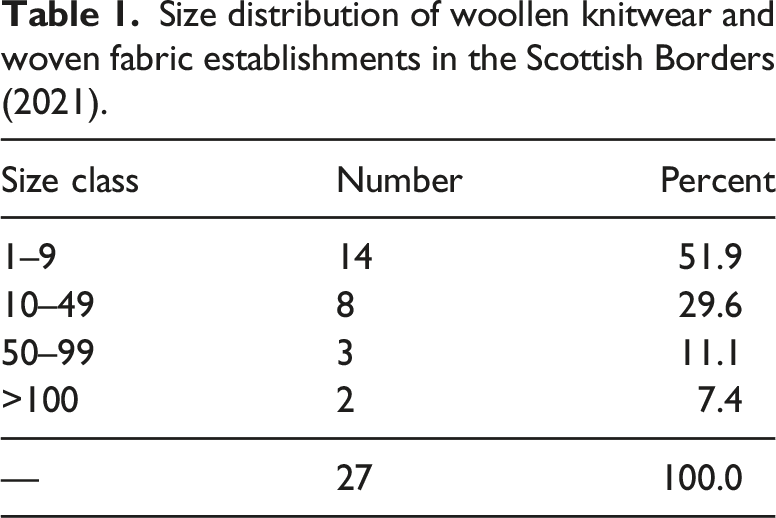
Despite these problems, the industry retains much of its character as a spatially agglomerated complex of small producers. Hawick, with its specialization in knitwear, remains by far the dominant centre within the region, but Galashiels, which has lost virtually all of its weaving capacity, is now just a shadow of its former self. Figure 6 depicts the main locations of the knitting and weaving segments of the industry as it exists today together with the locations of a number of ancillary functions. The latter comprise three dye works and four design studios along with a sizeable wholesale cloth merchant and distribution centre (owned by Holland and Sherry). Note that the small outlying centre of Langholm (located in the Dumfries and Galloway Council area) is also included in Figure 6. In the study area as a whole, some 27 establishments remain in operation, of which 22 are engaged in knitting and five in weaving. Three of the 27 establishments shown in the figure function as satellite locations managed by other plants in the region. Data from the UK Office of National Statistics show that 72.7% of the region’s 825 textile workers in 2018 were employed in the knitted goods subsector and 27.2% in weaving. I estimate on the basis of factory visits and informal reports that the total number of employees in the industry in the summer of 2021 was 1085 (23.6% of them being part-time) though this is probably an undercount as many workers were confined to their places of residence due to Covid-19. As indicated in Table 1, the majority of establishments in the region remain small in size, with only two having more than 100 employees. Geographical distribution of textile and ancillary industries in the Scottish Borders, 2021. The Scottish Borders Council area is shaded. Size distribution of woollen knitwear and woven fabric establishments in the Scottish Borders (2021).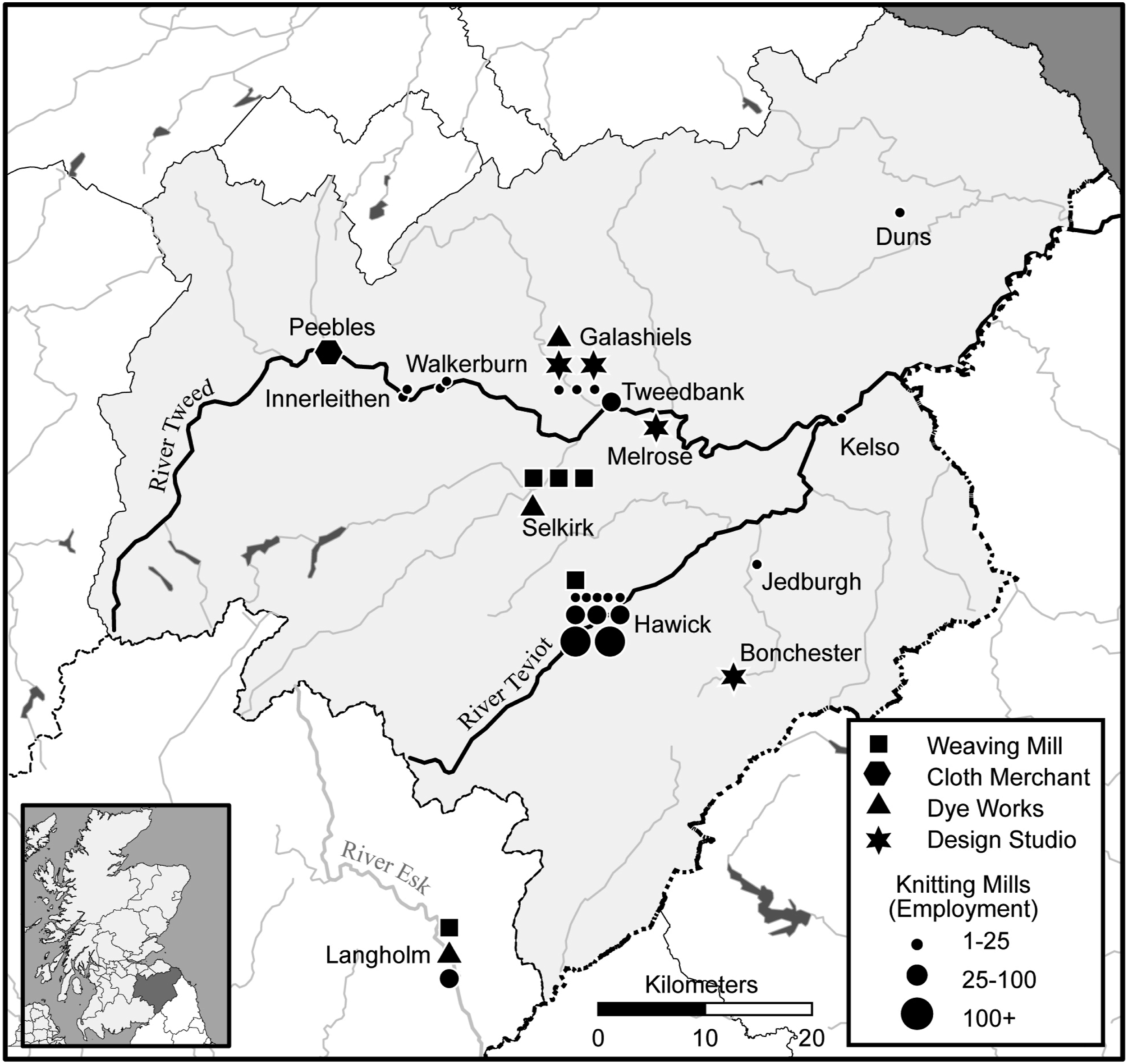
Production organization and entrepreneurship
The industry that emerged in the Scottish Borders region after the Second War was very much bound to the forms of paternalistic capitalism and family-based enterprise that had developed in the 19th century. It still retains elements of this traditional structure though by the 1970s deeply-rooted shifts in fashion and management structures were bringing about significant change. In the first place, the trend to more casual clothing was exerting a strong downward squeeze on tweed fabric manufacturing (Anderson 2018). In the second place, a number of the larger and more successful knitwear producers became take-over targets of large multinational textile, clothing and retail companies seeking to expand and diversify their business operations (Hood 1973), and this trend has not always been ultimately beneficial in terms of the region as a whole, for subsequent corporate restructuring in the face of global competition has led to the closure of several of the leading knitwear factories. The most significant of these corporate closures was Pringle, owned by the Hong Kong-based company S.C. Fang & Sons, which ceased manufacturing in Hawick in 2008. The long-established firm of Ballantyne in Peebles, owned by Italian textile manufacturer Zegna Baruffa and American retailer Brooks Brothers, shut down in 2010. Two other corporate-owned establishments in Hawick have also recently disappeared, namely Peter Scott Knitwear which closed in 2016, and Lyle and Scott which closed in 2021. Among the leading knitwear producers that remain in the region today are Barrie Knitwear, Hawico, Johnston’s of Elgin, Short’s of Hawick, Scott and Charters and William Lockie (all of them located in Hawick) and the Edinburgh Woollen Mill in Langholm. Lovat in Hawick and Lochcarron in Selkirk are the principal woven fabric producers. Each of these firms occupies a prominent position in the international woollen industry.
Most of the surviving firms in the region have emerged in the aftermath of these restructuring trends with enhanced functional and managerial competence, though the current state of the region-wide woollen industry is unquestionably not all that it might be. In contrast to the ideal cluster model as outlined earlier, the Scottish Borders woollen complex is plainly deficient in productivity-enhancing structures of local interdependence and collective order. The data presented in Figure 6 indicate that local opportunities exist for outsourcing dyeing and occasional design needs, and there is also a small facility in Hawick owned by Shima Seiki providing technical support to users of its machinery (who include almost all of the advanced knitwear producers in the region), but a more elaborate groundwork of specialized external services is signally absent. Some firms engage in lateral subcontracting practices when their production levels come close to maximum capacity, but otherwise they are reluctant to tap into one another’s special competences, which means, too, that channels of information exchange are to that degree restrained. An additional symptom of this low level of local functional integration is that spinning mills – once a basic component of the complex – no longer exist in the Scottish Borders, and most of the yarn for knitting and weaving is now imported from Yorkshire. Any further local interactions would appear mainly to involve a small amount of outwork in the form of home-based knitting and kilt-making but any significant revival of domestic production seems unlikely (Halbert 2018).
There is thus little in the Scottish Borders that comes even close to the dense, flexible and tightly interlocking structures of regional manufacturing and marketing activity with their vibrant agglomeration economies that characterize the world’s most dynamic woollen-producing clusters such as the Italian industrial districts as described, for example, by Becattini (1979) and Magnani (1999). These deficiencies no doubt stem in part from the long tradition of individualism that prevails in the Borders region, but they also reflect the small overall scale of the industry which is unable to generate significant economies of scale and scope. The observable general stasis of the cluster is compounded by the notably low levels of new firm formation, and, more specifically, spinoff activity from existing production facilities. Employees of knitwear and woven-cloth producers in the Scottish Borders are plainly not motivated to assume the risks that they would face in the sort of entrepreneurial experiments that are endemic in more vibrant industrial clusters
Local labour markets
Qualified and experienced employees in the region’s woollen industry receive attractive wages by local standards, though less skilled workers are paid at close to the Scottish minimum of £8.36 an hour. The ratio of female to male workers in the industry is roughly 60:40, with tasks like sewing and garment assembly carried out almost entirely by women and machine-operating processes by men. Labour turnover in most mills is reported to be low, but employers consistently claim that recruitment and training of new and especially skilled workers is a recurrent problem. Membership of trade unions is virtually non-existent, perhaps because a discreetly paternalistic system of labour relations helps to mitigate management-worker discord, and the last industry strike (in Hawick) dates from as far back as 1972 (McLean 2016).
Just as producers in the Scottish Borders seem to be averse to many of the inter-firm cooperative and collaborative practices observable in more successful industrial clusters so local labour markets display little of the vitality and resilience typically found in these clusters. Front-line knitting and weaving workers are certainly skilled and motivated, but signs of enervation are evident in the overall labour force which now comprises mainly older individuals, and new blood in the guise of habituated job-seekers is in short supply. Much of the industry’s training needs are provided in-house, though labour training is one aspect of the regional economy that has received some significant public support in recent years, and, indeed, a degree of basic educational opportunity has been continuously available for prospective textile workers ever since the end of the 19th century. This tradition is represented by a long line of institutions starting with the Galashiels Combined Technical School (1889–1906), followed by the South of Scotland Central Technical College (1906–1922), which, in turn, was succeeded by the Scottish Woollen Technical College or as it became known after 1965, the Scottish School of Textiles. In 1989 the School entered into an agreement with Heriot-Watt University, eventually becoming the School of Textiles and Design housed at the Heriot-Watt campus in Galashiels where both undergraduate and graduate training is offered in textile technology, fashion design, marketing and management. The School is undoubtedly a critical adjunct to the local woollen textile industry, and a number of its former students can be found scattered around different mills in the region, but its potential role could almost certainly be much improved, most notably in view of the fact that a high proportion of its graduates leave the south of Scotland altogether for greener pastures elsewhere. Another labour-training institution known as the Centre of Excellence in Textiles (funded by South of Scotland Enterprise) provided basic courses in Hawick but functioned for only a few years before closing down in 2021.
An institutional vacuum
The general theory of industrial clusters invests much credence in the potentially positive role of institutional infrastructures in coordinating the internal functional elements of local economies and drawing them into synergistic regional systems.
This role revolves in the main around efforts to internalize wayward externalities, to ensure a supply of critical public goods that would otherwise be subject to market failure, and to foster critical network connections between individual firms. In other clusters, efforts of this sort are often assumed by organizations like marketing bodies seeking to foster international trade in local products, or by technical institutes engaged in research activities, or by cooperatives that engage in joint purchasing of critical inputs at discounted prices. Labour training is also frequently provided as a public service, as we have seen in the case of the Heriot-Watt School of Textiles and Design. More generally, many different kinds of agencies in both civil society and government are capable in both principle and practice of undertaking collective action to secure increments to intra-firm operational efficiency, inter-firm fiduciary relations and system-wide positive externalities (Knox and Norin 2021). Specialized industry associations and workers’ organizations extend the range of potentially beneficial types of collective action, and over the last century and more, several initiatives to strengthen the institutional structures of the Borders woollen industry in this way have come and gone. 2 Most of these, however, have been short-lived and limited in their influence, a further symptom, perhaps, of the overall diffidence in the region and the industry in regard to joint action. At the present time, Textiles Scotland, a national association and a branch of UK Fashion and Textiles, appears to be the sole remaining industry organization with some representation in the Scottish Borders. Otherwise, the School of Textiles and Design at the Heriot-Watt campus in Galashiels remains one of the very few institutions within the region that can in any sense be said to offer meaningful industry-wide benefits, though as already indicated its impacts on the local labour market and entrepreneurial prospects could certainly be more forceful. A very recent initiative in the guise of the South of Scotland Enterprise organization – established in 2020 with significant support from the Scottish government – may well play a positive role in the region’s future economic development in general though its relevance to the woollen industry in particular is unclear. Thus far, the organization’s record of aid on behalf of the industry appears mainly to consist of limited financial support to a few firms for machinery upgrading, and its ill-fated experience with the Centre of Excellence in Textiles.
Competitive prospects and policy conjectures
Market relations
In spite of the evident hurdles faced by the woollen industry in the Scottish Borders, it retains a well-earned reputation for the excellence of its products and it continues to sell much of its output on some of the world’s most discriminating markets. Most of this output now comprises cashmere wool knitwear designed for the more fashion-orientated end of the market. One local firm actually retains two designers in Milan in order to preserve its edge in the fashion world. That said, the stock-in-trade of most producers plays above all on time-tested design themes with strong appeals to Scottishness and Britishness reinforced by cultural intimations drawn partly from Sir Walter Scott’s novels. These themes commonly allude to stylized images of the region’s romantic landscapes and heritage as reflected in the textures, colours, patterns and styles (including tartan motifs) of local knitwear and woven fabric products. Traditional resources like these endow producers with a cachet of authenticity and distinction, and, as such, represent an intangible but potent constituent of the region’s and the industry’s common iconographic capital (Chillas et al. 2018). At the same time, even in the highly traditional tweed segment of the industry, innovative variations on these design themes are quite common, as Anderson (2018) points out. It follows from all of this that while levels of collaboration and joint action may be relatively low within the industry, there is, by contrast, a very definite local sense of cultural identity that figures prominently in the look and feel of final products and in the semiotics of promotional efforts (McLaren-Hankin 2013). This identity acts not only as a source of cognitive orientation among creative workers in the industry but also as an implicit branding device, which, along with manufacturers’ formal product labels, functions as a quasi-monopolistic asset helping to keep competitors and imitators at bay (Pike 2015). There is currently no explicit brand covering the region’s knitwear and woven fabric products as a whole, but the establishment of a common geographical indication (as in the case of Harris Tweed and Thai silks), possibly under the auspices of the World Trade Organization, is a prospective initiative that is obviously in producers’ interests (see Dutfield 2011). One of the indisputable strengths of the industry, despite the competitive challenges that it faces, is its diverse forward connections to prestigious distribution and sales outlets throughout the world. Many of these connections involve simple arms’ length exchanges but many also consist of more durable contractual relations, including corporate integration into final sales (a point emphasized by Hood 1969). Knitwear and woven fabrics from the Scottish Borders are distributed to markets through a multiplicity of agents, cloth merchants, sales offices, and retail outlets. Prestige tailoring companies on Savile Row and elsewhere together with high-design garment producers/retailers like Burberry, Gucci, Ralph Lauren, Prada, Louis Vuitton and Vivienne Westwood are regular conduits through which these products pass. The luxury cashmere specialist, Barrie, one of the region’s larger manufacturers, is directly owned by Chanel. Johnston’s of Elgin has sales offices in London, Paris, Düsseldorf, Tokyo and Shanghai, and owns retail stores in London, Edinburgh and St Andrews, and, like several other local manufacturers, manages an in-house mill shop. Hawico has been especially assertive and innovative in its sales strategy with twelve fully-owned retail outlets in prime locations in cities not only in the UK but also in Germany, Italy, Switzerland and Japan. Virtually all manufacturers also engage in product promotion and sales activities via the Internet, and many of them express a strong sense that digital marketing platforms are likely to feature very much more prominently in future business transactions. Firms are well positioned to capitalize on this trend given their relatively short production runs and flexible in-house manufacturing processes enabling them to respond directly to final customer demands.
A role for policy?
The surviving firms in the Scottish Borders possess significant competitive advantages in regard to their internal management and iconic product designs. But, as noted, there are readily identifiable voids in the local industrial system, suggesting that overall growth and market performance could be materially improved by appropriate remedial action. Above and beyond the evidence already marshalled to show that the system has been subject to enormous stress over the recent past, trade statistics indicate that foreign exports of textile yarn, fabrics and made-up articles (SITC 65) from Scotland declined by 32.4% between 2013 and 2020. 3 To be sure, SITC 65 trade statistics for Scotland as a whole are not directly representative of the knitwear and woven fabric industry in the Scottish Borders, but they are surely symptomatic of broad trends. Even the robust textile clusters of Italy have lost some of their competitive edge over the last decade or two as cheap outputs from low-wage countries have flooded world markets (Clara 1999; Dei Ottati 2009)
The theoretical overview of industrial clusters with which this paper began already implies that effective joint action and public policy on the part of local stakeholders and governmental agencies will be unavoidable if the woollen knitwear and woven fabric industry in the Scottish Borders is appreciably to consolidate and improve upon its current prospects. I have suggested, in particular, that the construction of a viable, potent pool of agglomeration economies and institutional infrastructures would do much to boost productive performance and to generate new entrepreneurial energies in the region (cf. Porac et al. 1989; Scott 2001). The small size and limited number of producers make public intervention difficult but all the more urgent. Three points in particular must now be made. First, despite the indurated go-it-alone ethos of most producers, the possibility of constructing a more comprehensive system of inter-firm relations needs to be explored with a view, in particular, to the efficiencies that might be generated by more detailed vertical and lateral interlinkage and cooperation. Second, increased public support for skills formation is imperative as well as more effective orientation of the Heriot-Watt School of Textiles and Design to the region’s recruitment, research and entrepreneurial needs. Third, some sort of common information-scanning and intelligence-processing agency would undoubtedly help producers to keep abreast of relevant technical and economic trends and to sharpen their responsiveness to new market opportunities (Hall 1994). Each of these measures would almost certainly have positive impacts on the operational and innovative capacities of the industry.
A striking illustration of a highly successful public effort that combines significant facets of these measures can be found in Italy in the so-called Carpi Fashion System 4 which pursues a broad mandate to cultivate and reinforce localized competitive advantages in knitwear production in the Carpi cluster and its offshoots in the wider Emilia-Romagna region (Bianchi et al., 2021; Clara 1999). Carpi Fashion System offers an extensive range of pertinent research and advice to producers on matters as diverse as manufacturing processes, software development, skills requirements, foreign sales opportunities and fashion trends. It also assumes responsibility for overall regional marketing efforts and lobbying with diverse governmental agencies. Obviously, the knitwear and woven fabric industry in the Scottish Borders is far too small to support an institution as ambitious and complex as Carpi Fashion System, but some very modest experiments in the light of general benchmarks gleaned from this and other similar organizations would almost certainly repay the effort. In addition to the measures already suggested, the increasingly evident synergies between the woollen industry and the tourist trade in the Scottish Borders offer attractive opportunities for inventive policy formulation, and, once again, play into possibilities for promoting a robust regional creative economy (see Richards and Wilson 2007).
Finally, a word of caution is in order about the challenges that policy makers and other concerned parties in the region face in regard to these observations about conceivable directions of system upgrading. It is one thing to identify broad insufficiencies and to lay out theoretical arguments as to why given generic policy guidelines might offer suitable remedial guidelines; it is quite another to carry this kind of exercise out into concrete programmes of rectification. The volatility and uncertainties of actual socio-economic situations defy the formulaic clarity of theory, which means that the conception and implementation of policy measures must be allowed considerable room for manoeuvre. The broad principles articulated above are thus not intended to serve as a rigid template for immediate implementation, either in part or in whole. Rather, they represent preliminary points of reference based on forms of collective action that have been found in theory and in many different empirical situations to characterize dynamic industrial clusters; and they must obviously be tailored in ways that are fully adapted to local idiosyncrasies. It is in this spirit that I have sketched out possible developmental and policy pathways for the region, even if the obstacles to any concrete course of policy implementation are daunting. Above all, little in the way of actual progress can be expected in the absence of two further crucial conditions: One is that sufficient financial resources be found to underwrite private and public action; the other is that appropriate political mobilization of local stakeholders needs to be secured if appropriate strategic action is to be sustained – as it must – over any durable period of time. A further crucial desideratum is that the traditional mutual disengagement of woollen textile producers in the Scottish Borders be sufficiently challenged to allow for formation of the communal trust on which, in the end, effective collaborative interaction depends. Personal interviews with manufacturers in the region suggest to me that the latter recommendation may be the most problematical of all.
The uncertain future
I have tried to show in this paper how the woollen knitwear and woven fabric industry originated and evolved in the Scottish Borders, how it is constituted at the present time, and how certain forms of joint action and public policy might help to reinforce its productive capacities and market reach.
This particular empirical case represents a typical if somewhat abbreviated instance of a broad class of craft-orientated, labour-intensive industrial clusters, and which, like so many others of its kind is now faced with complex questions of survival and regeneration in a world of globalized markets (Scott 2006). The relatively inelastic demand for high-priced luxury outputs makes it all the harder to respond to these questions in practical terms. As I have argued, the industry may have many weaknesses, but it also has exceptional potentialities. Above all, it has grown out of a long tradition from which it continues to derive tangible strength, most notably, perhaps, in the matter of its access to the pool of distinctive skills, know-how, and design sensibilities that sustain its reputation for quality and prestige. At the same time, it is overseen by a new generation of managers who are moving rapidly away from the older family-based modes of ownership and control, and it is imbricated within networks of distribution and sales that project its outputs onto some of the world’s most demanding markets. The ravages of recent decades have assuredly taken their toll but are now to a degree in abeyance. The immediate future for the industry remains no doubt uncertain, though a case can be made for a scenario of at least short- to medium-term stabilization. Spontaneous renaissance is an unlikely prospective outcome but some substantial resurgence may be envisaged given appropriate joint action directed to the reinforcement of localized competitive advantages and a resolute long-term effort to set the industry on a new evolutionary trajectory. Realization of this projected state of affairs will manifestly require concerted leadership, planning and political action focussed on the development of a sufficient common pool of regional resources and capabilities. The alternative prospect, in all likelihood, is a future marked either by stasis or continued slow attrition.
Footnotes
Declaration of conflicting interests
The author(s) declared no potential conflicts of interest with respect to the research, authorship, and/or publication of this article.
Funding
The author(s) disclosed receipt of the following financial support for the research, authorship, and/or publication of this article: This research was funded by a bridge research grant awarded by the Council on Research of the Academic Senate, University of California - Los Angeles.
