




Abstract
This paper explores the potential of ‘Land Value Capture’ in addressing the shortfall in funding to address the biodiversity crisis through a series of interviews with Local Planning Authority officers in England. It finds heterogeneity in their responses to financial austerity and imperatives to deliver development, which heavily influences developer contribution (DC) practice. The response to these pressures differed depending upon localised planning culture and its interrelation with behavioural biases, which defined the scope of officer agency to influence developer contribution outcomes. Most LPAs placed a strong emphasis upon securing real estate investment to drive economic growth and to provide opportunities to secure DC to address socio-economic issues, with the status quo bias contributing towards inertia in policy and practice change. Elsewhere, there was a greater emphasis placed upon reconciling the need to deliver development with the preservation of environmental amenity, enabling officers to carefully frame practice changes, to successfully secure funding for ecological mitigation programs. The paper illustrates the cultural and behavioural challenges in implementing DC policy change to support funding these priorities, whilst this may be overcome by legislative changes, integrating these may be compromised by resource limitations whilst also affecting the existing delivery of public goods.
Keywords
Introduction
Land value capture (henceforth LVC) is an increasingly utilised mechanism to finance a variety of infrastructure and public goods across the world (Muñoz Gielen and van der Krabben, 2019). To date, LVC practice and research has largely focused upon financing ‘grey’ infrastructures such as education, health, transport facilities and subsided housing. In some localities, the funds secured through LVC represent a significant source of public funding, for example, £7bn in England in 2018/19 (Lord et al., 2020), meaning there may be significant potential for LVC in addressing the biodiversity crisis.
The protection and restoration of natural habitats as well as the integration of nature-based solutions within urbanised areas are both critical in addressing this crisis (Aronson et al., 2017). Nevertheless, these programs often suffer from underfunding (Kabisch et al., 2016), even in light of increasingly stark warnings over the impacts of biodiversity loss upon ecosystem service provisioning (Díaz et al., 2019; Mace et al., 2012). For example, in the UK recent estimates suggest that an investment of £2.2bn is required annually to meet current environmental land management priorities, with a current shortfall of £1.86bn (Rayment, 2017).
While the ecological outcomes of such investments vary widely (Gibbons et al., 2018), assessing the ecological impact of such investments is beyond the scope of this paper, instead given the underfunding of ecological mitigation and protection programs, there is a need to diversify financing sources. Therefore, the focus of this paper is to explore why English local authorities utilised land value capture mechanisms to negotiate funding for other forms of public goods at the expense of the investment in ecological mitigation and protection programs? In doing so, the paper also identifies nascent practice which currently supports investment in such programs.
In common with many developed nations, England’s local authorities have experienced significant financial pressures in response to the Global Financial Crisis, leading to significant cuts to non-statutory services including planning, ecology and green space management (Theodore, 2020; Hastings et al., 2015). Although Local Planning Authorities (henceforth LPAs) continue to have a duty to protect and enhance biodiversity through planning, the national planning policy framework, most recently updated in 2021, continues to place a greater weight upon delivering housing and economic growth (Longlands, 2013; MHCLG, 2021). In response, LPAs have tightly focused upon the latter priorities, leaving limited scope to embed environmental considerations within planning or to upskill staff on ecological issues (Whitten, 2019). These changes have also driven policy and practice innovation (Hastings et al., 2015), since LPAs have been forced to consider alternative approaches for funding plans, ecological mitigation and green space management programs, although the potential role for LVC in supporting such programs has not been fully explored.
The paper will first set out the broad principles of LVC and review recent research into the operation of LVC including a consideration of the behavioural aspects of this practice. Then, empirical evidence from a previously published study of the value of funds secured by English LPAs is presented (Lord et al., 2020). New empirical evidence is then outlined, drawing from a series of interviews with key stakeholders from a representative sample of English LPAs. The paper then explores how cultural and behavioural factors interact to support or prevent the use of LVC mechanisms for ecological mitigation, illustrating the impact of behavioural variations on planning and development outcomes.
Land Value Capture and its role in financing ecological mitigation and protection programs
Land value capture (LVC) seeks to capture a variable proportion of development value, which is defined as the difference between the maximum market value (i.e. the maximum sale of a completed development minus all costs of the development) and its existing use value (Cullingworth, 1980). The term LVC covers a variety of practices across different nations, with a unifying principle being that in-kind and cash payments are extracted through development and planning processes which can be used by local governments to fund the provision of public goods such as affordable housing and transport infrastructure. An important distinction between these practices is whether payments are negotiated between a developer and public authority or mandated as a requirement for gaining the necessary permissions for development through land-use plans or other development policies (Alterman, 2007).
In England, there is currently a hybrid system of flat-rate fees (via the Community Infrastructure Levy) and negotiated processes (Section 106 agreements), forming what are commonly known as developer contributions (henceforth DCs) (Crook, 2016). This paper focuses upon the use of Section 106 payments, since the Community Infrastructure Levy is less commonly used for ecological mitigation programs as regulations do not permit the hypothecation of funds for specific projects, unlike Section 106 agreements (Baker et al., 2018).
Their use to finance environmental mitigation purposes in England emerged alongside their use for other means in the 1980s (Whatmore and Boucher, 1993), and this practice was directly endorsed by the Department of the Environment (1991) via Circular 16/91, which defined reasonable use of payments ‘intended to offset the loss of or impact on any amenity on the site prior to development, for example, in the interests of nature conservation’. Despite this, the practice was relatively rare, largely implemented to address direct encroachment upon internationally recognised habitats (Cowell, 1997; Whatmore and Boucher, 1993).
However, concerns over this practice quickly emerged, with fears that it would accelerate the loss of irreplaceable habitats in the face of strong developer power (Cowell, 1997; Curry, 1993) and that this risked damaging the reputation of environmental groups through perceptions of ‘being bought’ (Whatmore and Boucher, 1993). Despite this, Whatmore and Boucher (1993: 48) concluded that ‘as a potential means of allowing the private sector to acquire at least partial responsibility for environmental protection, environmental planning gain can be expected to remain on the political agenda’.
Their limited use continued with Baker et al. (2014) estimating that as few as one in 1000 planning applications requiring compensation for ecological impacts of development. Following a DEFRA review, a 2-year pilot program was developed to understand whether a nationwide biodiversity offsetting program was feasible, which ran from April 2012 (DEFRA, 2011). There was a series of difficulties in its operation including a lack of ecological expertise within LPAs, an immature offsetting market and the challenges of integrating the tool into existing planning process in a 2-year timescale, although stakeholders believed the tool was successful in accounting for the impacts of development on habitats. Despite this potential, there were major concerns within the Government that the costs imposed by offsetting would slow housing delivery, a key political priority (Corbera et al., 2021; Baker et al., 2014).
Despite this, and to the surprise of many observers (Corbera et al., 2021), the policy was revived with a requirement for all major development to result in a 10% net increase in biodiversity units, calculated through habitat type, size and quality (see DEFRA, 2020 for details). Forthcoming legislation (DEFRA, 2020) will mandate its use, though a number of LPAs have already implemented biodiversity offsetting policies, as part of their non-statutory local planning frameworks (Corbera et al., 2021). However, as raised by Baker et al. (2018), given the limited value which can be extracted through LVC, this approach introduces trade-offs between biodiversity offsetting funds, and other priorities traditionally delivered through DCs, a theme which this paper focuses upon.
In parallel to these changes, many LPAs have increasingly established separate requirements for green infrastructure and ecological mitigation within their planning frameworks (Naumann et al., 2011; Mell, 2018). This provides greater opportunities to request DCs for these purposes, perhaps reflecting a localised planning culture that places significant value upon such assets. A trio of examples in Greater London is presented by Wilkinson (2019), where significant sums were secured for a range of ecological improvements, though they found that funding remained ‘crowded out’ by other priorities such as affordable housing and school provision.
While these solutions are often presented as a ‘win-win’ solution, resolving conflicts between development and the environment, Apostolopoulou and Adams (2015) question the validity of using market-based instruments in resolving the biodiversity crisis, while Apostolopoulou (2020) presents an account highlighting the depoliticising nature of biodiversity offsetting, which fails to address the loss of localised environment amenity for local communities where development takes place. While these issues, and others, are an important part of lively and ongoing debate surrounding biodiversity offsetting, this paper will instead explore the factors which lead English LPAs to prioritise negotiating funding for other forms of public goods, at the expense of funding ecological programs.
The determinants of the public goods secured through negotiated developer contributions
In common with other developed nations for example, Turkey and the Netherlands (Turk, 2018; Muñoz Gielan and Lenferink, 2018), there has been an expansion in the scope and scale of DCs within England since their introduction (Lord et al., 2020). This has been linked to increasing house prices and development activity, particularly in London and the South East, contributing towards regional disparities in securing developer contributions (Crook, 2016). These disparities led to considerable debate over the key determinates of DC outcomes, with some scholars emphasising the influence of development demand and underlying land values, leaving some LPAs being in a stronger bargaining position than those where development viability is more challenging (e.g. Ellis, 2018; Ferm and Raco, 2020).
However, other work highlights the potential to moderate the influence of the economic context. For example, Dunning et al. (2019) illustrated that a suite of socio-economic indicators over five separate periods in the 2000s–2010s failed to provide a satisfactory explanation for differences in the value of DCs, leading to a suggestion that variations in behaviour and planning culture impact an LPAs the ability to secure obligations.
‘Behavioural insights’
The insights provided by behavioural economics and psychology can help explore the role of variations in behaviour and heuristic norms. These insights are based upon the premise of bounded rationality, which states that limits to cognitive function, resources and time mean that decision-making is not always informed by a rational, utility maximisation calculation. Instead, to simplify decision-making, individuals often rely upon heuristics (mental shortcuts) and are affected by cognitive biases meaning that behaviour is not always rational (Simon, 1945; Kahneman, 2011). There have been a huge number of biases and heuristics identified (see McRaney, 2014 for an overview), along with a body of work within planning research exploring the role of such factors in determining variations in planning and development outcomes (e.g. Ferrari et al., 2011; Adams and Watkins, 2014; Kwon and Silva, 2020). This paper will focus upon the role of three factors, made up of two cognitive biases: framing and the status quo bias alongside the influence of local planning cultures.
The status quo bias refers to the preference for stability in decision-making, meaning that habits, routines and default options often determine behaviour (Samuelson and Zeckhauser, 1988). This can contribute towards stability in planning and development practices since stakeholders tend to favour existing standards of practice (e.g. Van der Heijden, 2015; Hu and Sheal, 2020). Framing refers to the context that information and choices are presented, which can alter preferences and behaviour (Wilkinson, 2008). Within planning the means by which information is presented can help to establish the key arguments for specific strategies, plans and decisions, helping to persuade stakeholders to take a particular action (Rein and Schön, 1993) as well as supporting the development of collective ‘meanings and sense-making’ (Ernste, 2012: 97). This indicates that the framing of information can be used to enact changes in DCs policy and practice, as well as in providing a tactical advantage in DC negotiations.
Constraints upon time, resources and cognitive ability mean that LPA officers often rely upon heuristics, norms, values and experiential knowledge to overcome bounded rationality when decision-making (Claydon, 1998; Ferrari et al., 2011). In DC negotiations, this results in the development of strategies to employ, for example, LPA officers developing their tactics in response to avoid the developers ‘viability charade’ reducing the value funds secured (Lord et al., 2019; 247). In Turkish LVC practice, Turk (2018) identifies the need to parties to build trust in contribution negotiations to avoid delays, while Ruming (2009) suggests that localised informal norms are an important part of Australian DC practice. Campbell and Henneberry (2005) and Raynor et al. (2021) both emphasise the importance of individual behavioural variations in bargaining and negotiating for development contributions in English and Australian practice.
The influence of planning culture
In addition to the cogitative biases discussed, another important explanatory factor in determining DC outcomes is the local planning culture. This can be defined as the context-specific variations in planning practice, where shared meanings are iteratively developed between stakeholders within planning and development processes, creating a shared planning culture (Knieling and Othengrafen, 2015). This establishes certain ways of working which over time become embedded in planners behaviour (Sanyal, 2005).
One aspect of a local planning culture is ‘an authority’s openness to development’ (Dunning et al., 2019: 466), which can strongly impact DC outcomes, since this can deter or attract real estate investment, impacting the opportunity to secure public goods. Within the Netherlands, cultural conditions have also been identified as important in determining DC outcomes (Samsura et al., 2010), for example, Root et al. (2016) found the values of political leadership, specifically their limited immediate concern of the impacts of climate change, undermined the potential of LVC to fund climate adaptation programs.
Whilst planning culture is often employed to compare practice across nations, there remains a lack of consideration of how it might affect variations in planning outcomes at a sub-national scale (Purkarthofer et al., 2021). The discretionary nature of the English planning system provides an opportunity for LPA to resist or embrace certain policy instruments (Claydon, 1998; Booth, 1996), such decisions can be interpreted as a reflection of a local planning culture. An example with direct relevance for this study is the voluntary adoption of biodiversity net gain policies, which may reflect a local planning culture that places a greater emphasis upon environmental conservation.
In summary, there are several explanatory factors for DC outcomes, the negotiated nature of DCs in many nations, including England, means that individual variations in behaviour can reinforce or moderate the influence of the economic context. This means that several behavioural factors have been identified as explanatory factors in observed DCs outcomes, particularly as decision-making is often affected by resource constraints and time pressures. The established ways of working and local policy frameworks within the authority are a reflection of the planning culture, which also contributes towards variation in DC outcomes. It is evident that whilst there has been consideration of the role and impacts of policy instruments such as biodiversity net gain legislation in addressing the biodiversity crisis, there remains a gap in the understanding of the potential role, and impact of utilising DCs to fund ecological mitigation and protection programs. In what follows, we consider previously published quantitative evidence of the allocation of DCs, before presenting new qualitative analysis exploring this issue.
Previous evidence of the value of DCs secured within England
Value of agreed developer contributions between 2005/06 and 2018/19 (£ millions). Source: Lord et al. (2020).
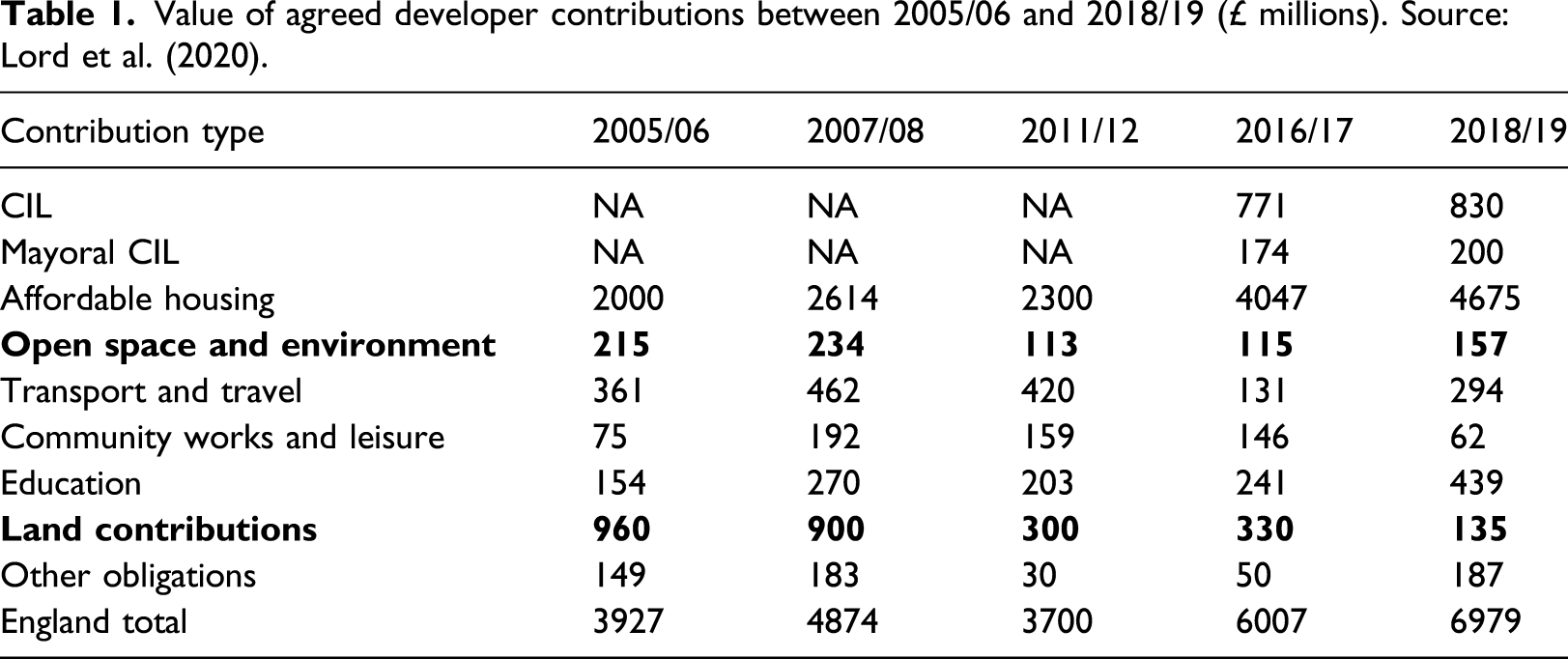
However, across the full-time period (2005/06 to 2018/19), sums secured for Affordable Housing and Education have increased by 134% and 185%, respectively, while Open Space and Environment reduced by 27% in the same period. Land contributions have plummeted by 81%, though used for a range of purposes, they can be an important source of land for environmental mitigation purposes (Whatmore and Boucher, 1993).
Therefore, it appears that the role of LVC in funding ecological mitigation programs has been relatively marginal when compared to other priorities. This is in marked contrast to increasing concerns of biodiversity loss and other environmental pressures and also diverges with domestic policy rhetoric surrounding the importance of environmental stewardship set out in the recent Environmental Bill (Treasury, 2021; DEFRA, 2020). The remainder of the paper will address the reasons behind this trend.
Methods
The research approach sought to understand the underlying factors which influence the decision-making of LPAs to prioritise funding for certain forms of public goods, often at the expense of funding ecological provision. To ensure that the research captured the influence in variations and behavioural and planning culture, there were two key conditions set when developing the study design.
Summary of participants.
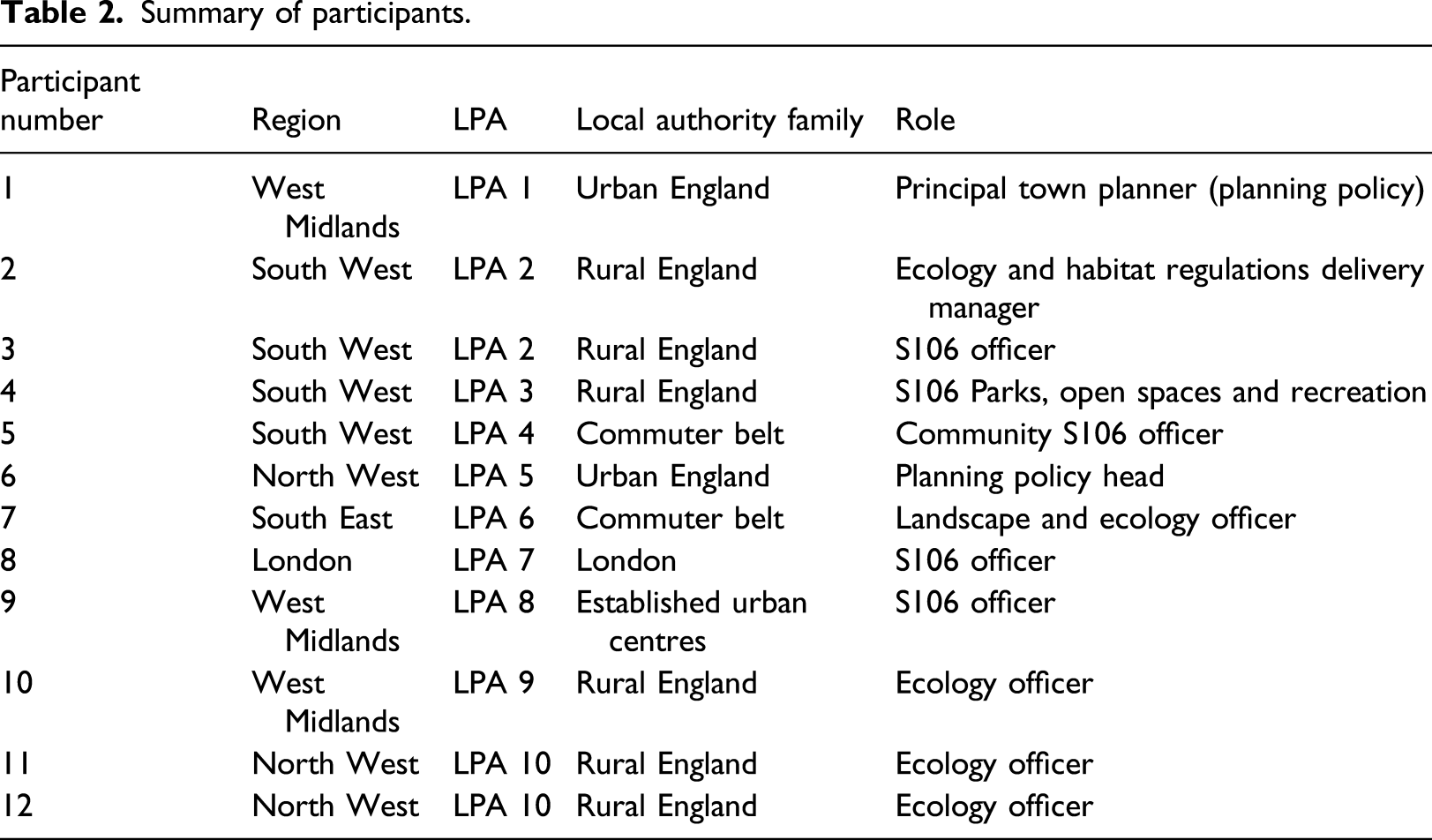
Secondly, the research needed to address the potential influence of ‘planning cultures’ upon DC outcomes, to best capture this diversity, the researcher used the Local Authority Family typology (Lord et al., 2020). The sampling approach ensured that an LPA from the five largest of the six Local Authority Family types were included, thereby including authorities with a variety of strategic priorities and pressures within the fieldwork. A secondary criteria ensured that there was an equal balance of rural and urban authorities, given the potential and requirements for ecological mitigation and protection programs are likely to differ between rural and urban areas. Overall, this approach ensured that testimony from a diversity of LPAs was captured, thereby enabling an exploration of the role of behavioural factors as well as planning cultures.
The intention to capture a diversity of LPAs meant that the responsibilities of LPA officers varied between participants, for example, some officers dealt purely with negotiating and developing DC policies for ecological purposes, while other officers had a remit to negotiate obligations across all policy areas. While this is a reflection of the researcher’s intention to capture a diversity of planning practice across different LPAs, it did result in discussions that varied in content, based upon the current and past experiences and responsibilities of participants.
To address this limitation, the interview followed a semi-structured approach, balancing the need for flexibility with consistency in qualitative research (King et al., 2018). To do so, a topic guide was followed to ensure that all main themes were addressed with each of the interviewees, with the semi-structured nature providing the flexibility to further explore the testimony provided by the interviewee. The questions centred upon the relative importance of various policy areas (e.g. affordable housing, education and transports) when compared to ecological mitigation and protection programs when considering the DC policy and practice; the key challenges and limitations when requesting funds for ecological programs via DC and the influence of private developer’s behaviour upon outcomes. There was also an exploration of the impact of the adoption of voluntary biodiversity net gain policies, as well as a discussion over the potential impacts and challenges of the forthcoming mandatory biodiversity net gain policies upon the DC outcomes.
All interviews were conducted remotely via online telecommunication software between March–June 2021 and all but one (due to refusal of consent to do so) were recorded, anonymised and transcribed. A coding structure was developed and applied using NVIVO software, enabling a series of themes to be established from the patterns in the data, which is presented below.
Findings
This section begins with a consideration of the financial and policy context in which English LPAs currently operate within, with all interviewees stressing the influence of financial austerity and changing national policy frameworks upon DC practice. Yet, it was evident that the heterogeneity in planning culture meant that they took contrasting approaches when balancing competing strategic objectives, with DC practice being an important part of these strategies. The latter section reflects upon how culture interacts with behavioural variations of LPA officers, combining to determine the potential for the use of DC to fund ecological protection and mitigation programs.
The impact of planning culture
Interviewees indicated that reforms to planning policy emphasised that an LPAs role was primarily to deliver development and drive economic growth, with frequent references made to housing targets assigned by Central Government (MHCLG, 2021). It was evident that the incentives (and penalties) imposed by these requirements meant that any policy decision or change in practice was viewed through this prism. This meant that anything that could delay or prevent the delivery of housing was met with resistance from those in leadership roles. Frequent references were also made the financial pressures that local authorities are placed under, with austerity measures meaning that the capacity and resources of local government were reduced, especially within planning and ecology departments.
LPAs responded to these pressures differently, which could be observed through their approach to developer contributions, this paper argues that these differences can be attributed to their local planning culture. Certain LPAs were characterised by their openness to new development, while others held a more pro-conservation planning culture, placing a greater emphasis upon the conservation and protection of environmental amenity in their authority. This factor was pivotal in shaping the potential for LPAs to use DC for ecological mitigation and protection programs.
Planning cultures: pro-development
A pro-development culture was largely observed within more urbanised authorities, their stance was typified by P9: ‘we have always been a very pro-development authority, so generally we do approve a huge amount of applications, it’s very rare for us to turn anything down’. The pressures to secure development meant that even where the merits of securing greater financial contributions for ecological mitigation were acknowledged and valued, this possibility was highly constrained by the pressures to secure new development. Whilst the presence of this planning culture did not necessarily result in ecological impacts of development being entirely overlooked, it meant any desire to secure ecological enhancements through developer contributions was always set against a consideration of how realistic and financially viable it was to do so, while also delivering other priorities: ‘At the end of the day we are in an economy that is very driven by government privatisation of housing delivery. How can we make sure that is all viable whilst also delivering all these other things, in terms of biodiversity’ P1
It was clear this approach emerged not only due to the pressures to meet Government housing delivery targets, but also resulted from the socio-economic challenges within these authorities, and that within the current context of local government austerity, development was often perceived as one of the few means to alleviate these challenges. DCs were then viewed as vitally important in responding to increasing pressures upon local services. Such pressures often translate into objections and anxieties related to new development from existing residents (Matthews et al., 2015; Hastings et al., 2015). Therefore, even with increasing awareness and concern over the impacts of environmental challenges amongst the general public, these risks were perceived as far less immediate, with limited tangible impacts of ecological degradation in comparison: ‘the first thing that you tend to hear over and over, with any development, pressures on health, schools and local traffic infrastructure. That is what is immediately tangible, that is what it tends to be, I suppose they can relate to, can I get into the doctor? are there enough school places’? P6
This lead to challenging judgements for prioritising various policy areas when negotiating DC, whilst participants resented being placed in this position, they nevertheless remained mindful of the way that such decision-making could be interpreted. The trade-offs between ecological mitigation, compared with the provision of other public goods was neatly summed up by P2: ‘are you more worried about birds than people? When funding is tight for most projects anyway, it is quite often a controversial decision to spend on wildlife’.
Instead, officers suggested that due to the political salience of pressures on public services, council members were likely to formally (i.e. through planning policy development processes and planning committees) and informally lobby for DCs to alleviate these pressures as a condition for supporting new development, thereby limiting the opportunity to secure funds for ecological measures. There was other evidence that political considerations had an impact upon the planning culture of the authority, and therefore, the scope of contributions secured, as P6 explained: ‘We have a Labour run authority, so meeting the needs of the more deprived people are kind of the top priority, the top aim for them […] affordable housing is for them the number 1 thing that changes their mind on development’.
In summary, development and accompanying DCs were viewed as a useful tool to tackle political and socio-economic challenges within an authority, shaping the local planning culture, resulting in a limited willingness and capacity to integrate ecological objectives within DCs practice.
Planning cultures: pro-conservation
In contrast, there was a more limited acceptance of development in other participating LPAs, particular those of a rural nature. While there were similar pressures to meet housing delivery targets, the central challenge in these authorities was perceived to be reconciling this with the preservation of environmental amenity within their authority. This meant the LPA was characterised by a pro-conservation planning culture, meaning the leadership of these authorities were receptive towards policies and practices which may help to resolve this tension, such as the use DCs in funding ecological mitigation programs: ‘if it was very urban, people have much more of a fight to get to towards these kind of policies, but because of the way that [LPA 9] is, the biodiversity value, the species, that is why people like [LPA 9], it is why quite a lot of affluent people do move to the district, because it is quite rural and beautiful, so I think that is recognised in the council’ P10
The adoption of biodiversity net gain (BNG) policies discussed in the introductory section was an important part of the authorities response in resolving this tension. The policy ensured that the impacts of development upon all habitats are accounted for, with mitigation payments via DCs if the net gain cannot be met on-site (see DEFRA, 2020 for details). While such measures are currently optional, mandatory BNG policies are due to be introduced following the implementation of the Environmental Bill (DEFRA, 2020). The voluntary adoption of such measures by certain LPAs is therefore a reflection of the pro-conservation planning culture within these authorities.
Officers from LPAs who had adopted this approach were enthusiastic about its value; despite it not being a legal requirement, they believed it strengthened their bargaining position when negotiating DCs for ecological mitigation measures. This was attributed to the biodiversity metric quantifying the ecological impacts of a development proposal, ensuring there was a clear and direct link between the ecological impacts of the proposal and the content and value of the DCs requested within negotiations. This provided certainty for the developer and LPA over the ecological impacts of development, bringing them into line with more established contributions, for example, for education, helping to blunt challenges to these requests. Previously, participants admitted their approach tended to estimate the ecological impacts of a proposal, often in an ad-hoc manner, which left their request open to challenge by developers. Secondly, this approach meant there was an opportunity to seek payment for impacts for all habitats, regardless of their quality or protected status. P10 described that before the adoption of these policies: ‘we only had powers to work with European protected species, we now can actually get something with that, that is what biodiversity offsetting does’.
However, an over-reliance upon funds extracted through DCs for ecological programs, risks providing an LPAs with an additional incentive to permit development, may then contribute towards additional indirect impacts on ecological assets and other environmental amenities, which are unaccounted for through the metric. Conversely, a lack of development demand, for example, during an economic downturn, would reduce the value of DCs secured, thereby compromising the ongoing funding of ecological mitigation and protection programs. There was also dissent amongst some participants over the clarity provided by BNG metrics, with the guidance provided for the calculation of ecological contributions compared unfavourably to the calculation of requests for other public goods, which perhaps reflects the complexity and contested nature of biodiversity valuation (Tregidga, 2013). P1 felt this was an important factor in the relative underrepresentation within DCs: ‘lots of different local authorities have used different ways of calculating that [the contribution], some don't even have a net gain calculator, that is a key issue with ecology and the environment. Perhaps that is something that is a bit more nebulous’.
Given that the preservation of environmental amenity was highly valued by certain LPAs, we questioned whether the ecological measures secured via DCs played a similar role to the provision of transport and social infrastructure, in fostering a greater acceptance of new development by existing residents. However, interviewees felt that they had a negligible impact at a localised scale since objections were primarily focused upon the loss of localised amenity such as open views and an ease of access to local green spaces, aligning with Apostolopoulou’s (2020) case study of biodiversity offsetting and the local acceptance to new housing developments. As a result, even if development led to significant net gains in ecological terms, this was viewed as irrelevant to many objectors. Here, parallels can be drawn towards debates over greenbelt loss, where objections are often linked to the loss of local amenity and the emotional connections to the development site in question (Matthews et al., 2015; Hastings et al., 2015).
Behavioural variations
The consequences of financial austerity upon local authority staff and expertise within planning and ecology departments often constrained an LPA’s ability to integrate ecological objectives within local development and planning outcomes, which directly affected DCs practice. In particular, interviewees suggested that ‘in-house’ ecologists were now relatively uncommon within local authorities. Where they were retained, it was an important example of the heterogeneity in LPA responses to changing local government funding regimes and can be interpreted as a sign of a local planning culture placing greater value upon conservation.
The previous section illustrated how the discretionary nature of the British planning system means that LPAs can adopt responses based upon localised challenges; however, it also provides individual officers with considerable flexibility and responsibility within decision-making. For example, the contents of DCs agreements are heavily influenced by planning policy but are ultimately determined by the site-specific context and negotiations between LPA officers and development stakeholders.
Therefore, the successful adoption and integration of ecological objectives within DCs policy and practice was a result of the dedication of individual officers in developing this agenda within their LPA. The presence of ecological expertise within LPAs with pro-conservation culture meant that they could use their skills and expertise to carefully develop this approach. They convinced the leadership of the LPA of the value of such an approach by framing the use of DCs as an effective means to reconcile the desire to enhance environmental amenities within their authority, while also meeting housing delivery targets. An important example was the adoption of biodiversity net gain policies to utilise DCs to support the financing of ecological mitigation programs. This illustrates how the successful framing of policy is used to build support amongst local authority leadership, through establishing the rationale for integrating such objectives within existing planning frameworks (Ernste, 2012).
The ecological expertise within LPAs also provided officers with greater scope to consider the ecological impacts of development and planning policy, thereby providing opportunities for formal and informal discussion of mitigation options between development stakeholders. This supported officers in securing DCs for ecological measures within negotiations, P10 described this as ‘just being clued up’. In more detailed terms, this was an ability to employ robust, high-quality ecological data presented with clarity to strengthen their negotiating position. For example, they described how they illustrated the potential ecological damage impact of development as a means of persuasion: ‘if there is a development there is a lot of pink for bats, it just adds to our argument, we cannot enforce, but we can use that evidence to strengthen the argument, to show this is the impact you are having’.
This is another illustration of how careful framing of information can help ensure that DCs requests for ecological mitigation stand up to scrutiny, whilst persuading developers through the calculation and illustration of the negative consequences of development upon ecological assets. In this case, the illustration of the impact of development alongside the prospect of an additional costs (i.e. through the payment of ecological DCs) are utilised by LPA officers to encourage developers to meet ecological objectives within the development design.
In contrast, authorities that were characterised by a pro-development planning culture often lacked ‘in-house’ ecology expertise. This meant that unless the impacts of development were of a statutory nature (e.g. impacting upon protected species), they would unlikely to be challenged, which left limited scope to justify a request for ecological mitigation payments. Interviewee testimony also underlined the significant time and resource required to develop the appropriate policy to secure ecological mitigation payments, as well as the requirement to upskill staff to successfully implement policy and practice change. However, it was also evident that behavioural factors also limited the opportunity to negotiate ecological funding through developer contributions: ‘without being rude to planning officer colleagues, there is an ease and an acceptance that those two contributions [affordable housing and recreational space] are easily defendable so they are the ones that we tend to get most of’. P9
This comment should be interpreted within the context of stringent requirements to meet housing delivery targets and decision deadlines with limited officer time and resources. In such a context, decision-making is optimised to secure development, and accompanying DCs, as efficiently as possible. This compromises the scope of public goods secured through DC negotiations since LPA officers behaviour is affected by bounded rationality, meaning they rely upon their experiential knowledge and routinised behaviours in negotiations (Claydon, 1998; Dunning et al., 2019).
It was evident that challenging these routines was difficult not only due to time pressures, but also due to doubts over whether this would be supported by senior colleagues as P9 questioned: ‘how easily you would be supported through that decision making if you were to look to reduce those contributions in favour of something else’? This meant the expectation that particular contributions should be secured was difficult to change. Therefore, even where convincing arguments for securing ecological contribution existed they would be unlikely to be supported if it led to delays or failed to meet existing expectations of development contributions outcomes. In this case, the role of the status quo bias is evident, since where the additional complexity of negotiating for developer contributions for ecological mitigation is compared with the relative ease of negotiating contributions for the provision of more established public goods, for example, affordable housing and education, there is a bias towards the status quo of the latter. This is particularly the case when the outcomes and payoff from altering practice to support greater payments for ecological programs are relatively uncertain, given the relative novelty of this approach within the English planning system. Other researchers, for example, Hu and Shealy (2020) and Samuelson and Zeckhauser (1988) have also previously attributed status quo bias as contributing towards a preference for stability in policy and practice in planning and development processes.
This bias therefore further compounds the financial challenges posed by changing policy and practice to secure contributions for ecological mitigation programs. This chimes with Whitten (2019) who found the scope for planners to embed ecological objectives within planning outcomes and to upskill in this area has become more limited following financial cuts. Instead, in the absence of specific training, officers rely upon established routines, leading to a clear preference for the status quo in DCs outcomes. This helps to explain the relative stability in the value ecological mitigation secured, even in light of increasing knowledge of impacts of biodiversity loss.
Discussion
This study sought to explore why LPAs have prioritised the negotiation of funding for certain public goods, at the expense of ecological mitigation and protection programs, which was explored through a series of interviews with a representative sample of English Local Planning Authority officers. A combination and interaction of behavioural and cultural factors were identified as important in explaining this.
The majority of participating LPAs were characterised by a pro-development culture, with officers under significant pressure to attract and secure real estate investment. This was seen to drive local economic growth and provide opportunities to secure developer contributions to address local socio-economic challenges through the provision of public goods such as affordable housing, education and health infrastructure. Therefore, the scope for officers to develop an alternative approach to DCs, which might support the financing of ecological programs, was highly constrained. With parallels to the consideration of the use of LVC for climate adaption in the Netherlands (Root et al., 2016), a change in approach to DCs failed to align to the pro-development culture, resulting in a lack of support from LPA leadership. Furthermore, any efforts to do so are compromised by resource constraints, most notably the absence of ecological expertise. This meant that deviating from routinised behaviours and heuristic norms (Claydon, 1998) when considering DCs was challenging, illustrating the influence of status quo bias in planning practice and policy inertia (Van der Heijden, 2015). Such insights help to expand the arguments of Ferm and Raco (2020) who suggest there is reluctance amongst LPAs to alter negotiation practices, due to the fears that additional regulatory burdens will negatively impact local real estate investment.
Yet, the research identified that planning practice within other LPAs was influenced by a pro-conservation planning culture since preserving of environmental amenity within the authority was viewed as strategically important by authority leadership. Therefore, planning processes emphasised the need to integrate ecological objectives whilst also meeting Government mandated housing targets. This shaped an opportunity for officers to exercise their discretion to develop a strategy to use DCs to provide additional funding for ecological mitigation. In doing so, they carefully framed this approach as a cost-effective strategy to reconcile the need to deliver development with the desire to enhance and protect the amenity offered by ecological assets. This framing provided the rationale for a change in approach, thereby justifying and persuading LPA leadership to adopt changes in DC policy and practice (Ernste, 2012; Rein and Schön, 1993), thereby supporting the financing of ecological mitigation and protection programs.
Both cases indicate how heterogeneity in planning culture provides officers with a varied sense of appropriate action in DC policy development and negotiations. De Vries (2015), Gunn and Hillier (2014) and Reimer and Blotevogel (2012) each illustrate how variations in planning culture provide planning actors with differences in informal rules and routines which influences their response to spatial challenges and behaviour in individual planning interactions. This then shapes divergence in planning and development outcomes. This paper extends these arguments, applying insights from behavioural science to illustrate how culturally informed routines can interrelate with the impact of cognitive biases, such as framing and status quo bias, to shape the ability and potential of individual actors to exercise discretion within planning practice (Booth, 1996; Laws and Forester, 2015).
Reimer (2013) highlights the importance of experimentation in altering the routines and practices of planning action, particularly when addressing new spatial challenges. The focus of this paper, the financing of ecological mitigation programs through developer contribution in addressing the funding gap in ecological mitigation and protection programs is one such example. However, the paper illustrates how the potential for individuals to instigate and shape change in planning processes and outcomes is variability constrained or supported by the interrelation between planning culture and cognitive biases, thereby contributing to stability or fluidity in planning practices. This then affects the planning authority’s ability to respond and address emerging crises, which has implications beyond the focus of this article, such as in the responses to the increasingly evident impacts of climatic change.
As a result of the barriers imposed by the interrelation of cultural and behavioural factors, the research suggests that a statutory requirement to use DCs as a financing measure for ecological mitigation programs (as is proposed by the Environmental Bill (DEFRA, 2020)) would be necessary to instigate widespread DCs practice and policy change to support diversification in funding sources of ecological programs. Whilst knowledge exchange activities may support the integration of new policies and approaches between varied local planning cultures (Healey, 2011), there remains a series of implementation challenges identified through the research. For example, interview testimony emphasised the significant officer time and resources required to develop DC practices that support ecological mitigation and protection funding. Given this study echoes the suggestions that many authorities lack the necessary in-house ecological expertise (Whitten, 2019), this would appear to be a barrier to the introduction of mandatory BNG requirements. Furthermore, the findings indicate that an expanded role for developer contribution in addressing the biodiversity crisis may impact the delivery of other public goods. Without commensurate funding to deliver these services and infrastructure, there are risks that such a move would compromise the ability of local governments to address a range of socio-economic challenges, potentially exacerbating existing inequalities (UK2070 Commission, 2020).
Consequently, without the provision of additional resourcing to LPAs there are challenges over the feasibility of the implementation of nationwide initiatives to support greater investment in ecological mitigation through DCs. The political importance of boosting housing delivery to this current Government and emphasis placed by participating LPAs in study to meeting targets set by MHCLG highlight challenges of integrating new and sometimes conflicting objectives within the planning system. In reference to DEFRA’s attempt to integrate the ‘ecosystem approach’ within the national planning framework, Campbell and Sheate (2012) suggested the siloed nature of Government departments compromise the success of that particular initiative. There is then an implication from the evidence presented in this study that the focus of the MHCLG and DEFRA upon meeting their own siloed objectives, with limited cross-departmental collaboration (Wheatley et al., 2018) may compromise the successful integration of practices to support greater investment in ecological mitigation, within current planning frameworks which emphasis the delivery of housing and economic growth through planning and development processes.
Conclusion
The paper set out to explore why, even in the face of increasing knowledge and awareness of the wide-ranging threats of biodiversity loss, the proportion of developer contributions agreed for ecological mitigation and protection continued to be marginal. The evidence presented outlines the explanatory power offered by planning culture and behavioural factors in understanding this, as well as the potential for evolution in DCs practice to support additional funding for ecological programs.
When examining the factors which underpinned the outcomes in DCs, the use of an analytical lens that emphasised the role of behaviour in planning and development outcomes supported the identification of how the agency of individual officers is shaped by the combination of planning culture and behavioural biases, which then determined the scope and nature of DC outcomes. Heterogeneity in these factors determined the willingness and ability for LPAs to alter DC practice to support the financing of ecological mitigation and protection measures. This emerged from a localised response to changing funding regimes and national planning policy frameworks. Whilst some LPAs in this study embraced policy innovation, helping to resolve tensions between competing objectives, often through biodiversity net gain policies, others had a strong dependence upon development and accompanying DCs to address socio-economic challenges. This meant the potential to re-direct these funds towards ecological purposes was limited. The combination of cultural and behavioural barriers helps to maintain this position, providing an explanation of why the proportion of developer contribution agreed for ecological mitigation programs continues to be marginal, even in light of increasing awareness of the impacts of biodiversity loss.
While the introduction of legislation mandating DC practice change through new measures and responsibilities within the Environmental Bill will help to overcome the cultural and behavioural barriers which currently limit the role of DCs in financing ecological measures, this work also highlights a series of barriers outlined in this study which may compromise the potential of this approach to diversify and increase the funds for ecological mitigation and protection programs. The implementation challenges identified point towards a need for further research to explore how the forthcoming mandatory biodiversity net gain requirements are likely to interact with existing, long-standing, discretionary use of DCs for the provision of public goods across a range of economic contexts. Furthermore, a quantitative approach to this paper research question, for example, exploring a relationship between land values and a willingness to utilise DCs for ecological mitigation measures would complement this papers findings effectively, by considering the potential for LPAs in different economic contexts to utilise DCs for such purposes.
Footnotes
Declaration of conflicting interests
The author(s) declared no potential conflicts of interest with respect to the research, authorship, and/or publication of this article.
Funding
The author(s) received no financial support for the research, authorship, and/or publication of this article.
