




Abstract
This study examines two inter-connected issues: the local economic governance strategies pursued by English local authorities in the post-2007 Crisis austerity period, and the impact of these strategies on local work and employment conditions. The study draws on interview data, policy documents and statistical datasets from an analysis of two English localities to understand how local authorities responded to the economic pressures resulting from the 2007 Crisis and subsequent imposition of austerity policies. The study finds local authorities engaged in various forms of entrepreneurial and austerity urbanist policies under conditions of tight budgetary constraints, resulting in an increased role for the private sector as a vehicle to generate jobs and increase tax revenue. This process has increased the influence of private sector actors within local government, part of a longer term trend. This study presents evidence to illustrate why this scenario is problematic for improving work and employment conditions, chiefly due to an unwillingness to progressively regulate work, and a prioritising of job quantity in terms of total employment, rather than favouring the creation of sustainable, high-quality local employment.
Keywords
Introduction
The aim of this study is to examine how local economic governance strategies (LEGS) implemented by English local authorities in the post-crisis austerity period have impacted local work and employment conditions. The study presents findings from a comparative study of two English localities – Greater Manchester, and the D2N2 (Derby, Derbyshire, Nottingham and Nottinghamshire) region – to achieve this research aim. It is important to understand and examine LEGS and their impact on work and employment conditions for several reasons. Firstly, the impact of the 2007–2008 Financial Crisis is still having adverse effects on UK labour markets and this is acutely evident at the local level. Local authorities in the United Kingdom have undergone profound shifts in economic governance since the Crisis and subsequent imposition of austerity policies by central government (Townsend and Champion, 2014), and despite recent claims from the UK government that austerity policies have ended (HM Government, 2020), the impact of such policies remains. Local authorities have had to implement budgetary cuts averaging 33% to public services with detrimental consequences for citizens and workers (Gray and Barford, 2018). England has been the worst affected nation within the United Kingdom in terms of budgetary cuts, and city-regions have faced significant cuts to expenditure in comparison to other areas, experiencing 74% of total government cuts (Centre for Cities, 2019: 14). Local authorities must manage the fallout from the crisis and imposition of austerity policies as they administer, manage and plan local services going forward over the financial cycle. The impact of austerity has been to reduce the amount of funding to local authorities via central government provisions of resource-equalising and needs-assessed grants (Jackson, 2017). Budgetary cuts make it challenging for local authorities to maintain high-quality provision of core and statutorily required functions of providing essential services such as health and social care, educational provision and infrastructure maintenance. Local authorities have had even fewer resources to devote to non-essential, but still important, issues such as labour market interventions and training provision as a result. Secondly, the Crisis exacerbated existing labour market weaknesses in the United Kingdom. Work and employment in the United Kingdom is characterised by high incidences of low-paid employment and stagnant real wages (TUC, 2019; Yates, 2017), increasing skills- and time-based under-employment (Bell and Blanchflower, 2018), limited training provisions and skills development (Lloyd and Payne, 2016) and work intensification (Gallie et al., 2017). These trends are responsible for a declining wage share for labour (OECD, 2015) and heightened economic inequality (Haldane, 2019), and it is within these economic conditions that local authorities must endeavour to maintain existing services and, crucially, promote local economic growth.
The impact of the crisis on local authorities and on work and employment outcomes intersects and manifests in the form of LEGS. The concept of LEGS captures all of the activities developed within a locality that contribute to shaping the governance of a local economy, ranging from prevailing thought processes to specific policies and legislative actions (Tomaney et al., 2010). Written documentation, reports, speeches and other forms of communication formalize LEGS in the substantive actions of institutions and individuals (Fuller, 2017). The results of LEGS are evident in local economic and local labour market conditions; LEGS can lead to improvements in labour market outcomes; conversely LEGS can sustain or even exacerbate problematic local economic and labour market conditions, for example, increased levels of unemployment or low-paying work. Therein, LEGS developed and, pursued by local authorities, are a central pillar in attempts to encourage economic growth and social reproduction. An analytical focus on LEGS grounds seemingly abstract processes of capital flows and fiscal austerity by concretising them in an empirical analysis of local authority behaviour, specifically in this case the influence of LEGS on local work and employment conditions.
Two research questions guided the research; firstly, what are the similarities and differences between the LEGS pursued by local authorities in the Greater Manchester and the D2N2 (Derby, Derbyshire, Nottingham and Nottinghamshire) region? This question seeks to understand what aspects of LEGS are successful in responding to economic crises and ensuring sustainable local economic development. Secondly, how do LEGS affect local work and employment conditions for local workers? This question seeks to provide empirical evidence to support the findings to question one by interrogating how LEGS have impacted work and employment outcomes in both localities. In order to explore the labour market outcomes of LEGS and answer the research questions, the study is divided into four sections. “LEGS and the decline in job quality in the United Kingdom” present our theorization, its historical context, and outline our methodology and research design. “Developing LEGS in Greater Manchester and D2N2” presents evidence on the contemporary economic governance strategies of Greater Manchester and the D2N2 region. “Labour market outcomes” probe the local labour market outcomes of LEGS in both localities and “Discussion: Differences and similarities in the two regions?” offers an analysis, discussion and conclusion on the empirical findings in the context of our research questions.
LEGS and the decline in job quality in the United Kingdom
This section constructs a systematic framework for understanding the behaviour of local authorities, drawing on central concepts from political economy, chiefly: the state, social class and capital accumulation. This framework is then used to evaluate historical developments in Greater Manchester and the D2N2 region.
The local state and LEGS
Understanding how LEGS affect labour market outcomes requires a theorisation of the state that interrogates the expression of centralized state power in a particular locality. The concept of the local state situates local authorities and their behaviour historically within the wider processes of continuous capitalist production and social reproduction, rather than being reified and ‘read-off’ in an ahistorical manner (Yates and Clark, 2018). What constitutes the composition of the local state is – at a high level of abstraction – conflict between classes with fundamentally competing material interests. Like the institutions of the central state, local state actors and institutions crystallise social and class conflict at a particular moment in time (Clarke, 1989). Local economic governance strategies, for example, and the institutional relationship they have to local labour market outcomes ground competing class interests between capital and labour and express these concretely in the relations between individual private employers and workers. Conflict between these groups plays out through the social form of the local state that is necessarily open-ended and precludes deterministic predictions of local economic development or labour market outcomes.
The abstraction of the local state becomes empirically concretised in local state institutions and individual agents who direct and engage in LEGS. Within the institutional infrastructure of the local state, these actors are immediately responsible for responding to the dynamic and often contradictory outcomes of capitalist accumulation in their localities. For example, within localities there are ever-present tensions between tempering the movement of capital by regulation or allowing the free flow of capital. Similar tensions exist between acting in the interests of capital-in-general, or favouring specific individual capitals and thereby facilitating local state capture. There are also tensions between disciplining or cooperating with labour, promoting territorial specialisation via locally enacted regulation and allowing uncoordinated growth via deregulation (Gough, 2002). Local state actors must endeavour to manage these contradictions by pursuing broadly neoliberal, social democratic or radical strategies in order to maintain the production–reproduction nexus of a locality (Gough, 2002).
Neoliberal resolutions favour empowering private capital through lightening product market and labour market regulations, and through the exclusion of labour from decision-making power as part of a more generalised suppression of labour. Social democratic strategies, by contrast, favour attempts to coordinate capitalist accumulation and incorporate labour into decision-making processes with the aim of increasing labour productivity and the profitability of firms. Both neoliberal and social democratic strategies operate within a capitalist framework and all localities that pursue them are vulnerable to recurrent capitalist crisis, irrespective of how seemingly resilient a particular LEGS may appear to be. Radical LEGS, by contrast, seek to overcome the contradictions of capitalism by pursuing processes of de-commodification and de-marketisation that diminish capitalist imperatives within a locality. Radical strategies can involve (re)municipalisation, promotion of worker co-operatives, development of local currencies, progressive taxation and proactive local opposition to national policies (Latham, 2017). Historically, however, radical LEGS face the seemingly intractable contradiction of having to organise in and against capitalist markets (Nolan and O’Donnell, 1987).
The limited statutory powers that local authorities possess limit their ability to define their own environment and engage in proactive intervention in local economies. The UK’s highly centralised system of government heavily constrains local authorities by limiting their fiscal autonomy, meaning they cannot meaningfully affect local tax rates or substantively shape how tax revenues are spent (Hooghe et al., 2010). Despite the narrow range of options available to local authorities, there are significant variations in LEGS and England (and the UK), suggesting the presence of some relative autonomy from the central state. There has also been increased optimism among local politicians and state officials that localities may be able to exert greater autonomy following the 2011 Localism Act and the associated increase in support for devolution in some English regions.
What is also important is the manner in which funding for local government declined at a time when deindustrialisation led to increased unemployment levels across English cities. From the 1970s onwards, local authorities – faced with economic pressures and declining funding – had to turn towards the private sector in an attempt to ensure continued local social reproduction. This shift towards entrepreneurial urbanism (Harvey, 1989) saw local state institutions and actors actively promote private sector-led economic growth in an attempt to create jobs and increase local tax revenues. It is significant that in the latest manifestation of this strategy in the United Kingdom, a combination of economic downturn since 2007, budget cuts due to austerity and the greater role of private capital each increase the risk of these economic strategies becoming locked-in, resulting in ‘austerity urbanism’ becoming permanent (Aldag et al., 2019; Davies and Blanco, 2017; Peck, 2012, 2014a, 2014b). This scenario is problematic as evidence presented in this article suggests these entrepreneurial policies are unable to generate decent labour market outcomes and may be contributing to increasing levels of low-paid work and economic inequality.
Neoliberalism and the erosion of decent work
Broader shifts in the political economy of macroeconomic management in the United Kingdom have compelled local authorities to look for alternative solutions to persistent problems in their localities. In the post-war period, the United Kingdom was characterised by buoyant economic conditions evident at the local level through the diffusion of ‘spatial Keynesianism’ (Martin and Sunley, 1997) resulting in generous public spending across localities, and investment in infrastructure and job creation, particularly in the public sector (Brenner, 2004). This system involved Keynesian state intervention to deliver sustained economic growth and improved welfare provision that balanced a commitment to the market economy with intervention to promote full-employment and social welfare (Harvey, 2007). The political compromise between capital-labour took the form of capital controls, nationalization, a commitment to the welfare state and trade union representation. However, economic growth up until the 1960s obscured long-run relative economic decline (Gamble, 1994). Neoliberal policies grew in popularity form the 1970s onwards with the ostensible aim of reversing economic decline and restoring the profitability of British-based capital. These were characterised by anti-inflation, balanced budgets, reducing union militancy and curtailing the drag effects on the market of welfare expenditure and state monopolies (Karakilic and Clark, 2020). A sterling crisis in 1976 followed by increases in industrial action-led successive Conservative governments (1979–1997) to focus on financial de-regulation and privatization in order to shift the balance of the economy from manufacturing to financial services (Crouch, 2011; Harvey, 2007: 19–30). Neoliberalism undermined post-war alliances between the state, managerial elites and organised labour. What emerged was a sustained attempt by the British state to break organised labour in order to facilitate its re-commodification so as to increase the profitability of UK-based capital (Cox and Nilsen, 2014: 141–147). In order to achieve this aim, a commitment to maintaining full-employment by the state was abandoned in favour of inflation targeting, leading to rapid rises in unemployment. These attacks on labour were accompanied by the imposition severe restrictions on trade unions’ ability to organise, and the material position of organised labour was worsened further by cuts to both welfare state and local government spending (Glyn, 2007: 27–31).
In the workplace, neoliberal policies manifest as a generalised opposition to regulatory practices which empower labour (Nolan, 2018: 1–2). Neoliberalism similarly emphasises public choice theory to promote worker lifestyle preferences and the benefits of flexible employment and labour markets while simultaneously degrading the notion for worker voice (Bales et al., 2018: 50; Moore et al., 2018: 404). The ideology of this approach informs a policy formulation in neoliberalism that views labour markets not as social constructs but as mechanisms to prioritise individualised worker choice. This formulation necessarily ignores the constraints and associated inequalities embedded in social class, gender, migration status and age (Grimshaw et al., 2017: 3). Similarly, it brushes over a permissiveness in the regulation and enforcement of uncertain and precarious work that is the antithesis of decent work (Heyes et al., 2018). Further, still neoliberalism ignores the potential for state intervention to create the conditions that support precarious work, rather than mitigating its presence. For example, welfare conditionality places people under pressure to accept low-quality jobs often characterised by low pay, under-utilisation of skills and limited opportunities for career progression and development (Briken and Taylor, 2018; Greer, 2016). National Minimum and Living Wage legislation provides a floor to wage exploitation in low-quality jobs, and in-work tax credits provide some material relief for low-paid workers. This type of work is however blighted by problems of wage theft and non-compliance with various elements of employment law (Gardiner, 2015; Hammer and Plugor, 2019).
These characteristics of contemporary work highlight the extent to which employers – actively supported by the state at the local and national level – are no longer willing to make continuous reciprocal commitments to workers that would underpin a decent work agenda (Collier, 2018: 42–46).
Historical developments in Greater Manchester and the D2N2 region
The emergence of entrepreneurial urbanism as a dominant feature of LEGS illustrates the tension between the necessity for local authorities to maintain capitalist production and social reproduction within a locality and the limited strategic choice that arises from restrictions imposed by central government. This development did not occur in isolation; rather, it connects to broader changes in the sectoral and occupational composition of local labour markets in the United Kingdom. For example, in those cities that developed historically because of mass employment in the manufacturing sector employment was characterised by permanent, open-ended jobs that were well-paid and offered opportunities for career progression within internal labour markets (McGovern et al., 2007). The 1970s economic crisis accelerated the decline of manufacturing as a major employer in the United Kingdom with significant consequences for cities built on manufacturing, such as Greater Manchester, Derby and Nottingham. In 1951, manufacturing accounted for 53% of all employment in Greater Manchester, declining to 41% in 1971 and <10% as of 2019. Similarly, manufacturing and extractive industries accounted for around two-thirds of all employment in the East Midlands in 1963 and much of this was concentrated in the industrial and mining complex of Nottinghamshire–Derbyshire. Employment in these sectors accounts for around 11% of total employment in D2N2 as of 2019 (EMEPC, 1966: 31; GB Historical, 2017). By the 1980s English urban localities experienced severe negative consequences following on from deindustrialisation and associated structural unemployment, chiefly chronic poverty, increased crime and worsening physical and mental health (Peck and Ward, 2002).
The emergence of the service sector as a major employer from the 1990s onwards appeared to offset the decline in manufacturing employment. Jobs in sectors such as retail, hospitality, personal and care services and business and financial services did – in a quantitative sense – replace many of the jobs lost in manufacturing (Harding et al., 2010). The quality of these jobs was – and remains – variable (as detailed in Labour market outcomes). Compositional shifts in local labour markets were guided by urban development corporations (UDCs), which were run by central government and designed to reinvigorate local economies affected by deindustrialisation (Deas et al., 2000). Training and enterprise councils (TECs) complemented UDCs and played a role in the governance of local economies by acting as a site where individuals from the public and private sectors could coalesce and develop local economic strategy. In the 1990s, Greater Manchester saw the emergence of ‘grant coalitions’ that aimed to capture national and EU-level funding. The coalitions fostered very close workings between small numbers of elite ‘Manchester Men’ from local politics and business through the Manchester TEC and related bodies (Cochrane et al., 1996; Tickell and Peck, 1996). Grant coalitions developed into growth coalitions that now actively pursue a private sector-led growth strategy growth in Greater Manchester.
In the D2N2 region, by contrast, there was not the same level of development coalition and institution building, in part because of the heterogeneous nature of the region and the complexity of its local government structures. The D2N2 area has unitary local authorities in Derby and Nottingham alongside two-tier (county/district) local government in the rest of the two shires. What compounds this structural complexity is the political make-up of local authorities within the region, for example, Nottingham city is an embedded Labour stronghold. In contrast, Derby City Council has been under ‘no overall control’ in recent years, whereas both Nottinghamshire and Derbyshire County Councils have moved between Labour and Conservative administrations over recent electoral cycles. Also significant is that the D2N2 borders were not formalised until 2011, when they came into being with the establishing of the D2N2 Local Enterprise Partnership (LEP). Prior to the establishment of the D2N2 LEP, a ‘Three Cities Initiative’ launched by Derby, Leicester and Nottingham operated within the auspices of the East Midlands Development Agency, 2006. In the mid-2000s, this initiative sought to capture national grants for local development and promote a coordinated and collaborative approach to development, although it did not have the same successes as in Greater Manchester due to lack of private sector buy-in and the complexities of local politics, which were often characterised by inter-city rivalry. A concurrent process during this period was the attempt by local planners to re-orientate parts of the D2N2 region away from a reliance on manufacturing and towards services. In Nottingham, ‘public entrepreneurs’ played an important role in directing local economic growth (Rossiter and Smith, 2017). These individual stakeholders assisted the economic development of Nottingham by securing institutional resources to effect change and promote development. The most obvious recent manifestation of this activity was the creation in 2003 of the Bio City life science business incubation and grow-on facility that is now the largest complex of this type in the United Kingdom (Smith et al., 2017).
Two developments are especially relevant for understanding LEGS and associated local labour market outcomes in the aftermath of the 2007 Crisis. The first is the creation of 39 LEPs in England in 2011, and the second is the current funding landscape for local authorities. Local Enterprise Partnerships are non-statutory bodies established to assist in the governance of localities and foreground private sector influence. The National Audit Office (NAO) has been critical of LEPs, specifically on funding and accountability issues (NAO, 2016), leading to the publication of the Ney Review in 2017 (2017). This review was followed by subsequent reports and enquires which highlighted governance failings within LEPS (DHCLG, 2018; NAO, 2016, 2019). Criticism of LEP funding relates to broader changes in the funding landscape for local authorities. Therein in addition to a reduction of funding following on from the diffusion of austerity policies, there has also been a shift away from formula-based allocations and a move towards challenge-based funds. These two processes link to LEPs, which in turn act as strategic institutions that bid for challenge-based funding in the post-crisis period (Taylor, 2019). Awards of challenge-based funds centre on the use of funding to further private sector job creation. Greater Manchester has been more successful than the D2N2 region in this process, due in part to its well-established network of institutional actors that give it greater strategic capacities (detailed in Developing LEGS in Greater Manchester and D2N2). The remainder of this study examines precisely how localities pursue LEGS in a changed funding landscape and the implications for local labour market outcomes.
Methodology and research design
The research utilised a comparative qualitative approach to interrogate similarities and differences in LEGS and the impact these have on work and employment outcomes. Recent research by Peck (2017) highlights the methodological importance of interrogating global processes of capitalist accumulation by conducting detailed comparative case studies grounded at a local level. A comparative approach allows for the articulation of abstract concepts by grounding them in empirical study, and it facilitates the generation of new theoretical insights that illuminate often stale notions of neoliberalism. Greater Manchester and the D2N2 region have a shared history of deindustrialisation and economic renewal through the growth of employment in the service sector, making them suitable cases for comparison. Central government lauds Greater Manchester as an example of a city-region that has successfully overcome the decline of its manufacturing sector to re-invent itself as a centre for service sector employment. The culmination of Greater Manchester’s renewal is the devolution of powers to the city-region via the 2011 Devolution Agreement, which grants greater autonomy over spending decisions (HM Treasury, 2014). The D2N2 region shares similarities with Greater Manchester in that it has developed a service economy while retaining a manufacturing presence in parts of the region. Manufacturing as a percentage of total employment is 14.3%, compared with 8.2% in Greater Manchester. Gross value added growth rates, moreover, are consistently lower in D2N2 than Greater Manchester, illustrating a weakness of the predominantly service sector economy of the region.
How LEGS in both localities affect growth outcomes, and to what extent economic growth is of itself sufficient for the development of sustainable local labour markets with the capacity to generate decent work for local residents, is a critical research issue. In order to answer the two research questions, this article poses draws upon primary data from forty semi-structured interviews with local politicians and state officials, local employers and labour market actors in both localities conducted over the period 2016–2019. The research also makes use of extensive secondary data in the form of local policy documents, economic reports and labour market statistical datasets.
Developing LEGS in Greater Manchester and D2N2
Greater Manchester
Greater Manchester has since the early 2000s pursued a specific LEGS that aims to generate economic growth driven by labour market reform (AGMA, 2009, 2013). The underlying principle of Greater Manchester’s strategy is that is that any growth is better than stagnation, and that the varied – and often detrimental outcomes – of growth can be resolved at a future date (Yates and Clark, 2018). The Association of Greater Manchester Authorities (AGMA), established following the dissolution of Greater Manchester County Council in 1984, pursued a process of ‘engag[ing] and follow[ing]’ the private sector (AGMA, 2013), establishing the Manchester Growth Company (MGC) in 1989 to facilitate more coordinated interventions in the local economy. The MGC: conducts research, acts to attract inward FDI, promotes skills development and job creation, provides business support (such as legal and administrative assistance) and runs marketing campaigns (MGC, 2019). In 2011, AGMA formed the Greater Manchester Combined Authority (GMCA), to bring the region’s 10 local authorities together as one.
Greater Manchester’s strategy has relied heavily on, ‘co-opting in a non-executive fashion’, private sector business leaders in order to shape local economic governance (former Head of Strategy, GM Economic Development Agency). A key mechanism for facilitating the input of private sector leaders is the Greater Manchester Local Enterprise Partnership (GMLEP), which ‘sits at the heart of all decision-making in the city’ (GMLEP, 2018). The extant literature and its associated research illustrate the success of GMLEP relative to other LEPs in England in achieving favourable economic growth outcomes (Taylor, 2019), chiefly by securing the aforementioned resources associated with challenge-based funds from central government which have boosted private sector job growth. The composition of the GMLEP reflects the influence of private sector actors in Greater Manchester and in turn reflects the economic growth strategy of the city and the associated local labour market outcomes this growth generates. The GMLEP Board comprises of 15 individuals; 11 are drawn from the private and voluntary sectors (including the Chair of GMLEP) and the remaining four are elected individuals from the public sector. The uneven ratio of public to private individuals has become more pronounced since GMLEPs inception in 2011, and there are no representatives of organised labour on the GMLEP.
The promotion and development of sectoral clusters – a strategy borne out of agglomeration theory – is a core feature of Greater Manchester’s LEGS (McCann and Van Oort, 2019). Headline local growth sectors include biotechnology, the creative and digital sector, financial and professional services and advanced manufacturing (Holman, 2013: 94). These sectors are favoured by planners as are high value-added and are a source of inward FDI (Manchester Inward Development Agency Service, 2016). ‘Greater Manchester’ is a coherent economic region and political entity brand that is promotable to businesses and investors, both nationally and internationally where promotion activities are assisted by the global visibility of the city’s sports teams and universities (Head of economic strategy, a Greater Manchester university). One aim of Greater Manchester’s LEGS is to advance locally based production of both goods and services higher-up in global value chains, thereby potentially generating higher rates of profitability for firms. Labour market outcomes details the limits of this strategy, illustrating how – despite the best intentions of local planners – this strategy fails to benefit all workers, as low-paying employment continues to grow.
The D2N2 region
The D2N2 area is a fractious, polycentric spatial region comprised of two cities and numerous small towns surrounded by rural hinterlands. The governance arrangements for D2N2 are complex; there are 18 local authorities in total, both unitary and two-tier. The embeddedness of working relationships in D2N2 is shallow because of the short-time period in which the authorities have worked together and because of the limited resources available to develop LEGS in the region, in contrast to the embeddedness of Greater Manchester as a spatially coherent entity. Key stakeholders in the Nottinghamshire and Derbyshire Chamber of Commerce were heavily influential in the formation of the D2N2LEP border and successfully lobbied for it to match its own operational borders (Former local economic development agency planner, 2019). When D2N2LEP was established, it was hosted and provided space by the Chamber, and the Chamber employed its first member of staff. Both of these points illustrate the degree to which the non-statutory, voluntary institutional form of LEPs makes them prone to takeover or ‘capture’ by specific private sector interests. The actions of a small number of interests continue to shape the emergence of entrepreneurial urbanism as a dominant feature of LEGS. D2N2LEP remains a voluntary association and as such is heavily dependent on one of its constituent local authorities, Derbyshire County Council, to act as its ‘accountable body’ when in receipt of public funds (D2N2LEP website, 2019).
Local economic governance strategies in the D2N2 region focus on economic development and labour market improvement with the aim of increasing the productivity of local firms and workers (D2N2LEP, 2013, 2017). The D2N2LEP facilitates these aims by shaping and providing funding, supporting private sector actors to invest locally for the long-term and fostering the implementation of the D2N2 Local Industrial Strategy (D2N2LEP, 2017). Planning documents also indicate the necessity of ‘inclusive’ economic growth (Black et al., 2017) that aims to foster the creation of quality jobs, raise wages and increase skills levels (D2N2LEP, 2013). The D2N2 Growth Hub supports these aims and acts as a business incubator, offering technical support, as well as financial aid, and skill and employability training. Extant research, however, reveals that LEP Growth Hubs are often limited to signposting businesses to information and resources, with little substantive capacity to assist businesses (Payne, 2018). Evidence from the D2N2LEP suggests that its Growth Hub is similar; the D2N2LEP has limited internal staffing and therefore limited capacity to deliver projects and programmes. It is therefore reliant on other local organisations such as the three local universities to deliver many of its projects and programmes.
The D2N2 region has developed two enterprise zones designed to bring local businesses together with the aim of securing the spatial benefits of agglomeration. The decision to locate the first of these zones on the Beeston Boots site is thought to have been heavily influenced by the then Boots CEO (Interview, former local planner, 2019), again illustrating the ability of influential individual private capitals to shape or capture the direction of policy. Place branding is also evident in the D2N2 strategy, and this is however limited to the creation of the ‘D2N2 – The UK’s Most Inspirational Postcode’ slogan which featured prominently in their first growth strategy (D2N2LEP, 2013). D2N2’s economic strategies contain common hallmarks of entrepreneurial urbanism such as local boosterism and the promotion of specific sectors of the private sector to generate jobs growth. Therein the benefits of agglomeration are projected, as is greater private sector influence over the governance of the local economy, illustrated by the central role of the D2N2LEP (D2N2, 2013, 2017).
The D2N2LEP has become a central institution for local economic governance in the D2N2 region as local leaders have declared attempts to achieve mayoral devolution ‘dead’ (Metcalf, 2016). A proposal for greater metropolitan cooperation across the D2N2 region as an alternative to devolution is outlined in the Vision 2030 Strategy document and has now resulted in the publication of a ‘Metro Strategy’ for Derby and Nottingham (Derby and Nottingham City Councils, 2017). This approach is, however, always at risk from local actor political conflict within the D2N2 region. In 2009, for example, the newly elected leader of Nottinghamshire County Council (NCC) withdrew support for the expansion of the local tram infrastructure project, which the previous administration had supported, citing concerns over the impact on road users, local businesses and the environment, as well as cost issues and potentially unfair distribution of benefits of the project (NCC, 2009: 3–5). This withdrawal is an example of a broader negative tendency of LEGS, wherein a change in local government and a subsequent shift in the local interest groups which are favoured plays out against a backdrop of declining material support and financial resources. This tendency is an illustration of how enforced neoliberal competition supersedes social democratic cooperation, undermining opportunities for regional growth and cooperation (Nurse and Fulton, 2017). Labour market outcomes of this article now examine precisely how LEGS in Greater Manchester and the D2N2 region have impacted work and employment conditions.
Labour market outcomes
Greater Manchester
Key features of Greater Manchester and D2N2 regional economies and labour markets (2020).
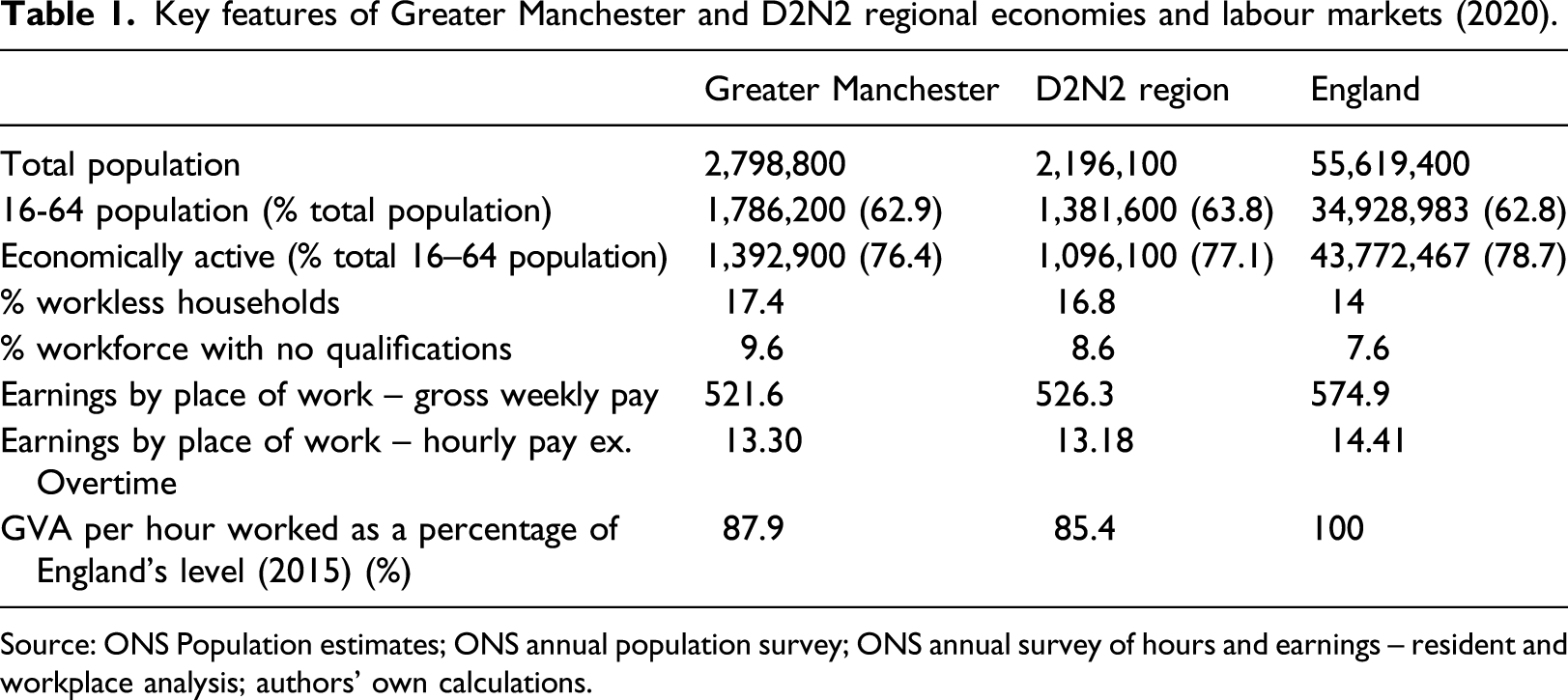
Source: ONS Population estimates; ONS annual population survey; ONS annual survey of hours and earnings – resident and workplace analysis; authors’ own calculations.
Change in occupational composition of Greater Manchester and D2N2 Region 2004–2020.
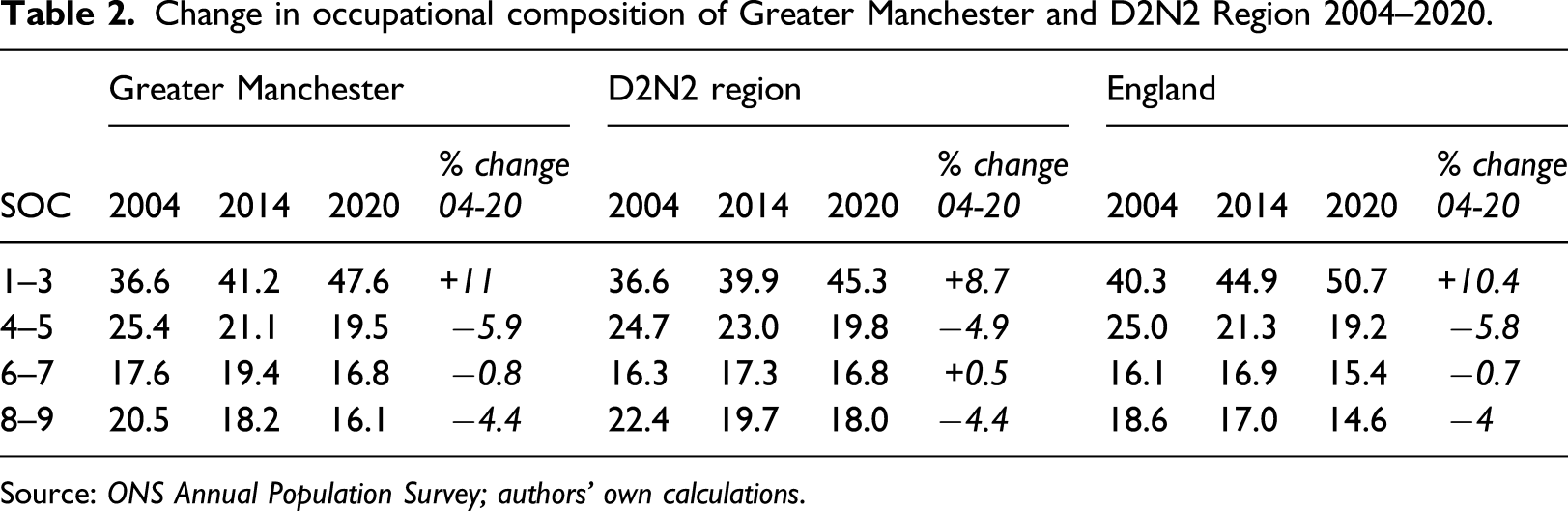
Source: ONS Annual Population Survey; authors’ own calculations.
Local planners have responded to labour market weaknesses with a series of supply-side policy interventions. Since 2009 a series of locally based active labour market programmes have been introduced to increase employment in jobs at the lower end of the labour market via upskilling and jobs coaching programmes. One feature of these programmes is the way they mimic national policy to emphasise welfare conditionality, compelling workers to take any job available to them, where the programme is driven by the slogan of ‘get a job, get a better job, get a career’ (Interview, GM DWP Manager). Another feature of work programmes is their employer-led nature; Greater Manchester has piloted the Employer Ownership of Skills programme, which aims to ‘orientat[e] entire sectors of the economy towards an employer-led skills model’ (New Economy, 2015: 5).
The creation of a directly elected mayoral position in Greater Manchester has sparked institutional change leading to new interventions in labour markets. The most prominent example of this type of development is a Good Employment Charter (GMCA, 2018). The term ‘Charter’ is however, a misnomer; rather, it is a toolkit for local employers that aim to improve local working practices. The GMCA has no statutory powers to enforce labour market regulation of its voluntary Charter, meaning that in order to achieve high levels of employer engagement with the Charter GMCA cannot suggest any employment practices or business strategies or business strategies which deviate radically from prevailing norms. This strategy of voluntary compliance may prove challenging in an economy characterised by an abundance of private sector SMEs which operate a low-wage business model.
The D2N2 region
Employment growth has occurred post-recession in the D2N2 region; the percentage of economically active individuals in employment was 73.6% in December 2018, compared to 68.4% in September 2011, which was the lowest level recorded during the recession in the D2N2 region. As in Greater Manchester, this growth in employment is of variable quality. Around 30% of those in work in the D2N2 region earned less than the living wage, while nationally the figure is 25% (Black et al., 2017). Moreover, despite higher rates of employment in manufacturing in the D2N2 region than Greater Manchester, local labour markets remain characterised by high levels of employment in typically low-paying sectors such as administration and support services (10.2% of total employment) and retail and wholesale (15.4% of total employment). Growth in these sectors derives from local planners favouring private sector job creation, a strategy that is itself driven by the changed nature of funding streams in the post-crisis austerity funding landscape. Employment in SOC groups 1–3 in the D2N2 region is both lower than the English average, and 2.3% lower than in Greater Manchester. Growth in SOC 1–3 occupations has been slower than in Greater Manchester (+8.7% to +11% over 16 years) and the D2N2 region has actually seen a small rise in employment in SOC 6–7 occupations of 0.5%, compared with falls of 0.8% in Greater Manchester and 0.7% in England. There is also the problem of limited availability of funding tending to homogenise LEGS because central government dictate the eligibility criteria for most funding. This weakness makes it even harder to generate bottom-up strategies that genuinely respond to local need, thereby further strengthening the structural power of private capital locally.
Local planners in the D2N2 region have made a public commitment to generating decent work outcomes through the ‘inclusive growth agenda’ (D2N2, 2017), alongside the commitment to becoming a ‘slave free city’ in the city of Nottingham (Salvation Army, 2019). Actively promoting decent work practices via local council tendering, compliance practices, and through working with local think tanks and universities to research and develop policies, aim to embed these practices in the local political economy. As of 2019, the inclusive growth agenda has produced no discernible material outcomes of benefit to workers and the slave free city campaign, altthough laudable, is a relatively low benchmark to aim for, in particular when assessed against other features of a decent work agenda. These labour market aims – like Greater Manchester’s Good Employment Charter – run the risk of failure due to their voluntary nature and because of the lack of statutory powers to support their advancement.
One policy tool where the D2N2 region is ahead of Greater Manchester is in experimentation with direct labour market interventions. In the D2N2 region, there have been attempts at localised Keynesianism that aim to generate good jobs and decent work for local workers. In 2011, construction began on the expansion of Nottingham Express Transit tram system, funded by a £578 million Private Finance Initiative, with money coming from central government and local councils in the D2N2 region. The aim of the project was to expand the local tram network and contained a commitment to maximise the local economic benefits afforded by the scheme. This commitment was integral to the procurement approach adopted by Nottingham City Council as the scheme’s promoter. The promotion of employment and training opportunities for young people were prioritized in order to offset the historically high levels of youth unemployment that were prevalent in the aftermath of the 2007 Crisis. At its peak, the project employed more than 1600 construction workers, with almost 400 new entrants to the labour market finding work on the scheme, and over 700 young people benefitting from linked work experience. Additionally, estimates suggest that supply chain expenditures have generated around £140m of activity in the local economy and a further £77m in the regional economy (Rossiter et al., 2016). However, this project, although significant in local scale was a modest intervention in a regional economy characterised by low-paying work and below national-average levels of productivity. Other local labour market interventions in the D2N2 region reflect prevailing national policies and a focus on supply-side interventions that seek to improve skills levels and move those furthest from the labour market into entry-level jobs.
Discussion: Differences and similarities in the two regions?
The evidence presented in developing LEGS in Greater Manchester and D2N2 and labour market outcomes provides answers to the research questions posed by this article. The LEGS pursued by Greater Manchester and the D2N2 region highlight the tensions that exist between neoliberal and social democratic attempts to overcome localized economic contradictions in both regions. Greater Manchester has been able to pursue LEGS that contributes to buoyant rates of growth because of its historically embedded spatial cohesion, something that the D2N2 region evidently lacks, based as it is around two cities. Raw growth figures do however mask problematic labour market outcomes in both localities, chiefly problems associated with low pay, the absence of mid-level jobs that hinders career progression and increases in non-standard work and under-employment. These problems are consequences of the LEGS pursued in both localities, which in turn are indicative of the structural power of capital in both localities. Both localities have experienced the compulsion to accept and promote the growth of low-paying service sector work where a failure to do so could lead to increased unemployment, especially in the context of a broader political economy of welfare state retrenchment and fiscal austerity. Similarly, the growth of low-paying work in both localities, despite both rolling out strategies to promote good work, highlights some of the fundamental limitations of local labour market interventions.
Evidence illustrates that local state managers prefer high levels of low-paying jobs, rather than fewer high-quality jobs and potentially increased unemployment. Derived as it is from neoliberalism this LEGS appears successful despite the wider costs it imposes on labour. For example, the growth of low-pay, low-productivity and high-intensity employers has detrimental consequences for worker health and well-being that are effectively externalized beyond the job creation metric of the model that employers follow. Moreover, employment of this type has the capacity to crowd-out other forms of more productive and potentially more equitable employment as individual private capital identifies profitable forms of accumulation utilising cheap, low-skilled labour that have a low turnover time. This approach contrasts with investment in potentially more profitable, more complex forms of accumulation that have a potentially longer turnover time (Erdem and Glyn, 2001).
Both localities had, prior to the crisis, service-based economies and each aimed to increase the quality of their local labour markets and did so in efforts to grow the amount of ‘good’ employment by promoting particular sectors. These interventions are however limited in scale and ambition. All localities aim to raise their position in global value chains by increasing levels of high-value added employment. What is important are the actions taken to achieve this aim, and whether they are successful or not. In both Greater Manchester and D2N2 LEGS are – despite some marginal promotion of high value-added work – geared to the promotion of any employment, irrespective of quality. There are several reasons for this; firstly, the logic of local planners is the aforementioned ‘any job is better than no job’ approach. This logic mirrors central government policy, which is advanced by the stick of work conditionality and punitive benefit sanctions. Secondly, shifts in government funding favour local strategies that attempt to generate jobs in the private sector. Thirdly, there is the harsh reality that local authorities simply do not have a great deal of power to influence substantially the sectoral and occupational composition of localities; LEGS are limited to shaping activities on the periphery of local economies and local labour markets. This fact does not mean LEGS are unimportant; even slight variations in strategy and policy can affect people’s working lives and those of their dependents, leading to increased employment and rises in average household incomes. However, shifts in central government policy, or a fluctuation in the global economy can undo all of the positive (or detrimental) impacts of LEGS. One interesting feature of LEGS is the extent to which localities are attempting to inculcate resilience against not only the vicissitudes of the global political economy, but also increasingly against the unpredictable but increasingly detrimental policies of central government.
The strategies of local planners in both localities illustrate the contradictions between neoliberal and social democratic resolutions to local problems. Neoliberal resolutions involve favouring open unregulated economic growth, designed to push the costs of doing business down through deregulation, and excluding labour from decision-making. Social democratic resolutions attempt to coordinate economic development, regulate business (which can incur costs), and include a range of stakeholders in the decision-making process. Planners in Greater Manchester – through the development of local economic governance institutions and the promotion of clusters – have pursued some social democratic interventions. However, the structural power of capital, both locally and at other spatial scales, favours neoliberal resolutions to social problems. The outcome of this approach is local economic growth continues to take a low-road path that in the main excludes organised labour from fora such as GMLEP. Planners in the D2N2 region are attempting to replicate the ‘Manchester Model’, with less success, due in part to short period of time the D2N2 region has existed as a defined geographic entity. Greater Manchester, by contrast, has been a relatively coherent entity since the 1970s and is undergoing continual processes of institutional bonding, exemplified by the creation of the GMCA (Shutt and Liddle, 2019). Relatedly, the GMLEP has been successful in part because it mapped onto the borders of the Greater Manchester city-region. The longevity of Greater Manchester has allowed it to develop and promote as a brand globally in a way that is less possible for the D2N2 region.
Conclusion
This study has answered its research questions by illustrating how LEGS in Greater Manchester and the D2N2 region favour neoliberal resolutions to the challenges of economic growth where both regions are characterised by the strong influence of individual private capital. It has also illustrated how LEGS create problematic labour market outcomes for local workers in both localities by fostering the growth of low-paid, poor-quality employment. This article contributes to the existing knowledge base by articulating how abstract processes of capital accumulation are differentially manifested in localities via LEGS and has presented theoretical explanations to new empirical data. Future research is necessary to expand this research agenda, to explore in more detail the labour market outcomes of LEGS in more localities, across the United Kingdom and internationally.
Footnotes
Acknowledgements
The authors would like to thank the editors of Local Economy, and two anonymous reviewers for their helpful comments on an earlier iteration of this paper.
Declaration of conflicting interests
The author(s) declared no potential conflicts of interest with respect to the research, authorship, and/or publication of this article.
Funding
The author(s) received no financial support for the research, authorship, and/or publication of this article.
