




Abstract
US manufacturing is struggling with both a productivity and job quality challenge. These challenges are interconnected, reinforcing the need for increased coordination of economic and workforce development efforts. This article outlines the evaluation findings of a novel business-facing initiative called the Genesis Movement, to understand its role in reshaping the workforce experience within small- and medium-sized manufacturing businesses in Chicago, Illinois. Spearheaded in 2014 by the Illinois Manufacturing Excellence Center (IMEC), Genesis starts with the premise that workforce practices are central to business operations, productivity, and competitiveness—and therefore, manufacturing extension services need to promote improvements to job quality in support of long-term business success. This integrated approach represents a form of “inclusive innovation,” expanding the capacities of firms and workers to adapt in a competitive environment where pressures to maintain high quality while reducing costs are ever-present. Firms that participate in Genesis learn to adopt an inclusive organizational culture, using front-line worker engagement, skills training, and job quality improvements to drive performance and process innovation. As such, Genesis offers transferable lessons that could be leveraged by other manufacturing-supporting organizations to benefit their industry clients and the workers they employ.
Introduction: Manufacturing and inclusive innovation
US manufacturing is struggling with both a productivity and job quality challenge. The productivity crisis reflects lower than anticipated manufacturing performance, which for decades has been obscured by the way economists factor quality-adjustments into industry productivity measures. The corresponding jobs crisis is more widely accepted, reflecting decades of precipitous decline in overall manufacturing employment and with a growing share of remaining jobs failing to provide family-sustaining wages or long-term job security.
These challenges are interconnected. Less stable, lower-quality jobs make it harder for manufacturing firms to introduce performance-enhancing measures, just as stagnant productivity means there is less revenue to share across-the-workforce. But this reinforcing dynamic also speaks to an opportunity for increased coordination of local economic and workforce development efforts and ultimately, for business and job-enhancing solutions to be better integrated. This represents a form of “inclusive innovation,” which as outlined in the opening essay of this special issue involves institutional interventions that support industry regeneration through the promotion of equitable job growth and mobility opportunities.
Tighter coupling of job and business-improving solutions is core to an experimental approach to manufacturing extension originally called the Genesis Movement (Genesis). 1 Spearheaded in 2014 by the Illinois Manufacturing Excellence Center (IMEC), Genesis starts with the premise that workforce practices are central to business operations, productivity, and competitiveness—and therefore manufacturing extension services need to promote improvements to job quality in support of long-term business success. Housed at Bradley University in Central Illinois, IMEC is part of the Manufacturing Extension Partnership (MEP), a nation-wide, publicly-funded network that was established by the US Department of Commerce in the late 1980s to improve the competitiveness of small- and medium-sized manufacturing enterprises.
The Genesis Movement was initially funded by a consortium of influential foundations that pool their funding sources to improve job quality for low-income workers in Chicago. The Chicagoland Workforce Funder Alliance agreed to financially support IMEC’s experimentation, on the condition that evaluators be allowed to follow their progress over time. As members of the Genesis evaluation team, we employed a mix of analytical methods from 2014 to 18, including conducting in-depth case studies of participating firms, over the course of multiple site visits. In addition to firm-specific stakeholder interviews, we analyzed survey data and individual wage records collected from all participating firms. To contextualize firm-level impacts, we also interviewed IMEC staff at yearly intervals.
In this article, we outline key evaluation results in support of further diffusion of the model developed through Genesis. We find that Genesis firms adopt an inclusive organizational culture, using front-line worker engagement, skills training, and job quality improvements to drive firm performance. As such, Genesis offers transferable lessons that could be leveraged by other MEP centers in support of their manufacturing business clients and the workers they employ.
Lower productivity means greater institutional opportunity
The connection between declining manufacturing productivity and job quality is gaining research and policy attention. Concern over the loss of quality job opportunities in manufacturing is mounting and is central to a protracted debate among US economists and labor scholars over rising income inequality (Boushey, 2019; Levy and Temin, 2011; Osterman, 2000). Mainstream economists often attribute growing economic disparity to changing skill requirements, claiming technological progress explains why less educated workers earn less pay in relation to those with higher educational attainment (Berman et al., 1994; Krueger, 1993). In the case of manufacturing, some argue that job quality is improving, though with far fewer jobs to go around, especially for less educated workers. But other scholars, labor economists included, have pushed back on this skill-mismatch hypothesis (Card and DiNardo, 2002), pointing instead to widespread shifts in the institutional structure of the US labor market that has increased the vulnerability of US workers and not just for those without a college education (Howell and Wieler, 1998; Osterman, 2000; Weil, 2014).
For institution-focused labor scholars, the structural changes that most threaten job quality standards are declines in labor union representation; weakened federal labor laws, including stagnating minimum wages; growing investor activism, which has enriched top-level executives and shareholders at the expense of wage gains for workers at the bottom half of the labor market; and questionable work arrangements that allow employers to undermine worker rights under the guise of independent contracting (Appelbaum and Batt, 2014; Bernhardt et al., 2008; Doussard and Gamal, 2016; Fligstein and Shin, 2007; Osterman and Shulman, 2011; Peck and Theodore, 2001; Weil, 2014). For manufacturing in particular, this institutional restructuring is visible in a lower wage premium, as well as rising use of third-party staffing agencies that reduce job and income security (Mishel, 2018). These shifts have taken hold since the late 1970s, putting large swaths of the US workforce at increasing economic risk.
Over the decades, labor scholars have backed this institutional restructuring story with multiple data points and a mix of methodological approaches—often triangulating across data sources to build the institutional case (Fligstein and Shin, 2007; Levy and Temin, 2011; Osterman, 2000). But in recent years, this nuanced approach has given way to a more simplified framing which centers on the widening gap between growth in average wages and productivity since 1980 (Mishel, 2012). Widely referenced by scholars, labor advocates, and journalists, data showing divergence between average (non-supervisory) wages and productivity anchors the claim that US businesses are no longer broadly sharing profits with the US workforce, thus reneging on an earlier “social contract” that was reinforced through business practices and norms established in the immediate aftermath of World War II (Boushey, 2019; Uchitelle, 2007; Wartzman, 2017).
But the productivity data upon which this wage-gap calculation rests is now being reevaluated for some US industries, which has significant implications for how we think about job quality losses and actions to reclaim them (Lowe, 2021). New research has significantly downgraded the productivity trend line since the 1980s, especially within US manufacturing, thus suggesting the gap between wages and productivity may be less pronounced. Economist Susan Houseman has uncovered a wide array of product-making industries in the United States with productivity rates that are significantly lower than originally presumed (Houseman, 2018). Previous studies obscured these anemic results because they conflate improved computer and electronics processing times (i.e., quality improvements) with product quantity jumps, even if the increased number of machines produced from one period to the next is minimal. As Houseman discovered, once computer and electronics manufacturing are removed from productivity calculations, most remaining manufacturing industries have significantly underperformed the national private sector average going back several decades.
Revised productivity measurements partially help explain wage-suppression in US manufacturing in so far as product-making businesses have fewer profit gains to share with their production workforce—there is less to go around. But lower productivity also means there is untapped growth potential in US manufacturing industries, raising the possibility for institutional solutions that address the dual challenges of stagnating wages and weak manufacturing performance. In other words, could business-facing interventions help more US manufacturers become globally competitive on the basis of higher performance and improved employment outcomes—thus ensuring gains for manufacturing employers also translate into increased numbers of better quality, higher-paying production jobs?
Inclusive innovation and organizational practice
This query is not new to industry and labor studies. A vast literature on “high performance work organization” (HPWO) emerged in the 1990s to document how firms—especially those in globally competitive sectors like manufacturing—were adopting new organizational models and approaches, from “lean” production principles to quality circles to performance-based pay, in an effort to boost quality while reducing costs and improving speed (Batt and Appelbaum, 1994; Osterman, 1994). Optimistic assessments about an emerging “mutual gains” paradigm for businesses and workers (Kochan and Osterman, 1994) have given way to evidence of variegated practices and outcomes across firms. Osterman (2006), for example, argues that manufacturers’ wage-setting practices—specifically, their use of standardized versus individualized wages for production workers—are an important mechanism for sharing the productivity benefits of HPWO across the front-line workforce. More recently, Ton (2014) book The Good Jobs Strategy documents four US retail chains and how their organizational strategies of paying above-market wages have contributed to functional flexibility, process innovation, and ultimately, business success. Yet as Osterman (2018) points out, those cases are somewhat “idiosyncratic” and un-representative of the larger population of firms. Their existence does, however, suggest a wider range of viable paths for firms to reconcile the demands for business profitability with improved job quality.
Innovation scholarship is reinforcing the potential for reconnecting employment and productivity gains by pointing to the importance of process innovation (Berger, 2013; Clark, 2014). While product innovation has long been privileged in business and economic development analysis, process innovation is often most critical in industries like manufacturing, where the production process itself represents an important source of embedded knowledge and organizational advantage. The bias towards product innovation means that analytical energy and policy attention are focused on firm research and development and design capabilities, while their co-location with production work as a source of innovative capacity remains underappreciated (Clark, 2013; Doussard and Schrock, 2015; Lowe and Wolf-Powers, 2018). There is growing evidence that this occupational balance—design with production—confers benefits on firms, industries, and regions, while at the same time rendering the benefits of innovation more inclusive and broad-based, by supporting a wider range of decent employment opportunities for workers without college degrees.
Still, efforts to promote process innovation within manufacturing industries cannot be assumed to lead directly and automatically to benefits for front-line production workers. Process innovation can translate into a variety of outcomes, some of which are more workforce friendly and inclusive than others. This variation—and the choice set they represent—reinforces the need to consider how improvements to manufacturing processes and practices are organizationally and institutionally mediated. Furthermore, while businesses may hope to do better by and with their production workforce, they may lack the capacity to achieve this mutually beneficial result on their own (Lowe, 2021).
Within this context, smaller, incumbent manufacturers are an especially vulnerable group of US businesses that struggle the most and could be targets for greater institutional support. Like their workers, smaller manufacturers disproportionately feel the stifling effects of intensifying global competition and often due to added pressure coming down from prominent customers and clients to cut costs (Forbes, 2018; Helper et al., 2011; Rutherford and Holmes, 2014; Theodore and Weber, 2001). Even without these power dynamics in play, smaller manufacturers are known to have limited resources and bandwidth to invest in job-enhancing improvements—numerous studies, for example, find smaller firms are less likely to pay top wages or support internal workforce training and career advancement (Lynch and Black, 1998; Weaver and Osterman, 2017). At least one study attributes a large share of US income inequality to significant wage differences between large- and small-sized firms (Song et al., 2019).
While it is important to not overstate the problem of size—large manufacturers can certainly struggle too—this varying business experience and performance does suggest an opening for institutional assistance to recognize sources of economic vulnerability that are shared by business owners and their workers alike. And from that vantage point, institutional actors can explore integrated solutions that bolster business success, at the same time, advancing better quality manufacturing jobs—in other words, solutions that also push forward mutual gains through reinforcing success.
Manufacturing extension as institutional intermediary
In the United States, the Manufacturing Extension Partnership (MEP) represents an important institution for shaping the capacities of small- and medium-sized enterprise (SME). The Manufacturing Extension Partnership was established in 1988 by the US Department of Commerce through the National Institute for Standards and Technology (NIST) with the mission to “enhance the productivity and technological performance of US manufacturing.” There are approximately 50 MEP centers throughout the United States, each under contract with NIST. These centers provide one-on-one technical assistance to individual businesses, especially SME manufacturers.
Given that SME manufacturers generally operate in cost-competitive markets, MEP centers have traditionally emphasized process improvement and “lean manufacturing” to reduce cost-creating inefficiencies and waste. In 2010, national MEP leadership laid the foundations for a broader approach, which they called Next Generation Strategy. The goal was to expand MEP service offerings beyond lean manufacturing to help companies improve their top-line revenue, workforce and talent development practices, and supply chain development. As part of that effort, NIST-MEP elevated workforce development and talent management as a focus area for local MEP centers.
Although all MEP centers operate under the Next Generation Strategy, each individual center has considerable latitude with implementation. Many MEP centers have maintained a core focus on lean manufacturing, but with limited options in support of workforce development or talent management (Lipscomb et al., 2018). This was reflective of past efforts to link MEP and workforce development, which were considered promising but poorly systematized (Troppe and Reesman, 2004).
Yet for some MEP centers, such as the IMEC, the Next Generation Strategy has represented an opportunity to experiment and innovate with novel approaches to service delivery that support business success, job quality, and ultimately, inclusive innovation. IMEC launched the “Genesis Movement” initiative in 2014 to leverage its manufacturing extension services to concurrently improve job quality outcomes and elevate business performance. Founded as a NIST-MEP affiliate in 1996, IMEC extended its jurisdictional reach into the Greater Chicagoland region in 2010, making them a relative newcomer in Chicago’s expansive manufacturing community when they initiated Genesis programming.
IMECs Genesis represents a major departure to more conventional forms of manufacturing extension, which often focus on short-term projects to promote efficiency through “lean” manufacturing principles. By contrast, Genesis-enrolled firms commit to a 24-month strategic planning process with the ultimate goal of integrating concurrent improvements to job quality with advances in business performance. While non-profit workforce service providers have long attempted to secure a similar job quality commitment from smaller firms (Conway and Giloth, 2014; Schrock, 2013), the Genesis experiment is the first to involve a federally-funded manufacturing extension program—one with a successful history of promoting innovative business strategies and technological modernization.
Evaluation design and methods
As evaluators of the Genesis program, we sought to capture the extent to which Genesis programming achieved these integrated goals. To do this, we set out using a developmental evaluation design. This is notably different from more traditional impact evaluations—which establish fixed and clearly-defined metrics at the start, measuring whether a program exceeds or fails to meet these initially stated objectives. By contrast, the developmental approach is learning-centered, adapted to dynamic realities of complex institutional environments; also supporting incremental change through feedback loops to share lessons and problem-solving in real-time. It assumes as well that the intervention being evaluated is dynamic, with programming changing over the course of the evaluation period.
Our evaluation used a mix of qualitative and quantitative methods to develop a comprehensive understanding of Genesis-influenced changes within participating firms. Our evaluation design reflected lower initial enrollment in the program than initially anticipated—twenty-two firms initially enrolled rather than 80. This led stakeholders in the program, including funders, to request our evaluation be designed to help them understand why some firms stayed engaged for longer and what changes were generated as a result. Additionally, they asked us to document changes within IMEC itself that resulted from the Genesis experience, details of which can be found in our evaluation report (Jain et al., 2019).
We selected 10 Genesis firms to study in-depth over a three-year period. Site visits at each firm allowed us to observe first-hand the production environment and operations. During these visits, we interviewed a range of firm representatives, including leadership, management, and front-line production workers. At six of the 10 firms, we conducted follow-up site visits two and three years out from when the company began participating in Genesis—when feasible, we interviewed the same management team and front-line production workers. By interviewing the same staff over time, we were able to gather longitudinal information about experiences throughout the course of Genesis implementation.
An integrated approach to manufacturing extension
People, Processes, and Products Explained: The following is a description of the types of people, process, and product solutions that IMEC worked with companies to implement.
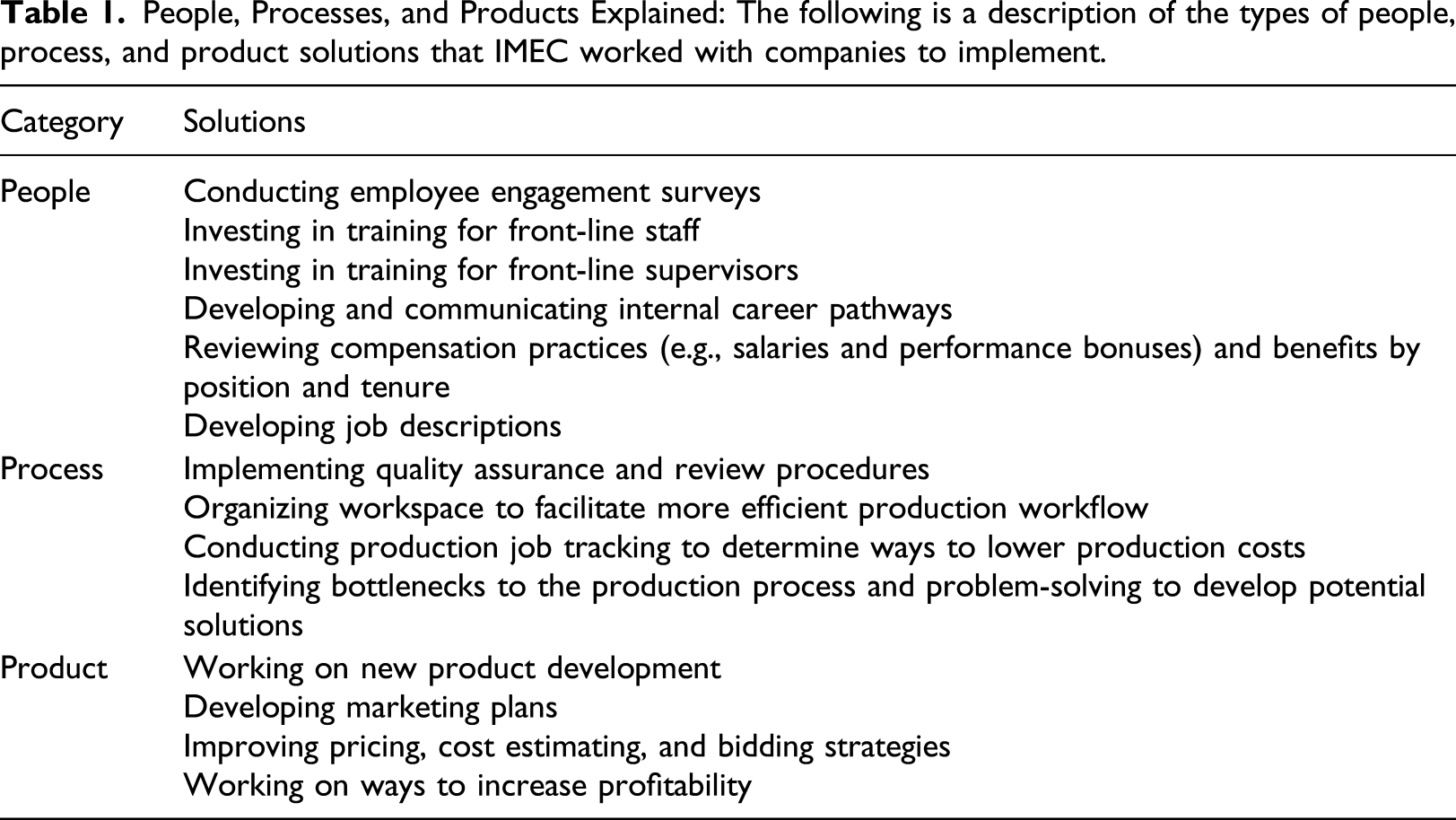
How does IMEC use this integrated approach to help manufacturers institutionalize worker-centric strategies and to amplify gains for workers and their employers? To begin to answer this question, it is useful to provide a rough sketch of the kinds of challenges firms faced when they entered the Genesis program and how awareness of those challenges influenced IMEC’s strategy overall.
When IMEC originally designed Genesis, they envisioned using stringent screening criteria to select for firms that were on solid financial ground and well-positioned for expansion and growth. IMEC assumed it would be easier to improve working conditions if starting from a stable foundation. But faced with lower than expected program enrollment, IMEC quickly opted to relax some of these early requirements. Doing so ultimately proved beneficial, in so far as it enabled IMEC to reach firms on shakier financial ground and get them much-needed resources and support. It also enabled IMEC to strengthen in-house expertise as they worked with struggling firms to resolve underlying management tensions or financial constraints. But it did so at the risk of introducing firms to the program who were less likely to experience positive impacts. 2
Still, this formative decision to be more inclusive at the start of Genesis led to further program modifications. Within its first year, IMEC extended the Genesis timeframe for engaging firms from 6 to 24 months. With Genesis firms now asked to make a longer, two-year time commitment, IMEC staff gained 18 more months during which to assess company strengths and weaknesses and then work to stabilize firms entering the program with greater organizational or financial constraints. But even for firms that entered on more stable financial ground—approximately half of those enrolled in Genesis during our evaluation period—this two-year commitment provided breathing room for IMEC to iterate programming in order to make longer-lasting improvements to the overall business and for the workers in it.
While the exact sequence of projects varied from firm-to-firm given the broad range of challenges in play, certain strategic steps were common to all participating firms and helped to set worker-focused expectations early in the program. For most Genesis firms, a critical first step was completion of an employee engagement survey (EES), which IMEC designed to inform strategic planning on people-related improvements. IMEC developed the survey instrument to gather perspectives from front-line production workers, which were tabulated and anonymously communicated with company leaders.
The 51-question EES survey focused on workplace culture, with questions related to business mission, vision, and objectives; job satisfaction; opportunities for training and growth; relationships with co-workers and immediate supervisors; workplace communication; and work–life balance. IMEC led the process for fielding the paper-based survey and conducted follow-on focus group discussions with employees. The survey and related focus group discussions were offered in both English and Spanish.
By asking employer permission to administer the EES survey, IMEC staff could assess early on if a firm owner was willing to engage in the holistic strategic planning of Genesis and open to making improvements to workforce practices. Those initially resistant to EES would require further exploratory discussions and more convincing. Once completed, the EES survey results were used by IMEC to identify and draw out hidden problems within Genesis firms, including tensions between production workers and supervisors, problematic communication practices, perceptions of favoritism in the workplace or feelings that worker input is not valued. Moreover, the survey set early expectations for worker involvement in strategic planning, demonstrating the importance of their participation and also the need for capturing candid employee input.
Interviews with leaders at Genesis firms reinforced the value of the EES. The owner at one company described his interest in having workers become more active participants in overall company development. As he noted: “In the past, we didn’t have this need [to change culture] because there wasn’t an overwhelming amount of work. But as we’ve grown, we have struggled with the production cycle.” Emphasizing the value of IMEC’s EES, he said: “I believe that workers on the floor have the best knowledge of what could work best to get us where we need to be. I want to change the direction of ideas. Who am I to say that I am the one with the best ideas?” Before embarking on Genesis, management at that same firm had actively encouraged front-line workers to propose new ideas and they even created a dedicated space within the factory where workers could be released for limited periods of time to incubate and develop their ideas with front-line managers. But the EES revealed that workers had other interests. As a result of what they learned, the company’s managers created employee committees to address employee growth and development, manager effectiveness, and pay and benefits. As the owner noted at the time, “The EES gave front-line workers an opportunity to be heard, and the way we reacted to that is positive; we are listening.”
Owners at another Genesis firm described how they were initially hesitant to conduct the EES, mostly because they felt they were not in a stable enough financial position to introduce major improvements. As one of the firm’s owners expressed, “I figured workers would say that they aren’t making enough money.” And as she went on to explain, their budget—at least at that time—could not support across-the-board raises, so “there wasn’t much [she] could do with this kind of feedback.” In this particular case, IMEC staff convinced company leaders that the survey was essential for Genesis strategic planning. The owners ended up seeing the value of the approach, with one noting, “I was pleasantly surprised that [our workers’] commitment to the family business has overridden the fact that we haven’t been able to provide raises, etc. the past few years.” But even more important, the survey pointed to ways the company could improve working conditions, even without immediately raising wages. Reinforcing as much, one owner noted: “We learned that employees feel like there are inequities in the way they are treated—that some [employees] feel like they are doing a big share of the work. And people are looking for a few more benefits.” Worker feedback like this informed subsequent actions, allowing IMEC to review policies for paid time off and to update the employee handbook to uniformly communicate to workers the benefits that were available.
Additionally, IMEC designed the EES to capture information on unsafe working conditions and fast-track safety solutions as needed. IMEC communicated survey results with firm leaders to stress both urgency and long-term gains to having workplace safety measures in place. IMEC also framed workplace safety as integral to overall business process improvement, building in metrics and procedures to draw attention to the high cost of workplace injury.
Workforce training
In addition to soliciting worker input and promoting safety standards, IMEC worked closely with Genesis firms to improve work-based learning and training, with an eye toward systematizing skills and aligning worker understanding of production processes. IMEC initially convinced Genesis firms to prioritize training by helping them apply for state and regional workforce grants to offset employee costs. With funding secured, IMEC could bring outside specialized trainers to Genesis companies free of charge. In several cases, training was provided by a local non-profit workforce development organization that offered training in such areas as blueprint reading, foundational math for caliper readings, and welding and soldering techniques. IMEC also used the initial Genesis period to develop in-house workforce training expertise.
In 2015, IMEC hired its own training expert and began offering Training Within Industry (TWI), a pre-existing industry-recognized manufacturing training curriculum. Training Within Industry is broad-based—meaning it is designed to support and extend skill development across all levels of an organization, from entry level to the most experienced production workers, even up to mid- and top-level supervisors and management. It is also recognized as complementary to lean manufacturing principles, given its emphasis on standardized work routines and efficiency-enhancing training practices. Training Within Industry lays the groundwork for organizational transformation, building a common knowledge base and consistent set of procedures for enhancing organizational and workplace dynamics.
Front-line workers at Genesis firms—entry level or more experienced—noted personal gains from this additional training support, as well as the value for the company. One front-line production worker, with more than 30 years of experience at his company, told us: “Being a setup man, I had many years of experience, but everything I know I have learned on the job. Having this (TWI) training has helped me learn things that I didn’t know.” To illustrate this point, he shared the example of clamping a die set to a metal stamping press machine, noting that previously, “When bolting screws into the bolter plate, I screwed it in the thickness of the bolt.” But he learned through formal training that this was not only incorrect but also risky: “You need to screw it in thickness and a half. And you need to do that for safety and the life of the equipment, and to save our plates and the thread.”
A manager at this company reinforced the point that formal technical training created an opportunity for incumbent workers to relearn skills and build common understanding about processes across the entire production department. But as she also stressed, that training provided a means to draw out hidden talents within the existing production workforce: “It showed people other jobs. … We actually realized that one of our operators may be a good setup person in the future—you know, she’s never done her own loading of the steel, but she did really well during the class and in testing.”
By making training an early strategic priority for Genesis, IMEC helped foster subsequent training investments by the employer. At one Genesis company, for example, front-line workers successfully lobbied the business owner to extend specialized training opportunities in blueprint reading to all shop-floor workers (initially only one manufacturing division was targeted). At another company, all front-line workers were eventually trained in welding techniques and received certificates which they proudly displayed above their workstations.
To reinforce the connection between training and career advancement, IMEC staff also helped several Genesis firms implement a skills assessment process to comprehensively track and elevate the work-based learning experience. This included developing a skills matrix to help identify skill gaps and pressure points where only a limited number of employees have the skills to complete critical tasks. This information guided subsequent actions at the firm. For instance, IMEC has helped some firms use this information to revise job descriptions so that the specific skills required are clearly articulated (and unnecessary skills are removed). In other cases, the information has helped firm leaders identify areas for cross-training and also implement new scheduling systems to ensure workers with the appropriate skills sets (e.g., machine setup) are available to meet on-going production demands. Additionally, IMEC worked with several Genesis firms to implement formal structures and systems for skills-based career advancement. This includes developing internal career ladders with steps tied to increases in compensation for front-line workers—system changes that bring transparency and clarity about the skills needed for promotion and can be helpful in situations in which favoritism and relationships were once perceived to be driving promotions.
Improved supervision
Rounding out this focus on training and skill development, IMEC also set its sights on improving front-line worker supervision. With this goal in mind, staff worked with many Genesis firms to ensure that production-level supervisors also participated in TWI and related supervisory training supports. Additionally, IMEC staff worked one-on-one with supervisors to assess and understand their leadership style and to provide training on a range of topics, including positive communication, effective listening, being a better team player, conflict resolution, addressing poor performance, and strategies for motivating employees to help manage change. Describing the value of supervisory training, one production supervisor noted, “I think [IMEC is] giving us the tools to be successful, because none of us had any training regarding management and how to deal with individuals—how to train individuals and how to communicate.” Emphasizing the broader value of this training for the company, he also noted that “IMEC gave us the baseline about what to do and how to act. Now there are tools to identify a problem and correct the issue.” A production supervisor at another Genesis firm reinforced this point, noting that, as a result of TWI training, “Instead of yelling at the guy or giving a verbal reprimand, we have a process we go through.” He went on to explain: “One guy did something different than what I told him to do, and I went through the process and provided him something in writing. It seems like a more fair, methodical approach. … He responded well because I was not yelling or wagging my finger.”
IMEC used TWI to help managers and supervisors at other Genesis companies institute new systems for identifying and resolving workplace conflicts. At one company, front-line production workers had previously avoided direct communication with their immediate supervisors, turning instead to other, more trusted leaders within the firm to voice their complaints. During our first site visit, a production supervisor expressed frustration at regularly receiving complaints from employees outside his department, especially because he was not in a position to resolve issues. As he noted, “There was a lot of griping but little resolution.” After completing TWI supervisor training, he commented at the next site visit that workplace dynamics and front-line worker morale had greatly improved. The plant manager at the same company noted that, because of the training that he and other supervisors had participated in, he became “a better listener, and … a better communicator.” Another leader at the firm stated that, after the training, “[he hadn’t] heard the plant manager complain. … It took a lot of stress off [the manager].” Workers also noted improvements once their supervisors learned these skills, reporting that they were able to engage more directly with their immediate supervisors and work through problems at the source.
By shepherding firms through various rounds of training—whether to enhance a specific technical area or more generally to improve workplace supervision—IMEC helped Genesis firms institute an internal training culture. This is especially important for smaller manufacturing firms, as they train less often compared with their larger counterparts and sometimes because they assume workforce training will redirect resources, talent, and time away from day-to-day operations (Lowe, 2021; Weaver and Osterman, 2014). We heard this exact concern voiced by several production supervisors and managers at the early stages of Genesis training. At our first site visit, one plant manager bemoaned, “We have been training constantly and it has been interfering with production. I spend my evenings and weekends trying to catch up, but then we have another training, and I’m back to square one.” To emphasize what was stake, he went on to say, “We have 500 orders and dozens of customers behind schedule.” But this perspective shifted as the firm moved further through Genesis programming. Ten months into the program, the same plant manager who had voiced initial reservations about the time-intensive nature of TWI training had become of its biggest advocates and not simply because it allowed him to off-load some of the burden for production management and scheduling to newly trained co-workers. In our follow-up discussion, he talked extensively about the value of extending formal training to new workers at the company, from blueprint and welding certificates to problem-solving skills and lean daily management. As he explained: The more trained and better skilled new workers are, the overall business will be much better off. (…) That’s my goal—to make sure they [all production workers] are skilled and are able to understand what’s going on and to think by themselves and understand what we’re trying to achieve.
As this example and others suggest, IMEC’s consistent and early training push helped strike a balance between production demands and skill development needs, and also increased manager appreciation for the benefits of dedicating time and resources to people-focused improvements. Through worker-oriented activities—including improving front-line worker supervision—IMEC staff helped business owners see direct and indirect benefits to business performance, including cost savings from reduced injuries and improved productivity that they attribute to cross-training, more effective supervision, and greater job satisfaction, among other factors.
Leadership development
Worker empowerment, including improvements to “shop-floor” communication and supervision, rarely lead to long-lasting workplace improvements, unless there is a concurrent commitment by company leaders to introduce reinforcing changes to organizational practices and routines. For several Genesis firms, despite strong initial support for training and employee engagement, momentum stalled. One firm owner acknowledged his role in this outcome, noting, “I don't feel like we got the benefit that we wanted [from Genesis]. I’m willing to take the blame. I don't feel like we were able to invest the time in implementing it.” A production supervisor at the same firm expressed deep frustration at not having an opportunity to practice what he and others had learned through TWI training. As he put it: “We were not given the time [by the owners] to implement it. … There was no time to do any tear down of the process, to train somebody like we were taught. …. I see more working than managing. I don't think we use the tools we got because there’s no time given.” For workers, this disconnect was particularly discouraging, with one noting, “There is distrust. They [the owners] may say they will do more training and cross-training, but there isn’t a sense of when and whether they will deliver it.”
These insights helped IMEC staff recognize the risk that workplace and workforce investments could “die a slow death” if they were not acted upon by company leaders. To push leaders to act, IMEC broadened their definition of “people” improvements to include leadership development, helping company owners and executives at Genesis firms realize the value of their investments on the production and workforce side. To support leadership development, IMEC scheduled regular meetings with company owners to help them implement Genesis-related projects. As one IMEC regional manager explained: It is not just about being trained—you have to make an effort to use it. … [We at IMEC will often say,] ‘We know you’re a small organization, so we’ll help you structure how to organize the training and guide its rollout. Then we [IMEC staff] can come in monthly and see your progress. We can help you manage this so you can go forward. … This is a discipline.
Early Genesis experiences also prompted IMEC staff to help company owners identify internal champions—individuals within their executive management team who would take ownership of a proposed change and be the point person with whom IMEC would work most closely on implementation. This use of top-level champions not only helped maintain momentum for organizational change, it also encouraged owners to delegate greater responsibility, empowering others, and making better use of limited senior management time.
IMEC also used a combination of targeted assessment tools and executive coaching to help firm owners and top-level managers become more effective in their leadership roles. Although these challenges were more pronounced in smaller firms, there was no particular size or industry pattern to it. In the words of one regional IMEC manager, “[Through Genesis] we identified a need for leadership development at almost every business … including the basics of leadership: how to delegate, how to lead with empathy, and emotional intelligence.” As IMEC staff discovered through Genesis, the need for improved leadership was often greatest in organizations that had several managing partners, including family-owned firms with multiple family members at the helm. Given this type of organizational and interpersonal complexity, leadership training and coaching was adapted to draw out underlying team or family dynamics, including identifying different decision-making frameworks that could negatively affect management consistency and unity. IMEC eventually trained four of its staff members to become leadership trainers, strengthen internal capacity to extend this type of support to top-level decision makers at all the firms that MEP serves.
Process-improving projects
But what did IMEC do to connect strategies on the workforce side with improved production performance and increased profitability? One critical area involved helping Genesis firms harness worker knowledge to help address on-going problems of production delays and excess waste and scrap material. To make these changes, IMEC drew on a mix of process-improving tools, many of which are common to lean manufacturing. IMEC used existing, well-established lean project tools, such as 5S, Kaizen, Total Productive Maintenance, and Value Stream Mapping—which in combination with worker insight and involvement helped to streamline production and work processes.
IMEC staff noted that for several Genesis firms, the immediate results from these process-oriented projects increased firm leaders’ trust in IMEC’s ability to provide strategic assistance. Workers also appreciated the improved workflow and efficiency gains that resulted from their active involvement. For example, at a firm where IMEC-supported a workspace organization and equipment setup training, a front-line worker noted: “When I started…if I went to do a setup, I did it, but not in the right order. I was jumping around. With [IMEC-support], you learned to get everything you need for set up before you start so you’re not running around looking for stuff. Everything to complete setup is with you.”
These process-improving projects helped set the stage for an even greater transformation, enabling workers and owners to jointly embrace a continuous improvement mindset. IMEC worked with Genesis companies to develop new systems for setting and managing production performance goals, with front-line workers critical to implementation. Several Genesis firms created some version of lean daily management in order to visually guide the production process in each unit and measure quality, productivity, delivery, and safety metrics on a daily basis. Under this system, teams of production workers would meet daily in a forum to communicate and jointly problem-solve. IMEC also helped Genesis firms implement forward-looking policy deployment systems in order to guide strategy implementation over three to five years. This step helped companies understand how different organizational goals and priorities would interact to support strategic and tactical decision-making. One firm owner remarked: I look at what they [IMEC] taught me with policy deployment and that was awesome for me. We went from a loose level of management to having a structure. Now with policy deployment, we’re continually focused on where we are going. And policy deployment has shown immediate financial results.
Implementation of lean daily management systems also helped firms address internal business communication issues. For example, at one Genesis company, multiple managers and sales representatives were providing conflicting information about production needs, making it difficult for front-line production workers to know which orders and deadlines to prioritize. Multiple departments were vying for production worker attention and time rather than working together to coordinate and align the production schedule. The firm addressed this issue by creating a new operations manager role to coordinate orders from the front office to the floor. The firm also engaged IMEC to deliver supplemental training on problem-solving to support its ability to constructively resolve production issues on an on-going basis.
As noted earlier, some firms entered Genesis on shaky financial ground, much of which was due to instability of top-line sales. For these firms, boom and bust cycles had fueled uncertainty and fears about losing customers. As a result, these companies buffered risk by continuing to take orders for production jobs with low profit margins that were neither good for organizational development or for planning long-term growth. In other words, they needed help reducing overdependence on poor-fitting customers in order to benefit from production-focused improvements. By continuing to accept orders with low profit margins, company leaders not only diverted resources away from serving higher-value customers but also placed undue pressure on production workers and restricted their ability to focus on continuous improvements. In the words of an IMEC regional manager, “By having the wrong [customer] businesses, what they do is drain: drain not only the workforce but drain monetary resources.” To address this challenge, IMEC added an additional business process optimization strategy to the toolbox to help top-level decision makers identify which orders and customers generate the largest returns—and ultimately make effective use of the firms “shop-floor” talent. Nearing the end of our evaluation period, one Genesis company had completed this data-driven process and was working with IMEC to strengthen connections to clients that were identified as providing more promising, higher-return growth opportunities. Other Genesis firms, having enacted workplace improvements, were lined up at the ready to do the same.
There is a temptation to view interventions like Genesis in relation to discrete, isolated problems within a firm, with suboptimal decisions and poor performance affecting distinct activities and organizational responsibilities. But we contend that the power of the approach taken by IMEC in the Genesis initiative was to recognize the interdependent character of choices about production systems, workforce arrangement, product market strategies, and so forth and attack them holistically and relationally. The role of IMEC thus fits with Lester and Piore (2004) innovation-applied concept of interpretation, which they state (p. 8) “has less to do with solving problems or negotiating between contending interests than with initiating and guiding conversations among individuals and groups.” In this sense, the critical lever of the Genesis initiative was the engagement of firms in an intensive process to reflect on their overall strategic direction, gather feedback from all stakeholders, especially front-line workers, and undertake discrete actions to bring their product market strategy, production methods, and workforce organization into greater alignment. And longer-term, this integrated process helps to move firms toward more reflexive forms of self-management, ones that allow them to self-diagnose and correct more effectively.
The foundation for inclusive innovation
The Genesis approach was predicated on the idea that by paying closer attention to the concerns of a company’s workforce, a business can be more successful in implementing strategies that promote near-term and longer-term business success and transformation. Our evaluation research found compelling evidence that Genesis participation has produced tangible gains for companies and their front-line workforce. In addition to qualitative evidence gathered through multiple site visits, positive outcomes were visible in our quantitative analysis of 22 Genesis firms that used a variety of data sources, including company surveys and administrative wage records.
The details of that analysis are beyond the scope of this article but are described at length in our full evaluation report (Jain et al., 2019). Measurable benefits for workers came in the form of improved job stability and security, clearer advancement pathways, improved wages, and more encompassing employee benefits. Average annual earnings for all workers employed by Genesis companies increased by 12% in real, inflation-adjusted terms from 2014 to 2017. Average worker turnover rates among all Genesis companies declined from 5.5% in 2015 to 4.3% in 2017. Among the most actively participating companies, turnover declined even more—from 5.8% in 2015 to 3.3% in 2017. Our comparison of Genesis and non-Genesis manufacturing businesses also found quantifiable differences in sales, cost savings, and job retention—with Genesis firms outperforming non-Genesis firms on all measures. Fifty-five percent of all Genesis companies and 61% of the most actively participating companies reported increases in annual sales, compared to 37% of non-Genesis companies that IMEC worked with. Additionally, 71% of all Genesis companies and 79% of the most actively participating companies reported cost savings, compared to 47% of non-Genesis companies that IMEC worked with.
So how does Genesis relate to inclusive innovation—the theme of this special issue? There is growing recognition that equity should not be left on the side lines of innovation—but deeply embedded in that process. Genesis presents an institutional pathway for achieving this inclusive innovation goal—leveraging a federally-funded manufacturing extension system that has over 30 years of proven success and a long history of strong bi-partisan support. Genesis firms in Illinois are elevating front-line workers as critical actors in process and product improvement, making them part of the manufacturing knowledge workforce to drive higher productivity for sure, but also to develop innovative products and services.
At least two Genesis companies have been able to intentionally advance innovation strategies through their work with IMEC. In one case, a company worked with IMEC to adopt new technologies to automate routinized production processes, freeing up production worker time to focus on more sophisticated, revenue-generating activities. As part of that upgrading, the company created a formal pathway for front-line production workers to move into product and process innovation supporting roles. During the course of our evaluation, two production workers completed community college certificate programs paid for by the company—one in AutoCAD and applied engineering. That worker has helped the company expand product innovation and design capabilities, applying her skills to develop product prototyping services in support of client firms. The other employee has helped redesign the company’s production system—adding computer terminals at each work station to provide dual language (Spanish and English) instructions, with embedded images that allow workers to access 3D drawings of the final product and with video links to illustrate optimal production steps. With this new system in place, the company is able to adapt quickly to changing production demand, adding new products with greater ease and flexibility. For other Genesis companies, the prospects for inclusive innovation is less dependent on applied technologies or digital visualization, but still involves harnessing the creativity and ingenuity of their front-line production workforce, by drawing on greater organizational capacity and wherewithal to pull in and inspire that shop-floor talent.
As a result of the mutual gains from Genesis for firms and workers, we believe it offers a promising model for other regions to learn from and potentially replicate. If Genesis-like client services were adopted by other Manufacturing Extension centers, there is the potential to reach tens of thousands of US manufacturing firms that turn to these centers for help each year—firms that collectively employ hundreds of thousands of workers. Admittedly, given varying levels of funding support and staff capacity, it may not be possible for all MEP centers to equally move in this direction. But this institutional constraint creates an opportunity to harness MEP proclivity to extend their industry reach through inter-institutional networking (Brandt et al., 2018), this time building stronger partnerships with local workforce agencies and labor advocacy organizations. Beyond the US, there is also the possibility to forge similar worker-supporting partnerships as governments in Europe, North America and well beyond experiment with new forms of industrial policy to shore up and retool manufacturing capacity in the post-COVID-19 global economy (Aiginger and Rodrik, 2020; Harris et al., 2020; Lowe and Vinodrai, 2020). Through greater collaboration, worker-centered groups and SME manufacturing support organizations can combine their respective knowledge and institutional networks to magnify their impacts on workforce inclusion, business performance, and industry innovation.
Footnotes
Acknowledgments
We thank Dave Boulay and the IMEC team, along with business leaders and front-line workers who generously shared their candid and thoughtful reflections on the Genesis initiative. We want to also acknowledge research and analytical support from colleagues and students, including Amy Blair, Vivian Vazquez, Mark Popovich, Jamaal Green, Monty Johnson, Lucia Constantine, Allison Forbes, Sadie Notts, and Tim Quinn. Ken Voytek, George Putnam, and Ewa Gallagher provided firm-level data in support of this project. Tara Vinodrai and Jason Spicer offered insightful feedback on an earlier version of this paper, as did two anonymous reviewers. We are especially grateful to Matthew Bruce for his guidance and thoughtful feedback throughout the evaluation.
Declaration of conflicting interests
The author(s) declared no potential conflicts of interest with respect to the research, authorship, and/or publication of this article.
Funding
The author(s) disclosed receipt of the following financial support for the research, authorship, and/or publication of this article: We received funding from the Chicagoland Workforce Funder Alliance and the Hitachi Foundation.
