




Abstract
According to a long-standing literature, workplace conditions and inequalities are rooted in occupational class relationships. However, little is known about how key elements of work conditions – autonomy and authority in the workplace – are distributed between occupational class in different contexts. Utilizing data for over 200,000 employees across 26 European nations, this study shows that there are large differences across countries in both the absolute levels of autonomy-authority afforded to workers but also the degree of class inequality. Even if employees belong to the same occupational class and are similar along demographic, human capital, job-related, and firm characteristics, they are granted varying levels of absolute and relative autonomy and authority depending on the country-context they work in. This means that the experience of belonging to a certain occupational class differs across contexts, and this variation is particularly strong when it comes to working-class employees.
Introduction
Autonomy and authority are valuable resources allocated in the workplace. Autonomy captures an employees’ ability to influence how their work is organized, while authority captures an employees’ ability to influence broader organizational decisions. Both autonomy and authority are associated with further desirable outcomes, including worker well-being, status inside and outside the workplace, and financial rewards (Gallie and Zhou, 2013; Smith, 2002; Wheatley, 2017; Wright et al., 1995). According to an influential sociological theory developed by Goldthorpe (2007), workplace conditions and inequalities therein – including distribution of autonomy and authority – are rooted in occupational class relationships (Goldthorpe, 2007; Kalleberg and Griffin, 1980; Tåhlin, 2007; Williams, 2016, 2017). Following this literature, occupational class is a key indicator of inequality because a class position will be associated with uneven conditions and experiences in the workplace. According to this occupational class theory, workers in the upper class – also known as salariat occupations (i.e. managerial and professional jobs) – are expected to have highest levels of autonomy and authority, followed by workers in the intermediate occupations (e.g. administrative roles), and working-class roles (e.g. manual work) are expected to entail the lowest level of both autonomy and authority. Validity studies have confirmed that occupational class – for example, the European Socio-Economic Classification (ESeC) – indeed discriminates between employment relations and conditions (Lambert and Bihagen, 2014; Rose and Harrison, 2010; Smallenbroek et al., 2024).
However, comparative research on quality of work has consistently shown that job conditions vary significantly across countries (Aspøy, 2020; Berglund, 2014; Dobbin and Boychuk, 1999; Esser and Olsen, 2011; Gallie and Zhou, 2013) – something that is not sufficiently considered in the occupational class literature. Bringing these two strands of research together, this study will explore this cross-national variation further by looking at: (1) How much autonomy and authority different social class positions possess and how does that differ across 26 European national contexts? and (2) To what extent does the degree of class-inequality in autonomy and authority vary across national contexts?
This study makes the following central contributions to the literature. First, we quantify how much autonomy and authority different occupational classes of workers have and where in Europe are workers enjoying higher levels of autonomy and authority. Second, we compare countries in terms of degree of class-inequality in autonomy-authority, which allows us to see how large the gaps are between occupational classes. We are particularly interested in the absolute and relative autonomy and authority allocated to the working-class employees, a group that according to social class theory is most disadvantaged (Goldthorpe, 2007; Wright, 1997). Recent research has shown considerable variation in the quality of low-end jobs across companies, market segments, and country-contexts (Aspøy, 2020; Carré and Tilly, 2017; Holman, 2013; Krings, 2020; Meagher et al., 2016). Our study will establish how much autonomy and authority different classes of workers possess and where in Europe are working-class employees better or worse off in terms of absolute and relative autonomy and authority. We extend the work of previous studies (Aspøy, 2020; Berglund, 2014; Gallie, 2007; Gallie and Zhou, 2013) by using extensive data spanning over almost two decades and covering 26 countries, considering a range of demographic, human capital, job-related, and firm characteristics to account for compositional differences of class incumbents across contexts, and focusing in more detail on the most vulnerable group of employees: the working-class. These contributions will advance knowledge by telling us if employees that belong to the same occupational class and are similar along demographic, human capital, job-related, and firm characteristics, are granted varying levels of absolute and relative autonomy and authority depending on the country-context they work in.
In addition to this study being instructive in telling us about the allocation and distribution of autonomy and authority in the workplace by occupational groups, it also contributes to the broader social stratification and inequality literature. Occupational class indicators such as the Erikson-Goldthorpe-Portocarero scheme (EGP) and its cognate measure ESeC (Goldthorpe, 2007; Rose and Harrison, 2010) are widely used indicators in both national and cross-national social stratification and inequality research to study intergenerational inequalities and inequalities in outcomes like economic standing, life satisfaction, health outcomes but also differences in political preferences and behaviours (Richards and Paskov, 2016; Brooks and Svallfors, 2010; Caínzos and Voces, 2010; Delhey et al., 2015; Fernández and Jaime-Castillo, 2017; Kaiser and Trinh, 2019; Paskov and Weisstanner, 2021; Shahbazian and Bihagen, 2022; Wodtke, 2017). The key assumption of this research is that occupational class captures different employment relations and conditions – including autonomy and authority – which workers are exposed to, which then translate into inequalities in a range of other outcomes (Goedemé et al., 2021; Shahbazian and Bihagen, 2022). However, to the extent that the absolute or relative autonomy and authority is different for occupational classes across contexts, class-inequalities are likely to be diminished or exacerbated in other dimensions, including life satisfaction and health outcomes as well as political preferences and behaviours. Our findings will thus have implications for the wider social stratification and inequality research and how we understand class inequality and its consequences for life chances, well-being, and attitudes. While some authors cast doubt on the relevance of class compared to income in capturing socio-economic position (Kim et al., 2018), occupational class remains a widely used indicator in the social stratification and inequality research. This is for conceptual reasons (Westhoff et al., 2022), the fact that class is a good predictor of economic standing (Shahbazian and Bihagen, 2022), and more practically, occupational information is often more consistently available in social science surveys where income data can be limited or have a large share of missingness.
Our study draws on the European Social Survey (ESS) data including some 220,000 employees working across 26 European country contexts. Our findings confirm the class theory and prior findings that there is a social class gradient in workplace autonomy and authority, this class gradient is found in all 26 countries under observation. However, we show that there are large differences across countries in both the absolute levels of autonomy-authority afforded to workers and the degree of class-inequality. The magnitude of variation across European workers is marked, for example, very low authority in the workplace is reported by third of the Norwegian working-class and by a striking 90% of the Bulgarian working-class, reflecting that belonging to a working-class is a vastly different experience in Norway and Bulgaria. Those class-differences across countries remain present net of class compositional differences across nations. This means that employees who belong to the same occupational class and are similar in their attributes and the kind of work they do, have varying levels of autonomy and authority depending on the country they work in. Cross-national differences are particularly stark for working-class employees. The findings thus illustrate that occupational class involves different experiences across various contexts. This has implications for the wider social stratification and inequality research, especially research interested in how work conditions shape inequalities in other outcomes. We consider the Production Regimes or Welfare Regimes theories in explaining this cross-national variation but conclude that they cannot fully help understand country variations.
Autonomy and authority in the workplace
Workplace autonomy and authority are both favourable nonmonetary workplace conditions. Autonomy refers to the control workers have over how to organize their own work (Adler, 1993). This can include control over time and schedules (i.e. when to work) or control over one’s work tasks and content. Ability to exercise autonomy is associated with a range of benefits like heightened worker well-being, life satisfaction, and better mental health (Smith, 2002; Strazdins et al., 2011; Wheatley, 2017) but also ability to combine work with family and private life (McKie et al., 2009; Schieman, 2013). Schneider and Harknett (2019) show that having little control over one’s work schedules is linked with negative outcomes not only for the health and well-being of the workers themselves but also their family members.
Authority refers to control or decision-making latitude that workers have over other employees or over broader organizational affairs (Smith, 2002). Authority is a form of ‘legitimate power’ in the workplace (Dahrendorf, 1959). While there are psychological benefits (together with some costs) associated with authority at work (Pudrovska and Karraker, 2014), it is commonly linked with status inside and outside of the workplace (Smith, 2002). Crucially, authority at work is an important resource that workers can use to attain further benefits and rewards, especially towards attaining higher earnings (Dahrendorf, 1959; Wright, 1997). While managerial and supervisory authority is a component of certain jobs (i.e. managers), decision-making authority refers to the degree to which employees are engaged in decision-making processes within the organization and can be allocated to employees notwithstanding their specific role. Being granted authority in the workplace can be an indication that workers are taken as legitimate, valued, and trusted members of the organization.
While autonomy and authority refer to somewhat different work conditions, in combination, they capture forms of workplace advantages and resources that are mostly favourable and desirable from the perspective of the employee. It is therefore important to understand the absolute levels of autonomy and authority allocated to employees but also how autonomy-authority are distributed between groups of employees.
Autonomy and authority by occupational class
In sociological literature, occupational class is a key indicator of inequality (Goldthorpe, 2007). The most commonly used occupational class schemas in Europe – the EGP and its cognate measure ESeC – are designed to differentiate employees based on their employment relations and conditions (Goldthorpe, 2007; Rose and Harrison, 2010). Based on this schema, a basic distinction between three occupational class categories can be made: salariat/upper class, intermediate, and working-class, although more fine-grained class categories are available (Rose and Harrison, 2010; Smallenbroek et al., 2024). Based on class-theory, workplace conditions and rewards – including autonomy and authority – are differentially allocated to occupational classes because of two main factors: (1) the nature of their jobs differs, and (2) the motivation for employers to reward or incentivise workers varies (Goldthorpe, 2007).
At the top of the class hierarchy is the upper-class class who is expected to hold most autonomy and authority. The upper-class class (also known as the salariat) consists of managers and professionals who are hired to provide a ‘service’ to the employer, either to exercise delegated authority (i.e. managers and supervisors) or to exercise knowledge and expertise on behalf of the employer (i.e. professionals) (Goldthorpe, 2007). Upper-class roles can thus automatically include an element of authority, for example, the authority to manage others or to manage the day-to-day work of the firm. Furthermore, upper-class class jobs are more complex and harder to monitor, which means those roles come with more autonomy to manage their day-to-day work. Therefore, it is partially the nature of upper-class jobs which leads to higher levels of autonomy and authority. In addition, however, upper-class employees are also seen as less replaceable, and therefore, employers have an incentive to provide upper-class employees with beneficial work conditions – including more autonomy and authority – as a form of reward to cultivate commitment.
At the bottom of the class hierarchy is the working-class who is found in manual and routine non-manual occupations, and they are thought to possess relatively low, unspecialised and widely available capacities and skills and they (Goldthorpe, 2007; Rose and Harrison, 2010). The working-class roles do not include any formal managerial or supervisory authority. Furthermore, the work and output of working-class employees is more easily monitored, which means that these roles are expected to be afforded less autonomy. Crucially, since the capacities and skills of the working-class employees are (perceived to be) more widely available, employers have fewer incentives to provide working-class employees with generous employment conditions and benefits such as authority or autonomy.
The intermediate class occupations fall in between the upper-class and the working-class, they consist of workers in administrative roles, which can include some supervisory roles. Workers in those roles are assumed to possess more autonomy and authority than the working-class but less than the upper-class.
Social class literature thus provides a structure for how autonomy and authority are to be distributed across employees in the workplace: upper-class holds the most autonomy and authority, followed by the intermediate class, and the working class holds least autonomy and authority. Previous validation studies have pointed out that ESeC, EGP, or national equivalents indeed discriminate between employment relations and conditions, including autonomy and authority (e.g. Bihagen et al., 2010; Evans and Mills, 1998; Mills and Evans, 2003; Smallenbroek et al., 2024; Williams, 2016). However, class theories often remain silent about whether the absolute levels and the distribution of employment conditions – such as autonomy and authority – experienced by different social classes can vary across contexts.
Autonomy and authority across different contexts
While the class-theory puts forward a compelling argument as to why we can expect autonomy and authority afforded to occupational classes to differ, it assumes class-relations to manifest uniformly across different contexts. However, workers face different relational fields and institutional contexts that empower or limit their opportunities to claim advantages and privileges such as autonomy and authority. For example, the relational inequality theory posits that worker autonomy and authority depend on the relative power of different social class categories, organizational culture, and welfare institutions which shape employees ability to negotiate employment relations and conditions (Breen, 1997; Edlund and Grönlund, 2010; Tilly, 1998; Tomaskovic-Devey & Avent-Holt, 2019). The Welfare Regime theory (Esping-Andersen, 1990) suggests that in social democratic Nordic countries (like Sweden, Denmark, Norway, and Finland) unionization and insurance against risk in the labour market strengthen the bargaining power of labour, especially the low-skilled workers (Breen, 1997). Generous welfare state arrangements – such as strong social security systems or generous unemployment benefits – can increase the bargaining power of workers by providing income support and services to households and making workers less dependent on the employer (Breen, 1997). Similarly, the Varieties of Capitalism approach (Hall and Soskice, 2001) suggests that workers can expect more favourable work conditions in coordinated regimes oriented on specific worker skills like the Nordic countries but also Germany, Austria, Switzerland, the Netherlands, and Belgium. By contrast, the United Kingdom and Ireland are known as the ‘liberal welfare regimes’ or the ‘liberal market economies’ characterized by the dominance of market dynamics, a weak welfare state, unregulated labour markets, and less-organized and less-skilled labour (Esping-Andersen, 1990; Hall and Soskice, 2001). In such contexts, workers will be in a weaker position to negotiate for favourable work conditions, and can be expected to have less autonomy and authority in the workplace.
The institutional models are less developed for other European countries. The Southern European countries are characterized by low social security (Ferrera, 1996), which could weaken a worker’s position to claim additional benefits at work. The expectation for the Eastern European countries is ambiguous too. On one hand, the state socialist project aimed at providing more power to the working class. This Soviet legacy might still hold and grant workers – especially the working classes – more autonomy and authority. On the other hand, the Soviet legacy might have had an opposite consequence in terms of leading to worker alienation, low work commitment, and inefficient management culture (Gallie et al., 1999). Furthermore, due to the large political and economic transformation in the region, including the rapid transition into a capitalist mode of production and concomitant rising inequality – worker’s positions in these countries are also weakened.
Empirical studies confirm that work conditions of otherwise similar workers can differ significantly across national settings (Carré and Tilly, 2017; Gallie, 2007, 2009; Gallie and Zhou, 2013). Gallie and Zhou (2013) use ESS Data from 2004 and 2010 and show that occupational class inequalities in workplace autonomy are lower in Nordic countries and highest in Post-Soviet and Southern European countries. Berglund (2014) finds that employees in the Nordic countries have higher levels of workplace autonomy compared to the rest of Europe. Another study by Gallie (2007) uses data from European Surveys on Working Conditions conducted in 1990, 1996, and 2000 and shows that levels of task discerption differ across countries. Crucially, Gallie (2007) casts doubt on the expectations of the Varieties of Capitalism theory showing how worker autonomy is higher in the liberal UK than coordinated Germany. Others have also casted doubt on the Varieties of Capitalism perspective, Edlund and Grönlund (2010) conclude from their study that the strength of organized labour is more influential in shaping autonomy for different classes of workers than the skills requirements of production. Overall, the empirical findings suggest that the absolute levels of work conditions and inequality between classes differs across contexts, although there is ambiguity over whether countries fall into particular groups or models.
Research questions and aims
In this study, we re-evaluate the relationship between occupational class and autonomy-authority by addressing the following questions: (1) How much autonomy and authority different social class positions possess and how does that differ across 26 European national contexts? (2) To what extent does the degree of class-inequality in autonomy and authority vary across national contexts? We interpret higher levels of autonomy-authority as indicative of better employment conditions and our aim is to establish where in Europe do workers, especially the working classes, fare better, and how much autonomy-authority different classes of workers have. We also look at class-inequality in autonomy and authority within countries, especially focusing on the relative position of the working-class employees. A stronger class-gradient in autonomy and authority can be taken as a reflection of heightened class inequality while flatter hierarchies between social classes are indicative of more class equality.
By answering these questions, our aim is to explore how the widely used social class schema, ESeC, operates in an international comparative context. According to class-theory (Goldthorpe, 2007; Rose and Harrison, 2010), we expect class-gradients in the autonomy-authority allocated to employees. What this study adds is to quantify the absolute and relative levels of autonomy-authority across social classes in different countries in Europe. Based on comparative studies on work-conditions, we expect absolute and relative levels of autonomy-authority allocated to employees to differ across countries (Aspøy, 2020; Berglund, 2014; Gallie, 2007; Gallie and Zhou, 2013). Therefore, our key expectation is that workers in similar occupational class positions experience different work conditions across national contexts.
Our aim is to extend previous work by using rich data spanning over almost two decades and covering 26 countries. Crucially, we consider whether cross-national differences in absolute and relative levels of autonomy-authority may be stemming from compositional differences of class incumbents across countries. Although we use the same occupational class schema across countries, there might be differences between countries in the characteristics of workers or the jobs that constitute these social class categories. For example, the working class might be more educated, older, or more gendered in one country compared to the next, and that might explain different levels of autonomy and authority afforded to the working-class employees in one country compared to another. We are interested to establish whether cross-national differences in employees’ autonomy and authority remain net of a range of individual, job-related, and organizational factors, and we account for that by using interaction terms between country and all the independent and control variables in our models. If country differences persist, this would be indicative of the fact that workers in comparable positions in the class structure face different employment conditions and rewards depending on the country context they work in, and that those differences stem from beyond compositional factors. This analysis will allow to verify previous findings in the field (Aspøy, 2020; Berglund, 2014; Gallie, 2007; Gallie and Zhou, 2013) but also bring new insights from a larger set of countries, especially to understand the position of the working-class. Ultimately, the study will help understand how work conditions of occupational classes vary across country-contexts. We will re-evaluate if countries fall into meaningful clusters.
Methods
This study uses data from the ESS, which is a multi-national repeated cross-sectional survey. We pool data from 26 European countries and nine survey waves that were collected biennially between 2002 and 2020. The sample is restricted to employees aged 25–65. We leave out employers, the self-employed, and people working for a family business. The remaining sample contained 231,972 employees with sample sizes ranging from 18,714 in Germany to 4141 in Italy. We apply design weights and population size weights in all our analyses.
The study includes two dependent variables. First, autonomy in the workplace is measured via a survey item ‘Please say how much the management at your work allows you to decide how your own daily work is organised?’. Authority in the workplace is measured using a survey item that asks ‘Please say how much the management at your work allows you to influence policy decisions about the activities of the organisation?’. Both items are measured on a scale from 0 to 10 where 0 indicates ‘I have no influence’ and 10 indicates ‘I have complete control’. Autonomy is measured in all survey waves while the authority measure is available from 2004 onwards. Missingness for autonomy is 3.2% and for authority it is 1.2%. The two variables – autonomy and authority – correlate at 0.60 and the Cronbach’s alpha is .75. In the analysis, we address the items separately.
The key independent variable in this study is social class. We measure social class based on the ESeC, which is an updated version of EGP class schema designed for European comparative purposes (Rose and Harrison, 2010). To derive the occupational class variable, we use the ‘iscogen’ command in Stata that uses ISCO-88 occupational codes in combination with employment status (employee vs self-employed) and supervisory status to assign ESeC class positions to each respondent. We use the three-category version of ESeC schema distinguishing between: (1) Upper-class, (2) Intermediate, and (3) Working-class (Rose et al., 2010). We leave out employers, the self-employed, and people working for a family business, as the aim is to capture autonomy and authority allocated to employees in different class positions. Prior research concludes that the three-category schema is best at discriminating between various employment conditions (Evans and Mills, 1998). When a person is not working at the time of data collection, their social class is observed based on their previous employment. Missingness for social class is 1.9% and those cases are dropped.
Our analysis includes a number of control variables to account for compositional differences between and within class categories across countries. First, we account for individual demographic attributes, including age group (25–35/36–50/51–65), gender (women/men), and ethnic minority status (yes/no). Second, we account for human capital factors measured as educational qualification (less than lower secondary/lower secondary/upper secondary or some post-secondary/degree) and unemployment experience lasting longer than 3 months (yes/no). Third, we control for job-level attributes, type of contract (unlimited/limited) and work hours (full-time/part-time). Fourth, we control for firm attributes, including type of industry (Manufacturing/Trade and repair/Seasonal service/Transport, finance, real estate/Public service/Missing industry) and firm size (under 25 people/over 25 people). A summary of all variables included in the analysis is provided in Table 2 in the Appendix.
We investigate occupational class influences on autonomy and authority in the workplace applying ordinary least squares (OLS) regression models on the pooled sample. We pool all employees in our sample and include country and survey year-fixed effects, in addition to using cluster-robust standard errors by country and year, to account for unobserved heterogeneity across countries and survey waves. We first present findings for absolute levels of autonomy and authority by social class in different country contexts and then move to quantifying country variation in class inequality by focusing on the gap between the working-class and the upper-class. Next to gross estimates (i.e. without accounting for any confounders), we also present adjusted estimates accounting for the fact that social classes can be compositionally different both between and within countries. The adjusted coefficients are attained from models where we include interaction terms between country and all the independent and control variables. With the latter approach, the estimates can be interpreted as if the demographic, human capital, job-level, and organizational factors were the same across social classes in different countries. This will allow us to detect whether differences across countries and between classes persist after accounting for underlying composition of the incumbents of the social classes.
Results
Absolute levels of autonomy and authority across European countries
We start by looking at how different social classes of employees are doing in terms of absolute levels of autonomy and authority across country-contexts. Figure 1 presents average scores on autonomy and authority for three social class categories in 26 European countries. Countries are ranked by average score for either autonomy or authority across all employees. Within all countries there is a clear class gradient in the level of autonomy and authority afforded in the workplace: highest levels are found for the upper-class, followed by the intermediate class, and lowest levels are found among working-class employees. This confirms that occupational class-inequality is present across all nations, just like the class-theory suggests (Goldthorpe, 2007).
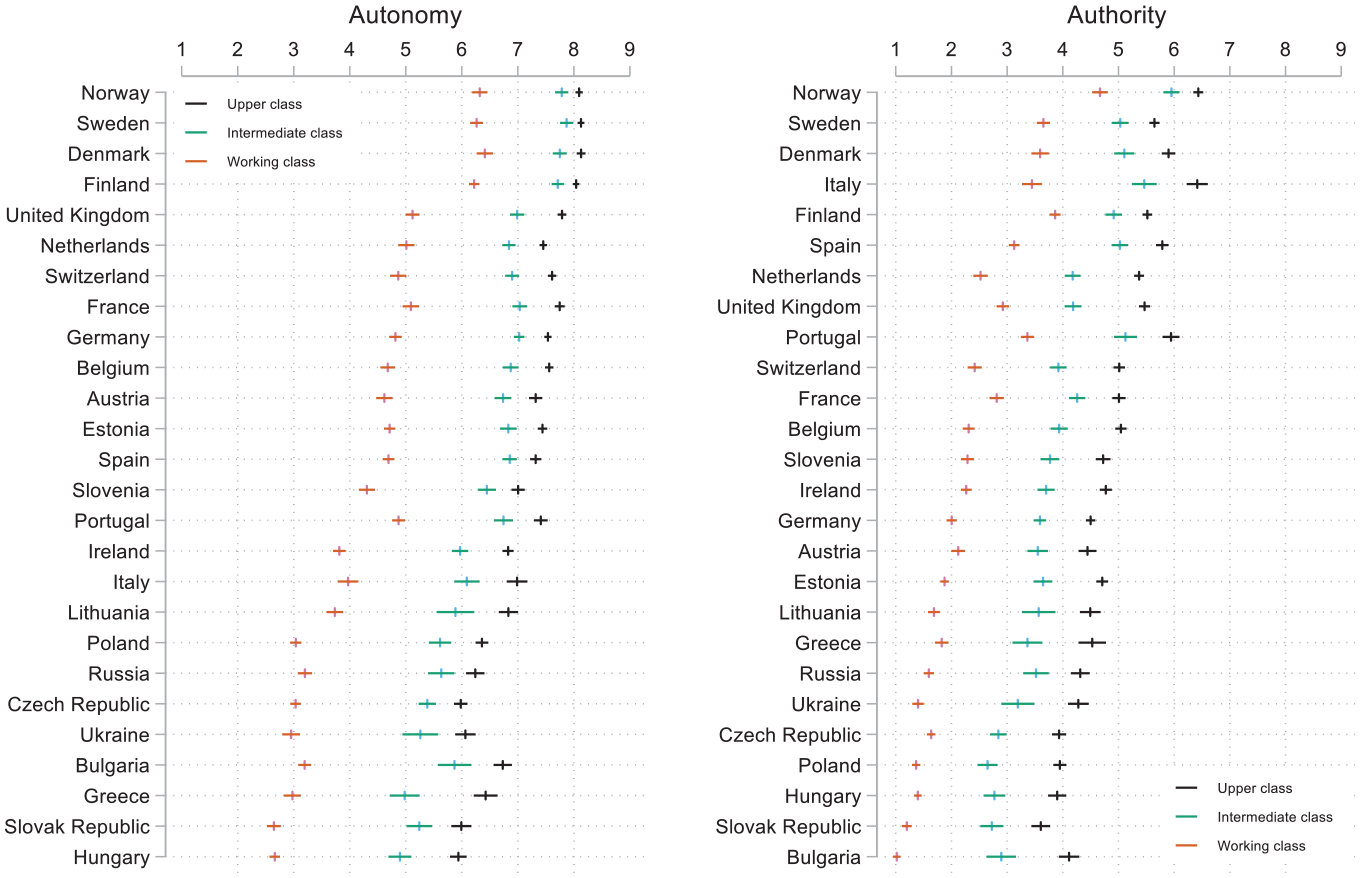
Average weighted scores on autonomy and authority by occupational class in European countries with 95% confidence intervals.
What Figure 1 also clearly illustrates is that that absolute levels of autonomy and authority differ markedly across countries. Mean autonomy for employees ranges from 3.8 in Hungary to 7.5 in Norway, suggesting very large differences in employees’ overall levels of autonomy in the workplace. The average levels of autonomy are highest in the Nordic countries (i.e. Norway, Sweden, Denmark, Finland), followed by the United Kingdom, the Netherlands, and Switzerland. Countries with the lowest employee autonomy are all Eastern European countries or Southern European countries (Greece and Italy) but also Irish employees have relatively low average autonomy. In lines with previous research (Aspøy, 2020; Berglund, 2014; Gallie and Zhou, 2013), level of autonomy is very high among the Nordic employees. In fact, our findings show that the Nordic working-class has as much autonomy as the intermediate class in Ireland, Italy and many Eastern European countries. Even more strikingly, autonomy among the Nordic working-class is on bar with that of the upper-class in countries like Czech Republic, Ukraine, Hungary, and Slovak Republic. This suggests vastly different work conditions and experiences of employees in the same occupational class positions.
Similarly, there are large country-differences in how much authority workers possess. The average score of worker authority ranges from 2.0 in Bulgaria to 5.8 in Norway. The highest levels of authority are again in the Nordic countries but also countries like Italy, Spain, Portugal score relatively high on worker authority. Lowest levels of authority are in the Eastern European countries. Among the Central European countries, Austria and Germany score relatively low on employee authority. The working-classes in the Nordic countries report as much authority as the intermediate classes in Austria, Germany, Ireland, and many of the Eastern European countries. Authority among the working-classes in Spain, Portugal, and the United Kingdom is on bar with the intermediate classes in Poland, Hungary, and Bulgaria.
These findings suggest that while there is a class gradient in autonomy-authority as suggested by the class theory, belonging to the same occupational class is a rather different experience from one country to the next in terms of how much autonomy and authority different classes of employees possess in the workplace. Figure 4 in the Appendix shows that these country differences and rankings hold when we look at men and women separately.
Is cultural context or language bias driving cross-national variation?
One concern with country-comparative research is that variation in outcomes might stem from language bias or cultural factors that influence the way people answer questions in a survey. For example, it is plausible that everyone in Eastern Europe gives very low scores when asked about their autonomy and authority, which could explain why we see low scores in those contexts. In response to this concern, we calculated corresponding figures of workplace autonomy and authority reported by employers interviewed in the same survey but who have been excluded from the analysis thus far. If there was a cultural or language bias, the country rankings for employers should be in lines with the country rankings for employees. However, this is not the case as shown in Figure 5 in the Appendix. There is no indication that in countries where employees report lower levels of autonomy and authority, employers would also give lower scores on the same questions. Eastern European employers evaluate their levels of autonomy and authority similarly or even higher compared to employers in the Nordic countries. We conclude that country variation in employees reports about their levels of autonomy and authority is unlikely to be substantially biased by different cultural understandings when answering survey-questions on autonomy-authority, instead, our figures are likely to present real differences in rates of autonomy and authority.
Autonomy and authority among the working-class employees: the role of compositional differences
We have seen so far that there are large cross-national differences in the level of autonomy and authority employees possess in the workplace. Next, we narrow the focus to working-class employees. Figure 2 depicts the unadjusted (i.e. without any controls) estimates for autonomy and authority held by working-class employees in different country-contexts. The average scores for autonomy range from 2.6 in Slovak Republic to 6.4 in Denmark, and for authority the scores range from a very low level of 1 in Bulgaria to an average of 4.6 in Norway. The magnitude of these differences becomes even more obvious when looking at the differences in percentage terms. About 67% of the working-class employees’ report ‘low autonomy’ (scores between 0 and 3) in Slovak Republic while only 20% of the Norwegian working-class says they have low autonomy (see Figure 6 in the Appendix). ‘Low authority’ (scores between 0 and 3) is reported by 36% of the Norwegian working-class and by a striking 90% of the Bulgarian working-class. Almost all working-class employees in Eastern European countries say they have very low authority while only a fifth of the working-class in the Nordic countries feels the same. There are very large absolute differences in the work conditions of the working-class employees across European nations.
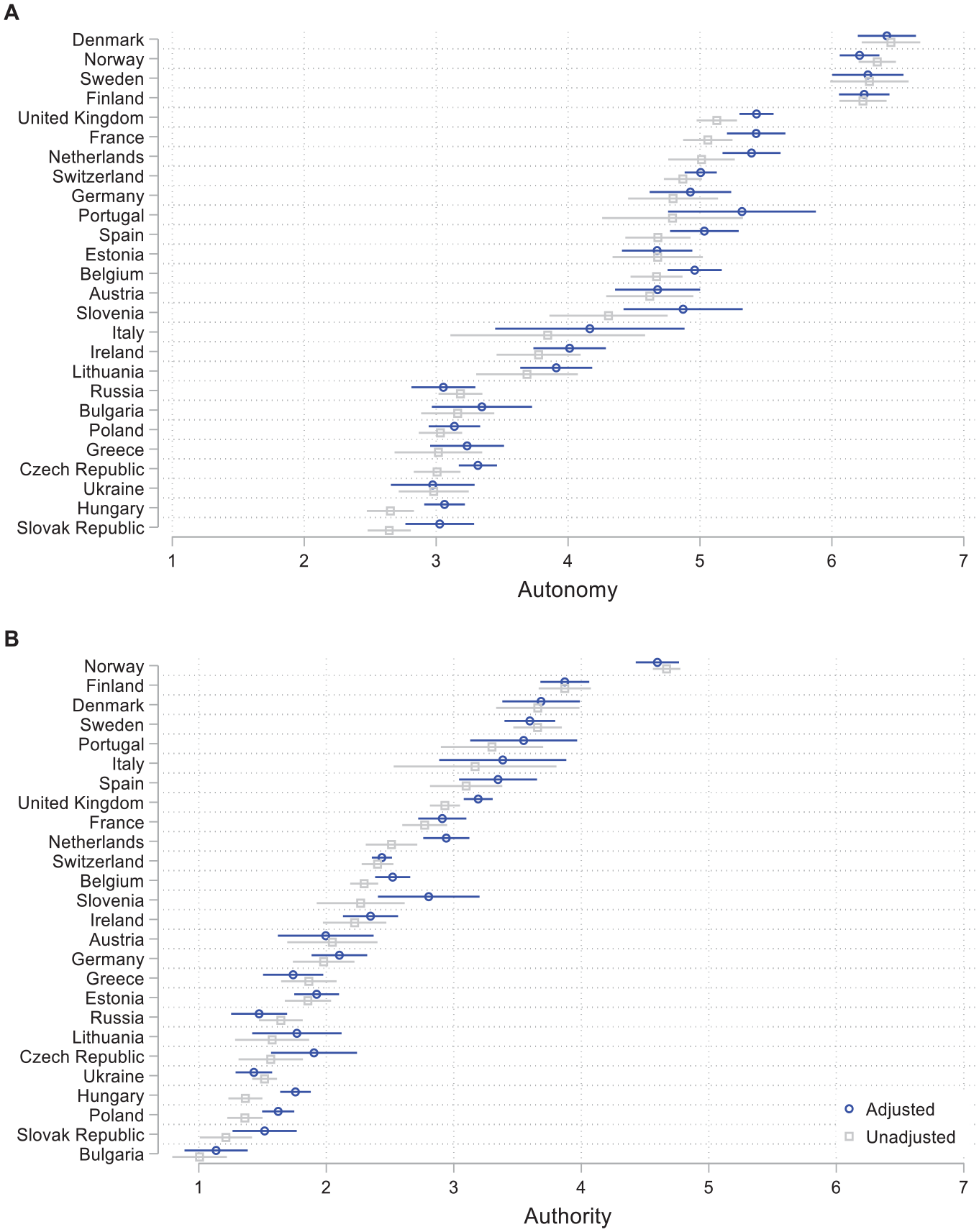
Average weighted autonomy and authority scores among working-class employees with 95% confidence intervals, before and after adjustment.
As discussed above, these large cross-national differences are unlikely to stem from language or cultural bias. However, could the cross-national variation stem from differences in the composition of occupational classes? For example, the working-class could be more educated in the Nordic countries compared to the Eastern European countries and could explain why they are afforded more autonomy and authority. Next, we turn to considering such compositional differences across countries. The adjusted estimates in Figure 2 account for the fact that across countries the working-class incumbents differ in terms of various important characteristics, including demographics, human capital but also job-level and firm-level characteristics. The findings in Figure 2 show that between-country variation is only slightly reduced once we account for compositional differences across countries. Country differences persist net of compositional controls and fixed country and survey wave differences. This means that employees who belong to the working-class and are similar in a range of other dimensions (demographics, human capital, firm-level and job-level characteristics) experience markedly varying levels of autonomy and authority depending on a country context they work in.
We conclude that working-class employees in the Nordic countries have the highest levels of autonomy and authority while working-class employees in the Eastern European countries together with Greece are the worst off. Among other countries, the German and Austrian working class has relatively little authority and Ireland’s working class is doing poorly on both autonomy and authority compared to their counterparts in other countries. The UK’s working class is doing better than the Irish working class both in terms of autonomy and authority.
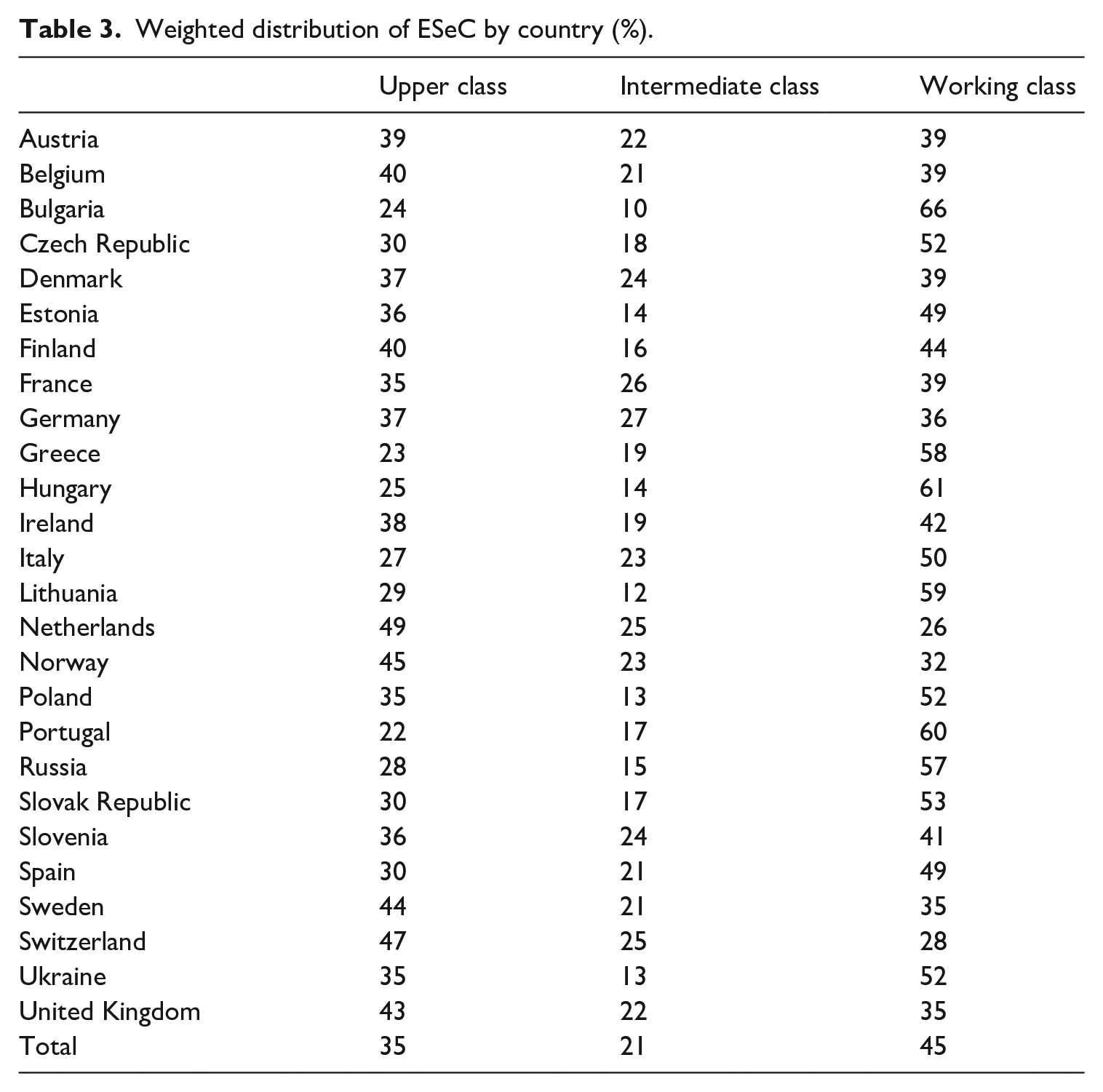
One consideration is that the sizes of occupational classes differ across countries, the working-class constitutes over half of the employees in Eastern Europe together with Greece and Portugal while in countries like the Netherlands, Switzerland, Norway, the United Kingdom, Sweden, and Germany working-class constitutes a third of the workforce (see Appendix Table 3). This reflects different levels of economic development and the fact that occupational upgrading has happened at different timelines depending on context (Bukodi et al., 2020; Morris and Oesch, 2025). It appears that where working-class is bigger, they score lower on work conditions. This means that the very low levels of autonomy and authority are influencing a large share of the workforce. Although it is not always the case, 60% of the Portuguese workforce is working-class but they appear to have relatively high levels of autonomy-authority. Germany has a relatively small-working class, but their autonomy-authority levels are lower than in Portugal. Occupational upgrading does thus not automatically lead to better work-conditions across the class structure.
Class-inequality in workplace autonomy and authority
We now turn attention to class-inequality in workplace autonomy and authority. Table 1 presents analysis of the pooled sample with country and survey-wave fixed effects. The results for the overall sample of employees show that class is a significant predictor of both autonomy and authority in the workplace. Compared to upper-class, working-class employees score, on average across all countries, 2.84 points lower on a 11-point autonomy scale (Model 1) and 2.59 points lower on a 11-point authority scale (Model 3). After including controls for demographic, human capital, job-related, and firm characteristics (see Model 2 for autonomy, Model 4 for authority), class remains a significant predictor of autonomy and authority and the class-differences are only slightly smaller than in the original model without any controls.
Determinants of autonomy and authority, pooled OLS regression with country and survey wave fixed effects.
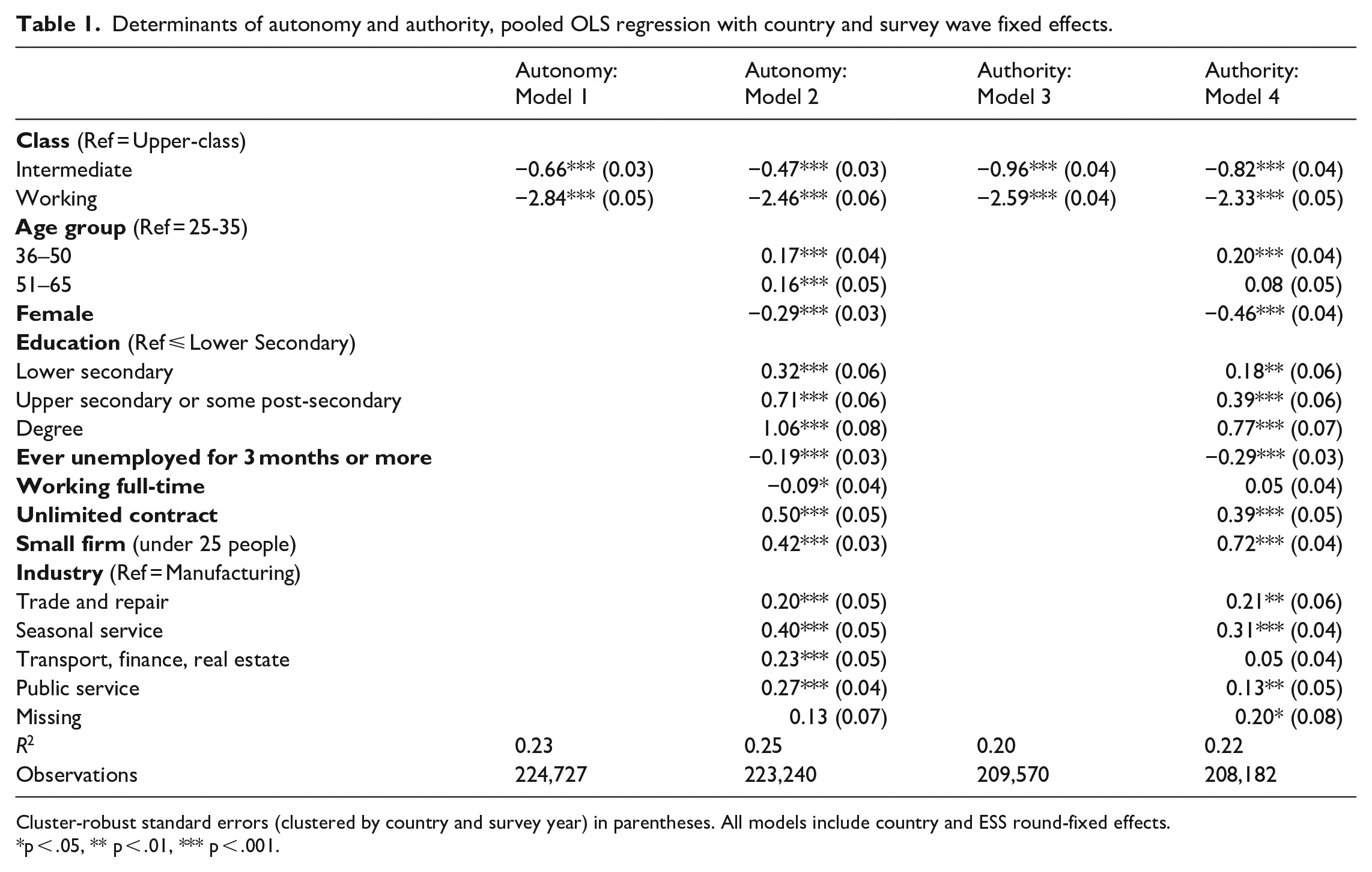
Cluster-robust standard errors (clustered by country and survey year) in parentheses. All models include country and ESS round-fixed effects.
p < .05, ** p < .01, *** p < .001.
Next to occupational class, the pooled analysis in Table 1 allows us to look at how other factors are associated with autonomy and authority in the workplace (note that the impact of those factors could differ within countries). In the combined sample, we see that compared to men, women hold less of both autonomy and authority in the workplace. Factors like higher education, unlimited work-contract, working in a small firm, and affiliation to a non-manufacturing industry are all associated with more autonomy and authority in the workplace. Furthermore, autonomy and authority are lower among those who have been out of the labour market due to unemployment, indicating a scarring effect of unemployment. What is of particular interest to us is the fact that compared to other factors, working-class status is the single most important determinant of autonomy and authority, for example, its effect is larger than that of university degree. Occupational class thus strongly shapes the distribution of autonomy and authority in the workplace.
The next question we address is whether the degree of class-inequality differs across countries. Figure 3 depicts the effect of being in a working-class compared to being in an upper-class and can be interpreted as the degree of working-class disadvantage in autonomy (Panel A) and authority (Panel B). The negative coefficients in Panel A indicate that working-class employees have lower levels of autonomy than the upper-class employees in all countries in our sample. However, the class-gap varies substantially across countries. The unadjusted working-class disadvantage is smallest in the Nordic countries like Denmark, Norway, Finland, and Sweden (less than a 2-point gap on 11-point scale). The gap between the working class and the upper-class is also relatively small in countries like the Netherlands, France, and Spain. Among the countries with largest working-class disadvantage are predominately Eastern European countries (Bulgaria, Slovak Republic, Poland) but also Greece and Italy. In the most class unequal context like Bulgaria, working-class disadvantage goes over 3.5 points on the 11-point autonomy scale. Among rich countries, class-inequality is larger in Ireland, Belgium, and Germany. The adjusted scores illustrate that class differences are reduced but persist after accounting for compositional differences.
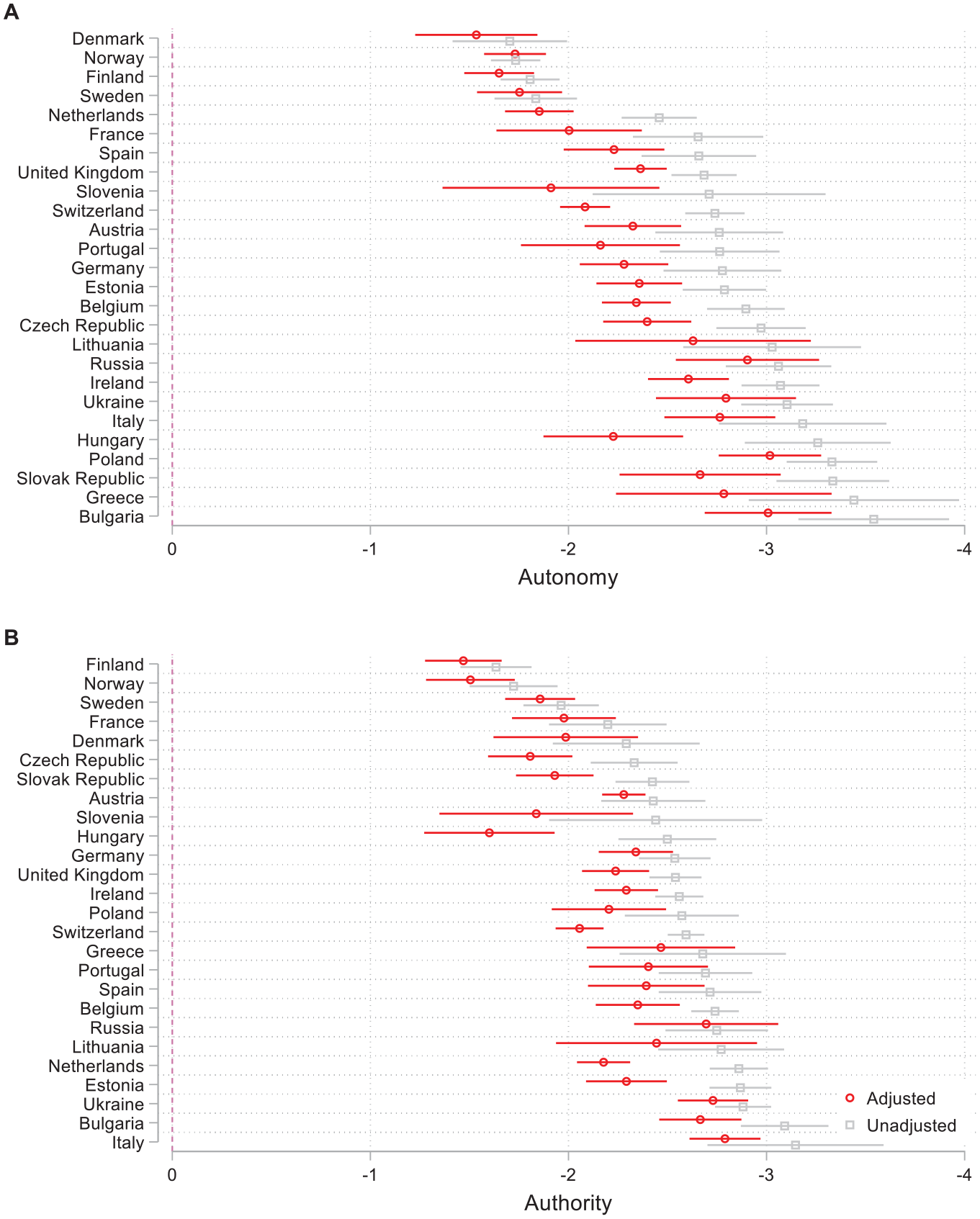
Effect of working-class position (relative to upper-class) on autonomy and authority in the workplace with 95% confidence intervals, before and after adjustment.
In Panel B of Figure 3, we repeat the exercise but for authority in the workplace. We can see that when it comes to authority, the relative working-class disadvantage is the smallest in the Nordic countries but also in France. The working classes in the Eastern European countries together with Italy, Spain, Portugal have least authority compared to the upper-class class in their respective countries. Among rich countries, class-inequality in authority is large in the Netherlands and Belgium. The adjusted scores reduce the class gap and narrow differences across countries. Hence, some of the initial class-inequality within countries are explained by the compositional factors, that is, the fact that social-classes differ along the dimensions included in our model.
Conclusion and discussion
The findings of this study confirm, like the occupational-class literature predicts (Goldthorpe, 2007; Rose and Harrison, 2010), which both autonomy and authority are unevenly distributed across occupational classes. Within countries in Europe, the upper-class class enjoys higher levels of autonomy and authority in the workplace, followed by the intermediate class, and the degree to which working-class employees can exercise autonomy and authority is lowest. Beyond this, the aim of this study was to answer the following questions: (1) How much autonomy and authority different social class positions possess and how does that differ across 26 European national contexts? (2) To what extent does the degree of class-inequality in autonomy and authority vary across national contexts?
The findings show that despite an overall class-gradient in autonomy-authority within all countries, there are substantial cross-national differences in what it is like to belong to a certain occupational class position. The absolute levels of autonomy and authority but also the degree of class-inequality in autonomy-authority vary substantially across country-contexts. Overall, work conditions are more favourable in the Nordic countries and least favourable in the Eastern European countries. Cross-national differences in work conditions are particularly stark when it comes the working-class employees. Being a working-class employee in a Nordic country or the United Kingdom and France is a much more favourable experience in terms of absolute and relative levels of autonomy and authority than being a working-class employee in many Eastern European countries or Southern Europe but also in countries like Ireland and Germany. In fact, a working-class employee in a Nordic country can enjoy as much autonomy-authority as an intermediate or even upper-class employee in some Eastern European countries, and they are on bar with intermediate classes in Austria, Germany, and Ireland. Belonging to a certain class position does thus not entail the same conditions and experiences across country-contexts. Crucially, what our findings show is that cross-national differences persist net of a range of characteristics of workers, their jobs, and the types of organizations they work in. In other words, the same social classes of workers – who are similar in terms of demographic and human capital characteristics but also in terms of the kind of job they do or the kind of organization they work in – enjoy more autonomy and authority in some countries than others.
Do countries fall into meaningful clusters? Our comparative findings suggest that we can distinguish two distinct geographic clusters: first, Nordic countries where workers’ autonomy and authority scores are the highest and there is less class-inequality, and second, Eastern European countries where workers have the least autonomy and authority and where class-inequality is larger. This supports previous findings that social democratic welfare regimes – Sweden, Denmark, Norway, and Finland – have more favourable work conditions as reflected by higher rates of autonomy and authority afforded to workers and lower class-inequality in those dimensions (Aspøy, 2020; Gallie, 2007; Gallie and Zhou, 2013). In the post-socialist countries in Eastern Europe, however, workers – especially the working-class – is worst off in that they have little autonomy to influence their daily work and they have even less authority to influence broader organizational decisions. Although working-class employees in some Eastern European countries like Slovenia, Estonia and to some extent Lithuania are doing better than working classes in the other Eastern European countries. A diverse set of countries rank in the middle between the social democratic and post-socialist countries. The United Kingdom and Ireland both belong to the liberal welfare regime and liberal market economy cluster (Esping-Andersen, 1990; Hall and Soskice, 2001), yet the British working-class has a higher level of autonmy and authority than the Irish working-class. Countries in the conservative welfare regime (e.g. Germany and Austria) tend to score relatively low on both autonomy and authority compared to other rich countries like the Netherlands and France. Importantly, German workers fare worse in terms of autonomy and authority than their Nordic and British counterparts. This runs counter to the production regimes approach, which clusers Germany together with Nordic countries and assumes workers to be worse-off in the United Kingdom than Germany. Based on this analysis, this is not the case when it comes to autonomy and authority in the workplace and is aligend with an earlier studies by Gallie (2007) and Edlund and Grönlund (2010). While the Nordic and the Eastern European countries emerge as distinct clusters, we conclude that grouping countries into geographical units, welfare regimes, or production regimes can be misleading when attempting to summarize the varying class experiences of European workers. The United Kingdom, as an example of a liberal market economy, ranks relatively high in terms of both autonomy and authority. In another liberal country, Ireland, working-class employees are afforded much lower rates of autonomy and authority. Germany, a coordinated market economy, performs worse than the United Kingdom, which is counter to expectations also based on German’s skills specificity and focus on vocational training (Dobbin and Boychuk, 1999; Esser and Olsen, 2011). Those examples add to the literature casting doubt on the Varieties of Capitalism approach in understanding cross-national differences in working conditions (Edlund and Grönlund, 2010; Gallie, 2007).
To summarize cross-national variation in the European context, working-class employees appear to be best-off in the Nordic countries and worst-off in the Eastern European countries. Insurance against risk in the labour market, bargaining power, and labour unions, are factors that are likely to contribute to workers’ more favourable conditions in the Nordic countries (Esser and Olsen, 2011; Gallie, 2007; Gallie and Zhou, 2013). Nordic countries stand out with trade union density of over 50%, which might explain why workers’ autonomy and authority rates are high (OECD, 2025). Although union density in Belgium is also around 50%, yet Belgium scores lower on autonomy and authority than the United Kingdom that has a union density of around 20%. Hence, union density is not fully able to explain country-variations in autonomy-authority rates of workers (Esser and Olsen, 2011), other explanations need to be investigated to understand what is driving varying experiences across countries. It is notable that although the state socialist project in many of the Eastern European countries during the Soviet era aimed at providing more power to the working class, what our findings show is that the working class in the former post-socialist states is having very little autonomy and authority, which is in lines with the work by Gallie et al. (1999).
A criticism towards our findings could be that we are not adequately capturing human capital differences across countries and that could explain country-variation in class experiences. An argument made it the literature is that educational qualification is not a good measure to capture skills and productivity across countries because educational systems differ (Leuven et al., 2004). For example, an educational qualification in Sweden or Finland might mean something different than in Estonia. If this is the case, the working classes in the Nordic countries might be better educated than the working classes in Eastern Europe, and that could explain the variation we observe in employment conditions. Workers with a better-quality education might be in a better position to bargain for more autonomy and authority at work. As a counterargument, however, according to the OECD figures, Estonia is a high-performing country scoring in the top of country rankings in terms of student performance and adult skills (OECD, 2016). This suggests that while workers in Estonia seem to be as well-educated and highly-skilled as workers in Finland and Sweden, they have an inferior position in terms of autonomy and authority in the workplace. Similarly, German employees have high skills-specificity yet score low on autonomy and authority (Esser and Olsen, 2011). More research is needed to find out to what extent differences in human capital might explain differences in workplace autonomy and authority between countries. Furthermore, there could be other macro determinants such as supply and demand dynamics, technological change, or international competitiveness but also worker power that could strengthen or weaken the position of workers and determine how much autonomy and authority they are afforded in the workplace (Gallie et al., 2004; Katz and Autor, 1999; Tomaskovic-Devey and Avent-Holt, 2019).
An important question is what are the implications of these findings for the wider comparative social stratification and inequality research? Does the fact that Nordic workers have more autonomy and authority mean that they are happier, healthier, and can negotiate for higher earnings? Does lower class inequality in autonomy and authority translate into lower class inequality in other dimensions, like health and well-being? Considering substantial variation in work experiences across countries, class can be expected to be differentially associated with other outcomes. These are important questions to address in future research. The findings of this study suggest that workers in similar occupational class positions are exposed to rather different work conditions across contexts. This needs to be considered in any analysis of class inequalities where the assumption is that conditions attached to the occupational class are driving the outcomes of interest.
Footnotes
Appendix 1
Weighted distribution of ESeC by country (%).
| Upper class | Intermediate class | Working class | |
|---|---|---|---|
| Austria | 39 | 22 | 39 |
| Belgium | 40 | 21 | 39 |
| Bulgaria | 24 | 10 | 66 |
| Czech Republic | 30 | 18 | 52 |
| Denmark | 37 | 24 | 39 |
| Estonia | 36 | 14 | 49 |
| Finland | 40 | 16 | 44 |
| France | 35 | 26 | 39 |
| Germany | 37 | 27 | 36 |
| Greece | 23 | 19 | 58 |
| Hungary | 25 | 14 | 61 |
| Ireland | 38 | 19 | 42 |
| Italy | 27 | 23 | 50 |
| Lithuania | 29 | 12 | 59 |
| Netherlands | 49 | 25 | 26 |
| Norway | 45 | 23 | 32 |
| Poland | 35 | 13 | 52 |
| Portugal | 22 | 17 | 60 |
| Russia | 28 | 15 | 57 |
| Slovak Republic | 30 | 17 | 53 |
| Slovenia | 36 | 24 | 41 |
| Spain | 30 | 21 | 49 |
| Sweden | 44 | 21 | 35 |
| Switzerland | 47 | 25 | 28 |
| Ukraine | 35 | 13 | 52 |
| United Kingdom | 43 | 22 | 35 |
| Total | 35 | 21 | 45 |
Declaration of conflicting interests
The author declared no potential conflicts of interest with respect to the research, authorship, and/or publication of this article.
Funding
The author received no financial support for the research, authorship, and/or publication of this article.
