




Abstract
In South Africa, children of single-headed households (70% of whom are Black) have significantly worse educational outcomes than any other demographic. While the impact of family structures has been scrutinised in pre-18 education, it remains understudied concerning access and success in Higher Education. Based on semi-structured interviews with students and alumni raised in single-headed households, this article explores the interplay of family milieu and Higher Education. Using a Bourdieusian framework, authors identify three key configurations between family and Higher Education fields (alignment, fraught (mis)alignment, and parallel fields), which have a long-lasting impact on individual educational trajectories and the fabric of South African society. Black women remain disproportionately disadvantaged in the post-apartheid university, and the family milieu as a key site of intersectional inequalities remains under-researched. This article reveals the structural impact of transgenerational social reproduction in post-colonial societies and argues for a policy shift away from discourses of individual resilience.
Introduction
Forty-two percent of youth in South Africa (70% of whom are Black 1 ) grow up in single-headed households (SHHs); 90% are headed by Black African 2 women (Dawood and Seedat-Khan, 2023), of which 82% live in poverty (Statistics South Africa, 2018). South Africa’s adoption of the National Development Plan: Vision 2030 to raise living standards, provide public services, and reduce poverty and inequality (LaFramboise, 2019) recognises the scope and seriousness of poverty in lone-mother households (LMHs). Lone mothers (LMs) face interlocking gender, race, and class inequalities underpinned by unequal socio-economic structures. Poverty and low levels of education impact women, who remain the poorest of the poor globally. These impediments also directly impact the life prospects of children living in these contexts. Children from SHHs in South Africa are disproportionately affected by poverty, poor educational attainment, substance abuse, criminality, ill health, and premature death (Barnard, 2018; Mulia, 2017). They have significantly worse educational outcomes than any other demographic (Statistics South Africa, 2018). Low educational attainment, therefore, is an issue beyond schooling and needs to be considered in relation to the structural conditions of the family. While the impact of family structures has been scrutinised in the context of pre-primary, primary and secondary basic education, it remains understudied in relation to access and success in South African Higher Education (SAHE) (Morley, 2012; Nkosi, 2021). Widening participation initiatives have a long way to go in South African where only five percent of Black or Coloured youth have a degree compared with 25% of their white counterparts (Nkosi, 2021) and more research in this area is vital.
This article explores how growing up in a SHH affects access and success in HE. Based on interviews with students and staff/alumni from the University of KwaZulu Natal and the University of Stellenbosch who grew up in SHHs, the research uses a Bourdieusian analysis framework to identify critical configurations between SHHs and SAHE. These configurations are framed by intersecting race, class, and gender inequalities, which influence education and reproduce systemic inequality in South Africa.
Widening participation in South African HE: Success beyond access
South Africa’s unequal education system provides a unique case for considering widening participation in HE policy. The apartheid (1948–1994) legacy is sustained in HE. Addressing the ‘inequitable distribution of access and opportunity for students (. . . ) along the lines of race, gender, class, and geography’ (Department of Education [DoE], 1997: 8) has been central to the HE Act 101 of 1997 (online) and the Education White Paper 3 of 1997 (online) promoting transformation, redress, and access for historically marginalised Black, female, disabled and mature students. Targeted redistribution of public funding was identified as the key lever to achieve these goals (Wangenge-Ouma, 2013), with the means-tested National Student Financial Aid Scheme (NSFAS) being established in 1996. The NSFAS, while a critical resource, has been under pressure with increasing demand. In 2023, approximately 800,000 students were funded, yet many others still face challenges accessing financial support (NSFAS, 2023). This financial gap disproportionately affects Black students, particularly those from rural and working-class backgrounds, and limits their participation in HE (Parliamentary Monitoring Group [PMG], 2024).
Access to HE from an inclusive and funding perspective is inadequate for success within a SAHE context. While there has been an increase in participation and in the number of Black university entrants, success (measured in terms of progression and/or graduation) remains elusive. In 2021 over a million students enrolled at public universities and universities of technology Of these, 76.4% were Black African and 11.4% were white (80% of the South African population is Black African and 7.9% White) (Statista Research, 2023). While white students remain over-represented, these figures indicate a shift in the number of Black African students accessing HE compared to 2014, where 66.4% were Black African and 22.3% were White (Statistics South Africa, 2014). In relation to success, the Department of Higher Education and Training (DHET, 2024) statistics show that in 2020, Coloured males and White males had the most unfavourable dropout to graduation ratios for completion within 3 years (24.9:19.6 and 28.2:21.4 respectively). Black African females who had in 2010 fared badly in this regard (23.7: 15.9) made substantial improvements in drop put and graduation rates (11.1:25.6). However, research shows that fewer than 50% of students who enrol in SAHE graduate within the expected time frame, with attrition rates particularly high among Black and first-generation students (DHET, 2021). This suggests that issues of inequality in HE are beyond issues of access and that retention and students’ experiences of HE is a key site for considering the reproduction of inequalities (Case et al., 2017; Swartz et al., 2018).
The complexities of some ethnic and gendered groups attending HE exemplifies ‘how the massification of HE can mask the maldistribution of opportunity structures’ (Morley, 2012: 353) and highlight the need for intersectionally-informed research. Research shows that Black students may be challenged due to academic unpreparedness, coming from under-resourced schools (Higher Education News South Africa, 2024). Gore (2021) found that a lack of English as a first language, alongside a lack of self-confidence and having to work, meant that Black students were less likely to complete their studies in the expected amount of time. Heyes et al. (2023) found that Black African females from SHHs had additional pressures, and while attending university was a way out of poverty, it did not negate the challenges that were still evident within the household, affecting the lone-parent/carer and other children, including sexual abuse, lack of food, and insecure housing. In response, programmes like the University Capacity Development Programme (UCDP) and the Teaching Development Grant (TDG) aim to support students and institutions in overcoming challenges. However, systemic issues such as the overcrowding and underfunding of universities remain significant barriers to widening participation (Boughey and McKenna, 2021; Swartz et al., 2018). South African universities struggle with outdated facilities, limited teaching staff, and increasing student numbers, all of which can detract from the quality of education and hinder successful student outcomes (Walker et al., 2022).
Intersectional race, class, and gender inequalities underpin opportunities, as highlighted by the matric (final high-school examination) results. Statistics for 2021 indicate ‘over 88% White students completed matric, followed by 74% Indians/Asians, 42% Black Africans and 39% Coloureds’ (Khuluvhe and Ganyaupfu, 2022: 8) with research indicating that growing up in a SHH and/or poverty negatively affected educational outcomes (De Lange et al., 2014; Hendricks, 2018). A potential limitation of means-tested financial aid such as NSFAS is the failure to consider the non-financial socio-emotional support from the lowest quartile households need to function on par with unqualified NSFAS students. The 2022 report of the Commission of Inquiry into Allegations of Racism at Stellenbosch University revealed accessibility issues for students whose first language was not Afrikaans, ultimately excluding lower quartile households (Khampepe, 2022).
Building on Bourdieu’s analysis of material inequalities, for scholars such as Vally (2007, 2022), education in South Africa is embedded in social class relations and primarily reflects and reinforces the inequalities in a racial capitalist society. Vally pinpoints how the social class nature of the post-apartheid state is often overlooked in the political economy of the transition from apartheid to democracy and is key for achieving social justice in education (Vally, 2022). Thus, issues of race and racism in education are inextricably linked to power relations and reproduced in conjunction with class, gender, and other inequalities. To recognise the complexities of power and subjectivity in post-colonial contexts such as South Africa, some authors have situated the contribution of Bourdieu alongside the poststructuralist perspective to unravel the structural, embodied, and symbolic nature of post-colonial experiences (Botsis, 2017). We then see how the micropolitics of power are constitutive of ideological categories such as language, race, and class in post-colonial contexts.
As forcefully argued, many South African scholars in the post-apartheid context point to the lacunae of democratic structures, policies, and regulations that hinder equal access to both citizenship and social justice, denying unfettered access to many rights including quality education (Badat and Sayed, 2014; Vally, 2022). Despite a range of interventions to improve educational access, an important question raised by Lewin (2007; in Badat and Sayed, 2014) relates to how educational experiences are shaped by cultural capital and microlevel affordances at the household level, where gender concerns for learner achievement are critical. However, the effect on gender is not elaborated in the context of the household and social inequality and is taken up in this paper through a Bourdieusian lens, framed through an intersectional approach.
Theoretical framework: Thinking of the ‘in-between’
This section outlines a theoretical framework to explore the interconnections between family milieu and education in the post-colonial, post-apartheid South African context.
Bourdieu and Passeron (1964, 1970) systematically explored the interplay of the family milieu and the educational field on individual educational trajectories, particularly in HE. Their analysis revolves around three key concepts (central to Bourdieusian sociology): habitus, capital, and field (which informs practice). Bourdieu (1979: vii, author’s translation) defines the concept of habitus as ‘a system of durable, transposable dispositions which function as the generative basis of structured, objectively unified practices. Understood as ‘the social structures of our subjectivity’ (Corcuff, 2007: 43, author’s translation), the habitus shapes individuals’ ways of being, thinking, perceiving, and acting and forms the principles of action. Habitus is continuously evolving as its constitutive dispositions operate spontaneously in concert with everyday structures. Closely connected to habitus, which is both the product and the producer (Jenkins, 1992), the ‘field’ concept is defined as ‘a social arena within which struggles or manoeuvres take place over specific resources or stakes and access to them’ (p.84).
Different fields have their references, histories, and stakes; they are the product and producer of their specific and appropriate habitus. The concept of capital is intricately connected to the notions of field and habitus. Bourdieu distinguishes four types of capital (economic, social, cultural, and symbolic), which can be understood as ‘the totality of material goods (wealth, income, etc.) as well as symbolic ones (reputation, consideration, culture), unevenly distributed and which are socially considered to have value in social games, at a given time in a given society’ (Champagne and Christin, 2004: 220, author’s translation). Agents use different types of capital in their field-specific forms to navigate social fields and establish their positions. The nature and volume of individuals’ capital ultimately inform structures of domination. The dynamic relations between habitus, capital, and field (all in a state of becoming) shape/determine agents’ practices.
Arguing the education system participates in both the reproduction and legitimation of social order, Bourdieu and Passeron’s (1964, 1970) work shed light on the importance of the family milieu (of which class is a structuring factor) in these social phenomena. Academic success is linked to families’ investment in their children’s cultural capital. Investing in their children’s education, the elite pass on their favourable position via an educational system (instituted by the elite) that legitimises both their cultural capital and their dominance.
The massification of HE has brought new publics to universities, which, under the joint pressures of democratisation and neoliberalisation, have transformed themselves slowly, if not reluctantly. In many countries, this increase in the number of students has not been the great leveller of inequalities that governing elites promised as part of their duplicitous social mobility agenda (Ingram and Gamsu, 2022). In Britain, for example, class positions tend not to change between generations (Bukodi, 2019). Democratising HE has meant increased social mixing, and the experience of cleft habitus is becoming more common among students. Bourdieu (1999: 511) defines a cleft habitus as ‘a habitus divided against itself, in constant negotiation with itself and its ambivalences, and therefore doomed to a kind of duplication, to a double perception of the self, to successive allegiance and multiple identities’. While a cleft habitus may be riddled with anxieties and suffering, Abrahams and Ingram (2013) argue that ‘a chameleon habitus’ fosters individuals’ reflexivity and ability to adapt to new fields and develop multiple belongings, envisaging the possibility of creating new/third social spaces.
Incorporating Bhabha’s work on hybridity and third spaces (Al-Khalili and Baker, 2021; Bhandari, 2022) into her re-reading of Bourdieusian theory in the context of post-apartheid South Africa, Decoteau (2013) highlights the strategy-generating and innovative streak of ‘the hybrid habitus incorporated by the subjects of post-apartheid (which) enable and shape their ability to traverse the many boundaries that circumscribe their daily lives’ (p.280). Alongside class position, gender, race, nationality, educational level, and place of residence inform and structure hybrid habitus. Going further, Decoteau (2013) argues that beyond innovating individual biographies, hybrid habitus stimulates social change for ‘practising hybridity, in this way, is onto-formative – it constantly (re)constitutes social reality in a processual and additive fashion’ (p.285). However, as explored in this paper, the onus of hybridisation of one’s habitus (conscious and unconscious) befalls unevenly on individuals who are in dominated positions within a given field; race, gender and class are vital determinants of perceptions of value and therefore impact pressures to comply to dominant cultural values. In other words, in South Africa, Black women are likely to feel the need to change the strongest but face the most significant barriers to setting change in motion and being recognised as legitimate in new roles/contexts they have accessed (Heyes et al., 2023).
The relationship between the family milieu and higher education outcomes in South Africa is shaped by a complex integration of socio-economic status, parental education, and historical legacies of inequality. Family background is critical to a student’s access to and success in SAHE. Children from SHHs are disproportionately affected by financial instability, lower socio-economic status, and the absence of a comprehensive support system, all of which create significant challenges for accessing Higher Education and achieving graduate success (Cloete and Maassen, 2015). Despite widening participation efforts to increase access to Higher Education, these children often struggle with inadequate academic preparation due to lower parental educational attainment, limited financial resources for tuition and other academic costs, and the lack of familial networks to support career development post-graduation (Calitz, 2018). Research indicates that even though children from LMHs are more likely to be enrolled in higher education under widening participation policies, they still face significant challenges that hinder their academic success, such as emotional stress, work-life balance issues, and limited access to opportunities for career advancement after graduation (Pather et al., 2017). The intersection of gender, race, and class in South Africa intensifies these challenges, with children from SHHs often facing multiple layers of disadvantage.
Building on these discussions, this paper explores the interplay of family milieu and HE and its impact on the trajectories of students and staff/ alumni in single-headed families, exploring the implications for widening participation policies. We do this through a Bourdieusian lens, using the concepts of habitus capital and field as outlined above. We build on Decoteau’s framing of the hybrid habitus in post apartheid South Africa by articulating three different configurations of habitus and field alignment. In this way we extend Bourdieu’s articulation of cleft habitus to show the different ways in which the complex alignment and misalignment of habitus and field can result in different habitus negotiations for different people.
Research design
This study is part of a research project that explores the impact of growing up in a SHH on access to and success in HE. Within a South African context, SHHs are homes where the parent may be deceased, separated from a partner, or working away from the home. Where both parents are deceased, or the parent works away from home, the children are cared for by an aunt, grandparent, neighbour, or the oldest child, who may still be a minor (Ahiaku and Ajani, 2022). To generate new insights as to why some of these inequalities persist and to identify factors supporting access to and success in HE, the research team sought to explore the lived experiences of individuals from SHHs who had found success in HE (defined herein as access and progression or graduation) despite circumstances, and challenges. Students and staff/alumni from the University of KwaZulu Natal and the University of Stellenbosch were selected using a non-probability snowball sampling method. Snowball sampling can allow researchers to access hard-to-reach groups through trusted networks, fostering a sense of safety and confidentiality (Creswell, 2013). These participants may have felt stigmatised due to being from a SHH, and this method helps to build trust in the researcher and the team. The narrative analysis provides a novel perspective of participants’ stories through a focus on understanding the broader social context, meaning, and impact. This method emphasises political and power dynamics retold by researchers and their audiences (Earthy and Cronin, 2008). This study was part of a larger study supported by the Global Challenges Research Fund and ethically approved by Manchester Metropolitan University (reference number: 32183), the University of KwaZulu Natal (reference number: HSSREC/00002538/2021) and Stellenbosch University (reference number: SOC-2021-21662). All data have been anonymised.
Forty semi-structured interviews with participants from SHHs were conducted – see Table 1. Ten participants at each university were students, and ten were staff/alumni. Thirty participants identified as women/female (F), eight as men/male (M), and two did not specify (Not Disclosed–ND). Thirty described themselves as Black/Black African (22 of whom were female), two as Indian (one of whom is female), two as Coloured (both female), and six as white (five of whom are female). Their ages ranged from 20 to 49.
Table of participants and their social characteristics.
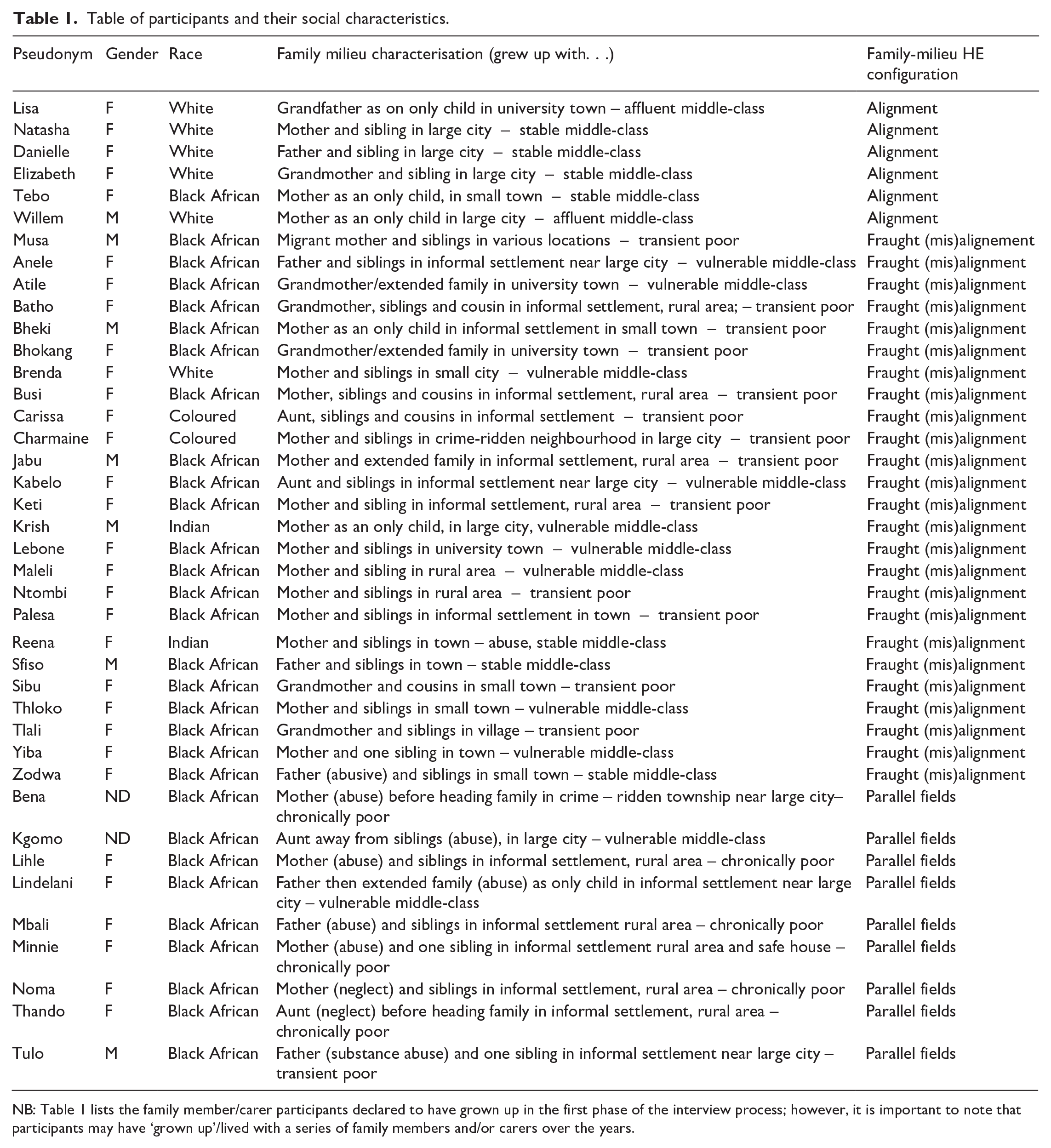
NB: Table 1 lists the family member/carer participants declared to have grown up in the first phase of the interview process; however, it is important to note that participants may have ‘grown up’/lived with a series of family members and/or carers over the years.
The interviews were conducted online, in English. The same female Durban-based South African researcher conducted and transcribed the interviews; this enhanced standardisation between interviews, as did the use of a semi-structured interview guide devised by the research team. Using a thematic interpretative analysis method, our multi-ethnic, all-women research team identified core themes before collaboratively devising the coding strategy used to process the data with NVivo. The range of experiences, backgrounds, and shared feminist sensibilities present in our team supported a collective and critical exploration of the data.
Findings and discussion
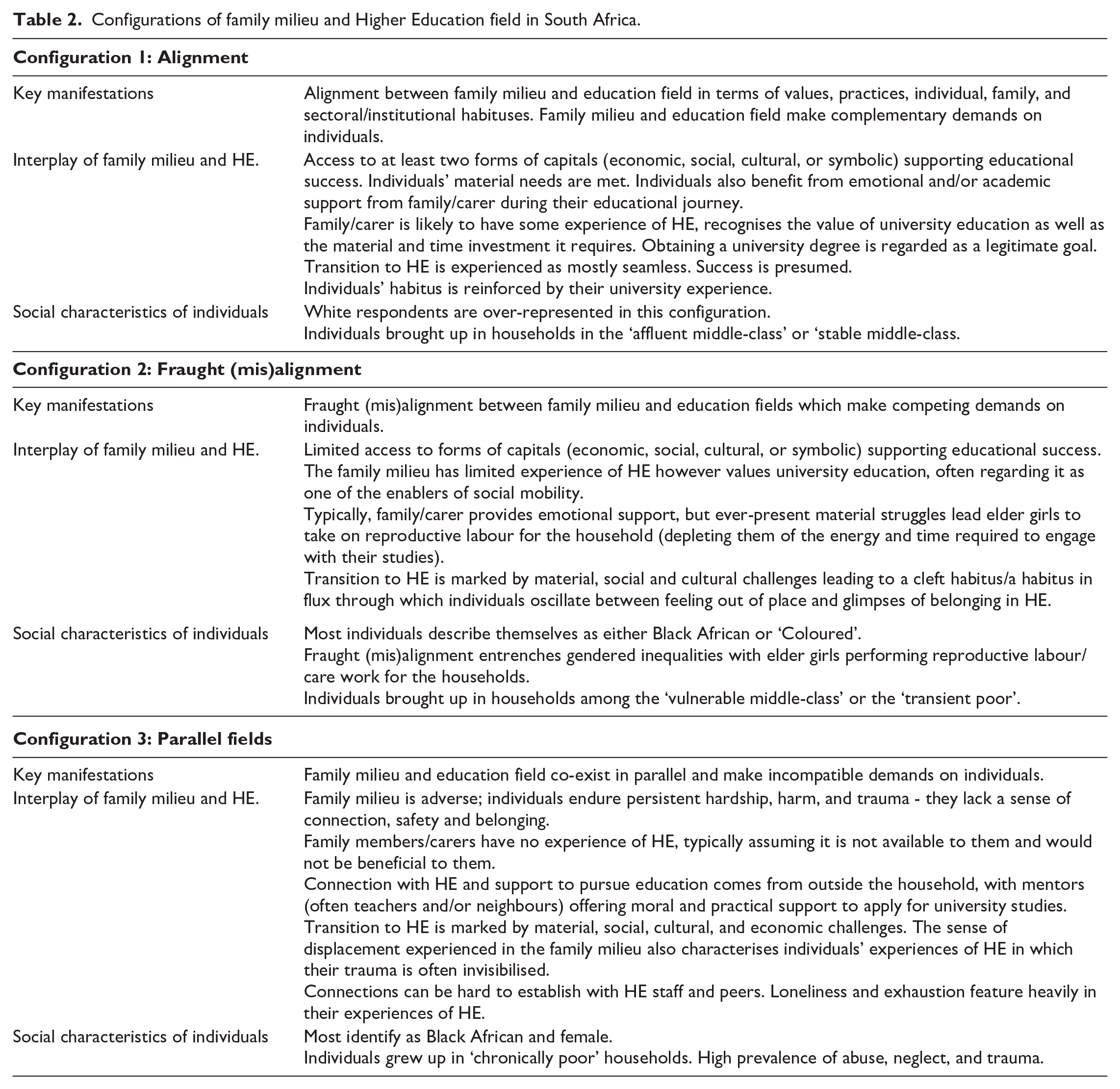
Based on the interviews conducted with research participants, this section explores fundamental dynamics between the family milieu/home environment and the education field. This paper identifies three broad configurations to characterise the relationship between the family milieu and the education field (alignment, fraught (mis)alignment, and parallel fields) (summarised in Table 2), which play out and can have a long-lasting impact on individuals’ educational trajectories and academic success.
Configurations of family milieu and Higher Education field in South Africa.
Configuration 1: Alignment
The first configuration identified sees a strong alignment between the family milieu and the education field. Individuals report transitioning between both environments with seamless ease. Not only was academic success a likely and naturalised outcome and expectation for individuals operating in this configuration, but the alignment between the two fields of family and education reinforced their habitus, accruing its legitimacy through conferring their degree.
When reflecting on their family milieu and how it shaped their educational trajectories, participants in this configuration all describe a home environment in which their material needs were met. In that sense, material needs were neither a hurdle nor a constraint, with some participants acknowledging the advantages derived from their access to material resources regarding their educational success. As indicated in the following quotations, white participants were over-represented in this category, highlighting the deep-seated maldistribution of affluence and access to resources across racial groups.
I had everything at my disposal to succeed. Whatever I needed whatever book I wanted, my grandfather would get it for me or give me the money to order it online. (Lisa, white, female) I had everything. I would go to the library. We had a computer at home with a printer at home and we have the Internet so I could research stuff for assignments. (Danielle, white, female)
These examples highlight the importance of economic capital in shaping habitus and, consequently, dispositions and orientations towards education. The examples above illustrate the conversion of economic capital into cultural capital in the form of space to study, books, and computers. This facilitated an alignment between the original habitus (as formed through the family milieu) and the habitus as it evolved through exposure to the field of education.
This alignment was facilitated by economic capital and the generation of a habitus where educational success and HE participation were the taken-for-granted norm. Participants in this configuration referenced close family members who had graduated from university or were studying for a degree/ qualification; this contributed to normalising expectations around HE. Some highlighted how, as individuals, they had little interest in studying and getting a university qualification but were pushed by their families to do so.
I matriculated and applied to Stellenbosch University. My granddad went there, and many family members went to Stellenbosch University so that was the university to go to. There was a lot of prestige. (Lisa, white, female) Because my sister went to university, she told me I had to. (. . . ). My grandad had huge respect for education. He had an honours degree. I really wanted to make him proud. (Natasha, white, female) I did not even care to go to uni. My mum insisted and both my grandparents. (. . . ) I had and have every available resource. I am the Elon Musk of Durban. (. . . ) I didn’t even apply. I never wanted to go. Dad knew someone who knew someone, and I got in. (Willem, white, male)
Interestingly, regardless of their level of motivation to pursue their studies in HE, participants in this configuration build on the familiarity and (sometimes personal) connections with HE relayed by close family members to ease their transition from secondary to HE. This suggests a strong alignment between their family milieu and the education field, with individuals navigating between the two (aligned codes and practices) with relative ease and the often-unnoticed comfort of the unchallenged habitus. In short, in Bourdieusian terms, they were like fish in water.
Participants in this aligned configuration were white, except for one participant – highlighting the long-lasting impact of apartheid with colonial legacies still structuring the education field. The white participants did not refer to privilege in their accounts and did not connect their success to the intergenerational reproduction of racialised power dynamics that play out through habitus. In fact, in an evolving society where white privilege was starting to be challenged, all the participants felt aggrieved that their perceived entitlement to domination in education and work was under threat. The racial undertones and sense of lost privilege were expressed more directly by two participants reflecting on their transition into the world of work.
Being white it was hard to find work (Danielle, white, female) I applied for work and, as a white person in South Africa, it is very difficult to find work. Everything is about affirmative action and even though I did really well at university I struggled to get work. (Lisa, white, female)
As shown in this section, alignment between the family milieu and the educational field is a configuration that operates to the advantage of whiteness. Our data show how whiteness preconfigures educational success, and the education system is set up to recognise, validate and reproduce white privilege. The perceptions of injustice by white participants in relation to reforms only reinforce the taken-for-granted expectations of the intergenerational reproduction of educational advantage for white South Africans. This advantage is all the more powerful for its unquestionability.
Tebo (female, Black African) was the only Black participant with a strong alignment between her family milieu and the education field. She attributed her adequate access to material resources to her being an only child raised by her mum (a trained nurse) and her maternal grandparents, who also gave her sustained emotional and academic support.
They always put me first and made sure that I was always provided for. Many of my friends had to do chores growing up but I only did chores in school holidays. I only studied. (. . . ) I felt like a privileged child when I saw some of my cousins. I had my own room. I would study in quiet. No chores. I achieved good grades. (. . . ) She(Tebo’s mum) studied so I wanted to study like her (. . . ) My mum used to sit up and do homework and projects when she was home.
Read in conjunction with white participants’ testimonies (all in this configuration), Tebo’s story bears witness to the fact that access and success in HE may be opening up; however, the fact that Tebo herself felt privileged in comparison to her cousins highlights how alignment between family milieu and the education field predominantly remains a white experience. Demonstrating how alignment remains the preserve of dominant groups in South African society, these findings support Bourdieusian analyses of Higher Education inequalities in other contexts.
Configuration 2: Fraught (mis)alignment
The second configuration identified sees a fraught (mis)alignment between the family milieu and the education field. Despite the family milieu and the education field making competing demands on individuals, particularly girls, academic success is highly regarded and seen as a legitimate and desirable goal by individuals in this configuration and their respective families. In this regard, there is a degree of alignment between the shaping of orientations towards education in both fields. However, individuals in this configuration demonstrate a habitus in flux, detailing their fraught strategies to navigate and succeed in education.
Individuals in this configuration identify material hardship as the main disabling factor in their educational journey, which was in tension with their desires for success. Being raised in a SHH often meant households (which varied greatly in size) relied on a single income/wage, with limited money and parental presence at home. This was contrasted against the white participants’ accounts of adequate money and resources despite reduced parental presence.
Things were hard. The house was full. Mum took all her grant and earnings for us. She would borrow money for clothes - and food and to fix our shoes when it was torn. Mum got sick. No money for paraffin or candles. No electricity and most days no food (. . .) The hardest part of growing up was that feeling of being hungry. (Jabu, male, Black African)
Charmaine (female, Coloured) highlights how gendered roles and expectations meant girls (and particularly oldest female siblings) were at a further disadvantage than their male counterparts (see Heyes et al., 2023).
Girls had to wake up first, so the earliest and you make something to eat, make breakfast, finish in the bathroom to leave time for the boys to go in. The boys would wake up much later and be ready for school and have everything ready to go to school. It was hard doing homework; it was hard studying (. . . ), I would have to cook and clean and neaten and organise and have to wash the uniform.
This hardship and lack of economic capital structured orientations towards education in both positive and negative ways. The lack of material resources shaped family perspectives on education as a potential solution to poverty. Moreover, most individuals in this configuration tended to describe growing up in an environment where they were emotionally sustained.
There were too much of us in the house. There was only a six-seater sofa – no place to do work. We used to take the icansi (Zulu mat) and do homework under the avocado tree. There was love, harmony and happiness. (Busi, female, Black African)
While many describe a longing for an estranged parent (often their father) or an absent carer (typically mothers in full-time work), individuals in this configuration sometimes drew emotional fulfilment from their connection with an aunt, a grandmother, a female neighbour, and/or siblings. Many of these relationships had a positive impact on their schooling and their educational trajectory. By holding education in high regard, these relations directly encouraged participants to study and/or siblings, creating a form of emulation conducive to wanting to study.
She (participant’s mother) believed in university. (Musa, female, Black African) Because mum and aunt grew up so poor, they were persistent about school. (Yiba, female, Black African) Mum kept saying don’t end up like me, educate yourself. (Reena, female, Indian)
The combination of poverty and emotional support/encouragement from others shaped the habitus of those within this configuration towards a perception of education as something to be valued and worth struggling for. In this way, there are echoes of the alignment we see in the previous configuration. However, in this fraught (mis)alignment configuration, parental desire for their children to gain an education was borne out of different structural conditions and perceptions of participants and families in the first ‘aligned’ configuration. While the former wish their children study to be like them, the latter want their children to study precisely so they don’t become like them.
While participants in this group may have benefitted from a positive family orientation towards education in addition to supportive and encouraging relationships, there were still significant obstacles to realising success, which creates a tension between alignment and misalignment. For example, family encouragement was often limited to emotional support rather than assistance in navigating processes.
To me, my caregiver had no role in helping me. They didn’t know or understand about universities themselves. And so, they did not know how to help me. (. . . ) I applied for university myself. You know, although my mum was supportive emotionally, she did not know how to help me through all the processes, and I had to struggle through that myself. (Atile, female, Black African)
The struggle was featured heavily in the transcripts of the participants in this configuration, and the battle for education that started within the family milieu continued as they moved from the material difficulties of their home environment to the cultural strangeness of the new environment of HE.
There are six of us and, yes, it’s a two-bedroom place. It really affects us. It’s always noisy, people fighting and throwing things and the neighbours are throwing bottles out of the windows so yeah, it was noisy and then you hear gunshots all the time, you hear people fighting and swearing all the time. This, for growing up, for us is normal. (. . .) The noise is normal and, when I went to university, it felt strange. It feels very strange to be in a space where there is quiet and how normal people live. (Carissa, female, Coloured)
Participants who were students during the interview described some of the struggles associated with their transition into HE. Misalignment manifests in various material and cultural challenges, from social unease and loneliness to difficulty accessing university and its systems and language barriers.
There were no people that we knew of that (university) so it was difficult when I got to campus but expected that I struggled initially. I had to align myself with mentors at the campus, that were in campus life in general, you know the social life, the academic life, the academic expectations. I really struggled with all that because I had no one to guide me. (Atile, female, Black African) It was hard in the first year. The language I struggled with. University was the best school. I travelled from Inanda. Transport was a problem. I always missed the early lectures. I had to wake up in the dark and leave. It costs me R60 per day by bus. I took 2 buses and a taxi. (. . .) I got residence in 2nd year. I struggled at home. It was hard to work at home or at night. There was no computer or internet. (Anele, female, Black African) It’s tough. My boyfriend left me. There is no time to socialise or go to parties. (. . .) I felt alone here. My English is poor ok, it’s a bit better now but I struggled with the language barrier to write in English. I went to Zulu schools. (Keti, female, Black African)
These excerpts point to the struggle to meet the expectations of university life. In some cases, these struggles were material, as in the case of navigating public transport and lack of home resources while studying. In other cases, we see the cultural struggle to fit within the HE field and its expectations for ways of being. This is most acutely felt through the use of language and accent, which are a form of embodied cultural capital.
When I went to university it was a privilege for me when I got space to be at Stellenbosch University because everyone speaks about Stellenbosch University I mean it was the top university and it was difficult to get into. People wonder why they wouldn’t get into Stellenbosch University but for me to get that letter to say that I got into Stellenbosch University. I was very, very happy but really when I was there it wasn’t all it was cracked up to be. It still felt like apartheid. I’m not sure if I’m allowed to say that about the university but you said it’s going to be anonymous? It’s tough being a non-white person at Stellenbosch University because they treat you different, they look at you different, they look at your clothes different, they look at you funny when you speak because you are not speaking their white language or the Afrikaans accent. It’s hard, it’s really, really hard I mean even the lecturers will take time to spend with the white students but not the other students, so we were very much on our own and we had to manage on our own through university. Even though there were jobs available at Stellenbosch University, I didn’t even bother applying for it because it’s not a place I want to be around when people look at you funny and you only get a job because they need people of colour on their statistics. (Carissa, female, Coloured)
Participants in this configuration came from various ethnic backgrounds, with Black African and ‘Coloured’ individuals featuring heavily. Black and Coloured students struggled to feel recognised by the institutions as responses to their ways of being, speaking, and acting rendered them different and outside of expected norms. The excerpt above powerfully illustrates the viscerality of the misalignment between habitus and field for racialised students. The students are caught up in a tension between their field-aligned orientations towards success and their experiences of economic and cultural capital misalignment in their encounters with the Higher Education field. These findings align with Bourdieusian analyses of inequalities in Higher Education and how they affect those in dominated groups.
Configuration 3: Parallel fields
The third configuration identified sees the family milieu and the education field as co-existing in parallel, with incompatible demands and little (if any) points of connection or conversion between the two. Individuals in this configuration face incommensurable challenges in their family milieu and the field, which leaves them in a place of displacement, neither in nor between the fields. Participants in this configuration – who, despite the difficulties, have been successful in their educational trajectories as defined above – have found a way to survive, not to belong. This third configuration sees the family milieu and the education field as co-existing in parallel with each other but neither offering refuge and comfort through an alignment with the habitus of the participants. Those in this configuration remain a minority (as they acknowledge it themselves). Many remain trapped in adverse circumstances throughout their lives or worse, as Minnie (female, Black African) points out: ‘Mine is a happy ending, but what about those girls who don’t survive’.
All participants in this configuration endured a range of profoundly adverse material and emotional circumstances, which were often compounded by traumatic events that prevented them from accessing and/or succeeding in school. Like several other participants, Bena (gender not disclosed, Black African) – as the oldest sibling–found themselves heading their family after the death of their mother:
At 11, I was a mum to 7 kids (her orphaned siblings and cousins). I matured very quickly. I missed a lot of school. I don’t know who was receiving our grants, but it wasn’t me. If I reported it, we would have been taken to the welfare and we all would all be separated. So, I kept quiet. The kids needed me. We lived in a one room shack. I used to go to all the neighbours to get food most days. So, I was raped by my mum’s boyfriend when I was 7. After months of it happening, my mum caught him, and she gave me a beating. I used to get blisters, and only now did I realise that this man gave me STDs. He also gave me HIV, but I collected all the two rands he gave me, and I could buy smarties whenever I wanted. That’s how I made money now when we didn’t have food. So, I would prostitute myself so I could feed my siblings. It’s not like anyone would give an 11-year-old work. Every time there was rain, the shack would wash away. I really struggled. (. . . ) My goal was survival and protect my brothers and sisters.
Bena’s testimony echoes that of other participants in this configuration. Growing up with abuse and with hardly anyone to turn to, these participants struggled for basic survival. The contexts and traumas they wrestled with profoundly impacted their education.
Fleeing their house and carer to find refuge with a family member, a neighbour or in a safe house or living independently – as Bena (see above) or Thando, a Black African woman who chased her abusive aunt from her family’s home – often constitutes the first step beyond survival and towards the reconstruction of their lives (as children/youth), part of which involves a re-alignment with the education field. Minnie (female, Black African) stresses the significance of the safe house, its staff, and volunteers in rebuilding her life and enabling her to access education:
I never went to school. I used to teach myself reading with the neighbourhood children who went to school back home. I only went to school from the place of safety. I was a bit behind, but I worked hard. I was so happy to be able to get an education. I used to clean and cook too and used to do domestic work in other areas on weekends. I was only 2 years behind school because I worked very hard and studied. The teachers worked extra hours with me and helped me catch up. Some teachers volunteered at the safe home, so they brought me books too. I couldn’t work with male teachers. The social worker was helping me with my traumas. (. . . ). I only survived because of my new family. They tried to get me to embrace Jesus, but you tell me if there is a God, would he or she allow me to go through this and my innocent baby F. (her brother) to take his life. No there is no God. We make our own way.
It is important to note here the extent to which gender shaped individual outcomes (which was compounded by age and birth order). In his interview, Tulo (male, Black African) extensively discussed how he ‘owned’ the opportunities to study to the sacrifice of his older sister:
Because of my sister, I could go and study at university while she is alone taking care of my dad, she didn’t study, she’s now got a kid and work part-time as a domestic to earn some extra money for the child.
For some, the education field became an escape route from traumatic lived experiences, often facilitated by a significant individual. Several participants highlighted the role specific teachers played in their lives, showing an interest in them and their studies, caring for them in that sense, and supporting their transition to university (sharing information about the application processes for a university place, accommodation, and funding).
Mrs L. in high school really believed in me. She was like a mother to me. She heard my story and comforted me. I used to struggle in maths and English, but she gave me extra sheets and really helped me. God bless her. She used to take me to expos and tell me about life and how to be successful. (Lihle, female, Black African)
The teachers’ attitudes contrasted sharply with the carer’s/parent’s attitude towards education, who often did not know about the education field (perhaps they had received no or limited schooling) and/or did not support their children with their schooling, either showing no interest in their studies and/or discouraging them from studying to prioritise household chores, childcare or paid child work.
While participants celebrated their success against the odds in the educational field, many described how this newfound equilibrium often felt precarious. Fear for their safety remained a lingering concern for many, from Mbali (female, Black African), who lived for many years in the same neighbourhood as her aggressors, dreading an encounter with them, to Kgomo (gender non disclosed, Black African), fearing homophobic attacks. Moving out of their childhood neighbourhood was often regarded as a major emancipatory step for these participants and a tangible sign of their success. Many expressed a desire to give back to their communities of origin to bring opportunities (derived from their success) to others. Beyond the hard work required to catch up with their studies and enter university, many participants acknowledged that navigating between social fields (family milieu and education field) required sustained efforts on their part with a sense that education providers (institutions, their staff, and student communities) – and universities in particular – made little effort to be inclusive. ‘University is hard. Lecturers don’t understand my English. I got Zulu and Xhosa and then English. You can hear my English is bad’ (Thando, female, Black African).
I sound like Black people. You hear me. I practiced very hard to speak this way so I can be respected. [. . . ] I had to learn how to speak English properly, so that I was respected. That’s how I got into Stellenbosch (University). Black people have to use their bodies to survive, and there is no shame in it, but it’s sad. (Bena, gender not disclosed, Black African)
Notwithstanding this, several current students in this configuration reported they had joined a support group for abuse survivors. They noted the importance of peer-to-peer support and solidarity in their educational and personal trajectories. While participants in the other two configurations identified had access to pre-existing support networks, participants in this configuration had to initiate and build their own support networks. Despite the personal toll and sense of inadequacy experienced by participants in this configuration (all Black Africans) when accessing and succeeding in HE and, despite some denouncing its colonial/apartheid legacies, many were accepting of its exclusionary practices, with some regarding mastery of these codes and practices as a sign of success. ‘She (daughter) writes like British white people. Her English is too good! I am so proud of her’ (Minnie, female, Black African).
In the third configuration identified, the family milieu and education field co-exist in parallel (with no interactions between the two) in individuals’ social worlds. Individuals navigating between these two realms of experience find each of them hostile and unwelcoming – albeit in different ways. For individuals in this configuration, their family milieu is hostile, violent, and abusive; it inflicts trauma on them, and surviving it is the focus of their efforts and consumes their energies. Most participants navigating this configuration experience rejection from their family milieu and become displaced from their family of origin, which, despite the upheaval this causes, often resulted in providing them with renewed opportunities to engage with education. Away from their family milieu, sites, and relations of trauma, individuals encountered fellow individuals who, in a personal and/or professional capacity, empowered them to pursue their education trajectory. Education was often perceived as a radical alternative, a refuge from the family milieu, and a path to a better life away from the family of origin and neighbourhood. However, accounts of lived experiences of HE from individuals in this configuration suggest they experience high levels of symbolic violence (Bourdieu, 1979) in the education fields, where they are left to feel inadequate, with their traumas silenced and invisibilised. In this particular configuration, family milieu and education fields reject each other (reject each other’s logic, norms, and values), with individuals navigating between experiences rejection on both sides. Black/racialised women were over-represented in this configuration in which only a few individuals seem to break away from the gendered cycle of delegitimisation and misrecognition Black women experience in the post-apartheid neoliberalised South African society. It is essential to note here that for individuals stuck in this configuration, many of whom are racialised women, the third space produced is not as generative as through their position in post-apartheid society, their contribution/presence/role are delegitimised and devalued. For these women, the third space that is borne out of the dislocation from both home and education fields is a space of desolation and disconnection. Throwing into sharp relief experiences of barren/non-generative dislocation, the third configuration (‘parallel fields’) offers a significant contribution to our current understanding and represents a notable shift from conventional Bourdieusian analysis of Higher Education inequalities and conceptualisations of the ‘third space’ as generative (Abrahams and Ingram, 2013; Decoteau, 2013).
Conclusion
This article casts light on the critical yet understudied interplay between family milieu, and HE in the educational trajectories of individuals brought up in SHHs in South Africa, many of whom are marginalised based on an intersection of race and gender. Using a Bourdieusian framework, authors identify three key configurations between family and HE fields (aligned, fraught (mis)aligned, and parallel fields), which have a long-lasting impact on individual educational trajectories and contribute to the intergenerational reproduction of inequalities in post-apartheid South African society. From a theoretical perspective, the first two configurations support an orthodox Bourdieusian approach to considering alignment and misalignment between habitus and field for the dominant and dominated fractions of society. In the aligned configuration, we see how white privilege is seamlessly supported to reproduce in the field of education, a field that has itself been structured through historical white dominance. In the fraught (mis)aligned configuration, we see tensions between positive orientations towards education and experiences of economic and cultural misalignment with the field of Higher Education. This is commensurate with Bourdieusian analyses of Higher Education inequalities in other contexts, which show tensions and struggles for those from dominated groups (e.g. Bathmaker et al., 2016). Our third configuration offers a departure from conventional Bourdieusian analysis of field alignment/misalignment to show a dislocation from both fields for actors who have been traumatised in each. Bhabha’s concept of the third space is useful here, but again, we depart from the conceptualisation of the third space as something that is generative (see Abrahams and Ingram, 2013 for a discussion of Bourdieu’s fields and Bhabha’s third space as generative). Instead, we show the third space to be a place of desolation and disconnection. Without an orientation to be anchored in either field, the participants in this study are cast into void like space. Here, the concept of field is useful for thinking about the significance of safe field anchor points of connection (Bhandari, 2022).
These configurations highlight the complexity of the interplay between family milieu and HE and how, in some instances, family and HE fields can be competing fields, making incompatible demands on individuals, with Black women remaining disproportionately disadvantaged (and their struggles often invisibilised) in the post-apartheid neoliberal university (and beyond). While changes are slowly taking place, success stories for Black African women in HE remain individualised and anecdotal, with the heroisation of those who succeed. Their achievements are heralded as examples of a changing structure while they promote a neoliberal narrative of the need for individual resilience. This turns the focus away from the need for costly state-level intervention and policy changes.
Thirty years after the abolition of apartheid and the apparent success of the so-called democratisation of HE in South Africa, these findings have important implications for widening participation initiatives, which have yielded mixed results. Usher and Burroughs’ (2018) report on targeted free tuition professes that countries such as South Africa may have chosen the best route to increasing the participation of the lowest-income households in HE. However, our research has shown that many factors beyond finances mean people from the lowest quartiles of income struggle to succeed and feel a sense of belonging when they get to university. The idea of widening access is to be welcomed; however, access does not equal successful participation, and further work is needed within the sector to understand and support the needs of different students when they make it to university. This study has exposed some of the socio-economic and emotional challenges experienced by Black female students, both in their journey to and through university. Our data highlight the past and present traumas that some students carry while engaging in education and exposes the lack of institutional support beyond access.
Primarily focusing on financial subsidies and using personal characteristics, widening participation initiatives (shaped by neoliberal individualistic values and problematic conceptions of social mobility) have overlooked – and to an extent invisibilised – the role family milieu plays in individuals’ HE trajectories. This article demonstrates the need for HE policy at state and institutional levels to be cognisant of the family field/structures in the space of widening participation in the post-colonial world. This article argues for the consideration of the family field/family structures in widening participation as a key site of intersectional inequalities and social reproduction. Deconstructing the neoliberal discourse of individual resilience to reveal the structural impact of transgenerational social reproduction in post-colonial societies is necessary to design policies that deliver social justice. We argue that in addition to critical financial subsidies, widening participation policies ought to consider the lived experiences of individuals by considering intergenerational contexts (as well as individual characteristics) on learners’ terms, so they are supported to exert their agency in carving out their trajectory and success. In other words, based on this research, we advocate for a qualitative and participatory turn in widening participation initiatives in which students and Higher Education institutions co-produce support interventions beyond access.
Footnotes
Declaration of conflicting interests
The authors declared no potential conflicts of interest with respect to the research, authorship and/or publication of this article.
Funding
The author(s) disclosed receipt of the following financial support for the research, authorship, and/or publication of this article: This work was supported by the UKRI QR Global Challenges Research Fund.
Ethics statement
The research project on which this article is based received ethical approval from Manchester Metropolitan University (reference number: 32183), the University of KwaZulu Natal (reference number: HSSREC/00002538/2021) and Stellenbosch University (reference number: SOC-2021-21662).
