



Abstract
Drawing on long-term participant-observation in Philadelphia’s hyper-segregated Puerto Rican retail narcotics markets, we document the gendered contours of exploding cycles of firearm violence among young males striving to dominate street sales and the grief violence generates. Mothers and sisters intervene eloquently in court (and on the streets) defusing lethal violence. They clarify entangled chains of self-blame, promoting dialogue, accountability, and forgiveness. Although ambivalent about their own outlaw pasts, their ‘streetwise’ credibility increases their peacekeeping effectiveness. They prompt male perpetrators to publicly hold themselves accountable, express grief, and recognize the trauma of firearm violence, chronic incarceration, and frustrated aspirations for legal employment. Meanwhile, low-income women earn below-subsistence-level legal wages to support male kin emotionally and financially during lengthy prison sentences. We analyze the biographies of mothers and perpetrator sons through the political economy of US ‘necrogovernance’: Puerto Rican colonialism, null gun-control, diasporic hyper-segregation, mass incarceration, and punitive state responses to poverty/unemployment/addictions.
‘You think you’re stompin’ on the streets, but the streets is stompin’ on you!’
The shooting
The first person 19-year-old Tito called, in tears, after accidentally killing his best friend Derek, was his mother, Carmen:
It was 4 in the morning. I knew there was a problem [cradling an invisible cell phone to her ear]: ‘Tito, what’s going on?’ All he could say is [whispering], ‘Mommy, Mommy, Mommy’. He couldn’t say anything else [eyes tearing]. I was scared. [Soft voice, tears flowing] ‘Baby! What’s goin’ on? What happened?’ ‘Mommy, I killed my friend. Mommy, I’m so scared. I don’t know what to do. I want to kill myself’. I couldn’t believe it, but I heard the helicopter goin’ down our street. They were looking for him from the sky. And then I heard it on his phone. I was going to run out there lookin’ for him too, but Kenney [Tito’s younger middle-brother] stopped me. Tito was hiding in the tracks [semi-abandoned railroad] and kept calling me all night. He’d hang up, then call me again minutes later, sayin’, ‘I’m scared’. I kept telling him, ‘Baby, come home’. Finally, at like 6 [am], he came home. I told him, ‘Let’s call the cops. Let’s turn you in. It was an accident’. ‘No mom, they’re gonna give me life [life without parole]. I’m too scared’. So I called a taxi. I told him, ‘You got to go before the police come, because they gonna come lookin’ for you’. And I spent the next three months sleeping with the door open, not knowing if he’s comin’ home . . . or the marshals be breakin’ my door down.
Tito and Derek – best friends – had been celebrating their 2-month anniversary as newbie bichotes* (see Figure 1). Sales were booming. Derek was excited about his 2-year-old daughter’s birthday party the following day and thrilled with the small automatic pistol he and Tito had just purchased together. They split a 24-ounce tallboy of malt liquor and swallowed a few ‘Xannies’* acquired at the end of the night shift from a ‘dopesick’ customer who had a legal prescription, in return for discounting his heroin purchase.
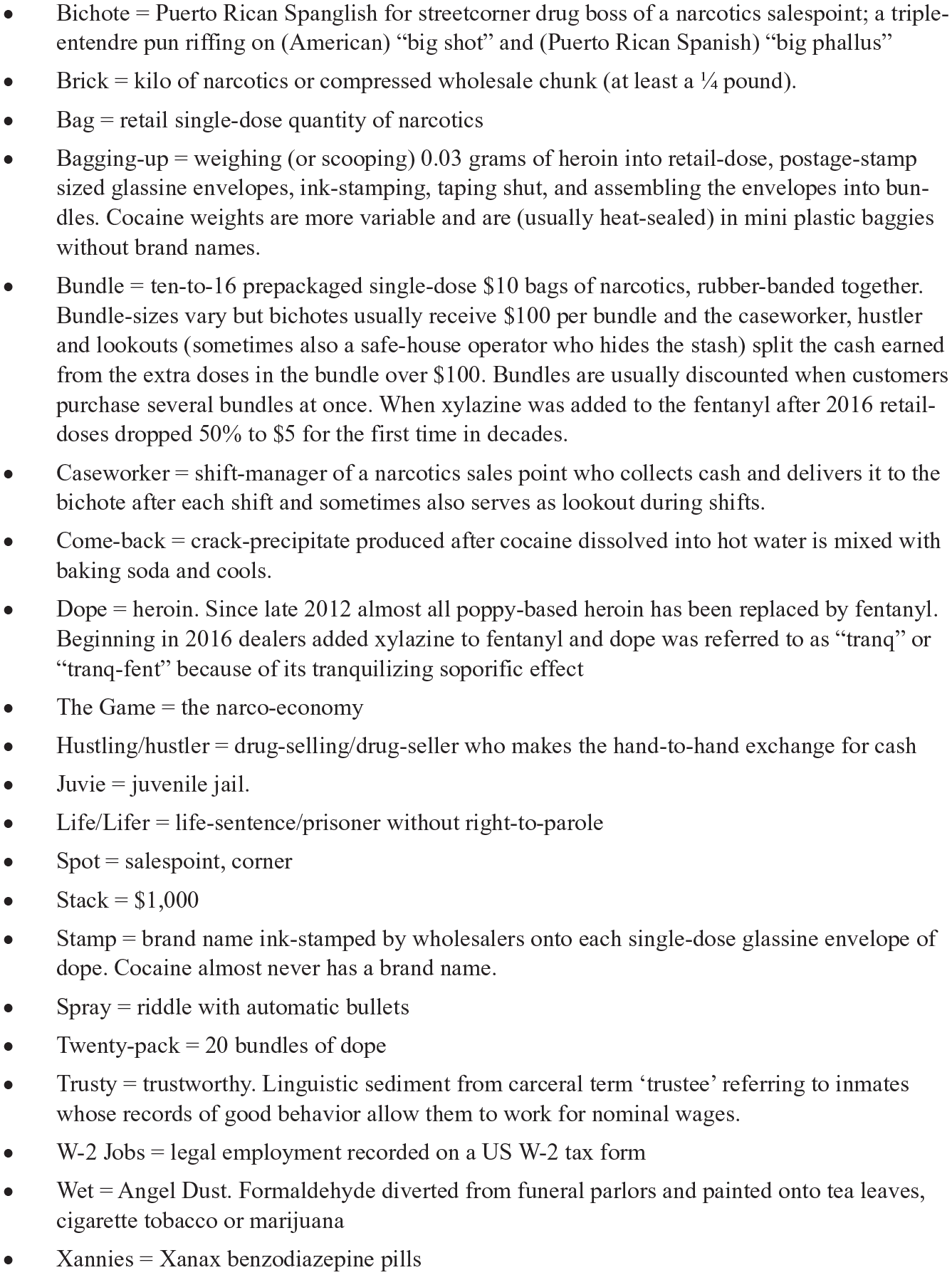
Glossary of Philadelphia Puerto Rican narcotics slang.
Two months earlier, Tito and Derek had partnered to rent a nearby drug corner inherited by the widow of a recently assassinated bichote, their former boss and mentor. Tito still lived in Carmen’s house with his two younger brothers, Kenney and Leo. Derek slept at his ‘baby momma’s’ house. Tito had alerted us, ‘I won’t be sellin’ no more on the block’, adding, with a 19-year-old’s pride (bursting with ambition), ‘You could say I’m goin’ up the food chain now’. Tito and Derek’s transition to controlling a corner required tense negotiations between the widow and her deceased husband’s first cousin, who was trying to seize the suddenly vacated territory. Tito and Derek were young to have risen to bichote status, but they were charismatic locals, and mentees of the widow’s husband. They had some legitimacy in the local narcotics economy’s moral logics, while the cousin was an outsider Black American.
But during that night of celebration, drunk and high, posing for selfies with their powerful new automatic weapon, Tito accidentally shot Derek.
Derek was about to give everyone a ride home and was already in the driver’s seat of the car they also shared; Jax, their caseworker* was in the backseat balancing Derek’s toddler’s oversized birthday cake on his lap. Tito was outside, stashing the gun under the hood, when he realized the trigger was cocked, and attempted to release it. His finger slipped, setting off the gun. The bullet smashed through the windshield, striking Derek in the chest. Tito yanked open the car door, put his ear on Derek’s bloody shirt, registered a heartbeat, shouted through tears to Jax to ‘call 911’, and – reeling in disbelief – panicked and ran.
Detectives and marshals kicked down Carmen’s front door as soon as their shift started that morning. They smashed up her kitchen and living room and tore through her second-floor bedroom, hurling her dresser’s contents down the stairs. They handcuffed Leo, Carmen’s youngest son (still asleep on the couch), and dragged him to police headquarters, interrogating him until well past midnight. Unable to coerce leads to Tito’s hideaway, they threatened to charge Leo with murder unless he called his brother. Carmen was halfway through her 12-hour night shift as a minimum-wage gas station cashier when terrified Leo called for her to pick him up. When her shift ended after dawn, she rushed to the detention center. Leo was still shirtless, shivering from the all-night interrogation. Carmen signed the mandatory ‘juvenile release’ forms and collapsed from exhaustion and high blood pressure on the detention center’s exit steps.
Carmen left her rowhome unlocked, but the marshals still repeatedly broke the door off its hinges in their ongoing raids to re-detain whichever two of Carmen’s younger sons happened to be home, deliberately confusing them with Tito. Tito, meanwhile, had already confessed on the detective’s after-hours voicemail during his second night in hiding. This cycle of law enforcement and family brutality persisted for almost 3 months until the detectives finally located Tito – presumably by merely tracking his voicemail confession from his second night ‘on-the-run’. 1
Neighborhood and US ‘Necrogovernance’
Derek’s shooting occurred early in our now 17-year (2007–2025) relationship with Carmen and her sons in Philadelphia’s infrastructurally devastated, low-income, Puerto Rican enclave, epicenter of hundreds of open-air narcotics salespoints controlled by frequently assassinated/arrested bichotes. We conducted participant-observation fieldwork as an ethnographic team from Fall 2007 to Summer 2013 with repeated solo and joint follow-up visits. Fernando and George lived full-time (2008–2012) in the neighborhood, and Laurie and Philippe visited on weekends and some weekday nights. 2 This article draws inspiration from multi-year exchanges with scholars working on youth and violence across diverse international contexts in colloquia sponsored by the global ERC GANGS project, 2019–2024, PI Dennis Rodgers. 3
The Puerto Rican enclave we studied in Philadelphia was the successor to a patchwork of hard-scrabble English, Irish, Scotch, Welsh, Dutch, German, Ukrainian and other European white migrants arriving in repeated waves since the 1700s. By the late nineteenth century, residents were entrenched in densely packed rowhomes abutting the enormous factories that employed them. Nicknamed ‘Workshop of the World’, this swathe of industrial Philadelphia (West Kensington) had the largest concentration of diverse manufacturing enterprises in the United States. 4 Philadelphia’s vibrant industrial economy collapsed after the Korean War ended (1955). Factories cut hours and wages or shuttered, and the former white industrial working class fled to government-subsidized whites-only suburbs (see Jackson, 1985), leaving a vacuum of decaying inner-city infrastructure. New immigrant Puerto Ricans, pushed from the island by the (still ongoing) US colonial destruction of Puerto Rico’s agricultural smallholder economy (Hart et al., 2024: 70–73; Caban, 1989, 2002) began arriving en masse to the deindustrializing US-mainland rustbelt. Initially seasonal migrant farmworkers, they settled in declining urban neighborhoods eagerly seeking wage-work–no matter how irregular – to escape the back-breaking routine of harvesting. In Philadelphia, Puerto Ricans coalesced in relatively small numbers (7300 in 1953) in a central neighborhood (Spring Garden) accessible to a range of work opportunities. As the local proportion of Puerto Ricans and other new immigrants increased, the dwindling second-generation German population lashed out violently. A 1953 bar-room altercation erupted into a week-long White race riot. 5 Expelled from Spring Garden, Puerto Ricans fled north to West Kensington’s safer, poorer, already-decimated terrain. They were sandwiched between almost all-Black North Philadelphia and all-White East Kensington/Port Richmond. Despite growing patches of gentrification (as of 2025), Puerto Ricans in the narcotics market zones remain confined within a ‘hypersegregated’ (Massey and Tannen, 2015) triad of Philadelphia’s poorest census tracts. 6
As the struggling vestiges of local manufacturing legal employment faded (late 1970s/early 1980s) under-employed entrepreneurial Puerto Rican youth began selling cheap marijuana, graduating to high-potency heroin and/or cocaine to supplement below-subsistence-level industrial wage-work. Once-thriving US factories, increasingly outcompeted for contracts in globalization’s race to the bottom, imposed irregular part-time hours. Our older neighbors (late-30s-to-60s) continued seeking undesirable entry-level jobs (e.g. meatpacking, greenhouses in Delaware/Maryland). The grueling commutes and employment instability pushed them into involuntary bouts of temporary hustling* on proliferating drug-corners or obliged some families to return to semi-subsistence squatter-homesteads on abandoned sugar plantations in rural Puerto Rico (Hart et al., 2024: 74–78, 80–85).
In Carmen’s neighborhood, narco-profits inconsistently percolate into legal household economies through informal sales of services and food, and bichotes or sellers engage in gift-giving or emergency support for rent, utilities, funerals, memorial murals, or summer treats for the kids, generating pragmatic, ambivalent, tolerance for narcotics selling (Karandinos et al., 2014). Long-established low-income Black constituencies in Philadelphia generally have more access to unionized civil service public sector employment, and customers in West Kensington told us Black neighborhood blocks are hostile to narcotics traffic – customers are heckled or beaten.
The phenotypically multi-racial diversity of Puerto Ricans transgresses the rigid segregated topology of race in Philadelphia, positioning West Kensington as a uniquely efficient open-air narcotics sales location. Nearby highway, railway and subway infrastructures maximize outsider access (typically from the mid-Atlantic rustbelt, PA, NJ, MD, DE, NY, CT, MA) to these markets. Puerto Ricans are often indifferent to or welcome White and Black neighbors and empathize with – or pity – the white addicted customers who frequent the block. Narcotics economies, however, are not benign. Criminalization of the product generates multiple workforce occupational injuries (addiction, incarceration, firearm violence, injury and death): illegality excludes criminal justice mediation for territorial and contract disputes. The neighborhood’s local topological gift/curse is compounded by Puerto Rico’s positioning as a current US colony in the Caribbean (a so-called US ‘unincorporated territorial possession’) (Rosenblum et al, 2014; Caban, 2002; Jorge and Rivera, 2018): Its proximity to southern narcotics-producing nations renders it the perfect ‘transit’ corridor for US-mainland-bound narcotics and US firearms bound for Latin American markets (Bourgois, 2015). As a result, neighborhood youth are in the eye-of-the-storm of the US ‘war on drugs’ that kills and ‘hyperincarcerates’ (Wacquant, 2010: 74) street-level sellers and drug users.
Families in low-income West Kensington struggle to keep their children alive and free through adolescence. Tracing the life history of one mother (and former adolescent gangster), ‘Carmen’, raising three sons, we focus on the affective/existential impact of structural-historical forces, following Contreras’s (2024: 3) C. Wright Mills-inspired approach that sets individual biographies in historical-political economic context. In Carmen’s family’s neighborhood the protective agency of kin is drastically constrained, as numerous ethnographers have documented across the United States and Latin America. 7 Most important, Carmen’s life history and her sons’ carceral trajectories reveal the particular burden on women of the US mesh of punitive state policies (increasingly administered by private subcontractors) that we call US ‘necrogovernance’, drawing on Cameroonian philosopher Achille Mbembe’s (2003) influential concept of ‘necropolitics’ or ‘necropower’. Mbembe turned on its head French philosopher Michel Foucault’s 1970s characterization of modern state power (as distinct from medieval sovereign brute violence) as ‘biopower’. For Foucault (1998), control is exerted through the conjuring, surveilling, educating, and promoting of a national population’s ‘public health’ and ‘self-care’ (exemplified in post WWII twentieth-century social democracies). He insightfully noted that biopolitics is inextricably accompanied by the exclusion from care of a pathologized/delinquent population that is ‘left to die’ – abandoned or incarcerated (see also Agamben, 1998). Mbembe, however, focuses on the direct brute power of early 2000s sub-Saharan militarized global kleptocracies, fractured sovereignties produced by centuries of colonial and ongoing post-colonial imperial and corporatized unsustainable extraction. By contrast to biopower, necropower, fueled by proliferating weapons of mass destruction, aims for the ‘maximum destruction’ of ordinary citizens in the ‘death worlds’ of the city, the plantation, and the mine of contemporary global capitalism.
As working-class communities are increasingly lumpenized through expulsion from the ‘legal’ labor force, urban ethnographers on the ground have focused on a critical trio of forces: intensification of firearm violence, expansion of narcotics markets, and the professionalization of adolescent streetcorner gangs into organized crime. The brutality of lethal conditions under globalization, neoliberal structural adjustment, militarized dictatorship and gang or paramilitary protection racketeering especially in the weaker most US-dominated Central American nations has generated a lexicon of ‘necro-terms’ linking neighborhood-based domestic gang terror to US counterinsurgency politics. They seek to render visible the terror of residents in spatially segregated (usually racialized) desperately poor neighborhoods and critically empathize with gang victim/perpetrators under the lethal impacts of local, state, and US zero tolerance policies. To name only two of many examples, we point to Rodgers’s (2015) adaptation of ‘thanatopolitics’ applied to the depoliticized semiotics of murals and gang graffiti, in his rich multi-decade oeuvre on teenage delinquent gangs morphing into organized crime in post-socialist Nicaragua; and Levenson-Estrada’s (2013) ‘necroliving’, applied to interminable cycles of gang rapes, murders, and terrorization of neighbors in Guatemalan urban shanty town squatter-settlements, which Levenson sees as the depoliticized sequelae of the dissociative trauma that has erased popular memory of Guatemalan state torture and indigenous genocide. (See also Cruz, 2010 for a comparative Central American perspective on the professionalization of gangs into organized crime domains in specific national counterinsurgency contexts.)
We are adding ‘necrogovernance’ to this lexicon in the hope that, grounded in the macro-philosophical insights of necropower and biopower, it offers a practical tool to render more visible the often-banal web of repressive state institutions and policies that brutalize the daily lives of vulnerable populations. Necrogovernance operates at the quotidian intermediary level of public policy implementation – generating systemic national subsidies for weapons of mass destruction and repressive bureaucracies such as carceral facilities, underwriting opportunistic private subcontractors implementing downsized health, educational, former ‘safety-net’ state administrative operations under diminished oversight. Necrogovernance lowers life expectancy and limits life chances. Like all terms in the necro-lexicon, it is useful only in its specificity, that is, its potential to pinpoint particular mechanisms in the apparatus of power that inflict harm and call for humane remediation and accountability.
President Trump’s historically unprecedented number of authoritarian executive orders since his 2025 second presidential inauguration exemplify the banality of necrogovernance: he slashed international humanitarian aid, defunded USAID and public health/HIV-AIDS prevention and treatment, eliminated global virus tracking and famine relief programs, defunded laboratory basic science, withdrew the US from the Global Climate Summit and the World Health Organization, forbade public funding of research on climate crisis, pollution, food safety, and eliminated consumer fraud protection. 8 These are life-threatening and gratuitously punitive edicts that augment kleptocratic oligarchical and corporate power, consistent with Mbembe’s necropolitics but operating at a domestic intermediary specific policy level. Trump’s deregulation of crypto and circulation of AI-generated images of an ethnically cleansed luxury Gaza Riviera built on the bomb-pulverized bones of Palestinian families (Odenheimer and Yuhas, 2025) encapsulate the petty personal profiteering often underlying necrogovernmental agendas. Necrogovernance transparently violates commonsensical norms of biopower and explicitly broadcasts hatred for pariah populations (racialized immigrant workforces, dispossessed refugees, the unemployed and the incarcerated). 9 Its forms of ‘fatal extraction’ or predatory accumulation 10 are often accomplished through the covert ‘soft’ violence of targeted deceptive marketing, fraud, administrative seizures of power, manipulations of judicial systems, free-marketing of automatic firearms, control of media, and administrative tactics spread across a broad range of US local level governance policies. Necrogovernance impacts the general population, but most brutally harms the negatively racialized poor.
We are documenting here how care, maternal or familial, is shaped by a necrogovernance that reduces life chances through measures that promote ubiquitous firearms, illegalize narcotics, hyperinvest in building prisons and set globally disproportionate prison terms (Gottschalk, 2015), authorize everyday police abuse (Goffman, 2014), and fund negligent and punitive (often for-profit) schooling. How does a mother deploy ‘care’ in the context of the toxic structuration of her own and her child’s life world, and in light of her own extreme vulnerability? How is the strong solidarity among kin typical of families in Puerto Rican North Philadelphia expressed as people seek personal and neighborhood safety? Loving parents – generally mothers, but also caregiving male kin – tragically find themselves at wits end, urging a child trapped in the narco-economy to enlist in the US military, the only low-barrier option (Filkins, 2025) for public sector employment, or seeking to incarcerate their child for long enough to age-out of the peak years of vulnerability to firearm violence (Richardson et al., 2014a).
We focus ethnographically here on the ‘subjectivation’ – the bruising material and emotional cost, the complex burdens of grief, self-blame, anger, and guilt – imposed on mothers striving to keep children alive in hyper-segregated poverty on violent streets and in carceral institutions. They find themselves compelled to equip their sons and daughters (Ness, 2010) with aggressive-defensive skills to survive school bullying as children (Karandinos et al., 2014: 7–8; and Hart et al., 2024: 77–78, 67–68). They strategize on multiple fronts to maximize their impact on children’s possibilities to thrive under fraught conditions. Paradoxically, here, for Carmen and for Derek’s kin, the courtroom emerged as a public space in which they (mothers and sisters) safely confronted one another to enact justice despite the parallel enactment of arbitrary punishment by an ‘inscrutable state’ indifferent to their decisions. What women say and do both on the street and in the punitive theater of the court is not solely private mourning: it is remedial practical quasi-political action in search of recognition and accountability (Hansen et al., 2014; Rosaldo, 1984). Most important, it also effectively broke, in this case, a rising cycle of lethal internecine revenge violence. 11
Carmen the gangster
Carmen first appears in our fieldnotes before we knew her name, three months before Derek’s death, as a mother standing in the doorway beseeching her sons (‘. . . the streets is stompin’ on you!’ – in the epigraph above) to ‘wake up’. A police narcotics raid had just hauled away the block’s drug boss and the caseworker managing the night shift. Carmen’s oldest son Tito was seizing the golden opportunity of sudden vacuum at the top to order more ‘work*’, and was re-opening sales as temporary bichote, under his younger brother Kenney’s admiring eyes. The narco-economy was seducing her sons on the heels of the previous seller’s incarceration, preordaining their generation’s carceral future.
Carmen was herself ‘streetwise’ (Anderson, 1990). At 14, she became a multiple-kilo drug-runner mentored by ‘Luther’, a Black cocaine/marijuana wholesaler who (before fatally overdosing) helped her out of homelessness:
I was just a baby when Luther offered me a trip. He was like, ‘Yo I’m’a give you $4,000–here’. I was like, ‘That shit sounds good!’ ’Cause I ain’t never seen fucking $4,000 put all in my hand. You know what it is to tell a child that ain’t got no fucking sneakers, ‘Yo’ go to New York . . . go get this for me. Here $4,000!’ You just opened a can of worms. I started dressin’ nice. I had a brand-new frickin’ car at 16. Proud as shit! I’ll never forget – a black Mazda R7. Then I bought a Jeep. Then after that, a Corvette [laughing]. Before, I was sleeping in the park – and now people were like, where is this young girl getting’ this money from? I was makin’ runs for people in New York. But I ain’t never sell drugs on no fucking corner. There ain’t nobody that knows me can tell you, Yo, I saw Carmen on a corner selling drugs. Never!
Barely an adolescent girl, Carmen’s survival opportunities were preeminently constrained by gendered violence. Numerous ethnographers across the Americas have explored how women charismatically negotiate love and family care against all odds in the hypermasculine narcotics and street economies, plagued by abusive law enforcement, and the betrayals of addiction. Women’s involvement in the drug trade is subordinated by masculinist abuse, in unpredictable conjugations. 12 Carmen fondly remembers Luther as a good-hearted uncle-figure for recruiting her into wholesale drug running and retail-bagging. Her alternatives were chronic homelessness and sexual victimization. Her narco-subcontracting funded fancy cars and clothes and a house for herself and another house for a young female friend (suddenly abandoned by the father of her newborn baby). Carmen entered the narcotics economy at the lowest wholesale level, less visible to law enforcement: it stabilized her economically and raised her self-esteem.
Carmen had fled to the streets as a 14-year-old trapped in the notoriously dysfunctional US foster care system, a state institution that epitomizes necrogovernance’s brutality through bureaucratic assignment. Foster care routinely propels already traumatized youths like Carmen into school abandonment and emotional, physical and often sexual victimization, shaping adult ‘outcomes’ of disproportionate poverty, addiction, sexwork, and premature death (Gerassi, 2015: 598–599).
Carmen portrays her narcotics trafficking as pragmatic, autonomous realpolitik that she survived by hard work and good luck. She has no delusions, however, about narcotics trafficking being viable for raising a family. On the contrary, she insists that re-entering legal employment was a life-saving conscious choice she made to break the familial trauma of abandonment and take care of her sons. She emphatically rejected reproducing her mother’s gendered victim-perpetrator role:
My mother was a fucking hooker. At least I wasn’t sellin’ pussy. I was never a fuckin’ ho’. My girlfriend Claudia is like, ‘Carmen don’t talk like that she’s your mother’. I said, ‘I could talk like that if I want, because that’s my mother and she did what she did to me’. I said, ‘Claudia, I don’t hate her, I just say shit because it feels good’. I just say that to less the amount I feel hurt. It’s like some sort of therapy for me you know [laughing] like talking to you now. But all I used to do was bag up and transport drugs. You’re not a big timer. You’re not a supplier. You’re under someone. It’s like factory work. I sure was bringing in a lot of shit [drugs], which I regret. I regret that now! You know how many people probably have problems with their family because of all this shit that I was bringing into this damn city? But I was young. In that business, you’re just a mule . . . It’s not like I was Griselda Blanco. (Griselda, 2024)
Carmen purposefully deflates the romance and terror of narcotics work by understating her risk-taking and highlighting its boring arduous tasks. She purposefully kept one foot in whatever entry-level, super-exploitative, legal job was available even when running drugs for Luther – although, she adds, ‘My ass should [instead] have went to school’. Her first ‘legal’ off-the-books job was cashier, at age 14, on a retail ice-cream popsicle truck, followed by harvesting vegetables in southern New Jersey and mopping out a corner store at night. Her first official ‘W-2 job’ was night-cashier in a gas station that folded when the Venezuelan proprietor’s wife murdered him for molesting little girls. She pivoted to industrial night shift ‘housekeeping jobs’ at a suburban mall: ‘I used to take the kids with me because I had three movie theaters and two banks. You got to be trusty*. You can’t touch nothin’. You got cameras’. She cleaned bedpans at a nursing home until finally securing another night-shift gas station cashier job. For three decades she has remained there full-time (hovering around minimum wage) despite changing proprietorships.
Carmen purposefully extricated herself from drug-running when she became pregnant. She lovingly reminds us, ‘Havin’ Tito saved my life!’ (see Note 7):
I stopped doin’ everything that I was doin’ thanks to Tito. Luther used to set me in a hotel with fucking kilos and I’d sit there for days baggin’ up weed and coke – not thinkin’ about it. Now I’m like ‘Damn! I coulda’ got fuckin’ robbed and killed’. You know how many people they’ve killed baggin’ up somewhere in a house. People lucky I’m not a gangster doin’ drugs. Or in a corner talking to a pole like I’m talking to a person . . . I could have been somethin’ bad, believe me.
Carmen was prominent enough in narcotics wholesale, however, for Tito to discover details of her past two decades later in prison:
Carmen: Tito was like, ‘Mom there’s a guy here that knows you. He seen a picture of you in my cell and he was like, “Who’s that lady.” “Your mom? – I knew your mom! Your mom used to be with some heavy hitters.”’ At first I was like, ‘Tito, That a bunch of fuckin’ lies’. But one day the guy was at the visit. I walked up to him and I said, ‘Listen, I don’t appreciate you talking to my son about that. Not that I was embarrassed, but my son didn’t need to hear you talkin’. There was nothing to be proud of – like, you didn’t have to talk to him’. Tito saw that, and asked me about it again, but I was like, ‘Tito [sighing] yeah, but that’s all in the past. Those people are not around no more’.
Carmen’s tough demeanor and blunt, low, voice remains a useful enduring dimension of the gangster habitus she acquired in elementary school, sleeping homeless in the park fleeing foster care. She easily flies into rages, fist-fights well, and as a teenage drug runner living alone in her a rowhome, fended off rape and assault. She doesn’t tolerate disrespect:
There’s a lot of my friends that got raped. My girlfriend, Andrea, came to my house in the middle of the night – all bruised up – crying, saying, ‘Mike raped me’. He beat the shit out of her. She came in with black eyes. I said, let’s go to the police station. But Mike was a cop and a psychopath so she was scared to snitch. She was traumatized. She didn’t want to go home to her mom. She stood in my house for like a couple of days. My girlfriend Lizette too [was raped], also late at night. I’m lucky I didn’t get raped. But if that guy woulda’ tried to do shit with me, I woulda’ fucked him up. Yeah – a lot of people didn’t try me, ’cause they knew my temper. That’s what protected me – I wasn’t gonna have it.
Colonial migratory ruptures
Carmen, her mother, grandmother and great grandmother were all born on the outskirts of Puerto Rico’s second city, Ponce. That peri-urban sugarcane belt was especially economically devastated in the mid-twentieth century and most able-bodied youth were leaving for the United States. Between 1940 and 1980, Puerto Rico, a colony of the United States since 1898, was propelled through cascading predatory shifts in modes of production – lurching from semi-subsistence small farms to extractive monocrop industrial plantations to low-wage maquiladora sweatshop export assembly to mainland failing factories and Biotech/Big Pharma tax-dodging globalization, to most recently (2025) neoliberal AI/social media gig-economy precarity. Each shift repeatedly ripped apart families ejected from the labor market (see Hart et al., 2024; Bourgois, 2003; Caban, 1989; Duany, 2005; Horowitz, 1981).
Carmen’s earliest childhood memory is of her mother suddenly leaving for Philadelphia with her brother and sister. Her grandparents reassured her that her mother would come get her when she had earned enough money. Carmen idealized her grandparents and forgot all about her mother and siblings until age 11:
My grandparents told me one day when I got home from school: ‘You’re going to your mom tomorrow’. I started crying, ‘Why?’ They said, ‘You have to go to her. You have to go!’ And tomorrow I was packed. I wasn’t allowed to say goodbye to nobody. My grandfather put me on a flight; sent me to the United States. And I been here ever since. And I never forget. It was February – snowin’ a big-ass snowstorm! Imagine! I was coming from Puerto Rico . . . no cold; no nothin’ bad – to snow! I could remember it clearly, like [it was] right now.
The next sequence of traumatic events seems inexplicable but is factually clear: two weeks after Carmen’s arrival in Philadelphia, her mother called the Bureau of Child Welfare and forced her into foster care. The roulette of US foster care spiraled Carmen through sequential temporary foster homes, some briefly loving and supportive, most neglectful and a few abusive, from which she repeatedly fled (in one case escaping from sexual molestation). She slept in a local nunnery’s courtyard or in the park by her elementary school. She liked her teachers but fist-fought her peers who bullied her for not knowing English:
Since I used to get beat on, I’m’a beat you the fuck up too! That’s the way I walked around. I was just a out-of-control-child. Like ‘What “tchou” lookin’ at?’ And if you said anything – that was your ass. I was an angry child.
In her mid-fifties, Carmen still struggles today to understand her mother’s hatred:
I got sent to Philly to be with my mother. But she hated me! you understand? I couldn’t understand why my mother didn’t want me. I wanted nothing else but my family. I wanted to belong. But my mother said I reminded her of my father. You understand? I didn’t feel like I belong. I didn’t belong nowhere. I miss my family. I wanted to be with my grandparents. So much rejection, rejection, rejection! It’s what I got from my mother.
Forty years later, with their mother dying of cancer, Carmen’s brother and sister persuaded her to attempt an in-person reconciliation. They went to the hospice together. As soon as Carmen crossed the threshold, her mother shrieked from her bed, ‘Get her out of here!’.
Carmen never knew her father, but she saw him once, at 16, when she peered at him through the upstairs window of her Philadelphia rowhome. ‘He got wind of what I was doing [running drugs] and came to take me home’; but she refused to answer the doorbell. Nearly half a century later this ‘lost opportunity’ of patriarchal redemption still haunts her. She regrets two forks in her life’s road: not answering her father’s knock; and her mother’s refusal to sign Carmen’s military recruitment contract when Carmen tried to escape the narcotics trade. A generation later she begged Tito to enlist in the Air Force in a juvenile court alternative-to-incarceration plea deal. Although island-born Puerto Ricans cannot vote in US federal elections, they are subject to military conscription, and they have been grossly over-represented in US military casualties since 1898 (Franqui-Rivera, 2018). In this colonial/imperial context the US military is construed by loving kin as a ‘safe place’ for Puerto Rican youth floundering in the narco-economy.
Carmen’s struggle to keep her sons alive
During the month and 10 days Tito was on the run, Carmen’s quick-to-rage, cool-under-fire, gangster habitus ratcheted into gear when a Black bichote to whom her middle son Kenney was running a quarter-pound brick* of cocaine held him hostage. The customer had ‘fronted’ Kenney $4500 and obliged him to stay put until he ‘cooked’ a test chip. When the product did not ‘come back’,* he drew a pistol and tied Kenney up:
Carmen: They had Kenney in the basement and made him call everybody he knew for money. Ricky [a semi-retired bichote] came over tellin’ me, ‘Your son sold some garbage to a Black bol [Philadelphia slang for young male] in West Philly. And n – wants his $4,500 back – or he gonna’ fuckin’ kill Kenney. It’s gettin’ late already. And Black bol ain’t playin’’. I called Kenney and got the man on the phone. Oh my God, it was crazy! I’m hyper now [tears flowing silently], but I was calm on the phone. And Leo [Carmen’s youngest son] was like, ‘Mami, why you so calm?’ I said, ‘Leo, I can’t scream at this guy over the fucking phone. He’s not even from the neighborhood. The ball’s in his court. There’s consequences to this shit!’ Bol was already pissed off. I started thinkin’ about the baby [Kenney’s girlfriend was pregnant] and I was cryin’, I’m like, ‘Who the fuck do I call? Should I call the cops?’ What am I gonna tell them? . . . [Wagging her head, imitating a white-accented airhead voice] ‘Uhh . . . My son sells drugs . . . and I don’t know where he be at’? Instead I just said [voice cracking], ‘Oh God please, don’t kill my son’. Black bol was like, [gruff deeper voice], ‘I know you worried about your son. I don’t really wanna do nothin’ to him. But ‘I ain’t goin’ home to my wife and my kids with no money. Your son need to understand, this a big man’s game. I want my money or my drugs . . .’ Which the guy was completely fuckin’ right! See, the guy was worrying about his spot*. That was the last of the money he had. You can’t sell somebody bad shit and then tell them, ‘That’s not my fucking problem’ when the shit don’t come back. It came to the point where Black bol didn’t even want the money. And Kenney was like, ‘Mami, they gonna take me over there and make me kill somebody’. I told the guy, ‘ Don’t worry! I get you your money’. At the end of the day, you only got your fuckin’ family. ’Cause people don’t care.
More precisely, however, family ‘one can count on’ generally means women in one’s network of extended kin, and ‘people’ who ‘don’t care’ primarily means untrustworthy men in the network:
I called my sister, Sofie, and she came down here and put up $1,000. I put up $1,500; Kenney’s girl – she’s a nice girl. She’s got a good little job at the Water Department. She sold her car and came here crying. And Leo had just bought a car – no-license no-papers – they gave him his money back and that made the $4,500. I didn’t let Leo go to West Philly [with the money] ’cause 85% of the time something’s gonna go wrong, with men. Kenney’s girl, she went. She’s Black – and she’s good. Kenney came home pale as shit, crying.
Two weeks later, Kenney was arrested selling five $10 packets to ‘some White kids’ in the same suburban mall where he had accompanied his mother mopping banks on the night shift.
The second shooting
On the day of Tito’s court-sentencing hearing, Leo was already in shackles for attempted murder after shooting an employee in the foot for stealing from his corner’s stash. Leo had ‘taken over responsibility’ to continue paying rent to the widow for Tito and Derek’s former corner:
I was doin’ good, like $1000 a day. My stamp* was American Gangsta, but the work start goin’ bad so I got samples of some new work, and the fiends I gave it to said it was good and I sold a 20-pack the first day. But the 20-pack the next day ain’t no good. We didn’t even sell a bundle*. I went from seein’ almost a stack* a day to seein’ nothin’. All I was making was rent money. I hustled* the last week by myself. It was a Sunday and I had to pay rent Monday. That’s when all the shit went down.
13
We had access to country jail visits 24/7 through HIV-outreach research, and Carmen urged us to visit Leo frequently to ‘talk some sense into that boy’. Our return reports rendered her introspectively self-critical for ‘failing’ to keep her sons off the streets. Objectively, no parent could shield an ambitious child from the narcotics economy’s siren call when they hit early adolescence. On her side was sheer fury, will power, and logic. Stacked against her: violent, failing privatized schools, a vacuum of legal employment, and, on her doorstep, the abundant cash and camaraderie of 24/7 narcotics sales. She fought back, threatening to snitch on bichotes when they employed her sons as look-outs and they skipped school, and confronting social workers and juvenile judges for failing to discipline Leo for months of truancy:
When Leo was a kid, he didn’t want to go to school. He went out on the street. Leo was absent 120-something days and they never took me to truancy court. Matter fact, I used to go to school and tell the social worker, ‘Take me to court! Put’im away!’ They never put Leo in truancy court, isn’t that weird? When he got caught selling drugs, I picked him up, cause you gotta pick up minors. I told him, ‘I’m picking you up, right now. But tomorrow you’re not coming home from court. I’m putting you away’. He’s like, ‘You wouldn’t do that to me’. I was like, ‘Yes, I am! I’m gonna put you away!’ But the judge was like, ‘Six months probation!’ I just flipped. I said, ‘To who? You’re not giving him six months probation, your honor. I’m not taking him home, ’cause he don’t go to school, so I don’t know what you’re going to do with him’. Αnd I walked out of the court. But when I was doing that, I thought I was going to have a stroke or something, ’cause I felt like, you know, ‘I didn’t take him home. I put him away’. . . . [tears streaming]. So I went back and took him home. Leo got his GED [high school equivalency degree], though [later, in juvenile jail]. When he passed his test, he called me. He’s like ‘Mom, I got my GED, I didn’t think I could do it’. I was like, ‘Leo you can do whatever you want’. You see? What you wanna do with your life? When you’re in [adult] jail, you’re going to have to do what they tell you. This is what life is, you have to do something. So you either do it out here now free or . . . you gonna have to do something anyways locked up. That’s life. I told Leo right then and there, ‘Stop fucking sellin’ drugs. Get your fuckin’ ass to school. Or get a fucking job and live like everybody else lives. Stop being greedy! Greedy ain’t getting’ you nowhere. Greedy gonna get you dead or in jail’.
Leo’s juvie* GED victory was pyrrhic. There were no safety-net services diverting him from adult incarceration:
Carmen: Matter of fact, every day [they were free] I used to go to bed I used to pray to God. ‘God, please don’t take them from me. Don’t let them die. Just get them locked up’. You can’t ask God for nothin’ you can’t take right? Leo’s gonna be in [adult] jail now. At least he’s not dead and he didn’t kill nobody. I sympathize with Derek’s mom [voice cracking]. I’m gonna sympathize with her forever. Because I can’t give her her son back. And if one of my kids die, I’ll fucking die with them. I’ll go crazy. I told Leo, ‘If the game* was easy, don’t you think I’d be doing it, man? You know I’m not happy with the little bit of shit-money I make. But you know what? I don’t got to worry about the cops. You shouldn’t be worrying about having the neatest sneakers and most expensive banana jeans. Be grateful with what you have. I need to take you and your brothers where there’s more poorest-people, like these fucking places in Mexico. That’s where I need to take you motherfuckers so that you look at that and say, “Damn! I have everything.” You can’t ask for more!’ I don’t got hundreds of dollars. I’m not gonna go sell fucking drugs for my kids. Maybe I didn’t do what the fuck I was supposed to do. But fine – it’s done and over. I am just scared that Leo doesn’t come to the point of realizing that what he did was serious enough and that he is coming home too soon and he be like ‘I’m’a do this shit [shoot people] for sports’.
The inscrutable state in court
Tito was initially charged with third-degree murder along with four additional felonies totaling 17.5–35 years. When the District Attorney offered an 8-to-16-year plea-bargain, Tito, encouraged by Carmen, waived his right to trial. His public defender lawyers still regret (in 2025) Tito’s decision not to take his case to trial for a much lighter 2.5-to-5-year misdemeanor sentence:
Lawyer: Most cases have clear intent, sometimes real cruelty. It’s very difficult to swallow a felony murder conviction in an obvious involuntary manslaughter misdemeanor case like this.
What the lawyers did not know was that Derek’s peer-group was slinging Facebook retribution-murder threats and had already sprayed* Carmen’s rowhome door and shot at Kenney when he walked by their block. Litigating for a shorter misdemeanor sentence risked provoking revenge killings. Neighborhood residents also knew that jury trials ‘dig up’, as Carmen said, ‘all sorts of shit nobody wants [exposed]’. Carmen insisted that justice and repair were at stake:
Carmen: You also have to be fair to Derek’s family. Things have consequences! What was he doing with the gun anyway? [Voice rising in anger] When Marshals used to come to my house, I used to call Tito [after] and tell him, ‘I’m ashamed that you’re my son and you’re runnin’. You need to face the music. I thought you wanted to be a gangsta. If you’re meant to be on the streets, you’re supposed to have testicles. But now, when the devil comes and dances with you, you don’t wanna dance with him. Hello! If you can’t dance with the devil, don’t call on him. Leave him alone’. [Composing herself, despite tears] I’m glad Tito took the deal. He can’t risk . . . trial. Derek’s mom used to smoke crack and wet*. Her daughter’s angry at her. I didn’t wanna put her through all a that. I told Tito, at least I can come see you. Her son is dead.
Despite desperately hoping that prison might reform her sons, Carmen was acutely aware of its brutalizing effects and of the schizogenic (Bateson, 2000) double-bind carceral-institutional imperative that inmates must be non-violent and remorseful to qualify for parole, but simultaneously mobilize hypermasculine violence for self-protection from peers behind bars (Contreras, 2013a, 2024).
Carmen: I hope he does good in jail and doesn’t get into more trouble. [Voice cracking] He’s gotta turn his life around and come out a man, come out and be the person that I wanted him to be when I was raising him. But he might run into someone who has life* and doesn’t give a fuck and might want to hurt him. He can defend himself though. Tito knows how to fight his way out of trouble. I have a friend that’s doin’ life right now, and you know what he does when new people come into the jail? [Flat voice, tears streaming] He rapes them.
Antigone in Philly: Women’s solidarity and mourning in court
The court arena offered the two families an important opportunity to air publicly the moral balance of obligations and accountability that could potentially defuse violent retribution and the murders/incarcerations of other mothers’ sons. The hearing began inauspiciously, with the bailiff flexing his arbitrary bureaucratic power by refusing (‘. . . for the security and safety of everyone in this courtroom’) the judge’s and defense lawyers’ requests to unshackle Tito’s for the court proceedings. The same bailiff also refused to allow Tito to change out of his jail jumpsuit into the pressed pants and polo shirt Carmen supplied 24 hours earlier, following regulations.
The first to address the court was the victim’s sister. Carmen cried silently as soon as she began speaking:
Derek’s sister: First of all, my brother is my best friend. [Chokes up.] I was away trying to better my own life when my brother’s life was tooken. [Frowning at her mother] My brother is all I ever had. It was just me and him. And I don’t have him no more. [Shouting at Tito] He has two daughters who will never know what it is to be in their father’s arms.
Initially stony-faced, Kenney put his arm around Carmen’s shoulders whispering, ‘Chill, mom, you gotta chill, mom’, until he suddenly buried his face in his lap to control his own sobbing. Tito alternated between looking straight at Derek’s sister and down at the ground, visibly restraining tears. Surprised by the power of her words generating shared emotions, Derek’s sister lowered her voice, addressing Tito almost affectionately:
I hear you have a child now. Your daughter or son will know what it is to say, ‘Hi, daddy, I love you’. My brother will never hear that from his daughter. She will never know what it is to have a birthday with him–not even a picture. [Whispering] Everything will just be a faded memory. [A pause, punctuated by Carmen’s tears and Kenney’s heavier sobbing] I don’t have no hate towards you at all. I wish you the best in life and I am grateful you are here taking amends for what you did. But [voice rising] I feel like you should have tooken-him to the hospital. That’s where you messed-up as a friend. He considered you his right hand. He always talked about you. I had never met you, but I looked to you as a friend because of his stories about you and him. [Softly again] I love my brother. His memory will forever-ever be in my mind. But I wish you the best. Just make sure that you teach your kids better than the choices that you made. And if you ever do see the outside, you make sure that when you go out there, you never turn your back on another friend. [To the judge] That’s all I have to say.
Derek’s mother turned down the prosecutor’s request for her to speak, but then, at her urging, approached the microphone hesitantly, struggling to steady her voice. She addressed Tito, Carmen, and her own daughter alternately, affirming her own pain and quietly responding her daughter’s grief-inflected accusation that she had failed in the impossible task of protecting Derek from drugs and guns, and finally forgiving everyone in their shared sorrow and fallibility:
[To the judge] I am really not a speaker. I really don’t even know these people [to Carmen, Kenney and Tito] . . . But it has affected me. I’m not the same . . . My kids, they have no world now. [To her daughter] I know that I raise my son until at least 19. He was a real good boy. He had a high school diploma and everything. [To Carmen] But he got caught up in the streets. I mean he liked his guns. [To Tito] Boy, I don’t know you. I really don’t. But I don’t wish you bad, bro. I’m older than you. I can’t bring my son back. You need to use the time in there to think about it seriously. You don’t play with guns, bro. My son did it too, and I had told him, over and over, not to. [To her daughter] I mean I’ve been doin’ this by myself, really, [voice cracking]. And this caused a little bit of conflict between me and my daughter, as you know. We need to be united with therapy to find out how. Period. [To Carmen] We are even, you know: I got grandkids by my son too. And I got to take over his responsibility. And I love them all. [Clearly, to Tito] But I don’t have no hate for nobody and I don’t wish you no bad. What happens, happens, and is going to happen anyway. I mean I can’t do nothing about it. It ain’t going to bring my son back to where I can hold him. I just know that I loved him and I won’t be able to see him. And that’s it.
Before sitting down, Derek’s mother turned to the judge, asking, ‘Is that okay ma’am?’. The judge turned to Tito, who rose speaking directly only to Derek’s mother and sister, steadying his voice:
I want you all to know I apologize. It is not something that I intentionally did. I didn’t want to cause no harm to nobody. I am sorry.
Derek’s mother suddenly turned to respond – prompting an unexpected three-way final call-and-response:
Mother: I don’t hold a grudge, bro. It’s the guns – Take away the guns! Tito: [Nodding]: But I have to take the heat for this. I did it. Mother: I know. Tito: I didn’t mean for this to happen and I hate to stand here and be grieving for that, but I got to accept the fact that I did run. I just wanna let you know that I am sorry. Mother: It was the gun. Tito: I am really sorry. I didn’t mean to hurt nobody. Sister [crying]: Did you really love him? Tito: Yes! I picked him up every morning and dropped him off every night . . . Mother: He was a good boy. He got caught in the street. Tito: We just got caught up in a lot of stuff we should never got caught up in. Mother [To her daughter]: He did that after I raised him. Once he was a man – Sister: I just wanna know that my brother wasn’t killed because of the grudge or hate. I want to know that it was an accident and that you really are sorry for that. I [tapping her chest] should’ve saved him. But whatever happened, happened. God has his plan. [To Tito] Just learn from it. Tito: It was not intentional. Sister: I am thankful that you did apologize to him like you just did, because it feels a lot better than just wondering. Tito: [Looking down now] I really don’t know what else to say to you all . . . Sister: Just tell us that you loved him. Tito: [Raising his head, speaking loudly] I did! I did! And I still do! [Softly] This is somethin’ I got to carry on with me. I just wish him peace because I know it is hard to find peace.
Anthropologist Veena Das argues that mourning rituals serve to resolve, for the living, where to locate blame: paradigmatically, they displace responsibility for death from the ‘proximate cause’ (illness, accident, assault) onto death itself. The proximate cause is ‘only the pretext for death to do its appointed job’. Murder – especially fratricidal murder – poses a problem about what ‘definition of the situation will come to prevail through the control of mourning laments’ (Das, 2007: 51–52). Derek’s sister, in a contemporary inner city Philly echo of the ancient Greek playwright Sophocles’ tragic heroine Antigone (see also Butler, 2000), asserts that a brother’s death generates, for a sister, a unique pain and a unique claim to and for justice. She gives voice to this pain but controls its political impact. Scripting her brother’s death as ‘God’s plan’, she makes it possible for herself as the most aggrieved party to publicly and definitively confirm Tito’s account of the death as an accident. Derek’s mother takes a parallel but complementary track: in assertive contrast to the humility of her initial courtroom speech and demeanor, she lucidly and with conviction pins final blame on ‘the gun’. She diverts the court’s focus from the two boys’ moral agency and condemns instead the out-of-control thing that killed, suddenly making it possible to situate Derek’s death as the end point of the state-sponsored free-market of lethal automatic weapons and frame it as political (necrogovernmental) fatality.
Carmen, for her part (and also Tito, in his decision ultimately to accept the felony murder conviction), makes it clear she knows it is impossible to balance the unequal tolls of Derek’s death versus Tito’s long, but finite, youthful incarceration, but in a gesture of compensation and acknowledgment of her debt she does not bargain over what is ‘enough’ carceral time and accepts an unjust conviction. Both sides – Derek’s female kin and Tito’s mother – collectively defuse the shooting’s ongoing contagion. They do this through their bodies in shared weeping, but also use the court’s public forum to align their polarized positions to reach a point of adjudication on their own ground, for themselves. This is a gendered politics of justice and peacemaking. The two boys are at the end interchangeable: death was inflicted by ‘one’s own [man]’ (Das, 2007) in a fratricide that belongs to all of them.
Blame and guilt abound in the fraught kin-relations of Philadelphia’s ‘concrete killing fields’ (Bourgois et al., 2019). Derek’s sister berates Tito for running, her mother for addiction, and herself for failing to protect her brother when she left Philadelphia ‘to get [her] life together’. Derek’s mother, a possibly not-quite-yet-recovered crack/wet consumer, gently claims her blameworthiness in a plea to her daughter for reconciliation. Her mourning wail – ‘It’s the gun! the gun! I told him not to play with guns’ – also reverberates as an embodied critique of the US gun market that has turned Puerto Rico and its mainland diaspora into a leading epicenter of global firearm murder (Friedman et al., 2019).
Tito’s assertion of his blameworthiness, in contrast, doubles as an assertion of his personal, masculine autonomy. He claims the shooting is a mistake he needs to ‘take the heat for’ – a masculine responsibility. He embraces his love/allegiance to Derek and expresses regret for what they got ‘caught up in’ while not rejecting the legitimacy and seductive comradery of their adolescent bichote-brothers dreams.
The judge – an African American woman – stuns the audience by abruptly accepting Tito’s guilty plea and interrupting the emotional scene to pronounce the sentence. She imposes a sentence of 8–16 years with $2500 ‘restitution to [Derek’s] family for the graveyard headstone’. The bailiff drags Tito, tripping over his shackles, toward the back door for ‘preventive punitive segregation’ pending transport to a sorting prison to screen for gang affiliations. Tito fixes his gaze on his mother, and then on Kenney, and, finally, nods respectfully at the judge. In unceremonious contrast, the court clerks and stenographer shuffle papers for the next case on the docket, chatting about Caribbean vacation plans – oblivious to what just transpired. Kenney, sitting between Laurie and Carmen, pulls his hoodie over his head and reburies his face while Carmen gently pats his downturned neck.
At the elevators the lawyers clarify for Carmen the bureaucratic logistics of Tito’s right to appeal the felony charge in favor of the reduced misdemeanor charge (involuntary manslaughter) within 30 days. Carmen insists to the distressed lawyers that the grief of the victim’s mother is greater than hers (belied by her tears) and tries to reassure them and herself that Tito will be safer locked up than free on the streets:
This the way I look at it: I could either visit him at jail or I could visit him at the cemetery. You know, that mother’s gonna visit her boy in the cemetery. She ain’t gonna go visit him in jail like I’m’a go visit Tito. And that sister, man, that was her only brother man. You know how much that gotta hurt? Your little brother! That’s like me losin’ Kenney [hugging him].
Carmen restates that Tito deserves punishment – and returns to the question of ‘the gun’:
Derek died because of Tito. We can’t bring him back. Three days before that happened, [Tito] brought me home in his car, and I felt the gun under the seat. I told him, ‘Get rid of that gun, man. Something’s going to change your life. It’s gonna take a second’. Now he’s, ‘Mom I should’ve listened to you’. I didn’t raise my boy to kill nobody’s son. I just cry a lot. I feel like my son was the one that had died.
Conclusion: Necrogovernance’s unsustainability
For the next 13 years, Carmen visited her sons in different carceral facilities monthly (costly round trip all-day van rides to Tito and Leo, with briefer rides to Kenney in country jail). In addition to draining her limited financial resources, each visit unleashed chronic grief:
Every fuckin’ day that I leave Tito’s prison . . . Every time . . . I cry. Sometimes my days are so bad at the visits that I sit there and just cry. Now here goes Leo. So it’s like . . . both at the same time.
Firearm death rates in Carmen’s neighborhood were triple those of Blacks and over tenfold those of Whites in Philadelphia (see Figure 2). Statistics belie the searing grief each individual death and felony incarceration imposes on kin of victims and perpetrators. Carmen left narcotics running as a pregnant single mother, transitioning into minimum-wage legal employment. She successfully broke the cycle of child abuse and dysfunctional foster care imposed on her. She could not, however, protect her ambitious sons from their neighborhood’s fast-track into chronic incarceration.
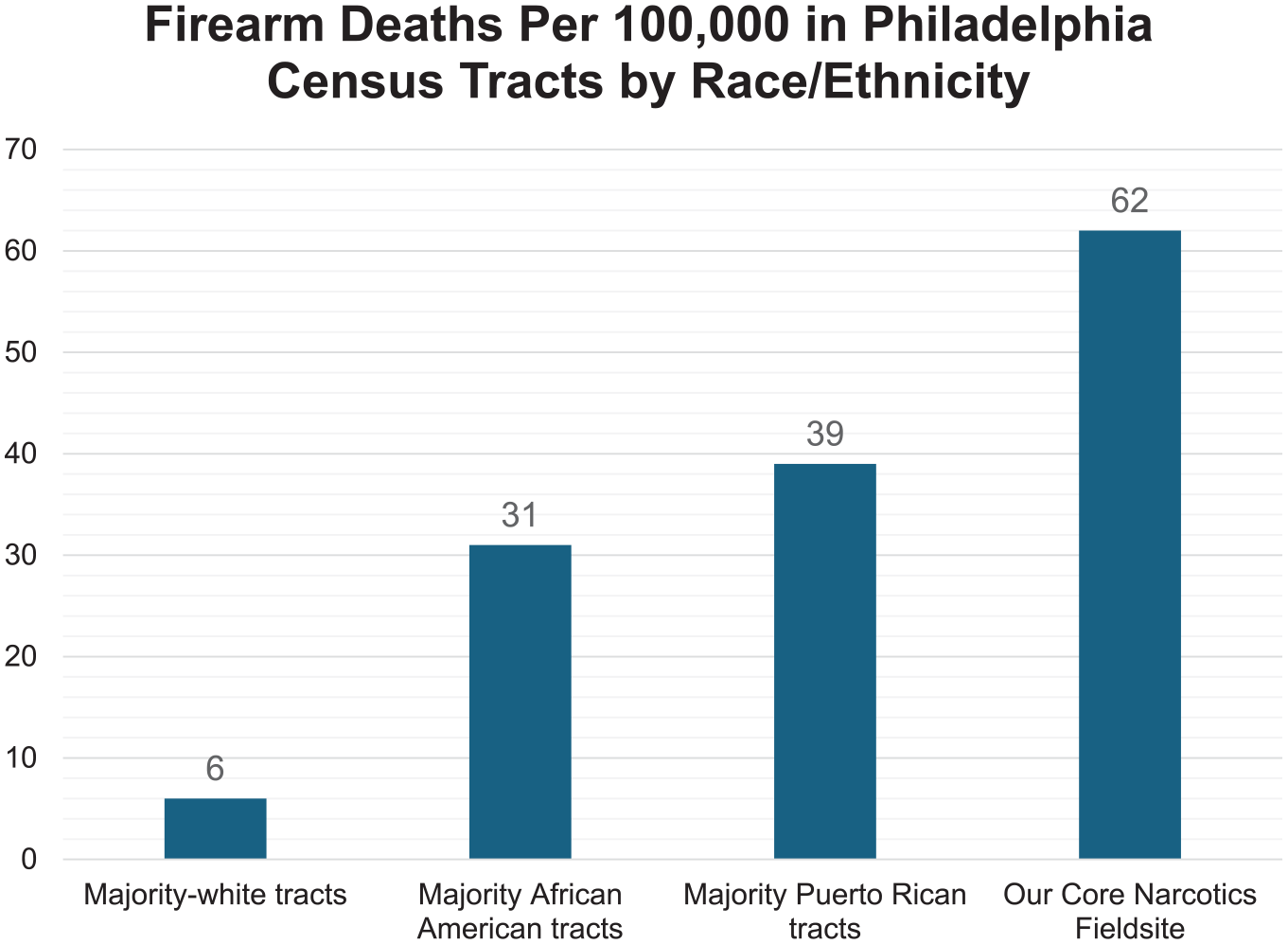
Firearm deaths per 100,000 Puerto Rican narcotics micro-neighborhood.
***
Less than 2 years into Tito’s incarceration Carmen noticed that Tito’s demeanor was changing:
Tito used to curse me out. He used to diss me right there in the middle of the street in front of his brothers and everybody. It took him a murder charge to change. Now he tells me, ‘Mom, I know how much you’ve struggled. Now I know that all that anger that you had yelling at me to come in the house, you wasn’t doing that to embarrass me. You knew that them people [bichotes] wasn’t really my friends’. The other day Kenney, my sister and I went to visit Tito, and Tito wanted to fuck-Kenney-up right there in the visiting room ‘cause Kenney was disrespecting me. I told him ‘Chill, Tito don’t fuck-him-up, he’s just bein’ an asshole like you used to be’.
We followed Tito during and after his prolonged carceral ordeal. The US carceral system is a hyper-racialized gladiator school, and Puerto Ricans, especially short males who do not tolerate subordination, must cultivate hypermasculine aggression to stay alive (Contreras, 2024). The penitentiary is not a site of prosocial reintegration (as the architects of Eastern State Penitentiary in Philadelphia fantasized when they designed modernized panopticons of solitary confinement cells for ‘ethical reflection’ and ‘penitence’ in 1829). Tito survived by channeling his mother’s self-control and abandoning his street warrior persona, earning a barber’s license and working as an unpaid ‘trusty’ filing-clerk in the warden’s office. He dreaded falling back into ‘the game’ after release.
The stability of Tito’s ‘transformation’ remains economically unsustainable, dependent on the love and financial subsidy of his low-income ‘baby-momma’. Initially after release, he had relapsed into the narco-economy. Luckily, a slew of bichote succession murders on and around his corner convinced him to move to the suburbs into the household of a pregnant girlfriend, a nursing home assistant. He adopted her child by a previous baby-pop. After unsuccessfully trying to register in vocational community college (unsuccessfully because of his unfamiliarity with computers – a technological-cultural-capital barrier for all the formerly incarcerated), he settled for minimum-wage night-shift jobs unloading frozen meat, supplemented by rideshare driving. All three of Carmen’s sons, after each release from their recurrent prison terms, credit their mother’s relentless, monthly, loving visits, and her scoldings, for their survival. They respect her pragmatic rejection of the seductive profits of narcotics trafficking, her embodied experience of struggle on the street, and her survival at the bottom of the legal labor market. They attribute to her their ability to stay sane during solitary confinement and their post-release desire to escape the narcotics economy. Extricating oneself from narcotics selling cannot be accomplished solely through heroic moral transformation. It is dependent on access to sustainable ‘W-2’ jobs and frameworks of care. Distressed families seeking some solution to the fatality of everyday life for youth in the neighborhoods to which they are ‘confined’ by the constraints of poverty sometimes resort to institutional confinement as a solution. In Latin America and Latinx diasporas, authoritarian death-squad ‘limpiezas’ [social cleansings of delinquent youths] propel perverse hybrids of love and filicidal sacrifice whereby families subcontract kidnapping to evangelical churches for confinement as an alternative to death (Fairbanks, 2009; Garcia, 2024; Hansen, 2018; O’Neill, 2019; Parker, 2024). Pervasively, the biopolitics/biopower of salvation merges into the necropolitics/thanatopolitics of carceral punishment.
In his long-term historical/ethnographic work on gangs in Brazil, Gay (2005) consistently exposes fundamental contradictions in the possibility of living securely as the opportunities of the working class are narrowed. Visiting his lifelong friend and research interlocutor (‘Lucia’) after an extended absence, thrilled that, motivated by care for her children, she had abandoned the narcotics trade, Gay was initially perplexed by Lucia’s apparent (relative) prosperity. Gay realized Lucia was selling narcotics again. He writes, ‘I had so much wanted to believe that Bruno and Lucia were going straight’. Then he backtracks. Why would they not want the minimal ‘prosperity’ they, as a family, could grasp (Gay, 2005: 169)?
Tito’s 14 years in a maximum-security prison for a felony have severely limited his future access to legal employment – as have Leo’s 16 years on two separate felony convictions and Kenney’s half-dozen misdemeanor sentences in county jail. Emulating their mother, they all proudly—but sometimes fallibly— want to stay out of ‘the game’. Tito loves being a father to his adopted and biological sons. He is ashamed, however, that his legal paychecks do not bring home an income matching his partner’s. They struggle to pay their month’s rent. Tito also loves the safety and silence of his suburb. He is proud of breaking his awol father’s cycle of male abandonment and emulates instead his mother’s love and dedication to her children. But his exhausted cat-naps after his all-night shifts are interrupted by panicked thoughts of his household’s economic unsustainability. The systemic necrogovernance that drives the neoliberal US political economy and the everyday life of poverty has rendered their foothold in legality fragile. From Carmen’s perspective, the only real alternative to her sons’ incarceration or death on the street would have been if he had enlisted, that day in juvenile court, in the US military:
It’s like I asked Tito one day, I said, Tito, have you ever thought about if you would have listened to me and you would have left to the Air Force? And you know what Tito told me? He says, Mom, I think about that every day of my life.
Footnotes
Acknowledgements
We thank Carmen above all, and her sons Tito, Kenney, Leo, as well as Derek’s mother and sister. May Derek rest in peace. We also thank Tito’s public defenders. Philippe and Laurie thank Karmen Pang for indispensable help editing the manuscript and Dennis Rodgers for his intellectual charisma and generosity in creating the GANGS project intellectual community of researchers.
Declaration of conflicting interests
The authors declared no potential conflicts of interest with respect to the research, authorship, and/or publication of this article. Content does not represent official views of any of the funders.
Funding
The authors disclosed receipt of the following financial support for the research, authorship, and/or publication of this article: This work was partially funded by European Research Council GANGS project #787935 PI: D. Rodgers. Data collection and writing/analysis partially funded by multiple US-NIH grants DA010164, DA027204, DA049644, MH019139-32, T32 MH019139-32, DA1UM1DA049415 and UCLA endowments of Leo Rangell, Richard & Ruth Walter Chair; HIV Center for Clinical and Behavioral Studies Postdoc at Columbia University; and Center for Gun Violence Prevention and the Division of General Medicine at the Massachusetts General Hospital.
