




Abstract
This article explores odour as a powerful mechanism in reproducing caste and investigates how odour affects caste boundaries. Based on embodied ethnographic fieldwork and interviews conducted in Ajmer, India, I show that odours create symbolic boundaries for ex-untouchables. I argue that these malodours are structurally produced within and around the spatial boundaries of ex-untouchable ghettos through the interaction of disadvantaged topographies, filth, caste occupations and urban poverty. The article makes three key contributions: first, it establishes that odour is not only cultural but also structural; second, it introduces a sensorial perspective to studying segregation; and third, it identifies a novel mechanism on the social reproduction of caste hierarchies.
Ajit, 39 years old, is a successful property dealer in Ajmer from the Koli caste. 1 I interviewed him in his office in a middle-class enclave in August 2016. He dresses up dapperly, speaks fluent English and is married to a Sikh woman, a ‘love wedding’ as it is called in the Indian context, a rare example of inter-caste wedding between an ex-untouchable and a non-ex-untouchable. Ajit mentioned that because of his ‘[lighter] complexion and personality’ nobody identifies him as a Koli [supposedly not sharing these characteristics]. Yet, he painfully continued, ‘My friend circle [of non-ex-untouchable castes] would say, “See that area [the largest Koli neighbourhood] how filthy that is! It is filled with Kolis!” They use this kind of language . . . and make me realise that after all I am a Koli’. Although Ajit does not live in the Koli neighbourhood his friends mentioned, they imposed the ‘symbolic boundary’ of filth on Ajit, like on the poor Kolis living in the neighbourhood, reminding him of his stigmatised caste status despite his elevated class background. A few weeks later, I met Robinson, a Christian officer, 56 years old, employed at the Life Insurance Corporation of India (LIC). After learning about my research, he frowned with disgust and blurted, ‘If you stand next to them [ex-untouchables], they stink like anything!’ Just as Ajit had described his friends’ reaction, Robinson was certain that all ex-untouchables ‘stink’, no matter what they do and achieve.
The symbolic olfactory boundary represents a powerful mechanism of social exclusion experienced by ex-untouchables in India. Ex-untouchables are an assemblage of separate endogamous castes that occupy the lowest position in the caste hierarchy and have suffered oppression for two millennia. The vignette above depicts this boundary through a noxious characterisation of ex-untouchables as ‘filthy’ and ‘stinking’. I use the term ‘symbolic boundary’ to mean conceptual distinctions that social actors make to categorise people, objects, practices, space and time (Lamont and Molnár, 2002). This symbolic olfactory boundary operates at two interconnected levels: it is imposed both on the bodies of ex-untouchables and on the spaces they inhabit.
How does odour affect caste boundaries? I employ Loïc Wacquant’s (2022) framework of ‘the Bourdieusian trialectic of symbolic space, social space, and physical space’ to decode the relationship between odour and caste. Building on Pierre Bourdieu’s vast corpus, Wacquant describes the three spaces: (1) symbolic space as ‘cognitive categories [to] classify people, places, objects, and activities’; (2) social space as ‘distribution of agents in objective positions defined by the allocation of efficient resources’, and (3) physical space as ‘bounded, three-dimensional material expanse within which agents and institutions are geographically situated and their actions ‘take place’’. The Bourdeusian trialectic, then, is ‘to think relationally or, better, topologically by tracing the layered connections’ between the three spaces.
Based on the Bourdieusian trialectic, I show that odour is a powerful symbol of social boundaries. Moreover, it helps constitute these boundaries in urban space. While a significant literature shows that social boundaries are spatialised (Anderson, 2012; Garrido, 2020, 2019; Simmel, 1997; Wacquant, 2008), it is largely silent on the role of olfaction in relation to both the social and spatial boundaries. Odours draw symbolic boundaries for the ex-untouchables, which are inseparably connected to spatial boundaries of their neighbourhoods. Exploring odour in an urban caste setting shows a quasi-perfect overlapping of the Bourdieusian trialectic of the physical, social and symbolic space. This becomes even more important because caste does not have visible phenotypical identifiers. Olfactory boundaries, therefore, help localising and reproducing caste hierarchies in the city.
In this article, I draw principally on ethnographic observations, interviews and photographic material I collected in the northwestern city of Ajmer, Rajasthan. However, the sensorial data that I discuss here was produced by customising these methods. First, much of the data for this sensory ethnography were generated through embodied ethnography, where the immersion of my body in the field was ‘not simply a source of experience. . . but itself as a source of knowledge’ (Pink, 2015: 26). It helped me perceive smells that kept appearing on my clothes and as phenomenological records in my fieldnotes. Second, it became possible to perceive and trace these odours due to the multi-sited ethnography I conducted. Segregation is organised in such a way in Ajmer that the poorest ex-untouchables reside farthest from the main roads into the core of a neighbourhood parcel in caste ‘ghettos’ 2 and the upper castes stay closest to the main roads in mixed ‘outer road citadels’ 3 (Sihra, 2023). Therefore, accessing the ghettos meant crossing the contiguous middle-class upper-caste and ex-untouchable neighbourhoods. The iteration of going in and out made me conscious of olfactory boundaries.
Thus, the data here come from (1) my experience of perceiving these odours, and not from asking specific questions to my interlocutors about olfaction, and (2) from what my interlocutors themselves underlined about filth, stench and odours in addressing my other queries. In other words, I found these data inductively in my transcriptions and fieldnotes. Operating within the context of untouchability, as a hypervisible, non-ex-untouchable, Sikh male, I found it extremely difficult to ask my ex-untouchable interlocutors direct questions about malodours. As an ‘outsider’ both in terms of neighbourhood and caste affiliations, talking about malodours would have been insensitive and stigmatising for my interlocutors. Even if there was filth strewn around me and the stench made me nauseous, I appeared as unperturbed as possible in front of them, rather than giving the impression that I found my environs intolerable. It was possible that since I was not accustomed to those odours, my perception was heightened compared with my interlocutors. My interlocutors have endured olfactory violence for so long that the only way to deal with it was to get used to it, a strategy I too adopted when these odours were inescapable.
Odours and boundaries
In Sociology of the Senses, Georg Simmel (1997) examines how odour penetrates physical and mental boundaries, shaping social interactions and sensory experiences between individuals and groups. Odours can reflect social status, hygiene and cultural identity, creating both distance and intimacy. Simmel notes that ‘instinctive antipathies and sympathies . . . attached to the olfactory sphere surrounding people . . . often have significant consequences for the sociological relationship of two races living in the same territory’ (Simmel, 1997: 118). However, the perception of odours remains subjective and culturally constructed.
Classen et al. (1994) noted that ‘Smell is cultural [emphasis original]’ (p.3) and is used to define the other and interact with the world (Classen, 1993; Manalansan, 2006). While individuals perceive their own social group as inodorate, it is always ‘other people’ that smell (Classen et al., 1994). Odours create symbolic and social boundaries along ethnic, class, racial or gender categories: among the Kapsiki/Higi, smell distinguishes blacksmiths as malodorous (van Beek, 1992); in Japan, odours reproduce stigma against the Buraku people through their associations with leather work (Hankins, 2013). Historically, various marginalised groups – sex workers, Jews, African Americans, women, workers and immigrants – have been stereotyped as smelling ‘filthy’ and ‘unpleasant’ (Classen et al., 1994; Corbin, 1986). In Singapore, olfactory distinctions intersect with gender and class, reinforcing social boundaries between the Chinese, Indian, Malay and Thai (Low, 2009).
Douglas Porteous (1985) links odour to space using the concept of ‘smellscape’. He notes that ‘like visual impressions, smells may be spatially ordered . . . the perceived smellscape will be non-continuous, fragmentary in space and episodic in time’ (Porteous, 1985: 359). The long relationship of city and stench has been a centre of much scholarly debate (see, e.g. Barnes, 2006; Tullett, 2019). Sanitary measures to control rancid odours in cities usually targeted lower status and poor populations (Low, 2018). A spatial logic of smell emerges as ethnic minorities are confined to segregated neighbourhoods (Hankins, 2013; Low, 2009), while ‘racial enclaves conjure up images of olfactory communities’ (Low, 2009: 102).
Turning to social stratification structures, Mark Michael Smith (2006) showed how sensory stereotypes about the Blacks helped create and reproduce race in the United States, justifying slavery and postbellum segregation. White southerners believed that race was not only about seeing, it could be ‘heard, smelled and felt’ (2006: 41). ‘Olfactory racism’ persisted in dystopian literature and online (Kettler, 2021).
In India, dirt is ‘deeply structural in nature’ rooted in Brahmanical purity–pollution ideology (Guru, 2009b: 14). It treats untouchables as ‘walking carrions’, evoking a visual and olfactory sense of decaying flesh. James McHugh (2012) argues that in South Asian traditions, smell – like taste and touch – was conceived as a ‘contact sense’ capable of causing ritual pollution, with smelling materials like corpses akin to touch. Building on this, Kapoor, (2021a, 2021b, 2022) suggests that smelling hides or tanners’ bodies is equivalent to touching the untouchable. Smell can symbolise dirt (van Beek, 1992). Following Mary Douglas (1966), olfaction can help differentiate dirt from cleanliness. As odours are integral to the cultural construction of social hierarchy and order (Bubandt, 1998; Corbin, 1986), lower-caste places ‘should look, smell, and feel differently from those of the rest of society’ (Lee, 2017: 470).
The explanation of olfactory symbolic boundaries around ex-untouchables and their neighbourhoods in this article makes three contributions to the literature. First, I show that smell is not only cultural but also structural. Second, while scholars have explained the spatial logic of smells, how olfaction is tied to socio-spatial segregation remains understudied. Third, it offers a novel mechanism of reproduction of caste hierarchies through the interaction of symbolic, spatial and social boundaries. Olfactory boundaries help manifest hidden spatial boundaries of ex-untouchable ghettos. Because smells travel, the olfactory boundary alerts outsiders to caste boundaries – sometimes provoking disgust – even before they enter the ghetto or perceive the source of the malodour. In a world where caste is not visually identifiable, I suggest that olfaction is vital to the localisation and the eventual reproduction of caste hierarchies in urban India.
Odour of caste?
It is necessary to return to Robinson’s highly stigmatising remark on ex-untouchables, with which I started this article. My own experience was markedly different from his workplace experience. Between 2017 and 2019, I visited numerous ex-untouchable households across various castes, shared meals and countless cups of chai, and spent extended periods with my interlocutors in multiple neighbourhoods. My overall impression was not of ex-untouchables ‘stinking’; often the matter surrounding them stank.
Most houses in the ghettos were kept clean, and people were well groomed, even amid poor surroundings. Take my neighbour from a Koli ghetto, for instance. Every morning at 5 am, she went through her toilette, waking me with the sound of water splashing in her tiny bathroom. By 6 am, she was on the platform in front of her house, rolling bidis, the local Indian cigarettes. She had carefully combed, oiled hair, and bright red vermillion in her hairline. These neighbours were hygienically clean.
Despite the repulsion I felt at Robinson’s remark, I want to treat it with a sociological subjectivity. Two incidents from the field push me to do so. I started surveying ex-untouchable neighbourhoods in February 2017. In one of the last days of the survey, I returned home in a mixed upper-caste neighbourhood, after spending about 9 hours in a Koli ghetto. My host opened the door, and just as I passed by him, he said with disgust, aap mein se ajeeb si boo aa rahi hai! ‘You are smelling strange!’ I thought it was my sweat’s smell. Not paying much attention, I moved on. A similar episode occurred in September 2019, when I was working in a Kanjar neighbourhood. I returned home after spending some 10 hours there. This time my host’s daughter opened the door, squeezed her nose and said, ‘Oh, you stink! Where are you coming from?’ She later added, ‘Your room has also been smelling strange lately’. They were vaguely familiar with my work, but these remarks were made only after I started spending long hours in a single location.
I took a shower, changed into a clean pair of clothes, and then deeply smelled the clothes I had just removed. They smelt unpleasant and foreign: rustic, smoky, rancid, sweaty and dusty. Spending time in ex-untouchable neighbourhoods was changing my bodily odours such that my clothes smelled someone else’s, and those odours wouldn’t leave even after a shower. Finding an accurate olfactory adjective was challenging, as the olfactory lexicon is limited (Classen et al., 1994; Miller, 1997). My hostess’s question of ‘where’ I spent time, forced me to think of the spaces I was in. My altering body odours created a symbolic olfactory boundary between me and my hosts, similar to the one Robinson referred to and that Ajit experienced through his relationship to the Koli neighbourhood.
These two incidents raised several questions: what is the source of this odour? Why did Robinson say that ex-untouchables stink? Why did my own odours change? When I first started visiting segregated Koli, Dhobi or Raigar 4 neighbourhoods, I sensed a transformation of olfactory environments – sometimes drastic – with pungent, stale or rustic smells. Was it because of people’s cultural practices who lived there or the spaces they lived in? By exploring the relationship between symbolic (olfaction), spatial (segregation) and social (caste) boundaries, I will suggest that smell can also be structural.
Structural origins of odour
Using Wacquant’s (2022) trialectic, I show that symbolic olfactory boundaries are intrinsically tied to spatial and social boundaries. What Robinson described as the ex-untouchable stench, which might otherwise be ascribed to cultural factors, is actually structurally produced in the ex-untouchable ghettos. By structural, I mean that these malodours are beyond the control of a single individual. The structural logic incorporates purity and pollution logic of caste, unequal socioeconomic and geographic structures and public service provisioning. Specifically, malodours are produced from disadvantaged topographies, filth, caste occupations and urban poverty.
Disadvantaged topographies
Public infrastructure scholarship is usually constructed from the vantage point of the urban poor (e.g. Amin, 2014; Björkman, 2015; Desai et al., 2015). Studying water connections in Mumbai, Björkman (2015: 103) notes how the state facilitated the settlement of the urban poor next to a dumping ground in 1968 by leasing land to Tata Power Company for their workers. Building on Viswanath’s (2014) conceptualisation of ‘caste-state nexus’, Lee (2017: 484) discusses how Valmiki sanitation workers in Lucknow were settled by the sanitation department adjacent to the municipality’s infrastructure of city’s drains, latrines and night soil depots, or were let to ‘fend for themselves’. Chalwadi (2023) notes that low-caste migrants themselves chose undesirable and unclaimed land at Mumbai’s peripheries. Although the state’s role or individual agency in settling along disadvantaged topographies matter, Desai et al. (2015) point out that ‘the micropolitics through which infrastructures are differently made, unmade and experienced’ is understudied. Recently, scholars expressed an interest in understanding the relationship between caste, public infrastructure and political ecology (Ranganathan, 2022a, 2022b; Sircar, 2022).
Most ex-untouchable castes’ ghettos in Ajmer are surrounded by a series of disadvantaged topographies serving as markers of spatial boundary (Sihra, 2023). Kolis are located in flood-prone zones, next to open sewers; Valmikis, Jatavs, Sansis, Kanjars, Dhankas, Raigars and Meghwals are on foothills, relegated to steep difficult-to-access slopes; Bairwas are next to railway tracks; and public toilets and waste collection bins are located at the entrances of these ghettos. While Björkman’s analysis of Mumbai’s slum, Lee’s study of Valmiki neighbourhoods in Lucknow and Chalwadi’s study of another Mumbai slum may partially explain this correlation in Ajmer, the systematic and structural proximity of almost all ex-untouchable castes to disadvantaged topographies in Ajmer remains a puzzle, and highlights deep, city-wide structural discrimination against all these castes.
Porteous (1985: 360) notes that smells are ‘located with reference to source, air currents, and direction and distance from source’. Each of these topographical conditions surrounding ex-untouchable neighbourhoods emit noxious stench. This barely seems specific to Ajmer. ‘The-life-near-the-drain’ appears as an important trope for Delhi’s Dalit residents (Buswala, 2020).
The Koli ghettos on the city’s eastern side are in a flood-prone zone. During field research in August 2015, I saw a ghetto entrance blocked by floodwater, with young men wading through knee-deep water. A big, open drain, meant to evacuate water, poured sewage into the neighbourhood. It took days for the stormwater to drain, leaving sewage sediment on streets and in homes, with the stench lingering even after cleaning. This is a recurring issue – every monsoon, even light rains flood the area. In 1975, a major flood devastated much of the Koli ghettos.
The open drain at the entrance emitted a putrid odour. When I moved into the neighbourhood in 2019, this drain seemed tiny in front of the nala, a massive open sewer that cuts across Koli neighbourhoods. The photograph in Figure 1 was clicked from the nala’s overbridge as a cultural procession was passing over in April 2019. My fieldnotes from 9 February 2017 described this nala during my first neighbourhood visit:
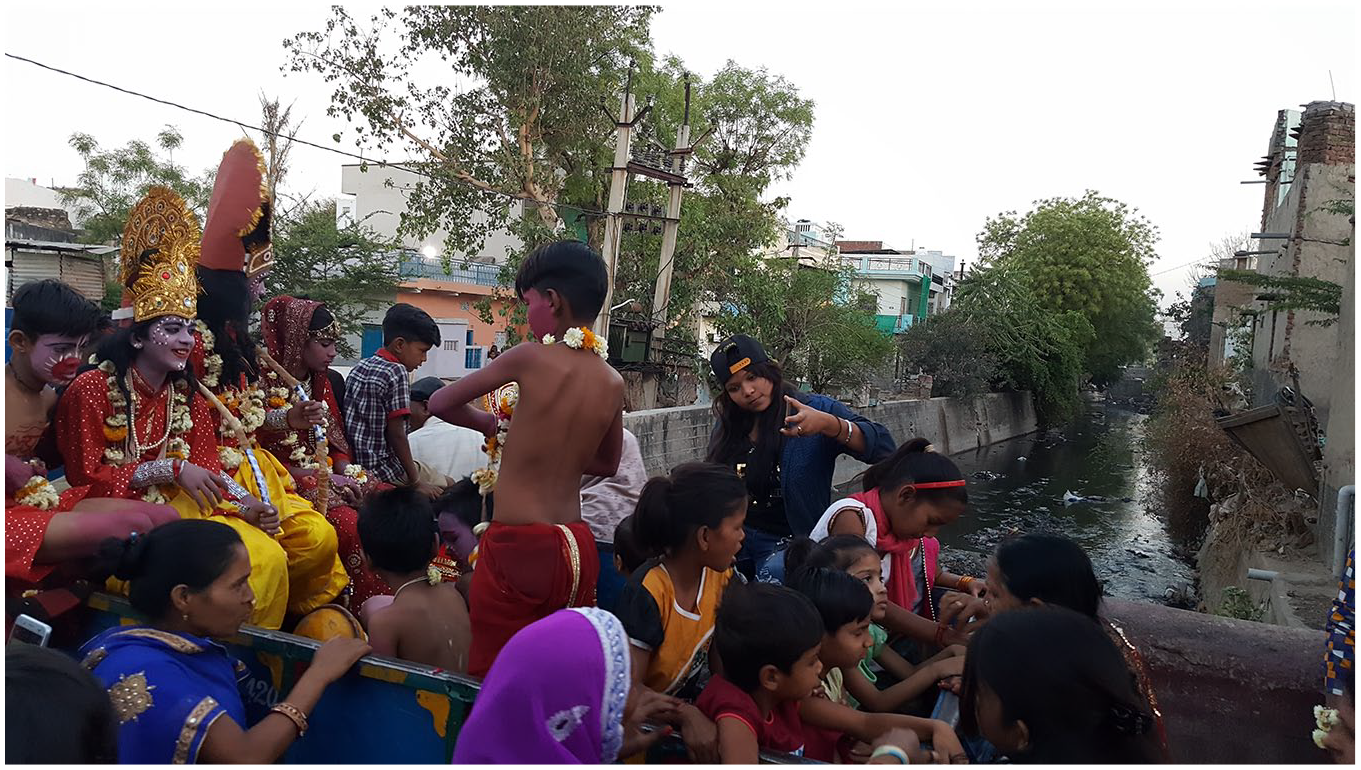
A cultural procession passing over the open sewer in a Koli ghetto.
This [neighbourhood] runs parallel to the wall of a huge nala that dissects it. There were pigs in the enormous sewer, and some white, long-beaked birds. The stench of the sewer was horrible. Even though [the neighbourhood] looks relatively well-off [compared to the surrounding Koli ghettos], the stench of the nala is unbearable.
It was the most offensive smelling area of the Koli ghettos. The loitering pigs and cows produced kilos of excreta a day, adding to the toxic smells. When I spoke to neighbourhood residents (left side of the nala in Figure 1), they complained about the nala’s location. Mistaking me for a state official, they wanted me to cover the nala. They planted trees to block the grim view, but the stench remained unblocked. Putrid sewer odour looms over the Koli, Valmiki and Gadiya Lohar ghettos.
Enduring olfactory violence, where one is subjected to constant aggression from foetid odours, without recourse, as a reminder of their social status, is a part of the ghetto’s everyday life. While Kapoor (2021b) similarly noted the ‘violence of odors’ in occupational spaces such as tanneries, in Ajmer, this violence is embedded in the residential spaces of ex-untouchables. Inside the ghetto, large public toilets for Koli, Bairwa and Valmiki residents are located with outlets into the nala. During the morning rush hours, the stench of faeces and urine would strike passers-by, underscoring the cyclical nature of this stench. There were three public toilets in the Koli ghetto alone. Public toilets are stigmatised as markers of low social status, reflecting the absence of private latrines. Despite claims by local elected representative that Valmiki workers cleaned them twice daily, these toilets often lacked running water, with tanks left unfilled for days, and commodes blocked with faeces, forcing residents into wretched conditions. During my March 2013 visit to Sansi basti, 5 a ghetto of the ex-untouchable Sansi caste on the city’s west side, I observed these conditions firsthand (Figure 2). Valmikis endure even more humiliation: their largest ghetto, Maila Teyshan, Excreta/Filth Station, is located beside an old excreta dumping site used before flush toilets emerged in the twentieth century.
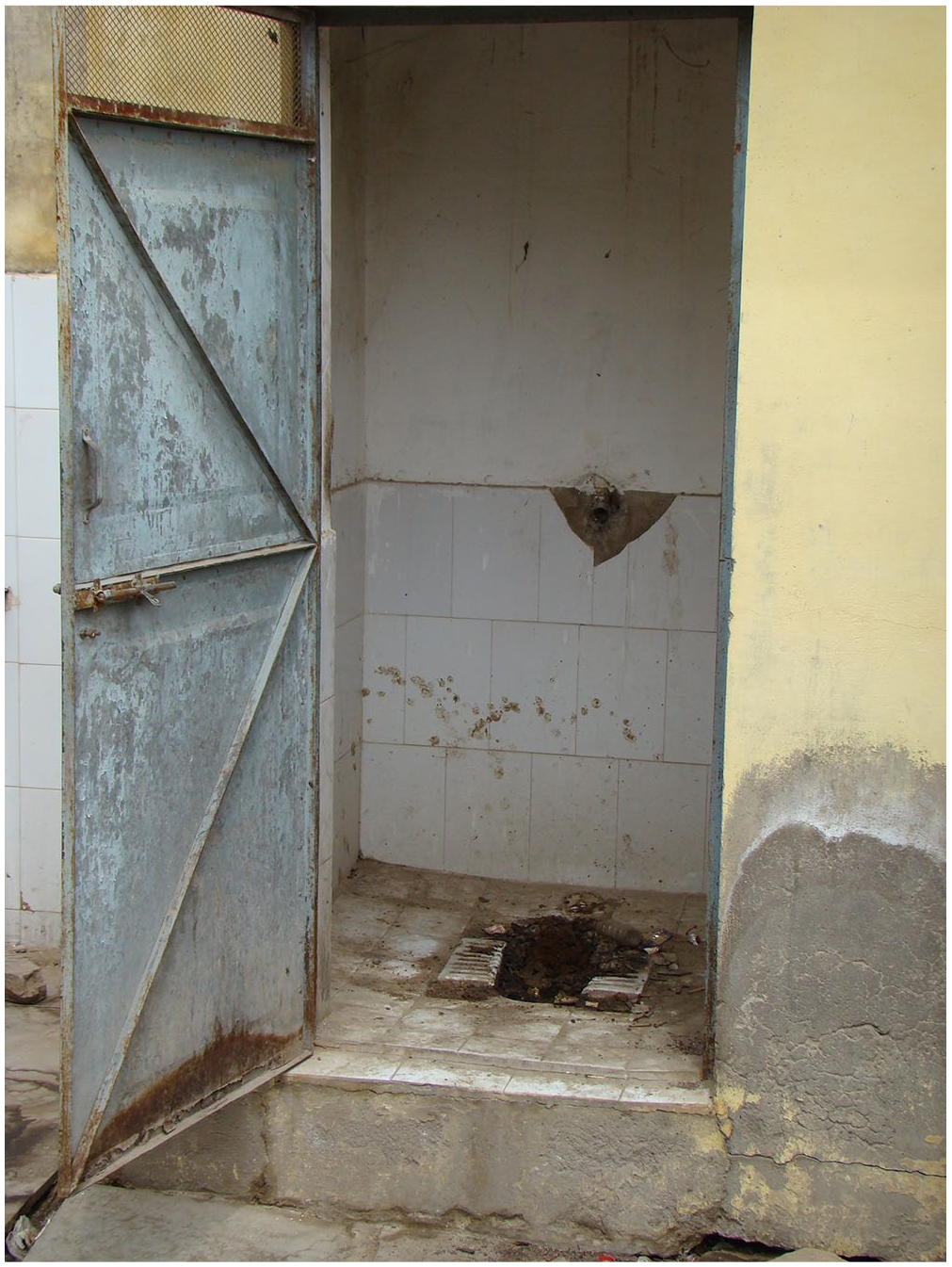
A severely clogged public toilet in Sansi Basti.
Dalit autobiographies painfully reflect the olfactory violence ex-untouchables endure from public toilets, filth and stench. Kausalya Baisantri (2009: 68–69) describes how she loathed entering her basti in Nagpur because a public toilet was at its entrance, ‘filled with excreta everywhere . . . black, red or brown . . . making [her] nauseous every morning’. Omprakash Valmiki (2003: 1) describes how village women defecated between the Chuhra (sanitary workers’ caste) houses and the village pond: ‘The muck was strewn everywhere. The stench was so overpowering that one would choke within a minute’. Paradoxically, the burden of cleaning ex-untouchable residential spaces falls on the Valmikis, who must clean night soil where it persists and dive into sewers to unclog blockages. During this work, sanitation workers are covered head to toe in putrefying filth, turning their bodies into what Guru (2009b: 14) called ‘the walking carrion’. In Ajmer, as elsewhere in India, Valmikis are regularly found working in such sewers.
Besides the open drain, at the entrance and exit of the Koli ghetto, large trash bins marked the invisible boundary between the mixed upper-caste neighbourhood and the ex-untouchable ghetto. The stench from the drains and overfilled trash created an olfactory boundary detectable before the ghetto’s physical boundary. Sanitation workers dumped residents’ trash into these bins, later picked up by tractors for disposal. I discovered this during a survey with two research assistants, noticing the bin strategically placed near the ghetto, away from the last house of the upper-caste area. The stench was so overwhelming that we covered our noses and swiftly walked towards the Koli neighbourhood, as pigs, cows and crows scavenged through the garbage, emphasising the stark sensory divide.
Railway tracks – another disadvantaged topography – create pungent olfactory boundaries. As I approached a large Bairwa ghetto located nearby, I noticed a stench, though less intense than from public toilets. Passenger trains release human waste directly onto the tracks, and the odious odour often reaches the ghetto (besides the recurrent noise). Railway tracks frequently appear as topographical markers in municipal delimitation documents to describe ex-untouchable neighbourhoods, with parts of Koli, Dhobi and Meghwal ghettos similarly located near tracks.
Filth in ex-untouchable spaces is the consequence of disadvantaged topographies. Neither is it wilfully generated by the urban poor ‘to symbolically establish their control [over parks]’ (Kaviraj, 1997: 107), nor is it a simple dichotomous relationship between the cultural ‘inside and outside’ in the form of a ‘house and bazaar’ (Chakrabarty, 1992). Filth and dirt are a ‘demonstration of the continued existence of untouchability in India’ (Rodrigues, 2009: 120), whereby disadvantaged topographies mark and surround ex-untouchable spaces. Ritualistic pollution ascribed to these castes seems to have been extended to spatial pollution, with the state contributing to planning these infrastructures.
Filth and ‘Social Dirt’
The stench from filth creates a powerful olfactory barrier because it travels, even if the putrefying object is confined to one location. Mary Douglas might have argued that filth and stench, as forms of dirt, are cultural categories shaped by social hierarchies and serve as symbols of impurity and lower social status. Ex-untouchables suffer neglect from municipal agents who, like the rest of the society, might perceive them as ‘social dirt’.
Shoddy municipal public services contribute to the filth in ex-untouchable neighbourhoods. While the main ghetto street might receive municipal waste collection, the service cannot access the ghetto’s narrow inner streets where the majority of the population lives. Manoj, 43, a resident of an inner street in a Koli ghetto, described the neglected state of cleanliness when I visited his house in February 2017:
The employees [of Valmiki caste] of Nagar Nigam [municipality] work on the main road, but they don’t come inside; they say, ‘rediyaan nahin nikalti, naliyaan hi itni hain. The carts do not pass. There are so many [wide] drains’. One Bhangi [Valmiki] woman agreed, but she asked for ₹50 ($ 0.67)
6
per home for a month plus rotis [Indian flatbread]! So, I take the garbage and put it in the big dustbin [at the entrance of the ghetto].
Even if residents like Manoj may take care of their garbage, the streets remain filthy. Residents throw their waste on the streets for dogs or cows to munch and animals’ excreta dot these streets such that a lack of attention would smear the footwear. Clogged open drains create a continuous olfactory nuisance. Doron (2021) similarly describes stench marking segregated Dalit bastis of Varanasi through open drains, open defecation and dump sites.
My stay in the Koli ghetto from March to May 2019 attested the dire conditions. I rented a newly renovated house of an upwardly mobile Koli professional who had moved to a mixed middle-class neighbourhood. The smell that greeted me was fresh paint mixed with regular wafts of animal excreta from an empty plot behind my house, where stray animals rested and left their waste. This plot became a garbage disposal site for some residents. Despite sealing the only ventilator with newspapers, fumes from the waste still entered my room, forcing me to often cover my nose with a scarf. There was no way of stopping it.
The monsoon period from July to September makes the conditions even more deplorable. I was in the Raigar ghetto for an interview in early September 2018. It is situated at a foothill with steep slopes and extremely narrow streets. After finishing my interview, the Raigar interlocutor proposed the neighbourhood’s tour. It was raining. In my fieldnotes from 10 September 2018, I described the Raigar neighbourhood environment:
There was excreta everywhere – of dogs, pigs and sometimes perhaps of humans. With rain, it was disgusting to walk there. The rainwater was gushing down with such velocity in the drains. It sounded as if you were next to a river with strong currents. Except that it was a drain of dirty water. I was watching every step lest I step into the excreta strewn everywhere. To imagine what it was for people living there was scary. It [the streets] was so unclean. One street was deliberately broken in the middle at regular intervals; a drain was flowing underneath. At the top-most edge, a dozen pigs were lying in what seemed like a dump site, from where dark water was flowing on the street going down in the basti (Figure 3).
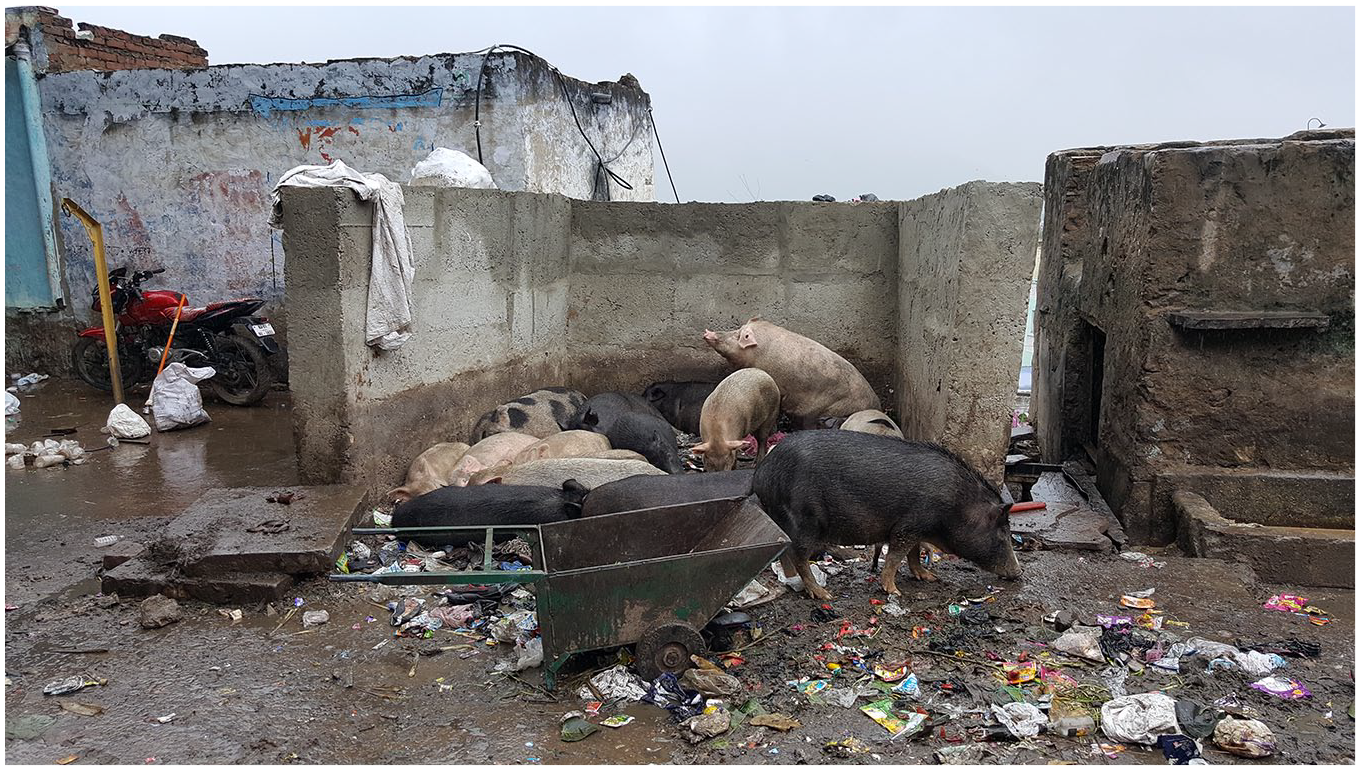
A herd of pigs at a dump site on the upper part of the Raigar ghetto from where filthy water flowed downwards in the ghetto.
While the Koli ghettos flood during the monsoon, the hilly Raigar basti faces a different challenge. Rainwater gushes down the slopes, bringing excreta with sewage. The wetness and stench in the streets were nauseating for both my interlocutor and me, as he exclaimed, Dekho kya haalat hai basti ki! Dekho hamein kaise rehna pad raha hai! ‘See for yourself, what is the condition of this basti! See, how we must live here!’ We held up our trousers to avoid the filth. Back at his house, his son gave us mugs of water to clean our legs, feet and sandals.
Filth symbolises the ex-untouchables’ place in the social hierarchy. Seen as ‘social dirt’, they are relegated by non-ex-untouchables and state institutions to disadvantageous, filthy areas. While some zones, like flood-prone or hilly terrains, were naturally disadvantageous, ex-untouchables were settled there through social, state, or market mechanisms, spatialising caste. Ascribed pollution from untouchable bodies transferred to these spaces. Topographical markers like public toilets, sewers and railway tracks trapped ex-untouchables deeper into noxious environments. Institutional apathy worsened conditions. Ex-untouchables are perceived as polluting, making the spaces they inhabit inherently filthy. Filth, then, becomes their cultural marker as Robinson’s quote highlighted earlier. For most, upward social mobility – and thus spatial mobility – remains rare (Sihra, 2023), leaving the stench of filth as an olfactory boundary of the ghetto and its residents.
Caste occupations
A Sikh schoolteacher who worked at a Koli ghetto school told me at her house on 15 January 2020, Unke noton mein se bhi bidi ki smell aati thi, ‘Even their [Kolis’] banknotes smell of bidis’. She received these banknotes from Koli parents as school fees. Bidi-making is the most widespread occupation in Koli ghettos. The bidi factory founded by Koli industrialist Shankar Bhati is located in the ghetto’s centre, with the tobacco odour noticeable from afar. Koli women’s hands, immersed in tobacco, transfer this smell to the notes, garments and household items.
In Kanjar basti, the odour of moonshine distillation was an olfactory marker of the caste. Poverty and the stigma of being an ex-criminal caste 7 force Kanjar women to continue the illegal trade, despite its irrepressible smell. In Raigar ghetto, one area smelled of rubber from flip-flop production, another of jute dust from making gunnies. Dhobhi Ghat, where the Dhobis (washermen) work, reeks of detergents and stagnant wastewater. Lohar basti is filled with the smell of cow dung from cowsheds mixed with that of open sewer nearby. Jatavs manufacture mudda chairs and the basti smells of canes and dry hay. Lee’s (2017) interlocutor noted similar caste-based olfactory patterns in his Uttar Pradesh village, such as, donkey’s dung from the Dhobis’ quarters. Although caste occupations have transformed in urban areas, the odour of new occupations continues to structure ex-untouchable ghettos like in villages.
Urban poverty
Smell is usually thought of as cultural. Although a detailed exploration of all cultural practices is beyond the scope of this research, cooking was the most obvious cultural practice which varied across castes, especially in relation to meat consumption (which was too expensive to be consumed regularly in ghettos). What stood out more was the fuel used to cook.
Many Kanjar and Lohar
8
households relied on firewood for cooking, with smoke often looming over the neighbourhoods during mealtimes. In September 2019, while conducting fieldwork in Kanjar basti, I observed a wood seller visiting daily to supply firewood, used both for cooking and alcohol distillation. Firewood was also used for cooking in Lohar basti. During a meal at my Lohar interlocutor Mangi’s home in March 2017, his daughter prepared fresh rotis over a firewood hearth. As she lit it, the smoke stung our eyes, causing tears. I assumed firewood use was a cultural preference among Kanjars and Lohars, but Mangi dispelled my myth by explaining:
[M: Mangi; J: Author] M: I do have a gas connection, but I don’t have money to buy a gas cylinder. I will get it when I have money. Till then, I’ll have to manage with the chulha, hearth. If there’s no employment, we’ll have to adjust. J: I’ve seen in a lot of houses that people cook in this traditional manner . . . M: We are forced to because we don’t have jobs. Our jobs were taken away after demonetisation [in 2016].
What I first perceived as a cultural preference was actually a result of urban poverty. These caste groups could not afford gas cylinders. Mangi’s house had a gas stove but no gas to light it. Those who could afford did have gas. He explained how demonetisation, implemented by the Modi government on 8 November 2016, devastated his caste neighbourhood that relied on cash. The policy, which declared ₹500 and ₹1000 notes invalid overnight replacing them with new ₹500 and ₹2000 notes, caused severe income loss for the poor (Ghosh et al., 2017). Gas cylinders became unaffordable, and smoke from hearths filled homes, seeping into their clothes, hair, walls and possessions. The smoky odour clung to Kanjars and Lohars, marking them symbolically and socially. The ‘rustic’ smell I described in my fieldnotes evoked rural Rajasthan and drew lines of segregation in Ajmer. Meeting Mangi on the main street, I immediately recognised the smoky odour from our meal, a scent that ties them to their caste identity.
Discussion and conclusion
I started the article by asking how odours affect caste boundaries and developed a spatial and social explanation of olfactory processes. My findings reveal that symbolic, social and spatial boundaries – part of the ‘Bourdieusian trialectic’ – overlap in the context of caste segregation in Ajmer, offering a novel perspective on studying segregation sensorially. The diagram in Figure 4 depicts the phenomenon. While the spatialisation of caste has segregated ex-untouchables in the city (Sihra, 2023) (pathway A), this article extends the argument to include the role of odour in creating symbolic boundaries.
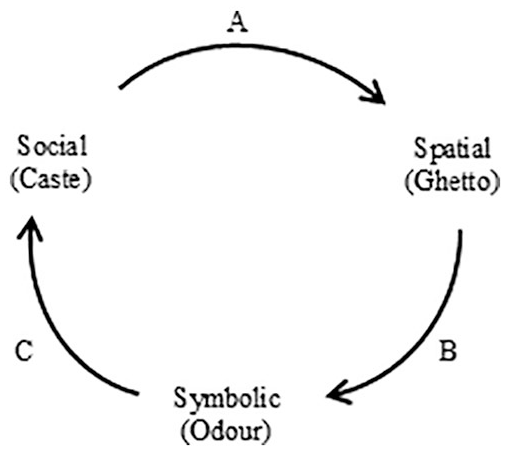
Mechanism of olfactory process of segregation.
While odours are often perceived as cultural, I have argued that putrid odours within ex-untouchable ghettos are also structurally produced (pathway B). These odours are accumulative, with no single factor fully explaining their pungency. Following Porteous (1985), these odours are emitted episodically and regularly from various sources in and around relegated neighbourhoods – public toilets, open sewers, trash bins, railway tracks, filth in inner streets, caste occupations, firewood cooking and poor public services – each compounding the other. I concur with Guru (2009b) that dirt in India is structural, rooted in the Brahmanical logic of purity and pollution, but I argue that this logic extends spatially, rendering dirt structurally spatial.
The organisation of caste segregation I discussed above affects air circulation into the ghettos. Bigger citadel houses with high walls are located next to wide arterial roads. Odours in these spaces might be termed ‘neutral’, signifying the privilege of this urban space. Public spaces here were kept clean by sanitation workers. Ex-untouchable ghettos, on the contrary, are located farthest from these arterial roads into inner streets. The large citadel houses block air from entering the extremely narrow, cul-de-sac lanes of the ghettos, filled with small, cramped houses and rare windows. This spatial organisation stifles air circulation, allowing accumulated odours from multiple sources to settle, enveloping the ghettos’ residents in an inescapable smell.
The state has played a major role in facilitating the creation of olfactory boundaries. Given the systematic correlation between ex-untouchable neighbourhoods and disadvantaged topographies, existing studies and my own data provide limited insight into what appears to be a carefully orchestrated, city-wide process. Some ex-untouchable neighbourhoods developed during the colonial era, while others emerged in the postcolonial period; some are located in central areas, while others are on peripheries; some are adjacent to upper caste localities, while others are far removed from them. If flood-prone zones and hills are natural geographies, as these places were territorially stigmatised after settlement by ex-untouchables, newer disadvantaged topographies got added around these neighbourhoods. Municipal, housing department and public works are the main decision-makers here. Similarly, waste collection services and maintenance of public toilets are municipal responsibilities, which get more neglected the deeper one goes into the inner ghetto streets. This necessitates a careful scrutiny of mechanisms about the ‘caste-state nexus’ operating in urban planning and governance in Indian cities.
Although filth and putrid odours in the ghettos are a direct consequence of the state neglect, Dalit communities have also used filth as a political tool of protest. For instance, Balmikis in Savanur, Karnataka, smeared excreta over their bodies to protest eviction by the Town Municipal Council (DHNS, 2010). After four men of a traditionally leatherworking Sarvariya caste were publicly flogged by cow vigilantes for skinning a dead cow in 2016 in Gujarat, Dalits dumped carcasses outside municipalities and government offices raising the slogan ‘Your mother [cow], you bury her’. They sent postcards marked Badbu Gujarat Ki (The Stench of Gujarat) to Amitabh Bacchhan, a film celebrity and Gujarat’s tourism ambassador, as a satire of the official slogan Khushbu Gujarat Ki (The Fragrance of Gujarat) (Kapoor, 2018: 259). Kapoor investigates the possibilities of ‘odours as resistance’ by exploring Dalit autobiographies, for instance, when Dalit writers assign a different meaning to odours associated to them or challenging the supposed deodorised upper caste bodies and spaces (Kapoor, 2022: 32–33).
In Ajmer, however, the segregated spaces trap ex-untouchables under an added layer of olfactory stigma. Yet, this is not the smell of ex-untouchables themselves; it is structurally produced malodour born from topographical, policy-related and caste inequalities. Unlike Kaviraj’s (1997) depiction of urban poor, I found that residents strive to keep their surroundings clean. However, without adequate public services, they are subjected to constant olfactory violence, forced to inhale foetid smells as a stark reminder of their social status. It was not that their ‘tolerance of garbage was much greater’ (Kaviraj, 1997: 107); rather, they have been structurally forced to tolerate filth. When ex-untouchables are made to live in front of a putrid, 10 m-wide open sewer, they may cover the view with trees, but they cannot escape the overpowering stench.
Through constant exposure, the clothes and hair of ex-untouchables, along with all other household objects, absorb these odours. Regardless of caste or class, anyone living in these spaces will emerge with those odours clinging to their clothes and bodies – odours that are stigmatised by the society outside these ghettos. A similar forceful critique was voiced by Black individuals to the segregationists about their material conditions: ‘many blacks argued that they did, in fact, often reek because they did, in fact, live in squalor – and squalor stank’ (Smith, 2006: 109). This perspective helps explain why my hosts were disgusted when my own body carried the stench of the ghetto.
These pungent malodours produce symbolic olfactory boundaries not only around ghettos but also around ex-untouchable bodies, marking them as capable of transmitting ‘olfactory pollution’, thus reinforcing the existing social hierarchies (pathway C). Those who reside outside the ghettos create symbolic boundaries such as ‘ex-untouchables stink’, ‘their banknotes stink’, ‘Kolis are filthy’ and ‘their neighbourhoods are filthy’. The olfactory pollution enforces social distance from the ex-untouchables. While Low (2009) frames spatial and olfactive boundaries as metaphors for racial identities, in Ajmer, spatial boundaries create symbolic olfactory ones, amplifying the existing social boundaries of caste. Although odours function as symbolic boundaries, my data show that they are also material realities emanating from specific putrid sources. Thus, odours operate not just as ‘sensory stereotypes’ (Smith, 2006), but tangible sensory matter imposed upon ex-untouchables in their lived environments.
Food preferences of ex-untouchable castes may influence their smells. Upper-caste neighbours outside the ghetto often claim, for instance, that ex-untouchables consume excessive garlic – a stereotype also applied to Muslim and Sikh minorities. 9 Non-ex-untouchable groups, too, have distinct smells. Brahmin households, for example, smell of ghee and heeng (asafoetida), but these odours, associated with purity and privilege (Ambedkar and Moon, 1979; Guru, 2020), differ qualitatively from those of open sewers and filth due to their distance from disadvantaged topographies. While cultural preferences may play a role, the structural odours I have described ultimately overshadow cultural ones.
While racial studies are critiqued for ocularcentrism (Smith, 2006), caste studies emphasise touch (Guru, 2009a; Jaaware, 2009; Sarukkai, 2009) as untouchability revolves around the transmission of ritual pollution through touch. Expanding the focus to other senses – olfaction, as I have shown here and as argued by Kapoor (2021b, 2022) – can offer a more nuanced understanding of caste hierarchies and opens new theoretical pathways. Examining the spatial organisation of caste reveals how inequalities are categorically entrenched through olfactory mechanisms: non-ex-untouchables inhabit cleaner, non-smelly areas, while ex-untouchables are confined to filthier, malodourous locations. Negative olfactory attributes become attached to already marginalised caste groups. Thus, olfactory boundaries contribute to the identification and stigmatisation of ex-untouchables in the city.
A sensorial approach to investigating spatial inequalities and social reproduction extends beyond the context of caste. While Smith employed a historical sensorial lens to study race and segregation in the United States, applying the trialectic framework to olfaction and sonic practices can reveal entrenched racial inequalities in societies where race is a defining factor. Multisensorial analysis is particularly valuable in contexts where ethnic or class identities are less visible yet still stigmatised and segregated.
Footnotes
Appendix 1
Table A1 describes the traditionally ascribed occupations of various castes. Most castes, however, have diversified their occupations into both blue- and white-collar work, and some of them, such as Kolis, have altogether abandoned their ascribed occupations.
Acknowledgements
The author warmly thanks Noorman Abdullah, Eve Colson-Sihra, Christophe Jaffrelot, Kelvin E.Y. Low, Nurit Stadler, Thomas Stodulka and participants of the ‘Embodied, Emotional and Sensorial Knowledge: Perspectives from Asia’ workshop at the National University of Singapore for their constructive comments on the article. The valuable and encouraging feedback from four anonymous reviewers greatly strengthened this paper.
Declaration of conflicting interests
The author declared no potential conflicts of interest with respect to the research, authorship and/or publication of this article.
Funding
The author disclosed receipt of the following financial support for the research, authorship and/or publication of this article: I am indebted to Christophe Jaffrelot for supporting my fieldwork through the ANR grant.
