




Abstract
Strongly felt grievances are the first, necessary condition for collective action to occur. While social movement studies have explored how activists frame grievances to attract recruits, this study assesses whether the pervasiveness of economic grievances in society affects individual decisions to join protests. Using data from nine rounds of the European Social Survey across 33 countries (2002-2019), multilevel models reveal that the population’s average sense of economic difficulty significantly predicts individuals’ willingness to participate in protests. The relationship holds when controlling for other objective economic indicators frequently used as substitutes for economic grievances in previous research, such as unemployment and GDP growth. Protesters also tend to be wealthier and financially comfortable when there is intense economic distress across society, while protest rates decline among the most aggrieved people. The findings suggest the importance of economic grievances lies on the contextual rather than the individual level: people are influenced to mobilize based on social assessments of others’ economic suffering but are less responsive to their own economic problems.
Introduction
In news media, the links between economic adversity and collective action are treated as obvious. During post-recession protests in Europe, The Economist (2011) noted that ‘public anger is clearly fueled by economic troubles’. The Arab Spring movements, which primarily decried authoritarian governance, were still said to have ‘clear economic underpinning: they were fueled by poverty, unemployment and lack of economic opportunity’ (Malik, 2011). High prices of fuel and other goods were considered key impetuses for a wave of protest across Latin America in the late 2010s (Daniels, 2020). A New York Times byline on unrest in Iran claimed that ‘the country’s long economic decline has been one of the main forces sending Iranians into the streets’ (Yee and Fassihi, 2022).
In academic literature, the role of economic grievances in stoking protest has been more contentious. Common wisdom in social movement studies once held that grievances, including economic ones, exist to some extent in all societies and therefore cannot be sufficient explanations for mobilization (McCarthy and Zald, 1977). The appearance of social movements instead was considered to depend on dynamic factors, such as whether activists possessed resources that allowed them to organize or were presented with transient political opportunities that facilitated activists’ organizing efforts. However, as news media reports imply, the extent of economic hardship in society is not a fixed quality but changes over time. As economic circumstances deteriorate, the share of a population enduring economic adversity and the severity to which it is felt tends to rise. The prevalence of economic grievances, in other words, is itself dynamic, not unlike political opportunities and activists’ access to resources.
Grievances are often conceptualized on the individual level in social movement studies, with researchers investigating whether the most aggrieved people in society are more likely to participate in protests. The present article conceptualizes economic grievances as a collective phenomenon, investigating whether changes in the pervasiveness and intensity to which economic adversity is felt in society, which I refer to as ‘shared economic grievances’, enhances individuals’ likelihood of joining protests. While this relationship is commonly assumed to exist in popular accounts, empirical work that directly investigates whether widespread feelings of hardship in a population actually spur more people to join protests are sparse. I posit that grievances matter beyond just the individual level but have a social influence whereby people are politically responsive to the level of suffering experienced by others in their society.
Capturing the extent to which grievances in a population intensify or diminish across time can be methodologically difficult given that it requires multiple points of survey data across time within the same population. Researchers thus often rely on objective economic statistics as a substitute for shared grievances, such as national GDP growth rates or unemployment rates. While objective indicators provide an approximation of a population’s level of hardship, the present study offers a direct focus on the population’s self-reported experience of economic grievances using survey data compiled over 17 years. Specifically, I employ nine rounds of European Social Survey (ESS) data gathered via face-to-face interviews in 33 countries between 2002 to 2019. The data provide a massive sample of 265,143 respondents. To quantify shared economic grievances in society, I quantify the average level to which survey respondents reported experiencing financial difficulty in each year. Respondents were also asked if they have recently participated in protests, allowing for an analysis of the average level of grievances in society and its relationship to protest participation. The study also investigates the demographic composition of protest participants during periods of high and low shared grievances, particularly with the aim of understanding protesters’ own level of political and economic grievances, in addition to those pervading broader society.
In the following, I first provide a literature overview noting recent strides in clarifying the various types of grievances and levels they can operate on. I present a typology of grievances to demonstrate that while plenty of studies explore the importance of individual-level grievances and macro-level economic statistics (Table 1), we still know little about subjective economic grievances among a population. I then introduce original multilevel regression analyses intended to address this issue. Finally, the implications of the findings for social movements literature are discussed.
A typology of economic grievances.

The state of the field: A typology for economic grievances
The theoretical development of grievances and how they operate among social movements is an indispensable task for social movement studies. Grievances are the first necessary condition for mobilization: a group of people must feel discontented with something before they initiate collective action aimed at bringing about social change. A renewed stream of studies in recent decades has produced a compelling array of findings that signal the continued usefulness of economic adversity to the study of contentious action. New work has not only expanded to analyze new types of grievances and new movements but re-engages with grievances in greater conceptual and theoretical depth, allowing for a richer, nuanced understanding of a topic that has had a ‘strange history’ in social movement studies (Buechler, 2004). Recent work highlights the complexity of grievances by acknowledging the levels of analysis on which they can be measured (i.e. individual or contextual), how they are experienced by the aggrieved (i.e. subjectively or objectively), different types (i.e. political, economic, social, etc.), and distinguishes between temporary and chronic definitions (i.e. grievances that are suddenly imposed, versus long-term, structural grievances).
Perhaps the most compelling evidence has emerged on the cross-national level, where recent studies found associations between adverse economic conditions as measured by recessions or rising unemployment rates and protest activity (Azedi and Schofer, 2023; Caren et al., 2017; Ortiz and Béjar, 2013; Quaranta, 2016). The evidence accumulating on the macro level is not entirely surprising; economic conditions are known to relate to other political outcomes. Voters tend to punish incumbents that preside over economic decline but re-elect leaders that preside over growth, suggesting a major relationship between economic troubles and political discontent (Lewis-Beck, 1988; Lewis-Beck and Stegmaier, 2000; Nadeau et al., 2013).
In the wake of the 2008 recession, a corollary body of literature examined the role of negative feelings among individuals following the economic collapse (Bernburg, 2016; Giugni and Grasso, 2019; Grasso and Giugni, 2016; Rüdig and Karyotis, 2014a, 2014b). These new studies often affirmed a long-held finding that the most destitute, economically aggrieved individuals in society do not tend to join protests, but this is not always the case. Individually aggrieved people do protest more under certain spending regimes (Grasso and Giugni, 2016), or in specific cases of movements (Kawalerowicz and Biggs, 2015; Opp, 1988).
The following section will delineate some axes upon which economic grievances can vary using a table referring to relevant literature (Table 1), which I also use to clarify the contribution of the present paper’s empirical analyses. First, grievances can be subjectively felt by individuals, or conditions that objectively exist. Authoritative voices in the field say grievances are ‘troublesome matters or conditions, and the feelings associated with them’ (Snow, 2013b; italics added). Grievances thus refer to both objective and subjective phenomena. Dictionary definitions of the word attest to its dual meaning (Merriam-Webster, 2019). Plenty of empirical work, moreover, treats the term ‘grievances’ as conditions rather than just subjective feelings (Kriesi et al., 2021; Kurer et al., 2019; Muliavka, 2019; Solt, 2015; inter alia).
Undesirable economic phenomena such as homelessness, poverty, and being unemployed, for instance, exist objectively (i.e. one does not ‘feel’ homeless, they objectively are), but can be interpreted by those that experience them in markedly different ways. Some may feel a strong sense of aggrievement, while others may be passive or even content with their situation. The negative feelings they may experience – deprivation, frustration, or discontent – can be thought of as subjective grievances. Their feelings do not necessarily need to align with objective circumstances: individuals who are objectively well-off may experience a myriad of subjectively felt grievances, possibly with even greater intensity than those in less privileged positions.
Second, grievances can exist on the contextual or individual level. With regards to the previous examples of homelessness, poverty, and unemployment: researchers can study either the individuals that experience these problems and their proclivity to protest, or whether the broader prevalence of these issues in society makes a society more prone to experiencing protest events. The imposition of negative objective circumstances has also been referred to as ‘threats’ (Almeida, 2018). The level the researcher chooses is often the crucial factor determining which outcome, or dependent variable, is preferable or even possible to observe. Protest participation is the most common dependent variable when studying individuals, but other outcomes can include participation in boycotts, strikes, and so on (Muliavka, 2019). The amount of protests a certain geographically defined location experiences, often gathered via newspaper counts, are examples of dependent variables that exist on the contextual level (Caren et al., 2017).
Table 1 provides examples of academic work that has been done in each of the two axes of grievance: objective vs subjective and individual vs contextual. Because the focus of the present paper is on economic grievances, I prioritize studies with an economic focus but acknowledge that political and social grievances can also be mobilizing forces (Muliavka, 2019). One may notice in Table 1 that, while many other forms of economic adversity have been studied, studies of subjective economic grievances on the contextual level are lacking.
Are shared grievances important?
Classical challenges to grievance-based theories argued that grievances are ubiquitous across societies and thus insufficient to explain mobilization (McCarthy and Zald, 1977). However, the extent and intensity to which grievances are felt can differ dramatically across time and space (Opp, 2009: 131), and directly measuring the collective level of discontent in society as a predictive factor for collective action is rarely done.
Yet, it is common to assume collective attitude changes influence protest, especially after new economic difficulties are introduced, and this has been the case since early studies of collective behavior. Davies (1962) argued that revolutions occur when economic fortunes suddenly decline because ‘people subjectively fear that ground gained with great effort will be quite lost; their mood becomes revolutionary’ (p. 5, italics added). This was also the basis for the concept of relative deprivation (Runciman, 1966). Contemporarily, Langman (2013) writes that ‘when people find themselves facing sudden economic reversals . . . they experience ‘moral shock’ and are likely to be angry, frustrated, indignant, anxious about the future, and impelled to seek amelioration’ (p. 514). Caren et al. (2017) propose that during tough economic times people see the state as having failed to provide economic opportunities for its constituents and subsequently will view anti-state mobilization frames as more salient. These explanations necessarily refer to many people simultaneously feeling aggrieved, not just individuals. Thus, the importance of shared grievances often appears as a baked-in assumption to explain social movements, especially those spurred by economic difficulty. The role of shared grievances on the macro-level, in a sense, resembles the importance of dark matter in the field of physics: important theories rely on its presumed existence, but it is never studied or observed directly.
Attitudes, beliefs, and worldviews can change abruptly during economic downturn (Hierro and Rico, 2018; Isaksen, 2019; Kuntz et al., 2017; Quaranta and Martini, 2017; Van der Cruijsen et al., 2013), but objective changes in economic conditions do not always match a population’s perception of their own economic difficulty. Appraisals about reality are subjective and two populations can appraise a similar situation differently (Roseman, 1996). A population enduring a national unemployment rate of 20%, for instance, may report a different level of aggrievement in surveys than those in another country enduring the same level of unemployment. This could be for various reasons that are likely mediated by culture, the strength of social safety programs, the historic frequency of high unemployment in the country, and so on.
I propose that the proliferation of grievances across society, rather than just those held by an individual, could affect citizens’ willingness to protest through social influence. Mass society approaches to collective action once suggested protesters are isolated social outcasts rebelling against a society that has rejected them. But real-world findings consistently indicate protesters have robust social networks and are active participants in society. People that are linked to social networks, members of organizations, and have other active roles in society are much more likely to join protests (Diani, 2004; Kerrissey and Schofer, 2018; Somma, 2009). Citizens are also more likely to protest when they are recruited by a trusted social contact rather than a stranger (Somma, 2009). Social embeddedness in organizations and other formal ties facilitate the recruitment of activists (Van Stekelenburg and Klandermans, 2013; Walgrave and Wouters, 2022). Social approval of protests can also contribute to increasing the likelihood of participation (Walgrave and Wouters, 2022). In short, protest participation is highly reliant on numerous intersecting social processes.
Most importantly for the present study, social embeddedness has also been found to facilitate discussions with others about shared grievances (Klandermans et al., 2008). Citizens are often aware of the socio-political attitudes permeating their country based on interactions with social contacts such as friends, family, co-workers, and other compatriots. Individuals’ awareness of the public mood may also spread via news media, the Internet and other information communication technologies that expose people to the views of others. Citizens coming to recognize the shared nature of their grievances greatly enhances the prospect of mobilization (Portos, 2021; Van Stekelenburg, 2013). In an environment of widespread economic discontent, I hypothesize that individuals will be more inclined to join protests.
Hypothesis 1 (H1). Shared economic grievances are associated with increased protest participation.
Individual-contextual interactions
There have been calls for social movement scholars to examine more thoroughly interactions between micro- and macro-level phenomena (Dalton et al., 2010; Opp, 2009). Recent work has demonstrated that the mobilizing effects of individual economic circumstances or grievances can vary depending on macro-level conditions (Azedi, 2023; Dodson, 2015; Grasso and Giugni, 2016; Rodon and Guinjoan, 2018). Thus, while this study first tests for a broad effect of shared grievances on protest participation, I also investigate whether the effect is more pronounced for those that actually harbor economic and political grievances. As mentioned earlier, macro-level work has shown that the amount of contentious events tends to increase as economic situations deteriorate (Azedi and Schofer, 2023; Caren et al., 2017; Ortiz and Béjar, 2013; Olzak and Shanahan, 1996), but less is known about who comes out to protest during periods of economic downturn. Amid severe economic conditions, are protesters the ones that have been hardest hit by the economic downturns, or well-off individuals protesting in solidarity with those enduring great difficulty?
Below, I hypothesize that individuals with economic grievances, political grievances, and citizens with high income may be more sensitive to joining protests amid environments of economic distress.
Economic grievance
In studies that use large-scale survey data, personal economic problems have had an inconsistent, weak relationship with protest participation (Bernburg, 2016; Bertuzzi et al., 2022; Dalton et al., 2010; Jenkins et al., 2008; Rüdig and Karyotis, 2014b). The current study’s focus on shared expressions of grievances presents an opportunity to investigate whether this relationship strengthens or remains weak during periods of high shared grievances. The mobilizing effect of individual economic circumstances, after all, has been shown to be context-dependent in many cases. The relationship between subjective feelings of economic insecurity and protest participation, for instance, can differ depending on the country’s spending regime (Azedi, 2023; Grasso and Giugni, 2016).
For mobilization to occur, individually-held grievances must be politicized by movement adherents as salient political issues (Snow, 2013a). I first propose that individuals may be emboldened to interpret personal discontent as worthy of protesting over when a sizable, growing portion of their fellow citizens share their discontent. Grasso and Giugni (2016) argue that economically aggrieved individuals are more prone to interpret their grievances through a political lens and ultimately join protests in countries with robust public spending regimes because there is a cultural expectation that economic issues be addressed by the government. I suggest a similar process may occur by which aggrieved individuals interpret their concerns as more politically relevant when they become more widely shared by others because there are rising expectations that the grievances be addressed. In other words, when citizens notice other people becoming economically dissatisfied, it socially validates the grievances of the most dissatisfied people, leading them to see their own problems as more worthy of protest.
Hypothesis 2 (H2). Individuals with subjective economic grievances will join protests more when shared economic grievances are high.
Alternatively, existing literature informed by resource mobilization theory encourages us to consider the opposite: that individuals with less economic aggrievement will begin to protest more during periods of high shared grievances. Personal resources such as income and education are known to facilitate activism (Brady et al., 1995). In this view, if society is enduring widespread economic suffering, individuals that are dealing with severe adversity will have more pressing concerns than participating in activism. Those that are well-off, however, will have the economic comfort to dedicate time and resources to protest. Rodon and Guinjoan (2018) find evidence for this notion, showing that the ‘resource gap’ in protest widens when unemployment rates are high. Those with very low income are also typically less represented in protest movements, including ones that appear during economic crises (Zarate-Tenorio, 2021).
Considering protesters’ income level allows for an analysis of citizens’ structural standing in their society’s economic ladder, rather than just the subjective perception of their financial situation, I hypothesize the following:
Hypothesis 3 (H3). Individuals with higher incomes will join protests more when the shared economic grievances are high.
Political grievance
The notion that politically aggrieved people would be more interested in protest is readily apparent. If people are unhappy with the government, politicians, or political institutions, protesting against them seems like a reasonable course of action. Political process theory postulates a similar idea: when people have political allies in government, there is no reason to protest them as they are presumably pursuing an agenda their supporters agree with. Only those that are detractors of current political decision-makers have the incentive to protest, as there is no other avenue to influence social change.
Nevertheless, the evidence that political grievances are associated with protest has been mixed. Before the Great Recession, studies suggested protesters in Western countries were not necessarily characterized by strong anti-government feelings (Dalton et al., 2010; Norris et al., 2005). However, studies on the post-recession protest movements in Europe signaled an outstanding role for political grievances. Anger with the government was a key motivator for people who joined post-recession movements in Iceland (Bernburg, 2016). Political grievances were key predictors of participation in contentious activities among progressive Italians during the recession (Bertuzzi et al., 2022) and blaming the government for the crisis was a crucial factor associated with protest in Spain (Giugni and Grasso, 2019). On the aggregate level, political dissatisfaction in a country was also associated with an increased number of protests following the recession (Kriesi et al., 2021; Portos, 2021). This is corroborated by studies on voter turnout: people enduring economic adversity are more likely to vote when they blame the government for their economic woes (Arceneaux, 2003).
Given this background, which suggests there is a particularly potent role for political grievances in modulating protest when there is widespread economic distress, I hypothesize the following:
Hypothesis 4 (H4). Individuals with political grievances will join protests more when shared economic grievances are high.
Data and method
To assess whether individual protest became more likely during periods of severe shared grievances, I employ data from the European Social Survey (ESS) starting with round one, which began in 2002, through round nine, which was completed in 2019 (European Social Survey Cumulative File 2020). The data thus provides 17 years of data to examine trends in shared grievances. The ESS is an academic survey project created by the European Science Foundation and conducts national surveys via face-to-face interviews in several European countries every two years. The ESS survey questionnaires ask respondents about a wide range of political, economic, and social beliefs. The questionnaires include rotating modules focusing on specific issues in each round, but the questions examined in this article were asked consistently in every round of data.
Countries which were surveyed in only one round of data were eliminated from the analysis as they cannot speak to year-to-year trends in shared grievances in that country. The final data contains 265,143 individual respondents across thirty-three countries in all subregions of Europe and 303 unique country-years. On average, each country contributes data in 9.2 years out of the 17 available, providing sufficient data coverage to represent trends in shared grievances across time.
Dependent variable
Given the purpose of studying individual protest participation, I use a dichotomous variable gathered from a question in the ESS asking whether the respondent participated in a lawful demonstration in the past year. Those that had participated in a demonstration were coded ‘1’ while those that did not were coded ‘0’. The protest measure is geared toward capturing recent participation in public demonstrations, but does not tell us the ideological character of the movement the person participated in.
Independent variables
The key independent variables relate to national-level contextual factors that drive protest: namely, the pervasiveness of economic grievances across society. Given the importance of distinguishing between objective and subjective economic factors, I employ both to weigh their relative importance.
Shared economic grievance
To capture how severely a population subjectively perceives themselves to be enduring economic adversity, I take the average perception of financial difficulty for every country-year observation in the ESS. The question from the ESS questionnaire asks respondents ‘which of the descriptions . . . comes closest to how you feel about your household’s income nowadays?’ The possible responses were ‘living comfortably on present income’, ‘coping on present income’, ‘finding it difficult on present income’, and ‘finding it very difficult on present income’. The question thus represents the level to which people perceive economic difficulty in their household. The responses were coded in the above order from 1-4, where greater the values indicate greater difficulty. I take the national average of how all respondents in each country and year answered. Thus, every individual in the data is assigned a value representing not their own level of economic grievance, but the average level of grievances among the entire citizenry in their country. The strategy of taking the statistical average of public opinion using a survey question has been done in previous studies as well (Kriesi et al., 2021; Portos, 2021).
Figure 1 displays histograms for each country in the latest wave of data, round 9 (2018-2019). The level of grievances varies notably across the countries, signaling that national differences in culture, politics, economic history, and other features likely play a major role in shaping perceptions of economic difficulty. Perhaps the most notable of these features is national development. In the wealthier western European countries, citizens tended to report greater financial comfort. In some of the wealthiest countries, such as Denmark, Iceland, Sweden, Norway, over 60 percent of citizens reported living comfortably on their income. In these four countries, less than 7 percent felt that their financial situation was ‘difficult’ or ‘very difficult’. Eastern European countries had comparatively greater financial difficulty, such as in Bulgaria, Cyprus, Hungary, and Slovakia, where at least 30 percent of the population reported some level of difficulty.
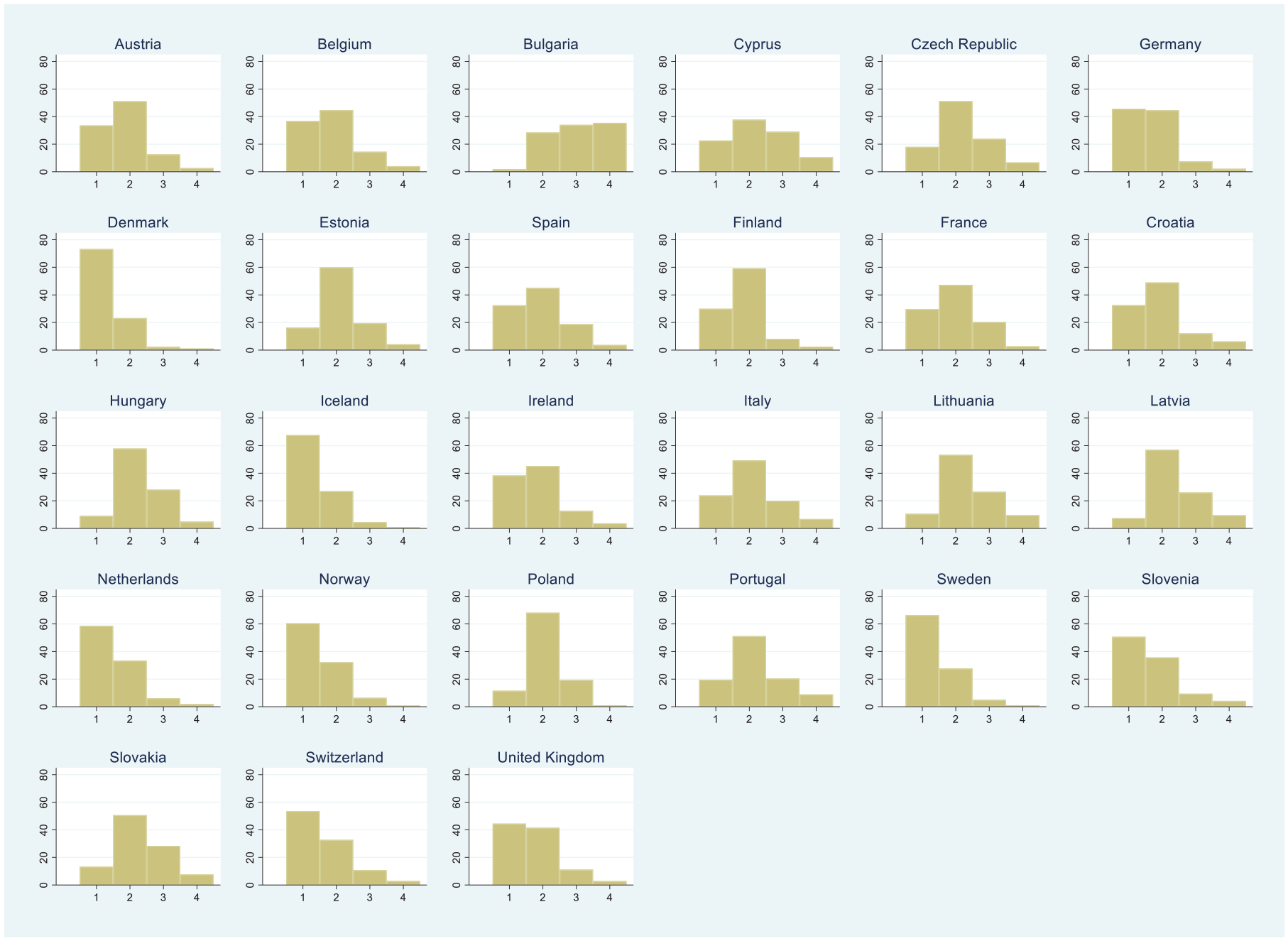
Distribution of economic grievances by country in ESS round nine (2018-2019).
Despite national variation in shared grievances and protest rates, the modeling strategy, discussed below, assesses how changes in shared grievances affect protest participation within countries across time by controlling for country differences. The models do not compare protest rates between countries with the highest versus the lowest levels of shared grievances, but instead how different levels of shared grievances within the same country affect expansions and declines in protest participation in that country. This tests for the effects of deteriorations in economic conditions, which are more important in stoking political protest than structural disadvantages (Bergstrand, 2014; Kurer et al., 2019). People are known to be loss-averse and likely to take action when presented with the prospect of losses (Bergstrand, 2014; Kahneman and Tversky, 1979). The presence of long-term grievances essentially represents conditions that people are accustomed to while a sudden rise in grievances, regardless of whether a country has a high or low baseline of grievances to begin with, represent perceptible changes that are more likely to provoke political action.
Unemployment rates
I use unemployment rates as a proxy for objective economic adversity in a country. Fluctuations in unemployment rates provide proximate indicators of the level of economic hardship a population is enduring. Unemployment rates are considered to represent the overall level of insecurity a population is enduring, including for employed workers (Gallie et al., 1998; Green, 2009). For this reason, unemployment rates are perhaps the most commonly used proxy for negative economic conditions in studies of collective action (Campante and Chor, 2012; Dodson, 2015; Grasso and Giugni, 2016; Jenkins et al., 2008; Kern et al., 2015; Kriesi et al., 2021; Myers and Caniglia, 2004; Rodon and Guinjoan, 2018; Snow et al., 2005). I gather data on unemployment rates from the World Bank development indicators, which itself gathers the data from the International Labor Organization’s estimates (World Bank, 2021).
Not surprisingly, subjective shared grievances and unemployment rates are correlated but only moderately (r = .41), suggesting changes in unemployment rates do not perfectly align with the population’s subjective sense of economic distress. Figures 2 and 3 display the relationship between unemployment rates and economic grievances in Germany and Sweden. These two countries were chosen to demonstrate how these indicators can be strongly correlated in some cases but disjointed in others, reflecting the distinction between objective and subjective grievances. In Germany (Figure 2), the relationship between unemployment and shared grievances is clear: grievances and unemployment rates were high in the early 2000s but declined simultaneously until 2019. In Sweden (Figure 3), perceptions of economic difficulty were more unpredictable. Unemployment rates were low in the early 2000s, rose during the 2008 recession, peaked in 2010, then declined, albeit inconsistently, until 2019. Yet, Swedish citizens did not report a significant increase in economic hardship in the post-recession period apart from a large one-year spike in 2013. Economic grievances in Sweden, if anything, were comparatively high before the recession, when unemployment rates were lower. Thus, while social movements researchers often rely on objective statistics as proxies for economic distress, examples like this suggest national statistics are not perfect indicators of actual aggrievement in society.
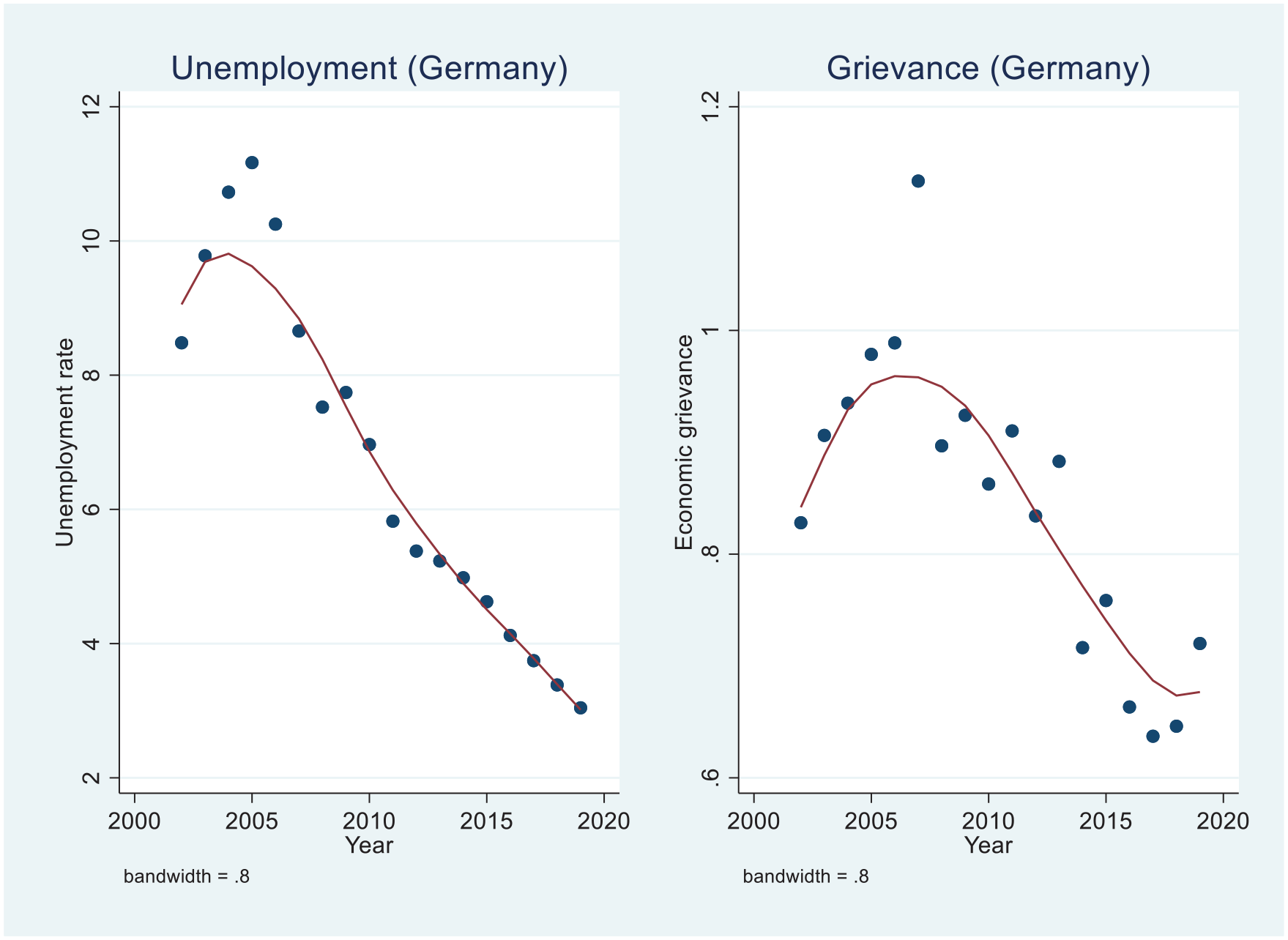
Unemployment rates and shared grievances in Germany.
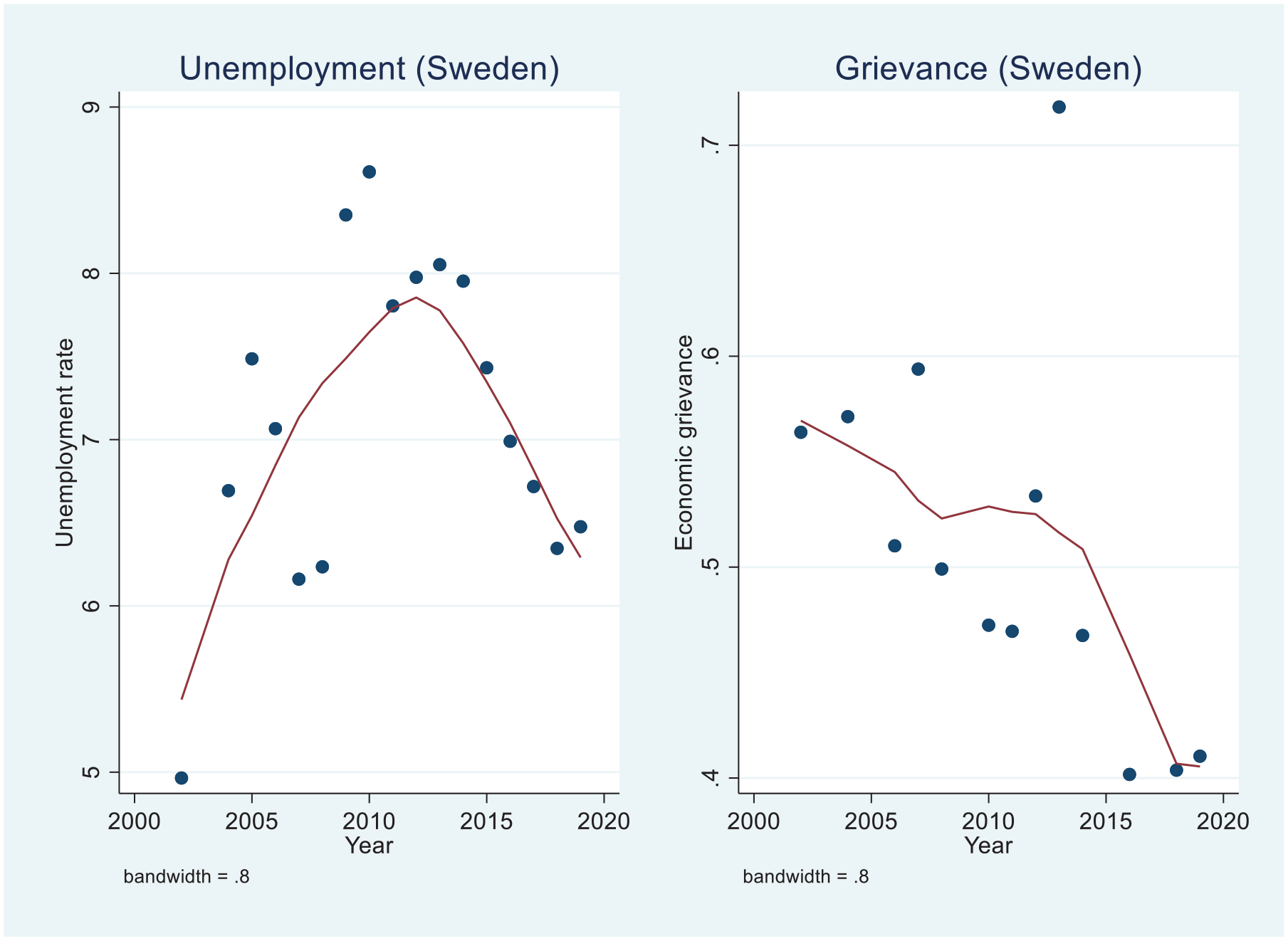
Unemployment rates and shared grievances in Sweden.
Control variables
Alternative individual and contextual variables will be accounted for to ensure any statistical associations are not better explained by other factors. On the individual-level I control for typical demographic markers: age, sex, education, income, and self-placement on the left-right political spectrum. Education is coded from 1-5, where 1 indicates incomplete secondary education and 5 indicates the completion of tertiary education. Income is coded on a 1-10 scale corresponding to the income decile in which the respondent falls into, standardized for their country. Left-right ideology is represented by the respondent’s self-placement on a 1-10 scale where 1 indicates farthest left 10 indicates farthest right, and 5 indicates the middle of the spectrum. I reverse-coded the responses such that higher figures indicated that the respondent was more left-wing. I also include a variable for perceptions of household financial difficulty (coded 1-5) using the original individual-level coding rather than the average for the population as described above for the ‘shared economic grievance’ variable. Given the importance of social capital to protest, I also include a variable that asks respondents how frequently they meet with friends or family, measured on a 1-6 scale.
I also include variables for political interest, measured on a 1-4 scale, and a variable for political trust, measured on a 0-10 scale where 1 indicates ‘no trust at all’ and 10 indicates ‘complete trust’. Finally, I include a measure of political grievance derived from a question asking respondents their level of satisfaction with the way democracy is functioning in their country on a scale from 0-10. The question gauges the respondent’s sense of dissatisfaction with the political system broadly. In my view, this is more appropriate than questions that ask about dissatisfaction with the government, which are prone to essentially measuring political party affiliation (e.g. supporters of a ruling party tend to be happier with the government than party detractors).
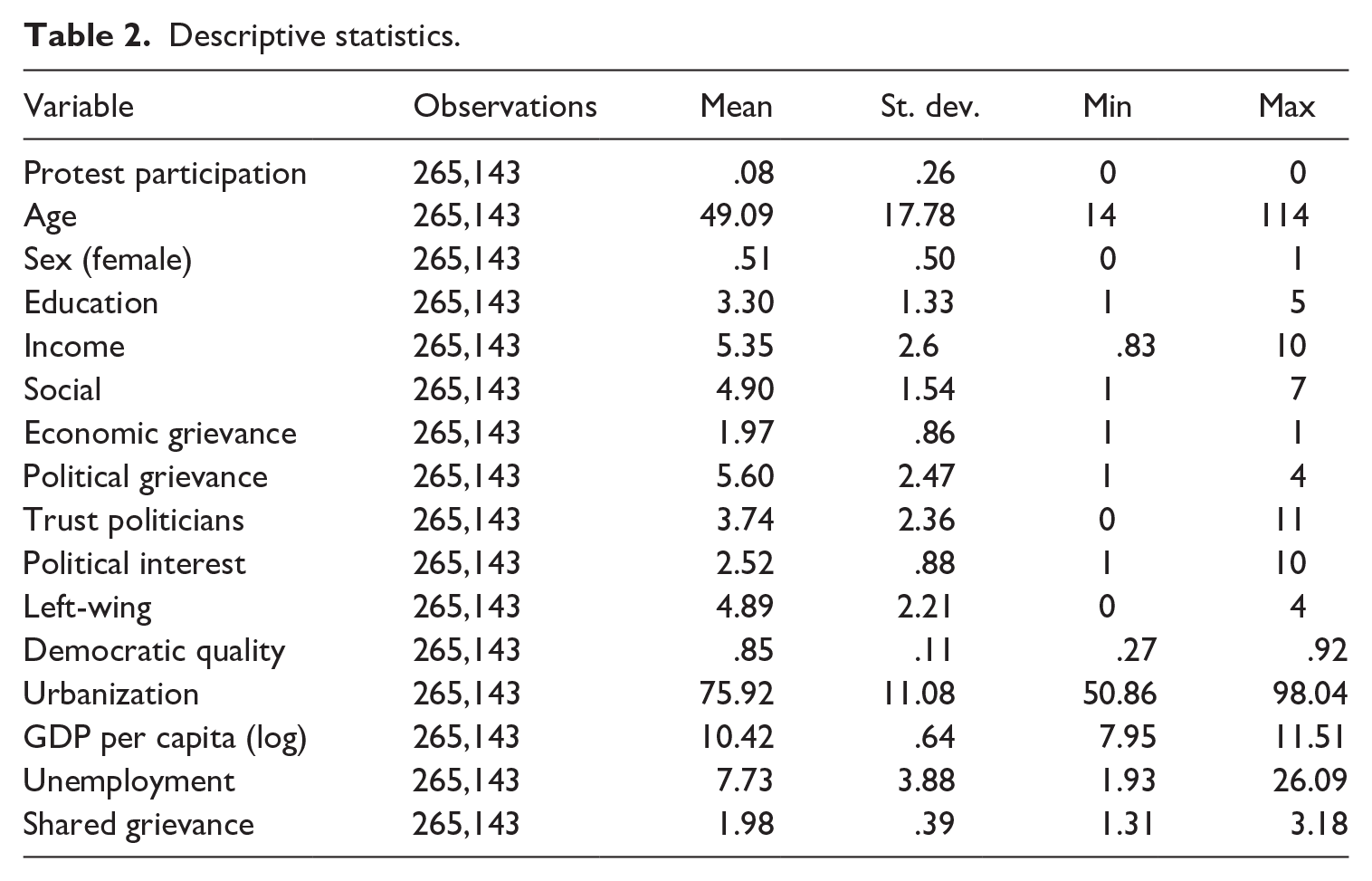
I next include three national controls. Domestic political landscapes are known to shape opportunities and constraints for social movement actors (Meyer, 2004). In cross-national context, the most salient political indicator is the country’s level of democracy. The V-Dem institute gathers expert survey data to create various indicators related to the country’s government (Lindberg et al., 2022). V-Dem’s ‘electoral democracy index’ will be used as a control for democratic quality, which measures the extent to which ‘rulers are responsive to citizens . . . political and civil society organizations can operate freely; elections are clean and not marred by fraud or systematic irregularities’. among other qualities representing liberal democratic norms. I also use a logged measure of national GDP per capita to represent a country’s national wealth, gathered from the World Bank Development Indicators (World Bank, 2021). Finally, protests are more likely to break out in urban centers where there are larger concentrations of people and thus more potential recruits. I include a national urbanization variable, also from the World Bank Development Indicators, measured as the percentage of the population classified as living in urban areas. Table 2 displays descriptive statistics for all variables and Table 3 displays a correlation matrix with all variables.
Descriptive statistics.
Correlation matrix.

Analytical strategy
I use multilevel mixed-effects logistic regression models to explore the relationship between protest participation and the individual and national independent variables. To account for country differences, the models include a random effects term for country. Year fixed-effects were included by adding dummy variables for each year of data to control for independent effects of time. Controlling for country and year effects is essential given the objective is to measure the effect of fluctuations in national grievances within the same country, not the effects of overall grievance levels between countries or across time generally. As an alternative to this modeling strategy, I experiment with logistic regressions with country and year fixed-effects, which produce extremely similar models to the mixed-effects logistic regressions described above.
For interactions between national and individual level variables, I run models with one interaction term at a time. This is done to reduce the effects of multicollinearity present in models with multiple correlated variables, but I also run a final model with all interaction terms to assess their relative importance. I also eliminate all country-years from analysis that contained fewer than 200 respondents. 1
The findings must be understood with limitations in mind. First, they do not say anything about outcomes other than individual protest such as the amount of protest events that occurred in a country. Instead, by predicting individual protest participation while controlling for country and year, the national-level variables essentially estimate the proportion of people that protested in a country. The nature of the dependent variable also does not reveal the type of action the individual participated in other than the fact that it was a ‘lawful public demonstration’. This could include a strike, sit-in, street march, and so on. The variable instead is a proxy for generalized public, non-routine action.
Results
Table 4 displays initial reduced regression models on protest participation, while full models with interaction terms are displayed in Table 5. In model I, which includes age, sex, education, income, personal economic grievances, and national economic variables, the shared grievance variable is significant and positive (B = .380; p = .003). The strength of the shared grievance coefficient remains similar when further national controls are added in model II (B = .402; p = .002).
Reduced multilevel regressions testing effects of shared grievance on protest participation.

p < .001, **p < .01, *p < .05. Robust standard errors in parenthesis.
Multilevel regressions testing effects of individual variables, national variables, and shared grievance on protest participation.

p < .001, **p < .01, *p < .05. Robust standard errors in parenthesis.
Table 5 displays more comprehensive results of six regressions on protest participation including many individual-level and national-level independent variables. Model III first considers all independent variables except shared grievance, while model IV considers the same variables with shared grievance added. Models V, VI, and VII each respectively include an interaction term between the national shared grievance variable and one individual-level variable. These models were separated to reduce the effects of multicollinearity and observe the effects of the interaction terms independent from one another. Finally, model VIII is a full model with all interaction terms included to observe which retain significance when all are considered simultaneously.
Consistent with existing knowledge, model III suggests people who protest are younger, highly educated, richer, social, very left-wing, and highly interested in politics. Previous studies have shown mixed evidence for the importance of economic grievances and political grievances, but here both have positive and significant relationships with protest participation.
Regarding national-level variables, the results from model III indicate that deteriorations in a country’s democracy are a powerful factor that drives individuals to protest. Democracy in the West has come under strain in recent years as normative restraints erode, politicians sidestep checks and balances, and leaders increasingly use anti-democratic rhetoric (Levitsky and Ziblatt, 2018). The negative coefficient for democracy means people protest more as political opportunities close, suggesting they interpret regimes becoming more authoritarian as a political threat (Almeida, 2018). Though democratic backsliding has accelerated recently, the results imply evidence of a defensive mobilization among populations whose governments become less democratic.
The urbanization variable is non-significant, indicating that a rising number of people living in cities is not associated with a higher rate of protest participation. National wealth has a positive, significant association with protest (B = .875; p = .000), consistent with the idea that long-term development is associated with the emergence of a ‘social movement society’ where activism and protest are more routine features of political life (Meyer and Tarrow, 1998). Similar to the resource-based proposal that high-income individuals protest more, people in high-income countries may be better positioned to act upon negative economic perceptions given the resources at their disposal and robustness of social movement infrastructure and ties. Unemployment rates are significantly associated with protest, suggesting contexts of elevated economic difficulty facilitate mobilization. The effect for unemployment, however, is far weaker than any other significant variable (B = .008; p = .038), implying a weak effect when objective statistics are used as a stand-in for economic difficulty.
When the shared grievance variable is added in model IV, it is positive and significant at the p < .001 level (B = .568, p = .000). This finding supports Hypothesis 1, which predicted that shared grievances would enhance individuals’ willingness to join protests. Notably, unemployment previously was significant in model III, but loses explanatory power when shared grievance is introduced and drops to non-significance in model IV (B = –.001; p = .756). Given that they are meant to measure similar phenomena, the loss of significance for unemployment when shared grievance is added suggests that shared perceptions of difficulty ultimately bear a more important relationship with protest than objective statistics that are often used as substitutes for difficulty in previous research. The other variables that were previously significant, democracy and GDP per capita, retain their significance. Together, the results largely suggest that democratic backsliding, advances in national development, and rises in shared economic grievances are the most salient national factors associated with higher protest rates.
Figure 4 displays the predicted effects of shared grievances on protest participation using results from model IV. The x-axis is scaled from 1.5 to 3.0, a range that includes 86 percent of the shared grievance values in the data. The chart suggests that when shared grievances in a society are low, at an average of 1.5 for instance, the predicted protest rate for citizens would be equivalent to 7.3 percent. Were shared grievances to rise to 2.0, the protest rate is expected to rise to 9.0 percent. Were there a huge increase in shared grievances that reaches 3.0, predicted protest would balloon to 14 percent of citizens.
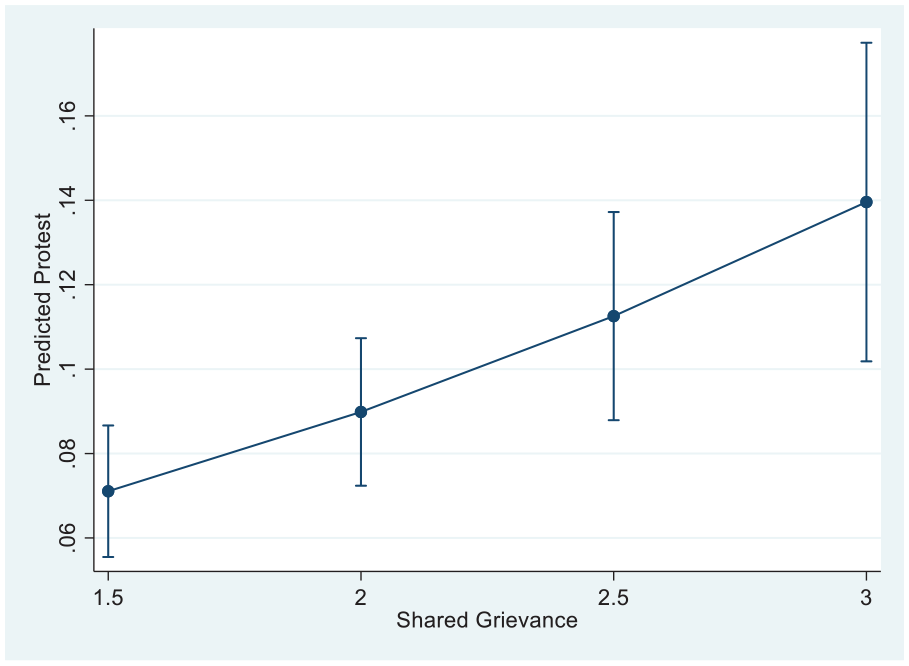
Predicted effect of shared grievances on protest.
Models V-VIII introduce interaction terms that combine shared economic grievance and individual variables multiplicatively. These models assess the hypotheses that environments of high shared suffering have greater mobilizing potential for the most aggrieved individuals. Model V begins by examining individuals who report subjective economic difficulty. The interaction coefficient is negative and significant (B = –.139; p = .000), suggesting that individuals who feel economic distress are actually less likely to protest when their society becomes highly economically aggrieved. Instead, the results suggest those who feel economically comfortable become more represented among protesters during high shared grievances. This runs contrary to hypothesis 2, which predicted that financially struggling people themselves would protest more when economic struggles were widespread. This result provides some initial support for arguments advanced by resource mobilization theory, that economically disadvantaged individuals are less prone to participating in activism.
This theory receives further support from model VI, which considers an individuals’ income. The coefficient for the interaction term is positive and extremely significant, suggesting the income of protesters tends to be far greater when shared grievances are high (B = .089; p = .000). The independent shared grievance variable also loses significance, indicating that the participation of high-income people is essential to rising protest rates during periods of high grievance. This result provides strong evidence that it is not the poorest citizens that become emboldened to protest during bad economic times, but the more financially privileged citizens that have the luxury of dedicating time and effort to protests when others are enduring economic distress. Figure 5 displays the predicted effects of personal economic grievances on protest across low and high levels of shared grievances, while Figure 6 displays predicted effects of income across low and high levels of shared grievances. Together, models V and VI suggest that both subjective and objective conceptualizations of economic disadvantage de-mobilize citizens when society at large is enduring economic distress.
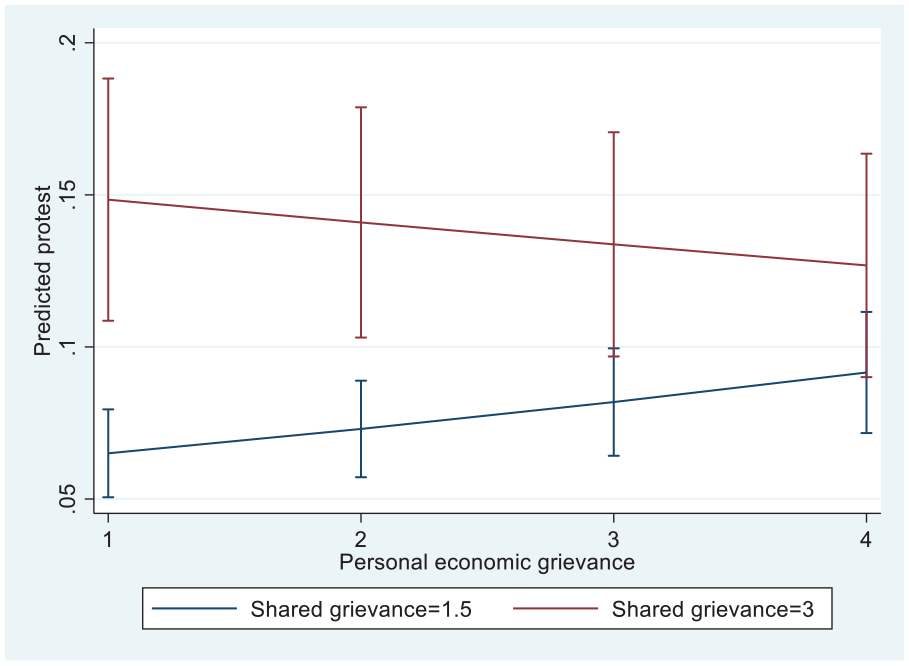
Predicted effects of personal economic grievances in contexts of low and high shared grievances.
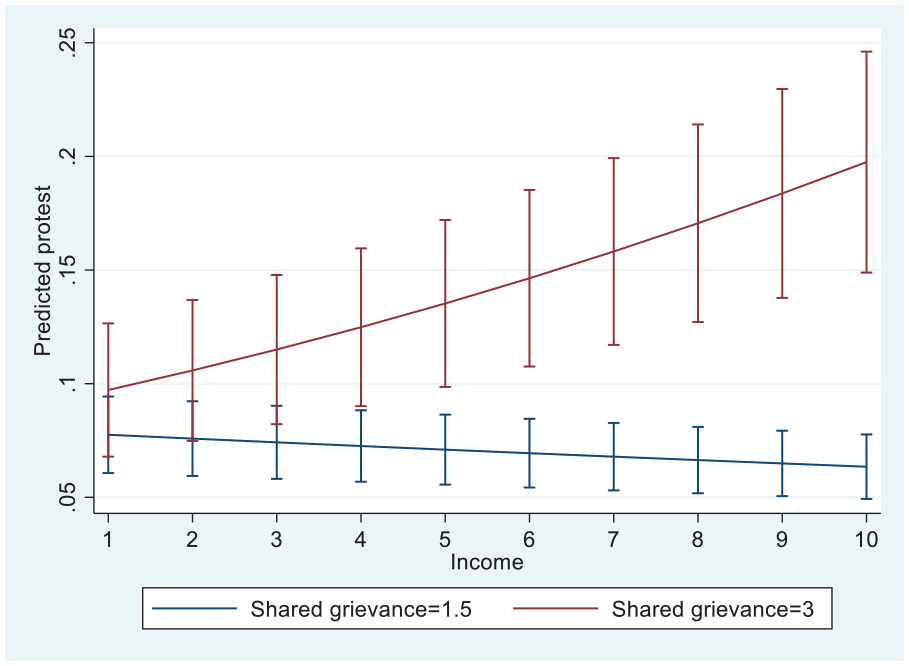
Predicted effects of income in contexts of low and high shared grievances.
Model VII estimates the role of political dissatisfaction during periods of high shared grievance. The interaction effect is negative and significant, suggesting politically dissatisfied people do not protest more during high shared grievances. The effect is comparatively weaker than the other interaction terms (B = –.030, p = .001) This contradicts hypothesis 4 and is an unexpected finding considering previous research that has emphasized protesters’ frustration with political authorities during the Great Recession (Bernburg, 2016; Giugni and Grasso, 2019; Kriesi et al., 2021).
Finally, model VIII provides a full model including all interaction terms. This model, however, is subject to multicollinearity that could skew the coefficients and standard errors, but still allows for a tolerable assessment of the interaction terms’ importance in relation to one another. In this model, the significance for the interactive economic grievance and political grievance terms fades entirely, but the effects for the interaction term for income and shared grievance remain significant (p = .000). This interaction variable hardly loses any explanatory power when considered alone versus in a full model with other interaction terms considered, dropping from a coefficient of .089 to .086 between the two. This strongly suggests that the most crucial feature determining who comes out to protest during periods of high economic grievances is having a higher income, with weaker roles for subjective financial dissatisfaction.
Ancillary analyses and robustness checks
Several modified regression models were run to evaluate the stability of the results. Shared grievances were previously found to be significant for protest while controlling for unemployment rates (model IV), which are perhaps the most widely used objective measures of economic performance in a country. I investigate whether the shared grievances effect survives controls for further national indicators of economic standing. I replicate model IV but add a variable for the annual percent of inflation for consumer prices and a measure for annual GDP per capita growth rates. Inflation is positive but non-significant (B = .010, p = .148), GDP growth is significant and negative (B = –.016, p = .000), indicating that protest rates increase when economic growth is negative. This result ultimately supports the idea that declines in economic conditions result in more protest. Unemployment remains non-significant, as was the case in model IV. The effect of shared grievance does not lose statistical significance and slightly strengthens (B = .632; p = .000). The result affirms the initial finding from model IV that subjective feelings of economic adversity in a population are significant predictors of protest, even when objective economic statistics are controlled for.
Next, while shared economic grievances have been the key focus of this study, a variety of public attitudes could also explain protest participation, or even displace the effect of shared grievances (Portos, 2021). To investigate this possibility, I control for changes in two other shared attitudes in the population: shifts in political grievance and political ideology. These variables are not new to this study, as individual-level versions of these variables were already used as individual control. For this robustness check, I take the country-year average of each variable, as was done with the shared economic grievance variable. When controlling for national changes in political discontent and political identification, the shared economic grievance variable remains significant (B = .593; p = .000), while political grievances (B = .013; p = .625) and shifts to the political left (B = .066; p = .186) do not significantly affect protest participation. Many attitudes and beliefs in a population are subject to change, but this result suggests that shifts in economic grievances in particular are key to influencing protest rates.
Next, I deal with a data-related issue that may have biased the results. As is well-known in survey research, smaller samples are more prone to producing unrepresentative results. While previously I had eliminated all country-years that had fewer than 200 respondents, I now take the average shared grievance in each country-round. In 93% of surveys in each country-round, ESS researchers collected more than 1,000 interviews. The fewest number of interviews collected in any country-round survey was 486 in round nine in Latvia. Taking the average level of shared grievances by round rather than year reduces the unique country-time data points from 303 to 208, decreasing the statistical power of the national-level results, but increasing confidence that each case of the shared grievance variable was derived from a survey with a large sample size to be representative of the population. After using the same variables seen in model IV in a new model, the results do not change notably. The shared grievance variable coefficient weakens somewhat, going from .569 to .566 and remains significant at the p < .001 level.
Finally, I also tried two models that replicate model IV but eliminate respondents from country-years with 300 or fewer and 400 or fewer respondents, respectively, rather than the original 200. This, again, was done to assess how increasing the survey sample size in each year affects the results of the shared grievance variable. The sample size of the regression models, nonetheless, decreased slightly given that fewer country-years are included. The first model contains 261,256 cases, down from 265,143 originally, and the second model has 257,629 cases. These changes hardly make a difference. In both models, shared grievance retains a similar coefficient and level of significance (p < .001).
Discussion and conclusion
It is common among journalists, academics, and other commentators to assume that rises in economic adversity in society can trigger outbreaks of protest. Yet, empirical research has indicated a weak or non-existent relationship between individually-held economic grievances and protest participation. Instead, findings suggest protesters are often educated and financially well-off. This study proposes that rather than acting on personally-held grievances, individuals are more politically responsive to changes in their contextual environment, namely to increases in the intensity of shared grievances held by others in their society. This study employs a survey sample of 265,143 respondents from thirty-three European countries gathered across multiple points in time from 2002-2019 to test this assertion. Relying on mixed-effects logistic regressions, the study finds consistent evidence that people are more likely to join protests when shared economic grievances intensify– that is, when their fellow citizens begin to endure greater economic difficulty.
The notion that objective, contextual circumstances influence protest is a foundational concept for some prominent social movement theories. Perspectives that highlight the absence of barriers (such as repression) or the presence of objective facilitating factors (such as resources or political openings), for instance, are thought to alter the material capability of activists to organize. In these perspectives, a group of people may be aggrieved, but if they confront obstacles such as a lack of resources, organizing networks, or political freedom, they are simply unable to act upon those grievances no matter how intensely they are felt.
Perspectives that emphasize contextual economic situations differ notably from these explanations in that they are assumed to be intermediated by a shift in people’s subjective perceptions (Langman, 2013). Previous cross-national work has relied on objective economic statistics (e.g. unemployment rates, GDP growth rates, inflation, etc.) as stand-ins for economic grievances (Azedi and Schofer, 2023; Caren et al., 2017; Davies, 1962; Langman, 2013; Ortiz and Béjar, 2013), but objective statistics alone do not directly reflect people’s subjective economic appraisals. A worsening of economic conditions alone does not cause protest but is thought to result in elevated discontent in society, which in turn facilitates protest. Thus, the importance of shared economic appraisals is already baked-in assumption in these studies, but the effects of subjective economic appraisals on the aggregate level are rarely tested. Recent work has emphasized the importance of emotions for mobilization, mostly focusing on individuals or smaller groups (Jasper, 2011), leaving the effects of large-scale shifts in subjective feelings largely unknown. The present study not only points to an independent role for shared grievances in facilitating protest, but shared grievances were found to have a more important role than objective economic indicators commonly used as proxies for economic grievances.
The findings signal that grievances have a socially influential effect whereby people become more likely to protest when economic hardship becomes pervasive in their society. Individual decisions to join collective action do not occur in a vacuum– people are embedded in complex societies that expose them to other people’s opinions, feelings, and grievances, and may be sensitive to discerning changes in public opinion. Social embeddedness has repeatedly been shown to be a powerful element in the process of recruiting protest participants, and the diffusion of shared grievances across social networks can enhance desires to take collective action (Klandermans et al., 2008). In this study, grievances are implied to travel along similar social routes, influencing individuals to protest even when they do not necessarily harbor those grievances.
There are certainly other intervening factors that work in-tandem with shared grievances to produce mobilization, but the data used in the present study is not equipped to detail the complex process by which shared grievances are transmuted to protest participation. Even when shared grievances are high, activists must still engage in meaning-making work to frame societal discontents, attract sympathy, and portray economic issues as worthy of protesting over (Benford and Snow 2000). The proliferation of intense grievances in a society likely renders mobilizing frames more resonant with a population, making it easier for movement leaders to recruit protesters (Caren et al., 2017). Political context also affects the ability and willingness of movements to organize (Meyer, 2004). A context of heightened shared grievances can be considered a temporary window of opportunity for contentious actors to attract protest participants. This study, in other words, does not discount non-grievance theories, but highlights the intensity of shared grievances as a noteworthy contextual component in the mobilization process.
This study also investigated whether shared grievances would magnify the salience of individual grievances, whereby low-income individuals and individuals enduring financial difficulty would protest more when overall economic suffering in their society rises. The results did not support this idea. Instead, the opposite was found: higher-income, financially comfortable individuals protest at higher rates during periods of intense adversity. The finding was particularly powerful with regards to income. It is well-known that citizens with sufficient resources have greater ability to act upon grievances by protesting (Brady et al., 1995; Jenkins et al., 2008; Somma, 2009). This finding suggests this effect expands amid resource-poor environments that appear during difficult economic times, consistent with findings that the ‘resource gap’ widens during poor economic performance (Rodon and Guinjoan, 2018).
Considering the many ways economic grievances can be conceptualized (see Table 1), theoretical caution and specificity from researchers is important to assess which conceptualization their empirical findings support. By finding a negative interaction between income levels and shared grievances, this study suggests the salience of individual economic grievances, both objective grievances (low income) and subjective grievances (financial dissatisfaction), fade as subjective contextual grievances proliferate. This also attests to the complexity of grievances and the importance of multilevel interactions that have been noted in other recent studies (Azedi, 2023; Dodson, 2015; Grasso and Giugni, 2016; Opp, 2009).
The sample in the present study was confined to Europe, a highly developed world region, which restricts the generalizability of the findings. Wealthier nations tend to have stronger social movement networks and resources that facilitate mobilization (Meyer and Tarrow, 1998), potentially rendering European populaces better equipped to respond politically to rises in shared grievances when they appear. However, it could be argued that shared economic grievances will be more salient in less developed societies, where research on contentious action in less developed countries spotlights food riots and the prevalence of material concerns (Hendrix and Haggard 2015; Rudolfsen, 2023; Walton and Ragin, 1990). Future contributions to this subject can investigate whether the findings apply to the Global South.
This study examined subjective grievances in society as one contextual factor for protest, but public opinion regarding a range of other political, economic, and social attitudes is also regularly in flux. Given that the effect of public opinion is rarely empirically examined with few exceptions (e.g. Portos, 2021), it could represent a fruitful path for social movement researchers to go beyond just objective societal features and investigate whether other shifts in public opinion have notable effects on protest or other social movement outcomes. Moreover, studies of public attitudes need not be limited to the country level, as was done here. Further evidence that shared grievances can influence protest rates within cities, provinces, and regions would be important to confirming their relevance.
Footnotes
Declaration of conflicting interests
The author declared no potential conflicts of interest with respect to the research, authorship, and/or publication of this article.
Funding
The author received no financial support for the research, authorship, and/or publication of this article.
