




Abstract
Crisis responses are created in reference to the meanings of other crises. We develop the notion of ‘linking crises’ to capture this phenomenon and apply it to two contemporary global crises: climate change and COVID-19. Concretely, we study four crisis linkage dimensions in American, Canadian, Dutch, and Lithuanian party manifestos for national elections from the pandemic heydays (2020–2021): (1) how often links were drawn; (2) the issues they were related to; (3) the argumentative strategies for making connections; and (4) and the political level on which this occurred. We find many cross-national similarities. For instance, in every country links with economic and environmental issues were very present, an argumentative trope of ‘building back better’ was employed by various political parties, and the majority of the connections were made at supra-national levels. These findings bring up the question of when cross-national parity in crisis responses does (not) occur.
Introduction
Climate change is widely considered one of the defining global crises of the twenty-first century. In the first months of 2020, another global crisis, the COVID-19 pandemic, began to disrupt the lives of billions of people. This public health crisis prompted immediate and radical political responses across the world (e.g. lockdowns). Meanwhile, to date, policies to tackle the climate crisis have been less drastic. From crisis literature, we know that the meaning-making of crises often happens in reference to other crises. Previous crises are used as an exemplar of how an emerging crisis should (not) be tackled (Mahoney, 2000; van Dooremalen, 2021). However, the occurrence of a new crisis can also inspire a re-evaluation of responses to older or other contemporary ones (Alexander, 2002; Wagner-Pacifici, 2017: 10–15). The aim for this article is to understand how such processes operate for the combination of climate change and the COVID-19 pandemic. Given the global magnitude of both crises and that lessons drawn from tackling COVID could be an inspiration for dealing with the climate crisis (e.g., Baldwin and Lenton, 2020; Manzanedo and Manning, 2020; Perkins et al., 2021), this is an important question. Yet, if and how this has actually materialized in public and political discourse has hardly been explored yet (except for Tavory and Wagner-Pacifici (2021) and Elliott (2022)).
To do so, we introduce the concept of ‘linking crises’, which enables capturing the direct connections that are drawn between the two crises. We then study these crisis linkages for four national elections that took place within North America and Europe at various time points of the heydays of the COVID-19 pandemic: Lithuania, the United States, the Netherlands, and Canada. From literature on the meaning-making of social and political life (Benson and Saguy, 2005; Brandom, 1994; Hilgartner and Bosk, 1988; van Eemeren et al., 2002), we derive four relevant dimensions of crises linking: (1) the number of links that are drawn between them; (2) the political and societal issues they are related to; (3) the argumentative strategies that are employed to make the links; and (4) the political level (local, national, continental, global) on which this happens.
To study these dimensions, we present a comparative content analysis, using both quantitative and qualitative text analysis methods to study political party and/or candidate election manifestos from our four country cases. We find many cross-national similarities in the ways the two crises were linked with each other. For instance, in all countries, economic and environmental issues were most dominantly connected with them and links were often made on the supra-national level (either continental or global). When there were differences, these were more related to political positionings (e.g. leftist parties drew more links than rightist ones) than to national contexts. Our results contradict a dominant idea in the literature on crisis meaning-making, according to which crisis responses generally differ a lot between nation-states (e.g. Fourcade, 2011; Hoffman and Durlak, 2018; van Dooremalen and Uitermark, 2021). Rather, they suggest that phenomena which drive cross-national parity such as party idea diffusion (e.g. Böhmelt et al., 2016; Börzel and Risse, 2022; Rydgren, 2005) and ideology effects (Farstad, 2018; Rovny et al., 2022) have been significantly at play for our four cases.
Theory: Considering four crisis linkages
Linking crises
Researching crises is important since they can be catalysts for change. They bring about a ‘window of opportunities’ (Kingdon, 1995) or ‘templates of possibilities’ (Berezin, 2012) for transformations of attitudes, feelings, behaviour, and policies that would have been difficult to imagine without their occurrence.
We follow a social constructivist perspective, meaning that we assume that it is not, say, the existence of poverty or the occurrence of a natural disaster per se that creates a crisis but widely shared negative perceptions of such phenomena (Alexander, 2002: 10–12; Koopmans and Duyvendak, 1995; Sendroiu, 2022). To what extent poverty or a natural disaster should be considered a problem and whether such issues are part of a broader crisis can differ significantly between societies and various groups within the same society (e.g. Fourcade, 2011; Hoffman and Durlak, 2018; van Dooremalen and Uitermark, 2021). Thus, studying crises is not a matter of looking at which objective conditions bring about certain ‘windows of opportunity’ for change but how such conditions are turned into a crisis situation through processes of meaning-making.
One of the ways in which crisis meaning-making takes shape is in reference to other crises. For instance, the path dependence literature shows that how an emerging crisis is treated is often very much patterned by responses to earlier crises (Mahoney, 2000; van Dooremalen, 2021). When political parties are used to responding to a natural disaster with policies on the local level, then this might create a tradition of ‘how things are normally done’, that sets the tone for future interventions. Conversely, the emergence of a new crisis could inspire a re-evaluation of responses to older ones (Wagner-Pacifici, 2017: 10–15). For example, Alexander (2002) demonstrates how the Holocaust at first was coded as but one of the many horrific acts of the Nazis. However, in decades that followed, and through connecting it to new crises, it came to be coded as the most immoral act in human history.
Thus, to understand crises is to understand how they are linked to other crises. We call this process ‘linking crises’, and investigate it for the global crises cases of climate change and COVID-19. The idea that climate change is a crisis already exists for at least some decades in many locations across the globe (e.g. Norgaard, 2011; Smith and Howe, 2015). The emergence of COVID-19 as a global crisis situation only dates back to early 2020. Nevertheless, its social and political impacts have already been widely researched (e.g. Johnson and Williams, 2020; Lipscy, 2020; Reichelt et al., 2021; Sniečkutė and Gaižauskatė, 2021).
However, the process of crises linking between the two has – to the best of our knowledge – hardly been investigated. Indeed, many scholars imply that the way governments responded to COVID-19 could teach us lessons of how to tackle the climate crisis (e.g. Baldwin and Lenton, 2020; Manzanedo and Manning, 2020; Perkins et al., 2021). These, though, are more examples of the process of crises linking in itself than empirical investigations of the very phenomenon. Tavory and Wagner-Pacifici (2021), who studied this phenomenon, show that for three different societal groups or institutions (climate scientists, climate activists, and climate change agreements) climate change has different meanings. The COVID-19 crisis is seen through the lenses of those meanings. For instance, scientists consider it a reminder of the widely spread politicization of scientific expertise, whereas activists claim that while the pandemic is treated as a real, urgent crisis, climate change is not. Another example of this is Elliott (2022). She analyses how on Twitter (currently X), the two crises were linked in an intergenerational justice debate on to what extent older generations were to blame for causing climate change and younger generations were responsible for preventing old, vulnerable people from getting COVID, through ‘flattening curve’.
Four linking dimensions
We build on various literatures that have focused on meaning-making process of social and political life, and distinguish four dimensions of crisis linkages that are relevant to investigate:
The number of links that are made. The agenda-setting and social problems literatures indicate that the assumed importance of a problem or crisis can be distracted from the attention it gets (Hilgartner and Bosk, 1988): the more it is being mentioned, the higher its considered importance. Thus, we can presume that the more often crises are linked with each other, the more important they are for each other’s meaning-making.
The political or societal issues that crises are linked to. Following our social constructivist perspective, crises are not naturally related to a specific societal problem (Alexander, 2002: 10–12; Koopmans and Duyvendak, 1995; Sendroiu, 2022). The issues that are linked with a crisis can differ considerably between social contexts. This issue linking sets the tone for whom will be affected by it and how (Benson and Saguy, 2005; Sendroiu, 2023). To go back to the example we gave earlier: framing poverty as a crisis of the poor (resulting from a ‘culture of poverty’) or a crisis of a failing welfare state gives rise to radically different policy interventions.
The argumentative strategies that are applied to make the links. Argumentative language use, understood as ‘the game of giving and asking for reasons’ (Brandom, 1994: e.g. 158–159), is a significant means to construct crises and to establish connections between them. We distinguish three argumentative strategies (van Eemeren et al., 2002), which indicate how crises are connected with each other: (1) An associative argumentative strategy, which treats two crises as similar through analogy. The analogy is either straightforwardly assumed or the characteristics of one crisis are being transferred onto the other one by way of association. (2) A symptomatic argumentative strategy that denotes how one crisis functions as a symptom of something else (another crisis, social problem, structure, etc.) is also relevant to the other crisis. (3) Finally, a causal/pragmatic argumentative strategy. This draws a link between one crisis causing the issues relevant to the other crisis, most typically manifesting as a specific policy measure presented as the means to prevent future crises.
The level (local, national, continental, and global) on which the links are located. Both climate change and COVID-19 are global crises in the sense that people from all over the world consider their existence a problem. Yet, this does not mean that all responses to them will only construct them as global affairs. For instance, we know that policies to tackle both crises are often formulated on the national or local level (e.g. the ‘New York approach’ for combatting climate change, Cohen, 2021). This might also be the case for the links between them.
Many studies on the meaning-making of crises posit that, processes of globalization notwithstanding, crises responses often vary quite a bit cross-nationally, even for cases that have a global outreach, such as terrorism (van Dooremalen and Uitermark, 2021) or pollution (Fourcade, 2011). Thus, we can expect to find a similar research outcome. However, there is also reason to hypothesize cross-national parity. For instance, recent literature on party idea diffusion argues that political parties increasingly look at the viewpoints of their foreign ‘siblings’ to develop their programmes (Böhmelt et al., 2016; Börzel and Risse, 2022; Rydgren, 2005). Furthermore, political parties make sense of crises through their ideologies (Farstad, 2018; Rovny et al., 2022), which could foster parties responding to them cross-nationally in similar ways.
Cases, data, and methods
We employ a comparative content analysis of how crises linking happened within party manifestos for national elections in our four country cases. We selected these specific countries because they are located on two continents and held their national elections at different moments during the heydays of the COVID-19 crisis: the Lithuanian parliamentary elections took place in October 2020, the American presidential elections in November 2020, the Dutch parliamentary elections in March 2021 and the Canadian federal elections in September 2021. This provides us with diversity both in terms of geographical location and crisis temporality. Moreover, the political contexts of these countries differ considerably in terms of number of parties that reached parliament (ranging from 2 in the United States to 17 in the Netherlands) and the presence of right-wing populists (which only happened in the American and Dutch elections). Due to these differences, finding much parity in crisis linkages for these cases cannot be explained by them being similar in every relevant feature. Finding variation could, however, possibly be traced back to one of these differences.
Investigating manifestos is informative for our research purposes because: (1) they give a view on what political parties want for their country for the mid-term future or even longer (instead of investigating immediate crisis responses, such as lockdowns, which might disappear quickly); (2) manifestos are usually full of elaborated argumentation (compared to, for instance, election debates), which allows to get an in-depth view on to what extent and how the two crises are linked with each other (cf. Volkens et al., 2009).
We limit our analysis to political parties that have gained representation during the elections of interest, because these are the ones that are expected to have the most influence on future crisis responses. Our corpus therefore consists of 5 manifestos in Canada, 14 in Lithuania (10 from parties and 4 from independent candidates) and 17 in the Netherlands. In the United States, only the Democrats had a real party manifesto for the 2020 elections. The Republicans published a document highlighting Donald Trump’s political programme in 53 bullet points. As this did not allow us to give depth to the Republicans’/Trump’s viewpoints, we chose to analyse four campaign speeches that Trump gave around the moment when a full party manifesto would normally be published (the end of August 2020). Two of the speeches were also made at the Republican Convention of August 24–27, which indicates their significance for the general campaign period.
For each country case, the collected manifestos were read and initially analysed in their original language. After the text units linking the crises were identified, we put all these units in an Excel file and for the Lithuanian and Dutch cases also added English translations. Each co-author was responsible for coding all data from one of the countries. The other co-authors then coded a representative sample of each country, to measure the intercoder reliability (Krippendorff, 2012).
We used a wide range of keywords to search for meaningful text units in each party manifesto:
‘covid’, ‘pandemic’, ‘epidemic’, ‘corona’, ‘virus’ in relation to the COVID-19 crisis;
‘climate’, ‘environmental’, ‘environment’, ‘ecological’, ‘weather’, ‘(global) warming’, ‘Paris climate accord’ in relation to the climate crisis.
Each time a keyword was found in the text, we did a thorough reading of several surrounding paragraphs to identify if a link was made between the two crises. We considered the crises linked if they were mentioned together in the same paragraph or in several consecutive paragraphs and they were used together to build a meaningful argument. Our intercoder reliability scores (see below) suggest that the four of us agreed on when a link is considered meaningful.
We could then measure the number of links that were drawn per party. Because parties differed in the number of words that they used in their manifestos, we divided the total word count of each manifesto by the number of links it contained.
To investigate the other three linking dimensions, we coded the following aspects for each text unit:
The main issues that were related to the crisis link(s). We coded for the following issues: economy, foreign policy, healthcare policy, environmental policy, social welfare policy, crisis management, criticism of political opponents, and other issues (ones that do not fit the others). We first came up with an initial, longer list of issues, based on open coding, and then arrived at this final list of issues, of which each one was at least a little salient in one of the country cases.
What argumentative strategy/strategies was/were used when linking the crises: associative, symptomatic, and/or causal/pragmatic.
The level(s) (local, national, continental (European or North-American), or global) on which the crisis links were drawn.
We figured that a link could be connected to/by multiple issues, argumentative strategies or levels; thus, we often gave multiple dimension codes to the same text unit. After coding, we ended up with the following intercoder reliability scores (Krippendorff, 2012): 0.86 for the issues, 0.82 for the argumentative strategies, and 0.86 for the levels. These are all good scores, indicating that our measurements of these three dimensions are reliable.
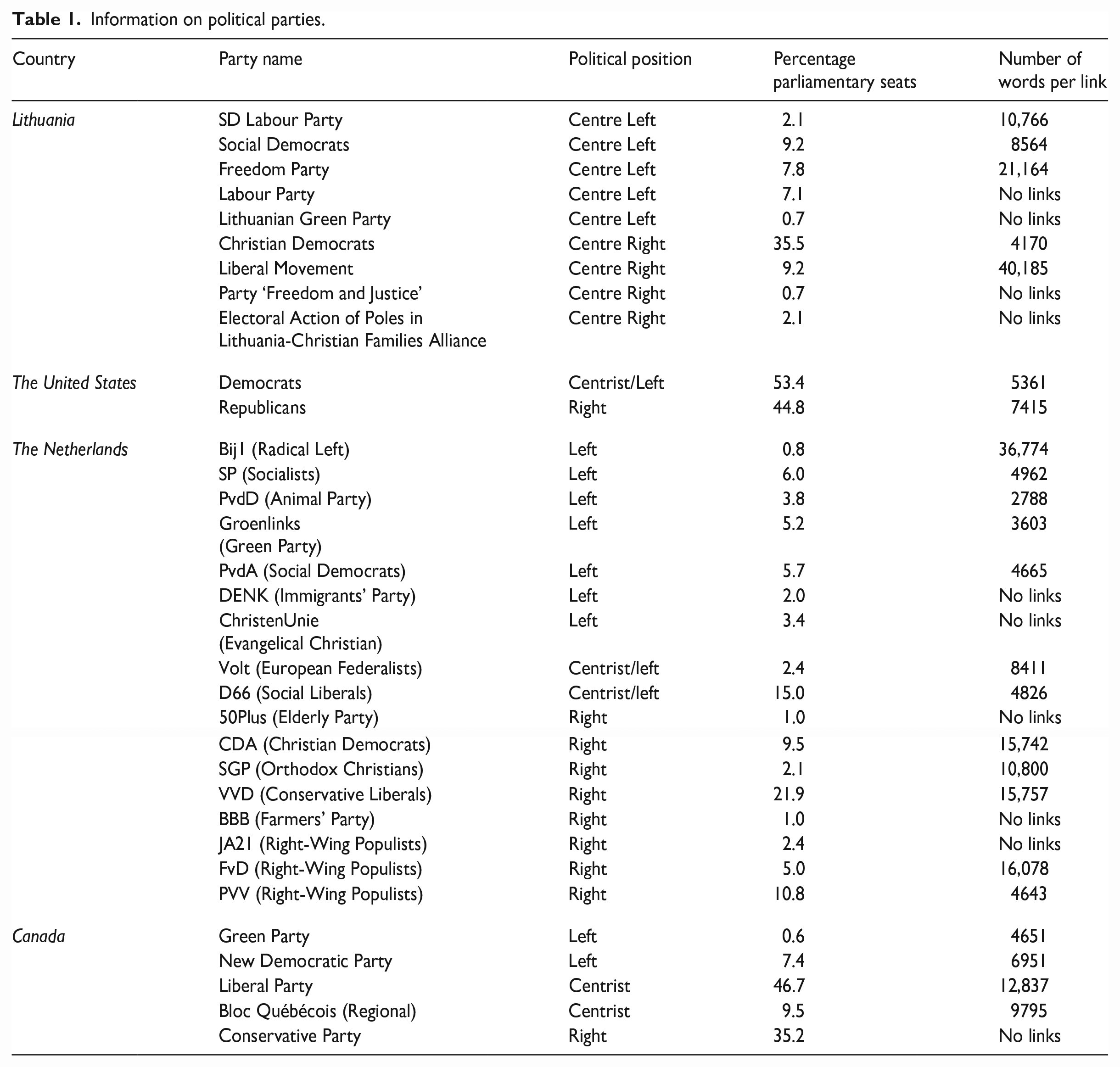
The results for each country case are discussed in four separate sections below, each time going from linkage dimension 1 up to 4. To contextualize these results, Table 1 provides an overview of party names, their political positions, their percentages of seats in parliament after the elections, and the number of words they used per link (with a low score indicating that a party made many links). In discussing our findings, only for the number of links we use absolute numbers as a baseline for comparison. For the other dimensions, we take a relative interpretation by considering what scores high and low within a party or a group of parties (e.g. all left-wing parties in the Netherlands connecting the crises mostly on a supra-national level) and then comparing that within and across the national contexts.
Information on political parties.
Results
Lithuania
In Lithuania, five out of nine parties whose programmes were analysed made links. 1 The centre-right Homeland Union-Lithuanian Christian Democrats (Christian Democrats) made them once per 4170 words, whereas the centre-right Liberal Movement of the Republic of Lithuania (Liberals) once per 40,185 words. The centre-left parties’ links were distributed as follows: the Social Democratic Party of Lithuania (Social Democrats) linked the two crises once per 8564 words, the Freedom Party once per 21164 words, and the Social Democratic Labour Party of Lithuania (SD Labour Party) once per 10,776 words. Among the four parties that did not draw any links in their election programmes, there were parties from both Left and Right (see Table 1). Though it is not possible to clearly state which Lithuanian parties were linking the two crises more frequently, the analysis of issues and argumentative strategies (see below) allows for presuming that the crises were more substantially linked by the leftist ones.
Crisis management (6 links), economy (4) and environmental policy (4) were the main issues when linking the crises. There was no clear Left versus Right pattern. The issue of crisis management appeared in both a leftist and rightist electoral programme, that of the centre-right Christian Democrats and the centre-left Freedom Party. However, all links made by the former referred to crisis management at the national level (claiming that the COVID-19 crisis and some recent environmental accidents in the country exposed issues in the national crisis management system), whereas the latter linked it with the issue of foreign policy, aiming for common solutions at the EU and global level.
The other two issues of reference – economy and environmental policy – went in tandem when linking the crises, regardless of a party’s political stance. For the centre-left Social Democrats, the COVID-19 crisis exposed long-existing problems in the current economic model, mainly regarding its negative effects on both the environment and society: Our response to the economic disturbance and the threat of further emigration caused by the coronavirus pandemic, climate change and other global upheavals -the inclusive economy model.
2
Similarly, the centre-right Liberal Movement saw the pandemic as the cause of the economic crisis and considered global developments within energy sectors as an opportunity to solve it. For example, by creating ‘added value from investments in climate change mitigation’. 3
A separate case was the centre-left SD Labour Party, which connected the issue of environmental policy specifically to farming. They believed that the challenges faced by the two crises called for the development of farmers competences. For example, on how to ‘farm sustainably, to combine sustainable farming with high productivity and to manage their farms intelligently’. 4
Associative (7 links) and symptomatic (5 links) argumentative strategies dominated in the Lithuanian case. Yet, again, argumentative strategies were rather more party-specific than revealing any distinct Left versus Right pattern.
In terms of associative strategies, as already discussed, the centre-right Christian Democrats proposed improvements for national management systems of any type of crisis, while the centre-left Freedom Party associated the crises as requiring supra-national solutions.
Parties diversely employed the symptomatic strategy. The centre-right Christian Democrats treated COVID-19 and environmental incidents as symptoms of the incapability of the public sector (e.g. health care system) in critical situations. The centre-left Social Democrats linked the two crises as symptoms of an economic crisis, but at the same time highlighted COVID-19 as revealing various negative consequences (e.g. environmental issues) of a ‘produce-consume-discard’ logic. 5 For the centre-left SD Labour Party, both crises were a symptom of the need to rethink farming strategies and practices.
A causal/pragmatic strategy was employed in the manifestos of the centre-left Social Democrats and the centre-right Liberal Movement. Their arguments were somewhat similar: an inclusive economy, green policies, or green energy were proposed as the means to make Lithuania more resistant to economic and health crises, natural disasters and to ease the recovery of the economic crisis, caused by COVID-19: Green policies are reducing inequalities, making the country more resilient to economic crises, pandemics and natural disasters.
6
It is peculiar to see that focusing on green policies as a direction of a more systemic economic change was a common ground between a centre-left and a centre-right party.
Regarding the political level on which crisis links were made, a continental (European) and/or global dimension was explicitly and widely present in most party programmes. Only the centre-right Christian Democrats linked the crises solely at the national level. Other parties either contextualized issues that connected the crises (e.g. associating crises as ‘global upheavals’
7
) or looked for solutions on the European and/or global level: in 6 out of 11 links reference to the European (1), global (2), or both level(s) (3) were present. For example, the centre-left Freedom Party (in both its links) called for European and global solidarity in the face of crises as opposed to single-country solutions: Lithuania is not an isolated island. Lithuania is a member of the European Union, of the Western world, of alliances of the richest liberal democracies. . . . Mitigating climate change, fighting cybercrime or pandemics are meaningless in isolation. . . . For Lithuania to win and prosper, we must choose global, open cooperation and solidarity.
8
The United States
Both American parties made links between the two crises in their programmes. The Democrats did so once per 5361 words. The Republicans did it less often: once per 7415 words.
The two parties had a lot in common concerning the issues that they connected to the links. The Republicans related them four times to the economy, whereas three of them dealt with the environment and foreign policy, and two concerned criticism of political opponents. For the Democrats, these numbers were 5 (economy), 4 (environment), 1 (foreign policy), and 2 (opponents).
The parties, though, had a very different political take on these issue linkages. The Republicans claimed that the measures that were made to tackle both crises were threatening the economic lives of average Americans. In the words of Donald Trump, when talking about Joe Biden’s COVID-19 crisis plans: He wants to impose a permanent lockdown combined with a socialist takeover of the US economy. Did you hear him the other day? Lock it down. He wants to lock it down. So everything that we’ve gained over the last number of months, he wants to lock it down.
9
And regarding environmental regulations he argued: We eliminated the most job destroying regulations in the history of our country. I ended the job killing Paris climate accord. That was a killer. That was meant to hurt the United States.
10
The threats that Trump mentioned were then coming from two sides. The first was the foreign. COVID-19 was constantly linked to China (‘the China virus’ and ‘plague from China’), and climate change measures were part of ‘globalist attacks’ on the United States. The second threat was Biden or the Democrats in general (criticism of political opponents). Democrats were framed as going for ill-judged crises responses. For instance, Trump was ironically downgrading Alexandria Ocasio-Cortez (prominent Democratic member of Congress) involvement in the New Green Deal: ‘She knows nothing about the environment. She probably never studied . . . Ask her. How many hours have you taken on the environment?’. 11
The Democrats were also very much linking both crises to the future of the American economy. They, though, proposed the idea that the economic crisis that followed from the COVID-19 crisis brought an opportunity to rebuild the economy into a greener one (their manifesto was called ‘Build back better’). This all comes together in the following citation: We will help rebuild our economy from the COVID-19 pandemic and President Trump’s recession by mobilizing historic, transformative public and private investments to launch a clean energy revolution. . . . Democrats reject the false choice between growing our economy and combating climate change; we can and must do both at the same time.
12
To the Democrats, the biggest enemy to tackle all these crises (COVID-19, the following recession, and climate change) was, as is also shown in this citation, Trump’s governing style and his policy programme (criticism of political opponents).
Trump (the Republicans) used various argumentative strategies to connect the two crises. He mostly employed an associative strategy (three times) to show how they were threatening the economic lives of average Americans. He also claimed (once) that he was the right person to take care of these two crises (causal strategy) and that Biden’s/the Democrats’ handling of them was exemplary (symptomatic) for their general misfunctioning.
In the argumentative strategies that were used by the Democrats, Trump’s handling of both crises was seen as a symptom (present in three links) of the bigger failure of his presidency. For instance, their programme claimed: ‘Even before the COVID-19 pandemic, President Trump was presiding over a recession in the manufacturing sector, after years of growth in the Obama-Biden Administration’. 13 Next, the argument that the COVID-19 crisis was an opportunity to take care of the climate crisis was made two times (association), and the idea that this could bring economic growth came up three times (causal).
Regarding the political level on which crisis links were drawn, both parties had a lot in common: they mostly related the connections to the global stage (Republicans 4 out of 5 links, Democrats 6 out of 8). However, the Republicans drew these links to show how this stage was very much a danger. Trump claimed that all kinds of international policies (open borders, climate change agreements) exemplified a core problem for the United States. To the Democrats, on the other hand, making policies on this level was very much considered a core solution to handle COVID-19, climate change, and the economic crisis.
The Netherlands
Out of 17 elected Dutch political parties, 12 made links between the two crises. Most of the parties not addressing links were small conservative and right-wing parties (see Table 1). Among the parties that made links, there was a sharp contrast between Left and Right: leftist ones drew links on average much more often (once every 4875 words) than rightist ones (once every 14,594 words).
Regarding the issues these parties invoked when linking the two crises, economy was very common for both Left and Right. Among rightist parties, it was the issue mentioned most frequently (11 times), followed by environmental policy (6 times). Next to these two issues, Dutch populist parties also added criticism of political opponents. The leftist parties referred mostly to environmental policy (32 times), with the economy being second (29 times), followed by social welfare (21 times).
When it concerns the employed argumentative strategies, there were various cross-party differences in articulating the links, especially, again, between Left and Right. Three dominant positions can be distinguished among the rightist parties: (1) moderate right (VVD and CDA) mainly emphasized how the COVID-19 crisis was affecting the economy (causal strategy, used three times in total), which required policy measures, including environmental ones, such as ‘sustainability and clean energy’.
14
The two crises were also related by an associative argumentative strategy (two times), that is, both crises were considered as problems and external threats, which could be solved by a strong government: Pandemics that arise on the other side of the world can quickly seriously disrupt society and public health in the Netherlands. Rising sea levels as a result of climate change require a major commitment to water safety. . . . we must do everything we can to preserve our freedoms and protect the well-being of the Dutch people. We can’t do that without a strong government.
15
(2) Two right-wing populist parties – the PVV and FvD – both denied the existence of the climate crisis and linked the two crises only by association (3 times in total). Their key argument was – and this very much resembles the viewpoint of the Republicans in the United States – that the COVID recovery funds and climate-related policies (e.g. Green Deals) were a ‘waste the Dutch taxpayers’ money’
16
and financially abused the Netherlands: COVID-19 was used to disguise the failure of the monetary union through a transfer union; with a transfer flow from North to South. The ‘Recovery Fund’ is redistributing EUR 750 billion, including common debt and new European taxes. This makes the Netherlands an ATM.
17
Finally (3), the Conservative Calvinists (SGP) made links between the two crises the most frequently among the rightist parties, usually by a combination of symptomatic and causal argumentative strategies (five out of six). Their core claim was that the COVID-19 crisis revealed the value of human life, which called for additional measures to tackle the climate crisis: The realization that human lives are worthy of protection was once again evident during the coronavirus pandemic . . . In a densely built-up and increasingly crowded country like the Netherlands, the landscape, flora and fauna are under heavy pressure. This pressure on water, soil and air is exacerbated by the obvious consequences of a changing climate. This calls for measures to help reduce emissions of all kinds of harmful substances.
18
Among the Left, two major positions can be distinguished. First, (1) the Social Liberals (D66), European Federalists (Volt) and Socialists (SP) mainly used symptomatic (9 times in total) and causal/pragmatic argumentation (15 times in total). Generally, the slogans ‘green recovery after the corona crisis’
19
and ‘sustainable economic recovery in the European Union’
20
were typical for this position. As D66 framed it, We can overcome the setbacks that the corona crisis has brought, and is still bringing us. I’m convinced of it. This election program is full of choices for a modern, fair and green recovery.
21
Second (2), the Greens (GroenLinks), Labour Party (PvdA) and the Animal Party (PvdD) related the two crises by invoking a ‘revelation’ trope, through using symptomatic and causal argumentative strategies. They all argued that COVID-19 revealed something essential (e.g. society’s vulnerability and strength, the value of environment), and that this called for systematic changes in relation to environmental policies. For instance, the Animal Party, which made most links between the two crises from all Dutch political parties (once every 2788 words), argued that the COVID crisis highlighted zoonosis danger and the value of a green environment, on the basis of which they formulated environmental reforms.
Although there are clear differences between the Dutch Right and Left in how they connect the two crises, they meet at two interfaces: moderate right (VVD and CDA) resonate with the social liberals (D66) in aiming for a green economic recovery; and the rightist Conservative Calvinists (SGP) come argumentatively close to the leftist Animal Party (PvdD) by connecting the value of human life to environmental reforms.
In terms of political level, most Dutch parties – next to connecting the two crises to the national level (48 times) – made clear links with the European (14 times) and global (41 times) levels. 9 out of 12 parties which drew links did so by referring to the European context. The two major election winners, the Conservative (VVD, 21.9% seats) and Social Liberals (D66, 15% seats), stressed the need for EU cooperation in terms of budgeting and laws. The populist right parties FvD and PVV criticized the EU for wasting its budget either on climate policies or COVID recovery programmes. The PVV framed the EU Climate Law as ‘a disguised seizure of power’ 22 and implicitly suggested the superiority of North over South Europe. Leftist parties were more internationally oriented and mentioned the EU mostly in reference to the economy. The Green Party (GroenLinks) stood out because it called for ‘European solidarity’, was explicitly pro-EU, while also being critical of it, and used the term ‘Europe’ to include ‘the north, east, south and west’.
Links to the global political level were mostly made by the leftist Labour party (10 times), Animal Party (8 times) and Green Party (7 times), while hardly ever by the rightist parties.
Canada
In Canada, nearly all elected parties made links between the two crises. There is a clear trend in the frequency of the links: the more left-wing a party, the more often it drew links. The two left-leaning parties, the Green Party and the New Democratic Party (Social Democrats), made links respectively once every 4651 words and once every 6591 words. The regional Bloc Québécois–a historically social democratic party turned centrist under the current leadership–followed, with one link every 9795 words, while the centrist Liberal Party drew links less frequently, doing so once every 12,837 words. The only right-wing party in parliament – the Conservative Party – did not make any link.
There were many similarities in the issues that these four parties raised in their linkages. Foreign policy was the leading issue for the Liberal Party and the Green Party. They both referred to this issue twice. The only other issue raised by the Liberal Party was the economy (1 link), while the Green Party also focused on environmental policy (2 links), the economy (1 link), and criticized the Liberal government (1 link). The economy was the leading issue for the NDP (3 links). It also connected the crises to environmental policies (1 link), and criticized the government (1 link). The only link made by the Bloc Québécois did not raise clear issues.
The Liberal Party and the Green Party both claimed that global problems such as COVID-19 and climate change should be solved on the international stage. For instance, the Liberals suggested that ‘Global challenges like the COVID-19 pandemic and the climate crisis underscore how the health, security, and prosperity of Canadians are profoundly impacted by the world around us’. 23 They also claimed that preserving Canada’s trade links with its partners and deepening its commitment to countries it is allied with was sufficient to overcome environmental and health-related crises. The Green Party was more critical and saw Canada’s current efforts as insufficient. It also called for more links with countries of the Global South, which according to them bore the brunt of the COVID-19 and the environmental crises. 24
Economic issues were framed in a very similar way by the Liberal Party and the NDP. A common thread in the manifestos of both parties was the opportunity for progress that the pandemic offered for building a fairer economic system. The two parties suggested that Canada could ‘move forward’ or that it ‘can build back better’ (just like the Democrats’ phrase in the U.S.) when the country recovered economically. For instance, the Liberal Party argued the following: ‘So, as we finish the fight against Covid-19, let’s build back better, together. . . . We can’t afford to move backward. Not in the fight against Covid-19 or the climate crisis’.
25
In a similar way, the New Democratic Party claimed, We believe that Canada can’t truly recover from the Covid-19 pandemic until hope, prosperity and security are within reach for everyone. When we build back, we have to build back for better.
26
However, while the two parties treated this issue in a similar way, one can observe differences in the importance of this issue in the two manifestos. Indeed, the leftist NPD emphasized the need to remedy economic inequality more strongly and used the ‘building back better’ trope more frequently than the centrist Liberal Party.
Interestingly, this kind of discourse was not at all a leitmotif in the manifesto of the Greens. The absence of the ‘building back better’ trope in the Green Party manifesto may indicate that this party is more sceptical about the idea that further economic growth could stop climate change. The Greens suggest instead that the pandemic revealed that economic indicators are inadequate to measure quality of life, which they argue has more to do with spending time with loved ones and connecting with nature. 27
All four parties which drew links used similar argumentative strategies. Associative strategies were used by all four parties that made links. In fact, it was present in 9 out the 16 links we found for the Canadian case. The Liberal Party and the Green Party both used it three times, the NDP twice and the Bloc Québécois once. Each time parties pointed towards crises parity. For instance, the Liberal Party suggested that the pandemic and the environmental crisis both underscored how the welfare of Canadians was affected by other countries. 28
Only one party – the NDP – used a causal/pragmatic argumentative strategy. They used it three times, to argue that the adoption of green policies would solve many problems caused by COVID-19, generally when using the ‘build back better’ trope mentioned above.
A symptomatic link was found only once, in the manifesto of the Green Party, where they mentioned that ‘the covid-19 pandemic has led us to reconsider the true meaning of a high quality of life. . . . We now see the importance . . . of connecting with the natural world’. 29
One difference that stood out between the four parties related to the political level on which crises links were drawn. Two parties, the Liberal Party (two out of three links) and the Green Party (2 out of 6), linked them on the global level. By contrast, for the NDP and the Bloc Québécois, all the links (respectively 5 and 1) focused on the national stage.
Findings: Many cross-national similarities
Table 2 presents an overview of our main findings. Looking at them, one key conclusion stands out: the extent to which there are cross-national similarities between the four country cases in how climate change and COVID-19 were connected with each other. As we outlined in the theory section, crises are socially constructed, which means that there are no ‘objective’ criteria that determine how responses to them take shape (Alexander, 2002: 10–12; Koopmans and Duyvendak, 1995; Sendroiu, 2022). This all comes down to interpretations of actors (in our cases political parties or politicians). We find that in our study, these interpretation processes were rather similar across party families, and in some cases even between almost all the actors we studied.
Main findings for crises linkages.
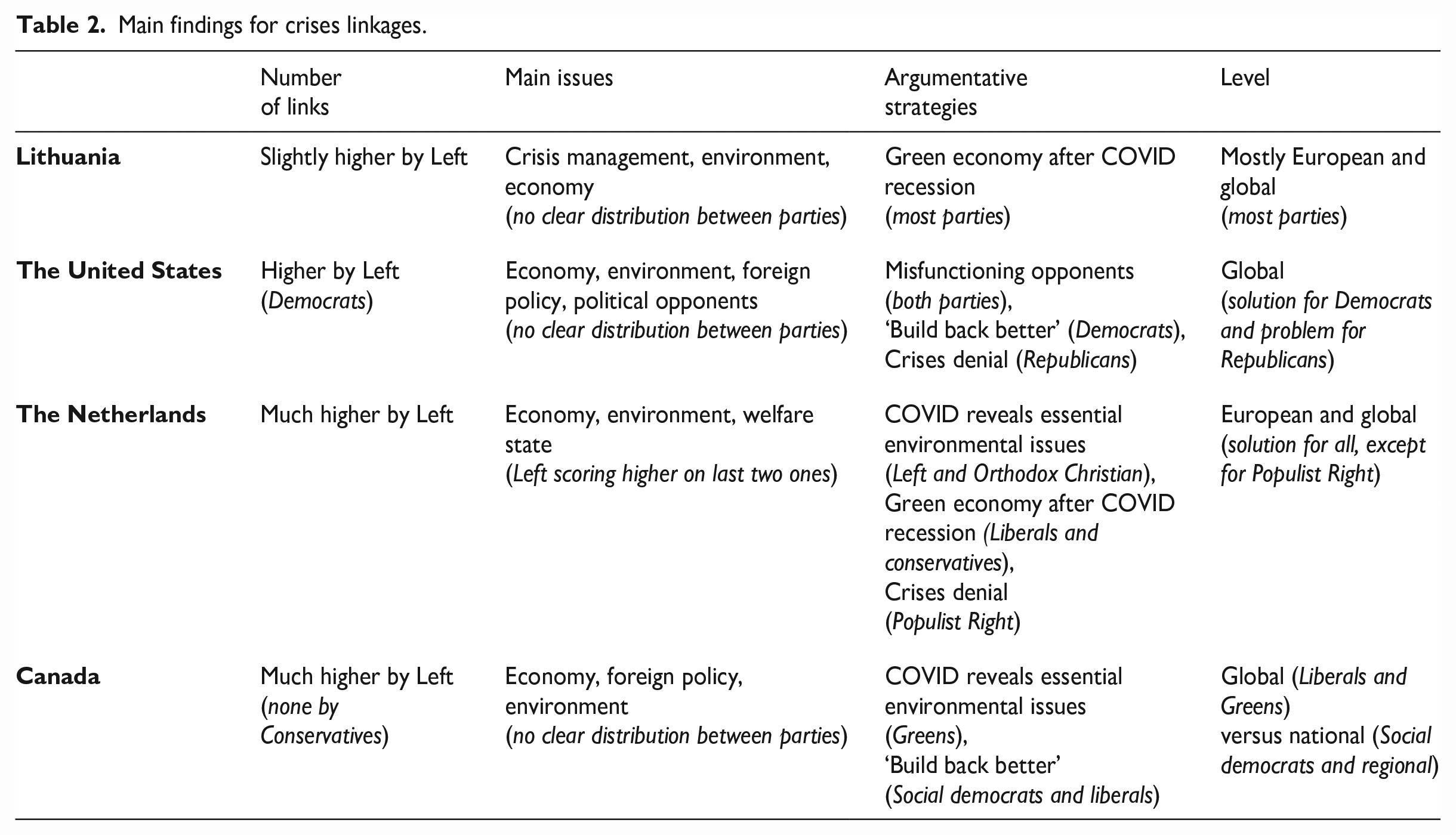
In all countries, we found that leftist parties more often linked both crises with each other than rightist ones (albeit the pattern is not so clear in Lithuania). This result might not be so surprising yet, given that we know that both the climate crisis and the COVID-19 crisis make for a better ‘fit’ with leftist agendas. Climate change has, to date, much more been a theme of the Left than of the Right (Farstad, 2018) and even though the pandemic is a newer phenomenon, it also seems that it has been ‘easier’ for leftist parties to mobilize some of their viewpoints (Rovny et al., 2022) around this crisis (e.g. health care issues, all sorts of social inequalities).
However, when it comes to the other dimensions we considered, we also found many similarities across the four countries. For instance, in all countries the issue of the economy was highly present in the crises linking, and issues such as the environment and foreign policy also came up frequently in each of them. Of course, not all issue associations in the four countries were the same, but the fact that these dominant ones were very similar is remarkable. This contradicts the idea from previous research, which often argues that issue associations in crises responses are usually quite different between national contexts (e.g. Fourcade, 2011; Hoffman and Durlak, 2018; van Dooremalen and Uitermark, 2021).
Also, when it comes to the argumentative strategies that were used to link the two crises we see that the cases resembled each other considerably. Not only were associative strategies used more often than symptomatic and causal/pragmatic ones (except for the Dutch case). We see – probably more interestingly – a lot of similarities in the actual contents of the strategies across the four countries. For instance, in both the Canadian case (New Democratic Party and Liberal Party) and the American one (Democrats), we found a causal argumentative strategy with the same name: ‘Building back better’. This type of reasoning was also present in the other two countries (albeit with different names). The idea in all cases was that the COVID-19 crisis created an economic crisis, which offered the opportunity to do a lot of things better, among others, building a greener economy. In various countries, several leftist parties (e.g. the Greens, Social Democrats and Animal Party in the Netherlands and the Greens in Canada) did not believe in this type of change. They argued that both the COVID-19 crisis and the climate crisis were symptomatic for the fact that there was something wrong with the entire existing capitalist system.
Many of the rightist parties in all four countries cared less about both crises. For those parties, there seemed to be two possible strategies. Either they did not link the COVID-19 and climate crises (as in: some of the parties in Canada and Lithuania) or they denied one or both of them (as in: the United States and the Netherlands). The American and Dutch radical right parties (Republicans, FvD, and PVV) claimed that all crisis responses that were proposed by ‘mainstream parties’ (Green Deals, lockdowns) were making things worse (especially the economic lives of ‘ordinary people’) instead of improving them. This type of associative argumentative strategy was then combined with a symptomatic strategy, in which these parties argued that crisis responses were symptomatic of a general failure of political elites to stay in touch with ‘the people’ (Bonikowski and Gidron, 2016; Sniečkutė, 2020). Again, all in all, the similarities across the cases are remarkable.
And even though we investigated national elections, meaning that they are (mainly) about the future of people living within a certain nation-state, we see that many crises linkages in each country were drawn on supra-national levels: the European/EU (Lithuania, the Netherlands) and/or the global (the United States, Canada, Lithuania, the Netherlands). For the Radical Right, European or global political institutions or policies (the EU, Green Deals, the IPCC, WTO, etc.) were regarded as a big problem which their countries should get rid of. For most other parties, these political levels were the exact locations where the main solutions to both crises (and their combination) could be found. This empirical result is interesting because previous research suggests that processes of ‘domestication’ (translating foreign affairs into matters of importance for a country’s domestic affairs) are often very dominant in relation to international crises (e.g. Alasuutari et al., 2013; Clausen, 2004; Olausson, 2014; van Dooremalen and Duyvendak, 2024).
Discussion
The general aim of our article is (1) to introduce the concept of ‘linking crises’, in order to better understand how crises are being created in co-construction with other crises and (2) to apply it to an interesting empirical case: connections between climate change and COVID-19 within election manifestos for national elections (2020–2021) in the United States, Canada, the Netherlands, and Lithuania. This empirical application indicated that there had been a lot of cross-national parity in how these crises were linked, which we consider a remarkable finding.
The case selection of our article might – of course – have impacted these outcomes. Choosing two such global crises as climate change and COVID-19 probably makes finding cross-national similarities more likely. Our four country cases are all located in North America and Europe. Thus, one could argue that since they are all part of the Global North, taking a wider research scope could have brought up more cross-national differences. Yet, other country comparative literature that has studied crisis responses within these two continents and looked at cases that also have global allure such as terrorism (van Dooremalen and Uitermark, 2021) and pollution (Fourcade, 2011) often came across variation too.
In any case, our findings certainly bring up the question why we found so much parity in the crisis linking. In the theory section, we referred to the phenomenon of party idea diffusion to hypothesize parity as a research outcome (e.g., Böhmelt et al., 2016; Börzel and Risse, 2022; Rydgren, 2005). We did not test the specific ideas that are put forward in this literature – e.g., that parties take over the ideas of other parties mostly when they are successful (Böhmelt et al., 2016) – so we cannot say whether it is really diffusion that drove our outcomes. However, we did find that various centre-left parties used the ‘Build back better’ trope. This might be a sign that parties looked at what their party ‘siblings’ were doing in other countries (Della Porta and Mattoni, 2014; Rydgren, 2005). Yet, many of the differences we found cross-nationally between Left and Right, such as that the Left most often connected the crises and that the Populist Right denied both of them, might also be an ideology effect rather than a direct product of diffusion. A leftist or rightist ideology often makes for different (crises) viewpoints, regardless of what siblings abroad are doing (Farstad, 2018; Rovny et al., 2022).
Though, that does still not explain why cross-national differences were less at play in our findings than in those from earlier research. It might be that this is due to the social contexts in which these two specific crises are constructed: international organizations (the WTO and the IPCC) and policies (COVID Recovery Funds or Green Deals) set very much the tone of what governments need to do in response to them. This could push political parties to draw links between the two crises on the European or global level or use issue associations and argumentative strategies that fit with how these organizations and policies are framing them. That mechanism even works for the crisis responses of nationalists, such as the Populist Right: these parties might not agree with international institutions or agreements, but they still have to discuss their frames, in order to criticize them.
Footnotes
Acknowledgements
Previous versions of this article were presented at the Annual Day of Dutch Sociology 2022, the Council for European Studies Conference 2022, the KU Leuven Cultural Sociology Seminar, and the James Coleman Symposium 2024. We thank the participants of these meetings (and in particular Galen Watts) for their helpful comments.
Declaration of conflicting interests
The authors declared no potential conflicts of interest with respect to the research, authorship, and/or publication of this article.
Funding
The authors disclosed receipt of the following financial support for the research, authorship, and/or publication of this article: This work was funded by a Marie Curie grant (project number 101066910) awarded to the first author.
