




Abstract
This article examines how newspaper coverage of inequality differs in Japan and South Korea, countries with comparable levels and nature of income inequality, but whose citizens maintain different attitudes toward it. Analyzing 18,630 articles in six major newspapers from 1990 to 2021, our analysis found (1) Japanese and South Korean newspapers report surprisingly little about inequality even in a period of growing inequality; (2) while South Korean newspapers significantly increased their coverage of within-country inequality in the 2010s, such a trend is not found in Japan; (3) progressive newspapers largely drive the increase in the coverage of inequality in South Korea. We also look closely into the four major topics within inequality coverage – income, employment, generation, and gender – to elaborate on qualitative differences in the ways inequality is discussed in newspapers in both societies. Our findings suggest that there exist nationally specific patterns of inequality coverage and offer important implications for the ongoing discussion about economic inequality in East Asia, as well as the literature on subjective inequality.
Introduction
In many advanced economies, the simultaneous increase in income and wealth inequality and decline in economic mobility is a central topic of concern among scholars, journalists, and politicians. This development also casts new light on the question of how people understand inequality and respond to it. Some scholars suggest that the growing inequality leads many to be deeply concerned about fairness in society and demand more rigorous redistributive policies (Franko and Witko, 2018). Meanwhile, others found that, though opportunities for upward mobility are in decline, many people still maintain optimistic attitudes toward making it or believe that they have made it (Berger and Engzell, 2020; Manza and Brooks, 2021) and citizens tend to underestimate the extent of inequality although there are important variations by class, gender, and political orientation (Kuziemko et al., 2015; Stantcheva, 2020). Furthermore, there are significant national differences in people’s understanding of inequality (Janmaat, 2013).
In explaining people’s understanding of inequality, many studies either tacitly or implicitly assume the central role of what cultural sociologist Michèle Lamont calls the cultural supply side: ‘the repertoires that individuals mobilize to make sense of their environment’ (Lamont et al., 2014: 583). Scholars suggest that accurate information about inequality has the potential to influence people’s belief about inequality, although there is considerable heterogeneity in the ways this potential manifests across demographic groups and different national contexts (Alesina et al., 2018; Diermeier et al., 2017; McCall et al., 2017; Mijs and Hoy, 2022). Scholars have examined how class inequality, meritocracy, and the ideal of the American Dream have been portrayed in various media, from popular music (Carbone and Mijs, 2022) to TV shows (Butsch, 2017) and how these portrayals can potentially affect people’s views of inequality (Kim, 2023). News media delivers content that is directly relevant to inequality. Greater and more critical coverage of inequality may affect citizens’ perceptions of it (Diermeier et al., 2017), but at the same time, the media may simply be following the public interest (Hopkins et al., 2017).
To this end, this article analyzes the newspaper coverage of inequality in two East Asian societies. Specifically, we ask how the newspaper coverage of inequality differs across time, types of newspapers, and two societies in the last three decades. We draw on an original analysis of 18,630 newspaper articles on inequality from 1990 to 2021. To our knowledge, this study is the first systematic comparative approach on this topic in East Asia. 1 While the existing studies explore news reporting in highly unequal societies such as the United States and China (e.g. Hirschman, 2021; McCall, 2013; Song, 2023), we know much less about the situation in more moderately unequal advanced economies. For example, the existing studies in the United States report the rise in reporting on inequality in the 2010s, but it is not clear whether this insight applies elsewhere. Furthermore, given the scarcity of comparative approaches in the literature, the comparison of Japan and South Korea, which share a number of features in the patterns and nature of inequality growth, has the potential to provide valuable insights into the nationally specific patterns of inequality coverage.
The steady growth of unstable employment and changing population structures are the central contributors to income inequality in both contexts (Kitao and Yamada, 2019; Kohara and Ohtake, 2014; Koo, 2019). Although the specific numbers differ depending on the measures scholars use (see Ohtake, 2008: 88–90), the extent of income inequality in both societies is roughly comparable. With the latest post-tax Gini coefficient standing at 0.331 in South Korea (2020) and 0.334 in Japan (2018) (OECD, 2023b), and the top 10% group holding 45% (Japan) and 47% (South Korea) of the total income share (Chancel et al., 2022: 207, 221), these are considered moderately unequal societies. Growth of inequality is said to have shifted societal discourse about inequality. The existing studies on people’s perception of inequality note South Korean citizens’ relatively critical attitudes toward inequality (Choi, 2013; Kim et al., 2018; but also see Kitsnik, 2023 who reported otherwise). In Japan, by contrast, researchers at OECD noted that ‘concern about income inequality is slightly lower than on OECD average, even though the actual level of inequality is higher’ based on the original survey (OECD, 2021). Comparing the ISSP 2009 data and the original survey data collected in 2018, Yeon Ju Lee (2018) noted that ‘although South Korea has much lower levels of income inequality than Japan, its perceived inequality is significantly higher than that of Japan’ (p. 9). Lee also notes that Japanese citizens’ perception of inequality dropped between 2009 and 2018 when the actual level of income inequality rose. The background of cross-national differences in people’s perception of inequality is complex and cannot be reduced to a single factor. 2 Meanwhile, as the existing studies highlight, it is sensible to hypothesize that media, at least in part, affects what people know about inequality. Examining such a possibility requires us to know what the media discusses about inequality in the first place. This is our goal.
News reporting of inequality
The existing studies in the United States suggest that the media portrayal of inequality is not a camera of objective levels of inequality. McCall (2013) shows that the reporting about inequality declined in number during the period of inequality growth. Thus, the author suggests the crucial importance of journalists – it is their own judgment and reading of public interest that determine whether certain issues pertaining to inequality are worthy of coverage (McCall, 2013: 88). Similarly, Matt Guardino (2019) suggested that media reporting of inequality is a political process in which journalistic norms and practices shape ‘whose views make the news’ (p. 29) and such norms and practices themselves are affected significantly by the changes in political and economic conditions in which the media industry is embedded. Beyond the decision of whether a particular topic deserves coverage, how to frame contested topics like inequality is also a question left to the hands of journalists. Popular beliefs attribute the causes of inequality to structural forces that go beyond one’s control or individual traits such as laziness, or bad luck (Kluegel and Smith, 1986; Lee et al., 1990). Concerningly, Epp and Jennings (2021)’s study of major US newspapers found the rise of what they call ‘personal-failure’ frames that attribute the cause of poverty to welfare recipients’ personal characteristics in times of growing inequality, and this shift can predict declining support for welfare spending even among those who might benefit from more rigorous redistribution policies.
In this study, we expect that the newspaper coverage of inequality-related issues diverges across time, types of newspapers, and societies. First, the coverage of inequality might not be constant over time. The existing studies in the United States found an increase in inequality reporting in the 2010s. This change reflects such events as the Occupy Wall Street movement that successfully garnered attention to the super-rich (Baumann and Majeed, 2020; Gaby and Caren, 2016) and the publication of Capital in the Twenty-First Century, the French economist Thomas Piketty (2014)’s magnum opus. Daniel Hirschman (2021) attributes the increasing public attention to extremely rich individuals to the shift in what he calls knowledge infrastructures. Accordingly, the dominant knowledge infrastructures of twentieth-century economics drew heavily on surveys and could not detect changes in top incomes. The public discourse mirrored this omission. It was only much later that new evidence that emerged in economics altered public discourse about inequality. All these events had impacts that went beyond the borders of nation-states. Hence, we expect that inequality reporting has been on the rise both in Japan and South Korea in the 2010s.
Second, different types of newspapers face different challenges in reporting inequality. For example, Xi Song (2023)’s study in China, where the critical portrayal of social issues is subjected to state censorship, found that state-owned media is less likely to report inequality than marketed media, and even if they do, the coverage touches less on educational and economic inequality. Furthermore, newspapers might have their own political imperatives. Bohr (2020)’s study of 52 newspapers in the United States revealed that liberal newspapers report more frequently on the impacts of climate change than conservative papers. We expect conservative and business-oriented media outlets that emphasize economic growth to be less likely to report on inequality than progressive papers.
Third, because journalistic fields are grounded in political, legal, and cultural constraints at the national level (Benson and Neveu, 2005: 11), we can expect that there is a cross-national variation in journalistic reporting. Indeed, newspaper coverage of various topics, from immigration to criticisms of the government, differs across country (Baumann and Majeed, 2020; Bloemraad et al., 2015) and region (Lei, 2016). Whether this insight also applies to the case of economic inequality is an empirical question. Identifying the source of cross-national differences goes beyond the limited scope of this article, but different political dynamics of different societies might affect newspapers’ coverage of inequality. For example, in contexts where competition between different parties is intense, various social issues, including inequality, may be more likely brought up by political elites to accuse their foes, especially during major elections. Furthermore, the history of popular contention might define the repertoire of expression to problematize social ills that affect journalists’ decisions to cover certain issues. In our comparison, Japan can be characterized by the strong dominance of a single party and a relatively low level of citizens’ participation in protest activities at the national level compared with other countries at least between the 1970s and the 2000s (Higuchi, 2021: 183–184), and South Korea represents intense party competition and a contentious civil society (Koo, 1993; Lee, 2022). In Japan, the conservative Liberal Democratic Party has been in power since 1955 except for a few brief interruptions in the early 1990s and the late 2000s. The images of mass protest movements of the 1960s and 1970s were characterized by terrorism and left collective trauma among citizens (Steinhoff, 2013). By contrast, South Korea’s democratization in 1987 largely owes to popular resistance against the authoritative government, and since then, several waves of protests have filled the streets of the country intermittently (Lee, 2022: Chapter 1). Most recently, a spectacular nationwide protest in 2016–2017 compelled the government to oust President Park Geun-Hye, who was at the heart of a massive corruption scandal. South Korea has had a de-facto two-party system where conservative and progressive parties compete, and the party in power has changed every 5 to 10 years since democratization. From here, we expect inequality reporting to be more active in South Korea than in Japan.
Context of Japan and South Korea
Several similarities concerning inequality make these two societies an exemplary pair for comparative analysis. Both societies represent model cases of economic development, rising from the total devastation after WWII and the Korean War to the world’s most prosperous economies in a short period. In times of condensed economic development, income inequality has declined, and by the mid-1980s, two-thirds of citizens in South Korea and about 70% of citizens in Japan believed themselves to be part of the middle class (Hommerich and Kikkawa, 2019: 13; Koo, 2008: 1). Nevertheless, this process also left the features common to both societies that shaped deep economic divides among citizens. Both economies are heavily centered on large companies, which serve as their social protection systems. Workers of large corporations and their family members are well protected while others are not, and support from family supplements the lack of strong welfare states. Since the 1980s, irregular employment has increased drastically and curved the division between relatively well-off white-collar workers and the new insecure group who struggle to make ends meet. Such trends have been particularly acute after the collapse of the financial bubble and decades of the economic recession that followed in Japan, and the Asian Financial Crisis and subsequent International Monetary Fund (IMF) bailout in South Korea (Ishida and Slater, 2010; Koo, 2008; Shin and Kong, 2014).
Some major aspects of inequality – employment, generation, and gender – are seen to be contributing to the overall level of income inequality. As noted earlier, social scientists in both societies spent much ink on the remarkable rise of precarious work based on a temporary contract in which workers, instead of employers or the government, bear the risks of employment (Kalleberg, 2018: 14). From 1982 to 2015, the proportion of non-regular workers increased from 15% to 38% in Japan (Gordon, 2017: 9). In South Korea, scholars disagree with the definition of ‘non-regular’ workers used in the government statistics, but even according to the government’s conservative statistics, more than one in three working persons hold such employment (Koo, 2019: 5). These workers are typically paid much less than regular employees and excluded from various benefits of the employment. In South Korea, for example, non-regular workers earn only about half of the average monthly wages of regular workers, just 46% of non-regular workers are covered by health insurance, and only 43% have employment insurance (KLSI, 2020: 14, 24). While the large gap in wages and benefits of workers at large and small-to-medium enterprises is a long-standing trend in both societies, in the last three decades, this dual structure has been overlaid by the stark divide between regular and non-regular workers (Gordon, 2017; Koo, 2019).
Generation is another frequently discussed aspect of inequality. Scholars suggest that the growth of precarious employment is particularly pronounced among the young, the elderly, and women (Koo, 2019: 6; Song, 2018), while some caution against placing too much emphasis on generation (Taromaru, 2017: Chapter 1). In rapidly aging Japan, economists argue that the growing elderly population is the central driver of overall growth in income inequality (Ohtake, 2008), and some in South Korea also make similar arguments (Song, 2018). In South Korea, Cheol-sung Lee (2019) argues that while the gains from the economic development of the 1980s and 1990s concentrated on those who were in their 30s and 40s at the time (often referred to as the 386 generation), the economic crises after the late 1990s impacted those who were in their 20s and 50s most severely, thereby leading to the significant rise in intergenerational inequality.
Finally, both societies are notorious for the worst level of gender inequality among advanced economies (for the major index of gender equality, please see The Economist, 2023; World Economic Forum, 2022). While the gap has been decreasing for years, 54% of non-regular workers in Japan were women in 2020 (Gender Equality Bureau Cabinet Office, 2021), and the same goes for South Korea in 2019 (KLSI, 2020). With the gender pay gap – the difference in median earnings of male and female workers – of 31% (South Korea) and 22% (Japan), these societies have the most gender-unequal labor markets in the advanced economies (the OECD average is 12%) (OECD, 2023a), and only about 13.3% and 15.7% of managers are women. Women are also severely underrepresented in positions of power, such as politicians (19% of Korean and 10% of Japanese national assembly members are women in 2022).
As the time of shared prosperity fades away, new discourses on inequality are believed to have caught public attention in both societies since the late 1990s (Chiavacci, 2008; Koo, 2019). In Japan, a few influential books penned by social scientists popularized the idea that Japan is a ‘gap society’ (kakusa shakai), denoting increasing economic polarization (Sato, 2000; Tachibanaki, 1998), and the term was chosen as one of the top 10 buzzwords of the year in 2006. In South Korea, economic polarization, ‘yangukhwa’, became the keyword in discussion concerning inequality (Kim, 2009), and a number of folklore theories described the unequal structure of opportunities in the country (Kang and Jueng, 2017; Kim and Han, 2019). Thus, there might have been a rise in the public discussion of inequality of various sorts in both societies. In this context, our interest lies in empirically exploring whether and to what extent news media convey the facts of inequality to citizens. Although the analysis of newspapers is not absent in Japan (Kanbayashi, 2012; Shimazaki et al., 2010) and South Korea (Ho and Kim, 2006; Kim, 2009; Kim and Han, 2019; Lee and Song, 2022; Youn, 2003), the existing studies tend to focus on certain topics within inequality debates such as welfare recipients (Horie, 2018; Nakamura, 2016), gender (Park et al., 2010), health inequalities (Kang, 2023), or youth (Kwak and Ryoo, 2021) and generally cover only a short time period. Our approach departs from the existing study by covering a longer time frame and developing a more comprehensive approach. Furthermore, this study is among the first systematic comparative research on this topic in East Asia.
Data and method
Data
We created a data set of all articles that contain the term ‘inequality’ in either the title or main text from three major newspapers in both societies for the period of 1990 to 2021. After removing the articles that appear in the online database multiple times under the same title, our data contains information from 13,691 articles in South Korea and 4,939 articles in Japan. Table 1 summarizes the characteristics of our data. The discrepancy in the number of articles in Japan and South Korea partially owes to the overall increase in the number of articles Korean newspapers published in the 2010s and 2020s, but also reflects the dramatic rise in inequality reporting in South Korea in the same period, which we will discuss in the findings section.
Characteristics of newspapers and number of articles used in analysis.
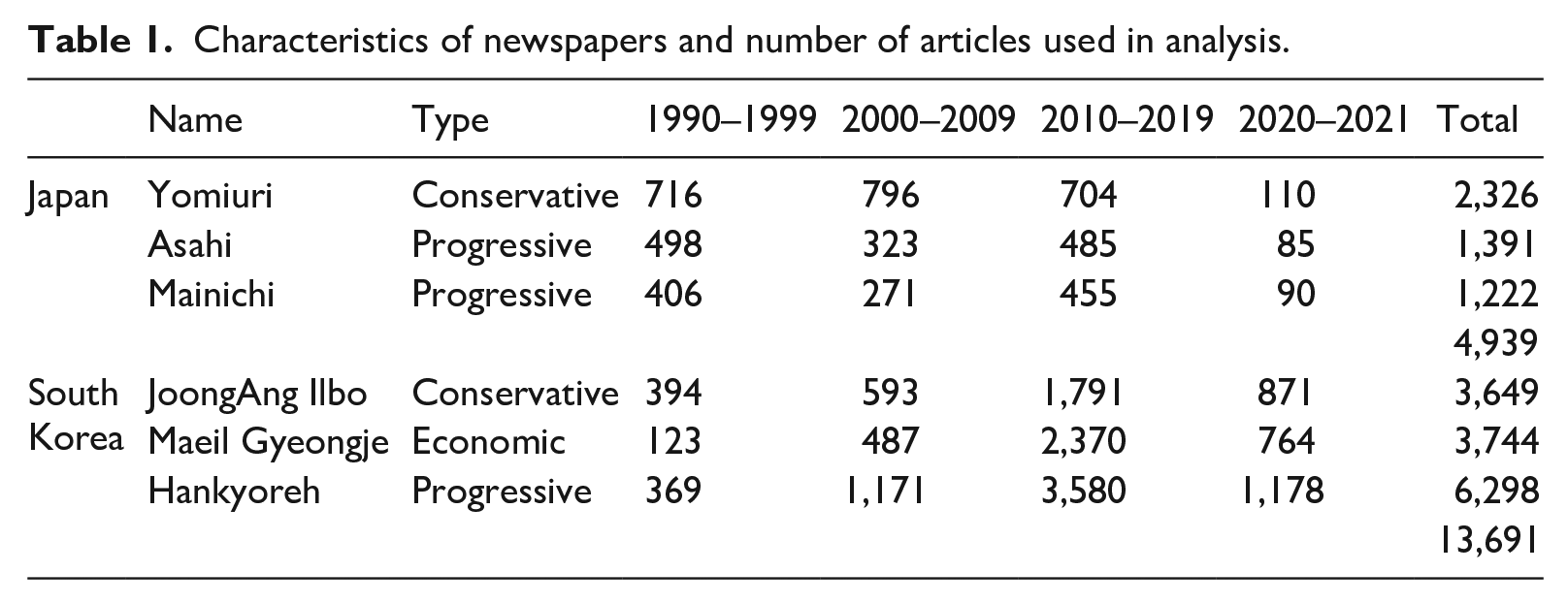
Because we expect that the political orientation of news media outlets affects the coverage of certain topics, and due to time and budget constraints, we focus on three major progressive and conservative newspapers in each country. In South Korea’s media landscape, there are seven dominant newspapers at the national level. Among them, the three most widely circulated papers (Chosun Ilbo, Dong-A Ilbo, and JoongAng Ilbo) are seen to be conservative in political orientation, followed by a few economic papers (Maeil Gyeongje and Hanguk Gyeongje), and progressive papers (Hankyoreh and Kyunghyang). Because some papers were unavailable via the online database, we decided to focus on the three papers – JoongAng Ilbo, Maeil Gyeongje, and Hankyoreh – representing each political spectrum. In Japan, there are three newspapers that are by far the most dominant nationally, including Yomiuri Shimbun (conservative), Asahi Shimbun, and Mainichi Shimbun (progressive), followed by the economic paper Nihon Keizai Shimbun. The inclusion of an economic paper was a sensible strategy, but the main texts of Nihon Keizai were not available to us, so we focused on the three major newspapers. Due to the availability of the data, we limited our analysis to the articles published between 1990 to 2021. We included the year 2021, considering the possibility that the COVID-19 pandemic brought significant changes to the inequality reporting in both societies. We obtained all article information from Big Kinds, an online archive of newspapers operated by the Korea Press Foundation, or individual newspaper archives.
We deliberately chose to use a broader keyword to capture heterogeneity in the media coverage of inequality in different contexts and its changes over time. Creating a data set with a focus on only a particular aspect of inequality makes it difficult for us to explore the diversity in how ‘inequality’ is discussed by journalists in two different contexts. Hence, we first make a broader corpus of articles using the broad term ‘inequality’, and code them into different dimensions of inequality. We limited our analysis to ‘politics’, ‘economy’, and ‘society’ sections of each newspaper and did not include ‘international’ sections. In both societies, the inequality debates after the 2000s rendered particular vocabularies salient. In Japan, the word kakusa (disparity or gap) came to represent the debate, and in South Korea, yangukhwa (polarization). Hence, we also collected articles related to kakusa and yangukhwa to see the overall pattern of changes (not included in the present analysis). The term inequality was broad enough to include enough numbers of articles that also use these words in the title or main text.
Analytical approach
We hand-coded all articles into a set of 19 coding categories based on our close reading of the title. We also read the main text when necessary. Chart 1 summarizes the distribution of these coding categories. Based on our reading of hundreds of sample articles from the corpus and our knowledge about salient topics in the discussion about inequality in both societies, we created coding categories and associated themes within each category. While most coding categories, such as income inequality, employment, and gender, can be understood intuitively, a few categories merit an explanation. As Chart 1 shows, a substantial proportion of articles belong to the ‘global inequality’ category. This category includes articles that broadly cover inequality between one country and another (quite typically between Japan or Korea and the United States). This is despite the fact that we did not include articles that appeared in the international section. The ‘politics/election’ category is another major category that not only includes articles about various within-country inequalities brought up in the periods of major elections but also inequality in political representation, especially in Japan, where there exists the long-standing problem that one vote carries different weights depending on the electoral district often called the ‘wide vote-value disparity (ippyō no kakusa) problem’.
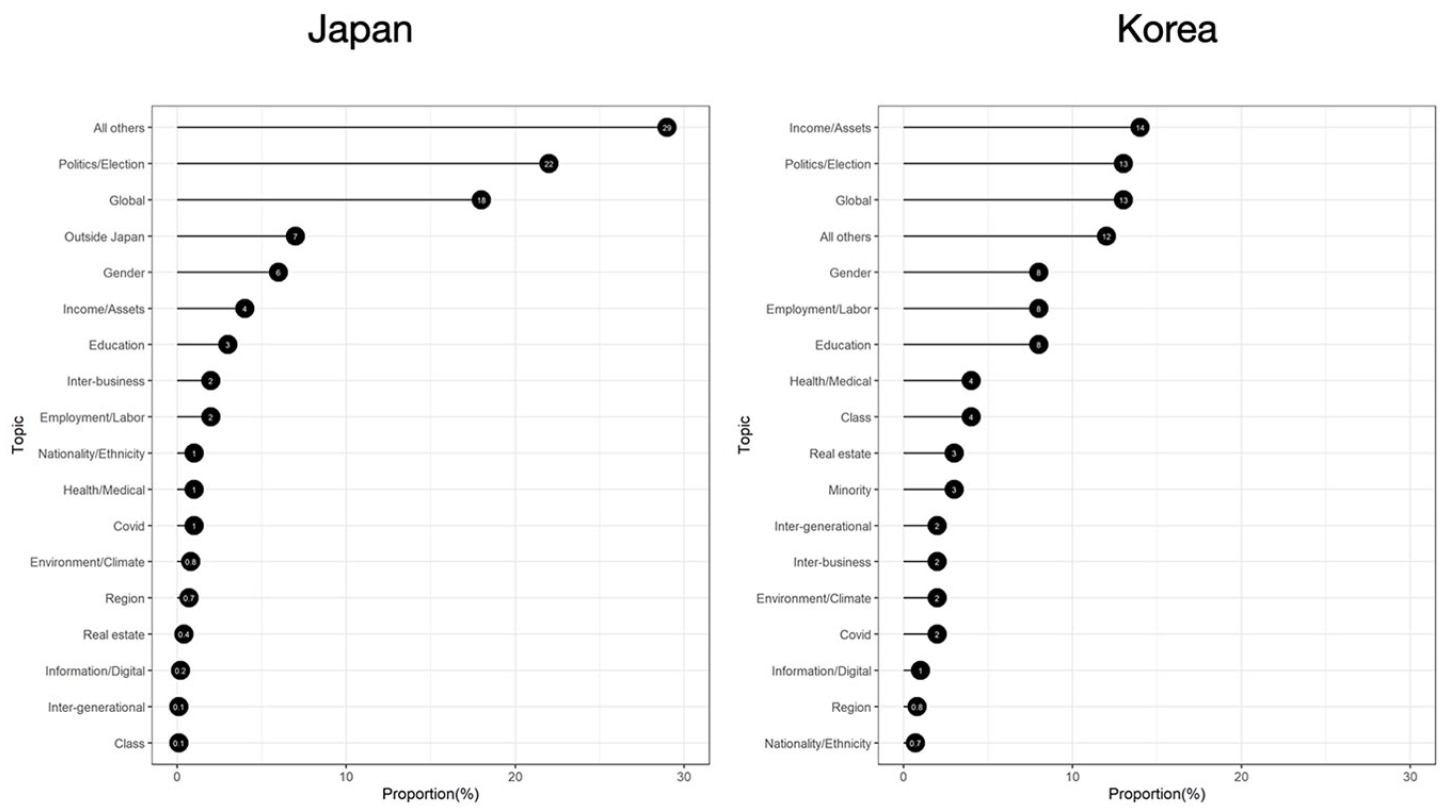
Distribution of coding categories.
The first author (a native user of Japanese and proficient in Korean) coded articles in the Japan data, and the second author (a native user of Korean and proficient in Japanese) did so for the South Korea data using Microsoft Access. After each author finished coding, they switched roles and checked all the coding done by the other author. When there is a discrepancy between the first and second authors’ opinions on a particular article’s coding category, they deliberated to determine the final code, but overall, such instances were very rare, and we are confident that coding is done systematically and consistently across the Japan and South Korea data. To further elucidate our findings, using the content analysis software KH coder, we explored the most frequently discussed keywords in each of the coding categories by time period. In this process, the number of articles in Japan dropped to 4,832 because newspapers did not make the main text of some articles available. Finally, we closely read the main texts of the articles randomly drawn from each coding category to gain a fuller understanding of their contents. In what follows, we first present our findings on the overall trends of differences in inequality reporting across time, types of newspapers, and two societies. Then, the analysis will zoom into the four major categories – income, employment, generation, and gender – that are identified to be among the most salient aspects of inequality in both societies by scholars.
Findings
Newspapers report little about inequality
Chart 2 shows the overall changes in inequality reporting. With the digitalization of news media outlets, the number of articles newspapers publish each year has increased, so the chart shows the proportion of articles related to inequality relative to all articles published that year but not the simple count of articles. This chart reveals two interesting findings. First, even in times of growing inequality, newspapers in both societies report little about inequality, with less than 1% of articles covering topics concerning inequality. This trend is consistent even when we look at the local terms frequently used to denote inequality – kakusa and yangukhwa. Second, Korean newspapers report slightly more often about inequality, and this difference is pronounced after the year 2013. In 2010, only 0.15% (308 articles) of Korean articles were related to inequality, but the rate rose to 0.9% (1,723 articles) in 2021, whereas the level of inequality reporting has been constant in Japan. We can observe a significant rise in the number of inequality-related articles in Korea, but not in Japan. This finding confirms the idea that there are nationally specific patterns of inequality reporting.
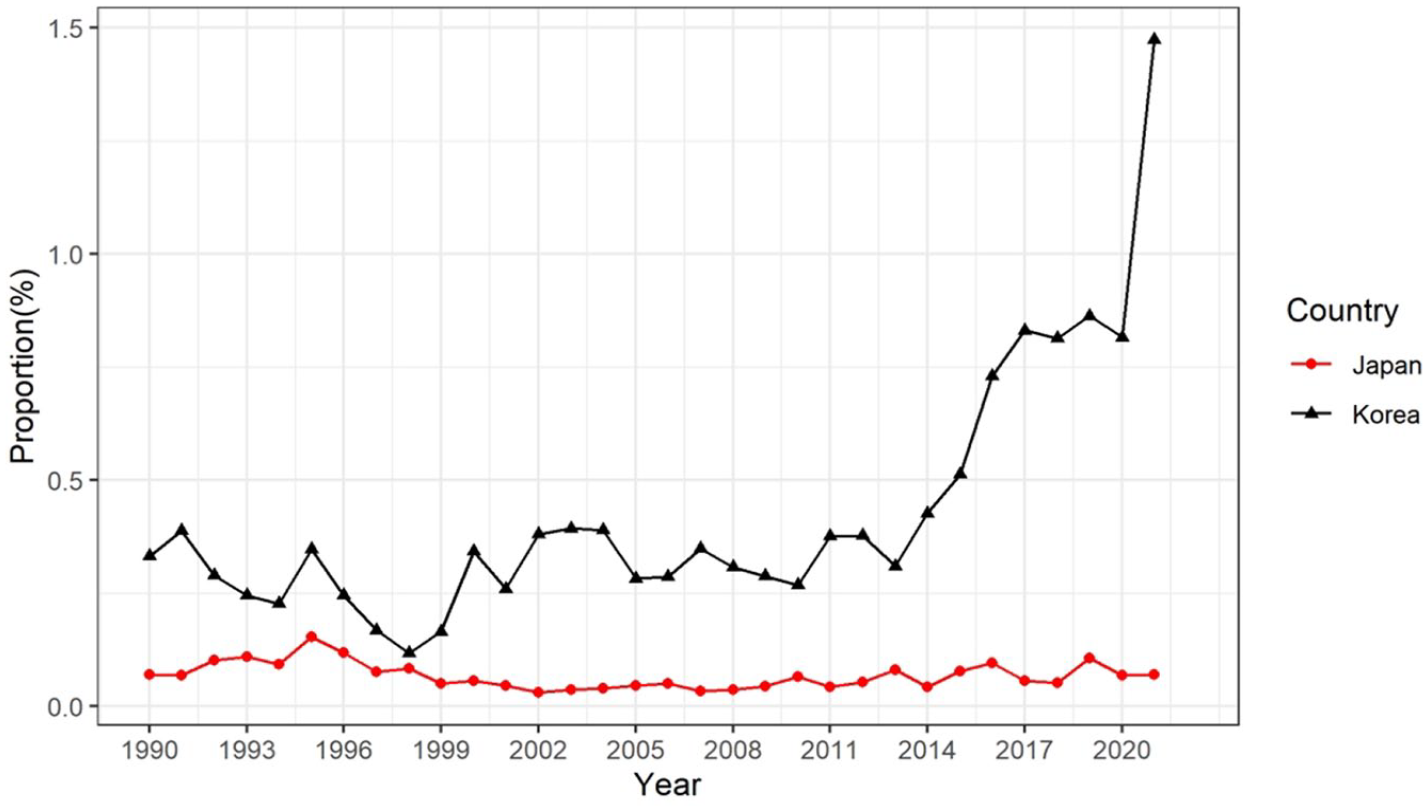
Yearly news media attention to inequality.
Progressive newspaper(s) drove the increase
We expected that progressive papers in both societies (Asahi and Mainichi in Japan and Hankyoreh in Korea) report more often about inequality. Chart 3 showing the breakdown by newspapers suggests that this is the case. Meanwhile, Japanese newspapers, regardless of political orientation, tend to report little about inequality, so even Asahi, the newspaper that covers inequality most often in Japan, reports only as much as JoongAng, one of the three most conservative papers in Korea. The progressive paper Hankyoreh largely drove the rise in inequality reporting in 2010s Korea. Only less than 0.2% of all articles in Hankyoreh were related to inequality in 1990, but the rate rose to 2.7% in 2021. Between 1990 to 2000, Hankyoreh produced only 40 inequality-related articles a year on average, and many of these articles concerned human rights issues related to labor, women, and disabled people. By contrast, Hankyoreh published 460 articles a year on average between 2014 to 2021. Many of these articles discuss within-country economic inequality. Overall, it is not that all newspapers have uniformly become sensitive to inequality. This implies the possibility that inequality seems to have become a more politically charged issue in South Korea in recent years, against which progressive and conservative papers take different stances.
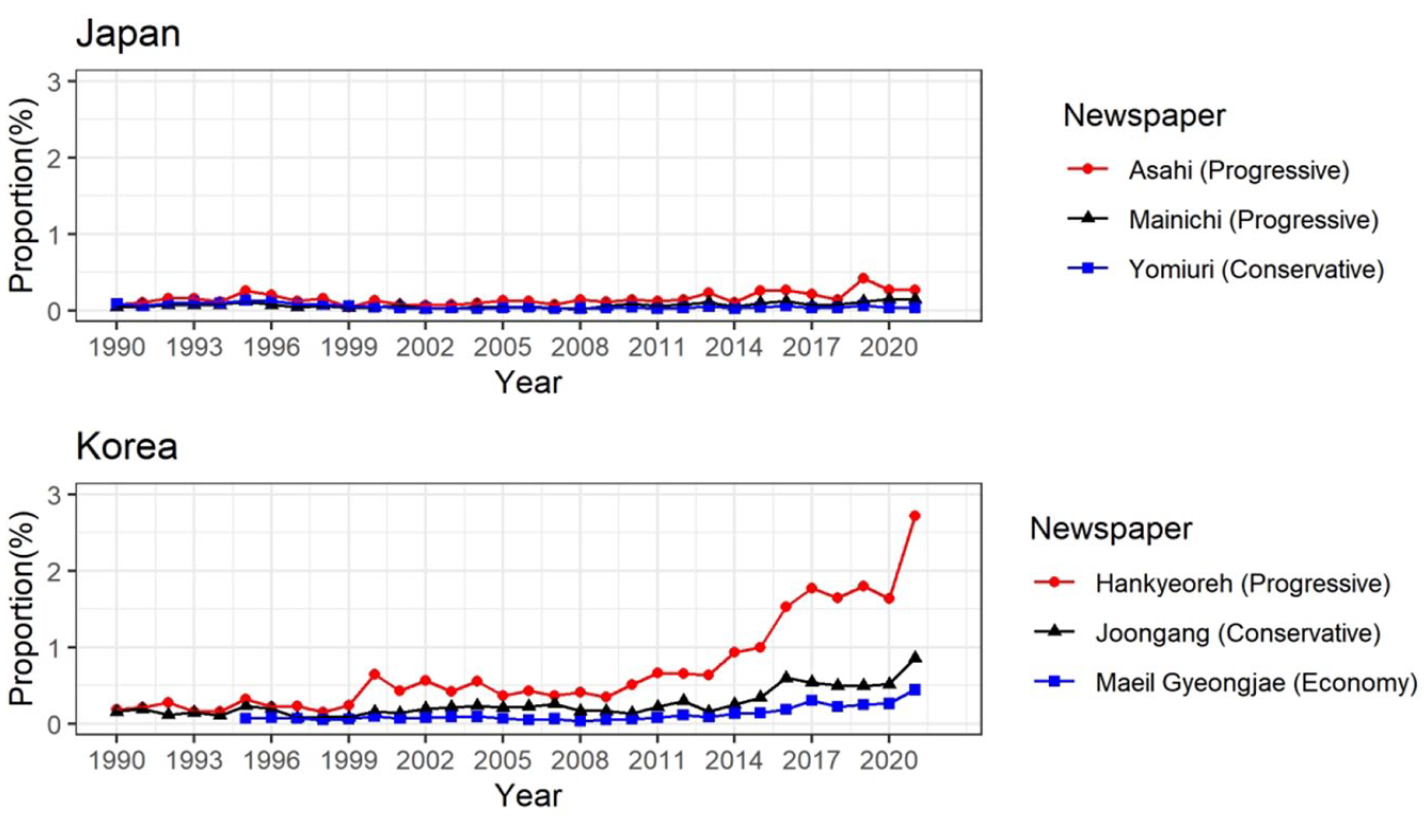
The proportion of ‘inequality’ articles by newspapers.
Elaboration of cross-national differences
What drives the changes in inequality reporting in South Korea but not in Japan? Chart 4 shows the top 10 most covered topics between 1990 to 2021. This chart suggests that the topics most often covered during the 1990s and 2000s in Japanese and South Korean newspapers were similar. Journalists seemed to be deeply concerned about the global inequality. For instance, both Japan and South Korea hold security treaties with the United States, allowing the US military to be stationed in the country. The unequal nature of these treaties, such as the US military service members’ exemption from the jurisdiction of local law, made headlines from time to time. Such events as the murder of a bar employee by a US soldier in 1992 and a hit-and-run incident resulting in the death of two Koreans in 2002 as well as the horrific incident in which three US soldiers raped a 12-year-old Okinawan girl in 1995 contributed to reporting about the global inequality. However, during the 2010s, the topics that social scientists in both societies identified to be central to the discussion of inequality – income, employment, generation, and gender – made their way to newspaper pages in South Korea, but this trend cannot be observed in Japan. To elaborate on this point, we now turn to the pattern of changes in coverage of these four topics.
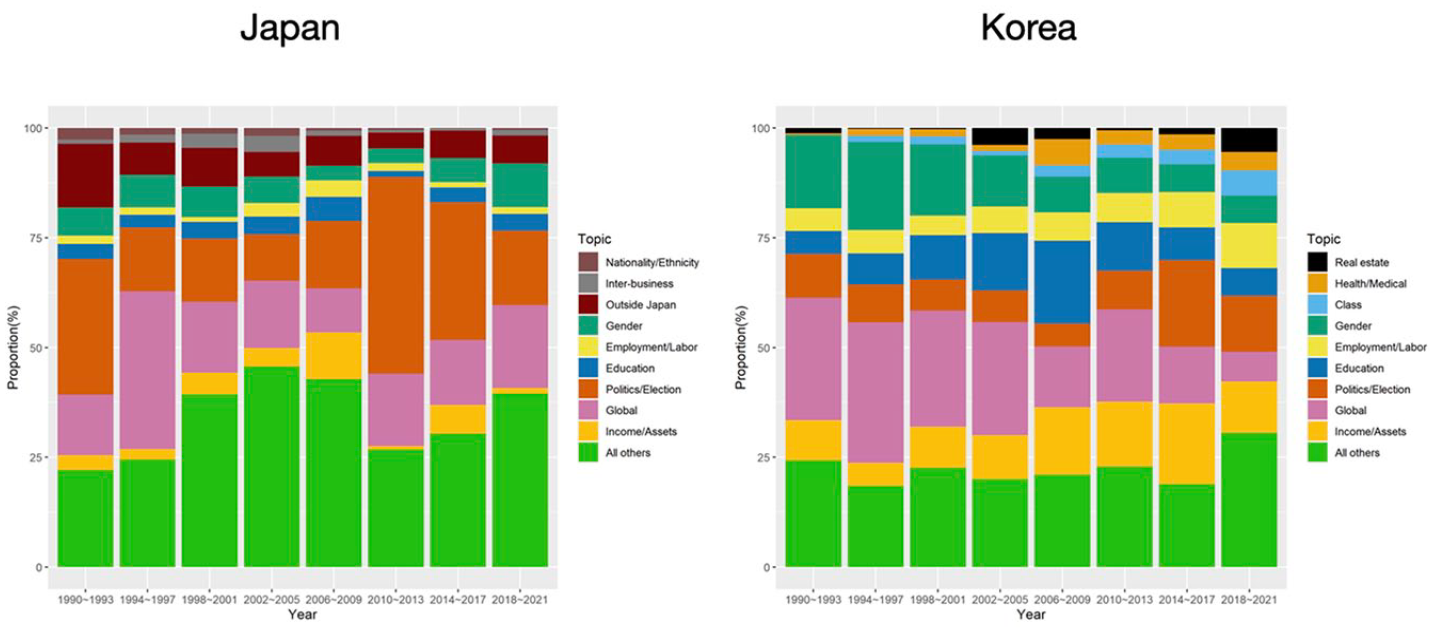
The main topics present in ‘inequality’ articles.
Income and wealth
Between 1990 to 1999, Japanese newspapers published only 53 articles on income and wealth inequality, but the number nearly doubled in 2000–2009 when the term gap society (kakusa shakai) gained traction. In this period, the then-Koizumi administration took on wide-ranging labor market flexibilization measures, which also contributed to the increasing attention to income inequality. Although articles generally noted an increase in income and wealth inequality, their tone remains ambiguous as journalists often cite both ‘pros’ and ‘cons’ of growing income inequality. For example, an article by progressive Mainichi cited a comment by a specialist arguing that ‘Japanese society will suffer irreparable deterioration in 10 years’, including the increase in the number of crimes due to rising inequality but then introduces comments by an economist who argues that ‘there is too little inequality compared to the class society before the war [WWII]’ and that more income inequality is needed to enhance people’s working motivations (December 30, 2005). From the Japan data, we could not find clear evidence that progressive papers are more critical toward income inequality than conservative ones. This ‘boom’ in inequality coverage faded away relatively quickly, and the number of articles remained low until the publication of Thomas Piketty’s Capital in the 21st Century rekindled the debate in the mid-2010s.
In Korea too, there were only 77 articles on this topic in the 1990s. Such events as the Chijon Family incident (1993–1994), in which a crime group kidnapped and murdered the people listed in the client list of a fancy department store out of their hostility to the rich, sporadically caught journalists’ attention on income inequality, but it was after the 1997 financial crisis that they started devoting concerted efforts to framing South Korea’s redistribution system as inadequate. The coverage of income inequality increased steadily from 279 in 2000–2009 to 1,387 in 2010–2019. Journalists emphasized the extent of income inequality and the lack of support for low-income groups as a particular social ill in South Korean society. Even the economic paper Maeil Gyeongje showed concern. ‘From international standards, the amount of investment in Korea’s social safety net is too small to cope with the upcoming serious crisis’ (Maeil Gyeongje, December 31, 2008). Likewise, Hankyoreh used the term ‘polarization’ to denote the situation where many suffer despite Korea’s GDP per capita reaching a record high in that year; ‘expanding Korea’s overall wealth does not improve individual finances. This is due to polarization’ (Hankyoreh, December 12, 2010). As in Japan, the increase in income and wealth inequality coverage partially owes to Capital in the 21st Century (the term ‘Piketty’ appeared 253 times after the publication of the book), but other domestic factors such as the vast political scandals that erupted in Korea in 2016 are also crucial in explaining this shift.
Employment
As you can see in Chart 5, the number of articles related to employment in Japan has been stable for the last three decades (45 from 1990 to 1999, 48 from 2000 to 2009, and 35 from 2010 to 2019). Many of these articles concern gender inequality in the workplace, and roughly one in three articles in the employment category are also included in the ‘gender’ category. This is not surprising given the stark gender inequality in the Japanese labor market. In the 2000s and 2010s, there were also articles that discussed the negative aspects of the so-called Japanese style management system characterized by seniority-based wages and lifetime employment. What is surprising is that newspapers do not report much about irregular employment even though the proportion of such workers increased from one in five of all workers to more than one in three in the period covered here. We also found that, besides some exceptions, such as Yomiuri’s serial articles that focus on the hardship of women with irregular employment during the COVID-19 pandemic (December 15, 2021), in-depth investigative articles on this topic are lacking.
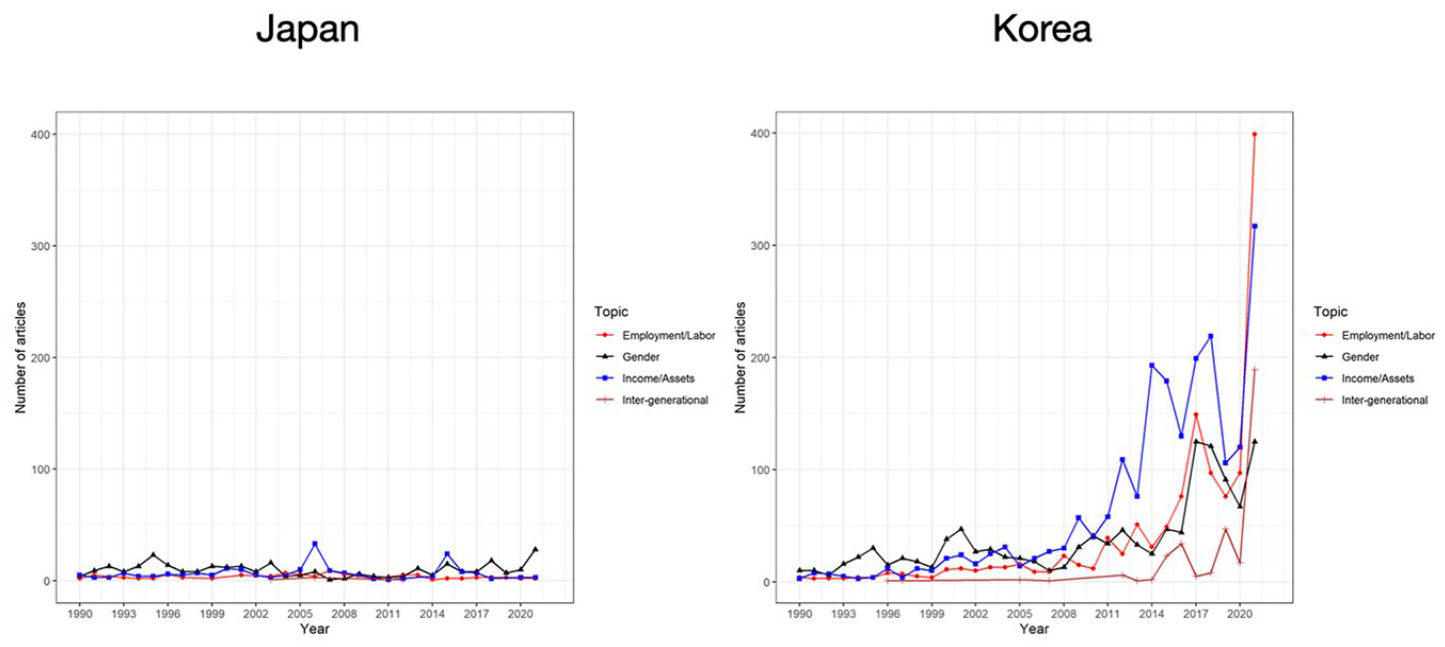
The number of newspaper articles in the four major categories.
In South Korea too, the focus of attention in the employment category was on gender inequality and discrimination before the 2000s. For example, by pointing to the prevalent practice back then that employers specified desired women’s (but not men’s) appearance in the job description, Hankyoreh denounced the prosecutors who did not press charges against the company, which officially stated that ‘they would only interview women with a height of more than 160 cm and a weight of less than 50 kg’ (December 8, 1994). Although the flexibilization of employment has been underway since the 1980s, it was in the mid-2000s that journalists started intensively covering the drastic increase in unstable employment and detailed its undesirable working conditions. Hankyoreh reported the situation of temp workers at a large discount store and argued that ‘temp worker contracts are illegal “slave contracts”’ (April 17, 2006). Furthermore, several years after the introduction of the Employment Permit System in 2004, which allows the employment of blue-collar migrant workers, Hankyoreh also devoted serious attention to the rampant human rights violation these workers experienced. The reporting of this sort continued to rise, but since the mid-2010s, the newspapers increasingly pointed to two kinds of conflicts. One is between regular workers and irregular workers. Even the economic paper Maeil Gyeongje, which is generally not critical of removing the labor market rigidity, criticized Korea General Motors for dismissing irregular workers but none of the regular workers as they shrunk their factory. ‘Once an individual is a regular employee, then that person will be a regular employee forever. It is nothing other than a caste system’ (November 11, 2019). The other is the nexus of employment and intergenerational inequality, with its focus on the precarious livelihood of the young. We now turn to this dimension.
Generation
Existing studies on inequality in Japan identified population aging as one of the main drivers of growth in income inequality, and there is no shortage of research highlighting the hardship experienced by the young, so-called ‘ice-age generation’ who entered the labor market after the collapse of Japan’s ‘bubble economy’. However, this topic is virtually absent from our Japan data, with only 10 articles appearing in the last three decades. These articles do suggest that there exists inequality ‘between generations’, and one article noted that 91% of the young and 78% of the old generations answered their survey that the younger generations are disadvantaged (Yomiuri, October 6, 2012), but somehow the coverage of this topic is quite limited overall.
Like in Japan, there were only three articles related to the inequality between generations in South Korea from 1990 to 1999, and 11 between 2000 and 2009, but the number rose to 222 in 2010–2019 and 101 in just 2 years between 2020 and 2021. Many articles in the earlier period were concerned with the intergenerational reproduction of inequality through education. The framing of the issue took a different turn in the mid-2010s. Articles that emphasize the misery of the young grew exponentially, and a number of new buzzwords have been invented to describe the challenges this generation faces. The latest twist to this discussion is that the young people’s discontent is increasingly framed as an issue of generational conflicts between the older so-called 386 generations, who are deemed to be monopolizing power, and the younger generation. In a long interview article with the sociologist Cheol-sung Lee, Hankyoreh calls for justice between generations citing his comments; ‘If the employment rate [among the young] and fertility rate continue to fall without solving this problem now, the children of the 386 generation will suffer from the pain of having to feed a huge elderly population’ (August 11, 2019).
Gender
Despite, or probably because of, these two countries’ notoriety in the wide gender gap, discussion about gender inequality has been constantly brought up by newspapers in both countries. In total, there were 309 articles related to gender inequality in Japan and 1,216 articles in South Korea. Besides discrimination in the workplace, one persistent gender-related topic in Japan is marriage with separate surnames (fufu bessei) – Japanese law mandates either bride or groom change their surname when they enter marriage. In 95% of all marriages, women do so with the pain of a nightmarish amount of paperwork. This law remains unchanged despite the strong support for separate surnames among citizens. In an article published in 1991, conservative Yomiuri Shimbun argued that ‘there is not enough discussion done’ on this topic, while their own public opinion survey found the majority of respondents in their 20s and 30s support separate surnames (June 26, 1991). Thirty years later, they still argue that there is merit in upholding the same surname system and urged politicians to ‘further deepen the discussion’ on this topic (June 24, 2021). The findings from the Japan data are a bitter reminder of how little has changed in the discourse surrounding gender equality.
Among a total of 199 articles about gender from 1990 to 2000 in Korea, many point to the need for the abolition of a discriminatory family registration system (hojuje), which allows only men to be household heads. After the constitutional court’s ruling that the law was unconstitutional in 2005, this provision was removed. After a period of low reporting on gender inequality, gender-related articles saw a surge in late 2010s Korea, this time because of the 2016 murder case in Seoul’s Gangnam Station. A 34-year-old man killed a woman in the bathroom of one of the busiest stations in the country and later confessed that his act was because ‘women usually neglect him’. His statement was perceived as a symbolic manifestation of misogyny in Korean society. While women’s and feminist movements called to protect women’s security, a few online-based ‘male organizations’ demanded ‘not to treat men like criminals’. Along with this trend, feminism became a topic of concern for both progressive and conservative papers and the famous feminist online community ‘WOMAD’ appeared 103 times. The different visions of equality this issue provoked remain at the heart of the discussion about inequality in South Korea today and are different from the gender inequality issues in the 1990s as well as those Japanese newspapers cover.
Summary
Overall, our analysis indicates that inequality became a shared topic of concern among both progressive and conservative political camps in South Korea. In turn, both camps criticized each other for the growth in domestic inequality. The country’s massive candlelight protests in 2016–2017, which eventually pressured the National Assembly to impeach Park Geun-hye, also might have contributed to the politicization of inequality. In one article, Park Won-soon, a human rights lawyer-turned-Seoul Mayor, argued, ‘I believe that the candlelight civic revolution will be an energy that fundamentally solves inequality (. . .) We will make new changes with great Korean citizens’ (Hankyoreh, March 30, 2017). Conservatives bite back by pointing out that progressive politicians abuse their power. Accordingly, in 2017 and 2018, the then Minister of Justice Cho Kuk and his wife submitted false certificates to help her daughter’s admission to a prestigious medical school. This reporting contributed to the growth in the number of articles related to inequality. Domestic inequality became a heated source of controversy in South Korea, while the same trend is not clearly manifested in Japan.
Conclusion
This article sought to illuminate nationally specific patterns of inequality coverage by focusing on the two East Asian societies and drawing on a more extensive data set than the existing studies. Our analysis yielded a few interesting findings. While growing economic inequality is seen to be one of the most pressing social problems in both societies, when it comes to newspapers, the coverage of this topic is quite limited. In line with the findings from the existing studies, news reporting of inequality in Japan and South Korea does not follow the ebbs and flows of the actual changes in income or other forms of inequality but rather reflects social and political contexts that shape journalists’ decisions.
While Korean newspapers experienced a marked increase in inequality reporting, the level of inequality coverage in Japan remained low even in the 2000s and 2010s when the actual level of income and wealth inequality rose. This is in part because Korean newspapers shifted their coverage to inequalities within the country while Japanese newspapers continue to report heavily on the global inequality between Japan and other countries. In Korea, the rise in the amount of inequality reporting was largely driven by a progressive newspaper, and during the same period, mentions of actors related to political parties grew. This means that the new discourse on inequality that proliferated in the 2010s Korea is a more politically charged one than that of the previous decade. In Japan, too, progressive papers tend to publish more articles than conservative papers, but it seems that the politicization of inequality has not been pronounced in the same way as in Korea. Taken together, these findings hint at one mechanism which shapes the vast gap between the objective level of economic inequality and people’s subjective understanding of it as well as its cross-national variations. There is a possibility that Japanese citizens’ high tolerance of inequality compared with their Korean peers stems in part from the different media portrayal of inequality. Our findings also imply that survey respondents in different countries might have different ideas when asked about ‘inequality’, and therefore, measures of subjective inequality might better be a combination of questions asking about different aspects of inequality.
Having said that, this article focused on exploring how newspapers in different societies cover inequality, and thus, we need further analysis to examine the relationship between the media coverage of inequality and people’s perception of inequality. Just as Song (2023)’s study did, we hope to extend the scope of our analysis in the future by combining content analysis with a multitude of survey data. Another limitation of this study is that we did not elaborate on the sources of the observed difference in inequality reporting in Japan and South Korea. This was not our aim and clearly goes beyond the scope of this article, yet represents an important lacuna in the existing research, which awaits to be pursued. We suspect that not only the difference in the organization of journalistic fields – a social space where journalistic actors holding different structural positions compete for legitimacy (Bourdieu, 2005: 33) – but also how such features interact with civil society and party political actors shape the particular trajectory of inequality reporting in a given context. We need another approach and sets of data, possibly an extensive comparative-historical analysis of the journalistic fields, to understand the reasons why the patterns of inequality coverage diverge across societies. At the very least, the results of our analysis call for further investigation on this topic to better understand when, how, and why journalists cover certain topics related to inequality or not and how this affects people’s understanding of inequality.
Footnotes
Acknowledgements
We are grateful to anonymous reviewers for their insightful comments. We also wish to thank the Japan Sociologist Network meeting participants at the 2023 Asian Studies Association Annual Conference and Patricia Steinhoff and Fumiya Uchikoshi, in particular, for their support and constructive feedback for this project. Finally, we thank Katy Bern for her editorial assistance.
Declaration of conflicting interests
The authors declared no potential conflicts of interest with respect to the research, authorship, and/or publication of this article.
Funding
The authors disclosed receipt of the following financial support for the research, authorship, and/or publication of this article: This work was supported by the Hankuk University of Foreign Studies.
