




Abstract
Based on an online survey conducted among a representative sample in the United Kingdom (n = 1013), this article investigates the role of traditional and new media in predicting climate change awareness. It suggests that individuals make choices under an ideological convincement that is organised within specific cultural and political-economic boundaries. It shows that the Gramscian concept of cultural hegemony is still valuable to make sense of an incessant process of formation and fragmentation of equilibria between social groups. Interpreting hegemony as a not totalitarian communicative process also suggests that the media represent a ground for counterhegemonies to flourish and trigger political transformation. This study constructs two indexes of both scepticism and advocacy of climate change by showing some traits of these two perspectives in the United Kingdom. It also shows that the division between sceptics and advocates’ convincement is not ‘black and white’, but a transitional space exists between hegemonic and counter-hegemonic forces.
Introduction
This article investigates how traditional and new media influence people’s awareness of climate change. The emphasis on the media is based on their ability to provide an interpretive lens to help make sense of information about environmental threats (Beck, 1992; Hannigan, 1995) and play a pivotal role in a democratic society in presenting a story from various perspectives. Approaching climate change from multiple standpoints fosters a democratic debate on climate issues, which is essential for social change (Maeseele and Peperman, 2017). However, within this debate, contrasting forces compete to gain visibility and protect their interests. On the one hand, a capitalist ideology appears to persist as an organising force within societies (Jaques et al., 2019) by reinforcing the influence of corporations and neoliberalism on a global scale (Korten, 1995; Robinson, 1996). On the other hand, anti-capitalist ideologies are promoted by ‘the relative autonomy of civil society (that) turns the ideological realm into a key site of political contestation among rival social groups and ideas’ (Levy and Egan, 2003: 806). This study is guided by the interpretation of such a debate in terms of a power struggle between the traditional hegemonic neoliberal ideology based on economic growth and environmental depletion and the growing counter-hegemonic ‘common sense’ of environmental respect. More specifically, this study aims to clarify how ideological forces operate within certain cultural and political-economic constraints to influence people’s opinions on climate change.
While one could argue that these opposing viewpoints are simply expressions of societal pluralism, in the context of climate change, its reality, causes, consequences, and necessary action cannot be considered as a matter of opinion. Although uncertainty is a component of both climate science and politics, recent research shows that there is little evidence for decoupling emissions from economic development and that benefits can only be produced by mitigation strategies that stay below 2°C, if not 1.5°C (Future Earth, The Earth League and the World Climate Research Programme (WCRP), 2021). Despite the fact that different strategies for achieving these targets can be identified (Fawzy et al., 2020), growing evidence indicates that current efforts cannot meet the Paris Agreement’s goals (Nieto et al., 2018).
In light of this, and based on an online survey of a sample of the UK adult population, this article investigates the relationship between media behaviour and public perception of climate change by employing the concept of cultural hegemony to examine the forces at work in the climate change debate (Gramsci, 1971). In Gramscian terms, the media are one of the institutions of civil society through which ideology is (re)produced. At the same time, the media are a space in which dominant ideology is contested. This is especially true for new media (Internet-based), which, according to a techno-optimist perspective (Jenkins, 2006), revitalise public spaces in which civil society produces social change (Dahlberg, 2001). Although the Internet represents a fundamental source of information on climate change, the literature shows contrasting results in terms of its role in either increasing (Zhao, 2009) or decreasing climate change knowledge (Kahlor and Rosenthal, 2009; Taddicken, 2013). Furthermore, while ‘new media’ can be viewed as civil society’s infrastructure for advancing rights and climate justice, they also serve as a platform for neo/ultraconservative and anti-climate movements to direct and disseminate their counter-narratives, obstructing pro-climate and pro-environment public policies in many contexts. This study bridges these divides to shed light on how traditional and new media can either support or undermine pro-environmental attitudes and behaviour.
Previous studies have shown that people in the United Kingdom are less concerned about climate change and its anthropogenic nature than people in other developed countries (European Perceptions of Climate Change (EPCC), 2017). Moreover, despite increasing awareness of the climate change threat in the United Kingdom (Department for Business, Energy & Industrial Strategy, 2021; Poushter and Huang, 2020), some studies show that people are less likely to be committed to solving the problem (BrightBlue, 2020; Steentjes et al., 2020). This makes the United Kingdom an interesting context in which to investigate the causes of such resistance to climate change recognition.
The originality of this work relies upon investigating traditional and new media in reproducing or contrasting hegemony through which power relations are maintained by obtaining public consent (Jaques et al., 2019). More specifically, understanding climate awareness is fundamental for identifying the factors that play a role in either supporting or contesting the capitalist hegemony of climate change. The Gramscian concept of hegemony has previously been applied to Norwegian and US media reporting of some climate summits (Ytterstad and Russell, 2012), showing contradictions in the common sense of media and implying that the media are not uniformly aligned in supporting the hegemony of neoliberal capitalism.
The present study will show that there is a liminal zone between hegemonic and counter-hegemonic forces, rather than a ‘black and white’ divide between sceptics and advocates. The terms ‘sceptics’ (about one or more aspects of climate change, such as its existence, causes, and gravity) and ‘advocates’ (disseminators of climate science discoveries) are employed in this context in a manner reminiscent of the terminology used in the climate change debate (Schmidt, 2015). Furthermore, it is important to note that scepticism and denial are not synonymous (McKie, 2019; Washington and Cook, 2011). Numerous attempts to categorise sceptical perspectives as ‘climate/climate change/global warming skeptics’, or ‘climate change contrarians’ (Jaspal et al., 2016) show that scepticism is a significant component of the discourse surrounding climate change. Sceptics’ ‘goal’ is usually defended as encouraging critical thinking rather than taking a polarised stance (Corner, 2010; Skeptic, 2016). In contrast, Dunlap and McCright (2010) discuss the denial machine’s use of ‘creating ambiguity’ and reinforcing ‘skepticism’ to obscure the need for environmental regulation. Therefore, following Dunlap (2013)
it seems best to think of scepticism–denial as a continuum, with some individuals (and interest groups) holding a sceptical view of AGW [anthropogenic global warming] but remaining open to evidence, and others in complete denial mode, their minds made up. (p. 693)
Furthermore, some authors argue that most sceptics’ organisations are funded by businesses with a common interest in advancing natural resource exploitation (Antilla, 2005; Rahmstorf, 2012). A more conservative ideology’s hegemony over climate change should be read in relation to its counter-hegemony, which seeks to redefine power relations in climate change governance (Smith et al., 2018). To that end, the second section of the article discusses (1) the concept of hegemony and the media, (2) perceptions of climate change with a focus on the UK context, and (3) some hypotheses. The third section is split into three sub-sections that describe (1) the methods adopted to analyse the data, (2) the variables included in an exploratory factor analysis (EFA) to explore the persistence of scepticism among the respondents, and (3) some indexes constructed to capture their media behaviour. The fourth and fifth sections present and discuss the findings in light of the concept of capitalist hegemony. Finally, the conclusions make recommendations for future research, while highlighting the limitations of this study.
Theoretical background
Hegemony and the media
The application of a Gramscian approach to the dynamics of contemporary phenomena may have several limitations (Lears, 1985). However, following Hall (1986), Murphy (1998), and Levy and Egan (2003), Gramscian theory can still offer valuable guidance for investigating contemporary phenomena, such as the complex dynamics between the media and the formation of consensus/dissensus over climate change. Gramsci emphasises how the ruling class makes moral and cultural leadership acceptable to the dominated by affirming ‘common sense’, which legitimises the dominant groups (Levy and Egan 2003). The hegemonic ideology works through a ‘common sense worldview’ (Brunsdon and Morley, 1978) that produces and reproduces the dominant point of view, also, via the media process of ‘sorting’ and ‘encoding’ information (Dispensa and Brulle, 2003). To examine the mass media, Hall combined a Marxist culturalist viewpoint, Gramsci’s theory of hegemony, and Althusser’s (1971) concept of the media as ideological state apparatuses devoted to the replication of dominant ideologies. According to Hall (1992), the media ‘produce’ reality while also ‘reproducing’ the dominant cultural order. Traditional media play a critical role in the reproduction and dissemination of common sense, which legitimises and reinforces the ruling class and their interests, including polluting. The process of reinforcing the preferred or dominant meaning is not ‘one-sided’, but involves ‘the ‘work’ required to enforce, win plausibility for, and command as legitimate a decoding within the dominant definition’ (Hall, 1973: 13). Hall believes that the media are a powerful tool for promoting the dominant viewpoint. The mainstream media add ‘political significance’, which involves projecting specific meanings onto the world (this was referred to as ‘representation’ by Hall). Because assigning meaning to an event implies defining reality, media representation is linked to the issue of power and ideology. Alternative and mainstream media both present reality in different ways, depending on their ideologies.
The literature has highlighted the institutional mechanisms by which a unified elite tends to dominate the political arena (Domhoff, 1990; Mills, 1967; Mizruchi, 1992; Useem, 1984). Specifically, Hillman and Hitt (1999) identify three generic strategies that assist the transnational elite of corporate and state managers (Cox, 1994; Gill, 1993) in consolidating their power: (1) information dissemination, (2) constituency building, and (3) financial incentives. In this study, we are interested in the first strategy related to the diffusion of information via the media. Interpreting the media as a space in which hegemonic apparatuses are reproduced but also contested entails viewing subjects as capable of making choices but under the influence of ideological persuasion that justifies specific courses of action. This implies that the power of hegemony is also dependent on the ability to conceal the influence of pointing out such choices in favour of elite class privileges, despite convincing that a specific action may be beneficial to everyone (Anderson, 1976). Furthermore, in some cases, such as the climate change debate, having complete control of the media narratives and persuading the majority to support the idea that climate change science is controversial may not be necessary. In contrast, it may be sufficient to raise doubts and delegate the scientific viewpoint. According to Wyatt and Brisman’s (2017) ‘doubt = inaction = victory’ equation, sceptical hegemony does not need to win the scientific debate, but simply fogging the room may be enough to cast doubt on causes, consequences, and required action. As a result, while sceptics are in the minority, they are useful to the hegemonic elite that profits from environmental exploitation. This ‘loud’ minority has used traditional media to mock, delegitimise, and challenge climate change scientists (Maria ML et al., 2021a). There may be various reasons for certain levels of uncertainty about climate change, but this does not always imply widespread scepticism among scientists (Poortinga et al., 2011). However, uncertainty can be used to spread doubt and confusion in public discourse. This is an important consideration when analysing media narratives because they frequently disseminate information that may support or contradict specific actions, and, as previously stated, public opinion learns about science (and specifically climate change) primarily through media accounts (Antilla, 2010; Nelkin, 1987). According to Beck (1992), as a result of emerging dangers with the potential to be catastrophic (e.g. climate change), risk awareness is growing, as is the importance of ‘risk’ and ‘risk communication’ (Zinn, 2009). There is now a growing body of research on risk culture (Lupton, 1999; Tulloch and Lupton, 2003), risk in governmentality (Dean, 1999; Ewald, 1986; O’Malley, 2004; Rose, 1999), and risk in social policy (Taylor-Gooby, 2004). However, this increased volume of research on risk is not always reflected in the media narrative. Brisman (2012) points out that, despite environmental violations, mainstream media tends to underreport environmental risks and portray them as forms of crime. However, the advent of digital media has democratised information production and dissemination (O’Neill and Boykoff, 2010), and has been increasingly interpreted as civil society’s infrastructure, given users’ proactive role in information search. On the one hand, the unrestricted freedom of cyber-space has resulted in either uncontrollable or hyper-controlled/manipulated flaws of (mis)information (Craft et al., 2017; Devine, 2018) that could be used for financial and political gains (Soukup, 2018). In this sense, the spread of ‘fake news’ has become a powerful force with serious consequences for democracy, compelling news organisations and IT firms to take action to prevent the creation and spread of false information. Even when independent fake news websites only attract a small number of viewers, fake news has the potential to harm the news media ecosystem by making it more difficult for the public to distinguish between real and fake news (Nelson and Taneja, 2018).
On the other hand, an increasing number of studies have shown both an increase in the use of the Internet as a source of information and how climate change debates have flourished as a result of social media (Holmberg and Hellsten, 2015; Pearce et al., 2014; Porter and Hellsten, 2014). There are murky areas in the media debate where neoliberal ideologies like ‘green economy’ and ‘climate finance’ coexist with anti-capitalist, pro-climate activists. New media frequently emphasise various discourses on ecological modernisation, green growth, ‘green transformation’, and all variations on a ‘low-carbon’ economy (Lovell, 2015; Urban and Nordensvärd, 2013), which are, in fact, attempts to explain how such a transformation might occur within the constraints and logics of capitalism (Anshelm and Hultman, 2014; Dale et al., 2016; Moe, 2012). Often, these ‘sustainable changes’ are part of PR campaigns organised by fossil fuel corporations to legitimise their business as ‘green’ (since the Paris Agreement, Exxon Mobil Corp., Royal Dutch Shell, Chevron, Total, and BP have spent more than one billion US dollars on public relations, Kaufman and D’angelo, 2019). When consumers are exposed to corporate greenwashing and then given contradictory information about what they see, eat, or buy, they experience cognitive dissonance (De Jong et al., 2020). Because of the abundance of environmental claims and problems, the audience is not always able to distinguish between true and misleading claims. As a result, user media behaviour in relation to climate change awareness needs to be investigated as either facilitating hegemony or counterhegemony.
News media coverage and perception of climate change in the United Kingdom
To understand the evolution of climate change perception, some socio-political dynamics of the United Kingdom’s governance of climate change must be considered (Boykoff, 2008; Carvalho, 2007). These factors are mostly reflected in climate change coverage in the media. For example, Carvalho’s (2007) study of UK ‘quality press’ between 1985 and 2001 revealed that after 1988, climate change became a polarised issue with The Times defending government interests, The Guardian criticising government proposals, and The Independent refusing to take a clear stance about the issue. Following the publication of the IPCC report in 1990, uncertainty about climate change became polarised in the UK press. Even after the second IPCC report, which identified a human component of climate change, was published in 1995, The Times continued to give space to sceptics and question the anthropogenic nature of the phenomenon, whereas The Guardian continued to report a sense of social responsibility surrounding climate change. Finally, during the 1990s, the debate centred on identifying the interests underlying specific political and scientific positions (against or ‘pro’-climate change) (Carvalho, 2007; Carvalho and Burgess, 2005). This context is important when investigating public perception of climate change in the United Kingdom, because some studies have shown that media representation of the phenomenon influences public perception. Research conducted by Whitmarsh and Capstick (2018) on public perception of climate change between 2003 and 2008 in the United Kingdom found that around half of respondents agreed with the sentiment that the media can be alarmist about climate change and that a large part of the public believes that experts do not agree about whether human activity causes climate change. Despite variable levels of awareness in the United Kingdom, concerns about climate change have grown over time (Spence et al., 2011). The UK Government’s climate change tracker shows increasing concerns, with 81% of the population describing themselves as very or fairly concerned about climate change (Department for Business, Energy & Industrial Strategy, 2021). Moreover, a recent Pew Global Poll showed that climate change has become the second largest public concern in the United Kingdom (Poushter and Huang, 2020). However, the RESiL RISK survey (Steentjes et al., 2020) showed that even though the level of concern about climate change has doubled since 2016, this does not necessarily mean that people are committed to solving the problem. In fact, the data show no significant changes in the number of people who agree that ‘they have ‘moral concerns’ about climate change’. Moreover, the British Social Attitudes survey (Phillips et al., 2018) highlights that only 36% of the population believes that human activity is the main cause of climate change and 53% of the respondents consider human and natural causes to be equally responsible. Some recent studies have shown scepticism about achieving the net-zero target by the United Kingdom (BrightBlue, 2020) and the consequences that this might have on current lifestyles (Ofgem, 2020). This research also shows that people ‘are most likely to be willing to pay more for products where they also have the lowest expectation of higher prices’ (e.g. electronic goods, food, and clothing), but less likely to be willing to pay more for products to ‘be believed to face price increases as a result of net-zero’ (such as household electricity and home heating, 52% and 51%, respectively) (BrightBlue, 2020). This is further supported by a YouGov-Cambridge Survey (2020) that shows public resistance to fundamental changes in terms of diet, leisure, travel, and cost.
The United Kingdom seems to be characterised by the persistence of some degrees of scepticism (Fisher et al., 2018; Taylor, 2012; Whitmarsh and Capstick, 2018), especially around the action needed, which might be interpreted as a struggle of the capitalist hegemony to influence different social collectives (Cortes-Ramirez, 2015). This also suggests that capitalist hegemony might be masked by what Beck and Kropp (2011) define as ‘manufactured uncertainties’ around several aspects of climate change, which persist and jeopardise efforts to converge towards public consensus. This is supported by a generalised ‘state of uncertainty’ that is often attributed to the invisibility of causes, distant impacts, and disbelief in human influence (Moser, 2010). It should be acknowledged that uncertainty is a constitutive component of both scientific and political debates related to climate change impacts and responses, which influences decision-making at all levels of society (Lourenço et al., 2015; Pearce et al., 2017a, 2017b). Simultaneously, uncertainty may become a pretext for promoting confusion in public understanding. This becomes relevant when considering that media disseminate information that might support or contrast certain types of actions. This, in turn, might influence public understanding (and the policy-making reaction) and overshadow the need for environmental regulation (Maria, 2021). This has also been described as the paradox of uncertainty, which occurs when even having no choice is a choice (Melucci, 1998), which may favour inaction in the case of climate change. However, the fact that acceptance of climate change has been increasing over time undermines the traditional definition of hegemony as rooted in the economic foundations of society (Altheide, 1984). On the other hand, it could indicate the rise of counter-hegemony, which is based on an economic paradigm shift towards sustainability (Morone and Yilan, 2020).
Hypotheses
While this article acknowledges that not all British media coverage of climate change casts doubt on scientific consensus and that sceptics play a minor role in UK media reporting of climate change (Grundmann and Scott, 2014), multiple strategies that undermine science validity have been identified in the literature. These strategies are employed by traditional media, particularly UK newspapers (Maria, 2021; Coen et al., 2021). Moreover, even though mainstream media tend to give more space to scientific consensus, there is still a tendency to represent the debate as a matter of opinion (Coen, 2020). This is exemplified by the recent intervention of the presenter of BBC Radio 4’s Today programme, Justin Webb, who referred to climate emergency as ‘a matter of opinion’ (Coen, 2020). Against this background, we expect a relationship between the use of traditional or new media and climate change awareness. Specifically, the first hypothesis is explorative and assumes that the UK context is still characterised by the persistence of scepticism (intended as scepticism in toto around causes, consequences, and actions needed):
H1: Along with the acceptance of climate change, scepticism around causes, consequences, and actions needed persist in the UK context.
The investigation of climate change discussions on social media (Cody et al., 2015; Connor et al., 2016; Garrett, 2009; Holmberg and Hellsten, 2011; Uldam and Askanius, 2013; Veltri and Atanasova, 2015; Williams et al., 2015) has become a focus of studies on public understanding of environmental issues (Arlt et al., 2011; Olausson, 2011; Zhao, 2009). However, only a limited number of studies have examined the relationship between media and environmentally friendly behaviour (Östman, 2014; Zhang and Skoric, 2018).
These studies demonstrate techno-optimism by suggesting that new media users tend to be active in socially constructing the meanings of media messages. This also seems to contrast with the interpretation of digital arenas as sites of reproduction of hegemonic discourse within civil society (Jaques et al., 2019). Online media are frequently portrayed as ‘accessible’ sources of information for people looking for environmental information (Bachmann et al., 2010). Based on these premises, the second hypothesis assumes that the use of online media will have a detrimental effect on scepticism, whereas traditional media will predict scepticism. Therefore, we hypothesise as follows:
H2a: Traditional media use for retrieving information on climate change is a positive predictor of climate change scepticism.
H2b: Online media use for retrieving information on climate change is a negative predictor of climate change scepticism.
However, the use of media per se may not be sufficient to explain climate change awareness if the credibility of the sources of information is not considered (Taddicken, 2013). The credibility of information has been linked to people’s trust in scientists as well as government organisations (Lee et al., 2018). On the one hand, traditional media have been found to ‘personalise’ information around climate change (Boykoff, 2013; DiFrancesco and Young, 2011; O’Neill, 2013), which means that specific voices become trustworthy sources that promote a particular interpretation of climate change (O’Neill and Smith, 2014; Rebich-Hespanha et al., 2015). Scientists tend to be highly trusted messengers, whereas politicians are scarcely trusted (even though governments are perceived as responsible for intervention) (Corner et al., 2015). On the other hand, the Internet allows activists and environmental organisations to form networks and disseminate information (Pearce et al., 2019; Segerberg and Bennett, 2011), as well as to sceptics of climate change. Finally, the literature highlights a tendency to develop polarised groups on social media that tend to support pre-existing opinions (Pearce et al., 2014, 2019; Porter and Hellsten, 2014). Therefore, the third hypothesis concerns users’ trust in information sources.
H3: Trust in scientists, environmental groups, traditional news media, and online platforms as sources of information are positive predictors of acceptance of climate change.
Because hegemony is the result of discursive practices, the study of the interaction between the media and societal awareness should investigate the relationship between media structure and personal characteristics that may influence public perception (Schafer, 2012). Many studies have shown how differences in personal attitudes are largely dependent on societal and individual differences, particularly in relation to environmental awareness, challenging the foundation of research on media effects as powerful (Kahlor and Rosenthal, 2009). However, several studies that explored environmental awareness have concentrated solely on socio-demographic characteristics and psychological factors, or on the behaviours of Internet users in specific contexts (e.g. social media). As a result, there is still a gap in the literature regarding the effects of media on public perceptions at a macro level.
According to Fisher et al. (2018) age and educational status have a greater influence on climate change awareness than other characteristics such as gender, income, religion, and ethnicity. Therefore, we assume that
H4: Climate change awareness is moderated by the interaction of both (a) traditional and (b) online news media with age and educational status.
Methods
Sample and survey
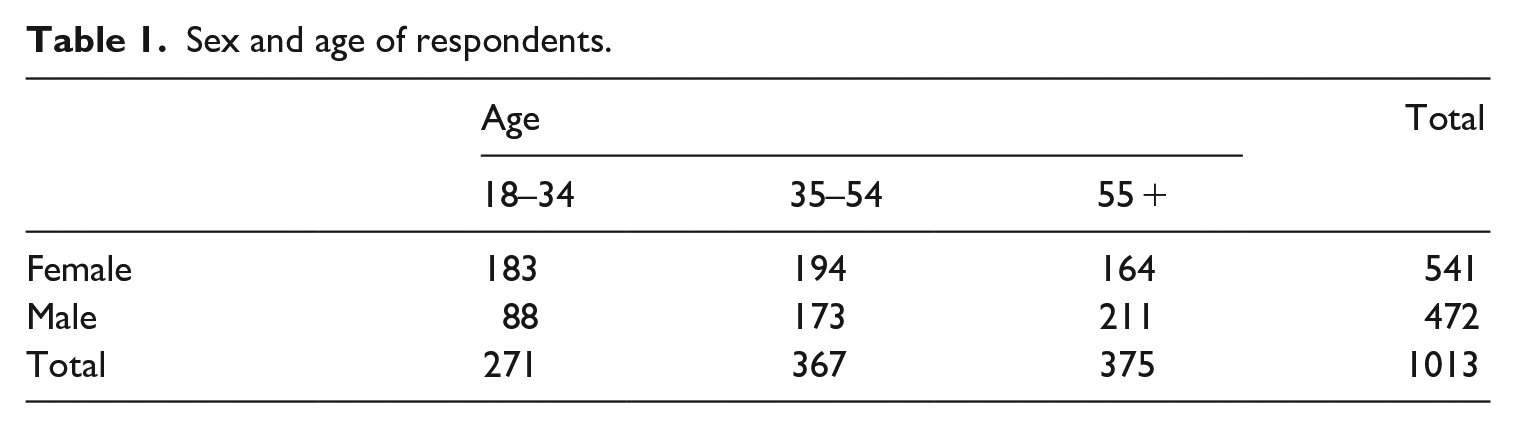
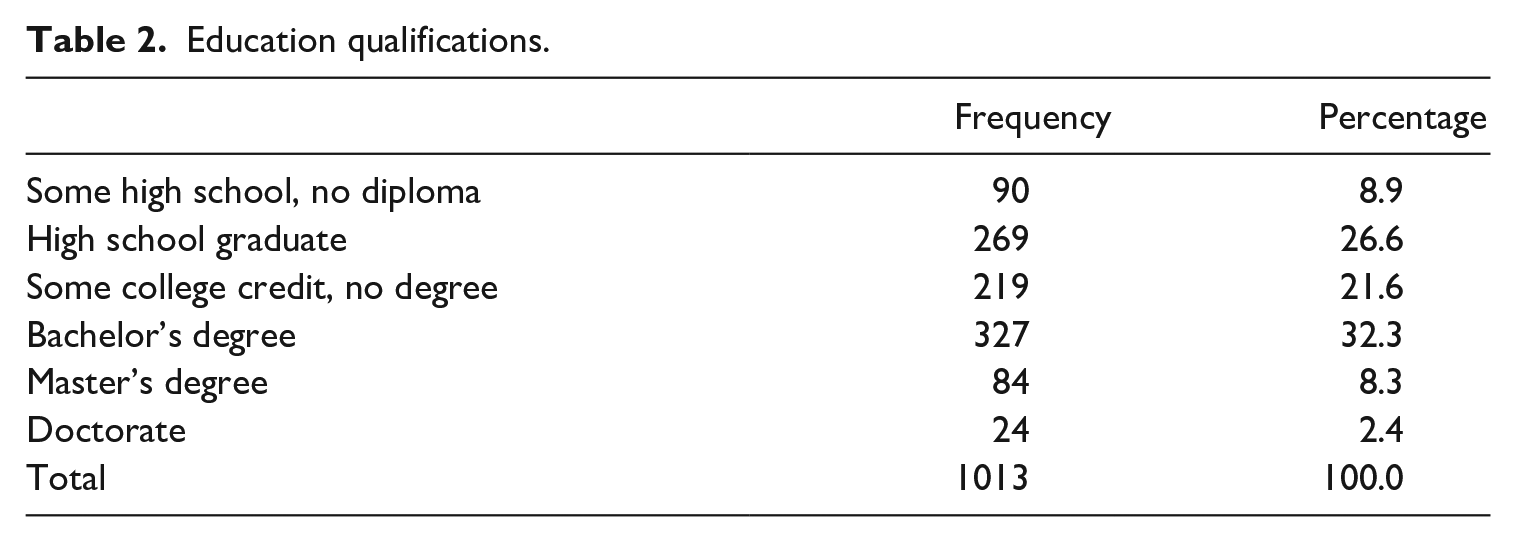
The online survey was based on a sample of the UK adult population (1013 respondents) selected using Toluna QuickSurveys. The sample appropriately captures the demographic stratification of the UK population; however, it is a quota sample based on the voluntary participation of respondents. The sample of the UK adult population (Table 1) included a mixture of educational backgrounds (Table 2), age groups (Table 1), and different annual household incomes (under £15,000, under 30,000, under 50,000, and above 50,000 a year).
Sex and age of respondents.
Education qualifications.
This stratification was deemed adequate for describing potential relationships between variations in climate change and environmental awareness and media use among people of various educational, age, and socioeconomic status. Research into climate change perception in the United Kingdom showed that gender, age, and educational backgrounds are relevant determinants of climate change awareness (European Social Survey, 2016; Fisher et al., 2018).
A review of the relevant literature on climate change awareness in the United Kingdom supports the use of some items included in a survey proposed by Whitmarsh and Capstick (2018) as the most recent and reliable tool for investigating climate change awareness in the United Kingdom. However, because the current study focuses on the potential relationship between climate change awareness and media behaviour, this tool has been reviewed and tailored to the study’s needs. The survey included questions about media consumption in particular.
Exploratory factor analysis and creation of traditional/online indexes
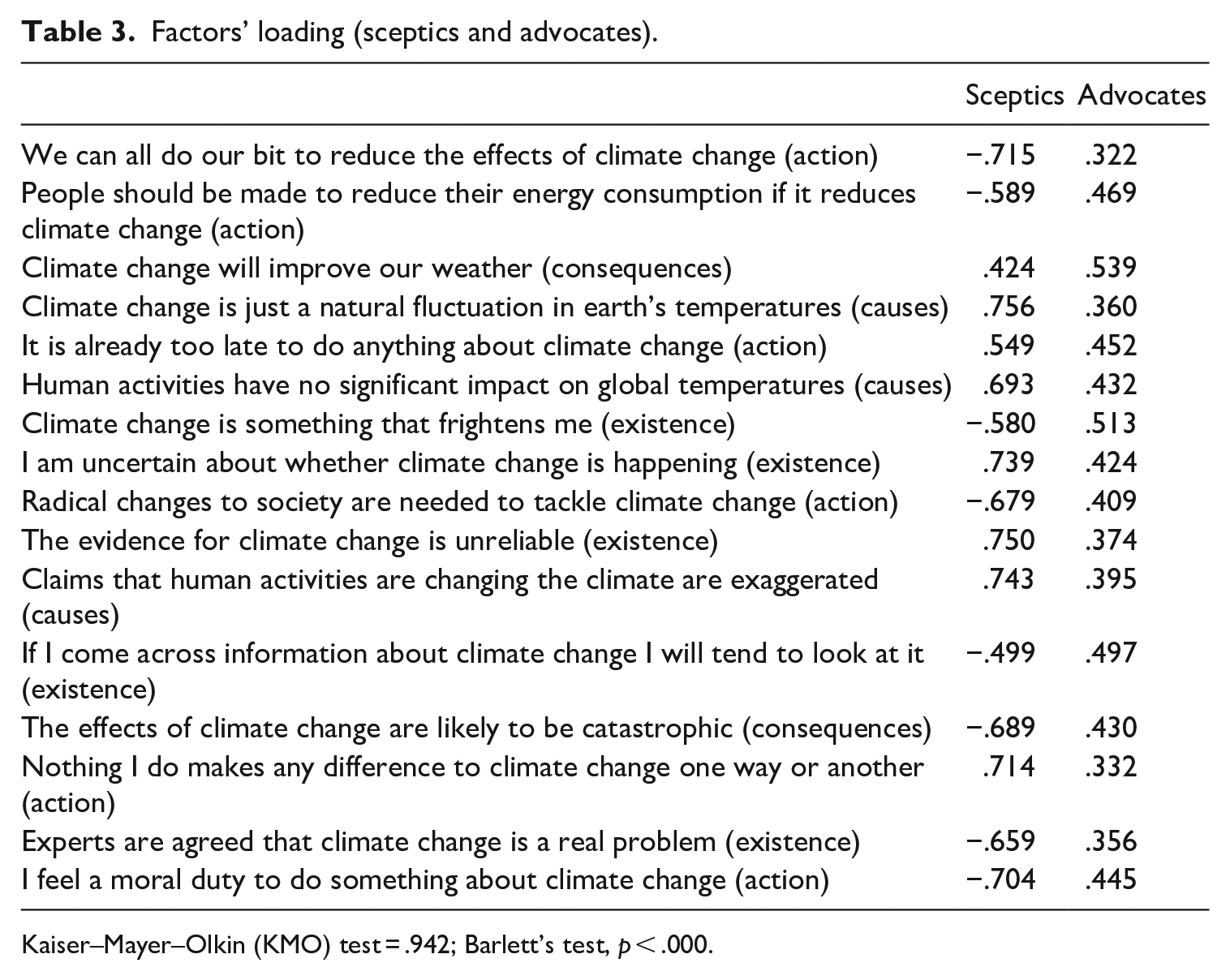
To capture the environmental awareness of respondents a section of the questionnaire asked respondents about their level of agreement concerning 16 items (Table 3). Using exploratory factor analysis, these items were combined into two factors (EFA; see Table 3). The two factors were extracted by adopting an eigenvalue greater than one as a criterion. Moreover, these two factors accounted for 62% of the variance. The 16 items considered four different levels of scepticism/realism regarding the existence, causes, and consequences of climate change, as well as the need for action (see Table 3). These two factors were labelled as sceptics and advocates. They are further discussed in section ‘Results’.
Factors’ loading (sceptics and advocates).
Kaiser–Mayer–Olkin (KMO) test = .942; Barlett’s test, p < .000.
The index of traditional media use was developed using three items that asked respondents to rate the frequency of use of newspapers, TV, and radio to obtain information about climate change on a 5-point scale (ranging from 1 = never to 5 = frequently). These three items were combined into a composite variable (Cronbach’s α = .717, M = 3.03, SD = 1.06). An online media use index was created using the same procedure. Drawing from previous research (Gil de Zúñiga et al., 2014), three items (Google searches, social media and online newspapers) were included in a composite variable (Cronbach’s α = .782, M = 2.82, SD = 1.20).
To assess respondents’ trust in information sources, they were asked to rate their trust in information about climate change heard from family members/friends, scientists, the government, an energy supplier, an environmental organisation, traditional media, social media links, social media, environmental blogs, Wikipedia, and specialised websites on a 5-point scale (ranging from 1 = ‘not at all’ to 5 = ‘a lot’).
Finally, the study controlled the demographic variables age (M = 47.29, SD = 16.5); gender (n = 541 females, n = 472 males); income (Mdn = £30,000–£39,999); and education qualification (Mdn = some college credit, no degree). The correlation between these variables and climate change awareness was explored.
Moreover, H2, H3, and H4 were investigated using multiple regression analysis. Four types of variables were included such as (1) demographic variables (sex, age, and education level) – incomes were excluded because the correlation analysis excluded correlation between the variables; (2) frequency of use of the media (traditional and new); (3) trust in various sources of information; and (4) interaction between media use/age and media use/education level.
Results
H1 related to the persistence of scepticism among UK Internet users was explored through an EFA (Table 3). The two factors extracted from the combination of 16 items show the existence of two factors connected to both sceptics and advocates. The first factor, labelled ‘sceptics’, is positively associated with the belief that climate change is a natural phenomenon, that human activities do not play a significant role in causing climate change, and that there is neither certainty about the phenomenon’s reality nor scientific evidence. This factor is positively influenced by items related to inaction such as ‘it is already too late to do anything about climate change’, and ‘nothing I do makes any difference to climate change one way or another’.
By contrast, the second factor, which can be labelled as ‘advocates’, is positively associated with items based on ‘action’ such as, for example, reducing energy consumption, and a moral duty to act and make radical changes to tackle climate change. Climate change is also perceived as a threat that might cause catastrophic consequences. However, it is worth noting that some items that characterise the sceptical factor are positively correlated with this factor, such as judging the human influence on climate change as exaggerated, assessing the certainty of the phenomenon, and assessing the efficacy of the individual intervention.
To make interpretation easier, the new two variables generated by factor analysis were converted to a range of 0 to 100. The distribution of the two factors is depicted in Figure 1. The graph, in line with the literature, shows a higher concentration of cases indicating higher levels of acceptance of climate change and a lower number of sceptics. However, a third area shows a concentration of cases in the ‘middle’, indicating that the distinction between sceptics and supporters is not ‘black and white’. This group appears to be heterogeneous, as the eigenvalue of the third factor is less than one and the variance explained is less than 5%.
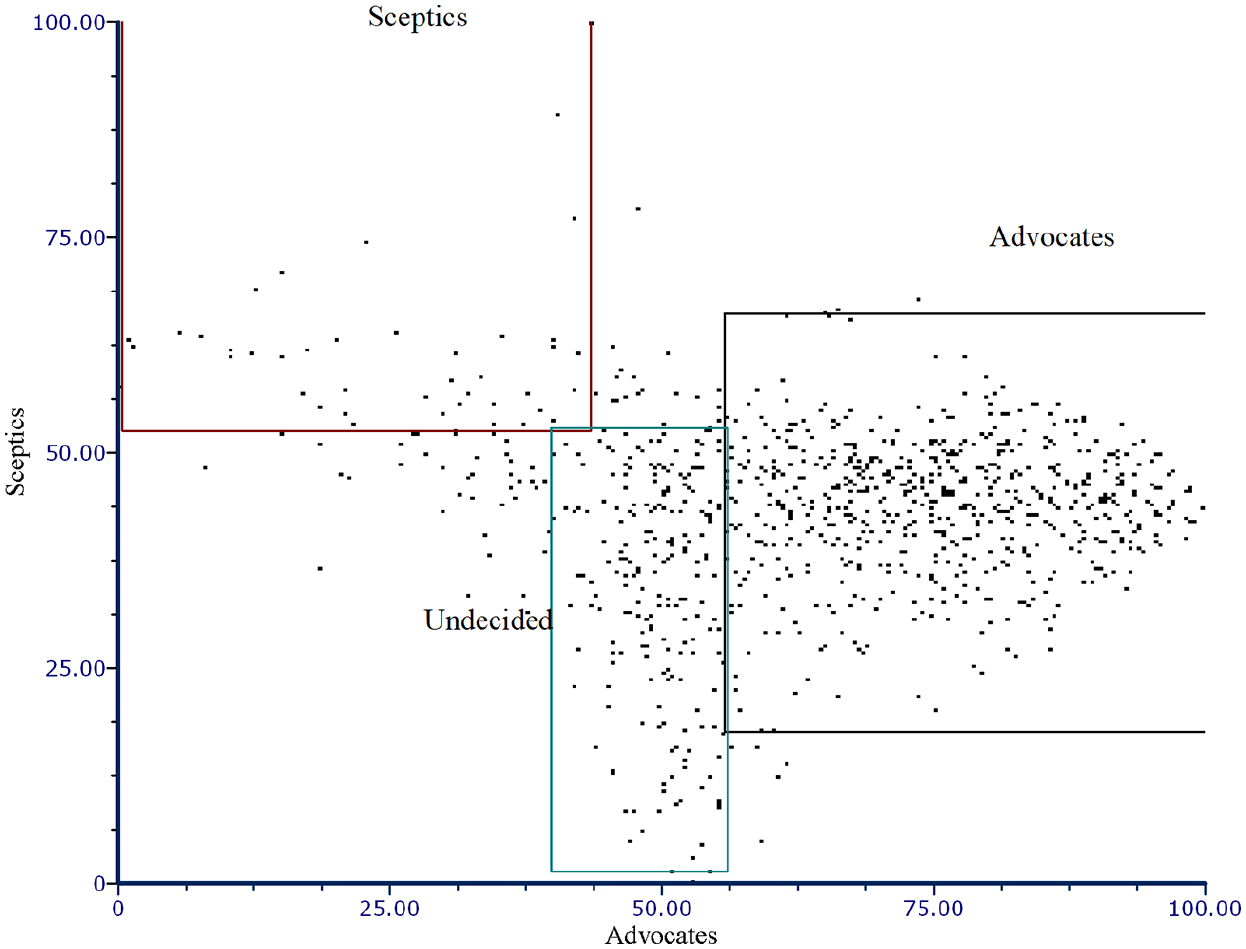
Distribution of sceptics and advocates.
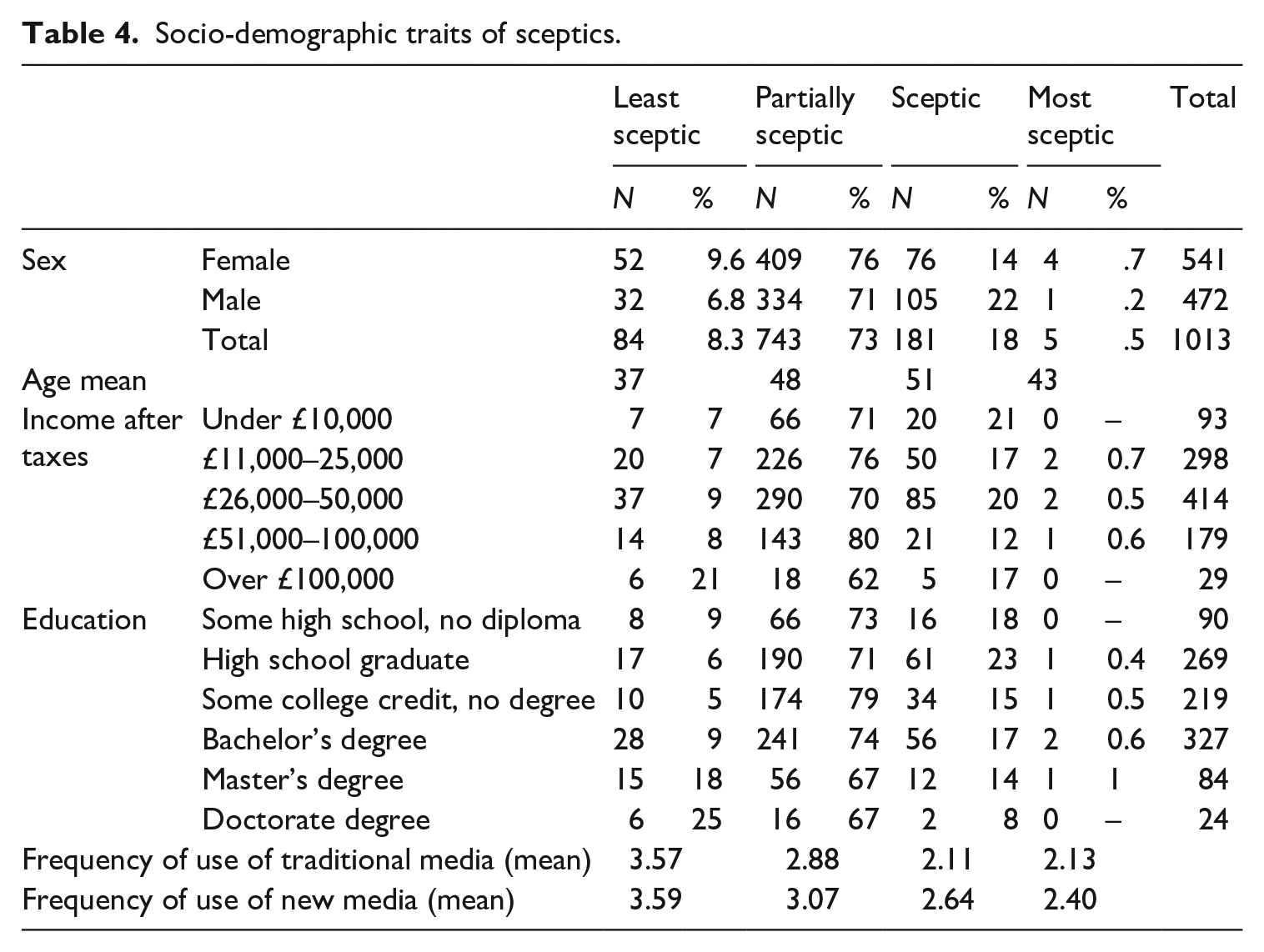
Table 4 displays the socio-demographic characteristics of the population by sceptical level, which was divided into four levels: low (score between 0 and 25), medium-low (26–50), medium-high (51–75), and high level (76–100). According to this table, the low level prefers both traditional and new media. As a result, an increase in climate change awareness may coincide with an increase in both new and traditional media use.
Socio-demographic traits of sceptics.
The correlation between the key variables is shown in Table 5. Scepticism correlates positively with age and negatively with education and the use of both traditional and new media. Being an advocate, on the other hand, is positively associated with education and increased use of both traditional and old media.
Zero-order correlations.
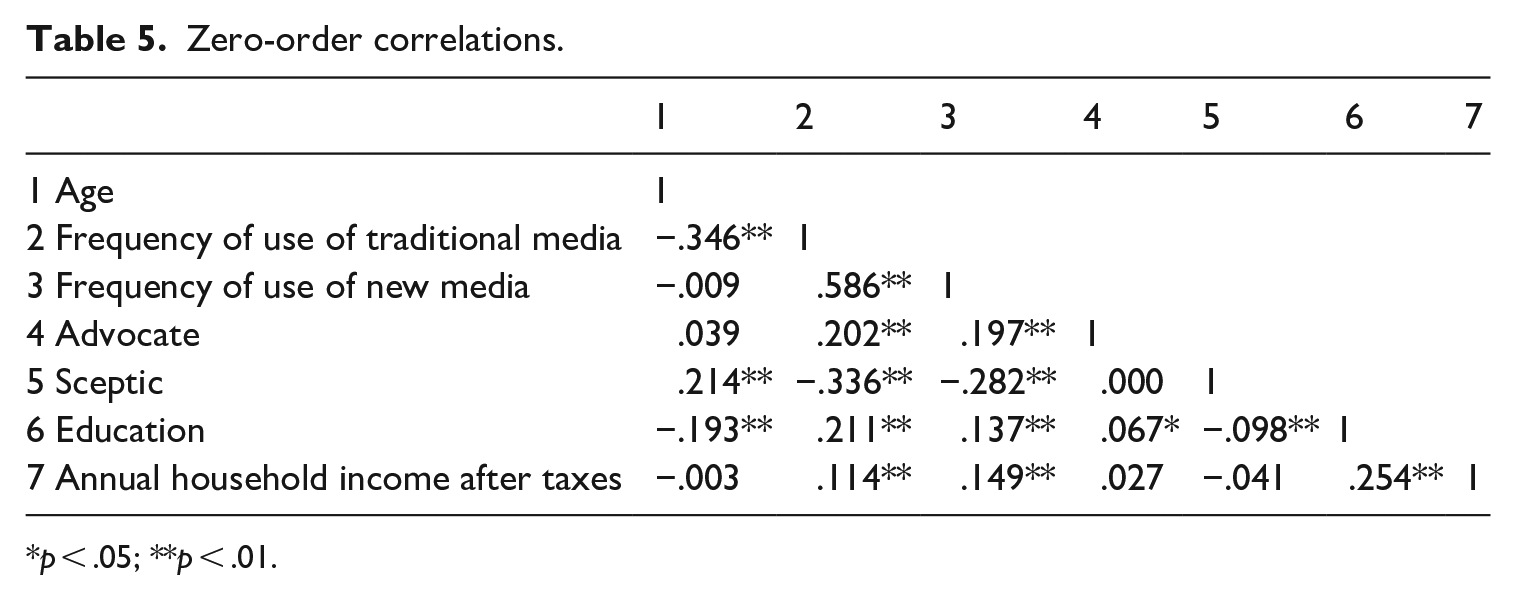
p < .05; **p < .01.
Table 6 shows findings for H2 (a and b), H3 (a and b), and H4. Two multiple regression analyses were conducted to identify potential predictors of both scepticism (model 1, 27% of variance) and advocacy (model 2, 30% of variance). Table 6 shows that when age is combined with other predictors, it becomes a negative predictor of both scepticism and advocacy (the correlation coefficients were positive). As a result, older people are more likely to be in the area of indecision depicted in Figure 1. This suggests that when a bivariate relationship between being ‘sceptical’/‘advocate’ and age is estimated, an omitted variable bias is affecting the results. Because on average older generations are less educated than younger ones, this implies a negative correlation between age and education. Thus, when education is omitted from the analysis, it ends up in the error term of the regression model and this leads to an overestimation of the coefficient associated with age (see Wooldridge, 2002).
Multiple regression analysis.
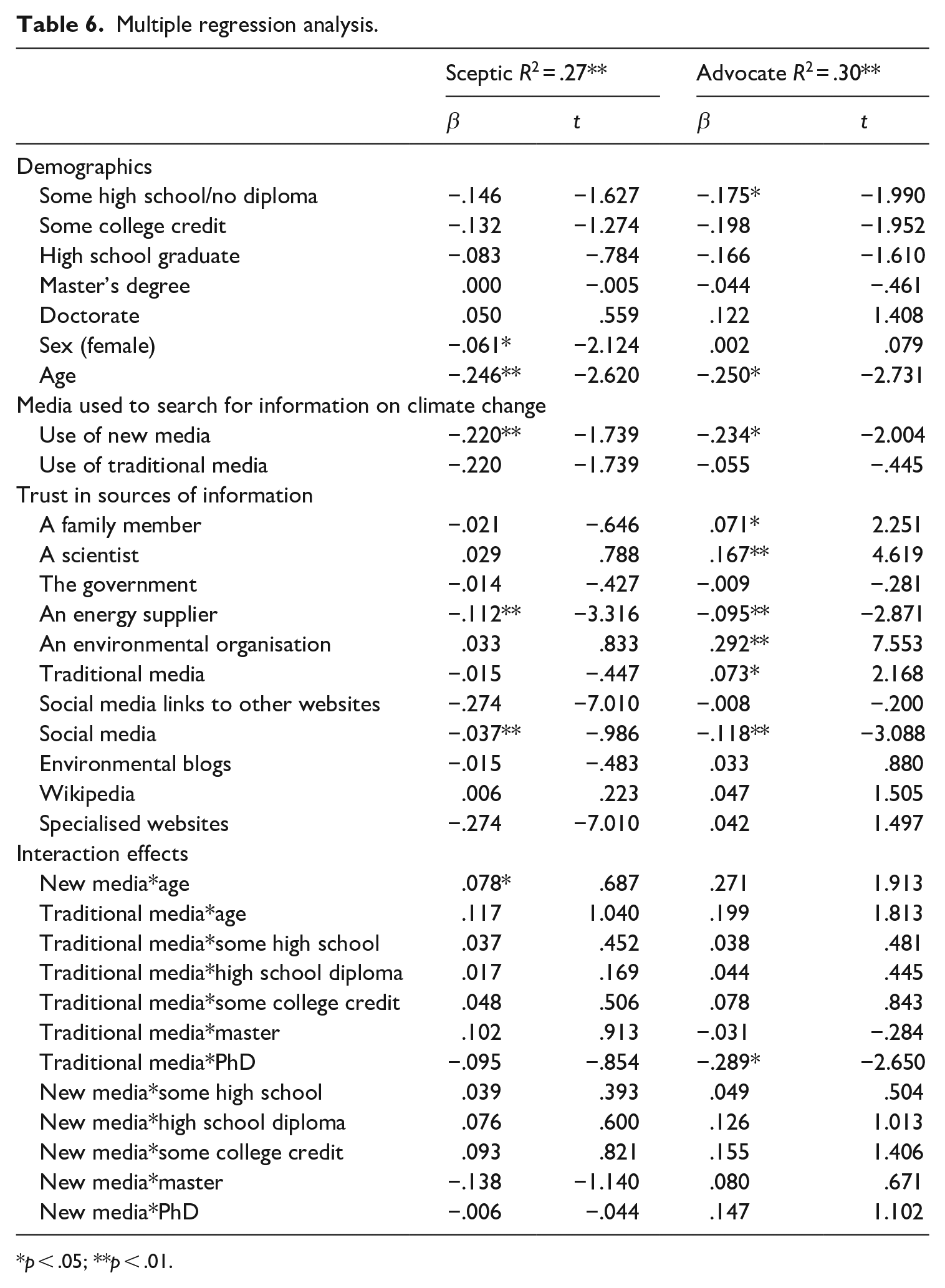
p < .05; **p < .01.
In terms of other socio-demographic variables (sex and education), both education levels and gender were entered as dummies in the model. In the first case, ‘bachelor’s degree’ (most frequent category) was used as the reference category. In the second case, ‘male’ was used as the reference category. The income variable was excluded from the model since, as shown in Table 2, it was correlated neither to sceptics nor to advocates. Moreover, in line with the literature (Ballew et al., 2018), female users tend to be less sceptical than men. In terms of education, the model shows that education does not play a significant role in predicting scepticism. By contrast, those who have some high school qualifications (no diploma) are less likely to be advocates compared to those with a bachelor’s degree. However, neither a master’s degree nor a PhD implies a significant increase in climate awareness.
H2a is not supported by the analysis given that the use of old media does not predict environmental orientation. H2b is supported by the model that shows how the use of new media has a negative effect on scepticism. The use of new media also decreases the probability of being an advocate. This is partially in contrast with previous studies that showed a positive relationship between media use and environmental awareness (Östman, 2014; Zhang and Skoric, 2018).
The analysis of the relation between sceptics/advocates and trust in sources of information partially supports H3. Trust in information received from scientists and environmental organisations, as well as from family members/friends and traditional media, predicts increased advocacy. In general, trust in social media is a negative predictor of scepticism and advocacy, whereas trust in specialised websites is not significant.
In addition, H4 is only partially supported. In the model with scepticism as the dependent variable, the relationship between the interaction effect of increasing use of new media and age has a positive sign. This outcome can be interpreted as follows: given that an individual is a new media user, a 1-year increase in age results in a higher scepticism score.
Finally, quite surprisingly the interaction between PhD qualification and the use of traditional media has a negative effect on advocacy.
Discussion
The analysis highlights some characteristics of both sceptics and advocates’ ‘ideologies’ (Gifford, 2011; Treen et al., 2020) among UK citizens. The sceptical ideology confirms the characteristics highlighted by the literature, such as the belief that climate change is a natural phenomenon, that human activities do not play a significant role in both causing and dealing with climate change, and that there is neither certainty nor scientific evidence about the reality of the phenomenon. Advocacy, on the other hand, sees the action as a moral duty and emphasises the importance of limiting behaviours that can have serious consequences. The analysis revealed that there is a transitional space between sceptics and advocates that requires further attention in terms of adhering to hegemonic or counter-hegemonic forces. Furthermore, some scepticism characteristics have a positive (albeit minor) influence on the advocate group, such as perceiving the impact of climate change as exaggerated and evaluating the certainty of climate change and the effectiveness of individual intervention. This supports that climate change representation can be perceived as exaggerated and uncertain by UK media consumers (Poortinga et al., 2011; Whitmarsh and Capstick, 2018). The lack of ‘common sense’/‘collective frame’ (Olausson, 2009) is in line with some contradictions in the media representation, which is not uniformly aligned to defend the capitalist hegemony. However, the power tensions between opposing ideologies lay the foundation for hegemony to flourish (Maeseele and Peperman, 2017). In reality, hegemony is not totalitarian, but rather a communicative process in which the media serve as a platform for counterhegemonies to influence political transformation (Whitworth, 2014). Following this interpretation, common worldviews are organised socially within specific cultural and political-economic boundaries (Norgaard, 2011). This is consistent with the Gramscian concept of hegemony, which is seen as an incessant process of formation of equilibria between the interests of dominant and subordinate groups, where the former prevails, but only up to a certain point (Gramsci, 1971: 182).
Our findings suggest that using new media may help reduce scepticism about climate change. They do, however, reveal the importance of considering the interaction between some variables (such as education and age) and the use of specific media. First, this study found there is still a gender gap in climate change beliefs, with women being slightly less sceptical than men (Ballew et al., 2018). Moreover, despite the persistence of scepticism among a segment of the UK public, the use of technologies to search for information about climate change has a positive effect on decreasing levels of scepticism. This might suggest a shift from traditional to new media as spaces in which power-balances are produced/reproduced (Holmberg and Hellsten, 2015; Pearce et al., 2014; Porter and Hellsten, 2014).
Traditional media do not play a significant part in predicting advocacy. These results are in contrast with the literature that highlighted how older generations, who have been less exposed to the mention of climate change by mainstream media, tend to be more sceptical than younger generations, who have learned about climate change in school and have heard about it in mainstream media for longer (Fisher et al., 2018). This could imply that older people have fewer tools and digital competencies to evaluate the reliability of online information (Coelho and Duarte, 2016; Hutto et al., 2015; Richardson, 2018), and thus may question climate change.
Note that the frequent use of new media per se is also a predictor of a lower degree of climate change acceptance. Traditional media, on the other hand, is associated with higher levels of acceptance when they are regarded as trustworthy. These findings could imply that the impact of media representation of the phenomenon no longer produces a clear polarisation in public perception of climate change in the United Kingdom (Whitmarsh and Capstick, 2018). This is consistent with rising climate change awareness (Spence et al., 2011), but also with the persistence of some scepticism (Fisher et al., 2018; Stokes et al., 2016; Taylor et al., 2014; Van der Linden, 2015). Therefore, interpreting the media as a space in which hegemony can be re-produced but also contested, might suggest that the online production/reproduction of power tensions has been generating counterdynamics that are fundamental for fragmenting public common sense and producing socio-ecological change. On the other hand, the ‘green common sense’ might be influenced by the ‘British environmental rhetoric’, which is founded on neoliberal commonplaces (Hatzisavvidou, 2020). The introductory sections of this work mentioned increasing awareness of climate change in the United Kingdom, but also to an individual commitment that depends on the ‘financial impact’ of green behaviour, the efficiency of green behaviour at the lowest cost, or technologically oriented (e.g. recycling or purchasing more efficient electronics) (BrightBlue, 2020). This has been also observed in the green discourses promoted by the UK Government and their translation into public lexicon via the media (Hatzisavvidou, 2020).
Considering the interaction between media behaviour and level of education, the picture becomes more nuanced. It highlights that those with some higher qualifications (no diploma) also tend to be less sceptical than those with a bachelor’s degree. However, the interaction between higher education qualifications, such as a PhD, and the use of traditional media negatively affects advocacy. This may imply that those with more scientific reasoning, such as Ph.D., but who also consume traditional media, may find the evidence proposed to support climate change unsatisfactory. This may lead to more cautious ‘advocacy’. Therefore, in contrast with the literature, our findings suggest that when the interaction effects with traditional media are considered, higher levels of education are not necessarily predictors of climate change awareness. Previous studies focussed on demographic aspects and the political orientation of respondents when exploring climate change awareness by reporting varying degrees of influence of these variables (Fisher et al., 2018).
Concerning the relationship between sceptics/advocates and trust in information sources, it should come as no surprise that trust in both scientists and environmental organisations is positively correlated with being an advocate. Lower levels of advocate orientation are associated with increased trust in social media. This could be explained by climate change activists’ proclivity to actively seek information rather than rely on social media conversations. Furthermore, in the case of scepticism, trust in social media has a negative impact on scepticism. This result is partially in contrast with previous findings that highlight a tendency to develop echo chambers and polarised groups on social media (Pearce et al., 2014; Porter and Hellsten, 2014). This aspect may be of interest to studies that focus on echo chambers (Shin et al., 2017; Williams et al., 2015) as well as studies that identified social media’s ‘soft power’ in influencing public awareness (Mavrodieva et al., 2019). However, this finding does not support previous studies’ findings that social media use correlates with increased awareness (Anderson, 2017; Mavrodieva et al., 2019). It supports that the impact of social media on climate change awareness should take into account the trust factor (Taddicken, 2013). These reflections on trust also suggest that subjects may be capable of making choices, but only within the framework of an ideological convincement (organised within specific cultural and political-economic boundaries) (Norgaard, 2011). Therefore, despite the limitations of the hegemony concept, it is still useful in making sense of an incessant process of formation and disintegration of equilibria between social groups (Gramsci, 1971).
Conclusion
This article investigated the role of traditional and new media in predicting climate change awareness. On the one hand, new media plays an important role in challenging the dominant narrative and advancing pro-civil rights and pro-environment causes. On the other hand, we have seen how they contribute to the spread of false information and the advancement of an ultraconservative agenda.
Other factors that could influence people’s views on climate change were also considered in the study. We focused on some socio-demographic features as well as sources of information for retrieving climate change information to predict climate change awareness.
Our findings revealed that the distinction between advocates and sceptics is not a binary one, but a grey area exists. This suggests that the Gramscian concept of hegemony is useful for investigating the dynamics of the ‘colonisation of awareness’ through the media, particularly in the context of a potential shift from traditional to new media in the face of climate change. The concept of hegemony as a non-totalitarian communication process implies that the media can serve as a platform for counterhegemonies as well as a catalyst for political change. Nevertheless, as we have seen, the media’s tendency to divide scientists who believe that climate change is occurring and will have significant consequences from those who are more sceptical makes it more difficult to make policies in an ‘uncertain’ situation (Boykoff, 2013; Rahmstorf, 2012; Tosse, 2013). Even if it has been repeatedly revealed that the oil industry supports this small group of sceptic scientists (Levy and Rothenberg, 1999), this mismatch adds to the public’s and policymakers’ confusion about the subject.
This study is based on an online survey that excludes non-frequent Internet users. This could imply that when media consumers use both traditional and new media, the effect of traditional media can be mitigated by using digital information sources.
Furthermore, the relationship between sceptics/advocates and trust in information sources shows that climate change advocates actively select content rather than simply trusting social media conversations (Shao et al., 2018). Considering the significance of both scientists and environmental organisations in increasing acceptance of climate change, policymakers should indeed focus on increasing trust in specific sources of information.
Further research may consider the individual level of digital competencies and how, if at all, this relates to users’ Internet engagement and trust in information sources, as well as how this may impact their sceptical or advocate orientation.
Considering the use of various media to retrieve information on climate change on a broad scale only provides an overview of the potential effects of both traditional and online media. This means that considering different media may produce different results.
Finally, the relationships between media behaviour and level of education should be investigated further to identify the reasons for a decrease in the number of advocates and users with a PhD who receive information from television. Qualitative research could be useful in investigating the production of a specific environmental common sense based on a neoliberal model, which is also reflected in the Government’s conceptualisation of addressing climate change based on efficiency, economic benefits, and competitiveness, and reproduced by media discourses.
To summarise, climate change is a direct result of capitalism’s development dynamics and the relationship between economic growth and the consumption of fossil fuels (Newell and Paterson, 2010; Wright and Nyberg, 2015), which in turn impede the fight against climate change. As stated throughout the article, hegemonic power flows through society and its institutions to shape media coverage and influence public discourse and understanding of climate change. The fragmentation of common sense, in particular, may imply a ‘win’ for the sceptical narrative. In fact, scepticism does not have to predominate in the debate; simply ‘fogging the room’ may be enough to sow doubts about the causes, consequences, and actions required to combat climate change.
Footnotes
Declaration of conflicting interests
The authors declared no potential conflicts of interest with respect to the research, authorship, and/or publication of this article.
Funding
The authors received no financial support for the research, authorship, and/or publication of this article.
