




Abstract
In this article, the authors move away from approaching generations as static categories and explore how ordinary people, as opposed to scholars, distinguish generations and justify their different responses to cultural diversity in terms of ethnicity, race and religion/belief. The analysis draws on 90 in-depth interviews with 30 residents in the Polish capital, Warsaw (2012–2013). Through approaching generation as an analytical category, the authors identify various differentiating narratives which the study participants employed to draw boundaries between generations, reinforcing the common belief that the youngest Poles are most accepting of diversity. Although generations are seen as the axis of difference, conditioning generation-specific responses to diversity, the accounts emerging from the interviews reveal their relational nature, as well as similarities and points of connection between their experiences.
Introduction
Generations can be an important lens through which to understand struggles over the meanings and effects of large-scale processes of social change (Edmunds and Turner, 2005), like those driven by immigration and related ethnic diversification of societies. Periods of such change have often been met with varying responses from people of different generations who were socialised in different times, and have differential stakes in the past, present and future. Until recently, sociological research defining and describing generations has been predominantly based on the experiences of the Western democracies (Bischoping and Gao, 2018; Vandegrift, 2016). In this article we focus on Poland – a society which has been undergoing ethnic diversification since 1989, when the process of transition into democracy started. This has been accompanied by secularisation and changes in behaviour and attitudes among the youngest cohorts due to growing up in a non-authoritarian regime (Requena and Stanek, 2013).
Despite an emerging interest in generation as a relational concept and the framework of intergenerationality (Hopkins and Pain, 2007; McDaniel et al., 2013; Vanderbeck and Worth, 2015), there has been relatively little research in sociological studies which has explored how ordinary people, as opposed to scholars, distinguish generations and what consequences such thinking might have (Foster, 2013b). Generations have been largely used in social sciences to identify age/birth cohorts that are believed to share some meaningful experience in the past and therefore hold similar attitudes and values. Every few years new ‘boxed and labelled’ generations emerge (e.g. Millennials, also known as Generation Y), which become marketing tools or the basis for policy (Biggs, 2007; McDaniel, 2004). Yet, there has been little sociological inquiry devoted to how people make sense of generations and how they discursively construct them (Aboim and Vasconcelos, 2014; Bischoping and Gao, 2018; Foster, 2013b).
The aim of this article is to explore how people in Poland narratively create boundaries between generations. We do so by analysing responses to cultural ‘otherness’ in terms of ethnicity, race and religion/belief. We consider these three axes of difference because, in the Polish context, whiteness and Catholic identity have historically been associated with national identity (Balogun, 2018; Borowik, 2002; Jaskułowski and Pawlak, 2020; Ząbek, 2007). Our intention is not to determine which generation is more or less prejudiced, but our research question relates to how people ascribing themselves to different generations perceive each other’s attitudes and behaviours, in relation to cultural difference, and how they justify those attitudes and behaviours. We draw on 90 in-depth interviews with 30 residents of Warsaw, conducted as a part of the project: ‘Living with Difference in Europe: Making Communities out of Strangers in an Era of Super Mobility and Super Diversity’ (2010–2014; see Mayblin et al., 2016). The research was completed on the eve of a downward shift in attitudes towards immigration and cultural difference in Poland (CBOS, 2018; Krzyżanowski, 2018). The narratives from the interviews reveal a common belief that the generation that grew up before 1989 (but after the Second World War) is less accepting of difference, because of being socialised in times of normative control, higher religiosity and no visible diversity. We unpack these narratives, demonstrating revealing contradictions and complexities.
Background
The Polish case
Unlike most Western European societies, Poland has not taken a linear path towards more immigration in the second part of the 20th century. The Second Republic of Poland (1918–1939) was a diverse state where around one third of the population might be characterised as a religious and/or ethnic minority (Jasińska-Kania and Łodziński, 2009). After the Second World War, border changes and population displacements meant that Poland became largely homogeneous, both ethnically (Polish) and religiously (Roman Catholic). During the subsequent Socialist period (1945–1989, since 1952 as People’s Republic of Poland: Polska Republika Ludowa or PRL) achieving population homogeneity was an official aim of the state as part of a nationalist ideology: a process facilitated by tight border controls and restrictions on free movement (Stola, 2010). The remaining Jewish population, Catholic Church and LGBT population were all subject to persecution; consequently, ethnic and sexual minorities were largely absent from public life (Heinen, 1997).
In the years after 1989, freedom of movement and expression increased. As a result of accession to the European Union (EU; 1 May 2004) legislation was established to provide protection from discrimination on the grounds of race, ethnicity, nationality and in part gender and sexuality (Bojarski, 2011). Poland has also started to experience processes of individualisation (Burrell, 2011), yet remains a relatively traditional society in which the Catholic Church has reasserted its influence following its prominent role in resisting the socialist state (Narkowicz, 2018; Requena and Stanek, 2013), and anti-equality movements in relation to gender and sexuality have gained more political power recently (Korolczuk and Graff, 2018).
After Poland signed the Geneva Convention in 1991, and an initial increase in antipathy to refugees and immigrants among Poles, 2000–2014 could be described as a period of rather indifferent attitudes (Łodziński, 2017). During the Polish parliamentary elections in 2015, immigration issues were mobilised for the first time in an electoral campaign, and have subsequently become a frequent topic in media and parliamentary debates (Narkowicz, 2018). Some authors point to a discursive shift ‘to a strong and forceful anti-immigrant rhetoric of discrimination or even outright hate toward migrants’ (Krzyżanowski, 2018: 76), which was strategically developed by the right-wing party Law and Justice (Prawo i Sprawiedliwość [PiS], now the ruling party) to regain political power. Consequently, since 2015 opinion polls reveal a steep decrease in openness towards refugees: in May 2015 21% agreed that Poland should not accept refugees from regions with armed conflicts; in June 2018, 60% thought so (CBOS, 2018). The anti-immigration discourse draws on longstanding feelings of cultural threat that immigrants could pose to the dominant Catholic values (Poland acting as a bulwark of Christian Europe) and to the vulnerable nation-state, which was previously in a precarious position (i.e. partitioned as a multi-ethnic state; Polynczuk-Alenius, 2020). Refugees were also orientalised and not perceived to be worthy of humanitarian help, and thus often presented as economic migrants (Narkowicz, 2018). This hardening of attitudes has been more pronounced among younger people; for example, in 2018, 8 out of 10 respondents aged 18–24 were against helping refugees originating from regions outside Europe (Narkowicz, 2018). In comparison to older people, younger Poles more often hold a mix of conservative-liberal values: conservative in terms of world-view about family life, low acceptance of minorities and preference for a strong leader, but liberal in terms of the economy and labour market (Winiewski et al., 2015). This could be a result of growing up in more uncertain economic and demographic contexts after 1989 (Mach, 2003).
Although our study was conducted before the so-called ‘migration crisis’ in 2015, attitudes are shaped over time and intergenerationally transmitted across decades. Pre-2015 perspectives on cultural ‘otherness’ and how they were narrated have laid foundations for the more recent hostility to some ethnic, racial or religious minorities and immigrants. Below we explain how a generational lens can be helpful in unpacking these processes in Poland.
The competing approaches to studying generations
Sociological enquiry into generations has grown from research where generations have been seen as fixed social categories. This stream of literature is informed by the influential work of Mannheim (1952), who argued that people born at a particular time and space encounter the same set of historical, cultural and political circumstances. These shared experiences shape their social and political values and some of these attitudes might persist over the life-course. Numerous studies from a range of academic traditions and international contexts have endorsed this analysis. For example, the work of Jennings and Niemi (1981) in American society demonstrated how political attitudes are shaped by formative political events of early youth, like participation in protests, and acquired norms and values persist over time.
However, such a compartmentalised concept of generation has been increasingly recognised by sociological scholarship as too reductive and conflating it with a birth cohort. Already Mannheim (1952) observed that within one generation there are many ‘generational units’ comprising groups with distinct values and behaviours (Edmunds and Turner, 2005). Other approaches have emerged in which generation is not conceived as a social category that can be ‘found’ in social life, but as a social construct, produced discursively or through relations (Bischoping and Gao, 2018; Foster, 2013a). The role of external factors and changes in the opportunity structures are not neglected, but the emphasis is on the relational nature of generations. Generations are not merely formed by ‘translating history in subjectivity’ or sharing similar moral and practical predispositions by being located in the same time-space (Aboim and Vasconcelos, 2014: 176). They are discursive formations – systems of meaning that shape thinking, understanding and experiencing; and different ways of speaking organising social relations (Grenier, 2007).
McDaniel (2004) has further argued that generations are not just systems of knowledge, but rather knowledge systems are generationed. People ‘do generations’ in similar ways to how they ‘do gender’ or other forms of difference which are ‘constituted in the context of the differential “doings” of the others’ (West and Fenstermaker, 1995: 32; West and Zimmerman, 1987). For example, as gender is performed in everyday life, and institutions and normative frames are gendered, the welfare and labour market regimes and within-family relations are also generationed (McDaniel, 2004). Generations are performed in everyday encounters, while navigating social reality, and their boundaries are reconfirmed or renegotiated while new generations emerge (McDaniel et al., 2013).
In this convention research has shown that individuals who belong to different generations form their social identities in relation to generational difference and through interactions with other age groups (Hopkins and Pain, 2007). Perspectives of ordinary people – in contrast to the ready categories devised and imposed by scholars – have been applied in studies of work relations in Canada (Foster, 2013a), social change in China (Bischoping and Gao, 2018) and intergenerational transfers in Canada and the US (McDaniel et al., 2013). Together this strand of research has demonstrated that generational boundaries are not fixed, but constantly recreated, and generational divisions might be drawn along multiple lines. However, such ‘narrative reiteration of intergenerational differences’ (Aboim and Vasconcelos, 2014: 176) might lead to strengthening generational identities, as both generations narratively build boundaries between each other. This might translate into the lack of intergenerational understanding and ideological separation (Biggs, 2007).
Generational studies in Poland
During the socialist era, generations in Poland were typically identified in relation to important societal events, like the ‘1956 Generation’ (post-Stalin-death thaw), the ‘March 1968 Generation’ (major student and intellectual protests) or the ‘1980 Generation’ (of the Solidarity movement) (Fatyga, 1999; Garewicz, 1983). Polish generational scholars argue that generations are not solely formed by these historical events, but by values, aspirations and attitudes developed in response to them (Fatyga, 1999). Likewise, the Polish sociologist Świda-Ziemba (2011), who extensively studied various cohorts of young people in the socialist period, demonstrated how their beliefs had a ‘radiating’ power in driving certain social and cultural processes during the communist era.
More recently, studies by Wrzesień (2009, 2016) have investigated values and cultural practices of more narrowly defined generations, such as ‘Generation ’89’ (born 1964–1970), ‘Children of Transformation’ (1971–1976) and ‘End of Century Whiners’ (1977–1982). Since 1989, the research on generations has been dominated by the exploration of challenges young people face in the capitalist economy. Another study on the ‘1989 generation’ in Poland (30-year-olds in 2000) demonstrated that they fared worse in the labour market than their peers in 1988 (30-year-olds in 1988), because of the uncertainty brought by economic transformation, which happened during a vulnerable stage of their lives, i.e. when they were making important life choices (Mach, 2003). In a similar manner, the recent work by Sawulski (2019) unpacks experiences of those born during the times of the systemic transformation, in the years 1986–1995, and – confusingly – also labels them as ‘Generation ’89’.
How attitudes towards minority ethnic groups and immigrants vary by generations has not been – to the best of our knowledge – systematically studied in Poland. Our contribution to generational and wider sociological studies is thus threefold. First, many studies in Polish sociology have focused on narrowly defined generations, limited to specific birth cohorts, and described their lifestyles, values or socio-economic status. Generationed responses to ethnic, religious and racial issues have not yet been considered. Second, most of these studies approached generations as fixed categories. We believe that by undertaking the relational approach to generations we will uncover the multi-layered nature of generational boundaries and inconsistencies in emerging narratives. It will help in understanding why some Poles believed (as of 2010–2014) that ethnic and racial prejudice was a problem of the past, not the future. Third, we contribute to sociological studies by using generation not merely as a descriptive category, but also as an analytical tool to understand societal transformations (Foster, 2013b).
Research context and methods
The empirical material comes from a research conducted in Warsaw, Poland, as a part of a larger project: ‘Living with Difference in Europe: Making Communities out of Strangers in an Era of Super Mobility and Super Diversity’ (https://livedifference.group.shef.ac.uk/). Warsaw was selected because it is the most diverse and multicultural city in Poland. This was a mixed-method multi-stage project, with a sequential explanatory design (Creswell and Clark, 2017) starting with secondary data analysis and representative surveys in Leeds and Warsaw, followed by a few concurrent stages of qualitative research: individual and focus group interviews, observational and participatory methods. The analysis in this article draws on the in-depth interviews. On the basis of preliminary analysis of the representative survey (see Piekut and Valentine, 2017), 30 people were recruited for the qualitative phase of the research. The participants were sampled to include those from a range of backgrounds, whose personal circumstances and lifestyle afforded them varying opportunities to encounter ‘difference’, and to reflect the range of responses to the survey. Most interviewees were white and Polish, except a Latvian woman and a Polish-American man. The majority, 25 interviewees, self-identified as Catholic, three as not belonging to any religious group and two as Jewish and Orthodox respectively. Regarding the age of interviewees, 11 participants were aged 18–34, 12 were 35–59 and seven over 60 years old. The split among genders was even, with one identifying as a gay man and one as a bisexual woman. Fifteen out of 30 were born in Warsaw, one abroad, and 14 came to live to Warsaw, usually as adults, from various regions in Poland. The Table A1 in the Appendix provides a fuller profile of each participant.
Each participant was interviewed three times in 2012–2013, approximately every three months. The first interview was a life story interview, where respondents shared childhood memories about their first encounters with difference. During the second interview we started with a reflection on meaningful events in participants’ lives, both private and historical events, which according to them might have had shaped their values and attitudes. The final interview focused on politics, current debates and changes in Polish society, so we could see what arguments interviewees use to account for and justify their social attitudes. 1 Interviews were repeated to build rapport between the participant and the researcher as the topics were often highly sensitive. The repetition meant that we could come back to difficult issues during later interviews, give an interviewee time between each meeting to reflect on the discussed topics, and finally, minimise the burden associated with interviewing.
The first named author, who is of Polish nationality, white female researcher, belonging to the post-1989 generation (see below), conducted all interviews in Polish. They were transcribed and translated by an external company, then thematically coded in NVivo software. First, a set of predefined thematic codes was developed on the basis of interview cues, but also new categories were coded in vivo which were later reviewed and organised as new codes.
Generation-making narratives
Although generational divisions were not the main focus of our project, when analysing empirical material, we realised that our interviewees extensively employed a generational lens when reflecting on Polish society’s responses to difference. They used floating signifiers to explain how they differ from their children/parents, such as ‘my generation’ or ‘younger/older generation’ (Bischoping and Gao, 2018), but also placed their experiences in relation to meaningful historical events, like ‘before the War’, ‘in PRL/Socialism’ or ‘after 1989’. Guided by these self-identifications, we decided to divide participants into three broad generations: the ‘war’ (born until 1945), the ‘socialist’ (born 1946–1976) and the ‘post-1989’ generation (born 1977 onwards, which includes Polish ‘End of Century Whiners’ [born 1977–1983] and Generation Y [born after 1984]; Wrzesień, 2007). 2 We recognise that these boundaries might be blurred or not necessarily overlap with our participants’ perspectives.
Reflecting on the foundations of their values and how attitudes have been changing in Polish society, respondents justified them by referring to (1) changes in the political regime and related dominant normative systems, (2) the role of Catholicism and declining religiosity, and (3) new opportunity structures to encounter visible difference. The next sections unpack these three narratives that participants used in outlining boundaries between generations.
Generations produced in the past: The role of political regimes
In participants’ accounts, generation was framed as an axis of difference, as older and younger Poles were thought to possess fundamentally different attitudes towards otherness (Foster, 2013a; West and Fenstermaker, 1995), largely due to being socialised in different political regimes. The generation which was born before the Second World War was characterised by the youngest interviewees as more tolerant than the socialist generation. This pattern reflects what is commonly related to as the ‘myth of Polish tolerance’ in which multicultural, pre-war Poland is idealised as a time when diverse communities coexisted in harmony. This is in spite of a well-documented history of complex inter-ethnic relations during this period, including clashes between Polish and Ukrainian populations and evidence of discrimination towards Jewish people (Buchowski and Chlewińska, 2012). In contrast, the socialist era was characterised by post-1989 participants as a period in which difference was suppressed or denied until the Iron Curtain fell, and Poland joined the EU. The pre-war period of cultural openness was believed to be followed by a more closed and self-focused socialist generation: Supposedly Poland before the [Second World] War, particularly before the First World War, was really open. And people came, for example, to study at Jagiellonian University or Warsaw University from around the world. Poland also developed a lot in this direction, it was really open, I would say open to different types of diversity. Whether it is religious background, skin colour, and so on. It was just natural. No one would deny that after the end of the Second World War, under Communism, people really behaved in such a closed way. Everyone looked out only for themselves. (W8, M, Post-1989)
The perceived lack of tolerance of the socialist generation – especially by the post-1989 generation – could be attributed to the fact that this generation was socialised in times when the communist authorities promoted a vision of an ethnically homogeneous state seen as a pivotal condition to achieve post-war stabilisation and justify the new territorial shape of the country (Motyka, 2011). New normative frames were imposed onto the population in multiple reforms in 1948–1952, which introduced more social controls and the communist ideology into various life spheres, like the national education (Świda-Ziemba, 2011
3
). The new frames were internalised by some participants from the socialist generations who perceived Polish society during socialism as more united, thanks to being more culturally homogeneous: The so-called post-war generation, such as mine, and maybe five years after the war, this generation is the most united with each other, without other groups from the outside, because then there weren’t any such groups after the war – it was religion against communism. There was political struggle, the two camps were established, but Poland was united, there wasn’t just such a variety of differences. (W12, M, Socialist)
According to the literature, the socialist generation was conditioned by the regime’s dominant norms not to express or discuss otherness: the emphasis on conformity discouraged the expression of any forms of difference; minorities experienced open discrimination and became largely invisible in public life (Heinen, 1997); and those defined as ‘internal enemies’ were expelled (e.g. Jewish people; Copsey, 2008). This argument was also present in our participants’ narratives. Respondents from the socialist generation when asked about their memories of people who were different to them, explained that ‘in their times’ diversity, if it existed, was ‘hidden’: We didn’t know, we only heard that something like this existed, but we didn’t know if it was among us. (W26, F, Socialist) There was the Iron Curtain, so people were not allowed to go to the West, not allowed to see that there it is much better, and that progress is larger. On the contrary, the propaganda was that the Soviet Union only could pull us out of the hole. And that will help us, and so on. So, all in all the people didn’t discuss these issues. (W18, F, Socialist)
Those born in late 1970s onwards were the first generation that started their adult lives in a democratic country (i.e. post-1989), with the freedom of speech and expression. At the same time, the process of accession to the EU in 2004 brought the introduction of new equalities legislation (Bojarski, 2011), contributing to further change in the normative frames that people were operating within. This systematic change was also picked up by the youngest participants who argued that their generation is less prejudiced compared to the generation of their parents who were socialised under communism: My peers and people from larger cities . . . for them it doesn’t matter who is what religion, what race . . . In the older [socialist] generation, people aged 60–63 . . . they categorise, stereotype . . . you can hear, when it comes to Jews, or other races that they are anti. They do not allow foreigners near them . . . My observation is that it is so ingrained in these people. It is still here, that era, that [socialist] system. I certainly think so, because they simply haven’t switched to what we have now, that it doesn’t matter what religion you are, what nationality. What is important is what you do in life . . . who you are, every day. Not where you came from . . . But that generation still has this categorisation [of difference] from previous years, the way they were brought up – and it is hard to just get over it somehow. (W15, M, Post-1989)
Surprisingly, despite the transformation into the political system which meant difference could be openly discussed, the accounts of the youngest participants revealed that the contested topics of either past or current cultural diversity were largely absent from their family homes: I remember my grandfather and my father never talked, for example, about politics. They never talked about religion. Once I heard they tried, and actually it was my father who ended the conversation with a quarrel. (W15, M, Post-1989) My father is . . . an atheist, and my mum is a religious person. They had to live with that and somehow, I do not recall that they discussed any people of different religious views. (W7, F, Post-1989) At home we never particularly talked about people who were of a different religion or had a different skin colour. It wasn’t specifically talked about and that’s maybe why I want to learn more. (W8, M, Post-1989)
As past studies have shown, the experiences of Poles after 1989 were marked by the post-socialist condition, which Stenning (2005) observed for labour market (im)mobilities during the transformation in Poland. Our research adds to this by showing that such a condition persists also in the sphere of family relations and value transmission, and it manifests as not discussing ethnic or religious issues. Although both generations were depicted as different from one another, family home was not a space of discussing religious differences before and after 1989. Despite that, the changing nature of religiosity in Poland was another important boundary drawn between generations.
Generations moving through time: ‘Outdated’ Catholicism
Interviewees – both from the socialist and post-1989 generations – suggested that the changing nature of religious beliefs in the socialist Poland may account for the greater (perceived) levels of prejudice amongst older generations. Catholicism was strengthened during the socialist era because the Catholic Church was a key opponent of the Communist government (Borowik, 2002). Some argued therefore that the strong adherence to the Catholic faith during this period may account in part for their perceived lack of tolerance, particularly towards other faiths: I think because Poland is a Catholic country, though not anymore so. I think that among older and middle generations this view was established after the Second World War, when Socialism was introduced, when resistance couldn’t be expressed because of the threat of sanctions. The Catholic faith was the mainstay, a weapon to survive. . . . As a child I had the impression that it was emphasized that the Catholic religion is better than other [religions] . . . And I just got the impression that the Polish Pope changed this approach, instilled a respect for other religions. (W23, F, Socialist)
The above reflection implies that the post-1989 generation might have become more tolerant due to the changing nature of Polish Catholicism. The youngest generation was socialised when John Paul II, a Polish national himself, was the Pope/Head of the Catholic Church between 1978 and 2005. According to Ruszkowski et al. (2006), his teaching and ecumenical work played a significant role in shaping values and religious attitudes among Poles who grew up during his pontificate, to the extent that the term ‘JPII generation’ was coined in public debates. Conversely, younger participants often claimed that the greater and rigid religiosity of the socialist generations has laid foundations for their exclusionary and stereotypical views: Only lately has Poland become more internationally open . . . But there are quite a lot of people who grew up and were raised in Poland under communism and that also has great significance. Because these are the very people who are quite parochial, they have some idiotic views. For example, that all Muslims are terrorists. I stubbornly try to explain to them that it’s not religion that kills, only people . . . There are Catholics and the extreme Catholics [PL: katole] who will sit in the Old Town, . . . and dance around the cross. (W8, M, Post-1989)
Religious people from the socialist generation were depicted by the post-1989 generation as more often holding distinct political views and ‘outdated’ ways of behaving, such as openly manifesting their religiousness in marches or praying in public. The above respondent referred to the gatherings in front of the Presidential Palace, where some Poles would meet on the 10th of every month to commemorate the Smoleńsk plane crash on 10 April 2010.
4
Interestingly, the generational line around the religiosity axis was not clear cut – some participants would relate higher religiosity with the socialist generation, while others with even older people. For example, a respondent born in the mid-1950s reflected: So, all those ‘moherówki’ [‘mohair berets’ – see below]. . . . This generation older than me, it seems to me that they are all completely confused, and they do not understand the difference between this and that, but a priest said ‘This is wrong’ and [they believed] this is wrong. (W16, F, Socialist)
Religious people from the war and the socialist generations were often associated with the Radio Maryja movement (led by a Redemptorist Father Tadeusz Rydzyk), which supports PiS, propagates ‘national-Catholic ideology’, and spreads xenophobic views against the official teaching of the Polish Catholic Church (Krzemiński, 2017). They were described by younger participants as less pro-European, and in general more prejudiced than younger people: I have nothing against Father Rydzyk and Radio Maryja, but in certain situations, sometimes during their marches, they behave like a sect. I am a Catholic, yet they manifest some extreme, some old way of thinking. They surely are not pro-European, but the other way around. And I reckon that we should get rid of this way of thinking, we should be open to otherness, to the West, to Europe. You cannot be narrow-minded and reject others. (W30, M, Post-1989)
It happened that participants from the post-1989 generation used pejorative terms, such as ‘katol’ [from Polish Katolik] or ‘mohair berets’ [PL: moherowe berety], to describe older, more religious persons. The latter is used to label people (usually female) who support the Radio Maryja movement. The term ‘mohair beret’ intersects ageism and religious prejudice, which among some younger people manifested as a belief that the older generations hold irrational political views, engage in ‘outdated’ or backwards religious activities, and do not fit with a modern, Europe-facing Poland. These are all characteristics implicitly associated with ageism, when older people are stereotyped as being rigid in thought, slow to change, and old-fashioned in terms of their moral dispositions (Bytheway, 2005).
In this section we have seen that the generational boundaries are temporally relational. According to the accounts of participants, generations like the war generation have become more prejudiced due to living through socialism, and like the socialist generation they had a specific Catholic religiosity instilled in them during this period. In socialism, religious events often blurred with anti-state demonstrations (Borowik, 2002), and the post-1989 generation perceived such mixing of politics and religious practice as an outdated practice of the past.
Generations moving through space: Visible difference
When reflecting on why different generations might hold dissimilar opinions about ethnic and religious minorities, participants also argued that limited possibilities to encounter otherness during socialism, either at home or overseas, could be another reason. This line of reasoning was based on an assumption that more opportunities to meet, work with and have friends of a non-Polish background have led to more favourable views on minorities among younger Poles. Our analysis based on a survey conducted with participants from the same project confirmed this – more everyday interactions with people who are perceived to be of a dissimilar ethnic background are associated with more tolerant attitudes to them (Piekut and Valentine, 2017). Moreover, the lives of the youngest generation are not bound by national boundaries, as lives of older generations were; they extend beyond one national setting, and are more influenced by the processes of European integration and globalisation, as well as by international media (Edmunds and Turner, 2005; Vandegrift, 2016).
Poles born in the late 1970s and early 1980s were the first generation in Poland intentionally investing in international mobility, participating in the Erasmus programme and overseas internships, and as such are described as ‘European seekers’ (Wrzesień, 2009), the ‘generation of the EU’ or ‘generation Erasmus’ (Andrejczuk, 2017).
Socialist Poland was for most citizens ‘a country with no exit’, and a country of almost no immigration to Poland (Stola, 2010). For the socialist generation the sudden increase in non-Polish residents in Warsaw after 1989 resulted in misunderstandings or discomfort due to problems in communication. Interestingly, the accounts of the youngest participants about their first visits abroad to some extent mirror the reflections made by the socialist generation about demographic changes they observed in Warsaw after 1989. Notably, contrary to the socialist generation, the Polish youth having gained experience of Western societies and grown up in more globalised times, did not perceive Warsaw as so culturally diverse. The first quote below comes from a participant in her fifties who never lived abroad, while the second is from a 20-year-old student, who worked for a few months in England: Warsaw is a strange city, there are a lot of foreigners. Sometimes, I wonder whether I am in a foreign country. Because when you walk the streets, apart from the Polish [language], you can only hear [foreign] languages. But our youth is talented now, as far as languages are concerned, they speak many languages, not only one. Well, but us, old people, we grew up in those [different] times. (W18, F, Socialist) [In England] [t]here are more people from other countries, a complete cultural mix that, really, wherever you go, you can encounter – I don’t know, at least 10 different nationalities in the store or in the pub, or wherever. But here [in Warsaw] when someone on the tram is speaking some other language, then everyone looks in their direction . . . because a tourist is talking on the tram. (W4, F, Post-1989)
Participants specifically reflected that PRL provided less opportunities to encounter visible difference in public space. In a ‘nationally, ethnically, racially and religiously non-heterogeneous Polish society’ the visual phenotypical difference of immigrants from African or Asian countries resulted in racialised perceptions (Vieten and Gawlewicz, 2016: 211). As visible ethnic difference in public spaces has become more commonplace after 1989, older generations believed that younger people have been developing more progressive attitudes towards minorities, and the presence of visible minorities has become normalised (Piekut et al., 2014). In contrast, their own first encounters with non-white people remained vivid in their memories: I remember, when I was a child and I saw a Black person [PL: Murzyna] . . . I was young . . . nine, ten, eleven years old. ‘Oh, a Black guy’ [PL: Murzyn], there was even ridiculing on trams ‘Oh, Murzyn Bambo’.
5
And now, maybe there is generally tolerance towards different people . . . Back then, in the 1980s, to meet a black person [PL: Murzyna] in the street it was rare, it virtually didn’t happen, I didn’t have an [opportunity]. Now it’s normal. (W30, M, Socialist) It used to be, for example, that when a Black guy [PL: Murzyn] came to Poland, heads would turn. At this moment, heads don’t turn anymore for a Black guy [PL: Murzyn]. . So, I reckon our children, for their generation, this is how is going to be, unless something drastic happens politically speaking, because politicians know how to set nations at odds. (W12, M, Socialist)
Yet, some stereotypical and negative words, like ‘Murzyn’ (Ząbek, 2007), were commonly used by participants irrespective of age. Many Poles do not realise the racialised undertone of the term (Gawlewicz, 2016), and for example, for one respondent in his thirties, who had some Black friends, the term was related to Africa as a region: ‘if we were living in Africa, we would have been dark too, unless this was South Africa, the white Murzyni’. Another interviewee from the post-1989 generation recalled her first memories as a student in England, and she also used the contested term ‘Murzyn’ to refer to Black people there. As Polish nationality is inclusive to whiteness (Balogun, 2018), in her account the darker skin tone was more broadly associated with being non-European and non-English: I was in England . . . I went to a college, that was the first time it really hit me, I didn’t expect such diversity there . . . Because the skin colour is the first thing you see – that there are just people from practically the whole world. Well, and I didn’t expect that at all [laughter]. For example, you can go to a fast-food place, and English people don’t work there at all. I mean . . . white people, at all. I didn’t meet any at all. Everywhere either Indians or someone from Pakistan and so on, or Black people [PL: Murzyni]. That was a big shock for me. (W4, F, Post-1989)
The above narratives uncover that generations indeed operate as systems of meaning underpinning perceptions of difference (Grenier, 2007; McDaniel, 2004). At the same time, a similarity between the socialist and post-1989 generations unfolded in the interviews: after 1989 both of them had to learn how to live in a more diverse context – either in Poland or internationally – than the society where they were socialised in. This similarity-in-difference demonstrates how encounters with immigrants and visibly different minorities are generationed, as both generations use different points of reference to make sense of increasing diversity in the contemporary Poland. The socialist generation relates their contemporary experiences to the ethnically homogeneous, socialist Poland, while for the younger, more Europe-facing generation, the still modest level of cultural diversity in post-1989 Poland is not seen as real diversity. Despite that, some stigmatising terms, like ‘Murzyn’, have been transmitted across generations, and are used in more diverse, supposedly more tolerant times.
Conclusions
In this article, we have applied a relational lens to illustrate how generations in Poland perceive each other and narratively construct boundaries between each other (Aboim and Vasconcelos, 2014; Hopkins and Pain, 2007; Vanderbeck and Worth, 2015). Instead of compartmentalising generations, we turned to arguments developed by our participants to understand why different generations might hold dissimilar attitudes towards people of minority ethnicity, race or religion. Generations were narrated as a form of difference, which defines behaviours and attitudes in various spheres of life (West and Fenstermaker, 1995), including the ways people ascribed to various generations were expected to interact with and feel about minorities. Participants of various age believed that the youngest, post-1989 generation is more respectful and open towards minority ethnic or religious groups, because they grew up in a society without political repressions, but in a country preserving the freedoms of speech, expression and movement, and where they have more everyday encounters with visible diversity.
Although generations were narrated as axes of difference, the boundaries between them were not clear-cut. On the one hand, generations were narrated as a product of past experience - being born and socialised in a specific normative framework. This understanding resembles the classic definition where a generation is conceived as a social category, whose values develop in response to influential political or economic events. On the other hand, our participants’ reflections – concerning attitudes to people of a different ethnicity, race or religion – have also revealed that generational boundaries are relational and re-negotiated, and as generations move through time and space, they change their points of reference. We did not have space in this article to delve into the complexity of cultural diversity in Poland, nor the specificity of Warsaw, and we are aware that attitudes of Poles towards various minorities vary. Yet, the evidence coming from our analysis indicates that the generational boundaries were being re-drawn along the contested lines of Catholic religiosity and the visibility of minorities. As such, the boundaries of generations are constructed around common knowledge and values, not around fixed membership in the community (Yuval-Davis, 2010), and generational affiliations constitute an important part of social identities (Hopkins and Pain, 2007).
The generational perspective might offer an appealing, comforting narrative in times of new challenges and growing uncertainty (White, 2013), like those associated with increased international migration. In the presented case, both the socialist and post-1989 generations believed that the political transition, accompanied by more immigrant inflows, had translated into more acceptance among the cohorts which grew up after 1989. Such positive self-perception of the post-1989 generation may obscure the recognition of their own intolerances – towards various minorities, including older generations which they try to differentiate from – because of an illusive belief in progress made in comparison to the older generations. This might provide some explanation why the narratives about growing openness to immigration (as made by our participants in 2012–2013) are in stark contrast with the change in public discourse after the so-called ‘migration crisis’ in 2015–2016, which has become more openly anti-immigrant, specifically anti-Muslim and against the ‘racialized Other’ in Poland (Jaskułowski and Pawlak, 2020; Krzyżanowski, 2018; Narkowicz, 2018).
The application of the generational frameworks might pose another challenge: they often mask diversity within, or similarities between generations (White, 2013). While our participants argued in favour of many differences between the socialist and post-1989 generations, we found commonalities across age groups, such as refraining from talking about ethnic and religious otherness in a family setting and sensationalising visible difference (e.g. of Black bodies). This highlights the urgent need for more research on intergenerational transmission of memories and values related to cultural otherness in Poland, which might help in improving our understanding of why the anti-immigration rhetoric has become more salient recently.
We would like to conclude by pointing to the contribution of our study for sociological studies. Thanks to viewing generation not as a descriptive, but as an analytical category (Foster, 2013b), our analysis demonstrated that generational boundaries are blurred, and are temporally and spatially relational. Generation-related identities mean different things to different generations and focusing on generation-making narratives allows to unpack their contextualised meanings. Like class or gender relations, generational relations could be used in sociological studies in other countries to understand generation-specific power relations, and their consequences for other kinds of difference or wider social inequalities.
Footnotes
Appendix
Demographic profiles of research participants.
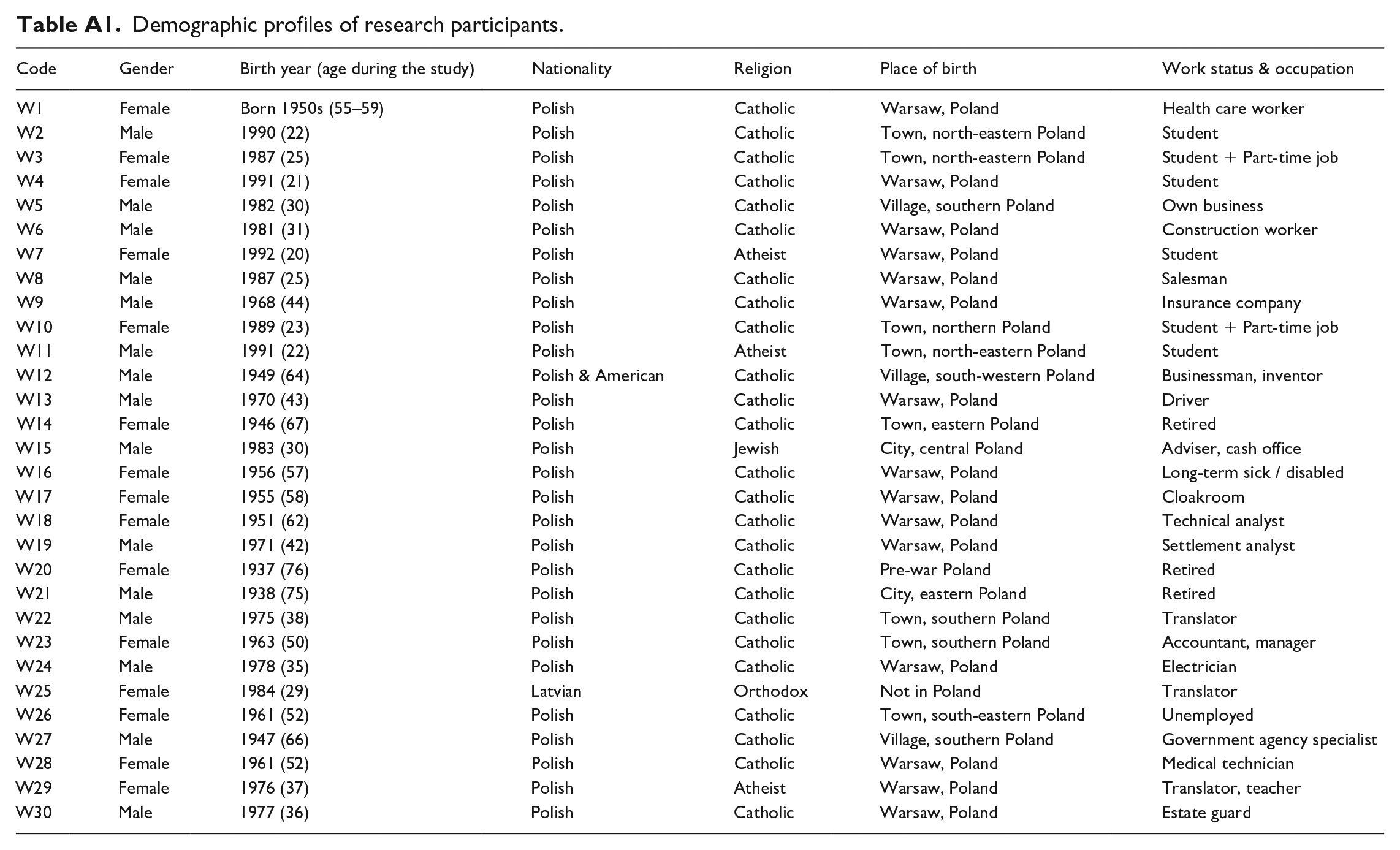
| Code | Gender | Birth year (age during the study) | Nationality | Religion | Place of birth | Work status & occupation |
|---|---|---|---|---|---|---|
| W1 | Female | Born 1950s (55–59) | Polish | Catholic | Warsaw, Poland | Health care worker |
| W2 | Male | 1990 (22) | Polish | Catholic | Town, north-eastern Poland | Student |
| W3 | Female | 1987 (25) | Polish | Catholic | Town, north-eastern Poland | Student + Part-time job |
| W4 | Female | 1991 (21) | Polish | Catholic | Warsaw, Poland | Student |
| W5 | Male | 1982 (30) | Polish | Catholic | Village, southern Poland | Own business |
| W6 | Male | 1981 (31) | Polish | Catholic | Warsaw, Poland | Construction worker |
| W7 | Female | 1992 (20) | Polish | Atheist | Warsaw, Poland | Student |
| W8 | Male | 1987 (25) | Polish | Catholic | Warsaw, Poland | Salesman |
| W9 | Male | 1968 (44) | Polish | Catholic | Warsaw, Poland | Insurance company |
| W10 | Female | 1989 (23) | Polish | Catholic | Town, northern Poland | Student + Part-time job |
| W11 | Male | 1991 (22) | Polish | Atheist | Town, north-eastern Poland | Student |
| W12 | Male | 1949 (64) | Polish & American | Catholic | Village, south-western Poland | Businessman, inventor |
| W13 | Male | 1970 (43) | Polish | Catholic | Warsaw, Poland | Driver |
| W14 | Female | 1946 (67) | Polish | Catholic | Town, eastern Poland | Retired |
| W15 | Male | 1983 (30) | Polish | Jewish | City, central Poland | Adviser, cash office |
| W16 | Female | 1956 (57) | Polish | Catholic | Warsaw, Poland | Long-term sick / disabled |
| W17 | Female | 1955 (58) | Polish | Catholic | Warsaw, Poland | Cloakroom |
| W18 | Female | 1951 (62) | Polish | Catholic | Warsaw, Poland | Technical analyst |
| W19 | Male | 1971 (42) | Polish | Catholic | Warsaw, Poland | Settlement analyst |
| W20 | Female | 1937 (76) | Polish | Catholic | Pre-war Poland | Retired |
| W21 | Male | 1938 (75) | Polish | Catholic | City, eastern Poland | Retired |
| W22 | Male | 1975 (38) | Polish | Catholic | Town, southern Poland | Translator |
| W23 | Female | 1963 (50) | Polish | Catholic | Town, southern Poland | Accountant, manager |
| W24 | Male | 1978 (35) | Polish | Catholic | Warsaw, Poland | Electrician |
| W25 | Female | 1984 (29) | Latvian | Orthodox | Not in Poland | Translator |
| W26 | Female | 1961 (52) | Polish | Catholic | Town, south-eastern Poland | Unemployed |
| W27 | Male | 1947 (66) | Polish | Catholic | Village, southern Poland | Government agency specialist |
| W28 | Female | 1961 (52) | Polish | Catholic | Warsaw, Poland | Medical technician |
| W29 | Female | 1976 (37) | Polish | Atheist | Warsaw, Poland | Translator, teacher |
| W30 | Male | 1977 (36) | Polish | Catholic | Warsaw, Poland | Estate guard |
Acknowledgements
Special thanks to Anna Gawlewicz, Will Mason, Mark Taylor, Andrew Bell and three anonymous reviewers for giving us useful comments on previous versions of the manuscript.
Declaration of conflicting interests
The authors declared no potential conflicts of interest with respect to the research, authorship, and/or publication of this article.
Funding
We are grateful to the European Research Council for funding the research on which this article is based, ‘Living with Difference in Europe: Making Communities out of Strangers in an Era of Super Mobility and Super Diversity’ (grant agreement no. 249658).
