




Abstract
On 30 November 2018 tens of thousands of Indian farmers marched to Parliament and demanded a special session to discuss the deepening agrarian crisis. The protest march to Parliament was only the latest in a series of protest marches which had been organized by an umbrella group of over 200 farmers’ organizations from all over India. Moreover, for the first time, an alliance of different activist groups, political parties, trade unions and students had cohered to support the farmers and their cause. Despite its political, empirical and theoretical significance, research on the formation of alliances has gained scant attention in sociological research. Based on original research, this article suggests alliance building should be understood with reference to political opportunities, processes of meaning attribution and framing, and as a strategy, which facilitates worthiness, unity, numbers and commitment (WUNC displays, as outlined by Charles Tilly).
Introduction
India’s farming sector – which employs most of the country’s labour force – has been in crisis for decades. A significant indicator has been the dramatic increase of farmers’ suicides, which first entered the headlines in the 1990s. It has been reported that between 1995 and 2014 more than 300,000 farmers took their own lives (People’s Archive of Rural India, 2014). These fatalistic suicides imply that the social conditions create an environment of hopelessness, which leads people to commit suicide (Durkheim, 2002 [1952]). This condition mostly impacts small farmers who obtain the major portion of their income from subsistence farming and sale of their labour to medium and large farmers (Mohanty, 2005).
The agrarian crisis in India has a number of causes. While climate change and its consequent effects on Indian agriculture have played a role, some activists and opponents of the government’s agricultural policies see the Green Revolution and the transformation of Indian agriculture into large-scale corporate industrial agriculture since the 1970s as the main reason behind India’s agricultural crisis. Others see neglect of agriculture and failures of governments to protect the farmers against economic globalization, and WTO regulations as the main problem (see Münster, 2012; Shiva, 2004; Suri, 2006). In 2014, Narendra Modi was supported by a large majority of peasants and agricultural workers based on his promises to ensure a minimum of 50% profits over the cost of production for farmers, to implement farm insurance and adopt a National Land Use Policy among other policy initiatives. Observers agree, however, that he failed to keep his promises. At the same time, climate change and severe drought have led to a decrease in crop yields among small- and medium-sized farms in recent years (Kumar et al., 2017).
Against this backdrop, on 30 November 2018, tens of thousands of farmers and agricultural workers marched towards the Indian Parliament from all over India and demanded a special session of Parliament to discuss the deepening agrarian crisis. Two of their immediate demands were debt waivers and higher crop prices. The protest march to Parliament was only the latest in a series of protest marches that had been organized by farmers in 2018. These protests had brought together different farming groups, such as large farmers, small farmers, agricultural workers, Adivasis (tribes), Dalits (ex-untouchables) and women farmers. Moreover, for the first time an alliance of urban-based individuals and civil society groups, workers, students and oppositional political parties came together to support the farmers and their cause. This article will demonstrate how India’s social, economic and political landscape has served to foster alliances among groups that have historically been at odds. At first glance, it may appear as if the farmers’ march to Parliament and the alliance upon which it was based were targeting the government of Narendra Modi and the 2019 general elections, but this research reveals the existence of deep-seated long-term dissatisfaction surrounding the political economy and agricultural policy. In this article, I analyse two parallel and concurrent aspects of alliance formation, which led to the farmers’ march to Parliament. First are the alliances among different farmers who belong to historically different social groups because of questions around social status, land ownership, and the amount of land one owns. Second, I analyse the politics of collaboration and partnership building among non-farm groups in support of farmers. I show while political opportunity played an important role in the emergence of alliances within and across movements, processes of meaning attribution and framing were also significant for the development of the cross-movement alliance. Moreover, I argue that alliance building should be understood as a strategy that facilitates worthiness, unity, numbers and commitment (or WUNC), which are central to Charles Tilly’s concept of ‘repertoires of contention’ (Tilly, 2008).
Social movement scholars have used the concept of alliance or coalition in different ways, and my understanding of the concept draws on Beamish and Luebbers (2009) for whom an activist alliance is collaboration and involvement in joint planning and action among different groups. According to this definition, those involved in the alliance do not need to share a collective identity but can have similar values to form ties around one or more issues. Alliances are extremely important for social movements because they make movements more effective in achieving their specific goals for the generation of social change. Despite the importance of the politics of alliance in social movements as a strategy of social change, scholarly literature has paid scant attention to it. Moreover, those academic works which are concerned with this issue have either focused on understanding collaborative efforts within movements (e.g. Benford, 1993; Fantasia and Voss, 2004; Ferree and Hess, 2000; McAdam, 1982; Morris, 1984) or cross movements (e.g. Beamish and Luebbers, 2009; Obach, 2004; Omi and Winant, 1986; Rose, 2000) but there are no efforts so far to look at both aspects at once.
This article proceeds as follows. In the first section, I briefly review the literature on movement strategic practices and alliance building and show there is a gap in the literature in studying the formation of alliances. This is followed by a methodology section. I then discuss the significance of political opportunities for the emergence of within-movement alliances. The fourth section elaborates on the role of political opportunities as well as processes of framing and meaning attribution for the emergence of cross-movement alliances. The fifth illustrates the march to Parliament as a strategy that facilitates WUNC displays.
Social movements, strategic practices and alliance building
Social movements are collective actors that generate social change through their actions. These actions can be divided into ‘actions through which movements constitute themselves’, such as processes of organizing and mobilization, and ‘the more frequently public actions through which movements attempt to achieve social change’ (Gillan, 2019: 305). However, as Taylor and Van Dyke (2007) have rightly argued, there are a number of movement actions which serve both purposes, i.e. they are aimed at externally oriented processes of social change as well as internal movement building processes. Although there are overlaps in these actions, and many movement actions have both functions, the distinction is necessary to make sense of strategic choices social movements make to facilitate generation of social change.
The dominant notion for understanding movement strategies of social change is Charles Tilly’s concept of ‘repertoires of contention’, which indicates the centrality of displays of worthiness, unity, numbers and commitment (or WUNC) (Tilly, 2008). Worthiness refers to the ways people present themselves, while unity is about showing that the movement is united around a cause. Number and commitment are exactly what they sound like, i.e. related to showing there are many people who are willing to make sacrifices for the movement to be successful. However, this model has its limitations and is not inclusive of all methods movements use to achieve social change. For example, in their criticism of Tilly’s approach, Doherty and Hayes (2018: 280) argue that in thinking about strategy we need to connect ‘long-term thinking’ with ‘overall goals’, while Bringel and Domingues (2015) call for the multiplication of actors and centres in understanding prospects of change enacted by social movements. To address these shortcomings Gillan (2019) has proposed an actor-centred approach to strategy, which provides a basic typology of strategic practices in social movements. He focuses his analysis on two variable dimensions: the degree to which persuasion is important for social change and the temporal domain. Based on these two dimensions he presents four types of strategic practices for social movements: WUNC displays; direct action – generation of direct impact on a situation or an adversary; prefiguration – an attempt to enact a desirable future; and lifestyle actions. WUNC displays and direct actions only happen in the temporal domain of the exceptional because they depend on availability of opportunities and resources for action. In contrast, prefiguration and lifestyle actions take place in the temporal domain of the everyday. The ultimate purpose of WUNC displays and lifestyle actions is persuasion, while direct actions and prefigurative politics are aimed at enactment. Finally, WUNC displays and direct actions’ targets for actions are clearly defined and concerned with questions of pressuring and addressing authority.
Following up on Gillan’s typology, I argue that alliance building should be understood as a strategy through which WUNC displays – which occur in the domain of the exceptional and with the ultimate purpose of persuasion – can be facilitated (see Table 1 for an overview). Alliances enhance displays of worthiness through claims making of different groups and their rationale. They enable networking and sharing of resources while creating more unity and numbers (see Gawerc, 2019). Moreover, understanding alliances can encourage discovering the merits of movements’ efforts at a particular time, as well as the recognition that movement actors who are in an alliance, in spite of their differences and heterogeneity, organize their actions by the cognitive realization of an ultimate goal.
WUNC displays and strategic alliance making.
Purpose: Persuasion Domain: Exceptional
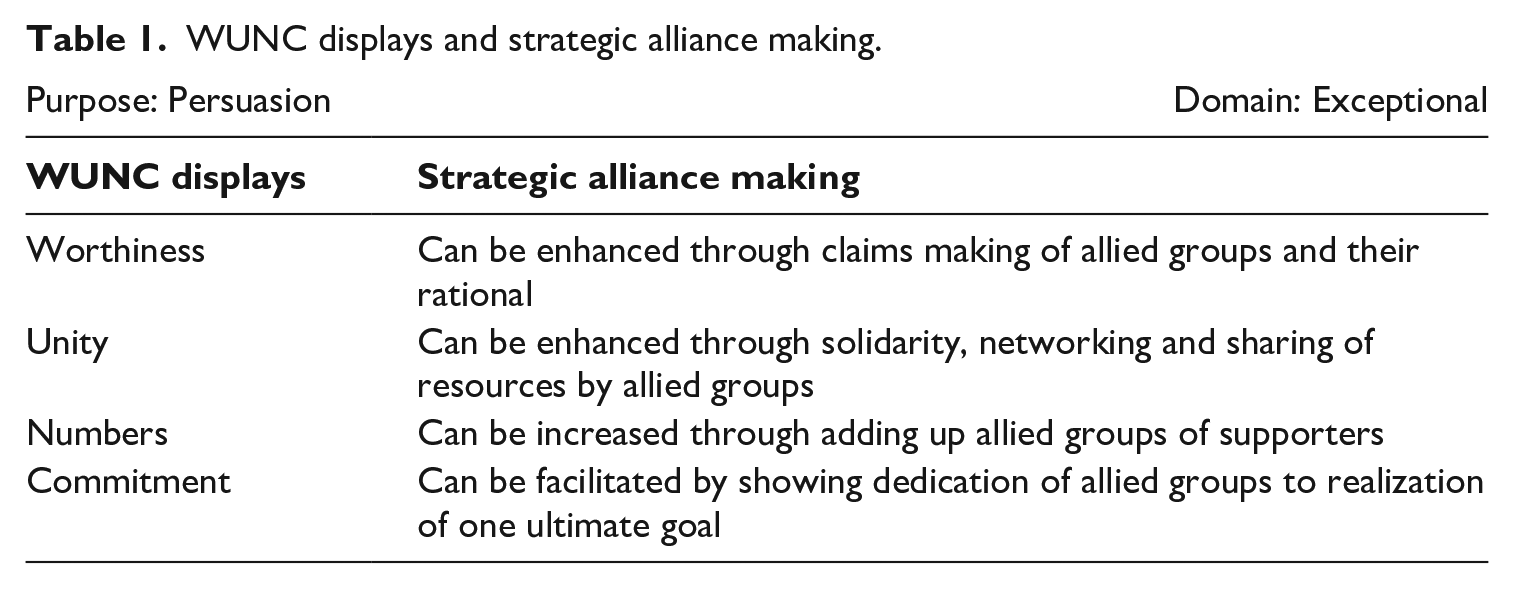
As alliances do not happen in a vacuum and are the result of contextual and processual factors, I suggest this analytical lens should be complemented by reference to the particular configuration of political opportunities (Meyer and Minkoff, 2004) and processes of meaning attribution and framing (Benford and Snow, 2000). While political opportunities – in their broader sense – are instrumental in the emergence of both within- and cross-movement alliances, processes of meaning attribution and framing play a significant role in attracting various groups and movements in cross-movement alliances.
Scholarly work on alliance building has so far either focused on understanding collaborative efforts within movements (Benford, 1993; Fantasia and Voss, 2004; Gilmore, 2008; McAdam, 1982; McMath, 2017; Morris, 1984; Murphy, 2005; Polletta, 2002; Rochon and Meyer, 1997; Shaffer, 2000; Staggenborg, 1998) or cross movements (Beamish and Luebbers, 2009; Chávez, 2011; Croteau and Hicks, 2003; Heaney and Rojas, 2014; McCammon and Campbell, 2002; Obach, 2004; Omi and Winant, 1986; Rose, 2000; Tarrow and Meyer, 2019; Van Dyke et al., 2007; Wood, 2005). However, within-movement and cross-movement alliances emerge in response to diverse factors and pose different sets of challenges and opportunities, and when they are analysed together, they provide us with a more comprehensive analysis of alliance building dynamics and demonstrate the larger picture within which movements’ strategic practices are shaped. In other words, studying intra- and inter-movement alliance building dynamically and in relation to each other would enable us better understand when, how and why alliance building occurs and what the implications of alliance building could be.
Therefore, in this article I look at dynamics of both within- and cross-movement alliances. I have divided the empirical section of the article into three parts. In the first part, I explain the role of political opportunities in the emergence of within-movement alliances. I then demonstrate how political opportunities and framing influenced the emergence of cross-movement alliance. The last empirical section highlights the significance of within- and cross-movements alliance building as a strategy through which WUNC displays (worthiness, unity, numbers and commitment) can be facilitated and enhanced.
Methodology
I conducted 15 semi-structured interviews with representatives of the key groups and organizations involved in organizing and supporting the march. These included interviews with representatives of farmers’ organizations, civil society organizations, student organizations, trade unions and an umbrella group of middle-class citizens called Nation for Farmers. An ‘insider activist’ assisted me in the course of the research and helped me recruit interviewees who were representatives of their respective organizations. Therefore, the interviews were conducted within their professional competence and reflect the viewpoint of their respective organizations or group. None of the data is considered to be sensitive or confidential in nature. However, because of the contentious nature of the topic and India’s increasing tendency towards authoritarianism and repression of dissent, the interviewees have been anonymized.
The interviews were conducted right after the march to Parliament and in April 2019, shortly before the 2019 general elections. They were semi-structured and around a few themes such as the nature of the informant’s organization, their view on the agrarian crisis, their reasons for joining the march or the alliance with farmers, the activities they were involved with during the march to Parliament and after, as well as their plans for the future. I coded the interview contents manually because this allowed for a more in-depth analysis of the data and references which were constantly made to other groups and particular themes.
While the interviews constitute the main body of data analysed here, participant observation and the documents I collected during the march to Parliament helped me flesh out the interviewees’ narratives. I attended the farmers’ march to Parliament on 30 November 2018 and the preceding programmes, including performances, talks and discussions on the 29 November upon the farmers’ arrival to the capital from different parts of the country. At the end of the march, I participated in a rally where a number of organizers and politicians spoke in defence of the farmers. Participant observation of the march and the events around it allowed me to understand the context of the mobilization and get a more comprehensive view of how the alliance was unfolding and what the main demands and issues were.
March to Parliament: Political opportunities and within-movement alliances
There have been different waves of farmers’ uprisings in India since the 1980s. However, in the 1980s and 1990s, many of these movements were driven by rich farmers which had emerged as the result of land reforms and the Green Revolution after independence and were against the exploitation of rural India by westernized urban Indians (Lindberg, 1994; Nilsen, 2018). In the late 1990s and early 2000s, some segments of the farmers’ movement were integrated into the broad coalition of social movements beyond national boundaries and became part of the larger struggle against globalization at the global level (Assadi, 2002). However, the recent wave of farmers’ movement in India, which is the focus of this article, has its roots in years of nationally oriented land rights and environmental justice struggles, as well as fragmented but continuous peasant mobilizations organized by different leftist political parties in the late 2000s and early 2010s. Unlike the previous uprisings, small and marginal farmers, landless labourers and Adivasis (tribal groups) form an important part of this movement. Being united with the rich farmers, their interests and demands are not uniform and represent, on the one hand, India’s agrarian crisis and on the other hand wide inequalities that exist across India’s rural population.
India’s ongoing agrarian crisis has its roots in the neoliberal reforms that have shaped India’s political economy since the early 1990s and in the Green Revolution before that. Due to these reforms, state intervention in agriculture declined and led to rising costs of products (Mohanty and Shroff, 2004; Vyas, 2004), frequent loss of production (Vasavi, 1999), decreasing income and increased indebtedness for farmers (Sarma, 2004). For example, according to the report by the Ministry of Agriculture and Farmers’ Welfare (2018), 52% of agricultural households in India are indebted.
Moreover, the neoliberal policies resulted in the decline of available agricultural land and unequal distribution of land and have left the majority of Indian farmers landless or with small and marginal holdings. For example, the percentage of land owned by small farmers has gone up from 38% in 1953–4 to 70% in 2003 (Ministry of Agriculture, 2014; cf. Dandekar and Bhattacharya, 2017: 77). In many cases, those with small pieces of land need to supplement working on their own land with wage labour (Jodhka, 2012; Nilsen, 2018).
These trends have led to the emergence of a state of ‘advanced marginality’, as Vasavi (2009) has put it, and an unprecedented crisis in the agricultural sector. Moreover, the liberalization of India’s economy in the 1990s ‘marginalised agriculture in the development discourse on India’ (Jodhka, 2012: 6) while agriculture continued to employ the majority of the workforce. The contribution of agriculture to India’s economy has decreased constantly since independence. In the mid-2010s, it accounted for just above 15% of gross domestic product (GDP) compared to more than 50% in the early 1950s (Figure 1).
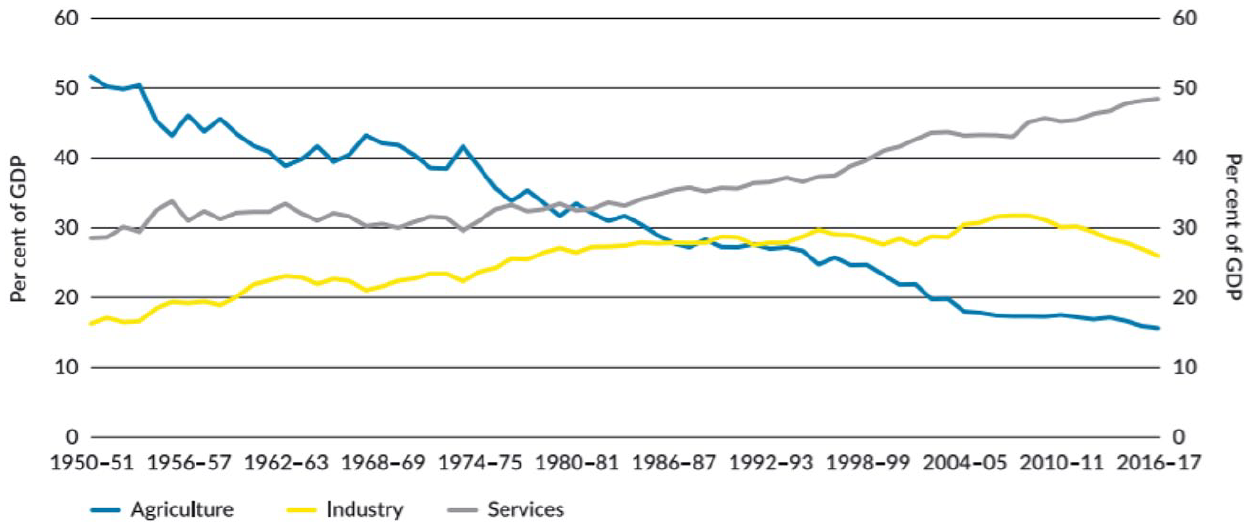
Change in sectoral shares of the Indian economy.
In the 2014 general elections, Narendra Modi led the Hindu Nationalist Bharatiya Janata Party (BJP) to a landslide victory. He promoted himself as someone who would follow up on the neoliberal economic policies and scale up growth and development. To continue the process through which the BJP had managed to expand their vote beyond the upper castes and urban middle classes, he propagated an anti-elitist alternative to the long-lasting politics of the Indian National Congress (henceforth Congress), which had become the dominant political party in post-independence India (Nilsen, 2018). In his campaign, Modi addressed farmers’ suicides and agrarian distress as a major problem and ensured them a minimum of 50% profit over the cost of production, the implementation of farm insurance and the adoption of a National Land Use Policy, among other promises. Consequently, a large number of farmers and agricultural workers supported him.
Despite Modi’s populist promises to improve farmers’ situation, many feared the prospect of a wave of repression against pro-farmer activists. Shortly after his victory, a call by All India Kisan Sabha (AIKS) – the peasants’ front of the Communist Party of India (Marxist) – brought a large number of groups together. ‘There was a need to come together and different groups realized they cannot survive on their own’ a representative of one of the main organizations involved in the march to Parliament stated.
Modi’s election in 2014 provided the opportunity for several organizations who were previously involved in questions of land grabbing, environmental justice and peasants’ livelihoods to come together and work on some issues, which were mostly at the state and local level. In February 2015, farmers organized the first large demonstration against Modi in response to the government’s aggressive changes to the Land Acquisition Act of 2013. Many political parties and different groups joined the farmers in this demonstration. The government responded harshly. This collaboration happened at the national level, but the main organizations involved returned to the state level and organized in a number of states. For the next two years there was no national level collaboration, and the local campaigns remained limited.
On 6 June 2017 police fired on the farmers’ protest in the central state of Madhya Pradesh and shot dead six Indian farmers. Protests in Madhya Pradesh followed the strike in the state of Maharashtra, where farmers a few days earlier had started dumping vegetables and milk on the road, demanding debt relief and higher prices for their produce. Madhya Pradesh is among the states which has been hit badly by climate change in recent years, leading to crop failures. Shortly after the killings, around 150 farmers’ organizations came together and formed the All India Kisan Sangharsh Coordination Committee (AIKSCC), an umbrella group which as of April 2019 worked with over 200 farmers’ organizations from all over India. AIKSCC was behind most of the mobilizations that led to the farmers march to Parliament on 30 November 2018. For the first time in the history of independent India this umbrella group managed to bring together representatives from different states of India, signifying the stakes of all farmers, including agricultural workers, Adivasis (tribal groups), Dalits (ex-untouchables) and women farmers. A representative of AIKSCC organizing committee demonstrated this as follows: When the police shooting of June 2017 happened, we felt an immediate need to respond. There were already protests in Rajasthan, Maharashtra and Delhi and the police firing on the protest was the turning point and gave an angle to a lot of ongoing farmers’ protests. (personal communication)
Although the farmers’ march to the Parliament was the major event AIKSCC organized, from the day of their establishment they became involved in organization of a number of successful events, marches and protests. On 20 and 21 November 2017, they organized a major protest meeting in New Delhi and passed a resolution that two bills should be passed in Parliament: a minimum support price for agricultural products and a total loan waiver for farmers. As one representative of AIKSCC stated: ‘each of us [organizations] had our own agenda but collectively we agreed on these two issues’ (personal communication).
During the months after this, AIKSCC organized meetings in different states and capitals and invited different farm groups as well as students, lawyers, artists and journalists to learn about their issues. Although these meetings had their own foci in each state and region, due to the nature of the agrarian crisis in different places, the organizations involved in AIKSCC unanimously stated that a sense of unity, collaboration and inter-group connection had emerged among farmers from all regions and backgrounds.
Apart from the events which were locally organized with the support of AIKSCC, in March 2018, some 40,000 farmers marched to Mumbai from all over India to demand debt relief, minimum support prices and land rights; on 1 June 2018, thousands of farmers started a 10-day protest in a number of states, and in November 2018, prior to the march to Parliament, some 50,000 farmers marched in Kolkata. Due to the nature of AIKSCC, which represented different farmers’ groups with different backgrounds, all these mobilizations were supported by diverse farmers’ organizations and groups. This is something unique in the history of famers’ mobilization in post-independent India. Figure 2 gives a timeline of the main protest events following the changes to the Land Acquisition Act.
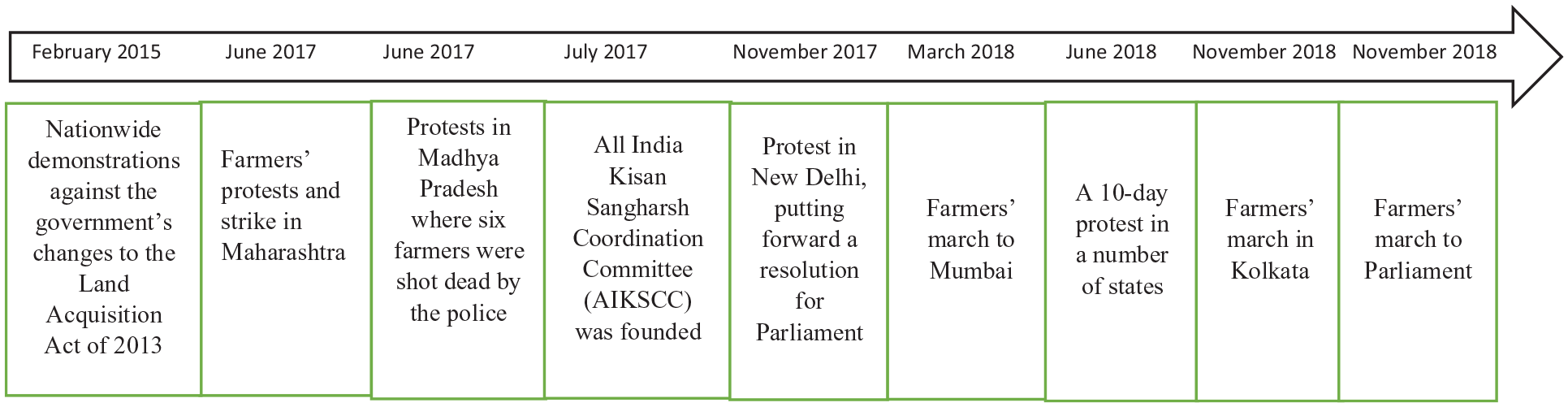
Timeline of farmers’ main protest events from 2015 to 2018.
March to Parliament: Political opportunities, framing and cross-movement alliances
During the farmers’ march to Mumbai in March 2018, an alliance of urban-based middle-class citizens, civil society groups and activists, workers, students and oppositional political parties came together to support the farmers and their cause. They acted as a loose group of supporters and reached out to the protesters with food, water and slippers for the barefoot farmers. Doctors offered to treat farmers’ hurt feet, and lawyers offered legal support. According to many observers and activists, this was the first time middle classes had come out in spontaneous support for farmers. There were a number of explanations for this support. The crisis was increasingly framed as national and societal in scope, rather than as an agrarian crisis confined to rural areas. For example, there is consensus among scholars that semi-proletarianization is a common trend among the majority of India’s rural population (Levien, 2018). Moreover, the prolonged agrarian crisis fuelled by neoliberal economic policies has forced a large fraction of farmers and agricultural workers to fully migrate to urban areas in search of employment. Most of these migrants and their families end up becoming part of the informal urban economy and live extremely precarious lives (De Roy and Saratchand, 2021; Mishra, 2020). Bernstein’s (2004: 205) analysis of the agrarian question has unpacked various interconnections with the question of labour while focusing on different forms of oppression ‘along intersecting lines of class, gender, generation, caste and ethnicity’ in workers’ struggle for social reproduction in their new homes in the cities. Gidwani and Ramamurthy’s term ‘middle migrants’, in urban India, precisely deals with how such households ‘remain enmeshed in their rural lives through translocal householding and cultural dispositions to difference, especially those of regional patriarchy, caste and generation’ (Gidwani and Ramamurthy, 2018: 1012). These interlinkages between the rural and the urban and similarities of struggle for a decent life were clearly recognized and emphasized by my informants.
For example one of my interviewees and representative of one of the student organizations stated: During and after the Mumbai march, everyone somehow got involved and understood farmers’ issues are not only theirs, but farmers’ problems also affect us [in urban areas]. Farmers are the basic unit and give you food. So, many people can identify with them. Also, there are many categories within farmers such as women, tribal groups, lowers castes, farm labourers, so people can identify with one of these categories at least. (personal communication)
Although India is officially a liberal democracy, democratic practices have remained fragile and exclusive in post-independence India, leading to the emergence of a non-responsive, and more recently, repressive state, in which subaltern groups remain marginalized (Chatterjee, 2004) and civil liberties are commonly suspended. Since Modi’s election a number of scholars have pointed to an authoritarian turn (Chacko, 2018; Sud, 2020). According to Chacko (2018) the rapid growth of authoritarian politics in recent years in India should be understood in the context of a long-term crisis of the state which has failed to establish legitimacy for its neoliberal policies introduced in the 1990s. India has turned to authoritarian statist tendencies and marginalizes dissent albeit within a framework of constitutional democracy. Sud (2020) emphasizes the fact that the current model of governance under Modi combines a partnership with big capital with an authoritarian and repressive state. This has exposed different social groups, social movements and activists to various forms of repression. One very clear example has been numerous attacks and crackdowns on universities and student groups – which were among the most represented groups in the alliance – as well as transforming schools and higher education in an effort to bring India closer to the Hindu nationalist ideology of the BJP (Bhatty and Sundar, 2020). As a representative of a student organization reaffirmed, ‘[the] policies of Modi have broken the backbone of [the] rural economy’ but also ‘this government has been extremely repressive not only on the farmers but also on the students . . . So our alliance with farmers is rather natural’ (personal communication).
The spontaneous and loosely organized act of support and solidarity during the march to Mumbai turned into a coherent organized group during the march to Parliament in November 2018. Two important manifestations of this unity were the emergence of the ‘Dilli Chalo Movement’ and ‘The Nation for Farmers Group’. After the march to Mumbai and the spontaneous involvement of the middle classes, Palagummi Sainath, the renowned journalist of rural India and the founder/editor of the People’s Archive of Rural India – a digital journalism platform focused on different aspects of rural life – decided to help organize support from non-farm groups for the march in Delhi. He created the platform Dilli Chalo, which translates as ‘Let’s go to Delhi’, to encourage middle-class groups to support the farmers’ march in any way they could. In the first announcement of the call he tweeted: ‘The agrarian crisis won’t be restricted to only the rural for much longer. The pressure will fall in urban India soon enough’, trying to interconnect the rural and urban issues. In different interviews and meetings, he repeatedly argued that the agrarian crisis had gone beyond rural India and has become ‘a crisis of the society and civilization’, and that as a nation all Indians are responsible in fighting the ‘commodification’ and ‘corporatization’ of farming,
1
signifying the structural problems which were behind the creation of the national emergency that has emerged as the consequence of wrong-headed economic and agricultural policies. Also, he organized a petition to be circulated widely which addressed the president of India to convene a special parliamentary session on the agrarian crisis. In addition, within this context, Nation for Farmers emerged as a group to work together with the organizers of the farmers’ march to Delhi but also to carry forward the work of the Dilli Chalo movement. This group is comprised of volunteers from different sectors and states across India who work together to generate a public understanding of the processes which have led to the emergence of the agricultural crisis and the consequent crises of migration, water shortage, informalization and precariousness, among others. As one of the representatives of the group mentioned: We are trying to inform the people that this agrarian crisis has been engineered, it has not happened automatically, it has not happened by default, it has happened by design and the design lies in monetizing resources, monetizing land, water and agricultural commodities. (personal communication)
In the weeks and days prior to the march in Delhi, Nation for Farmers organized teach-ins and public lectures across India and mobilized people and resources in support of the farmers. During the two-day gathering of farmers in Delhi on the 29 and 30 October 2018, the group managed to mobilize different sub-groups of middle classes into categories of doctors for farmers, lawyers for farmers, artists for farmers and journalists for farmers. All these groups in their own capacity supported the march by providing medical support, legal advice on the farmers’ issues, organization of performances in support of the farmers across the city as well as wide coverage of the march by media activists and journalists from across the country. Hence, processes of meaning attribution and framing encouraged mobilization of those who were not necessarily the immediate target audience of the movement.
The credit has to go to the organizers . . . I think after [the] Modi government coming in, they did not give a damn about people dying. They tried to disassociate suicides, agrarian distress and their economic policies. So, the work farmers’ organizations have recently done has been really changing the public discourse, so many groups now feel they understand why farmers are protesting. (personal communication)
Finally, organizers of the march to Parliament emphasized that they not only used the march to build an alliance of groups and activists around the broad master frame (Carroll and Ratner, 1996) of farmers’ discontent but also used this opportunity to push for the emergence of a further consensus among the groups about their objectives and values (Doherty and Doyle, 2006) in an increasingly authoritarian context where various forms of discontent have been silenced. In such a political environment, this alliance created hope as many of my informants put it.
After the march to Parliament, the group organized a few meetings and conferences to avoid losing ‘the solidarity and keep some sort of a continuity’, as one of the organizers of the group stated. Apart from the Dilli Chalo movement and the Nation for Farmers group, a number of renowned civil society groups, trade unions, student groups and oppositional political parties rallied in support of the farmers’ march in Delhi. Some coordinated their support with Dilli Chalo, Nation for Farmers and/or AIKSCC, while the others joined the march independently. Many remained cooperative in the months after the march to Parliament.
March to Parliament: Strategic alliance building
This article has so far demonstrated that political opportunities shape the emergence of processes of both within- and cross-movement alliance building while framing and meaning attribution play a crucial role in making cross-movement alliance likely. However, this article also highlights the significance of within- and cross-movements alliance building as a strategy through which WUNC displays (worthiness, unity, numbers and commitment) can be facilitated and enhanced. As has been demonstrated, participants in this case study represented a range of different groups and organizations, from various farmers’ groups to groups with no immediate link to farmers and their issues. In this sense, the march to Parliament led to the building of an alliance with many participants who did not hold a collective identity (Doherty and Doyle, 2006). At first sight, the march seemed to reflect an ‘event coalition’, which, according to Levi and Murphy (2006), brings together activists for an event without having a long-term strategy for cooperation. However, most participants interpreted this alliance as a strategic move, which will have a political impact in terms of material change for farmers, but also noted their dissatisfaction with the situation at large and stressed the prospects for social change that this alliance has brought about. As was discussed in the previous sections, major issues that concern the Indian public today vary from growing authoritarian tendencies combined with increased neoliberalization of the economy and the state’s alliance with big businesses and corporations to the decline of living standard and state protection for the marginalized and impoverished segments of the society, including farmers.
For example, a representative of a trade union noted: Here [in India] the industrial corporates are dictating the entire economy, polity and society, and Modi’s government has made everything worse. They are partners with industrial agriculturalists, and our agriculture is in crisis because of them. Workers are also suffering because of them, so we support each other . . . We hope this alliance can push for some substantial change, not only during the election but also after. (personal communication)
By emphasizing the broader rationale behind the alliance and its claims making, this person referred to the worthiness aspect of the WUNC displays and how such an alliance can enhance it. One of the speakers of the post-march gathering on 30 November 2018 was Rahul Gandhi, the then-president of the Congress, who in his speech declared that ‘farmers are not seeking free gifts from the government, only their rights’. However, a number of organizations showed their dissatisfaction with the involvement of the Congress in the march and associated the roots of current agricultural policies with the years when they were in power. They believed the Congress were misusing the people’s movement to their own benefit. But the consensus was that Modi’s government was intensifying the previous economic tendencies and was limiting civil liberties and hence was paving the way towards authoritarianism. Therefore, even the involvement of the Congress in the march seemed acceptable as a strategy to enhance worthiness. As a representative of one peasant organization mentioned: We, the peasant organizations, know very well they [Congress] have their limits. Their target is the next general elections . . . The very policy which is affecting the peasantry was made by them in the 1990s. These policies have not only ruined agriculture but other aspects of our economy too. Instead multinationals and corporates have been benefiting. But BJP is the party which has the worst policies for peasants and others . . . So, the first step is to get rid of BJP and Modi with the help of the peasantry and then plan for the future. (personal communication)
Within this dialectic of dissatisfaction with the status quo and support for the farmers, representatives of farmers’ organizations agreed that the killings of farmer-protesters in June 2017 was used strategically to unite various farm groups (unity aspect of WUNC displays). Sure enough, the police shooting provided the farmers and their organizations a platform to reinterpret their sociopolitical environment and provided a contingency for them to act. A representative of one farmers’ organization and one of the main organizers of AIKSCC explained that the killings of farmers provided a critical point which was used strategically to come together in spite of differences: After the killings, there were different but fragmented protests. But we called for a meeting and told different organizations forget the colour of your [organization’s] flag. You represent farmers. Farmers are under attack. Come to save the farmers. This is our first mission. We will talk about differences later. (personal communication)
Moreover, the organizers’ move in bringing together farm and non-farm groups a few months ahead of the general election also proved to be a strategic move in enhancing unity as well as numbers.
Finally, interviewees highlighted ongoing, collaborative, local- and state-level campaigns and activities and emphasized the importance of the march to Parliament for the creation of these local networks, which were enacted at a later time. This showed the dedication of different groups to the realization of an ultimate goal (commitment aspect of WUNC displays). Apart from commitment, this demonstrates success, as in many cases longevity is a crucial aspect of a successful coalition (Staggenborg, 1986: 375). My informants were confident a counterhegemonic force had emerged which would reshape India’s future as a whole – and not only rural India – through pushing for pro-people policies and a programme of social change beyond farmers’ issues and regardless of the outcome of the general elections. Major concerns about democracy, anti-capitalist transformation and the welfare system were raised and discussed as possible frames for future collaborations.
Conclusion
This article has suggested that political opportunities and framing processes are significant factors in shaping the emergence of alliances. While political opportunities are a key factor in the emergence and success of both within and cross-movement coalitions, framing processes contribute mostly to cross-movement alliance building. Moreover, this research has shown the significance of alliance building as a strategy to facilitate WUNC displays for bringing about social change. Alliances enhance displays of worthiness through claims making of different groups and their rationale. They enable networking and sharing of resources while creating more unity and numbers. Alliances can encourage discovering the merits of movements’ efforts at a particular time. Also, movement actors who are in an alliance, in spite of their differences and heterogeneity, organize their actions by the cognitive realization of an ultimate goal.
Social movement scholarship has been criticized for its heavy focus on the global North and its systematic negligence of social movements in the global South by primarily focusing on case studies from Europe and North America (Cox et al., 2017; ; Fadaee, 2016; De Sousa Santos, 2014). Literature on alliance building has not been exceptional and remains largely focused on the global North in spite of recognizing the importance of context and political opportunities for building alliances (Almeida and Stearns, 1998; Amenta and Zylan, 1991; Banaszak, 1996; Bandy, 2004; Borland, 2010; Brumley and Shefner, 2014; Meyer and Corrigall-Brown, 2005; Staggenborg, 1986). Fadaee (2016, 2017) has outlined a number of characteristics exhibited by social movements in the global South. She has argued that one of the determining characteristics of Southern social movements is the particularities of political structures and political opportunity structures for the emergence and evolution of most social movements in the global South. This article shows how the socioeconomic conditions, mixed with political angst, gave rise to a shared experience that cut across group identities which led to the emergence of cross-cutting affiliations to support an alliance for political action. The march to Parliament was the culmination of these forces. Strategic framing facilitated the process of bringing together different groups to form a counterhegemonic coalition which would work towards a progressive political transformation.
Many had hoped that this repertoire of contention would prove to be the force, which defeated Modi in the general election of 2019. However, in May 2019 Modi was re-elected, with the BJP winning a clear majority. It is beyond the scope of this article to discuss the reasons behind this victory. However, as many of my informants had emphasized, India’s agrarian crisis and the structural causes of this crisis would have not been resolved simply by the defeat of Modi in the general elections. They all predicted the alliance which had been shaped around farmers’ discontent would continue, regardless of the election results. Their prediction proved to be true when in November 2020, two years after the march to Parliament, tens of thousands of farmers and agricultural workers blocked numerous entry points on the outskirts of New Delhi for months and demanded the repeal of three controversial farm laws passed in September 2020. It is believed that the new farm laws will move the agricultural sector towards more deregulation. No agreement has been reached after several rounds of talks and farmers have remained insistent over repealing the farm laws.
The 2020–2021 protest sites have been replicating the sense of community spirit that had begun to take shape during the 2018 march to Parliament. Farmers have been joined by individual volunteers and sympathetic groups who help them to continue their protest. Some have opened their homes to the protesters, others have provided food, blankets and tents. The Dilli Chalo campaign has been clearly present and contributed to the growing support for farmers. Apart from various farmers’ organizations, farmers’ unions and farmers’ fronts, numerous political parties, student groups and trade unions have been present too and supported the farmers in various ways. What is apparent is that farmers’ mobilizations in India have turned to a site of resistance against the status quo which for the foreseeable future is expected to continue to mobilize.
Footnotes
Declaration of conflicting interests
The author declared no potential conflicts of interest with respect to the research, authorship, and/or publication of this article.
Funding
The author received no financial support for the research, authorship, and/or publication of this article.
