



Abstract
Digital technologies have rapidly pervaded firms, industries, and economic networks. This development has raised expectations that a firm’s chief information officer (CIO) will take a more strategic role, including innovation leadership and digital exploration. In this study, we argue from an upper echelons perspective that CIOs’ career variety and role tenure are critical in shaping the extent to which firms explore digital technologies in their patent portfolio, that is, digital exploration. We expect a U-shaped relationship between CIO career variety and digital exploration, and an inverted U-shaped relationship between CIO role tenure and digital exploration. We test our conceptual model using a cross-industry panel of U.S. firms. As predicted, the results show high digital exploration for low and high career variety, and low digital exploration for moderate career variety, that is, a U-shape. Conversely, they show low digital exploration for low and high role tenure, and high digital exploration for moderate role tenure, that is, an inverted U-shape. These insights indicate that CIOs do become strategic leaders in exploring and shaping digital innovation.
Keywords
Introduction
“CIOs must reinvent themselves in order to understand how the disruptions that digital transformation will bring to the businesses as we know them can create opportunities to growth and establish themselves as the strategic digital leader companies expect and need them to be” (Cavallo, 2016, 3rd paragraph).
A recent survey among information technology (IT) leaders and business executives supports this view. A vast majority (89%) considered chief information officers (CIOs), that is, firms’ most senior IT executives (Banker et al., 2011; Feng et al., 2021), to be the most essential executives in driving digital transformation efforts (IDG Communications, 2020). These findings underscore CIOs’ pivotal role in steering their firms through digital change. Despite this recognition, our understanding remains limited regarding how CIOs facilitate explorative behavior in discovering new digital opportunities. This gap has spurred calls from various scholars for deeper investigation into the specific dynamics through which CIOs can manage exploratory activities within organizations (Gurbaxani and Dunkle, 2019; King, 2011; Kohli and Melville, 2019; Saldanha and Krirshnan, 2011). In particular, Chen et al., (2010: 261) suggest examining the “exploitative and explorative mechanisms the CIO can use to influence different organizational outcomes.”
We contribute to this discourse by examining how the characteristics of CIOs influence the extent of digital exploration within their firms’ patent portfolios. Specifically, we argue that the capability of CIOs to drive digital exploration by orchestrating IT resources and forming partnerships with business collaborators depends on their experiences, skills, and knowledge (Li and Chan, 2019). Surprisingly, the impact of these attributes of CIOs on shaping firms’ digital strategy remains underexplored. Thus, our research question is: How do the characteristics of CIOs influence firms’ digital exploration efforts?
To answer this question, we adopt an upper echelons perspective (Hambrick and Mason, 1984). We introduce career variety (Crossland et al., 2014) and role tenure (Bourdeau et al., 2024) of CIOs as two crucial characteristics for firms’ digital exploration. Career variety reflects the range and depth of expertise that executives have gained before their current position (Crossland et al., 2014). Role tenure denotes the duration of executives in their current occupation (Miller, 1991). We argue that both characteristics shape three functional roles of a CIO: informational, decisional, and relational (Boyd et al., 2010; Carpenter et al., 2004; Kunisch et al., 2022). These roles influence the extent to which firms pursue digital exploration (Firk et al., 2022).
Against the backdrop of these roles, we expect the relationship between CIO career variety and digital exploration to be U-shaped. We predict that high digital exploration will correlate with low and high career variety, and low digital exploration with moderate CIO career variety. We attribute this relationship to the three aforementioned roles of CIOs that vary based on their career variety. Hence, we argue that CIOs with low career variety contribute to digital exploration in three ways: (1) through their deep domain-specific expertise, (2) with a strategic focus on IT investments, and (3) by having access to a specialized network offering in-depth insights. Conversely, we suggest that CIOs with broad career experiences enhance digital exploration by (1) bringing a diverse perspective to identifying technological and market opportunities, (2) taking a comprehensive approach to IT investments for venturing into new digital domains and business models, and (3) having access to a wide network with a diversity that stimulates digital innovation capabilities. We expect CIOs with moderate career variety to not push boundaries in any direction strongly enough to foster digital exploration.
As for the relationship between CIO role tenure and digital exploration, we expect it to follow an inverted U-shape. We expect high digital exploration to correlate with moderate role tenure, and low digital exploration with low and high role tenure. Again, we attribute this relationship to the three roles of CIOs that vary according to their role tenure. We argue that CIOs with low role tenure suffer from (1) a lack of in-depth organizational knowledge of digital opportunities and how to leverage them, (2) caution in making risky, long-term IT investments, and (3) their small networks. Conversely, we expect that CIOs with high role tenure suffer from (1) their immersion in the firm’s established ways, (2) their preference for the status quo, and (3) the fact that their networks have become echo chambers reinforcing existing perspectives, due to being too extensive. We expect that CIOs with moderate role tenure have acclimated to their firms and learned their organizations’ cultures, strategic goals, and technology landscapes. We expect these CIOs to have built a large and active network. All of this puts them at peak effectiveness for digital exploration.
To test our hypotheses, we created a panel dataset of firms found in the S&P 500 index, and their CIOs and digital patent portfolios from 2006 to 2015. This resulted in 845 firm-year observations. We sourced financial data from Compustat and conducted an extensive review of official filings and public sources to create executive profiles. Our analyses support our theory that a U-shaped relationship exists between CIO career variety and digital exploration, along with an inverted U-shaped relationship between CIO role tenure and digital exploration.
In this study, we contribute to research in three important ways. First, we add to the digital innovation literature by arguing that senior executives’ values and cognition influence their strategic decisions about exploring digital innovation. By focusing on the actual characteristics of CIOs, we go beyond simply testing their presence in the top management team (TMT). Our focus resolves ambiguous findings regarding CIOs’ impact on firms’ strategy and performance in information systems (IS) research (e.g., Bendig et al., 2023; Sobol and Klein, 2009). Second, we add to research on upper echelons by showing how career variety and role tenure affect functional TMT members’ informational, decisional, and relational roles to shape firms’ digital exploration. We particularly find that the impact of career variety on digital exploration for functional managers, such as CIOs, diverges from that of CEOs. Finally, while demonstrating the importance of individual-level factors such as career variety and role tenure, we also uncover that the relationships between these variables and digital exploration are more complex than related research suggests. Specifically, our findings indicate that not all characteristics have uniform effects on decision-making outcomes. Instead, some characteristics exhibit non-linear relationships.
Theory and hypotheses
Upper echelons theory, career variety, and role tenure
Upper echelons theory suggests that the characteristics of organizations’ CEOs shape organizational outcomes. This is especially true in terms of strategic choices and performance, because CEOs’ backgrounds, experiences, values, and personalities affect their interpretations of situations and their decision-making (Hambrick and Mason, 1984). The upper echelons perspective considers observable managerial characteristics such as age, career experiences, and tenure as influences on the psychological dimensions listed above. Subsequent research expanded Hambrick and Mason’s original CEO focus to all senior executives (Carpenter et al., 2004; Georgakakis et al., 2022; Hambrick, 2007; Menz, 2012). We use this theoretical lens to examine the role of CIOs in firm outcomes. We particularly examine how two important characteristics, CIOs’ career variety and role tenure, shape their firms’ digital exploration.
Career variety captures the breadth and depth of the expertise an executive brings to their current position. It highlights the value of diverse professional experiences in enriching an executive’s strategic insight and decision-making ability (Crossland et al., 2014). High career variety implies that an executive has worked in many firms, industries, and functions relative to years of employment. In contrast, low career variety indicates a focus on one or a few firms, industries, and functions. Scholars suggest that low career variety lets executives collect in-depth knowledge in one domain. High career variety, on the other hand, gives them a broader understanding of business challenges, technological opportunities, and market trends (Chen et al., 2021; Gonzalez et al., 2019). This breadth of understanding correlates with preferring change and experimentation (Dragoni et al., 2011; Tesluk and Jacobs, 1998). Following Crossland et al. (2014), we define CIO career variety as the array of distinct professional and institutional experiences a senior IT executive has had before becoming CIO. We suggest that this experience helps to form their cognitions and motivations.
Role tenure focuses on the length and dynamics of executives’ service in their current position. It reflects the evolution of their authority and the development of professional networks (Miller, 1991). For executives, role tenure indicates their experience in their organization and their grasp of that organization’s culture and internal procedures (Bourdeau et al., 2024). We draw from literature on CEO tenure (Hambrick and Fukutomi, 1991) to introduce CIOs’ role tenure. Hambrick and Fukutomi (1991: 720) propose five stages of executive tenure: “(a) response to mandate, (b) experimentation, (c) selection of an enduring theme, (d) convergence, and (e) dysfunction,” which describe an inverted U-shaped relationship between executive tenure and firm outcomes. Studies indicate such a relationship for firm outcomes such as performance (Feng et al., 2021; Miller and Shamsie, 2001), research and development (R&D) spending (Barker and Mueller, 2002; Pang et al., 2016), and patenting activity (Wu et al., 2005).
The roles of functional executives
We aim to explain the underlying mechanisms linking CIO career variety and role tenure to firms’ digital exploration. To do so, we draw on the work of Boyd et al. (2010) to suggest that a CIO as a functional executive needs to play at least three roles to affect firm outcomes. These roles are informational, decisional, and relational (see also Nath and Bharadwaj, 2020). Transferring Boyd et al.’s (2010) work from the marketing domain to IS, we suggest that (1) the informational role of the CIO is critical for firms to identify new digital opportunities and threats; (2) likewise, the decisional role to determine the investments to be made in IT; and (3) the relational role is essential for developing and managing stakeholders relevant to the digital ecosystem, that is, suppliers, alliance partners, investors, and users. We argue that if CIOs succeed in these roles, they contribute to firms’ competitive advantages and performance.
In terms of the informational role, we suggest that CIOs monitor and evaluate IT trends to make sure the firm operates with optimal software and hardware. CIOs should also recognize opportunities to add value to goods offered through digital technologies (Haislip et al., 2021). Their domain expertise in IT and digital technologies is critical for their effectiveness in this role.
For the decisional role, we argue that CIOs must allocate resources to and set strategic priorities for IT initiatives to ensure their activities align with company goals and maximize creating value through digital technologies (Scuotto et al., 2022). Their strategic perspective and managerial capabilities are critical for their effectiveness in this role.
As for the relational role, we suggest that CIOs build and maintain a network of relationships inside and outside of the firm. They should connect experts across intra- and inter-organizational boundaries to strengthen the firm’s collective IT capability (Li et al., 2021b). Their personal networks and social capital are critical for their effectiveness in this role.
The roles of CIOs in information systems research
A frequent observation in information systems literature is that the scope, authority, tasks, and challenges of a CIO are often ambiguous, varying between firms and over time (Blaskovich and Mintchik, 2011; Peppard et al., 2011). CIOs are generally appointed to manage IT costs and IT operations (Peppard et al., 2011: 37). However, IT has grown rapidly in just a few decades across departments, firms, industries, and economic networks (Benlian and Haffke, 2016; Luftman et al., 2015; Vial, 2019). This development has raised expectations that CIOs must take a more strategic role to deliver strategic value from IT. They do so by developing novel digital solutions and leveraging digital technologies to enable innovation in other fields (Cavallo, 2016; Chun and Mooney, 2009; Garms and Engelen, 2019; Gerth and Peppard, 2016). This is in line with research by Bendig et al. (2022). They found that industry IT intensity, experience gaps in IT in the TMT, and a strategic shift towards IT relate to CIO presence in the TMT.
CIO roles are ambiguous and heterogeneous due to the fundamental dichotomy between the roles of managing IT operations and costs versus driving strategic value (Chun and Mooney, 2009; Peppard et al., 2011: 6). Chen et al. (2010, 2021) describe these two roles as demand- and supply-side leadership. They argue that the development of CIO leadership follows a maturation process from the supply side, focused on managing IT operations and costs, to the demand side, focused on driving strategic business value. These two roles correspond to the two types of innovation activity identified in the organizational learning literature: exploration and exploitation (March, 1991; O’Reilly and Tushman, 2013).
In an exploitation paradigm, firms innovate by relying on and refining their existing internal knowledge stock (Benner and Tushman, 2002; Garms and Engelen, 2019). Hence, exploitation activities use internal knowledge to improve and extend existing competencies, knowledge, processes, products, and technologies. Such activities promise incremental innovation, efficiency gains, and predictable returns. However, they are also short-term.
In the exploration paradigm, firms innovate by incorporating knowledge from outside the firm (Benner and Tushman, 2002; Garms and Engelen, 2019). Exploration creates innovation in the long term when firms search for and experiment with new competencies, knowledge, processes, products, and technologies. The returns from these activities can be much higher than from exploitation activities. However, they are also more uncertain (March, 1991). Because prior research focused on CIOs’ exploitation tasks, that is, managing IT costs and operations (Chen et al., 2010, 2021), we focus on how CIOs’ characteristics shape firms’ digital exploration.
Digital exploration and CIOs
We define digital exploration as the process of investigating and experimenting with new digital technologies, platforms, and capabilities in order to uncover novel opportunities, improve efficiencies, or gain competitive advantage (Bendig et al., 2022; Chung et al., 2019). Empirical studies show that the effect of digital exploration on firm performance depends on the degree of uncertainty in the environment (O’Reilly and Tushman, 2013). Hence, whether an observed exploration is optimal depends on the firm’s internal characteristics and external context. Confirming this, Chung et al. (2019) find that the fit between a firm’s digital exploration and the uncertainty in its environment affects firm performance. Evidence concerning the outcomes of different levels of digital exploration exists, but the roots of such outcomes remain unexplored. Examining the different roles of CIOs through the lens of upper echelons theory, our core contention is that CIOs’ characteristics shape firms’ digital exploration.
Research on the CIO has focused on proxies of decision-making authority such as CIO presence (Bendig et al., 2023), reporting structure (Banker et al., 2011; Li et al., 2021a), organizational support for IT (Haislip et al., 2021; Preston et al., 2008), or compensation (Kwon et al., 2012). Recently, Bendig et al. (2022, 2023) have shown that CIO presence positively influences a firm’s orientation toward exploration and that including a CIO in the TMT positively affects a firm’s digital innovation, both in ideation and commercialization. However, these studies have not examined the role of CIO characteristics in this process, indicating a need for additional research. Moreover, Sobol and Klein (2009) find that CIOs with a technical background and a strategic rather than utilitarian orientation are associated with higher firm performance. The exact ways in which CIOs affect firm performance remain unexplained. We build on these insights by examining a more immediate strategic outcome than firm performance, that is, digital exploration, defined as the extent to which firms explore digital technologies in their patent portfolios.
Our theoretical development concentrates on CIOs’ career variety and role tenure. These two characteristics are vital for understanding CIOs’ contributions to TMTs. Executive career variety and role tenure are standard measures in upper echelons research (e.g., Dong et al., 2018). These measures enable a comprehensive examination of TMT characteristics and their influence on firm outcomes. Our study builds on existing literature, including research on how career variety and role tenure affect the dynamic interplay within TMTs and the resulting organizational impacts. In light of this prior research, our unique focus on CIO characteristics from an upper echelons perspective provides new perspectives (Barker and Mueller, 2002; Custódio et al., 2019; Finkelstein and Hambrick, 1990; Hambrick and Fukutomi, 1991).
CIO career variety and digital exploration
We expect a U-shaped relationship between CIO career variety and firms’ digital exploration efforts. To derive this relationship, we discuss the effect of CIO career variety on digital exploration in terms of the informational, decisional, and relational roles of functional executives (Boyd et al., 2010), and at low, moderate, and high levels of career variety. The three roles establish a U-shaped relationship over the three levels, with high digital exploration for low and high career variety, and low digital exploration for moderate career variety.
First, we argue that CIOs with low career variety engage in high levels of digital exploration using their deep expertise in specific domains. Particularly, they leverage their informational role to deeply understand, exploit, and communicate using niche digital technologies that competitors might overlook (Carter et al., 2011). In the decisional role, they focus on targeted IT investments that reinforce the firm’s strategic positioning within familiar territories. Thus, they catalyze innovation within a specialized domain (Chun and Mooney, 2009). As for the relational role of CIOs with low career variety, their focused network can yield unique, in-depth insights and collaborations, fostering a concentrated exploration within their expertise area (Peppard et al., 2011). Such CIOs help firms delve deeply into specific digital innovations and opportunities that align with their existing strengths and strategies (McLean and Smits, 2014). Hence, we expect high digital exploration for low CIO career variety.
Second, we expect CIOs with moderate career variety might be disadvantaged in terms of digital exploration due to their intermediary position. They do have a breadth of experiences (Chun and Mooney, 2009; McLean and Smits, 2014), but we posit that this breadth might dilute the depth of expertise required in the informational role to drive deep digital innovation in any single domain. When it comes to the decisional role, this dilution could lead to overly cautious IT investment decisions or the inability to make a decision altogether (Sobol and Klein, 2009). In terms of the relational role, the networks of CIOs with moderate career variety are diverse but may lack the depth of connections needed to forge strong, innovation-driving partnerships. This middle ground could lead to restraint and low digital exploration, as these CIOs might not push boundaries in any direction strongly enough to foster a distinct competitive advantage through digital exploration.
Finally, we posit that high career variety equips CIOs with a broad perspective that can significantly enhance firms’ digital exploration. In their informational role, these CIOs use their broad experience to identify digital opportunities and threats across different markets and technologies. Thus, they drive the firm towards a more exploratory and innovative stance (McLean and Smits, 2014). As for their decisional role, their extensive background supports exploring new digital territories and business models by making bold, wide-ranging IT investment decisions (Peppard et al., 2011; Sobol and Klein, 2009). In their relational role, their wide and varied networks open numerous avenues for collaboration and insight, enhancing their firms’ ability to innovate and explore digitally (Chun and Mooney, 2009). Strong relational resources, such as alliances, positively relate to the volume and quality of digitally focused patents (Bockelmann et al., 2024). Thus, we expect high digital exploration for CIOs with a high career variety. Such CIOs foster an open, innovative, and exploratory approach toward digital opportunities, overcoming the limitations of a narrow focus. Taking all aspects into consideration, we propose:
The relationship between CIOs’ career variety and firms’ digital exploration follows a U-shape.
CIO role tenure and digital exploration
We expect an inverted U-shaped relationship for the link between CIO role tenure and firms’ digital exploration efforts. To derive this relationship, we again discuss the effect of CIO role tenure on digital exploration in terms of the informational, decisional, and relational roles of functional executives (Boyd et al., 2010), and at low, moderate, and high levels of role tenure. The three roles establish an inverted U-shaped relationship over the three levels, with high digital exploration for moderate role tenure, and low digital exploration for low and high role tenure.
First, we argue that CIOs with low role tenure are likely learning the organizational culture, technology landscape, and stakeholder networks. This can negatively affect them in the informational role, because they may lack the depth of organizational knowledge needed to identify and leverage new digital opportunities and threats (Carter et al., 2011). In their decisional role, CIOs show caution in making substantial IT investments, opting for safer, short-term initiatives over bold, exploratory projects due to their limited understanding of firms’ strategic direction and risk appetite (Chun and Mooney, 2009). As for their relational role, their developing networks may be too tenuous to support ambitious digital exploration efforts, hindering the firm’s ability to engage with new partners or technologies (Peppard et al., 2011). We expect low digital exploration for low CIO role tenure due to these limitations.
Second, we suggest that CIOs with moderate role tenure have overcome acclimation challenges and developed an understanding of their firm’s culture, strategic goals, and technology landscape, positively affecting digital exploration. In the informational role, they are well-positioned to identify and interpret many digital opportunities and threats, leveraging their accumulated organizational knowledge (Carter et al., 2011; McLean and Smits, 2014). In terms of their decisional role, they have the confidence and organizational support to champion IT initiatives that push the boundaries of the firm’s current digital capabilities, aligning these investments with long-term strategic goals (Sobol and Klein, 2009). As for their relational role, they have established strong networks inside and outside the organization. These networks enable them to mobilize resources, foster collaboration, and drive digital exploration initiatives (Chun and Mooney, 2009). Hence, we expect a high digital exploration at moderate stages of tenure, balancing innovative exploration with strategic alignment.
Finally, we posit that high-tenured CIOs experience diminishing returns on their ability to drive digital exploration. This is due to a potential onset of cognitive and organizational inertia. In their informational role, their immersion in the firm’s established ways of doing things can lead to confirmation bias. This may make high-tenured CIOs likelier to see opportunities that align with existing strategies but overlook emerging digital trends (Miller, 1991). In their decisional role, a high tenure might result in a preference for maintaining the status quo, because high-tenured CIOs have a vested interest in the success of their past decisions. This could lead to resisting disruptive or radical IT investments (Carpenter et al., 2004; Wiersema and Bantel, 1992). As for their relational role, CIOs’ networks are extensive, so they could become echo chambers reinforcing current perspectives rather than introducing novel digital exploration ideas or opportunities (Tushman and Rosenkopf, 1996). Consequently, we expect low digital exploration at high levels of role tenure, because the commitment to established practices and networks deters exploration outside of known territories. Therefore, we propose:
The relationship between a CIO’s role tenure and the firm’s digital exploration follows an inverted U-shape. Figure 1 summarizes our research model.
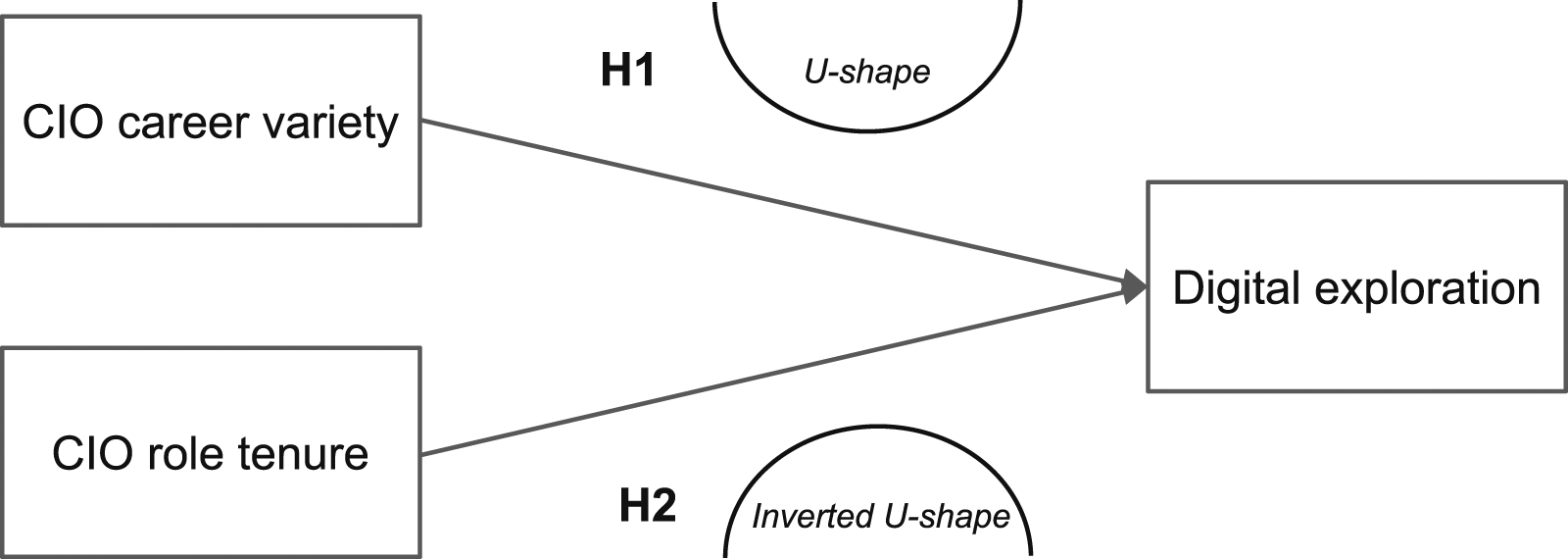
Research model in focus.
Methods
Data and sample
To test our hypotheses empirically, we compiled a panel data set of large U.S. firms, their CIOs, and their patent portfolios. The study’s sample comprises all firms in the Standard & Poor (S&P) 500 index between 2006 and 2015. We collected financial data from S&P’s Compustat North America. To codify executives’ roles and prior work experiences, a team of researchers manually collected data. The data came from firms’ annual proxy statements filed with the U.S. Securities and Exchange Commission (SEC), annual reports, executives’ official biographies, professional social network profiles, and other publicly accessible trustworthy sources (Nath and Bharadwaj, 2020).
We gathered patent data as of October 2019 from the PatentsView database provided by the U.S. Patent and Trademark Office (USPTO). We used an advanced fuzzy name-matching algorithm to match patent assignees to Compustat firms following Bendig et al. (2023). The algorithm compares the similarity of patent assignee names with the names of Compustat firms and their subsidiaries based on the Jaro-Winkler distance with a conservative match threshold (Jaro, 1989; Winkler and Thibaudeau, 1991). We confirmed the validity of our approach by comparing our results with the data sets provided by Hall et al. (2005) and Stoffman et al. (2018). Results concurred for more than 90% of assignee–firm matches. We manually inspected contradictory results and used the findings to improve our matching approach further. Our final data set contains 2.0 million utility patents granted to U.S. corporations between 1976 and 2019 and 34.7 million citations that can be matched to Compustat firms. The remaining unmatched patents belong mainly to educational trusts, firms with foreign corporate parents, or non-public firms.
We found a CIO in the TMT in 20.5% of firm-year observations and at least one digital patent application in 33.3% of firm-year observations. Excluding observations without CIOs and those for which we could not construct all measures resulted in an unbalanced data panel of 195 firms and 845 firm-year observations. Of these, we observed digital patent applications in 114 firms.
Measures
Dependent variable
We captured our dependent variable, digital exploration, by analyzing patents. Patents have a long history in innovation research as a proxy for brainstormed innovation output (Bendig et al., 2020; Hall et al., 2005). Using patent applications’ citations to measure a firm’s relative orientation towards exploration versus exploitation is an approach firmly established in innovation literature (Chung et al., 2019; Custódio et al., 2019). In this study, we apply this approach to the field of digital technology by determining the relative exploration orientation of a firm’s digital patent portfolio.
A patent application must cite prior work—that is, patents already approved—that the invention builds or touches upon. The extent of these so-called backward citations is highly regulated. An experienced patent office examiner must revise them for brevity and comprehensiveness (Alcácer et al., 2009; Savage et al., 2020). Following Benner and Tushman (2002) and Chung et al. (2019), we examine the citations made to previous patents by every patent application in the year of observation. We counted backward citations that were not existing patents of the firm or citations to other patents that the firm had cited in the past 5 years. These exploratory citations are considered new knowledge.
We then classified patent applications as digital or non-digital by examining their patent technology classes. The Cooperative Patent Classification (CPC) subsections related to information and communication technology we used were G06 (Computing; Calculating; Counting), G11 (Information Storage), G16 (Information and Communication Technology specially adapted for specific application fields), and Y04 (Information or Communication Technologies having an Impact on other Technology Areas). We based our classification method on the approach taken by Bendig et al. (2023), but we adapted it to measure exploration via patents. We divided the number of exploratory citations by the total number of citations to express their relative exploration orientation for all digital patent applications.
Following prior research (e.g., Chung et al., 2019; Uotila et al., 2009), we calculated our dependent variable digital exploration as the annual average proportion of backward citations by digital patent applications that were not self-citations or citations to patents the same firm had cited in the past 5 years. A higher digital exploration ratio indicates that a firm relies more on new than existing knowledge in its digital patent portfolio.
Following prior research, we used the patents’ application date rather than the eventual grant date (Custódio et al., 2019; Hall et al., 2001; Sunder et al., 2017). We did so for three reasons: First, to measure a firm’s digital innovation activity shaped by the CIO’s managerial action, because the TMT presumably had the authority and opportunity to affect the patenting activity when the application was made. Second, inventors are incentivized to file their applications immediately (Hall et al., 2001), so the application date is an appropriate proxy of a patented invention’s actual timing. Third, the delay between the application and grant date depends on the Patent Office review process, muddying our analyses (Alcácer and Gittelman, 2006).
One limitation of our data set is that by construction, it only contains those patents that were eventually granted. Therefore, it suffers from time truncation (Custódio et al., 2019). Our data set shows that 80% of all patents are granted within 4 years. Since our most recent patent data is from 2019, we followed Hall et al., (2001) and ended our data set in 2015. We calculated our dependent variable as the average explorative ratio of all digital patents in the portfolio. We found no statistical evidence that this ratio correlates with grant lag, so we did not expect time truncation to significantly affect our results. Still, we included year-fixed effects in our regression models to address any minor time truncation concerns.
Independent variables
Our approach to identifying the characteristics of CIOs in TMTs and determining CIO career variety and CIO role tenure as our independent variables follow extant TMT literature (e.g., Nath and Bharadwaj, 2020), building upon research on CIO presence (Bendig et al., 2022, 2023). First, we define the firm’s TMT as senior executives listed in the firm’s annual 10-K and DEF 14A proxy statements. Leading researchers on functional executives recommend this approach, which is consistent with prior TMT research (Benaroch and Chernobai, 2017; Menz and Scheef, 2014; Nath and Bharadwaj, 2020). Our definition of the TMT includes the CEO, divisional and regional heads, and functional members such as the chief financial officer, chief marketing officer, and the CIO. This vision of TMT membership goes beyond considering compensation alone as a proxy for inclusion in the TMT. Instead, we rely on the board of directors’ classification of their organization’s strategically important “policymaking” executives (Nath and Bharadwaj, 2020: 691).
Second, we searched the executives’ titles for keywords proposed in prior research, such as “chief information officer” and “chief software technology officer” (Menz, 2012). Researchers understand that CIOs often have other titles (Banker et al., 2011), so a team of experts in the field of innovation manually extended the search with related terms. When executives’ titles were ambiguous, we analyzed role descriptions to determine responsibilities. We also included chief digital officers (CDOs) in our definition of the CIO. CDOs are still rare in firms’ upper echelons, and prior research finds their role is often equivalent to a CIO in a strategic leadership role (Haffke et al., 2016). However, we explicitly distinguished CIOs from chief technology officers (CTOs) who are focused on research, development, and innovation in the broader sense (Garms and Engelen, 2019). We further ensured that divisional executives with titles resembling CIOs were not falsely considered as such.
Third, to determine CIO career variety, we followed the approach established by Crossland et al., (2014). Whereas their study examined the career variety of CEOs, we applied this construct to the CIO. We documented each executive’s work history from the time they completed their education up to their current role. We calculated the sum of distinct industry sectors in the Standard Industrial Classification system (SIC), distinct firms, and distinct functional experience areas of the CIOs prior to their current role. We divided this sum by the years the executives worked before they were appointed CIO to determine CIO career variety (Crossland et al., 2014). Based on prior literature (Cannella et al., 2008; Crossland et al., 2014), we used eight categories to code functional background and counted each area only once: production/operations, R&D/engineering, accounting/finance, management/administration, marketing/sales, personnel/labor relations, law, and other.
As for our second independent variable, we analyzed publicly available sources to determine CIO role tenure as the years since a CIO took on their current role at the firm (Henderson et al., 2006; Miller, 1991).
Control variables
Variable definitions and data sources.
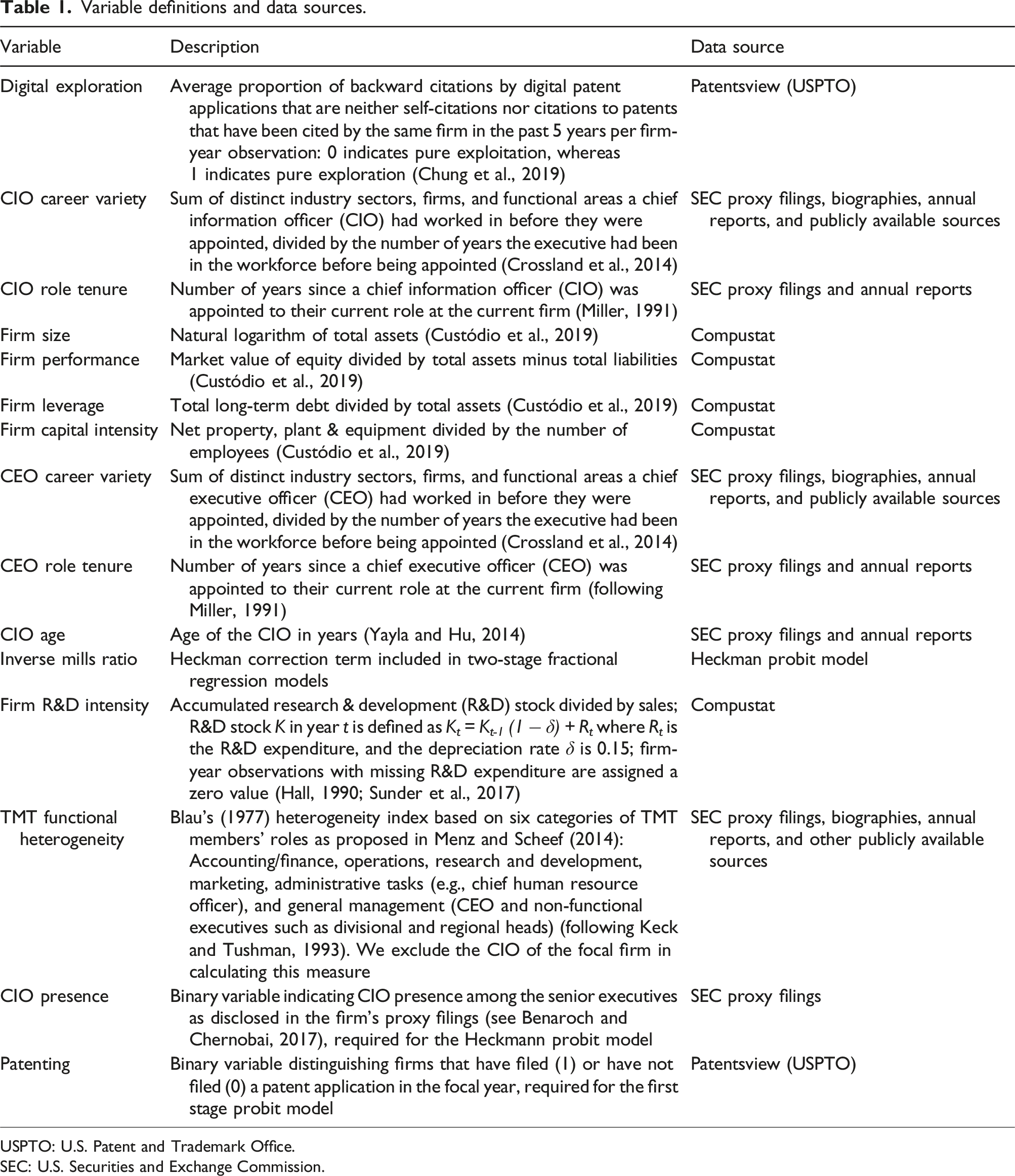
USPTO: U.S. Patent and Trademark Office.
SEC: U.S. Securities and Exchange Commission.
Analysis
Fractional regression model
Since our dependent variable, digital exploration, is a fraction bounded between zero and one, we employed a fractional regression model (Papke and Wooldridge, 1996). Linear models are generally inappropriate for predicting fractional response variables. They do not restrict the predicted values to the unit interval or allow for a non-linear effect of the regressors at the boundaries. Villadsen and Wulff (2019) argue in their methodological review of fractional outcome estimations that both log-odds transformation and Tobit models present disadvantages. Therefore, fractional regression models “should be the preferred choice” for fractional dependent variables (Villadsen and Wulff, 2019: 3). Papke and Wooldridge (1996) propose a non-linear fractional regression model that considers the specific characteristics of fractional response variables. These models have been shown to lead to robust and efficient estimation even with extreme values (Villadsen and Wulff, 2019). We used robust standard errors and included year and industry-fixed effects in all our models to account for heteroskedasticity, time trends, and industry-specific characteristics. We lagged all explanatory variables by 1 year to address potential reverse causality concerns. We winsorized all continuous variables at the one percent level at both tails to rule out bias from outliers.
Endogeneity
The specification of the research model introduces two possible sources of endogeneity. First, some firms choose not to file patent applications, leading to missing values in the dependent variable. This can be considered a problem of “Selection into Sample” (Hill et al., 2021: 111). Second, some firms choose not to appoint a CIO to their TMT, effectively self-selecting out of our sample. Thus, we could not observe the independent variables describing CIO characteristics, presenting a problem of “Selection of Treatment” (Hill et al., 2021: 111). We addressed these concerns empirically using a two-staged fractional regression model and a Heckman treatment estimate (Clougherty et al. 2016; Hill et al., 2021).
First, we addressed the potential for selection bias caused by our focus on firms that appointed a CIO to their TMT. This is a strategic choice undertaken by the firm. We considered it in our empirical design because firms self-selected from our sample. Hill et al. (2021) note that 2SLS and related instrumental variable methods should not be used to address this concern for binary treatment conditions. Instead, since we used probit and fractional probit regressions in our two-stage main model, the Heckman method is an appropriate empirical approach (Certo et al., 2016; Clougherty et al., 2016; Hill et al., 2021; Wolfolds and Siegel, 2019). Therefore, we used Heckman’s two-stage approach (1979) to first use a probit model to model the decision to appoint a CIO to the TMT. As an exclusion restriction, we employed TMT functional heterogeneity, defined as Blau’s (1977) heterogeneity index based on six categories of functional TMT members’ roles. TMT functional heterogeneity indicates the extent of centralization of firm decision-making (Cannella et al., 2008; Finkelstein and Hambrick, 1996; Keck and Tushman, 1993; Menz and Scheef, 2014).
Second, we assumed that firms’ decisions on whether to file patent applications and how much to rely on external versus internal knowledge if they file are separate decision-making processes. We, therefore, employed generalized two-part fractional probit regression models (GTP-FRM). We used a probit model to estimate whether firms file patent applications in the first stage and a fractional probit model to estimate the digital exploration in the second stage (Ramalho and da Silva, 2009; Schwiebert and Wagner, 2015; Wulff, 2019). We employed firm R&D intensity as an exclusion restriction. We defined R&D intensity as the annual R&D stock divided by sales. Prior researchers have argued that the decision to patent depends on a firm’s R&D effort (Arora and Ceccagnoli, 2006; Griliches et al., 1991). R&D intensity is, therefore, an appropriate exclusion restriction. Following Hall (1990), we calculated R&D stock K in year t as K t = K t-1 (1 − δ) + R t where R t is the R&D expenditure, and the depreciation rate δ is 0.15. We assigned firm-year observations with missing R&D expenditure a value of zero (Hall, 1990; Hirshleifer et al., 2012; Sunder et al., 2017). Moreover, we also incorporated the inverse Mills ratio, derived from the first stage of the Heckman estimation, into our generalized two-stage fractional probit regression models to correct for selection bias (Clougherty et al., 2016; Wolfolds and Siegel, 2019).
Results
Descriptive sample statistics and bivariate correlation coefficients.
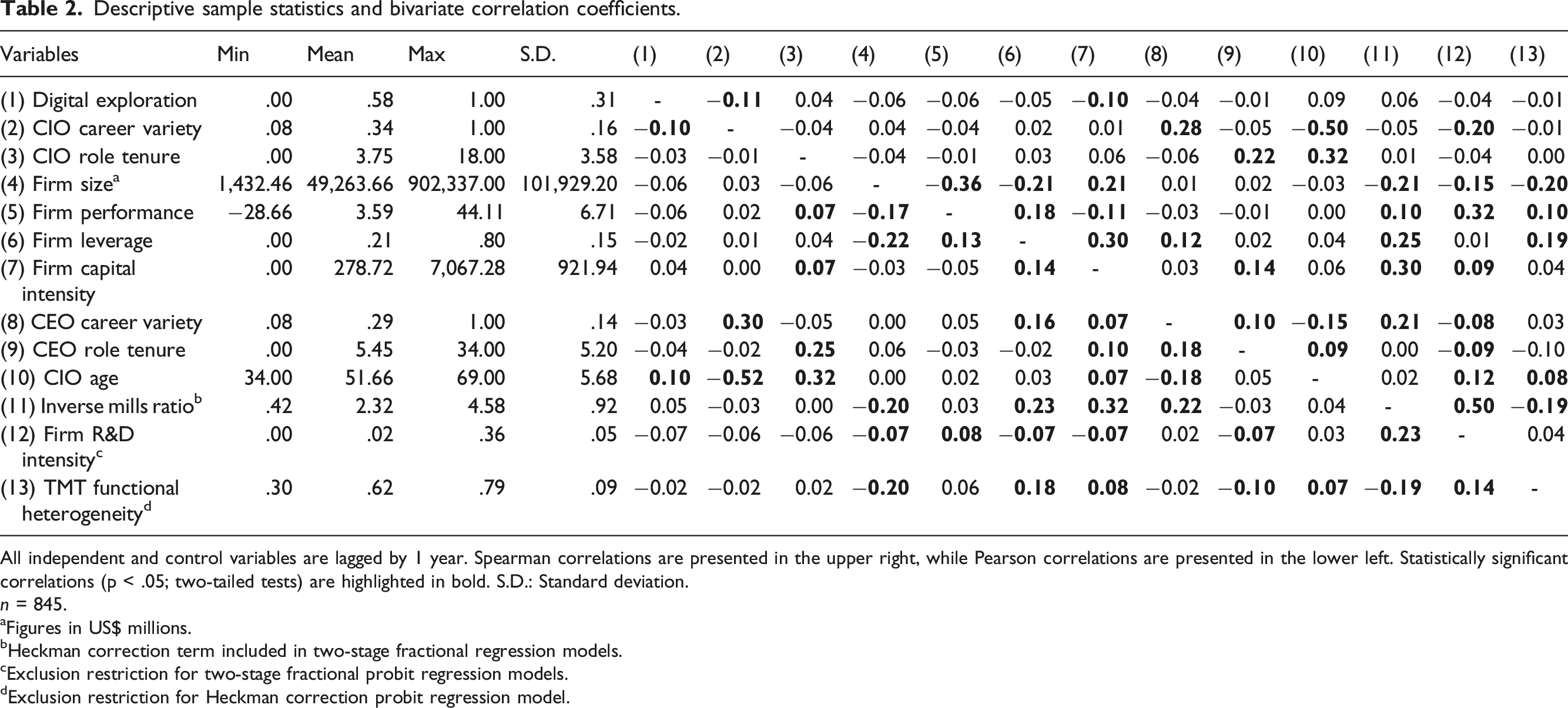
All independent and control variables are lagged by 1 year. Spearman correlations are presented in the upper right, while Pearson correlations are presented in the lower left. Statistically significant correlations (p < .05; two-tailed tests) are highlighted in bold. S.D.: Standard deviation.
n = 845.
aFigures in US$ millions.
bHeckman correction term included in two-stage fractional regression models.
cExclusion restriction for two-stage fractional probit regression models.
dExclusion restriction for Heckman correction probit regression model.
Results of generalized two-stage fractional probit regression models (GTP-FRM) and the Heckman correction with digital exploration as the dependent variable.
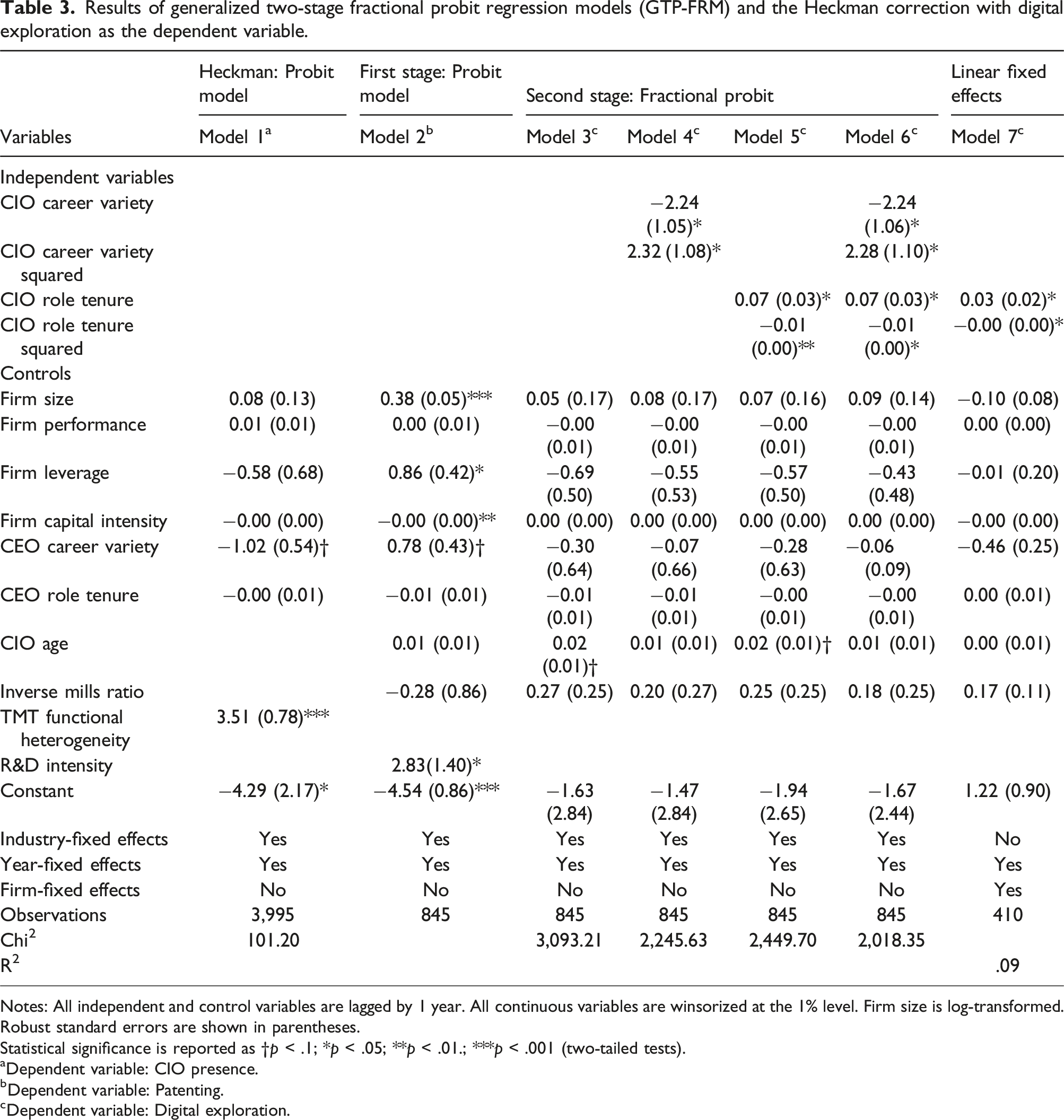
Notes: All independent and control variables are lagged by 1 year. All continuous variables are winsorized at the 1% level. Firm size is log-transformed. Robust standard errors are shown in parentheses.
Statistical significance is reported as †p < .1; *p < .05; **p < .01.; ***p < .001 (two-tailed tests).
aDependent variable: CIO presence.
bDependent variable: Patenting.
cDependent variable: Digital exploration.
In the Heckman correction probit model (Model 1), the coefficient of the exclusion restriction is positively associated with CIO presence and statistically significant (β = 3.51, p < .001). At the same time, we find that the exclusion restriction does not correlate with our dependent variable, digital exploration (ρ = −0.02 in Table 2). As for the first stage of the fractional regression model (Model 2 in Table 3), we again observe that the exclusion is a statistically significant estimator (β = 2.83, p < .05). The variable, however, is only weakly correlated with our dependent variable (ρ = −0.07 in Table 2). The data supports our core contention that these two variables are suitable exclusion restrictions and that the Heckman correction and the two-stage fractional regression model were set up appropriately. Finally, our analysis demonstrates that the inverse mills ratio is not statistically significant in Models 2 to 7, indicating that sample selection bias is likely not an issue in our empirical design (Certo et al., 2016; Clougherty et al., 2016; Hill et al., 2021; Wolfolds and Siegel, 2019).
Results of U-tests following Haans et al. (2016).
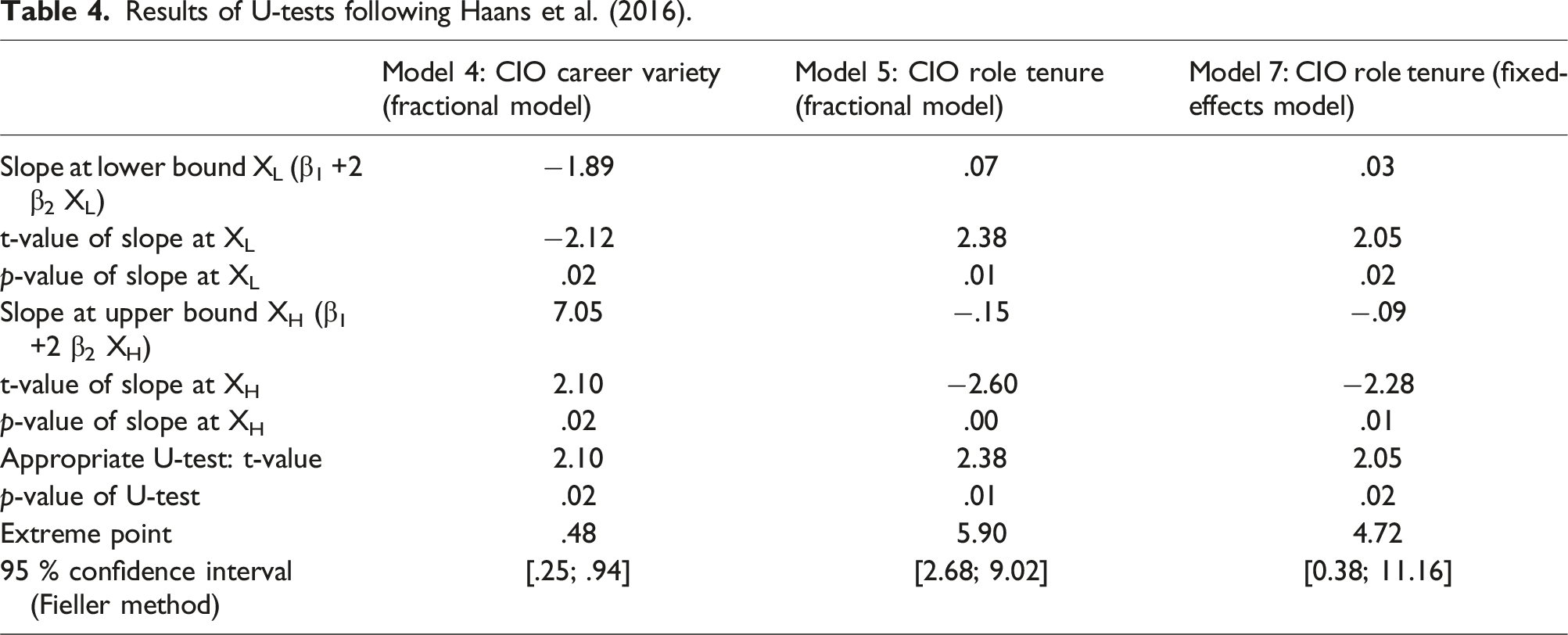
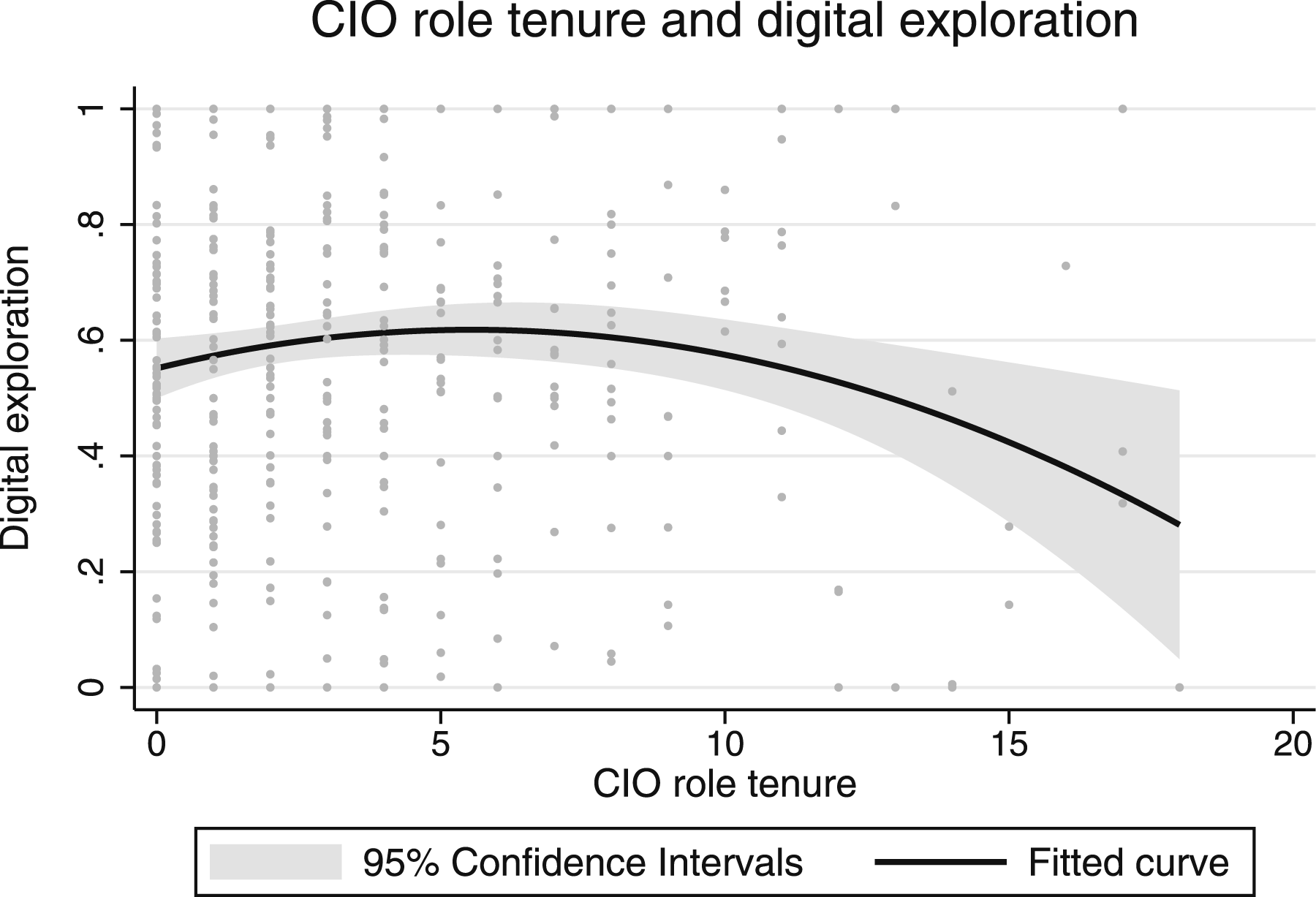
Overall, our analysis supports both hypothesized curvilinear relationships: CIO career variety exhibits a U-shaped relationship with digital exploration. CIO role tenure has an inverted U-shaped relationship with digital exploration. Visual inspection of the results further validates our findings: Figures 2 and 3 plot the fitted quadratic curves and the 95% confidence intervals for both models. U-shaped relationship between CIO career variety and digital exploration. Inverted U-shaped relationship between CIO role tenure and digital exploration.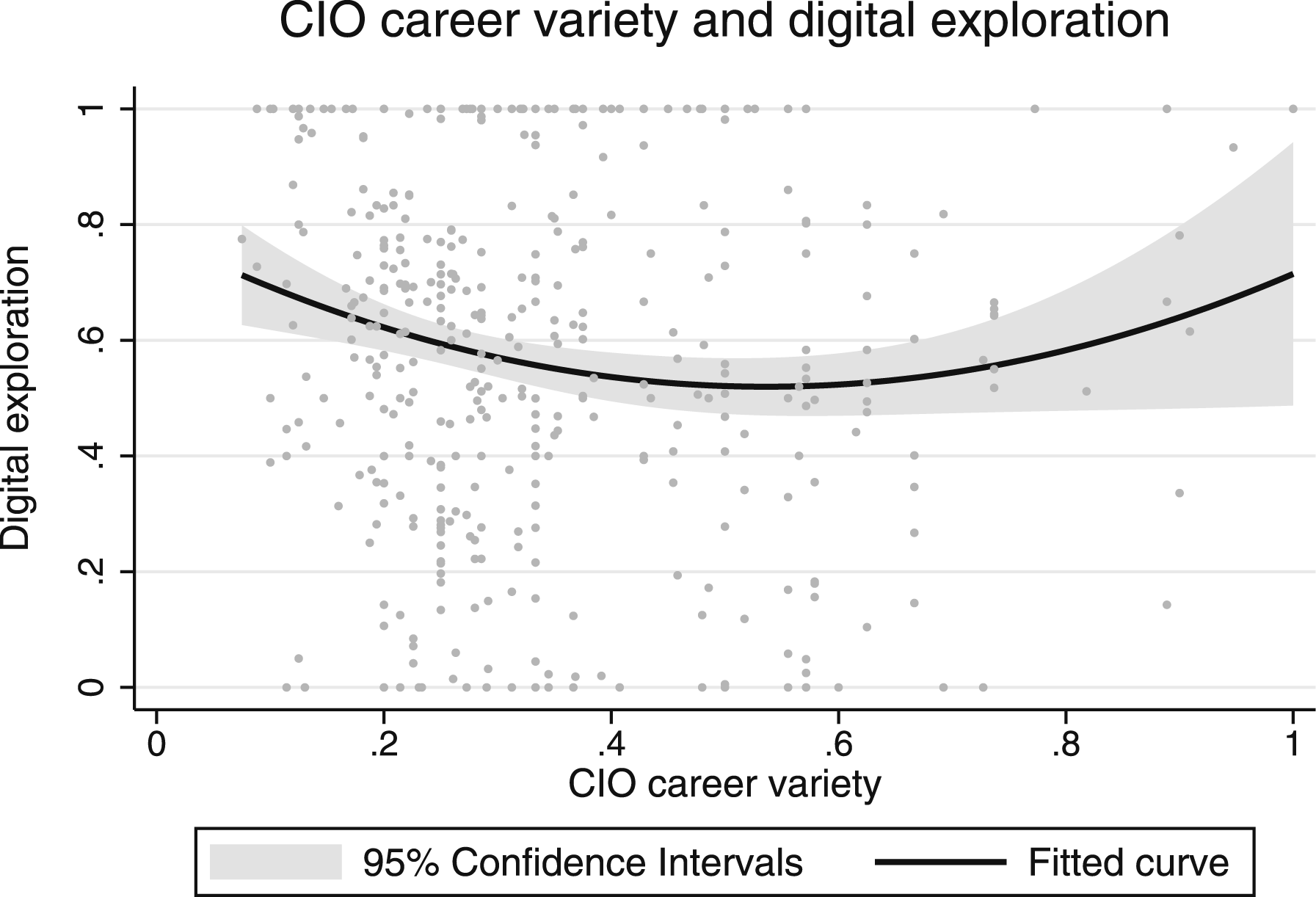
To validate our findings, we performed several robustness checks. To address endogeneity concerns through unobserved firm-level variables, we estimated the second specification (CIO role tenure) using fixed effects (Hill et al., 2021). Since we cannot model firm-fixed effects in fractional regressions (Hochberg et al., 2010), we estimated a simple fixed-effects regression model, despite the limitations of estimating fractions using linear models, as explained above. We found a relatively low R2 value of 0.09. It is natural for a fixed-effects model that the variation explained by the model is limited. Table 3, Model 7 shows our results, and although these findings must be interpreted cautiously, they support our results. Since CIO career variety is determined at the start of a CIO’s tenure, so does not vary over time, we could not estimate a fixed-effects approach for the first hypothesis.
Moreover, we demonstrate in unreported models that a simple linear and a cubic specification of each independent variable do not lead to statistically significant results, strengthening our core findings of curvilinear effects (Haans et al., 2016). To address potential multicollinearity, we further examined the bivariate correlations following Kalnins and Praitis Hill (2023), and Kalnins (2018). The analysis revealed a negative, though statistically insignificant, bivariate correlation between CIO role tenure and the dependent variable, contrasting with a positive beta coefficient in the regression analysis. Additionally, the data show a moderate correlation between CIO role tenure and CEO role tenure (ρ = 0.25), and between CIO role tenure and CIO age (ρ = 0.32). In unreported analyses, we found that dropping either or both control variables did not change our results’ statistical significance or direction. We can infer that multicollinearity is unlikely to be an issue in our results.
Discussion
Summary of the results
This study explores the impact of CIOs’ career variety and role tenure on digital exploration. Our analysis indicates a U-shaped relationship between CIO career variety and digital exploration. Our results suggest that both low and high career variety levels relate to high digital exploration, while moderate career variety relates to lower digital exploration. We argue that CIOs with low career variety drive digital exploration through deep domain-specific expertise and focused IT investments. Conversely, CIOs with broad career experiences may bring diverse perspectives and a wide-ranging approach to IT investments, enhancing digital innovation capabilities.
In contrast, the relationship between CIO role tenure and digital exploration is an inverted U-shape, with moderate role tenure yielding the highest digital exploration. We attribute this to a balanced mix of organizational knowledge, strategic insight, and the vibrant networks of moderately tenured CIOs. Further, we argue that CIOs at the extremes of role tenure—either too new or too entrenched—face challenges that limit their ability to foster digital exploration.
Theoretical implications
By analyzing CIO characteristics as antecedents of digital exploration, we contribute to research in at least three meaningful ways: (1) Introducing CIO characteristics as antecedents for digital innovation, (2) extending upper echelon theory by introducing three functional roles that CIOs can occupy for digital exploration, and (3) identifying non-linear relationships between CIO characteristics and digital exploration.
First, we add to the literature on digital innovation by demonstrating how the personal attributes and cognitive frameworks of senior executives, particularly CIOs, influence their strategic decisions about digital innovation initiatives. We examine the specific characteristics of CIOs and particularly focus on CIOs’ career variety and role tenure as important antecedents of digital exploration. Beyond the basic assessment of CIO presence within the TMT, we further address and clarify previous ambiguous findings about the impact of CIOs on organizational strategy and performance. This contribution extends our understanding of how senior IT executives’ values and cognitive processes shape digital patent portfolios.
Second, we contribute to upper echelons theory by transferring the work of Boyd et al. (2010) to information systems. We use CIOs’ informational, decisional, and relational roles as the underlying theoretical mechanisms linking CIO career variety and role tenure to digital exploration. Our approach extends the scope of current research (e.g., Bendig et al., 2022, 2023) by shifting the focus from the presence of CIOs to an analysis of their distinct individual attributes. Focusing on the effects of career variety and role tenure among functional TMT members such as CIOs compared to CEOs, we gain insights into how these factors add to a firm’s digital innovation capabilities. This differentiation emphasizes the unique contributions of TMT members with diverse career paths and tenures to the strategic exploration of digital technologies.
Finally, we contribute to the literature by revealing non-linear relationships between personal characteristics and digital exploration. While we highlight the role of various individual-level factors (i.e., career variety and role tenure), our research also illuminates the complexities underlying these relationships. Specifically, we show that career variety and role tenure display differential and, at times, opposing impacts on digital exploration. By shedding light on these nuances, our research provides valuable new perspectives on the dynamics underlying mechanisms.
Beyond that, Nambisan et al. (2017: 231) call for “novel methodologies” to study digital innovation management. Our methodology expands on Bendig et al. (2023) by employing patent data to develop a specialized measure of digital exploration. This measure is constructed from highly regulated, consistently available public data. Thus, this approach overcomes limitations that exploration researchers typically face, such as relying on self-reported or researcher-coded innovation outcomes.
Practical implications
Our study underscores the relevance of CIO characteristics for a firm’s digital innovation strategy, emphasizing CIOs’ strategic leadership roles in digital innovation activities. CIOs’ ability to drive meaningful digital transformation is linked to their capacity to foster a culture of innovation, openness, and adaptability within their teams and across the organization (Bendig et al., 2022; Chen et al., 2021). This type of organizational culture is essential for companies seeking to capitalize on digital opportunities and navigate the challenges of a technological landscape in flux (Li et al., 2021b).
Moreover, by understanding the influence of CIO career variety and role tenure, firms can make informed staffing decisions in selecting CIOs whose experiences align with the desired innovation orientation. This recruitment strategy counters firms’ tendency to drift towards exploitative innovation due to learning myopia and knowledge inertia. The career trajectories of Atish Banerjea and Kevin Scott, as the CIO of Meta and CTO of Microsoft, respectively, serve as examples when studying digital innovation driven by diverse professional experiences. Banerjea’s progression through various technological roles and his educational background in electronics and engineering have shaped his strategic vision at Meta. This vision has helped transform Meta’s IT infrastructure to support scalable solutions and foster innovation, particularly in artificial intelligence and blockchain technology (Meta, 2022).
Moreover, Kevin Scott’s career path, including significant roles at Google, AdMob, and LinkedIn before his tenure at Microsoft, demonstrates a blend of technical expertise and strategic leadership. His work at Microsoft focuses on developing inclusive technologies and nurturing a culture of innovation. This approach shows the impact a diverse career path can have on driving technological advancement and innovation in the technology industry (The Verge, 2023). Scott’s role in scaling LinkedIn’s systems during its rapid growth phase illustrates the influence of a diverse career on effective technology leadership and digital transformation in major tech companies.
Our findings also offer guidance on configuring the TMT in response to environmental uncertainty and aligning innovation strategies with the firm’s strategic environment, as indicated by research like Chung et al., (2019). This approach contributes to the debate on IT leadership and strategic alignment. It also provides a practical framework for organizations to leverage their CIOs’ unique attributes for optimal digital innovation outcomes.
Limitations and future research
Our study has limitations that offer future research directions. First, using patent data to measure our outcome variable involves multiple empirical challenges. Although we rely on state-of-the-art empirical methods to address the central issues of working with patent data (Savage et al., 2020), some challenges remain. For example, not all innovation outcomes meet the USPTO’s patentability criteria (Hall et al., 2001). Because of this, we could not use them in our research. Since this limitation affects all firms equally, we do not expect it to systematically confound our results. Still, we call for further research to investigate other innovation outcomes to corroborate our results.
Second, our CIO identification approach based on membership in the firm’s TMT limits our sample to senior executives with high formal authority levels. Future research might investigate the role of IT leaders in the firm’s middle management. Still, our study can serve as a blueprint to examine the influence of other TMT members’ characteristics on their immediate domain-specific innovation outcomes. For example, scholars could explore the chief marketing officer’s effect on exploration orientation in the firm’s product portfolio.
Third, in this study, we have focused on large public U.S. firms. Extending our research to smaller firms or even startups and validating our findings outside the U.S. could be valuable to scientific research. Moreover, exploring CIOs’ roles across industries requires acknowledging the variations in their impact on decision-making (Carter et al., 2011). For example, while CIOs in technology-driven sectors prioritize innovation, those in traditional industries emphasize efficiency (Chen et al., 2010, 2021; Gonzalez et al., 2019). This differentiation is important when considering the dataset composition drawn from the S&P index, which likely over-represents IT companies. Consequently, the roles and impacts of CIOs in our analysis may not fully represent non-tech industries (Whitler et al., 2017). Within technology firms, the CIO’s influence on core business strategy and digital innovation is substantial due to the centrality of technology in their operations (Taylor and Vithayathil, 2018). In highly regulated sectors like finance or healthcare, a CIO’s decision-making may be more constrained, emphasizing compliance and security aspects of digital innovation (Banker et al., 2022). This could lead to divergent strategic priorities compared to industries with less stringent regulations. Furthermore, the collaborative nature of innovation leadership between CIOs and CEOs in IT-centric companies adds complexity. This dynamic makes it challenging to disentangle the distinct contributions of each role (Georgakakis et al., 2022; Lorenz and Buchwald, 2023; Peppard, 2010). Such collaborative models might be less prevalent in non-tech sectors. Outside of technology companies, the CIO’s responsibilities are often more narrowly defined and focus on supporting rather than driving business operations. Future research could explore how CIO influence varies across industries and its interplay with other executive roles.
Fourth, despite the observed relationships between CIO’s career variety and role tenure with digital exploration, we must keep in mind the constraints imposed by external factors in shaping these decisions. Period-specific challenges like technological disruptions, regulatory changes, and economic fluctuations, all influence a CIO’s strategic choices. For instance, during economic downturns, CIOs with extensive tenure may tend toward risk-averse strategies in digital innovation, prioritizing stability over exploration (Bourdreau et al., 2021; Zahra and Bogner, 2000). Future research should investigate how CIO decision-making adapts to varying economic conditions. Furthermore, resource availability within an organization, such as budget, talent, and technological infrastructure, influences the extent and direction of digital exploration (Feng and Wang, 2019; Pang et al. 2016; Yalcinkaya et al., 2007). A CIO in a resource-rich firm may have greater flexibility to experiment and innovate than one in a resource-constrained environment. Future studies should explore how resource availability shapes CIO decision-making in digital innovation.
Lastly, in examining patenting behaviors among S&P 500 companies using fractional regression models, we must recognize the complexities of the distinction between internal and external innovation sources (Garms and Engelen, 2019). This issue is pronounced in sectors such as pharmaceuticals, where the traditional paradigm of patenting every significant internal R&D advancement has adapted due to escalating R&D expenses. The transition towards collaborative R&D endeavors involving external entities, such as universities and startups, introduces a multifaceted dynamic to patenting decisions (Scuotto et al., 2022). For instance, joint discoveries made in collaboration with the pharmaceutical industry introduce intellectual property rights considerations and pre-existing agreements. This complicates the straightforward nature of patenting decisions driven by internal factors (Di Stefano et al., 2012). In instances of joint discovery, the determination to pursue patent protection is influenced by the innovation’s potential value and the intricacies of partnerships and contractual obligations. This scenario challenges our initial assumption that internal and external knowledge sources operate differently in the context of patenting. Instead, these sources are increasingly interconnected, particularly within industries reliant on collaborative innovation (Chen et al., 2021; Roper and Hewitt-Dundas, 2015). Future research should explore these dynamics further and consider using alternative methodologies to better understand patenting behaviors in collaborative innovation environments.
Conclusion
Our research underscores the critical role of CIOs in navigating firms through the complexities of digital transformation. It echoes the call for CIOs to reinvent themselves as strategic digital leaders. By examining the relationship of CIOs’ career variety and role tenure with digital exploration, we have shown how these executive characteristics shape firms’ approaches to leveraging digital technologies. Our empirical findings exhibit a U-shaped relationship between CIO career variety and digital exploration and an inverted U-shaped relationship between role tenure and digital exploration. This suggests that experience breadth and tenure duration play pivotal roles in optimizing firms’ digital innovation strategies. This study contributes to the literature by providing empirical evidence on how specific attributes of CIOs affect firms’ digital exploration efforts. In this study, we highlight the importance of strategic executive IT leadership in harnessing the opportunities presented by digital transformation. Thereby, we inform both academic discourse and practical applications in the evolving landscape of digital innovation.
Footnotes
Declaration of conflicting interests
The author(s) declared no potential conflicts of interest with respect to the research, authorship, and/or publication of this article.
Funding
The author(s) received no financial support for the research, authorship, and/or publication of this article.
