




Abstract
While digital platforms have become an increasingly important research area in the information systems discipline, the existing literature does not conceptualize a theoretical link between platforms and morality. This paper theorizes such a link by drawing on Jensen’s (2010) conceptualization of processes of demoralization to operationalize two notions from critical social theorist Zygmunt Bauman: workers’ moral impulse and moral ambivalence. We conducted a case study of a large luxury resort hotel to examine how digital platforms (specifically TripAdvisor and WhatsApp) facilitate surveillance. Our findings show how digital platform-facilitated synoptic and panoptic forms of surveillance can suppress workers’ moral impulse and foster moral ambivalence towards such issues as invading others’ privacy, pressuring others outside working hours, and increasing surveillance in the workplace. This paper offers a novel perspective on theorizing the links between digital platforms, surveillance, and workers’ morality and highlights some unintended consequences.
Introduction
Digital platforms, such as Google’s Android, Apple’s iOS, Facebook, and TripAdvisor, have become increasingly important in how organizations establish and innovate their business processes and services (Rolland et al., 2018). The extant literature emphasizes that digital platforms typically focus on maximizing how much digital data they obtain from user interactions and monitoring it to derive value (Alaimo et al., 2020). To do so, organizations often couple digital platforms with other digital technologies such as mobile Internet and smartphones. Large digital platform owners’ apparent success has highlighted the value of user data and motivated organizations across sectors to adopt similar platform strategies (Fuchs, 2017; Srnicek, 2017). Recent literature from user organizations’ perspective has also expanded our understanding about how digital platforms can influence existing organizational practices, which includes their interactions with existing infrastructures and work processes (Rolland et al., 2018), and how service organizations respond to the synoptic surveillance and accountability pressures from social media (Karunakaran et al., 2022).
However, emerging critical literature has begun to recognize that the central role that digital data plays in digital platforms’ economic value can have serious negative consequences. For example, Zuboff (2019) argues that digital platforms’ drive to collect more data, which she terms “surveillance capitalism,” blurs the boundaries between private and public life and negatively impacts users’ privacy. Furthermore, the recent gig economy platform literature has shown how Uber uses continuous data surveillance to exercise control over its drivers (Iazzolino, 2021). Mechanisms such as online promotional events to attract new drivers and smartphone apps to create an individualized working environment severely limit opportunities for driver interactions (Tassinari and Maccarrone, 2020). In addition, some high-profile surveillance-related scandals that involve well-known digital platforms, such as Facebook and Cambridge Analytica’s privacy breaches (Cadwalladr and Graham-Harrison, 2018) and reports about how Uber treats its drivers and their labor rights (Butler, 2018), have heightened concerns over digital platforms’ social responsibility and drawn researchers’ attention to their unintended social consequences for workers and other users (e.g., see Srnicek, 2017).
Although the literature has theorized digital platform surveillance and expressed increasing concerns over its social impact, little research has examined how digital platform surveillance can influence workers’ own morality. Yet, despite the increasing surveillance surrounding digital platforms and high-profile surveillance-related scandals, organizations have increasingly incorporated digital platforms into their work processes (Rolland et al., 2018). Hence, we identify a need to theorize the unintended moral consequence that digital platforms have on workers’ organizational practices (Bailey et al., 2019; Rauch and Ansari, 2022).
In this paper, we draw on Jensen's (2010) processes of demoralization to theorize how incorporating digital platforms into organizational surveillance practices can suppress what Bauman (1993) terms individuals’ “moral impulse.” As we discuss later, Bauman argues that suppressing moral impulse can facilitate a state of moral ambivalence whereby workers lack concern about their actions’ morality or act in ways that could negatively affect others (Bauman 1993; Jensen 2010). We draw on evidence from a longitudinal case study that we conducted on a luxury resort hotel that incorporated the TripAdvisor and WhatsApp platforms into its performance-measurement and management practices along with other information technologies such as smartphones and mobile Internet, which enabled workers to use those platforms. Drawing on this theorization, we analyze how processes of demoralization led to a state of moral ambivalence among the hotel’s employees and managers by suppressing their moral impulse concerning the increasingly complex forms of organizational surveillance.
Our analysis illustrates how the use of digital platforms can suppress workers’ moral impulse and how, thereby, they can become ambivalent towards potential issues such as privacy invasions, efforts to pressure other employees outside working hours, and heightened surveillance (Bauman and Lyon, 2012; Zuboff, 2019). In this way, we illustrate how digital platforms can facilitate both synoptic and panoptic surveillance (Bauman and Lyon, 2012) and, in turn, make workers morally ambivalent towards increasing surveillance. Accordingly, with this paper, we contribute to knowledge about the unintended consequences that can result from surveillance that digital platforms facilitate (Iazzolino, 2021; Tassinari and Maccarrone, 2020; Zuboff, 2015, 2019).
In the next section, we review the literature on digital platforms and surveillance. Subsequently, we describe Jensen’s (2010) processes of demoralization to help explain the contexts and conditions that facilitate a state of moral ambivalence. We then present our research methods and setting before analyzing and discussing our findings. We conclude by describing the study’s contributions and discussing implications for future research.
Literature review: Digital platforms and surveillance
The literature on how both organizations and individuals use digital platforms has shown how they can bring beneficial changes to existing processes and practices. For example, Henfridsson et al., (2018) demonstrated how music-streaming services, such as Spotify and Pandora, use Amazon’s smart speaker, Echo, to connect users to their digital resources. As such, researchers widely acknowledge that digital platforms can create benefits for user organizations by offering readily available resources, making inter-organization collaboration easier and, thereby, reconfiguring their organizational practices.
However, digital platforms can also have negative consequences for both organizational and individual users due to their monopolistic tendency (Srnicek, 2017) and hidden surveillance practices (Srnicek, 2017; Zuboff, 2015, 2019). Srnicek (2017) points out that engagement in intra- or inter-organizational collaboration can enhance digital platforms’ monopolistic power. Furthermore, digital platforms can introduce new forms of surveillance (Wood and Monahan, 2019) that can even challenge existing organizational surveillance practices (Zuboff, 2015, 2019). For example, social networking platforms (e.g., Facebook) and travel review sites (e.g., TripAdvisor) allow anyone to publicly monitor large corporate organizations (Karunakaran et al., 2022; Orlikowski and Scott, 2014; Scott and Orlikowski, 2012), which can challenge traditional organizational surveillance and control practices, such as performance-measurement and management practices. By creating a mobile and distributed working environment (Constantinides et al., 2018; Oborn et al., 2019), digital platforms can influence organizational communication methods and employees’ performance-signaling practices (Cristea and Leonardi, 2019).
Digital platforms, which mass participation sustain, have changed relationships between organizations and individuals. For instance, they have given rise to new forms of synoptic surveillance whereby the many (e.g., social media users) watch each other and the few (e.g., organizations or specific individual under public scrutiny) (Bauman and Lyon 2012, see also Scott and Orlikowski 2012). For example, Scott and Orlikowski, (2012, 2014) demonstrate how reviews on TripAdvisor allow anyone to monitor hotels and restaurants and contribute to performance measures such as online rankings, reviews, and ratings. This synoptic surveillance can influence how individuals and, in aggregate, the monitored organizations behave as they respond to the rankings, ratings, and reviews. In their study on crowd-based accountability, Karunakaran et al. (2022) further highlight how synoptic surveillance, through which “the many” on social media watch “the few” service organizations, can reconfigure meanings, activities, relations, and outcomes in those service organizations. As such, digital platforms can be an effective tool to enable many individuals—guests and customers—to monitor the relatively few organizations and, as such, shift the surveillance relationships between individuals and organizations.
Digital platforms also introduce a new form of panoptic surveillance, which is hidden from the surveillance subjects. For example, Zuboff (2015, 2019) illustrates how the hidden algorithms in Google’s search engine can give rise to such panoptic surveillance that remains hidden from users. Zuboff argues that, while digital platforms offer users greater freedom to search and consume information, Google exercises control over users through the data that it collects via its hidden surveillance and predictive analytics. As a result, increased surveillance accompanies the freedom and benefits that Google users experience. In other words, what Google users may perceive as a “free” service is not free: they pay by allowing Google to use their data to create personalized marketing. In this way, the data that digital platforms, such as Google, collect from users constitutes their key resource (Srnicek, 2017). As such, users “work” autonomously for Google without realizing it and Google controls their behavior (Zuboff, 2015, 2019).
The panoptic and synoptic surveillance that digital platforms facilitate differ from previous forms of surveillance in two ways: (1) management intention and (2) surveillance practice visibility. First, managers have often used technologies such as closed-circuit television (CCTV), hidden cameras, and motion detectors to enhance organizational surveillance (Pierce et al., 2015; Sewell et al., 2012; Sewell and Barker, 2006; Staples, 1997, 2013). In a recent study, Anteby and Chan (2018) found that managers can use resistance to existing forms of surveillance to justify even stronger forms of surveillance, which can create a self-fulfilling cycle of increasing surveillance. By contrast, the forms of surveillance that digital platforms facilitate may not result from managerial intention (see Scott and Orlikowski 2012, 2014). Instead, digital platforms can become constitutively entangled in individuals’ everyday social and business lives (Orlikowski, 2007), which can, in turn, extend surveillance into their private lives (Bauman and Lyon, 2012; Clegg, 2018; Rojek, 2013). Therefore, we would argue that the surveillance that digital platforms, such as TripAdvisor (Orlikowski and Scott, 2014; Scott and Orlikowski, 2012) and Google (Zuboff, 2015, 2019), facilitate does not necessarily require managerial attention and that individuals can sustain it via actively participating in the platforms and voluntarily disclosing their activities.
Second, prior research posits that effective surveillance requires subordinates to recognize that they are being watched in order to create a sense of constant surveillance (Foucault, 1977; Townley, 1994). The oft-used panopticon metaphor suggests that one should house prisoners in cells set around a centrally located watchtower to maximize their visibility from the watchtower and create a sense of constant surveillance. In contrast, digital platforms can project individuals’ private lives into the public space through the data that they collect (Bauman and Lyon, 2012; De Vaujany et al., 2021) and, thus, subject them to a new and hidden form of panoptic surveillance (Zuboff, 2015). Unlike the panopticon and other traditional forms of panoptic surveillance, which rely on hierarchical organizational structures and bureaucratic controls, Google’s surveillance algorithms remain hidden from users. Bauman and Lyon argue that, even after users learn about the hidden surveillance, they prefer to give up their privacy in exchange for the convenience and benefits they experience.
Organizations can use these new forms of digital platform-facilitated surveillance to exercise control over workers. The recent literature on digital labor platforms, and especially on gig economy platforms such as Freelancer.com and Uber, have shown how their operators use embedded surveillance mechanisms to monitor and control workers (Graham et al., 2020; Iazzolino, 2021; Wood et al., 2018, 2019). These studies focus on hidden panoptic surveillance and how it can severely damage workers’ working conditions. For instance, since gig economy platforms lack face-to-face contact and do not allow workers to identify other workers (Iazzolino, 2021), workers face obstacles in interacting with one another and developing solidary (Howson et al., 2020; Tassinari and Maccarrone, 2020). Nevertheless, recent studies highlight how workers use other technologies, such as online forums (Wood et al., 2018) and social media (Howcroft and Bergvall-Kåreborn, 2019), or simply meet offline (Iazzolino, 2021) to express their solidarity and fight for their employment rights (Tassinari and Maccarrone, 2020).
However, an important gap in our knowledge about surveillance on digital platforms remains. While the gig economy literature explores how workers can overcome obstacles to solidarity and unionization, this literature usually assumes that workers can determine what is morally right or wrong. Yet, some workers on digital platforms do not care or show little interest in unionizing even though they know about the high-profile scandals surrounding digital platforms (Butler, 2018; Cadwalladr and Graham-Harrison, 2018) and the surveillance that directly affects their working lives (Wood et al., 2018). Instead, many workers simply follow what others do without acting on their own moral impulse (Bauman, 1993) or voicing their opinions about their working conditions to help themselves and others. In this paper, we fill this gap on platforms and worker morality by focusing on how digital platform-facilitated surveillance can influence individual worker’s moral impulse and make them morally ambivalent towards the consequences of their actions. We further elaborate on this when discussing our conceptual framework in the next section.
Theoretical perspective: Demoralization processes
As we indicate above, we draw on Jensen’s (2010) six processes of demoralization framework which is derived from Bauman’s work on morality. A number of organization and management studies scholars have applied Bauman’s (1993) work on postmodern ethics, which focuses on individual morality (e.g., Clegg, 2018; Clegg and Baumeler, 2010; ten Bos, 1997). It is also applied in prior information systems (IS) research, a notable example is Chatterjee et al.’s (2009) study on information system development. More recently, in their study on how the U.S. Air Force uses drone technology, Rauch and Ansari (2022) expand our knowledge about how emerging technology can disrupt work’s meaning and morality by invoking emotional ambivalence as to what is right and wrong. However, Rauch and Ansari (2022) use the term emotional ambivalence, which they define as having conflicting feelings, we use Bauman’s (1993) term moral ambivalence, 1 which refers to “not feeling responsible for one’s actions and, consequently, lacking concern about their morality.”
Bauman argues that moral responsibility belongs exclusively to individual human beings and, as such, that no universal principles can guide individual morality (Bauman, 1993). Consequently, “morality may only be understood by the continuous existence of self-doubt within the moral entity” (Chatterjee et al., 2009: p. 789). Bauman (1989) argues that modern society and organizations tend towards a state of moral neutrality in which individuals become “morally ambivalent” (Bauman, 1993: p. 10); that is, neither fundamentally moral or immoral but rather amoral. 2 Therefore, to understand the morality of individual actions, we need to be sensitive to context (Bauman, 1993). Bauman argues that, rather than universally applicable moral principles, two different moral positions exist: “being for” and “being with.” Individuals who take moral responsibility act on their own beliefs and sometimes on impulse even when it conflicts with social norms. Bauman terms this position “being for” (Bauman, 1993, 1995). Bauman sees individuals who act on their moral impulse as motivated by a pre-reflexive inner compulsion. These individuals do not calculate gains and losses or consider rules, regulations, and other compliance issues. Instead, such individuals act solely based on their concern for the other; in other words, such individuals exercise their moral impulse.
In contrast, “being with” describes individuals who uncritically follow social norms and act indifferently towards each other. Bauman (1993) asserts that distancing, effacement of face and reduction to traits can suppress individuals’ moral impulse. Distancing refers to the practices organizations usually achieve through hierarchical structures that create social layers between those in command and those who act. These practices make it difficult for organizational actors to fully comprehend the intentions behind their actions or to see the actions’ consequences. Effacement of face refers to organizational practices that remove the need for face-to-face interactions. Bauman (1993) claims that powerful organizational actors rarely encounter the individuals they manage or those who bear their actions’ consequences. Reduction to traits refers to practices that repress an individual’s identity. For example, organizations often use performance measures to depict workers’ and their actions, and Bauman (1993) posits that organizations that use such measures can lack ethical standards in evaluating workers.
Defining the key concepts.
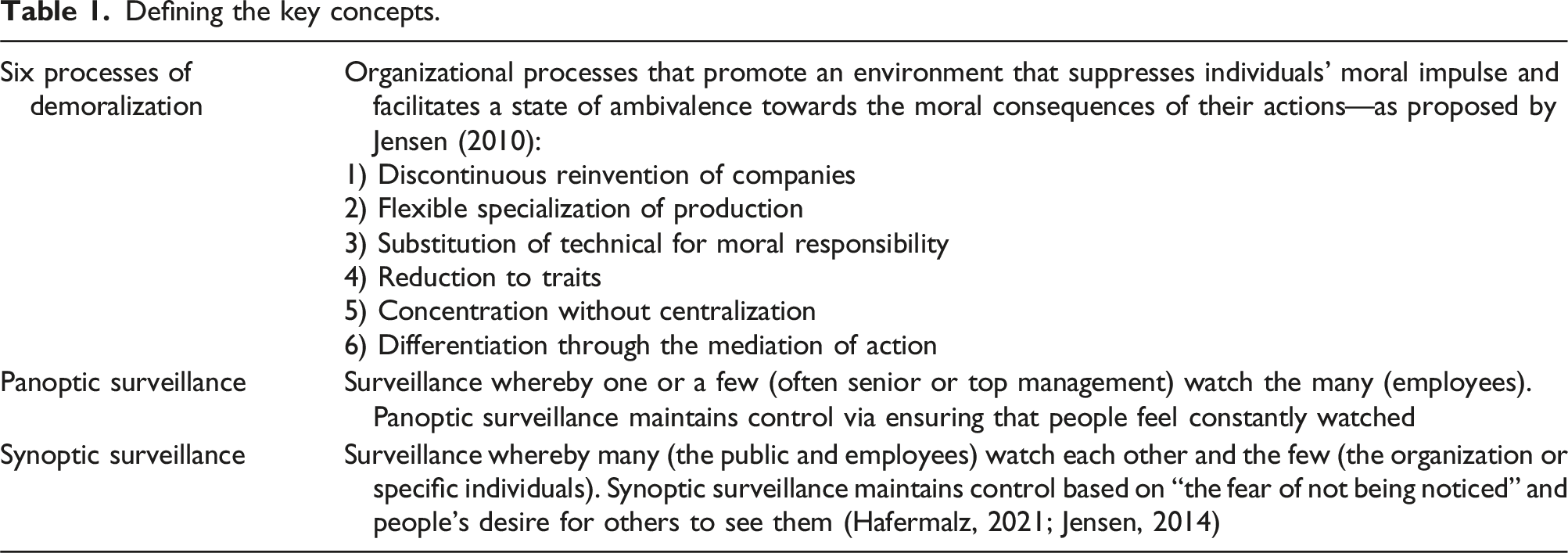
The first two of Jensen’s processes of demoralization, discontinuous reinvention of companies and flexible specialization of production, relate to Bauman’s (1993) concept of distancing. According to Jensen (2010), distancing can occur in contexts where organizations and their members engage in flexible specialization and, consequently, face constantly reinvented routines. In such contexts, stability in the workplace falls as individuals become detached from their previous experience. As a result, individuals face instabilities and uncertainties in their tasks and have no guarantee that they will receive reward or recognition even as their organizations perpetually require them to expand their efforts (Bauman, 2000, 2002). These processes can cause individuals’ focus to shift from long-term collective commitments to short-term individual gains (Bauman, 1998). For example, Bauman, (2002) posits that the “ambitious few” might pursue their personal success by stepping over the “many” who struggle with the increased responsibility and the pressure to constantly (re)train to avoid becoming redundant.
The third and fourth processes of demoralization, substitution of technical for moral responsibility and reduction to traits, create a context that conceals actions’ moral significance from the individuals who perform them (see Bauman, 1989). To illustrate the third process, Jensen (2010) used Milgram's (2005) electroshock experiment as an example: in this experiment, students were asked to deliver a punishment (i.e., electroshocks) to another person (a hired actor) in order to study how it affected learning. He argued that individuals who “gradually become absorbed by technological aspects of the task at hand, [and] how this task could best be technically solved and carried out, pay lesser and lesser attention to dimensions and consequences other than those belonging to the technological realm of action” (2010, p. 430).
The fourth process, reduction to traits, related to reduction of individuals’ actions to certain specialized and standardized traits that usually involve setting quantified targets while giving individuals the responsibility to decide how to achieve them. As a consequence, the way in which individuals perceive “responsible action” can transform into acting in accordance with organizational rules and demands (Jensen, 2010) and a task’s technical nature replaces the individual’s moral responsibility. The individual’s focus becomes based solely on whether the available options are “effective [or] ineffective, efficient [or] inefficient” (Bauman, 1989: p. 180). The third and fourth processes suppress individuals’ moral impulse to care for others and the primary focus becomes compliance, obedience, and duty (Bauman, 1989).
The fifth and sixth processes of demoralization, concentration without centralization and differentiation through mediation of action, extend Bauman’s (1993) concept of effacement of face or, as ten Bos (1997) puts it, “dehumanization.” Concentration without centralization concerns the way in which digital technologies enable organizations to, at least partially, break free from traditional hierarchical structures and allow business units to manage their own tasks while pursuing the goals that central management sets (Jensen, 2010; Sennett, 1999). This creates a convoluted organizational structure, in which there is concentration without the centralization of power and the center disperses mistakes, failures, and responsibilities to the periphery (Sennett, 1999, cited in Jensen, 2010: p. 429). To illustrate, gig platform owners exercise concentration without centralization of power by delegating responsibilities to individual gig workers, while imposing a comprehensive set of controls to surveil workers (Graham et a., 2020; Iazzolino, 2021). In such a context, individuals can experience greater control over their tasks in flatter organizational structures, while synoptically surveilling each other and themselves (Bauman and Lyon, 2012). Workers maintain synoptic surveillance based on their “ fear of not being noticed” and desire for others to see them (Hafermalz, 2021; Jensen, 2014). Such behavior can, in turn, loosen the “bond of trust and commitment” between organizational members (Sennett, 1999: p. 31) and result in the “social production of distance” (Bauman, 1989: p. 199), with multiple layers between human interactions that separate individuals’ actions from their consequences. In other words, the actors cannot easily observe how their actions affect others, which, in turn, potentially dehumanizes the others involved in and/or affected by those actions. Jensen terms this the sixth process of demoralization as differentiation through the mediation of action. As a result, individuals can come to equate the manner in which they perceive “responsible actions” with acting in accordance with organizational rules and demands. Consequently, individuals “are excluded from the authorship of their acts” and no longer bears “full, undivided responsibility for their acts” (Bauman, 2014, p. xvi). The key concepts we use to explore our empirical data are summarized Table 1 and used in the following section to describe our research methods.
Research methods
From 2014 to 2017, we conducted a qualitative, longitudinal case study of a luxury resort hotel in Vietnam. For confidentiality reasons, we refer to the hotel as IR (a pseudonym). IR, which opened in mid-2012, was among the first luxury resort hotels in the region. As part of a strategic investment to establish the city as a popular international tourism destination, a Vietnamese developer, SV (a pseudonym), designed and built the resort, which an international hotel chain, MIG (a pseudonym), has managed since it opened. During our fieldwork, we observed and interviewed workers in customer-facing departments (such as guest relations and services), which contained approximately 150 people over three shifts. Additionally, we also interviewed and observed workers from departments involved in general management and support (e.g., directors, human resources (HR), information technology (IT), and quality consistent improvement (QCI)) to gather insights from both employees and management.
Overview of interviews in IR.
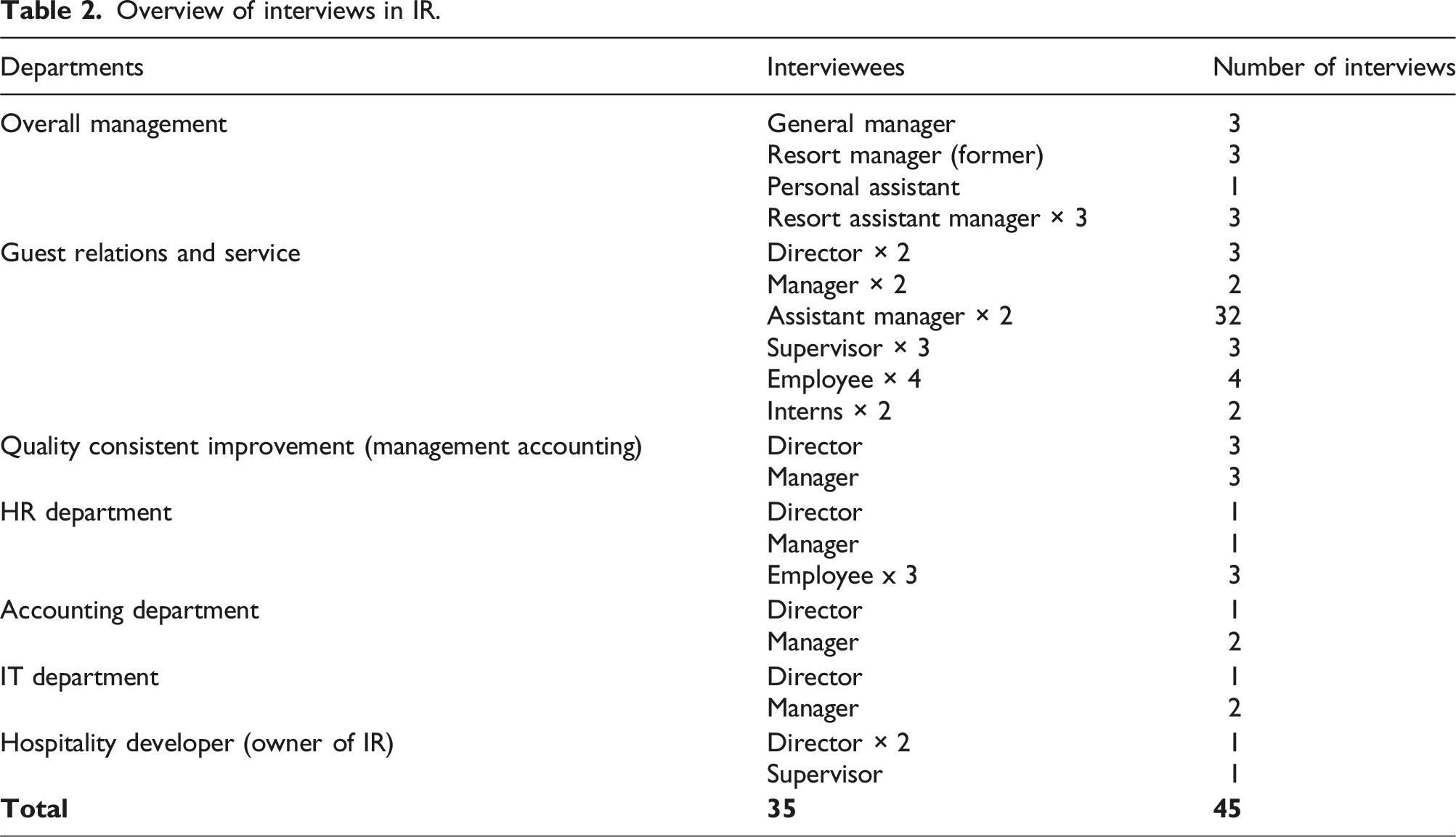
In addition, we used ethnographic techniques (Myers and Young, 1997; Myers, 1997, 2013) to “move beyond the immediate narrative of the subjects to the broader processes within which the narratives are embedded” (Myers and Young, 1997: p. 227). By adopting ethnographic techniques, we could understand the ongoing social activities in the hotel and obtain rich data about the context in which individuals experienced the surveillance emanating from the way employees across the organization used digital platforms. Specifically, during the third fieldwork phase (April to May 2017), the first author spent 3 weeks shadowing the three main departments that managed service performance and participated in the hotel’s surveillance practices (guest relations and services, QCI, and management). During this time, that author observed customer-facing workers, kept a detailed diary of his experiences and observations, and took pictures and videos. The author lived near the employee residential area, commuted to the research site each day on the employee shuttle bus, and dined in the employee’s canteen. In this way, the author became immersed in the context that the workers experienced on a daily basis. Accordingly, the author could interact with workers from various departments, which included employees who could not take time off for interviews during their shifts (e.g., cleaners, golf cart drivers, concierges, kitchen staff, and the greeting team). After each interaction and observation, the author made extensive notes, which helped to illustrate the scene and the context for each interaction and observation. By doing so, the author collected rich stories that illustrated relevant themes. We summarize the organizational structure and key actors in our case study in Figure 1. Organizational chart and key actors.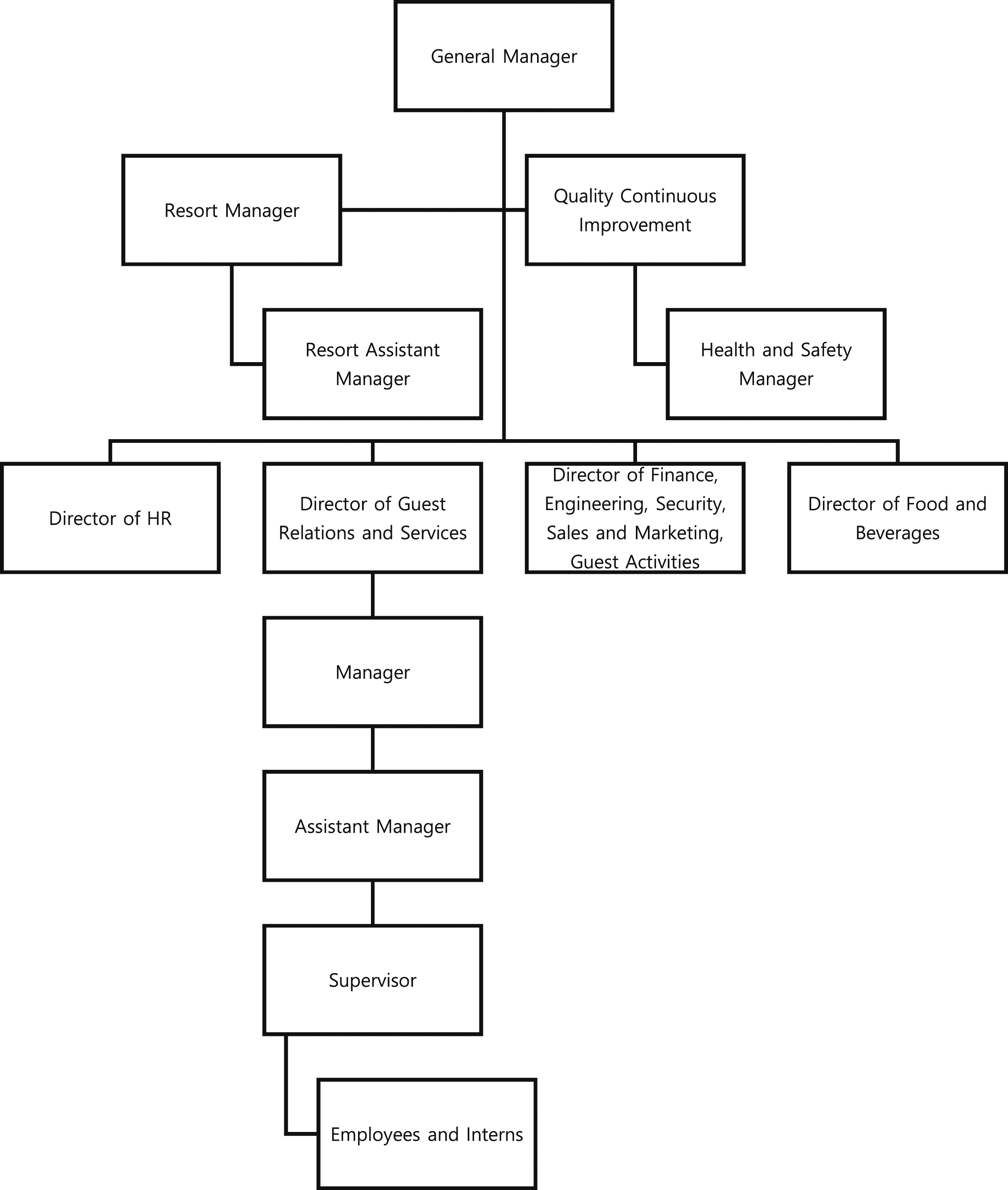
In addition to the primary data that we collected from interviews and ethnographic observation, we gathered archival data related to IR and its practices, including information on websites (such as TripAdvisor and IR’s own website), employee-training program booklets, the internal service standard guidebook, and other service-performance related reports and manuals.
Data analysis
We analyzed the data in several steps as the research progressed. Following each fieldwork stage, we transcribed the interviews verbatim. Inspired by Braun and Clarke (2006), we derived themes interactively after each fieldwork stage by reading and re-reading the data and sorting it into thematic categories with case summaries representing “interesting features of the data” (p. 87). We refined each theme’s specific details (e.g., definitions and labels) as we produced working papers and conference presentations. We obtained feedback from these working papers and presentation that we used to further refine our analysis (Walsham, 2006). For this paper, we draw on the data associated with two themes: (1) digital platform-facilitated surveillance and (2) workers’ morality. We first identified key service-performance management episodes from the data associated with these two themes using two criteria: whether the episode concerned: (1) the organization’s surveillance/monitoring practices for managing service performance or (2) changes in the way the organization used digital platforms, such as TripAdvisor. We arranged key episodes into chronological order to better describe the case and to show how digital platforms: (1) influenced the organization’s hierarchical (panoptic) surveillance, (2) influenced its surveillance practices for managing service performance, and (3) gave rise to more extensive (both panoptic and synoptic) surveillance.
Although we began by looking at changes in surveillance practices after IR integrated digital platforms into its performance-management practices, we faced issues that directed our attention to the influence that digital platform surveillance had on workers’ morality. Consequently, we decided to adopt Myers and Klein's (2011) principles for conducting critical research when subsequently collecting data and analyzing our findings. In particular, we followed Myers and Klein's advice to adopt a value position by drawing on insights from Bauman’s (1993, 2000) work to reveal and challenge our prevailing beliefs about the consequences that digital platform surveillance has on workers’ moral impulse. As a result, our focus shifted from revealing surveillance practices that the digital platforms facilitated to understanding the negative moral consequences that digital platform surveillance had for individual workers in the case organization. As a result, we identified Jensen’s (2010) six processes of demoralization to analyze how the surveillance suppressed workers’ moral impulse and the state of moral ambivalence we observed in our case study.
Through intensive discussion among the authors and continuously reading the relevant literature, we could relate our data to relevant theory in order to explain the phenomena we observed (Braun and Clarke, 2006). Specifically, after sorting the data into the two themes (i.e., digital platforms and surveillance practices) and then re-examining the data, an empirical puzzle attracted our attention: why did the workers not question or raise concerns about the continuously increasing surveillance, but instead actively and voluntarily participated in sustaining the synoptic surveillance by using WhatsApp and TripAdvisor even where it invaded others’ privacy. To address this empirical puzzle, we drew on Jensen’s (2010) six processes of demoralization to operationalize Bauman’s (1993) work on moral impulse and moral ambivalence.
Case background
Built in 2012, IR is now part of an international hotel chain (MIG) that has more than 500 hotels and approximately 400,000 people working across 100 countries. In 2019, its revenues amounted to US$4.6 billion. IR, a luxury hotel resort in Vietnam, located approximately halfway down the western coastline. At the time of our research, IR employed around 600 staff members (about 70 management and 530 employees) working in three shifts 24 h a day, 7 days a week. The hotel had eight departments: HR, sales and marketing, guest relations and services, finance, engineering, food and beverage, security, and guest activities.
The MIG management team, which IR brought in (in 2014), introduced MIG’s management tools, including their key performance indicators (KPIs), employee-training programs, reporting procedures, intranet and enterprise resource planning (ERP) systems, to meet its luxury service standards and requirements. The MIG management team also created detailed procedures that allowed the senior management team (managers, directors, and resort assistant managers) to manage the different departments’ overall performance and to centrally monitor all the other staff (departmental assistant managers and supervisors in addition to employees and interns).
A primary problem that IR had to overcome concerned the significant skill and experience gap between international and local employees. Compared to the international employees, which MIG brought to IR, local employees perceived “luxury service” rather differently, as they had no experience of working in a luxury resort or staying in one. IR’s top managers recognized, and attempted to overcome, this gap by training the local employees and tightening internal surveillance practices. In addition to the formal performance-reporting system, which followed the hierarchical monitoring and reporting system, the former resort manager introduced a ‘demerit point system’ that made the employees feel constantly surveilled. In contrast to the earlier surveillance practices, in which managers monitored employees’ service performance at set review times, such as during the quarterly service audit, the demerit point system allowed managers to allocate demerit points to employees at any time. For example, to remind IR’s employees that they always need to behave professionally, managers could give employees demerit points if they noticed such things as dirty shoes and they recorded these demerit points in their personal notes. Once an employee’s demerit points exceeded a certain level, the managers would adopt more traditional discipline practices and give the employee a verbal, and then written, warning and potentially dismissal. However, the accumulated demerit points were reset each year. Managers intended the system to identify employees who frequently broke the rules in a relatively short time period. Since this system required their physical presence and direct observation, managers emphasized the need to connect with employees as the hotel business is “all about connecting with people” (Former Resort Manager) and suggested that the demerit point system did not focus on punishment, but instead encouraged employees to continuously improve. Although IR’s managers highlighted the need to understand and establish a connection with employees, in 2014 we observed that this had begun to change as digital platforms began to influence IR’s surveillance practices and eventually replaced the “demerit point system.”
Management perceived the new surveillance practices, which digital platforms such as TripAdvisor and WhatsApp, together with the employees’ smartphone use, facilitated to be a success. Over this period, IR’s daily room rate increased rapidly from approximately US$150 per night in 2013 to US$550 per night in 2017. In addition, IR received numerous awards for its luxury service in 2015, 2016, and 2017, and it outperformed MIG’s other resort hotels in Southeast Asia in guest satisfaction. A sharp increase in the extent to which IR surveilled its workers accompanied this success. Interestingly, we found no evidence that IR’s employees expressed concern over this increasing surveillance. Instead, they seemed to embrace it and to actively participate in surveilling their peers. In Figure 2, we summarize the key episodes that we analyze in the following section in order to understand how and why IR’s employees exhibited this behavior. Key episodes in IR’s use of digital platforms.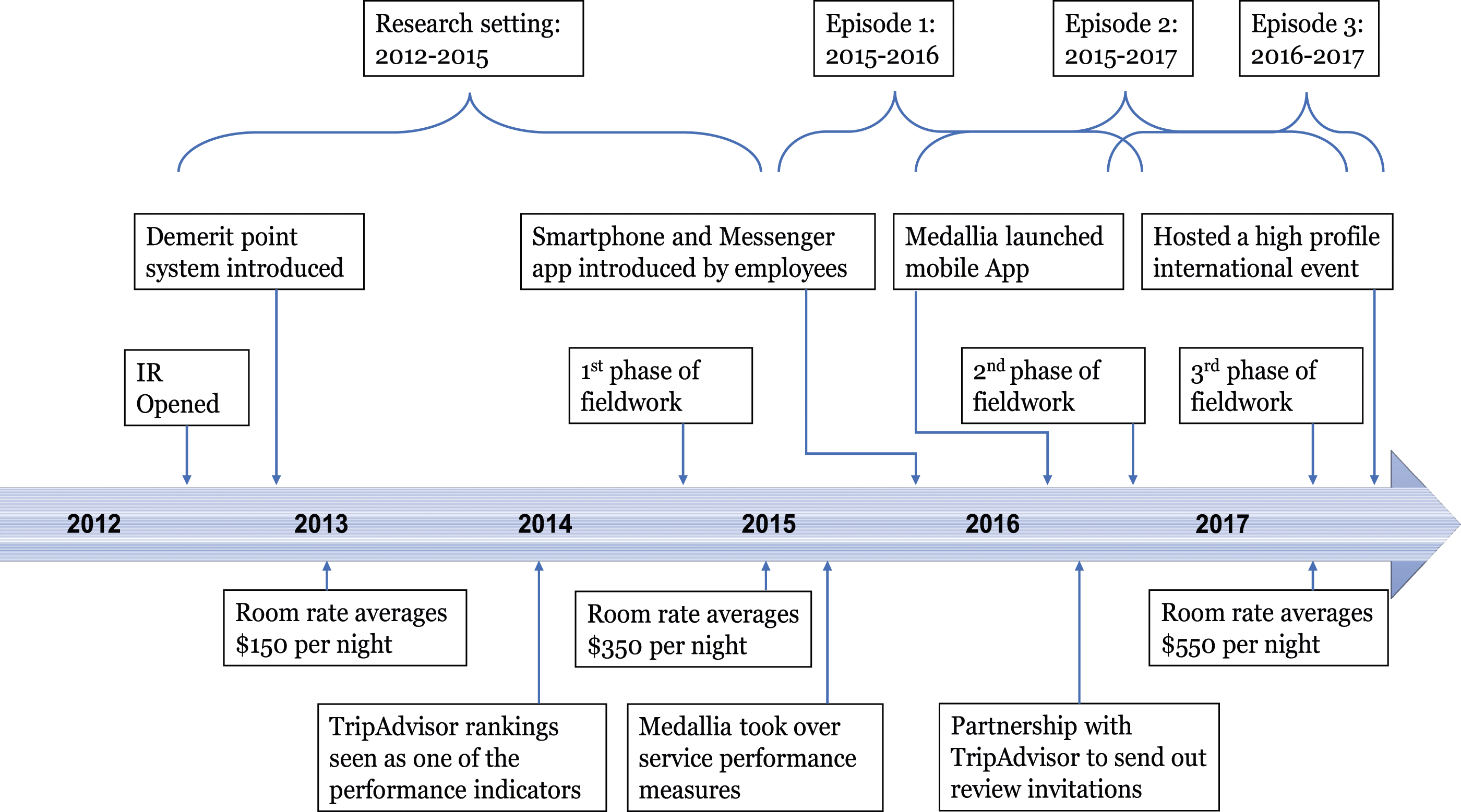
Analysis of the findings
In this paper, we set out to explain how digital platform-facilitated surveillance can suppress individuals’ moral impulse and facilitate a state of moral ambivalence. The three episodes that we describe below provide insights into how surveillance at IR, via TripAdvisor, WhatsApp group chatrooms and the workers’ own smartphones, suppressed workers’ moral impulse (Bauman, 1993; Jensen, 2010; ten Bos, 1997). Drawing on Jensen’s (2010) conceptualization of processes of demoralization, we argue that, when organizations and their employees use digital platforms and other digital technologies, such as smartphones, for surveillance, it can facilitate organizational practices that suppresses individuals’ moral impulse and, thus, make them morally ambivalent towards the consequences of their actions (see Clegg, 2018; Jensen, 2014, 2010).
Key actors and events for each episode.
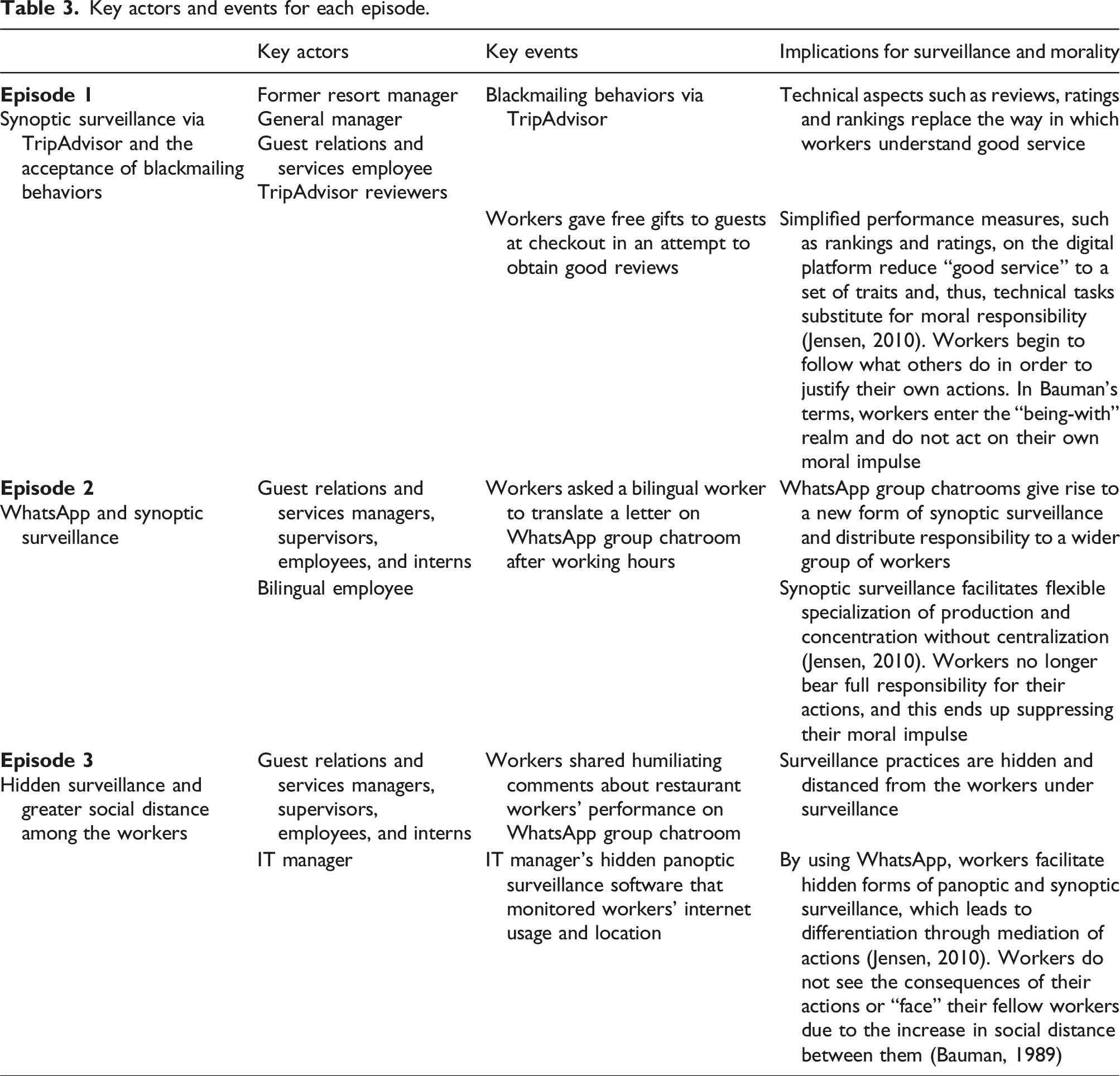
Episode 1: Synoptic surveillance on TripAdvisor and acceptance of blackmailing behaviors
This first episode illustrates how IR’s workers became ambivalent towards nefarious behaviors on TripAdvisor, such as guests’ (i.e., reviewers’) “blackmail” behaviors and workers obsessing over TripAdvisor reviews and then at checkout requesting “happy” guests to write good reviews. In this way, the workers’ active engagement with TripAdvisor reduced guests and other workers to a set of traits and made it easy for workers to focus solely on the technical aspects of their tasks.
Prior to 2015, despite TripAdvisor’s growing influence over the hospitality sector, IR’s management did not trust the reviews and explicitly stated that the information lacked reliability for measuring service performance. The growing number of guests who used TripAdvisor to “blackmail” the hotel into giving them upgrades or other benefits for good reviews exacerbated this mistrust as the following comment that the former resort manager made in 2014 indicates: [TripAdvisor] is one of the most popular measures of hotel success and we do include this in our service performance evaluation, but we cannot be too influenced by what is posted on this website everyday…. Sometimes guests insist on getting an upgrade or freebies by telling us that they will write a bad review on TripAdvisor or Booking.com, which will influence our reputation…. The individual reviews are not always reliable, and we have our own brand and standards to evaluate our employees’ performance.
As the above quote illustrates, rather than actively engaging with TripAdvisor and focusing on obtaining good reviews, IR continued to follow the standards and practices in MIG’s formal guidelines to determine their performance quality. Furthermore, managers evaluated employees’ performance based on how they understood internal procedures and their own interpretations based on their training. The former resort manager emphasized that, as his top priority, he focused on training and educating employees so that they had the ability to act on their own beliefs and interpretations, rather than becoming obsessed with TripAdvisor reviews.
However, IR’s attempt to control its employees’ behavior did not keep pace with the rapidly increasing synoptic surveillance that was emerging due to the growing number of users on TripAdvisor (both internally and externally). As the number of tourists who used TripAdvisor grew, its influence increased significantly. Consequently, by 2015, rankings on TripAdvisor had begun to have a greater influence on IR’s workers. The new general manager,
3
who replaced the former resort manager in that year, acknowledged that: [TripAdvisor] helps us get attention from potential guests, but also causes us a lot of headaches…. We subscribe to TripAdvisor’s service to send out invitations to leave a TripAdvisor review after our guests check out. TripAdvisor provides us with their invitation link, and we send it to our guests’ email after they check out… If you look at this [showing a list of TripAdvisor reviews on other resorts] many of these reviews are written by first-time users, and they don’t have the verified mark…. We think some of our new competitors buy reviews or tell guests to write a good review during their stay for gifts, but we can only suspect it.
This quote is significant because it indicates that the new general manager did recognize the nefarious behaviors on TripAdvisor but, nevertheless, submitted “to control by TripAdvisor” as IR began to engage more actively with TripAdvisor by, for instance, encouraging guests to write reviews and sending out TripAdvisor’s invitations. Although this practice did not necessarily increase the number of guests who reviewed IR on TripAdvisor, or the frequency with which IR appeared on TripAdvisor’s main page, it helped IR ensure that actual guests, who had stayed and experienced the hotel’s service, wrote the TripAdvisor reviews.
During 2015, in an attempt to manage content about IR on the various digital platforms (Facebook, Twitter, and TripAdvisor), MIG changed the way it evaluated the service performance of all its hotels, moving from in-house generated data to an outsourced provider called Medallia. Medallia collects textual data from relevant digital platforms (mainly Twitter, Facebook, Booking.com, and TripAdvisor) to identify trends in the hotel’s service performance. Consequently, quantified scores and rankings based on reviews from the various digital platforms replaced what good service performance meant to the managers and employees, which used to be based on comments the hotel received from guests, their own observations, and way they understood MIG’s detailed guidelines and training. In essence, the change reduced good service to a set of traits and, thus, substituted technical for moral responsibility (Jensen 2010). Despite initial resistance to using TripAdvisor’s reviews to measure service performance in IR, TripAdvisor’s reviews and rankings became an increasingly central focus for IR’s workers. Many informants we interviewed (employees, managers, and directors) frequently made such statements as: It is very important for us to get good reviews on TripAdvisor to stay ahead of our competition.
We observed an example that illustrates the workers’ obsession with TripAdvisor reviews from the ethnographic fieldwork. Specifically, we observed a guest relations and services employee helping two guests to check out and then handed them a gift bag. When the researcher asked why she gave them this gift, the employee responded: They made a complaint yesterday, and I just wanted to make sure that they leave our hotel happy, so they won’t leave us a bad review.
Although this action directly contradicts the former resort manager’s concern about obsessing over TripAdvisor reviews, it now appeared that ensuring good reviews had become an important objective for employees and managers.
These examples suggest that the workers now cared more about the technical aspects of good service, such as quantified performance measures, good reviews and rankings on TripAdvisor and Medallia, than really understanding what providing “good service” actually means. Jensen (2010) argues that, in such a context, individuals will care less about others or their own emotions and will do anything to blindly follow goals that their organization sets—in this case, the scores, reviews, and rankings on TripAdvisor and Medallia. In this way, the complex notion of “good service” becomes simplified to scores, ratings, and rankings, which makes it easier for workers to dehumanize guests (Bauman, 1993; Sennett, 1999) and to focus on getting their technical tasks done without expressing their moral impulse. For instance, the workers we observed during our fieldwork appeared morally ambivalent about whether giving guests free gifts at checkout could affect the integrity of the performance measures or whether the free gifts rewarded some guests for their TripAdvisor “blackmail.” Rather than questioning, or at least contemplating, their actions’ consequences, employees and managers justified their actions by saying “this is what we do” and, thus, to use Bauman’s (1993) term, stayed in the “being with” realm. While this context may be an autonomous working environment in which employees and managers do whatever it takes to receive a good review, they reduce their role in the process to such traits as individual productivity or whether reviews mention them. While workers might feel that they have control over their tasks, the environment also suppresses their moral impulse and facilitates a state of moral ambivalence.
Episode 2: WhatsApp and synoptic surveillance
This episode illustrates how, in actively participating in using smartphones and WhatsApp chatrooms and in voluntarily submitting to more extensive surveillance, IR employees created new forms of synoptic and panoptic surveillance.
In 2015, circumstances arose that caused IR employees to use their personal smartphones and, concomitantly, WhatsApp for communication at work. At that time, management had allocated all available walkie-talkie and radio channels to golf cart drivers who transported guests around the hotel site. Consequently, other employees experienced severe difficulties in communicating with their supervisors and with each other when undertaking their day-to-day tasks. To deal with these difficulties, employees began to use their personal smartphones and WhatsApp. Although IR had previously strictly prohibited personal mobile phones, management now allowed, and even encouraged them, as they significantly improved communications around the hotel site. However, as a result, the smartphones and WhatsApp chatrooms combined to create a new form of synoptic surveillance.
We can interpret the improvised manner in which workers’ adopted smartphones and WhatsApp as an attempt by IR’s employees to achieve “continuous quality improvement,” to pursue an organizational strategy that highlights the importance of continuous adaptation, and to embrace flexible thinking and change. The above example illustrates a constant but discontinuous reinvention of the company’s routines (Jensen, 2010). The frequent introduction of new technologies, such as smartphones, WhatsApp, and TripAdvisor, makes it difficult for workers to experience stability at work. Bauman (2000) and Jensen (2010) argue that, in this context, individuals begin to assume that changes occur constantly, and workers become solely focused on the goals that their organization set. Consequently, individuals in such an organizational setting can become morally ambivalent about surveilling others in a way that could invade their privacy. We will draw on two examples to illustrate how IR’s workers acted ambivalently towards more extensive surveillance and how new forms of surveillance suppressed their moral impulse.
The first example relates to the improvised manner in which workers used the group chatroom function on WhatsApp to share specific observations about the service they provided to guests. Each group chatroom had its own theme based either on short-term projects (e.g., VIP guest stay, conferences, and weddings) or on individual departments and their responsibilities. These chatrooms allowed IR’s workers to instantly share information without having to go through the previous hierarchical reporting procedures. For example, during the fieldwork, we observed workers taking pictures of broken fixtures. They then shared these pictures with other workers in the group chatrooms. As a result, the group could immediately recognize this particular problem and have it fixed by the end of the day. Thus, employees had flexibility and immediacy in their surveillance practices, and their communication began to resemble the flexible, spontaneous, and transparent communication that can typically be found on social media (Brivot et al., 2017). Consequently, workers began to synoptically track each other’s current location and service-performance status.
Over time, these changes enabled workers in various positions and at various levels, rather than just the managers, to take responsibility for the organization’s service performance monitoring by looking for potential performance issues (as the above example about the broken fixture shows) and raising them with other workers. As workers broke down the responsibility for surveillance into smaller elements, they began to treat each finding as a separate episode and, consequently, focused on solving emergent, short-term problems. These changes in IR’s surveillance practices illustrate flexible specialization of production and concentration without centralization (Jensen, 2010) as managers no longer solely had responsibility over surveillance; instead, the responsibility lay with many employees at various positions and levels and even with others outside the organization, such as guests using TripAdvisor. However, even though the surveillance moved beyond the hierarchical structure, organizational rules and top management’s demands still influenced employees (Jensen, 2010), and this made it difficult for them to act against the “norm [s] of the many” or, in Bauman’s (1993) terms, “being with.” Consequently, we observed that workers thought less about their actions’ morality and how other people might perceive their actions; instead, they cared only about identifying potential problems and solving short-term issues.
The second example illustrates this process of demoralization. IR had a limited number of bilingual workers and other workers often asked them to translate letters, reviews and messages in, for example, Korean, Chinese, and occasionally Spanish, into English or vice versa. Sometimes, they made such requests to individuals who worked on different shifts through the group chatrooms, which meant other workers (including managers) could see the messages. Thus, all chatroom users could easily identify whether this individual had completed the translation work and if they did it quickly. Although many of the managers and employees we interviewed generally claimed that no one had to work extra hours or check messages on group chats outside their normal working hours, we found evidence that bilingual workers felt pressured to respond immediately due to “being with” the others in the group chatroom. For example, a guest relations supervisor said: We are not expected to read the messages [on the group chats] when we are off shift…. I don’t normally reply to the messages, but I still like to read through the messages to keep myself updated. Otherwise, it is difficult to keep up when I come back to work, and I don’t want to feel left out…. Sometimes, it [translating] is too much work but I am here to advance my career, so I try to see it as an opportunity to develop my skills and be recognized by the manager.
Ironically, while using WhatsApp group chatrooms in this way at IR could encourage workers to voice their opinions, it can also enable synoptic surveillance that can pressure specific worker groups (in this case, bilingual workers) to work extra hours. However, we found no evidence that other group chatroom members had concerns about feeling pressured to perform extra duties outside normal working hours or about the increasing surveillance in and even outside the workplace. When we asked the workers involved in the above incident for an explanation, they generally responded: “this is what we do to achieve our service quality.” Interestingly, no informant expressed particular concerns or frustrations about the increased surveillance, nor did any of them speak out to support or express solidarity with the exploited bilingual workers. Instead, they believed that, as long as their actions improved the guest experience reflected in the ratings, rankings, and reviews, it constituted the right thing to do.
Workers’ constantly shifting roles (e.g., from greeting guests to translating letters) illustrates how the flexible specialization of service (Jensen, 2010) can cause workers to justify their actions solely based on effectiveness and efficiency (Bauman, 1989) and not express concerns about the increasing surveillance and the requirements for some to work outside their shifts. In this way, flexible specialization can suppress workers’ moral impulse and, consequently, they can feel ambivalent towards seemingly unreasonable situations which they experience at work. Or, to put it in Jensen’s (2010) words, the technical requirements substitute for moral responsibility, as the task’s technical aspects become the primary and sole focus and, as a result, people conceal or ignore the morality of their actions.
Episode 3: Hidden surveillance and greater social distance among the workers
This third episode indicates why workers with suppressed moral impulse were morally ambivalent towards the surveillance practices in IR. Specifically, this episode illustrates how the synoptic surveillance, which workers facilitated by using their smartphones and WhatsApp, resulted in workers dehumanizing other members in the group chatrooms. The workers’ voluntary use of smartphones and WhatsApp provided an opportunity for the IT manager to design software to track workers’ internet usage during working hours, which increased panoptic surveillance in IR.
The synoptic surveillance that emerged in the WhatsApp group chatrooms and the shift in focus from understanding “good service” to receiving good reviews on TripAdvisor created an environment in which the workers focused primarily on eliminating the potential for guests to write bad reviews. Our informants often stated that “it is better to deal with the problem now, before it escalates” to emphasize that they focused on solving problems quickly and, if possible, before guests checked out so that they did not leave the resort unhappy and then write negative reviews on TripAdvisor. Acting on this belief, workers did not hesitate to share any observations that may (or may not) have indicated a potential problem, even if it involved “publicly” accusing other workers. We illustrate this with an incident that happened during an interview with a guest relations manager in one of the hotel’s restaurants. The manager suddenly excused herself and took a picture of an unfinished afternoon tea (that comprised sandwiches, cakes, and beverages) on another table. She then uploaded this image to various group chatrooms with a request for their opinions on why the guests did not touch more than half of their cakes. Some immediate responses that we observed in the group chatroom included: The cakes could have tasted bad, The presentation might have been inadequate, Employees could have offended the guests resulting in them leaving early.
When asked whether one could interpret these group chatroom conversations as jumping to conclusions too quickly and even as publicly accusing the kitchen and restaurant employees, the guest relations manager explained: This is what we do to find out the root cause of the problems. If we see signs of potential problems, we share it with others to find out what could have gone wrong…. If there was a mistake, we need to correct it.
This incident exemplifies the synoptic surveillance that emerged when workers began using their personal smartphones and WhatsApp group chatrooms. In this instance, the group chatroom members appeared unconcerned about publicly accusing other individuals and departments without any evidence. Indeed, as their roles became more flexible, the employees experienced more freedom in the workplace (i.e., freedom to improvise, to be creative, to flexibly reinvent their roles, and to voice their opinions). However, at the same time, during our research, they seemed unconcerned about making accusations without any evidence—accusations that could cause others to feel publicly humiliated. Instead, they focused on a shared organizational goal: to provide guests with the sort of luxury service that would generate high rankings and good reviews on TripAdvisor, without any concern for the potential moral implications of their actions.
This incident also illustrates new forms of control in IR, whereby employees voluntarily monitored each other, while sacrificing their own privacy and lives outside work. Jensen’s (2010) two demoralization processes, differentiation through mediation of actions and reduction to traits manifested in the absence of face-to-face interactions, created a context wherein workers dehumanized each other and saw themselves as various traits to achieve shared organizational goals; in this case, to achieve good reviews on TripAdvisor by providing the “best possible service.” By actively using WhatsApp chatrooms and staying constantly connected even though they rarely saw other chatroom members, workers suppressed their moral impulse.
Furthermore, as multiple group chatroom members actively participated in each event by, for instance, sharing their opinions, no one individual felt wholly responsible for the potential consequences of their actions. As the WhatsApp group chatrooms enabled workers to feel only a limited and, thus, acceptable share of responsibility for the surveillance, the many found it easy to remain morally ambivalent. Our findings illustrate why the workers cared only about actions in the “here and now” and were ambivalent about consequences that might occur “there” or “then” (Jensen, 2010). This finding concurs with Bauman’s (1989) contention that increasing social distance between individuals can suppress their moral impulse and make them morally ambivalent towards the potential consequences of their actions, as often they cannot readily see the moral consequences due to the number of layers in their social interactions.
Another example demonstrates how, by actively using their smartphones and WhatsApp group chatrooms, the IR workers not only facilitated synoptic surveillance, but also created an opportunity for IR’s IT manager to create a new and hidden form of panoptic surveillance by monitoring workers’ smartphone and Internet usage. The IT manager explained: I got a lot of complaints from the guests and the managers about the slow broadband speed and low coverage during the daytime…. Since we recently upgraded our broadband speed, I suspected that it could be our staff using too much Internet near the guest areas… I designed a software to confirm this…. Since only the staff will use the internet in both guest areas and the back-office [staff canteen and changing rooms], the software collects all the devices’ MAC address [unique identifier code that cannot be changed] that used the Internet near the back office and guest areas. This helps me distinguish the HR staff working in the back office with the operational staff who work in guest areas. I then limit the Internet speed for operational staff’s devices using the software I designed.
Here, the IT manager saw an opportunity to solve the Internet speed problem with an improvised solution and, at the same time, to gain personal recognition. He proudly pointed out that this solution represented “one of my finest outputs” and he received much praise for solving the problem without incurring additional cost. Although the manager designed his Internet usage-tracking software to limit employees’ Internet usage near guest areas, he could also use it to track employees’ locations and their Internet usage patterns. This software created more extensive panoptic surveillance in a somewhat similar way to the surveillance algorithms embedded in Google’s search engine (Zuboff, 2019), but, in this case, confined within IR. However, we found no evidence that the manager discussed or disclosed the surveillance issues with workers before implementing the software, nor any evidence that he had concerns about potentially invading workers’ privacy. One could say that the IT manager created his software in an attempt to cope with the discontinuous reinvention of company’s routines and the flexible specialization of production (Jensen, 2010). Ironically, by actively using their smartphones and WhatsApp, employees sustained the resulting increase in panoptic surveillance. In this example, we see how the demand for continuous improvement and fast decision making resulted in the IT manager wanting to signal his performance and commitment (Cristea and Leonardi, 2019; Jensen, 2014), while acting in a morally ambivalent manner towards the potential moral consequences of his actions. His software made it easy to dehumanize workers by reducing them to a set of traits, such as their Internet usage. We can interpret this event as an instance in which a task’s technical aspects (i.e., improving the internet speed and coverage for guests) substituted for the IT manager’s moral impulse to voice concern over potentially invading workers’ privacy.
Discussion
This study advances our knowledge of the negative moral consequences that can result from digital platform-facilitated surveillance. Specifically, we examine the processes through which organizational practices can suppress individuals’ moral impulse and foster a state of moral ambivalence. As such, this study fills an important gap in the digital platform literature by drawing attention to the impact that digital platforms can have on workers’ morality and by providing a framework for studying some of the negative consequences of digital platforms. Below, we discuss how our study contributes to specific areas of the digital platforms and surveillance literature, and then we discuss some practical implications of our study.
Contributions to research on digital platforms and surveillance
First, in line with prior literature, we examine the surveillance that digital platforms can facilitate (Iazzolino, 2021; Tassinari and Maccarrone, 2020) and, more specifically, the impact digital platforms can have on workers’ morality (Rauch and Ansari, 2022). As prior literature tends to focus on why, and in what way, technology enabled surveillance influences organizational practices and workers’ resistance to such surveillance (Anteby and Chan 2018; Pierce et al. 2015; Sewell et al. 2012; Sewell and Barker 2006; Staples 1997; 2013), we lack empirical research that seeks to understand how new forms of organizational surveillance can influence workers’ morality. We address this gap by focusing on how digital platform-facilitated surveillance can suppress individual worker’s moral impulse (Bauman, 1993; Jensen, 2010; ten Bos, 1997) and, thereby, facilitate a state of moral ambivalence towards that surveillance. In so doing, we highlight why workers might not resist increasingly extensive organizational surveillance and act ambivalently towards its unintended moral consequences, such as the invasion of privacy, and to yet more extensive surveillance. One can transfer our insights into how digital platform-facilitated surveillance can suppress workers’ moral impulse to other contemporary organizations that embrace continuous technological change and flexible specialization in their workers’ skills and tasks (Bauman and Lyon, 2012; Bauman, 2000), who then focus on technical tasks over concerns about morality.
Second, this research adds to the recent gig economy platform studies (Howson et al., 2020; Iazzolino, 2021; Tassinari and Maccarrone, 2020). While prior research has discussed the extensive surveillance that gig economy platforms can exercise over their workers and how it can lead to workers’ solidarity and resistance (Iazzolino, 2021; Tassinari and Maccarrone, 2020), we find that workers actively participated in enacting synoptic surveillance rather than resisting it. Workers in our case study did not raise concerns over the increasing surveillance or the potentially detrimental consequences that their actions could have on others. In this synoptic surveillance context, workers are not only the surveilled subjects, but also active participants in surveilling others. We are thus observing the suppression of workers’ moral impulse to voice concerns over the increasingly extensive surveillance. Our insights into synoptic surveillance, through the use of smartphones and WhatsApp, aligns with Bauman’s (1989, 1993) view of morally ambivalent individuals who feel little moral responsibility and simply act in accordance with organizational rules and demands to achieve their immediate targets. These insights extend the discourse on how digital platform workers react to surveillance.
Third, the research advances our knowledge about workers’ “visibilizing practices” (i.e., though which they make themselves visible to others) in distributed working environments. In their study, Cristea and Leonardi (2019) illustrated how employees can try to overcome the absence of face-to-face interactions by signaling their commitment through practices such as staying online after working hours. Hafermalz (2021) theorized this behavior as the visibilizing practices through which workers overcome their fear of being outside their social group. While these studies suggest that anxiety and/or stress drive such practices, the workers in our case did not report such negative emotions as they lacked concern for, and acted in a morally ambivalent manner towards, whether their actions were right/wrong or could negatively affect others (Bauman, 1993; Jensen, 2010). Our research, thus, goes beyond prevailing knowledge about how and why workers engage in visibilizing practices and submit to organizational surveillance. Our findings draw attention to the processes of demoralization (Jensen, 2010) that workers facilitated by using digital platforms and their personal smartphones; processes which suppressed their moral impulse and fostered moral ambivalence (Bauman, 1993; Jensen, 2010). Our findings raise concerns about workers being morally ambivalent towards the consequences of actions such as invading others’ privacy, extending surveillance outside the workplace, and even humiliating fellow workers: what Bauman (1993) refers to as “being with” (Bauman, 1993).
Fourth, our study sheds light on the way in which individuals and organizations respond to the continuously changing environment that digital platforms and other advances in information technology can create. Rolland et al. (2018) pointed out how the resources that digital platforms make readily available can interact with existing organizational practices to overcome challenges to infrastructure and work processes. Furthermore, in studying how service sector organizations respond to social media comments on Twitter and TripAdvisor to explore crowd-based accountability, Karunakaran et al. (2022) highlighted how this synoptic form of surveillance can reconfigure quality-focused work’s meaning, activities, relations, and outcomes. These prior studies have largely adopted a user-organization perspective to study the organizational processes that manage resources and the information that digital platforms create. By focusing on individual workers and their actions in response to new forms of organizational surveillance, we highlight the consequences that individuals’ moral ambivalence towards changes in surveillance practices can have in user organizations. In this way, our research advances knowledge about the negative unintended consequences of digital platforms and information technology by considering morality when discussing the way in which they influence changes in organizational practices.
Fifth, the processes of demoralization (Jensen, 2010) that we adopted in this research help to expand knowledge about the false sense of freedom that digital platforms, with their hidden surveillance, can create (Zuboff, 2015, 2019). Prior research has indicated how hidden panoptic surveillance algorithms embedded in digital platforms can restrict and manipulate users’ behaviors, even where users believe they have freedom over the way they use digital platforms, such as Google search and Uber (Iazzolino, 2021; Zuboff, 2015, 2019). By drawing on the concept of moral impulse, our research provides an additional explanation for, and points to the consequences of, the false sense of freedom that digital platforms can create for organizational workers. When digital platforms suppress workers’ moral impulse and they become morally ambivalent, the freedom they claim to experience in the workplace remains circumscribed within the boundaries that their organization sets and, according to Bauman (1995, 1993), their morality belongs to the “being with” realm. Consequently, we have concerns for workers in other settings in which digital platform- or information technology-facilitated surveillance could lead to moral ambivalence and to workers losing the ability to voice concerns over potentially morally questionable activities, even in relation to beliefs that the many share.
However, Zuboff’s (2015, 2019) work on surveillance capitalism zooms out to the surveillance capability of digital platforms at the societal level, we zoom in to the organizational level. As a result, in this study, we observed how processes of demoralization suppressed workers’ moral impulse and, in turn, normalized the more extensive surveillance facilitated by workers exercising synoptic surveillance through their use of their smartphones and WhatsApp. In using Jensen’s (2010) demoralization framework, we provide practical examples that illustrate how adopting digital platforms (in particular, TripAdvisor and WhatsApp) in daily work activities, and being subject to ratings platforms (such as TripAdvisor) can suppress moral impulse and foster a state of moral ambivalence.
By drawing on Jensen (2010), we theorize the processes through which organizational practices suppress workers’ moral impulses in a context where digital platforms enable new forms of surveillance. In so doing, we shed light on why workers might not resist the increasing surveillance and the deteriorating working conditions that can occur when organizations incorporate digital technologies into their organizational practices. In this way, we improve our understanding of how morally suppressed workers can be functional in the workings of surveillance capitalism (Zuboff, 2015, 2019). By combining Jensen’s processes of demoralization, with Bauman (1993) concepts of moral ambivalence and moral impulse, our case study shows how digital platform-facilitated surveillance (both synoptic and panoptic) can suppress workers’ moral impulse and lead them to view passively invasions of privacy and the pressuring workers to work outside normal working hours. Here, our findings to some extent echo what Bauman describes as cruel things done by non-cruel people (Bauman, 1995). Consequentially, organizations face the danger that incorporating digital technologies into organizational practices could lead to more extreme consequences. Accordingly, our study contributes to the platform surveillance domain, enriches the nascent literature on surveillance in the IS discipline, and raises awareness about the potential for digital platforms to have unintended negative consequences in facilitating new forms of surveillance in service organizations.
Practical implications
This study’s implications for IS praxis lies in exposing the potentially demoralizing processes that can accompany technological solutions to organizational problems, such as the use of digital platforms. We would argue that, to be “morally aware,” managers and technical professionals in the contemporary technological environment, which features rapid and continuous change, must consider carefully the potential consequences of their actions, rather than simply following what others do and, thereby, remain morally ambivalent (Bauman, 1993; Jensen, 2010). In this way, we not only reinforce Chatterjee et al.'s (2009) conclusions regarding the moral responsibility of IS experts, but also extend moral responsibility to a wider participant group.
Our findings illustrate how the use of informal communication channels, together with small side projects, can evolve into strong surveillance practices. For example, the group chatrooms on WhatsApp fostered workers’ synoptic surveillance of each other, even extending it outside the working hours. Such new informal modes of surveillance could be problematic in long term, especially if there are no safeguards to protect privacy and labor rights. Similarly, small side projects, such as the IT manager’s internet usage-tracking project, can potentially have detrimental moral consequences in the workplace. As providing oversight and/or regulation of emerging and new technologies can be very difficult (Chatterjee et al., 2009), we would argue that practitioners need to give particular attention to the potential unintended consequences of their actions for both the organization and individual workers within it.
Conclusion and limitations
The influence of digital platforms on organizational practices continues to grow. As well as providing immense opportunities for innovation, they can also foster new surveillance practices. However, our understanding of the potential negative moral consequences of digital platform-facilitated surveillance is quite limited. In our case study of a hospitality organization, we illustrated how digital platform-facilitated surveillance can suppress individual workers’ moral impulse and foster a state of moral ambivalence through processes of demoralization. By so doing, we fill an important gap in literature in drawing attention to the relationship between digital platforms and workers’ morality.
Finally, as with any study, this paper has limitations. First, we do not discuss in detail the digital transformation process that led IR’s workers to make increasing use of digital platforms. Although our findings provide a glimpse into this digital transformation, we did not focus on it as a central theme in our analysis. Second, future research could explore the relationships between digital platforms, surveillance practices, and demoralizing processes in other contexts. We based our research on a case study of an organization in the hospitality sector. However, digital platforms could exert different influences on surveillance practices in other industries and sectors, and lead to different forms of surveillance. Nevertheless, in this paper, we theorize a link between digital platforms and workers’ morality and highlight some of the unintended consequences that can result from organizational surveillance. We believe our case study highlights the processes through which digital platforms can influence workers’ morality, and we would expect the framework we adopted to analyze our case to be useful in other studies.
Footnotes
Declaration of conflicting interests
The author(s) declared no potential conflicts of interest with respect to the research, authorship, and/or publication of this article.
Funding
The author(s) received no financial support for the research, authorship, and/or publication of this article.
