




Abstract
Increasingly, people are turning to social media to express grief. By and large, however, the social media community can do little more than improvise reactions, not quite sure how to use the old familiar social scripts as guides to lending effective support. To examine the role of social media in the grieving process, we used a mixed-methods approach: 12 interviews with “social media grievers” reveal the expectations of the bereaved regarding other users’ behavior. By way of two online experiments with 1058 participants, we tested how these expectations are met by the messaging of social media providers in accordance with social norm theory. We found that injunctive social norm messages are particularly effective, whereas descriptive social norm messages vary in their effectiveness, depending on which information is presented and how prominently so. What our study shows, then, is that both are potent socio-technical tools that can guide users towards more empathetic behavior when dealing with the bereaved, so while social media may not be a substitute for therapy, they can offer profound comfort for those of us dealing with bereavement and grief.
Introduction
We become what we behold. We shape our tools, and thereafter our tools shape us. (Marshall McLuhan, cited in Kakar and Oberoi, 2016)
1
While it is perhaps the most universal human experience, bereavement can have detrimental unforeseen consequences, such as sudden separation anxiety, physiological distress, obsessive dwelling on the past, or apprehension about the future (American Psychological Association, 2004). The grief that follows bereavement can have a similarly overwhelming price tag since the economic costs of grieving include reduced productivity, lost business, and poor performance in the workplace (Praetorius, 2018). In 2002, the Grief Recovery Institute estimated the average annual economic cost of grief to be $75 billion for US employers (James and Friedman, 2003). These costs further increased during the COVID-19 pandemic, as everyone who died of the virus in the US left behind at least nine bereaved loved ones (Gilbert, 2021). What we are dealing with, therefore, is a grief crisis of enormous proportions.
In the 21st century, death and grief took on a digital dimension (Eriksson Krutrök, 2021). Ever since, the number of people grieving on social media has increased notably (Digital Legacy Association, 2022). The COO of Facebook (today’s Meta Platforms, Inc.), Sheryl Sandberg, acknowledged this trend when she pointed to over 30 million people interacting with memorialized profiles on Facebook every month, as of 2019 (Sandberg, 2019). While there are no current figures on how many people are offering their condolences on social media, a secondary analysis of our studies, which we report in this paper, indicates that over 62% of the 1058 participants do so. It is clear, then, that online mourning is a significant issue of our times. Since the protracted pandemic and its requirement for social distancing have further exacerbated this trend (Beaunoyer and Guitton, 2021; Feintzeig, 2022), we have entered an era of loss. This has seen the burgeoning of business models that offer farewell video messages, to be published on one’s Facebook network after one’s death (ifidie.net). Other profitable services include reviews of the tweets posted in the period leading up to the deceased’s passing (deathgoesdigital.com) (Jacobsen and Petersen, 2020). Meanwhile, several companies are working on avatars that people feed with personal and social media information during their lifetime to ensure that relatives can communicate with this digital self once they have died (Matei, 2021; Neville, 2021). Another new development is headspace, one of the most popular meditation apps, which has caught up with this grieving trend and prepared its users to face grief mindfully on social media (Figy, 2021). As this broad embrace of online grieving aids indicates, the expression of grief on social media has become “a thing.”
It would, therefore, be reasonable to expect the grief experience to have been inscribed deeply into our social narrative (Springer, 2017). However, since bereavement and grief are typically deemed to be distasteful aspects of life, people tend to discuss them only when they become impossible to ignore. Then, having had little practice, many find themselves ill-equipped to express sympathy, which is why the bereaved often have to contend with the added challenge of socially awkward if not clumsy responses to their grief (Breen et al., 2020; Macdonald, 2020). Many report that their networks merely offer platitudes and seem somewhat lacking in sympathy, presumably because of their inexperience in lending support and comfort. Often, even those closest to the bereaved cannot rely on their intuition to effectively express sympathy (Aoun et al., 2019; Breen et al., 2020; Swartwood et al., 2011). This is deeply unfortunate as decades’ worth of psychological research has shown that a potent means of processing loss is for the bereaved to share and discuss their stories with others (Marcu, 2007; Bosticco and Thompson, 2005; Rimé et al., 1998). Today, there are multiple tools and applications by means of which social media users can interact with one another, yet while these tools and apps are increasingly sophisticated, the technical and cultural protocols currently available to express sympathy online are still very much in the process of development (Miller-Lewis et al., 2020). With no reliable or readily available roadmap to guide the social media community in their efforts to effectively support the bereaved, they often improvise somewhat aimlessly or merely stumble down the avenue of cliché when communicating their care (Springer, 2017).
This study examines how best to support social media grievers. While research on this subject is as yet in the early stages, it suggests that social media grievers feel empowered when making their grief public by expressing it online (Eriksson Krutrök, 2021; Moyer and Enck, 2020). To date, however, we are unclear on what constitutes effective supportive reactions. To get clarity on these issues, we first approach them from an exploratory point of view, then a confirmatory one (Venkatesh et al., 2013; Venkatesh et al., 2016). We start by interviewing 12 social media grievers, our intention being to identify what the bereaved expect from other social media users in terms of supportive reactions and how the design of a social media environment can facilitate this support.
Social norms (SNs) are central to our social life. SNs refer to an individual’s beliefs about how to behave in social situations (Kormos et al., 2015). As such, SNs are conceived and communicated within social groups to steer behavior in helpful directions while remaining within socially accepted boundaries (Cialdini, 2003; Cialdini et al., 1990). Prior research has shown that SNs are a powerful tool that can be used to encourage pro-social behavior in various domains (Gimpel et al., 2021). Indeed, people tend to follow established SNs even when there is no risk of being observed let alone sanctioned for failure to do so (Gross and Vostroknutov, 2022). In the grief context, the helpful and socially desirable behavior suggested by SNs is an expression of sympathy for the bereaved. Yet it is important to note that adherence to these SNs is voluntary, whether one chooses to express sympathy in person or on social media. Indeed, aside from perhaps a guilty conscience, there are no negative consequences if one simply scrolls on after viewing grief-related content in one’s social media feed. SNs merely encourage one to stop and communicate care and, as such, they could be a positive means of fostering more empathetic behavior towards the bereaved on social media. In other words, social norm (SN) messages are tools that signal SNs on social media, but so far there is no consensus on whether social media are adequate for the task of conveying SN messages when it comes to grieving. To achieve clarity on this matter, we conduct two online experiments with 1058 social media users, testing the effectiveness of different SN messages in prompting social media users to express sympathy.
As for the theoretical value of this study, we explore the specificities of online grieving based on the experiences of social media users who have already shared their grief on social media. In a further step, we propose how to accelerate reactions to grief posts on social media and in doing so apply SN theory to fields of unfamiliar but socially desirable behaviors. Based on our findings, we propose clear design characteristics for SN messages. As a result of these efforts, we contribute to the study of information systems (IS), particularly the growing school of thought that looks at resilience and a notable trend in this topic area; individuals becoming increasingly dependent on IS to adjust to major disruptions or indeed overcome them (e.g., Association for Information Systems, 2021; Mirbabaie et al., 2020). This brings us to the practical value of this study, the clear evidence that SNs can serve social media providers as a means of guiding their users in how to behave toward the bereaved.
Theoretical background and hypothesis development
Grief in the digital age
The American Psychological Association defines grief as an anguish experience after a significant loss, such as the death of a loved one (American Psychological Association, 2020). Since all manner of human experiences has moved into digital spaces, social media has become a primary space for the sharing of grief (Murrell et al., 2021; Leidner and Tona, 2021).
Although the digital community has given more room and recognition to grief, the research field is still very much in its infancy (Eriksson Krutrök, 2021; Moyer and Enck, 2020). Prior research has revealed that the bereaved tend to share their grief on social media predominantly to gain emotional release, connect with others, or remember special occasions (e.g., Moyer and Enck, 2020; Willis and Ferrucci, 2017; Varga and Varga, 2021; Murrell et al., 2021). In view of these mental health benefits, it may be an effective adjunct to professional therapy (e.g., Robinson and Pond, 2019; Bassett, 2021).
While we have begun to get some understanding of why people grieve on social media, there is little to no research on the extent to which social media can play an active role in the grief process (Beaunoyer and Guitton, 2021). Eriksson Krutrök (2021) was among the first to suggest that social media platforms may indeed take an active role in the grief process. Social media platforms may establish digital grieving communities based on the algorithmic proximity of their users’ platform activities. Uniquely, however, social media are capable of facilitating further caregiving (Beaunoyer and Guitton, 2021), given that they are in a position to support their semi-public audience to express sympathy effectively, an inactive audience that is often at a loss as to how to react to grief (Breen et al., 2020; Miller-Lewis et al., 2020). Compelling psychological research has indicated the key significance of social support in that it allows one to be joined by others on one’s grief journey (e.g., Kaunonen et al., 1999; Wright, 2000; Moore et al., 2019; Aoun et al., 2019; Aoun et al., 2015).
This raises an essential but as yet unanswered question, which is why it is the first research question of this study.
“How do the bereaved expect social media to ease their grief?”
This question has become ever more pertinent given the growing extent of grieving on social media, and due to the novelty of this phenomenon, large numbers of social media users are still managing to express their compassion or act in the spirit of what some may perceive to be the community’s implicit duty of care without a social script on how to support the bereaved. It is an “open-ended, evolving, and non-directional” research question, which is why qualitative methods are the most suitable tools to tackle it (Onwuegbuzie and Leech, 2006, p.482). Our goal is to explore the narratives of social media grievers and the expectations they have when it comes to how social media providers may facilitate their grief process by guiding the responses of other users. Historically, SNs have been a potent means by which social media platforms have guided user behavior with regard to socially relevant issues, such as the spread of fake news (see Lyons, 2018) or the COVID-19 pandemic (see Instagram, 2021, 2022). Compelling research has demonstrated their basic effectiveness (Gimpel et al., 2021). With this in mind, we use SNs to further investigate how social media users may “support effectively” and help the providers of social media platforms in their efforts to guide user behavior towards greater expressions of empathy when dealing with the bereaved. Our second research question, therefore, consists of two parts.
“Can SN messages that are provided as part of a social media user interface increase the likelihood that users will express sympathy?”
“If so, which SN messages – if provided as part of a social media user interface – make users more likely to express sympathy?” It bears repeating that, to date, there has been no clarity on how effective SNs are when it comes to directing peoples’ handling of grief via social media. Historically, SN theory has focused on other contexts, such as alcohol abuse or litter reduction, where individuals have long shown a tendency to be influenced by their peers (Rimal and Real, 2003; Cialdini et al., 1990). Social media, however, are uncharted territory as their networks are looser, their connectedness lower than in offline peer groups, and their users part of multiple communities at once. Behaviors such as watching without engaging are common. Most users do not react to many of the posts they see in the manner familiar from offline interaction, which is to say that they do not click any of the available reaction buttons or comment on the posts so their reaction is not visible to other users on the platform. With it being far less noticeable whether a specific user reacts to a given post, be it by having a private reaction offline or sending a private message through the platform, peer pressure would seem to be reduced, as is its power to direct behavior. Our research question regarding the transferability of social norms suggests a process of testing and validating, which calls for the quantitative methods discussed below (Onwuegbuzie and Leech, 2006).
Social norms
SNs are almost ubiquitous in social situations (Fehr and Schurtenberger, 2018). While SNs may not affect everyone the same (e.g., due to differences in belief systems), they are widely considered an effective means of guiding behavior (Cialdini et al., 2006). Grounded in the theory of normative conduct (Cialdini et al., 1990), SNs are thought to impact individual actions. This impact, however, is only significant if SNs are generally in an individual’s consciousness or specifically capture their attention. To be clear, an SN must be salient to be effective (Cialdini et al., 2006). Otherwise, the SN might not be noticed. For example, people tend to litter less when they observe another person littering in a clean environment, as opposed to when they observe others not littering (Cialdini, 2003). This is because the person who is observed littering acts as a salient reminder of the SN against littering. On the other hand, when another person simply walks by in a clean environment, their adherence to the demands of public order constitutes a non-salient SN. In the latter scenario, more people behave in ways that are socially undesirable as they seem to assume that they have a license to litter (Cialdini et al., 1990). It follows that highlighting SNs makes them more effective in prompting desired behaviors (Cialdini et al., 1990; Gimpel et al., 2021).
As our research indicates, this can be accomplished by means of SN messages. These differ from SNs in that SNs are beliefs, whereas SN messages signal the beliefs held by other members of a social group (Gimpel et al., 2021). SN messages can, therefore, emphasize SNs.
Scholars differentiate between two types of SNs: injunctive SNs and descriptive SNs. An injunctive SN provides information about what should be done and, thus, suggests the behavior that is expected by the social community (Cialdini et al., 1990). An injunctive SN affects behavior because individuals expect social rewards for approved behavior or sanctions for conduct that is not approved by the community (Cialdini et al., 2006). Generally speaking, injunctive SNs relate to issues like public littering (Cialdini et al., 1990; Reno et al., 1993) or thievery (Cialdini et al., 2006); behaviors that most people learn to reject as socially undesirable at an early age. This does not, however, apply to the issue of grief. Few people know what is socially desirable or undesirable when someone in their community is grieving, because few of us have internalized the relevant injunctive SN (Aoun et al., 2019; Breen et al., 2020). Since grief is complex, it stands to reason that the ways in which people respond to grief posts on social media are also complex (Moyer and Enck, 2020). This is where SN messages would seem to be effective as they can signal a socially desirable behavior to social media users who are unsure how to deal with such public grief messaging. We proceed, therefore, on the hypothesis that injunctive SN messages which clearly signal what ought to be done are an effective means of guiding behavior when encountering online grief.
The presence of an injunctive SN message indicating that expressing one’s sympathy on social media is a socially desirable behavior increases the likelihood of users expressing sympathy. Meanwhile, descriptive SNs encourage certain conduct by describing how others behave. This second type of SN provides information on behavior that is socially approved on the basis that it is deemed typical or normal (Cialdini et al., 1990). As such, the behavior of others serves as a benchmark, supporting the individual by instilling the confidence that comes with peer approval in uncertain, ambiguous, or uncomfortable situations (Jacobson et al., 2011). Further reassurance is given by the tacit understanding that in following the example of others one can usually make good and efficient behavioral decisions (Cialdini et al., 2006). In some domains, such as the aforementioned example of littering, the behavior of others or the consequences thereof can be readily observed. As prior research has demonstrated, descriptive SNs can play an effective role in supporting environmental conservation (Goldstein et al., 2008), political participation (Gerber and Rogers, 2009), and charity activities (Croson et al., 2009). When it comes to grief processes, however, expressing one’s condolences is typically a rather private matter. It stands to reason, therefore, that many of us have not internalized a descriptive SN that could direct one’s response, such as whether to respond to another person’s public grieving (should I write a letter?) or how to do so (should I write a letter or an e-mail, or should I make a call or a personal visit?). This lack of internalization and guidance extends to how we deal with grief on social media. In this digital space, however, descriptive SNs concerning other behaviors are a common sight. Typical manifestations are social media news feeds showing the number of likes, comments, or retweets of a post. The rapid expansion of the social media landscape has shown these SNs to be highly effective in directing user engagement, but the question remains whether descriptive SN messages can impact how users engage with another user’s grief process on social media. A descriptive SN message that others have already expressed their condolences might reinforce the bystander effect, even on a topic as challenging and sensitive as grief. This bystander effect is what happens when someone does not offer support because others are seen or thought to have done so already (Latané and Darley, 1970). This effect applies in social groups whether they communicate offline or online (Fischer et al., 2011; Gimpel et al., 2021). Groups that communicate online via social media, however, tend to have a much larger audience, so one might assume that there are likely to be far more people who see a descriptive SN message as evidence that large numbers of other users did not respond, which might establish the social norm that not expressing any condolences is socially acceptable or even advisable. We were curious to explore, however, whether descriptive SNs conveyed by means of SN messages could have the opposite effect of lowering the “entry barrier” to expressions of sympathy for the grief experienced by another social media user. Put differently, might such SN messages encourage a “bystander intervention” (Darley and Latané, 1968)? The argument in favor of this bystander intervention builds on prior research that indicated the potential of descriptive SNs to make more bystanders intervene in the context of sexual assault on US college campuses (Lukacena et al., 2019; Reynolds-Tylus et al., 2018). When social media users notice that other users have already responded to a grief post, it frees the individual of the pressure to assist the grieving all by oneself. Analogously, were one to attend the funeral of a distant acquaintance, one would most likely wish to avoid being the first or only attendee so as not to shoulder all by oneself the heavy burden of supporting the bereaved in their grief. Admittedly, this analogy may not extend to the bereavements of close friends or relatives, but scenarios in which bereavement strikes in one’s inner social circle are few and far between in social media networks. Given this particular social media dynamic and the fact that, like injunctive SN messages, descriptive SN messages can focus attention on SNs in an online community as well as it can do so in offline communities, we hypothesize:
The presence of a descriptive SN message indicating that other users express sympathy on social media increases the likelihood of users expressing sympathy. It is essential to differentiate between injunctive and descriptive SNs because both types can occur concomitantly and have either consistent or contradictory behavioral consequences (Cialdini et al., 1990). While these two types of SNs may be promoted separately with considerable success, we proceed on the assumption that a combination should be even more effective. Indeed, prior research has indicated that combining injunctive and descriptive SN messages is superior to applying only one type of SN (e.g., Gimpel et al., 2021; Cialdini, 2003; Schultz et al., 2008). It has also been established that injunctive and descriptive SNs are rooted in different motivations (Cialdini et al., 1990; Reno et al., 1993; Rimal and Real, 2003). Their simultaneous application may, therefore, compound motivational forces and lead to further desired actions. Let us, then, look at the specific context of how people deal with grief via social media when users receive clear guidance towards desired behavior (by means of an injunctive SN message), experience a lower entry barrier to join the community of users who have previously expressed sympathy (as the descriptive SN suggests others have already done so), and focus their attention on the SN (by means of both types of SN messages). Since we expect the desired behavior (i.e., expressing sympathy towards the bereaved) to be enhanced through the simultaneous communication of injunctive and descriptive SNs, we hypothesize:
The simultaneous presence of injunctive and descriptive SN messages indicating that expressing sympathy is a socially desirable behavior and that other users express sympathy increases the likelihood of users expressing sympathy compared to using only one of the two types of SN messages. It is worth observing that the potency of a descriptive SN may vary with the information presented, that is, with the number of people who have already expressed their sympathy. Researchers have noted a positive correlation between the strength of a descriptive SN message and its impact on human behavior (Demarque et al., 2015; Gimpel et al., 2021). For example, when customers shopping online are informed that a high proportion of them has chosen ecological products, this will prompt more customers to follow suit (Demarque et al., 2015). When such a descriptive SN is communicated in stronger terms and combined with an injunctive SN, it reinforces the desirable behavior (i.e., the injunctive norm) and even leverages behavioral change (Cialdini et al., 1990). In some contexts, such as reporting fake news on social media (Gimpel et al., 2021), this may be countered by the “bystander effect,” as explained above. In the context of sharing grief on social media, however, we do not anticipate any problems arising from the existence of such a tipping point. After all, the average Instagram account of a user in the US has no more than 150 followers (Erin, 2020). Moreover, on the assumption that most social media users understand that those grieving remain sad even when several people have already expressed their sympathy to them, we hypothesize:
The strength of a descriptive SN message affects the likelihood of users expressing sympathy.
2
Mixed-Methods study design
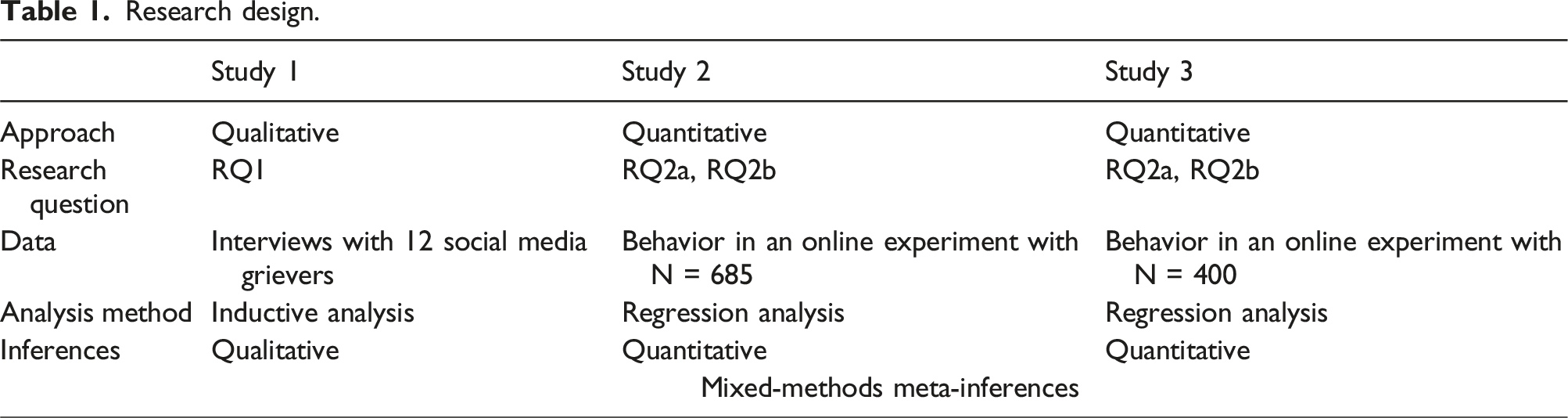
We used a sequential quantitative-dominant mixed-methods approach with three studies (Venkatesh et al., 2013; Venkatesh et al., 2016). The mixed-method design provides three specific benefits: 1) The ability to “address exploratory and confirmatory research questions,” 2) to “provide stronger inferences than a single method,” and 3) to “produce a greater assortment of divergent and/or complementary views” (Venkatesh et al., 2016., p. 437). Upon request, we are happy to provide details on our compliance with mixed-methods criteria.
Research design.
Study 1—Qualitative analysis of interview data
Method
We conducted a series of one-on-one semi-structured interviews with individuals who had shared their grief on social media. These interviews each comprised 10 questions, their dual purpose being to take full account of the expectations of social media grievers and at the same time evaluate the importance, accessibility, and suitability of this research project with regard to the practical impact of our research (Rosemann and Vessey, 2008). Having recruited our initial participants via personal networks, we continued with snowball sampling. This did produce a somewhat unrepresentative sample, but it is a well-established research method in the context of online grieving (e.g., Brubaker et al., 2013; Moore et al., 2019, Hayden and Dunne, 2020) because it informs a study of the first-hand accounts of individuals who are otherwise difficult to reach (Heckathorn, 1997).
Prior to each interview, we provided a clear description of the project and its purpose. We informed each participant that the interview was subject to video recording, audio recording, or note-taking, all of which would aid us in using the anonymized content as part of a research project we would later present and publish. We clarified the voluntary nature of participation and reassured all of the participants ahead of their interviews that, should they require professional help, we would refer them to our contacts at grief counseling centers. All interviewers were well-versed in conducting interviews on subjects as sensitive as the grief process (e.g., Crawford, 1997; Patton, 2002; Saunders et al., 2009). All participants completed their interviews without incident.
We conducted 12 interviews (6 with men, 6 with women), each of which lasted between 15 and 60 minutes (6.41 hours in aggregate). The age of the interviewees ranged from 21 to 58 years (mean = 35.58, SD = 13.73). Because they resided in either Germany, Austria, or Switzerland, we conducted all interviews in German and then translated them. Due to social distancing measures necessitated by COVID-19, we conducted all interviews in the form of audio-based or video-based computer-mediated communication. Depending on the preference of the individual interviewee, we recorded and transcribed (4) the interview or took field notes (8) for subsequent analysis.
Data analysis and results
After an inductive analysis of the interview transcripts and field notes, we performed a thematic analysis in line with Braun and Clarke (2006) and Nowell et al. (2017) to provide a detailed description of our results. Coding was done in accordance with our interview guide. This allowed us to review and refine the initial codes through various iterations until three relevant themes emerged: (1) how social media users reacted to interviewees' grief posts, (2) how interviewees expected others to react, and (3) how interviewees expect social media providers to do their part in making more social media users react in more helpful ways.
Qualitative inferences
Interview quotes supporting the applicability check.
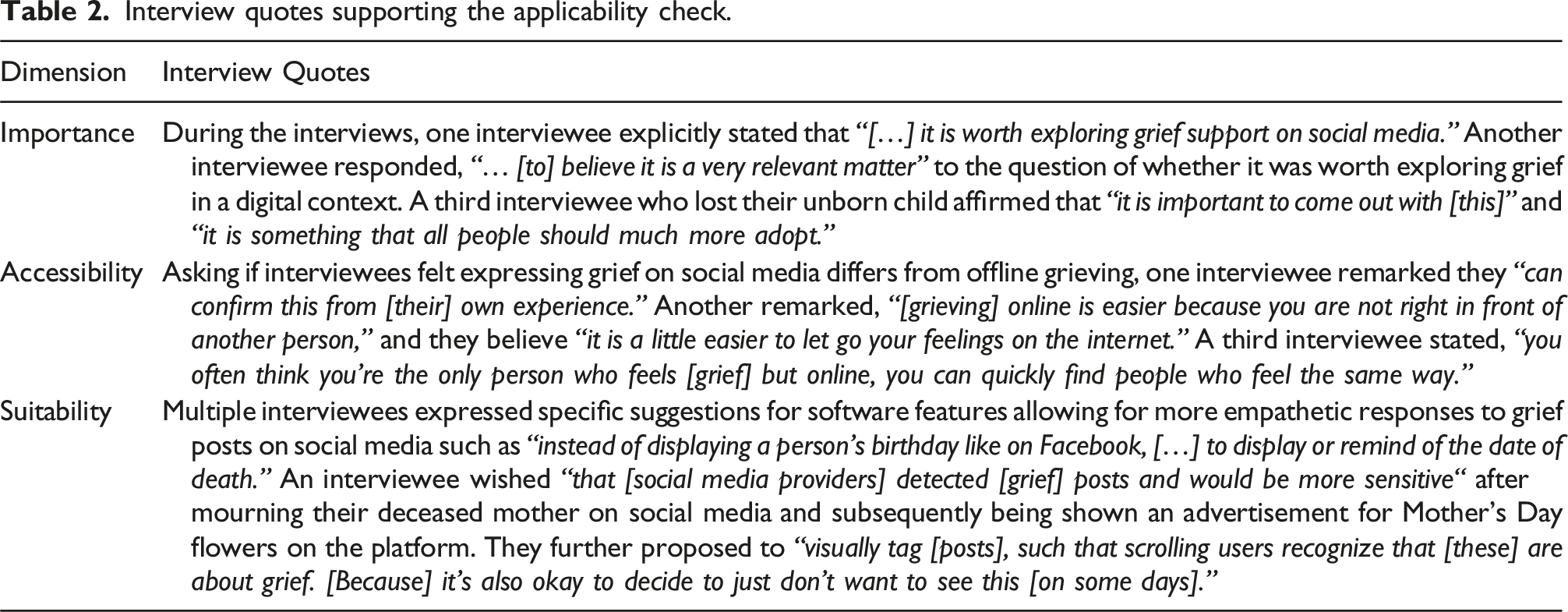
In response to RQ1, the interviewees indicated that more personal reactions to grief posts helped them more than an increase in the number of reactions. Hypotheses H1 to H3 do not account for differences between the channels chosen by social media users when reacting to a grief post, so these hypotheses could not take into account whether the bereaved felt better for having sympathy expressed via an impersonal channel such as liking a grief post or a personal channel such as sending a direct message. Our qualitative study, however, indicated that this choice of channel is of notable significance to the bereaved, which is why we formulated an additional hypothesis. The theoretical reasoning underlying this additional hypothesis follows the reasoning presented above for H1 to H3. SNs refer to beliefs about what constitutes appropriate and typical behavior in social situations. Such beliefs can encompass a wide range of grief responses as well as the channel one ought to use in a particular context, such as a social media platform where one can choose to like a post, write a comment, or send a personal message. As prior research has indicated, however, social media users do not easily follow the social code of conduct, such as showing compassion in the case of death (Wagner, 2018). Most notably, personalized comments tend to be very rare (Klastrup, 2015). On the assumption that injunctive and descriptive SN messages can facilitate more helpful expressions of sympathy when these SN messages are tailored toward the specific form that a grief response ought to take, our additional hypothesis reads:
The presence of an injunctive and descriptive SN message increases the likelihood of users expressing sympathy
Study 2—Quantitative analysis of experimental data
Participants and procedures
From April to May 2021, we ran an online experiment with US social media users recruited from a professional research panel. Prior to data collection, we pre-registered the hypotheses, experimental design, and statistical analyses (Bogert et al., 2021; Gelman and Loken, 2013). The pre-registration is available at https://aspredicted.org/blind.php?x=wx3sh4. Since material made available online might not engage every participant, we implemented an attention check, sometimes referred to as an “instructional manipulation check” (IMC) (Oppenheimer et al., 2009). It required participants to select a response that was not the obvious choice. Specifically, we asked the question “which social media do you actively use?”, then asked a follow-up question with answer options suggesting we were asking about the frequency of social media use. However, a somewhat counter-intuitive option (i.e., “rarely to never”) had to be checked, as explained in the text accompanying the question. Out of 1949 participants, 33% passed the attention check, which resulted in a sample of 658 US social media users (∼55% female, ∼38 years average age with SD of 14.6). These users were subject to randomization and further data analysis. Appendix A (Table A1) details sample demographics.
For the purpose of this experiment, we presented the participants with a news feed similar to Instagram because most of the interviewees from Study 1 had used this social media platform for their grief posts. As on Instagram, participants could react to posts in the form of a like, a comment, or a private message to the post’s author. We did not provide an incentive to engage with these posts, that is, no payment was provided for any form of engagement, nor for a minimum number of reactions.
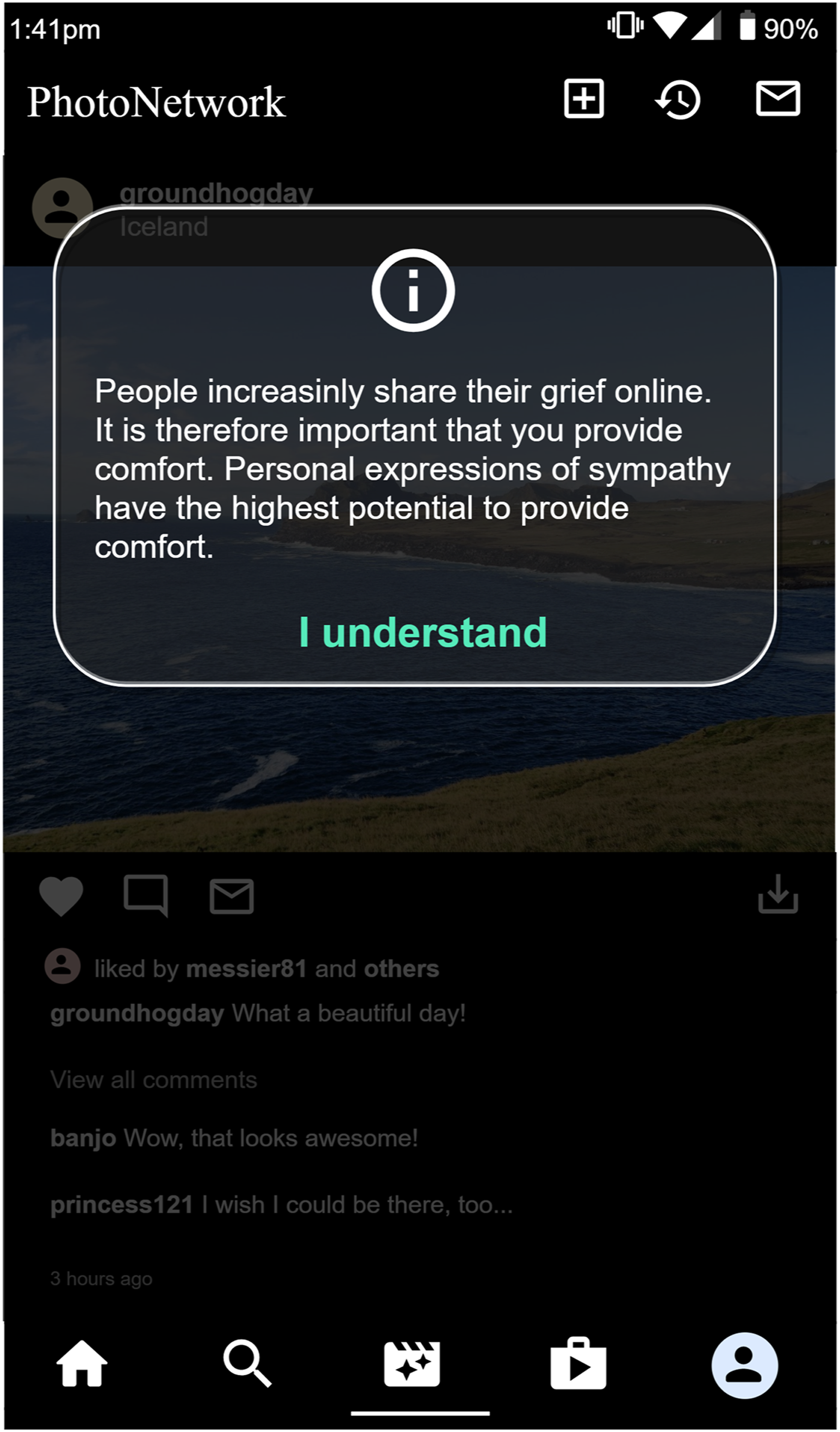
The feed comprised nine randomized posts. Six posts were “typical” social media posts to create a realistic environment. The other three posts showed a variety of grief content reflected in the interviews: the loss of a spouse, the loss of an unborn child, and the loss of a different loved one. The experiment comprised four treatments: 1) The control treatment had no SN messages in the feed. 2) The injunctive treatment had only one injunctive SN message displayed at the beginning of the feed. This SN message was derived from the interviews and read, “People increasingly share their grief online. It is, therefore, important that you provide comfort. Personal expressions of sympathy have the highest potential to provide comfort.” Participants had to confirm that they had read the injunctive SN message before proceeding to the newsfeed. We presented the SN message as the focus of attention (Cialdini et al., 1991). 3) The descriptive treatment had a descriptive SN message on each grief post, indicating how many users had already expressed sympathy. The descriptive SN listed all channels available for expressions of sympathy, that is, pressing the heart icon, commenting, or sending a direct message. We used a three-level within-participant approach to vary the strength of the descriptive SN, without reducing credibility (i.e., 3, 14, and 33). We assigned the strength of the descriptive SN to a given post at random. 4) Finally, the combined treatment used injunctive as well as descriptive SN messages (operationalized as described above).
We assigned these treatments to the participants at random, which resulted in each treatment being experienced by between 151 and 175 participants (see Appendix A for details). Figures 1 and 2 show the implementations of descriptive and injunctive SN messages. The supplementary material offers screenshots of the survey used for Study 2.
3
Descriptive social norm messages in Study 2 (displayed with three different exemplary grief posts). Injunctive social norm message in Study 2 (displayed once on top of the social media feed).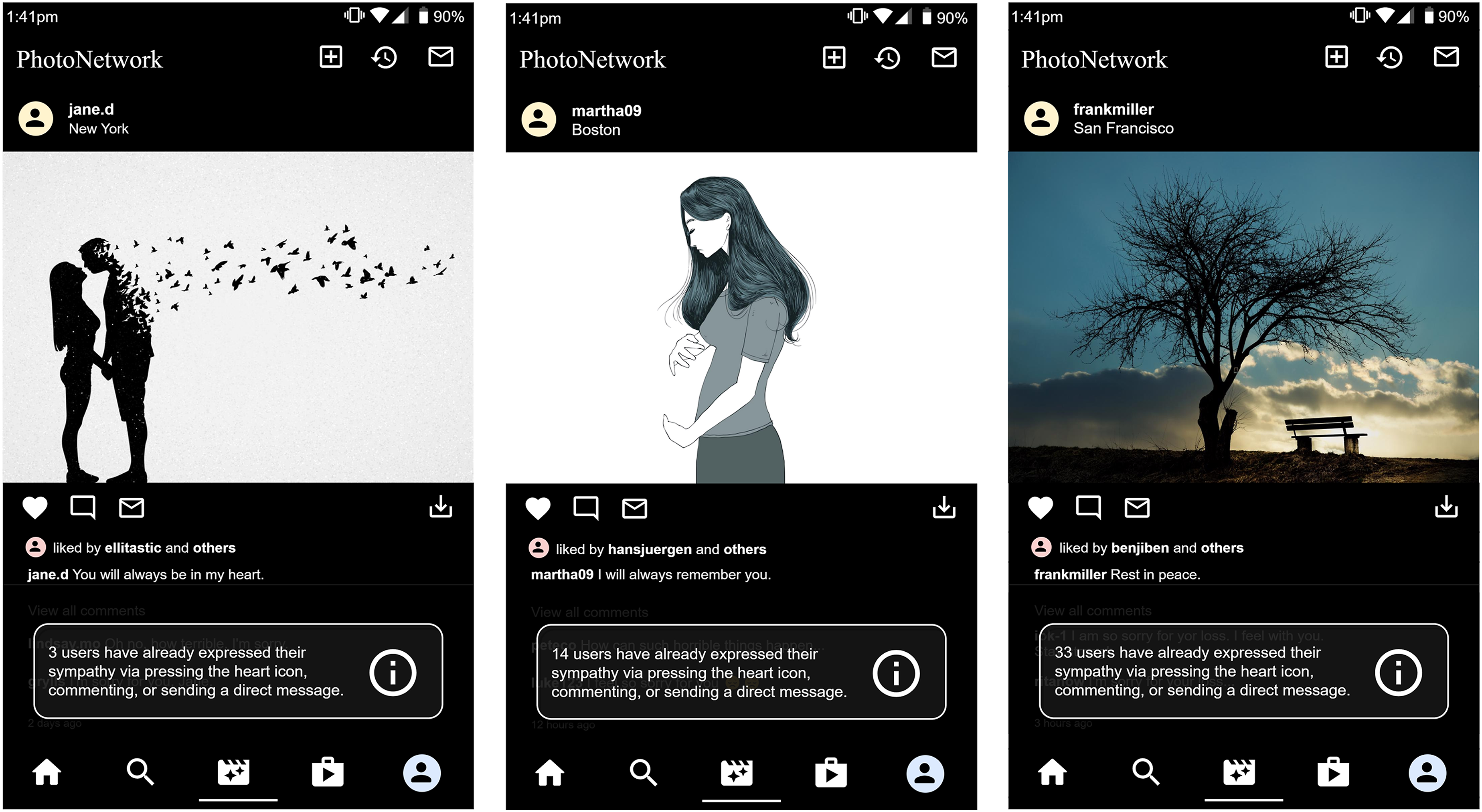
To be effective, SNs must not only be perceived as appropriate and credible (Croson et al., 2009). They must also be presented as the focus of attention (Cialdini et al., 1991). With this in mind, we made sure that the SN messages did not appear in the form of instructions that the test subjects might habitually ignore. Instead, they were presented as part of the social media news feed. This methodological decision was predicated on the work of Gimpel et al. (2021) since they successfully implemented SN messages in the context of fake news on social media.
Measures
Upon discovering that the interviewees had hoped for more reactions and personal expressions of sympathy, we measured two dependent variables in how a social media user behaved: first, we measured the reaction to a grief post, which has the binary outcome 1 = yes or 0 = no. Second, we measured the channel used for expressions of sympathy. The variable channel is ordinal, whereby “no reaction” = 1, sending likes (i.e., pressing the “heart button” in the Instagram-inspired interface) = 2, commenting = 3, and writing a personal message = 4. If a participant chose more than one channel to express sympathy, we used the most personal one in our analysis.
Our independent categorical variable “social norm” refers to the following four treatments: control, descriptive, injunctive, and combined. We also ran analytics for demographic variables, such as age, gender, and education. Furthermore, we asked participants about their social media activity, including the frequency of social media use, the number of interactions with social media posts, for example, in the form of likes or comments, and whether participants had ever reached out to the author of a post via a personal message.
Analysis and results
Binomial logistic regression results on social media users’ reaction to a grief post.
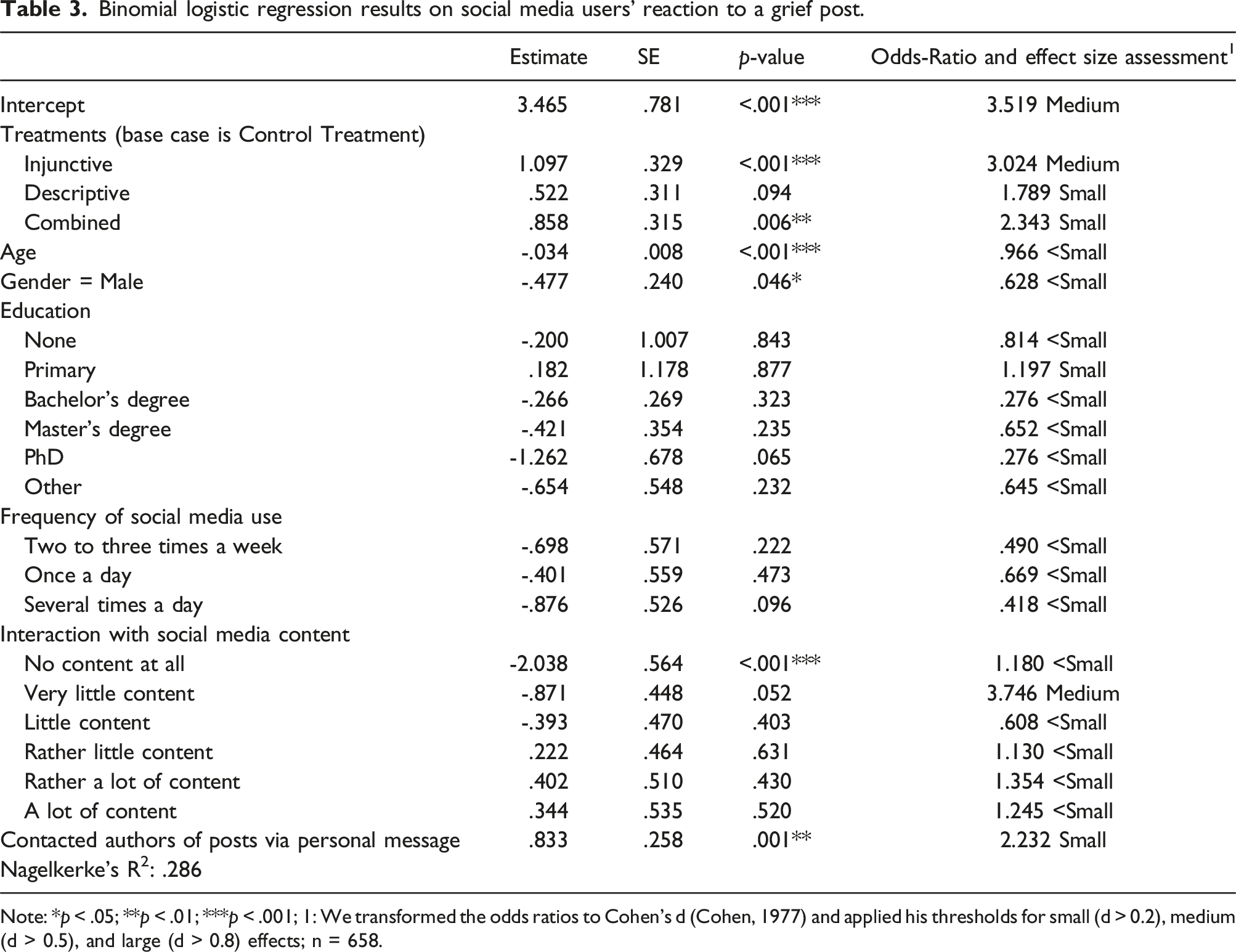
Note: *p < .05; **p < .01; ***p < .001; 1: We transformed the odds ratios to Cohen’s d (Cohen, 1977) and applied his thresholds for small (d > 0.2), medium (d > 0.5), and large (d > 0.8) effects; n = 658.
The test revealed a significant positive impact of injunctive SNs, which supports H1. Compared to the control treatment, the odds of social media users expressing sympathy tripled (odds = 3.024). Descriptive SNs also had a positive impact on sympathy expression, but only on a 10% significance level, which does not constitute satisfactory empirical support of H2.
Combined SNs were found to have a significant positive impact on sympathy expressions as they more than doubled the odds (odds = 2.343) compared to when no SN message was provided. H3 held that combining both norms would have a greater impact than either norm individually. On the contrary, however, our analysis shows that the impact of the combined SN messages is numerically lower than that of the injunctive SN message alone. It is worth noting, though, that a “re-base” indicated the difference to be statistically insignificant as it showed a less than small effect size (p = .487 and odds = .787 when considering the injunctive treatment as the base case, see Appendix B).
Binomial logistic regression results on the likelihood of a user expressing sympathy based on the strength of the descriptive social norms for the descriptive treatment.
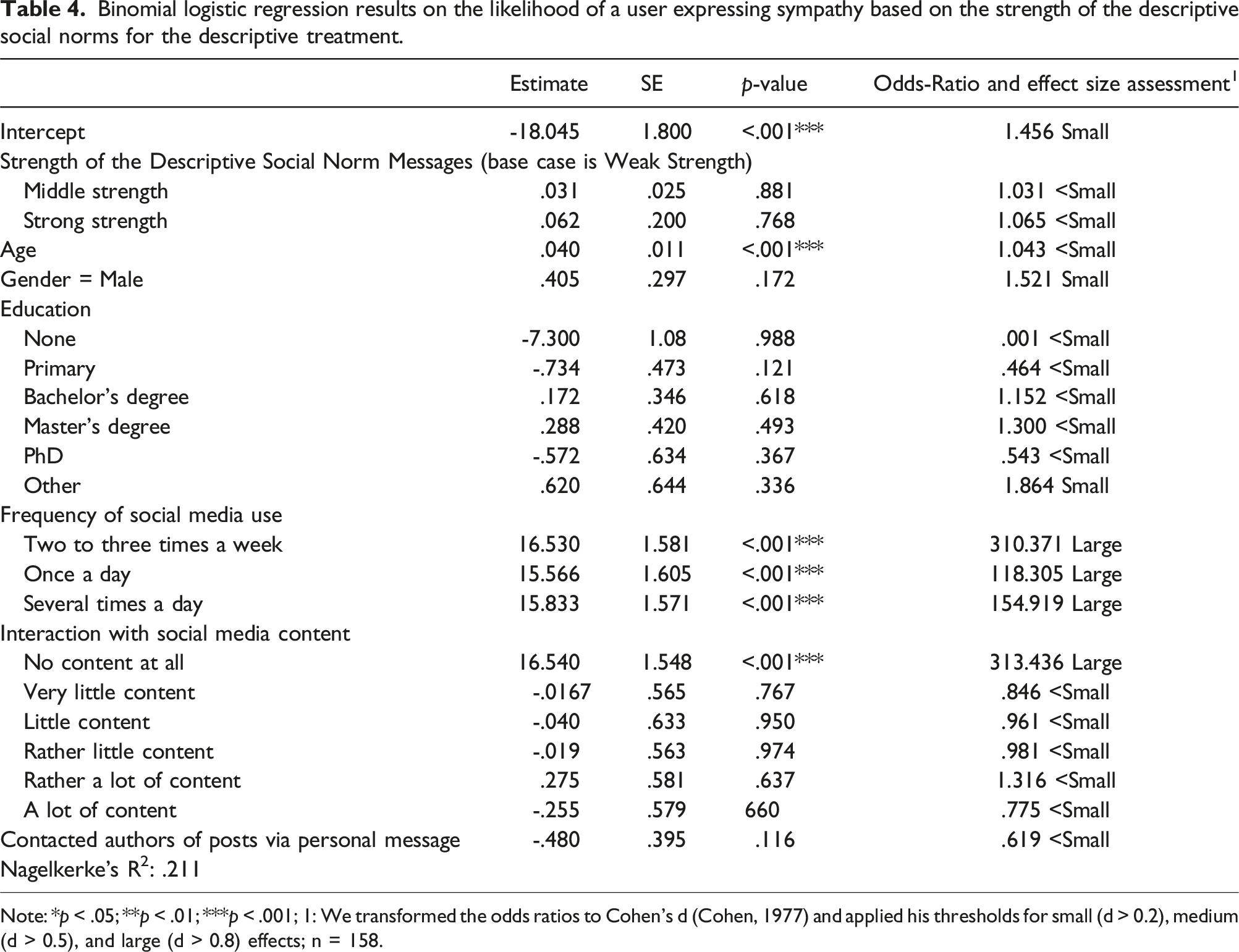
Note: *p < .05; **p < .01; ***p < .001; 1: We transformed the odds ratios to Cohen’s d (Cohen, 1977) and applied his thresholds for small (d > 0.2), medium (d > 0.5), and large (d > 0.8) effects; n = 158.
Ordered logistic regression results on the channel used to express sympathy in response to a grief post.
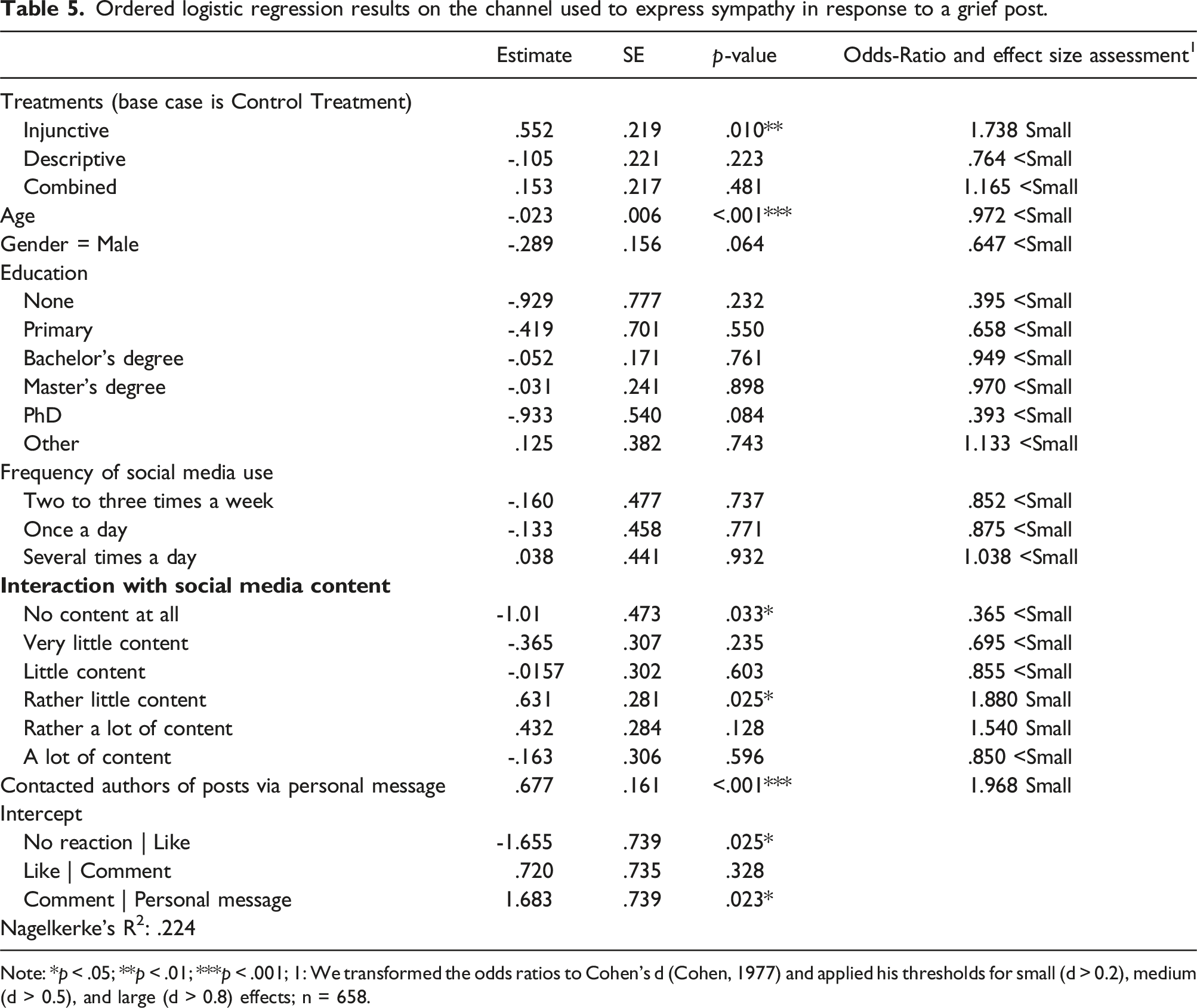
Note: *p < .05; **p < .01; ***p < .001; 1: We transformed the odds ratios to Cohen’s d (Cohen, 1977) and applied his thresholds for small (d > 0.2), medium (d > 0.5), and large (d > 0.8) effects; n = 658.
In summary, Study 2 indicates that injunctive SN messages have the hypothesized impact in that they incline social media users towards expressions of sympathy when people in their social media networks grieve on these platforms. An injunctive SN message increases the likelihood that sympathy will be expressed (H1) and that this will be done through a more personal channel (H5). After Study 1 suggested both of these to be desired effects, Study 2 does not support the hypothesis that descriptive SN messages alone can produce this effect (H2) or be combined with injunctive SN messages for greater effect (H3, H4). The fact that the study found support for only one type of SN message came as a surprise, so we assimilated our findings into two post-hoc analyses.
First, we ran a mixed-effects model as we have multiple observations (from different grief posts) for each participant. Specifically, we examine if the results still hold when having the treatment and the covariates as fixed and the three different grief posts as random effects. Appendix D summarizes the results that reveal a significant impact of injunctive SNs on users’ reactions to grief posts (as above). Different from the analysis above, the mixed-effects model also suggests a significant impact of descriptive SNs and combined SNs on users’ reactions to grief posts. Second, we tested the generalized linear model (logit) for the three grief posts separately. The results show that descriptive SN messages only significantly impact the reaction to one of the three grief posts, namely, the general loss of a loved one (p=.049). The reaction to the remaining two grief posts is not affected by descriptive SN messages (i.e., the loss of a spouse p = 0.256 and the loss of an unborn child p = 0.175). It might be that not finding support for H2, H3, and H4 is an artifact from the design of the SN messages and the grief posts in our experiment. Thus, we follow up with a further experiment. This new experiment aims at implementing descriptive SN messages so that their effectiveness does not change with the type of grief post.
Study 3—Deepened quantitative analysis of experimental data
The purpose of Study 3 was to test the main effect of injunctive and descriptive SN messages (H1, H2, and H5) with a more salient design of descriptive SN messages and a similar display of both SN messages in the newsfeed (i.e., below each grief post). Because we focused on the main effect, we repeated the injunctive and descriptive experimental treatments and deliberately did not test for H3 and H4 (which both refer to the combined treatment).
Participants and procedures
Similar to Study 2, Study 3 is an online experiment that was pre-registered (see https://aspredicted.org/R39_ZQK) (Bogert et al., 2021; Gelman and Loken, 2013). We recruited 612 participants from another professional research panel in January 2022, 65 percent of which passed the attention check, which resulted in a sample size of 400 US social media users (∼50% female, ∼35 years average age with SD of 11.6). This sample was subject to randomization and further analysis. Appendix A (Table A2) provides details on sample demographics. Study 3 comprised two treatments, randomly assigned to the participants, the result being that 200 participants got to experience each treatment: 1) The injunctive treatment meant that only one injunctive SN was displayed. Contrary to Study 2, injunctive SN messages were not manipulated via a pop-up window at the top of the social media feed but integrated into the newsfeed and displayed below grief posts. 2) The descriptive treatment meant that a descriptive SN on each grief post indicated how many users had already expressed sympathy. As in Study 2, we used a three-level within-participant approach to vary the strength of the descriptive SN, without reducing credibility. Contrary to Study 2, however, we made the descriptive SN messages more salient to test for differences across strength levels. We displayed the number of people who have already expressed their compassion in a bold and larger font and increased the differences between strengths (i.e., 3, 140, and 330 instead of 3, 14, and 33 as in Study 2). Additionally, the descriptive SN message was formulated similarly to the injunctive SN by stating the number of people who had “already shared personal expression of sympathy.” Details are provided in Figures 3 and 4. Descriptive social norm messages in Study 3 (displayed with three different exemplary grief posts). Injunctive social norm message in Study 3 (displayed with three different exemplary grief posts).
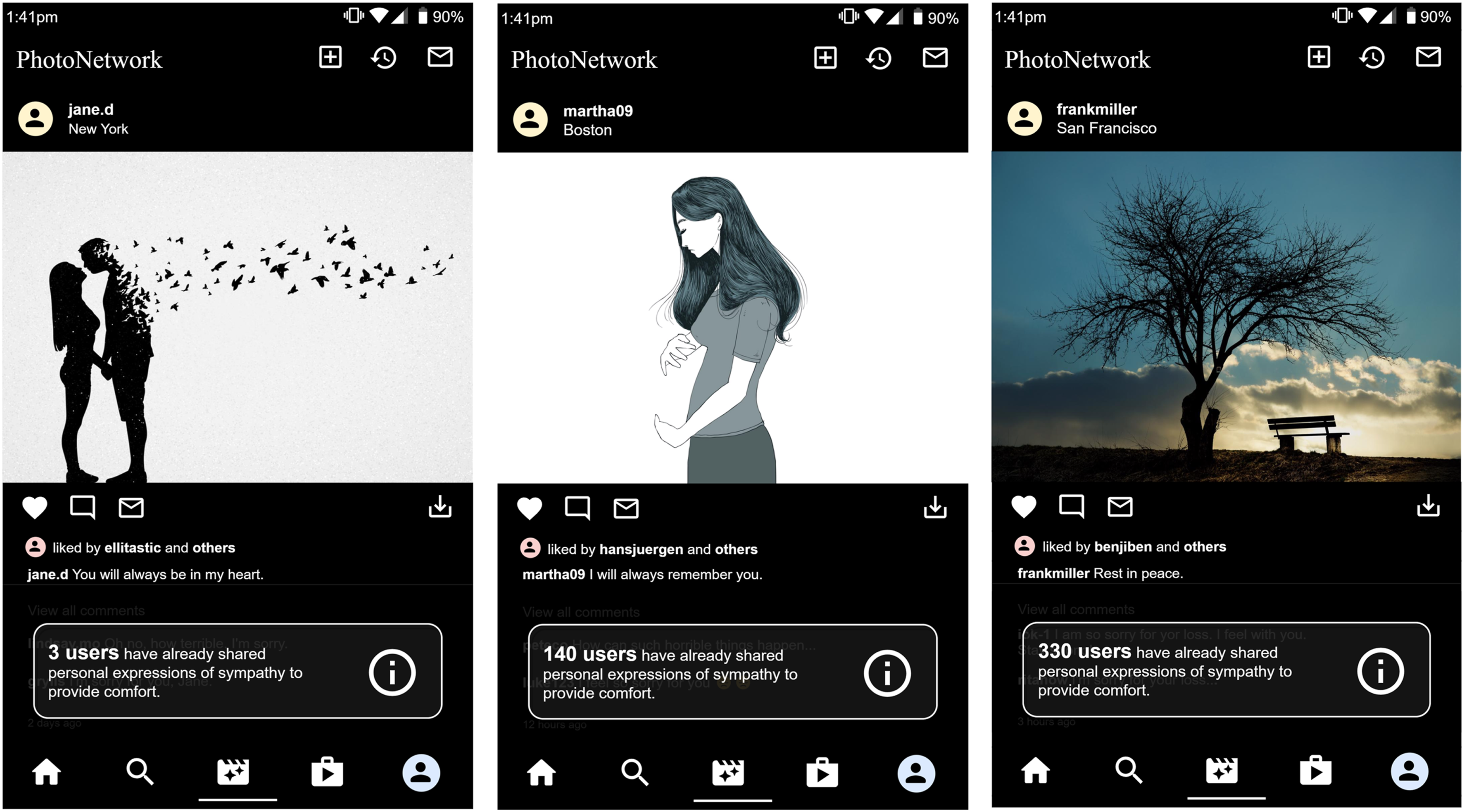
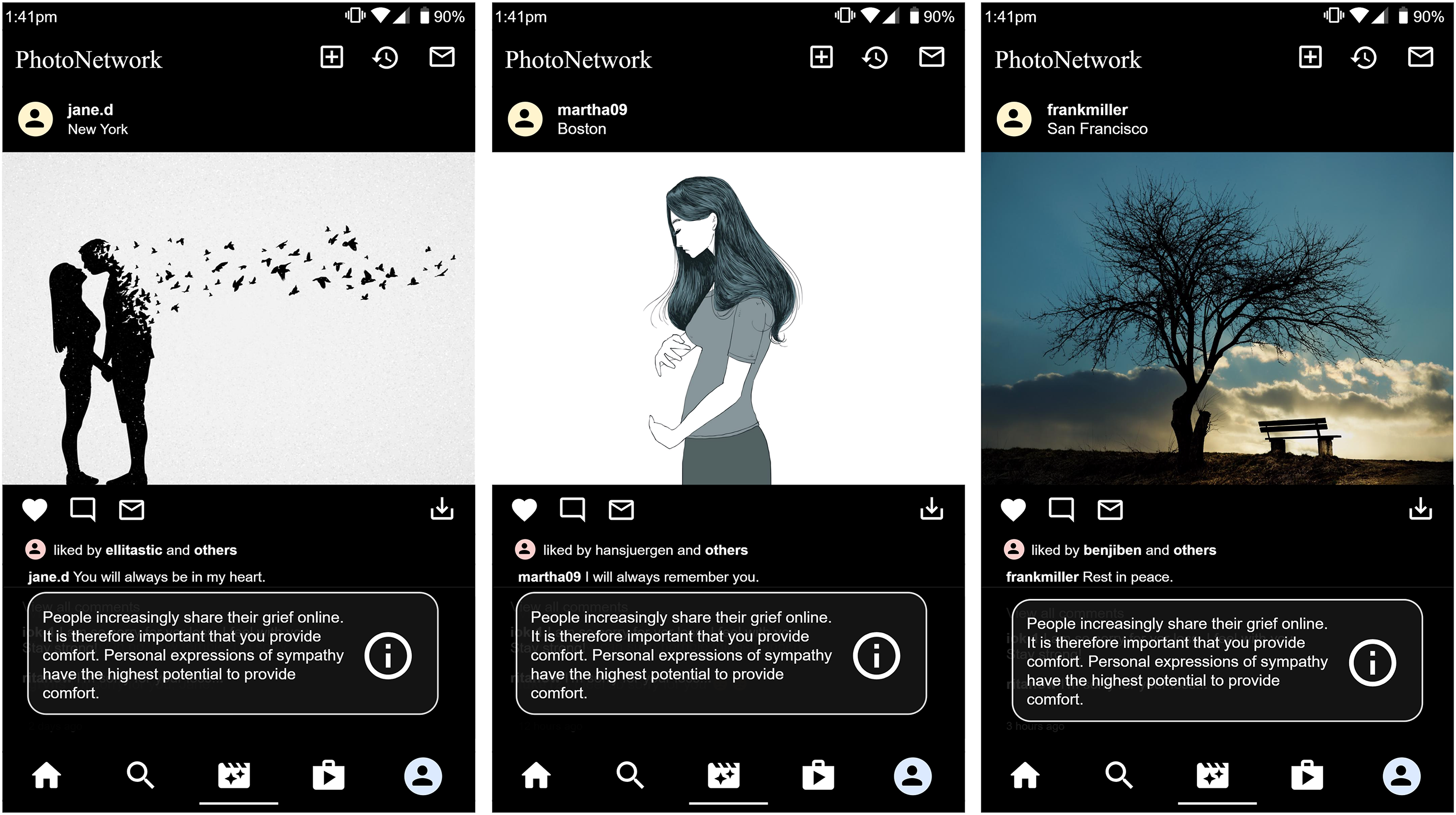
After the treatments, we ran an additional manipulation check to test whether a participant had experienced the intended effect of the assigned treatment (Hauser et al., 2018). We presented the participants with a multiple-choice question, asking them to select aspects they had noticed in the newsfeed. The online supplementary material details screenshots of Study 3. 4
Out of 400 participants, 363 (89.5% in the injunctive and 91.5% in the descriptive treatment) passed the manipulation check. To analyze the treatment effect, we conducted an intention-to-treat (ITT) analysis. The ITT analysis includes every randomly assigned participant and ignores anything after randomization. This approach maintains a prognostic balance and is not prone to over-estimation bias (Hollis and Campbell, 1999; Gupta, 2011; Shah, 2011). To provide further analysis, we ran the same statistics as reported below, but only with data pertaining to the participants who passed the manipulation check. As summarized in Appendix E, all results are substantially identical.
Measures
The measures used in Study 3 were identical to those in Study 2, with the exception that the independent categorical variable “social norm” refers to two (i.e., injunctive and descriptive) instead of four treatments.
Analysis and results
Binomial logistic regression results on social media users’ reaction to a grief post in Study 3.
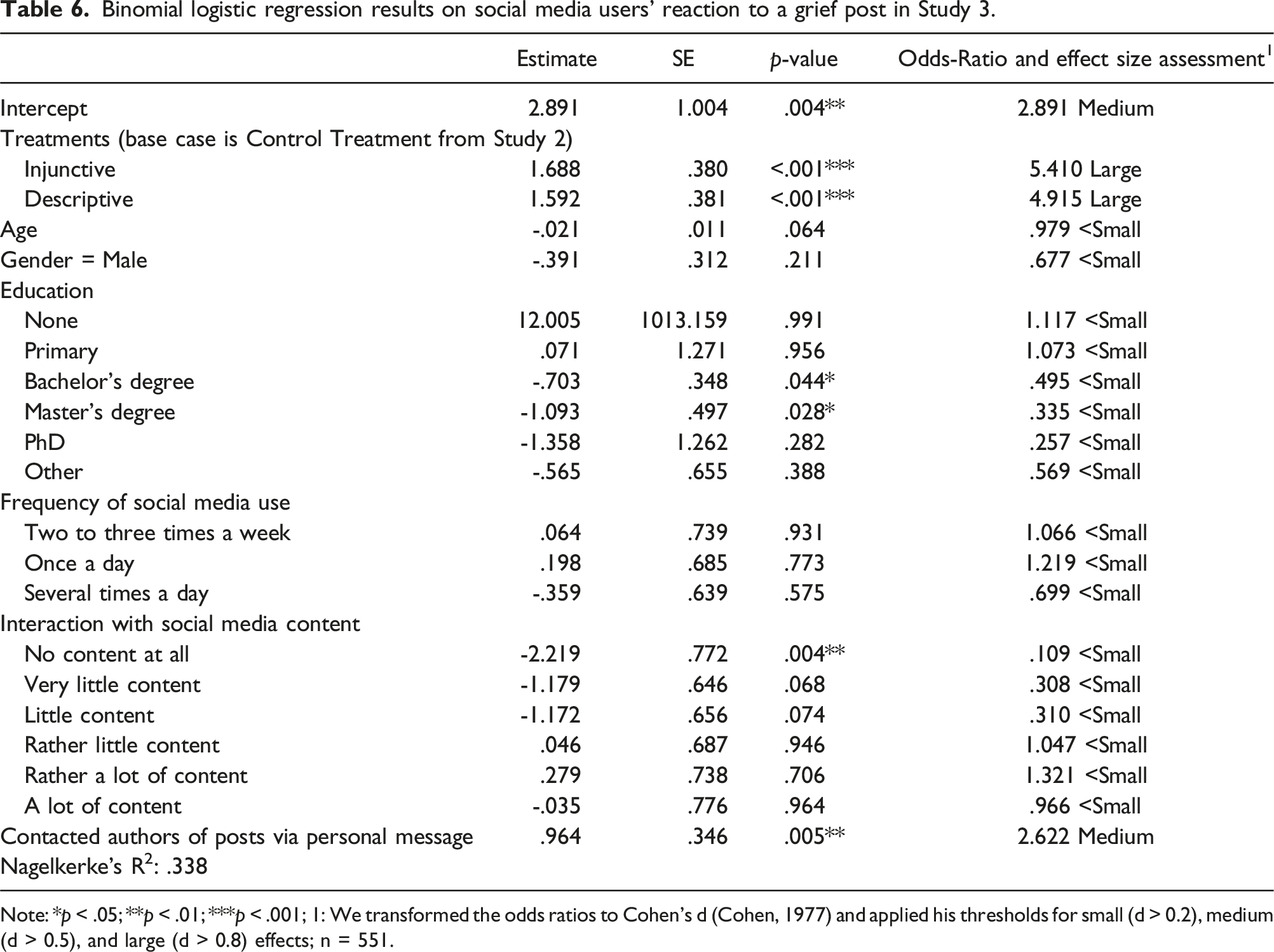
Note: *p < .05; **p < .01; ***p < .001; 1: We transformed the odds ratios to Cohen’s d (Cohen, 1977) and applied his thresholds for small (d > 0.2), medium (d > 0.5), and large (d > 0.8) effects; n = 551.
Contrary to Study 2, however, Study 3 revealed that this significant positive impact can also be produced by descriptive SNs. Compared to the control treatment, the odds of social media users expressing sympathy nearly quintupled (odds = 4.915), which is in line with H2.
Ordered logistic regression results on the channel used to express sympathy in response to a grief post.
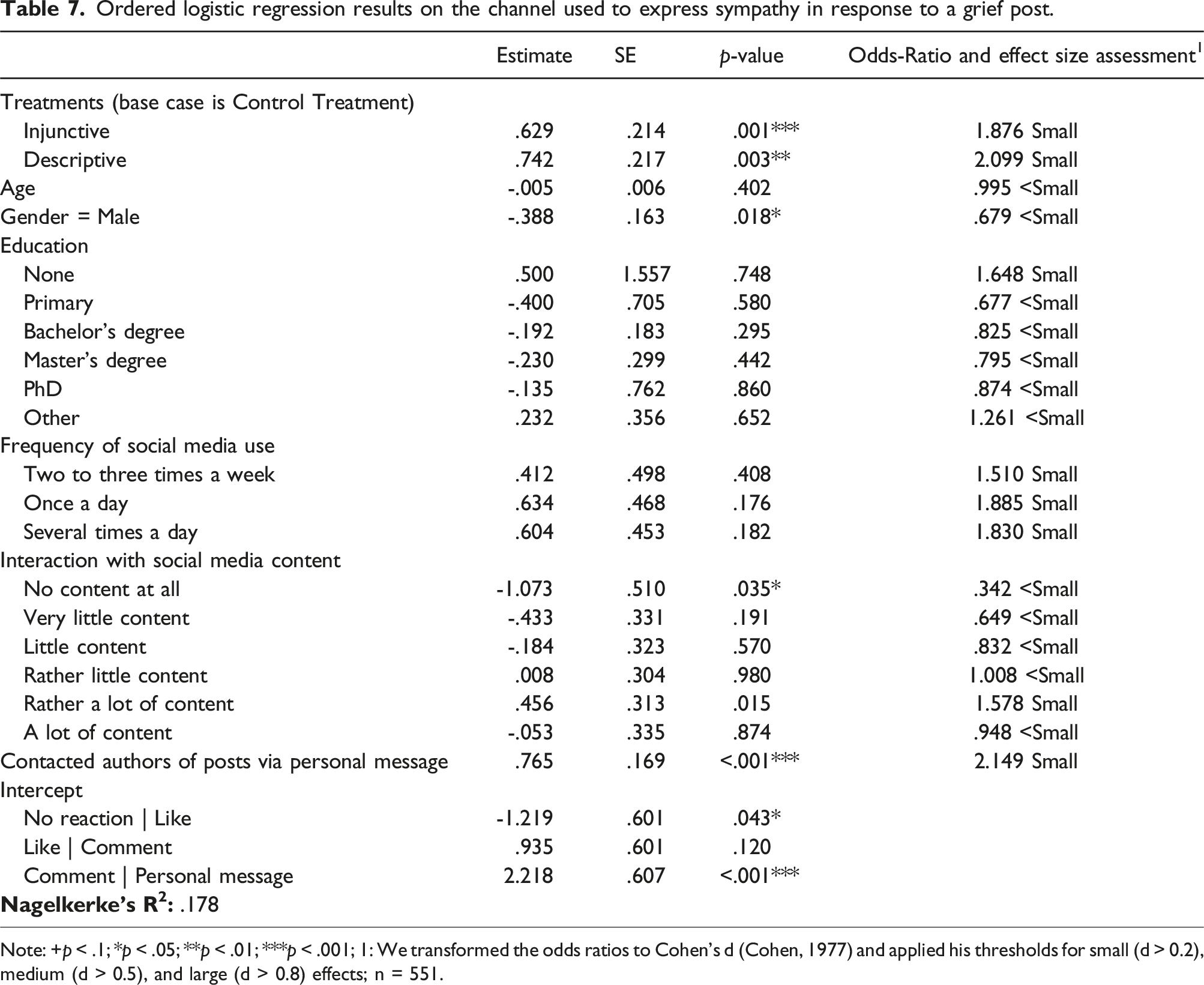
Note: +p < .1; *p < .05; **p < .01; ***p < .001; 1: We transformed the odds ratios to Cohen’s d (Cohen, 1977) and applied his thresholds for small (d > 0.2), medium (d > 0.5), and large (d > 0.8) effects; n = 551.
Discussion
All of us will die. Some of us will have our deaths mourned by our loved ones. And some of those bereaved will do so on social media, where many of them typically expect to find comfort. But how may social media platforms support the bereaved by using SN messages to guide other platform users in how to provide comfort? We conducted a mixed-methods approach to find answers.
The qualitative part of our study focused on the measures that social media grievers expected social media users and providers to take in order to ease their grief (RQ1). We conducted 12 semi-structured interviews with people who had mourned through social media, and we chose this methodology for two reasons: one, because it allowed us to gain relevant insights into first-hand experiences, and two, because it served as an applicability check with a view to our research endeavor. Three insights were of key significance: first, interviewees would have hoped for more reactions to their grief posts. Second, they preferred reactions submitted via more personal channels, such as direct messages, private phone calls, or even hand-written letters. Third, they made thoughtful suggestions for functionalities that could endow social media with greater empathy, such as improvements to the sensitivity of advertising and considerations of injunctive SNs.
The qualitative insights presented in these pages confirm previous research on the motivations behind social media grieving (e.g., Moyer and Enck, 2020; Willis and Ferrucci, 2017; Varga and Varga, 2021; Murrell et al., 2021; Robinson and Pond, 2019). Going beyond those familiar motivations, remembrance perhaps being the most notable and obvious (Robinson and Pond, 2019), one of our interviewees revealed an expectation to feel relieved upon sharing their grief. This is in line with current research on self-disclosure via social media and its positive impact on mental well-being (Luo and Hancock, 2020). It is to this discourse that our research here speaks by giving a voice to those who grieve through social media and hearing how they expect the providers and users of such platforms to comfort the bereaved.
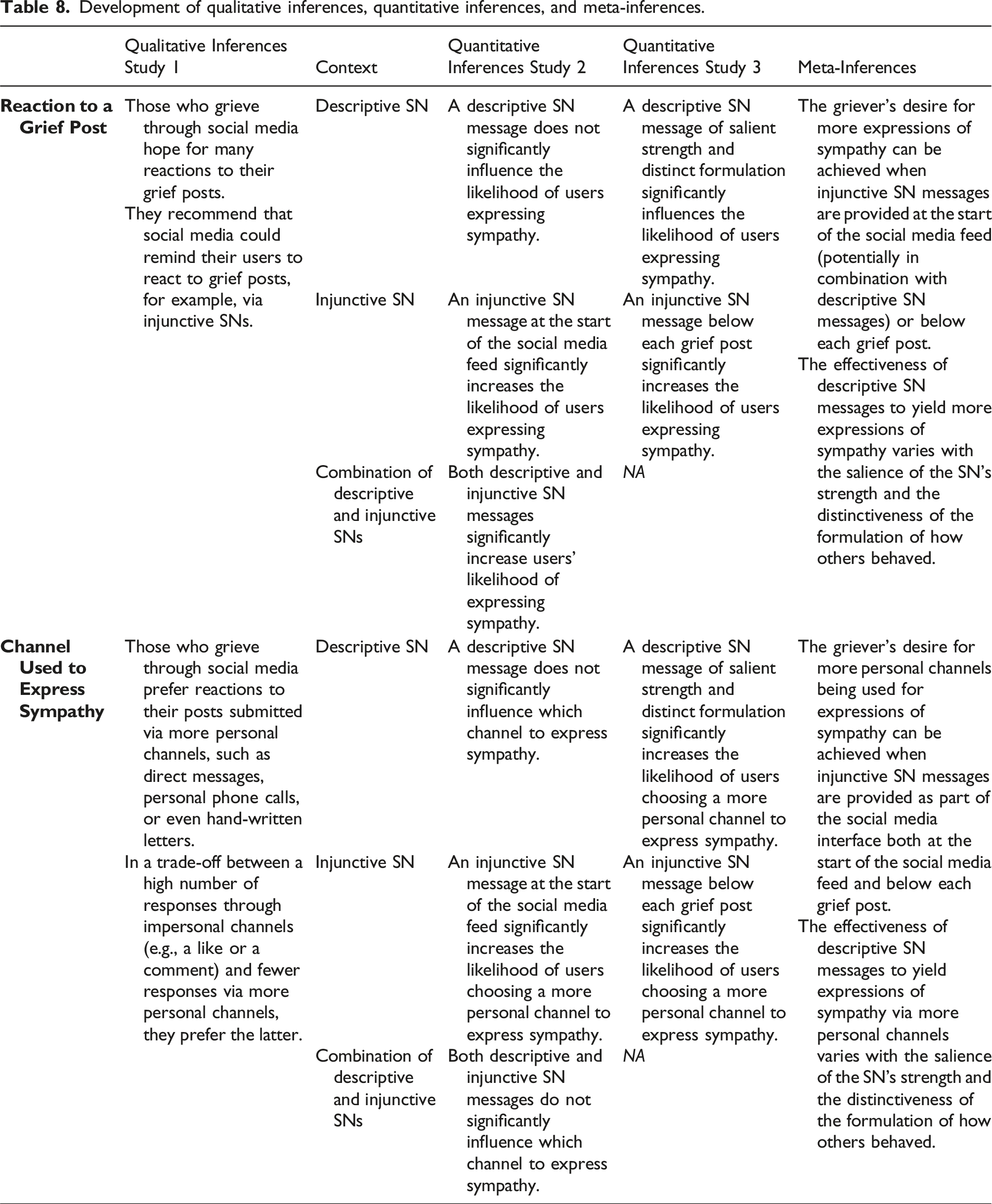
Development of qualitative inferences, quantitative inferences, and meta-inferences.
Limitations
The semi-structured interview method has limitations, such as the risk of impacting answers (Denscombe, 2007). We attempted to mitigate this risk by making the interviewer assume the roles of “friendly stranger” and “sympathetic listener” (Cotterill, 1992).
In our quantitative analyses, the participants had no personal relationship with the people who posted or were supposed to be deceased. Conceivably, then, this lack of familiarity might have placed a limitation on our study in that it might have reduced a participant’s willingness to express their condolences. It is also conceivable, however, that it might have made the context of the study feel more realistic, given that many people are lost for words when bereavement befalls a loved one. We reviewed the content of the direct messages to test whether someone had consciously participated in the online experiment (e.g., “so sorry for your loss”; “Sending you strength and light. I am here for you!”). We did not, however, include comments and direct messages in our further investigation. Suffice it to say here that their potential to bring comfort to the bereaved would make them a worthy subject for future research.
For the purpose of this project, we used the control group of Study 2 to analyze Study 3. To assess the comparability of the sub-samples, we tested for differences alongside the samples’ demographic variables. Results are detailed in Appendix A, Tables A3 and A4, and show that although some significant differences exist, they are all small or less than small according to established thresholds. Further, most of the demographic characteristics that show a difference have a less than small effect on reactions to grief posts in our regression analyses. Hence, we suggest that the differences between the control group and the treatments in Study 3 are indeed a causal effect of the treatments.
Further, we used two professional research panels to collect data for our quantitative studies. We needed a second provider for Study 3 as the provider of Study 2 could not guarantee to recruit enough participants within a dedicated time frame. In principle, it is possible that a participant was registered in both panels and, thus, participated in studies 2 and 3. However, as there were more than six months between the two studies, we recruited participants via different panel providers and each panel provider has only sent the invitation to a random subset of their panelists, we consider double participations quite unlikely.
Another point worth noting, this one with regard to a conventional limitation of our study, is that its sample size limits the extent to which one can draw conclusions of general validity based on its results. The experiment was not designed to vary the newsfeed appearance. Instead, it was made to resemble Instagram. Nor did we vary the presentation format of the SN messages. Conceivably, such variations in presentation and wording might further increase the effectiveness of SN messages.
Finally, we did not conduct an empirical investigation of how expressions of sympathy on social media affect the grief process. Since the topic is still evolving, the literature on the matter is scarce. It certainly promises to be a worthy future research project to take a closer look at the empirical evidence on how SN messages impact the well-being of the bereaved in the long term.
Implications for theory and research
The results of this study contribute to the greater understanding of two current concerns: the differences between how people grieve in online and offline contexts, and the applicability of SN theory in social media environments.
With regard to the first concern, our qualitative findings pinpoint specifities of online grieving. What primarily motivated our interviewees to express their grief through social media was the opportunity to inform others of their loss and show their social network that they were in a state of grief. Our interviewees did this at various times, ranging from hours to years after the bereavement. This differs from offline traditions, such as placing obituaries in newspapers or informing family and close friends over the telephone, both of which are typically measures taken shortly after someone has passed. It is worth pointing out that traditional (offline) grieving theories like the Kübler-Ross model (1969) do not incorporate such a strong wish to inform others, so this ‘wish’ may require an extension of the grieving model in a social media context. Due to the variability in time, we believe there to be no comfortable fit for this “wish” anywhere within traditional grieving models. Instead, grieving on social media affords an optional and temporally flexible extension to traditional grief processes. However, we require more (grounded) theory approaches (e.g., Wiesche et al., 2017) to examine the design and dynamics of a complete grief model that includes the sharing of grief through social media. Further systematic research is required to examine whether offline and online grieving are separate phenomena or constitute a new phenomenon, an inseparable hybrid grief process of sorts.
With regard to the second concern, our quantitative findings are twofold, contributing to both SN theory and design science research (DSR). Our results point to injunctive SNs reliably prompting expressions of sympathy. This supports the theory that an injunctive SN can be used to direct individual behavior in various contexts (Park and Smith, 2007; Baumgartner et al., 2011). It further provides theoretical and indeed empirical proof of the effectiveness of injunctive SNs in unfamiliar but socially desirable contexts, such as reactions to grief posts. Recently, Gimpel et al. (2021) investigated SN theory in social media environments and found injunctive SN messages to be more effective than descriptive SN messages. Our findings now lend further credence to the superiority of injunctive SN messages as a means of fostering desirable user behavior in social media contexts. Using an injunctive SN is even more effective in guiding social media users toward expressions of sympathy than the combination of descriptive and injunctive SNs, even though the difference is not statistically significant. At first glance, this finding is counterintuitive. One might expect that providing individuals with more social norms reinforces the corresponding action. However, an enriched information base has an unfortunate flipside, a phenomenon called “information overload.” Accordingly, an individual’s attention and action do not see corresponding shifts (van Knippenberg et al., 2015). It follows that an abundance of information increases the risk of distracting users from the activity itself (i.e., reacting to a grief post by expressing sympathy). It is, therefore, a key challenge in the digital world to manage information and “channel it to productive ends” (van Knippenberg et al., 2015: 649). With this in mind, we call on more researchers to investigate how the interplay of various SNs in the context of online grieving can be optimized. Our research indicates that SNs have a substantial untapped potential to help social media users ease suffering, which, arguably, makes it a moral imperative that we assess and leverage them to their full potential.
Our findings further point to the importance of a salient design of descriptive SN messages. When their formulation is more distinct, they may be as effective as injunctive SNs. This is consistent with the focus theory of normative conduct (Cialdini et al., 1990), which suggests that norms are more likely to influence behavior when they are brought into focus. Achieving this result, however, would likely require further design-oriented research to discern the core design guidelines and principles. We suggest that Design Science Research (DSR, Gregor and Hevner, 2013; Hevner et al., 2004; Peffers et al., 2007) can develop the design knowledge needed to make descriptive SN messages effective in the context of social media grief. DSR—an increasingly prominent method in IS research (Gregor et al., 2020)—is a search process that yields satisfactory designs and provides prescriptive knowledge and theories to defined problems (Gregor, 2009; Gregor et al., 2020). As our results indicate, such design knowledge can help to increase the effectiveness of injunctive SN messages by placing them directly below grief posts, rather than providing a generic notice at the top of a social media feed (cf. design of injunctive SNs messages in Study 2 vs. Study 3). Another element of design knowledge refers to making descriptive SN messages more salient to increase their impact. Future DSR can build on these findings to undertake necessary empirical studies that explore the design space and conduct evaluation-driven design cycles.
Meanwhile, our mixed-methods research findings offer further contributions to the IS discipline in general, particularly to IS for resilience (e.g., Association for Information Systems, 2021; Mirbabaie et al., 2020). This research stream, for example, explores how to make recommender systems in social media more empathetic (Bonenberger et al., 2022). The findings presented in these pages have the potential to inform the design of such empathic recommender systems. As for the wider relevance of this research project, its examination of grief on social media brings attention to a current phenomenon that spans the entire social-technical continuum (Sarker et al., 2019).
Implications for practice
Our research has implications for a broad variety of stakeholders. On the evidence of these findings, we call on social media providers to “do the right thing,” as the Google parent company Alphabet enshrined in its code of conduct (Basu, 2015). While this motto was first conceived to address employee behavior, it should also guide the treatment of users, which is to say it should inform product design. Our interviews yielded recommendations as to how providers can make their users behave with greater empathy for those who use social media to process their grief. We heard that providers ought to be more sensitive in how they present advertising on their platforms. For instance, a user who has recently lost a parent should not be shown adverts for family related products or services. To ensure such sensitivity, providers could go further than filtering emotional triggers. They could develop an advertising-free business model of a social network favored by more empathetic users in the case of death events.
For the time being, a less invasive and quicker to implement recommendation is to sort posts in social media feeds with grief filters. After all, a grief post may not gain much attention let alone traction if placed between two party pictures. Another small but meaningful change proposed in the context of this study is to give users the option of responding to posts with an alternative reaction button, one more sensitive than a thumbs-up. This brings us to the most promising recommendations of our studies, and those we demonstrated in our online experiments, where we tested the potential of inserting injunctive SN messages and descriptive SNs messages into social media feeds while ensuring that those messages had both salient presentation and distinct formulation. As the experiments indicate, this type of messaging has the significant potential to increase the number of responses and make those responses more personal.
Looking beyond social media providers, our research concerns every one of their users. It ought to be a priority of the former to sensitize the latter with regard to the expectations of mourners who share their grief through social media. Our study indicates a starting point for those wishing to approach online mourners by reacting to their posts, and preferably by selecting a personal channel to do so, a prime example being the sending of a private message. In a sense, then, this study transmits its own injunctive SN to social media users.
In a final appeal, this study also addresses a third, broader demographic. Therapists, grief counselors, and other organizations that support the bereaved might use injunctive and select descriptive SNs on social media platforms to help online mourners get the desired reactions to their posts. When those qualified in mental healthcare engage with their followers through social media, they are in an influential position to communicate SNs, such as the ones we deployed in our online experiment. In doing so, they could help tip the balance of social media toward empathy. Indeed, social media could provide a therapeutic benefit for the bereaved. As things stand, there is no way of knowing for sure whether social media can mitigate the negative consequences of grief, be they related to the economy or mental health. We would suggest, however, that our study offers promising starting points for those attempting to do so.
Conclusion
Whoever has experienced the loss of a loved one understands the dark and often lonely journey of the grief process. While the bereaved struggle to comprehend the loss of a significant presence in their life, people are unsure how to talk to them. These days, however, social media offer a new way for the bereaved to be supported. The mixed-methods study presented here has investigated how best to do so. Qualitative interviews revealed that the bereaved have two key expectations: to receive multiple reactions to a grief post, and to receive them through personal channels. Our quantitative analysis revealed that injunctive SN messages are a particularly effective means of attaining both. As for the effectiveness of descriptive SN messages in this context, it was found to vary with the salience of their design and the distinctiveness of their formulation when describing the empathetic behavior of others.
Supplemental Material
Supplemental Material - The influence of social norms on expressing sympathy in social media
Supplemental Material for The influence of social norms on expressing sympathy in social media by Valerie Graf-Drasch, Henner Gimpel, Lukas Bonenberger and Marlene Blaß in Journal of Information Technology
Footnotes
Declaration of Conflicting Interests
The author(s) declared no potential conflicts of interest with respect to the research, authorship, and/or publication of this article.
Funding
The author(s) disclosed receipt of the following financial support for the research, authorship, and/or publication of this article: This work was supported by the Bavarian Research Institute for Digital Transformation (Henner Gimpel).

Supplemental Material
Supplemental material for this article is available online.
Notes
Author biographies
References
Supplementary Material
Please find the following supplemental material available below.
For Open Access articles published under a Creative Commons License, all supplemental material carries the same license as the article it is associated with.
For non-Open Access articles published, all supplemental material carries a non-exclusive license, and permission requests for re-use of supplemental material or any part of supplemental material shall be sent directly to the copyright owner as specified in the copyright notice associated with the article.
