




Abstract
The economic dominance of large Internet tech companies, specifically the ‘Big Five’ (Google, Apple, Meta née Facebook, Amazon and Microsoft), is fundamentally complicating the organisation of society. Their positions raise profound questions, old and new, at the intersection of information systems and political philosophy, where companies have traditionally appeared in liberal democracies as economic operators rather than powerful political actors that threaten to limit citizens’ fundamental rights significantly through their operations. Importantly, the traditional understanding of corporate social responsibility is rooted in the liberal-democratic conception of moral labour’s division between public and private powers in a market economy. Focussing on this division, the paper analyses the various types of political power these companies wield and the complexities of regulating that power. Thus, it contributes to the IS discipline’s theoretical discussion by introducing political theory concepts that hold untapped potential for reconciling Big Tech and modern liberal-democratic conceptions of society. Taking these concepts as underpinnings for discussing six types of power, in turn (business vs. politics, democratic government, institutions of a market economy, companies, civil society and citizens), the paper offers the discipline example research questions to tackle and points to potential directions for scholarship.
Keywords
Introduction
This Journal of Information Technology special issue called for research on ‘regulating through IT’ and the ‘regulation of IT’. We focus on the latter subject, which encompasses such issues as potential new regulatory bodies or establishment of new controls in connection with scrutinising technology-vendors. Investigations of this nature bring in age-old questions of political philosophy related to the boundaries between private and public institutional actors in a market economy. The information systems (IS) discipline is in a unique position (1) to understand this field, possible impacts, and the questions surrounding regulation and (2) to devise solutions that express an informed, nuanced approach to the emerging questions. Hence, the special issue is a good venue for raising some direct questions pertaining to regulation that encompasses societal interventions designed for implementing a policy or making a specific change (in the vital private sector especially). Until recently, questions about regulation have been surprisingly absent from many IS debates, even though the popular press has often embraced regulatory instruments as mechanisms for resolving issues related to Big Tech companies (our discussion in this paper focusses on GAFAM: Google Amazon, Facebook or Meta, Apple and Microsoft). Even the general relationship between business and politics has not received enough macro-level discussion – in its own right or in other connections – in our field. We strongly believe that these conversations are crucial, and we attempt to contribute here by introducing some useful conceptual resources and providing examples of their possible utility for future IS research.
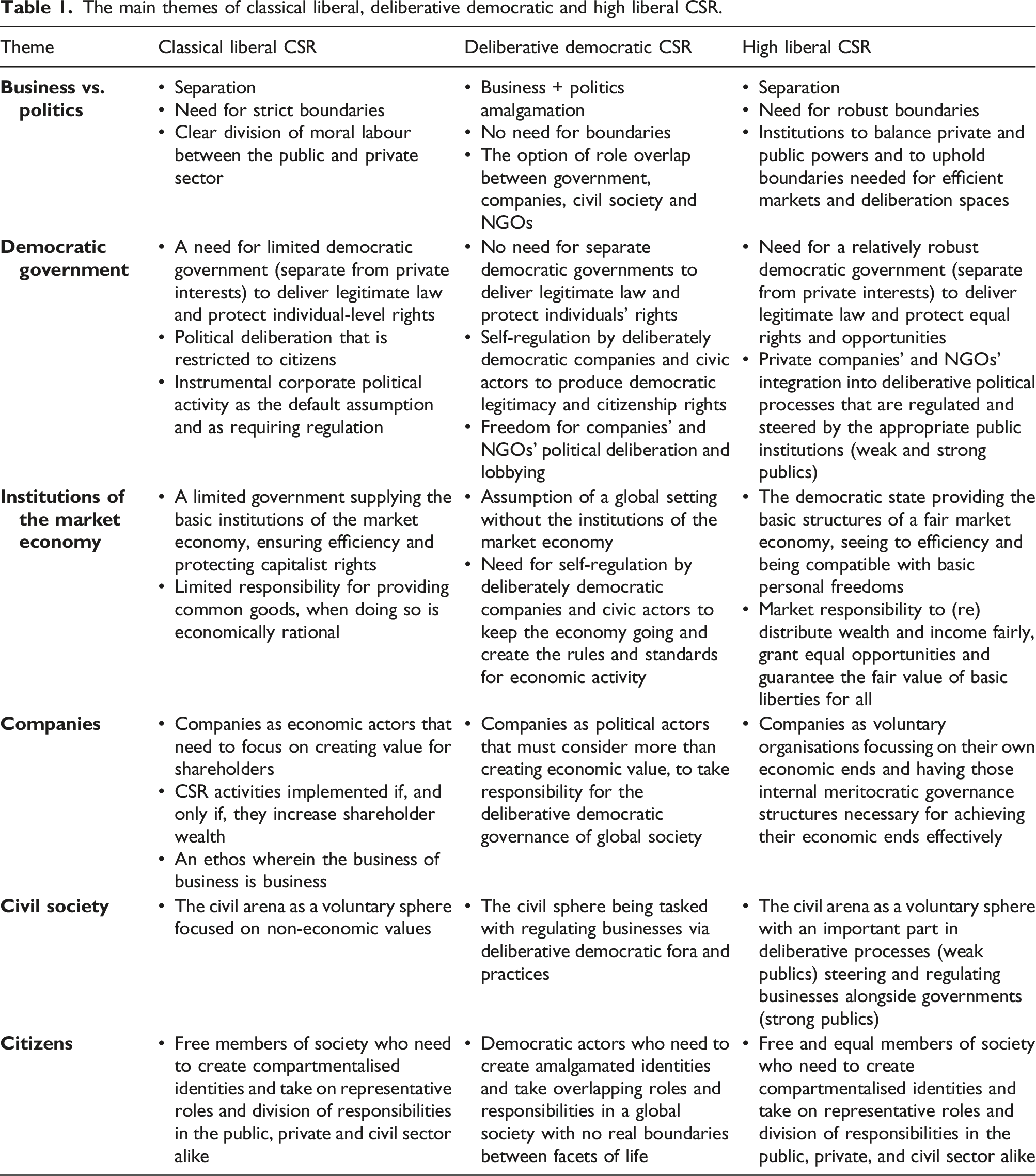
Currently, most of the prominent Big Tech companies are based in market-based Western democracies, the US specifically. By broad-brush characterisation, these societies are manifestations of liberal social ideals. At the core of liberalism is citizens’ right to personal, political and economic freedom, which points to the question of the border between the public and private sector. We focus on the concentration of power in the hands of Big Tech and how this consolidation challenges the order of a liberal-democratic society. There are several schools of thought within liberalism, leading to different views on the roles of companies, civic organisations and government in society, with the chosen variety of liberalism significantly influencing the angle from which one tackles regulating Big Tech. In a classical liberal tradition, corporations are economic actors; a strict boundary separates business from politics; and a limited government efficiently provides public goods, regulates businesses and supports individuals’ rights. Our work does not restrict itself to the classical liberal interpretation of political thinking. Taking a broad-based approach, we consider classical liberal, deliberative democratic and high liberal CSR traditions, all of which provide tools for creating a proper regulatory framework.
Where some scholars emphasise Big Tech’s positive contributions to sustainability, values of corporate social responsibility, legitimacy and the democratising power of digital technology, we apply a more nuanced and critical perspective on the political challenges posed by surveillance capitalism (Zuboff, 2015, 2019). Arguing that a few private companies hold a dominant position that poses a threat to the liberal-democratic social order and its core values (see also Belei and Bush, 2019), we delve into the following issues: How can we provide theoretical tools to support research that conceptualises these new threats and address them? What safeguards can prevent the manipulation of political deliberations and violation of individuals’ rights? What is regulation’s role in all this? Our goal here is to enrich IS discussions via the theoretical concepts and outline the problematic division of moral labour and its implications for IS research.
The paper is structured to begin by introducing interpretations of CSR: classical liberal interpretation CSR, then deliberative democratic CSR as a critical alternative and finally high liberal CSR as an integrative combination of the other two approaches. Secondly, we use these concepts to map out the forms of Big Tech’s political power and delineate how these forms of power have dismantled the boundary elements in moral labour’s division. We turn our attention next to how these three traditions are positioned to curb Big Tech’s political power in its various forms. Finally, we outline macro-level implications for future IS research, alongside concrete examples.
Three interpretations of corporate social responsibility
The liberal understanding of businesses’ roles in society is rooted in a particular political system for division of moral labour (Rawls, 2005). This system is intended to reconcile foci on freedom, equality and economic efficiency. In a liberal system, businesses operate within basic liberal-democratic structures that enable them to advance their interests effectively within the established framework, while the overall structure’s societal institutions uphold background justice and handle the realisation of liberal-democratic political values (Rawls, 2005: 265–269). A liberal-democratic society’s core structure should reflect the notion that the citizens are free and equal, and that political power is used responsibly to safeguard individuals’ fundamental liberties. In addition, legitimate political power in this setting should be democratic and transparent. Since the liberal setting is pluralistic in its values, the public structures of the society must be impartial with regard to the various aspects of human life. Liberally oriented basic structures need to consider efficiency requirements in light of scarcity of resources (Rawls, 2005).
The fundaments for liberal businesses, meanwhile, differ from those of the society. They are supposed to operate within competitive markets that respect basic liberties and efficiency-related values both. In addition, businesses are expected to be voluntary organisations for their members. By dint of their voluntariness, companies are allowed to pursue their own substantive goals, which may not find agreement in society at large. Furthermore, companies are allowed to exist as meritocratic entities that can recruit, assess, and change members in accordance with employees’ competence to further the goals of the company. In contrast, the liberal-democratic basic structure is not tasked with assessing citizens in such a fashion because its aim is to treat its members as free and equal citizens without a shared conception of the good life (Rawls, 2005).
In a liberal system, the border between business and politics is important for the functioning of the whole system. While the major varieties of liberalism erect this boundary in somewhat different places, it remains fairly robust: upholding freedom, equality and efficiency belongs to the public domain, whereas creating economic value and providing the society with material means are the primary tasks of the private economic sphere. Blurring or vanishing of the boundary could undermine core liberal-democratic values. The accompanying issues are major discussion topics in CSR studies.
Though the scope of CSR activities has been debated for more than 70 years now (Eberlein, 2019), CSR studies have recently stressed the political dimension more (see Frynas and Stephens, 2015). Scholars in the deliberative democratic CSR school see corporations as political actors that provide public goods and support citizens’ basic rights while also filling the governance gaps in global business via democratic deliberations in multi-stakeholder initiatives and fora (Crane et al., 2008; Scherer and Palazzo, 2011). In contrast, influential economic conceptions of CSR based on a classical liberal conception of society frame CSR in shareholder terms or as a form of maximising economic value (Friedman, 1962, 1970; Jensen, 2002, 2008).
The following subsections introduce three interpretations of CSR: (1) the classical liberal understanding of appropriate relations between public and private powers in a society, (2) the deliberative democratic interpretations of CSR and (3) high liberal CSR as an integrative perspective.
The classical liberal interpretation of corporate social responsibility
A prominent variant of the liberal tradition, classical liberalism enshrines economically oriented doctrine that emphasises the role of basic capitalist rights, such as freedom of contract and private property rights, as the fundamental elements for a functioning economy that can efficiently ensure societal well-being (Freeman, 2007). Friedman, Hayek and Jensen are among recent contributors to such economic interpretations of liberalism (e.g. Freeman, 2011) and related conceptualisation of CSR (Mäkinen and Kasanen, 2016).
From the classical liberal perspective, efficient markets and the democratic governance of society require a clear separation of responsibilities between society’s public and private powers. In this division, the boundary between politics and business needs strict demarcation so that government powers are distinct from private interests and, likewise, businesses are not bound up with particular political agendas of the government (Friedman, 1962, 1970). That said, the legitimate domain of business operations in the society (and the scope for other voluntary organisations) remains relatively wide.
The main aim of a classical liberal government is to democratically uphold the limited public institutions of a society that looks after individuals’ basic rights, private property rights, freedom of contract and efficient use of resources (Friedman, 1962). Jensen (2002, 2008) has argued that, in a similar vein, the legitimate public arm of the society attempts to use its (human and non-human) resources as efficiently as possible in serving the limited functions of protecting people, enforcing voluntary contracts and minimising negative externalities. Although the remit of the public sector is minimal in classical liberalism, attention is given to its democratic governance and it is granted strong powers of enforcement in the relevant area.
Liberal businesses operating within this public framework focus on economic issues (Friedman, 1962); therefore, responsible liberal companies implement CSR policies that contribute to their own value creation. In fact, CSR strategies that extend beyond value maximisation are regarded as illegitimate use of private economic resources and as disrespecting the democratic legislation that regulates the society’s public use of resources (see Friedman, 1970). It is no wonder, then, that classical liberal CSR focuses on the economic results of companies’ CSR activities and searches for the ‘business case’ for CSR (Mäkinen and Kourula, 2012).
The deliberative democratic interpretation of corporate social responsibility
Spearheaded by Scherer, Palazzo and others, deliberative democratic CSR, often referred to as political CSR (or PCSR), is a major criticism of the classical liberal system and of the economic CSR implied by such a system (Scherer and Palazzo, 2011). Deliberative democratic CSR scholars’ central aim is to challenge classical liberal CSR and replace it with Habermasian deliberative CSR. This involves a critical perspective toward perfect markets and the economic rationality of classical liberal CSR. From the standpoint of deliberative democratic CSR, the latter is old-fashioned in today’s global economy, where the fundamental boundary between business and politics is blurring or disappearing and where businesses are urgently required to take on public responsibilities and fill the global governance gaps left by governments (Eberlein, 2019).
In deliberative democratic CSR (per Scherer and Palazzo 2011), territorially bounded nation-states participating in the global economy are no longer positioned such that they can steer and regulate the activities of globally operating businesses. On the contrary, the companies themselves need to be politically active, together with civil-society actors, in providing public goods and supporting basic citizenship rights alongside businesses’ legal and ethical governance. The deliberative democratic CSR stance is that businesses can be governed democratically via deliberative fora and initiatives as well as through internalised democracy – that is, ‘by establishing democratic structures and processes in their internal corporate governance structures’ (Scherer et al., 2013: 477). In this perspective on CSR, ‘[r]esponsible firms engage in public deliberations, collective decisions, and provision of public goods or the restriction of public bads in cases where public authorities are unable or unwilling to fulfil this role’ (Scherer and Rasche, 2016: 276). Proponents of this view maintain that global companies are state-like actors who must complete major political tasks and that their logics of operation must reflect this (Scherer and Palazzo, 2011). To address the transformation involved, deliberative democratic CSR incorporates businesses’ honouring of the Habermasian conception of deliberative democracy, whereby the valid norms of action are those norms to which all affected persons could agree as participants in rational discourses (Habermas and Rehg, 1996: 107). According to Scherer and Palazzo (2007: 1109), through these rational discourses with civic actors, ‘democratic control on the public use of corporate power can be established’.
Deliberative democracy steps beyond an economic rationality and vote-centric conceptions of democracy (Kymlicka, 2002) by attending to the logics of democratic discussions (Rawls, 2005). Decision-making at this level requires the exchange of defensible reasons amidst public deliberation by free and equal citizens (Bohman, 1998). In addition, deliberative democracy requires background justice, which entails equality in political freedoms, equality before the law, economic justice and procedural fairness (Richardson, 2002). In deliberative democracy, the best argument ought to win, the participants in the discussions stand on equal footing, reasons to support political opinions are public reasons among equals, and constitutional democracy – wherein such resources as economic power are not appropriate currency for the democratic processes – constitutes the deliberations’ institutional setting (Sabadoz and Singer, 2017).
The key argument behind deliberative democratic CSR, then, is that globalisation processes have altered the societal positions of businesses and public structures so much that the classical liberal division of moral labour is no longer relevant. To address the changes, responsible businesses have to complete the new political tasks with new democratic operation logics, beyond economic rationality. Companies become ‘corporate citizens’ engaging in political issues’ deliberation freely and (ideally) on equal footing with civic actors and ‘private citizens’.
The high liberal interpretation of corporate social responsibility
High liberalism concerns itself with individual-level liberty, social justice, equality and poverty in society, though economic-efficiency issues too are on its agenda. From the perspective of this tradition, represented by philosophers such as Mill, Green, Dewey, Rawls, Dworkin and Nagel (Freeman, 2011), economic contracts need to be regulated and steered more strongly than classical liberalism would have them be. Furthermore, in high liberalism, market institutions must play a less extensive role than in that classical setting if such core liberal-democratic values as equal opportunity, economic equality and wide and equal provision of public goods are to be realised (Freeman, 2011).
Both classical and high liberalism are committed to the ideal of political power as a public impartial power for the good of all citizens of the liberal-democratic society, not a private economic good for sale in the marketplace. Whereas classical liberalism is not intended to neutralise the effects of economic inequalities on political processes, high liberalism does pursue this aim, to promote political impartiality and equality of political influence. High liberalism is focused on limiting economic inequalities, on regulating political campaign spending and promoting public financing for the campaigns, on education and promoting more equal access to public media and on well-specified limited regulation of media and of freedom of speech (Rawls, 2001: 149). The scope for public institutions’ influence is wider than that in classical liberalism because high liberalism is aimed at ensuring equal value of political liberties and equal opportunities for all, not merely targeting economic efficiency and formal freedom. These aims necessitate an expanded role of public structures in (re)distributing resources while the political role of companies is diminished.
In the integrative framework of high liberalism, strong borders between business and politics are required for the sake of economic efficiency and protection of basic capitalist rights, but these boundaries must be upheld also for reason of individuals’ privacy rights, freedom of speech, security, social justice, equality and democracy. For proponents of high liberalism, this boundary is absolutely essential for deliberative democracy, as is the background justice produced with the aid of these institutions. Making the boundary between business and politics institutionally more robust offsets the major weaknesses of both classical liberal and deliberative democratic CSR. It thus supports drawing together the policy tools of classical liberal CSR and deliberative democratic CSR. Thereby, the high liberal CSR approach can create meaningful interactions between strong and weak publics (Baynes, 2002). The weak publics here are participatory regulatory venues, among them corporations, civic associations and public authorities, while the strong publics are embodied by democratic deliberations that take place within the formal and public institutions of the society (Mäkinen and Kourula, 2012). In the high liberal setting, the former develop drafts for businesses’ regulatory frameworks while the democratically governed strong publics revise the drafts, take decisions accordingly and enforce them.
The main themes of classical liberal, deliberative democratic and high liberal CSR.
Big Tech’s challenging of boundaries
The GAFAM entities all are economically minded businesses that can readily cross the boundary between business and politics. They are politically positioned to navigate the values and logics of societies’ private and public sector simultaneously. Problematically, these companies can take decisions that directly afford or impinge on the realisation of core liberal-democratic political values, such as privacy, freedom of political association, national security and freedom of speech.
To unpack these powers, we next discuss Big Tech’s influence from the perspective of our six categories of analysis, in turn.
Business versus politics
One traditional way to deal with the boundary between business and politics is for private companies to lobby political actors. Corporate political activity (CPA) literature explores the ways in which corporations control their political environments to protect and promote their interests (Rasche, 2015). Such activities may involve lobbying, a significant role for legal strategies aimed at creating favourable interpretations of constitutional law for businesses (Winkler, 2018), and contributing to political campaigns. With these activities, companies act instrumentally to influence public policy, political authorities and institutions so as to advance particular economic interests. Lobbying has proved to be an especially viable economic strategy for major US-based companies (Hacker and Loewentheil, 2013: 35–36), and contributions to political campaigns have worked very well for them (MacLean, 2017).
The US Big Tech companies have demonstrated quite active CPA. From 1998 to 2021, the ‘Big Five’ Internet companies, GAFAM, spent more than 600 million US dollars lobbying the US Congress, with 2021 seeing them devote more than $69 million to this (Center for Responsive Politics, 2019). The US tech lobby has been active in Europe also; by money spent, the biggest lobbyists in the EU since 2012 have been Google and Facebook (LobbyFacts, 2022). The predominant aim of the tech lobby is to convince politicians and citizens alike that the privacy issues bundled with the use and exploitation of people’s data should be addressed by the companies themselves in well-organised self-regulation processes and that no major oversight concerns exist for legislators (Short, 2012). Other policy issues receiving significant attention involve taxes, intellectual property, immigration matters, online advertising, cybersecurity and antitrust rules (Popiel, 2018).
Funding for direct lobbying is only part of the problem, however. A novel twist to the separation of business and politics is the regulators’ difficulty in obtaining in-house technical capabilities. Their lack of authoritatively backed expertise has led them easily down the path to extensive reliance on information and guidance provided by the tech lobby when legislators are making oversight decisions (Belei and Bush, 2019).
Democratic government
Traditional economic regulation has a long history of dealing with concentrations of monopolistic and oligopolistic power, along with various antitrust arrangements. In the early-twentieth-century ‘Gilded Age’, strong opposition to large American corporations’ dominance of the oil, railroad, steel, telegraph and other industries, prompted antitrust laws and regulatory interventions (Chandler, 1977: 494–497). In a sense, then, there are important precedents to the contemporary regulatory challenges posed by GAFAM. However, the traditional emphasis on economic power leaves us at risk of focussing on only one part of the problematic dynamic, direct misuse of market power. Apple, Microsoft, Amazon and Google powerhouse Alphabet all are among the world’s top ten companies by market value (Duffin, 2022). These US tech giants also are the most valuable brands in the world. In 2020 global rankings, Apple led the pack in brand value, followed by Google, Microsoft, Amazon and Facebook, with these companies together accounting for brand value in excess of 800 billion dollars (per forbes.com data retrieved on 14 February 2022). In 2022, Facebook, Google, Amazon and Apple’s combined market capitalisation surpassed $9.3 trillion (per nasdaq.com figures retrieved on 8 February). It is clear that even the pandemic was no great impediment to these companies: if anything, they were among the actors whose business value benefited from the quarantines and other restrictions, with Apple recently becoming the first publicly traded American company valued at a trillion US dollars, followed later by Microsoft, Google and Amazon. Apple’s market value has already surpassed the 3 trillion mark (per the same NASDAQ figures), after the company produced $365 billion in revenue and earned $94 billion in profit for the 2021 financial year (per its Apple 10-K figures, retrieved from annreports.com on 14 February).
Thanks to the vast financial resources at their command, Big Tech can also engineer mergers and acquire start-ups with ease. One corollary of this economic success is further concentration of wealth. In 2021, 6 of the 10 largest wealth sources for billionaires lay in Big Data companies (per forbes.com data retrieved on 14 February 2022). Perhaps GAFAM’s average tax rates are even more telling. For example, ‘AT&T used to have a profit margin of 25 percent, but it paid a tax rate of 45 percent’ in the 1950s, and ‘[i]n the 2010s Apple’s margin was almost 30 percent and its tax rate was less than 26 percent’ (Philippon, 2019: 249).
The skew of resources extends well beyond the financial domain, with far-reaching impact. In 2020, Amazon was the largest employer in the tech industry, with 1,300,000-plus employees, worldwide (see Amazon 10-K, retrieved from annreports.com on 14 February 2022). This is a landscape rife with ‘paternalistic power’, by which we refer to the private companies controlling satisfaction of citizens’ most basic needs and owning schools, hospitals, homes, etc. When taken to extremes, this power is so pervasive that the whole society falls in the CSR domain. Such a social order lacks a democratically governed public sector, there is no boundary between business and politics, and companies control the provision of public goods and handle the realisation of basic citizenship rights and liberties. We find examples in the context of economically underdeveloped countries where the society’s public structures, if any exist, are bypassed (Ehrnström-Fuentes and Kröger, 2018). Industrial history reminds us of ‘company towns’. Lacking a business–politics boundary, they made the entirety of life into a private economic scheme (Djelic and Etchanchu, 2017). There is evidence that contemporary Big Tech companies are increasingly active in exercising paternalistic power and creating modern versions of company towns (Cooke, 2020).
Institutions of the market economy
In a liberal market economy, the government’s task is to furnish the background institutions for the economy, to support efficiency coupled with the protection and enforcement of basic capitalist rights (the right to private property, freedom of contract, etc.). As the specific political interpretation of liberalism dictates, the government may be responsible also for providing public goods when doing so is economically rational or is necessary from the perspective of democracy and social justice. Importantly, the efficiency of liberal markets follows from the separation of roles among the legislator, judicial system, market actors and civil society.
Crucially, GAFAM are interwoven throughout society. They are major platform businesses that connect vendors and customers or match buyers with suppliers, while their operation chains guarantee them extensive reach or an ecosystem of services. Several of these companies not only operate and control their platform or marketplace but also engage in the associated markets as participants (Rietveld et al., 2019). For example, Amazon, Google and Apple can exploit data pertaining to other companies’ performance on their platforms so as to inform the creation of their own products. It seems that Big Tech companies own, control and act within the markets they run (Khan, 2017). Obviously, a moral-labour setting wherein private companies take on several major roles in markets’ creation, regulation, and interaction seems at odds with some central assumptions behind the traditional understanding of the liberal market economy, wherein there is supposed to be separation between the creators of the rules, the rules themselves, the referee(s) and the players of the game (Freeman, 2011).
Companies
In a liberal market economy, companies have traditionally focused on economic issues, such as shareholder value or total value created for the company. For these economic actors, CSR activities are within legitimate scope if one can justify said activities as economically rationale and aligned with value creation. Furthermore, in liberal settings, companies are supposed to operate within the well-demarcated lines of democratically governed basic structural institutions and in competitive markets that respect both basic liberties and values related to efficiency.
However, Big Tech companies do not mesh with this conception of how a liberal-democratic society is arranged. In addition to being economically dominant actors in the modern information economy in its various forms, these companies are powerful forces in local and global politics, controlling citizenship rights in liberal societies (Zwitter, 2014). Not only do GAFAM operate their businesses successfully, but they do so while directly straddling the boundary between business and politics. By providing the overall technical (infra)structure of contemporary knowledge economies and societies, the political settings of these companies invite simultaneously navigating the values and logics of the society’s private and public sector. This position lets these private companies act as gatekeepers to the realisation of core liberal-democratic political values. They hence seem to be political actors stretching far beyond the traditional economic roles of private businesses in liberal-democratic societies.
Civil society
Arguably, an especially intriguing and significant form of Big Tech’s power arises from these companies’ ability to supply and control the key institutional structures of contemporary information societies and economies. It seems, then, that no discussion of Big Tech’s power would be complete without addressing societies’ privately provided and controlled institutional infrastructure (Rahman, 2018). The central democratic principle of a society forming political will via free and open discussions among equals could be undermined by such phenomena. According to Nemitz (2018), Google and Facebook exert dominance over the central components to the structures and processes of political will formation and democratic decision-making nowadays. Their online platforms now are the main sources of political information (Fletcher and Nielsen, 2017).
Furthermore, several major challenges could arise for the market economy and democracy if economic players or any given participants in deliberation fora hold strong oligopolies over knowledge’s production and dissemination. Big Tech companies already profile customers and other citizens by drawing information from their behaviour online and offline (Nemitz, 2018). This has raised ethics questions pertaining to multiple aspects of privacy and security (Martin, 2015). Furthermore, even the most conscientious and savvy customers ultimately have very limited power to manage their privacy themselves (Solove, 2013).
Thus, the business models of Big Tech companies raise major concerns in liberal-democratic societies. Zuboff (2015: 75) rightly argues that these businesses represent ‘an emergent logic of accumulation in the networked sphere, surveillance capitalism. This new form of capitalism aims to predict and modify human behaviour as a means to produce revenue and market control [emphasis in original]’. For Zuboff, surveillance capitalism flies in the face of ‘democratic norms and departs in key ways from the centuries-long evolution of market capitalism’ (2019). The situation is not made easier by the ‘surveillance state’. Diverse countries, from China and Russia to the USA and Sweden, have built elaborate digital surveillance systems brought to bear on citizens and companies alike.
Citizens
Hopes of establishing a successful tech company in a university dormitory that could address the world’s burning social issues while also making an economic fortune are often dismissed as fantasy. At the same time, such hopes are nurtured by IT curricula (covering computer science, IS, etc.) and related programmes at top US universities, which have been important in encouraging talented young people who go on to establish or join tech companies. Besides being important pools from which to acquire young technical experts, elite institutions such as Stanford and MIT have been especially integral to Big Tech production ecosystems.
The ‘Californian ideology’ (Barbrook and Cameron, 1996) and the associated quest for a life free from societal or institutional constraints, coupled with business-school-nurtured ideas of disruptive innovations, have fostered an image of Big Tech companies as progressive (Nemitz, 2018). However, many agree that Big Tech has become too big and too politically powerful (Philippon, 2019). Reports have surfaced about mishandling of user data, and platforms’ roles in accumulating massive influence on US political life via foreign sponsors’ ad campaigns and production of ‘fake news’ that undermines democratic deliberations (Rahman, 2018).
Discussion: regulation
Now that we have outlined the six types of power that Big Tech exercises, we can direct our attention to the potential regulation of these powers.
The classical liberal position on regulation
From the classical liberal CSR perspective, efficient markets and the democratic governance of society require clear division of responsibilities between public and private powers. For the classical school, the business–politics boundary needs to be strict, keeping government powers isolated from private interests and separating business interests from government political agendas.
The nature of Big Tech’s power constitutes a considerable hurdle for classical liberal CSR. Tech giants that follow an economics-rooted rationale operate at the very edges of business and politics, with business models that incorporate the central values and logics of the society’s private and public sector simultaneously. Furthermore, a government in the classical liberal mould does not aim to neutralise or rebalance the economic inequalities arising from the economic realm. This leaves Big Tech’s economic power relatively free to expand. When such expansion room exists and the company sees value in well-resourced expert lobbying, this power easily changes form, becoming political power. Because using money in politics runs counter to the classical liberal idea of democracy and undermines markets’ efficiency over time, a government in this tradition is tasked with institutionally blocking the use of this power; however, its minimalist and anti-interventionist nature limits its capacity to fulfil this responsibility.
Other core features of classical liberalism, though, speak to the aim of ameliorating Big-Tech–imposed challenges. Classical liberalism regards property rights, fair competition, companies’ creation of economic value and pricing of externalities as central aspects of a well-functioning market. It has already produced powerful regulatory tools for all companies accordingly, and Big Tech is not exempt from these. After all, a moral and economic code under which companies should concentrate on value creation provides a natural argument for curbing and regulating excessive political lobbying by companies.
Well-defined property rights are considered crucial for proper functioning of the economy and the whole society (e.g. Scotchmer, 2006). Responsible creation and management of property presupposes appropriate definition and protection of those rights. However, the ownership of personal data is an unresolved issue, and in this vacuum Big Tech seems to be treating personal data as a resource relatively easily harnessed for private profit. Solidly established priority for personal rights to said data and rules addressing their commercial utilisation should significantly aid in rendering the associated forms of surveillance capitalism efficient and fair. The commercialisation of other modern productive assets could point the way; as with intellectual property rights or trading in clean-environment-linked emissions permits, there could be a similarly standardised (and fairer) commercial contract for use of the data one generates, whether in anonymous or subject-linked form. Big Tech companies could, for example, pay royalties for each transaction in personal data, depending on the degree of anonymity/pseudonymity.
The classical liberal policy tools suited to curbing Big Tech’s power are focused on pro-competition regulation, public utility regulation, enforcement of rules on mergers and other antitrust measures (Khan, 2017). The aim behind these tools is to control the anti-competitive behaviour of large players and increase competition within the relevant industry (Belei and Bush, 2019). Big Tech is precisely such a domain. In addition, from the classical liberal perspective, the various privacy and security challenges that aggressive collection, aggregation and reselling of data and firms’ extensive targeting of individual-level behaviour usher in can be seen as negative externalities. From this standpoint, the surveillance system brings with it a major negative externality, violating citizens’ personal and political autonomy. Since the Big Tech industry itself has not addressed this social cost (Martin, 2015), taxes or command devices could be imposed to address it and other negative externalities produced by the Big Data companies (Verveer, 2019).
The deliberative democratic position on regulation
Turning next to the capacities of deliberative democratic CSR to address Big Tech’s power, we expect fewer conceptual challenges than encountered with the classical liberal stance. After all, the Big Tech companies and their ‘sovereign-like’ positions in the economy and society are a paradigmatic case of businesses’ political entanglements challenging classical liberalism’s ideally strict boundary between business and politics. Proponents of deliberative democratic CSR argue for improving both external and internal governance mechanisms and for creating participatory platforms via which to solve societal problems. These tools are of a soft and trust-based nature rather than reliant on hard legal or financial sanctions.
The status quo would seem to reflect deliberative democratic CSR at least in the US, where Big Tech has not faced strong governmental oversight historically. Free from any significant federal regulation, that landscape appears replete with exemplary cases of industry-level self-governance mechanisms, with multi-stakeholder initiatives and fora such as the Global Network Initiative (GNI) and the Data Transfer Project offering default responses to regulatory challenges. In deliberative democratic CSR, voluntary participatory governance models for self-regulation demonstrate responsibility based on companies’ deliberations with their stakeholders in laissez-faire regulatory environments (Scherer and Rasche, 2016).
However, in the US setting, the results of these models, under which companies and their stakeholders perform central government’s functions (Short, 2012), are far from promising in terms of paring back Big Tech’s power and steering Big Tech democratically. In this setting, the public credibility of soft-law governance led by the businesses is on shaky ground, and public attitudes are changing to such an extent that companies must show genuine co-operation to solve problems, accompanied by the government taking a more active role (Belei and Bush, 2019).
In addition, more philosophically oriented concerns confront the deliberative democratic CSR approach in the Big Tech setting. The very nature of deliberation is at issue, for instance. Within and for Facebook, it ‘is part of an underlying transaction that transforms that activity into advertising revenue’ (Joergensen, 2017). More generally, debating and deliberating on the Internet are often commercial acts (Goldberg, 2011), and it is somewhat hard to see online platforms provided and controlled by Big Tech as legitimate settings for truly democratic deliberations. Furthermore, deliberative democratic CSR does not seem institutionally equipped to hold back the powers of the Big Tech companies greatly. The literature on this brand of CSR does not discuss the significant redistributive mechanisms needed institutionally to level the playing field between the globally operating multinational corporations and their main stakeholders. Instead, the notion of deliberative democratic CSR is restricted to quite straightforward deliberative argumentation in the corporate context (critically, see Sabadoz and Singer, 2017).
Under the theory of deliberative democracy (Richardson, 2002), deliberation among free and equal citizens requires institutional structures that produce background justice, such as equal political freedom, equality before the law, procedural fairness and economic justice. However, deliberative democratic CSR addresses itself to precisely those business settings in which that structural backdrop is lacking or fragile by dint of governments’ unwillingness or inability to furnish it. The absence of institutionally produced background justice in the Big Tech setting means that deliberative democratic stakeholder dialogues should somehow take place without the institutional prerequisites for deliberative democracy.
It appears that this approach to CSR puts too much faith in pursuing the common good via voluntary joint deliberation with Big Tech. One cannot reasonably expect companies operating in competitive environments to subordinate their business interests. While these companies can supply expert witnesses (e.g. on analytics methods for examining large datasets) and provide data to inform the democratic processes that steer the industry (Schultz and Seele, 2020), asking Big Tech firms to neutralise their power over their stakeholders and police their own activities (along with the activities of civic actors, citizens, government representatives, etc.) via deliberative democratic fora and initiatives seems to be asking too much. Given the huge power advantages of these companies, at odds with the egalitarian fundaments of deliberative democracy, there is a real danger that these fora and initiatives may turn out to be ‘vehicles of propaganda devoted to obstructing investigation into the gaps between ideal and reality’ (Stanley, 2015).
Furthermore, the entire idea of legitimate regulations and laws emerging from deliberations among the Big Tech companies and their major stakeholders seems somewhat naïve, given that these are business actors, players that may know their stakeholders intimately and be able to control those stakeholders’ acquisition of knowledge and manipulate their decision-making (West, 2019).
The high liberal position on regulation
Classical liberalism is noteworthy in supporting policy tools and concepts that can aid in holding back some forms of Big Tech’s power, and deliberations about privacy, security and freedom of speech still may show utility if we can figure out proper institutional settings for these debates. At the same time, both approaches to CSR face major challenges when the power of Big Tech rears its head. The high liberal tradition within political theory offers the reconciling perspective required by CSR scholars aiming to address Big Tech’s powers, through additional support and resources with which to protect and bolster the fundamental boundary between business and politics. At this juncture, let us briefly sketch out how high liberal CSR can combine the useful policy tools from the other two brands of CSR. In this setting, one can offset the major weaknesses of both classical liberal and deliberative democratic CSR by making the boundary between business and politics institutionally more robust. Thus, an integrative positioning helps to address the powers of Big Tech better than either of its alternatives.
Let us start with the economic institutions and policies necessary for controlling Big Tech. From the high liberal perspective, Big Tech needs greater antitrust scrutiny. As Khan (2017) has demonstrated in the case of Amazon, current classical liberal antitrust doctrine focussing on short-term price effects is not enough to stave off Big Tech’s harm to competition. The ‘economics of platform markets create incentives for a company to pursue growth over profits’, and, furthermore, these platforms ‘control the essential infrastructure on which their rivals depend’, such that a platform-operator can ‘exploit information collected on companies using its services to undermine them as competitors’ (Khan, 2017: 564). For these reasons, short-term price effects as metrics of efficiency prove insufficient for capturing the platform economy’s market power.
What we need is ‘restoring traditional antitrust and competition principles or applying common carrier obligation and duties’, per Khan (2017: 564). The first option entails governing platform markets through competition, while the second involves seeing those markets as monopolistic or oligopolistic and regulating them accordingly. Under the first approach, laws against predatory pricing must be more robust and accompanied by strict policing of forms of vertical integration that Big Tech puts to anti-competitive ends. With the regulatory option, a non-discrimination policy prohibiting platforms from prioritising their operators’ own products and discriminating unfairly among producers (or consumers) is worth considering. Coupling such a non-discrimination mechanism with common-carrier obligations requiring platforms to guarantee other businesses open and fair access should further limit the anti-competitive power (Khan, 2017).
Secondly, a high liberal CSR system could address surveillance arising from Big Tech business models as an aggregate negative externality (Martin, 2015). The premise is that employing these models yields an all-encompassing system of surveillance, whereby profits accrue at the expense of individuals’ privacy (whether via targeted ads or from changes to individuals’ decisions and thinking) without the businesses absorbing the costs of surveillance, such as the value of the lost privacy and autonomy. A high liberal approach to the division of moral labour could use tools from welfare economics to estimate the value of individual’ liberty and autonomy in the relevant regulatory settings and apply suitable taxation systems or command devices accordingly (Verveer, 2019).
Finally, a high liberal approach tackles power imbalances and inequality of knowledge in political deliberations among companies, citizens and political decision-makers. Redistribution of wealth and knowledge serves as a regulatory tool for creating a more level playing field. Citizens’ groups could obtain a share of company lobbying budgets via lobbying fees, and political decision-makers need access to independent high-quality technology think tanks.
Regulation of IT – theoretical implications and future avenues for IS
The IS field has a rich and successful history of drawing on reference disciplines to resolve emerging issues related to governance, design and the use of digital artefacts. The discussion below takes us full circle, from the reference discipline’s concepts borrowed for this article to unpacking their significance specifically for IS (Baskerville and Myers, 2002). In this approach – or epistemic script – we engage in a type of mid-level theorising, as opposed to grand theory (Grover and Lyytinen, 2015). The purpose is to ‘domesticate’ a theory, to limit the conceptual range of a higher-level abstract theory such that it may enrich IS conversations and their scope (Grover and Lyytinen, 2015). We can now summarise possible macro-level topics for IS arising from the integrated high liberal perspective characterised above.
Tarafdar and Davison (2018) point out that it is becoming increasingly difficult to demarcate in general which theories are “IS-enabled” and where precisely the borders with other disciplines lie. They recommend categorising knowledge contributions as intra-disciplinary vs. inter-disciplinary. Intra-disciplinary theories contribute to IS, while inter-disciplinary knowledge contributions are geared for contributing to other disciplines too. In this framework, our article is a home-discipline contribution: the theories are drawn from political theory and IS, but the main theoretical contribution is directed toward the IS field. The research efforts envisaged would extend toward new audiences and afford bringing a well-developed IS perspective to discussions of regulation. Such participation by IS researchers is important since, however much the field has consigned IT’s regulation to the background, researching regulations is of immense practical relevance for industries and societies.
We are definitely not the first IS researchers to draw on philosophy when investigating contemporary issues related to ways of understanding the societal-level design implications of digital technology better and of influencing the results. Professionals need to cultivate a heightened sense of ethical responsibility for the systems they help bring into being, since they are in a better position to ‘recognize and understand the consequences of the adoption and use of information systems’ (Du Plooy, 2003). Relevant work has been carried out in the computer-ethics arena also (Stah and Eden, 2014), and scholars have recently revisited American pragmatism and notions of social justice in information systems (Levy et al., 2020).
Sample future questions for IS.
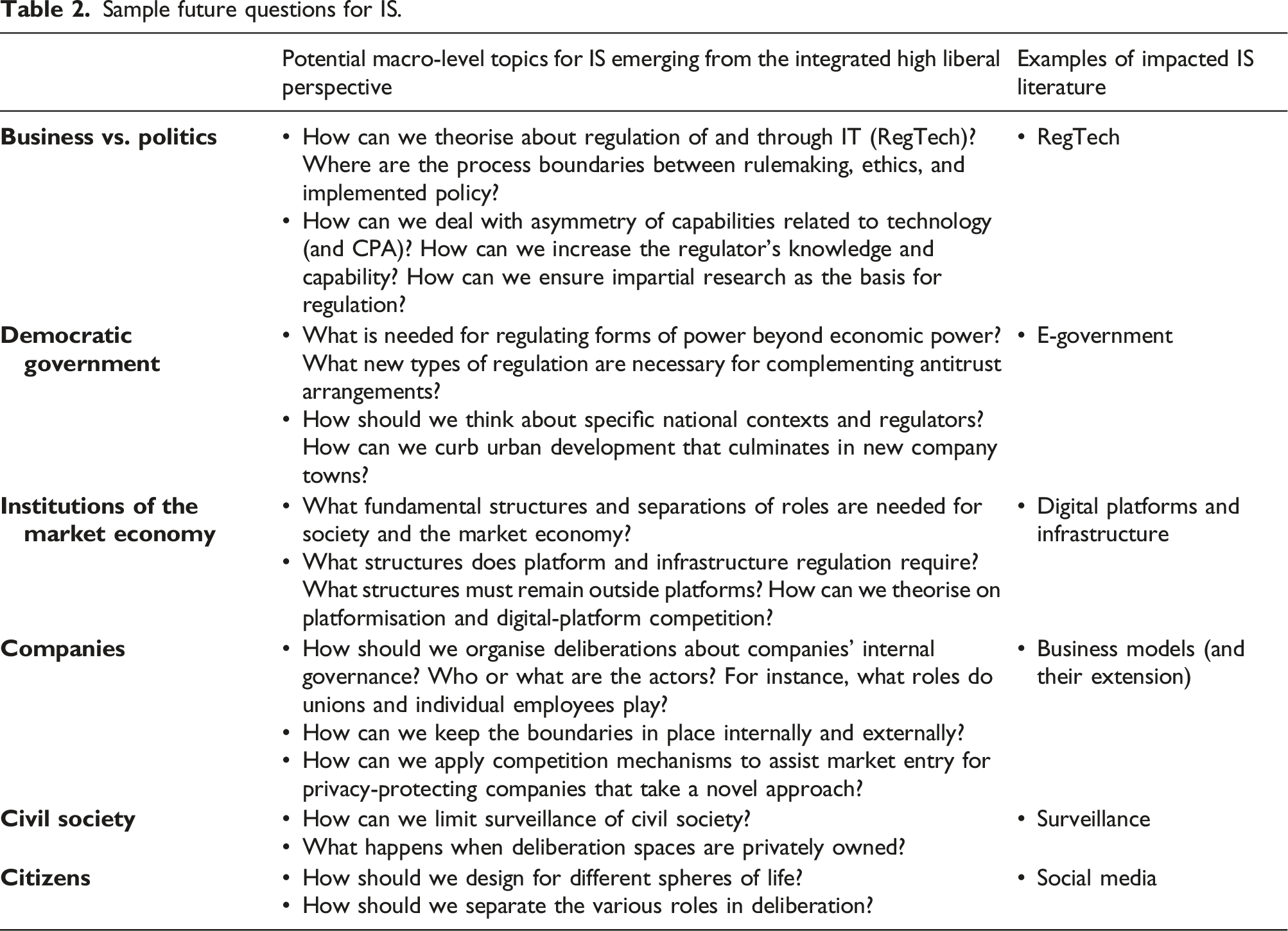
To stimulate thinking about possible avenues for future study, we will now consider six possibly fruitful streams of IS literature in some depth. Each stream corresponds to one of the examples in the rightmost column of the table.
RegTech
The first path responds directly to the need highlighted in the call for contributions to the special issue (i.e. for articles on the regulation of IT and regulating through IT). RegTech is an area of IS research concerned with the role of technology in connection with both regulation’s enactment and its implementation in organisations and society (Butler, 2017). To distinguish clearly between the two streams, one can separate those efforts focused primarily on rulemaking from those addressing the enactment of rules (often through technology). The latter would be more focused on maintaining, following and enforcing rules. The literature on regulation through IT can be divided into three subsidiary streams: (1) how a specific instance and organisation are involved in the process of a rule materialising, wherein that rule becomes embedded in a material artefact; (2) sense-making for rules, or what following a given rule locally means; and (3) elicitation, which pertains to temporal aspects of the process, especially synchronisation of technologies and practices (De Vaujany et al., 2018). Some well-known IS frameworks that have been articulated for regulating through IT are structuration theory, actor-network theory and neo-institutional analysis. Since Big Tech companies exercise dominance on both sides of the boundary between political rulemaking and enactment of rules, work on concepts such as the division of moral labour necessarily has implications for RegTech work. Another interesting topic is how one can directly guarantee regulator capability and non-bias in rulemaking through research and education institutions’ efforts. Polyphonic research, in particular, has a critical role in producing the knowledge demanded for monitoring and understanding the technical details and consequences of regulation activities. Impartial research on regulation topics – an area that has recently received attention, for example, in relation to discussions on Facebook (or Meta) and Social Science One data-sharing. Another vital target for secure research investment is responsible research and innovation (RRI) initiatives that draw together policy, academic research, and scholarship in the area of computing (Grimpe et al., 2014).
E-government
Big Tech’s new forms of power extend far beyond economic power. More research is needed into the institutions and mechanisms via which these operate. Some interesting examples of IS research are to be found in relation to IT investments dedicated to generating efficiency in various countries, which often lead to privatisation of public services as one way of implementing a reform agenda (Heeks, 1999). More generally, e-government research has investigated public-sector implementations of digital solutions that bear similarities to deployments in the private sector. Challenges have been identified in relation to development of systems architecture, database consolidation, data security, capacity-building and leadership and performance measurement (Krishnamurthy and Desouza, 2014). Initiatives for privatising public services, such as New Public Management (NPM), have a long history as a focus for IS research, as these efforts have often been accompanied by introduction of novel information systems (Cordella and Bonina, 2012). While the privatisation trend itself prompts questions about the division of moral labour at macro level, our primary concern from the standpoint of threats directly related to GAFAM is with the roles played in specific deployments by the division of moral labour and, especially, by GAFAM. One of these implementations is the e-government initiatives that have been gaining prominence in urban development and in efforts to make cities ‘smarter’ (Meijer et al., 2016). In addition to extending their campuses along such lines, Big Tech companies are providing much of the infrastructure required for these kinds of private systems for the division of moral labour.
Digital platforms and infrastructure
While there is sustained IS research interest in digital platforms, it is not immediately obvious how division of moral labour can be examined in digital-platforms research. This is because the platforms are often situated somewhere ‘above’ individual companies: hosted by consortia, by networks or in ecosystems (Nambisan et al., 2019). Also, IS research into digital platforms often focuses on platforms that produce or support software development (Asadullah et al., 2018). Probing platform competition relies on distinguishing between normal market competition between companies in any given industry and competition among platforms (Eisenmann et al., 2006). Usually, several types of competition are visible, at various layers: between platforms, across platforms and companies vs. platforms (Parker and Van Alstyne, 2018). While traditional political philosophy considers companies at the industry-competition layer, platforms generate two-sided market situations wherein platform-owners are pushed to compete for several groups of users simultaneously (Rochet and Tirole, 2006). Also, platforms and infrastructure are not synonymous; platforms are privately owned, with revenue getting captured via the platform (see De Reuver et al., 2018; Tilson et al., 2010), while infrastructure consists of the underlying structures that enable platforms and services to work, with development- or use-related activities not being controlled by any single owner/operator. Technically, platforms can be private or public (with the IS field showing sustained interest in private ones; see Hanseth and Lyytinen, 2004), but there is typically some owner nonetheless, considered a private entity for our purposes. This owner is situated near the platform core and hence has a key role to play in the governance (West, 2003). Here too, the division of moral labour has crucial implications.
Some of the conceptual issues have to do with conceptualising platforms, their mutual competition, and infrastructure, along with how these dovetail, and with conditions in which value is increasingly produced in network settings, of several sorts. Public actors already play some important roles in, for instance, the development of standards (West, 2003), with direct implications for competition. Another interesting avenue involves governance of platforms themselves: how to secure solid conditions for deliberation amid serious power asymmetries in platform governance.
Business models (and their extension)
Another area where more research is needed for understanding the changing dynamic of business vs. politics is the concept of the business model. Developing technology (especially digital technology) has always had an impact on value-generating activities in companies, logics and organising (Kavadias et al., 2016). Business models express how commercial companies conduct their business (Osterwalder et al., 2005) and generate value (Zott et al., 2011). The idea that businesses have more than financial responsibilities is not new (Dao et al., 2011). One of the most well-known perspectives in this respect is the ‘triple bottom line’ (Elkington, 1994), aligned with promoting sustainability on environmental and social axes in addition to the economic-performance axis. To harness sustainability benefits, the organisation must investigate cultivating novel resources and solutions past its boundaries, to optimise the whole supply chain (Dao et al., 2011) and address diverse impacts (Malik et al., 2016) and sustainability in its IT outsourcing arrangements (Babin and Nicholson, 2009) and environmental sustainability agenda (see Melville, 2010). While this paper deals primarily with Western countries wrestling with governance issues, earlier IS research reminds us of the importance of considering ICT developments in developing countries too (see, e.g. Heeks, 2009). Examining business models’ boundaries is integral to preventing those models from extending into a stranglehold that could (1) start to affect the industry’s competition dynamics or (2) limit citizenship rights in the society. One potential way forward is to develop stronger organisation-internal deliberation (and associated fora). Another is to investigate privacy-enhancing business models that reinforce individuals’ rights (Fukuyama and Richman, 2021).
Surveillance
Issues related to surveillance (workplace surveillance included) and information privacy are popular topics of discussion in the IS discipline (Mason, 1986; Stahl and Eden, 2014). From an ethics perspective, surveillance has been cast as a ‘pathology of accountability’ wherein IT artefacts are used not to establish accountability or allocate responsibilities but, instead, as ‘one-sided exertion of power’ (Stahl, 2006). The ethics issues multiply when the issue at hand is surveillance at societal level. The Age of Surveillance Capitalism is probably one of the best-known books from recent years to outline the dangers posed by GAFAM and surveillance capitalism. Its author, Zuboff (2019), suggests that it is important to establish external rules and recourse against Big Tech companies’ overreach and that this can be accomplished through democratic institutions, exemplified by the European Union’s General Data Protection Regulation. The underlying general problem for regulation is that technological development usually outpaces policy development. For example, today’s control mechanisms are unable to address mistakes wrought by potentially unfair, biased or incorrect algorithmic decisions (Lepri et al., 2018). This perennial problem calls for further empirical and theoretical research following on from Zuboff’s work on the interplay of Big Tech companies’ value production, increased surveillance and securing deliberation spaces not directly controlled by Big Tech.
Social media
The constellation of themes related to platforms and surveillance ties in with IS scholarship’s traditional attention to the use and design of social-media affordances and social media networks (Karahanna et al., 2018). Research into social media plays an important part in IS and in understanding changes in strategic communication related to various CSR activities and company policies (Benitez et al., 2020). Several of the concepts cohering around the division of moral labour hold promise for discussion of deliberation in this space.
Among the patterns deserving attention are how some social-media networks afford opportunities for anonymity, pseudonymity, or even ‘false profiles’ and other ways to represent citizens on the platform (Kane et al., 2014). Several social media actors strive to impose limits whereby each user has only one online identity or synthesises multiple facets of life into a single profile. These developments constitute entry points for further exploring the profile–user relationship and raise questions about the meaning of authenticity in this domain. Difficulties in enforcing ‘one person, one social-media profile’ conditions confound certain assumptions that are usually made about deliberation among (equal) citizens, in that deliberation usually requires that participants not hold large asymmetries of power.
Conclusion
We fervently hope this review of some key theoretical questions at the juncture of IS and political philosophy helps stimulate in-depth discussion that problematises the deceptively simple traditional view of companies as economic actors, not political forces that could threaten citizenship rights. Our analyses focused on the crucial role of regulation in mitigating the associated risks and on the question of division of moral labour between public and private powers in a market economy. We think that the research agenda proposed for the IS discipline, which draws on political theory, promises our field fuller understanding of the subject of regulation, its impacts and related questions, thereby paving the way to informed and nuanced new answers to emerging questions.
Footnotes
Declaration of conflicting interests
The author(s) declared no potential conflicts of interest with respect to the research, authorship, and/or publication of this article
Funding
The author(s) received no financial support for the research, authorship, and/or publication of this article.
